




Abstract
Using a systematic literature review, this review examines existing studies on the design, usability, user experience (UX), and adoption of computer applications designed for illiterate and semi-literate users. A total of 45 articles were reviewed from an initial set of 527 articles following an inclusion-exclusion criterion. As outcomes, in addition to synthesizing the present research activities, this review revealed a total of 16 design considerations or guidelines that may improve the usability, user experience, and adoption of software systems to illiterate and semi-literate people. The revealed design considerations were also investigated concerning the country context and application platform. Finally, a set of good rules categorized into five perspectives (uses of text, interaction pattern, uses of pictography, uses of audio-video, and info-architecture) were revealed to design and evaluate software systems to make them more usable to the illiterate and semi-literate users. The review also reveals future research opportunities that include: exploring the design considerations with respect to context-dependent applications; investigating the design requirements for public IT (e.g., vending machines and kiosks) systems; adopting the semiotic concept in UI design; developing a new usability evaluation framework; and exploring the effects of multi-platform and cross-country app design. Thus, the implication of this study is to discover the research gaps and provide future research directions aiming to design applications for illiterate and semi-literate users with enhanced usability and UX.
Keywords
Introduction
The global literacy rate has been noticeably rising over the last 50 years (Literacy, 2020). According to recent statistics, about 750 million adults are still illiterate, most of whom are from South Asia, West Asia, and sub-Saharan Africa, while the world literacy rate is 86.3% (Literacy Rate by Country 2020, 2020). A major percent of the literate population can further be classified as semi-literate, who are not fluent in reading or writing. Today’s revolutionary change in communication would be impossible without the ubiquitous adoption and use of modern communication technologies, that is, computers, smartphones, and Internet services. Taken together, a large portion of the population in the world who are withered, illiterate, or semi-literate cannot get proper access to computer applications, mobile phones, and Internet services. Thus, this review study focuses to the users who have a deficiency or shortage of skills in reading, writing, and accessing digital content/devices (i.e., illiteracy in reading, writing, and accessing digital contents).
Despite a large portion of the population’s lack of education, many of the current applications and their interfaces are designed and developed for educated people. These interfaces generally are text-heavy, therefore, unsuitable for illiterate, semi-literate, or digital illiterate as they cannot read, write, and interact with software systems properly. These large groups of people can not reap the benefit from ICT services if they can not access them. This will eventually lead to a digital divide, the difference between those who have access to information and communications technology and those who do not or have limited access to it. (Klecun, 2008). In recent years, studies have shown that users in developing or underdeveloped countries cannot receive electronic services, access online information, participate in mass communication, conduct business online, receive electronic health services, etc. This creates a digital divide between urban and rural areas and between literacy and illiteracy (Babar, 2017; Hsieh et al., 2008). Therefore, reducing the use of digital devices would be impossible without establishing ICT services for this large number of marginalized (illiterate and semi-literate) groups of people.
Indeed, several studies focused on the design, development, and uses of IT applications for illiterate and semi-literate people. For example, Khan et al. (2017) designed and developed a job search website for illiterate people in Pakistan; Ahmed et al. (2019) designed and developed a mobile-based job search application for illiterate people in Bangladesh, while an image-based mobile money system was designed for illiterate users in Ethiopia by Woldmariam et al. (2014). However, these studies were conducted in different geographical regions for various purposes while the system was developed for other platforms and channels (computer, web, and mobile). However, no study has been conducted to investigate to what extent the design considerations or principles used to design these applications separately are valid or varied concerning the applications’ platforms, purposes, and country. Again, understanding the types of research and the design consideration considered in the existing analysis would help researchers and practitioners to develop a usable and valuable application for illiterate and semi-literate users.
To begin, the fundamental objective of this review is to establish state-of-the-art research into designing and evaluating UIs for illiterate and semi-literate people. Secondly, to examine the UI design principles considered for the development of any software system to elevate the usability and user experience of literate and semi-literate users, and finally, to point out the research gaps and provide potential future research directions to improve the usages, usability, user experience, and adoption of such applications. To attain this objective, a systematic literature review was carried out following Kitchenham’s (2004) guidelines.
The study makes a significant contribution to the field of software design for illiterate and semi-literate individuals. Despite a rising trend in literacy levels globally, there are still a large number of illiterate adults, hence the need for design considerations in this area. The study found that prior research has been limited and mainly concentrated on Human-Computer Interaction and conducted in just a few countries, particularly in South Asia. Additionally, the study highlighted the absence of research on the broader impacts of these systems, such as their economic and social effects and their impact on education and empowerment. The study offers 16 design guidelines and a set of rules organized into five perspectives to improve the usability and user experience of software systems for illiterate and semi-literate users. These guidelines and rules can be used as tools for practitioners to evaluate the usability of software systems for these individuals and design systems that are more likely to be adopted.
The remaining section of this article is organized as follows. In section 2, the study method is presented. Section 3 discusses the results and findings of the study. The ideas for future research work are presented in section 4, while section 5 concludes the research. shoptagr:installed
Study Methodology
A literature review generally provides an analysis and evaluation report of the published articles within a specific time duration focusing on a particular area of research. Thus to attain the study objectives, a Systematic Literature Review (SLR) described by Kitchenham (2004) was followed.
Search Strategy
The primary sources of review articles were IEEE Explorer, ACM digital library, ScienceDirect, IADIS portal, DBPL citation indexed, Springer Link, and Google scholar. The selected strings or keywords and combinations and altering the order of the strings were used in the search process to identify the maximum number of articles. For example, illiterate AND user interface; semi-literate AND user interface; illiterate AND/OR semi-literate AND usability; illiterate AND/OR semi-literate AND user experience; illiterate AND/OR semi-literate AND application/system design; and illiterate AND/OR semi-literate AND human-computer interaction. In the search process, forward and backward searches were applied; the reference list and the cited articles of the identified articles were also searched. The search activities were carried out from July to December 2022 and January 2023. The search was applied to the journals, book chapters, and conferences published over the last 22 years.
Inclusion and Exclusion Criteria
The summary of the search and selection of final articles are illustrated in Figure 1. The search results identified 523 articles, and 4 additional ones were retrieved from gray literature. The articles (n = 527) were further investigated, and a limited number (n = 45) of articles were finally selected as the primary study materials. Different materials were selected, like published research articles, technical documents, and postgraduate thesis dissertations. The primary goal was to find the best-matched articles that focus on the study objective. Therefore, the preliminary screening step was carried out based on the title of the articles. Then by reading the abstract and, in a few cases, the introduction section was read to select the final set of articles. The criteria used to finalize the literature materials were as follows:
Excluded the duplicated articles found from the succeeding search results. For example, if an article was indexed in multiple scholarly databases, for example, both IEEE Explorer and ACM digital libraries, then the article was selected from the first scholarly database (say IEEE Explorer) and excluded from the succeeding search results (say from the ACM digital library).
Articles written in English.
Published from 2001 to 2022.
Excluded the earlier version of an article while the extended version is published as a separate article.
The title, abstract, and introduction of the article explicitly focus on the user interface/UX design and usability evaluation of applications developed for literate and semi-literate people or digital illiteracy.

PRISMA flow diagram for the selection of articles.
Data Extraction and Analysis
A data collection protocol was used to extract the relevant information from the included studies. This review considered a few important considerations to remove the specific kinds of data to obtain the review goals that subsume: the year of publication, research objectives, focus area, study conflicts, and the contribution in terms of the UI design considerations or principles. The data were extracted by reading mainly the abstract, introduction, methodology, results, and conclusion of the selected articles. The extracted data from the selected papers are organized in a tabular format and synthesized to provide a state-of-the-art view of the research conducted, focusing on designing, developing, and evaluating software systems with enhanced usability and UX for literate and semi-literate users.
Analysis and Results
The extracted data were synthesized and analyzed in terms of year of publication, topical relationship, the context of the study, application platform, research objectives/scope, design considerations, and the good rules for designing usable UI design.
Publication Profile
The number of articles published every 5 years since 2001 is presented in Figure 2. The review showed that around 3 to 14 articles were published every 5 years focusing on the design and development of software systems for literate and semi-literate people. No article was published in 2003, 2005, 2010, 2013, and 2018, while the maximum number (n = 5) of the article was published in 2009. Among the selected articles, 17 were published in different Journals; one was published as a technical report, and a maximum number (n = 27) of articles was published in conference proceedings. Among the conference proceedings, a maximum (n = 10) number of articles were published by the ACM, followed by the IEEE (n = 8) and Springer (n = 6). Other publishers like Cite Seer, IADIS, and ACTA press published the remaining conference proceedings. Again, 9 out of 24 (38%) articles were published in the HCI-related conference proceedings, and the remaining articles were published in the conference proceedings focusing on computer and information technologies. Again, 7 out of 17 (41%) journal articles were published in HCI-focused journals, including ACM Transactions on Computer-Human Interaction, Interacting with Computers, Behavior and Information Technology, and Foundations and Trends in Human-Computer Interaction. In contrast, the other journals were focused on information technology in general. This result indicates that human-computer interaction is the most prominent subject for pursuing research on designing and developing software systems for illiterate and semi-literate people.

Number of articles published every 5 years since 2000.
Topical association
In the form of a word cloud, Figure 4 depicts the phrases that emerged as keywords in the examined publications. The size of a word in a word cloud represents its frequency of occurrence in the context. Therefore, the more important a word in the word cloud is, the more it occurs. The most commonly used keywords in the reviewed articles are illiterate, farmers, people, user, usability, rural, and interface. It can be perceived that most of the studies have been conducted in the context of rural populations. In contrast, less focus can be found in the context of urban illiterate and semi-literate users. Some small terms in the word cloud subsume mental, health, framework, speech, banking, etc. Therefore, it can be said that the mental health, sociological and psychological factors were not heavily focused on in the reviewed studies (Figures 3 and 4).
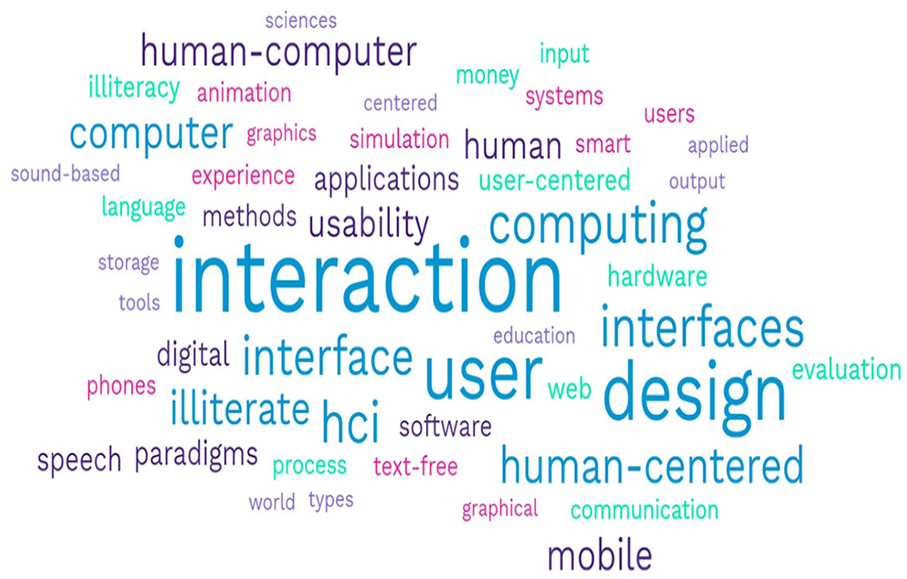
Generated word cloud from article keywords.

Generated word cloud from the article title.
The most prevalent words in the titles of chosen papers, as delineated in Figure 4, are design, interface, illiteracy, centered, etc. Other minor phrases like mobile, digital, divide, and technology offer an understanding of the work that has gone into developing mobile apps or digital techniques to reduce the digital divide. The words, such as voice, speech, audio, input, and IoT, can also be seen in the word cloud, which portrays that some studies also focused on the audio based inputs, speech recognition techniques, and the inclusion of IoT devices for designing interactive UIs for illiterate and semi-literate users.
Country Context of Existing Studies
The country context of the published articles was analyzed by considering the studies that were explicitly carried out in a specific country and discussed in the article. For example, Alduhailan and Alshamari (2016) conducted a user study in Saudi Arabia to measure the usability performance of a text-free e-government web system with illiterate and semi-literate people. The review analysis found that more than two-thirds (66.67%) of total studies were conducted in developing countries, only one study was focused on a developed country (The Netherlands; Cremers et al., 2008), and the remaining 7 (17%) articles were not focused to any specific country context instead focused to the illiterate and semi-literate people in general. The maximum number of studies (n = 12) were conducted in India, followed by Pakistan (n = 5), Ethiopia (n = 2), Bangladesh (n = 2), and Saudi Arabia (n = 2). Figure 5 represents the number of studies conducted in the different geographical regions worldwide. These results showed that a maximum (54%) of studies were conducted in Southern Asia, followed by Africa (10%). According to the recent UNESCO Institute for Statistics, about half of the global illiterate people (49%) live in Southern Asia, and 27% of all illiterate people live in sub-Saharan Africa. Again, 10%, 9%, and 4% of the global illiterate population live in Eastern and South-Eastern Asia, Northern Africa and Western Asia, Latin America, and the Caribbean, respectively. The review results thus indicated that such kinds of research studies are primarily conducted in a country where the illiteracy rate is high and are still striving toward adopting IT systems.

Number of studies conducted in different geographical region.
Platform Focused in Existing Studies
Different platforms or types of applications, including desktop/computer systems, websites/web systems, mobile software systems, and the like, have been considered for pursuing research on UI design for illiterate and semi-literate people. For example, Khan et al. (2017) designed and developed a job search website for illiterate people, while Ahmed et al. (2019) developed a job search mobile application for illiterate and semi-literate people. The review analysis found that around one-third (33%) of total studies were conducted focusing on mobile applications, 11 (28%) included articles were focused on web systems, and 6 (15%) articles were focused on desktop-based computer systems. Four other articles were focused on the different kinds of UIs, including ATM interfaces (n = 2), interactive voice response (IVR) systems (n = 1), and kiosk systems (n = 1). Again, the remaining three articles were focused on multiple platforms (both the web and the mobile systems; Thies, 2015). Figure 6 represents the number of articles focused on different application platforms. These results indicate that most articles focused on mobile interfaces, web systems, and desktop applications. A minimal number of studies have been conducted that focus on different kinds of platforms as well as multi-platform applications. These results are not surprising and very similar to the state of the computer, mobile, and internet users around the globe who are illiterate or semi-literate.

The number of articles with respect to the applications’ platforms.
UI Design Considerations
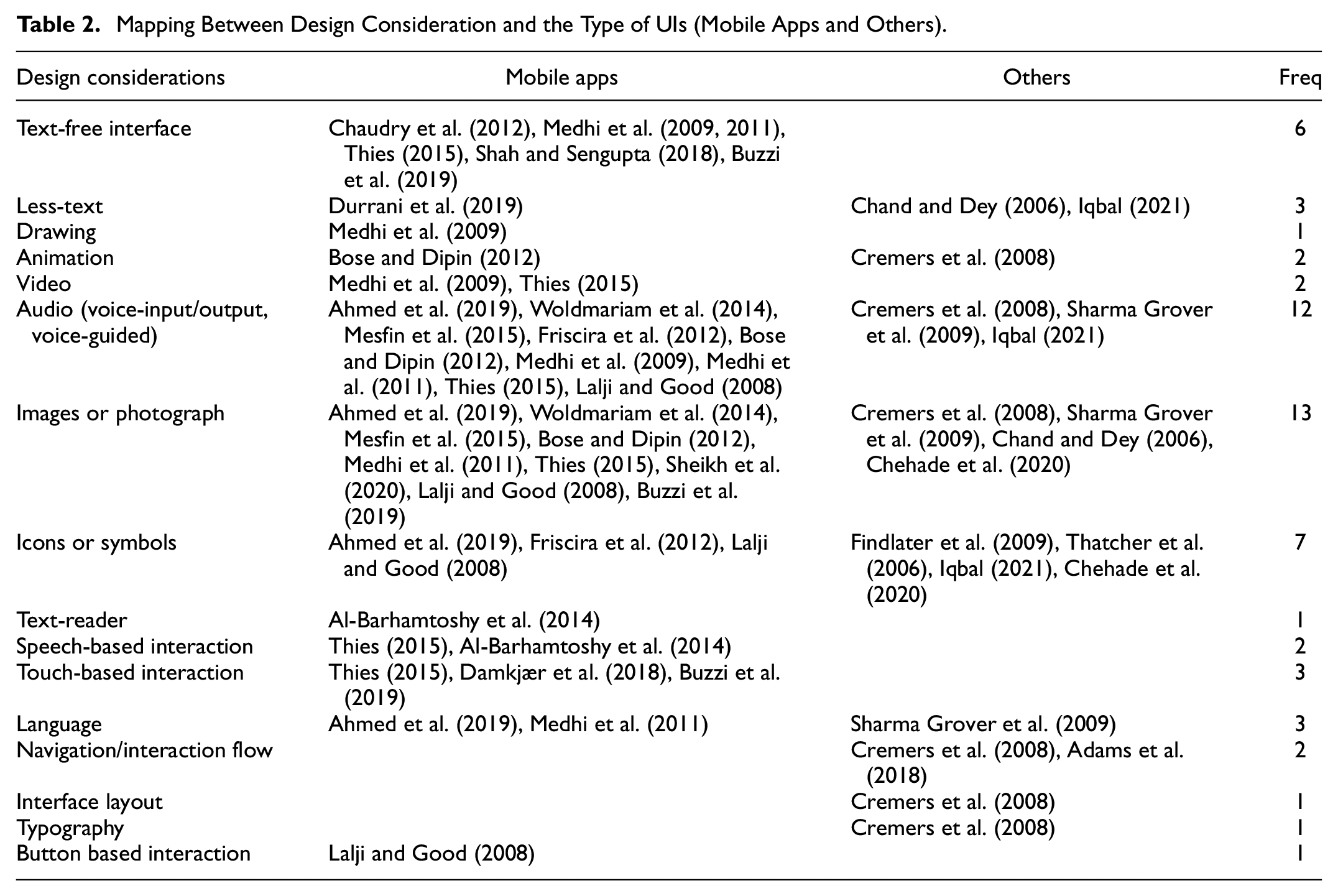
A total of 16 design considerations were found in this review study (see Tables 1 and 2). A Summary of the mapping between design consideration and the type of UIs is shown in Figure 7. Audio, images or photographs, icons or symbols, and text-free interface were the most cited design considerations. For example, 20 out of 45 (44%) articles focused on using audio in terms of voice input, voice output, voice information, and voice-guided to make the interface intuitive for illiterate and semi-literate users. Eight articles explicitly suggested not using any text in UIs since reading text is difficult for illiterate and semi-literate people. Four reports suggested using less text, while a few pieces (n = 4) explicitly suggested using the local language as UI text (if any) and for voice input, voice guide, and speech-based interaction. The audio, images or photographs, and icons or symbols were found in each system, including desktop-based software systems, web systems, mobile applications, ATM interfaces, interactive voice response systems, and kiosk systems. In contrast, touch-based and button-based interaction (instead of menu-based navigation/interaction) was found only for designing mobile interfaces. The remaining design considerations were found in multiple platforms but not on all (see Tables 1 and 2). The results thus showed that around one-fifth of the total design considerations (19% articles) was platform-independent, while most were platform dependent.

Summary of the mapping between design consideration and the type of UIs.
Mapping Between Design Consideration and the Type of UIs (Desktop and Web System).

Mapping Between Design Consideration and the Type of UIs (Mobile Apps and Others).
Tables 3 and 4 delineate the mapping between the design considerations with country context. The results showed that 12 out of 16 (75%) design considerations were explored in South Asia, and 8 were revealed without stating the country’s context. Only one to four design consideration(s) was/were observed in the studies conducted in the Middle East, South America, and Africa. Only one study (Cremers et al., 2008) was shown on ATM interface in Europe and suggested six design considerations. Among these design considerations, three (navigation/interaction plan, interface layout, and typography) were unique and were not highlighted in the studies conducted in South Asia. One of the reasons was how they define illiteracy; like in Cremers et al. (2008), literacy is defined in digital knowledge, not in terms of lack of primary education. Therefore, digital illiterate, age, and UI design were the key facts for users in Cremers et al. (2008). The results thus indicated that design considerations depend not only on the type of application but also on the country context.
Mapping Between Design Consideration and the Country Context (South East, Middle East, and South America).

Mapping Between Design Consideration and the Country Context (Africa, Europe, and Not Specific).

Good Rules for Usable UI Design
Again, from the literature survey, a set of reasonable rules were revealed, which were grouped into five categories through an affinity diagram. The affinity diagram is presented in Figure 8.

Affinity diagram of clustering good rules.
Future Research Implications
The review study showed several open issues that required further investigation. Future research may conduct on the following topics for designing and developing software systems to make them accessible, usable, and for adoption by illiterate and semi-literate people.
Exploring the Design Considerations for Context-Dependent Applications
The uses of design considerations and the design considerations’ performance may vary for the context-dependent applications developed for illiterate and semi-literate people. The review showed that most of the design considerations are platform-dependent, like text-free interface, voice-guide, and voice-based input/output are mainly used for mobile application development (Ahmed et al., 2019; Medhi et al., 2009, 2011; Woldmariam et al., 2014) while the typography used to design the ATM interface (Cremers et al., 2008). Again, few to none of the prior studies have focused on exploring the entire set of revealed design considerations (as stated in Table 2) to design any software system for a specific (country or platform) context. Thus, future research could be conducted to explore: (a) which of the design considerations impact most to design an enhanced usable application for a specific platform in a specific country context for illiterate and semi-literate people; (b) assess the applicability of the revealed design considerations in designing system UIs for a specific platform in a specific country-context; and (c) devise a set of design/evaluation guidelines designing system UIs for a specific platform in a specific country-context like proposing a set of design and evaluation guidelines for developing mobile learning applications for illiterate and semi-literate people in the context of Bangladesh.
Understanding the Design Requirements for Public IT Systems
Though several earlier studies have been conducted focusing on the web system, mobile applications, and desktop systems, few studies focused on public IT systems like public kiosks, ticket vending machines, snack vending machines, etc., to explore and evaluate the design requirements of such systems. These general uses of IT systems are also critical to be used by the illiterate and semi-literate people; thus, further studies need to conduct in this direction. Similarly, future research could focus on revealing the design considerations and reasonable rules to design user interfaces of wearable technologies for education, money transfer, purchasing products and tickets from vending machines, etc. Thus, the potential research questions for future investigations could be: how is the present design of the public system feasible for illiterate and semi-literate people? Which design considerations are mainly required for such a system for illiterate and semi-literate people? How the revealed design considerations and good rules, as discussed n section III, are applicable to design the public systems to make them more usable to illiterate and semi-literate people and the like.
Adopting Semiotic Concept in UI Design
This review found that images or photographs, as well as icons or symbols, play a key role in designing applications for illiterate and semi-literate people. These icons, images, symbols, etc., could be considered the essential element of UIs and may call as “signs” that mediate the interactions between the system and the users and are treated as the communication artifact. Since semiotic theories deal with the creation and interpretation of sign system to make a sign (interface element) like navigation link, icon, image, thumbnail, and symbols intuitive to end-user (Islam & Bouwman, 2015, 2016). The semiotic theory and the concept of semiotic engineering are also widely used to design intuitive interfaces for end-users (De Souza, 2005; Islam, 2013). In future research, which icons, images, thumbnails, and command buttons are more intuitive for the illiterate and semi-literate people could be explored through a semiotic perspective. Again, future work may focus on exploring the excellent design rules for designing the intuitive interface elements (signs) for illiterate and semi-literate people through a semiotic perspective.
Developing a New Usability Evaluation Framework
The review findings highlighted that the design considerations and evaluation techniques/approaches could be proposed for evaluating the system developed for illiterate and semi-literate users. Existing literature showed that traditional usability evaluation methods were adopted only in a limited number of articles to assess the usability of a system developed for illiterate and semi-literate people. Since several usability evaluation methods exist, each method has its own merit and demerits depending on the evaluation’s context (application type, users, and platform). Thus, it is not yet explored or investigated how much the traditional approach is performing to evaluate a system developed for illiterate/ semi-literate people. Potential future research may focus on establishing a new/extended usability evaluation framework considering the design considerations revealed in this review study and the limitations of illiterate and semi-literate people. Again, the proposed evaluation framework could be compared with the traditional approaches for evaluating a system developed for illiterate and semi-literate people.
Exploring the Effects of Multi-Platform and Cross Country App Design
All articles except one (Thies, 2015) were conducted focusing on a single platform. Similarly, no single article was found that was shown cross-country (i.e., the same study conducted in multiple developing countries). Thus, potential future research could be conducted focusing on exploring the effect of the revealed design considerations and good rules from a multi-platform and cross-country (culture) perspective to improve the usability and UX of any application developed for illiterate ad semi-literate people. Triangulating regions, as well as platforms to reveal and explore the design dynamics to develop more valuable applications for illiterate and semi-literate people, are required to be studied empirically in the future.
Developing Usable Applications to Reduce Digital Divide
ATM, Kiosk should be focused on, as these devices are placed in public places for public use. These systems are also essential to use by the semi-literate and illiterate users. For digitalizing the public services, these kinds of devices should be accessible to all kinds of users including illiterate and semi-literate users. But a very few studies focused to the design and development of such systems. Thus, future research may focus firstly to design and develop such systems more incorporating the revealed design considerations, and then explore the effect of developing such system for illiterate and semi-literate people in terms of reducing unemployment, education and to reduce the digital divide.
Discussion
Main Findings
The review study found that only a limited number of articles have been published since 2000 that focused on the design and evaluation of software systems developed for illiterate and semi-literate people around the globe. Most of the studies were conducted in developing countries, specifically South Asia. Secondly, the review found that most of the published articles were focused on HCI and thus missed exploring other emerging issues like social and economic impact, ICT adoption, and the improvement of the educational and other empowerment skills of illiterate and semi-literate people. Thirdly, other than South Asian countries, a very limited and, in some cases, no single study was conducted in many other developing countries like Brazil, Nigeria, and the like. Fourthly, the review found that much research focuses on the web, mobile, and computer systems. Still, little concentration has been paid to vending machine interface systems, kiosk systems, and ATM interfaces through illiterate uses; interaction with such systems is more prominent. Fifthly, 16 design considerations or guidelines were revealed from the existing literature that facilitates the usability, user experience, and adoption of software systems for illiterate and semi-literate people. Similarly, the review explored the uses of revealed design consideration concerning the country context and application platform. Finally, a set of reasonable rules categorized into five perspectives were told to design and evaluate the system to make them more usable to illiterate and semi-literate users.
Theoretical and Practical Contributions
Despite a significant rise in literacy levels globally over the past few centuries, there are still around 750 million illiterate adults worldwide (Literacy, 2020). This study provides a thorough overview of the existing research on software systems designed for illiterate and semi-literate users, highlighting the scarcity of studies in this field and the lack of research on crucial topics such as the social and economic impact, ICT adoption, and educational improvement.
The study offers 16 design considerations and a set of rules organized into five perspectives to improve the design and evaluation of software systems for illiterate and semi-literate users. This practical contribution serves as a guide for HCI/UI practitioners in assessing the usability of applications for these users and designing applications that are easier to use and adopt. The study provides insights into the most critical design considerations for different countries and types of applications, helping practitioners understand and consider the most important design considerations for a specific context concerning the country and type of application.
The study’s outcome will assist HCI/UI practitioners to be aware of the limitations of illiterate and semi-literate people and in designing and developing applications for these users, which in turn will help them to use and adopt the software systems. The design considerations and good rules can also be used as heuristics or checklists to inspect or evaluate the usability of any applications developed for illiterate and semi-literate users.
Review Limitations and Concluding Remarks
This review study has a few limitations as well. Firstly, the primary literature set is selected by following the selected search criteria described in the methodology section. Some other relevant papers might also have been missed by the criteria used for selecting the relevant papers for this review. There might be a possibility of reviewing more literature using other kinds of searching methodology. Moreover, the authors were unable to consider a few articles due to the limited accessibility (for the author and also for the author’s institution) to this literature. Several relevant data sources, including the International Journal of Signs and Semiotic Systems, SCIS series of LNCS-Springer, etc., were excluded because neither the reviewers nor their university subscribed to them. The main limitation of this study was the inaccuracy in data extraction and misclassification during preparation. With a second check, the reviewers attempted to mitigate these threats of data extraction and misclassification.
In a nutshell, though world literacy has reduced noticeably since 2000, many people are illiterate. On the other hand, technology and mobile devices were not that much during the early 2000, and the present world has become more dependent on IT. Thus, illiterate people are also required to use and adopt software systems. Therefore, further potential research is needed focusing on the software system’s design, development, and evaluation to enhance the usability, UX, and adoption of IT systems for illiterate and semi-literate people.
Footnotes
Declaration of Conflicting Interests
The author(s) declared no potential conflicts of interest with respect to the research, authorship, and/or publication of this article.
Funding
The author(s) received no financial support for the research, authorship, and/or publication of this article.
