




Abstract
This study explores the effectiveness of a Blended Production-Oriented Approach (BPOA) in improving Self-Directed Learning (SDL) skills among English as a Foreign Language (EFL) learners. A quasi-experimental design with pre- and post-tests revealed significant enhancements in key SDL skills, including planning, strategy use, resource utilization, motivation, evaluation, and monitoring. Semi-structured interviews confirmed these findings, highlighting participants’ positive perceptions and tangible growth in autonomous learning capabilities. By integrating the BPOA into EFL education, this study not only provides empirical evidence supporting innovative instructional strategies but also offers practical insights for educators seeking to cultivate lifelong learning skills. The findings underscore the adaptability of BPOA to diverse educational contexts, making it a valuable framework for fostering learner autonomy in both language learning and broader academic disciplines.
Plain Language Summary
Why was the study done? Many students learning English as a foreign language (EFL) in China struggle with learning independently when they start college. Being able to direct their learning is very important for success in both school and work. However, current teaching methods often don’t help students develop these self-directed learning (SDL) skills. The study aimed to find out if a new teaching method called the Blended Production-Oriented Approach (BPOA)—which mixes online and face-to-face learning—could help improve these important skills. What did the researchers do? The researchers worked with 60 Chinese university students studying English interpreting. Half of the students learned with the new BPOA method, and the other half learned through traditional teaching. They used tests and interviews to measure how students’ SDL skills—like planning, motivation, using resources, and monitoring progress—changed over the study. What did the researchers find? The study showed that students who learned through the BPOA method significantly improved their self-directed learning skills compared to those who learned through traditional methods. Skills like finding and using resources, making learning plans, staying motivated, monitoring progress, and evaluating their learning got much better. Interviews with students also showed they felt more confident and capable of managing their own learning after participating in the BPOA program. What do the findings mean? This study suggests that the Blended Production-Oriented Approach can help English learners become better at managing their own learning, an essential skill for lifelong success. It highlights the value of combining online and classroom activities in a structured way and focusing learning around real-world communication tasks. The approach could be adapted not only for English learning but also for teaching other subjects where independent learning is important. Future work will explore.
Keywords
Introduction
The Sustainable Development Goals by UNESCO emphasize the importance of language education in equipping students with skills for global competitiveness (UNESCO, 2015). In China, EFL education faces challenges, particularly in fostering self-directed learning (SDL) skills, essential for autonomous language acquisition and lifelong learning. The transition from highly structured high school environments to more autonomous college settings often leaves students struggling to adapt, highlighting the need for strategies to enhance SDL in EFL learners (Yang, 2006). This struggle limits progress in language acquisition, which depends heavily on the amount of input received (Zhao, 2012). Consequently, the lack of SDL skills is a major challenge in Chinese EFL education.
SDL allows learners to assess their learning needs, set goals, choose resources, apply strategies, and evaluate outcomes (Knowles, 1975). It is considered a crucial 21st-century skill, especially for college students preparing to enter the workforce. Reports by the China Education Innovation Institute and WISE emphasize SDL as essential for navigating today’s fast-evolving world. For EFL learners, SDL fosters autonomy and responsibility, empowering them to set goals, manage time, and tailor learning to their interests (Du, 2013; Navarro & Thornton, 2011). It also cultivates independence, adaptability, and critical thinking, fostering a lifelong learning mindset (García Botero et al., 2019). Moreover, SDL enables learners to navigate challenges and apply language skills effectively (Cheng & Lee, 2018; Cho et al., 2020).
However, current EFL teaching practices in Chinese tertiary education fall short of developing SDL skills, especially when integrating technology into language learning. To address this gap, this study explores an innovative blended learning module designed to enhance EFL learners’ SDL skills. Blended learning, which combines online and offline components, has gained popularity since the COVID-19 pandemic and offers opportunities for autonomous learning (Ma et al., 2020; Ying, 2019). While it promotes SDL, research on its effectiveness in enhancing SDL skills in EFL learners is limited. Moreover, instructors lack a clear framework for implementing blended learning effectively. This study addressed these challenges by integrating the Production-oriented Approach (POA) into blended learning, creating the Blended Production-oriented Approach (BPOA). The purpose of the study was to investigate the effectiveness of the BPOA in enhancing EFL learners’ SDL skills. The research questions are as follows:
(1) What is the effectiveness of the Blended Production-oriented Approach (BPOA) in enhancing EFL learners’ self-directed learning skills?
(2) What are EFL participants’ perceptions of the Blended Production-oriented Approach (BPOA)?
This study initiates by examining existing literature and establishing the theoretical framework. Subsequently, it introduces the research methodology and the intervention involving the BPOA module. The findings pertaining to the efficacy of the module in developing EFL learners’ SDL skills, as well as the perceptions and suggestions for improvement from the learners, are presented and deliberated upon. The article concludes with a recapitulation of the conclusions and provides recommendations for future research.
Literature Review
Blended Learning for EFL Education
The concept of Blended Learning (BL) has garnered considerable attention from educators and researchers involved in teaching English as a foreign language (EFL). Numerous studies have delved into the utilization and efficacy of BL within the EFL context, pinpointing advantages for language learners (Albiladi & Alshareef, 2019; Banditvilai, 2016; Tomlinson & Whittaker, 2013). BL exhibits versatility, finding application across a spectrum of EFL courses encompassing speaking, reading, listening, writing, translating, and interpreting (Aji, 2017; Albiladi & Alshareef, 2019; Ariyanto et al., 2020; Banditvilai, 2016; Galán-Mañas & Albir, 2010; Ginaya et al., 2018; Kolomieets & Guryeyeva, 2018; Peng & Fu, 2021; Tomlinson & Whittaker, 2013; Yudhana, 2021). Moreover, (Peng & Fu, 2021) drawing insights from existing literature, underscored BL’s potential to bolster EFL students’ language proficiency, elevate motivation and engagement levels, and enhance the overall learning environment. To be more specific, BL was found to be effective in triggering EFL learners’ motivation in English learning. For instance, Peng and Fu (2021) conducted experimental research with 60 EFL students in an Asian university and found that the use of BL can not only improve language skills but more significantly, foster learning autonomy and motivation in EFL learners. Banditvilai (2016) conducted mixed-method research with 960 students from six Chinese universities to assess the impact of blended learning (BL) in College English. The results revealed improvements in language skills, learning autonomy, perseverance, confidence, and satisfaction, concluding that learners’ interest in English and motivation to understand English culture were crucial for positive outcomes in a blended learning environment. What is worth mentioning is that BL was found to have the potential to support EFL learners’ self-directed learning (SDL) with its effects in promoting learner motivation and opportunities for SDL (Rui & Jin, 2021; Ma et al., 2020). Yet to date, little research has specifically explored BL’s effects on SDL in EFL learners. The few research identified in the relative fields only touched on the superficial aspect of the BL’s effect on SDL without a thorough or systematic examination. For example, Jin and Li (2021) claim that the POA strategies implemented in the BL mode might have a positive impact on EFL learners’ SDL skills, but there was no data or any research foundation in the article that could demonstrate its effect, nor did it give a specific module on how to carry out POA in the BL mode. The other research by Zhai (2021) analyzed the blended learning-based POA teaching in English writing courses but didn’t investigate its effect on SDL. Though there has been more and more research developing the POA in the BL mode, up to date, very little research has focused on developing a module that particularly targets EFL learners’ SDL skills in the BL-based POA pedagogy. This study then fills this gap by developing an SDL-targeted BL module investigating its effectiveness on SDL in its six sub-skills of motivation, planning, monitoring, strategy use, resource use, and evaluation.
Another finding from the literature review is that instructors in EFL find it challenging to use BL. One important reason is that there’s no flowchart to follow and no pedagogical guidance to adhere to, leading to an unsatisfactory outcome of BL (Albiladi & Alshareef, 2019; Graham et al., 2005; Kaur, 2013; Namyssova et al., 2019; Rasheed et al., 2020). This study fills this gap by integrating the Production-oriented Approach in BL, developing a step-by-step flowchart for EFL instructors to use as a pedagogical direction for EFL instruction.
Production-Oriented Approach in EFL
The Production-oriented Approach (POA) is a pedagogical method designed and developed by a Chinese EFL scholar Wen Qiufang and her research team. As depicted in Figure 1, the POA theoretical system contains three parts: teaching principles, teaching hypothesis, and teaching procedures. Based on the teaching principles of learning-centered, learning-using integrated, cultural exchange, and key competencies development, the POA is developed upon four teaching hypotheses: output-driven, input-enable, selective learning, and assessment-being learning. Following these principles and hypotheses, three phases were designed as the teaching procedure: motivating-enabling-assessing (Xuan et al., 2023). In a word, learners in POA are driven by output, when the teacher tells them what to achieve after the class as in the motivating phase, in the enabling phase, learners are input-enabled with necessary input, following which production is achieved for the assessing phase. This method oversets the teaching procedure of input-focused modules in traditional EFL learning, centering on the learning process, emphasizing the concept of learning to use and developing learners’ key competencies such as autonomous learning, critical thinking, and cooperative learning (Xing & Puteh, 2023).
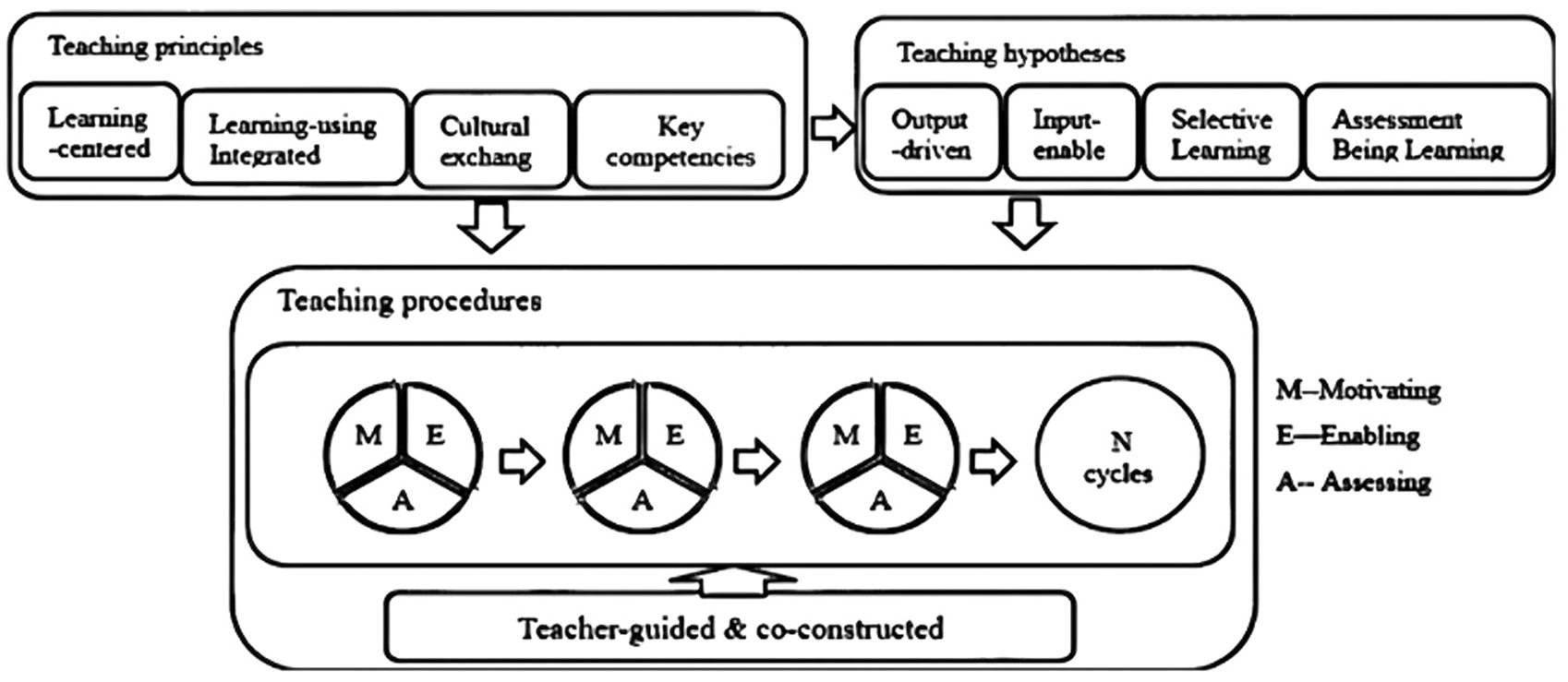
The POA theoretical system (Wen, 2018).
In the overall assessment of the literature on POA, it was proved as an effective method in developing EFL learners’ language details as well as developing key competencies such as critical thinking and autonomous learning (X. Wang, 2022; Wen, 2018; Xing & Puteh, 2023; Xuan et al., 2023), yet certain limitations and shortcomings of traditional POA emerge. Primarily, current research on POA tends to remain confined to the stage of imitation and reference, echoing the findings of Wen Qiufang’s study. To date, the exploration of POA is relatively superficial and predominantly focused on practical applications, lacking in-depth, long-term, and high-level investigation.
Furthermore, traditional POA primarily concentrates on classroom teaching, neglecting opportunities for students’ post-class learning. Various review articles have emphasized the need for additional research to advance POA by integrating it with the internet or digital learning patterns (Nan, 2023; Ruoxi, 2022; Xing & Puteh, 2023). This study addresses this gap by developing POA through blended learning, creating the Blended POA module. Blended learning proves instrumental in filling this void by offering diverse platforms and opportunities for implementing POA in both face-to-face and online learning settings. The online learning component compensates for the traditional POA’s shortcomings, particularly its oversight of students’ learning beyond the classroom. Therefore, BL makes full play of POA, while POA can serve as a perfect match for BL as a pedagogical guide in EFL instruction.
Integration of Blended Learning and Self-Directed Learning
Research on Self-directed Learning (SDL) has a long history, which dates back to 1975, when Knowles defined SDL as a process where individuals, either independently or with assistance, proactively identify their learning needs, establish learning objectives, locate human and material resources for learning, select and apply suitable learning strategies, and assess the outcomes of their learning efforts (Knowles, 1975), followed by a bunch of researchers who gave various definitions on SDL and explored research on all aspects of SDL. This study adopted Knowles’ definition, considering SDL as a competency in language learning.
Regarding the constructs or sub-skills of SDL, there are also diverse perspectives. This study follows Song & Hill (2007)’ s conceptual framework of SDL skills, who concluded from the literature a concept of SDL skills that suits both online and offline learning, depicting SDL skills from six aspects: planning for learning, monitoring the learning process, evaluating the outcome, motivation, re-source use, and strategy use. Resource use, strategy use, and motivation are regarded as personal attributes, while the rest three are identified in the learning process. This research has adopted this conceptual framework because it’s a module that suits the blended learning environment (Figure 2).
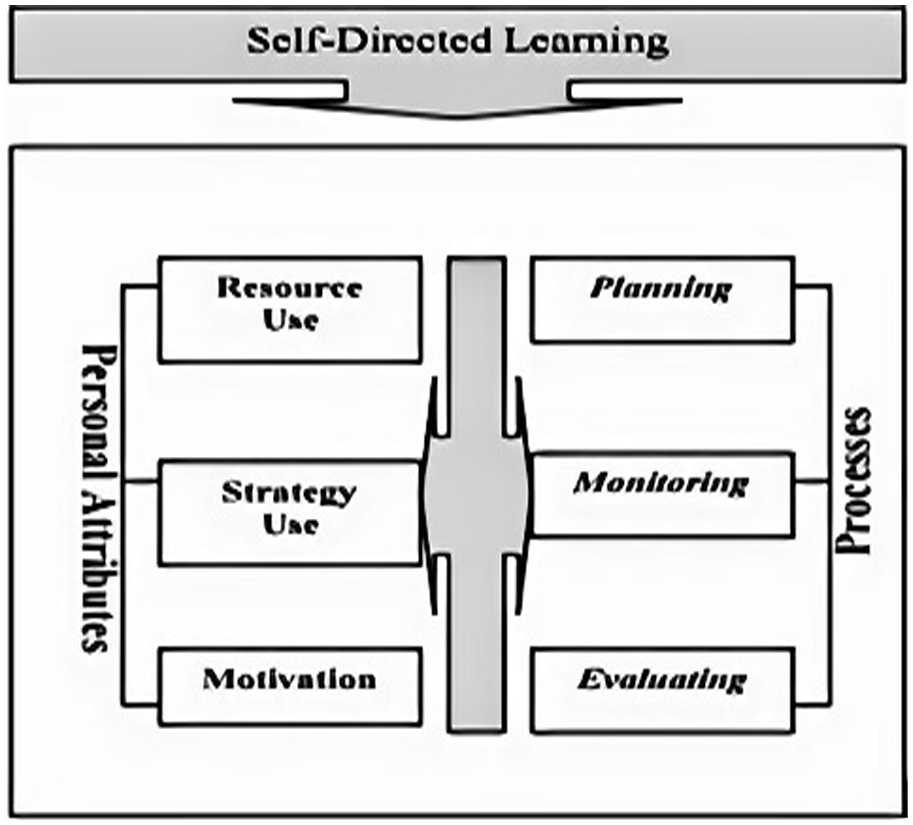
Conceptual framework of SDL skills (Song & Hill, 2007).
A comprehensive literature review on self-directed learning (SDL) reveals a substantial body of research, yet there remains a notable deficiency in the SDL skills of learners in China (H. Y. Wang, 2006; Yang, 2006). This gap is particularly pronounced in the context of technology-enhanced learning environments, where the rapid evolution of educational technologies has outpaced the development of instructional models that effectively support SDL. Despite the proliferation of blended learning models, there is a conspicuous absence of research that specifically addresses the integration of Production-Oriented Approaches (POA) with SDL in a blended learning context, particularly within the EFL domain.
This study aims to fill this gap by developing and evaluating a blended learning module that is designed to enhance SDL skills among EFL learners in China. This module is unique in its integration of face-to-face instruction with online components, creating a synergistic learning environment that leverages the strengths of both traditional and technology-integrated approaches. By grounding our instructional design in the POA, which is well-established in EFL education, we are able to provide a structured yet flexible framework that supports the development of SDL behaviors.
The empirical evidence gathered from this study demonstrates the effectiveness of the Blended Production-Oriented Approach module in fostering autonomous learning behaviors among EFL learners. The findings not only address the current inadequacies in SDL skills but also contribute to the broader understanding of how blended learning models can be tailored to support the dynamic needs of modern learners in EFL contexts. This research provides educators with a practical model that can be implemented to enhance SDL skills, thereby contributing to the advancement of EFL education in the digital age.
Methodology
This study employs a mixed-method research (MMR) approach, combining both qualitative and quantitative methods. This approach enhances the researcher’s understanding of the research problem by leveraging the strengths of both approaches (Creswell, 2012). MMR is known for improving data accuracy and dependability through triangulation, minimizing bias, offering a problem-driven research approach, and facilitating complementarity and supplementarity (Denscombe et al., 2014).
Research Design
According to Campbell (1979), quasi-experiments are good ways to evaluate the effectiveness of a treatment, especially a type of educational intervention. Hence a pretest-posttest quasi-experimental research was designed for this study since the participants are not randomly selected. This quasi-experimental study was conducted in a third-tier Chinese university to examine the impact of Blended Production-Oriented Approach on self-directed learning (SDL) in an English-Chinese Interpreting (ECI) course for EFL students. Two groups participated in the study an experimental group and a control group. Although random assignment was not possible, the study was carefully structured to minimize confounding variables. Students were matched across groups based on similar English proficiency levels, and both groups followed the same course content, differing only in the mode of instruction. To measure the effectiveness of the BPOA intervention, quantitative data were collected through standardized pre- and post-tests using the Self-Directed Learning Skills Scale (SDLSS). Statistical analysis involved independent samples t-tests to compare the two groups at baseline and after the intervention, and paired samples t-tests to assess within-group changes over time. Qualitative data from semi-structured interviews with selected participants from the experimental group further explored their perceptions of SDL skill development, providing triangulation to support the quantitative findings.
To control for selection bias, we ensured that both the experimental and control groups were composed of students from the same course with similar English proficiency levels. This approach aimed to create comparable groups in terms of their baseline characteristics. We minimized history bias by conducting the study in a controlled environment where no significant educational events or interventions occurred concurrently that could influence the outcomes. The experimental group was intervened by the Blended Production-Oriented Approach module, while the control group was taught with traditional classroom teaching mode. Both groups participated in the pre-posttests. After the intervention, a deeper understanding of the influence of the intervention was explored through interviews with students from the experimental group. We analyzed our data to account for any regression to the mean effects. Furthermore, all participants who began the study completed it, which allowed us to control for attrition. As for threats to external validity, we addressed the Hawthorne effect by maintaining a consistent study protocol and minimizing the awareness of participants regarding the study’s specific objectives. To control for the experimenter effect, the same researcher administered the pre-posttests to all participants, and interviews were conducted in a standardized manner.
Participants
The study employed purposive sampling, specifically selecting participants who were English as a Foreign Language (EFL) learners at a third-tier Chinese university. This method was chosen to ensure that the sample was relevant to the study’s focus on enhancing self-directed learning skills within this specific educational context.
The participants in this study were from an EFL course named “English Chinese Interpreting.” Interpreting is one of the key English language skills and is a common course for EFL education in Chinese universities. Sixty undergraduate students from two classes participated in the study. One was the experimental group with 30 students, and the other one was the control group with 30 students. In this study, both groups were of similar structure, with 28 girls and 2 boys, and similar English proficiency levels based on TEM 4 (a test for English majors for sophomores) scores, ensuring comparable structures and academic performance. All 60 students have participated in the pre-posttests. Six students from the experimental participated in the semi-structured interview.
For the quantitative component, 30 participants were selected for both the experimental and control groups. This sample size was chosen based on practical constraints, but it aligns with Cohen’s (1988) recommendation for detecting large effect sizes (d = 0.8) in experimental research. Additionally, the Central Limit Theorem supports that a sample size of 30 is sufficient to approximate a normal distribution, which is crucial for the validity of parametric tests. While the sample size may limit generalizability, it provides valuable preliminary insights and can serve as a basis for future studies with larger samples.
For the qualitative component, six participants were chosen for in-depth interviews. This aligns with the literature on data saturation in qualitative research, where Guest et al. (2006) suggest that saturation often occurs with 6 to 12 interviews, especially in relatively homogeneous groups. The sample size for interviews was determined based on the depth of information required and the focus on understanding individual experiences with the intervention. In future research, a larger and more diverse sample would strengthen the findings and enhance generalizability. However, the current study provides important exploratory insights within its specific context.
Instruments
Two instruments were used for data collection. One was the pre-posttests of learners’ SDL skills, using the instrument of a Self-directed Learning Skills Scale (SDLSS) adopted from previous literature (Tarhan, 2015). The Cronbach’s alpha reliability coefficient for the SDLSS was determined to be .86, indicating a relatively high level of reliability. The SDLSS comprises 40 items rated on a 5-point Likert scale, organized into six subscales relevant to the present study: motivation (items 1–6), monitoring (items 7–12), planning (items 13–17), resource use (items 18–24), learning strategy use (items 25–33), and self-evaluation (items 36–40). Before and after the experiments, both groups were administered with the SDLSS tests.
The other instrument was a semi-structured interview protocol. The researcher crafted the interview protocol, which underwent review by two experts. Finally, seven questions were asked to explore the effectiveness of the BPOA in the six dimensions. Namely, one question for a general perception of the module’s effect on learners’ SDL, and the other six questions identifying its effectiveness in the six dimensions of SDL skills. The interview respondents consisted of six deliberately chosen learners. Face-to-face interviews were conducted in a classroom setting, facilitating a relaxed environment for the participants to freely express themselves in Chinese. All six learners willingly took part in the interviews, with S1 to S5 being girls and S6 being a boy.
Treatment
During the experimental phase, participants in the experimental group engaged in a series of 14 structured sessions following the Blended Production-Oriented Approach (BPOA). The approach integrated online and face-to-face components, with each session divided into three key phases: motivating, enabling, and assessing.
The motivating phase commenced with instructors introducing the session’s target production activity through descriptions or videos, leveraging the Chaoxing Learning App to provide access to course materials, including MOOCs, prior to face-to-face meetings. This strategy was designed to stimulate learners’ motivation and establish an output-driven mindset aligned with the lesson objectives.
In the enabling phase, the online segment involved MOOC learning before class and online discussions in-class first fostered learners’ knowledge of each topic in the interpreting course. During the class, more activities such as skill training in interpreting listening and sentences interpreting enabled learners to master the skills in interpreting. After class, in order to accomplish the interpreting scenario presentation, learners could get more information through the resource-sharing section in Chaoxing Learning App, as well as search the internet for more resources by themselves. These activities aimed to equip learners with the necessary skills and knowledge to undertake the production activity, which could include pair work or group projects.
The assessing phase was the last phase in this module. Following the enabling phase, learners engaged in self-directed learning to prepare for the presentation of their production activity. After their presentation of the production of interpreting tasks, assessing was happening involving peer assessment, teacher evaluation, and a combination of online and face-to-face feedback mechanisms.
To ensure consistency across sessions, a standardized session plan was implemented, which included selected MOOC learning before class, review of online content, in-class discussion of the MOOC content, interpreting skills training, group work preparation and presentation in interpreting, and a wrap-up segment of thorough assessing. This structure was maintained throughout the 14 treatment sessions to provide a uniform learning experience.
The Chaoxing Learning App served as a platform for online activities, which were closely aligned with the face-to-face components. This platform was used before class for MOOC learning and resource sharing, in class for online discussion and assessing, and after class for assignments of writing tasks and additional self-reflection, making it possible for a natural integration of online and face-to-face teaching. Instructors monitored student progress on the platform, using this data to inform their teaching and to ensure the online and face-to-face components were cohesive.
A detailed flowchart (Figure 3) provided a clearer visual representation of the BPOA’s practical implementation, including the transition between online and face-to-face activities and the various assessment strategies employed.
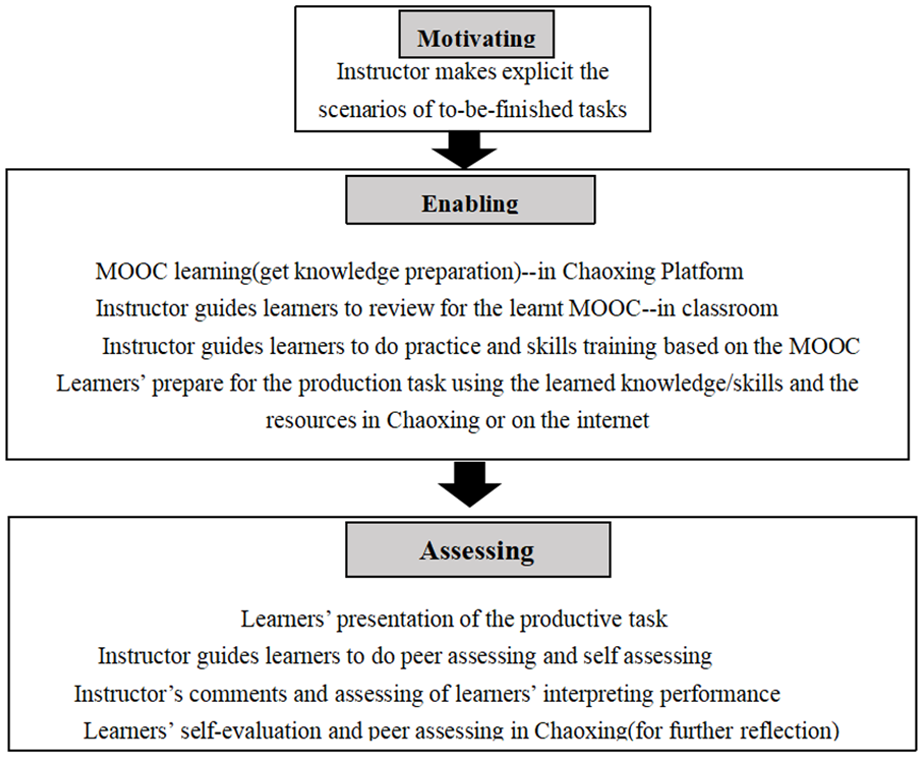
The flowchart of the Blended Production-Oriented Approach (BPOA) module.
In contrast, the control group received instruction through a conventional teaching model, with a teacher-fronted approach that focused on direct instruction and limited access to technology during the learning process. This group did not participate in the BPOA treatment sessions.
Data Analysis
The quantitative data from the pre- and post-tests were analyzed using SPSS (Statistical Package for the Social Sciences). Independent samples t-tests were conducted to compare the experimental and control groups at the baseline (pretest) and after the intervention (posttest), determining whether there were statistically significant differences between groups. Paired samples t-tests were performed within each group to evaluate changes in self-directed learning skills over time. These tests enabled assessment of both the intervention’s overall impact and specific skill development within each group.
For the qualitative component, semi-structured interviews were audio-recorded, transcribed verbatim into Word documents, and subsequently imported into NVivo 12 Plus for analysis. A thematic analysis approach was adopted to systematically code and organize the data into key themes reflecting learners’ perceptions of the Blended Production-Oriented Approach (BPOA) and their development of self-directed learning skills. Initial codes were generated deductively based on the research questions and inductively from emerging patterns in the data.
To mitigate potential researcher bias, we have implemented several strategies in our qualitative data analysis. First, we conducted a peer review, where independent colleagues familiar with qualitative analysis reviewed the coding process, helping to identify and challenge any biases. Additionally, we maintained a reflexive journal to document our thoughts and preconceptions, increasing awareness of how our own beliefs could influence the analysis. Member checking was used by presenting the findings to participants for validation, ensuring that their perspectives were accurately represented. Finally, we ensured intercoder reliability by having two researchers independently code the data and compare results, resolving any discrepancies through discussion to reduce individual bias.
Results
Effectiveness of the Blended Production-Oriented Approach in enhancing SDL Skills
To answer Research question 1: “What is the effectiveness of the Production-oriented Approach based on blended learning in enhancing EFL learners’ self-directed learning skills?” as mentioned above, an independent sample t-test was conducted through SPSS to analyze the data. First of all, the average mean score of the control group is m = 3.20, and the experimental group has a similar average mean score (m = 3.23), signifying a medium level of overall SDL skills that need to be enhanced. More importantly, as shown in Table 1, the Levene Statistic outcome from the independent sample T-test indicates that the assumed equal variance between the experimental and control groups holds true. This is evident as all six dimensions of SDL skills showed significance levels above .05 in Levene’s Test for Equality of Variances. This implies that the overall dimensions of self-directed learning (SDL) skills satisfy the assumption of homogeneity, meeting the criteria for a quasi-experiment as outlined by (Cook, 2015) for the two groups.
Independent Sample T-Test for Pretests (Levene Statistic).

After the intervention, both groups participated in the post-test. A paired sample T-test was employed to assess the impact of the BPOA intervention on post-test results, examining the effectiveness of the intervention. Table 2 details the paired sample T-test outcomes for the experimental group. The mean difference across all six dimensions of SDL skills is 34.8, with a standard deviation of 18.938 and a Standard Error Mean of 3.458. The lower 95% Confidence Interval of the Difference ranges from −41.872 to −27.728, providing compelling evidence against the null hypothesis and indicating a noteworthy and statistically significant difference.
Paired Sample T-Test Results for the Experimental Group.

The t value is −10.065, with 29 degrees of freedom, and the 2-tailed significance is .000, significantly below the 0.05 threshold. This reinforces the conclusion that the BPOA intervention has significantly enhanced SDL skills. Individual examination of the six subscales within SDL dimensions reveals consistently significant differences, all with a 2-tailed significance of .000. These findings affirm the substantial effectiveness of the BPOA in improving SDL skills across each dimension. Moreover, the results highlight that the most substantial growth is observed in “resource use,” followed by “strategy use, monitoring, planning, motivation, and evaluation” in sequential order.
On the contrary, the control group underwent a paired sample T-test, comparing pre-posttests of SDLSS. The results in Table 3 unveil the impact of conventional teaching on the difference in SDL skill outcomes for the control group. It is evident that a significant difference exists in the total SDL score, as well as in motivation, monitoring, resource use, and evaluation. However, no significant difference is observed in planning (sig 2-tailed = 0.270) and strategy use (sig 2-tailed = 0.135). Notably, the mean increase in these dimensions is considerably less than that observed in the experimental group.
Paired Sample T-Test Results for the Control Group.

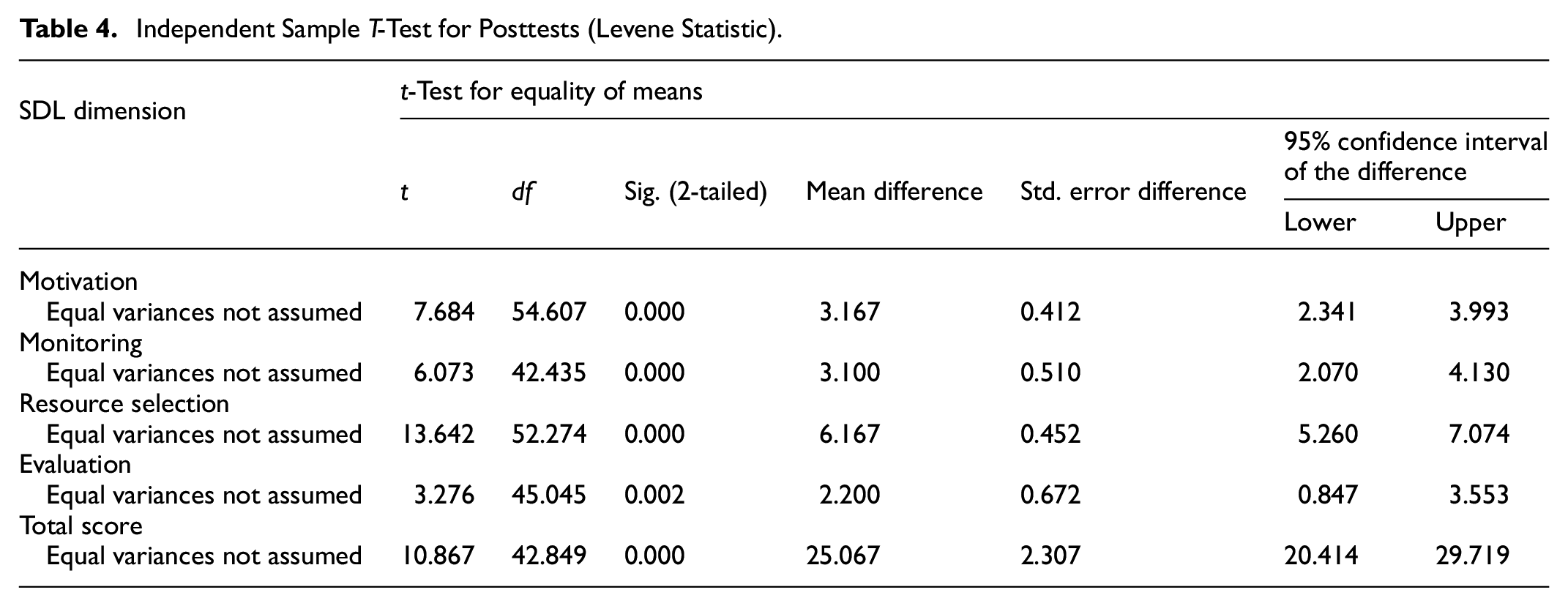
To comprehensively evaluate the efficacy of the blended learning module in comparison to traditional teaching, an additional independent sample T-test is required to examine the variance assumption of significantly different dimensions between the posttests of the two groups. Table 4 illustrates the results of the independent sample T-test for the post-test outcomes in the four dimensions and the total score for both groups. Remarkably, all dimensions exhibit a sig. 2-tailed value well below .05, and the total score’s mean difference is 25.067. This underscores that the blended learning module has resulted in a significantly more substantial improvement in SDL skills compared to traditional teaching.
Independent Sample T-Test for Posttests (Levene Statistic).
Learners’ Perceptions of the Blended Production-Oriented Approach
Regarding Research question 2: “What are EFL participants’ perceptions of the Production-oriented Approach-based blended learning module?” The interviews with the six participants from the experimental class were thematically analyzed. Feedback from six respondents (S1, S2, S3, S4, S5, S6) regarding the impact of the BPOA on their self-directed learning (SDL) was uniformly positive. Expressions such as “greatly improved,”“sure, there is much impact,”“enhanced my SDL skills,”“great advantages, indeed helpful,” and “great progress in SDL” were used to describe their perceptions. When asked about the reasons behind their positive responses, respondents highlighted that the module provided more opportunities for self-directed learning, including online learning, production activity completion, and self-evaluation. This, in contrast to traditional classroom teaching, allowed learners to take more initiative in their learning process. The blended learning module was seen as offering numerous opportunities for independent study and fostering SDL throughout various learning processes.
The interviews reported constructive triggers of the BPOA module’s effectiveness in enhancing learners’ self-directed learning (SDL) skills. Respondents specifically noted that the module addressed weaknesses in SDL skills through the integration of online and offline learning, with its learner-centered nature serving as a motivating factor, significantly facilitating SDL skill improvement. The overall optimistic outlook from the interviews depicted the module as providing more SDL opportunities in POA teaching and blended learning compared to traditional teaching. In addition to its learner-centered approach, the interviews underscored key factors contributing to the efficacy of BPOA modules in enhancing learners’ motivation. Notably, the engaging content design, featuring attractive production activities simulating practicum tasks, was highlighted as a primary motivator, fostering creativity. The comprehensive evaluation system within the new module, encouraging learners to excel for positive assessments, further fueled motivation, along with the learner-centered approach that enhanced proactivity among learners throughout the learning experience.
In specific, the interviews showed overall positive feedback on the blended learning module’s efficacy on SDL skills in its six sub-skills. The interviews highlighted the positive impact of the BPOA on learners’ planning skills, emphasizing the production-oriented approach with a motivating-enabling-evaluation flowchart. Learners engaged in individual or group planning for interpreting tasks and developed a planning habit through blended learning, watching MOOCs, and class preparation. However, the complexity of task preparation influenced planning, with easier tasks potentially leading to less motivation. The module demonstrated positive effectiveness on learners’ monitoring skills, evident in active participation, self-study, production task preparation, whole-set evaluation, MOOC review quizzes, and self-motivation, despite occasional laziness due to a heavy workload. Resource use skills improved through instructor guidance, Chaoxing learning, and independent online resource selection. Strategy use benefits encompassed learning procedures, time management, ECI learning tips, and a formative evaluation-centered approach, fostering progress. The synthesized analysis emphasized the implications of BPOA settings on learners’ self-evaluation, promoting systematic identification of improvement areas, enhancing learning efficiency, and nurturing a proactive attitude toward learning endeavors.
Discussion and Conclusion
This study investigates the effect of the Blended Production-Oriented Approach (BPOA) on enhancing EFL learners’ Self-Directed Learning (SDL) skills. The quasi-experimental design, involving pre- and post-tests for both control and experimental groups, reveals a substantial positive impact of the module on learners’ SDL skills compared to traditional teaching methods. The module notably improved planning and strategy use, followed by resource utilization, motivation, evaluation, and monitoring skills. Semi-structured interviews with six representative learners validated these findings, indicating a prevalent sense of optimistic growth in SDL skills.
The positive outcomes observed in the study may be attributed to several factors that could have influenced the results. The novelty and freshness of the BPOA module might have initially boosted participants’ motivation and engagement, leading to the observed improvements. Additionally, the participants may have been influenced by the Hawthorne effect, altering their behavior due to the awareness of being part of a study. Selection bias could also have played a role if the participants in the experimental group were inherently more motivated or had characteristics making them more likely to benefit from the intervention. Furthermore, social desirability bias might have led participants to provide responses they believed would be viewed favorably by the researchers, skewing the results toward positivity. The potential for researcher bias, where expectations or unconscious biases could have influenced data collection and interpretation, also warrants consideration. The quality of BPOA implementation and the possibility of statistical regression, where initial performance levels could have influenced the degree of observed change, should not be overlooked. Finally, while the findings show short-term gains, the sustainability of these improvements remains uncertain without longitudinal follow-up.
A key consideration for future work is the long-term impact of the BPOA on SDL development. While this study provides compelling short-term evidence, the durability of these skills over time is critical for ensuring that learners can transfer and apply SDL competencies beyond the classroom. Sustained SDL development depends not only on instructional design but also on continued institutional and instructional support. For SDL gains to persist, educational environments must embed SDL principles across curricula, promote regular goal-setting and self-monitoring, and offer tools—such as adaptive technologies and peer-learning platforms—that facilitate independent learning.
Long-term success also relies on cultivating metacognitive habits that allow learners to evaluate and refine their own strategies over time. Embedding reflection cycles, personalized learning pathways, and formative assessment into future BPOA modules could reinforce and solidify SDL behaviors. Educator training is equally essential; teachers must be equipped with strategies to scaffold SDL skills and encourage learner autonomy throughout a course and across academic programs.
Despite these limitations, the present study makes a meaningful contribution by offering a comprehensive view of the BPOA’s role in fostering SDL skills. The findings align with previous research highlighting the positive influence of blended learning and technology integration on SDL (Bosch, 2017; Bosch & Pool, 2019; Zhu & Bonk, 2019). Moreover, the improvements in motivation, planning, monitoring, and strategy use reinforce Song and Hill’s (2007) model of SDL dimensions as central to independent learning success. It is essential to sustain the SDL improvements observed through the BPOA in the short term. This requires a multifaceted approach. Institutions should provide ongoing support via workshops and mentorship, while embedding SDL principles into curricula using the BPOA module. Learners benefit from regular self-reflection, goal setting, and adaptive technologies that personalize learning experiences. Building communities of practice fosters collaboration and accountability, while long-term assessments ensure progress is tracked. Teacher development programs are also crucial to equip educators with the skills to support SDL. Together, these strategies ensure SDL skills become a lasting part of learners’ educational journeys in the BPOA module.
Nevertheless, the findings of this study offer a comprehensive examination of the Blended Production-Oriented Approach’s (BPOA) impact on SDL skills among EFL learners. Our results align with and extend previous research, which has consistently demonstrated the positive effects of blended learning environments on fostering SDL opportunities. Zhu and Bonk (2019), Bosch (2017), and Bosch and Pool (2019) have previously highlighted how technology integration can enhance learner autonomy and motivation, key components of SDL. Similarly, Ruchan and Adem (2018) emphasized the role of blended learning in creating a conducive environment for SDL.
Our study’s findings underscore the significant improvements in various dimensions of SDL, including motivation, planning, monitoring, strategy use, resource utilization, and evaluation. These improvements are consistent with the work of Song and Hill (2007), who identified these dimensions as critical for effective SDL. The BPOA’s structured approach, with its focus on output-driven and input-oriented strategies, provides a clear framework that supports learners in navigating the complexities of blended learning. This structured approach is particularly beneficial in enhancing learners’ SDL skills, as it encourages proactive engagement with learning materials and strategies.
The effectiveness of the POA in enhancing motivation and evaluation skills, as noted by Nan (2023), Ruoxi (2022), Wen (2018), Xing and Puteh (2023), and Xuan et al. (2023), is further supported by our findings. The POA’s emphasis on clear learning objectives and the integration of formative assessments within the learning process creates a cycle of continuous improvement that is instrumental in promoting SDL.
Moreover, the synergistic relationship between the POA and blended learning, as observed in this study, reinforces the findings of Jing and Li (2021), Ke et al. (2021), Q. Wang (2022), Zhai (2021), and Zhang (2023). These studies have shown that a well-implemented blended learning model, guided by a pedagogical approach like the POA, can significantly enhance the overall effectiveness of language education.
The practical implications of this study are manifold. For educators, the BPOA provides a framework for designing blended learning experiences that are not only engaging but also supportive of SDL. The integration of technology, when aligned with pedagogical principles, can lead to more autonomous and effective learners. For future research, this study suggests the need to continue exploring the long-term effects of blended learning and the POA on SDL skills, as well as the influence of individual learner characteristics on the effectiveness of these instructional strategies.
In conclusion, this study makes a significant contribution to the theoretical development of blended learning and the POA by providing empirical evidence of their combined effectiveness in enhancing SDL skills among EFL learners. The findings offer valuable insights for educators and highlight the importance of continued research in this area.
Implications and Suggestions
The primary goal of this study is to enhance the Self-Directed Learning (SDL) skills of English as a Foreign Language (EFL) learners through a Blended Production-Oriented Approach (BPOA). This approach involves developing instructional strategies tailored to EFL learners, aligned with the Chinese college syllabus, while emphasizing the importance of both learner and teacher awareness of SDL. The course syllabus, integrated with the blended learning module, is designed to support the core principles of SDL.
This research has both theoretical and practical implications. The study combines blended learning, the Production-Oriented Approach (POA), and SDL theory to create a more effective instructional module for EFL education. This integration not only advances each theory individually but also introduces a new instructional model suited to 21st-century, technology-driven education. It enhances learners’ overall SDL skills across six sub-skills: planning, strategy use, resource utilization, motivation, evaluation, and monitoring. By incorporating these theories into a cohesive framework, the study provides a comprehensive approach to promoting autonomous learning in language education.
On a practical level, the research offers a valuable pedagogical module for administrators, instructors, learners, and researchers in EFL education. The Blended Production-Oriented Approach module is both structured and flexible, adaptable to teaching a range of language skills, including listening, speaking, reading, and writing. This versatility makes it a useful tool for fostering SDL skills across different aspects of language learning.
Importantly, the applicability of the BPOA framework extends well beyond the EFL domain. Its principles of output-driven learning, scaffolded input, and continuous formative assessment are equally relevant in other disciplines where SDL is crucial. For instance, in science, technology, engineering, and mathematics (STEM) education, the BPOA model can be adapted to support inquiry-based learning, independent research projects, and problem-solving activities. In the humanities and social sciences, it can be used to encourage critical thinking, reflective learning, and project-based assessments.
In educational settings with limited technological infrastructure, the approach can be adjusted to emphasize offline strategies for promoting SDL, such as paper-based modules, peer teaching, or community-based projects. Conversely, in resource-rich environments, the integration of advanced technologies like artificial intelligence, adaptive learning platforms, and gamification can further enhance its effectiveness. These tools can provide personalized feedback, monitor progress, and suggest tailored learning resources, thereby enriching the SDL experience.
Moreover, the BPOA framework is culturally adaptable, making it suitable for implementation across diverse educational systems worldwide. It respects the variability in learner preferences, cultural learning styles, institutional priorities, and educational traditions. Through culturally responsive adaptations—such as localizing content, adjusting group dynamics, or aligning with national curriculum standards—the BPOA can be scaled effectively across different global contexts. To maximize its transferability, pilot studies, stakeholder consultations, and iterative local modifications should be conducted prior to full-scale implementation. Such localized refinements can ensure that the BPOA maintains its core strength—promoting SDL—while fitting the unique educational needs and sociocultural realities of different learning environments.
In essence, the BPOA provides a strong framework for promoting autonomous learning in language education. With careful adaptation to the unique needs of different educational contexts, it can be effectively scaled and implemented to enhance SDL skills in EFL learners globally.
While this study primarily focused on the immediate impact of the BPOA on SDL skills, it is equally important to consider the sustainability of these effects over time. Future research should incorporate longitudinal studies to evaluate the durability of SDL improvements. By tracking participants’ progress beyond the intervention, researchers can assess whether the observed gains in SDL are temporary or lead to lasting developmental shifts. This limitation has been noted in the current study, and we recommend future research to explore long-term outcomes.
Given the dynamic nature of SDL development, extending the timeframe of future investigations will offer a more comprehensive understanding of its long-term impact. Additionally, further application research is necessary to validate and build upon this study’s findings. Applying the BPOA module across diverse educational settings and with different learner populations will help determine its broader applicability. Furthermore, exploring the integration of emerging technologies within the BPOA framework could reveal how advancements in technology can enhance the effectiveness of blended learning in fostering SDL skills.
This study makes a significant contribution to both the theoretical and practical dimensions of EFL education. By developing and validating the BPOA module, it provides a strong foundation for enhancing SDL skills among EFL learners. The findings highlight the importance of combining engaging content, production-oriented motivation, online self-learning opportunities, and systematic assessment within the POA framework. These elements are crucial for educators seeking to foster autonomous learning in EFL contexts. By leveraging these insights, educators can improve the overall effectiveness of language education, ultimately preparing learners for lifelong, independent learning.
In conclusion, the BPOA offers a versatile and adaptable framework for enhancing SDL skills. While further research is needed to explore its long-term impacts and broader applicability, this study lays the groundwork for future innovations in EFL education and autonomous learning.
Footnotes
Acknowledgements
The authors wish to thank all the participants from Faculty of Foreign Languages, Science and Technology College of Gannan Normal University. This work was supported in part by Faculty of Foreign Languages, Science and Technology College of Gannan Normal University, with its ethical approval for the experiment in this research.
Ethical Considerations
This study was conducted in accordance with the ethical principles outlined in the Declaration of Helsinki. Ethical approval was obtained from the Ethics Committee of the Faculty of Foreign Languages, Science and Technology College of Gannan Normal University (approval number 60). To minimize any risk of harm to participants, the study design ensured that all activities were educational in nature, integrated into their regular coursework, and did not expose students to physical, psychological, or social risks. Participation in the study did not affect students’ academic evaluations, and confidentiality of personal information was strictly maintained. The potential benefits of the research to both the study participants and society outweighed the minimal risks involved. Participants had the opportunity to enhance important self-directed learning skills, which can contribute to their future academic and professional success. On a broader scale, the study’s findings provide valuable insights into effective teaching strategies for improving autonomous learning among English as a Foreign Language (EFL) students, supporting educational development in increasingly technology-driven learning environments. Informed consent was obtained by providing participants with a detailed written explanation of the study’s purpose, procedures, potential risks, and benefits. Participants were clearly informed that their participation was voluntary and that they could withdraw from the study at any time without penalty. Written consent forms were collected from all participants before the study began.
Funding
The author(s) received no financial support for the research, authorship, and/or publication of this article.
Declaration of Conflicting Interests
The author(s) declared no potential conflicts of interest with respect to the research, authorship, and/or publication of this article.
Data Availability Statement
The datasets generated and analyzed during the current study are available on the Wenjuanxing website, Link for Pretest: https://www.wjx.cn/vm/wF5SEOp.aspx Posttest Link: 