




Abstract
Many researchers have acknowledged the benefits of the production-oriented approach (POA) in teaching English as a Foreign Language (EFL) writing. However, the impacts of POA on students’ foreign language writing anxiety and English writing performance were still under-researched. Therefore, this longitudinal quasi-experimental study investigated the effect of POA on foreign language writing anxiety and English writing performance among 128 Chinese EFL university students. The experimental group was instructed through POA for 15 weeks, while the traditional product-oriented approach was used to teach the control group. Results revealed significant enhancement in the experimental group’s English writing performance after a 15-week intervention in the post-test, and the effect was retained in the delayed post-test. Significant decreases in foreign language writing anxiety were found in the experimental group after the intervention in the post-test, and the effect was retained in the delayed post-test. In contrast, no significant changes were found in the control group’s foreign language writing anxiety and English writing performance in the post-test and delayed post-test.
Keywords
Introduction
Writing is an important skill for achieving communicative purposes (Jin & Guo, 2021), and students are required to have sufficient English writing competence to finish assignments, written examinations, essays, and dissertations to obtain the degree (Thulasi et al., 2015). In China, students are required to learn English writing in each stage of their English learning, and many national English tests have been developed to assess students’ English writing performance (Jin & Guo, 2021; Wang et al., 2024). Recently, many writing instructional methods have been used to improve Chinese students’ English writing performance (Y. Huang & Zhang, 2020; Y. Yang, 2016; Zhou, 2015). Product-oriented approach guides students to imitate selected writing sample texts (Nordin & Mohammad, 2017), and it focuses on the grammatical accuracy and language structures rather than the writing content (L. J. Zhang et al., 2016). This approach is seen as a teacher-centered approach, and teachers may ignore the individual characteristics and differences of language learners, which could lead to students’ negative attitudes toward and unpleasant experiences in English writing (Wu et al., 2023; Yu et al., 2023). Lee et al.’s (2018) study revealed that the teacher feedback on students’ writing tasks in product-oriented approach was mainly unfocused and was difficult to revise accordingly, and this may increase students’ foreign language writing anxiety.
In contrast, production-oriented approach (POA) was developed to promote students’ positive attitude toward English writing and their English writing performance (Gao & Wang, 2023; Zhao & Li, 2021). Production-oriented approach regards language production as a motivator to students’ language learning and emphasizes the effect of language input on students’ language development (Wen, 2018). Influenced by sociocultural theories, production-oriented approach stresses that students are able to achieve higher language performance with the support from specialists (Eun, 2019), emphasizing the collaboration between teachers and students (Xie, 2021). Production-oriented approach is composed of three teaching stages, namely motivating, enabling, and assessing (Wen, 2018), and the whole process of production-oriented approach is designed and supported by language teachers (Wen, 2018). Taken together, the production-oriented approach is distinct from the product-oriented approach. The product-oriented approach is teacher-centered, guiding students to conduct linguistic analysis of the selected writing model texts with the main focus on grammar accuracy, language use, and cohesive devices (Kadmiry, 2021). It attributes the development of writing skills to the imitation of sample texts (Rashtchi et al., 2019). However, the production-oriented approach is learning-centered and values collaboration between writing instructors and students (Xie, 2021). During the process of production-oriented writing instructions, writing teachers act as facilitators, providing scaffolding throughout the learning process (Wen, 2018). This approach engages students by motivating, enabling, and assessing them, fostering the development of students’ overall writing skills rather than merely emphasizing linguistic-related issues (Xing & Puteh, 2023). Currently, the benefits of production-oriented approach have been found by an increasing number of language teachers (Gao & Wang, 2023), and some recent studies have been conducted to explore the implementation of production-oriented approach in writing instructions (e.g., Gao & Wang, 2023; Ren & Wang, 2018; W. Zhang, 2020). For example, W. Zhang (2020) conducted a 2-week quasi-experimental research to examine the effect of production-oriented approach on Chinese university students’ English writing performance. The findings indicated that students in the experimental group had higher scores in language use after 2-week production-oriented instructions, whereas there were no statistically significant differences in content and organization between the experimental group and the control group. W. Zhang (2020) attributed the insignificant improvement in content and organization to the short period of production-oriented writing instructions.
On the other hand, it is well-documented that anxiety has a significant impact on students’ English language learning (Hu et al., 2021; Pan & Zhang, 2023; Teimouri et al., 2019). Spielberger (1983, p. 1) defines anxiety as individuals’ subjective feelings of mental stress, “nervousness,”“fear,” and “worry.” As a language-skill-specific anxiety, foreign language writing anxiety is regarded as the anxious feelings occurring in the process of composing in foreign languages (Woodrow, 2011). It has been found that anxious feelings can have negative impacts on writers’ cognitive competence and information-processing ability, while positive attitudes could develop writers’ potential in terms of cognitive ability (Dewaele & MacIntyre, 2014). Students with high foreign language writing anxiety tend to be concerned about their writing expression, procrastinate their writing tasks, and spend less time and effort on learning foreign language writing, which consequently results in unsatisfactory foreign language writing performance (Tahmouresi & Papi, 2021). Furthermore, some English teachers state that EFL students’ writing performance might be negatively affected if they have negative attitudes toward EFL writing (Rasuan & Wati, 2021). Collectively, although several researchers have studied the effect of production-oriented approach on the development of Chinese students’ English writing performance (Gao & Wang, 2023; W. Zhang, 2020), the duration of these interventional studies may be relatively short. Furthermore, the follow-up effect of production-oriented approach has not been explored. Therefore, Gao and Wang (2023) and W. Zhang (2020) called for longitudinal studies to have a more reliable answer to this issue. In addition, although foreign language writing anxiety is a significant factor affecting students’ English writing performance and many Chinese students are confronted with high levels of foreign language writing anxiety (D. Yin, 2016), the effect of production-oriented approach on Chinese university students’ foreign language writing anxiety has never been explored. Therefore, to address these gaps in the existing literature, the current longitudinal interventional study aimed to investigate the effect of production-oriented approach on Chinese university students’ foreign language writing anxiety and English writing performance. Specifically, the following research questions were addressed:
Methods
Research Design
The current study employed a quasi-experimental design to investigate the effect of production-oriented approach on Chinese EFL university students’ foreign language writing anxiety and English writing performance. Based on the results of the pre-test, an experimental group (EG, two classes, n = 64) and a control group (CG, two classes, n = 64) with similar performance in English writing performance test and similar levels of foreign language writing anxiety were selected. Then, the experimental group received the production-oriented writing instruction, while the control group was taught through the conventional product-oriented writing approach for a 15-week semester. Two teachers were involved in the writing instructions. One taught two classes in EG through using the production-oriented approach, while the two classes in CG were instructed by the product-oriented approach. Both the EG teacher and CG teacher attended weekly training sessions arranged by the researchers to help them be capable of implementing the corresponding teaching interventions successfully. Author 1 observed the writing instructions in the first 2 weeks to ensure that the teaching procedures were executed as planned. Then, a post-test was conducted to assess the differences between EG and CG in the extent of foreign language writing anxiety and English writing performance after the 15-week writing instructions. In addition, a delayed post-test was conducted after 5 weeks of the writing instructions to investigate whether the effect of the production-oriented writing instructions on students’ foreign language writing anxiety and English writing performance can be retained.
Participants
This study was carried out in a university in the southeast part of China. 128 first-year EFL university students (majoring in English) participated in this study after they signed the written informed consent. Students in the EG (n = 64) were 57 females (89.06%) and 7 males (10.94%) aged between 17 and 19. Similarly, students in the CG (n = 64) were 56 females (87.50%) and 8 males (12.50%) in the same age range. The results of the present study have shown that students in the EG and CG were similar in English writing performance and foreign language writing anxiety in the pretest (see Results section).
Instruments
Foreign Language Writing Anxiety Scale
Second Language Writing Anxiety Inventory (SLWAI) designed by Cheng (2004b) showed a good reliability (Overall: Cronbach’s α = .91; Somatic Anxiety: Cronbach’s α = .88; Avoidance Behavior: Cronbach’s α = .88; Cognitive Anxiety: Cronbach’s α = .83) and have been widely employed by many studies (e.g., Quvanch & Si Na, 2022; Rahimi & Zhang, 2019; Rasool et al., 2023). Therefore, SLWAI was used to evaluate the foreign language writing anxiety of Chinese EFL learners. This inventory contains 22 items: (1) Somatic Anxiety (7 items); (2) Avoidance Behavior (7 items); (3) Cognitive Anxiety (8 items). Participants could make choices on the 5-point Likert scale, ranging from 1 (strongly disagree) to 5 (strongly agree). The SLWAI was translated into Chinese by two independent translators with more than 10 years of English-Chinese translation experience. The translated version was validated through the use of back-translation. In the current study, the translated SLWAI was piloted in a similar group and was found to have a high Cronbach’s alpha of .92.
English Writing Performance Test
Students’ English writing performance was tested through the mock tests for the writing section of College English Test-4 (CET-4) arranged by the School of English Language. CET-4 is a national-level standardized English language examination in mainland China and annually attracts millions of candidates. The reliability and validity of the test items have undergone thorough scrutiny by the examination center prior to their release (National Education Examinations Authority, 2024). The three writing topics in the pre-test, post-test, and delayed post-test were purposefully selected from the writing section of the past CET-4 tests after taking suggestions from four experienced teachers with master’s degrees in English Language Education so as to ensure the three writing topics were comparable. Then, these three writing topics were distributed to the first-year students from another class to ensure that the difficulty of these writing topics was at a moderate level and was appropriate for the first-year English major students.
Scoring
Two English writing teachers with more than 15 years of teaching experience were invited to a double-blind marking process for students’ English writing performance tests. Jacobs et al.’s (1981) ESL Composition Profile was applied as the marking rubrics to score students’ English writing performance. The overall score of the ESL Composition Profile is 100 points, including five dimensions, namely vocabulary (7–20), content (13–30), language use (5–25), organization (7–20), and mechanics (2–5). To ensure the inter-rater reliability and consistency of the marking process, the two markers were invited to attend a marking workshop after the pre-test, post-test, and delayed post-test. First, they were offered 25 students’ compositions and were required to mark the compositions individually. Then, researchers checked if the marks given by the two markers to the same composition were similar (score gap within 5 points). If the score discrepancy was more than 5 points, they were required to discuss their own marking rationale, which helped them understand each other’s marking standards. After they reached a consensus on the scoring standard, they began to mark the remaining compositions individually. The reliability of their grading was confirmed by Cronbach’s Alpha scores of .865 in pre-tests, .846 in post-tests, and .853 in delayed post-tests, indicating a high level of reliability.
Treatment
15-week production-oriented writing instructions were implemented in the EG, while product-oriented writing instructions were conducted in the CG for 15 weeks. The writing instructions for the EG (see Figure 1) followed the three stages of the production-oriented approach (Wen, 2018), including (1) motivating, (2) enabling, and (3) assessing. eight topics were covered during the 15-week writing instructions, including Sport (weeks 1–2), Fitness and Health (weeks 3–4), Education (weeks 5–6), Culture (weeks 7–8), Praise (weeks 9–10), Career (weeks 11–12), School (weeks 13–14), and Language (week 15). The time allocated to the stages of (1) motivating, (2) enabling, and (3) assessing during each session was approximately 10, 50, and 40 min, respectively. However, the instructor retained the flexibility to adjust the time distribution for each stage based on the real situations during each session.

The production-oriented writing instructions for the experimental group.
In the motivating stage, the teacher created a real communicative scenario to attract students’ attention and boost their enthusiasm. Then, the teacher released the writing task to be finished and encouraged students to attempt the writing task, during which students could realize their current deficiencies in writing. According to the feedback about the actual difficulties reported by students across different levels of ability (high, medium, and relatively low English writing proficiency), the teaching and learning objectives of the lesson were determined. In the enabling stage, the teacher performed as a “scaffolding” to elaborate the requirements of the writing task. Explicit instructions on linguistic knowledge, genre information, and writing strategies related to the writing task were offered. Reading materials and writing model texts pertinent to the writing tasks were also presented and analyzed to help students understand the writing structure and generate more ideas about the writing tasks. These materials and model texts cover different levels of difficulty so that students could purposefully read these materials based on their own writing proficiency and weak points for completing the task. Brainstorming was organized to offer students the opportunity to exchange ideas with each other and make their own ideas more well-developed. Later, some mini-tasks related to the writing topic were organized to strengthen students’ understanding of the knowledge learned in previous activities. Then, students were asked to finish the writing task independently and they may use the knowledge obtained in previous activities. In the assessment stage, Jacobs et al.’s (1981) ESL Composition Profile was used as the marking rubric to evaluate students’ compositions. First, this rubric was reviewed by teachers and students jointly before evaluation, which helped students to have a better understanding of the marking rubric and consider others’ compositions from the perspective of a marker. Then, a group discussion was organized and students gave peer feedback on others’ compositions based on the dimensions of the marking rubric, and they could revise according to peer feedback obtained. Given that peer feedback was provided according to Jacobs et al.’s (1981) marking rubric that included detailed descriptors for different levels of writing proficiency, students received individualized peer feedback tailored to their specific proficiency levels. Later, the teacher selected some compositions written by students with high, medium, and relatively low English writing performance in the pre-test to analyze with students together and offered constructive teacher feedback based on the marking rubric. This selection highlighted the different problems encountered by students at different levels of English writing ability. Finally, students made revisions according to the teacher and peer feedback received and submitted the final version of the composition.
In contrast, for the control group, the writing instructions followed teaching procedures of the traditional product-oriented language teaching. The teacher presented the writing task to students at the beginning of the class, and then words, phrases, and sentence structures that may be used in the writing task were explicitly instructed to students to help them grasp sufficient linguistic knowledge for finishing the writing task. Then, some writing model texts related to the writing task were analyzed by teachers and students jointly, during which the main focus of their analysis was on the linguistic features and the grammatical and textual structures of the model texts. Students were required to complete the writing task independently. After they finished the composition, the teacher randomly chose some students to read their compositions in front of the class, and teacher feedback was offered correspondingly. Finally, students revised the compositions based on the teacher feedback obtained and submitted the final composition to the teacher. Furthermore, the writing teacher for the experimental group and the writing teacher for the control group were invited to attend respective pre-lesson training seminars to ensure that they could conduct the teaching procedures as planned.
Data Collection
The pre-test phase involved a CET-4 mock writing test, arranged by the School of English Language of the university, to collect the baseline data for both EG and CG. Following the writing test, students were invited to fill in the 22-item SLWAI before leaving the classroom. Subsequently, EG received 15-week production-oriented instructions, while CG underwent product-oriented writing instructions for 15 weeks. The effectiveness of the production-oriented approach on students’ foreign language writing anxiety and English writing performance was then assessed through the SLWAI and another mock writing test with the same difficulty in the post-test. Additionally, a delayed post-test was conducted 5 weeks later after the completion of the writing interventions to measure the follow-up effect.
Data Analysis
Normality of distribution was evaluated with box plots and Shapiro-Wilk tests. Mauchily’s test was employed for sphericity, and Levene’s test checked homogeneity of variance. The effects of the production-oriented approach on students’ foreign language writing anxiety and English writing performance were examined using mixed factorial analysis of variance (ANOVAs) and the Friedman test. Post-hoc analyses within groups were conducted using simple effect analysis and Wilcoxon signed-ranks tests, with Bonferroni corrections applied for multiple comparisons to avoid Type I errors.
Results
Effect on English Writing Performance
Descriptive statistics of students’ English writing performance in both EG and CG are detailed in Table 1. The changes over time are depicted through line charts in Figure 2. Considering that the assumptions of normal distribution, homogeneity, and sphericity were met, mixed ANOVAs were used for the overall English writing scores and individual dimensions, including content, organization, vocabulary, and mechanics. For the language use score, which exhibited non-normal distribution among students, Friedman test was employed as an alternative analysis. The results of the baseline test indicated comparable English writing performance among students at the pretest (overall, p = .558; content, p = .496; organization, p = 1.000; vocabulary, p = .762; language use, p = .213, and mechanics, p = .836).
Descriptive Statistics of EG and CG Students’ Overall Writing Scores and Scores in Individual Dimensions Across Time.


Group means for scores in overall writing and individual dimensions across time.
Effect on Overall English Writing Performance Over Time
As revealed by mixed-design ANOVA results (see Table 2), there is a significant interaction between the effects of time and group on students’ overall English writing performance, F (5, 378) = 45.61, p < .001, η ρ 2 = .19. Simple effect analyses provided a more detailed look at the time × group interaction effect. According to within-subject comparisons (see Table 3), the EG’s adoption of production-oriented approach led to a significant improvement in their English writing performance (pre-test vs. post-test, p < .001; pre-test vs. delayed post-test, p < .001), and the effect was retained in the delayed post-test (post-test vs. delayed post-test, p = .247). However, the CG’s performance saw no significant improvement across the same period (pre-test vs. post-test, p = .163; pre-test vs. delayed post-test, p = .379; post-test vs. delayed post-test, p = .605).
Results of Mixed-Design ANOVA.
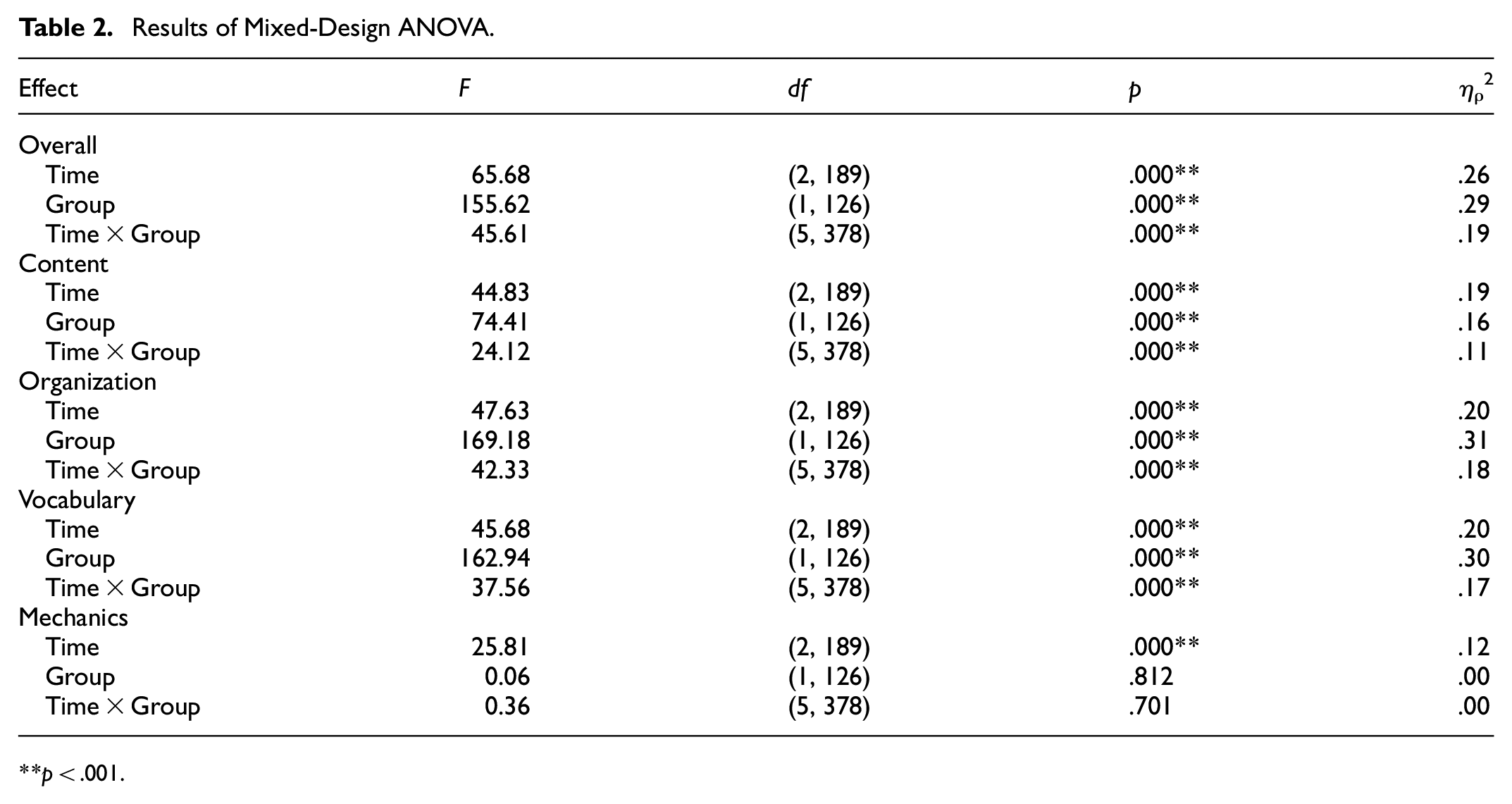
p < .001.
Results of Within-Subject Comparisons.

p < .001.
Table 4 indicated that the pre-test overall English writing scores of EG and CG were comparable (p = .558). However, the EG’s performance significantly exceeded that of the CG in the post-test, p < .001, with large effect size, d = 1.94, and in the delayed post-test, p < .001, with large effect size, d = 1.87.
Results of Between-Subject Comparisons.

p < .001.
Effect on Individual English Writing Dimensions Over Time
The mixed-design ANOVAs (Table 2) revealed significant interactions between time and group effects on the content (F (5, 378) = 24.12, p < .001, η ρ 2 = .11), organization (F (5, 378) = 42.33, p < .001, η ρ 2 = .18), and vocabulary dimensions (F (5, 378) = 37.56, p < .001, η ρ 2 = .17). However, the interaction on the mechanics dimension was not significant (F (5, 378) = 0.36, p = .701, η ρ 2 = .00).
The simple effect analysis (Table 3) revealed significant improvement in the content dimension for EG over time (pre-test vs. post-test, p < .001; pre-test vs. delayed post-test, p < .001), with sustained effects (post-test vs. delayed post-test, p = .496). In contrast, CG showed no significant improvement (pre-test vs. post-test, p = .110; post-test vs. delayed post-test, p = .904). The analysis also indicated significant and sustained improvement in the organization dimension for EG (pre-test vs. post-test, p < .001; pre-test vs. delayed post-test, p < .001; post-test vs. delayed post-test, p = .612), while CG showed no significant improvement (pre-test vs. post-test, p = .693; post-test vs. delayed post-test, p = .910). Similarly, the vocabulary dimension in EG improved significantly (pre-test vs. post-test, p < .001; pre-test vs. delayed post-test, p < .001), with effects retained (post-test vs. delayed post-test, p = .275); CG showed no significant change (pre-test vs. post-test, p = .467; post-test vs. delayed post-test, p = .671). Additionally, both EG and CG showed significant improvement in the mechanics dimension (EG: pre-test vs. post-test, p < .001; pre-test vs. delayed post-test, p < .001; post-test vs. delayed post-test, p = .409; CG: pre-test vs. post-test, p < .001; pre-test vs. delayed post-test, p < .001; post-test vs. delayed post-test, p = .836).
Table 4 presents between-group comparisons across various individual dimensions. In the content dimension, no significant difference was observed in the pre-test (p = .496), while EG outperformed CG in both the post-test (p < .001) and the delayed post-test (p < .001), with large effect sizes, d = 1.41 and d = 1.30, respectively. In the organization dimension, there was no significant difference between EG and CG in the pre-test (p = 1.000), but EG surpassed CG in the post-test, p < .001, with a large effect size (d = 1.90), and in the delayed post-test, p < .001, with a large effect size (d = 2.10). Similarly, the vocabulary dimension saw no significant difference between EG and CG in the pre-test (p = .762); however, EG outperformed CG in the post-test, p < .001, with a large effect size, d = 1.85, and in the delayed post-test, p < .001, with a large effect size, d = 1.82. The mechanics dimension, however, did not exhibit significant between-group differences in the pre-test (p = .836), post-test (p = .409), and delayed post-test (p = .836).
Given the non-normal distribution of language use scores, the Friedman test was employed to assess its differences over time. Table 5 indicated that production-oriented approach had effects on the language use scores for EG (χ2 = 61.19, p < .001), while CG, following the product-oriented approach, showed no effects over time (χ2 = 2.14, p = .343).
Friedman Test Results for the EG and CG on Language Use.

p < .001.
Post-hoc analysis with Wilcoxon signed-rank test was conducted with a Bonferroni correction applied, resulting in a significant level set as p < .017. Significant improvements in the language use dimension were observed in EG in the pre-test versus the post-test (z = −6.28, p < .001, r = −.56), and the pre-test versus the delayed post-test (z = −6.11, p < .001, r = −.54). No significant difference was found for EG in the post-test versus the delayed post-test (z = −1.24, p = .217, r = −.11), indicating that the effect was sustained in the delayed post-test. However, no significant differences were found in the language use scores for CG in the pre-test versus the post-test (z = −0.10, p = .924, r = −.01), the pre-test versus the delayed post-test (z = −.1.27, p = .206, r = −.11), and the post-test versus the delayed post-test (z = −0.72, p = .471, r = −.06), suggesting the minimal impact of the traditional product-oriented approach on students’ language use in writing. In addition, Mann-Whitney U tests were conducted to examine the differences in the language use dimension between EG and CG across time. The results revealed that the two groups were quite similar in the pre-test (U = 1,792.50, p = .213, r = .11); however, statistically significant differences between EG and CG were found in the post-test (U = 685.00, p < .001, r = .58) and retained in the delayed post-test (U = 639.50, p < .001, r = .60).
Effect on Foreign Language Writing Anxiety
Descriptive statistics of students’ foreign language writing anxiety in both EG and CG are detailed in Table 6. The changes over time are depicted through line charts in Figure 3. With the assumptions of normal distribution, homogeneity, and sphericity being met, mixed ANOVAs were applied for the overall foreign language writing anxiety scores and individual dimensions, including cognitive anxiety, and somatic anxiety. For the avoidance behavior, which exhibited a non-normal distribution, Friedman test was conducted as an alternative analysis. The baseline test results revealed no significant differences in foreign language writing anxiety among students in the pretest (overall, p = .957; cognitive anxiety, p = .844; somatic anxiety, p = .967; avoidance behavior, p = .958).
Descriptive Statistics of EG and CG Students’ Overall Foreign Language Writing Anxiety Scores and Individual Dimensions Across Time.

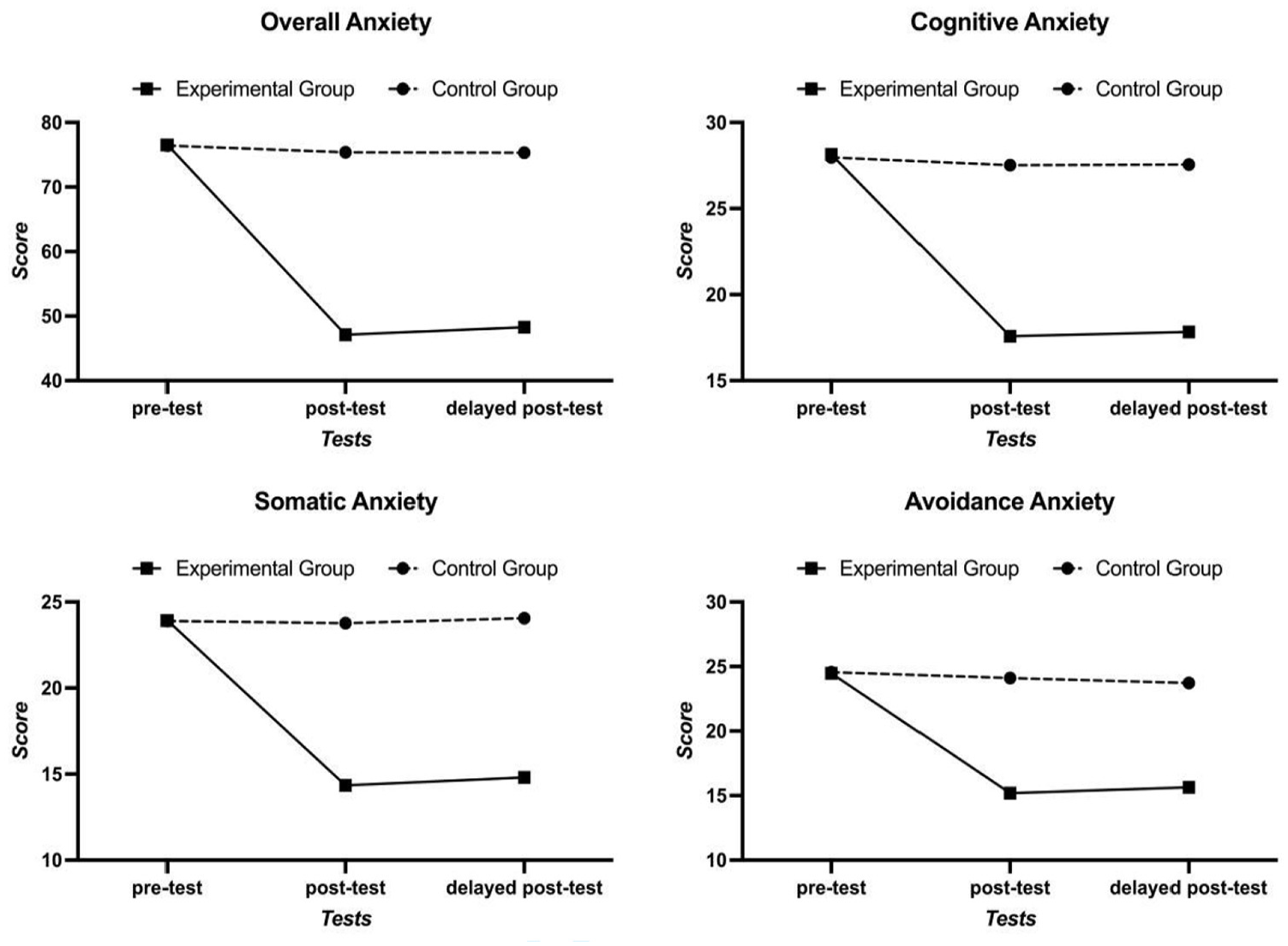
Group means for scores in overall writing anxiety and individual dimensions across time.
Effect on Overall Foreign Language Writing Anxiety Over Time
According to mixed-design ANOVA results presented in Table 7, there is a significant interaction between the effects of time and group on students’ overall foreign language writing anxiety, F (5, 378) = 61.47, p < .001, η ρ 2 = .25. To further investigate the time × group interaction effect, simple effect analyses were conducted. Within-subject comparisons (see Table 8) showed that the EG’s adoption of production-oriented approach resulted in a decrease in overall foreign language writing anxiety over time (pre-test vs. post-test, p < .001; pre-test vs. delayed post-test, p < .001), with the effect maintained in the delayed post-test (post-test vs. delayed post-test, p = .578). In contrast, the CG showed no significant alleviation of overall foreign language writing anxiety throughout the study (pre-test vs. post-test, p = .615; post-test vs. delayed post-test, p = .976; pre-test vs. delayed post-test, p = .593).
Results of Mixed-Design ANOVA.

p < .001.
Results of Within-Subject Comparisons.

p < .001.
Table 9 presents the results of between-group comparisons, indicating that the overall foreign language writing anxiety of EG and CG were found to be similar in the pre-test (p = .957). Following the intervention, EG showed a significant decline in overall foreign language writing anxiety than CG in the post-test, p < .001, with a large effect size, d = 2.95, and in the delayed post-test, p < .001, with a large effect size, d = 2.43.
Results of Between-Subject Comparisons.

p < .001.
Effect on Individual Foreign Language Writing Anxiety Dimensions Over Time
The mixed-design ANOVAs (Table 7) revealed significant interactions between time and group effects on both cognitive anxiety, F (5, 378) = 44.00, p < .001, η ρ 2 = .19, and somatic anxiety, F (5, 378) = 49.87, p < .001, η ρ 2 = .21.
Simple effect analysis (Table 8) confirmed that EG experienced a significant and sustained decrease in cognitive anxiety over time (pre-test vs. post-test, p < .001; pre-test vs. delayed post-test, p < .001; post-test vs. delayed post-test, p = .774), unlike CG (pre-test vs. post-test, p = .603; post-test vs. delayed post-test, p = .971). Similarly, EG saw a significant reduction in somatic anxiety following the implementation of the production-oriented approach, maintained in the delayed post-test (pre-test vs. post-test, p < .001; pre-test vs. delayed post-test, p < .001; post-test vs. delayed post-test, p = .554), whereas CG did not (pre-test vs. post-test, p = .870; post-test vs. delayed post-test, p = .714).
Table 9 indicates that the cognitive anxiety dimension did not differ significantly between EG and CG in the pre-test (p = .844), but EG achieved a significant and lasting decrease in cognitive anxiety than CG in the post-test (p < .001), and in the delayed post-test (p < .001), with large effect sizes, d = 2.31 and d = 2.03, respectively. For somatic anxiety, between-group comparisons suggested that the pre-test scores were not significantly different between EG and CG (p = .967), but EG demonstrated a significant and sustained decrease than CG in the post-test, p < .001, with a large effect size (d = 2.20), and in the delayed post-test, p < .001, with a large effect size (d = 2.37).
Given the non-normal distribution of avoidance behavior scores, the Friedman test was employed to examine the differences over time. As indicated in Table 10, EG, with the implementation of production-oriented approach, experienced changes in the avoidance behavior dimension (χ2 = 67.62, p < .001), while CG, following the traditional product-oriented approach, displayed no effects across time (χ2 = 3.09, p = .214).
Friedman Test Results for the EG and CG on Avoidance Behavior.

p < .001.
Post-hoc analysis with Wilcoxon signed-rank test was conducted with a Bonferroni correction applied, resulting in a significant level set as p < .017. EG exhibited a significant decrease in the avoidance behavior dimension in the pre-test versus the post-test (z = −6.56, p < .001, r = −.58), and the pre-test versus the delayed post-test (z = −6.32, p < .001, r = −.56). No significant difference was found for EG in the post-test versus the delayed post-test (z = −0.81, p = .418, r = −.07), suggesting a retained effect in the delayed post-test. In contrast, no significant differences were found in the avoidance behavior scores in CG in the pre-test versus the post-test (z = −0.58, p = .560, r = −.05), the pre-test versus the delayed post-test (z = −1.26, p = .208, r = −.11), and the post-test versus the delayed post-test (z = −0.41, p = .681, r = −.04), implying the minimal effect of traditional product-oriented approach on students’ avoidance behavior scores. Additionally, Mann-Whitney U tests were conducted to compare the differences between EG and CG over time. The results revealed no significant differences between EG and CG in the pre-test concerning the avoidance behavior dimension (U = 2037.00, p = .958, r = .01), but highlighted the significant improvement of EG as opposed to CG in the post-test (U = 80.00, p < .001, r = .83) and the delayed post-test (U = 336.50, p < .001, r = .72).
Discussion and Conclusion
The present study investigated the effect of the production-oriented approach on foreign language writing anxiety and English writing performance among Chinese university students. The experimental group was instructed through the production-oriented approach, whereas the control group was taught through the traditional product-oriented approach for a 15-week semester. By comparing the results in the pre-test, post-test, and delayed post-test, it was revealed that the English writing performance among students in the experimental group significantly improved (as seen in content, organization, vocabulary, language use, mechanics, and overall scores) after receiving 15-week production-oriented instructions, and the improvement was retained in the delayed post-test. The findings were encouraging since the findings of W. Zhang’s (2020) empirical study of the effect of the production-oriented approach on Chinese university students’ English writing performance found that although students in the experimental group achieved higher scores in vocabulary, genre knowledge, and rhetorical structure after the 2-week production-oriented instructions, no improvement was identified in terms of content and the organization. Therefore, the current study revealed that longitudinal production-oriented writing instructions can effectively improve Chinese university students’ English writing performance. The current study also found that the effect of the production-oriented approach can be retained upon the completion of teaching intervention. The present study made a response to W. Zhang’s (2020) call for a longer duration of production-oriented instructions and an additional delayed post-test to investigate the follow-up effect of the interventions.
Students in the experimental group had great improvement in the content of the English writing, which means students may benefit from the motivating and enabling stages. The genre awareness, communicative purpose, and the awareness of the target social context obtained from the communicative scenarios constructed by the teacher helped students to have a clear understanding of the purpose of the writing task so that they were capable of generating a composition to realize the specific communicative purpose effectively (Yasuda, 2011). The reading materials and writing model texts related to the writing task offered students a variety of ideas and information, which may be helpful for them to enrich the content of their English compositions and realize the linguistic features of the writing task (Hyland, 2019). Furthermore, the group discussion gave students the opportunities to brainstorm more creative and innovative ideas jointly and exchange them with each other, during which the students’ ideas became much more well-developed and contributed to their writing content further (Heidari Darani et al., 2023; A. R. Rezaei, 2023).
The language use of students in the experimental group improved dramatically after 15-week production-oriented instructions, which concurs with Xuan et al.’s (2023) and W. Zhang’s (2020) empirical findings. The explicit instructions equipped students with important grammar items and sentence structures that may be used to finish the writing task, which supported students’ following the writing process and reduced their difficulties in grammar accuracy (Hughes et al., 2022). In this case, they were more likely to make fewer grammatical errors in writing. Moreover, during the assessing stage, students received detailed feedback from both teachers and peers on their drafts, and the feedback focusing on grammatical aspects helped students to recognize their problems in grammatical errors and polish their drafts (Li & Zhang, 2021; Ruegg, 2015). In this process, their ability to English compositions with fewer grammatical errors and better language expressions may be significantly developed.
The development of organization was found among students in the experimental group, which may be partially because of the planning strategies taught in the enabling stage. Planning strategy is used by writers to have an outline of the content they are going to write before the actual writing behaviors (Kieft et al., 2007), and students could use this strategy to have a direction for writing before they begin to write. Many empirical studies have found the positive effects of planning strategy on students’ English writing performance (Baaijen et al., 2014; Chung et al., 2021). Furthermore, in the assessing stage, students exchanged their writing products within a group and offered detailed peer feedback to their peers. During the process of producing and receiving peer feedback, problems in the structure of students’ compositions were also pointed out, enhancing the organization of their compositions, which was corroborated by Wu et al.’s (2023) study.
Students in the experimental group have made remarkable progress in the vocabulary of their English writing, revealing that the experimental group’s students have a better command of vocabulary on account of the implementation of the production-oriented approach, which is consistent with the findings of Xuan et al. (2023) and W. Zhang (2020). The attempt to write in the motivating stage helped students to notice their current problems and difficulties in writing. This may enhance students’ motivation to learn and enable them to realize the urgent need to learn new vocabulary to help them complete the writing task successfully, which is supported by the findings of T. Huang and Wu (2022). They found that students’ increased vocabulary size can be attributed to increased learning motivation. Furthermore, the teaching activities during the process of production-oriented writing instructions facilitated students to understand the communicative process and genre awareness of the writing task, and this may help them to make the most appropriate “lexico-grammatical choices for a specific genre” (Y. Huang & Zhang, 2020, p. 355).
Students in both the experimental group and the control group made a great improvement in terms of mechanics. The accurate use of mechanics was constantly stressed in every lesson of the control group, and writing excerpts, including mechanics errors of students, were present and explained in detail to ensure that they would not make the same errors. Given that the use of mechanics was not highly context-dependent, students could grasp the appropriate use of mechanics, such as spelling and capitalization, with less difficulty (Y. Huang & Zhang, 2020), which may explain the control group’ s significant improvement in mechanics score under the instruction of the traditional product-oriented approach. With regard to the experimental group, even though the knowledge of mechanics was not explicitly instructed, students gradually obtained the knowledge from the reading and writing materials offered by the teacher. Furthermore, feedback from the teacher and peers helped them to recognize and correct their mistakes in mechanics, and this also strengthened their understanding of mechanics further (Huisman et al., 2018).
However, despite that the knowledge of vocabulary, content, language use, and organization was actually taught to students by using the product-oriented approach, no significant improvement can be seen among students in the control group in these four dimensions. The product-oriented approach is seen as teacher-centered, which was found to cause students’ negative emotions about writing tasks (Yu et al., 2023) and failed to raise students’ learning motivation and enthusiasm (Lee et al., 2018; Ren & Wang, 2018). Furthermore, it emphasizes too much on the language input, whereas the importance of language output is neglected (Ren & Wang, 2018), which means that students may struggle to transfer the knowledge they learned in class into their independent writing process.
In addition, based on the results in the pre-test, post-test, and delayed post-test, it can be found that the students’ foreign language writing anxiety in the experimental group was significantly mitigated (as seen in somatic anxiety, cognitive anxiety, avoidance behavior, and overall anxiety scores) after receiving production-oriented writing instructions for 15 weeks, and the positive effect was sustained in the delayed post-test. Avoidance behavior refers to individuals’ anxiety from the behavioral aspect, evident as the reluctance or refusal to engage in the writing process (Cheng, 2004b). The avoidance behavior dimension of foreign language writing anxiety has been significantly reduced among students in the experimental group, which means students may benefit from the motivating stage. At the beginning of the writing instructions, the production-oriented approach stimulated students’ willingness to write instead of compelling them to write by creating a real-life scenario of the writing task. This may enhance their intrinsic motivation to write and enable them to actively engage in the writing process, reducing their avoidance behavior toward writing activities (Liu & Zhang, 2019; Xuan et al., 2023; M. Yang & Deris, 2023). Moreover, the teacher formulated the teaching and learning objectives of the lesson based on the students’ feedback about their own writing difficulties. Students may expect that they were capable of overcoming their individualized writing difficulties if they participated in the writing activities in the class, which were likely to make them less reluctant to engage in the writing process (Razalan, 2024).
Somatic anxiety refers to the psychological dimension of individuals’ anxious experiences, which can be reflected in negative perceptions such as apprehension and mental stress (Cheng, 2004b). A decrease in somatic anxiety was found among students in the experimental group, and this might be partially due to the multiple procedures of writing instructional activities in the enabling stage. The linguistic knowledge, genre information, and writing strategies learned from the explicit instructions in production-oriented writing instructions supported students in making the appropriate word choice and planning the structure of the writing systematically. This could enable students to become more confident and capable of accomplishing the target writing topic so that their somatic anxiety was reduced accordingly (Lu et al., 2018; J. Yin, 2019). Collaborative activities such as brainstorming and the analysis of reading materials helped students to get in touch with a wide range of ideas related to the writing topic. Therefore, students had less pressure to generate ideas independently, and their apprehension and mental stress of generating ideas for foreign language writing were relieved since one of the main sources for writing anxiety is that writers cannot generate enough ideas about what he or she plans to write (Badrasawi et al., 2016; Bruning et al., 2013; İpek & Karabuğa, 2022). Similarly, ideas obtained from the model writing samples could alleviate students’ anxious feelings caused by the difficulty in idea generation for writing further. In addition, at the assessing stage, students exchanged their compositions within the group for peer feedback, which means they had the opportunity to read many compositions of their peers. This offered learners a considerable number of opportunities to learn from the errors in their peers’ compositions and enabled them to recognize the frequently occurring errors in English writing. This may cultivate their awareness to avoid similar errors in their future English writing and contribute to reduced somatic anxiety (Noroozi & De Wever, 2023; Yastıbaş & Yastıbaş, 2015; Zhu et al., 2023).
Cognitive anxiety is related to the cognitive component of individuals’ anxiety, encompassing negative self-expectations and concerns about external comments or judgment such as their teachers (Cheng, 2004b). A salient decrease in cognitive anxiety was observed among students in the experimental group, which may be attributed to the collaborative peer-supporting atmosphere established in the assessing stage. Previous research had revealed that students were likely to experience a high level of writing anxiety when their tasks and assignments were presented in front of their teacher since they were concerned about receiving negative comments or judgment from the teacher (Cahyono et al., 2023; M. Rezaei & Jafari, 2014). In the current study, students’ completed written products were presented to their peers and they received feedback from them to make the first round of revisions before presenting it to the teachers. This could relieve students’ anxiety caused by perfectionism or the belief that they should generate an error-free composition before presenting it to the teacher (Flett et al., 2016; Khosravi et al., 2023; Yastıbaş & Yastıbaş, 2015). In contrast, given that the students in CG only received feedback from the teacher, the teacher would find all errors in students’ compositions, which may lead to increased writing anxiety among students. In essence, many studies have shown that students’ foreign language writing anxiety was statistically negatively associated with their English writing performance (Fitrinada et al., 2018; Sabti et al., 2019), and students’ deficiency in English writing is one of the most important underlying reasons for the writing anxiety (İpek & Karabuğa, 2022). In light of the findings of the current study, the experimental group’s English writing performance was significantly improved, which may explain the decrease in students’ foreign language writing anxiety.
This longitudinal quasi-experimental study with pretest, posttest, and delayed posttest, indicated the positive impacts of the production-oriented approach on the English writing performance of Chinese university students. This addressed the pressing need identified by Gao and Wang (2023) and W. Zhang (2020) for longitudinal interventional studies to examine the effect of the production-oriented approach on the English writing development of Chinese students over time. Further, this study investigated the previously underexplored effect of the production-oriented approach on foreign language writing anxiety among Chinese university students. The results indicated that the implementation of this approach can significantly mitigate students’ foreign language writing anxiety, which may offer a viable solution for writing teachers to alleviate the high levels of foreign language writing anxiety reported by many Chinese students (D. Yin, 2016).
Some practical implications for future writing instruction in EFL contexts are proposed based on the findings of the present study. Teachers should create a flexible and collaborative atmosphere for English writing so as to mitigate the adverse impacts of foreign language writing anxiety on students’ English writing performance (Namaziandost et al., 2022). Students are prone to be concerned about making mistakes in foreign language writing and perceive good writing as error-free (Cheng, 2004a), and therefore teachers should explain to students that conveying accurate information is more important than language accuracy when they are marking students’ compositions. Teachers should set achievable goals for learners according to their different language competencies. Many students are worried about committing errors before the teachers and classmates (Cheng, 2004a). Accordingly, teachers are suggested to lead students to consider errors from a positive viewpoint. The errors identified in their compositions can help them realize their current weaknesses in writing and then they could develop their writing skills more quickly with feedback from teachers and peers. For students with insufficient second-language grammar knowledge (Cheng, 2004a), it is necessary for English teachers to analyze these students’ grammatical weaknesses in their compositions and arrange additional workshops or seminars on English grammar to help them tackle these difficulties. Moreover, some in-class activities could be organized to develop students’ capability to guess the meanings of unknown words and phrases based on the context.
The following suggestions may be taken into account in future studies. First, the current study was implemented in a university in the Chinese context. Students in other EFL contexts might be invited to participate in future studies to explore the generalizability of the current findings. Second, this study employed a quantitative research design to explore the application of the production-oriented approach. Research with a mixed-methods design may be conducted in the future to have a more holistic understanding of this approach.
Footnotes

Ethical Considerations
This study obtained ethical approval from the research ethics committee of Zhejiang Yuexiu University. All methods performed in the study were carried out in accordance with the 1964 Helsinki Declaration and its later amendments or comparable ethical standards.
Consent to Participate
Informed consent was obtained from all individual participants involved in the study.
Author Contributions
Conceptualization: C. Wu; Methodology: C. Wu; Investigation: T. Huang; Data curation: T. Huang; Software: C. Wu; Original draft: T. Huang, C. Wu, & W. Zhang; Review & Revising: T. Huang, C. Wu, W. Zhang & Y. Chen; Project administration: T. Huang & C. Wu. All authors have read and agreed to the published version of the manuscript.
Funding
The author(s) received no financial support for the research, authorship, and/or publication of this article.
Declaration of Conflicting Interests
The author(s) declared no potential conflicts of interest with respect to the research, authorship, and/or publication of this article.
Data Availability Statement
We confirm that the data supporting the findings are available within this article. Raw data supporting this study’s findings are available from the corresponding author, upon reasonable request.