




Abstract
Multiple previous studies in language learning have examined the static effect of various independent variables on Foreign Language Enjoyment (FLE) and Foreign Language Classroom Anxiety (FLCA), but little attention has been given to the dynamic features of these two learner emotions. The present study is based on a pseudo-longitudinal design to investigate the change of FLE and FLCA over time and their interplay with independent variables (learner-internal and teacher-centered variables) in a higher education context. A total of 288 English learners divided into three groups (undergraduates, master’s students, and doctoral students) completed the FLE, FLCA, and NEO Five-Factor Inventory questionnaires. Statistical analyses showed that doctoral students and undergraduates reported higher levels of FLE, while master’s students reported the highest levels of FLCA. Multiple regression analyses signified that FLE was jointly predicted by learner variables and teacher variables, whereas FLCA was solely predicted by learner variables, with attitude towards English identified as the best predictor for FLE, and Neuroticism as the strong predictor for FLCA in three groups. These results imply that levels of learner emotions and their interaction with predictor variables are dynamic in relation to learners’ educational qualifications. It is thus recommended that teachers and educational institutions implement pertinent interventions to boost FLE and alleviate FLCA at different stages of higher education.
Plain language summary
Many studies have looked at how different factors affect two important emotions in language learning: Foreign Language Enjoyment (FLE) and Foreign Language Classroom Anxiety (FLCA). However, most of the previous studies have focused on learner emotions as fixed and unchanging, rather than looking at how they might change over time. This study used a pseudo-longitudinal method to explore how FLE and FLCA change over time in university students and how these emotions relate to factors both within the students and related to their teachers. A total of 288 students studying English, including undergraduates, master’s students, and doctoral students, took part in the study. They completed surveys about their enjoyment and anxiety in learning English, as well as a personality questionnaire. The results showed that undergraduates and doctoral students had higher levels of enjoyment in learning English, while master’s students experienced the most anxiety. Further analysis revealed that both learner-related and teacher-related factors predicted FLE, with a positive attitude towards English being the best predictor. In contrast, FLCA was mainly predicted by learner-related factors, particularly the personality trait of Neuroticism. These findings suggest that learners’ emotions and how they relate to different factors change depending on their level of education.
Keywords
Introduction
The significant role of learner emotions in Second Language Acquisition (SLA) is well-recognized, as in-class emotions have been proven to greatly affect learners’ academic success in the foreign language (FL) learning process (Alrabai, 2022; Botes et al., 2020, 2022). Drawing on Fredrickson’s (2003) Broaden-and-Build Theory, positive emotions (e.g., enjoyment and interest) enhance learning, whereas negative emotions (e.g., anxiety and boredom) interfere with learning. More specifically, Fredrickson (2003) asserted that positive emotions can expand learners’“momentary thought-action repertoires” and increase their long-term personal resources (e.g., intellectual and psychological resources), but negative emotions appear to narrow the repertoire. Similarly, in the context of FL learning, positive emotions are believed to improve concentration, strengthen the awareness of language input, and promote resilience in coping with difficulties in the process of acquiring the target language, while negative emotions fail to maintain a longer attention span and restrict the range of potential language input (Dewaele & Alfawzan, 2018; MacIntyre & Gregersen, 2012). Research on Foreign Language Classroom Anxiety (FLCA), the most well-researched negative emotion, has soared since the 1970s (Liu & Hong, 2021). Consequently, a large body of quantitative and qualitative research on FLCA has been conducted in various educational settings (Kelsen, 2019; Mak, 2011; Resnik et al., 2023). In recent years, with Positive Psychology emerging in the domain of SLA (MacIntyre & Mercer, 2014), positive emotions, as represented by Foreign Language Enjoyment (FLE), have received much scholarly attention and thus become an expanding research topic (Huang, 2022; C. Li, 2020; Zhang & Tsung, 2021).
Lazarus (2003) stressed that it was pivotal to look simultaneously at both positive and negative emotions as they were inseparable. MacIntyre and Mercer (2014) heeded the call and mobilized researchers to adopt a holistic approach to incorporate both positive and negative emotions in language learning research. Similar ideas were developed by Dewaele and MacIntyre (2016) who pointed out that foreign language enjoyment and anxiety were the learners’ metaphorical left and right feet on their language-learning journey. Hereafter, a burgeoning avenue of research, including both FLE and FLCA in research design, revealed the independence of these two emotions, their relationship, and the predictive power of learner-internal and learner-external variables on them (e.g., Dewaele et al., 2018; Dewaele & Li, 2022; Jiang & Dewaele, 2019; Yeşilçınar & Erdemir, 2023). Most of these studies are cross-sectional. However, learner emotions are complex, dynamic, and multifaceted, and they can potentially fluctuate on different timescales in response to a multitude of learner-internal and learner-external factors (Shirvan et al., 2024; Shirvan & Taherian, 2018). Larsen-Freeman (2016) recommended researchers to adopt a longitudinal approach to explore complex constructs in order that their dynamic changes across time, as well as their interplay with different independent variables, can be observed. Resonating with this argument, a few prior studies on FLE and FLCA have employed pseudo-longitudinal or longitudinal methods (Dewaele & Dewaele, 2017; Dewaele et al., 2022; Pan & Zhang, 2023; Shirvan & Taherian, 2018; Shirvan et al., 2024).
Given the limited number of pseudo-longitudinal and longitudinal studies, more work is needed to further our understanding of the dynamic nature of FLE and FLCA. For one thing, little attention has been paid to considering how FLE and FLCA evolve over time among learners with different levels of education. For another, little is known about how learner variables and teacher variables interact with FLE and FLCA across different educational stages. To fill these gaps, the present study applied a pseudo-longitudinal design to undergraduates, master’s students, and doctoral students in an English as a foreign language (EFL) context, focusing on the variation of FLE and FLCA, the flux of their correlation, and the changing interplay between learner emotions and multiple learner variables (Attitudes towards English, English level, Relative standing among peers, Preparation, Openness, Conscientiousness, Extraversion, Agreeableness, and Neuroticism) and teacher variables (Attitudes towards the teacher, Frequency of using English, Teacher’s predictability, Interesting level of teaching content, Positive level of classroom climate, Teacher’s friendliness, Teacher’s humor, Teacher’s strictness, and Frequency of encouraging students).
Literature Review
Foreign Language Classroom Anxiety
In the realm of SLA, foreign language classroom anxiety is one of the most widely studied affective variables (MacIntyre, 2017). Foreign language classroom anxiety was referred to by Horwitz et al. (1986, p. 128) as “a distinct complex of self-perceptions, beliefs, feelings and behaviors related to classroom learning arising from the uniqueness of the language learning process.”Horwitz et al. (1986) also developed the Foreign Language Classroom Anxiety Scale (FLCAS), a 33-item scale, to measure FLCA levels. The FLCAS has been extensively replicated in substantial empirical studies situated in FL contexts, and an overwhelming majority of studies have revealed that FLCA impedes FL learning and ultimately results in unsatisfactory academic attainment, as reviewed in Teimouri et al. (2019).
For over a decade, influenced by the Complexity and Dynamic Systems Theory (Larsen-Freeman & Cameron, 2008), a new line of research has positioned FLCA among a myriad of individual and social factors. MacIntyre (2017) explained that owing to the internal and social dimensions of language anxiety, FLCA constantly interacted with a range of variables (e.g., learners’ personality traits, interpersonal relationships with teacher and peers), and fluctuated on a timescale of seconds, minutes, days, months, and years. Concurrently, Horwitz (2016) also suggested examining how FLCA changed across diverse FL learner samples and conditions.
Foreign Language Enjoyment
While negative emotions, mainly FL anxiety, maintain a strong momentum in SLA research, positive emotions, mainly FL enjoyment, have become an important branch of research due to the Positive Psychology movement (Dewaele & Alfawzan, 2018). Dewaele and MacIntyre (2014) undertook a ground-breaking study that integrated both FLE and FLCA into the research topic, providing a more holistic perspective. They further conceptualized FLE as a “complex emotion, capturing interacting dimensions of challenge and perceived ability that reflect the human drive for success in the face of difficult tasks” (Dewaele & MacIntyre, 2016, p. 216). In a meta-analysis conducted by Botes et al. (2022), higher levels of FLE were confirmed to be associated with less FLCA, greater willingness to communicate, better actual learning outcomes, and higher self-perceived achievement. FLE is also found to be a strong predictor of flow experience and acts as a motivation booster, which is crucial for FL acquisition (Dewaele & MacIntyre, 2024; Dewaele et al., 2023).
Through factor analysis, Dewaele and MacIntyre (2016) unpacked two underlying dimensions of FL enjoyment: FLE–Private and FLE-Social. The former refers to learners’ internal pleasure arising from personal progress and a sense of accomplishment; the latter refers to the satisfaction resulting from an optimal classroom climate that is jointly built by teachers and peers. This identification, as with FLCA, implies that FLE is associated with both learners’ characteristics and the FL learning environment (Jiang & Dewaele, 2019). Indeed, a few recent studies have explored the dynamic interactions between FLE and different learner-internal and learner-external variables, attesting to its dynamic nature (Dewaele et al., 2022; C. Li et al., 2020; Pan & Zhang, 2023; Shirvan & Taherian, 2018).
Cross-Sectional Research on FLE and FLCA
Most research focusing on FLE and FLCA is characterized by cross-sectional research. Dewaele and MacIntyre (2014) carried out a pioneering study to investigate both FLE and FLCA by surveying 1746 FL learners across the globe. To measure FLE and FLCA levels, Dewaele and MacIntyre (2014) developed the 21-item Foreign Language Enjoyment Scale (FLES) and extracted 8 items from the FLCAS (Horwitz et al., 1986). The statistical analyses suggested that participants who were females, multilingual, advanced in the FL, and better educated reported more FLE and less FLCA. Dewaele and MacIntyre (2014) also identified a negative correlation between FLE and FLCA, indicating that they were two related but separate emotional constructs. This conclusion is further supported by the ensuing studies (Dewaele & MacIntyre, 2019; Dewaele et al., 2018, Dewaele, Magdalena, et al., 2019; Dewaele, Özdemir, et al., 2019; Geng & Jin, 2023; Jiang & Dewaele, 2019; Liu & Hong, 2021; Yeşilçınar & Erdemir, 2023).
Among all the variables influencing FLE and FLCA, gender is one of the most frequently researched factors, but the current literature shows contradictory results. For instance, Dewaele et al. (2016) combined both quantitative and qualitative methods to examine the gender differences in enjoyment and anxiety among 1736 FL learners, revealing that female participants exhibited both more FLE and FLCA than their male counterparts. This finding is confirmed by latter research (Dewaele et al., 2018; Liu & Hong, 2021). Nonetheless, some studies reported that the gender difference was significant for FLCA but not salient for FLE (Dewaele & MacIntyre, 2019; Dewaele, Özdemir, et al., 2019; Yeşilçınar & Erdemir, 2023), while Jiang and Dewaele (2019) found no correlation between gender and either emotion.
Educational level is another variable affecting FLE and FLCA, but there are mixed findings regarding the relationship between academic levels and classroom emotions in the existing research. For example, Liu and Hong (2021) found that pupils seemed to display more anxiety and less enjoyment in English class as grade levels increased. However, Dewaele et al. (2018) presented a conflicting pattern, in which British high school students experienced greater FLE by and large as their grade levels increased, whereas their FLCA remained unaffected. In Dewaele and MacIntyre’s (2014) research, participants with higher academic levels (e.g., MA and PhD groups) tended to experience more FLE and less FLCA than those with lower education levels (e.g., middle school students). In another study focusing on older EFL learners between the ages of 50 and 80 in the Universities of the Third Age, Geng and Jin (2023) found that FLCA levels dropped with higher educational qualifications (e.g., college diploma or above), whereas the variation of FLE was minimal. These inconsistent findings could be explained by the varying age groups and cultural backgrounds.
Another variable that is closely related to FL anxiety and enjoyment is learners’ personality traits. Earlier research has revealed that Extraversion is positively correlated with FLE and negatively correlated with FLCA (Dewaele, 2013; Pan & Zhang, 2023), denoting that extroverts are more likely to feel joyful in FL classes compared to introverts. Kelsen (2019) assessed the connections between personality traits and speaking anxiety of 209 EFL learners via the Big Five Inventory (BFI). The findings showed that Extraversion and Openness were linked to less speaking anxiety, whereas Neuroticism and Conscientiousness were linked to more speaking anxiety. In a large-scale study involving 750 FL learners from different countries, Dewaele and MacIntyre (2019) found that Cultural Empathy (the capacity to empathize with the emotional condition of a person from a different culture) and Social Initiative (the efforts to sustain and promote the society) were the strong predictors of FLE and FLCA, although these two personality traits predicted only 10% of the variance in enjoyment compared to 30% of the variance in anxiety.
Concerning the sources of FLE and FLCA, the existing studies have identified a similar pattern that FLCA was more connected with learner factors, while FLE had a stronger relationship with context-related factors. For example, Dewaele et al. (2018) investigated both learner-internal and learner-external variables of FLE and FLCA. A total of 189 students in London were invited to complete the online questionnaire. Quantitative analyses uncovered that FLE was significantly predicted by teachers’ frequency of using the FL, teachers’ predictability, learners’ attitudes towards the FL and the instructor, and their FL levels, while FLCA was predicted by the relative standing among peers, learners’ FL proficiency, and their attitudes towards the FL. This pattern was later reaffirmed by Jiang and Dewaele (2019) who surveyed 564 EFL learners at a university. They found that Chinese undergraduates’ FLE was more easily triggered by teacher variables (teacher’s humor and friendliness, attitudes towards the teacher), whereas FLCA was mainly provoked by learner variables (relative standing in class, FL levels, attitudes towards the FL and the teacher).
Likewise, Dewaele and MacIntyre (2019) reinforced the argument that teacher-centered variables, such as teacher’s friendliness and humor, contributed to learners’ FLE, while learner-related variables, such as multilingualism and FL levels, engendered FLCA. In a similar vein, Dewaele, Özdemir, et al. (2019) concentrated on the FLE and FLCA of 592 Turkish learners in Kazakhstan. Findings suggested that strong predictors of FLE were chiefly teacher-related variables, including teacher friendliness, teacher’s frequency of using Turkish, teacher strictness, and attitudes towards the teacher. On the contrary, the strong predictors of FLCA were learner-related variables, including exam results and their attitudes toward Turkish. The latest research on the causes of FL learners’ enjoyment and anxiety was carried out by Yeşilçınar and Erdemir (2023) who collected data from 305 undergraduates. They found that although contextual factors seemed to play a more dominant role in FLE, both learner and contextual variables accounted for learners’ emotional experiences. This aligns with C. Li (2022) who maintained that FLE was collectively shaped by individual variables (e.g., FL mastery level, attitudes towards the FL) and teacher variables (e.g., enthusiasm, friendliness).
Since many SLA researchers agree on the crucial role of teachers in fueling learners’ FLE, some studies focused exclusively on how teacher characteristics and behavior shaped learners’ FL enjoyment. In Dewaele, Magdalena, et al.’s (2019) study, 210 EFL learners in Spain completed an online questionnaire. Multiple regression analysis showed that teacher’s friendliness and accent explained 20% of the variance in FLE, while teacher’s strictness, FL use, and age explained only 8.4% of the variance in FLCA. These findings strengthened earlier studies that learners’ FLE was more dependent on teachers. In another study conducted by Dewaele and Dewaele (2020), the impacts of teachers on learner emotions were evaluated in a British high school, with 40 FL learners taught by two teachers. Results indicated that participants had similar levels of FLCA, but those taught by the Main Teacher experienced higher levels of FLE. This is because FLE predictors, including attitudes towards the instructor, the instructor’s frequency of using the FL, and unpredictable behavior, were markedly stronger for the Main Teacher than the Second Teacher.
Longitudinal Research on FLE and FLCA
In recent years, an increasing number of research studies on FLE and FLCA have applied longitudinal designs. In a pseudo-longitudinal study, Dewaele and Dewaele (2017) examined how 189 learners’ FLE and FLCA and the predictors of both emotions changed in two British secondary schools. Participants were divided into three age groups, namely 12 to 13 years old (age group 1), 14 to 15 years old (age group 2), and 16 to 18 years old (age group 3). Findings signified that the negative correlation between FLE and FLCA was unchanged among the three age groups; students’ FLCA remained stable, while their FLE levels rose slightly with age. Moreover, variables predicting FLE and FLCA varied in different age groups, with teacher variables making up more variance in the FLE of age groups 2 and 3 than in age group 1. In another pseudo-longitudinal study, Liu and Hong (2021) administered a 26-item questionnaire to 709 Chinese fourth to ninth graders aged 9 to 16 in an elementary school and a junior middle school, assessing how pupils’ FLE and FLCA would change with the increase of grade levels. One major finding is that FLE and FLCA were inversely correlated in all grades apart from grade 9. Overall, pupils were prone to be more anxious as they advanced to higher grades, while their enjoyment levels had a downward trend on the whole. This could be attributed to the mounting pressure of high-stakes tests (e.g., junior and high school entrance examinations) and the more challenging learning tasks.
Pan and Zhang (2023) aimed to explore the variations of FLE and FLCA and the extent to which learners’ classroom emotions were associated with their motivation and personality traits over 16 weeks. Participants were 55 English majors who filled out the FLE/FLCA, motivation, and personality questionnaires at a given time. According to the findings, levels of FLE and FLCA showed ups and downs throughout the whole semester, although FLE had bigger fluctuations than FLCA. Furthermore, FLCA was found to be negatively correlated with Extraversion and positively with Neuroticism; FLE was positively correlated with Extraversion. A more recent longitudinal study undertaken by Dewaele et al. (2022) looked at how three teacher behaviors (in-class FL use, predictability, and joking) impacted 360 FL learners’ FLE, FLCA, and Attitude/Motivation over one semester at a university. Results implied that FLCA levels remained constant, but FLE levels declined as the course progressed. In addition, further analysis demonstrated that respondents’ FLE was positively predicted by all three teacher behaviors, but a non-significant association was found between FLCA and the three teacher behaviors, confirming past research on the pivotal role of instructors in learners’ FLE (Dewaele & Dewaele, 2020; Dewaele & MacIntyre, 2019; Dewaele et al., 2018; Dewaele, Magdalena, et al., 2019; Jiang & Dewaele, 2019).
In accordance with the aforementioned literature, most research on FLE and FLCA has adopted a cross-sectional design in which investigators gather data from participants at one given point in time (e.g., Dewaele & MacIntyre, 2019; Dewaele, Magdalena, et al., 2019). Yet, learner emotions are dynamic in nature, meaning that the levels of FLE and FLCA, their relationship, and the causality between independent variables and FLE/FLCA are not static (Pan & Zhang, 2023). To date, several pseudo-longitudinal and longitudinal studies have concluded that person-environment attributes predicting FLE and FLCA appeared to change among young learners (Dewaele & Dewaele, 2017; Liu & Hong, 2021). However, the variability of FLE/FLCA of foreign language learners at both undergraduate and postgraduate levels remains under-researched. Given the large population of English learners at the tertiary level in China, it is worthwhile to investigate the emotions of Chinese EFL learners across different stages of higher education, including undergraduates, master’s students, and doctoral students. To this end, four research questions were formulated:
RQ1: How do FLE and FLCA correlate with each other across educational backgrounds?
RQ2: How do FLE and FLCA change over time in higher education?
RQ3: How do independent variables predicting FLE and FLCA vary among undergraduates, master’s students, and doctoral students?
RQ4: Are there any gender differences in FLE and FLCA at the tertiary level?
Method
Participants and Contexts
A total of 288 non-English majors (127 males, 161 females) in a Chinese state-owned university participated in this study, aged between 17 and 38. The participants were divided into three groups based on their education levels: 139 first-year undergraduates (62 males, 77 females), 98 first-year master’s students (43 males, 55 females), and 51 first-year doctoral students (22 males, 29 females). The average ages of these three samples were 18 years old (SD = 0.59), 23 years old (SD = 1.81), and 26 years old (SD = 3.26) respectively. All the respondents were Chinese who had studied English as their first foreign language for over ten years.
While participants in this study majored in various disciplines, the English course was mandatory. For freshmen, College English was a three-credit compulsory course that they took twice per week. This course was primarily taught through communicative and task-based language instructional methods which involved a lot of oral practice and pair work. In the second academic year, they were supposed to pass the nationwide English tests called the College English Test Band 4 (CET 4) and College English Test Band 6 (CET 6). As for master’s students, they enrolled in a three-credit course called Academic English in which students learned to deliver academic presentations in English and complete the authentic assignments of writing an English-medium paper. With regard to doctoral students, they took Academic English Writing which predominantly emphasized academic writing and publication skills. The reason why English for Academic Purposes (EAP) programs were embedded in graduate students’ curricula was that academic publication was a prerequisite for the conferment of the master’s degree and PhD degree. Specifically, master’s students in research programs and doctoral students were expected to have their papers published at home or abroad to fulfill graduation requirements. These three courses were taught by Chinese English teachers.
Instruments
The questionnaire started with demographic information regarding participants’ gender, age, major, and educational level. Then, participants answered the questionnaire containing items for FLE, FLCA, and the Big Five. Additionally, items concerning learner-related and teacher-related variables were also included in the questionnaire. The questionnaire was presented bilingually (in English and Chinese). The original scale items were translated into Chinese using back translation.
FLE: The ten-item measure extracted from Dewaele and MacIntyre’s (2014) FLE Scale was labeled “Private-FLE” and “Social-FLE,” rated on a five-point Likert scale ranging from “strongly disagree” (value 1) to “strongly agree” (5). All items were positively phrased, so higher scores on this measure were a sign of higher levels of FLE. In this study, the Cronbach’s alpha reliability coefficients for the three samples’ FLE scales were .849, .870, and .876, signifying strong internal consistency.
FLCA: Another eight items extracted from Horwitz et al.’s (1986) FLCA Scale measured participants’ anxiety levels, reflecting their physical symptoms of anxiety, nervousness, and lack of confidence. Anchored on a 5-point Likert-type scale, responses to these items ranged from “strongly disagree” (value 1) to “strongly agree” (5). Two items implying low anxiety were reverse-coded so that higher scores suggested higher levels of FLCA. The Cronbach’s alpha reliability coefficients of the FLCA scales in the three groups were .912, .911, and .931.
The NEO Five-Factor Inventory: This validated 60-item scale was developed by Costa and McCrae (1992) to measure the Big Five personality traits (Openness, Conscientiousness, Extraversion, Agreeableness, and Neuroticism), with each facet evaluated by 12 statements. Answers to all the items were scored on a 5-point Likert scale, with the negatively phrased items reverse-scored. The scale has been widely applied across different contexts to interpret individual differences in FL learning experiences (Ahmadi-Azad et al., 2020; Kelsen, 2019). The internal consistency, measured by Cronbach’s alpha, for Openness, Conscientiousness, Extraversion, Agreeableness, and Neuroticism was high at .713, .788, .827, .742, and .833 respectively (averaged across three samples).
Openness: This describes an individual’s tendency to stray away from tradition and venture into the unknown. People high in Openness are normally open to novel ideas and abstract thoughts.
Conscientiousness: It refers to the tendency to consistently behave in a goal-directed manner. Conscientious people are usually considered self-disciplined, efficient, and organized.
Extraversion: This trait measures how proactive a person is in terms of interacting with others socially. Extraverts are oftentimes seen as outgoing, sociable, and energetic.
Agreeableness: This describes the ability to deal with the relationships with others. Someone high in Agreeableness is recognized as more sympathetic, altruistic, and compliant.
Neuroticism: It is defined as the emotional stability of individuals. Those who score high in Neuroticism are often inhibited, irritable, and moody.
In addition to the above five personality traits, another four learner-internal independent variables were English proficiency, attitudes towards English, relative standing among peers, and preparation before class. Analogously, there were also nine teacher-related independent variables, encompassing attitudes towards the English teacher, the frequency of using English in class and encouraging students in class, and participants’ perceptions of the teacher and teaching instruction (including how friendly, humorous, strict, and predictable the English teacher was; how interesting the teaching content was; and how positive the classroom atmosphere was). These learner and teacher variables were adopted from Dewaele et al. (2018), Dewaele and MacIntyre (2019), Dewaele, Özdemir, et al. (2019), and Jiang and Dewaele (2019).
Data Collection
Before data collection, the research design and questionnaire were approved by the Ethical Committee at the university where this research project was carried out. Convenience sampling was employed in this study to recruit the target population. This non-probability sampling method was used because of the easy accessibility and close proximity to the subjects (Etikan et al., 2016). Data were gathered at the last teaching session in June 2022 when students were clear about their English learning conditions and had become familiar with the instructors and peers. Initially, the EFL teachers teaching undergraduates, master’s students and PhD students in a provincial university were contacted to get a broad picture of the research. Then, these English teachers forwarded the questionnaire link to students during regular classroom hours within the designated time. Before completing the questionnaire, students were well informed of the purpose of the study, and a consent letter was signed. Participants’ confidentiality, anonymity, and right to participate or withdraw from the study were ensured.
Data Analysis
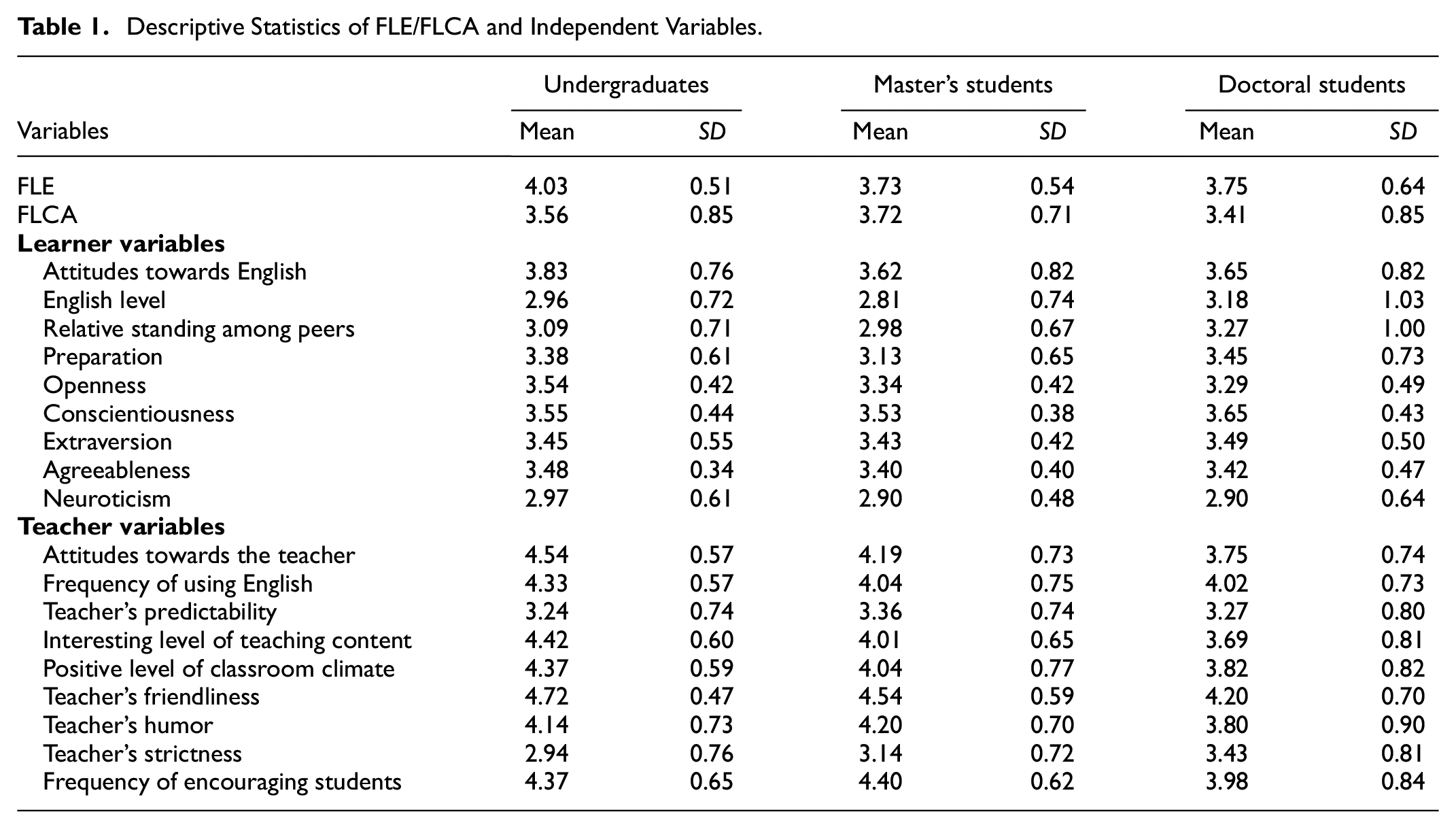
In total, 288 questionnaires were collected: 139, 98, and 51 questionnaires from three groups of students who were pursuing bachelor’s, master’s, and doctorate degrees in the first year. First, questionnaire data were analyzed using SPSS 26 to yield descriptive statistics of dependent variables (FLE and FLCA) and independent variables (learner variables and teacher variables) (see Table 1). The means and standard deviations were calculated to indicate the variances of FLE and FLCA levels across academic backgrounds, and an analysis of variance (ANOVA) was performed to observe whether levels of FLE and FLCA changed significantly. Second, independent t-tests were conducted to investigate gender differences in FLE and FLCA among the three sample groups. Third, correlation analyses were used to examine how FLE and FLCA correlated with each other, and to reveal how FLE and FLCA were related to independent variables in the three different educational stages. Finally, multiple linear regression analyses were run to identify whether the predictive value of the learner and teacher variables on enjoyment and anxiety shifted over time.
Descriptive Statistics of FLE/FLCA and Independent Variables.
Results
The Relationship Between FLE and FLCA Across Educational Backgrounds
Based on the Pearson correlation analysis, FLE was significantly negatively related to FLCA for undergraduate students (r [138] = –.286, p < .001) and PhD students (r [50] = –.342, p = .014), and these classroom emotions shared 8.2% and 11.7% of the variance respectively, demonstrating a medium effect size (Plonsky & Oswald, 2014). However, no significant negative correlation was found between FLE and FLCA for master’s students (r [97] = –.187, p = .65).
The Change of FLE and FLCA Over Time
As visualized in Figures 1 and 2, the average scores in participants’ FLE and FLCA displayed a contrasting trend. Specifically, the levels of FLE declined remarkably from the undergraduate group to the group of master’s students, and then grew slightly in the group of PhD students; the levels of FLCA increased from the undergraduate group to the group of master’s students, and then decreased in the group of PhD students. These patterns implies that master’s students scored the highest in FLCA but the lowest in FLE.
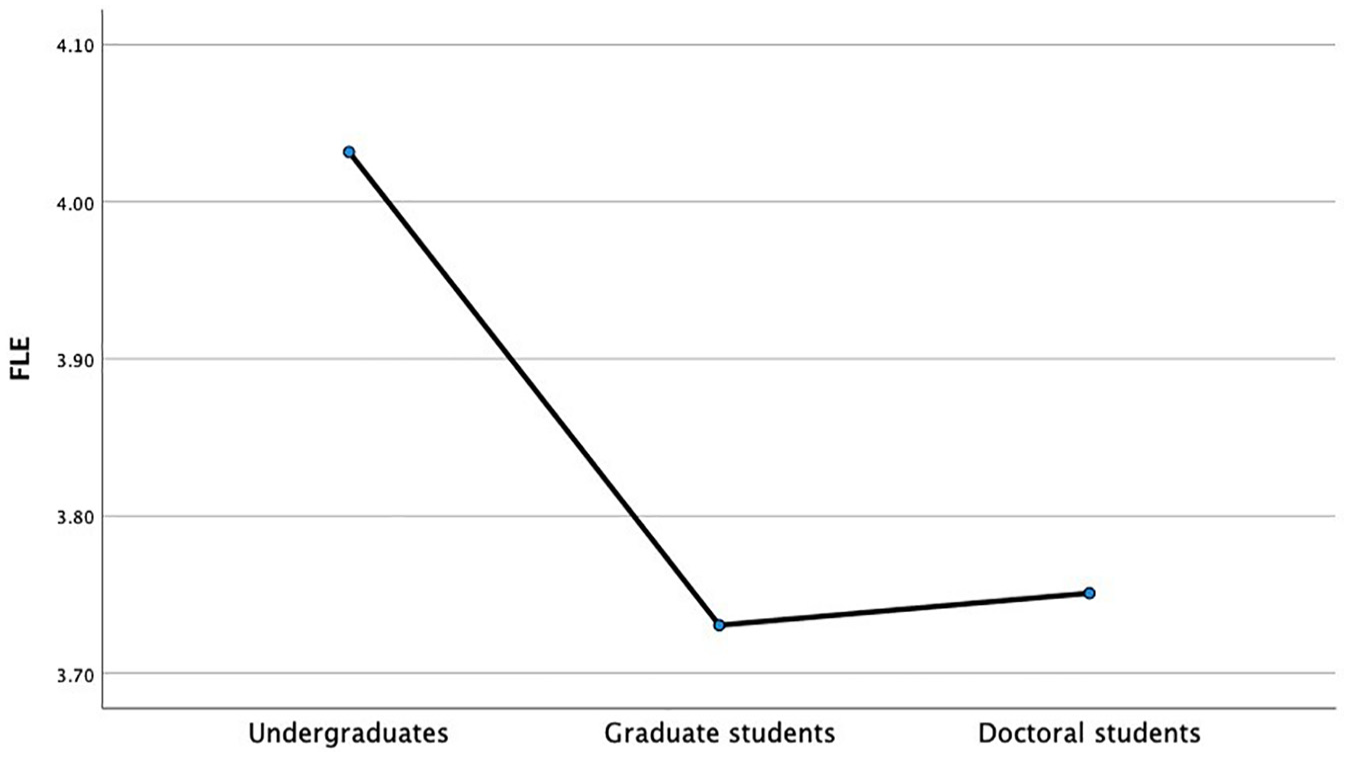
The effect of time on FLE.

The effect of time on FLCA.
As demonstrated by the ANOVA results (see Table 2), FLE varied notably over time (df [2,285], F = 10.43, p < .001, η2 = .068). The post hoc test revealed that the undergraduate group had highly significant differences with the postgraduate groups in FLE levels (p < .001). In other words, undergraduate students’ enjoyment levels were significantly higher than those of postgraduate students in English classes. On the other hand, FLCA remained relatively stable through time (df [2,285], F = 2.57, p = .078, η2 = .018). The post hoc test uncovered that the difference in FLCA levels was only significant between the group of master’s students and the doctoral group (p < .005), with master’s students reporting more anxiety than doctoral students.
ANOVA Results of FLE and FLCA Among Three Groups.

The Independent Variables Predicting FLE and FLCA Among Three Groups
Initially, a series of Pearson correlation analyses were run to identify the independent variables that were significantly correlated with FLE and FLCA. As seen from Table 3, FLE in all three groups was linked to a variety of learner variables and teacher variables, but FLCA in the entire sample was primarily associated with learner variables. Teacher’s predictability was the only variable that had no significant relationship with both emotions. Further, independent variables that were significantly (p < .05) related to FLE and FLCA in three groups were included in the subsequent multiple stepwise regression analyses to determine the best predictors of the dependent variables.
Correlations Between Independent Variables and FLE/FLCA Among Three Groups.

p < .05. **p < .01 (all two-tailed tests).
As shown in Table 4, the analysis of the undergraduate group arrived at significant regression equations for FLE (F(5, 133) = 34.122, p < .0001, Adjusted R2 = .545) and FLCA (F[3, 135] = 23.878, p < .0001, Adjusted R2 = .332). Five variables emerged as the strongest positive predictors for FLE. Learners’ attitudes towards English was the strongest predictor, explaining 32.6% of the variance. Two additional learner-related predictors (Conscientiousness and relative standing in class) and two teacher-related predictors (classroom climate shaped by the teacher and teacher’s encouragement) accounted for 14.4% and 9.2% of the variance in FLE. As for the strongest predictors for FLCA in the undergraduate group, they were Neuroticism, English level, and Conscientiousness, explaining 34.7% of the variance in FLCA.
Results of Multiple Regression Analyses Showing the Best Predictors of FLE/FLCA.
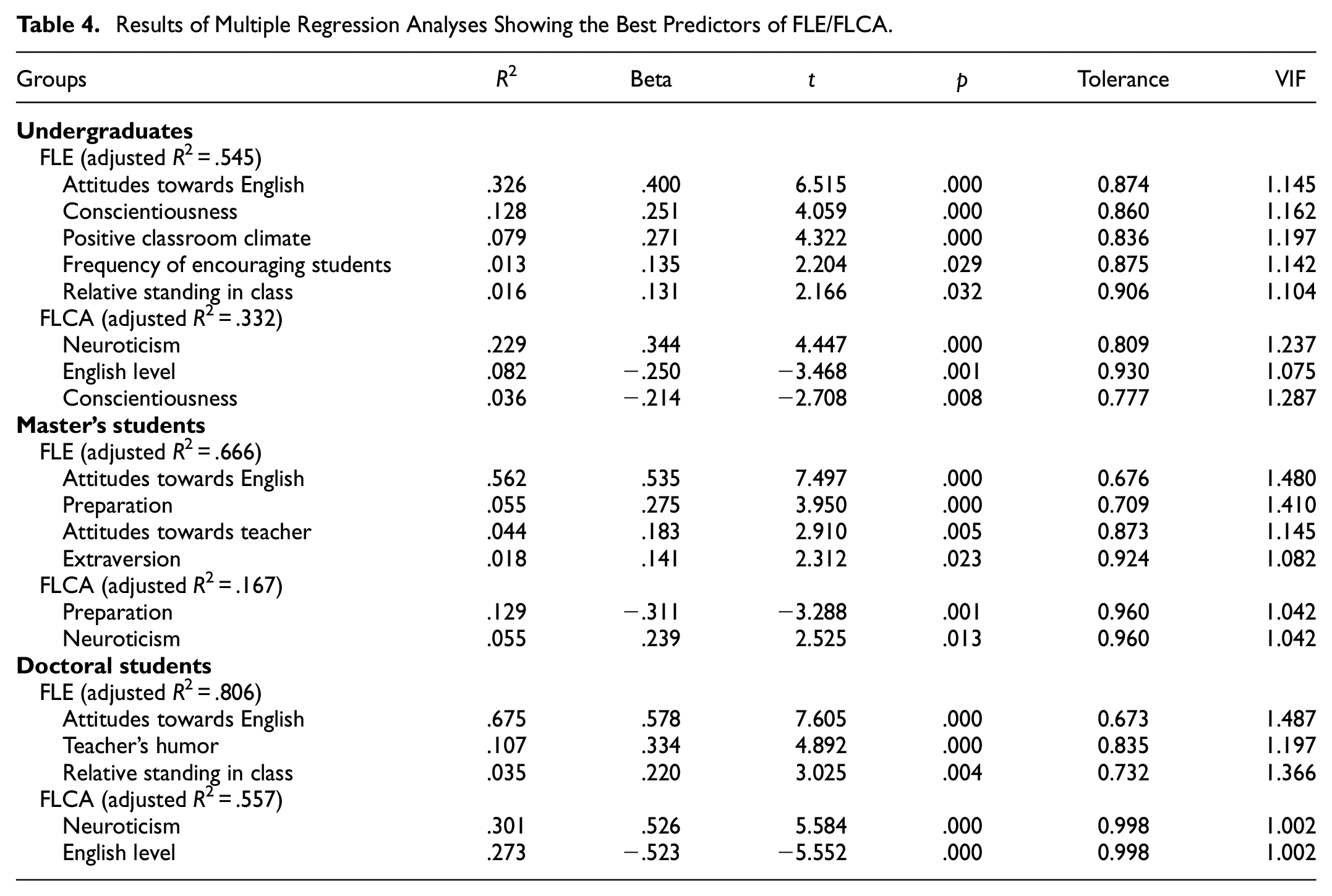
As for the group of master’s students, significant regression equations were also found for FLE (F[4, 93] = 49.290, p < .0001, Adjusted R2 = .666) and FLCA (F[2, 95] = 10.691, p < .0001, Adjusted R2 = .167). The best predictor for FLE was learners’ attitudes towards English (56.2% of the variance), and the remaining predictors included preparation before English class, attitudes towards the teacher, and Extroversion, accounting for a combined 11.7% of the variance in FLE. On the other hand, the most significant predictor for FLCA was preparation (12.9%), followed by Neuroticism (5.5%).
For the group of doctoral students, a significant regression model was found for FLE (F[3, 47] = 70.167, p < .0001, Adjusted R2 = .806), with a favorable attitude towards the target language being the most significant predictor (67.5% of the variance). Teacher’s humor was the only teacher characteristic leading to FLE, with relative standing being an additional predictor (the same as the undergraduate group). These two variables explained approximately 15% of the variance. The stepwise analysis also yielded two predictor variables, namely Neuroticism (30.1%) and English level (27.3%), for FLCA (F[2, 48] = 32.386, p < .0001, Adjusted R2 = .557). Therefore, the predictors of FLCA in the groups of undergraduates and PhD students were similar, with Neuroticism and English level identified as the common predictors. VIF (The Variance Inflation Factor) values of the above-mentioned predictors were all under 1.487, so no multicollinearity was detected.
Gender Differences in FLE and FLCA Levels at the Tertiary Level
As evidenced by the average scores listed in Table 5, the female participants scored higher on FLE and FLCA than male peers in the entire sample and across all the stages of higher education. An exception was that female master’s students scored lower on FLCA than male master’s students. However, independent t-tests suggested that no significant gender difference was found in the whole sample for FLE (Males Mean = 3.82, SD = 0.60, Females Mean = 3.92, SD = 0.53) (t[286] = −1.518, p = .130) nor FLCA (Males Mean = 3.51, SD = 0.81, Females Mean = 3.64, SD = 0.81) (t[286] = −1.316, p = .189). The same pattern was observed in the undergraduate group for FLE (t[137] = −1.632, p = .105) and FLCA (t[137] = −1.791, p = .075), in the group of master’s students for FLE (t[96] = −0.380, p = .705) and FLCA (t[96] = 0.624, p = .534), and in the group of doctoral students for their FLE (t[49] = −0.667, p = .508) and FLCA (t[49] = −0.761, p = .450) (Table 5).
T-test results of FLE and FLCA between genders.

Discussion
The first research question dealt with the relationship between FLE and FLCA across educational levels. A Pearson correlation revealed a negative relationship between FLE and FLCA for all three groups, meaning that participants with high enjoyment may suffer less anxiety in FL learning, and vice versa. This finding is in line with plentiful prior studies (Dewaele & MacIntyre, 2014; Liu & Hong, 2021; Yeşilçınar & Erdemir, 2023). However, the negative correlation was only significant among undergraduates and PhD students, which confirmed that FLE and FLCA were two distinct dimensions instead of opposite ends on the same continuum. Thus, it is likely that FL learners could experience both high or low enjoyment and anxiety synchronously (Dewaele & Dewaele, 2017; Geng & Jin, 2023; Jiang & Dewaele, 2019).
The second research question concerned the change of FLE and FLCA over time. It started with the highest FLE level for college students, dropped to the lowest level for master’s students, and then rose slightly for the group of doctoral students. An opposite pattern emerged for FLCA, as master’s students showed higher mean anxiety ratings than college students and doctoral students. These two findings dovetail with the assertion in some pseudo-longitudinal or longitudinal investigations that levels of FLE and FLCA changed over time (Dewaele & Dewaele, 2017; Liu & Hong, 2021; Pan & Zhang, 2023). Yet, statistically significant differences among the three groups were only found in FLE, but not for FLCA, showing an opposite trend described by Geng and Jin (2023). To be more specific, undergraduates reported much more enjoyment than master’s students and doctoral students. A possible reason is that freshmen have gradually transitioned from exam-oriented instruction in high school to student-centered and communication-based teaching in university, which gives them more freedom to learn English in alignment with their own interests (Jiang & Dewaele, 2019). However, for master’s students and doctoral students in this study and those in other prestigious universities, their institutions normally have specified the number of papers published in high-impact international journals or core domestic journals to meet graduation requirements (Y. Li, 2016). As peer-reviewed overseas publications are overwhelmingly written in English (Flowerdew, 2015), it imposes substantial pressure on EFL master’s students and doctoral students. Consequently, the challenge of English academic writing results in master’s students’ lower FLE and higher FLCA. In 2021, among 3.33 million master’s students in China, those who studied in the universities of “Double First-Class” (world-class universities and first-class disciplines) constituted around 58% of the total, and this figure was projected to increase (PRC Ministry of Education, 2022). Given this, the findings of the second research question deserve nationwide attention.
The third research question delved into the independent variables predicting FLE and FLCA of the three samples in a higher education institution. Findings revealed that predictors of FLE and FLCA varied as students progressed through higher levels of education. FLE was best predicted by a combination of factors, including learners’ attitudes towards the FL, relative standing in the group, learners’ personality traits, teacher characteristics, and teacher behavior. This result broadly accords with those of existing studies, indicating that both individual factors and contextual factors contributed to learners’ enjoyable language learning experiences (Dewaele & MacIntyre, 2019; Dewaele et al., 2018; Dewaele, Özdemir, et al., 2019; Jiang & Dewaele, 2019; C. Li, 2022; Yeşilçınar & Erdemir, 2023). In the present study, attitude towards English was the strongest predictor of FLE in all three groups, explaining 32.6%, 56.2%, and 67.5% of the variance from undergraduate to doctoral levels, which reflected its increasingly explanatory power. One underlying reason could be that students develop more ingrained motivation for mastering English for scholarly purposes as they progress through higher education, Coincidentally, as students in this study advanced through higher education, the influence of learner-internal factors on FLE became more pronounced. This can be explained by greater autonomy, more self-directed learning, and the development of intrinsic motivation. On the other hand, the present study unveiled that FLCA was unrelated to English teachers but linked to learner-internal variables, including learners’ personality traits (mainly Neuroticism), linguistic competence, and their preparation before class. This finding reflects those of prior research that FLCA was more dependent on learners themselves (Dewaele et al., 2018; Jiang & Dewaele, 2019; Liu & Hong, 2021). In this study, Neuroticism strongly predicted FLCA in all groups, which not only denotes ongoing challenges and stress at high academic levels but also provides additional evidence that high levels of Neuroticism were associated with more FLCA (Dewaele & MacIntyre, 2019; Kelsen, 2019; Pan & Zhang, 2023).
Indeed, the researcher was not surprised at the robust connections between Neuroticism and FLCA (in three groups) as well as Extroversion and FLE (in the group of master’s students). Yet, an intriguing finding in the undergraduate group is that Conscientiousness positively affected FLE and negatively influenced FLCA, partially supporting the hypothesis in Kelsen (2019) that Conscientiousness was linked to higher public speaking anxiety. In other words, diligent and self-disciplined learners were prone to exhibit more pleasant feelings in the English class; meanwhile, conscientious learners may overly worry about linguistic mistakes and error corrections, thus fidgeting during language output. In the group of master’s students, preparation was a learner-internal factor gaining significance in shaping their FLE and FLCA, which partially echoes the findings in Tutton and Cohen (2024) that pre-class preparation could mitigate the effects of FLCA. Master’s students have higher academic demands, which involved reading research papers, writing theses, or participating in in-depth discussions. Adequate preparation is essential for managing these tasks effectively; inadequate preparation may jeopardize the ability to comprehend lectures and engage in meaningful discussions (Tutton & Cohen, 2024; Wu, 2019). Therefore, the degree of preparation significantly impacts master’s students’ enjoyment and anxiety levels in English classes. For doctoral students, teacher’s humor emerged as a positive factor contributing to FLE. Given that doctoral students frequently suffer from intense stress owing to their demanding academic workload (Zhang, 2023), the use of humor by teachers can bring them much-needed relief. Conversely, lower English levels heightened their FLCA. This could be ascribed to the advanced nature of doctoral studies, which requires good proficiency in English to meet academic expectations, such as publishing high-quality research papers in peer-reviewed journals and presenting at academic conferences.
In the current database, learner variables explained a greater amount of variance in FLE than teacher variables, and the variables significantly predicting FLCA were all related to learners, reinforcing the observation in Liu and Hong (2021) that learner variables had a stronger relationship with FLE and FLCA than instructor variables. However, this finding differs from some research in which learners’ FLE was predominantly predicted by teacher variables whereas FLCA was primarily predicted by learner variables (Dewaele & MacIntyre, 2019; Dewaele, Magdalena, et al., 2019; Dewaele et al., 2022; Jiang & Dewaele, 2019).
The fourth research question explored the gender effects on FLE and FLCA. Unexpectedly, the gender difference was not statistically significant in the three groups for either FLE or FLCA, which corroborates the outcome reported by Jiang and Dewaele (2019) in a Chinese university context, but it contradicts several prior studies in which females tended to feel significantly more joyful and anxious than males in the FL class (Dewaele & MacIntyre, 2014; Dewaele et al., 2016, 2018). Concurrently, the little impact of gender on FLE in this research mirrors the findings of previous studies in worldwide educational contexts (Dewaele & MacIntyre, 2019; Yeşilçınar & Erdemir, 2023). Plausible explanations for the non-significant association between gender and FLCA include the implementation of the One-Child Policy and the enhancement of females’ social status (Liu & Hong, 2021). Since gender equality and woman empowerment boost Chinese females’ self-confidence, it is possible that females and males have similar levels of anxiety.
Conclusion
With a pseudo-longitudinal design, the current study has examined the FLE and FLCA of Chinese EFL learners from college students to doctoral students, aiming to get a glimpse of how learner emotions interacted with various factors at different educational stages. The following are the major findings: (1) Negative correlation between FL enjoyment and anxiety was significant for undergraduates and doctoral students in English class, but master’s students’ enjoyment and anxiety were not significantly interrelated. This signified that FLE and FLCA were two independent emotion constructs. (2) Among three groups, undergraduates reported the highest level of FLE, and statistically significant differences were found between undergraduates and the other two groups in relation to FLE. In the meantime, master’s students reported feeling more anxious than undergraduates and doctoral peers, and significant differences in FLCA were only observed between the group of master’s students and the doctoral group. (3) FLE of participants in three groups were jointly predicted by a range of learner-internal and teacher-centered variables, with attitudes towards English consistently emerging as the strongest predictor. It is noteworthy that learner variables predicted larger amounts of variance in FLE than teacher variables, which is in contrast with the preceding research. Interestingly, FLCA was predominantly predicted by learner-internal variables, with Neuroticism being identified as the common predictor in all groups. (4) Gender differences were not observed in either emotion throughout the three groups, showing that gender had a negligible impact on participants’ classroom emotions.
All these findings can further our understanding of FLE and FLCA. By investigating how FLE and FLCA evolve among three educational groups and how the interactions between FLE/FLCA and various independent variables change over time, this study could benefit educational institutes, policymakers, and other stakeholders to consider learner emotions dealing with EFL learning. Moreover, prior research has demonstrated that enhancing FLE and alleviating FLCA can lead to positive influences on foreign language learning outcomes (e.g., Dewaele & Alfawzan, 2018), so the findings of this study can provide some practical implications with respect to FL learning and teaching in higher education institutions.
First, as found in the current study, participants’ FLCA in three groups was only predicted by learner-internal factors, whereas their FLE was caused by learner-related and teacher-related factors. This reinforces the conclusion drawn from preliminary studies that FL teachers are more well-suited to fuel learners’ FLE instead of trying to eradicate their FLCA (Dewaele & Dewaele, 2017, 2020; Dewaele & MacIntyre, 2019; Dewaele et al., 2018; Dewaele, Magdalena, et al., 2019; Dewaele, Özdemir, et al., 2019; Dewaele et al., 2022). Teachers are supposed to demonstrate their agreeable characteristics (e.g., friendliness, humor, patience, etc.), effective pedagogical practices (e.g., engaging classroom activities), combined with frequent encouragement for students who complete challenging tasks (Dewaele, Özdemir, et al., 2019; Dewaele et al., 2022; Yeşilçınar & Erdemir, 2023). All these not only help foster learners’ favorable attitudes toward their teachers, but also build a positive atmosphere in the classroom in which learners are ready to explore, engage in, and express themselves in the target language (Dewaele & MacIntyre, 2019; Pan & Zhang, 2023). This kind of FL class will eventually boost students’ enjoyment levels and enhance their learning experience.
Second, it is necessary for instructors to improve learners’ attitudes toward foreign languages, which was found as the most powerful trigger of participants’ FLE. Teachers could incorporate the cultural treasures of the target language in the teaching process to showcase diverse lifestyles and customs. As such, students may realize that the target language not only functions as a medium of communication, but also as access to appreciate a new culture, to reflect from another perspective, and to embrace novel ways of being (C. Li, 2022; Pan & Zhang, 2023; Zhang & Tsung, 2021).
Third, master’s students in this study scored higher than undergraduates and doctoral students on FLCA, which may be attributed to the mandate of publishing English papers in high-impact journals. For this insight, institution-level interventions, including academic English writing support, guidance from the designated tutor, and mental health counseling service, should be in place to help combat anxiety. Also, in the current study, sufficient preparation positively predicted master’s students’ FLE but negatively predicted their FLCA. Therefore, students had better prepare themselves before classes (Liu & Hong, 2021), as using the FL may involve linguistic, cognitive, and psychological abilities, which could be a demanding process for language learners (Mak, 2011).
The limitations of this investigation are evident. First, although a pseudo-longitudinal design could not only sketch out the fluctuations of FLE/FLCA as well as their predictor variables over time, but also avoid boredom and weariness resulting from repetitive data collection, this study is not a genuine longitudinal study. If FL researchers can keep track of the same cohort of respondents throughout their educational experiences, it will depict a more precise and vivid panorama of learner emotions. Second, due to the convenience sampling used in this study, participants of three groups were all recruited from a first-tier Chinese university, so they may not constitute a representative sample. Thus, the study results reported here may not be generalized to all adult EFL learners in China. Future research can include a broader range of Chinese EFL learners receiving higher education to obtain more generalizable results. Thirdly, the quantitative design of this study makes it difficult to unveil the potential causes behind statistical patterns. Hence, it is recommended that similar designs could be coupled with qualitative data, such as students’ journal entries, interviews, and observations, which may help gain more all-sided insights into FL learners’ emotional experiences.
Footnotes
Acknowledgements
The author wishes to thank the students who participated in the study.
Declaration of Conflicting Interests
The author declared no potential conflicts of interest with respect to the research, authorship, and/or publication of this article.
Funding
The author disclosed receipt of the following financial support for the research, authorship, and/or publication of this article: This study is supported by the Project of Hubei Provincial Department of Education (Project No. 21Q012), the Teaching Research Project of Hubei University (Project No. 2023062), and the Research and Planning Fund for Humanities and Social Sciences of Ministry of Education of China (Project No. 24YJA740034).
Ethical Approval
In 2022, the researcher of this study applied for Approval to Use Human Research Participants. Hubei University Institutional Review Board reviewed and approved the application (Reference number 22/HU/157).
Informed Consent
Informed consent was obtained from all individual participants included in the study.

Data Availability Statement
The datasets generated during and/or analyzed during the current study are available from the corresponding author on reasonable request.