




Abstract
This study explores the influence of technological capabilities (TC) and environmental strategies (ENS) on the sustainability performance (SP) of manufacturing firms, using dynamic capabilities theory as a framework. It specifically examines the mediating role of green innovation (GI) in these relationships. Data from 272 managers of manufacturing firms in China were analyzed using partial least squares structural equation modeling (PLS-SEM). The findings indicate that both TC and ENS positively affect GI and SP. Additionally, GI significantly mediates the impact of TC and ENS on SP. By integrating dynamic capabilities theory with empirical evidence from a rapidly developing economy, this research highlights the crucial role of green innovation in strengthening the link between technological and environmental strategies and sustainability outcomes. The study provides valuable insights for practitioners and policymakers, offering practical guidance on enhancing sustainability performance through targeted technological and environmental initiatives.
Keywords
Introduction
Adopting sustainable business practices is increasingly essential for contemporary firms to maintain competitiveness and enhance their sustainability performance (SP) (Bhat et al., 2024; Ha et al., 2023). Technological capabilities (TC) play a vital role in shaping firms’ SP, with significant implications for organizational efficiency and innovation (Feng et al., 2020). Additionally, companies that strategically incorporate environmental strategies (ENS) into their business models demonstrate higher levels of SP, addressing both their ecological impact and market demands (Wijethilake, 2017). The mediating role of green innovation (GI) in this relationship provides a critical lens through which to understand these dynamics. When companies leverage their TC for GI, they can enhance their SP and obtain a competitive edge in the market (Asadi et al., 2020). Similarly, an effective ENS can stimulate GI by fostering a culture of creativity and problem-solving oriented toward sustainability (Aftab et al., 2022; Barba-Sánchez et al., 2024). Moreover, companies integrating TC and ENS focusing on GI demonstrate a more robust SP, responsive to regulatory changes, market shifts, and evolving consumer preferences (Hartmann & Moeller, 2014; Omri, 2020). These firms are more resilient and innovative, utilizing green technologies to develop sustainable products and solutions that meet emerging market needs (Dangelico & Pujari, 2010).
This study adopts the dynamic capability theory (DCT) as its theoretical foundation. According to DCT, sensing opportunities, seizing resources, and transforming operations are the underlying mechanisms through which firms’ innovative capabilities and sustainability performances are achieved (Teece et al., 1997). It explains how, in a sustainability context, firms use technological capabilities and environmental strategies to enable methods to improve their economic performance and environmental and social dimensions. TC and ENS are critical factors shaping firms’ sustainability performance (SP). TC refers to a firm’s ability to utilize and adapt technology to enhance efficiency and drive innovation (Y. Zhang et al., 2019). Firms with strong TC can optimize resource usage, reduce waste, and develop innovative solutions to environmental issues, thereby improving their SP (Johnson & Schaltegger, 2016). ENS integrates environmental considerations into a firm’s operations and strategic decision-making (Chan et al., 2022). Firms that effectively implement ENS can lower their environmental impact, comply with regulations, and meet increasing consumer demand for sustainable products, leading to improved SP (Bhat et al., 2024). However, limited research explores the role of green innovation (GI) as a mediator between TC, ENS, and SP. GI involves creating and commercializing environmentally friendly products, services, or processes that meet market demands (Y. S. Chen et al., 2006). By fostering differentiation and appealing to green consumers, GI can boost SP (Bansal & Roth, 2000). Firms that strategically align TC and ENS to drive GI can thus achieve superior SP (Liu et al., 2022).
The research gap addressed by this study lies in the need for a deeper understanding of the interconnections between TC, ENS, GI, and SP. While previous research has examined the direct effects of TC and ENS on SP (Chan et al., 2022; Dangelico & Pujari, 2010; Fernando & Wah, 2017; Khan et al., 2022), the mediating role of GI has received little attention (Feng et al., 2020; Liu et al., 2022). Additionally, the existing literature has often examined TC, ENS, and SP in isolation, overlooking their combined influence. This study explores how TC, ENS, and SP interact and how GI mediates this relationship. Previous studies have shown that firms with strong green innovation capabilities can utilize resources efficiently and respond quickly to market demands, gaining a competitive edge (L. Zhang et al., 2020). While some research highlights the importance of green innovation in enhancing corporate sustainability (Le et al., 2022), less attention has been paid to how technological capabilities contribute to sustainability through GI. This study aims to fill these gaps and clarify how firms can leverage TC and ENS to drive GI, ultimately improving their SP.
By concentrating on the GI’s mediating function, this study aims to add to the body of knowledge already available about the effects of TC, ENS, and SP. First, the paper investigates the direct impact of TC on SP, building on the knowledge presented by Y. Zhang et al. (2019) and Johnson & Schaltegger (2016) regarding the implications of TC on a firm’s environmental performance. The second objective is to explore the impact caused by ENS on SP, extending the work of Ambec and Lanoie (2012), Chan et al. (2022), and Muñoz-Pascual et al. (2019) on the strategic inclusion of sustainability concerns into company operations. The third objective is to investigate the mediating role of GI in the interactions between TC, ENS, and SP, thus filling the research gap identified by Lin and Zhu (2019) and Q. Wu et al. (2012). This study offers concrete advice for businesses looking to increase SP by efficiently using TC, ENS, and GI. The current study thoroughly reviews the interactions between TC, ENS, GI, and SP to equip enterprises aiming to improve SP with insightful information. Consequently, this study’s central research question is: “How do technological capabilities and environmental strategies, mediated by green innovation, influence the sustainability performance of manufacturing firms?”
This research aims to establish the mechanisms through which TC and ENS contribute to the sustainable performance of manufacturing firms, with a primary focus on the mediating role of green innovation. One clear literature gap is the poor understanding of how TC and ENS jointly drive SP through GI, particularly in the context of emerging nations like China. Given the above gap, we adopt the partial least squares structural equation modeling to analyze data collected from 272 managers in Chinese manufacturing firms. This study’s findings are significant in affecting TC and ENS in both GI and SP. More importantly, they highlight GI’s mediating role in these relationships. As such, they contribute new insights into the DCT. This research offers a novel and precise viewpoint on the relevance and significance of the DCT in TC, ENS, GI, and SP domains. The article makes compelling reasons for a different perspective on how TC, ENS, and enterprises’ SP relate to one another. It disproves the widely held belief that it confines TC to traditional corporate contexts by emphasizing its critical role in advancing GI and broadening its significance within the field of sustainability (Costantini et al., 2013; De Marchi, 2012). The paper also emphasizes the critical theoretical implications of ENS in shaping enterprises’ SP, arguing that efficient ENS implementation can hasten the development of environmentally friendly technologies and directly impact total SP (Ghisetti & Rennings, 2014; Triguero et al., 2013). By presenting these insights, the study contributes to a greater understanding of DCT and proposes a more comprehensive integration of ENS within the broader context of dynamic capabilities. In addition, this study suggests that GI acts as a moderator between firms’ TC and SP, as well as between their ENS and SP, thereby providing firms with an opportunity to enhance their SP through the practical application of TC, ENS, and GI (Horbach et al., 2012). Further, the study explains the relationship between innovation and sustainability for manufacturing firms’ managers, underscoring their interdependence and advocating for an integrated strategy to achieve sustainable performance.
A summary of the organizational structure used to accomplish the research objectives of this study is presented. The upcoming section thoroughly analyzes the existing scholarly works on TC, ENS, GI, and SP. The paper’s third section thoroughly explains the research methodology used in this study, outlining the methods for gathering data, choosing samples, and using data analysis tools. The results of data analysis relevant to the study’s hypotheses are presented in the fourth part. The remainder of this academic article goes deeper into the findings of our study, highlighting its ramifications, identifying any potential obstacles, and outlining possible research avenues. The study’s findings are fully summarized in the paper’s conclusion, and their ramifications are thoroughly examined. To advance this field, we offer proposals for subsequent research endeavors.
Literature Review
Technological Capabilities and Firms’ Sustainability Performance
Utilizing TC offers significant potential for companies to enhance their SP (Akram et al., 2018; Ferreira et al., 2023). Chesbrough (2003) highlights that leveraging technology to drive innovation, optimize resources, and create sustainable business models can improve economic, social, and environmental outcomes. As technology continues to evolve, its role in promoting sustainable practices is expected to grow. SP is typically measured across three dimensions: environmental, economic, and social (Alsayegh et al., 2020; Omri, 2020). TC refers to a firm’s ability to develop, use, and deploy technologies effectively, making it crucial for improving environmental SP (Y. Zhang et al., 2019). A key component is adopting green technologies, such as renewable energy systems and energy-efficient processes, which have been shown to enhance environmental performance (Fernando & Wah, 2017). These technologies help reduce resource consumption, emissions, and waste, ultimately boosting sustainability. Additionally, TC fosters ongoing innovation and sustainability improvements (Demirel & Kesidou, 2019). Firms with robust TC can create novel solutions to environmental challenges, as demonstrated in studies linking TC to reduced carbon emissions (Xing et al., 2020) and proactive environmental innovation (Ambec et al., 2013).
Consistent with DCT, technological capabilities represent the firm’s ability to sense and seize technological advancements to address sustainability challenges. Prior research suggests that firms with strong TC are better positioned to innovate and improve SP by reducing resource consumption and emissions (Y. Zhang et al., 2019). Furthermore, TC can provide a strategic edge to firms, enhancing their operational efficiency, driving innovation, and improving their economic SP (Helfat & Raubitschek, 2018). Enhanced operational efficiency is one of the significant advantages conferred by TC. By leveraging technology, firms can improve productivity and reduce resource consumption, decreasing operating costs (Volberda et al., 2011). For instance, applying automation technology in the manufacturing sector can minimize resource wastage and optimize production processes. Additionally, TC fosters innovation, a key driver of economic sustainability. Firms with robust TC are better positioned to undertake radical innovation, develop new products, services, or processes, and create new market opportunities (Cohen & Levin, 1989). Empirical evidence corroborates the relationship between firms’ TC and their economic SP. A study conducted by Y. Wu et al. (2020) revealed that firms with superior TC demonstrated better economic SP compared to those with less developed TC.
Moreover, the implementation of TC can serve as a means of enhancing a company’s social SP. According to Jain et al. (2011), technology has the potential to strengthen workplace safety and health, facilitate the creation of solutions for social issues through product and service development, and enhance stakeholder communication. Companies that have good IT capabilities will be better positioned to ensure proper coordination between IT and business planning processes, implement effective and low-cost IT applications that provide them with competitive advantages, anticipate future customer needs, and develop critical new product features ahead of, rather than with, the competition. IT capabilities positively impact the firm’s performance through the development of digital orientation and digital transformation of the organization, state Barba-Sánchez et al. (2024). Technologies ensure supply chain traceability and create transparency to improve sustainability performance (Khan, Parvaiz, Dedahanov, et al., 2022). It can be contended that information technology capability and AI-based customer relationship management, as per Siddik et al., 2023, influence artificial intelligence-based customer relationship management and relationship performance and social sustainability performance. Latest technology adoption can also lead to renewable energy use and minimizing emissions (Rahman & Ferdaous, 2024). Akram et al. (2018) reported that firms with better technological infrastructure and capabilities can attain sustainable competitive advantage and perform comparatively better than their competitors. Similarly, Jum’a et al. (2024) concluded that manufacturing companies with strong TC can enjoy superior sustainability performance. Therefore, firms’ TC can potentially improve their triple bottom line (TBL) sustainability performance. In conclusion, we can develop the following hypothesis:
Technological Capabilities and Firms’ Green Innovation
The role of TC in fostering GI has emerged as a key research theme in recent academic discourse. Numerous scholars concur that TC can efficiently stimulate GI within firms (Y. S. Chen et al., 2012; Ghisetti & Rennings, 2014). TC refers to a firm’s capacity to effectively utilize, augment, and adjust its technical resources (Khan, Parvaiz, Bashir, et al., 2022). This capability plays a pivotal role in propelling the GI process. GI is a multifaceted construct, encompassing two primary components—green product innovation and green process innovation (Y. S. Chen et al., 2006). Green product innovation refers to developing environmentally friendly products or enhancing existing products to minimize their environmental impact. On the other hand, green process innovation entails innovating and improving manufacturing processes to reduce environmental degradation (Y. S. Chen et al., 2006).
Y. S. Chen et al. (2006) posit that robust TC plays a significant role in fostering the development of green innovative products.Y.S. Chen et al. (2012) propose that firms possessing advanced TC are more predisposed to invest in and realize success in green product innovation. Similarly, De Marchi (2012) provides empirical evidence that firms endowed with established TC exhibit a higher propensity to launch environmentally friendly products. Adding another dimension to the discourse, Costantini et al. (2013) have found a positive correlation between TC and the probability of developing eco-innovations, emphasizing the role of TC in creating an organizational culture conducive to sustainable innovation.
In parallel, the impact of TC also extends to the realm of green process innovation. This aspect of innovation involves the conception and implementation of novel or considerably improved production processes geared toward environmental sustainability (Rennings, 2000). Tang et al. (2018) argue that companies boasting sophisticated TC can enhance the efficiency of their manufacturing processes, thereby curtailing inefficiencies, reducing energy consumption, and mitigating emissions. Similarly, Florida (1996) maintains that firms with sophisticated TC enjoy a strategic advantage in identifying, developing, and implementing environmentally friendly process innovations. Furthermore, Kesidou and Demirel (2012) argue that TC is essential for firms to mitigate the costs and risks associated with adopting and implementing eco-friendly process innovations. Investments in developing and enhancing TC can lead to environmentally friendly products and processes, thereby supporting environmental sustainability.
As such, the following hypothesis can be formulated:
Environmental Strategies and Firms’ Sustainability Performance
ENS pertains to the methodologies and techniques corporations utilize to mitigate the effects of their operations on the ecological system. In light of mounting expectations for businesses to conform to sustainable practices, ENS has been recognized as a pivotal factor influencing a company’s SP. The ENS can be broadly categorized into two types, namely proactive ENS and reactive ENS (Chan et al., 2022).
The term “Proactive Environmental Strategies (PES),” which consists of voluntary actions that exceed regulatory requirements to integrate environmental considerations into business operations, has been identified as a substantial contributor to a firm’s SP. SP includes a company’s environmental, social, and economic impacts (Hart & Dowell, 2011). This may involve implementing waste minimization techniques, adopting sustainable procurement practices, and incorporating ecologically conscious design principles (Klassen & Vereecke, 2012). Businesses can minimize their environmental impact and promote sustainability by proactively addressing environmental issues. Montabon et al. (2007) revealed that compared to businesses that take a more reactive stance, PES-adopting companies typically exhibit higher levels of environmental performance. Businesses that use PES frequently innovate regarding green technologies, processes, and/or products, increasing environmental sustainability. Companies can cut future ecological risks, penalties, cleanup work, and remediation costs by implementing PES. Additionally, reducing waste and optimizing resources can reduce costs and increase operational efficiency (Ambec & Lanoie, 2012). According to research by Flammer (2013), firms implementing PES were associated with superior financial performance. This effect was attributable to increased operational efficiency and enhanced market recognition, which led to increased sales and profitability. PES can promote social sustainability by positively influencing a firm’s stakeholder relationships. Firms with proactive ENS are often perceived more positively by customers, employees, and the community, increasing customer loyalty, employee engagement, and community support (Muñoz-Pascual et al., 2019).
Conversely, reactive environmental strategies (RES) entail responding to environmental issues as they arise, often to comply with regulatory standards, rather than taking proactive steps. This approach’s influence on a firm’s SP, encompassing environmental, social, and economic dimensions, has been an important research topic (Bansal & DesJardine, 2014). Genç and Benedetto (2019) found that firms that adopted RES to comply with environmental regulations achieved marked improvements in their SP. These strategies include effluent treatment, retrofitting pollution control technologies, and other end-of-pipe solutions (Delmas & Toffel, 2008). Despite being commonly perceived as reactive measures to external pressures, these strategies are instrumental in mitigating environmental risks, safeguarding a company’s image, and upholding its competitive standing. Prior research suggests that reactive strategies can indirectly improve a firm’s SP by reducing the potential for regulatory fines and reputational damage (Jiang & Bansal, 2003).
Furthermore, Chan et al. (2022) observed that companies implementing RES demonstrated improved environmental, social, and governance (ESG) performance. These studies concluded that RES is a critical driver of SP, especially in firms under regulatory or market pressures. ENS is operationalized by implementing specific programs, policies, and procedures, improving product creation. ENS contributes to mitigating energy consumption and waste generation by using sustainable energy sources and effective environmental management systems (Aftab et al., 2023). Based on these findings between the interplay of PES and RES with a firm’s SP, we can hypothesize as below:
Environmental Strategies and Firms’ Green Innovation
Multiple research strands indicate that companies that adopt ENS practices are more likely to enhance their level of GI (Brunnermeier & Cohen, 2003; Dangelico & Pujari, 2010; Ghisetti & Rennings, 2014; Horbach et al., 2012; Zhu et al., 2013). ENS may encompass a range of sustainability-focused methodologies and undertakings, including but not limited to minimizing waste, implementing energy-efficient measures, managing supply chains in an environmentally conscious manner, and creating sustainable products and services (Dangelico & Pujari, 2010; Horbach et al., 2012). Ghisetti and Rennings (2014) provide empirical evidence that establishes a correlation between ENS and a rise in eco-innovation activities undertaken by firms. Their research findings indicate that using ENS may incite an inventive and forward-thinking reaction toward the environment, ultimately resulting in the creation and execution of environmentally friendly technologies. Consistent with this viewpoint, Triguero et al. (2013) discovered that ENS can promote GI by enabling the integration of eco-friendly technologies. ENS enables firms to meet the evolving market demands for sustainable products and directly shape market expectations for sustainability (Dangelico & Pujari, 2010). By incorporating ENS, firms can design and develop greener products that appeal to an ecologically conscious consumer base and foster GI. Firms with robust ENS are more likely to be proactive in complying with green regulations and standards, encouraging the development of green products (Brunnermeier & Cohen, 2003). Furthermore, engaging stakeholders in ENS plays a crucial role in developing innovative green products by leveraging shared knowledge to identify areas of improvement and drive innovation (Hart & Dowell, 2011). Firms that commit to ENS aim for operational efficiency, which encompasses waste reduction and resource optimization, thereby stimulating green process innovation as firms strive to achieve these objectives (Florida, 1996). To satisfy the environmental demands of stakeholders, corporations must establish connections with their stakeholders as part of their environmental strategy. While pursuing green innovation, businesses rely on the connections they establish with stakeholders as valuable assets to address various issues, such as technological challenges (El-Kassar & Singh, 2019) and a lack of green knowledge (Yang & Jiang, 2023). Additionally, ENS often involve adopting cleaner technologies, which mitigate the environmental impact of a firm’s operations and drive process innovation by prompting the development or implementation of new green technologies (Rennings, 2000). As firms embrace ENS, they foster the establishment of sustainable supply chains, encouraging innovation in sourcing, production, and distribution processes and substantially reducing their environmental footprint (Zhu et al., 2013). Considering these arguments, we hypothesize that:
Green Innovation and Firms’ Sustainability Performance
A widespread consensus exists regarding the significance of GI in enhancing SP. GI pertains to innovative products, processes, or services that substantially reduce environmental impacts (Y. S. Chen et al., 2006; Dangelico & Pujari, 2010). Numerous studies have established the direct effects of GI on SP. Demirel and Kesidou (2011) have suggested that companies adopting GI strategies exhibit improved environmental performance, a key element of SP. The enhancement may materialize in diverse forms, encompassing diminished emissions, decreased energy usage, and waste reduction, all of which are vital for the enduring viability of the enterprises. (Y. S. Chen, 2008) further supports this assertion by illustrating that implementing GI can also enhance economic efficacy, a crucial aspect of sustainability. Adopting GI can yield significant financial advantages, such as reduced expenses resulting from the optimized utilization of resources, increased revenue generated by introducing environmentally sustainable products, and a strategic advantage in progressively more ecologically aware markets. This perspective is further reinforced by Porter and Van Der Linde (1995a), who suggest a mutually beneficial situation, commonly referred to as a “win-win” scenario, in which GI leads to improved operational efficiencies, the discovery of novel market opportunities, and enhanced economic performance, all while simultaneously promoting ENS. Furthermore, the implementation of GI has the potential to impact social sustainability through its contribution to promoting healthier communities and enhancing the overall quality of life (Nidumolu et al., 2013). Green products have the potential to mitigate detrimental emissions and enhance air quality, thereby resulting in improved public health and social welfare. It is worth noting that the implementation of GI has the potential to yield favorable outcomes for a company’s reputation, thereby constituting an additional dimension of SP (Hartmann & Moeller, 2014). Organizations perceived as pioneers in GI are inclined to experience elevated levels of trust from stakeholders and customer loyalty, thereby augmenting their SP from a relational standpoint (Du et al., 2010). Asadi et al. (2020) contended that green innovation directly impacts the SP of Malaysian hotels. Kanan et al. (2023) found that GI substantially affects the SP of manufacturing firms in Palestine. Similarly, Yan et al. (2022) reported a positive linkage between banking firms’ GI and their SP. Building on these observations, we can hypothesize that GI has a direct causal impact on firms’ SP.
Mediating Role of Green Innovation
The association between TC and SP has sparked robust debate in environmental economics and business studies. A range of studies presents contrasting views on this relationship, with some indicating a positive impact, others suggesting a negative effect, and a separate group positing no significant correlation at all (Dangelico & Pujari, 2010; Martín-de Castro, 2015; Omri, 2020). Some studies assert enhanced TC, characterized by cutting-edge equipment, advanced software, and skilled personnel, improves SP. These capabilities, they argue, allow organizations to streamline processes, lower resource usage, and decrease environmental harm, thus bolstering their SP (Cai & Li, 2018). On the other hand, some researchers posit that an indiscriminate investment in TC can inadvertently lead to unsustainable practices. Firms emphasizing technological advancements may ignore the environmental consequences, including increased energy consumption or electronic waste generation (Lin & Zhu, 2019; Song et al., 2012).
Meanwhile, a few scholars suggest an insignificant relationship between TC and SP (Omri, 2020). While TC might potentially influence SP, other factors such as organizational commitment, stakeholder pressure, or regulatory frameworks may play a more decisive role. Given these divergent perspectives, the potential exists for the relationship between TC and SP to be mediated by other variables. The concept of GI is one such variable that might mediate this relationship. GI refers to introducing and implementing novel processes, products, or ideas that reconcile economic feasibility with environmental sustainability (Y. S. Chen et al., 2006). Companies with robust TC could apply these toward GI, enhancing their SP. There are three primary arguments supporting GI as a mediator. First, TC forms the basis for any innovation, including GI (Y. S. Chen et al., 2006). Second, GI directly impacts SP by reducing environmental damage and promoting resource conservation (Mongo et al., 2021). Third, GI can help reconcile the conflicting findings from previous studies. If firms leverage their TC for GI, it could lead to a positive impact on SP. Conversely, the lack of GI could account for the adverse or insignificant effects reported in other studies (Dangelico & Pujari, 2010). A few pieces of literature have advocated for the mediating role of green innovation between manufacturing practices, including technological capabilities and sustainability performance (Jum’a et al., 2022, 2024).
Similarly, various studies offer divergent perspectives on the relationship between ENS and SP. While some studies indicate a positive influence, others propose a negative influence, and a distinct group suggests no significant correlation (Porter & Van Der Linde, 1995b; Russo & Fouts, 1997; Schaltegger & Synnestvedt, 2002; Zeng et al., 2010). Proponents of the positive impact perspective argue that implementing ENS, such as renewable energy initiatives or waste reduction programs, can enhance SP (Hartmann & Moeller, 2014). This positive impact is achieved by integrating environmental consciousness directly into business operations, leading to economic and reputational benefits. In contrast, certain studies have suggested that adopting ENS could negatively impact SP (Q. Wu et al., 2012). This argument hinges on the belief that these strategies might divert resources from core business objectives and require a substantial investment and cultural shift, affecting short-term sustainability outcomes. A third stream of research suggests an insignificant relationship between ENS and SP (Zeng et al., 2010). These researchers argue that although ENS are desirable, factors like regulatory compliance, market demand, and stakeholder pressure may profoundly influence SP. Given the divergent viewpoints, we posit that the relationship between ENS and SP is not straightforward but mediated by other factors. One such mediator could be GI. Several arguments could be made to support this proposition. Firstly, ENS could act as the catalyst for GI. Firms with a solid commitment to ENS would naturally seek innovative solutions to environmental challenges (Horbach et al., 2012).
Secondly, GI has been shown to directly impact SP by reducing environmental harm and promoting resource conservation (Mongo et al., 2021). Lastly, GI could help resolve the disparities in existing research on the relationship between ENS and SP. If firms focus their ENS on GI, this could lead to a positive impact on SP. Conversely, the absence of a focus on GI in the ENS could explain the adverse or insignificant effects reported in other studies (Triguero et al., 2013). Further, Rehman et al. (2021) conclude that proactive ENS can strengthen firms’ green innovation and enhance sustainability performance.
Therefore, we posit the hypothesis that:
The conceptual model of this research is illustrated in Figure 1.
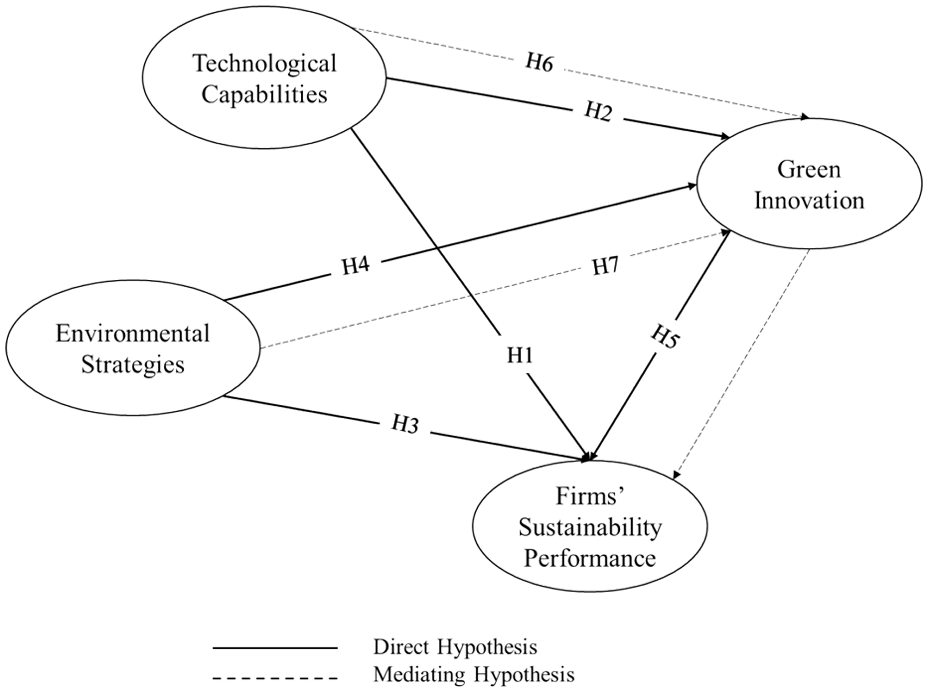
Conceptual model.
Research Methods
Sampling and Data Collection
We obtained data from knowledgeable managers of China’s medium to large manufacturing firms, focusing on the sector’s crucial role in the country’s economy. The manufacturing sector in China has proved to be instrumental in achieving SDG 9, which encompasses industry, infrastructure, and innovation, with manufacturing value added (MVA) contributing approximately 28.3% to the GDP in 2022 (UNIDO Statistics Data Portal, n.d.; World Bank, 2022). As China embraces the fourth industrial revolution, the country has witnessed a notable adoption of cutting-edge technologies such as intelligent manufacturing systems, big data analytics, the internet of things (IoT), and artificial intelligence (AI) within the Chinese manufacturing industry (Koh et al., 2019). This technology-driven transformation, often called “Industry 4.0,” has enhanced China’s global competitiveness and played a vital role in navigating the economic challenges posed by the COVID-19 pandemic (Dongfang et al., 2022). Many Chinese factories have also embraced environmentally friendly technologies and waste management practices, reducing environmental impact and aligning the country with global climate goals (Beraud et al., 2022). China’s commitment to technological innovation and sustainable practices in the manufacturing sector has solidified its position as a leading global player, with an evident dedication to improving its economy and environment (Morrison, 2019). Hence, assessing how Chinese manufacturing firms can enhance their sustainability performance by employing TC, ENS, and GI is crucial.
We collected data on TC, ENS, GI, and SP through a self-administered questionnaire targeting company managers. A stratified sampling technique was employed, considering industry type, firm size, and geographic location to ensure representative results. The questionnaire was pre-tested by four subject experts and seven manufacturing managers to validate its clarity and accuracy. Based on their feedback, several items were revised for better comprehension. After these adjustments, the final questionnaire was distributed to 380 manufacturing firms, accompanied by a cover letter explaining the study’s purpose and assuring respondents of anonymity and voluntary participation. A follow-up effort yielded 272 valid responses, achieving a response rate of 71.58%. Data collection occurred from March to August 2022.
The statistical power required for the PLS-SEM technique utilized in our analysis is adequate, as indicated by the sample size of 272. PLS-SEM is known for handling smaller sample sizes effectively; however, our sample size surpasses the bare minimum necessary to attain reliable outcomes. Hair et al. (2019) state that a rule of thumb for PLS-SEM is 10 times the number of structural paths directed toward a specific construct in the model. Considering the intricacy of our model, the sample size we have utilized is considerably larger than the threshold generally advised to guarantee robust and dependable findings. The respondents’ group reflects the wider population, comprising managers employed in manufacturing companies located in China. By selecting respondents from a broad spectrum of manufacturing companies, we ensured the diversity of our sample and captured a wealth of perspectives and experiences about TC, ENS, GI, and SP.
Measurement Items
Survey items for TC, ENS, GI, and SP were adapted from previous studies and rated using a 5-point Likert scale, where 1 represented “strongly disagree” and 5 represented “strongly agree.” Reliability analysis confirmed that all scales were robust, with Cronbach’s alpha exceeding .70 (Hair et al., 2019). For instance, we measured the predictor TC using six Bhatia (2021) items. The participating firms were asked about their capabilities regarding technology adoption and application. We adopted three items from Tan et al. (2022) to measure the ENS construct. The mediating variable—GI, was measured using six items from Singh et al. (2020). We asked the managers whether they introduced green products and process innovation in their supply chain. They were asked whether their production process reduces environmental consequences and improves resource efficiency. Finally, we measured the SP of the respondent firms with six items adopted from Siddik, Yong, & Rahman. (2023) and Yan et al. (2022). The SP items incorporated performance measures of the companies in terms of environmental, economic, and social sustainability (Table 1).
Measurement Items.

Demographic Information
Our final dataset comprised responses from 272 manufacturing firm managers in China, who were selected as the unit of analysis due to their direct involvement in their firms’ TC, ENS, GI, and SP. Most respondents (84%) held managerial positions for at least 1 year, with 67% aged between 41 and 50, and 72% having completed post-secondary education. Regarding business models, 43% of firms were B2C, 26% were B2B, and 31% operated as hybrid. The firms were categorized by age: 11% were under 3 years, 26% were 3 to 5 years, 35% were 6 to 10 years, and 28% were over 10 years old. Additionally, 45% of the firms had more than 50 employees, 38% had between 21 and 50, and 17% had over 100 employees (Table 2).
Respondents’ Profile and Firm Characteristics.

Data Analysis Techniques
This study examined the relationships between TC, ENS, GI, and SP using the partial least squares structural equation modeling (PLS-SEM) approach. The analysis was conducted with SmartPLS software version 4.0, which facilitates the PLS-SEM method. Structural equation modeling (SEM) allows researchers to test theoretical frameworks by estimating statistical relationships (Ringle et al., 2015). This method helps uncover and verify relationships among multiple latent variables and their constructs, minimizing errors in the model. It is preferred for its capability to explore numerous latent constructs (Hair et al., 2021). PLS-SEM, in particular, offers advantages over other techniques, particularly in mediation analysis, as it provides more accurate estimates (Preacher & Hayes, 2008). According to Chin (1998), PLS-SEM accounts for measurement error, making it well-suited for experimental research. Additionally, it removes the need for normality assumption, making it applicable to simple and complex studies (Hair et al., 2019). SmartPLS offers various statistical tools for understanding intricate interactions between independent and dependent variables. We employed the bootstrapping technique with 5,000 subsamples to evaluate our hypotheses. The SEM produced a measurement model that defined the relationship between observed and latent variables and a structural model that tested the links among latent variables. Random errors were calculated and removed, leaving only general variance. We applied multiple convergent and discriminant validity criteria to ensure the structural model’s accuracy. The methods of this study are outlined in Figure 2.

Flowchart of research methods.
To assess potential non-response bias, we compared early and late respondents based on the assumption that late respondents are more similar to non-respondents. The sample was divided into two groups: early respondents (the first 25% of responses) and late respondents (the last 25%). These groups were compared using key demographic variables, such as firm age and size. A t-test was conducted to detect significant differences between the groups. The absence of statistically significant differences suggests that non-response bias does not pose a significant limitation (Armstrong & Overton, 1977). Additionally, Harman’s single-factor test was used to evaluate common method variance. The test showed that a single factor explained 48.73% of the total variance, indicating that common method bias is unlikely to be a concern in this study (Podsakoff et al., 2003).
Results
Measurement Model
Before constructing PLS-SEM, it is necessary to assess the reliability and validity of the measurement to guarantee that the techniques and data are appropriate. The vital stage is establishing the model’s internal consistency; the correlation between the variables is acceptable for further investigation. The common approaches include two requirements to be met: the initial is a model performance utilizing individual indicator reliability and convergent validity (CV), and the second is the assessment of discriminant validity (DV) once the first criterion has been met. This requires several assessment iterations by removing low-loading components (Henseler et al., 2016).
To analyze the measurement model, we computed indicator loadings, Cronbach’s alpha, composite reliability, average variance extracted, and the heterotrait–monotrait ratio of correlations (HTMT) (Hair et al., 2021). As shown in Table 3, the CA and CR for each construct were more than .70. Therefore, the construct’s reliability was established (Tian et al., 2023). Fornell and Larcker (1981) propose that AVE values must be larger than 0.5 to confirm convergent validity (CV). The AVEs for all components were within the range of 0.564 to 0.713, verifying the CV of variables. Each indicator has a significant and high standard loading (>0.05) on its intended construct (Hair et al., 2021), as revealed by our analysis.
Summary Results of the Measurement Model.
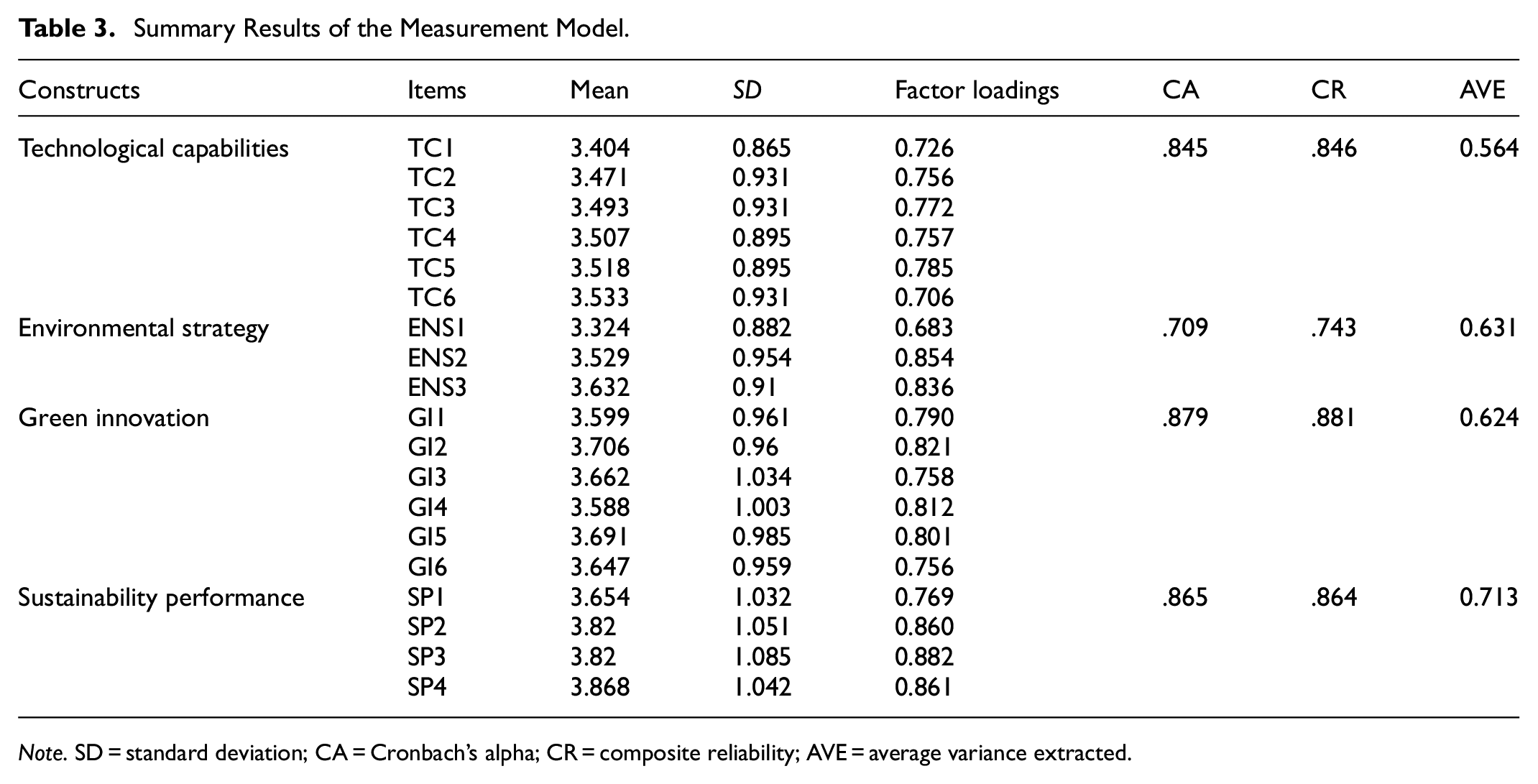
Note. SD = standard deviation; CA = Cronbach’s alpha; CR = composite reliability; AVE = average variance extracted.
After confirming the model performance and meeting Hair et al.’s (2021) criteria, the next stage in the evaluation is to examine the discriminant validity (DV). DV is the extent to which factors discriminate among or gauge distinct concepts by examining the correlation between measurements of possibly overlapping factors (Hair et al., 2021). We estimated the DV for every factor using the HTMT criterion. As shown in Table 4, all HTMT scores fell below the conservative threshold of 0.85 (Kline, 2011). The maximum value on the HTMT was 0.83, thus validating the DV of the factors (Islam et al., 2019). Consequently, our model’s components exhibited high reliability and validity levels.
HTMT Criterion.

Source. Authors’ calculation.
Structural Model
Before testing the hypotheses, we conducted a collinearity assessment to rule out multicollinearity issues (Hair et al., 2019). The VIF values for all constructs ranged from 1.91 to 2.32, well below the cutoff of 5.00, confirming that multicollinearity was not a concern. With this confirmation, the PLS-SEM analysis proceeded. Next, we evaluated the R2 values of the endogenous constructs. R2 values of 0.75, 0.50, and 0.25 are considered strong, moderate, and weak, respectively (Hair et al., 2011). The R2 values for GI and SP were 0.569 and 0.597, indicating strong predictive power. Additionally, the Q2 values of 0.413 for SP and 0.350 for GI confirmed the model’s predictive relevance (Hair et al., 2019). Finally, the model fit was assessed using the SRMR value of 0.064, below the threshold of 0.08, indicating a good fit (Hu & Bentler, 1999) (Table 5).
R2 and Q2 of the Model.
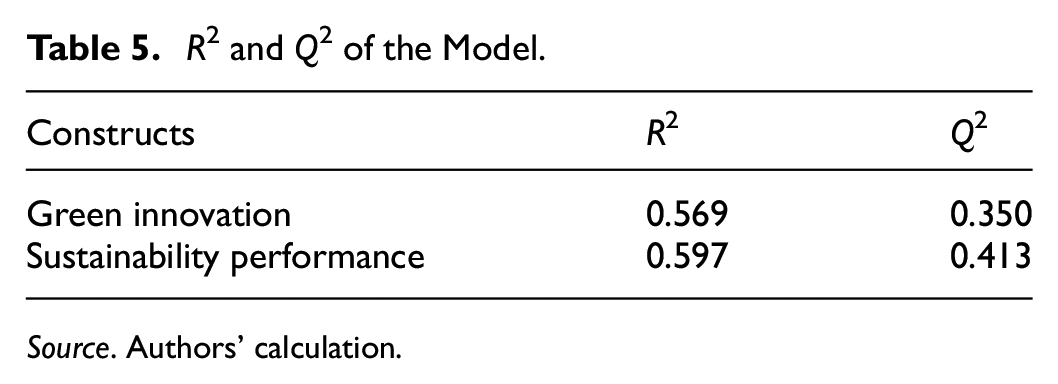
Source. Authors’ calculation.
The next stage is to evaluate the significance and relevance of the path coefficients, having established the model’s explanatory and predictive capacity. Hypothesis testing aims to verify the significance values empirically and examine the hypothesized link between constructs in which the antecedents substantially impact the outcome variables. Both t-values and p-values are used as thresholds to assess whether a significant relationship exists. The t-value must be more than 1.96, and the p-value must be less than .05 (Hair et al., 2021). Table 6 and Figure 3 represent each hypothesis’s path coefficients, standard errors, and t-values.
Results of Hypothesis Testing.

Note.SE = standard error.
p < .01.

Structural model.
Table 6 shows that technological capabilities significantly influence manufacturing firms’ sustainability performance (β = .148, p = .009) and green innovation (β = .441, p = .000), which supports Hypotheses 1 and 2. As expected, the findings revealed that environmental strategy significantly drives firms’ sustainability performance (β = .239, p = .000), thus confirming Hypothesis 3. Additionally, Hypothesis 4 was supported, indicating that ENS strongly impacts GI (β = .405, p = .000). Next, we found that firms’ sustainability is influenced by green innovation (β = .479, p = .000). Thus, H5 was confirmed. Furthermore, the mediation analysis results confirmed Hypothesis 6 of green innovation’s mediating (partial) effect on the relationship between technological capabilities and sustainability performance (β = .211, p = .000). Finally, we observed that GI successfully mediates the linkage between ENS and SP (β = .194, p = .000), supporting H7.
We conducted the Sobel test to check the robustness of the mediation results. The Sobel test output demonstrates that green innovation successfully mediates the associations between technological capabilities and sustainability performance and environmental strategies and sustainability performance, supporting hypotheses H6 and H7. Hence, the Sobel test results are consistent with the PLS-SEM results, establishing the robustness of our findings (Table 7).
Sobel Test for Mediation.
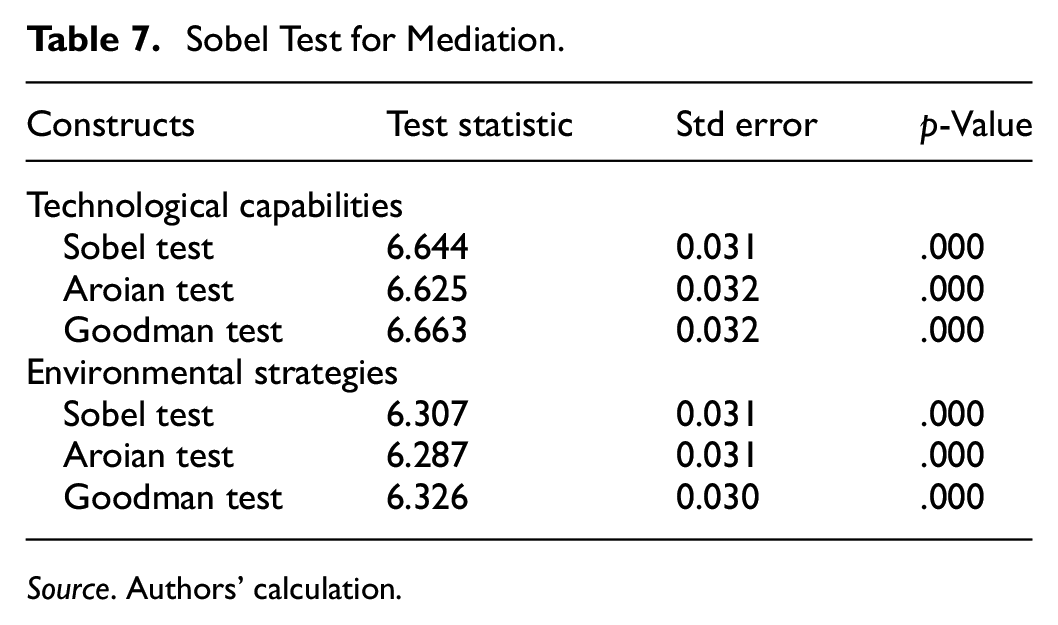
Source. Authors’ calculation.
Discussion
We aimed to explore the impact of TC and ENS on SP, with the potential mediating role of GI. The empirical testing of the relationships between TC and GI, TC and SP, ENS and GI, and ENS and SP was conducted through empirical testing, utilizing the theoretical framework of dynamic capabilities theory (DCT). Furthermore, the research examined the function of GI as an intermediary in these connections.
This study’s first hypothesis proposed that the TC positively affects firms’ SP. Previous research on this subject matter has demonstrated that technology can drive sustainability by facilitating energy efficiency, waste reduction, insightful data analysis, supply chain transparency, circular economy promotion, renewable energy adoption, carbon capture, and accurate environmental impact assessments (Abid et al., 2017; Barba-Sánchez et al., 2024; Di Maria et al., 2022; Tsolakis et al., 2022; Y. Wu et al., 2020). The results of the SEM analysis support Hypothesis 1, which states that TC positively influences the SP of businesses. TC, particularly adopting green technologies, plays a crucial role in enhancing environmental performance (Cao et al., 2021; Razzaq et al., 2023). They facilitate resource consumption reduction, waste management optimization, and emissions minimization (Fernando & Wah, 2017; Xing et al., 2020). While prior studies primarily emphasize operational efficiencies and cost reductions through advanced technologies (Cao et al., 2021), this study corroborates that TC also facilitates radical innovations, contributing to firms’ social sustainability by improving supply chain transparency and community welfare. Firms with advanced TC are better positioned to develop innovative solutions to environmental challenges, including carbon emission reduction strategies (Y. Zhang et al., 2019). Additionally, firms with robust TC can undertake radical innovation, creating new products, services, or market opportunities, leading to better economic performance (Helfat & Raubitschek, 2018; Y. Wu et al., 2020). TC can also improve a firm’s social SP. Firms with well-developed TC can engage in social entrepreneurship, leveraging their resources and competencies to address social issues and enhance social welfare (Jain et al., 2011). TC of firms also improves their supply-chain traceability and transparency, leading to superior sustainability performance (Khan, Parvaiz, Dedahanov, et al., 2022).
The results of the SEM analysis also support H2, suggesting that TC positively affects the GI of businesses. This is consistent with previous studies examining the role of TC in promoting the GI of companies (Dong et al., 2024; Makhloufi, 2024). The contribution of TC to creating environmentally friendly products or improving existing products to reduce their environmental impact is substantial (Tian et al., 2023). Firms with robust TC are more likely to invest in green product innovation and accomplish success (H. Chen et al., 2012). While prior works have highlighted TC’s contribution to product and process innovations, this research provides empirical evidence of TC’s role in creating an organizational culture conducive to GI. This aligns with Costantini et al. (2013) and Rennings (2000) but adds depth by showing that TC-driven GI is critical in reconciling the divergent findings in the literature on TC’s role in SP (Omri, 2020; Song et al., 2012). Empirical evidence supports that companies with established TC are more likely to introduce environmentally beneficial products (De Marchi, 2012). Moreover, TC is expected to develop eco-innovations, as TC is vital in nurturing a culture conducive to sustainable innovation (Costantini et al., 2013). TC also plays a significant role in promoting green process innovation, which entails developing and implementing novel or improved production processes with an eye toward environmental sustainability (Rennings, 2000). Firms with sophisticated TC can enhance the efficiency of their manufacturing processes, reducing inefficiencies, energy consumption, and emissions (Ghisetti & Rennings, 2014). Additionally, TC is vital for firms to mitigate costs and risks associated with adopting and implementing eco-friendly process innovations (Kesidou & Demirel, 2012).
As stated in H3, ENS positively affects firms’ SP, which is evident in our study. This outcome is in line with earlier studies evaluating the role of ENS in a firm’s ability to attain a sustainable advantage in the competitive marketplace (Ambec & Lanoie, 2012; Chan et al., 2022; Hart & Dowell, 2011; Muñoz-Pascual et al., 2019). ENS, particularly proactive environmental strategies (PES), have been found to positively impact firms’ SP by integrating environmental considerations into their business operations and addressing ecological concerns (Montabon et al., 2007). PES-adopting companies voluntarily exceed regulatory requirements and typically demonstrate superior environmental performance compared to companies that take a more reactive approach. Implementing the PES results in cost savings by effectively reducing waste and optimizing resources, enhancing operational efficiency (Ambec & Lanoie, 2012). Additionally, firms implementing PES exhibit superior financial performance due to increased operational efficiency and heightened market recognition, resulting in increased sales and profits (Flammer, 2013). Beyond environmental and economic benefits, PES positively influences a firm’s social sustainability. Firms with proactive environmental strategies are perceived more positively by customers, employees, and the community, increasing customer loyalty, employee engagement, and community support (Adomako et al., 2021). This fosters stronger stakeholder relationships, contributing to social sustainability (Muñoz-Pascual et al., 2019). While proactive strategies are crucial, reactive environmental strategies (RES) also enhance SP (Chan et al., 2022). Firms adopting RES respond to ecological issues as they arise, driven by regulatory compliance requirements. Implementing RES for environmental compliance has marked improvements in SP (Genç & Benedetto, 2019). Our findings corroborate existing literature and assert that firms can reduce the potential for regulatory fines and reputational damage by addressing environmental issues reactively (Jiang & Bansal, 2003).
Next, our findings highlight a positive relationship between ENS and GI. This conclusion is supported by multiple studies that have consistently demonstrated the strong impact of ENS on firms’ GI (Aftab et al., 2023; Hussain et al., 2022; Le et al., 2024). Using ENS can trigger an inventive and forward-thinking response toward the environment, leading to the development and implementation of environmentally friendly technologies. ENS also enables the integration of eco-friendly technologies, thereby promoting GI (Triguero et al., 2013). Incorporating ENS allows firms to meet market demands for sustainable products and shape consumer expectations for sustainability (Dangelico & Pujari, 2010). By designing and developing greener products, firms can attract an ecologically conscious consumer base and foster GI. Firms with robust ENS are more likely to comply with green regulations and standards proactively, further encouraging green product development (Brunnermeier & Cohen, 2003). Engaging stakeholders in ENS is another crucial factor in driving GI. By leveraging shared knowledge and expertise, firms can identify areas of improvement and drive innovation in the development of green products (Hart & Dowell, 2011). ENS also incentivizes operational efficiency, including waste reduction and resource optimization, stimulating green process innovation (Florida, 1996). Adopting cleaner technologies as part of ENS reduces the environmental impact of a firm’s operations and drives process innovation by prompting the development and implementation of new green technologies (Rennings, 2000). Furthermore, ENS contributes to establishing sustainable supply chains, which drive innovation in sourcing, production, and distribution processes, significantly reducing firms’ environmental footprint (Zhu et al., 2013).
Our findings confirm a strong positive relationship between a company’s GI and SP, consistent with prior studies (Demirel & Kesidou, 2011; Du et al., 2010; Hartmann & Moeller, 2014; Nidumolu et al., 2013). This relationship underlines the potential of GI to transform sustainability in environmental, economic, and social dimensions. For example, our findings support prior claims of the notion that GI strategy implementation is associated with an improved environmental performance characterized by reduced emissions, energy use, and waste (Demirel & Kesidou, 2011). However, the present study extends prior research in that it demonstrates how such improvements serve not only to advance long-term environmental sustainability but also to exploit operational efficiency to provide a dual benefit to the firm in reduced ecological impact along with economic gain, consistent with Porter and Van Der Linde’s (1995a) win-win hypothesis.
Finally, the inclusion of GI as a mediator was implemented in the model to examine its influence on the relationship between TC and SP and the relationship between ENS and SP. GI mitigates the disparities in prior research on TC and ENS’s direct effects on SP (Omri, 2020; Zeng et al., 2010), offering a cohesive explanation for varying outcomes. By operationalizing GI as a mediator, this study confirms its centrality in achieving both environmental and economic sustainability (Mongo et al., 2021; Porter & Van Der Linde, 1995a). The findings revealed that although a firm’s TC plays a crucial role in enhancing its SP, it may not be fully realized without GI functioning as a mediator between TC and SP. Studies on the relationship between TC and SP present disparate views, with some highlighting a positive impact, others proposing a negative impact, and a few arguing an insignificant relationship. On the one hand, particular research contends that enhanced TC—typified by advanced equipment, software, and skilled personnel- promotes SP by allowing organizations to optimize processes, reduce resource consumption, and decrease environmental impact (Cai & Li, 2018). Conversely, other researchers assert that uncontrolled investment in TC may lead to unsustainable practices due to potential increases in energy consumption and electronic waste (Lin & Zhu, 2019; Song et al., 2012). Yet, some suggest that the influence of TC on SP might be non-significant, pointing toward the potentially more significant role of factors like managerial commitment, stakeholder pressure, and regulatory frameworks (Omri, 2020). This disparity can be mitigated by introducing GI as a potential mediating variable in the relationship between TC and SP. Companies with strong TC can direct these toward GI, which could enhance their SP. Three primary arguments are provided for GI’s mediating role: TC underpins any form of innovation, including GI (Y. S. Chen et al., 2006); GI has a direct positive effect on SP through mitigating environmental harm and promoting resource conservation (Mongo et al., 2021); and GI can harmonize the disparate results from previous studies by demonstrating how appropriate application of TC toward GI could positively impact SP, and conversely, how the absence of GI could explain reported negative or insignificant effects (Dangelico & Pujari, 2010).
By demonstrating the economic ramifications of implementing green innovation for sustainability performance, the results of our study contribute to and solidify the current body of knowledge. Previous studies have established a positive relationship between technological capabilities (TC) and SP (Cai & Li, 2018; Lin & Zhu, 2019). However, our research extends this understanding by examining the mediation role of GI. This mediation indicates that although TC contributes directly to SP, its complete potential is realized when implemented in GI initiatives. This implies an economic rationale in which aligning investments in TC with GI results in improved efficiency of processes and greater sustainability achievements. Similarly, our results concerning the positive effects of environmental strategies (ENS) on SP are consistent with those of previous research (Hartmann & Moeller, 2014; Q. Wu et al., 2012), but we further expand upon this by emphasizing the mediating function of GI. This indicates that the economic impact of ENS on SP is substantially amplified when such strategies elicit GI. Organizations incorporating GI initiatives into their ENS can anticipate enhanced environmental results and financial advantages, including improved productivity and market competitiveness.
Theoretical Implications
This study aims to provide a new perspective on dynamic capability theory (DCT) by examining its applicability and relevance in TC, ENS, GI, and SP. The article presents persuasive arguments that offer a new perspective on the relationship between TC, ENS, and the SP of firms. Additionally, this study presents a crucial theoretical argument highlighting the essential nature of TC in driving the progress of GI. This challenges the prevailing perspective that narrowly focuses on the significance of TC in conventional business settings and broadens it to encompass its crucial role in the realm of sustainability and GI. Furthermore, a significant theoretical implication that can be drawn from this study pertains to the vital influence of ENS on firms’ SPs. The study posits that implementing a robust ENS can be a potent driver that accelerates the development of eco-friendly innovations, directly influencing the overall SP. This study enhances our comprehension of dynamic capabilities theory (DCT) and offers a fresh outlook on how ENS can be contextualized within the broader dynamic capabilities’ framework.
The study also contends that GI is a mediating variable between firms’ TC and SP and their ENS and SP. Companies can increase their SP by utilizing their TC and ENS following the roadmap outlined in this study. Furthermore, this research presents an innovative viewpoint on the relationship between innovation and sustainability, positing that a firm’s SP can be substantially enhanced through TC, ENS, and GI. This perspective advocates for a comprehensive approach incorporating these concepts to foster a cohesive understanding.
Managerial Implications
Our research questions are designed to address the practical challenge of how manufacturing firms can leverage technological capabilities (TC) and environmental strategies (ENS) to enhance their sustainability performance (SP). This is a pressing issue for practitioners seeking actionable insights into effective sustainability strategies. Our study’s findings are pertinent for businesses seeking to enhance their SP. The collected data supports the hypothesis that a company’s TC and ENS significantly affect its SP, with GI playing a crucial mediating function. Management must prioritize the comprehensive development of TC while concurrently acknowledging the interconnected impact of TC on both GI and SP. This implies that it actively supports sustainability principles in tandem with fostering innovation. This could involve designating resources to cutting-edge technologies, integrating technology seamlessly into business operations, and fostering a culture that encourages technological advancement.
Our research also emphasizes the significance of employing ENS to boost GI and enhance SP. Managers are presented with the opportunity to integrate effective environmental and sustainability practices into the strategic objectives of their organizations. Organizations may effectively expand GI initiatives and improve their SP by implementing these strategies. This may entail integrating environmental goals into strategic planning, adopting business models prioritizing sustainability, and fostering ecological consciousness.
Moreover, our research underscores the significance of GI in enhancing SP. Managers should strategically utilize GI to convert TC and ENS into measurable sustainability results. It is imperative for managers to proactively endorse and facilitate the development of inventive, environmentally friendly solutions to guarantee that these competencies and approaches result in significant enhancements in sustainability.
In addition, the findings propose adopting a comprehensive framework for decision-making guided by sustainability principles. Understanding the complex interaction between TC, ENS, and GI can improve resource allocation and strategic planning for managers. This may involve prioritizing investments in eco-friendly technologies, developing strategic plans aligned with ecological principles, and nurturing an organizational culture that places a premium on sustainability. This entails advocating for GI, allocating resources toward TC, and formulating comprehensive ENS. In this respect, the optimization and readjustment of the industrial structure by industry experts and policymakers to explore the development potential of manufacturing businesses through technological innovation will lead to the sustainable development of the manufacturing industry (Bagh et al., 2023).
Limitations and Future Research Directions
While this study provides valuable insights into the roles of TC, ENS, and GI in improving firms’ SP, several limitations must be acknowledged, along with suggestions for future research. One limitation is the focus on a specific industry, which may restrict the generalizability of the findings to other sectors or organizational types. Future studies should explore these relationships across broader industries, such as the service, technology, and non-profit sectors, to enhance understanding of these dynamics in different contexts. Additionally, the use of cross-sectional data limits the ability to capture the evolution of these relationships over time. Future research should employ longitudinal data to understand better how TC, ENS, GI, and SP interact over extended periods, potentially revealing new causal patterns and time-dependent effects.
Further investigation is also needed to explore potential feedback loops and time-delay effects in these relationships, which could provide deeper insights into the complexities of these dynamics. Exploring contextual factors like organizational culture, external stakeholder pressures, and regulatory environments may also offer new perspectives on how these factors influence the relationships between TC, ENS, GI, and SP. Finally, while this study focused on positive correlations, future research could examine possible trade-offs and challenges firms face when enhancing SP through TC and ENS. Such exploration could provide a more comprehensive understanding of the complexities of fostering GI and improving sustainability performance.
Future research could finally be directed toward the question: “How do specific technological capabilities and environmental strategies interact over time to influence firms’ sustainability performance across different industry sectors?” It would provide much earlier warnings of the dynamism and contingency of such relationships and assist firms in checks and balances to pull off a particular strategy toward sustainable outcomes. By addressing these limitations and expanding upon the directions suggested for future research, scholars can significantly deepen our understanding of the complex interconnections between TC, ENS, GI, and firms’ SP. This knowledge will empower managers with the insights needed to effectively integrate sustainability principles into their strategic decision-making processes, allowing firms to navigate the intricate landscape of sustainable business and establish a strong and resilient position in their respective markets.
Conclusion and Implications
This study aimed to explore the influence of TC and ENS on an organization’s SP, explicitly examining the mediating effect of GI. Using PLS-SEM and data from management professionals in various manufacturing industries, our findings confirmed positive associations between TC, ENS, GI, and SP. Specifically, GI plays a significant mediating role in these relationships. These insights provide valuable guidance for businesses on utilizing their TC and ENS to improve their SP. The findings highlight the significance of cultivating TC and implementing strong ENS as primary catalysts for promoting GI, thereby augmenting SP. Nevertheless, it is essential to acknowledge that this study has certain limitations that should be considered, thereby opening avenues for future research. The study offers valuable insights about the topic at hand; however, to enhance the depth and comprehensiveness of our understanding, it is suggested that additional research be conducted to explore potential moderating variables and different industrial and geographical contexts. In general, this study holds significant theoretical and practical implications. The research, in a theoretical sense, contributes to the advancement of our comprehension regarding the intricate relationship among TC, ENS, GI, and SP. From a pragmatic perspective, it provides companies with a strategic avenue to improve their SP in an evolving market that prioritizes environmental consciousness. Therefore, this study contributes to the academic discourse and practical implementation of sustainability and innovation within the field.
Footnotes
Acknowledgements
The researchers would like to express their gratitude to the anonymous re-viewers for their efforts to improve the quality of this paper.

Consent to Participate
All participants in this study provided informed consent before their involvement. They were informed about the study’s purpose, procedures, potential risks, and benefits. Participants were assured of the confidentiality of their information and their right to withdraw from the study at any time without consequences.
Author Contributions
Yuan Li contributed to the conceptualization, methodology, formal analysis, funding acquisition, writing of the original draft, and revision of the study. Thillai Raja Pertheban was responsible for data curation, supervision, investigation, review, and editing of the manuscript, as well as visualization. Qiaoling Li contributed visualization, curation, and editing of original draft. Zheng Guang-Wen provided supervision, project administration, and contributed to the review and editing of the manuscript.
Funding
The author(s) disclosed receipt of the following financial support for the research, authorship, and/or publication of this article: This research was supported by the Soft Science Research Project of the Science and Technology Department of Henan Province (Research on the Effectiveness Improvement Mechanism and Promotion Strategies for Digital Empowerment of Tourism Supply Chain Resilience, Grant No. 252400410683), the Henan Philosophy and Social Science Planning Project (Study on the Coupling and Coordination Between Cultural Resources and the Tourism Industry in the Cities Along the Yellow River in Henan Province, Grant No. 2024XWH238), and the China Ministry of Education Fund (Research on the Transmission Route of Third-Party Logistics Service Capability to Performance and the Promotion Countermeasures under the Background of High-Quality Development, Grant No. 20XJC790015).
Declaration of Conflicting Interests
The author(s) declared no potential conflicts of interest with respect to the research, authorship, and/or publication of this article.
Data Availability Statement
The data that support the findings of this study are available from the corresponding author upon reasonable request.