



Abstract
This study investigates the impact of Communities of Practice (CoPs) on the professional development of Chinese teachers, focusing on collaborative learning, skill development, and job satisfaction within the unique cultural context of Chinese education. Using a mixed-methods longitudinal design, the research spanned 18 months and involved 135 in-service teachers from diverse regions across China. Qualitative data were collected through semi-structured interviews, while quantitative data were gathered through surveys administered at the beginning and end of the study. The qualitative findings highlight the complex interplay between cultural norms, collaborative processes, and teachers' professional growth within CoPs. Teachers emphasized the value of CoPs in fostering a sense of community, providing opportunities for peer learning and feedback, and supporting the development of their professional identities. While navigating cultural challenges related to hierarchy and “saving face,” teachers also underscored the importance of CoPs in promoting collaboration and knowledge sharing. The quantitative findings revealed statistically significant improvements in collaborative learning, skill development, and job satisfaction, with large effect sizes observed in collaborative learning and medium effect sizes in skill development and job satisfaction. These findings demonstrate the multifaceted ways in which CoPs can contribute to the professional growth and well-being of Chinese teachers, offering valuable insights for policymakers and school leaders seeking to promote effective and culturally responsive professional development initiatives.
Plain Language Summary
This study looks at how joining Communities of Practice (CoPs), where teachers regularly work together, helps improve teaching skills, teamwork, and job satisfaction for teachers in China. Over 18 months, 135 teachers took part in this study. We used surveys and interviews to find out how being in these communities changed how they taught and worked with others. The results showed that teachers felt more confident about working together and planning lessons. They also felt happier with their jobs. Interviews showed that teachers appreciated sharing ideas, getting support from colleagues, and learning from others, even though time pressures sometimes made participation difficult. This study shows that teacher communities can be powerful in helping teachers grow professionally and feel more satisfied in their jobs.
Keywords
Introduction
Teacher professional development (PD) plays a key role in improving educational quality and student outcomes (Donath et al., 2023; Sancar et al., 2021). In this study, we define teacher professional development (PD) as the ongoing, formal and informal, process of acquiring knowledge, skills, and dispositions to enhance teaching practices and improve student learning outcomes (Darling-Hammond et al., 2017). This can involve a variety of activities, such as workshops, courses, mentoring, peer observation, and participation in collaborative learning communities. Effective PD programs are sustained, collaborative, and focus on specific content and instructional strategies (Coenders & Verhoef, 2019; Darling-Hammond et al., 2017). In recent years, the rise of online professional development (OPD) has further transformed PD, offering greater flexibility and accessibility, allowing teachers to participate in training that fits their schedules (Rienties et al., 2023). However, challenges such as inconsistent engagement and the need for technical support remain (Jayatilleke et al., 2017).
One model that has gained prominence in education is Communities of Practice (CoPs) (Cantillon et al., 2016; Van As, 2018). Drawing on the work of Wenger-Trayner and Wenger-Trayner (2015), we conceptualize CoPs as groups of individuals with a shared interest in a particular domain who come together to deepen their knowledge and enhance their skills through regular interaction and collaborative learning. This shared domain fosters a sense of community, and the ongoing interaction and collaboration within the CoP enables members to continuously develop and improve their practices (Wenger, 1998). CoPs bring together individuals to engage in collective learning (Lave & Wenger, 1991), characterized by mutual engagement, shared goals, and a common repertoire (Wenger, 1998). CoPs support the exchange of tacit knowledge—knowledge that is often difficult to formalize or disseminate through traditional means—enabling members to learn from each other's experiences, insights, and implicit understandings (Brown & Duguid, 2001; Sim, 2006; Woods et al., 2016). They are essential for organizational learning, allowing members to experiment, reflect, and adapt practices based on collective feedback (Wenger et al., 2002). Research shows that teachers in CoPs often experience improvements in both teaching practices and student outcomes (Admiraal et al., 2021; Vescio et al., 2008). The growth of digital technologies has further expanded the reach of CoPs, enabling virtual communities that facilitate global collaboration and knowledge sharing (Dubé et al., 2006; Hajisoteriou et al., 2018; Liljekvist et al., 2021).
Although the potential of CoPs is well-documented, their effectiveness within the unique cultural context of Chinese education requires further examination. Chinese schools often operate within hierarchical structures that may hinder open communication and collaboration (Ardichvili et al., 2006). The cultural emphasis on “saving face” could also discourage teachers from openly sharing challenges or seeking help (Zhang & Pang, 2016). CoPs, with their emphasis on mutual respect, shared learning, and collective responsibility, may provide a unique opportunity to foster a more collaborative and supportive professional culture within Chinese schools. Furthermore, the affordances of digital platforms could enable teachers to connect and collaborate across geographical distances, overcoming potential institutional constraints (Feng & Wang, 2015).
To investigate the potential of CoPs for supporting teacher professional development in China, this study explores how these communities function within this specific cultural context. We examine the impact of CoP participation on three key factors that influence teachers' professional growth and well-being: teacher self-efficacy, teacher collaboration, and job satisfaction (Goddard & Kim, 2018; Tschannen-Moran & Hoy, 2001; Weiss et al., 1967). Teacher self-efficacy, defined as teachers' beliefs in their ability to effectively impact student learning, is crucial for motivation and persistence in the face of challenges (Tschannen-Moran & Hoy, 2001). Teacher collaboration, which involves shared planning, decision-making, and reflection, is essential for creating a supportive and effective learning environment (Goddard & Kim, 2018). Job satisfaction, encompassing both intrinsic and extrinsic aspects of teachers' work, is a key indicator of teacher well-being and retention (Weiss et al., 1967). To explore these issues, this study investigates the following research questions:
How do Chinese teachers experience and perceive the benefits of participating in CoPs, particularly in relation to collaborative learning, skill development, and job satisfaction?
What challenges do Chinese teachers face in participating in CoPs, and how do these challenges relate to the cultural context of Chinese education, including hierarchical structures and time constraints?
How do CoPs contribute to the professional identity and sense of belonging among Chinese teachers in the context of Chinese schools?
To explore these questions, we adopt a longitudinal mixed-methods design. While quantitative data offer an overview of trends in professional development outcomes, the study emphasizes qualitative analysis to capture teachers’ lived experiences. Although the absence of a control group limits the generalizability of quantitative findings, the mixed-methods approach enables a more comprehensive understanding of CoPs in the Chinese context. This research contributes to the literature on teacher professional development by situating CoPs within the cultural and structural realities of Chinese schools. It provides empirical evidence on how CoPs influence Chinese teachers’ experiences, informing culturally responsive PD design and offering practical implications for policymakers and school leaders.
Literature Review
Professional Development for Teachers
Professional development (PD) is crucial for improving educational quality and student outcomes (King, 2016; Loucks-Horsley et al., 2010). Effective PD programs are sustained, collaborative, and focused on specific content areas and instructional strategies (Darling-Hammond et al., 2017; Desimone, 2009). Research emphasizes that PD should be an ongoing process embedded into teachers' daily work, incorporating practical applications and feedback to foster a continuous cycle of learning and improvement (Coenders & Verhoef, 2019; Desimone & Garet, 2015; Liao et al., 2017; Smith & Gillespie, 2023).
Teachers need varied skills for their roles. As instructional planners, they design engaging, standards-aligned lessons using curriculum expertise, pedagogy, and digital tools (Boss & Larmer, 2018; Boschman et al., 2014; Dogan et al., 2021; Shulman, 1986; Mishra & Koehler, 2006; Wiggins & McTighe, 2005). Collaborative activities like lesson study refine these abilities. As assessors, they create assessments to track progress, supported by PD like data workshops (Black & Wiliam, 1998; Popham, 2008; Sun et al., 2016; Yüksel & Gündüz, 2017). As mentors, they guide novices, building collaboration and communication through coaching (Mantzourani et al., 2022; Nesje & Lejonberg, 2022; Yan, 2021). Problem-solving aids all roles, addressing instruction, planning, and management (Güner & Erbay, 2021; Maulyda et al., 2024), while digital integration ensures equitable learning, enhanced by action research and tech-focused PD (Guggemos & Seufert, 2021; Hennessy et al., 2022).
Monitoring and motivating students are key to creating positive learning environments, requiring strategies for behavior management, feedback, and engagement (Franklin & Harrington, 2019; Kennedy, 2016). Theories like self-determination (Deci & Ryan, 2000) and growth mindset (Dweck, 2006) guide motivation, integrated into PD via role-playing and reflection. Communication and classroom management build relationships and inclusivity (Marzano, 2003; Shan et al., 2014), while collaboration in curriculum planning leverages pedagogy and problem-solving (Orgoványi-Gajdos, 2016). CoPs and PLCs offer platforms to tackle challenges, share practices, and innovate (Teague & Anfara Jr., 2012; Vescio et al., 2008).
Online PD (OPD) provides flexible, personalized learning (Bragg et al., 2021; Wynants & Dennis, 2018), but sustaining engagement and cultural fit can be tough (Rienties et al., 2023). Tailored PD with hands-on activities, problem-solving, and mentorship boosts self-efficacy and teaching (Crawford et al., 2021; Guskey, 2002). Aligning PD with classroom needs maximizes impact (Borko et al., 2010; Sancar et al., 2021), supported by PLCs for collaboration and innovation (Teague & Anfara, 2012; Vescio et al., 2008) and mentorship for guiding novices and refining skills (Chen, 2020; Dogan et al., 2016; Kraft et al., 2018).
Despite its benefits, PD often faces implementation barriers, such as funding limitations, time constraints, and inadequate administrative support. Addressing these challenges requires educational leaders to prioritize PD in budgets and schedules, ensuring teachers have the time and resources necessary for meaningful learning (Archibald, 2006; Borko, 2004). Research highlights that PD effectiveness depends more on the pedagogical strategies employed than on its duration or intensity (Kennedy, 2016). Context-specific and theory-to-practice approaches are especially crucial for enhancing PD outcomes in diverse settings (Adey, 2007; Alvaré, 2017; Avalos, 2011; Collinson et al., 2009). Collaborative school cultures also play a vital role, fostering environments that support PD and improve teaching practices (Admiraal et al., 2021). For instance, Kong and Wang (2024) demonstrated how strong school support systems facilitated the adoption of student-centered pedagogies, positively impacting student learning. Personalized PD programs tailored to individual teaching contexts have also proven to yield more relevant and sustainable outcomes (Sancar et al., 2021). Technology has become increasingly central to modern PD, enhancing teacher collaboration and learning in remote or resource-limited settings (National Research Council, et al. 2007; Twining et al., 2013). Integrating action research into PD programs promotes reflection and continuous improvement (Meesuk et al., 2020). By leveraging technology and teacher-driven inquiry, PD can adapt to contemporary educational challenges.
Communities of Practice (CoPs)
Communities of Practice (CoPs) have become a key framework for understanding collective learning and knowledge sharing in various professional fields (De Carvalho-Filho et al., 2020; Nicolini et al., 2022). Introduced by Lave and Wenger (1991), CoPs involve groups of individuals who share common interests or professions and engage in collective learning. This learning is social, emphasizing mutual engagement, shared goals, and the development of common knowledge (Cox, 2005; Wenger, 1998). CoPs not only support knowledge acquisition but also contribute to evolving practices and professional identity formation, promoting both individual and organizational growth (Dei & van der Walt, 2020; Li et al., 2009).
A key strength of CoPs is their ability to foster collaborative learning environments, essential for knowledge dissemination and innovation (Barab & Duffy, 2012; Gertner et al., 2011). Through informal discussions, storytelling, and mentorship, CoPs facilitate the transfer of tacit knowledge, which is often embedded in personal experiences and practical know-how (Brown & Duguid, 2001; Pyrko et al., 2017; Wenger et al., 2002). These interactions help members deepen their understanding, refine skills, and experiment with new approaches, creating ongoing professional development (Kapucu, 2012; Nagy & Burch, 2009). Research shows that CoPs promote reflective practice and adaptation based on feedback, leading to improved professional outcomes (Irving et al., 2020; Kirkman et al., 2011).
Communities of Practice (CoPs) effectively support teacher development, improving teaching and student outcomes through collaboration (Bannister, 2015; Buysse et al., 2003; Patton & Parker, 2017; Vescio et al., 2008). Teachers share challenges and solutions, aligning growth with classroom needs. Beyond education, CoPs boost organizational learning and innovation in healthcare and business (Retna & Ng, 2011; Schenkel & Teigland, 2008). Digital tools expand CoPs’ reach, with virtual platforms enabling global knowledge sharing (Dubé et al., 2006; Xue et al., 2021). These online groups enhance access and innovation, though sustaining engagement and overcoming technical issues require effort (Ghamrawi, 2022; Vincent et al., 2018).
CoPs also shape professional identities by fostering belonging and peer interaction (Andrew et al., 2009; Handley et al., 2006; Jawitz, 2009; Wenger, 2009; Woods et al., 2016). In education, they blend theory and practice, helping teachers refine skills (Buysse et al., 2003; Cantillon et al., 2016; Fathi et al., 2024; Vangrieken et al., 2017; Viskovic, 2006). However, challenges arise—diverse views or hierarchical cultures can hinder participation (Ardichvili et al., 2006). Leadership builds trust and inclusion (Patton & Parker, 2017; Wenger, 2010), while organizational support, like time and tech resources, ensures success (Schenkel & Teigland, 2008). With these, CoPs drive personal and institutional growth.
Communities of Practice and Teacher Development
Communities of Practice (CoPs) have been widely studied for their role in promoting collaborative learning and professional development in education (Cantillon et al., 2016; Holland, 2018). Initially conceptualized by Lave and Wenger (1991), CoPs involve social groups where individuals with shared interests engage in collective activities that foster knowledge creation and professional skill development (Harris & Jones, 2010; Saint-Onge & Wallace, 2012). Research highlights the need for technology integration in CoPs, ensuring that digital tools align with teachers' practices to maintain relevance (Albion et al., 2015; Schlager & Fusco, 2003). The flexibility of CoPs allows them to meet the diverse needs of teachers across various settings (Bielaczyc & Collins, 2013; Farnsworth et al., 2016).
CoPs bridge geographic and institutional divides, offering sustained support for teachers to refine their practices (Chalmers & Keown, 2006; Friesen & Clifford, 2003). This strengthens both individual educators and overall teaching quality (Mitchell & Sackney, 2011; Ronfeldt et al., 2015). By fostering trust and respect, CoPs create a collaborative environment (Patton & Parker, 2017) and link policy to practice, enabling teachers to adapt reforms to local contexts for greater impact (Coburn & Stein, 2006). Beyond K-12, CoPs support faculty development across fields, providing a platform to share experiences and hone skills (Abigail, 2016). Reflective practice within these communities improves teaching strategies (Feldman, 2020; Warner & Hallman, 2017), while digital platforms extend their reach globally, delivering tailored support despite challenges like engagement and technical barriers (Macià & García, 2016; Vincent et al., 2018).
In China, CoPs benefit teachers but encounter obstacles such as hierarchical structures and “saving face,” which restrict open sharing (Qi & Wang, 2018; Zhang & Pang, 2016). Digital tools help overcome these barriers, expanding access to resources (Feng & Wang, 2015). Collaboration and shared goals sustain these communities (Cheng & Wu, 2016), and teacher networks aid in spreading reforms despite initial resistance (Sargent, 2015). However, rural CoPs struggle with resource shortages (Wang et al., 2017), making effective principal leadership vital in hierarchical settings (Lee & Ip, 2023).
The Purpose of the Study
The purpose of this mixed-methods study is to explore the lived experiences of Chinese teachers participating in CoPs within the Chinese educational context. While quantitative data provide descriptive insights into potential changes in teachers' perceptions of collaborative learning, skill development, and job satisfaction, the primary focus of this study is to understand how CoPs are experienced and perceived by teachers in relation to their professional development. Specifically, this research seeks to understand how CoPs foster collaborative learning, enhance teaching practices, and contribute to teachers' professional growth within a cultural context that may present unique challenges and opportunities. The study aims to investigate both the benefits and challenges that arise from CoP participation, particularly in relation to hierarchical structures, cultural dynamics, and resource disparities between urban and rural schools. By integrating quantitative data from surveys with in-depth qualitative insights from teacher interviews, this study will provide a comprehensive analysis of how CoPs influence teachers’ professional development and contribute to their overall effectiveness within Chinese schools. The findings are expected to offer valuable implications for educational leaders seeking to leverage CoPs as a tool for sustainable professional development and instructional improvement across diverse educational settings.
Methods
This study employed a mixed-methods design, prioritizing qualitative data to gain an in-depth understanding of teachers' experiences in CoPs (Creswell & Plano Clark, 2017). While quantitative data were collected to provide a general overview of potential changes in teachers' perceptions, the qualitative strand was paramount in exploring the nuanced “how” and “why” of CoP influence within the Chinese educational context. This approach aligns with the exploratory sequential design, where qualitative data collection and analysis precede quantitative data to gain a deeper understanding of the phenomena before examining the relationships or impacts (Creswell, 2014).
Participants
The research spanned a period of 18 months and targeted a specific population of in-service teachers from diverse regions across China. A purposive sampling strategy was utilized to recruit participants actively involved in established CoPs focused on professional development. Collaborations were established with school districts and educational organizations known to foster CoPs for teachers. Potential participants were contacted through these collaborating entities, with inclusion criteria being: currently employed as a full-time teacher in a Chinese school, active membership in a CoP with a focus on professional development for at least 6 months prior to the study, and willingness to participate in multiple interviews throughout the research period.
A total of 135 teachers were recruited, ensuring a broad representation across the Chinese education system. Geographically, the sample included participants from both economically developed eastern provinces (e.g., Beijing, Shanghai, Guangdong) and less developed western regions (e.g., Gansu, Xinjiang, Qinghai). This geographical diversity helped capture the nuances of CoP participation in various socio-economic and educational contexts. The participants' teaching experience ranged from 2 to 30 years, with an average of 10.5 years of experience. Teachers from elementary, middle, and high school levels were represented, covering a variety of subject areas, including mathematics, science, language arts, social studies, physical education, and the arts. The sample included approximately 60% female and 40% male participants, reflecting the broader gender distribution within the Chinese teaching workforce.
In terms of age, the participants ranged from 25 to 58 years, with a mean age of 37.8 years. This diverse age range provided insights into how teachers at different career stages engage with CoPs, from early-career teachers looking for mentorship and skill development to more experienced educators seeking professional growth and collaboration. The inclusion of a subset of participants (n = 21) for semi-structured interviews throughout the 18-month study allowed for a deeper exploration of their lived experiences within their CoPs. These interviewees represented a microcosm of the larger sample, maintaining diversity in terms of geographical location, grade level, subject area, years of experience, and gender. By capturing their perspectives at three distinct points – baseline, mid-point, and exit interview—the research gained valuable insights into the evolving nature of collaboration, skill development, and job satisfaction within the CoPs over the extended research period.
Ethical approval was obtained from the relevant university research ethics committee prior to participant recruitment. Informed consent was secured from all participants, ensuring they were aware of their right to withdraw at any time without penalty and that their data would remain confidential and anonymized throughout the study.
Instruments
Qualitative Phase
To gain a deeper understanding of the lived experiences of Chinese teachers participating in Communities of Practice (CoPs), we conducted semi-structured interviews with 21 participants from the larger study sample. These participants were purposefully selected to reflect the diversity of the larger group in terms of geographical location, teaching level, subject area, years of teaching experience, and gender. This ensured that the interview data captured a wide range of perspectives and experiences within the Chinese educational context, allowing for a nuanced and comprehensive understanding of how CoPs function as a tool for teacher professional development.
The interviews were conducted at three distinct points throughout the 18-month research period. Initially, baseline interviews were conducted at the outset of the study to explore teachers' initial motivations for joining CoPs, their expectations for participation, and their early experiences. Subsequently, mid-point interviews were conducted midway through the study to capture any shifts or developments in teachers' experiences with CoP participation, focusing on their ongoing experiences of collaboration, perceived skill development, and job satisfaction. Finally, exit interviews were conducted at the conclusion of the research period, providing a platform for teachers to reflect on the overall impact of CoP participation on their professional development journey. This longitudinal approach, with interviews conducted at three distinct time points, allowed us to trace the trajectory of teachers' experiences and perceptions, providing a more nuanced and dynamic understanding of how CoP participation unfolds within the Chinese educational context.
The semi-structured interview protocol was designed to elicit rich and nuanced data regarding the “how” and “why” of teachers' experiences in CoPs. The interview guide consisted of open-ended questions that encouraged participants to reflect on their experiences in depth, focusing on their perceptions, motivations, and challenges. For a comprehensive list of the interview questions, please refer to Appendix A.
All interviews were conducted in Mandarin Chinese, the native language of the participants, to ensure clear and nuanced communication. With informed consent obtained beforehand, the interviews were audio-recorded and transcribed verbatim for analysis. Furthermore, the transcripts were translated into English by professional bilingual translators with expertise in educational research. To ensure accuracy and maintain the authenticity of the participants' voices, a second translator reviewed the translations, and any ambiguous or culturally specific terms were discussed and resolved by the research team.
Quantitative Phase
The original English instruments were translated into Mandarin by bilingual educators and back-translated by independent translators to ensure accuracy, with discrepancies resolved through consensus. The translated scales were pilot-tested with 20 Chinese teachers, demonstrating good reliability (Cronbach’s α > .80), confirming their suitability for the Chinese context.
Teacher Collaboration Scale
The Teacher Collaboration Scale (Goddard & Kim, 2018) assesses collaborative practices among teachers with 13 items across three subconstructs: (a) collective efforts in planning school improvement, curriculum, and professional development (e.g., “Teachers in this school work collectively to plan school improvement”), (b) formal structures supporting collaboration (e.g., “Our school has scheduled time for teachers to collaborate”), and (c) informal collaboration (e.g., “Teachers frequently share teaching strategies informally”). Each item on the scale is rated on a five-point Likert scale ranging from 1 (strongly disagree) to 5 (strongly agree), providing a comprehensive view of collaborative practices within the school environment. In this study, the Teacher Collaboration Scale demonstrated high internal consistency, with a Cronbach's alpha coefficient of .89.
Skill Development: Teachers' Sense of Efficacy Scale (TSES)
The Teachers’ Sense of Efficacy Scale (TSES; Tschannen-Moran & Hoy, 2001) measures teachers’ perceived competence in teaching strategies, student engagement, and classroom management with 24 items (e.g., “How much can you do to get through to the most difficult students?”). Each item is evaluated using a five-point Likert scale ranging from 1 (nothing) to 5 (a great deal). The use of the TSES provides a thorough evaluation of professional growth, capturing a broad range of teaching competencies. The TSES exhibited excellent internal consistency in this study, with a Cronbach's alpha of .92.
Job Satisfaction: Minnesota Satisfaction Questionnaire (MSQ)
The short-form Minnesota Satisfaction Questionnaire (MSQ; Weiss et al., 1967) evaluates job satisfaction with 20 items covering intrinsic (e.g., “I am satisfied with the freedom to use my own judgment”), extrinsic (e.g., “I am satisfied with the way my job provides for steady employment”), and general satisfaction aspects. Respondents rate each item on a five-point Likert scale ranging from 1 (very dissatisfied) to 5 (very satisfied), ensuring a nuanced understanding of job satisfaction levels among participants. The internal consistency of the MSQ was also found to be high, with a Cronbach's alpha of .88.
Data Analysis
To analyze the data collected in this study, we employed a mixed-methods approach, integrating both quantitative and qualitative data to gain a comprehensive understanding of the impact of CoPs on Chinese teachers' professional development (Greene, 2007). The qualitative data, derived from semi-structured interviews, were analyzed using thematic analysis, a rigorous approach for identifying patterns (themes) within qualitative data (Braun & Clarke, 2006).
Our analysis began with a deep dive into the interview transcripts, reading and re-reading them multiple times to gain a thorough understanding of the data. We took notes and memos to capture initial impressions, insights, and potential connections between the data and existing theory. Next, we systematically coded the transcripts, identifying meaningful segments of text and assigning labels (codes) to capture the key concepts, ideas, and experiences expressed by the participants. Our coding scheme combined pre-defined codes based on existing theory (e.g., Wenger's theory of Communities of Practice, situated learning theory, self-determination theory) and emergent codes that arose from the data itself. This hybrid approach allowed us to ground our analysis in relevant theoretical frameworks while remaining open to new insights.
Following the initial coding, we reviewed the codes, looking for patterns and connections to identify broader themes that captured the essence of the participants' experiences. We used constant comparison techniques, comparing data within and across transcripts, to identify similarities, differences, and nuances in the data, ultimately refining our understanding of the emerging themes. We then critically examined these themes, ensuring they accurately reflected the data and captured the complexities of the participants' experiences. We also considered how the themes related to each other and to the broader research questions, refining and reorganizing them as needed to create a coherent narrative. The final themes were clearly defined and named, with detailed descriptions and illustrative quotes provided to support our interpretations. Throughout the analysis, we considered the cultural context of Chinese education, ensuring that our interpretations were sensitive to the unique cultural factors that might shape teachers' experiences in CoPs.
To ensure rigor and trustworthiness, we employed several strategies. First, we shared our preliminary findings with the participants to ensure they accurately reflected their experiences, allowing us to clarify any misunderstandings and refine our analysis (member checking). Second, two researchers independently coded a subset of the interview transcripts (20%) to ensure consistency in coding and theme identification (inter-coder reliability) (Saldaña, 2016). We calculated inter-coder reliability using Cohen's kappa, achieving a high level of agreement between coders (κ = .85). Any discrepancies in coding were resolved through thorough discussion and consensus. Finally, we provided rich descriptions of the participants' experiences, including their thoughts, feelings, and behaviors, to provide context and depth to our analysis.
Quantitative data from self-reported surveys were analyzed using SPSS. All quantitative analyses were conducted using SPSS, with statistical significance set at p < .05. Effect sizes were classified according to Cohen's (1988) conventions: small effect: d = 0.20, medium effect: d = 0.50, and large effect: d = 0.80. Paired-samples t-tests were conducted to evaluate changes in key variables—collaborative learning, skill development, and job satisfaction—allowing for the identification of statistically significant differences in teachers' perceptions before and after their participation in CoPs (Creswell, 2014).
Finally, we integrated the quantitative and qualitative findings using a mixed-methods convergence approach (Johnson et al., 2007), providing a more holistic view of how CoPs influence teachers' professional growth. This triangulation of data sources deepened our understanding of the relationship between teachers' self-reported experiences and measurable changes in their perceptions (Creswell & Plano Clark, 2017). By juxtaposing both sets of results, the study offered a richer interpretation of the role CoPs play in enhancing teacher development within the Chinese educational context (Tashakkori & Teddlie, 2010).
Results
Qualitative Findings
The qualitative analysis of the interview data revealed a rich set of experiences and perspectives related to the participation of Chinese teachers in CoPs. As summarized in Table 1, these findings illuminate the “how” and “why” of CoP engagement within the unique cultural context of Chinese education, providing detailed insights into the processes, challenges, and benefits of collaborative professional learning. The table highlights key themes and illustrative quotes that exemplify participants’ experiences, offering a nuanced understanding of their engagement in CoPs.
Themes and Illustrative Quotes from Teacher Interviews.
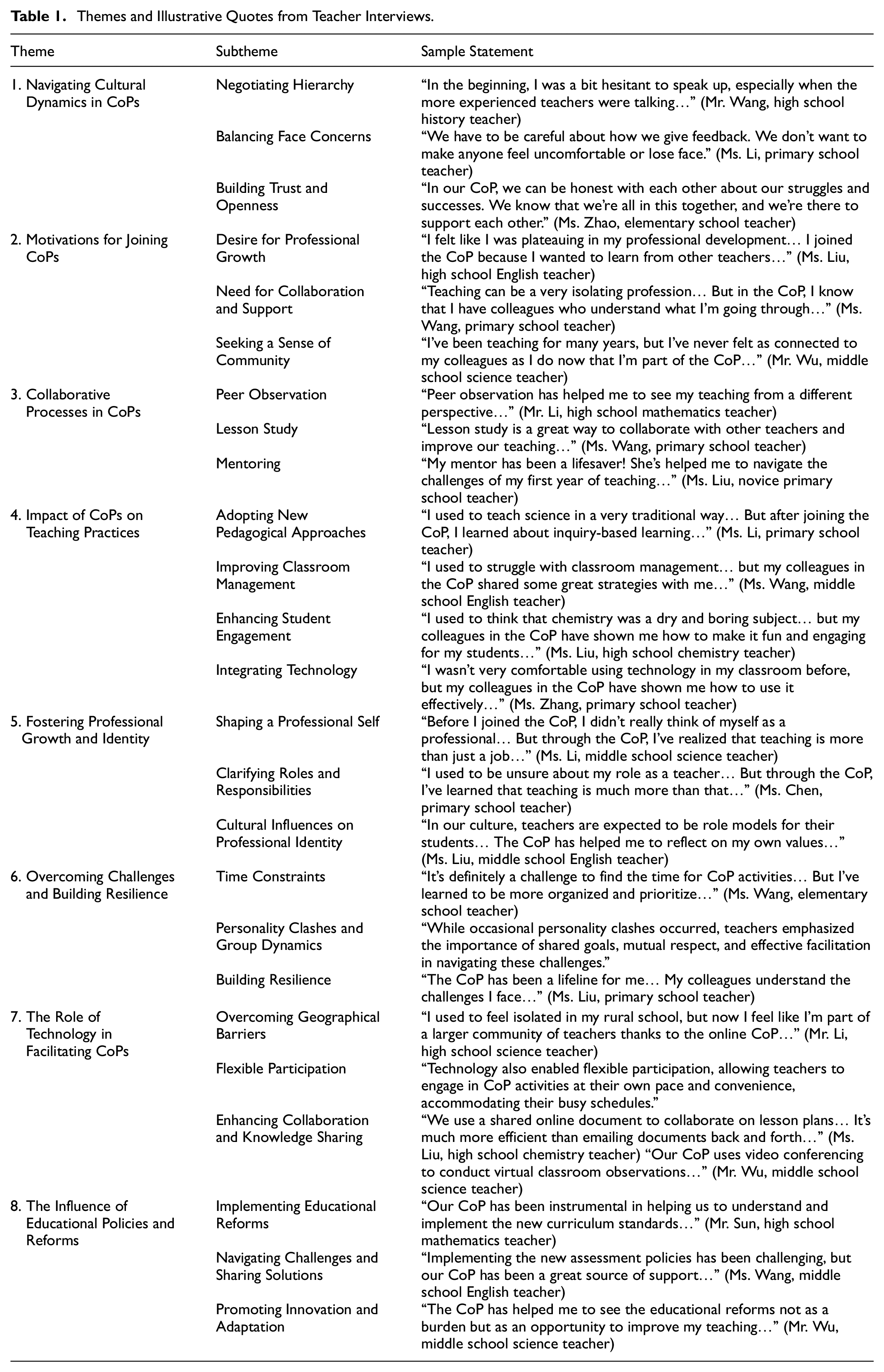
Theme 1: Navigating Cultural Dynamics in CoPs
This theme examines how teachers manage the interplay between cultural norms, such as hierarchy and saving face, and their participation in CoPs. These dynamics shape their experiences and approaches to collaborative professional learning.
Negotiating Hierarchy
Chinese cultural norms that emphasize respect for authority initially discouraged some teachers from voicing their opinions or challenging senior colleagues. Mr. Wang, a high school history teacher, shared, “In the beginning, I was a bit hesitant to speak up, especially when the more experienced teachers were talking.” However, as teachers acclimated to the CoP environment, which emphasized mutual respect and shared learning, many became more comfortable contributing to discussions. This suggests that CoPs can gradually challenge traditional hierarchical norms by fostering a culture of collaboration.
Balancing Face Concerns
Participants also navigated the cultural value of “saving face” while providing feedback. Mr. Zhang, a high school mathematics teacher, explained, “I try to focus on the positive aspects first and then offer suggestions in a gentle way.” These approaches reflect how teachers adapted culturally sensitive methods to maintain harmony while engaging in critical dialogue.
Building Trust and Openness
Despite initial hesitations, CoPs fostered trust through shared goals and mutual support, enabling more candid exchanges over time. As Ms. Zhao, an elementary school teacher, noted, “In our CoP, we can be honest with each other about our struggles and successes.” This highlights how CoPs provide a safe space where cultural barriers are softened, and authentic collaboration can flourish.
In summary, while cultural factors such as hierarchy and saving face initially constrained participation, the trust-building processes and cultural sensitivity fostered within CoPs helped teachers engage more openly and collaboratively. This highlights how CoPs can serve as catalysts for navigating cultural challenges and transforming professional learning experiences.
Theme 2: Motivations for Joining CoPs
This theme explores why teachers were motivated to join CoPs, focusing on their professional aspirations, need for support, and desire for community.
Desire for Professional Growth
Teachers frequently cited professional development as a primary motivation for joining CoPs. Traditional training often failed to meet their evolving needs, prompting them to seek more dynamic and personalized learning environments. For example, Ms. Liu, a high school English teacher, stated, “I felt like I was plateauing in my professional development… I joined the CoP because I wanted to learn from other teachers, share ideas, and try new things in my classroom.” This underscores how CoPs address gaps in existing PD opportunities by offering practical and collaborative learning experiences.
Need for Collaboration and Support
Teaching's isolating nature was another motivator for CoP participation. Teachers valued the opportunity to share experiences and receive peer support. Ms. Wang, a primary school teacher, remarked, “In the CoP, I know I have colleagues who understand what I’m going through and who are there to support me.” CoPs thus provided a supportive network to counter professional isolation.
Seeking a Sense of Community
Beyond professional benefits, teachers sought a sense of belonging within CoPs. Mr. Wu, a middle school science teacher, commented, “I’ve never felt as connected to my colleagues as I do now that I’m part of the CoP.” This demonstrates how CoPs fulfill both emotional and professional needs by fostering strong interpersonal connections.
Overall, teachers were drawn to CoPs not only for professional development but also for emotional support and a sense of belonging. These motivations reveal how CoPs cater to the intertwined personal and professional dimensions of teaching, creating a comprehensive support system.
Theme 3: Collaborative Processes in CoPs
This theme investigates the processes that underpin collaboration in CoPs, emphasizing their role in shared professional growth.
Peer Observation
Peer observation allowed teachers to gain new perspectives on their teaching practices. Mr. Li, a high school mathematics teacher, noted, “Peer observation has helped me to see my teaching from a different perspective.” These exchanges encouraged reflective practice and skill-sharing among participants.
Lesson Study
Through lesson study, teachers collaboratively planned, implemented, and refined lessons. Ms. Wang, a primary school teacher, remarked, “Lesson study is a great way to collaborate with other teachers and improve our teaching.” The iterative nature of this process supported continuous improvement in teaching quality.
Mentoring
Experienced teachers played a vital role in guiding novices through the challenges of early teaching. Ms. Liu, a novice teacher, shared, “My mentor has been a lifesaver… She’s helped me navigate the challenges of my first year.” Mentoring within CoPs fostered not only professional skill development but also a sense of belonging for new teachers.
Thus, collaborative processes like peer observation, lesson study, and mentoring form the backbone of CoPs. By combining reflective practice with practical guidance, these activities address diverse teacher needs and enhance professional growth.
Theme 4: Impact of CoPs on Teaching Practices
This theme examines the tangible changes teachers made to their teaching practices as a result of CoP participation, focusing on pedagogical approaches, classroom management, student engagement, and technology integration. CoPs fostered a collaborative environment for learning and experimentation, enabling teachers to refine their instructional strategies.
Adopting New Pedagogical Approaches
Teachers frequently reported that CoPs encouraged them to implement innovative teaching strategies, shifting from traditional methods to more engaging, student-centered approaches. For instance, Ms. Li, a primary school teacher, described how inquiry-based learning transformed her science lessons, making them more interactive and impactful: “I used to teach science in a very traditional way, with lectures and textbooks. But after joining the CoP, I started incorporating hands-on activities and experiments. My students are now much more engaged, and they're learning more deeply.” This illustrates how CoPs enable educators to exchange ideas, experiment with novel techniques, and enhance pedagogical effectiveness, resulting in improved student outcomes.
Improving Classroom Management
Another critical area of improvement was classroom management. Teachers shared strategies for addressing challenging behaviors, fostering positive relationships, and creating structured learning environments. Ms. Wang, a middle school English teacher, highlighted how CoP discussions helped her refine her classroom management approach: “My colleagues in the CoP shared strategies to establish clear expectations and build positive relationships with students. My classroom has become a much more productive learning environment.” Such exchanges demonstrate the value of peer support in resolving common challenges and building a repertoire of effective management practices.
Enhancing Student Engagement
CoPs also played a key role in enhancing student engagement. Teachers collaborated to develop interactive and differentiated instruction methods tailored to diverse student needs. Ms. Liu, a high school chemistry teacher, noted: “Chemistry used to feel dry and boring, but with the CoP’s help, I’ve introduced interactive simulations, hands-on experiments, and real-world applications that captivate my students.” These examples reflect how CoPs inspire creativity and innovation in lesson planning, fostering an engaging learning atmosphere.
Integrating Technology
Participants also improved their technological proficiency through CoP activities. Teachers learned to use digital tools for resource sharing, assessment, and instructional differentiation. Ms. Zhang, a primary school teacher, shared: “I wasn’t comfortable using technology before, but the CoP taught me how to integrate online platforms effectively. I now use them for creating quizzes, sharing resources, and providing feedback.” This highlights how CoPs support teachers in developing technological pedagogical content knowledge (TPACK), enabling them to meet the demands of modern classrooms.
As a result, CoP participation led to meaningful changes in teaching practices across pedagogy, classroom management, student engagement, and technology integration. By fostering collaboration, creativity, and skill-building, CoPs exemplify the transformative potential of professional learning communities to improve educational outcomes.
Theme 5: Fostering Professional Growth and Identity
This theme explores how CoPs influence teachers' professional identities, emphasizing reflection, role clarification, and cultural alignment. Through peer collaboration and feedback, teachers cultivated a stronger sense of purpose and professional belonging.
Shaping a Professional Self
Teachers frequently described how CoPs encouraged reflective practice, enabling them to better understand their professional values and goals. Ms. Li, a middle school science teacher, reflected: “Before the CoP, I didn’t think of myself as a professional. Now, I see teaching as more than a job—it’s a profession that requires constant learning and growth.” Such reflections highlight how CoPs nurture a professional mindset, fostering lifelong learning and self-improvement.
Clarifying Roles and Responsibilities
CoPs also helped teachers define and expand their roles. Ms. Chen, a primary school teacher, explained: “Through the CoP, I’ve realized that teaching isn’t just about delivering the curriculum. It’s about building relationships and helping students reach their full potential.”
This demonstrates how CoPs provide a space for educators to explore and embrace the multifaceted nature of their work.
Cultural Influences on Professional Identity
The cultural context of Chinese education, with its emphasis on teachers as moral exemplars, further shaped participants’ professional identities. Ms. Liu, a middle school English teacher, remarked: “In our culture, teachers are role models. The CoP helped me reflect on my values and how I can be a better role model for my students.” CoPs supported teachers in aligning their professional identities with both personal values and societal expectations.
Overall, CoPs provided a platform for teachers to reflect on their values, refine their roles, and align with cultural expectations. These experiences contributed to the development of professional identities grounded in both personal growth and broader societal responsibilities.
Theme 6: Overcoming Challenges and Building Resilience
This theme addresses the obstacles teachers faced in CoPs and the strategies they employed to overcome them. Despite time constraints and interpersonal challenges, CoPs provided a supportive environment for resilience and professional growth.
Time Constraints
Participants cited limited time as a significant barrier, yet many adapted by prioritizing CoP activities and leveraging technology for flexibility. Ms. Wang, an elementary school teacher, shared: “It’s challenging to find time for CoP activities, but I’ve learned to be more organized and use online platforms for discussions.” This reflects how CoPs empower teachers to navigate logistical challenges through practical solutions.
Personality Clashes and Group Dynamics
Interpersonal differences occasionally disrupted collaboration, but shared goals and effective facilitation helped maintain cohesion. Teachers emphasized the importance of mutual respect and constructive communication in overcoming these hurdles.
Building Resilience
CoPs fostered resilience by creating a community where teachers could share struggles, receive encouragement, and learn coping strategies. Ms. Liu, a primary school teacher, noted:
“The CoP has been a lifeline for me. My colleagues understand the challenges I face and offer invaluable support.” This underscores how CoPs provide both emotional and professional support, essential for sustaining teachers in a demanding profession.
Consequently, CoPs served as a buffer against professional challenges by fostering flexibility, mutual respect, and emotional support. These attributes highlight the role of CoPs in building resilience and sustaining long-term teacher engagement.
Theme 7: The Role of Technology in Facilitating CoPs
This theme explores how technology supports and enhances CoP activities, particularly for teachers in rural areas with limited access to in-person professional development. Technology emerged as a crucial tool for overcoming barriers, enabling flexible participation, and fostering collaboration.
Overcoming Geographical Barriers
Technology helped bridge physical distances, connecting teachers in remote areas to larger professional networks. Mr. Li, a high school science teacher, reflected: “I used to feel isolated in my rural school, but now I feel like I’m part of a larger community thanks to the online CoP.” Teachers emphasized that virtual platforms created opportunities to share ideas and resources with colleagues they otherwise would not have met, fostering a sense of community and belonging.
Flexible Participation
One of the key benefits of technology was its ability to facilitate asynchronous and flexible engagement. For instance, Ms. Wang, a primary school teacher, noted: “With a young child at home, it’s hard to join activities in person. I appreciate that our CoP uses online forums where I can contribute at my own pace.” This flexibility allowed participants to balance CoP activities with their professional and personal responsibilities, highlighting technology’s role in making professional development more accessible.
Enhancing Collaboration and Knowledge Sharing
Online platforms streamlined collaboration and communication within CoPs. Ms. Liu, a high school chemistry teacher, described: “We use shared online documents for lesson planning—it’s so much more efficient than emailing back and forth.” Similarly, Mr. Wu, a middle school science teacher, explained how video conferencing enabled virtual classroom observations and peer feedback, enhancing the depth of collaboration. These examples underscore how technology promotes innovative practices in CoPs.
Thus, the integration of technology into CoPs not only overcomes logistical challenges but also amplifies collaboration and flexibility. By fostering connections across geographical divides, enabling accessible participation, and supporting innovative practices, technology has expanded the reach and impact of CoPs, particularly in rural and diverse contexts.
Theme 8: The Influence of Educational Policies and Reforms
This theme examines how educational policies and reforms shape the functioning of CoPs, highlighting their role in supporting teachers to navigate changes and adapt to evolving educational demands.
Implementing Educational Reforms
CoPs served as a space for teachers to interpret and implement new curriculum standards and assessment policies. Mr. Sun, a high school mathematics teacher, stated: “Our CoP has been instrumental in helping us understand the new curriculum standards and how to apply them in our classrooms.” Teachers appreciated the opportunity to collaboratively translate abstract policy guidelines into practical classroom strategies, fostering a shared sense of purpose.
Navigating Challenges and Sharing Solutions
Teachers faced significant challenges in adapting to reforms, such as managing increased workloads and aligning practices with new policies. CoPs provided a platform for sharing experiences and strategies. Ms. Wang, a middle school English teacher, shared: “Implementing the new assessment policies was daunting, but the CoP became a place where we could brainstorm solutions and support each other.” This collaborative problem-solving reduced feelings of isolation and increased teachers’ confidence in managing reform-related demands.
Promoting Innovation and Adaptation
Beyond compliance, CoPs encouraged teachers to view reforms as opportunities for innovation. Mr. Wu, a middle school science teacher, reflected: “The CoP helped me see reforms not as a burden but as a chance to improve my teaching. We experimented with new approaches and shared what worked best.” This adaptive mindset fostered by CoPs contributed to a culture of continuous improvement, positioning teachers as active agents of change.
Consequently, CoPs emerged as vital spaces for navigating policy-driven changes. By offering collaborative support, fostering innovative thinking, and building confidence, CoPs not only help teachers adapt to reforms but also empower them to drive meaningful systemic improvements in education.
The qualitative findings underscore the multifaceted ways in which CoPs contribute to teacher professional development in the Chinese educational context. By fostering collaboration, addressing cultural dynamics, and supporting adaptation to policy reforms, CoPs have proven to be transformative spaces for professional learning. Teachers reported enhanced pedagogical practices, stronger professional identities, and increased resilience, all facilitated through trust, shared goals, and innovative use of technology. These insights highlight the critical role of CoPs in bridging individual and systemic needs, making them an essential strategy for sustainable educational improvement.
Quantitative Findings
To evaluate changes in teachers' perceptions, paired-samples t-tests were conducted to compare pre- and post-intervention scores. The Shapiro-Wilk test was used to confirm the normality of difference scores, suitable for smaller sample sizes. The results of the Shapiro-Wilk tests for the main scales and their subcomponents are presented in Table 2.
Results of Shapiro-Wilk Tests for Normality.

Note. All p-values are greater than .05, indicating that the assumption of normality is met for all scales and subcomponents.
The paired-samples t-tests (Table 3) revealed significant improvements across all areas (p < .05). Effect sizes, calculated using Cohen’s d, highlighted a large effect for collaborative learning (d = 0.95) and medium effects for skill development (d = 0.62) and job satisfaction (d = 0.76), demonstrating the practical significance of these changes.
Changes in Teacher Perceptions Following CoP Participation.

Source.Cohen, 1988.
Note. Effect size classification: d = 0.20 (small), d = 0.50 (medium), d = 0.80 (large).
Job satisfaction, assessed with the Minnesota Satisfaction Questionnaire (MSQ), showed a significant improvement (t(134) = 5.7, p < .001, d = 0.76). Subcomponent analysis revealed medium-sized gains in both intrinsic satisfaction (t(134) = 5.3, p < .001, d = 0.70) and extrinsic satisfaction (t(134) = 5.0, p < .001, d = 0.65). Increases in intrinsic satisfaction reflect enhanced autonomy, professional growth, and alignment with internal motivations, while improvements in extrinsic satisfaction suggest better work conditions and a supportive environment fostered by CoPs. These findings highlight the significant and multifaceted impact of CoP participation on teachers’ collaborative practices, professional skills, and job satisfaction.
A detailed analysis of subcomponents (Table 4) highlights key improvements. Within Collaborative Learning, the largest gains were observed in Planning School Improvement (t(134) = 7.5, p < .001, d = 1.07) and Curriculum and Instruction Methods (t(134) = 6.2, p < .001, d = 0.88), both with large effect sizes. These results indicate that CoP participation fostered more proactive engagement in collective decision-making and curriculum planning, integral aspects of effective collaboration.
Detailed Changes in Perceptions Following CoP Participation.

Source.Cohen, 1988.
Note. Effect size classification: d = 0.20 (small), d = 0.50 (medium), d = 0.80 (large).
The Professional Development Activities subcomponent showed minimal change (t(134) = 0.3, p = .750, d = 0.03), suggesting no meaningful improvement. This could reflect that formal professional development opportunities were already well-established or that CoPs emphasized informal, practice-based collaboration over structured programs. Future research could examine how teachers perceive professional development within CoPs compared to traditional activities.
For Skill Development, the most substantial improvement was observed in Student Engagement (t(134) = 5.2, p < .001, d = 0.75), reflecting a medium effect. This suggests CoPs effectively supported teachers in refining classroom practices to better engage and motivate students through shared strategies. Gains in Effective Teaching Strategies (t(134) = 4.1, p < .001, d = 0.60) and Classroom Management (t(134) = 3.6, p < .001, d = 0.41) further demonstrate the role of CoPs in enhancing practical teaching skills critical for everyday instruction.
Discussion
This study investigated the impact of CoPs on the professional development of Chinese teachers, with a focus on collaborative learning, skill development, and job satisfaction. By employing a mixed-methods longitudinal design, we obtained both quantitative data demonstrating significant gains in all three areas and qualitative insights that illuminate the cultural, organizational, and pedagogical nuances shaping these results. Although the quantitative findings suggest notable improvements, the absence of a control group and the complex cultural environment underscore the need for a more contextualized understanding of how CoPs function within Chinese schools.
Our qualitative data underscore the pivotal role of cultural norms—such as hierarchy and “saving face”—in shaping teachers’ experiences within CoPs. While prior research indicates that CoPs may foster more egalitarian relationships even in hierarchical school contexts (Ardichvili et al., 2006; Lee & Ip, 2023), our findings reveal that this transformation is neither quick nor straightforward. Teachers’ initial reluctance to challenge senior colleagues aligns with Hofstede’s (2011) concept of high power distance, in which deference to authority is deeply ingrained. For example, participants described hesitations about providing critical feedback, fearing it would disrupt harmonious relationships (Zhang & Pang, 2016). Yet, over time, the shared learning ethos of CoPs gradually mitigated these barriers, consistent with Wenger’s (1998) emphasis on mutual engagement and a shared repertoire. This dynamic is also reflected in research on professional identity among educators, where collaborative platforms have been shown to ease hierarchies by promoting reciprocal learning (Andrew et al., 2009; Handley et al., 2006).
Despite these positive shifts, concerns about “saving face” remained salient and frequently limited open dialogue or constructive critique—an observation also made by Peng et al. (2014) in cross-cultural settings. Our findings align with Yüksel and Gündüz (2017), who argued that culturally responsive approaches to offering feedback can prevent discomfort and sustain respectful collaboration. Notably, teachers in this study learned to reframe criticism as collective problem-solving, emphasizing shared improvement rather than individual shortcomings (Abigail, 2016). This approach not only protected interpersonal harmony but also supported the significant improvement in skill development (Cohen’s d = 0.62) by encouraging teachers to seek and apply feedback.
Beyond cultural factors, time constraints and heavy workloads hinder sustained CoP participation, a common issue in teacher development (Bautista et al., 2023; Wang et al., 2017). Teachers struggled to balance CoP involvement with duties like exam prep, resource creation, and administrative tasks. In China, high-stakes tests like the gaokao often overshadow collaborative learning (Chen, 2020; Zhang & Pang, 2016). Echoing the findings of Bautista et al. (2023) on preschool constraints, participants noted that without administrative and policy support, embedding CoPs into daily practice is tough. Aligning CoPs with school priorities—via set meeting times, resources, or leadership recognition—could boost engagement and reduce conflicts (Albion et al., 2015; Archibald, 2006).
The collaborative processes within CoPs, including peer observation, lesson study, and mentoring, were identified as key mechanisms for sharing insights and refining teaching practices. These findings corroborate Vescio et al. (2008), who emphasized how CoPs promote joint accountability for student learning. Moreover, the enhanced sense of community appears to fulfill the basic psychological needs for autonomy, competence, and relatedness outlined in self-determination theory (Deci & Ryan, 2000; Wenger, 1998). Teachers reported increased motivation in authentic CoP settings, aligning with findings from mentoring-focused studies (Mantzourani et al., 2022; Nesje & Lejonberg, 2022). Yet, cultural norms of respecting authority often limited open critique, especially with senior teachers. Structured protocols, such as “non-evaluative” feedback and rotating leadership, could address this by encouraging reciprocity and reducing hierarchy (Van As, 2018; Yüksel & Gündüz, 2017), further enhancing gains in collaboration and satisfaction (d = 0.95 and d = 0.76, respectively).
The study also demonstrated that participation in CoPs leads to tangible improvements in teaching practices, such as enhanced classroom management, innovative pedagogical strategies, and more effective integration of technology (Cheng & Pan, 2019; Loucks-Horsley et al., 2010). These findings reflect prior research showing that CoPs can act as catalysts for pedagogical innovation (Feldman, 2020). These shifts align with prior literature suggesting that CoPs stimulate teacher-led experimentation and foster a deeper sense of professional agency (Avalos, 2011; Bannister, 2015). Notably, improved communication skills and collaborative lesson design were repeatedly cited as benefits—a finding consistent with Skaalvik and Skaalvik (2011), who associated such collaborative gains with increased teacher well-being and reduced isolation.
From a theoretical perspective, our data reinforce Beijaard et al.’s (2004) view that professional identity evolves through social engagement, reflection, and shared practice (Andrew et al., 2009; Wenger, 1998). Teachers in CoPs often articulated a stronger sense of belonging and professional clarity, suggesting that these communities bolster both self-efficacy and commitment to teaching (Tschannen-Moran & Hoy, 2001). In cultures where teacher retention poses challenges, these positive identity shifts could have broad implications for job satisfaction and longevity in the profession (Borko et al., 2010; Collinson et al., 2009).
Furthermore, the findings highlight the crucial role of technology in facilitating CoPs, particularly in overcoming geographical and institutional barriers (Albion et al., 2015; Ghamrawi, 2022). Consistent with Ghamrawi (2022) and Hennessy et al. (2022), rural teachers in this study credited virtual CoPs with enabling flexible participation and access to diverse professional expertise, aligning with broader efforts to address digital inequities (National Research Council, et al. 2007). In addition to technological innovations, teachers described using CoPs as collaborative spaces for interpreting and implementing policy changes, a pattern consistent with Sargent’s (2015) argument that teacher networks support the diffusion of educational reforms (Coburn & Stein, 2006; Retna & Ng, 2011). However, these networks often faced challenges related to insufficient digital infrastructure and inadequate policy support for sustained collaboration (Albion et al., 2015). Future initiatives could integrate official guidelines recommending CoP-based PD or offer incentives for teachers who consistently engage in CoP activities, thereby aligning local practices with national reforms (Chen, 2020; Orgoványi-Gajdos, 2016).
Limitations and Future Directions
This study provides valuable insights into the experiences of Chinese teachers participating in CoPs, though several limitations must be acknowledged. First, the use of purposive sampling, while beneficial for capturing diverse perspectives, limits generalizability. Future research could employ random sampling and larger samples, supported by statistical power analysis to determine optimal sample sizes. Second, the reliance on self-reported data introduces potential biases, such as social desirability or recall biases. Subsequent studies could integrate objective measures, including structured classroom observations or student assessments, to triangulate findings and enhance validity. Third, the absence of a control group restricts causal interpretations of CoP impacts. Future studies should adopt quasi-experimental designs with comparison groups or randomized controlled trials to isolate CoP effects and account for confounding factors.
Additionally, this research primarily examined teachers' perceptions without detailing mechanisms through which CoPs influence teaching practices and student outcomes. Further qualitative studies employing grounded theory (Corbin & Strauss, 2015) could elucidate these mechanisms by identifying mediating processes such as changes in teacher beliefs, knowledge, or self-efficacy. Quantitative studies could utilize structural equation modeling (SEM) to test these hypothesized relationships explicitly. Longitudinal studies are also recommended to explore CoPs' long-term impacts on teacher retention, motivation, and leadership development within the Chinese educational context, examining influences on job satisfaction, career trajectories, and leadership aspirations. Qualitative inquiries into leadership roles undertaken by teachers within CoPs could further illuminate how participation supports leadership growth.
Implications
This study offers significant implications for educational practice and policy in China. For school leaders, fostering environments supportive of CoPs is essential. Leaders should allocate dedicated time for CoP activities through schedule adjustments, release time, or integration with existing professional development schedules. Schools must also ensure adequate resources, including meeting spaces, materials, and technological support, particularly in rural areas. Promoting a collaborative school culture—via school-wide initiatives, professional development focused on collaboration, and recognition of active CoP participants—is crucial. Addressing cultural dynamics, such as hierarchical norms and “face” concerns, by encouraging shared leadership, training in culturally sensitive feedback, and ensuring inclusive environments, can further enhance CoP effectiveness.
Policymakers should recognize CoPs as valuable instruments for teacher development and educational reform implementation. Policies could include funding and resource provision for CoPs, facilitator training, and integration of CoP principles into teacher preparation programs. Offering incentives such as continuing education credits, recognition awards, or leadership opportunities within CoPs would further encourage participation. Formally acknowledging CoPs' contributions to school improvement and integrating them into school development plans would enhance their sustainability and impact. By deepening the understanding of CoPs' complexities and potentials in the Chinese educational context, this research contributes to the broader discourse on effective teacher professional development and sustainable educational change.
Conclusion
This mixed-methods study explored the impact of CoPs on the professional development of Chinese teachers, focusing on their experiences and perceptions within a unique cultural context. The qualitative findings highlighted the dynamic interplay between cultural norms, collaborative processes, and professional growth within CoPs, emphasizing their role in fostering a sense of community, promoting collaboration, and supporting the development of teacher identity. The quantitative findings, while limited by the lack of a control group, suggested positive trends in teachers' perceptions of collaborative learning, skill development, and job satisfaction. These findings have implications for both practice and policy, underscoring the need for supportive school environments, dedicated resources, and culturally responsive approaches to maximize the benefits of CoPs for teacher professional development in China. Future research should address the limitations of this study by employing more rigorous quantitative designs and exploring the long-term impact of CoPs on teacher practice and student learning outcomes. This study contributes valuable insights into the effective implementation and sustainability of CoPs to support teacher professional development and promote educational change in China.
Footnotes
Appendix A: Semi-structured Interview Protocol
Acknowledgements
This work was supported in part by the Weinan Normal University Higher Education Reform Research Project, “Research and Practice on the Spirit of Educators” (No. GJ202311).

Ethical Considerations
The study received approval from the ethics committee of Weinan Normal University. All participants provided informed consent before taking part in the study.
Author Contributions
Youjing Wang conceived the study, designed the methodology, and conducted the data analysis. Zhongtao Fan contributed to data collection, literature review, and drafting the manuscript. Both authors read and approved the final version of the manuscript.
Funding
The author(s) disclosed receipt of the following financial support for the research, authorship, and/or publication of this article: This study was partially funded by the Weinan Normal University Higher Education Reform Research Project, “Research and Practice on the Spirit of Educators” (No. GJ202311).
Declaration of Conflicting Interests
The author(s) declared no potential conflicts of interest with respect to the research, authorship, and/or publication of this article.
Data Availability Statement
The data that support the findings of this study are available from the corresponding author upon reasonable request.