



Abstract
Under conditions featuring high levels of accountability, where teachers are constantly evaluated according to top-down criteria, professional development (PD) has become compulsory. External mandates are increasingly defining both the content and expected outcomes of PD. To understand how these requirements influence teachers’ PD experiences and perceptions, this study employed self-determination theory as an analytical framework to investigate the motivations of 36 teachers in Shanghai, China, to participate in formal PD. Although intrinsic motivation is the ideal prototype of human motivation, it is rare in workplaces. The majority of the teachers participated in formal PD for multiple reasons. As a result of the participation, they broadened their subject knowledge and teaching skills, obtained promotions and higher levels of professional status and exhibited self-accomplishment. The value and meaning of top-down requirements were then internalised, which could trigger autonomous motives for PD. While the teachers experienced increased work pressure due to PD, they enjoyed their professional growth and enhanced status. Policymakers and school leaders should acknowledge teachers’ diverse concerns, particularly when intrinsic motivation is low, thus leaving little room for initial policy manipulation.
Keywords
Introduction: Teachers’ Professional Development under High-Stakes Accountability
Researchers have confirmed that teachers are the most important school-based factor in students’ academic performance (Damianidou, 2021; Kraft et al., 2020; Lillejord & Børte, 2020; Proudfoot & Boyd, 2025; Zhang et al., 2021). It is suggested that exposure to highly effective teachers for three consecutive years can improve a student’s ranking on standardised tests from the 25th percentile to the 75th percentile (Hunter & Springer, 2022). When students underperform on standardised tests, teachers are often singled out as primary contributors to perceived educational ‘crises’ (Avalos-Bevan, 2018; Sullivan et al., 2021). Multiple instruments (such as classroom observations, student achievement measures, teaching portfolios and peer reviews) have been variously combined to evaluate teacher performance (Clinton & Dawson, 2018; Guenther, 2021; Lejonberg et al., 2018; Liu et al., 2019; Pauflera & Sloat, 2020; Taut et al., 2019; Yoo, 2019), subjecting teachers to constant and ongoing surveillance. Teachers who perform well are eligible for retention, career advancement and pay increases, whereas those categorised as ‘ineffective’ are at risk of a reduction in responsibilities or dismissal (Anagnostopoulos et al., 2021; Dee et al., 2021; Ochoa et al., 2023; Pauflera & Sloat, 2020; Ro, 2022).
Under conditions featuring high levels of accountability, where teachers are constantly evaluated according to external, top-down criteria, leading to high-stake rewards and sanctions, teacher improvement cannot be left to chance. An increasing number of countries have made teachers’ participation in professional development (PD) compulsory. Teachers must complete their required PD hours in a regularly recurring manner (Heystek & Terhoven, 2015; Siko & Hess, 2014). The content and outcomes of PD are gradually being set through official standards and evaluation metrics for teachers (Bertram & Mxenge, 2023; Damianidou, 2021; Lloyd & Davis, 2018). Teachers whose performance is considered inadequate are placed on intensive training, which mainly ‘teaches’ them how to increase their evaluation scores. The focus of PD has come to emphasise mandatory PD hours and normalised teaching formats (Hunter, 2022; Kraft & Christian, 2022; Liebowitz, 2022; Pallas, 2023; Pauflera & Sloat, 2020; Ro, 2020; Taut et al., 2019).
To analyse the influence of high-stakes accountability on teachers, Ball (2003) introduced the term ‘performativity’, which describes a mode of regulation that ‘reduces complex social processes to simple numerical categories or judgements’ (Chiang et al., 2023, p. 3). This term has since been widely adopted in PD research (e.g., Bourke et al., 2015; Frostenson & Englund, 2020; Gore et al., 2023; Ruecker, 2020). A substantial share of the literature portrays teachers as reluctant receivers or passive adopters. They criticise PD for being overly mechanical and useless (Anagnostopoulos et al., 2021; Head, 2019; Warren & Ward, 2019; Wilkins, 2011). Nonetheless, high levels of accountability increase the cost of decoupling from dominant institutions. Although PD is widely believed to be unable to provide valuable learning experiences, it is still another task to complete (Hardy & Lewis, 2017; Hendrikx, 2021). These teachers are sometimes called ‘performative teachers’ (e.g., Holloway & Brass, 2018, p. 378).
A small but substantial body of literature has identified a group of teachers who are willing to embrace the accountability regime. It argues that even though educators initially perceived accountability measures as antithetical to professionalism, this dichotomy has faded as such policies became routine in daily practice (Holloway & Brass, 2018; Ro, 2022). This group of teachers, often termed ‘post-performative teachers’, is relatively young. These teachers were born in a performative era (Holloway, 2019; Wilkins et al., 2021), have internalised the language of accountability (Bertram & Mxenge, 2023) and have adjusted their understanding of the profession accordingly (Ro, 2022). Because it is nearly impossible to become the ‘good teacher’ depicted in evaluation metrics, post-performative teachers perceive themselves as ‘perpetually imperfect’ (Holloway, 2019, p. 174) and are eager to learn. They exhibit an ongoing desire to better themselves (Chiang et al., 2023; Sullivan et al., 2021).
Both performative and post-performative teachers have been shown to suffer from frustration. Whereas extraneously imposed PD elicits a feeling of alienation from performative teachers, post-performative teachers face pressure to deliver notable results to be perceived as accountable professionals (Hardy & Lewis, 2017). The recognition that there is always room to improve invokes their anxiety and insecurity (Englund & Frostenson, 2017). They exhaust themselves in the relentless pursuit of perfection (Sullivan et al., 2021) and explicitly express experiences of physical and/or emotional pain, which results in eating disorders, mental illness, sick leave and staff turnover (Englund & Frostenson, 2017; Holloway, 2019).
Regarding the influence of accountability on teachers’ PD and/or well-being, the literature has offered a somewhat gloomy picture. It is therefore important to explore strategies for mitigating the negative effects of PD and to identify under what conditions PD could become beneficial rather than burdensome—particularly where PD has become compulsory, occupying a substantial portion of teachers’ time. Fortunately, a small but growing body of literature has indicated that the role of external institutions may be overemphasised, whereas the importance of personal factors may be underestimated (Berghe et al., 2013; Gorozidis & Papaioannou, 2016). Teachers working at the same school and, thus, under similar accountability pressure can vary widely in their PD perceptions and behaviour (Lane, 2020). A few studies on teachers’ personal factors have focused mainly on age (Appel, 2020; Brass & Holloway, 2021; Frostenson & Englund, 2020; Wilkins, 2011; Wilkins et al., 2021) and race (Bridwell-Mitchell & Sherer, 2017), but the motivation for PD has rarely been studied. Unlike age or race, which cannot be changed by policy, motivation can be modified to buffer external pressures. Based on 36 interviews with primary and secondary school teachers in Shanghai, China, this study investigates teachers’ motivations for formal PD. Although teachers engage in informal PD (e.g., daily discussions in teachers’ offices and self-selected professional reading) owing to their own interest or the perceived usefulness of such PD, their motivations for formal PD can be diverse.
As in most other countries, PD in China is embedded in a strong accountability context. Completing preset PD hours and producing prescribed PD outputs (such as publishing research articles and winning teaching competitions) are critical for making decisions on teachers’ careers. Like their post-performative counterparts, the majority of the teachers in this study were enthusiastic about continuing their learning and experienced heavy workloads. The difference is that most of our teachers were satisfied with their PD. They described their PD experiences in terms of ‘suffering while enjoying’ (Study 2/Profile 3/History/7; Study 2/Profile 3/Music/23). While they faced tight schedules and increased work pressure, they enjoyed their professional growth and enhanced status and they were willing to continue to invest in PD. Employing self-determination theory (SDT) as the analytical framework, this study argues that teachers in Shanghai participate in PD out of a combination of various motives, and most of them internalise the value and meaning of top-down requirements. In a strong accountability system, these teachers exhibit relatively high levels of resilience and persistence.
Teacher PD in China
Teacher PD in Shanghai and across China has undergone significant institutionalisation (Han, 2012). In 1999, the Ministry of Education (1999) established participation in PD as both a right and an obligation for teachers (Qu & Yu, 2018). This framework was further formalised in 2012, mandating that teachers complete 360 PD hours within every 5-year cycle (State Council, 2012). Given the central government’s prohibition on using student scores for teacher evaluations (Central Committee of the Communist Party of China and State Council, 2018), PD participation and outputs have consequently become crucial indicators in teacher evaluations. The results of these evaluations are crucial for decisions concerning (re)registration, employment, promotions and salary increases (Shanghai Municipal Education Commission, Shanghai Municipal Committee of the Office of the Organization and Staffing Committee of the CPC, Shanghai Municipal Human Resources and Social Security Bureau, Shanghai Municipal Finance Bureau, 2021).
Teachers participate in a combination of various PD activities. Some take place in schools, while others have a cross-school basis. However, only activities that have received accreditation from the government are counted as part of the 360 required PD hours (Ding & Yan, 2024). In this study, these PD activities are identified as formal because they are officially recognised. In the literature, formal PD is usually defined as pre-structured ‘learning activities such as courses or workshops that are organized and offered by educational institutions’ (Krille, 2020, p. 2). In Shanghai, formal PD takes various forms, including lectures, workshops, college courses, open lessons, group discussions, mentoring, etc. Some formal PD activities mandate attendance by all teachers, whereas other activities allow participation on a voluntary basis. Some formal PD activities are inclusive and open to all teachers in a district or the entire municipality, whereas others are selective and feature extremely limited quotas (Ding & Yan, 2024).
A very popular form of selective PD is a professional learning community (PLC). A PLC is led by one or two outstanding teachers and is carried out by teachers from different schools. Only high-performing teachers who meet certain criteria (such as winning a teaching competition or being a member of a research project) are eligible to apply for participation in these communities. For example, in Shanghai, the municipal-level workshop targeting class advisors requires applicants to have undertaken a research project and to have published a scholarly article in the last 5 years (Shanghai Municipal Education Commission, 2018). Unlike other countries, where certain PD programmes are remedial and target teachers labelled ‘ineffective’ (Hunter, 2022; Kraft & Christian, 2022; Liebowitz, 2022; Pallas, 2023; Pauflera & Sloat, 2020; Ro, 2020; Taut et al., 2019), PLCs in China are regarded as rewards and as recognition of the participants’ professional competence (X. Qin & Wu, 2018). PLC members usually teach the same subject, and they attend lectures together, observe each other’s classrooms, discuss issues of mutual concern and conduct common research projects (Zeng & Lo, 2023).
Nearly every selective PLC formulates performance indicators for its members. The district-level PLCs investigated in this study operate on a 3-year cycle and categorise members into five levels. The performance indicators associated with teachers at the highest level include delivering six open lessons and three keynote speeches at the district level, publishing three papers and six bulletins, leading the development of one district-level PD course, and chairing and completing one research project. All these outputs are important with respect to the possibility of being promoted. For example, Shanghai teachers seeking promotion to a senior rank must not only complete their mandated PD hours but also demonstrate research outputs, such as publishing officially accredited articles and leading government-funded research projects (Shanghai Municipal Education Commission and Shanghai Municipal Human Resources and Social Security Bureau, 2018).
The Analytical Framework: Self-Determination Theory
Self-determination theory (SDT) is a dominant framework for understanding human motivation in a broad range of contexts (Abós et al., 2018; Al-Hoorie et al., 2022; Franco et al., 2021; Gilal et al., 2022). The literature on motivation predominantly favours intrinsic motivation over extrinsic motivation (Deci & Ryan, 2008; Fischer et al., 2019; Vansteenkiste et al., 2007). Differently, SDT posits that most human behaviours in learning contexts or workplaces are not inherently enjoyable. Intrinsic motivation is less applicable to these behaviours; thus, extrinsic motivation must be considered (Fischer et al., 2019; Gilal et al., 2019). As shown in Figure 1, SDT differentiates among four types of motivation, including intrinsic motivation and three types of extrinsic motivation, and it places them on a continuum depending on the degree to which individuals endorse the reason for engaging in a behaviour (Deci & Ryan, 2008).
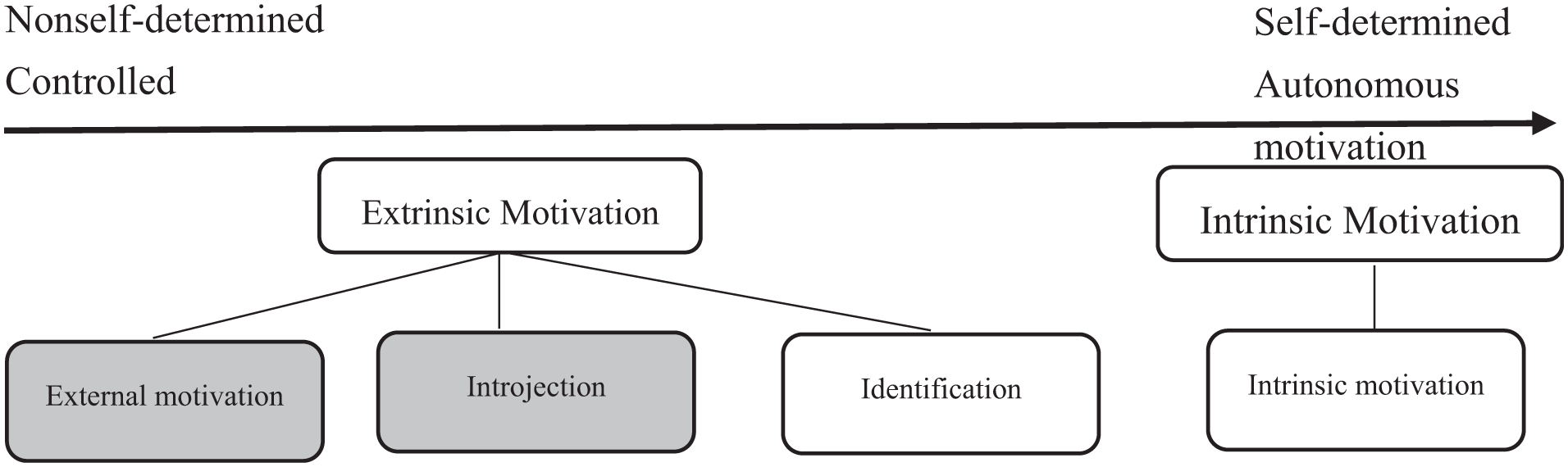
Four types of motivation (adapted from Fischer et al., 2019).
Intrinsic motivation ‘lies in the behaviour itself’ (Deci et al., 2017, p. 21). Individuals are intrinsically motivated when they perform a behaviour due to their own interest, excitement or sense of personal accomplishment (Poraj-Weder et al., 2021; Ryan & Deci, 2020). Intrinsic motivation is consistently and positively associated with a variety of functional outcomes, such as task performance, engagement, persistence and personal well-being. Additionally, it alleviates maladaptive outcomes, such as anxiety, depression, absenteeism and boredom, across various contexts and personal backgrounds (Fischer et al., 2019; Nie et al., 2015; Ryan & Deci, 2020; Sheldon & Titova, 2023).
Extrinsic motivation focuses on the utility of a behaviour rather than the behaviour itself. The first type of extrinsic motivation, identified motivation, occurs when one personally acknowledges the value and meaning of a behaviour (Poraj-Weder et al., 2021; Vansteenkiste et al., 2018). Teachers participate in a PD event for identified reasons if they value what they can learn from the event, even if the event is not inherently interesting. The identified motivation functions in a manner somewhat similar to that of intrinsic motivation. Both types of motivation reflect a sense of self-determination and positively correlate with performance (Sheldon & Titova, 2023; Stephan et al., 2010). Therefore, identified motivation and intrinsic motivation are often combined into autonomous motivation in SDT. The difference between these two types of motivation is that for tasks that are not interesting and require diligence and persistence, identified motivation is likely to be a stronger predictor of engagement and dedication (Kaap-Deeder et al., 2016; Ryan et al., 2021; Vansteenkiste et al., 2018). However, efforts and persistence invested in uninteresting behaviours may lead to psychological costs. While intrinsic motivation is significantly and negatively correlated with maladaptive symptoms, the relationship between identified motivation and maladaptation is inexistent or weak (Howard et al., 2021; Nie et al., 2015).
The second type of extrinsic motivation, introjected motivation, occurs when external demands or regulations are only partially internalised without being fully accepted as one’s own. Individuals compel themselves to take action because of a sense of ‘I must’ or ‘I should’ (Poraj-Weder et al., 2021). Behaviour is performed with the goal of enhancing individuals’ self-esteem or pleasing significant others or to avoid feelings of shame or guilt (Deci & Ryan, 2008; Gilal et al., 2019; Ryan & Deci, 2020). Introjected motivation often results in mixed results due to its conflicting nature: while it is internal to a person, it is external to the self (Deci & Ryan, 2008). On the one hand, introjected motivation is positively associated with persistence, engagement and hard work, at least in the short term (Deci & Ryan, 2008; Kaap-Deeder et al., 2016; Koestner et al., 1996; Stephan et al., 2010; Vansteenkiste et al., 2018). On the other hand, ego-involvement induces internal costs: individuals who act to gain social status or praise generally report higher levels of pressure, anxiety and exhaustion (Abós et al., 2018; Koestner et al., 1996; Howard et al., 2021; Vansteenkiste et al., 2018). Post-performative teachers in the literature may represent an example of introjected motivation. They feel a responsibility to perform and to pursue self-critical perfectionism, which is characterised by a fear of failing to live up to standards (Sullivan et al., 2021). They endeavour to earn respect and social acceptance. However, these efforts are accompanied by a variety of physical and mental illnesses (Englund & Frostenson, 2017; Holloway, 2019; Kaap-Deede et al., 2016).
The last type of extrinsic motivation, external motivation, refers to behaviours that are initiated with the goal of receiving rewards or avoiding punishments (Ryan & Deci, 2020). SDT classifies external and introjected motivation as forms of controlled motivation, although they have different loci of control. In introjected motivation, rewards and punishments are compelled from within, whereas in external motivation, rewards and punishments are extraneously imposed. External motivation is the most pressured type of extrinsic motivation because it is alien to oneself. The effect of external motivation on task performance is controversial. Some studies have reported a positive relationship between external motivation and performance (e.g., Abós et al., 2018; Fischer et al., 2019), although such a positive relationship is poorly maintained when external incentives are removed (Ryan et al., 2021). Other studies support the proposition that externally motivated individuals are less likely to engage in a behaviour, which leads to lower performance (Amabile et al., 1986; M. Qin & Tao, 2021). Regardless of the relationship between external motivation and performance, external motivation is always detrimental to personal well-being (Deci et al., 2017; Howard et al., 2021; Nie et al., 2015; Stephan et al., 2010; Vansteenkiste et al., 2018). Performative teachers who reluctantly complete imposed PD requirements are externally motivated and consequently suffer from maladaptive outcomes (Holloway, 2019; Ro, 2020).
In reality, individuals typically perform a behaviour due to multiple motives (Berghe et al. 2013; Franco et al., 2021). Therefore, this study employs a person-centred approach to explore teachers’ natural combination of motives for participating in formal PD and the influence of these combinations on teachers’ opinions of PD.
Research Method
Methodologically, this study employs qualitative secondary analysis (QSA). While secondary analysis is well established in quantitative research, QSA has gained traction in recent years. QSA reuses existing qualitative data for various purposes (Hobson & Maxwell, 2017; Irwin, 2013). This study applies this method to explore a new research question that is not a focus of the original studies that generated the data (Tate & Happ, 2018). This approach is viable because original qualitative research typically generates rich datasets and insights that cannot be fully exhausted within a single publication (Gladstone et al., 2007). The benefits of QSA include maximising data utility, reducing respondent burden and enabling the combination of diverse datasets to increase the sample size and broaden the geographical scope (Cheong et al., 2023; Tate & Happ, 2018). A major challenge, however, is that the researcher was ‘not there’ (Bishop, 2007), limiting the contextual understanding of the original studies and their participants. This limitation likely explains why 86% of studies that use QSA reuse the researchers’ own data (Sharp & Munly, 2022). Accordingly, this study employs the same strategy, utilising data collected by the first and third authors as part of two separate investigations that were conducted during 2018 and 2023 in Shanghai, China. The current study and the two original studies focused on teacher PD, thus allowing the authors to examine themes that were indicated but not fully explored in the original studies.
The Original Studies
Study 1 was conducted by the first author between December 2018 and July 2020. Twenty teachers at 10 schools in three districts and 11 employees of PD organisers were interviewed, and seven school-based PD activities were observed. Two of these districts were commercial centres of Shanghai, whereas the other was a newly developing area. Using convenience sampling, district gatekeepers (three PD organisers from the selected districts) facilitated researcher access to geographically dispersed interviewees and schools across the districts. The purpose of this study was to understand teachers’ experiences with and opinions of different types of PD in which they had participated, including both formal and informal as well as inclusive and selective types of PD. The interviews with the PD organisers opened with one overarching question: ‘Could you please tell me how you arrange PD activities for teachers?’ The opening question for the teachers was as follows: ‘Could you please tell me your experiences and opinions of the various PD activities in which you participated?’ Follow-up questions were asked according to the interviewees’ answers. The first author was struck by the apparent differences in teachers’ feelings towards PD, even when teachers from the same school had participated in the same activity.
Study 2 was conducted in April 2023 by a group of three researchers, including the first and third authors of the current study. This study was mainly evaluative in nature and sought to investigate the effectiveness of the aforementioned selective PLCs in a fourth district. Seventeen PLC members from different schools were nominated by the PLC organiser to take part in the study. The opening question for the members was as follows: ‘Could you please share your experiences and opinions regarding the PLC you participated in?’ Follow-up questions were then tailored based on each interviewee’s response. During the interviews, the authors were fascinated by teachers’ experiences of ‘suffering while enjoying’. The authors then decided to reuse these two datasets to investigate teachers’ motivation for formal PD. An understanding of motivation may help us interpret the differences among teachers in terms of their attitudes towards PD.
Not all the data are suitable for this study. The interviews of 11 employees of PD organisers in Study 1 are not included because the current study is about teachers. Furthermore, one interview in Study 2 is not included because the interviewee worked for a PD organiser. In addition, observation data are not included because we cannot infer motivation from observations. Ultimately, 20 interviews in Study 1 and 16 interviews in Study 2 are analysed in the current study. All the interviewees were nominated according to their years of teaching experience and their teaching subject. Altogether, they taught 15 subjects in 26 schools for 1 to 25 years (Table 2).
Data Analysis
Only narrations concerning formal PD (hereinafter referred to as ‘PD’, unless otherwise specified) were coded. We used teachers’ self-reported reasons for PD as an index of their motivation for PD. We first employed a case study approach, treating each teacher as a separate case to gain a comprehensive understanding of their perspectives. We highlighted all excerpts concerning the motivation to engage in PD. In each interview, the percentage of words concerning motivation accounted for approximately 4 to 28% of the transcripts. These excerpts were then deductively coded following the principles of SDT (Table 1). The results show that, with the exception of three teachers who were exclusively motivated by external reasons, all teachers were stimulated by multiple incentives. By examining the combinations of various motives across the teachers, four motivational profiles were identified (Table 2). We also inductively coded other excerpts related to teachers’ experiences with PD. This included teachers’ reported gains through PD and their perceptions of PD-related burdens. Teachers’ gains through PD were later categorised into external rewards (such as career promotion and competition wins) and intrinsic rewards (such as expanded horizon and teaching improvement). Teachers’ perceptions of PD-related burdens were classified into four types: busy yet with no complaint, suffering while enjoying, no perceived additional burden, and reluctance to dedicate extra time. The matrix coding query in NVivo software was utilised. The matrix coding was structured around two dimensions: the teachers’ motivational profiles (as rows) and the teachers’ experiences in PD (as columns). This approach enabled structured comparisons of PD experiences across different motivational profiles. The results of the comparisons are detailed below.
Codes and Subcodes for Motivation.

Four Motivational Profiles.
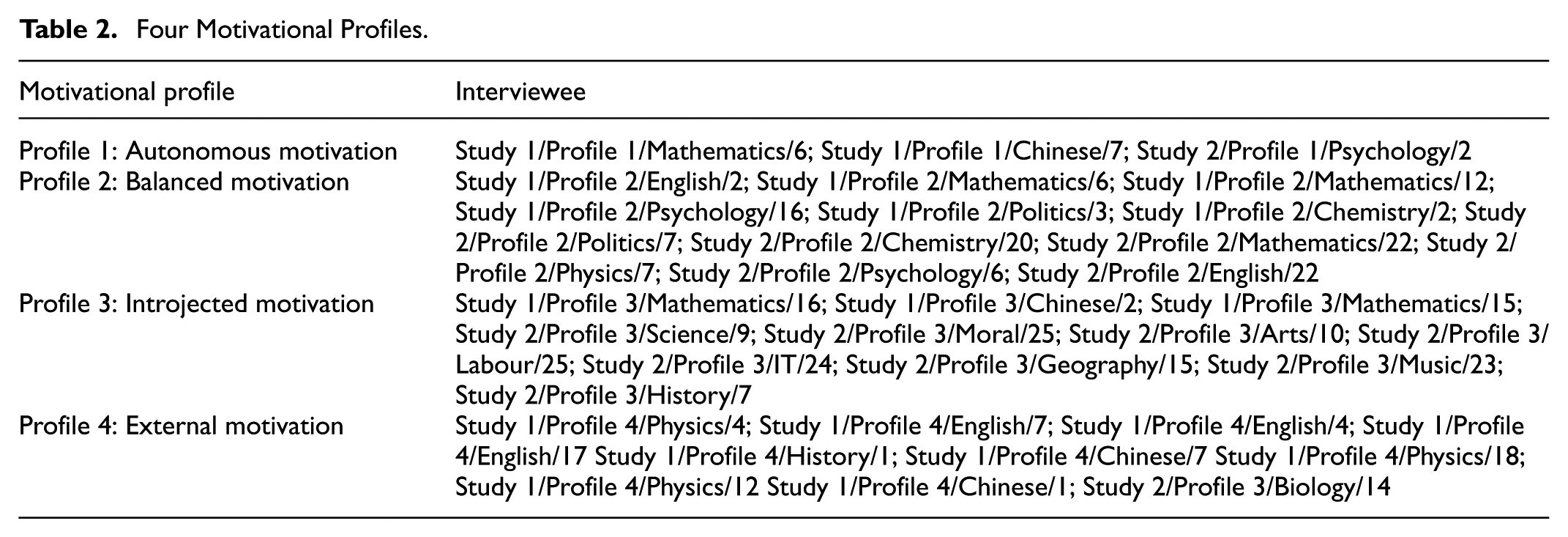
The transcripts were independently coded by the first and second authors. The first author participated in both original studies, whereas the second author processed the datasets from a fresh perspective. Their coding results were then shared with the third author. Regular meetings were held where the three authors discussed the coding process and resolved discrepancies. Because the authors later reached a coding structure (such as the two types of gains through PD and four types of perceptions of PD-related burdens), disagreements arose only twice regarding the classification of two teachers’ profiles. The authors reviewed these teachers’ interview transcripts together and compared their motivations with those of other teachers until reaching a consensus.
Each interviewee is labelled with four codes. The first code identifies the study in which the interviewee in question participated. The second code refers to the interviewee’s motivational profile. The third code identifies the subject that the interviewee taught, and the final code represents the interviewee’s years of teaching experience.
Research Findings: The Four Motivational Profiles
Profile 1: Autonomous Motivation
This profile is characterised by high intrinsic and identified motivation and low introjected and external motivation. Theoretically, this motivational profile is the most adaptive because not only are people interested in the task at hand but they also recognise the importance and value of that task (Burton et al., 2006; Wal et al., 2014). Only three of our teachers were autonomously motivated, probably because this study focused on formal PD, which always involves external requirements.
Like the ‘extremely autonomous’ teachers identified in a study of Dutch teachers, these three teachers ‘almost exclusively learn because they find it important and enjoyable’ (Wal et al. 2014, p. 32). All of these teachers loved teaching. Study 1/Profile 1/Mathematics/6 used the phrase ‘devoting myself to teaching wholeheartedly’ to describe her passion for teaching. She wanted to attend as many PD activities as possible. Interest in the subject matter also serves as a crucial motivation (Simonsz et al., 2023). This is typically reflected in the interviews with Study 2/Profile 1/Psychology/2, who explicitly expressed her love of psychology. She applied for a research project on psychotherapy, which she had been interested in since she was a university student, and the project was approved shortly before her interview.
In addition to their intrinsic motivation for PD, these three teachers recognised the importance of PD with respect to attempts to improve their teaching. Hence, they applied for the selective PLC on their own initiative (Study 2/Profile 1/Psychology/2) or actively participated in lesson studies (Study 1/Profile 1/Mathematics/6; Study 1/Profile 1/Chinese/7) and other types of PD. Study 1/Profile 1/Mathematics/6 explained why she applied for a postgraduate programme in the teaching of mathematics as follows: I felt that I truly needed to go back to university to rebuild myself. During my undergraduate study, I hadn’t taken many of the courses seriously, especially the courses concerning teaching. At that time, I placed much emphasis on the learning of mathematics and paid little attention to the learning of teaching skills. … However, after teaching for a year, I realised that I definitely needed to go back to university for further learning. (Study 1/Profile 1/Mathematics/6)
When asked about the benefits that they had obtained from PD, none of these teachers mentioned external rewards such as career promotion. Instead, they referred to what they had learned from giving and observing open lessons and how PD events had broadened their horizons. Study 2/Profile 1/Psychology/2 was the only psychology teacher at her school. In the PLC, she met and engaged in exchange with peers from other schools and thus absorbed new ideas from other PLC members.
Actually, my own perspectives are very limited… (In this PLC), every teacher has different experiences and different perspectives, and I find the discussion process quite rewarding. (Study 2/Profile 1/Psychology/2)
This finding was echoed by Study 1/Profile 1/Chinese/7, who was unsatisfied with school-based PD owing to the limited exchanges among the small group of familiar colleagues with which the PD was associated. She zealously sought out-of-school platforms that could enable her to meet interesting new friends: We are familiar with each other as colleagues. We know each other’s teaching styles. We have observed each other’s lessons countless times over the years. … Constantly observing the same kind of lessons inevitably leads to fatigue. We need fresh blood from outside. (Study 1/Profile 1/Chinese/7)
Research on autonomous motivation has revealed that when individuals are immersed in interesting and valuable tasks, long hours of work can actually increase their well-being (Trépanier et al., 2013). The teachers in this group mentioned that they needed to work overtime because of the large amount of time that they had invested in PD. However, they did not express any complaints regarding this situation.
Who is not busy? Is there any job that is not busy? Teachers are busy, but does that mean those who are not teachers are not busy?… Many employees in companies have to work overtime until 8 or 9 PM. … Adults all live busy lives. (Study 1/Profile 1/Chinese/7)
Profile 2: Balanced Motivation
Twelve teachers were associated with this profile and exhibited relatively balanced levels of both autonomous and controlled motivation. Some of these teachers loved teaching and the subject that they taught and pursued self-accomplishment. Like the Hong Kong teachers investigated in Cheng and Li’s (2020) study, who were ready to leave their comfort zones, several teachers in this group actively looked for changes to refresh themselves.
Actually, after doing something for a long time, I may feel bored and want to change. This is my personality, which drives me to try something new at a certain time. … Many teachers may use the same set of PPTs all the time, but I don’t. I always create a new set of PPTs or a new set of learning plans. I don’t want to repeat what I have done before, and I may challenge myself with something new. (Study 2/Profile 2/Politics/7)
Moreover, most of the teachers in this group recognised the value of PD with respect to improving their teaching, acquiring subject knowledge and solving problems in daily work.
The factor that distinguishes this motivational profile from the autonomous motivation profile is the addition of controlled motivation, particularly external motivation. These teachers were partly or initially compelled to complete PD tasks that were assigned by the school and the government. For example, Study 1/Profile 2/Mathematics/12 claimed that the school at which he worked had implemented a rule stipulating that all teachers must observe other teachers’ open lessons. Similarly, Study 1/Profile 2/Chemistry/2 applied for a research project because the school required every teacher to do so. Moreover, almost all the teachers in this group admitted that they had participated in particular PD events to increase their ability to obtain promotions. Study 2/Profile 2/Chemistry/20 regarded the selective PLC in which he participated as an important platform in terms of producing outputs that were crucial for promotion: The chairperson of the PLC has high-level research projects at hand and invites PLC members to perform the research together. … This is very useful for the future of the members. You are a participant in the project. Regardless of the outcome, this experience will be a great asset when you apply for promotion. (Study 2/Profile 2/Chemistry/20)
Study 2/Profile 2/Physics/7 was pursuing promotion to a mid-level professional title, which required academic publications. This career objective motivated his participation in the PLC, as he acknowledged: Writing academic papers is my weakness. There might be professional teachers in the PLC to train me in academic writing… Academic publication is undoubtedly an important criterion for promotion. (Study 2/Profile 2/Physics/7)
While the teachers who were associated with this profile participated in PD partly for external reasons, all of them admitted that they grew professionally as a result of this process. For example, they prepared for open lessons by seeking to comply with external requirements. During this process, they broadened their subject knowledge and teaching skills, obtained career promotions and enhanced their professional status, thus promoting self-accomplishment. Autonomous motives for PD were thus triggered and/or reinforced. This situation was reflected in the words of Study 1/Profile 2/Mathematics/12, whose initial reluctance towards PD transformed into active participation in a variety of PD events when he recognised the value of PD: That year, to apply for a mid-level professional title, I reluctantly gave a district-level open lesson. At that time… with the guidance of the district expert teacher, I learned little by little. Ultimately, I felt that I had a lot to learn. (Study 1/Profile 2/Mathematics/12)
In contrast to autonomously motivated teachers, who worked extra hours but never complained, the reactions of the teachers in this group to such additional workloads were diverse. A few of these teachers did not voice any complaints or experience any job stress. However, the majority of these teachers complained about their busy schedules, which might have impeded deep learning.
It actually relates to teachers’ workload. Frankly, we need to ensure that teachers have the energy to learn. … Otherwise, I believe that the effectiveness of learning will be compromised. (Study 1/Profile 2/Psychology/16)
The addition of controlled motivation to autonomous motivation may sometimes lead to side effects with respect to teachers’ engagement and well-being (Franco et al., 2021). Nonetheless, autonomous motivation reinforces teachers’ resilience (Berghe et al., 2013). Thus, even teachers who experienced work stress acknowledged that they learned useful material via PD.
Although it might feel like there is already much work to do at school and having to spend a whole day each week on PD can feel burdensome… the anticipated growth via PD is also very important. (Study 2/Profile 2/Politics/7)
Profile 3: Introjected motivation
Eleven teachers exhibited levels of introjected motivation that were higher than those exhibited by other teachers in this study. While research conducted in Western contexts has generally reported low levels of introjection (Krille, 2020), introjected reasons are relatively common among Chinese teachers, probably because collectivist Asian cultures pay close attention to social expectations (M. Qin & Tao, 2021). Teachers with strong introjected motivation vigorously attended teaching competitions and were eager to defeat their peers. Such teachers ‘are motivated to demonstrate ability (or avoid failure) in order to maintain feelings of worth’ (Ryan & Deci, 2000, p. 72).
I want to win first place in teaching competitions. … My superior won’t say, ‘you must win this competition’. However, I’m quite competitive and have the desire to excel. (Study 2/Profile 3/Labour/25)
SDT often relates introjection to a poor ability to cope with failure (Ryan & Deci, 2000) because individuals’ self-worth depends on their achievement. Several teachers in this group regarded failure as a way of losing face. When Study 2/Profile 3/Moral/25 failed to win a competition for the post of chairperson of a municipal selective PLC, she ‘felt truly embarrassed’. She then applied for an honorary title. The application’s success allowed her to save face: I failed in the competition for the post of chairperson. It would be truly upsetting if I did not achieve anything. Therefore, for the sake of face, I applied for an honorary title and succeeded. This somewhat restored my dignity. (Study 2/Profile 3/Moral/25)
These introjected motivated teachers attended PD events partly for the purpose of improving their teaching (identified reason) and partly to stand out in the crowd and to enhance their status. Sometimes, being a member of a selective PLC can arouse feelings of pride because the PLC is selective and is placed high on the governmental agenda. For example, for Study 2/Profile 3/Geography/15, the PLC in which he participated represented a platform ‘for the top 20% to stand out’. Study 2/Profile 2/Arts/10 agreed with this claim, indicating that the PLC represented a platform for her ‘to be noticed by others’. A similar sentiment is also found in the study of Proudfoot and Boyd (2025), in which teachers participated in PD for the sake of esteem.
Introjected motivation is sometimes positively associated with personal relationships that encourage individuals to act in a certain way to satisfy the expectations of important others (Vansteenkiste et al., 2018). The teachers in this group sometimes participated in PD to please significant others, such as principals, mentors and family members. When Study 1/Profile 3/Mathematics/15 talked about her PD experience since she had transferred to her current school, she recalled the favour that she owed the principal. She then participated in the PD events designated by the principal as a way to repay the debt: When all of us feel that the school leader is so good to us and cares about us, we work very hard, right? … The main reason I came to work here was because the principal helped me with my children’s school enrolment… The school helped me solve such a big issue, so I should do my best to work here. (Study 1/Profile 3/Mathematics/15)
This finding is quite similar to that reported in a study of 266 teachers in China, which proposed that the more supportive the school environment is, the greater the likelihood that teachers will experience introjected motivation, with the goal of preventing their superiors from being disappointed (Nie et al., 2015).
Like the teachers in Profile 2, the teachers in this group participated in PD partly or initially for controlled reasons, and they unanimously agreed that they grew professionally due to PD. The difference between these groups lies in the fact that the introjected motivated teachers discussed their enhanced ability to conduct research and produce academic writing more frequently. A qualitative study conducted by Ye and Zhou (2025) in Shanghai revealed that enhanced research competence is crucial for winning competitions for higher professional titles. The teachers in this group reported that, owing to their enhanced research ability, their research proposals received approval and their research articles were published, thus greatly improving their opportunities for promotion and self-esteem.
I publish papers for utilitarian purposes. I published three papers in order to apply for mid-level professional titles. When I applied for a senior professional title, I published three or four papers. I haven’t published many papers. I published, just to show that I have papers when I applied for career promotion. (Study 1/Profile 3/Mathematics/15)
The literature has shown that introjected motivation is positively associated with short-term persistence, engagement and hard work (Deci & Ryan, 2008; Koestner et al., 1996; Vansteenkiste et al., 2018). In this study, we found that personal pride can be a strong motive to engage in behaviour, not only for short-term hard work but also for constant persistence, particularly when autonomous motivation is added to the profile to buffer the stress caused by long hours of work. The introjected motivated teachers felt extremely busy and tired, often having to work very late at night.
After receiving a PD task, I often work late at night. When encountering a problem, we discuss via WeChat, sometimes until late at night… We keep discussing until we fall asleep, sometimes until 1 or 2 a.m. (Study2/type3/IT/24)
However, they worked extra-long hours voluntarily to learn something important for enhancing self-esteem, and they achieved a sense of self-accomplishment.
Every PLC member is here to do something beyond daily work. … The PLC members say that we are suffering while enjoying during PD. When I feel very tired, I think of this saying and realise that, indeed, when I feel extremely tired, I am actually making progress. (Study 2/Profile 3/Music/23)
Profile 4: External Motivation
Ten of the teachers in this study were motivated mainly or exclusively by external reasons and exhibited low levels of other types of motivation. All of these teachers admitted that they were required to complete certain PD tasks for purposes related to reregistration, employment and/or promotion. ‘It was required/assigned by …’ was a typical answer to the question ‘Why did you participate in PD?’
We are required to submit teaching plans once a week, observe school-based open lessons every two weeks, and submit teaching reflections once a month…. These tasks are assigned by the teaching department of the school. (Study 1/Profile 4/Physics/18)
While the influence of external motivation on task performance in SDT is controversial (Amabile et al., 1986; Fischer et al., 2019; M. Qin & Tao, 2021), studies have consistently shown that its relationship with well-being is negative (Deci et al., 2017; Nie et al., 2015; Vansteenkiste et al., 2018). This study revealed that external motivation is detrimental to task performance and well-being. The externally motivated teachers were less likely to engage and persist in learning. Although they all said that they could learn something useful from PD (e.g., an innovative teaching method employed in an open lesson), the resulting professional learning was random and sporadic and may not be applicable to their own classrooms. Because they are compelled to complete irrelevant or unimportant tasks, these teachers exert only the minimum effort necessary to meet external demands.
The school asks us to submit reading notes. I think it’s just a way to prove that we’re doing the task… Personally, I believe that if I can do my job well and fulfil my responsibilities to my students, that’s all that matters… It’s enough for me simply to complete the (PD) task. (Study 1/Profile 4/English/4)
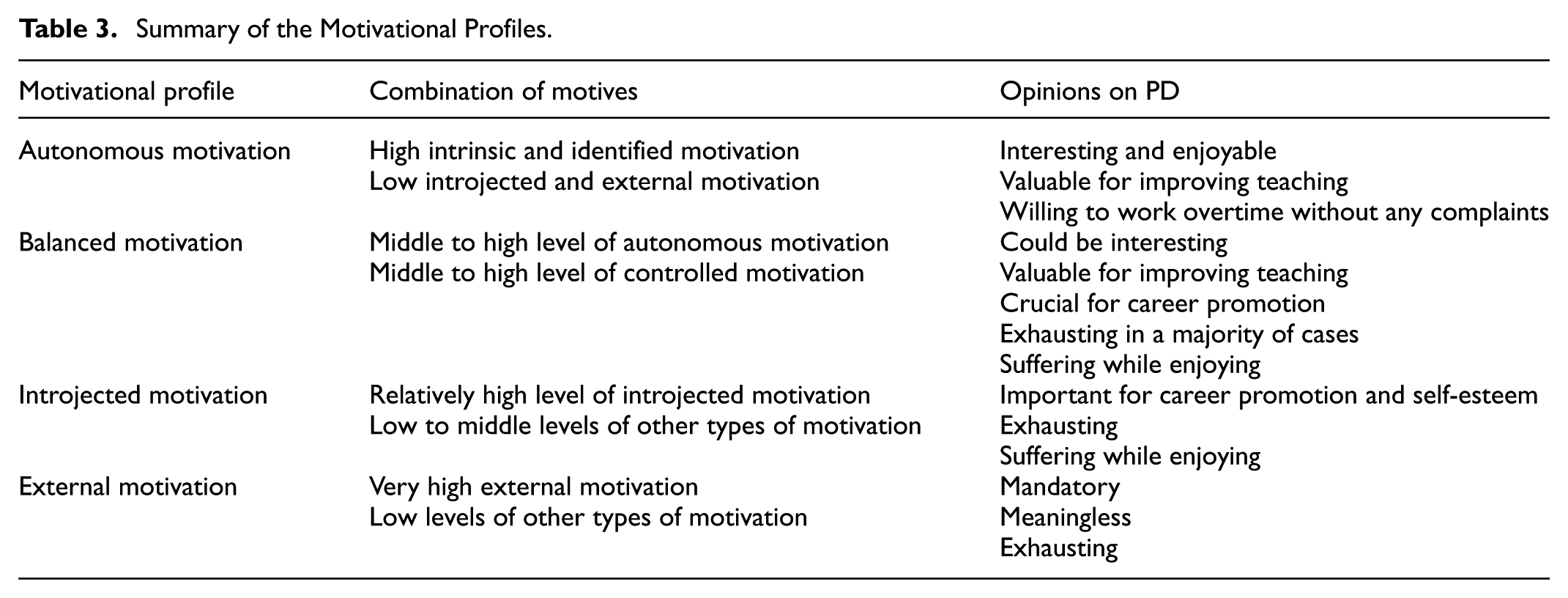
This perceived meaninglessness caused PD to increase the workload of externally motivated teachers, leading to feelings of exhaustion and unhappiness (Vansteenkiste et al., 2007). These teachers received little or no support from autonomous motivation; thus, it was difficult for them to mitigate the unfavourable effects of external stimuli. Consequently, they complained that they were too busy and tired to spend extra hours on PD (Table 3).
Nowadays, teachers have a lot of tedious work to do. I really want to spend sufficient time on the PD task, but in the end, I have no choice but to muddle through. (Study 1/Profile 4/physics/12)
Summary of the Motivational Profiles.
Discussion
The Limited Effects of Intrinsic and External Motivation
Intrinsic motivation is the ideal prototype of human motivation. It does not rely on external incentives or pressure (Deci et al., 2017), is consistently positively associated with all kinds of adaptive outcomes, and prevents various maladaptive results (Fischer et al, 2019; Nie et al., 2015; Ryan & Deci, 2020; Sheldon & Titova, 2023). However, in workplaces, purely intrinsic motivation is rare. Among the 36 teachers in this study, only three (two with Profile 1 and one with Profile 2) exhibited high levels of intrinsic motivation.
Given the rareness of intrinsic motivation, policymakers generally rely on external rewards and punishments (Gorozidis & Papaioannou, 2016). From a classic operant behaviourist view, if desired behaviours ‘are rewarded, the likelihood of those behaviours will increase’ (Amabile et al., 1986, p. 14). PD is thus embedded in a close network of accountability (Sullivan et al., 2021). However, research has shown that external motivation is consistently detrimental to personal well-being and is not guaranteed to have a positive association with performance (Deci et al., 2017; Nie et al., 2015; Vansteenkiste et al., 2018). The provision of external incentives shifts an individual’s attention from the behaviours themselves to receiving rewards (Mintz & Kelly, 2021), which makes the behaviours less enjoyable and meaningful than they should be (Avidov-Ungar, 2023; Krijgsman et al., 2017). These arguments are clearly supported by teachers in Profile 4. While teachers in the other three profiles regarded PD as an opportunity for professional growth and career promotion, the externally motivated teachers regarded it mainly as a waste of time. This group of teachers is quite similar to the performative teachers highlighted in the literature, who are reluctant with respect to accountability mechanisms. They ceremonially attend PD and criticise PD as being mechanical and useless (Warren & Ward, 2019). Instead of relying solely on the ideal of intrinsic motivation or on external rewards and punishments, policies regarding PD should recognise that teachers have heterogeneous motivations and that the same set of incentives cannot motivate all teachers in the same way.
The Internalisation of External Requirements
SDT admits that most jobs and learning activities are not inherently enjoyable. Extrinsic reasons are usually necessary to initiate and maintain a behaviour (Ryan & Deci, 2000). SDT also proposes the concept of ‘internalisation’, which involves ‘people taking in values, attitudes, or regulatory structures, such that the external regulation of a behaviour is transformed into an internal regulation’ (Gagné & Deci, 2005, p. 334). A critical issue for policymakers is how to promote the internalisation of external requirements to facilitate teachers’ participation and engagement.
The internalisation of external requirements is found in the literature on post-performative teachers, who adopt the language of accountability and relentlessly seek self-perfection. However, it seems that post-performative teachers in the literature express higher levels of physical and/or emotional pain (Englund & Frostenson, 2017; Holloway, 2019) than do the teachers in this study, probably because post-performative teachers attend PD due to internal pressure and for reasons of ego-involvement to prove that they are responsible and performing (Sullivan et al., 2021). In this study, the teachers interviewed internalised external requirements more deeply.
In the present study, among the four motivational profiles, Profiles 1 and 4 were characterised by strong autonomous or external motivation. While the teachers in Profile 1 did not need external incentives for PD, the teachers in Profile 4 were more passive and dissatisfied with their PD experiences. The majority of our teachers were associated with Profile 2 or Profile 3. These two groups of teachers were motivated by multiple motives. Their initial participation in PD was partly triggered for external and/or introjected reasons. However, as discussed above, they benefited from PD in terms of their curriculum and subject knowledge, pedagogy and academic research ability. Although most PD activities were not interesting to these teachers, they gradually became aware of the personal relevance and necessity of the activities (Vansteenkiste et al., 2018). Thus, participating in PD became important. This finding provides a basis for the evolution or reinforcement of identified motivation, which sustains hard work and persistence in challenging circumstances (Burton et al., 2006). Additionally, this finding echoes that of a longitudinal study of five Australian teachers whose initial resistance to a mandatory PD mechanism transformed into positive adoption when they recognised the mechanism’s value for their professional growth (Baker et al., 2018).
In addition to the professional growth obtained via PD, the teachers earned professional titles, participated in and sometimes won various teaching competitions, and consequently gained access to various selective PLCs. SDT regards these rewards as external. However, SDT also acknowledges that these incentives are not necessarily controlling; they may provide meaningful information that can help individuals improve or highlight areas of competence instead of pushing individuals towards specific outcomes. In these cases, external incentives tend to enhance autonomous motivation (Ryan & Deci, 2020). Studies of teachers in China (Chiang et al., 2023; M. Qin & Tao, 2021), the U.S. (Thomson & Turner, 2015) and the U.K. (Hobson & Maxwell, 2017) have confirmed that some teachers regard external incentives as forms of recognition of their work and competence, leading to a sense of personal accomplishment. This is similar to the findings of the teachers in this study in Profiles 2 or 3, who reported that obtaining various titles and awards affirmed their competence and efficacy.
I always encourage teachers to apply for professional titles. I say, ‘Don’t do it for the money.’ The increase in salary (after promotion) is not significant. What truly counts is professional recognition. After working for five or ten years, having official recognition will make you feel that, indeed, you have worked hard and are able to reach a certain professional level. (Study 1/Profile 3/Mathematics/16)
In summary, controlled motivation could be important for triggering teachers’ initial participation in PD, especially when their autonomous motivation is low. If the PD process can support meaningful learning and provide constructive feedback, then controlled motivators could be internalised and transformed into autonomous stimuli. However, when controlled motivators are not fully internalised into intrinsic motivation, as found in this study when PD was not perceived as inherently interesting, their positive relationships with performance and persistence may incur psychological costs (Deci et al., 2017; Koestner et al., 1996; Nie et al., 2015; Vansteenkiste et al., 2018). This finding explains why most teachers (mainly those in Profiles 2 and 3) were ‘suffering while enjoying’, as their persistence in PD not only led to improved professional practices and self-actualisation but also induced a certain degree of stress and exhaustion, even though they were willing to continue to invest a large amount of time in PD.
Selective and Inclusive PD
The teachers in Study 2 participated in PLCs that were accessible only to high-performing teachers. The high quality of such PLCs (as perceived by the teachers) facilitated the internalisation of the value of PD. In fact, the teachers in Study 2 acknowledged the importance and meaning of PD more often than did those in Study 1. A comparison between the teachers in the two original studies in terms of motivational profiles revealed that 14 of the teachers in Study 2 were associated with Profiles 2 or 3, and only one was externally motivated. In contrast, only nine of the teachers in Study 1 were associated with Profile 2 or 3, whereas nine were externally motivated. Only a small proportion of teachers in Shanghai are eligible to engage in selective PD. If we had expanded the scope of this study to account for a wider sample of teachers, a much greater percentage of teachers may have been associated with Profile 4.
Conclusion and Implications
In many countries, teachers are increasingly accountable for their own development and student outcomes. PD has become increasingly compulsory, and teachers are required to spend additional hours on PD. How can these additional hours be made meaningful to teachers? How can the maladaptive outcomes of PD-related stress be alleviated? Based on interviews with 36 teachers conducted as part of two studies performed in Shanghai, this study uses SDT as an analytical framework to identify teachers’ motivation for participating in formal PD, a malleable personal factor that could transform engagement with and perceptions of PD. First, the majority of our teachers participated in PD for various reasons. While the literature has made more optimistic claims regarding the impacts of autonomous motivation on task performance and well-being, in this study, controlled motivation was shown to trigger teachers’ participation, at least at the beginning. It is important for PD policies to address teachers’ diverse concerns, particularly when intrinsic motivation is low, thus leaving little room for initial policy manipulation. PD organisers and school leaders should encourage teachers to understand their own motivational profile and acknowledge their feelings (Deci et al., 1999). Additionally, they should avoid labelling extrinsically motivated teachers as ‘irresponsible’ or ‘unprofessional’.
Second, the literature has generally shown that introjected motivation is detrimental to physical and mental well-being (Englund & Frostenson, 2017; Holloway, 2019). However, several studies have proposed that introjection is a more potent motivator than SDT posits because ego involvement enhances the personal relevance of the target behaviour (Proudfoot & Boyd, 2024). This study adopts a person-centred approach to explore the interaction between various motives. Rather than regarding introjection as a stand-alone variable, we argue that when introjection is linked with autonomous motivation, the pursuit of self-esteem can drive people to act and improve their self-actualisation. The role of introjected motivation warrants further study, particularly in a strong accountability regime, in which context the pursuit of success may involve self-esteem.
Third, several limitations of this study warrant acknowledgement. This study was confined to Shanghai and used teachers’ self-reported reasons for PD participation as a proxy for motivation. Quantitative approaches could be utilised in future investigations to examine PD motivations in various settings. Furthermore, while Study 2 included approximately half of the teachers, Shanghai’s selective PLCs have stringent eligibility criteria. Consequently, Profiles 2 and 3 might be overrepresented. It is important to study the nuanced differences between various types of PD, remedial or enhancement, inclusive or selective. Different types of PD may attract different types of teachers who tend to have different motivational profiles. Future studies could compare these PD types to improve the relevance and effectiveness of PD.
Footnotes

Ethical Considerations
The studies were approved by the Academic Ethics Committee of Shanghai Normal University. The interviewees were aware of the purposes of the studies. They participated in the studies voluntarily. Confidentiality was ensured.
Funding
The authors received no financial support for the research, authorship, and/or publication of this article.
Declaration of Conflicting Interests
The authors declared no potential conflicts of interest with respect to the research, authorship, and/or publication of this article.