




Abstract
This study, inspired by Vision 2030 and Saudi education reforms, offers a comprehensive framework for teachers and educators. It identifies English as a Foreign Language (EFL) teachers’ perspectives on online and in-person professional development practices (PDPs). Through the descriptive survey research design, data was collected from (N = 85) male and female teachers using a set of instruments: two questionnaires and a semi-structured interview. The findings showed that EFL teachers are highly involved in online PDPs compared to in-person practices in which they were medially involved. Also, the respondents hold high attitudes toward both online and in-person PDPs. In addition, there was a positive and statistically significant correlation between PDPs and attitudes toward the online mode of attendance; this means the more PDPs EFL teachers are involved online, the higher attitudes they have toward those practices. Moreover, the mode of attendance played a role in the attitudes of the study sample. The analysis of semi-structured interviews revealed that EFL teachers can be proficient in complex ideas and IT-mediated pedagogical approaches by getting involved in PDPs, particularly those offered online, which will ultimately reflect in students’ success and learning. Besides, the participants noted constraints that faced them when attending online and in-person PDPs include, but are not limited to, technical and connectivity issues, including the compatibility of e-initiatives, extra financial load, fatigue, and worry. In light of the findings, this study proposes an integrated English Language Teaching (ELT) professional development model based on five principles and offers suggestions and recommendations for further research.
Keywords
Introduction
Professional development is the pursuit of knowledge, learning. or skill development with the goal of advancing one’s career. In the context of teaching and learning, it guides teachers to execute better pedagogical practices that assist in student learning both inside and outside of the classroom. It encompasses numerous PDPs and initiatives through which “teachers always seek to enhance their productivity, background knowledge and bring about change to education systems” (Assia, 2023, p. 71). PDPs’ importance for teachers’ professional exposure cannot be ignored. This study intends to identify online and in-person perspectives of PDPs among EFL teachers in the inspiration of Saudi Vision 2030 and education. The inspiration for undertaking this research lies in the realization that Vision 2030 prioritizes the creation of a national plan to improve the quality of education. This plan calls for raising the threshold for teachers’ professional standards, creating a supportive work environment, and improving the level of services offered to teachers as a means of support. According to Patalong (2016), the notion of professional development serves as a focal component, aligning closely with one of the central objectives of Saudi Vision 2030, which emphasizes the establishment of a comprehensive framework for the professional growth of teachers and educational leaders.
This study, by addressing the research questions, aims to provide context-specific insights into the effectiveness and challenges of professional development initiatives for EFL teachers in Saudi Arabia, contributing to the ongoing efforts to improve educational quality and outcomes in alignment with Vision 2030. Scholars agree that PDPs are crucial for English teachers to adapt pedagogical innovations such as workshops and conferences. They offer opportunities for collaboration and knowledge sharing, and instructors must stay informed to create effective learning environments inside or outside the classroom. For example, Karaaslan (2003) observed that various PDPs proved beneficial for English teachers to participate actively and contribute to the learning process. PDPs instruct teachers on how to deal with continuing pedagogical innovations and implement those changes in their teaching environments. Also, Omar (2014) contends that teachers must deal with educational innovation both inside and outside the academic environment. Likewise, Avalos (2011) identified PDPs as methods that focus on teachers’ progress to provide high-quality education to students. Many researchers believe that facilitating teachers’ professional development is essential to understanding what teachers require from online professional development, given the growing use of online spaces for various academic orientations. The importance of effective professional development is not in dispute but is frequently discussed what it entails, especially given how professional development is reshaping in both in-person and online modes (Binmohsen & Abrahams, 2020; Boylan et al., 2018; Quinn et al., 2019). Additionally, Morris (2010) observed that teachers can participate in various activities such as workshops, conferences, and training courses with the help of cutting-edge technologies mediated initiatives like online discussions and wikis, etc. Teachers can access various internet-based resources to strengthen their professional development exposure. Kim et al. (2023) maintained that Massive Open Online Courses (MOOCs) can offer necessary professional development opportunities for educators worldwide. Moussaoui (2021), while describing professional development attributes, added that they “include sustained time, collaborative and active participation, and situated activities” (p. 64). Likewise, D. Hill et al. (2010) claim that “teachers develop expertise not as isolated individuals but through job-embedded professional development, as members of collaborative, interdisciplinary teams” (p. 10). It is crucial to note that professional development like other disciplines has undergone cutting-edge variations to keep its beneficiaries and fellow stakeholders on board. As a result, online and in-person PDPs were included in the academic reform initiatives. According to Kleinman (2004), online professional development utilizes the Internet to allow users to collaborate and engage with others to share knowledge, activities, and expertise. Thus, with the rise of the digital age applications like Facebook, Blogs, Wikis, Twitter (now “X”), YouTube, etc., teachers engagement for learning and professional development became more and more popular (Crook et al., 2008; El Hadef, 2021). Accordingly, instructors must be aware of these developments through professional development activities to have an effective, pleasurable, and productive learning environment for teachers and students. Hennessy et al. (2022) maintained, “the use of technology across education systems offers potential benefits for mediating teacher professional development (p. 2).”
It is worth mentioning that differentiating between various professional development activities, such as attending webinars or seminars versus being observed in the classroom is essential because each one presents teachers with a different set of opportunities for professional development. Teachers who attend seminars or webinars participate passively. They learn about cutting-edge teaching techniques and acquire new information with this format. It might not, however, provide teachers with the individualized feedback and customized assistance they require to enhance their practice successfully. Furthermore, strategies acquired during webinars or workshops may differ based on unique teaching obstacles and situations. However, receiving in-class observation offers a more focused and individualized professional development. Teachers receive immediate feedback on their teaching strategies and classroom management approaches. Often, this feedback is actionable, precise, and catered to the requirements and difficulties faced by the teacher. Observations in the classroom also facilitate cooperative reflection and communication between the observers and the teachers, which promotes a culture of ongoing professional development. Additionally, having a teacher observer in the classroom allows teachers to show off their pedagogical techniques, get assistance with solving problems in the classroom, and thus improve their methods in response to the requirements of their students. Therefore, while both participating in seminars and webinars and having one’s teaching practice observed are important ways to advance one’s professional development, they have different advantages and focus on other facets of teaching. Acknowledging and comprehending these differences enables stakeholders to create thorough and efficient professional development plans that cater to the various requirements of teachers and encourage their ongoing professional development and enhancement in the classroom.
The researchers present studies concentrating on online PDPs corroborating the context, variables, and findings of investigations. For example, Silvia’s (2015) study showed that most participants view the course as well-organized and beneficial for professional development. Additionally, Kim et al. (2023) described how support from their MOOC camp facilitator and peers helped increase their affective, behavioral, and cognitive engagement. Likewise, McCall (2018) found that teachers agreed that the online courses improved their ability to plan lessons for English language learners. Similarly, Magidin de Kramer et al. (2012) indicated that the online professional program had substantially impacted instructors’ subject-matter expertise, their techniques for teaching writing and vocabulary, and students’ reading comprehension skills. Moreover, Liu (2012) discovered that Taiwanese preservice and in-service EFL instructors participating in an online video case discussion community valued as a professional development opportunity. Furthermore, Kabilan et al. (2011) discovered that EFL teachers valued their relevant professional development experience in communicating and exchanging their teaching expertise and developing their IT knowledge and technical proficiency. Murugaiah et al. (2010) found that teacher interaction through online blogs helped teachers expose various technical skills important for implementing computer-assisted education in their instructions. In addition, Kabilan and Rajab (2010) discovered that the Internet had a crucial impact on boosting their professional learning through knowledge-sharing with other educators. By the same token, Elmabruk (2009) demonstrated that teachers retained positive attitudes about Internet-based professional development, which is a promising sign for Libyan EFL teachers.
Considering the importance and efficacy of PDPs in mind, the current study, to be precise, intends to identify teachers’ both online and in-person perspectives of PDPs concerning the vision 2030 and the education reforms in Saudi Arabia. Interestingly, this study’s objectives correspond with one of the highlights of Vision 2030, which offers a comprehensive framework for the professional development of teachers and educational leaders (Al-Shehri & Gharamah, 2021; Patalong, 2016). Additionally, the need to conduct a study like this is crucial because some scholars claim that Saudi EFL initiatives for professional development fall short of an ideal model of professional development (Al-Hazmi, 2017; Alsalahi, 2015; Al-Seghayer, 2011; Alshaikhi, 2018; Elyas & Al Grigri, 2014; Sywelem & Witte, 2013). It should also be noted that PDP’s effectiveness is undeniable, and in the world of today, PDPs organizers have made it easier for teachers to participate in e-activities according to their comfort and convenience. The researchers while agreeing with the available literature, reflect that PDPs—both online and in person—are unavoidable initiatives for teachers to improve their instructional efficacy as well as keeping them digitally informed about ongoing pedagogy projects in the academic world. Therefore, this study is essential because it seeks to identify the extent to which EFL teachers are involved in online and in-person PDPs, investigate EFL teachers’ attitudes toward online and in-person PDPs, find out any correlation between EFL teachers’ involvement in PDPs and their attitudes of those activities, find out whether EFL teachers’ responses to PDPs and attitudes toward them differ by the mode of attendance, that is, online and in-person, investigate views of teachers on how online and in-person PDPs can contribute toward students’ success and learning, and discover the constraints the faculty members face when involve online and in-person PDPs.
Theoretical Framework
Teacher professional development has been defined as a teacher’s continuous pursuit of formal and informal learning and strong working connections between teachers for intensive learning opportunities and self-evaluation (Darling-Hammond et al., 2009; Guskey, 1995; Rhodes et al., 2004). Traces are manifested through multifold domains. Teachers involved in PDPs learn from their practices and theories (Hattie, 2002; Ingersoll, 2003; Stroll, 1999), reproduce scholarship by active reflection (Absolum, 2006; Fraser, 2008; Lovett, 2002), demonstrate the importance of theory through practice (Joyce & Showers, 1982; Lovett, 2002; Rentoul, 1996), reflect positivity through reflection and constructive response (Fraser, 2008; Totterdell et al., 2002), build knowledge through action research and inquiry (Fraser, 2008; Reid, 2004; Timperley et al., 2008), collaborate through teamwork and support (Bishop, 2005; R. Hill & Sewell, 2010; Wink, 2000), connect globally through cutting edge technology (Gilbert, 2007).
The review of literature, perhaps, offers no indications of having a unanimous theory, framework, or model of teacher professional development, yet educators nonetheless classified and labeled it as the traditional model for their convenience, which assumes that teachers may be lacking knowledge and expertise, is considered ineffective in improving teaching quality and professionalism (Garet et al., 2001). In 1999, Hawley and Valli, as we trace the models, classified traditional professional development into four models: the individually guided model, the observer/assessment model, the development/improvement model, and the training model. These models, according to many scholars, are criticized for being ineffective, incoherent, decontextualized, unrelated to real classroom situations, and outdated in terms of current teaching and learning approaches, despite having some features of professional development of the current era (Kennedy, 2001; Lustick, 2011; Sabah et al., 2014). Hawley and Valli (1999), keeping the concerns of the traditional model and its classifications in mind, refurbished the model into the reform model based on a set of principles including teacher involvement in design and implementation, contextualization, cooperation, ongoing support for knowledge enlargement, and improvement of theoretical understanding. On one hand, scholars like Desimone et al. (2007) and Lustick (2011) supported the reform model, while on the other, Ingvarson (1998), Guskey (2003), and Lustick (2011) favored the integration of both models. On the other, keeping the importance of PDPs, teachers’ involvement aimed at enhancing instructional efficacy cannot be disregarded. According to Doran (2014), there is a growing need to study the professional development engagements that prepare teachers to offer effective instruction.
This study’s theoretical underpinnings align with the aforementioned models as well as the scholars who carried out numerous studies on teachers’ professional development initiatives with a variety of variables, circumstances, contexts, and factors including the role of PDPs in strengthening teaching and learning domains. The earlier studies focused on professional development’s crucial role in the delivery of teaching (Qader, 2020), bridging the gap between individual needs and professional development programs (Olatunde-Aiyedun et al., 2021), inadequate welfare policy implementation with academic staff performance (Bernadette & Ukaegbu, 2017), the low performance of teachers as a result of insufficient in-service training activities (Dolores & Ernest, 2018), and action research to make instructions effective (Özdemir, 2001). Besides, they paid attention to assessing the effectiveness of teacher evaluation and appraisal for professional growth (Badia, 2015), the perspectives and experiences of continuing professional development (Qadhi & Floyd, 2021), concerns regarding the continuing professional development activities (Ouardani, 2020), attitudes of EFL teachers toward the teaching profession (Agcam & Babanoglu, 2016).
The literature review provides valuable insights into the effectiveness and impact of online professional development programs for educators, particularly in EFL teaching. Alzahrani and Althaqafi (2020) found that while online professional development programs offer flexibility and accessibility, their effectiveness may be limited due to teachers’ perceptions and application of new knowledge. This highlights the need for online professional development providers to consider teachers’ needs and preferences to enhance program effectiveness. However, there is a gap in understanding how online professional development can be tailored to better meet these needs. Similarly, Poole et al. (2020) identified crucial components of successful online programs, such as flexible learning and technology integration. While these findings contribute to developing effective online professional development frameworks, further research is needed to explore how these components can be implemented in practice to improve outcomes for educators. Vadivel et al. (2021) highlighted the importance of continuous professional development for ESL teachers, emphasizing shared experiences and a sense of community to meet international standards. However, there is a lack of research on how continuous professional development programs can effectively foster a sense of community and shared experiences among teachers, pointing to a research gap in this area. Fishman et al. (2013) and Russell et al. (2009) compared online and in-person professional development modalities, finding significant differences in teacher knowledge and student learning outcomes. These studies underscore the need for further research to identify the most effective professional development modalities for different contexts and subjects. Carrillo and Assuncao Flores (2022) provided insights into teaching and learning strategies during the COVID-19 pandemic, highlighting the importance of caring, social collaboration, and inclusivity in education. This study suggests a need for more research on how these aspects can be integrated into online teaching practices beyond the pandemic. Finally, Powell and Bodur (2019) and Meyer et al. (2023) examined the planning and evaluation of online professional development sessions. Their findings contribute to understanding the design and implementation of effective online professional development programs. However, there is a need for more research on how to sustain engagement and collaboration among participants in online professional development as well as how to measure the long-term impact of these programs on teachers’ professional practices.
In summary, the literature review points to several major issues in online professional development for educators, including program effectiveness, the impact of different modalities, the role of community and collaboration, and the long-term effects of professional development on professional practices. Addressing these issues through further research can help improve the design and implementation of online professional development programs to better support educators and enhance student learning outcomes. Hence, this study is essential because it demonstrates how crucial English is in today’s worldwide society and how ELT practitioners need to stay current with new developments in English pedagogy, keeping in mind that English is the principal language of instruction in the majority of Saudi Arabia’s higher education institutions. The professionalism of teaching EFL in Saudi Arabia has been impacted by extensive educational reforms, including those in curriculum, instruction, and evaluations. These reforms aim to improve Saudi students’ education so that they can meet the demanding educational requirements of life and work in the 21st century (Badia, 2015). As a result, English teachers “need to keep up with the information and skills necessary to their professional progress and be a lifelong learner” (Al Asmari, 2016, p. 118). In addition, after reviewing the available literature, it is evident that studies on EFL teachers’ online and in-person perspectives of professional development activities in the context of Vision 2030 and Saudi education reforms appear to be limited in the Middle East in general and a university in particular. Therefore, this study intends to bridge this gap and provide valuable insights into the effectiveness and challenges of professional development initiatives for EFL teachers in Saudi Arabia, contributing to the ongoing efforts to enhance educational quality and outcomes in alignment with Vision 2030. Hence, the study objectives are reformulated in the form of the following research questions:
To what extent do EFL teachers involve in online and in-person PDPs?
What are EFL teachers’ attitudes toward online or in-person PDPs?
Is there any correlation between PDPs and EFL teachers’ attitudes?
Are there any significant differences in the sample’s responses about PDPs and their attitudes due to the mode of attendance (online, in-person)?
How can online and in-person PDPs contribute toward students’ success and learning?
What constraints do the faculty members face when engaged in online and in-person PDPs?
Methodology
Research Design
This study employed the descriptive survey research design. The design describes a specific phenomenon or situation and provides a detailed description of the phenomenon, including its characteristics, patterns, behaviors, and frequency. In addition, it identifies and analyzes factors that contribute to the observed phenomenon, such as institutional support, teacher demographics, or contextual factors. This research design is utilized when researchers aim to understand not only the current state but also the underlying factors. In the current study, the EFL teachers’ perspectives toward online and in-person PDPs were described. Also, the study, while finding any correlation between PDPs and EFL teachers’ attitudes, diagnosed the relationship between the participants’ responses in light of the mode of attendance: online and in-person. Besides, the participants’ views on online and in-person PDPs that contribute toward students’ success and learning, including the constraints the faculty members face when they attend online and in-person PDPs were identified. For data collection, the researchers utilized a questionnaire and a semi-structured interview.
Population and Sample of the Study
The study was conducted at a Saudi university; EFL teachers at the College of Languages and Translation and Preparatory Year at the university were the community of the study (n = 103: 50 males & 53 females) in the third semester of the academic year 2023. The teachers belong to various nationalities and have different degrees in English, including masters and doctorates in various fields of applied linguistics. In addition, they have rich teaching experiences ranging from (0–5) years, (6–10) years, and above (10) years. The questionnaire link was circulated to the whole study population, and the number of respondents who completed the survey was (n = 85: 40 = males & 45 = females), equivalent to (83%) of the study population. The shortfall in survey responses may be attributed to a lack of interest, time constraints, or other factors among participants. It is important to note that some participants who completed the survey were interviewed for in-depth analysis, ensuring consistency across data collection methods. In addition, the approval letter for conducting the research from the xx Committee at the xx was obtained with the code [xxxxxx-xxxxxx-xx]. The questionnaires contained a text requesting consent to participate in the study, and it is assumed that everybody who completed the survey did so voluntarily. In addition, interview participants (13) who were chosen purposively also completed two versions of the written informed consent; one was given back to the researchers, and the other was kept with the participant. The participants were provided with a written informed consent form outlining the study’s purpose, participants’ involvement, and other information about confidentiality. Participants signed the form, indicating their voluntary willingness to participate. They were given a second copy for record-keeping, enabling them to make informed decisions and remind them of their rights and responsibilities.
Research Instruments
Questionnaires
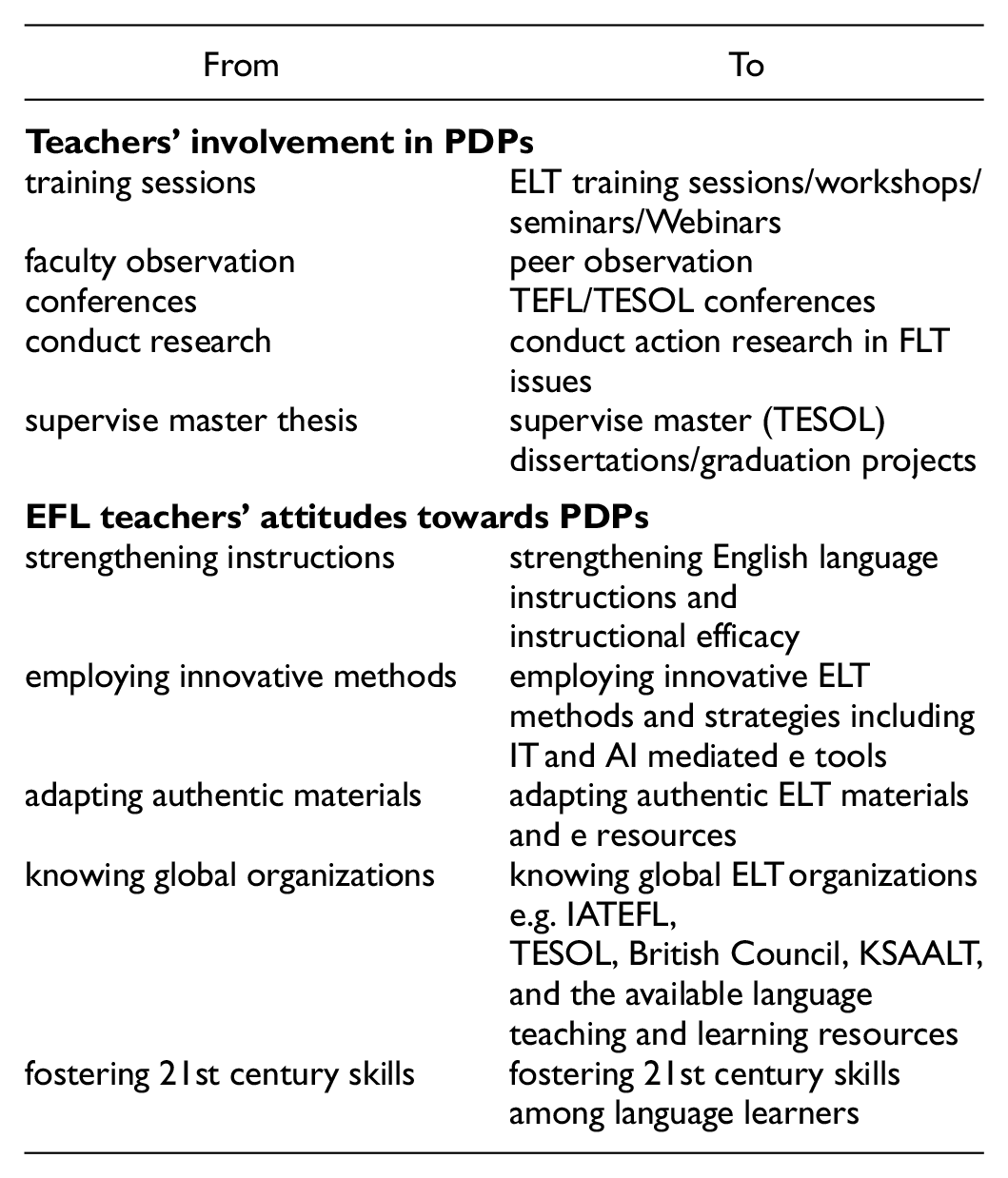
Two questionnaires to answer the questions were used to collect data. A closed-item questionnaire was used to assess the extent of PDPs that EFL teachers engage in online and in-person. Another questionnaire was used to know EFL teachers’ attitudes toward those activities. The questionnaire was developed by the researchers based on their teaching experience and the literature review (Al Asmari, 2016; Assia, 2023; Bouaissane et al., 2022). The choice of the questionnaire to collect data aligns with Creswell (2012), who believes that “'surveys help identify important beliefs and attitudes of individuals'” (p. 06). The first questionnaire included the PDPs (10 items), such as I attend ELT training sessions/workshops/webinars/seminars; I supervise master (TESOL) dissertations/ graduation projects). The second one had EFL teachers’ attitudes toward PDPs (20 items), such as professional development activities assist in strengthening English language instructions and instructional efficacy, employing innovative ELT methods and strategies including IT and AI mediated e tools, understanding how to implement ICT in EFL classrooms, creating student-friendly projects, and assessments for language learning, adapting authentic ELT materials and e-resources). A Google link was available for 3 weeks and shared on the department’s WhatsApp groups and teachers’ emails. The average time to complete the questionnaire was approximately 20 min. The questionnaires (professional development activities and teachers’ attitudes) used a five-point Likert scale: Always 5, Very often 4, Sometimes 3, Rarely 2, Never 1, and: 1 = strongly disagree, 2 = disagree, 3 = neutral, 4 = agree, 5 = strongly agree.
Semi-Structured Interview
A semi-structured interview, using protocols developed by the researchers, was employed to answer research questions 5 (whether online and in-person PDPs contribute toward student success) and 6 (learning and what constraints the faculty members face when they attend online and in-person PDPs). The participants (N = 13), to provide their consent to participate in the interview, were interviewed by researchers. The interviews were estimated to last 10 to 15 min. They were conducted in the Department of English, College of Languages and Translation and Department of English Skills, Preparatory Year at university, and audio recorded. The semi-structured interviews conducted for the study were designed to maintain consistency and standardization while allowing for flexibility and depth in responses. Each interview began with an introduction from the interviewer, an explanation of the purpose of the study, and obtaining informed consent from the participant. This ensured that participants understood the nature of the research and voluntarily agreed to participate. The interview questions were semi-structured, meaning that while there were predetermined questions, there was also room for follow-up and probing based on participants’ responses. The questions focused on the following areas: the role of online and in-person PDPs in student success and learning and the constraints to attending online and in-person PDPs. The 13 participants selected purposively for the interviews were chosen based on specific criteria deemed relevant to the research objectives. While this sampling approach may limit generalizability to the broader population, it allowed for a targeted examination of perspectives from individuals with diverse experiences and insights related to PDPs among EFL teachers in the context of Vision 2030 and Saudi education reforms. In addition, the researchers familiarized themselves with the interview protocol and techniques for maintaining neutrality and objectivity. They maintained a non-judgmental demeanor and refrained from expressing personal opinions or preconceived notions during the interviews. The questions judiciously elicited detailed responses without leading participants or imposing interviewer perceptions. Moreover, regular debriefing sessions among the researchers were conducted to reflect on interview experiences, identify potential biases, and discuss strategies for mitigating them. Following data collection, thematic analysis was employed to identify patterns, themes, and insights from the interviews. The thematic analysis process involved transcription of audio-recorded interviews, familiarization with the data, coding, categorization, theme development, etc. The transcription ensured accurate representation of participants’ responses, while familiarization involved multiple readings to identify patterns and themes. In addition, coding allowed the researchers to systematically divide the transcript into categories, identifying relationships between codes, and analyzing the data to develop key concepts. The analysis examined the identified themes in relation to the research questions, linking them to the current research context. The findings, finally, were systematically reported, highlighting key insights and answering research questions. This process helped researchers to ensure that the data were interpreted objectively and accurately, minimizing the influence of any biases introduced during the interview phase. Overall, efforts were made to maintain consistency, standardization, and impartiality in the interview process, thereby enhancing the validity and reliability of the study’s findings.
Validity
Content validity in the current research involved assessing the relevance, representativeness, and appropriateness of items in the questionnaires and interviews. It included establishing a clear theoretical framework, developing items based on relevant literature, conducting a thorough item review by a panel of experts, administering the questionnaire to a pilot sample, and collecting qualitative feedback to identify any misunderstanding or inappropriate items. The items were revised to ensure they accurately represent the intended constructs. A panel of experts assessed the changes and ensured they met the criteria for content validity. This systematic evaluation ensured that the items were not solely reliant on expert judgment but were considered appropriate for the study. Henceforth, in this study, the face and content validity of the questionnaire and interview were checked by a jury of experts (N = 9). The experts checked if the tools could collect data that could answer the research questions and thus achieve the research objectives. Therefore, they were provided with the research tools, questions, objectives, and an assessment scale. The assessment scale included criteria for judging each item in terms of the compatibility of statements with their domains, appropriateness of wording of statements, inclusiveness of statements to achieve the objectives of the study, language, and grammaticality soundness, applicability of statements in the Saudi EFL teachers’ professional development context, and suggestions for improvement. Face validity is a term used to describe how suitable a study tool’s contents appear on its outer layer. Content validity is determined by examining how well it can represent the various facets of a particular concept. Bhandari (2022) observes that face validity, which examines whether a study tool appears to measure what it is supposed to evaluate, is concerned with how relevant and appropriate a measurement appears to be for the object it is evaluating. In addition, Rusticus (2014) defines content validity as the extent to which an assessment tool is pertinent to and representational of the targeted construct that it is intended to measure. The study tools were approved by the jury members after incorporating their reviews, and they noted that the tools help this research achieve its objectives. The issues which were observed by the experts were related to wordiness, language, and the study context. The researchers incorporated the experts’ observations, and the modifications were as:
Semi Structured Interview Question
Can professional development activities contribute toward students’ success?
What are the problems of professional development activities?
How can online and in-person PDPs contribute toward students’ success and learning?
What are the constraints to attending online and in-person PDPs?
Internal Consistency
Pearson’s coefficients were applied to check the internal consistency of the questionnaire statements. The questionnaire was applied to a sample of (20) participants who were excluded from the main study later. The correlation was checked between statements and domains, and domains and the total degree of the questionnaire. Table 1 shows the values of Pearson’s correlation coefficients.
Internal Consistency (Pearson) of PDPs Questionnaire.

statistically significant at (.01). *statistically significant at (.05).
Table 1 shows that the Pearson correlation coefficients between the items and the total score of the domain belonging to it were statistically significant at the significance level (.01) and (.05). Pearson correlation coefficients between the items and the total score ranged between (.646**–.732**). These values indicate that the questionnaire enjoys validity.
Table 2 shows that the Pearson correlation coefficients between EFL teachers’ attitudes toward PDPs with the total score were statistically significant at the significance level (.01) and (.05). Pearson correlation coefficients between the items and the total score ranged between (.549*–.785**). These values indicate that the questionnaire has consistency.
Internal Consistency (Pearson) of Attitudes Toward PDPs Questionnaire.

statistically significant at (.01). *statistically significant at (.05)
Reliability
The reliability coefficients were calculated on the questionnaire domains using split halves (Guttman) and Cronbach’s alpha methods. There are many indices to calculate a study tool’s reliability. One of them is Guttman’s Split Halves, which is calculated by dividing the items in a test into two-halves such that the covariance between scores on the two-halves is as high as possible (Guttman, 1945). Similarly, Cronbach’s alpha is a way of assessing reliability by comparing the amount of shared variance, or covariance, among the items making up an instrument to the amount of overall variance Cronbach (1951). The study tool was applied to a survey pilot sample of (20) teachers. Then, the researchers calculated the Pearson correlation coefficients. Table 3 shows the reliability coefficients.
The Study Tool’s Reliability (Questionnaires).

Table 3 shows that the reliability coefficient on the first questionnaire (EFL teacher’s PDPs) reached (0.80) by Cronbach’s alpha and (.83) by split half (Guttman). The second questionnaire (EFL teachers’ attitudes toward PDPs) scored (0.93) using Cronbach’s alpha and (.90) using split half (Guttman). These results indicate that the study tool’s reliability.
Data Analysis
The statistical software (SPSS) version (23) was adopted to analyze the results and answer its questions. In addition, the Pearson correlation coefficient was used to verify the validity of the consistency. Furthermore, Cronbach’s alpha and split-half (Guttman) were applied to check the reliability of the study tool. In addition, Means, standard deviations, and rank were presented for answering questions (1–2). Moreover, the adopted scale for assessing the degree of achievement of statements and domains within the study tool utilized a range equation to determine the level of approval. The scale categorizes degrees of achievement into five distinct ranges: very low degree (1.00–1.80), low degree (1.81–2.60), medium degree (2.61–3.40), high degree (3.41–4.20), and very high degree (4.21–5.00). This systematic approach allowed for the precise evaluation of the extent to which statements and domains within the study tool were perceived to have been achieved and fulfilled. By employing this scale, researchers could effectively gauge the level of approval across various aspects of the study tool, providing valuable insights into its overall effectiveness and validity. Additionally, Pearson correlation and Paired sample t-tests were used to answer the third and fourth questions. Finally, thematic analysis was employed to answer questions (5–6). Thematic analysis is a methodical and objective technique for analyzing qualitative information from interviews. Finding recurrent themes, patterns, and ideas in the interview responses is part of this process. Researchers scrutinize interview transcripts meticulously and use coding techniques to classify and arrange the data into coherent segments. During the process, researchers learn more about the underlying meanings, viewpoints, and insights that interviewees offer. By using thematic analysis, researchers find recurring themes and patterns in the interviews, which helps them understand the subject matter better and produces rich qualitative data that can be further examined and interpreted. With the help of the patterns and themes found in the interview data, researchers draw conclusions, infer, and interpret the results. Hence, the qualitative data from the interview was analyzed following the thematic analysis technique by Braun and Clarke (2006). The interviewees’ answers were transcribed, classified, and grouped under the main themes.
Results
RQ1: EFL Teachers’ Involvement in PDPs (Online and In-Person)
Table 4 demonstrates that EFL teachers exhibit a higher level of engagement in online professional development activities compared to in-person professional development. The mean score for online professional development involvement was 3.57, indicating a high level of engagement, while in-person professional development involvement scored a mean of 2.70, indicating a medium level of engagement. This suggests that EFL teachers value and actively participate in professional development activities that offer flexibility and convenience, such as online professional development.
Descriptive Statists of EFL Teachers’ Involvement in PDPs.

RQ2: EFL Teachers’ Attitudes Towards PDPs (Online and In-Person)
The results in Table 5 suggest that EFL teachers have a positive outlook toward professional development programs (PDPs) in both online and in-person formats. They rated their attitudes toward online PDPs at a mean score of 4.15, with a standard deviation of 0.884, and toward in-person PDPs at a mean score of 4.05, with a standard deviation of 0.670. This indicates that EFL teachers highly value and view professional development activities positively, regardless of whether they are conducted online or in-person.
Descriptive Statists of EFL Teachers’ Attitudes Toward PDPs (Online and In-Person).

RQ3: Correlation Between EFL Teachers’ Involvement in PDPs and Attitudes Towards Them
Table 6 shows the results of Pearson correlation coefficient between EFL teachers’ involvement in PDPs and attitudes toward them from the study sample viewpoint in the two modes of attendance: online versus in-person. There is a positive and statistically significant correlation at the significance level (.05) between PDPs and attitudes toward them in the online attendance mode. This result means the more PDPs EFL teachers are engaged online more attitude they have toward those activities. Also, it is shown that there is no positive and statistically significant correlation at the level of significance (.05) between PDPs and attitudes toward them in the in-person attendance mode. This result means that the less PDPs EFL teachers are engaged in in-person the less attitudes they have toward those practices.
Pearson Correlation Coefficient (Involvement in PDPs & Attitudes).

Correlation is significant at the 0.05 level (2-tailed).
RQ4: Differences in the Study Sample’s Responses to PDPs and Attitudes Toward Them According to the Attendance Mode
As shown in Table 7, the paired sample t-test results reveal statistically significant differences in how the study participants perceived PDPs based on their mode of attendance (online or in-person). Regarding online PDPs, the mean attitude score (4.15) was significantly higher than the mean PDP score (3.57), with a t-value of −5.802 and a significance level of .000. Similarly, for in-person PDPs, the mean attitude score (4.05) was significantly higher than the mean PDPs score (2.70), with a t-value of −16.853 and a significance level of .000. These results indicate that the mode of attendance (online vs. in-person) influenced the study sample’s responses to PDPs and their attitudes toward them. In both cases, attitudes toward PDPs were more positive than the actual engagement in PDPs, suggesting that the study sample valued and viewed professional development activities more positively than their actual participation in them.
Paired sample t-test for the responses attributed to attendance mode.

RQ5: Online and In-Person PDPs Contribution Toward Students’ Success and Learning
Teachers’ responses regarding the contribution of online and in-person PDPs to students’ learning success were qualitatively analyzed. The findings showed that the interviewees were of the view that PDPs both online and in person have their positives and restrictions. However, participants showed more interests toward online mode of PDPs which contribute toward students’ success and learning. They asserted that by participating especially in online PDPs, EFL teachers learn several cutting-edge concepts and IT-mediated pedagogical approaches which ultimately contribute toward students’ success and learning. Some of the selected excerpts are listed below:
T1: “Online development can give teachers new worldwide developments, whereas, in person professional development activities develop teachers skills and students get benefit.”
T2: “Online activities provide innovative e-resources but, in person professional development activities give us real and physical and on-campus experience.”
T4: “Online professional development activities may not assist teachers fostering improvement in students, while, in person professional development activities contribute positively toward students’ success in enriching their experiences.”
T5: “on one hand, online activities let teachers updated with the latest issues and techniques, while on the other, in person activities may not provide you with new methods.”
T6: “Effective online professional learning leads to improved teacher knowledge, skills and practice, while, in person professional development activities help teachers fosters a cycle of improvement for their students.”
T9: “With online professional development, teachers can contribute positively to enhancing students' understanding, whilst, teachers with in-person can exchange ideas, stories, and experiences with their local counterparts.”
T10: “Online professional development activities give chances for the teacher to go global, whereas, in in-person involvements enhances teacher’s ability to deal locally.”
T11: “Through online professional development engagement, teachers can learn various cutting-edge hi-tech concepts, however, by in-person, teachers enable to rethink how instruction can be applied in the classroom.”
T12: “Online activities develop new skills for integrating technology, when in fact, in in-person development activities teachers can use different strategies for on-campus activities.”
RQ6: Constraints That the Faculty Members Face When Attend Online and In-Person PDPs
Teachers’ responses to the constraints the faculty members face when they attend online, and in-person were qualitatively analyzed. The results revealed that the interviewees noted that the constraints the faculty members face when they engage in online PDPs include but are not limited to technical issues, connectivity to the internet, some sites are special and not for all network issues, information technology gadgets, repeated topics, etc. Whereas, the participants added that the constraints the faculty members face when they engage in in-person PDPs are typically held distance from home or the location of the institution, which adds to extra financial load, fatigue, and worry. Some selected excerpts are mentioned below:
T1: “Online professional development bring constrains like, network problems, registration limitations, while in-person professional development activities include away from home, travel problems, and cost burden on the participants.”
T3: “Online attendees do not necessarily equip with IT skills, resources, and motivation, whereas, in-person professional development activities are attended by the participants who remain hesitant and face many barriers.”
T4: “The participants remain hesitant attending online activities because of their hectic schedule, while on the contrary, attending in-person presents different type of constraints like travel to other places, inadequate budgets, poorly designed programs.”
T5: “The trainers in online programs are sometimes not knowledgeable. Whereas, the issues in attending in-person development may be listed as the time clash, session(s) duration, presenters way of presentation, and repeated topics.”
T7: “Online activities consist of participants knowledge about online technologies, restricted or no support from local IT administrators, access denied to digital technologies, and GMT. However, in- activities consist of odd timing, non-interested topics, clash of programs and activities with TTT.”
T8: “Online activities can be attended easily, but sometimes it might have internet issues. And, lack of financial support, delay of visa processing, and presenters disconnect from the classroom are some of the constraints which might discourage teachers to attend in-person activities.”
T9: “Many participants want to participate and ask questions during online events, but their efforts remain in vain because of internet issues like weak connections. In addition, the restrictions that faculty members face when participate on campus include instructors’ disbelief and practices and seminars far distant.”
T13: “online professional development activities are not collaborative, training tools and other e resources are beyond comprehension, when in fact during in-person professional development activities do not see many discussions. Also, real experiences are rarely shared.
Discussion
This study exhibited that EFL teachers are more engaged in online professional development activities compared to in-person professional development initiatives. The findings highlighted the flexibility and sustainability of online PDPs. The results also demonstrated that EFL teachers hold positive attitudes toward professional development initiatives, recognizing the quality of teaching and learning opportunities provided by both online and in-person PDPs. The following sections present a detailed discussion of each research question:
To What Extent Do EFL Teachers Involve in Online and In-Person PDPs?
EFL teachers exhibit a higher level of engagement in online professional development activities compared to in-person professional development. In the online mode of attendance, in particular, the respondents highly attended ELT training sessions/workshops/webinars/seminars compared to a medium level of the same activity in the in-person mode. Also, they were being observed in class as part of a peer observation program during online classes at a high level compared to a medium level of peer observation in person. In addition, attending TEFL/TESOL conferences in online mode scored high, whereas it came at a low level of attendance in in-person attendance. The convenience and accessibility of online professional development may contribute to this higher level of engagement, as teachers can participate from anywhere at any time. Additionally, the interactive and self-paced nature of online professional development may be more engaging for teachers compared to traditional lecture-based in-person professional development. The quantitative results of this study are fairly consistent with the qualitative findings of this study, which reveal that the majority of the participants engaged in online professional development.
The results of this study also agree with those of Alzahrani and Althaqafi (2020) and Poole et al. (2020), who found that teachers engaged in online professional development via social networks, webinars, and online forums due to its flexibility and sustainability. However, the results of this study contrast with Moussaoui’s (2021) findings, which showed that instructors generally prefer in-person professional development opportunities. This contrast may be due to study context, participants, and other factors, including IT and internet issues that could have impacted the findings. Institutions and professional development providers should consider offering a variety of professional development formats to meet the diverse needs and preferences of EFL teachers, ensuring they have access to high-quality professional development opportunities that enhance their professional growth and teaching practice.
What Are EFL Teachers’ Attitudes Towards Online or In-Person PDPs?
The results revealed that EFL teachers have positive attitudes toward professional development programs, regardless of the mode of delivery. This means that teachers are not only driven to advance their pedagogical knowledge but also believe that both online and in-person PDPs help provide high-quality teaching and learning opportunities. PDPs, according to the teachers’ attitudes, very highly assisted faculty members in using better management techniques in the classroom both online and in-person. Also, the respondents perceived that online and in-person PDPs help faculty members very highly in understanding how to implement ICT in EFL classrooms. One potential reason for these favorable attitudes is that EFL educators value ongoing professional development to enhance their teaching methods and elevate student learning. Both virtual and traditional professional development programs provide avenues for teachers to broaden their expertise, skills, and instructional techniques, ultimately resulting in greater job satisfaction and career advancement. In addition, the positive views toward both types of professional development may stem from the quality of the programs. Well-designed professional development initiatives are engaging, pertinent, and directly applicable to teachers’ everyday teaching, fostering positive attitudes and outlooks among participants.
The results of this study are compatible with those of Al Asmari (2016), who found that teachers see professional development as a contest to their standing experience and classroom activity. Moreover, the findings of this study coincide with those of Alzahrani and Althaqafi (2020) and Poole et al. (2020), whose findings also indicated the efficacy of online professional development in promoting active and collaborative participation. However, the researchers could not find any study with findings that contradict the findings of this study, and the reasons for non-contrastive results may be due to study context, participants, and other factors, including different variables that could have resulted in only favorable findings. Institutions and professional development providers should continue to offer high-quality PDPs that meet the needs and expectations of EFL teachers, ensuring they have the support and resources needed to excel in their profession.
Is There Any Correlation Between PDPs and EFL Teachers’ Attitudes?
It was also found that there was a positive and statistically significant correlation between PDPs and attitudes toward them in the online attendance mode. These findings indicate that the format of professional development (online vs. in-person) could impact how EFL teachers view their participation in such programs. The positive association observed with online professional development might be because of its convenience, accessibility, and potentially more interactive nature compared to traditional in-person sessions. Conversely, the absence of a clear correlation with in-person professional development suggests that factors beyond just attending, such as the quality of content or delivery method, could have a greater influence on how teachers perceive these programs. In addition, reasons such as adaptability, lack of convenience, limited range of activities of programs, cost, travel anxiety, the loss of teaching and other academic responsibilities, the lack of program customization, the disconnect with other ELT practitioners from other parts of the world, the dearth of learning from subject or domain specialists, and the harm of professional acknowledgment.
The results of this study related to online PDPs in terms of more (positive) attitudes correspond with those of Poole et al. (2020), whose findings identified adaptability, interaction with others, content, monetary savings, and technological advances as essential components of efficient online PDPs. However, the results of this study contrast with those of Alzahrani and Althaqafi (2020), whose findings revealed restrictions in teachers’ acquiring knowledge and application of new abilities and information. The reasons for the contrastive findings may be due to the study context, participants, and other circumstances, including many variables that could have led to unfavorable results. The findings of this study related to in-person PDPs in terms of less (negative or critical) attitudes correspond with those of Moussaoui (2021), whose study’s findings revealed that Moroccan teachers continue to demonstrate more enthusiasm for conventional forms of professional development compared to online professional development. However, the findings of this study related to in-person PDPs in terms of less (negative or critical) perceptions somewhat contrast with those of Vadivel et al. (2021), whose findings indicated that teachers are in command of their professional development, but improved outcomes, they perceive professional development through collaboration, classroom reflection, and an awareness of community among themselves to keep up with the high standards of the global system of education. The reasons for the contrastive findings may be due to study context, participants, and other factors, including several variables that could have produced negative outcomes and opposed results. These results underscore the significance of incorporating delivery mode considerations into the design and execution of professional development programs for EFL instructors. Offering interactive and easily accessible online PDPs could result in more favorable attitudes and increased participation from teachers, ultimately improving the impact of these initiatives.
Are There Any Significant Differences in the Sample’s Responses About PDPs and Their Attitudes Due to the Mode of Attendance (Online, In-Person)?
The results indicate that the mode of attendance played a role in varying the responses of the study sample online. This result means that teachers have a favorable attitude toward online PDPs since e-activities are well-structured and have defined objectives. By assisting teachers in changing their professional habits, they contribute and let them feel at ease in terms of their academic involvement and routines. Teachers change their professional practices after participating in online activities. They gave them fresh attitudes and opportunities for discussion about the most recent ELT developments and best practices. This result could be explained by the possibility that the study participants held high expectations or had positive predispositions toward professional development activities, resulting in more positive attitudes irrespective of their actual involvement. Furthermore, the mode of delivery might have influenced how participants perceived the activities, with online PDPs potentially being seen as more accessible, convenient, and engaging than in-person PDPs.
The findings of this research are consistent with those of Fishman et al. (2013), Magidin de Kramer et al. (2012), Russell et al. (2009), and Carrillo and Assuncao Flores (2022), who discovered that online professional development for teachers has generally positive impacts on teachers’ professional practices. The results of this study also concur with those of Meyer et al. (2023), who found that teachers in online professional development exhibited high levels of cognitive engagement, high levels of activity clarity and organization, and moderate levels of collaboration. However, the results of this study are somewhat in contrast with those of Powell and Bodur's (2019) research, which revealed that an online component might often fail to provide sufficient opportunities for teachers to collaborate, including the methodology of this specific experience is insufficient. The reasons for the contrary findings may be attributed to the study context, participants, and other factors that could have produced negative results. These results underscore the importance of not just focusing on the content and structure of professional development activities but also considering participants’ attitudes toward them. Institutions and providers of professional development should strive to create and deliver programs that not only address the needs and expectations of participants but also resonate with their attitudes toward professional development.
How Can Online and In-Person PDPs Contribute Toward Students’ Success and Learning?
The findings of the interview questions revealed that the respondents believed that PDPs, both in person and online, have benefits and limitations. Participants, however, expressed a greater interest in PDPs that can be used online and that help students succeed and learn. According to some participants, teachers’ capacity to reimagine teaching and learning through involvement in in-person PDPs ultimately influences the success of students’ learning. This means that participating in both online and in-person PDPs advances teachers’ pedagogical faculties, which in turn assist students in not only meeting their needs but also comprehending innovative and differentiated instructions to be able to better learn and succeed. The reasons for these findings may be attributed to the fact PDPs—both online and offline—provide teachers with opportunities to learn innovative and cutting-edge pedagogical practices and development in teaching and learning which results in the best content delivery to make the students’ learning pleasing effective and positive outcome-oriented. The research’s conclusions are in line with those of Fishman et al. (2013), Magidin de Kramer et al. (2012), and Russell et al. (2009), who discovered that both face-to-face and online professional development programs have an equal impact on improvements in teachers’ views and understanding, teachers’ professional conduct, and the performance of students. The finding indicates the importance for institutions to implement a well-rounded approach to professional development, integrating both online and in-person activities. Furthermore, there is a pedagogical implication for institutions to embrace technology, offer adaptable learning options, promote collaborative learning, and customize professional development programs to address the unique needs of EFL teachers.
What Constraints Do the Faculty Members Face When Engaged in Online and In-Person PDPs?
Besides, the responses of the teachers to the constraints that the faculty members encounter whether they attend in person or online were qualitatively examined. The findings demonstrated that the constraints include but are not limited to technical issues, strain on the eyes, connectivity to the internet, presenters’ styles of presentation, repeated topics, etc. In contrast, the participants highlighted that the limitations faced by faculty members during in-person PDPs are frequently far from their homes or the location of the institution, adding to their financial burden, exhaustion, and anxiety. These results indicate toward the fact that distinct obstacles arise for both online and offline PDPs. Therefore, instructors who participate in online activities need to be serious about organizing their time and completing obligations whereas teachers who participate in online professional activity sessions may need to be concerned about variations in time zones, technological issues, and other glitches and interruptions. Interestingly, no study was found in the best search of the researchers to support or contrast the results of this particular research question. The findings showed that EFL teachers are highly engaged in online PDPs compared to a medially engaged degree in PDPs in the in-person mode of attendance. Interestingly, the results of the quantitative data coincide with qualitative analysis, which also revealed that the PDPs, both in person and online, have benefits and limitations. Participants, however, expressed a greater interest in PDPs that can be used online and that help students succeed and learn. In addition, the current study’s results are expected to motivate EFL teachers and practitioners to actively engage in professional development, both online and in person. The researchers, in harmony with other scholars like Patalong (2016), Al-Shehri and Gharamah (2021), Badia (2015), and Al Asmari (2016), anticipate that ELT professionals, through their involvement in professional development programs and constructive perceptions, will expose themselves to the latest advancements in English pedagogy. Moreover, this will equip them with the necessary knowledge and skills required to excel in their ELT roles, including having a significant impact on educational reforms, particularly in the areas of curriculum, instruction, and assessment in English education. These findings indicate the importance of institutions offering sufficient technical assistance and resources to ensure seamless participation in online professional development programs. Participants cited challenges related to travel distance for in-person PDPs, leading to additional financial strain, fatigue, and stress. Institutions should consider providing online PDPs as an alternative to reduce the necessity for travel and cater to teachers’ requirements for flexible and accessible professional development options. Moreover, institutions should offer financial aid or incentives to teachers attending in-person PDPs to mitigate the financial challenges associated with travel.
Pedagogical Implications
This research has implications for EFL teachers, educators, and other stakeholders whose engaged participation in PDPs both online and in-person can improve teaching efficacy, student learning experiences, and the overall quality of ELT developments. Pedagogically, the findings of this study underscore the importance of incorporating digital platforms into professional development programs to meet the evolving needs of EFL teachers. By embracing online resources and technologies, teachers can access a wide range of learning opportunities, collaborate with peers globally, and stay abreast of the latest advancements in ELT. Additionally, the study results emphasize the role of professional development in driving educational reforms and improving curriculum, instruction, and assessment practices in English education. By actively engaging in professional development activities, EFL teachers can enhance their teaching effectiveness, promote student learning outcomes, and contribute to the ongoing improvement of English language education. Moreover, the findings of this study provide valuable insights into the preferences, perspectives, and challenges associated with online and in-person PDPs among EFL teachers. By addressing these findings, educators, policymakers, and professional development providers can design more tailored and effective PDPs to support the continuous growth and development of English language educators globally.
Conclusion
This study, inspired by Vision 2030 and Saudi educational reforms that offer a comprehensive framework for teachers and educational leaders, investigated EFL teachers’ perspectives of online and in-person PDPs and attitudes toward them. The findings showed that EFL teachers were highly engaged in online PDPs. Also, the results revealed that EFL teachers highly perceived online and in-person PDPs and attitudes. In addition, there was a positive and statistically significant correlation between professional development activities and the attitudes of PDPs toward the online attendance mode. Moreover, the mode of attendance played a role in the attitudes of the study sample. Furthermore, it was observed that attending PDPs both online and in person contributes toward students’ success and learning; however, the participants noted some constraints related to both online and in-person PDPs, such as technical issues, connectivity to the internet, extra financial load, fatigue, and worry.
While the findings of this study provide valuable insights into the preferences and attitudes toward EFL teachers regarding online and in-person PDPs, several limitations should be acknowledged. Firstly, the study’s sample was limited to EFL teachers at a specific university in Saudi Arabia, which may limit the generalizability of the findings to other contexts. Secondly, the study relied on self-reported data from participants, which may be subject to response bias or social desirability bias. Thirdly, the study focused primarily on quantitative analysis, with a limited qualitative exploration of participants’ experiences and attitudes. A more comprehensive qualitative investigation could provide deeper insights into the underlying reasons behind teachers’ preferences and attitudes toward different modes of professional development. Moreover, the study did not consider external factors such as institutional policies or cultural norms that may influence teachers’ involvement in PDPs. Future research could explore these factors to provide a more nuanced understanding of the dynamics shaping PDPs in the field of ELT. Finally, the study’s cross-sectional design limits the ability to establish causal relationships between variables. Longitudinal studies could provide a more robust analysis of the impact of professional development programs on teachers’ pedagogical practices and student outcomes over time. The researchers, despite these limitations, anticipate that the findings of this study contribute valuable insights to the existing literature on PDPs in ELT and highlight areas for further research and exploration. In the end, the researchers propose an integrated ELT professional development model based on five principles:
It is anticipated that the proposed model will encourage teachers to engage in PDPs both online and in person to make the English teaching and learning environment convenient and inspirational. In addition, the researchers suggest that the institutions should do the needed to address the constraints that EFL teachers face in attending professional development programs regardless of the mode online and/or in-person. The proposed ELT professional development model complements the study’s results and provides a comprehensive structure for creating and carrying out successful professional development programs for EFL teachers. The model seeks to elevate the standard of ELT teaching and eventually lead to better student success through attending to the unique requirements of EFL teachers, encouraging teamwork and communication, offering motivation and assistance, encouraging hands-on learning, and prioritizing students’ academic success.
Footnotes
Acknowledgements
The authors are thankful to the Deanship of Graduate Studies and Scientific Research at Najran University for funding this work under the Growth Funding Program grant code (NU/GP/SEHRC/13/404-1).
Data Availability Statement included at the end of the article
Author Contribution
The authors confirm contribution to the paper as follows: study conception and design: MN, AZ; data collection: MN; analysis and interpretation of results: MN, AZ; draft manuscript preparation: MN, AZ. All authors reviewed, revised, and approved the final version of the manuscript.
Declaration of Conflicting Interests
The author(s) declared no potential conflicts of interest with respect to the research, authorship, and/or publication of this article.
Funding
The author(s) disclosed receipt of the following financial support for the research, authorship, and/or publication of this article: The authors are thankful to the Deanship of Graduate Studies and Scientific Research at Najran University for funding this work under the Growth Funding Program grant code (NU/GP/SEHRC/13/404-1).

Data Availability statement
The datasets generated during and/or analyzed during the current study are available from the corresponding author on request.