




Abstract
To ensure high-quality customer service, it is of utmost importance for restaurant employees to experience high job satisfaction. Recent indicate that many job seekers place more trust in information provided by job portal websites rather than one directly offered by companies. Therefore, this study adopts mixed-method research based on employee-generated corporate reviews within the restaurant service sector sourced from the Korean job portal site “JobPlanet.” Following a qualitative extraction of 10 determinants of job satisfaction from reviews using topic modeling, we conducted a survey to quantitatively explore the asymmetric relationships between the identified determinants and job satisfaction. The findings of this study categorize work environment and promotion opportunities as satisfiers, a work-life balance and customer service as dissatisfiers, and the remaining components as hybrid factors. As such, the unveiled determinants are expected to serve as valuable references for HR departments across various restaurant businesses seeking to enhance their policies.
Keywords
Introduction
The restaurant industry is a service-oriented sector in which a company’s competitive advantage is significantly influenced by employees’ service provision (Karatepe & Karadas, 2015). However, not only the turnover rates among restaurant employees are revealed to be higher than other industries, but such rates are also rapidly increasing with rates reaching 74.3% in 2018 and 101.2% in 2022 (Bureau of Labor Statistics, 2022). From employers’ perspective, higher turnover rates necessitate increased expenditures for recruiting new employees and staff training (Frye et al., 2020). Therefore, it is crucial for restaurant businesses to ascertain the underlying factors contributing to employees’ turnover and to engage in efforts of enhancing employee retention to obtain a competitive advantage (Lu & Gursoy, 2016). In general, job satisfaction is recognized as one of the main features affecting employee turnover, with higher job satisfaction leading to reduced turnover intentions (Wang et al., 2020).
In fact, the restaurant industry places a high reliance on human resources compared to other sectors, rendering interpersonal services even more critical (Wen & Liu-Lastres, 2021). In other words, employees’ role of providing service determines whether customers obtain positive experiences (DiPietro et al., 2020). However, employees who are dissatisfied with their job not only struggle to provide high-quality service but also find it challenging to satisfy their customers. Moreover, such employees are more likely to leave the company in a voluntary manner (Brotheridge & Lee, 2003). In order to deliver high-quality service to customers and reduce employee turnover, it is essential to first identify factors influencing employees’ job satisfaction (Bellet et al., 2024; George, 1990).
Recently, job seekers showed propensity to place greater trust in online business reviews authored by actual employees on job portal websites than information directly provided by companies (Lakin, 2015). As reviews from job portal websites ensure anonymity, there is a greater likelihood of employees providing more candid and specific accounts (Evans & Mathur, 2005). Therefore, it is of necessity to examine such review texts to explore factors influencing employees’ job satisfaction.
Prior research has conducted qualitative studies on review texts to investigate determinants of job satisfaction using Topic Modeling (Jung & Suh, 2019; Liu et al., 2024; Sainju et al., 2021). However, such qualitative research has limitations in comprehending the relationship between job satisfaction determinants and overall job satisfaction. Mixed method research can overcome such limitations by combining quantitative and qualitative research methods which offer in-depth insights into the phenomenon under investigation (Creswell & Clark, 2017). It addresses limitations of single method approaches, solely being either qualitative or quantitative, and further provides specific insights (Johnson & Onwuegbuzie, 2004). Additionally, Kim et al. (2025) conducted a study exploring the determinants of job satisfaction among restaurant employees using data from the Korean job review platform, JobPlanet. This research compared the analysis of JobPlanet’s detailed ratings data with survey data to evaluate how these two data sources align or differ in identifying determinants of job satisfaction. However, as the study predominantly relied on quantified rating data, it had limitations in utilizing potential latent factors or unstructured data embedded within text reviews.
Therefore, in this study, we aim to identify the key determinants of job satisfaction that are highly valued by restaurant employees through mixed method research by utilizing topic modeling as well as a survey. We collected reviews written by employees enrolled in restaurant service sector from the job portal website, “Job Planet,” and conducted Latent Dirichlet Allocation (LDA) to qualitatively explore the key determinants of job satisfaction. Next, in the quantitative research phase, we investigated the asymmetric relationships between the key determinants and overall job satisfaction through analyzing the survey results. Using Penalty Reward Contrast Analysis (PRCA), we categorized each job satisfaction determinant into a satisfier, dissatisfier, or hybrid factor to unveil their asymmetric relationships with job satisfaction. Consequently, this study is anticipated to improve the overall understanding of job satisfaction for future researchers and contribute to the operations and planning of human resource management for businesses within the restaurant service sector.
RQ1: What are the determinants of job satisfaction for restaurant employees as identified from JobPlanet reviews?
RQ2: How can the determinants of job satisfaction be categorized into satisfiers, dissatisfiers, and hybrid factors based on the Kano model?
Literature Review
Job Satisfaction in Restaurant Service Sector
Prior studies have suggested several definitions of job satisfaction, which is summarized as a positive state of mind that employees experience while performing job tasks (Chiaburu et al., 2022; Dessler, 2016; Schermerhorn et al., 1991). Employee job satisfaction positively affects both corporate and customer evaluations (Gil et al., 2008). Therefore, encouraging positive emotions and attitudes toward their job tasks is essential for increasing overall corporate performance.
In particular, since the restaurant service sector highly relies on human resources compared to other industries, placing an emphasis on its employee job satisfaction is critical (Snipes et al., 2005). Employees from the restaurant industry who are dissatisfied with their jobs are incapable of providing satisfactory service to customers (Brotheridge & Lee, 2003). Due to the prioritized order of employees with high job satisfaction leading to the provision of subsequent satisfactory customer service, it is significant to make employees feel satisfied with their job in the first place (Bellet et al., 2024; George, 1990).
As a result, research has been conducted to scrutinize determinants of overall job satisfaction among restaurant employees. Notably, a recent trend reveals an increasing prevalence of mixed method approaches, as shown in Table 1 (Cain et al., 2020; DiPietro et al., 2020; Lippert et al., 2022; Mulyawan et al., 2021).
Previous Research on Job Satisfaction Analysis in the Food Service Industry Using Mixed Methods.
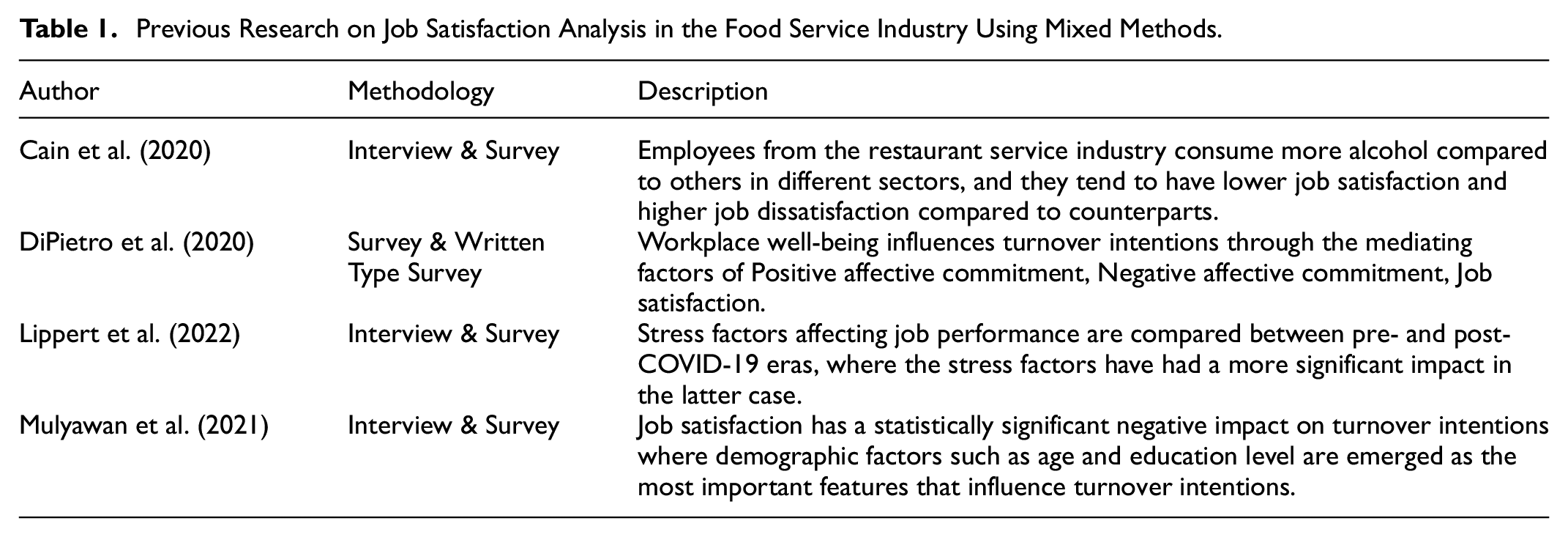
However, prior research has predominantly employed the combined use of a survey and an interview, which infers a limited presence of mixed method research on information provided by job portal websites or relevant online communities. To address this gap, this study first conducts qualitative research on reviews collected from the job portal website to identify the key determinants of job satisfaction and then quantitatively examine the asymmetrical relationships of such determinants and overall job satisfaction.
Topic Modeling
Topic modeling is a method used to identify the main themes or topics within a document, and one of the prominent algorithms widely applied in numerous research is LDA (Latent Dirichlet Allocation; Jelodar et al., 2019). LDA identifies topics within unstructured documents by uncovering patterns as illustrated in Figure 1. Here, M represents the entire corpus, which is the total number of documents; N represents individual documents; Z denotes topics. The parameter β represents a weight which reflects how likely a word W corresponds to a topic Z, while θ represents a vector indicating the proportions of latent topics Z within the document N. α is an external variable that generates θ, where a larger α renders the distribution of topics to be more uniform, while a smaller α results in a higher prominence of specific topics α (Blei, 2012). LDA has an advantage of determining topics within a document without prior knowledge to a given content. Therefore, LDA has been widely used in various text analysis domains including online community posts, news articles, and online shopping reviews to extract the underlying topics within textual data (Mutanga & Abayomi, 2022; Tabiaa & Madani, 2021; Zhang & Zhang, 2022).

LDA algorithm.
Recently, there has been a notable surge in research employing topic modeling within the hospitality and service industry. Lee et al. (2017) utilized LDA to analyze online reviews written by tourists, aiming to extract topics and derive insights into the behavioral traits of Japanese tourists. Jia et al. (2018) collected both user-generated reviews and fraudulent reviews of restaurants sourced from Yelp.com; they conducted LDA topic modeling on each type of reviews to delineate topic patterns in a separate manner, and ultimately proposed a model for the classification of fake reviews based on the discerned topic patterns.
Kano Model
Kano (1984) proposed a model that categorizes quality attributes into three groups based on their impact on customer satisfaction, as shown in Figure 2. These categories are satisfier factors, hybrid factors, and dissatisfier factors, each contributing to customer satisfaction in distinct ways. Satisfier factors lead to satisfaction when fulfilled but do not cause dissatisfaction when unmet. Hybrid factors contribute to satisfaction when fulfilled but result in dissatisfaction when unmet. Dissatisfier factors are essential attributes that cause dissatisfaction when absent but do not increase satisfaction when fulfilled. While the Kano model is rooted in Herzberg’s Two-Factor Theory, it introduces several important distinctions. For instance, the classification of quality attributes in the Kano model is flexible, changing based on customer expectations and industry-specific characteristics. Additionally, the model recognizes that attributes initially perceived as exciting can evolve into performance or basic factors over time. These features offer valuable insights not only for customer satisfaction but also for employee satisfaction research (Matzler et al., 2004). This study applies the Kano model to explore which factors contribute to job satisfaction for restaurant employees. To achieve this, Latent Dirichlet Allocation (LDA) was used to extract job satisfaction determinants from reviews written by restaurant employees on South Korea’s major job portal site, JobPlanet. Based on these determinants, a survey was conducted, and Penalty Reward Contrast Analysis (PRCA) was used to examine which factors lead to satisfaction or dissatisfaction among restaurant employees. The findings are expected to provide practical insights for improving the overall job satisfaction of restaurant employees.

Kano model (Tan & Pawitra, 2001).
Penalty Reward Contrast Analysis
Penalty Reward Contrast Analysis (PRCA) is an analytical methodology first introduced by Brandt to identify attributes that can potentially enhance customer satisfaction. PRCA is utilized to explore the asymmetric relationships between product or service attributes and overall customer satisfaction, drawing upon the principles of the Kano Model (Kano, 1984). Kano model classifies attributes affecting customer satisfaction into three types: Satisfier, Dissatisfier, and Hybrid. A satisfier pertains to a quality element that boosts customer satisfaction when it exceeds their expectations, playing a vital role in product and service differentiation. Conversely, a dissatisfier represents a fundamental quality element expected to be fulfilled consistently, thus leading to dissatisfaction if it is absent. A hybrid category encompasses quality elements that yield satisfaction when fulfilled and dissatisfaction when unfulfilled. PRCA involves the creation of two binary dummy variables (high performance and low performance) for each attribute, followed by conducting multiple regression analysis. This approach classifies the impact of each dummy variable on overall satisfaction into Satisfier, Dissatisfier, Hybrid, thus revealing their asymmetric relationships.
Numerous studies have validated that not all service attributes symmetrically impact satisfaction, and they have highlighted the existence of asymmetric relationships between provided service attributes and overall satisfaction (Kwon et al., 2022; Lai & Hitchcock, 2017; Mathe-Soulek et al., 2015; Tontini et al., 2020). Table 2 illustrates the application of PRCA in the hospitality industry to identify the asymmetric relationships between service attributes with satisfaction.
Extant Research using PRCA in Hospitality Industry Settings.

Since the restaurant service industry is labor-intensive and thus reliant on human resources, human resources play a huge role in determining a company’s competitive advantage. In order for a restaurant business to satisfy customers’ experience, it is of necessity to treat employees’ job satisfaction not only as a prerequisite but also as a priority. Therefore, there is a need to identify determinants of job satisfaction among restaurant employees and uncover how such determinants asymmetrically affect overall job satisfaction.
Research Methodology
Mixed-Methods Approach and Its Procedure
In this study, we conducted a mixed method research utilizing both topic modeling and a survey, as illustrated in Figure 3. During the qualitative research phase, we employed LDA topic modeling on corporate reviews written by employees in the restaurant service industry to extract determinants of job satisfaction. In a subsequent phase of quantitative research, we conducted PRCA to investigate the asymmetric relationships between such determinants and overall job satisfaction.

Research framework.
LDA Topic Modeling Procedure
The following demonstrates the sequential steps involved in conducting LDA topic modeling to explore the determinants of employee job satisfaction in the restaurant service sector.
Step 1. Collection of review texts from Job Planet, the prominent job portal website in South Korea
Step 2. Review text preprocessing ○ Tokenization: on a word basis ○ Cleaning: removal of unnecessary words such as stop words ○ Normalization: integration of words with the same meaning but in different expressions
Step 3. LDA Topic Modeling ○ Coherence score calculation ○ Intertopic Distance Map Visualization
This study labels the topics obtained through topic modeling based on insights from the extant literature and expert participation.
Survey Analysis Procedure
In the quantitative research phase, the determinants of employee job satisfaction derived through LDA topic modeling are used as a basis to create survey questionnaires to be distributed to employees in the restaurant service sector and collect their answers. The job satisfaction determinants are then transformed into two binary dummy variables (high and low performance) to be utilized in multiple regression analysis for testing their influence on overall job satisfaction that are ultimately categorized as satisfiers, dissatisfiers, or hybrid.
The survey analysis procedure is outlined as follows:
Step 1. Conduct a survey (on a scale of 1–5) on the job satisfaction determinants identified through topic modeling.
Step 2. Convert the job satisfaction determinants into dummy variables. ○ The first dummy variable assigns 1 to the case where the performance of determinant is low, 0 otherwise. ○ The second dummy variable assigns 1 to the case where the performance of determinant is high, 0 otherwise.
Step 3. Perform multiple regression analysis using the dummy variables.
Step 4: Calculate the Penalty Index (PI: the negative impact on overall satisfaction when the performance is low) and the Reward Index (RI: the positive impact on overall satisfaction when fulfilled) for each determinant. Determinants are categorized as Satisfier, Dissatisfier, or Hybrid based on the calculated PI and RI values.
Data Collection
To perform LDA topic modeling, data was collected from South Korea’s largest job portal site, Job Planet, web scraped using the BeautifulSoup and Selenium libraries from Python, as depicted in Figure 4. The collected reviews, written by employees in the restaurant service sector, span from 2014 to 2021, involving both positive and negative sentiment reviews that discuss advantages as well as disadvantages. Since these reviews encouraged employees to write both the strengths and weaknesses of their respective companies, we used reviews that would discuss both advantages and disadvantages to successfully navigate topics influencing job satisfaction. A total of 11,411 reviews were collected to be used for analysis.

JobPlanet data: (a) coherence score and (b) intertopic distance map.
LDA Topic Modeling Result
Prior to conducting LDA topic modeling, we determined the number of topics by the range of topics with high coherence scores from 8 to 12, as illustrated in Figure 5. We then conducted a sequential simulation to establish the number of topics, considering the minimal overlap between them.

Estimated number of topics: (a) Coherence score and (b) Intertopic distance map.
In this study, we determined the number of topics using the coherence scores and the intertopic distance map. In general, higher coherence scores indicate semantic consistency among topics derived through LDA (Newman et al., 2010). Moreover, intertopic distance maps spatially depict the distances between circles representing topics, implying that non-overlapping circles at a greater distance are the indicators of higher discriminant validity between the topics (Sievert & Shirley, 2014). After careful consideration, we set the number of topics to 10.
The topics derived from LDA topic modeling are presented in Table 3. In this study, we named the topics through discussions involving prior studies and expert consultations, taking into account 15 keywords designated for each topic (Antoncic & Antoncic, 2011; Galup et al., 2008; Jung & Suh, 2019; Lund, 2003; Macky & Boxall, 2008; Spector, 1985). Therefore, we identified 10 topics using Latent Dirichlet Allocation (LDA) based on employee reviews. These topics, as presented in Table 3, encompass key aspects of job satisfaction in the restaurant industry, such as “Welfare and Wage,”“Work Environment,”“Work-Life Balance,” and “Corporate Policy.” Each topic represents a distinct determinant of job satisfaction derived through topic modeling, ensuring minimal overlap and high coherence. Table 3 provides a comprehensive summary of these topics, including representative keywords for each, offering insights into the specific concerns and priorities of employees. Topic 1, titled Welfare and Wage, comprises keywords associated with the provision of material or psychological services by organizations to their members. Topic 2, titled Attendance Management, includes keywords related to working hours such as commuting times, leave, and annual vacations. Topic 3, titled Work Environment, consists of keywords linked to the conditions under which tasks are performed, encompassing physical surroundings or job characteristics. Topic 4, titled Work-Life Balance, reflects keywords describing a satisfying psychological state achieved through harmony and balance in all aspects of life and work. Topic 5, titled Corporate Culture, represents keywords associated with the atmosphere and relationships within an organization, formed among its members. Topic 6, titled Management, pertains to keywords denoting the relationship between employees and their supervisors. Topic 7, titled Customer Service, relates to keywords that describe interactions with customers, whether harmonious or strained. Topic 8, titled Organizational Inflexibility, involves keywords highlighting rigid rules imposed by managers within the organization, potentially causing stress and limiting employee behavior. Topic 9, titled Promotion Opportunities and Possibilities, captures keywords reflecting achievements such as promotions, benefits, or conversions to regular positions through continuous effort. Topic 10, titled Corporate Policy, includes keywords referring to policies implemented to support and care for employees within an organization.
LDA Results.

Survey Measurement Instrument
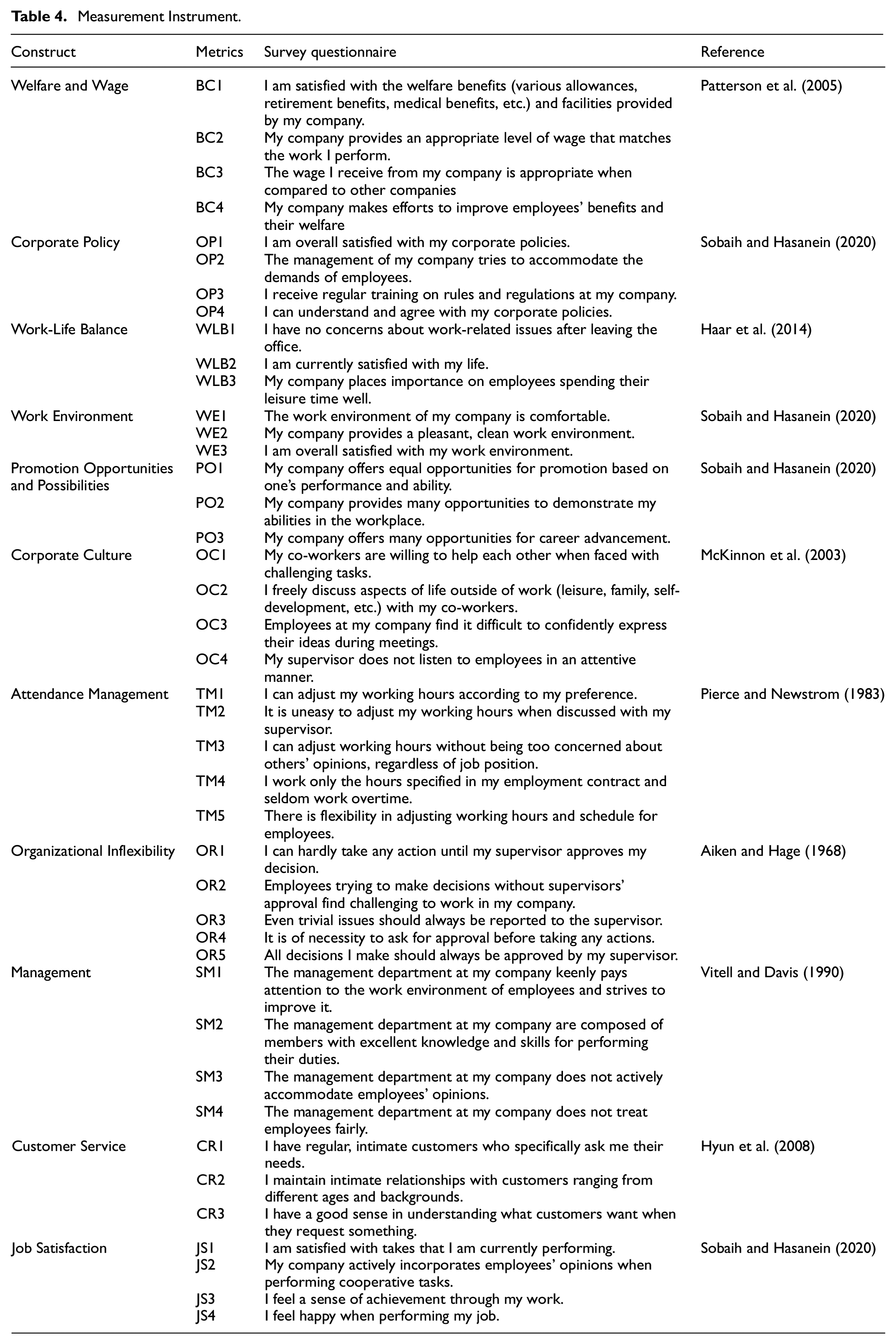
A survey was conducted to examine the asymmetric relationships between the determinants of job satisfaction among employees in the restaurant service sector and their overall job satisfaction. The operationalized definitions of each constructed topic are shown in Table 4. Each construct was modified based on the validated variables established by extant research in the context of the restaurant industry.
Measurement Instrument.
Demographic Information of Respondents
Prior to conducting PRCA, we performed an online survey on subjects who were either current or former employees in the restaurant service industry. The survey was commissioned to the South Korean Research and Consulting Corporation named “PMI” to generate it on an online panel called “Wizpanel” from January 7, 2022, to January 21, 2022, for the 14-day period.
Table 5 demonstrates the demographic information of the survey respondents where 400 survey responses from 200 current employees and the other half being former employees were used for analysis. There were 133 male respondents (33.3%) and 267 female respondents (66.8%), indicating a higher proportion of female participants. In terms of age groups, there were 95 (23.8%), 133 (33.3%), and 172 (43.0%) respondents under the age of 30, in the 30s, and in the 40s or above, respectively, demonstrating the latter group being the largest in proportion. Regarding years of work experience, the majority of respondents which account for 237 respondents (59.3%) having 1 to 10 years of work experience were reported, while 277 respondents (69.3%) reported working less than 45 hours per week in terms of working hours per week. Lastly, in regard to the highest education level, the number of respondents who were high school graduates, 2-year college graduates, 4-year university graduates, and those who are enrolled in graduate school were 130 (32.5%), 90 (22.5%), 172 (43.0%), and 8 (2.0%), respectively.
Descriptive Statistics of Respondents.

Convergent Validity
We validated whether the sample size as well as the number of determinants obtained are suitable for factor analysis using KMO and Barlett’s Test of Sphericity. Table 6 presents the validity results: KMO of sampling adequacy yielded 0.936 and the Approx. Chi-square value was
Convergent Validity Results.

Note. Kaiser-Meyer-Olkin Measure (KMO) of Sampling Adequacy = 0.936. Bartlett’s Test of Sphericity Approx. Chi-Square = 8236.846, p < .001.
Analysis Results
Table 7 shows the results of PRCA for the purpose of exploring the asymmetrical influence on one’s overall job satisfaction. Based on the absolute difference (comparison score) between the Reward Index (RI) and the Penalty Index (PI), we categorized each construct into a satisfier, dissatisfier, or hybrid when the score is above 0.09, below −0.09, or in between −0.09 and 0.09, respectively (Kwon et al., 2022; Yuan et al., 2018). The results demonstrate that Work Environment (Comparison score = 0.113) and Promotion Opportunities and Possibilities (Comparison score = 0.118) were categorized as satisfiers. This implies that when employees are satisfied with their overall work environment and promotion opportunities and possibilities provided their company, they experience satisfaction. In fact, the absence of satisfaction on these two constructs does not necessarily lead to employees’ dissatisfaction toward their overall job satisfaction. For example, well-maintained and supportive work environment that fosters teamwork and transparent communication can motivate employees and enhance engagement. Similarly, a transparent and fair promotion system can build trust among employees, even if promotions are not immediately attainable. On the other hand, Work-Life Balance (Comparison score = −0.109) and Customer Service (Comparison score = −0.091) turned out being dissatisfiers, meaning that employees feel dissatisfied when their work-life balance is not fulfilled or when they do not have flexible relationships with customers. It is worthwhile noting that even if these constructs are satisfied, it does not necessarily lead to employee’s overall job satisfaction level. A lack of scheduling flexibility or frequent overtime can lead to burnout and dissatisfaction. Likewise, challenging or demanding customers can cause stress for employees, highlighting the need for additional support or training. Lastly, Welfare and Wage (Comparison score = 0.072), Corporate Policy (Comparison score = 0.022), Corporate Culture (Comparison score = 0.070), Attendance Management (Comparison score = −0.005), Organizational Inflexibility (Comparison score = −0.065), Management (Comparison score = 0.036) were categorized as Hybrid factors. This classification suggests that if employees are satisfied with these factors, employees experience high job satisfaction, while in the opposite circumstance of employees not satisfied with such factors lead to their dissatisfaction toward overall job satisfaction. Welfare policies, such as healthcare benefits or retirement plans, can significantly enhance employee satisfaction when properly implemented, but their absence or inadequacy can lead to dissatisfaction. Similarly, rigid corporate policies or a lack of organizational flexibility can hinder employee engagement, whereas inclusive and flexible policies can boost morale and reduce turnover rates.
PRCA Results.

Note. R2: 0.466, F: 16.537***, Durbin-Watson: 2.129, Dependent variable: Overall job satisfaction.
p < .001. *p < .05.
These findings underscore the importance of tailoring organizational strategies to the nature of each factor. Improving satisfiers, such as the work environment and promotion opportunities, can directly enhance employee satisfaction, while addressing dissatisfiers, such as work-life balance and customer service challenges, is crucial for reducing dissatisfaction. Hybrid factors require a balanced approach to both increase satisfaction and mitigate dissatisfaction.
Discussion and Implications
Discussion of Findings
In this study, we explored the determinants of job satisfaction among restaurant employees through LDA Topic Modeling and analyzed how such determinants would be classified into satisfiers, dissatisfiers, or hybrid factors. The discussion regarding this categorization is as follows:
First, the PRCA results indicate that work environment as well as promotion opportunities and possibilities were categorized as satisfiers. Thus, it is imperative to establish a conducive work environment that can amplify employees’ job performance. Moreover, if employees perceive the corporate promotion evaluation system as fair, they are more likely to accept outcomes such as remaining in their current position or receiving negative evaluations (Bellet et al., 2024). In essence, as long as the current personnel evaluation system maintains its fairness, employee dissatisfaction is unlikely to arise. This study therefore recommends that corporate management within the restaurant service sector contemplate the implementation of long-term improvement strategies, while concurrently upholding the existing work environment and personnel evaluation system. Such actions are expected to contribute to heightened levels of employee job satisfaction.
Second, the PRCA results revealed that work-life balance and customer service were revealed as dissatisfiers. It is therefore essential to give precedence to and resolve issues related to employees’ work-life balance as well as customer service if they are not met. For instance, the implementation of flexible work arrangements, such as telecommuting, could serve as a potential solution to assist employees attain a more satisfactory work-life balance. In addition, fostering an environment where employees are also encouraged to cultivate positive, flexible relationships with customers who utilize their services is also crucial and warrants attention.
Third, welfare and wage, corporate culture, attendance management, corporate policy, organizational inflexibility, and management were all categorized as Hybrid factors. Enhancing employee job satisfaction holds promise through an understanding of employee perceptions of such factors and the subsequent implementation of appropriate strategies. For example, the introduction of family-friendly corporate policies, such as remote work options and childcare support, has a demonstratable impact on job satisfaction (Saltzstein et al., 2001). Such policies can foster one’s emotional attachment to the company and ultimately reduce employee turnover intentions (Grover & Crooker, 1995). Therefore, it is imperative for the management department to actively engage in and advocate for the adoption of family-friendly policies and similar initiatives. Continuous policy evaluation is also essential to ensure employee satisfaction with current organizational policies, which may require modifications in the future. In fact, employee dissatisfaction tends to arise if the company employs a top-down structure and an authoritarian approach characterized by stringent rule enforcement (Hackman & Oldham, 1975; Zeitz, 1984). Conversely, when employees are afforded freedom to express their opinions and are granted to decision-making authorities and responsibilities, it results in heightened job satisfaction levels (Miller & Monge, 1986; Thomas & Dunkerley, 1999). Hence, this study underscores the necessity of reshaping organizational structures to empower and involve lower-level employees in decision-making processes, rather than centralizing all responsibilities with top management.
Implications for Research
Theoretical implications of this study are as follows. First, this study utilizes Topic Modeling to explore determinants influencing employees’ job satisfaction in the restaurant industry. Such a methodology enables the identification of key determinants of job satisfaction as defined in prior studies. Unlike deductive frameworks, this approach allows for the inductive extraction of features from large-scale review data. Therefore, the derived determinants can serve as a foundation for the creation of interview or survey questionnaires, which are anticipated to yield more objective, reliable than other research methods.
We adopted a mixed-method approach, commencing with qualitative research to figure determinants of job satisfaction among restaurant employees using the LDA algorithm. Subsequently, we transitioned to quantitative research by conducting a survey based on the identified determinants to investigate the asymmetric relationships concerning employee job satisfaction. We thus employed PRCA to categorize the determinants into satisfiers, dissatisfiers, or hybrid factors. This represents a novel perspective not addressed in the similar study by Lee et al. (2023), which utilized quantitative data and survey results provided by JobPlanet. Both studies analyzed job satisfaction using data from 2014 to 2021 and employed the same JobPlanet dataset. However, Lee et al. (2023) primarily focused on analyzing the importance of job satisfaction determinants using quantitative data, such as detailed ratings (e.g., career opportunities, compensation and benefits, work-life balance, culture & values, senior management). Their approach centered on comparing the alignment and discrepancies between the two data sources and survey findings, contributing to an understanding of general trends in job satisfaction determinants. In contrast, while also using the JobPlanet dataset, our study focused on analyzing textual data from pros and cons reviews. By employing topic modeling, we extracted latent factors from the text data and applied the Kano model to investigate the asymmetric relationships among job satisfaction determinants. For instance, our study categorized job satisfaction determinants into satisfiers, dissatisfiers, and hybrids, providing an in-depth analysis of each factor’s characteristics. This process combined quantitative and qualitative data, presenting a fresh perspective on job satisfaction. For example, work-life balance, which was analyzed as a simple score-based satisfaction determinant in Lee et al. (2023), was classified as a dissatisfier in our study based on textual and survey data analysis, as it causes significant dissatisfaction when unmet. This latent insight could only be identified through the Kano model. Therefore, this study is significant as it introduces a novel data-driven approach that can potentially be utilized in HR departments within the restaurant service sector.
Implications for Practice
The practical implications of this study are as follows. First, the results of this study underscore the importance for restaurant businesses to acknowledge and prioritize the fulfillment of their employees’ job satisfaction. Such businesses may formulate strategies for talent acquisition and retention, as well as devise job training programs based on the determinants identified in this study.
With the advent of information and communication technology (ICT) and the widespread use of numerous social networking sites (SNS), job portal sites have witnessed a surge in activity. The increased adoption of smartphones has further led to a significant rise in job seekers using these job portal sites. As a result, job seekers tend to share various information through job portal sites, which they often trust more than information directly provided by companies (Lakin, 2015). This study has successful yielded statistically significant results by analyzing a substantial volume of reviews and ratings from the job portal site. The implications of these findings extend beyond informing HR management strategies; they also serve as a signal to restaurant businesses to closely monitor and leverage information shared in the online environment. This approach can thus provide valuable insights and help these businesses stay informed about employee perceptions and feedback.
Limitations and Future Research
This study has several limitations that need to be acknowledged. First, this study did not investigate the potential impact of specific events, such as the COVID-19 pandemic, on job satisfaction. Future research could examine how such events influence job satisfaction or conduct comparative analyses before and after significant events to gain a more comprehensive understand of their effects.
Second, this study did not consider the demographic information such as gender, age, work experience, and the employment status when conducting analysis. However, such demographic factors are documented to influence job satisfaction (Froese et al., 2019). Future studies could consider categorizing subjects based on demographic information and conducting separate analyses to account for these influences.
Third, this study employed LDA Topic Modeling to extract the determinants of job satisfaction from reviews written by restaurant employees. Nevertheless, recent advancements in topic modeling techniques have spanned to deep learning models, which have demonstrated superior performance. Thus, future studies are encouraged to utilize deep-learning-based topic modeling, which is expected to yield more accurate topics and keywords for analysis.
Footnotes
Acknowledgements
None.

Ethical Considerations
Not applicable (This study involved collecting anonymous survey responses from restaurant employees via an external online survey panel provider. No personal identifying information was collected, and participants were not exposed to any physical or psychological risk. Prior to participation, all respondents were informed about the academic purpose of the study and their rights to voluntarily participate or withdraw at any time. Informed consent was obtained at the beginning of the survey. This study did not involve any medical procedures or vulnerable populations and was therefore not subject to institutional ethical review.).
Funding
The author(s) received no financial support for the research, authorship, and/or publication of this article.
Declaration of Conflicting Interests
The author(s) declared no potential conflicts of interest with respect to the research, authorship, and/or publication of this article.