



Abstract
Under the special background of epidemic superimposed and increasingly volatility, uncertainty, complexity, ambiguity (VUCA) environment, how to improve the corporate resilience and enhance the ability of corporates to cope with external shocks is one of the major issues to corporates and the country. This study investigates the impact of digital transformation on corporate resilience and its mechanisms under crisis scenarios using the impact of COVID-19 epidemic as the research background. This study utilizes the event study methodology—a causal inference-based analytical technique—drawing on data covering all Chinese A-share listed firms, which are sourced from the China Securities Market and Accounting Research (CSMAR) and Wind databases. This study finds that digital transformation can enhance corporate resilience. The mechanism study shows that digital transformation can enhance corporate resilience by promoting human capital upgrading and improving resource allocation efficiency. This study enriches and expands the research literature on the economic consequences of corporate digital transformation and the influence factor of corporate resilience, provides systematic empirical evidence on how digital transformation affects corporate resilience, and can also provide policy suggestions for the development of the digital economy and the transformation of corporates.
Introduction
The outbreak of COVID-19 has strongly impacted the global economic and political landscape (Martin et al., 2023). A large number of Small and medium-sized enterprises (SMEs) have closed down, and even some industry leaders are on the verge of bankruptcy (Lu et al., 2021). It has seriously hindered the business model and development path on which different industries and regions depend for survival. Many countries have suffered from corporate bankruptcies and unemployment (Fu and Shen, 2020). In 2020, global gross domestic product (GDP) fell by 3.1%, global trade (GT) decline by 5.3%, resulting in approximately 258 million full-time job cuts and an unemployment rate of 6.5%. Traditional cyclical fluctuations can no longer explain the devastating impact of the COVID-19 pandemic on the economy, trade, and employment (Song et al., 2020). In the increasingly VUCA environment, corporate resilience has become the key to survival and development; that is, the ability to resist systematic discontinuities and adapt to new risk environments (Li & Välikangas, 2020; Kong et al., 2021). Meanwhile, according to the China Academy of Information and Communications Technology (2020), China’s total digital economy has leaped to the second place in the world. The intelligence, connectivity and analytics capabilities that digitalization embodies are constantly reshaping corporate business ecology and value creation (Fischer et al., 2020; Lenka et al., 2017; Liu et al., 2020; Wang et al., 2020). Contemporary media coverage indicates ongoing public and investor interest in understanding the motives for corporate digital transformation. The relation between digital transformation and corporate resilience has become an important research topic in sociology, economics, and management studies. However, most studies still focus on the conventional situation (Fitzgerald et al., 2014; Hanelt et al., 2020; Hinings et al., 2018; Vial, 2019; Warner & Wäger, 2019). During the COVID-19 pandemic, as digitalization becomes a must for companies to recover and rebound, whether the existing digital transformation logic is still applicable needs further exploration and testing. Our article takes COVID-19 pandemic as an exogenous shock and treats corporate resilience as the outcome of digital transformation to explore the impact mechanism between digital transformation and corporate resilience using Chinese a-share listed companies.
In fact, digitalization has disrupted the business model and value creation of enterprises, and restructured the growth path of enterprises. Especially in the case of a series of external shocks such as the continuous escalation of international trade frictions and the global novel coronavirus epidemic, many enterprises regard digitalization as a “key move” to win the chance to survive in a crisis situation. The structural optimization effect, resource allocation effect, dynamic response mechanism, and efficiency improvement effect of digital transformation can help enterprises cope with crisis and restore stability, thus reducing the negative impact of adverse events. By accelerating the process of digital transformation, enterprises can reconstruct their competitive advantages, enhance their sustainable development capabilities, and enhance industrial resilience and competitiveness. However, enterprise digital transformation is a complex systematic project with large investment, long cycle and high uncertainty, which makes enterprises face a series of risks and challenges, threatening their survival and long-term development. So, how does digital transformation affect enterprise resilience? What is the mechanism behind it? This series of problems urgently need to explore the relationship between them from the academic theory.
Given the growing importance of resilience to firm operations and performance and its impact on society, it has become an important research topic in literature (DesJardine et al., 2019; Kong et al., 2021; Linnenluecke, 2017; Ortiz-de-Mandojana & Bansal, 2016; Zhang et al., 2020). In the context of the current VUCA new normal, corporate resilience emphasizes the unique ability to survive the black swan incident and grow against the trend (Li, 2020). Due to the limitations of research context, most studies are theoretical discussions and qualitative analysis under different adversity events (Li & Zhu, 2021), few empirical studies on the mechanisms of corporate resilience formation (Shan et al., 2021). It is undeniable that corporate resilience is an important success factor in responding to unexpected threats and crisis changes. Corporate with high resilience can identify early signs of crisis and respond faster (Ortiz-de-Mandojana & Bansal, 2016). Thus avoiding, resisting and cushioning the impact of adverse events, recovering and rebounding quickly from adversity and even promoting future development (Lengnick-Hall et al., 2011).
While the VUCA trend has created challenges for companies, it has also brought opportunities for business development, and one of the most important changes is the rapid development of digital technology (Nowacka & Rzemieniak, 2022). Relying on digital technology and empowerment, digital transformation can completely change various aspects of production and operation activities such as design, R&D, production, manufacturing, and organization, thereby influencing the absorptive and dynamic capabilities through cost reduction and efficiency enhancement, social synergy, resource empowerment and improvement of human capital level (Caputo et al., 2021; Eggers & Park, 2018; Reis et al., 2018; Siachou et al., 2021).
As mentioned above, digital transformation may be a way to shape organizational resilience. In order to further explore the impact and mechanism of digital transformation on organizational resilience, our paper investigates the impact of digital transformation on corporate resilience and its mechanisms under crisis scenarios by conducting a large sample empirical study of Chinese A-share listed companies and using the impact of COVID-19 epidemic as the research background. This study finds that digital transformation can enhance corporate resilience. The mechanism study shows that digital transformation can enhance corporate resilience by promoting human capital upgrading and improving resource allocation efficiency.
Our study has the following marginal contributions: Firstly, this study examines the relationship between digital transformation and corporate resilience with the impact of COVID-19 epidemic, responding to Williams et al. (2017) call for integrating crisis management and resilience research, which can compensate for the current insufficient research on the factors and mechanisms influencing corporate resilience. Secondly, this study enriches and expands the research literature on the economic consequences of corporate digital transformation, and provides systematic empirical evidence on how digital transformation affects corporate resilience. This study explores the impact of digital transformation on corporate resilience from the perspective of human capital upgrading and resource allocation efficiency, which provides new research perspectives and ideas for understanding the enterprises digital empowerment. Thirdly, current research topics on corporate resilience are concentrated in the context of Western developed economies, while research on corporate resilience under the Chinese cultural, historical and realistic background is extremely rare (Li & Zhu, 2021). Therefore, this study develops a study on the resilience of Chinese local enterprises based on the reality of China. Especially the vigorous development of digital economy in China and the digital transformation of many companies are complementing the local research on corporate resilience and further deepening the research on global organizational resilience.
The remaining papers are arranged as follows: The second part is theoretical framework, literature review and hypotheses; the third part is data and model; the fourth part is empirical results; and the last part is the conclusion.
Theoretical Framework, Literature Review, and Hypotheses
Theoretical Framework
To theoretically anchor the hypothesized relationships between digital transformation, corporate resilience, and their underlying mechanisms—human capital upgrades and resource allocation efficiency—this study grounds its analysis in resource allocation theory. Rooted in organizational economics and strategic management, this theory posits that firms operate under conditions of resource scarcity and must strategically allocate limited resources to maximize value creation, adapt to environmental changes, and sustain competitive advantage (Alchian & Demsetz, 1972; Eisenhardt & Martin, 2000). In the context of digital transformation, resource allocation theory offers critical insights into how firms navigate uncertainty and enhance resilience. The COVID-19 pandemic, a severe exogenous shock, exacerbated resource constraints while demanding rapid adaptation. Under such conditions, firms that align digital transformation with resource allocation strategies are better positioned to withstand disruptions and recover (Lenka et al., 2017; Wang et al., 2020).
A core tenet of resource allocation theory posits that firms operating under resource scarcity must prioritize investments yielding the highest returns (Alchian & Demsetz, 1972). Digital transformation addresses this imperative by optimizing resource use: data-driven decision-making reduces information asymmetry, enabling firms to reallocate financial and human resources to high-value activities (Tan et al., 2015). During the pandemic, firms that adopted digital tools streamlined operations, cut redundant costs, and redirected resources to critical functions. These efficiency gains not only preserved scarce resources but also enhanced their capacity to absorb shocks, directly reinforcing the logic that digital transformation strengthens corporate resilience.
A second tenet of resource allocation theory emphasizes that resilience hinges on a firm’s dynamic capacity to reconfigure resources (Teece et al., 1997). Human capital serves as a critical resource in this process. Digital transformation amplifies the value of human capital by generating demand for new skills and facilitating knowledge sharing. For example, AI-driven training platforms or collaborative digital workspaces enable firms to upskill employees, cultivating a workforce capable of quickly reallocating tasks, innovating, and responding to crises. By upgrading human capital, digital transformation strengthens the stock of adaptable resources, thereby enhancing resilience. This mechanism aligns with the hypothesis that human capital upgrades mediate the relationship between digital transformation and resilience.
Third, resource allocation theory underscores that resilience requires not merely the allocation of resources but their orchestration to create synergies (Teece et al., 1997). Digital transformation facilitates this orchestration by breaking down organizational silos: enterprise resource planning (ERP) systems, for instance, integrate data across departments, enabling real-time monitoring of resource flows, and informed reallocation decisions (Bharadwaj et al., 2013). During the pandemic, firms that leveraged digital tools to reconfigure production or redirect supply chains demonstrated superior resource orchestration, accelerating recovery. This ability to orchestrate resources to adapt to disruptions directly supports the hypothesis that optimized resource allocation mediates the link between digital transformation and resilience.
In summary, resource allocation theory provides a robust theoretical foundation for hypothesizing that digital transformation strengthens corporate resilience during the pandemic, with human capital upgrades and optimized resource allocation emerging as key mediating mechanisms.
Digital Transformation and Corporate Resilience
Corporate resilience reflects the corporate potential ability to withstand adversity, recover and grow against shocks (DesJardine et al., 2019; Gunderson & Pritchard, 2012; Williams et al., 2017). Williams et al. (2017) further argues that organizational resilience develops on the basis of a series of “durability capabilities.” Durable ability refers to the ability endowments possessed by an organization, which exist before adverse events occur and can promote the organization to make positive adjustments to adverse events, including the five dimensions of financial, behavioral, cognitive, ethical, and relational ability endowments. With the vigorous rise of digital technologies such as artificial intelligence, cloud computing and big data, digital transformation has become an important choice for enterprises to overtake and obtain sustainable development momentum (Demirkan et al., 2016; Liu et al., 2020). Digital transformation refers to the process of using digital technology to achieve business innovation, efficiency improvement and value creation reshaping (Fischer et al., 2020; Vial, 2019), which is often accompanied by iterative upgrading of corporate capabilities (Du et al., 2016; Tan et al., 2015). Digital transformation provides new momentum for organizations to cope with uncertain environment and crisis situations. Through the application of digital technology and assets, data is the core to mobilize internal and external resources of enterprises, reduce the complexity and uncertainty of organizational information, and thus empower organizations to withstand the disruption of organizational production and operation and adapt to risk environment. According to the behavioral capacity endowment perspective in the framework of organizational resilience formation, organizational resilience formation requires an organization to have action options and behavioral reserves, which also includes building comfort with uncertainty, diffusion of decision making across units, and cooperation and coordinated behavior in practice. As an enterprise’s behavior to cope with the changes in the digital age, digital technology has been deeply embedded in every link of organizational structure, process and activity allocation, and is a key behavioral ability endowment to promote the formation of organizational resilience.
On the one hand, the upgrading of corporate capabilities is the premise to realize digital transformation (Carcary et al., 2016). Corporate must carry out structural reform, improve employees’ digital skills by enhancing their understanding of digital technology (Hess et al., 2016; Kane, 2015), cultivate a digital leadership model to upgrade the corporate capabilities (Dumeresque, 2014), and lay the foundation for the development and implementation for the development and implementation of digital technology and tools, thus providing corresponding support for the realization of digital transformation. By contrast, corporate capability upgrade is the result of digital transformation (Du et al., 2016; Vial, 2019). Corporate can use digital technologies and tools to optimize resource allocation, improve the value creation path (Grace, 2017; Tan et al., 2015), restructure the internal management and production operations mode, and reduce the inefficient behaviors. As a result, corporate have more resources available to develop its core competitiveness (Kane, 2015), the better balance sheet position accelerates the process of corporate decision-making and corporate responsiveness to the outside world has increased significantly (Bharadwaj et al., 2013; Xiao et al., 2020). Especially during the COVID-19 pandemic, the efficiency improvement, optimization of resource allocation and cultivation of digital talents brought by digitalization have promoted the recovery and rebound speed under the impact of adverse events, which is of great value in shaping corporate resilience (Lenka et al., 2017; Wang et al., 2020). Thus, we pose the following hypothesis in the Chinese setting:
The Mechanism of Digital Transformation Affecting Corporate Resilience
The premise of digital transformation is whether corporate has enough high-skilled labor force to adapt to the digital technology. Therefore, upgrading human capital is an important mechanism for digital transformation to improve corporate resilience. On the one hand, due to the complementarity of “Capital-Skill” (Liu & Zhao, 2020), the demand for highly skilled labor will inevitably increase in the process of upgrading production technology (Han et al., 2024). Therefore, the digital transformation of enterprises cannot promote the business transformation without the support of high-quality digital talents (Wu et al., 2023). Optimizing the human capital structure has become the key to the success of digital transformation (Chen & Ma, 2018). By contrast, Li and Li (2013) argue that digital technology can facilitate knowledge sharing, enable the flow and sharing of tacit knowledge, and improve employees’ digital skills. Alexopoulos and Cohen (2016) found that corporate digital transformation can also generate some new labor demand, such as digital maintenance personnel and other digital talents related to digital transformation. The important manifestation of corporate resilience is the ability of employees to quickly reallocate resources in crisis and actively respond to emergencies (Wang, 2016). Based on the staff-organization fit, corporate digital transformation can improve employees skill level and make it easier for them to acquire knowledge, which improves the stock and quality of human capital and contributes to the formation of corporate resilience under the impact of COVID-19 pandemic.
Corporate digital transformation is also a dynamic process to achieve specific objectives and capabilities (Warner & Wäger, 2019). The result of digital transformation can meet the policy expectations depends on it can improve the efficiency and optimize the resource allocation. Therefore, resource allocation efficiency is another path for digital transformation to improve corporate resilience. Chen and Zhang (2020) found that enterprises usually have better internal control after the digital transformation, the tunneling behavior and inefficient investment are inhibited, so the internal resource allocation efficiency can be improved. Eisenhardt and Martin (2000) pointed out that enterprises implementing digital transformation strategy can better adapt and respond to the unstable external environment by actively or reactively reallocating organizational resources, thus assisting enterprises to stay ahead of the competition more flexibly. More importantly, the frequent changes of external environment will prompt enterprises to allocate more resources in accelerating corporate digital transformation to reduce the potential negative impact. According to resource allocation theory, this study concludes that the optimized resource allocation can help corporate find new methods and approaches to break out from the crisis and promote recovery and rebound speed in the COVID-19 pandemic. Based on these findings, we test the following hypothesis in the Chinese setting:
Data and Model
Given the potential endogeneity issues, this study adopts the event study method to examine the impact of digital transformation on corporate resilience by selecting the COVID-19 outbreak in China around the Spring Festival in 2020 as the analysis object.
Sample Selection and Data Sources
Our article takes A-share listed companies as the initial research sample and eliminates the following four types from our sample: (i) financial companies; (ii) special treatment (ST), suspension from trading (*ST) and asset-liability ratio greater than 100% companies; (iii) estimating excess returns by excluding companies with an estimation window of less than 180 trading days. All data are obtained from the China Securities Market and Accounting Research (CSMAR) and Wind database. All the continuous variables are winsorized at the 1 and 99 percentiles to reduce the influence of extreme values. Following the sample selection criteria, our final data set consists of 3,124 samples.
Key Variables
Corporate Resilience
In this article, we use the stock price change around the outbreak of COVID-19 as a proxy of corporate resilience. Firstly, for the event date, we choose the time when the National Health Commission announced that the COVID-19 can be transmitted from person to person; that is, January 20th, 2020. Secondly, for the change of stock price, our paper uses the market model method to measure the cumulative abnormal return, the basic model is as follows:

Firstly, we take a total of 200 trading days in the (−210, −10) window phase before the event date as the estimation period; Secondly, we use model (1) to estimate the risk-free return

After calculating the abnormal return, this study selects the cumulative abnormal return (CAR) for a total of seven trading days including three trading days before and after the event day as a proxy for stock price changes to measure corporate resilience.
Digital Transformation
Firstly, following Xiao et al. (2020), we finally screened 197 enterprise digitalization-related words with frequencies greater than or equal to five times, which constitute the enterprise digitalization terminology dictionary in this paper. Secondly, conduct the text analysis on the relevant paragraphs of the annual report. We use the 197 words from the above digital dictionary to expand the “jieba” Chinese lexical database of the Python package. Then, based on the machine learning method, this study analyzes the text of “Management Discussion and Analysis (MD&A)” section of the annual reports obtains the frequency of 197 words related to corporate digitalization in the annual reports. Finally, the construction of enterprise digitalization indicator (Digital). Taking into account the differences in the text length of MD&A section of the annual report, after extracting the frequency of each keyword in the annual report of listed company, we measure the degree of micro-enterprise digitization by dividing the frequency sum of related digital words into the length of MD&A paragraphs in the annual report. The greater the digital indicator value, the higher the digitalization degree of enterprises.
Control Variables
According to previous studies, the model also controls for the following variables: Lev is the opening gearing ratio, expressed as total liabilities divided by total assets; Size is the opening level of total assets, which is equal to total assets taking the natural logarithm; ROA is the opening total return on assets, defined as net income divided by total assets; MTB denotes the book-to-market ratio, proxied by the ratio of market value to net assets of an enterprise; Beta represents the estimated stock β value for the 200 trading days before the event date; SOE is an ownership dummy variable which takes the value of 1 when the enterprise is a state-owned enterprise, or 0 if not.
Model
In order to control the influence of other factors on the market reaction of the above major events, this study establishes the following multiple regression model for analysis:

Descriptive Statistics
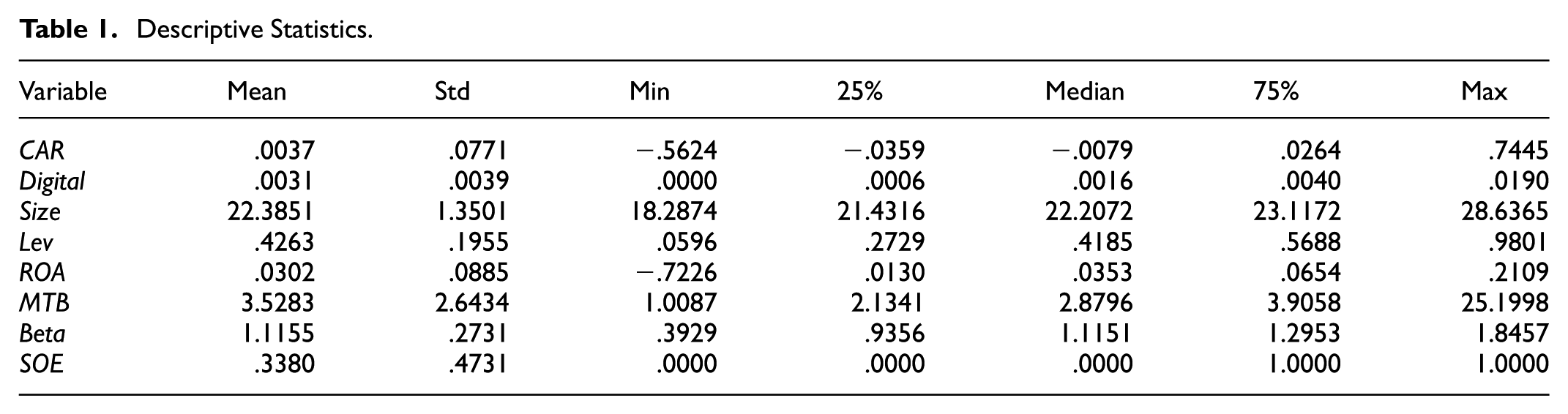
The descriptive statistics of all variables are shown in Table 1. The results show that the mean and median value of CAR are .0037 and −.0079, respectively, revealing a negative cumulative abnormal return for most enterprises after the clear human-to-human transmission of COVID-19 epidemic, which is consistent with the expectations of this study. The mean value of Digital is .0031, indicating that an average of .31% words in the MD&A section of listed companies’ annual reports are related to digitalization; the maximum value of .0190 implies a maximum of 1.90% words in the MD&A section of the annual report are related to digitization, suggesting that the difference in digital transformation of the sample companies is significant, and the overall level is still low. The distribution characteristics of other control variables are basically consistent with normal distribution and similar to previous research literature.
Descriptive Statistics.
Empirical Results
Univariate Analysis
We conduct a univariate analysis of the relationship between corporate digital transformation and stock market reactions. We present the results in Table 2. The sample was divided into high-level digital transformation group (Digital_D = 1) and low-level digital transformation group (Digital_D = 0) according to the median of enterprises digital transformation. The results show that cumulative abnormal return of the high-level digital transformation group is significantly higher than that of the low-level digital transformation group during the window phase, indicating that enterprises with high digital transformation level are more resilient and made a relatively more positive response in the face of COVID-19 epidemic shocks. Thus, H1 is supported, which fully reflects the resilience of digital transformation in the context of tight market liquidity.
Univariate Analysis.
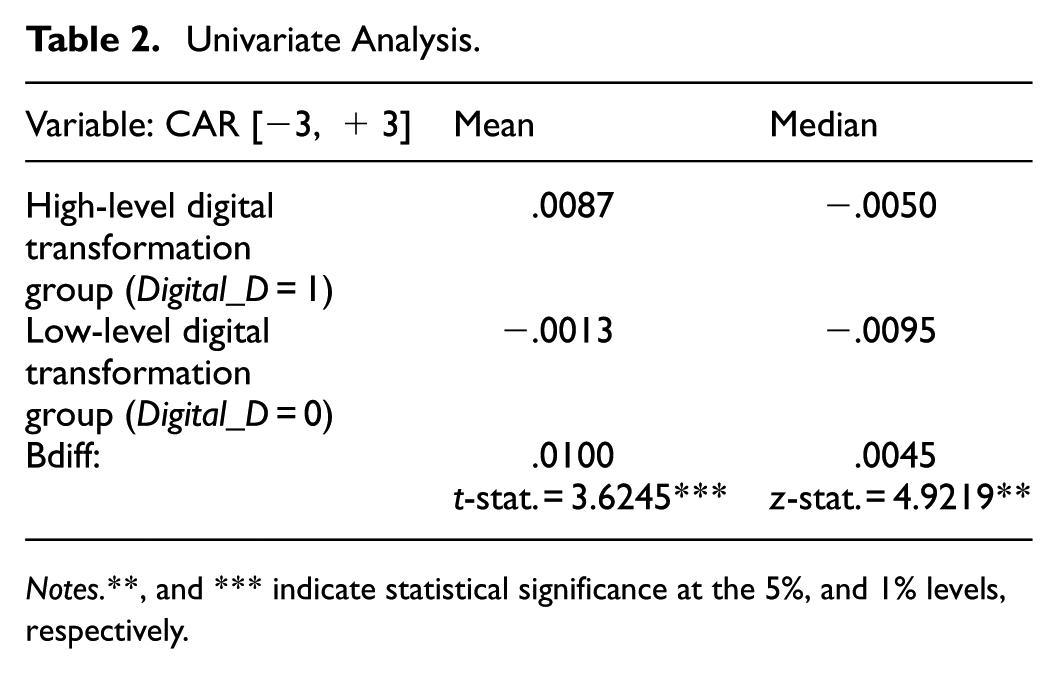
Notes.**, and *** indicate statistical significance at the 5%, and 1% levels, respectively.
Regression Results
Table 3 reports the results for multiple regression analyses for model (3). In columns (1) and (2), we use continuous variables to measure enterprise digital transformation and it is significantly and positively related to the cumulative abnormal return during the COVID-19 epidemic (the corresponding t-statistics were 4.04 and 2.79). In other words, digital transformation enhances corporate resilience and has better performance in capital market. In column (3), we use the dummy variable Digital_D to measure the digital transformation, and the result is also significant at the 5% level. Overall, the results in Table 5 support H1 that digital transformation enhances corporate resilience to cope with such unexpected crises in the face of the great impact of COVID-19 epidemic. Meanwhile, the market has gradually recognized the importance of enterprise digital transformation and given higher pricing to enterprises with higher digital transformation to obtain relatively higher cumulative abnormal returns, which fully shows that digital transformation of enterprises can enhance enterprise resilience. This result further validates our hypothesis 1. Corporate can use digital technologies and tools to optimize resource allocation, develop their core competitiveness, accelerate the process of corporate decision-making, and enhance the ability to respond to the outside world. Especially during the COVID-19 pandemic, digital transformation is of great value in building enterprise resilience.
Digital Transformation and Corporate Resilience.
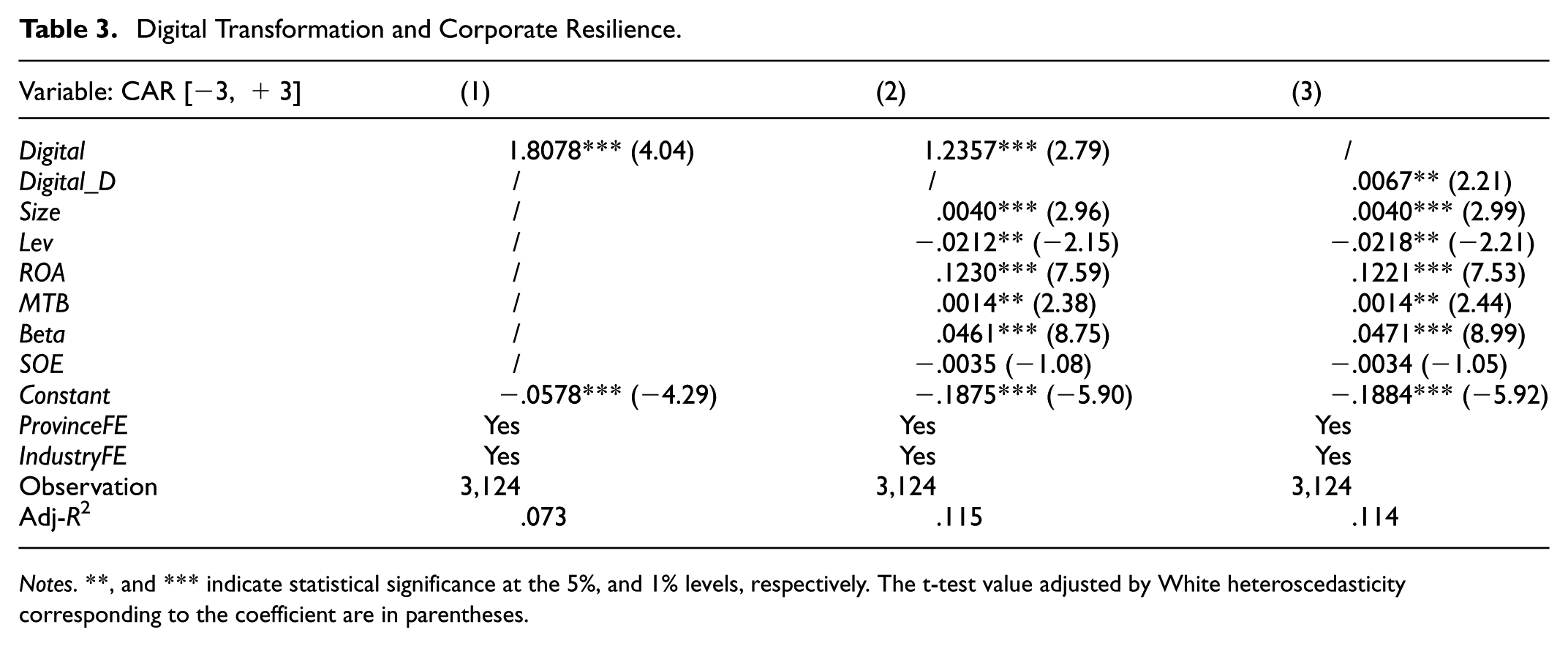
Notes. **, and *** indicate statistical significance at the 5%, and 1% levels, respectively. The t-test value adjusted by White heteroscedasticity corresponding to the coefficient are in parentheses.
Robustness Tests
Change Window Period
To strengthen the robustness of our conclusions, this study first changes the event window period for testing. Here, we selected [−2, +2] or [−10, +10] as the event window period, respectively, that is, using CAR [−2, +2] or CAR [−10, +10] to proxy the stock price changes during the COVID-19 epidemic to measure corporate resilience. The results are shown in Table 4, the results are presented in Table 4, and the coefficients remain significantly positive at the 5% or 1% level (corresponding to t-statistics of 2.46 and 2.79, respectively), supporting the basic conclusions of this study.
Change Window Period.
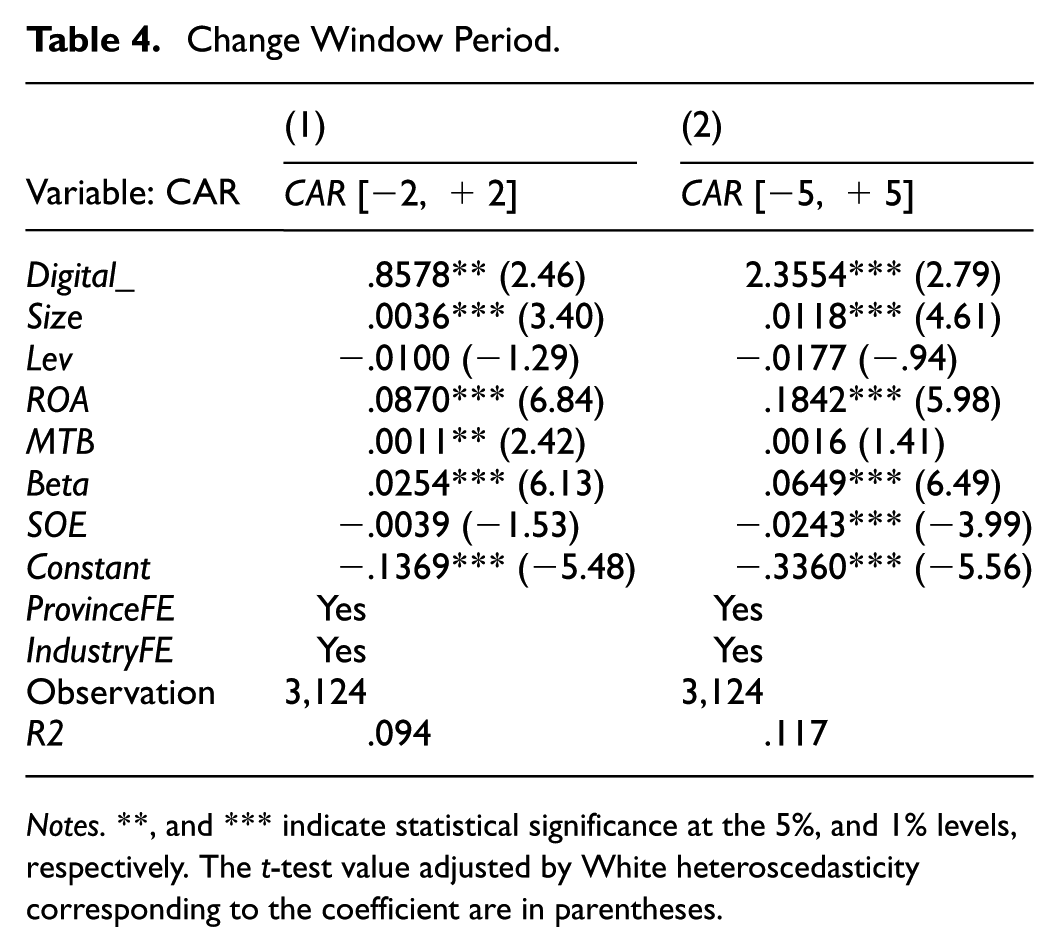
Notes.**, and *** indicate statistical significance at the 5%, and 1% levels, respectively. The t-test value adjusted by White heteroscedasticity corresponding to the coefficient are in parentheses.
Change the Measurement of Digital Transformation
Secondly, this study also constructs two other digital transformation indicators as robustness test. Digital_1 is the deviation standardization of the enterprise digitization-related words frequencies, which is measured by dividing the “difference between the frequency of digitization-related words in annual report and the minimum frequency of annual digitization-related words” by “the difference between the maximum and minimum frequency of digitization-related words by year.” Digital_2 is adjusted by industry mean on the basis of Digital to characterize the relative level of enterprise digitization in the industry. The results are reported in columns (1) and (2) of Table 5. It is not difficult to find that the coefficients of both Digital_1 and Digital_2 are significantly positive at the 1% level (corresponding to t-statistics of 2.76 and 2.97, respectively), supporting our basic conclusions. Overall, changing the measurement of corporate resilience and digital transformation has not substantially changed the main findings of this study.
Change the Measurement of Digital Transformation.

Notes.**, and *** indicate statistical significance at the 5%, and 1% levels, respectively. The t-test value adjusted by White heteroscedasticity corresponding to the coefficient are in parentheses.
Mechanism Analysis
Human Capital Upgrading Mechanism
Drawing on the studies of Autor et al. (2003), Zhao et al. (2020), Liu et al. (2023), this study measures employee skill levels from both education level and occupation type. Firstly, according to the education level, those with bachelor’s degree or above are regarded as high-skilled employees and those with less than bachelor’s degree are regarded as low-skilled employees. We use the proportion of employees with bachelor’s degree or above to measure the high-level human capital education structure (High_Edu). Then, we regress by grouping the median value of High_Edu, and the results are shown in columns (1) and (2) of Table 6. The coefficient of Digital in column (1) is 2.5054, which is significantly positive at the 1% level, and the coefficient in column (2) is .5187 and not significant. Secondly, this study grouped regressions by occupation type. Production workers, administrative support staff, and other hard-to-categorize personnel are regarded as regular low-skilled employees, while technology, marketing and sales, and finance personnel are classified as non-regular high-skilled employees. We measure the advanced skill structure of human capital by the proportion of high-skilled employees in the firm (High_Skill). Then, we regress by grouping the median value of High_Skill, and the results are shown in columns (3) and (4) of Table 6. The coefficient of Digital in column (1) is 1.4423, which is significantly positive at the 10% level, and the coefficient in column (2) is .6479 and not significant. The above results reveal that when the human capital level is low, the digital transformation is more capable to enhance corporate resilience, which suggests that digital transformation will increase corporate resilience by promoting structural upgrading of human capital.
Mediating Mechanism of Human Capital Upgrading.

Notes.**, and *** indicate statistical significance at the 5%, and 1% levels, respectively. The t-test value adjusted by White heteroscedasticity corresponding to the coefficient are in parentheses.
Resource Allocation Efficiency Optimization Mechanism
Drawing on Levinsohn and Petrin (2003), this study uses the total factor productivity (TFP) calculated by LP method to measure the efficiency of enterprise resource allocation. Then, we regress by grouping the median value of TFP, and the results are shown in Table 7. The coefficient of Digital in column (1) is 2.1121, which is significantly positive at the 1% level, and the coefficient in column (2) is .6579 and not significant, indicating that when the resource allocation efficiency is low, the digital transformation is more capable to enhance corporate resilience, which suggests that digital transformation will increase corporate resilience by optimizing resource allocation efficiency.
Mediating Mechanism of Resource Allocation Efficiency Optimization.
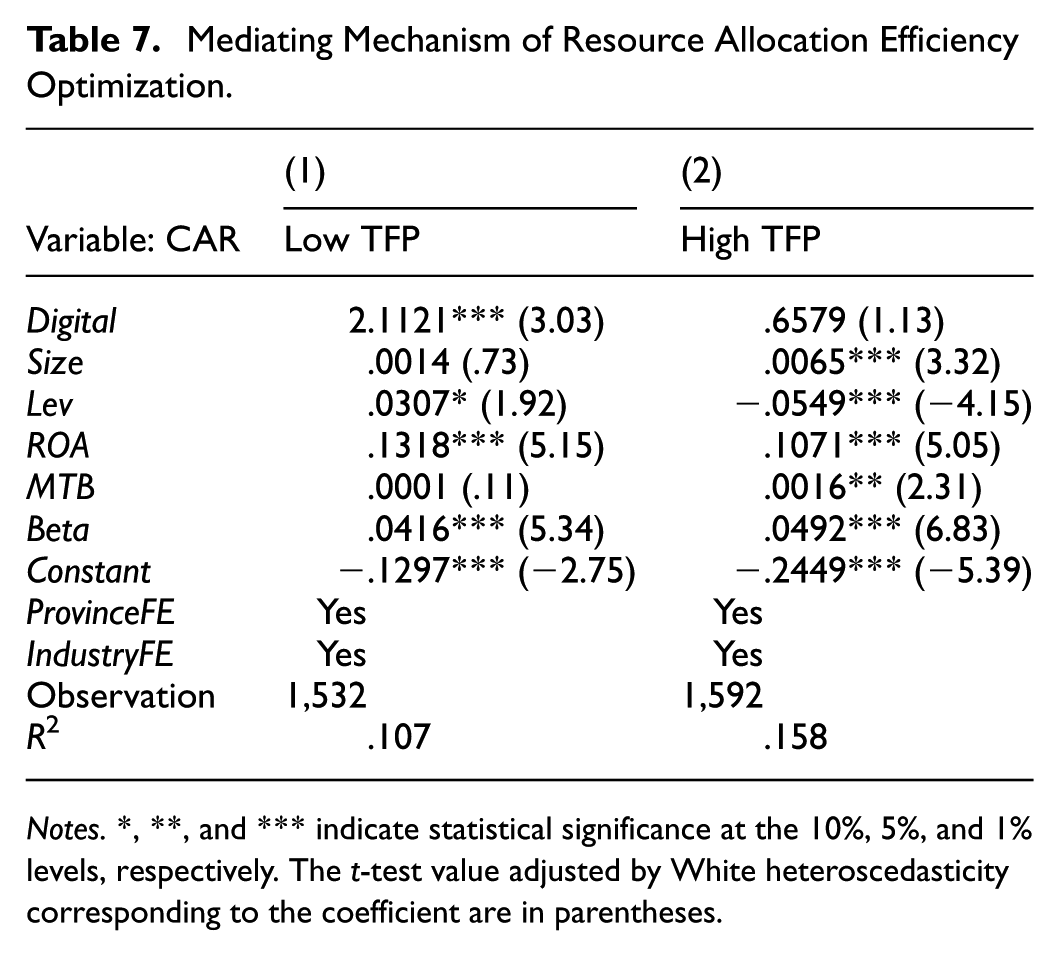
Notes.*, **, and *** indicate statistical significance at the 10%, 5%, and 1% levels, respectively. The t-test value adjusted by White heteroscedasticity corresponding to the coefficient are in parentheses.
Discussion and Conclusion
At present, the research on the influencing factors of corporate resilience is still in its infancy. Some scholars believe that the characteristics of the corporate itself determine its resilience level, such as good decision-making ability (Williams et al., 2017; Stoverink et al., 2020) and the psychological quality of managers (Barton & Kahn, 2019; Kahn et al., 2018). Some scholars believe that the external environment of a corporate will also affect its resilience, such as institutional environment (DesJardine et al., 2019; Williams et al., 2017) and social trust (Dutta, 2017; Rao & Greve, 2018). However, few literatures discuss the influencing factors of corporate resilience in combination with the digital development trend of the current era. This study attempts to make up for the deficiency in this aspect, and attempts to discuss the influencing factors of enterprise resilience from the perspective of digital transformation. This study examines the relationship between digital transformation and corporate resilience with the impact of COVID-19 epidemic, responding to Williams et al. (2017) call for integrating crisis management and resilience research, which can compensate for the current insufficient research on the factors and mechanisms influencing corporate resilience. This study explores the impact of digital transformation on corporate resilience from the perspective of human capital upgrading and resource allocation efficiency, which provides new research perspectives and ideas for understanding the enterprises digital empowerment.
This study investigates the impact of digital transformation on corporate resilience and its mechanisms under crisis scenarios by conducting a large sample empirical study of Chinese A-share listed companies and using the impact of COVID-19 epidemic as the research background. This study finds that digital transformation can enhance corporate resilience. The mechanism study shows that digital transformation can enhance corporate resilience by promoting human capital upgrading and improving resource allocation efficiency.
Under the background of the rapid development of the digital economy and the trend of VUCA, studying the issue of corporate resilience from the perspective of digital transformation is of great significance for using digital technology to improve corporate resilience, overcome crises and create corporate value. First, this study examines the impact of enterprise digital transformation on corporate resilience from a micro perspective, which is conducive to revealing the multi-dimensional impact of new economies such as digital transformation on corporate resilience in crisis scenarios. It is particularly important in the context of VUCA trends and the fact that Chinese companies are less resilient and more difficult to survive the crisis. Second, this study studies the impact of digital economy development on real enterprises from the perspective of micro-enterprise digital transformation. At this stage, the digital economy has become a new driving force for high-quality economic development under the new normal. In-depth research on the situation and consequences of digital transformation of enterprises is conducive to summarizing the successful experience of the integration of the digital economy and the real economy, and promoting the sustainable and healthy development of the digital economy. Third, by studying the impact of digital transformation on corporate resilience, this study helps corporates use digital technology to improve their resilience, so as to achieve corporate value creation, which is of great significance to the high-quality development of the economy.
Based on the above research conclusions, the following policy recommendations are put forward: First, the government should continue to promote digital construction, and give full play to the role of digital transformation in enhancing corporate resilience. The government should increase the proportion of digital construction projects in the financial budget, and give more support to related enterprises in terms of investment attraction and policy support. The government should strengthen the cultivation and introduction of talents, fill the talent gap, and promote the digital construction to achieve better results. Second, we should pay attention to the differences in the development of different types of enterprises, and deeply tap the potential of digital transformation to enhance the resilience of enterprises. Third, the government should give full play to the role of city-level and enterprise-level drivers to continue to help improve resilience. The government should pay attention to the change of talent demand for digital transformation, strengthen education investment and talent training in the digital field, promote cooperation among enterprises, universities and scientific research institutions, and help enterprises solve the problem of talent matching. The government should strengthen the construction of digital infrastructure to provide a more reliable network environment and technical support for enterprise development.
This study explores the impact of digital transformation on organizational resilience during the COVID-19 pandemic, and makes useful discussions on its influencing mechanism, but there are still some shortcomings to be improved in future research. First, this article focuses on the impact of digital transformation on organizational resilience in a short-term crisis scenario. Future studies may consider incorporating the impact of digital transformation on organizational resilience in conventional contexts into the research framework, and integrating and improving existing studies with quantitative and qualitative methods. Secondly, this paper mainly uses the key word frequency statistics method to measure the digital transformation of enterprises, which has the limitation of single data source and index. In the future, a more comprehensive evaluation index system can be built by integrating financial index and text index.
Footnotes

Ethical Considerations
These considerations were not relevant for this study type.
Funding
The authors disclosed receipt of the following financial support for the research, authorship, and/or publication of this article: National Natural Science Foundation of China (72502131), Shandong Provincial Natural Science Foundation (ZR2024QG021), Shandong Province Social Science Research Project (24DGLJ15).
Declaration of Conflicting Interests
The authors declared no potential conflicts of interest with respect to the research, authorship, and/or publication of this article.
Data Availability Statement
The data that support the findings of the study are available on request from the Corresponding author.