




Abstract
Agricultural Marketing Cooperative Societies (AMCOS) serve both business and association roles. While the association role emphasizes collective action, the business role focuses on generating surplus and maximizing member welfare. To sustain loyalty, AMCOS must ensure service quality. This study examines members’ perceptions of AMCOS service quality in rural Kaliua District, Tanzania, offering a unique perspective beyond financial cooperatives by integrating qualitative and quantitative insights. A cross-sectional survey was conducted with eight randomly selected AMCOS, involving 239 respondents. Primary data were collected through structured questionnaires and Focus Group Discussions (FGDs). The SERVQUAL model was used to assess service quality, with quantitative data analysed using descriptive statistics and paired samples t-tests, while thematic analysis was applied to qualitative data. Findings indicate that AMCOS service quality was unsatisfactory, with reliability as the most problematic dimension. Members’ expectations did not align with their perceptions. Compared to similar studies in Tanzania, service quality challenges were linked to inadequate funds, bureaucratic delays in delivering tobacco inputs, and unskilled board members and management. To improve service quality, AMCOS should allocate sufficient funds for regular governance training to enhance board and management competence. Additionally, the Tanzanian government, through the Ministry of Agriculture and the Registrar of Cooperatives, should revise mechanisms to ensure timely delivery of farm inputs to tobacco farmers.
Keywords
Introduction
Service quality is considered a crucial element for the success of any business. An organisation that provides high-quality services tends to achieve greater customer satisfaction, which in turn boosts customer loyalty, enhances sales, and leads to higher profits compared to its competitors (Nguyen et al., 2024; Wolter et al., 2019). Service quality represents the customer’s overall judgment of a service and how effectively it meets the expectations set for it (Pakurár et al., 2019). Service quality is considered acceptable when it meets customer expectations; however, if these expectations fall short, the service quality is deemed unsatisfactory, leading to customer dissatisfaction (Elkhani and Bakri, 2012; Koshuma et al., 2023).
Agricultural Marketing Cooperative Societies (AMCOS) like many other cooperatives have a dual nature: business (enterprise) and association roles. The association role is built on actions and solidarity of members, while the business role is about making economic activities to generate the surplus needed for growth and maximisation of members’ welfare (Novkovic et al., 2022). As business enterprises, cooperatives including AMCOS must provide quality service to maintain members’ and customers’ loyalty (Arizal and Seswandi, 2019). Likewise, Dung (2011) asserted that the performance and development of AMCOS mostly depend upon the efficiency of their service activities.
In Tanzania, AMCOS started in 1925 when Kilimanjaro Native Cooperative Union (KNCU) was established in the Moshi district. The movement spread quickly in the entire country, especially in the regions where cash crops such as coffee and cotton were cultivated. By 1968, Tanzania had developed the largest cooperative movement in Africa and ranked third globally in terms of the market share percentage of agricultural exports (Maghimbi, 2010). By 2023, Tanzania had 4,327 AMCOS serving more than 6 million members (TCDC, 2023). AMCOS primarily provide services to their members such as purchasing, marketing, supplying inputs for crop cultivation, processing, and distributing agricultural products (The Cooperative Societies Act 2013, 2014).
However, since the 1980s when Tanzania adopted economic reforms which allowed free market and trade liberalisation, cooperatives especially AMCOS were reported to experience many challenges to operate in liberalised trade (Maghimbi, 2010; URT, 2005). Similarly, according to TCDC (2021), 68% of cooperatives in the country are dormant and have had little to no operations for some years. Several factors can hinder the successful operation of cooperatives in liberalised trade among them can be poor service quality provision which leads to members’ dissatisfaction. Studies by Msuya (2020) and Msuya (2019) revealed that poor service quality provided by SACCOS prompted members’ dissatisfaction, particularly in rural SACCOS. Could this also be the case for AMCOS? Limited empirical works are known on service quality provision among AMCOS which are predominant cooperatives in Tanzania (TCDC, 2023). Those empirical works which exist have mixed results: poor services (Arizal and Seswandi, 2019b; Ebrahimi, 2018; Malkoc and Yercan, 2018) and satisfactory service (Mustapha et al., 2017; Rwela, 2023) provision among AMCOS. The current study addressed the existing empirical gap by evaluating members’ perceptions of service quality provided by rural AMCOS in Kaliua district. Specifically, it assessed the perceived level of service quality of service quality provision and investigated the factors contributing to the perceived quality of services offered by AMCOS.
Literature Review
This section presents both theoretical and empirical parts of the study. The theoretical review focuses on theories guiding this study while the empirical review unfolds several empirical works related to this study.
Theoretical Review
This research was grounded in the Expectancy Disconfirmation Theory (EDT), which was formulated by Oliver in 1977. The theory illustrates that customer satisfaction is assessed by comparing the difference between expectations and actual experiences with a product or service. It explains how a customer’s initial expectations differ from their perception after using the product or service. Dissatisfaction arises when expectations exceed performance, while satisfaction is achieved when performance surpasses expectations, resulting in positive disconfirmation. EDT was preferred because it is widely accepted among researchers as it can show how disconfirmation might result in either satisfaction or dissatisfaction, unlike other theories of customer satisfaction such as Dissonance Theory (DT). Given that EDT is widely recognised for evaluating service quality, this study applied it to analyse members’ perceptions and expectations of the services provided by AMCOS (Elkhani and Bakri, 2012 citing Oliver, 1977).
In addition, the study employed the SERVQUAL model to assess service quality developed by Parasuraman et al. (1985). Researchers such as Raza et al. (2020) and Mustapha et al. (2017) have utilised the model to examine service quality while studies by Malkoc and Yercan (2018), Naamwintome (2023), and Rwela (2023) involved service quality, especially in agriculture marketing cooperatives. The SERVQUAL model was chosen over alternative models like SERVPERF, which solely focuses on service performance and disregards expectations as a benchmark for comparison. In the context of AMCOS, expectations play a crucial role in assessing service quality, as cooperative members join with specific socio-economic aspirations that can only be realised through the delivery of expected service standards. Given the importance of aligning service delivery with members’ expectations, the SERVQUAL model provides a more comprehensive and contextually relevant framework for evaluating service quality in this study. In addition, Manzano (2024) found that SERVQUAL dimensions are strong predictors of cooperative members’ satisfaction, reinforcing its suitability for this study. The model incorporates 22 statements regarding expectations and perceptions as a standard metric for evaluating service quality. Service quality comprises five key dimensions: tangibles, reliability, responsiveness, assurance, and empathy. Tangibles encompass the physical aspects of AMCOS that members interact with. Reliability pertains to AMCOS’s ability to consistently provide promised services accurately and dependably. Responsiveness indicates AMCOS’s ability to provide prompt and efficient service, demonstrating a willingness to quickly address members' issues and requests. Assurance is exhibited when AMCOS instills confidence in cooperators by fostering trust, demonstrating competence, and displaying courtesy. Empathy reflects the provision of attentive and personalised care to members by AMCOS. The study assessed service quality by identifying the quality gap, measured as the difference between members’ expectations and the actual service performance. If the result of the quality gap is less than 0, the quality is considered unacceptable; if it equals 0, the quality is deemed satisfactory; and if it is greater than 0, the quality is regarded as acceptable (Parasuraman et al., 1991).
Empirical Review
Few studies have been conducted on service quality among cooperatives, unlike other forms of business ventures. Studies focused on agricultural cooperatives are even fewer than those directed to other forms of cooperatives including saving and credit cooperatives. Studies focused on agricultural cooperatives include the one conducted in Turkey using the SERVQUAL model by Malkoc and Yercan (2018). The findings revealed that Dairy Cooperatives provided inadequate service quality to their members, with the most significant average quality gap observed in empathy (−0.85), followed by assurance (−0.67), tangibles (−0.39), and responsiveness (−0.36). The dimension with the smallest average quality gap was reliability, which stood at −0.29. Similarly, a study conducted in China using the SERVQUAL model by Aihua et al. (2024) observed that there was a gap between the inner expectations and the actual perception of the members among farmers cooperatives, stemming from structural inefficiencies and governance limitations.
Moreover, studies conducted in Indonesia and Nigeria by Arizal and Seswandi (2019) and Mustapha et al. (2017) respectively, concluded that the SERVQUAL dimensions have a positive and significant relationship with members’ satisfaction. Ebrahimi (2018) evaluated customer satisfaction in Iranian agricultural cooperatives using the SERVQUAL model and found that the perceptions of members exceeded expectations, thus members were satisfied with all services offered by Iranian agricultural cooperatives. In Tanzania, Rwela (2023) assessed service quality and farmers’ satisfaction with the service provided by AMCOS in Mvomero and Kilombero districts. He found that the overall service quality or customer satisfaction index was 54% indicating that members were satisfied with AMCOS services. Furthermore, Koshuma et al. (2023) identified a connection between service quality dimensions and smallholder farmer satisfaction, highlighting that empathy, assurance, and tangibles were statistically significant in the Kilombero Valley, Tanzania
The first implication of the above empirical analysis is that few empirical studies exist on service quality among AMCOS in Africa and Tanzania. The second implication is that there is room to expand studies on the subject matter because the existing empirical studies have mixed results: poor and satisfactory service quality among AMCOS. Based on the theoretical and empirical review, the study developed the following research questions:
What are the perceptions of members on the service quality offered by AMCOS?
What are perceived attributes contributing to the service quality offered by AMCOS?
Research Methods
This section outlines the research methods and techniques employed to address the research questions guiding this study.
Research Design
This study utilised a cross-sectional survey design, as it enabled the collection and analysis of data on service quality in AMCOS at a single point in time. In contrast to a longitudinal survey, which requires data to be gathered at multiple intervals over an extended period, the cross-sectional approach allows for a more immediate snapshot of the data (Bryman, 2012).
Population and Sampling
The research was carried out in Kaliua district, located in the Tabora region of Tanzania. Tabora region and Kaliua district were deliberately chosen for this study due to their having the highest concentration of AMCOS compared to other regions and districts in the country (Tanzania Cooperative Development Commission [TCDC], 2023). Eight AMCOS were randomly selected in the study area: Issoga, Ushokola, Ugunga, Kasungu, Limbula, Kombe, Watapenda, and Chapakazi. The study used Yamene’s (1967) formula to calculate the sample size. The specification of sample size calculation was given as follows:



Where,
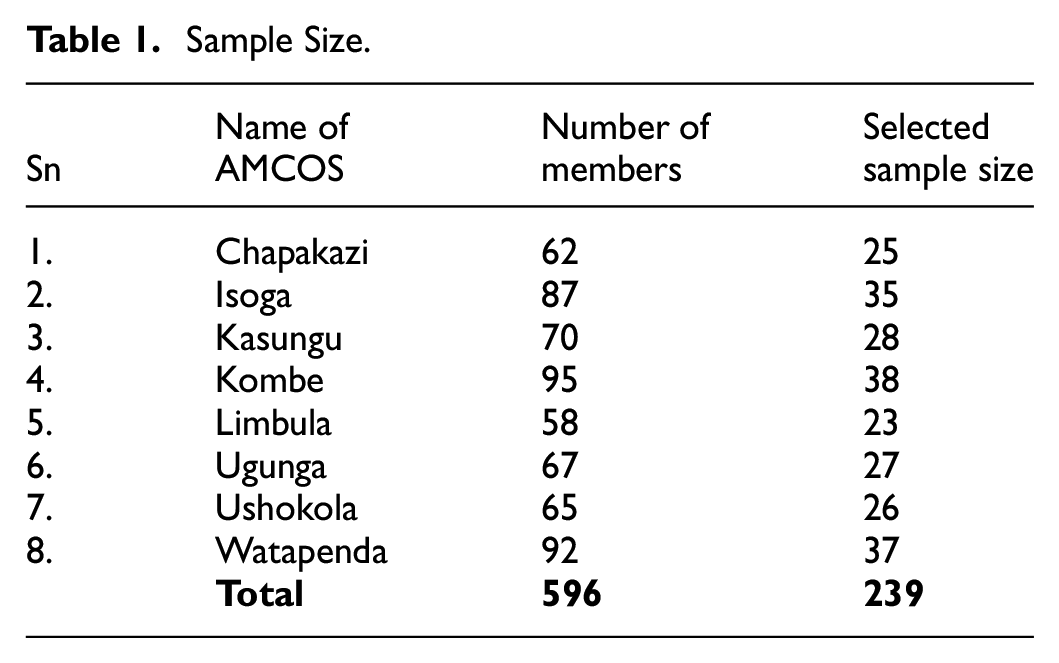
Thus, the estimated minimum sample size for the study was 239 respondents. Members were selected proportionally according to the number of registered members from each AMCOS, as detailed in Table 1.
Sample Size.
Source of Data
The study adopted a mixed-method approach, incorporating both quantitative (numerical insights) and qualitative data collection and analysis (Cohen et al., 2018). Given the complexity of service quality perception, a mixed methods approach ensures a comprehensive, validated, and policy-relevant analysis by integrating numerical trends with rich, contextual insights. In addition, primary data were gathered using a structured questionnaire and a Focus Group Discussion (FGD) interview guide. The structured questionnaire was employed to collect quantitative data, while the FGD interview guide was used to obtain qualitative insights from members of each AMCOS. A total of eight FGDs were conducted, with each session comprising at least 10 participants. To enhance participant diversity, the selection process considered key demographic factors, including gender, age, and leadership roles within AMCOS. This approach ensured that both male and female members, as well as younger and older participants, were adequately represented, capturing a wide range of experiences and viewpoints. Each discussion was facilitated by a trained moderator, ensuring neutrality and enabling participants to express their views freely. The number of FGDs was determined based on the principle of data saturation, meaning additional discussions were unlikely to yield significantly new insights. FGD findings were cross validated with quantitative survey results, strengthening the credibility of the study findings.
Validity and Reliability of Data
Prior to the actual data collection, a pilot survey was conducted with five (5) members to assess the consistency, reliability, and clarity of the instruments. Efforts were also made to test the internal consistency of the items using statistical methods. The Cronbach’s alpha coefficient was applied for this purpose, and the result showed a strong internal consistency with an alpha coefficient of 0.823, which is well above the acceptable threshold of 0.7(Cohen et al., 2018). Additionally, the study ensured construct and content validity by conducting comprehensive theoretical and empirical reviews on the subject to identify key theories, models, and relevant empirical studies concerning service quality in AMCOS. Furthermore, experts in service quality and AMCOS were consulted, and their insights were incorporated to ensure that the instruments effectively and accurately captured the critical data related to service quality in AMCOS.
Data Analysis
The original 22 SERVQUAL statements were adapted to 14 statements from previous studies (Msuya, 2020) better to suit the context of cooperative studies in Tanzania. Members were asked to select one service quality scale option for each statement - 0 for poor, 1 for good, and 3 for very good—to express their perceptions and expectations of the services provided by AMCOS.
Qualitative data were analysed using thematic techniques. Data from field notes and audio recordings were transcribed, categorised, and coded, then organised into themes aligned with the study’s objectives. These themes were further interpreted to derive meaningful insights.
For the quantitative data on service quality, a five-step process was adopted from Msuya (2019). In the first step, the quality gap score was computed for each of the 14 SERVQUAL statements. A paired sample t-test was then used to determine whether the differences between perception and expectation for each statement were statistically significant. The second step involved calculating the average quality gap score for each service quality dimension. This was done by summing the quality gap scores for all statements within a given dimension and dividing by the number of statements in that dimension.
The third step involved calculating the average SERVQUAL quality score by summing the average gap scores for each dimension and dividing by five, which represents the total number of SERVQUAL dimensions. This step provided an unweighted measure of service quality observed in the study area.
The fourth step focused on calculating the weighted average SERVQUAL scores for each service quality dimension. To facilitate this, respondents were asked to distribute a total of 100 points among the five dimensions during data collection, reflecting the relative importance of each dimension. The total for all five dimensions needed to equal 100 points. The average weight score for each dimension was then multiplied by the unweighted scores obtained in the third step to derive the weighted average SERVQUAL scores for each dimension.
The final step entailed calculating the overall weighted SERVQUAL score by summing the weighted average SERVQUAL scores for each dimension and dividing the total by five (the number of dimensions).
Findings and Discussion
This section presents study findings covering the members’ socio-economic characteristics, perceived level of service quality and perceived attributes for the poor services provision in AMCOS.
Members’ Socio-economic Characteristics
In the first place, the study analyses the characteristics of respondents (members) as presented in Table 2. Table 2 indicates that the mean age of members was 38 years. According to Sturman (2003) an individual between 17 and 49 years old is active to perform well in many aspects of life including the production of goods and services. This implies that members of AMCOS in the study area are energetic enough to engage in agricultural production. Table 2 further shows that the mean years of schooling was six implying that most of the AMCOS members in the study area have not completed primary education. However, might also indicate that the literacy level is high among AMCOS members in the study area. Table 2 also indicates that the mean membership period was 6 years. This signifies that most of the members of AMCOS in the study area have enjoyed the AMCOS services for 6 years.
Members’ Socio-economic Characteristics (n = 239).
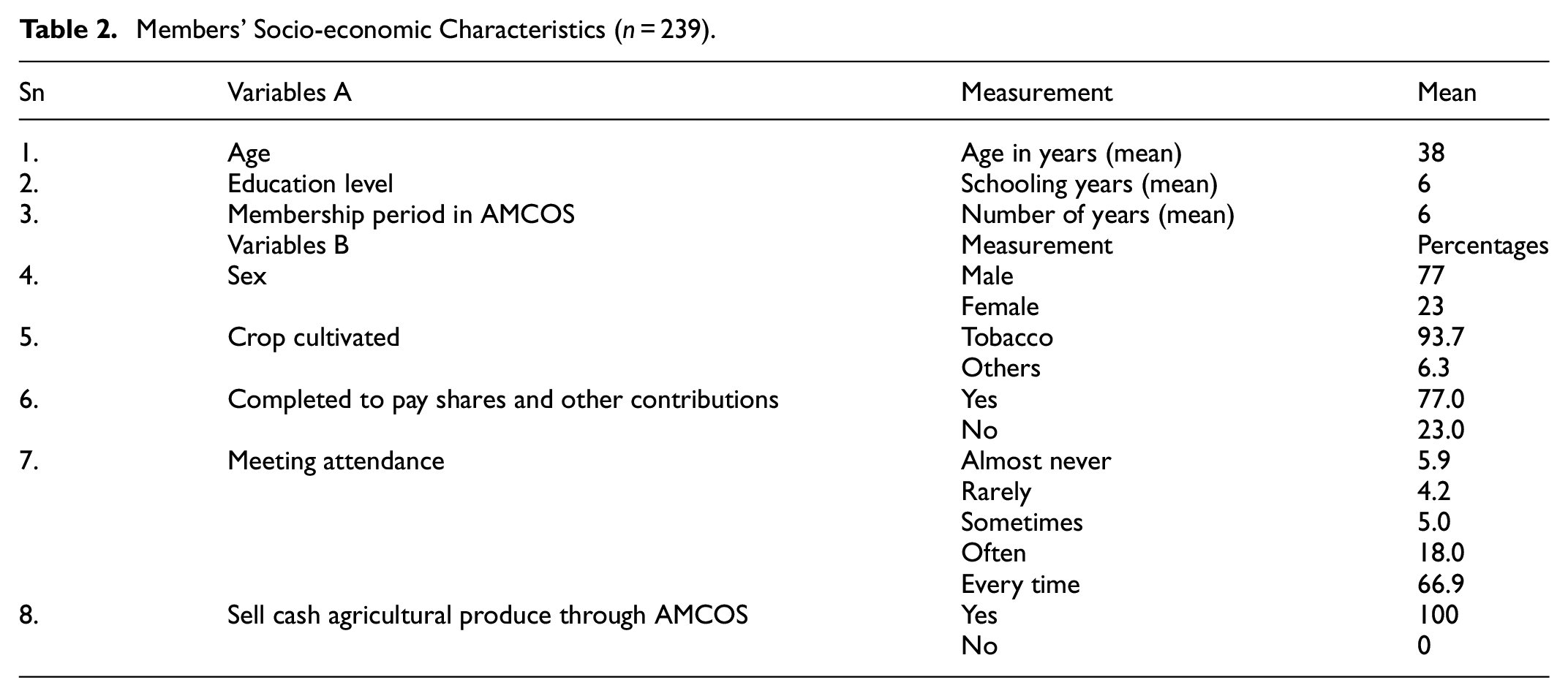
Moreover, Table 2 shows that the majority (77%) of members in AMCOS are males compared with females (23%) members. The possible reason for male dominance in AMCOS is connected with African tradition which gives ownership of the means of production such as land to males compared to females. Ownership of the land is an important aspect needed for farmers to engage in agricultural activities, and participating in agricultural activities is one of the prerequisite conditions that pull together farmers in AMCOS. Table 2 reveals that the majority (93%) of AMCOS members engaged in tobacco cultivation.
Table 2 further indicates that the majority (77%) of members consistently paid their shares and other contributions. Additionally, 66.9% attended meetings regularly, and all members (100%) sold their cash crops through AMCOS. This implies that most members have significantly played a great role in fulfilling their responsibilities as a key source of good service in AMCOS.
Members’ Perception of Service Quality Level Offered by AMCOS
The research also explored the standard of service quality provided by AMCOS. The assessment was done using three categories: unacceptable, satisfactory, and acceptable levels.
Table 3 presents the opinions of members regarding the quality of services provided by AMCOS. The table shows negative values for all dimensions, signifying that the services offered were below the members’ expectations, with the differences being statistically significant (p < .01) across all 14 items analysed using paired samples t-test. As a result, the service quality of AMCOS was deemed unacceptable. The largest quality gap was in empathy (−139.50), followed by reliability (−136.75), tangibles (−131.67), and responsiveness (−130.50), while assurance had the smallest unacceptable gap (−130.33).
Perceived Level of Service Quality Offered by AMCOS.

However, the service quality gaps shown in Table 3 are unweighted, meaning the importance weights assigned to each dimension were not factored in by members. To obtain the weighted service quality gap for each dimension, the relative importance weights given by the members were first determined. Table 4 displays the weights assigned by the members.
Weights Allocated for Each Dimension in Percentage (n = 239).

Table 4 shows that reliability (41%) was considered the most important, followed by responsiveness (20%) and tangibles (17%), while empathy received the lowest weight (6%). To calculate the weighted average SERVQUAL score, the weights for each dimension listed in Table 4 were multiplied by the average quality gap for that dimension. The resulting weighted average SERVQUAL score is displayed in Table 5.
Weighted average SERVQUAL Scores (n = 239).

Table 5 reveals that reliability (−56.07) had the largest deficiency, followed by responsiveness (−26.10), tangibles (−22.38), assurance (−20.85), with empathy showing the smallest gap (−8.38). These weighted SERVQUAL scores illustrate the extent to which each dimension contributed to the overall level of unacceptable services. According to the SERVQUAL model and the expectancy disconfirmation theory discussed in this study, these unsatisfactory services resulted in members’ dissatisfaction with AMCOS. This suggests that members felt AMCOS did not follow its bylaws, failed to deliver services as promised, and maintained inadequate records. Additionally, members perceived that AMCOS staff were not delivering services promptly and were unresponsive to members’ or farmers’ needs, including the provision of agricultural inputs, produce pricing, and regular training sessions.
Table 5 shows the overall level of service quality for all eight (8) AMCOS, represented by the SERVQUAL score. However, the study took additional steps to analyse the SERVQUAL score for each individual AMCOS within the study area. Table 6 provides the SERVQUAL scores for each AMCOS.
Weighted Average SERVQUAL Scores for Each AMCOS.

Table 6 reveals that all weighted SERVQUAL scores were negative, indicating that the perceived services fell short of members’ expectations, signifying unacceptable service quality across each AMCOS. Kombe AMCOS exhibited the most significant level of unacceptable service quality at (−7.21), followed by Issoga AMCOS (−6.05). In contrast, Watapenda AMCOS had the least unacceptable service quality at (−1.02), closely followed by Kasungu AMCOS at (−1.27). This suggests that members of Kombe AMCOS felt their AMCOS provided the poorest service quality, while those from Watapenda AMCOS experienced the least inadequate service quality.
The findings of this study are consistent with those of Msuya (2020, 2019) and Koshuma et al. (2023) in Tanzania, which revealed that SACCOS and AMCOS members, respectively, perceived service quality as falling short of their expectations. Furthermore, these findings align with international studies, such as Malkoc and Yercan (2018) in Turkey, who reported that dairy cooperatives delivered inadequate service quality to their members. In contrast, the findings of this study differ from those of Rwela (2023), who reported that 54% of AMCOS members were satisfied with the service quality. This indicates that while some Tanzanian and international cooperative societies deliver satisfactory service quality to their members, others do not. Previous research has provided limited insights into the factors contributing to either satisfied or dissatisfied service quality. This study expands the discussion regarding the factors leading to the inadequate service quality experienced in AMCOS.
Perceived Attributes Contributing to the Poor Service Quality Provision in AMCOS
Based on FGDs conducted in each AMCOS, three factors were identified contributing to poor service quality offered by AMCOS in the study area.
Unskilled Board Members and Management
During FGDs, it was found that unskilled board members and management resulted in a lack of reliable services. It was reported that management failed to prepare financial reports due to a lack of expertise. On the other hand, the board members failed to strategically plan and make sound decisions due to low education and competence.
Low Capital
It was found that an inadequate budget hindered AMCOS from providing quality services relating to the tangible dimension of the SERVQUAL model. Tangible services include having physical office facilities such as computers, chairs, and tables. Likewise, it includes the ability to employ skilled staff like managers and accountants in AMCOS. The following qualitative caption was captured during FGDs: … lack of funds is the main constraint toward having required office facilities and employing qualified staff in our AMCOS… (FGDs 20/02/2024)
The above narration implies that AMCOS could have done several things relating to tangible services if they had enough funds.
Bureaucracy in Delivering Farm Inputs
During focus group discussions, bureaucracy in delivering farm inputs to farmers emerged as one of the main complaints raised by members. It was found that the process of delivering tobacco farm inputs involves several stakeholders and steps, which result in significant delays. One member said that: … usually, we don’t get the required tobacco inputs on time due to lengthy procedures involving certification from banks, the union, the assistant registrar of cooperatives, the Tobacco Cooperative Joint Enterprise Ltd (TCJE), and suppliers. All these stakeholders and procedures hinder the timely delivery of farm inputs… (FGDs 6/2/2024)
The above qualitative caption indicates that bureaucracy in delivering tobacco farm inputs is a challenge within AMCOS. Typically, the process of ordering tobacco farm inputs begins with farmers sending requests to the union. The union gathers all farmers' requests from AMCOS and forwards them to TCJE. Before sending the requests to TCJE, the union must secure a letter of credit from banks and certification of maximum liability from the regional assistant registrar. Once these procedures are completed, TCJE collects requests from all unions in the country and announces the tender for supplying tobacco inputs. The company that wins the tender is then required to import and supply farm inputs to all farmers in the country. From this perspective, any stakeholder failing to fulfill their responsibilities can result in delays in delivering farm inputs to the farmers.
Research Contributions
The findings of this study significantly diverge from previous research on cooperative service quality in Tanzania. For instance, Rwela (2023) reported that 54% of AMCOS members in Tanzania were satisfied with the service quality they received, while this study found service quality to be largely unacceptable across all measured dimensions. This difference can be attributed to the specific challenges facing AMCOS in rural Kaliua, including governance weaknesses, financial constraints, and bureaucratic inefficiencies in input distribution. Additionally, previous studies on service quality in Tanzania have primarily focused on SACCOS (for instance, Msuya, 2020, 2019), which operate under different conditions from AMCOS. Unlike SACCOS, which offer financial services that are relatively easier to standardise, AMCOS must manage complex agricultural supply chains, market uncertainties, and regulatory processes that significantly affect service delivery. This study is among the first to systematically apply the SERVQUAL model to AMCOS in Tanzania, providing empirical evidence on service gaps and contextualising these findings within the broader agricultural cooperative sector.
Moreover, international studies on agricultural cooperatives (for instance, Malkoc and Yercan, 2018 in Turkey and Aihua et al., 2024 in China) have similarly observed service quality deficiencies but attributed them primarily to market fluctuations and external competition. In contrast, this study identifies internal governance inefficiencies and bureaucratic bottlenecks as primary drivers of poor service quality, highlighting a unique institutional challenge faced by Tanzanian AMCOS.
Conclusions and Recommendations
Conclusions
This study evaluated members’ perceptions of service quality provided by rural AMCOS in the Kaliua district. Specifically, it aimed to assess the perceived level of service quality and to identify the factors influencing this perception. The findings concluded that members felt the service quality offered by AMCOS in the study area was inadequate (poor), as their expectations were not met. Consequently, members were dissatisfied with the service quality among rural AMCOS. Additionally, both internal and external factors were identified as contributing to the poor service quality. Internally, factors such as insufficient funds and unqualified board members and management were key issues. Externally, the main issue was the bureaucratic process involved in distributing tobacco farm inputs, which negatively affected service quality.
Practical Recommendations
AMCOS should strengthen governance by establishing structured training programs for board members and managers in collaboration with institutions like Moshi Co-operative University (MoCU). Training should focus on financial management, cooperative law compliance, and service efficiency. Additionally, performance evaluations should be conducted regularly to assess improvements in leadership. Financial sustainability should be enhanced by diversifying revenue sources beyond crop sales through value-added processing activities, such as tobacco curing and packaging. Cooperatives should also explore partnerships with financial institutions and development organisations to access concessional loans and investment funding. To address bureaucratic delays in farm input distribution, AMCOS should streamline internal procurement processes, form regional procurement alliances to negotiate better supply terms, and adopt digital solutions for tracking input orders as supported by Mramba and Msuya (2024).
Policy Recommendations
The Ministry of Agriculture and the Registrar of Cooperatives should reform the farm input distribution system by introducing a digitalised tracking system that enables real-time monitoring of input requests as proposed by Minzar and Mishra (2024). To strengthen financial sustainability, the TCDC should establish a cooperative development fund, providing AMCOS with access to low-interest loans for infrastructure improvements and operational efficiency. Governance standards should also be reinforced by making leadership training mandatory for AMCOS board members and requiring annual governance performance reports. Additionally, the government should introduce standardised performance benchmarks for AMCOS service delivery, including criteria for timeliness, financial transparency, and member satisfaction, with well-performing cooperatives qualifying for incentives such as grants or tax benefits. Lastly, public-private partnerships should be encouraged to allow cooperatives to access financing, markets, and modern agricultural technologies through collaboration with financial institutions and agribusiness investors.
Study Limitations and Directions for Future Research
This study is geographically confined to Kaliua District, which may limit the generalisability of the findings to other regions with different socio-economic and institutional contexts. While the insights contribute to understanding AMCOS service quality, future research should consider a multi-regional or national-level study to enhance external validity. Additionally, this study adopted a cross-sectional design, which provides only a snapshot of service quality perceptions at a specific point in time. Although this approach is suitable for identifying immediate concerns, it does not account for temporal changes in service quality dynamics. A longitudinal study would allow for tracking evolving trends, offering deeper insights into the impact of policy changes, governance improvements, or market fluctuations on AMCOS service quality. Moreover, qualitative data analysis in this study relied on manual thematic coding, which, while effective, may introduce subjectivity and limitations in replication. Future research could benefit from the use of computer-assisted qualitative data analysis software (e.g., NVivo, Atlas.ti) to enhance transparency, consistency, and analytical rigor.
Footnotes
Acknowledgements
I acknowledge the support from Moshi Co-operative University (MoCU) for several publications training.

Ethical Considerations
The study complied with ethical guidelines set by the Moshi Cooperative Research Ethics Committee, receiving formal approval from the Deputy Vice Chancellor, Academic Research and Consultancy, on August 21, 2023. This approval is documented in the Minutes of Approval, reference number MoCU/IRP/3/81/01 Vol II F.29. Additionally, ethical clearance for data collection was granted by the United Republic of Tanzania on September 20, 2023, through the President’s Office Regional Administration and Local Government, under reference number AC.54/2018/01.F/315. Prior to data collection, participants were informed about the study's objectives, their right to withdraw, and the confidentiality of their responses. Written informed consent was obtained from all participants and included in the questionnaire.
Funding
The author disclosed receipt of the following financial support for the research, authorship, and/or publication of this article: The author received funds for primary data collection from my employer (MoCU).
Declaration of Conflicting Interests
The author declared no potential conflicts of interest with respect to the research, authorship, and/or publication of this article.
Data Availability Statement
The author confirms that the raw data and do-file used in delivering the findings of this study are available on request.