




Abstract
The existing literature on partnership seems to take the relationship between partnership quality and outsourcing success for granted. Therefore, this article aims at examining the role of service quality in strengthening the relationship between partnership quality and human resource (HR) outsourcing success. The samples were obtained from 96 manufacturing organizations in Penang, Malaysia. The results showed that partnership quality variables such as trust, business understanding, and communication have significant positive impact on HR outsourcing success, whereas in general, service quality was found to partially moderate these relationships. Therefore, comprehending the HR outsourcing relationship in the context of service quality may assist the organizations to accomplish HR outsourcing success by identifying areas of expected benefits and improvements.
Introduction
The growth in outsourcing, in particular human resource (HR) outsourcing, has been triggered by the enduring efforts of organizations to reduce costs, to focus on strategic issues, and to improve services to the employees (Chiang & Shih, 2011). Although HR departments used to be known as performing administrative work, they are now becoming more and more strategic oriented to assist organizations to compete and sustain through various challenges (Braun, Pull, Alewell, Störmer, & Thommes, 2011; Cook & Gildner, 2006). Indeed, many researchers posit that HR outsourcing concentrates on restructuring the HR department, refocusing activities, and redeploying HR resources (Chiang & Shih, 2011; Greer, Youngblood, & Gray, 1999), so that organizations can “make more by doing less” (Gilley & Rasheed, 2000).
The existing literature only suggests that among the areas neglected in HR are the partnership quality and the impact of service quality on the success of HR outsourcing. The market for the service providers of outsourced services is growing rapidly and concurrently, HR outsourcing has evolved from single service provider to multiple service providers easily contracted to satisfy the different needs of the organizations (Lilly, Gray, & Virick, 2005; Reichel & Lazarova, 2013). The quality of relationship between a client and a vendor and the quality of the service provided by a vendor to the client have been indicated to influence the success or failure of the outsourcing initiative (Chakrabarty, Whitten, & Green, 2008). As HR outsourcing development in Malaysia has not been intensively studied, managers may still have lack of knowledge on how to select the right service providers and how to manage the outsourcing relationship (Ee, Abdul-Halim, & Ramayah, 2013). To many organizations, managing the relationships between organizations and service providers has become increasingly complex because both parties may have different desires and agenda when developing and maintaining HR outsourcing relationships (Ates, 2013; Lievens & Corte, 2008). Furthermore, the inadequate choice of outsourcing partners can also impede the success and quality of outsourcing relationship (Elmuti & Kathawala, 2000; Tapiero, 2006). Many organizations fail to opt for the right partners and are not able to build a stable and trustworthy relationship with their service providers. Thus, to ensure the quality and successful relationship with the service providers, organizations must be aware that the outsourcing partners should be selected based on the expertise of the outsourcing partners in their operations, the cultural similarity between the service providers and the organizations, the ability of both parties to establish strategic alliances, and the willingness of the outsourcing partners to adopt the philosophy of the organizations (Lau & Hurley, 1997; Tapiero, 2006). Along these lines, both parties need to develop a certain mechanism to strengthen the quality of HR outsourcing relationship to function more as a partnership (Ates, 2013; Elmuti, 2003; Lee & Huynh, 2005). High partnership quality involves a high level of trust, commitment, quality communication, understanding, and strong top management support between the organization and the service provider. High service quality from the service provider would involve high reliability, responsiveness, tangible, assurance, and empathy. Undeniably, these aspects of partnership quality and service quality would positively influence the effective utilization of various HR functions for better interactions between the service provider and the organizations, and eventually may lead to HR outsourcing success.
Nevertheless, the existing literature on partnership seems to take the relationship among partnership quality, service quality, and outsourcing success for granted (Chakrabarty et al., 2008; Lee, 2001). There should be justification whether HR outsourcing is successful when high-quality partnership exists. Consistent with the above argument, this study was designed to explore the factors of partnership quality in the context of HR outsourcing that may lead to outsourcing success, which would be moderated by service quality. After a brief review of related literature and hypotheses development, the theoretical framework will be presented. The method and techniques used for the analysis and the results are given in the following sections. The final section presents the discussion and limitations.
Literature Review
Theoretical Perspectives and HR Outsourcing
In the literature on HR outsourcing, transaction cost theory and relational exchange theory provide insights into organizational motivation for outsourcing. Transaction cost theory states that there are economic costs involved in the transactions between two or more entities (Williamson, 1975, 1985). The costs include operational costs (e.g., search costs, inventory holding costs, operation cost) and contractual costs (e.g., cost of writing and enforcing a contract cost). Organizations need to choose whether to produce and make an activity on their own or to outsource that activity. Relational exchange theory also plays an important role in the framework of outsourcing. Past studies of HR outsourcing have largely neglected the quality of relationship aspects of the client–vendor behavior. Much focus has been given on outsourcing transaction as discrete events (Kim & Chung, 2003; Sheehan & Cooper, 2011). To place emphasis on the importance of managing outsourcing relationship for success, it is important to view HR outsourcing from the partnership perspective rather than solely from the economic perspective. It is necessary to include relational exchange characteristics along with several key dimensions. Relational structure can be used to address the behavioral and procession aspects of relationship in joint ventures, partnership, and outsourcing arrangements (Ginevicius, 2010; Reichel & Lazarova, 2013).
Partnership Quality and Outsourcing Success
In general, a partnership involves common values that exist among parties involved (Ren, Ngai, & Cho, 2010). Partnership quality is very crucial in determining the success of HR outsourcing. Nevertheless, a part of the knowledge on building successful partnership in HR outsourcing is becoming a dilemma for many organizations. HR practitioners lack the know-how in selecting their outsourcing vendors and there are also concerns on how they should manage this outsource relationship (Ates, 2013; Lee & Kim, 1999). In the less developed market, some organizations are even reluctant to establish a partnership in their outsourcing agreement, although this method has been proposed to be the most effective method to achieve competitiveness. The most frequently reported problem in the outsourcing relationship among clients and their HR vendors is the inability to express and describe in detail what they require from the vendors (Ates, 2013). This scenario will lead to conflict and inefficiency in the outsourced activity.
Partnership is not a new concept and it has long been explored in the marketing and interorganizational systems research. Any organization’s activities would not sustain without relationships with the surrounding environment (Raman, Chadee, Roxas, & Michailova, 2013). According to interorganizational research, recognizing, analyzing, and promoting the interorganizational relationships are the prerequisites and keys for organization to gain knowledge, deploy resources, and pursue continuous competitive advantages. By definition, interorganizational relationships embedded in the organization are seen to be the repeated interaction and exchange process between organization and other organizations, and a set of a series of sustained social connections in business (Raman et al., 2013; Ren et al., 2010).
There have been different views on how to implement successful relationships. The two groups of thoughts that have emerged from previous researches are transactional style relationship and partnership style relationship. The transactional relationship is developed through a formal contract and partnership is formed through relationship exchange that involves risk and benefit sharing (Srinivasan, Mukherjee, & Gaur, 2011). Lee (2001) in his work states that in the 1990s, many organizations experienced difficulties in forming and managing successful outsourcing relationships. This problem caused a shift from contractual relationship to a partnership relationship in the outsourcing industry. Partnership allows two organizations to achieve key organizational objectives and build competitive advantage in their respective industries (Ates, 2013; Grover, Cheon, & Teng, 1996). Therefore, it is interesting to study whether HR outsourcing success would be affected by the quality of the partnership. Quality can be described as fitness of use. Partnership quality exists when relationship serves its intended function and is successful in meeting objectives of both parties. Partnership is affected by organizational, human, and environmental factors. Lee and Kim (1999) propose that partnership has its own factors to represent quality. They state that there are several variables that influence the degree of partnership quality and the degree of partnership quality is related to the outsourcing success. They identify five factors that make up partnership quality, which are trust, business understanding, benefit and risk sharing, conflict, and commitment. Anderson and Narus (1990) also identify that trust can also lead to higher quality partnership, besides other variables such as communication and top management cooperation. All these factors have been identified as the factors making up partnership quality. The communication quality plays an effective role in partnership. Effective communication between partners is essential to achieve the intended objectives. In fact, effective communication will lead to better informed parties, which in turn will make each party to be more confident in the relationship and more willing to maintain it (Lee & Kim, 1999; Swar, Moon, Oh, & Rhee, 2012). Apart from that, the support from top management is very essential and is considered as a prerequisite for every successful outsourcing partnership (Anderson & Weitz, 1989). Top management has to play an effective role to overcome the inevitable divergence of interest between participants and at the same time to share an understanding of the benefits of collaboration (Rai, Borah, & Ramaprasad, 1996; Srinivasan et al., 2011).
When organization embarks on outsourcing relationship and selects a particular service provider, the organization must be ready to maintain the relationship over a period of time. The need to maintain such business relationships requires a form of long-term relationship based on trust. Both parties need to believe one another to perform actions that will result in positive outcomes for the organizations (Lee & Kim, 1999; Swar et al., 2012; Willcocks & Chong, 1995). In addition, commitment also plays a critical role in the development of a long-term relationship and in facilitating an exchange relationship. These relationships must contain a certain degree of sincerity, pledge, or promise of relationship continuity between partners. Therefore, trust and commitment are the basic concepts of partnership style relationship and these factors increase confidence in the relationship and in turn lead to outsourcing success (Chu & Wang, 2012; Lee, 2001; Moore, 1998). Finally, outsourcing success is also motivated by business understanding, whereby both parties have the ability to understand each other in terms of the operation dealings, behavior goals, and business procedures and policies (Hsu, Wu, & Hsu, 2005; Srinivasan et al., 2011). In short, partnership quality helps foster cooperative relationship based on trust, business understanding, commitment, communication, and the top management (Ates, 2013; Chu & Wang, 2012). These factors are critical in determining the success of outsourcing, particularly in the area of HR.
Outsourcing success refers to the overall organizational advantage derived from HR outsourcing (Ren et al., 2010). In other words, outsourcing success is defined as the satisfaction with the benefits attained by an organization as a result of deploying outsourcing and successful outsourcing is a powerful tool for organization to generate values and gain competitive advantage (Grover et al., 1996). In fact, outsourcing success can be identified from the business perspective and user perspective (Lee & Kim, 1999; Swar et al., 2012). Business performance can be measured by the qualitative impact of strategic and technological improvement and the quantitative improvement in terms of economic returns. Kim and Chung (2003) mention that there are two indicators for outsourcing success, namely, satisfaction and perceived benefits. Satisfaction involves evaluation of all aspects of the perceived effectiveness of the interorganizational relationship. In contrast, perceived benefits are clients’ firm’s perception of benefits gained from a specific outsourcing relationship.
Successful partnership enables the organizations to achieve organizational objectives and to build a competitive advantage that each organization could not easily attain by itself (Khong, 2005; Lee & Kim, 1999). This situation may lead to HR outsourcing success in which the effectiveness of the business process is enhanced (Hsu et al., 2005). More focus on core activities such as talent retention and career planning provides value-added services in business, improves service level and accountabilities, enhances quality of customer experience, and achieves cost optimization, which would reflect on HR outsourcing success for firms. Studies have found a significant relationship between partnership quality and outsourcing (Grover et al., 1996; Ren et al., 2010). Indeed, partnership allows two parties to achieve key organizational objectives and build competitive advantage, and a good partnership with service providers is proposed as the key success in outsourcing strategy. Based on the above arguments, it is proposed as follows:
Service Quality
Service quality can be defined as the conformance to customer requirements in the delivery of a service (Chakrabarty et al., 2008; Park, Lee, Lee, & Truex, 2012). Services are fundamentally different from physical goods and the measurement of quality in service delivery has been proved to be more complicated than measuring the quality of physical goods (Bowen & Schneither, 1988; Braun et al., 2011). Services tend to be performance oriented, therefore making precise specifications to a uniform quality difficult to measure and execute (Abu-El Samen, Akroush, & Abu-Lail, 2013; Kettinger, Choong, & Lee, 1994). In a similar vein, Parasuraman, Zeithaml, and Berry (1988) define service quality as the degree and discrepancy between service receiver’s expectation and perceptions. This means that the smaller the gap, the greater service quality is achieved. Service quality is more difficult to measure in comparison with quality of goods because the characteristics of a service are intangible, inseparable, and heterogeneous. Service quality perceptions will result from a comparison of consumer expectations with actual service performance. Service quality has been the most researched area of services marketing (Fisk, Brown, & Bitner, 1993) and it was first established by Parasuraman, Berry, and Zeithaml (1985) who undertook an exploratory investigation of service quality by commencing with a series of focus group interviews with consumers and executives at four nationally recognized service organizations. As a result, the SERVQUAL instrument was developed as a frequently used measure of service quality.
Specifically related to outsourcing success, service quality research has shown many mixed results. Grover et al. (1996) posit that service quality significantly and negatively interacts with application development outsourcing in its relationship with outsourcing success. In this case, outsourcing quality evaluations are not made solely on the partnership quality but will also involve evaluation of service quality in the process of service delivery. As noted, service quality is a measure of how well the delivered service matches customer expectations (Chakrabarty et al., 2008). HR outsourcing is a service that is provided by a service provider for organizations that involve facets of service quality. Delivering quality service means conforming to customer expectation on a consistent basis that is believed to lead to better outsourcing success. Outsourcing implementation involves the quality of both the service provider and the partnership. Grover et al. (1996) suggest that both partnership quality and service quality affect the degree of outsourcing success.
Over the years, there have been a variety of studies on different issues pertaining to service quality and partnership quality. Determinants of partnership quality have been studied by Saunders, Gebelt, and Qing (1997); Lee and Kim (1999); and Lee (2001). Although researches have shown that partnership quality is a key predictor of outsourcing effectiveness, existing literature fails to examine the importance of service quality that may contribute to partnership quality (Park et al., 2012; Sigala, 2004). This study proposes that partnership is the key to outsourcing success and this relationship will be stronger (moderated) under increased level of service quality.
Partnership context can be described as the degree partners believe that this relationship can be sustained over time (Chu & Wang, 2012). There are two reasons on how service level may affect the performance of the partnership. First, poor quality service may lead to conflict in partnership because the service provider is unable to meet the organization’s needs. Conflicts arise because both parties are unable to meet a service agreement (Moore, 1998; Park et al., 2012). Second, poor service quality may also destroy trust in the partnership because firms are unable to believe that the service provider’s actions would result in positive outcomes for the firms, thus leading to outsourcing failure (Chakrabarty, 2008). To investigate and explore service quality of service providers, the Application Service Provider Quality model (ASP-Qual) instrument by Sigala (2004) has been adopted. Sigala (2004) develops her model by modifying the widely accepted SERVICE QUALITY (SERVQUAL) model developed by Parasuraman et al. (1988). Modification of instruments for measuring service quality in other environment is allowed because SERVQUAL is an instrument that collects only perception data and these data may differ from an industry to another (Jabnoun & Al-Tamimi, 2003).
The existing literature on partnership seems to take the relationship between partnership quality and outsourcing success for granted. Not many studies have been done on the partnership quality of HR outsourcing. Therefore, it is crucial to explore on service quality to strengthen the HR outsourcing success. Based on the arguments above, it is proposed as follows:
Based on the arguments above, the research model is exhibited in Figure 1.

Research model.
Method
Population and Sample
This study used a mail survey questionnaire to obtain the data. The population of this study was manufacturing organizations in Malaysia that outsourced their HR function(s). These organizations were selected from the Federation of Malaysia Manufacturer (FMM) Directory. The questionnaires were targeted to the head of HR department, or the persons responsible for HR of Malaysian manufacturing organizations who are engaged with HR outsourcing. They were in the position to provide data on HR outsourcing and can be considered as the best persons to interpret the success of outsourcing strategy. Purposive sampling method was used in which the organizations were first contacted to enquire on their engagement with HR outsourcing. Thus, only organizations that outsourced HR functions were selected to participate in this study.
Measurement Instrument
The determination of outsourcing success was adopted from the instrument of Grover et al. (1996) and was designed on the 5-point Likert-type scale (1 = strongly disagree; 5 = strongly agree). The instrument was used to measure outsourcing business performance and was validated by other researchers. The measurements for the variables used in the questionnaire were adopted from Lee and Kim (1999). In this study, perceptual measure for the variables of partnership quality was employed. The 5-point Likert-type scale was also used to test the multi-item constructs for partnership quality such as trust, business understanding, top management support, communication, and commitment. The measurement for service quality was adopted from the ASP-Qual model by Sigala (2004). The 5-point Likert-type scale was used to test the dimensions of service quality such as tangibles, reliability, assurance, responsiveness, and empathy.
Factor Analysis
Factor analysis was conducted to check the validity and reliability of the measurement scales. The Statistical Package for the Social Sciences (SPSS) was used to analyze and test the hypotheses. The results of Barlett’s Test of Sphericity for the three separate groups were significant and the Kaiser–Meyer–Olkin (KMO) measures of sampling adequacy were all from 0.7 to 0.86 with the percentage of variance explained above 42% for all the factors. The cutoff used for factor loadings was set at 0.5 to ensure that each item was only uniquely assigned to only one factor. Cronbach’s alpha of each factor is as follows:
Business understanding, α = 0.73
Trust, α = 0.91
Commitment, α = 0.71
Communication, α = 0.81
Top management, α = 0.87
Outsourcing success, α = 0.80
Tangible, α = 0.83
Reliability, α = 0.86
Responsiveness, α = 0.78
Assurance, α = 0.93
Empathy, α = 0.84
Analysis and Results
Profile of the Respondents
Of the 228 questionnaires distributed, a total of 99 questionnaires were returned at the end of the data collection process. Thus, the response rate was 43.42%. Although the response rate was less than 50%, Three of the ninety-nine questionnaires returned were less than 30% completed by the respondents and hence were abandoned from the analysis. The final 96 completed sets of questionnaire were used in this study. Table 1 shows the profile of the respondents.
Profile of the Organizations That Outsourced HR Functions.

Note. HR = human resource.
28.1% of the respondents were from the electronics and electrical industry and 76% of the organizations employed less than 10 HR employees. In terms of the position of the respondents, 42.7% of them were the HR managers and the mean period for the outsourcing of HR function was about 5 years with an average of about 1,002 employees.
On the profile of the number of HR functions outsourced by the organizations, training was the most frequently outsourced function (63.5%). The recruitment function recorded the second highest percentage with 58.3%, followed by operator/labor supply with 44.8%. The least outsourced function was compensation and benefits with 16.7%. Table 2 summarizes the various HR functions outsourced by the respondents.
Profile of the HR Functions Outsource by Respondents.

Note. HR = human resource.
Regression for Partnership Quality and Outsourcing Success.

p < .1. **p < .05. ***p < .01.
The Effect of Partnership Quality on Outsourcing Success
The results showed that 46% of the variations in outsourcing success can be explained by the partnership quality variables. The significance of F change was 0.00, implying that there was a significant relationship between partnership quality and outsourcing success. The results showed support for H1a, H1b, and H1d. Trust was found to be positively and significantly correlated at 1% level (α = 0.47). The beta value of .47 indicated that trust was the most influential variable in explaining outsourcing success. As a result, H1a was supported. In addition, business understanding also showed a significant impact on the success of outsourcing (α = 0.16). Therefore, H1b was also supported. H1c was also supported in which communication showed a significant relationship with outsourcing success (α = 0.26). In contrast, commitment and top management support were found to be not statistically significant with the outsourcing success. As a result, H1c and H1e were not supported .
The Moderating Effect of Service Quality on Outsourcing Success
Five hierarchical regression analyses were performed in this study to examine the relationship between partnership quality and outsourcing success with service quality as the moderator. Analyses were carried out for components of service quality, namely tangibles, reliability, responsibility, assurance, and empathy. In Step 1, the five partnership quality variables were entered with outsourcing success as the dependent variable. In Step 2, the moderating variable was entered. Finally, in Step 3, the interaction terms were entered. A significant change in R-squared in Step 3 would indicate the existence of the moderator effect. Initial data on normal p–p plots and histogram of all SPSS results were normally distributed. Therefore, the basic assumptions of linearity and normality were met.
Table 4 presents the model summary for the three-step hierarchical regression results with tangibles as the moderator variable. As shown in Table 4, tangibles showed a significant positive relationship (α = 0.24, p < .05) with outsourcing success. It was also observed that the significance of F change was .02 (p <.05) in Step 3, implying that three of the interaction terms were significant, namely, trust (α = 2.06, p < .05), commitment (α = −1.71, p < .10), and communication (α = 2.03, p < .05). These findings suggested that tangibles only moderated three of the five independent variables investigated. The R-squared change with the influence of the quasi-moderator was 8%.
Hierarchical Regression Results Using Tangibles as a Moderator.

Note. DV = dependent variable.
p < .1. **p < .05. ***p < .01.
To interpret the moderator effect, trust, commitment, communication, and tangibles were split at the median to form low and high subgroups. Then, each subgroup was plotted against outsourcing success. A similar method was used for the other independent variables. Figures 2 to 4 show the interaction effect, thus H2a was partially supported.

Moderating effect of tangibles on trust and outsourcing success.

Moderating effect of tangibles on commitment and outsourcing success.

Moderating effect of tangibles on communication and outsourcing success.
Therefore, interactive line graphs were used to explain the moderator effects. The results in Figure 2 show that when tangibles level was high, outsourcing success increased from low to high as trust level increased. When tangibles level was low, the rate of increase for outsourcing success was very much lower, as trust level increased from low to high. Therefore, it can be assumed that when tangibles level was high, it had a greater impact on outsourcing success, as trust level increased from low to high.
From Figure 3, it can be observed that for the high tangibles level, the impact of commitment on outsourcing success was stronger compared with the low tangibles level.
The result shown in Figure 4 implies that the impact of communication on outsourcing was stronger for low tangibles level as compared with high tangibles level.
As can be observed from Table 5, the moderator (reliability) showed no significant relationship with the dependent variable (HR outsourcing success). Reliability was found to be a pure moderator. Significance of F change was .01 (p < .05) in Step 3 of the hierarchical regression analysis, indicating that one of the interaction terms was significant, namely, top management support (α = 2.58, p < .05). The R-squared change was 10%.
Hierarchical Regression Results Using Reliability as a Moderator.

Note. DV = dependent variable.
p < .1. **p < .05. ***p < .01.
As can be observed from Figure 5, for a high level of reliability, increase in top management support had less influence on outsourcing success. When reliability level was low, it had a greater impact on outsourcing success, as top management support increased from low to high. Therefore, H2d was not supported because the relationship between partnership quality and outsourcing success was not stronger with higher reliability.

Moderating effect of reliability on top management support and outsourcing success.
As shown in Table 6, the moderator (responsiveness) showed a significant positive relationship with outsourcing success (α = 0.20, p < .05). Therefore, responsiveness was a quasi-moderator and R-squared change was observed to be 6% in Step 3. Significance of F change was .07 (p < .1) in Step 3 of the hierarchical regression analysis, indicating that one of the interaction terms, namely, communication (α = 2.27, p < .05) was significant.
Hierarchical Regression Results Using Responsiveness as a Moderator.

Note. DV = dependent variable.
p < .1. **p < .05. ***p < .01.
As shown in Figure 6, when responsiveness level was low, increased level of communication from low to high had no impact on outsourcing success. However, when responsiveness level was high, outsourcing success increased as communication increased from low to high. Hence, this finding suggested that a high level of responsiveness had a significant impact on outsourcing success, as communication level increased from low to high. Based on the findings shown in Figure 6, H2c was supported.

Moderating effect of responsiveness on communication and outsourcing success.
Table 7 shows the result of the hierarchical regression analysis with assurance as the moderator. In Step 2, R-squared indicated that 49% of outsourcing success was explained. Of the 49%, 4% was explained by assurance variable. The increase was significant (p < .05). Thus, assurance had a positive relationship with outsourcing success (α = 0.31, p < .05). In Step 3, all the five interaction terms were added into the equation. No interaction terms were found to be significant. Based on the findings, H2d was not supported.
Hierarchical Regression Results Using Assurance as a Moderator.

Note. DV = dependent variable.
p < .1. **p < .05. ***p < .01.
As shown in Table 8, it can be concluded that empathy had no significant positive relationship with outsourcing success. Therefore, it was a pure moderator. It was also observed that the significance of F change was .06 (p < .1) in Step 3, implying that one of the interaction terms, namely, trust was significant (α = 2.18, p < .10). The finding presented that empathy only moderated one of five independent variables investigated. The R-squared change was 6%.
Hierarchical Regression Results Using Empathy as a Moderator.

Note. DV = dependent variable.
p < .1. **p < .05. ***p < .01.
The results shown in Figure 7 imply that when empathy level is low, outsourcing success will increase from low to high as trust level increases. At a high level of empathy, the increase in outsourcing success is stronger as trust level increases. Therefore, it can be concluded that a high level of empathy has a greater influence on outsourcing success, when trust level increases from low to high. As such, H2e was supported.
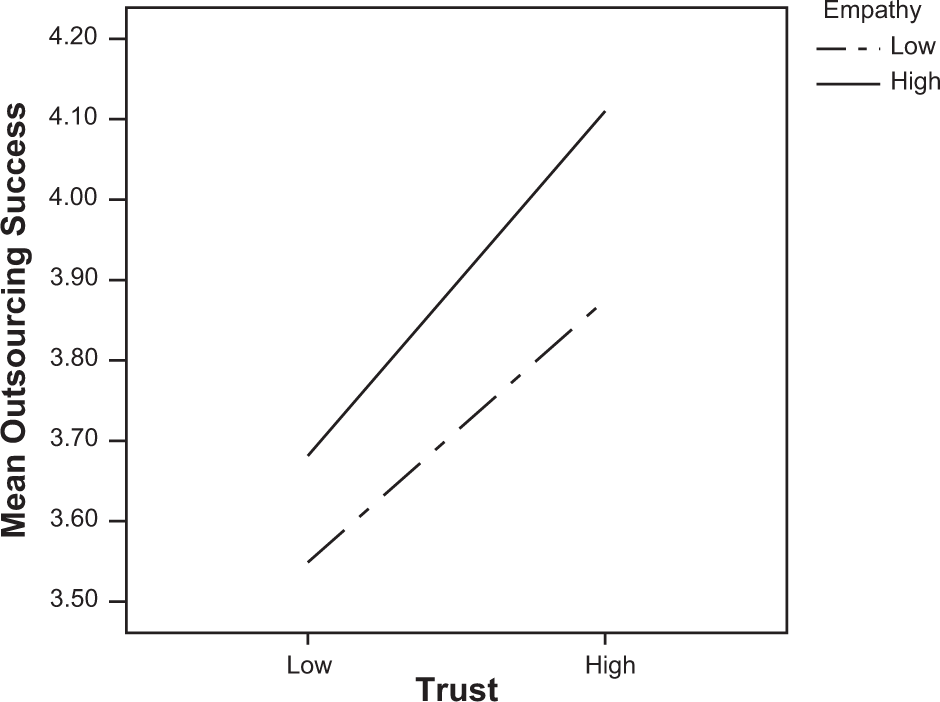
Moderating effect of empathy on trust and outsourcing success.
Discussion
The results revealed that there was a strong positive relationship between trust and outsourcing success. This result was consistent with previous works such as Lee and Kim (1999), Parker and Russell (2004), Lee and Huynh (2005), and Gurung and Prater (2006). Trust is an important component in partnership quality because it is a central aspect of a successful outsourcing relationship from the beginning of a relationship to the end (Anderson & Weitz, 1989; Ates, 2013; Moore, 1998). An absence of trust can lead to disruption of information flow, coordination problems, and conflicts between organizations.
The finding also indicates that business understanding is an important factor in an outsourcing agreement because of the shared responsibility, benefits, and risks involved in the process. Essentially, the organizations’ profit is partly depending on the ability of their outsourcing partner to support their business operations. Understanding clients’ expectation and knowing the organization’s capability in providing these services will lead to a viable partnership (Chu & Wang, 2012; Lee & Kim, 1999).
This finding suggests that communication is a critical activity that allows information flow between different parties during different stages of outsourcing activity (Chu & Wang, 2012; Galanaki & Papalexandris, 2007). In essence, communication skills help the organizations communicate their wants and needs accurately to their service providers, thus allowing things to be done right the first time. This practice will prevent loss of time and wastage of resources, thus leading to a better outsourcing outcome. Therefore, meaningful discussion is vital in planning, goal setting, implementation, coordination, and performance evaluation.
However, the results show that neither commitment nor top management support has a significant association with HR outsourcing success. This finding is not consistent with the findings of Lee and Kim (1999). It is possible that for Malaysian organizations, the role of commitment is overshadowed by other components of partnership quality such as trust and business understanding. Initial trust will lead both parties to the disposition to believe that the other party would fulfill the commitment and behave in a predictable way (Lee & Huynh, 2005; Swar et al., 2012). Business understanding and communication serve as important economic and cognitive cues in outsourcing success. Organizations are more dependent on the higher trust, stronger business understanding, and better communication as these elements are the drivers to positively influence outsourcing success. As for top management support, it can be assumed that HR practitioners are able to manage the outsourcing relationship proficiently without the assistance of the top management. This may be due to the fact that the employees themselves are responsible or have a positive attitude in making outsourcing a success. Once top management has decided what functions to outsource, they typically delegate the commitment to their middle management to manage and administer the outsourcing activities as they believe that their employees have the capability and functional knowledge in making it a success.
As for the moderating impact, tangibles were found to moderate the relationship between partnership quality (trust, commitment, and communication) and outsourcing success. Nevertheless, the hypotheses for variable tangibles were only partially supported. The relationship between trust and commitment with outsourcing success was found to be stronger with a higher level of tangibles. In contrast, relationship between communication and outsourcing success was stronger at a lower level of tangibles. Perhaps, when tangibles level was high, the customers were able to observe and feel for themselves the ability of their service providers. Therefore, when tangibles are already high, an increase in communication level would not bring about much change in outsourcing success.
Next, reliability was found not associated with the relationship between partnership quality (top management support) and outsourcing success. The results indicated that HR outsourcing success was influenced more by partnership quality at a low level of reliability than by a high level of reliability. The relationship between top management support and outsourcing success was stronger at a lower level of reliability. Top management support was more important for outsourcing success at low levels of reliability, as top management would need to step in to intervene. In other words, when reliability is low, top management support is needed to closely monitor the service providers and to identify possible strategies and solution to improve the operational results. If all other efforts fail to improve performance, top management also has the power to cease the relationship with the service provider. Thus, when reliability level of service provider is high, an increase in top management support will not bring a significant change in outsourcing success, as HR practitioners are trusted to be able to manage the partners on their own.
Responsiveness was found to positively moderate the relationship between partnership quality (communication) and outsourcing success. The relationship between communication and outsourcing success was stronger with a higher level of responsiveness. When responsiveness level is high, communication could bring a significant improvement in outsourcing success. The service providers will help the customers and provide them with prompt services through communication. In contrast, if the service providers are not responsive, then any information derived from communication would not be used for improvement purposes. Responsiveness is needed for all service providers to remain competitive, as the response time matters most to customers in relationship for outsourcing success. In this study, it was also observed that assurance did not significantly moderate the relationship between the partnership quality (trust, business understanding, commitment, communication, and top management support) and outsourcing success. The service provider’s ability to inspire trust and confidence through knowledge and courteous actions of their employees is not able to influence the relationship between partnership quality and outsourcing success. Other than that, assurance was found to directly influence outsourcing success but it did not moderate the relationship.
Finally, it was found that the relationship between trust and outsourcing success was stronger with a higher level of empathy. When empathy level is high, trust could bring a significant improvement in outsourcing success because service providers are thoughtful, considerate, and able to provide customized services whenever the need arises. Empathetic service providers are dependable especially during crisis and emergencies because they can be trusted to think of their clients’ best interest in the outsourcing relationships. At lower levels of empathy, increasing levels of trust also would not bring about much outsourcing success because service providers are not able to perform to the required level of customization.
Implications
The findings of this study are of value not only to the practitioners responsible for managing HR outsourcing, but equally to the researchers interested in understanding the phenomenon of HR outsourcing relationship. This study contributes to the body of knowledge in distinguishing the dimensions of partnership quality and service quality in the context of HR outsourcing success. It specifically identifies five factors of partnership quality that determine the success of HR outsourcing, which is strengthened by the factors of service quality. There has been no consensus on how service quality forms an HR outsourcing relationship. In this regard, this study attempts to draw a consensus on recognizing those factors of service quality that moderate the association between partnership quality and HR outsourcing success.
This study also offers useful guidelines for HR managers. It is common to find that organizations outsource more than one HR function and in fact most of them outsource training and recruitment functions. This finding indicates that HR outsourcing as a competitive strategy in Malaysia is still relatively new than other countries and probably many of its potential benefits are not fully understood. Therefore, by understanding the relationship with the service providers, the organizations are able to achieve outsourcing success by identifying areas of expected benefits and improvements. It is important to understand the components of partnership quality to develop a solid relationship with the vendor, irrespective of whether one specific HR function is outsourced or more and ultimately the most impact on HR outsourcing success. Trust has been found to have the strongest impact and this finding suggests to managers that they can use trust as a foundation for successful outcomes in the outsourcing relationship with their partners. Frequently, outsourcing strategies are viewed negatively by the service receivers because of the fear of losing control over the process. It takes time to build trust in a partnership. Therefore, initial trust would be a qualitative attribute that managers should look for in their selection of vendors for outsourcing. For organizations that are already practicing outsourcing, they should integrate activities such as information exchange on long-range plans, benefits and risk sharing, mutual problems, and knowledge sharing; all these activities can enhance the partnership trust level and improve the working relationship.
Apart from that, organizations must also understand that there should be an open and frequent communication between service providers and service receivers. This is because proper communication facilitates negotiation and transfer of information and resolves possible conflicts in any outsourcing relationship. Managers should therefore insist on timely and creditable communication channels. In addition, organizations can have better understanding on how service quality works in the HR outsourcing relationship. Overall, the elements of service quality only partially moderate the relationship. Being sensitive and aware of the presence of service quality as moderators is important for service receivers. This is because it may provide HR managers with some subtle cues for selection and evaluation of the right service providers in which the finding suggests that organizations should search for service providers with high levels of tangibles, responsiveness, and empathy.
This study also assists HR managers that business understanding should become an extension of a particular organizational work culture when they handle outsourced HR functions such as training, recruitment, employee records, and other functional tasks. In this matter, occasionally conflict and disagreement in needs may hamper outsourcing success. Consequently, understanding of roles and responsibilities of the service providers and service receivers is a crucial aspect of partnership quality that requires special managerial attention. Prior to entering a partnership, the business mission of both parties needs to be properly understood. This could be achieved through having a set of assigned goals for each specific milestone in the relationship to serve as check points. Apart from that, it is not unusual to find service providers competing among each other by imitating one another on the type of services offered. However, service quality should also be a priority for service providers if they are to build a strong reputation for their organizations. This is because customers evaluate services from a series of judgments over time. Superior quality will aid the reputation building of service providers and it is not something that can be replicated easily as it is an implicit knowledge and unique to a particular competitor.
Limitation and Future Research
First, the sample size is small due to the low response rate and time constraint. Obtaining more robust results would require a larger sample size. Second, in this study, one questionnaire represents an organization, thus the person who filled up the questionnaire may be biased and non-representative. Next, limited numbers of similar research have been carried out on this topic. Therefore, to overcome these limitations, this article includes literature review from other industries mainly from the Information System (IS) and Information Technology (IT) industry. Finally, the effect of partnership quality on HR outsourcing success of this study is limited to only manufacturing firms in Malaysia.
More researches can be conducted to examine the proposed model on HR outsourcing success. First, it would be interesting to extend this research to, for example, service industry to obtain more generalized findings to provide a better understanding on the growing trend of HR outsourcing in Malaysia. Next, analysis of the relationship between partnership quality and outsourcing success from the service provider’s perceptive would also provide a broader perspective. It is also suggested that a longitudinal research be carried out to investigate the dynamic features of outsourcing partnership as it will provide a more robust result than a snapshot research. Finally, more variables could be examined as an extension to this study. Other variables reflecting factors such as firm environment, strategic orientation, corporate philosophy, culture, and organizational practice could be included.
Conclusion
In a nutshell, it is essential to comprehend that the influence of partnership quality on HR outsourcing success is moderated by the service quality. In this study, organizations should realize that the success of HR outsourcing is very much dependent on their relationship with the service providers, which take into account the significant factors such as trust, business understanding, commitment, communication, and top management support. In addition, the impact of moderating factor that is service quality is equally essential to strengthen the relationship between partnership and HR outsourcing success. In light of the above, it was found that only trust, business understanding, and communication have an impact on HR outsourcing success, and service quality partially moderated these relationships. Therefore, it is anticipated that this research would be able to provide some insights to the organizations pertaining to the partnership quality, service quality, and HR outsourcing success, while offering guidelines for organizations to plan accordingly in selecting the appropriate service providers.
Footnotes
Declaration of Conflicting Interests
The author(s) declared no potential conflicts of interest with respect to the research, authorship, and/or publication of this article.
Funding
The author(s) disclosed receipt of the following financial support for the research and/or authorship of this article: We would like to thank the Universiti Sains Malaysia (USM) Research University Grant for funding this project under RU 1001/PMGT/81615.
Author Biographies
 .
.