




Abstract
This paper examines the impact of travel agencies’ video marketing campaigns on their marketing efficiency and effectiveness on Facebook (FB), with a focus on analyzing the characteristics of these campaigns. The study evaluated 135 FB video marketing campaigns (FVMCs) from three distinct types of travel agencies, utilizing Data Envelopment Analysis (DEA) to assess two inputs and three outputs, based on prior research and expert insights. The 135 FVMCs were classified into four categories by five experts: promotional campaigns, attraction recommendations, hotel content, and special events. Central and peripheral messages were identified using the Elaboration Likelihood Model (ELM), which facilitated the development of a four-quadrant framework to establish the benchmark for FVMCs. The findings suggest that FVMCs in the promotional campaign category, which incorporate comprehensive descriptions and appropriate video elements, tend to exhibit higher levels of efficiency and effectiveness, primarily due to the clarity of their central messages. Moreover, the study highlights a significant difference between the central and peripheral routes in terms of overall communication outcomes and efficiency.
Plain language summary
Purpose: This research investigates the impact of travel agencies’ video marketing campaigns on their marketing performance on Facebook (FB), focusing on campaign characteristics. Methods: We evaluated 135 FB video marketing campaigns (FVMCs) from three types of travel agencies. Data envelopment analysis (DEA) was used, considering two inputs and three outputs. Campaigns were categorized into four types by experts and assessed using the elaboration likelihood model (ELM) to identify central and peripheral messages. Conclusions: FVMCs with clear central messages and comprehensive descriptions in promotional campaigns led to improved performance. A significant difference was found between central and peripheral routes in terms of total output. Implications: While this study focused on FVMC efficiency and characteristics, it did not explore the link between marketing and financial performance. Future research can investigate financial indicators, such as sales revenue, to strengthen marketing investments and positive outcomes. Limitations: This research did not examine the direct relationship between marketing and financial performance, leaving room for further exploration.
Introduction
The travel industry has experienced significant growth over the past decade, with international tourist numbers reaching 1.5 billion in 2019. However, the COVID-19 pandemic has had a negative impact on the industry’s development, as evidenced by several studies (Keelson et al., 2024; Pachucki et al., 2022). According to the update by the UNWTO, in 2024, the global tourism industry experienced a strong recovery, with international travel reaching 99% of pre-pandemic levels and many regions surpassing their 2019 performance. Driven by surging global demand and the stabilization of major source markets, international tourist arrivals totaled 1.4 billion, an increase of 140 million compared to 2023. Tourism export revenues rose to a record USD 1.9 trillion, exceeding pre-pandemic levels. According to the UN Tourism Confidence Index, international tourism is projected to grow by another 3% to 5% in 2025, reflecting a steady rebound in tourism productivity and a positive outlook for continued growth (UN Tourism, 2025a). As a key component of the United Nations’ 2030 Agenda for Sustainable Development, the United Nations World Tourism Organization (UNWTO) has identified tourism as a strategic priority, aligning it with 169 specific targets across the Sustainable Development Goals (SDGs). With a membership comprising 159 countries, UN Tourism plays a central role in advancing these objectives by actively promoting the Global Code of Ethics for Tourism. This framework is designed to enhance tourism’s socio-economic contributions while minimizing its potential negative impacts, thereby supporting a more inclusive, responsible, and sustainable global tourism sector (UN Tourism, 2025b). Travel agencies are crucial players in the marketing platform for travel products, such as airline tickets, hotel accommodations, tourist attractions, and catering. In addition to regular brand and image promotions, travel agencies mostly function as intermediaries for travel product purchases, utilizing social media marketing campaigns, display advertisements, and promotions to attract the attention of fans and potential consumers and encourage purchase intention. From a consumer-facing perspective, the rapid adoption of digital technologies has driven the digital transformation of travel agencies. Multisided Platforms (MSPs), as a key digital application, have enabled traditional agencies to integrate with online platforms, allowing consumers to search, compare, and book travel products digitally (Aamir et al., 2025).
In the digital age, the number of internet users worldwide has reached 5.56 billion, accounting for nearly 68% of the global population (Meltwater, 2025). Social media provides a new means for the hospitality industry to interact actively with customers, representing a new marketing trend. Social media has been widely studied for its potential in communication between corporations and customers, creating unique interactive experiences and user-generated content for customer relations management (Azzaakiyyah, 2023; Barta et al., 2023; Chan & Guillet, 2011; Joshi et al., 2025; Ma et al., 2025). During the COVID-19 pandemic, social media played a critical role in the tourism industry, significantly impacting tourists’ destination choices and enhancing consumers’ engagement on social media platforms (Keelson et al., 2024; Pachucki et al., 2022). Prior research has examined the social media marketing strategies employed by international hotel chains, highlighting their influence on shaping consumer tourism preferences. Empirical evidence suggests that social media platforms not only contribute positively to the management of customer relationships but also enable hotel management to gain deeper insights into customer needs and behaviors through continuous, interactive engagement (Lo & Fang, 2018; Riwo et al., 2023) and travel agency operations in the tourism and service industries. Marriott Hotels Ltd. plans to invest more resources in online marketing, targeting online sales accounting for 20% of total revenues by the end of 2020.
Facebook (FB) is one of the most widely used and popular social media platforms globally. As the first platform to surpass one billion registered accounts, it continues to lead the global social media market with over three billion monthly active users. According to data from the third quarter of 2023, Facebook alone recorded approximately four billion monthly active users, underscoring its extensive global reach and sustained dominance in the social networking sector (Statista, 2025). Furthermore, Facebook’s advertising reach extends to 2.28 billion users, representing over 41% of the global internet-using population (Meltwater, 2025). Unlike platforms such as Twitter and LinkedIn that have specific target audiences, FB is a versatile platform that appeals to a wide range of people (Investopedia, 2024; Pew Research Center, 2024). Its popularity is attributed to its ability to offer photos, text, and messaging features through Messenger, which has attracted a significant user base. Travel agencies are increasingly prioritizing interactive engagement with their customers and potential customers through the use of photos, text, and videos, which can be easily facilitated through FB’s robust commercial mechanisms. Therefore, FB has become a crucial online marketing tool for travel marketers, making it the most valuable social media marketing platform for achieving optimal marketing performance (G. Cao & Weerawardena, 2023; Lo & Fang, 2018; Riwo et al., 2023).
In interdisciplinary studies, the synthesis of multiple articles underscores the significance of neuromarketing in advertising studies, emphasizing its influence on consumer behavior (Alsharif et al., 2024; Baltaci et al., 2024; Pilelienė et al., 2022). Recent research in neurophysiology and physiology reveals that brain processes such as emotions, cognitive processes, and perception are influenced by advertising campaigns (Alsharif et al., 2022). Furthermore, these insights should be incorporated into the consideration of the marketing mix (Alsharif, Salleh, Abdullah, et al., 2023).
Numerous studies have investigated how messages can impact customers’ perceptions and enhance marketing or advertising performance. The elaboration likelihood model (ELM) provides a framework for understanding the essential process of persuasive communication by reflecting on issue-relevant messages (C. D. Chen et al., 2022). The ELM assumes that elaboration occurs when the message recipient is motivated to think about an issue. Petty et al. (1981) proposed two delivery modes: central and peripheral routes. The dual-process theory has been applied in various fields, including social media information and quality (Pan, 2024; Zha et al., 2018). Marketing and advertising companies have conducted research on the effectiveness of marketing campaigns from various perspectives to understand the strength and impact of consumer message interpretation.
Previous research has predominantly concentrated on evaluating the effectiveness of marketing campaigns based on their impact on business performance. However, a comprehensive exploration of the operational performance of the tourism industry’s social media through multiple perspectives and the integration of both qualitative and quantitative analysis methods remains relatively underexplored. This study adopts both qualitative and quantitative methods to investigate the operational efficiency and effectiveness of travel agencies’ social media. In the qualitative analysis, the Elaboration Likelihood Model (ELM) is utilized to classify travel agencies’ FB Video Marketing Campaigns (FVMCs) based on expert opinions through the central and peripheral routes. For the quantitative research methods, this study employs Data Envelopment Analysis (DEA) and the four-quadrant analysis to examine the efficiency of these campaigns. This study classifies and evaluates the efficiency of social media marketing campaigns, leveraging the theoretical characteristics of the ELM to verify the differences of various types of FVMCs through the central and peripheral routes, aiming to address the gaps in previous ELM research. Additionally, the study seeks to develop effective advertising strategies through social media campaigns to promote tourism products and enhance advertising effectiveness.
The study aims to validate the theoretical and methodological approaches and provide a more specific understanding of how travel agencies manage different types of FVMCs. This will assist them in developing clear marketing strategies for future digital media platforms. By integrating qualitative analysis of expert opinions and leveraging the advantages of DEA and four-quadrant analysis in line with ELM theory, this study comprehensively explores the efficiency and effectiveness of FVMCs within the context of travel agencies, focusing on addressing the research objectives.
The remainder of the paper is organized as follows: Section “Literature Review” reviews the literature; Section “Methods” outlines the methodology; Section “Results” presents the results of the analysis; Section “Discussion and Implications” discusses the findings and their implications, and Section “Conclusion and Future Research” concludes the study.
Literature Review
Social Media and Facebook
Social media refers to Internet-based applications that enable users to generate and exchange content (D. Cao et al., 2021; Kaplan & Haenlein, 2010), and is characterized by participation, openness, conversation, interactivity, and connectivity (Haro-de-Rosario et al., 2018). The motivations behind fan interactions on social media have also emerged as a growing focus in international research (Syu et al., 2024). Social media platforms, such as FB, allow companies to engage with consumer groups or fans who can create and share information, pictures, texts, images, and sounds (Madan & Rahul, 2025). The interaction between consumers and brands through social media has created dynamic networks where consumers share their user experience with the brand. Social media has become a popular vehicle for consumers seeking entertainment (Wei et al., 2025) and a source of updated information for professionals (Lu et al., 2025). By engaging in social media activities, people become more likely to become regular visitors to those platforms and familiarize themselves with most marketing campaigns (Ghaderi et al., 2024). Hence, marketers need to comprehend how social media creates differences among consumers.
Facebook, a popular social media platform, allows users to “Follow,”“Like,”“Comment,” or “Share” content (D. Cao et al., 2021). Social advertising on FB is affordable and effective (Cordero-Gutiérrez & Lahuerta-Otero, 2020), making it a norm for many industries seeking to engage consumers actively. Firms and institutions have official FB accounts and post interesting photos with captions for their products or services to appeal to consumers (Drossos et al., 2024). In social media marketing, FB can be used to provide live updates to sell products or services in social media communities through commenting or responding to related “Posts” (D. Cao et al., 2021). Companies send FB messages to consumers and fans in the target market, some of which attract consumers to purchase online through promotions or discounts, while others provide incentives to refer friends from the social network. Information on products or service content is also provided to reinforce purchase decisions and enhance the brand image by providing brand information, which is also placed in social media promotions (Antczak, 2024).
Research on marketing and social marketing is quite extensive, with empirical studies being conducted across various disciplines and fields. Recent studies have increasingly incorporated interdisciplinary research, utilizing a more diverse set of tools such as functional near-infrared spectroscopy (fNIRS) and functional magnetic resonance imaging (fMRI) to explore consumer responses to marketing activities (Alsharif, Salleh, & Pilelienė, 2023). Additionally, some research uses bibliometric analysis to explore new findings regarding the relationship between social media and information sharing (Abbas et al., 2022). Alsharif et al. (2024) employed the Preferred Reporting Items for Systematic Reviews and Meta-Analyses (PRISMA) framework to select pertinent studies and performed bibliometric analysis to identify global trends and advancements in the fields of advertising and neuromarketing. The study identified correlations between the functioning of specific brain regions and the emotions of message recipients. It further examined how intrinsic and extrinsic emotional processes, endogenous and exogenous attentional mechanisms, memory, reward systems, motivational attitudes, and perception are implicated. These factors are crucial for comprehending the responses elicited by advertising campaigns.
Research methods have been employed in the analysis of business performance for advertising and promotions, where multiple inputs and outputs have been assessed. Table 1 presents a summary of the input and output selection from prior literature. Serrano-Cinca et al. (2005) employed the nonparametric method of data envelopment analysis (DEA) to assess the efficiency of dot-com companies. The authors found that businesses that utilize the Internet as their primary sales channel are able to achieve two important promotional goals, which are generating revenue and making an impact online. To conduct an efficiency analysis, the study employed the number of unique visitors to a website and sales as two outputs of the DEA model, which served as the output indices for performance evaluation.
Summary of DEA Input and Output Papers Review.

Büschken (2007) employed DEA to investigate the effectiveness of different media types, and found a positive correlation between efficient car advertisements and purchase event feedback. Another study in Spain’s automobile industry utilized DEA to assess the performance of advertising budget spending, using costs of print, broadcast, Internet, and outdoor advertisement as inputs, and sales turnover and the number of cars sold as outputs (Büschken, 2007). Cordero-Gutiérrez and Lahuerta-Otero (2020) also examined the impact of social media marketing campaigns on enhancing awareness of postgraduate students and recruiting potential students, concluding that online advertising can improve efficiency and long-term performance (Boerman et al., 2017).
Lohtia et al. (2007) employed two output-oriented DEA models, one based on click-through rate (CTR) and the other based on CTR of advertisement, memory, and attitude. The effectiveness of online behavioral advertising is influenced by factors controlled by advertisers and consumers (Boerman et al., 2017), requiring strong coordination between advertising operators and consumers to achieve efficient online advertising on social media through push promotions. Kaplan and Haenlein (2010) confirmed that marketing or promotion through sharing, collaboration, and consumer involvement is crucial for attracting consumer attention. Lo and Fang (2018) analyzed international hotel chains’ FB marketing campaigns and suggested the effective use of text and images, as interesting content can attract fans and consumers. In addition to providing valuable information for advertisers and marketing managers, DEA can identify marketing or advertising campaigns that are not investing sufficient resources by comparing them with high-performing campaigns, and suggest ways of supplementing insufficient resources (Lohtia et al., 2007). To summarize, DEA enables the evaluation and selection of multiple inputs and outputs, and can be used to compare FB video marketing campaigns (FVMCs) and assess their efficiency regarding multiple targets.
Elaboration Likelihood Model Marketing and Advertising Messages
When a person is motivated and capable of considering an issue, they are more likely to process messages using either the central or peripheral route. This idea is supported by research by Petty et al. (1983) and corresponds to Howard and Sheth’s (1969) suggestion that consumers are involved in the purchasing process. In the central route, high-involvement and message-oriented methods increase the persuasiveness of a product or service, while in the peripheral route, low-involvement consumers rely on simple decision-making rules. Both routes have a positive effect on perceived information, which can strengthen the persuasiveness of a product or service (Zhang et al., 2017). ELM is useful for explaining persuasive marketing in social media (Teng et al., 2014). When a travel agency advertises on a website, consumers may be influenced by both the central and peripheral routes in high-involvement situations (SanJosé-Cabezudo et al., 2009). ELM has also been used to understand how marketing and advertisement campaigns affect consumers and how the central and peripheral routes impact marketing effectiveness. Hlee et al. (2016) found that reason-based text messages were similar to the central route, while emotion-based messages with images were similar to the peripheral route. The central route’s strength lies in message representation, while the peripheral route’s strength is in the attractiveness of the information source (Cyr et al., 2018). Other studies have explored how different types of media (such as texts, images, and videos) with various attributes affect consumer message reception. Therefore, ELM can help outline the unique characteristics of social media from the perspective of the dual-route model (central and peripheral routes; Zha et al., 2019).
Stylianou et al. (2025) emphasized the significance of video promotions in social media marketing. Y. Kim et al. (2016) demonstrated that consumers are more receptive to content-rich messages, while Lo and Fang (2018) found that informational messages in FB marketing campaigns are more effective in capturing consumers’ attention. These studies are consistent with who reported that issue-related arguments encourage consumers to reflect more, leading to wiser decisions (Shi et al., 2018). Bhattacherjee and Sanford (2006) highlighted that elaboration involves consumers’ reflection on issue-relevant messages. Macias (2013) investigated social media campaigns and concluded that consumers use the central route to make decisions and make cognitive efforts to obtain more information. Aghakhani et al. (2018) suggested that consumers who rely on the central route reflect on controversial messages and facts before decision-making, leading to more stable and enduring cognition. However, customers who prefer the peripheral route may have less enduring cognition and attitude toward a product or service because of less cognitive effort and more unpredictable long-term behavior.
Kumar et al. (2025) provide strategic insights for brands to optimize social media budget allocation based on their primary objective either fostering long-term customer engagement or driving immediate sales. FB has emerged as a preferred online marketing platform for small and medium-sized enterprises, including travel agencies, due to its cost-effectiveness and utility in allocating limited marketing budgets and promoting newly launched travel products and services within their FB communities. The trackable and monitorable performance of online marketing on FB is a strong reason why it is a top priority in social media marketing. However, there are few publications addressing the performance of online marketing efficiency of travel agencies, despite their profits being earned from commissions and service charges. Therefore, marketers must consider the effectiveness and efficiency of marketing performance. This study uses DEA to comprehensively understand the efficiency of FVMCs, applies the ELM dual-route model to illustrate the distribution of FVMCs through quadrant performance analysis, and concludes their marketing efficiency.
Methods
Alsharif, Salleh, Hashem E, et al. (2023) conducted semi-structured qualitative interviews with scholars and subsequently performed quantitative research to test and measure the findings, leveraging the dual advantages of both qualitative and quantitative methods. Similarly, we first gather expert opinions and then conduct quantitative analysis to obtain new perspectives and research results. This study aims to identify benchmark FVMCs using both quantitative and qualitative methods. We employ DEA to evaluate the efficiency of selected FVMCs and conduct expert interviews to determine their efficiency and effectiveness in various marketing categories. Figure 1 illustrates the conceptual steps involved in this research.
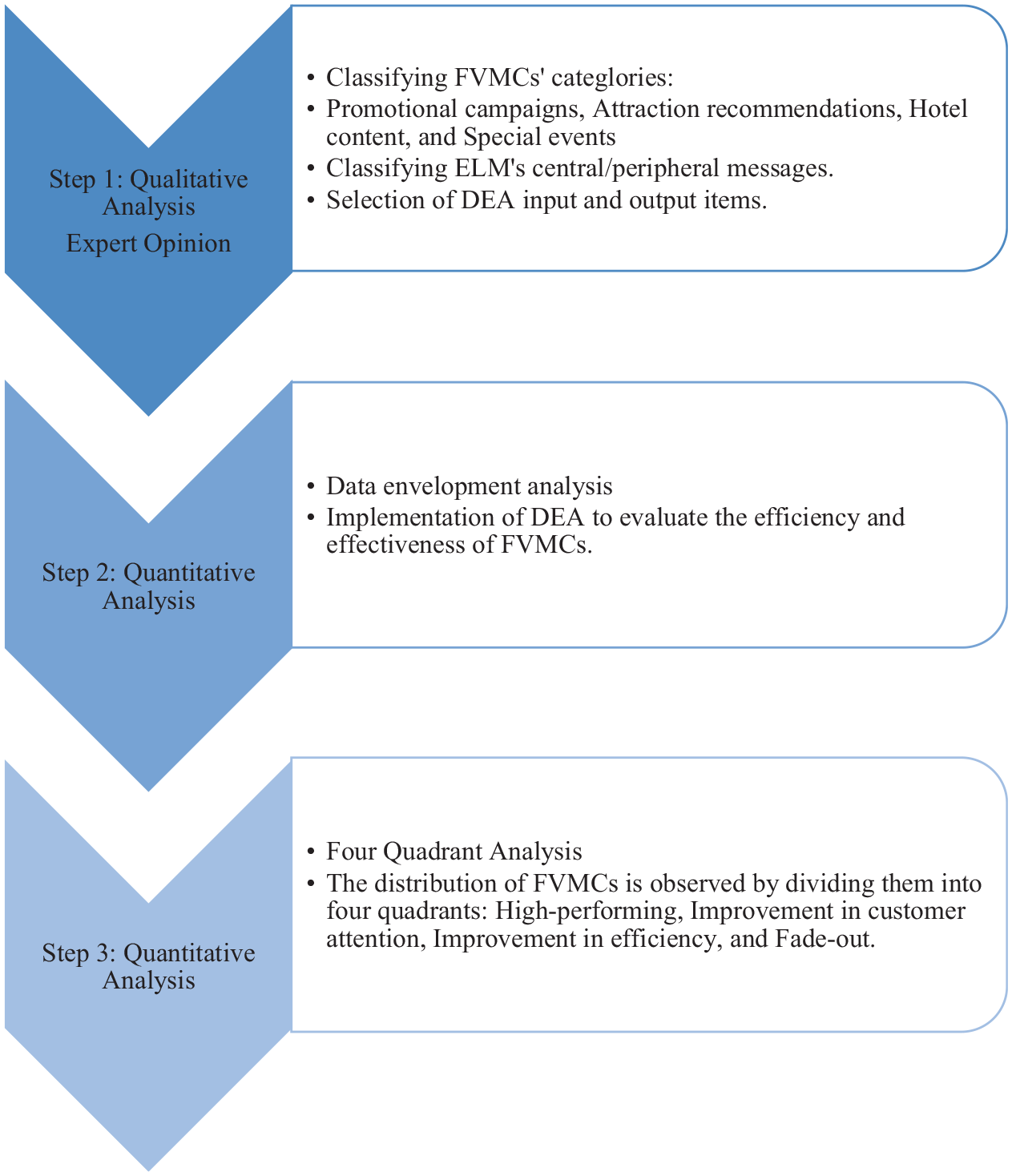
Research conceptual steps.
Data Envelopment Analysis
DEA is a powerful tool that can produce comprehensive indices for multiple inputs and outputs, making it useful in efficiency research across various industries and fields. Its theoretical development began with Farrell (1957) use of DEA with non-predefined production functions, which was further advanced by Charnes et al.’s (1978) pioneering research on DEA and their publication of “Measuring the Efficiency of Decision-Making Units” in the European Journal of Operational Research. DEA’s processing of multiple inputs and outputs makes it advantageous in assessing multifaceted efficiency, as noted by Lewin and Minton (1986). Furthermore, the efficiency assessment process and results analysis are objective, as individual input weights are not required. Determining the efficiency and inefficiency of a decision-making unit (DMU) is also straightforward with DEA. This involves comparing DMUs to understand their positions on the efficient frontier and identifying the DMU with the smallest resource investment. To calculate the efficiency of FVMCs, this study used the Charnes, Cooper, and Rhodes (CCR; Charnes et al., 1978) model and the Banker et al. (1984; BCC) model, with the CCR model (input dimensions) capable of measuring FVMC efficiency and the BCC model evaluating pure technical efficiency (PTE).
DEA is widely used as a benchmarking tool in practice, providing comprehensive indices that serve as a reference for decision-making and operation analysis by management departments and decision-makers. Its applications have been studied in various industries, particularly in tourism and leisure, such as hotel management performance and catering management analysis (Fang & Ding, 2020; Fang et al., 2013; Fang & Zheng, 2024; Lo & Fang, 2018), and business performance analysis in aviation (Schefczyk, 1993). This study used DEA to assess the FVMCs launched by travel agencies for 23 months as DMUs to evaluate their relative efficiencies and identify ways to improve efficiency and increase output value. The CCR model was used to measure the efficiency of a selected FVMC through constant returns to scale, while the BCC model was used to evaluate the pure technical efficiency (PTE) using variable returns to scale analysis. The study evaluated FVMCs’ efficiency achieved under the output scale obtained through actual operation and whether it achieved optimal efficiency with minimal resource investment.
Input and Output Selection
Input and output selection can be determined based on a review of existing literature, data availability, and expert input (Lo & Fang, 2018). Some studies have highlighted the significance of social media marketing and video promotions in reaching potential consumers and achieving sales objectives (Leung et al., 2013; Stylianou et al., 2025). According to Xu et al. (2015), video messages can reduce customers’ uncertainty about service processes and performance, while Y. Kim et al. (2016) suggest that providing ample information can attract consumers’ attention. To identify suitable inputs and outputs for the FVMCs, this study collected data from the FB platform and sought the opinions of five social media marketing experts in the tourism industry, who were asked to rate their level of agreement on a 5-point Likert scale (5 points = strongly agree, 4 = agree, 3 = neutral, 2 = disagree, and 1 = strongly disagree). The results revealed that 80% of the experts agreed on two inputs “video lengths and text lengths” and three outputs “likes, shares, and video views.”
To ensure a rigorous and transparent selection process for expert panel members, this study followed a systematic approach to expert selection, outlined as follows:
First, five professionals were selected based on predefined criteria, which included a minimum of 10 years of experience in tourism marketing, active involvement in social media strategy execution, and expertise in digital media planning. These experts held senior positions in the tourism industry, such as Marketing Vice President, Marketing Director, Marketing Manager, and Digital Marketing Manager. Their collective expertise facilitated a comprehensive evaluation of Facebook Video Marketing Campaigns (FVMCs). Second, the data collection process adhered to a structured methodology. Experts were initially briefed on the study’s objectives and provided with classification guidelines based on the Elaboration Likelihood Model (ELM). Furthermore, the operational definitions of the questionnaire items used to gather expert opinions were systematically explained and clarified. The professional background of the five tourism marketing experts is presented in Table 2.
Expert Profiles.

Figure 2 illustrates the input-output DEA model to enhance the understanding of the mathematical framework. This model analyzes videos by considering the number of seconds for which the video is recorded and played in the input section, combined with the amount of text as the total input resources for FVMCs. For output performance, three metrics are considered: likes, shares, and video views. These metrics are used to discuss and analyze the efficiency of 135 DMUs. Figure 2 shows that two input variables (text length and video length) and three output variables (number of likes, number of shares, and number of video views) were selected and evaluated by experts using this DEA method.
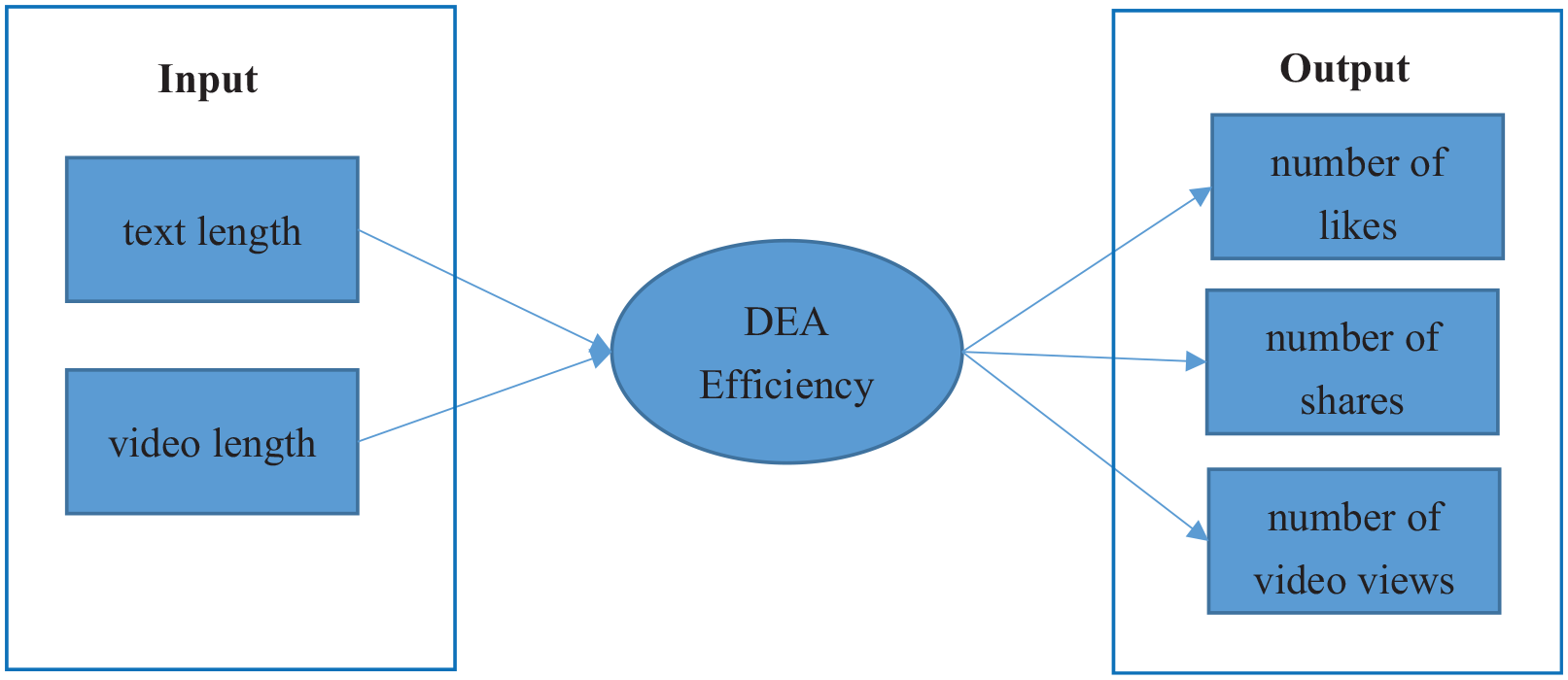
The input-output DEA model.
Data Selection
Over a period of 23 months, this study collected data from three sectors that frequently posted and engaged with fans on social media networks: online travel agencies, themed travel agencies, and large-scale travel agencies. These agencies consistently promoted their services and products through video marketing with text descriptions on FB. Table 3 presents the company profiles and the frequency of video launches for each travel agency. The FB Video Marketing Campaigns (FVMCs) produced by these three types of travel agencies were selected as Decision Making Units (DMUs).
The Profiles of the Travel Agencies.

During the study period, a total of 165 FVMCs were created. Based on the criteria for selecting DMUs, invalid and duplicate FVMCs were removed. These exclusions included (1) FVMCs with an output of 0 for likes, shares, and video views, or input values of 0 for text length and video length. (2) FVMCs with allocated advertising expenses. As a result, 135 FVMCs were selected as DMUs for Data Envelopment Analysis (DEA), comprising 59 from online travel agencies, 21 from themed travel agencies, and 55 from large-scale travel agencies.
Marketing personnel in travel agencies are responsible for engaging with customers and driving sales through social media. Consequently, these staff members need to have a clear understanding of the efficiency achieved by individual FVMCs while investing resources judiciously. To optimize resource allocation and advertising expenditure while minimizing waste on inefficient FVMCs, the benchmarking group was selected from the 135 FVMCs. To further enhance understanding of FVMC efficiency and output effectiveness, five experts classified the 135 FVMCs into four categories based on the ELM dual-route model, which can serve as a valuable reference for social media marketing managers.
Results
The statistical analysis for this study was conducted using SPSS 25.0 and DEAP 2.1. In the following section, the analysis and results for the selected FVMCs are presented.
Descriptive Statistics
The statistical analysis results of the 135 FVMCs selected in this study are presented in Table 4, providing descriptive statistics for the input and output variables. The average length of text input was 148 (148.4) words, and the average length of video was 60 (59.8) s. In terms of outputs, the mean number of likes was 124 (123.9), shares was 10 (10.3), and video views were 4,036 (4,035.7). Furthermore, the study analyzed the range between the maximum and minimum values of the inputs and outputs. The minimum text length was 40 times smaller than the maximum, while the maximum video length was over 303 times longer than the minimum. The maximum number of likes was nearly 99 times more than the minimum, and the range of shares was between 1 and 433. Lastly, the maximum number of video views was almost 100 times greater than the minimum number of views.
Descriptive Statistics.

The resource allocation and resulting benefits derived from the deployment of different types of FVMCs by travel agencies exhibit a certain degree of variation. However, discerning the individual performance in terms of efficiency values remains elusive. Thus, the application of DEA in this research enables the examination of efficiency values pertaining to distinct DMU categories, shedding light on their respective efficiency and effectiveness.
Data Envelopment Analysis CCR and BCC Efficiency Analysis
The study analyzed the efficiency of overall, PTE, and SE. Out of the 135 FVMCs, only 48 had an overall efficiency higher than the CCR mean (0.31), accounting for 35.6% of the total. Similarly, only 55 FVMCs had a PTE higher than the mean in BCC (0.55), accounting for 40.7% of the total. The number of FVMCs with higher efficiency was small. Regarding RTS, only nine FVMCs had reached total efficiency, and FVMC 62 and FVMC 68 showed decreasing returns to scale (DRS). More than 91% of FVMCs demonstrated increasing returns to scale (IRS). Among the FVMCs, nine had an overall CCR efficiency of 1, out of which five were promotional campaigns and four were attraction recommendations. FVMCs with complete text descriptions and suitable landscape videos in promotional campaigns yielded considerable video views. In terms of PTE, 19 FVMCs achieved total efficiency 1, including promotional campaigns, attraction recommendations, and special events. The involved attributes were diverse.
The efficiency performance of the 135 DMUs, evaluated using the CCR and BCC models, reveals a relatively lower level. Moreover, an overwhelming 91% of the DMUs exhibit increasing returns to scale (IRS), underscoring the importance for marketing manager to enhance resource and effort toward inputs. By doing so, they can effectively improve the efficiency performance of FVMCs.
Marketing Categories and Elaboration Likelihood Model Dual-Route
In this study, the performance of different categories of FVMCs was observed in four quadrants. The 135 FVMCs were categorized by five experts into four groups: “promotional campaigns” (35 FVMCs), “attraction recommendations” (58 FVMCs), “hotel contents” (16 FVMCs), and “special events” (26 FVMCs). The distribution and attributes of each category in the four quadrants were analyzed and compared. To investigate the efficiency and output effectiveness of FVMCs in different routes of the ELM theory, the 135 FVMCs were classified based on the experts’ opinions and divided into central route (33 FVMCs, 24.4% of the total) and peripheral route (102 FVMCs, 75.6% of the total).
Differentiation of Output Effectiveness in Elaboration Likelihood Model
According to the findings of this study, FB fans exhibited distinct reactions to the central and peripheral routes. Table 5 displays that the output effectiveness, specifically video views and total output, was higher for the central route compared to the peripheral route. The difference between these two routes was analyzed through an independent samples t-test, and the results are presented in detail in Table 6.
Group Statistics.

Independent-Sample T-Test.
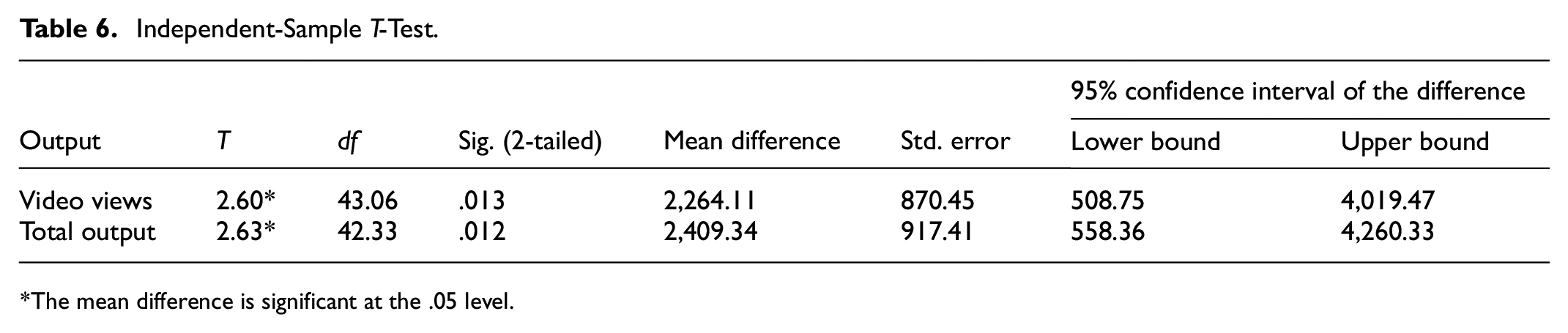
The mean difference is significant at the .05 level.
The central route of communication, characterized by a more deliberative and attentive processing of the message, yielded superior output performance, particularly in terms of video views and total output. In contrast, the peripheral route, which relied on surface-level cues, exhibited diminished effectiveness in eliciting the desired response. Consequently, when engaging with FB fans, prioritizing strategies that foster deeper engagement becomes imperative, as it is more likely to result in heightened video views and overall output.
Comparison of Elaboration Likelihood Model and Marketing Categories
This study classified 135 FVMCs into different marketing categories and ELM dual routes based on expert opinions and attributes. The matrix for FVMC classification by marketing categories and ELM dual route is presented in Table 7. Promotional campaigns (60.6%) and attraction recommendations (33.3%) accounted for almost 94% of the central route, while attraction recommendations (46.1%) and special events (23.5%) accounted for nearly 70% of the peripheral route. Promotional campaigns tend to fall under the central route, while attraction recommendations tend to belong to the peripheral route. Having information on central routes is crucial in promotional campaign FVMCs because they require more information and eWOM to enhance customer intention and maximize persuasive communication effectiveness (Teng et al., 2014).
The Matrix of FVMCs Marketing Categories and ELM Dual-Route.
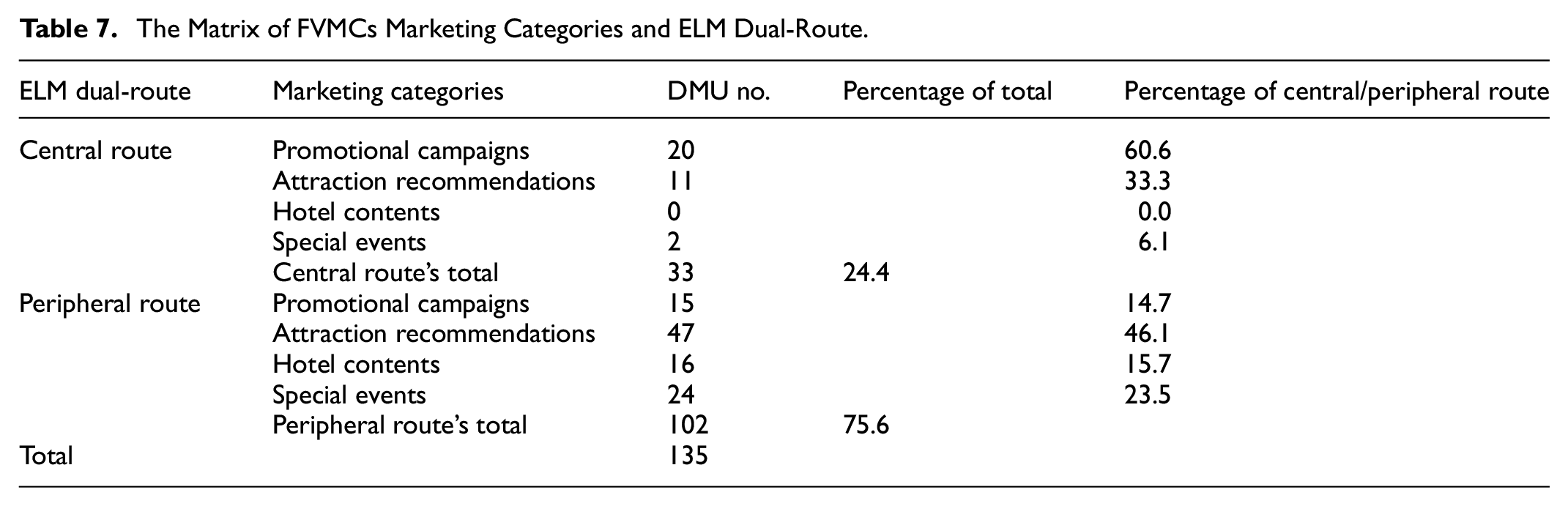
Promotional campaigns predominantly employ the central route of communication, prioritizing comprehensive information processing to effectively shape customer attitudes and intentions. Conversely, attraction recommendations tend to rely on the peripheral route, employing concise descriptions or endorsements for expedited evaluations.
CCR Differentiation of Four Categories
Table 8 displays the homogeneity of variance results for the four categories of FVMCs, which were analyzed to determine whether their overall CCR efficiency varied significantly. The analysis found that the homogeneity hypothesis was not supported for 135 DMUs and for DMUs divided across three different types of travel agencies. In such cases, the Dunnett T3 test is commonly used as an alternative when the assumption of homogeneity is violated. This test is particularly useful for comparing multiple groups or conditions and when equal variances are not assumed (Shingala & Rajyaguru, 2015).
Levene’s Test of Equality of Error Variances.

The mean difference is significant at the .01 level.
In summary, all three groups demonstrated significant differences in efficiency. The results in Table 9 indicate significant differences between the categories of FVMCs. Specifically, the efficiency of promotional campaigns (category 1) was significantly higher than that of hotel contents (category 3) and special events (category 4). This implies that promotional campaigns, with their emphasis on the central route and comprehensive information processing, outperformed the other categories in terms of generating desired outcomes. Moreover, the efficiency of attraction recommendations (category 2) was significantly greater than that of hotel contents (category 3). This suggests that the peripheral route, utilized by attraction recommendations with their succinct descriptions or endorsements, proved more effective in driving desired results compared to hotel contents.
FVMC’s CCR Efficiency Dunnett T3 Post Hoc Tests.
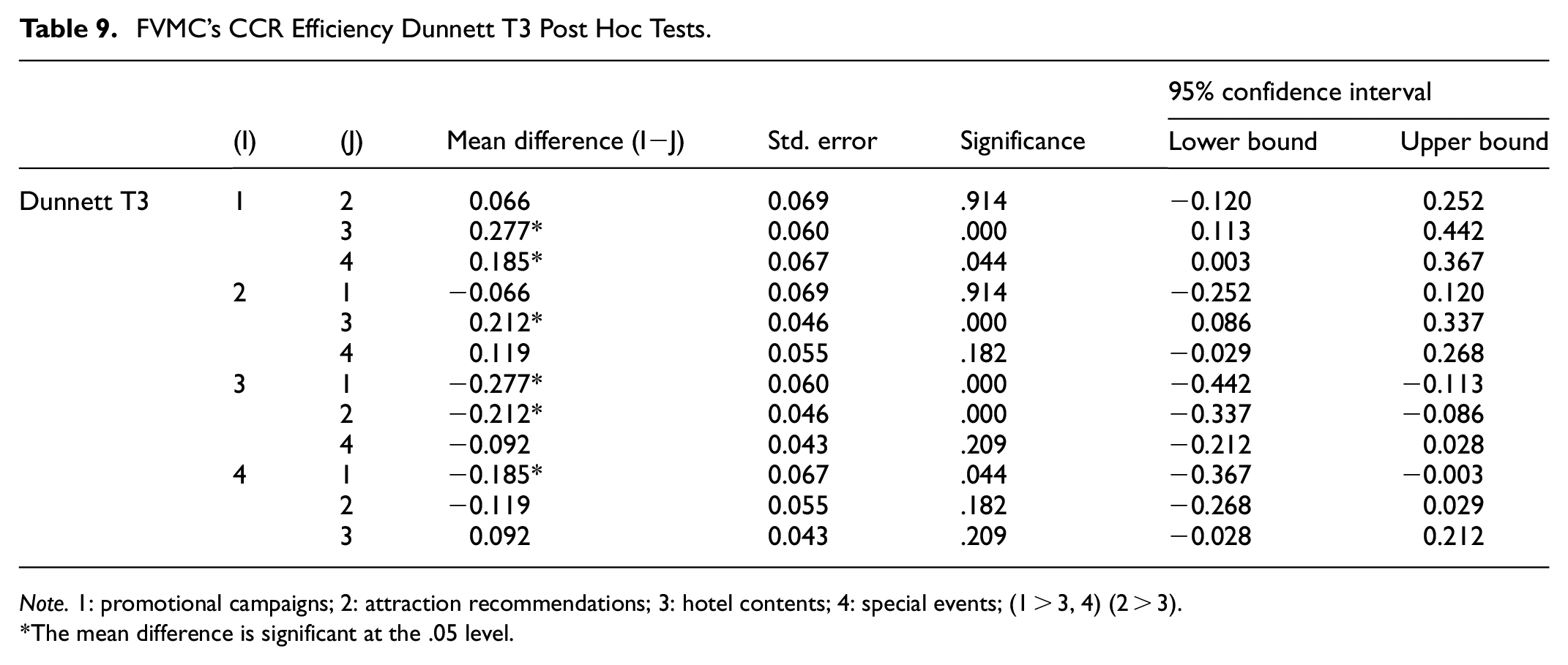
Note. 1: promotional campaigns; 2: attraction recommendations; 3: hotel contents; 4: special events; (1 > 3, 4) (2 > 3).
The mean difference is significant at the .05 level.
Four-Quadrant Analysis
In order to assess the efficiency and impact of 135 FVMCs, they were grouped and subjected to a four-quadrant analysis in which CCR and output values were standardized. The effectiveness of outputs, including likes, shares, and video views, was plotted along the X-axis, with shares weighted at seven likes according to (C. Kim & Yang, 2017). CCR efficiency was plotted along the Y-axis. Figure 3 displays the four quadrants: high-performing, improvement in customer attention, improvement in efficiency, and fade-out. The study also classified the 135 FVMCs into central and peripheral routes based on the ELM and examined the attributes and distribution of the different categories of FVMCs in the four quadrants. Table 10 provides an overview of the characteristics of FVMCs in the four quadrants, categorized by their effectiveness and CCR efficiency.
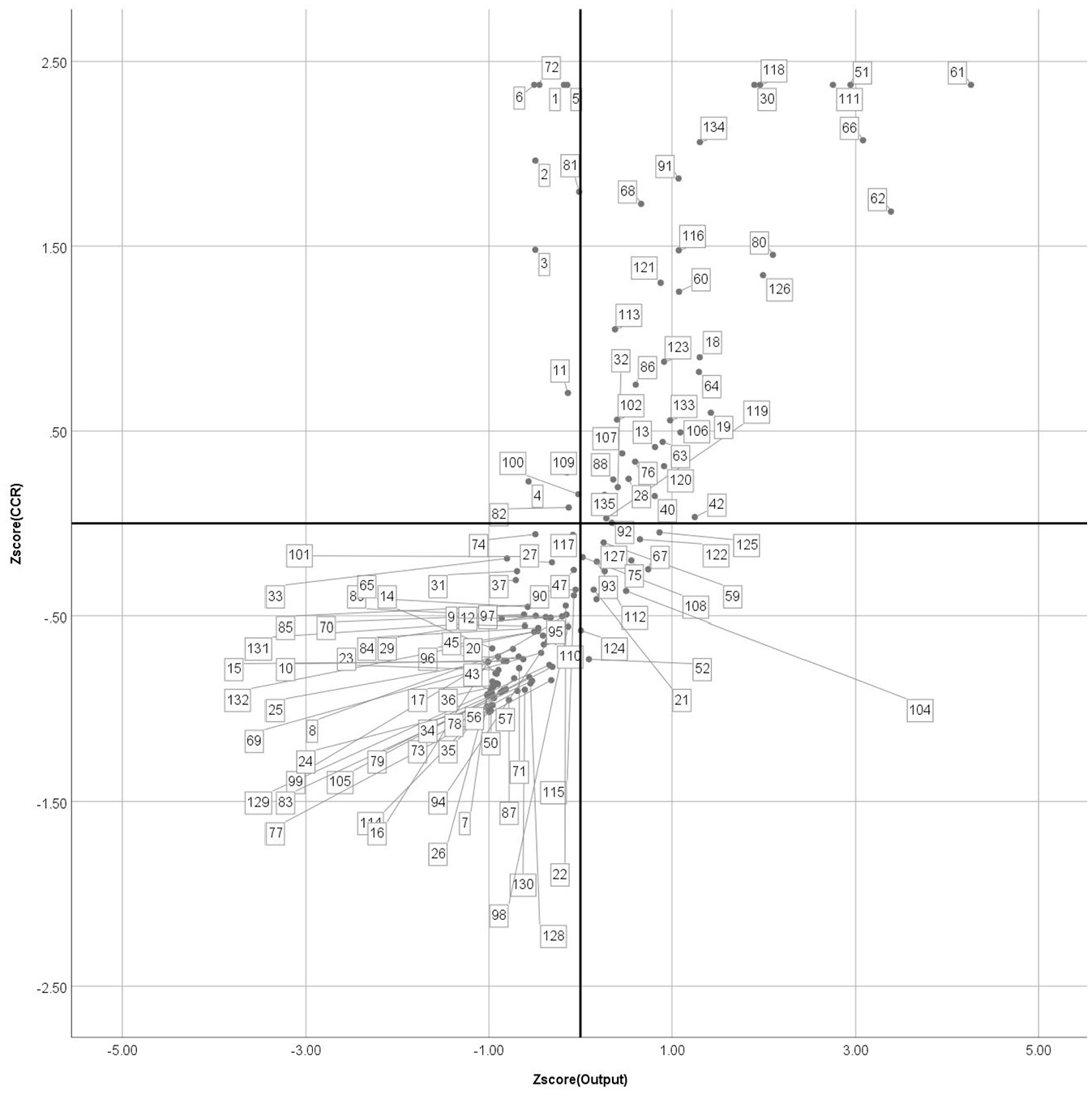
Quadrant analysis: CCR efficiency and effectiveness output.
The FVMCs Characteristics of Four-Quadrant.

High-Performing Quadrant
This quadrant comprises FVMCs with above-average CCR efficiency and output and contains a total of 37 FVMCs. FVMCs in this quadrant with the highest CCR efficiency score (efficiency value = 1) and an above-average output value can serve as benchmarks for other FVMCs (i.e., the high-performing quadrant). This study identified five promotional campaigns that met these criteria. Table 11 comprehensively presents the performance of various FVMCs in overall and four quadrants after categorizing them into marketing campaigns and ELM’s central and peripheral routes based on expert opinions. The performance of promotional campaigns in the high-performing quadrant was 48.7%, significantly higher than that of other categories and its overall proportion (25.9%). Moreover, a further examination of the characteristics combined with ELM in high-performing and central routes FVMCs indicated that 61.1% of FVMCs in the promotional campaigns category were in the central route, which was higher than its overall proportion of 57.1%. This suggests that FVMCs with rational appeal in the central route of promotional campaigns had better CCR efficiency and overall output (the average number of video views in quadrant I, central route of promotional campaigns was 10,339, which was higher than the overall average of 4,036).
The Matrix of Marketing Campaign and ELM Dual-Route in Four-Quadrant.

Improvement in the Customer Attention Quadrant
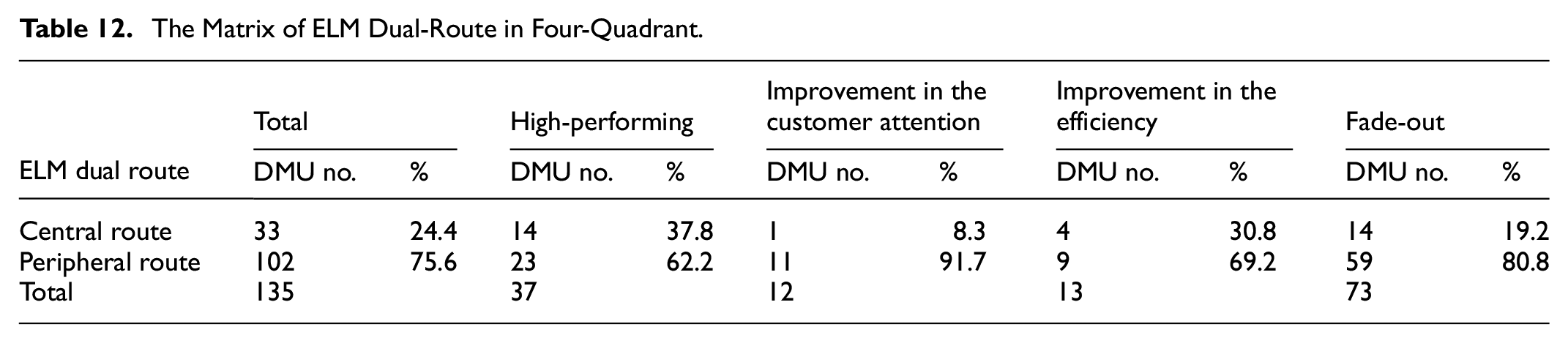
In the improvement in customer attention quadrant, the efficiency of the FVMC group was above average, but the output effect still had scope for enhancement. The study identified 12 FVMCs in this quadrant, of which 11 were associated with the peripheral route in the ELM. Table 12 illustrates that the proportion of peripheral routes in this quadrant was 91.7%, significantly higher than its overall proportion of 75.6%. Furthermore, all FVMCs related to attraction recommendations were associated with peripheral routes, higher than its overall proportion of 81% in the category of attraction recommendations.
The Matrix of ELM Dual-Route in Four-Quadrant.
Improvement in the Efficiency Quadrant
In the improvement in efficiency quadrant, the total output effect of FVMCs was above average, but the efficiency had scope for enhancement, with 13 FVMCs falling into this quadrant. The proportion of FVMCs associated with the central route in the ELM in this quadrant was 30.8%, which totaled to four, higher than the mean proportion of 24.4%.
Fade-Out Quadrant
The fade-out quadrant represents poor efficiency and output effectiveness of its FVMCs compared to the mean. This study found that 73 FVMCs were situated in this quadrant, and 80.82% of them belonged to the peripheral route, which is higher than the total proportion of 75.6%. Further analysis was carried out on the proportions of the four categories, revealing that there were 14 FVMCs in the hotel contents category in this quadrant, and all of them pertained to the peripheral route, which is 87.5% higher than the total proportion of hotel contents FVMCs (16 FVMCs).
Discussion and Implications
This study adopts a quantitative methodology to explore the performance of FVMCs from different perspectives and address questions related to their performance. To analyze business efficiency, DEA was employed, and a four-quadrant analysis was used to understand the differences in efficiency and total output. Additionally, the study examines the insights of FVMCs’ efficiency and effectiveness through the central and peripheral routes based on ELM, which can shed light on how travel agency FVMCs can serve as benchmarks.
Discussion
Four-Quadrant Analysis
High-Performing Quadrant
These campaigns excel in delivering persuasive and impactful messages that resonate deeply with viewers. By fostering a meaningful cognitive connection, they capture attention and stimulate active involvement, leading to heightened viewer engagement. This distinct quality sets them apart, enabling them to effectively convey their intended message and generate desired outcomes. Therefore, prioritizing strategies that promote profound cognitive engagement in promotional campaigns is essential for achieving success in FVMCs. This is consistent with the findings of Y. C. Chen et al. (2021), which indicate that consumers, through higher-involvement behaviors during their interactions with products or service providers, can participate more actively in brand promotion and engagement, thereby exerting a positive influence on the marketing performance of new product or service launches. Shiwen and Ahn (2024) also show that customer involvement within the community positively affects engagement.
Improvement in the Customer Attention Quadrant
This study highlights the importance of the attraction recommendation category and confirms that peripheral routes have a positive impact on the efficiency performance of short video marketing campaigns in this context. Recent research also indicates that with advancements in technology, many tourism businesses can further enhance customer attention through the use of virtual video tools (Rogoleva et al., 2023). Destination marketing remains a core element in the promotion of tourism products, and recent studies have increasingly emphasized its application in emerging topics related to smart tourism, such as smart destinations and the integration of technological innovations. These efforts aim to successfully capture consumer attention and foster favorable perceptions, thereby enhancing marketing effectiveness (Sorokina et al., 2022).
Improvement in the Efficiency Quadrant
In the context of promotional campaigns and attraction recommendations, marketers need to focus on optimizing the content creation process to achieve an optimal balance between the quantity and quality of input. Such optimization should align with followers’ preferences, ultimately maximizing efficiency performance (Darvidou, 2024). In the study by Zulfikar et al. (2024), it was also found that digital marketing has a significant positive impact on marketing efficiency through the enhancement and requirements of content quality.
Fade-Out Quadrant
These findings suggest a strong association between the peripheral route and FVMCs in the hotel contents category within the quadrant. Hotel accommodation and dining hold considerable weight in the travel expenditure budget, exerting a substantial influence on consumer purchasing decisions. To entice consumers, hotels often emphasize the ambiance of their accommodations through videos, employing the peripheral route approach to create a favorable perception. This study highlights the significance of marketers focusing on enhancing both the quality and quantity of FVMCs in this domain to improve overall marketing performance. Sun et al. (2025) also indicated that visual content plays an important role in influencing user decisions.
Theoretical Implications
The present study draws upon previous research to shed light on the performance of FVMCs from different perspectives. Firstly, the study shows that there are significant differences between the central and peripheral routes based on ELM. Specifically, FVMCs that employ the central route tend to have higher video views and total output effectiveness than those that employ the peripheral route. This finding supports previous research suggesting that high-quality, credible information delivered via the central route is more effective in attracting and engaging travel-related social media (TSM) users (Hur et al., 2017). Particularly the advancements and emerging trends in video and animation promotional tools, it becomes imperative to strengthen the production and generation processes to effectively enhance the quantifiable metrics and informational richness and value of FVMCs. By doing so, a substantial improvement can be achieved in both the total output value and efficiency of FVMCs.
Secondly, high-performing FVMCs that demonstrate high efficiency and total output were identified in the integrated perspective of categories, four-quadrant analyses, and ELM. The study highlights the positive influence of clear and issue-relevant information delivered via the central route for promotional campaigns in FVMCs of travel agencies. Previous research has indicated that delivering reason-based messages through the central route can cultivate enduring and predictable attitudes among consumers (Bhattacherjee & Sanford, 2006; Teng et al., 2014). This current study further contributes to this understanding by highlighting the effectiveness of employing the central route, specifically through video editing, in promoting travel products. Such an approach enhances the advertising impact, leading to long-lasting effects that influence consumers’ purchase decisions. This effect is particularly pronounced when targeting high-end travel products and services that come with significant costs, as consumers tend to demonstrate heightened engagement during the purchasing process (Hur et al., 2017). Consequently, the clarity and comprehensibility of information quality play a pivotal role in generating consumer interest and shaping their decision-making.
Thirdly, the study reveals that all hotel content FVMCs are peripheral route DMUs without rational appeals in the content of text and video, and their performance in terms of effectiveness and efficiency is relatively poor. Accommodation services provided by hotels are highly anticipated by consumers during their travel experiences, and they also constitute a relatively significant portion of travel costs. Therefore, in the editing of videos and messages, in addition to presenting the overall ambiance of the hotel, emphasis should be placed on the integrity of delivering rational information. This finding supplements previous research, indicating that consumers attach greater importance and respond more positively to rich information based on rational appeals in their purchase decisions (Y. Kim et al., 2016; Lo & Fang, 2018).
Managerial Implications
Barreto (2013) pointed out that sharing images and videos on websites requires less cognitive effort from consumers compared to other types of communication. However, the empirical research in this study, based on the perspective of the ELM, shows that FVMCs in the central route outperform FVMCs in the peripheral route in terms of social media video efficiency and effectiveness. These results further support the findings from the four-quadrant analysis. Individual FVMCs in the central route exhibit better performance than the overall proportion in the high-performing and efficiency improvement quadrants. Further observations within marketing categories reveal that in promotional campaigns, five FVMCs achieve overall efficiency and higher output value, surpassing the average level. This indicates a strong effect of utilizing attributes of the central route in promotional campaigns. Therefore, travel agencies should optimize the editing of promotional activity videos, such as providing detailed descriptions of the event and incorporating supporting text during video presentations, to enhance the rational persuasiveness and achieve strategic appeals in promotional campaigns.
Furthermore, the study reveals significant differences in the efficiency performance between FVMCs in promotional campaigns (category 1) and FVMCs related to hotel contents (category 3). It indicates that when travel agency marketers utilize hotel contents as materials on social media, particularly for luxury hotels, they should emphasize objective introductions of the hotel information. Specifically, marketers should strategically incorporate more informational elements, such as descriptions of hotel features and unique selling points, in both the text and video content, rather than focusing solely on emotional descriptions. Research on the impact of information quality on consumer purchasing behavior has shown that more “likes” on FB advertisements can increase consumers’ purchase intention (J. V. Chen et al., 2016).
This study suggests that in order to achieve high business performance, the marketing staff of travel agencies should focus on enhancing the category of promotion when producing FVMCs. Among the FVMCs in the category of attraction recommendation, all four that achieved total efficiency were in the improvement in customer attention quadrant and attributed to the peripheral route. This indicates that marketers of travel agencies should properly showcase the scenario when launching FVMCs on social media to gain more customer feedback. To strengthen the overall efficiency, marketing managers should consider improving the text and video arrangements, as most FVMCs had insufficient resources invested in them.
Moreover, the number of FVMCs in the peripheral route in the improvement in customer attention and fade-out quadrants was higher than the total proportion of each item. This suggests that there were more FVMCs that performed poorly in terms of total output value (customer attention), which highlights the negative effect of FVMCs related to the peripheral route. Particularly after the COVID-19 outbreak in 2020, enhancing traveler well-being has become crucial in improving travel quality (Lee et al., 2020). Therefore, marketers of travel agencies should strategically combine attraction recommendations, hotel content, and special events into a single promotional package that complements the unique selling points and detailed message of the marketing campaign with well-designed videos.
Conclusion and Future Research
To comprehensively understand the operational performance of travel agencies’ FVMCs, employing these diverse research methods to explore the topic represents a significant challenge and achievement of this study. In the qualitative expert interviews, experts were consulted to classify FVMCs according to the principles of the dual-route Elaboration Likelihood Model (ELM). This approach is unique and original to this study, aiming to strengthen areas that previous research has overlooked. Consequently, the findings of this study contribute valuable theoretical insights and practical guidelines for strategy implementation in businesses.
The study evaluated 135 FB video marketing campaigns (FVMCs) from three types of travel agencies, utilizing data envelopment analysis (DEA) to consider two inputs (text length and video length) and three outputs (number of likes, number of shares, and number of video views), based on previous research and expert opinions. Of the 135 FVMCs analyzed, only 48 demonstrated an overall efficiency higher than the mean score (0.31) of the CCR model, representing 35.6% of the total. Similarly, only 55 FVMCs exhibited a PTE higher than the mean score (0.55) of the BCC model, accounting for 40.7% of the total. Central and peripheral messages were then identified using the elaboration likelihood model (ELM), leading to the formulation of four quadrants to establish the benchmark of FVMCs. The 135 FVMCs were categorized by five experts into four groups: “promotional campaigns” (35 FVMCs), “attraction recommendations” (58 FVMCs), “hotel contents” (16 FVMCs), and “special events” (26 FVMCs). The study revealed that FVMCs with comprehensive descriptions and appropriate video content in promotional campaigns enhanced marketing efficiency and effectiveness due to clear central messages. Furthermore, the study found a significant difference between the central and peripheral routes in terms of total output. This study shows that there are significant differences between the central and peripheral routes based on ELM. High-performing FVMCs that demonstrate high efficiency and total output were identified in the integrated perspective of categories, four-quadrant analyses, and ELM. The study highlights the positive influence of clear and issue-relevant information delivered via the central route for promotional campaigns in FVMCs of travel agencies.
This research placed significant emphasis on leveraging video as a prominent medium for social media marketing and aimed to explore different categories of FVMCs by employing the ELM theory. The ELM theory was utilized to consult experts to classify FVMCs into distinct central and peripheral routes. Additionally, the study employed the DEA model to assess the efficiency and output value of these FVMCs. By integrating discussions on FVMC content, the ELM dual-route, and quadrants, this study provided general principles and guidelines for the implementation of strategies, benefiting both marketing practitioners and researchers. Moreover, this study lays the groundwork for future research endeavors, which could involve converting related indices into ratios and exploring the efficiency of image-based inputs and outputs. This study reviewed and synthesized the input and output variables used in previous literature on Data Envelopment Analysis (DEA), as summarized in Table 1. Among these studies, Lo and Fang (2018) applied the CCR model to evaluate the efficiency of Facebook marketing campaigns. Their selected input variables included text and image categories, while the output variables were chosen to measure brand attractiveness to fans and potential consumers, specifically brand awareness and brand loyalty. Jayasingh (2019) proposed that content characteristics are the key factors influencing engagement on social media brand pages. Engagement is typically measured by the number of likes, comments, and shares a post receives. Incorporating dynamic animations, vibrant colors, or compelling images can capture customer attention, foster interaction, boost engagement, and potentially enhance brand loyalty. The output indicators consisted of the number of people reached, reactions, likes, clicks on posts, comments, and shares. Building on this framework, the present study selected text length and video length as input variables, while number of likes, number of shares, and number of video views were chosen as output variables. Furthermore, the CCR efficiency scores were integrated with the output values to classify the performance of FVMCs into four categories. By integrating the findings of this study with previous research, this study provides insights into the operational performance of travel agencies’ social media marketing activities. However, due to research limitations, it was not possible to further explore the specific marketing performance of travel agencies’ FVMCs in greater depth. This limitation also offers guidance for future research directions in this field.
FVMCs that were highly efficient were not addressed in this study, and further research is needed on consumer behavior regarding travel product purchases. The study recommends collecting information on sales revenue and examining the relationship between FVMC efficiency and financial management using a multi-stage super-efficiency DEA. In terms of FVMC attributes and target customer groups, exploring the effects of diverse social media marketing types and advertisements on fans with varying characteristics, as well as exploring and investigating other potential factors, such as seasonal factors, in relation to efficiency is recommended. This approach can help marketing management teams to implement their advertising and marketing campaigns effectively and encourage operators to allocate more resources to their advertising budgets.
Furthermore, the study proposes a further analysis of FVMC efficiency and output value. The four-quadrant analysis indicated that promotional FVMCs performed best in the high-performing quadrant. Future research could use actual travel product promotions to better understand how video promotion factors can attract more fans’ attention. For instance, the study suggests focusing on attracting consumers’ attention and interest through video using promotions and processes through the central route, given the transparency and similarity of itineraries in the travel industry, or the perishability of service capacity in the tourism industry, where time is a critical component (Rust, 1996). To enhance the understanding of other FVMCs’ efficiency and output, the study suggests using the central or peripheral routes in the ELM to improve performance. Expert opinions should be taken into account, and the issue of the relative importance of input and output factors should be addressed by limiting the weight range. This can enhance the discrimination of DEA regarding efficiency in related research topics and strengthen the selection of target FVMCs for allocating advertising budget and resources. Meanwhile, as part of future research, this paper proposes to identify the carry-over variables, collect panel data, and utilize a dynamic DEA model (Chiu et al., 2022) to evaluate the temporal efficiency over the designated time.
Footnotes
Acknowledgements
We would like to express our gratitude to National Science and Technology Council (Ministry of Science and Technology) for their invaluable contributions to this research project.

Ethical Considerations
This research did not involve any ethical considerations or issues as it did not include human subjects, animal research, or any other activities that would typically raise ethical concerns. Therefore, no ethical review or approvals were required for this study.
Funding
The author(s) disclosed receipt of the following financial support for the research, authorship, and/or publication of this article: This work was supported by National Science and Technology Council of Taiwan under Grant 108-2410-H-262-004 & NSTC 113-2410-H-003-156.
Declaration of Conflicting Interests
The author(s) declared no potential conflicts of interest with respect to the research, authorship, and/or publication of this article.
Data Availability Statement
Data sharing not applicable to this article as no datasets were generated or analyzed during the current study.