




Abstract
Supermarkets’ cross-border integration, as an innovative format for the transformation and upgrading of traditional supermarkets, has been increasingly favored by enterprises recently. However, whether the cross-border integration of supermarkets encourages consumers to cross-buy is still a largely unexplored field. This study introduces the central and peripheral paths of the elaboration likelihood model and two mediating variables of consumers’ attitudes and herd mentality to explore the potential mechanism of consumers’ instant cross-buying intentions against the background of supermarkets’ cross-border integration. It takes consumers who purchase in cross-border integrated supermarkets as the research object. The empirical findings show that on the central path, perceived product quality and perceived fit have positive impacts on consumers’ attitudes, which then enhances their instant cross-buying intentions. Further, on the peripheral path, store image, and social interaction have positive impacts on consumers’ herd mentality, which then raises their instant cross-buying intentions.
Keywords
Introduction
Traditional retail stores, especially supermarkets and hypermarkets, are experiencing a significant decline in customer flow (Childs & Jin, 2020) in the face of competition from convenience stores, local supermarkets, and online supermarkets. As a strategy to increase customer flow and promote sales by encouraging consumers to cross-buy, some retailers have adopted a cross-border integration format to transform and upgrade their stores.
Cross-border integration is an innovative format that combines multiple types of offering delivered by the same supplier (Liu & Lv, 2021). The most typical case in practice is the “supermarket + catering” format; examples include Hema Xian Sheng created by Alibaba in 2016 and Super Species created by Yonghui Supermarket in 2017. These retailers cooperate with catering formats that have strong complementarity and matching at the supermarket brand and product levels (Jian et al., 2021) because this provides diversified and personalized offline consumption scenarios to promote the instant cross-buying of different formats (e.g., purchasing supermarket products and catering products at the same time).
In 2018, Hema Xian Sheng announced that its operating efficiency was two to three times higher than that of similar supermarkets, with average daily sales exceeding 800,000 yuan per store (take Wal-Mart as a reference, average daily sales is about 490,000 yuan per store) and per-store floor efficiency exceeding 50,000 yuan. However, the operational efficiency and profitability of the “supermarket + catering” format has recently declined (Wang et al., 2018), and the emergence and spread of COVID-19 in 2020 accelerated the expansion of local supermarkets, which has slowed the cross-border integration of many supermarkets and led to the closure of stores. Therefore, a key issue in managing long-term profitability is whether supermarkets can truly achieve the effect of 1 + 1 > 2 through cross-border integration. In other words, have consumers accepted this instant cross-buying method or is the new format only temporarily novel?
Supermarkets’ cross-border integration has recently become a concern in a wide range of fields. As a development strategy, such cross-border integration can integrate more consumer market segments than traditional supermarket, thereby sharing customer flow across formats (Klink & Athaide, 2010). It can also formulate differentiated marketing campaigns to avoid uniform competition based on price wars (Liu & Lv, 2021). From the perspective of serving customers, studies have shown that supermarkets’ cross-border integration offers an omni-experience store built around customers’ lifestyles (Artusi et al., 2020), which increases their time spent in store and purchase frequency. In general, supermarkets’ cross-border integration is closely related to their competitiveness and profitability and crucial to their long-term strategic development.
Consumer behavior research is the cornerstone of retail format innovation (Furaiji & Łatuszyńska, 2018). However, studies of the influencing factors of consumers’ behavior in supermarkets’ cross-border integration are scarce, especially of consumers’ instant cross-buying intentions. Only when consumers intend to cross-buy instantly can supermarkets’ cross-border integration format increase unit prices and customer flow. Therefore, exploring the influencing factors of consumers’ instant cross-buying intentions is particularly important.
In research on consumers’ cross-buying behavior, most scholars use the stimulus organism response model, technology acceptance model, and other theories of consumers’ behavior. Researchers have shown that information such as perceived value, product price, and service quality are key factors in stimulating consumers’ cross-buying intentions (Mukerjee, 2020; Mukerjee & Shaikh, 2019). The abovementioned research and theories have also successfully predicted consumers’ cross-buying attitudes and intentions and new marketing strategies. However, in today’s fast-paced and information-rich era, consumers’ purchasing decisions have changed. Consumers do not always rely on extensive and detailed information search and analysis processes. More often, the purchase decisions of customers happen suddenly (e.g., triggered by promotional information or recommendations from others during social interactions) (Grewal et al., 2017). Some research suggests that consumers are stimulated by external social-related factors and exhibit strong but short-term herd mentality, which affects their purchasing decisions (Yin et al., 2019). As current research theories cannot explain the changes in consumers’ attitudes and decision-making caused by promotional information and content marketing (Shahab et al., 2021), research gaps still exist on the factors that influence consumers’ instant cross-buying intentions against the background of supermarkets’ cross-border integration. However, the elaboration likelihood model (ELM) can help explain changes in consumer decision-making through a central path and a peripheral path (Petty & Cacioppo, 1986), which provides a new way of thinking about the impact of consumers’ instant cross-buying intentions under supermarkets’ cross-border integration.
Considering the abovementioned benefits to supermarkets of increasing consumers’ instant cross-buying intentions under their cross-border integration, this study contributes to the literature by providing insights into the influencing factors of consumers’ instant cross-buying intentions. Based on ELM theory, we test a conceptual framework that links the central and peripheral path cues of supermarkets’ cross-border integration with consumers’ instant cross-buying intentions. Using a sample of 527 customers from cross-border integrated supermarkets, we shed light on the antecedents that affect consumers’ instant cross-buying intentions to add insights into existing research and practice on supermarkets’ cross-border integration.
Theoretical Background
Supermarkets’ Cross-Border Integration
Cross-border integration is a concept related to firm innovation (Chu & Zhang, 2011). At its essence, it is a process of breaking through traditional industry practices and organizational boundaries, extending or overlapping service functions, realizing diversified operations, and forming a new format (Newmeyer et al., 2018; Zhang & Ren, 2018). Some scholars have begun to pay attention to the cross-border integration of supermarkets, finding that it includes a variety of forms such as alliances (Wang et al., 2015), the integration of physical stores and online retail (Hu, 2020), retailer–brand collaborations (Childs & Jin, 2020), and retailer–supplier collaborations (Konuk, 2020). In this study, we focus on the hybrid form of supermarkets’ cross-border integration that combines the supermarket format and catering forms, with food as the theme (Liu & Lv, 2021). Because of its novelty and closeness to actual consumption, this format can not only improve the consumption experience without increasing the cost for customers, but also help enterprises achieve cross-drainage and customer acquisition of different formats and finally achieve the superimposition effect of 1 + 1 > 2 (Zhang & Ren, 2018).
The combination of the various attributes and functions of different formats and products is crucial to the success of supermarkets’ cross-border integration, which addresses the relationships among products’ physical attributes, brand image, and brand value (Wang et al., 2015). The theory of brand extension provides an established theoretical framework to study the relationships among different formats in supermarkets’ cross-border integration (Aaker & Keller, 1990). This theory states that consumers’ attitudes toward brand extensions are affected by the perceived quality of the parent brand and perceived fit between the parent brand’s products and extension products. This theory emphasizes that perceived quality and perceived fit promote the cognitive coordination of consumers, thus influencing their attitudes toward brand extensions (Seltene & Brunel, 2008). With the deepening of cross-border integration research, some researchers have found that the diffusion of innovations and creative products is largely facilitated by people’s herd mentality (Zhang et al., 2019). Specifically, consumers are stimulated by firms’ marketing information (e.g., advertising, new products, innovative marketing methods, in-store displays, social media recommendations), often leading them toward herd consumption. In this situation, consumers’ purchase behavior is not through cognitive coordination. Therefore, the theory of brand extension cannot explain the generation of consumers’ herd mentality and its influence on their intentions. Thus, this study analyzes the processes and mechanisms of consumers’ attitudes and herd mentality during cross-border integration to help predict when and how consumers’ purchase intentions or behavioral changes occur and thus allow supermarkets to carry out effective marketing and promotion.
Instant Cross-Buying Intentions
Cross-buying occurs when consumers buy different products through different retail channels operated by the same company (Cassill et al., 2011). According to the time dimension, cross-buying can be divided into multi-period and instant cross-buying (Yang, 2015). Previous studies of cross-buying are mainly based on shopping experiences that occur at least twice (i.e., multi-period cross-buying). For example, in the banking services industry, self-service technology and customer orientation can affect consumers’ multi-period cross-buying intentions (Mukerjee, 2020; Mukerjee & Shaikh, 2019). In terms of instant cross-buying, retailers expect consumers to purchase different types of products and services in the same purchase process to achieve higher unit prices. For example, e-commerce companies promote consumers’ instant cross-buying intentions through online cross-recommendations (Zhu et al., 2018). In offline marketing practice, supermarkets’ cross-border integration is a typical example. Supermarkets stimulate consumers through the product mix, in-store display, advertising, and extended services to arouse consumers’ instant cross-buying intentions. Against this background, based on the definition of Zhu et al. (2018), we define instant cross-buying intentions as a consumer’s intention to purchase products and services in different formats (e.g., commodities, catering, and entertainment services) at the same time in a cross-border integrated supermarket.
Elaboration Likelihood Model
The ELM, proposed by American psychologists Petty and Cacioppo (1986), states that when individuals face new information, their changes in attitude are mainly affected by two main paths: the central path and peripheral path. Further, individuals have different emotions, abilities, and motivations to process the new information that they receive. When individuals make cognitive efforts to absorb the new information, they are on the central path. After thinking, judging, and evaluating the content of this new information, they form a corresponding cognition or attitude. The main cues that influence central path processing are information quality, product quality, and the perception of cross-border fit (Petty & Cacioppo, 1986; Zhao, Wang et al., 2015) Attitude changes via the central path are generally long-term and stable and they affect behavior (Chang et al., 2015).
On the contrary, when individuals are unwilling to spend energy or cannot pay attention to the content of the new information received, they are on the peripheral path. The main cues that influence peripheral path processing are information credibility, friends’ purchase behavior, factors related to feelings, and visual attractiveness (Liang & Lin, 2018; Petty & Cacioppo, 1986). However, the peripheral path only has a short-term impact on attitudes and behaviors (Chang et al., 2015).
Research Model and Hypotheses Development
Supermarkets’ cross-border integration is a new format. Relaying information on the new format to consumers triggers changes in purchase intention and behavior through the cognitive coordination of consumers. Then, because consumers do not always actively search for information, they can also be affected by the atmosphere of the new scene or behavior of others in social interactions, which triggers changes in their purchase intentions and behaviors through herd mentality (Jian et al., 2021). Therefore, based on the ELM, the present study introduces consumers’ attitudes and herd mentality as mediating variables and constructs a conceptual framework for consumers’ instant cross-buying intentions under supermarkets’ cross-border integration. Figure 1 shows the conceptual model.

Conceptual model of the Study.
Central Path
In this framework, when consumers conduct a rational, objective, and in-depth analysis of the specific content of the information on the new format, they mainly process the information via the central path. They spend time perceiving product quality in different formats and the fit of different business combinations, thereby forming a more stable attitude, which in turn affects their instant cross-buying intentions.
Perceived product quality refers to consumers’ subjective judgments of the ability of a combination of products in different formats to meet their needs, which mainly includes dimensions such as product functions, theme environment, and brand image. Some researchers have proposed that consumers are more willing to believe that suppliers that provide high-quality products can provide better additional services (Jeng, 2011). Further, previous studies indicate that consumers’ satisfaction with product quality extends to the additional services provided by the same supplier, stimulating their purchase demand (Evanschitzky et al., 2017). Studying practical cases of supermarkets’ cross-border integration shows that how to innovate was the initial focus; however, product quality combined with different formats has now become more important for the development of supermarkets’ cross-border integration and their competitive advantage (Jiang & Wang, 2020). Based on this evidence, when consumers perceive that supermarkets’ products are high quality, their satisfaction may spill over to the products in other combined formats, thereby generating positive attitudes. Based on the above analysis, the following hypothesis is proposed:
Hypothesis 1 (H1): In supermarkets’ cross-border integration, perceived product quality positively affects consumers’ attitudes.
Perceived fit refers to the degree of consistency between consumers’ perception of a new hybrid format comprising multiple formats and the retailer’s original format (Aaker & Keller, 1990), which mainly includes dimensions such as product, image, and theme (Zheng et al., 2016). The affect transfer model states that consumers’ attitudes and emotions toward the parent brand can migrate to the extended brand via a certain path. When the extended product and parent brand have a high degree of fit in terms of brand image and theme environment, this positively affects consumers’ attitudes toward the extended product (Bhat & Reddy, 2001). Childs and Jin’s (2020) findings support this statement, indicating that the higher consumers’ perceived fit between retailer–brand cooperative products, the higher is their instant purchase intentions for extended products. Further, the similarity of themes based on this relationship can also promote extended evaluation (Estes et al., 2012). Wang et al. (2015) pointed out that because of the thematic similarities between luxury brands and high-end retail, US consumers have a positive attitude toward luxury brands and high-end retail products. In this study, supermarkets’ cross-border integration is based on the related theme of food (i.e., combination with the catering industry). Therefore, when consumers perceive a strong fit for this kind of cross-category business alliance, it positively affects their attitudes and instant cross-buying intentions. Based on the above analysis, the following hypothesis is proposed:
Hypothesis 2 (H2): In supermarkets’ cross-border integration, perceived fit positively affects consumers’ attitudes.
Consumers’ attitudes, the positive or negative emotional tendency of consumers toward new things, affect consumers’ behavior and decision-making (Kimmel, 2018). Ajzen and Fishbein (1980) emphasized that attitudes precede and consciously influence consumers’ behavioral intentions. The relationship between consumers’ attitudes and instant cross-buying intentions has been extensively studied in the literature. For example, there is a positive link between attitude and cross-buying intentions in retail banking (Mukerjee, 2020; Tung & Carlson, 2015). Supermarkets’ cross-border integration is an innovative format for consumers. Hence, higher perceived product quality and perceived fit may enable consumers to accept this new format, produce a better attitude, and form a relatively long-term stable cross-buying intention. Based on the above analysis, the following hypothesis is proposed:
Hypothesis 3 (H3): In supermarkets’ cross-border integration, consumers’ attitudes positively influence instant cross-buying intentions.
Peripheral Path
By contrast, when consumers have a limited understanding of a new format, their focus is separate from the content of the new format itself and they are easily affected by the external situational factors of the new format. Therefore, they mainly receive their information on the new format via the peripheral path. Store image and social interaction stimulate consumers to form relatively temporary herd mentality, which in turn affects their instant cross-buying intentions.
Store image refers to consumers’ comprehensive cognition of the different elements of retail stores (Burlison & Oe, 2018), which mainly includes dimensions such as environmental image, innovative image, and price image (Watanabe et al., 2019). According to Rajaguru (2014), consumers are consciously or unconsciously affected by the store’s environmental image (e.g., decorative design and visual cues). When consumers perceive a better image of the environment during the experience, they are willing to participate more, which also attracts more people to participate (Graciola et al., 2020). Previous studies have shown that popularity is the most intuitive peripheral clue to judge the difference and uniqueness of a store (Sun, 2013). Therefore, the image of a highly popular innovative format can trigger consumers’ herd mentality and purchase intention. Retailers usually create a welcoming atmosphere through large-scale advertising and other marketing activities to enhance consumers’ image perception (Graciola et al., 2020). In addition, some cross-border integration formats meet the needs of consumers through innovative mix-and-match scenario marketing, thus encouraging the buy-in of Internet celebrities and enhancing word-of-mouth communication (Wang et al., 2021). Based on the above analysis, the following hypothesis is proposed:
Hypothesis 4 (H4): In supermarkets’ cross-border integration, store image positively affects consumers’ herd mentality.
Social interaction refers to the interactive and interdependent social activities among consumers through information dissemination (Kim et al., 2019). It affects consumers’ information-processing methods and purchasing decisions (Cheng et al., 2019; He et al., 2022). According to signaling theory, action-based social interaction information (e.g., purchases by relatives and friends) and opinion-based social interaction information (e.g., recommendations by celebrities and key opinion leaders) have a significant impact on consumers’ purchase decisions (Wirtz & Chew, 2002) because consumers believe that most people’s purchases and recommendations represent higher-quality or better-value products, thus prompting them to have herd mentality (Cheung et al., 2014). Alibaba consumers are motivated by promotional information and other people’s buying behavior, which leads to a herd effect since more people imitate the buying behavior of the majority (Xi, 2020). Therefore, when consumers are unfamiliar with the product quality of the new retail format, they are easily attracted by various social interactions and follow the shopping behaviors of others, thus showing herd mentality (Fei et al., 2021). Based on the above analysis, the following hypothesis is proposed:
Hypothesis 5 (H5): In supermarkets’ cross-border integration, social interaction positively affects consumers’ herd mentality.
Herd mentality refers to the psychological tendency that consumers’ purchasing behavior is consistent with that of others when they have incomplete information (Sun, 2013). Faced with the unfamiliar, consumers tend to refer to the buying opinions of other people before making a decision in order to both eliminate incomplete information and reduce the uncertainty of choice as well as reduce the effort of searching for information (Chen et al., 2021; He et al., 2021). Darban and Polites (2020) empirically researched users’ adoption of new technologies and found that their herd mentality had a significant impact on their first use intentions. Shen et al. (2016) found that when consumers and online reviewers have similar educational backgrounds and attitudes, they tend not to pay too much attention to product information, but rather imitate their purchasing decisions and adopt their reviews. Therefore, when supermarkets’ cross-border advertising and social interaction information affect consumers, these clues can arouse their herd mentality and increase their instant cross-buying intentions. Based on the above analysis, the following hypothesis is proposed:
Hypothesis 6 (H6): In supermarkets’ cross-border integration, herd mentality positively affects instant cross-buying intentions.
Research Methodology and Design
Survey Administration and Sample
This study focuses on the influencing factors of consumers’ instant cross-buying intentions under supermarkets’ cross-border integration to obtain empirical data on consumers across China. In this study, the Questionnaire Star software is used to distribute and collect online questionnaires from June to July 2020. The research object of this study is consumers who intend to make instant cross-purchases in cross-border integrated supermarkets. The questionnaire starts with a screening question (Do you know about supermarkets’ cross-border integration? Yes/No) to ensure the suitability of the respondents for the purpose of the study. China’s typical cross-border integrated supermarkets include Super Species and Hema Xian Sheng. Hema Xian Sheng has more than 300 stores, covering 16 provinces nationally, and Super Species has more than 50 stores in eight provinces. Therefore, we cite Hema Xian Sheng and Super Species as examples to help the respondents understand the term “supermarkets’ cross-border integration.” The respondents must answer “yes” to be included in the valid sample. The questionnaires are sent to consumers in eight provinces in China covered by both Hema Xian Sheng and Super Species. Finally, 744 questionnaires were returned. After excluding 217 incomplete questionnaires and removing those consumers that did not meet the inclusion criteria, a valid sample of 527 consumers was obtained. Among them, 87 were in Beijing, 73 in Shanghai, 73 in Zhejiang, 68 in Fujian, 63 in Jiangsu, 40 in Guangdong, 40 in Sichuan, 35 in Chongqing, 27 in Hunan, and 21 in Jiangxi.
Table 1 illustrates the demographics of the 527 consumers. Most of the respondents in this study are between 18 and 39 years old (79.7%). Such young and middle-aged people are more willing to accept new formats and are also the main influencing factor behind the consumption in new retail formats. Therefore, our respondents are similar to the target customer group for supermarkets’ cross-border integration. About half of the respondents (51.8%) are women and 74.2% earn more than 5,000 yuan a month. Therefore, the sample of middle and high-income earners is larger than that of lower earners, meaning they have the economic ability to frequently purchase boutique supermarket products, in line with the research goals. The above shows that the full sample is ideal and the distribution is reasonable for this research.
Sample Characteristics (N = 527).

Survey Instrument
The seven main structures (i.e., perceived product quality, perceived fit, consumers’ attitudes, store environment, social interaction, herd mentality, and consumers’ instant cross-buying intentions) derived from the theoretical framework are all measured by three items verified and adapted from the previous literature. All the scale items in the survey are anchored by five-point Likert scales (1 = totally disagree to 5 = totally agree).
Perceived product quality is measured by three items adapted from Yoo et al. (2000). The items used include that when buying fast-moving consumer goods, catering products, and other products and services in a cross-border integrated supermarket, the respondents respond to the following statements: “I think product quality is reliable,” “I think the product is practical,” and “I think product quality is high.”
Perceived fit is measured by three items adapted from Aaker and Keller (1990). The items used include that when the supermarket format is integrated with the catering format or other services in a cross-border integrated supermarket, the respondents respond to the following statements: “I think the format theme has a good connection,” “I think the characteristics of consumers are basically the same,” and “I think the brand image recognition is basically the same.”
Consumers’ attitudes are measured by three items adapted from Tung and Carlson (2015). The items used include that when buying in a cross-border integrated supermarket, the respondents respond to the following statements: “I think it is a good choice,” “I support the cross-border combination of products and services provided by the supermarket,” and “I like the cross-border combination of products and services provided by the supermarket.”
Store image is measured by three items adapted from Graciola et al. (2020). The items used include when buying in a cross-border integrated supermarket, the respondents respond to the following statements: “I think the store has a novel and popular atmosphere,” “I think the store has a strong sense of experience,” and “I think the overall design of the store is different and attractive.”
Social interaction is measured by three items adapted from Cheng et al. (2019). The items used include “My friends or relatives have purchased in cross-border integrated supermarkets,” “My friends recommended that I buy in cross-border integrated supermarkets,” and “The social media I use has promotional information related to cross-border integrated supermarkets.”
Herd mentality is measured by three items adapted from Darban and Polites (2020). The items used include “When many people buy in a cross-border integrated supermarket, it will prompt me to want to buy products in different formats,” “When friends and others are recommending, it will prompt me to want to buy products of different formats,” and “When there is a lot of related social media and advertising, it will prompt me to want to buy products in different formats.”
Instant cross-buying intentions is measured by three items adapted from Mukerjee (2020). The items used include “I am willing to purchase products (or services) in different formats at the same time in cross-border integrated supermarkets,” “Next time I will continue to consider buying products (or services) in different formats at the same time in cross-border integrated supermarkets,” and “I would recommend that others buy products (or services) in different formats at the same time in cross-border integrated supermarkets.”
Analysis and Results
Reliability and validity tests
Before testing the proposed hypotheses, we use AMOS software v. 24.0 to conduct a confirmatory factor analysis (CFA) of all the constructs to evaluate the reliability and validity of the measurement model. First, the reliability of the measurement model is tested by examining the standardized factor loading (Std.), squared multiple correlation (SMC), and composite reliability (CR) values. Table 2 shows that the item loadings of all the constructs exceed 0.7 (p < .000), the SMC values exceed 0.5, and the CR values exceed 0.8, meeting the evaluation criteria of Fornell and Larcker (1981). The above results indicate adequate support for the reliability of the measurement model.
CFA Results.

p < .001.
Then, the validity of the measurement model is tested by assessing convergent validity and discriminant validity. According to the evaluation criteria of Fornell and Larcker (1981), Table 3 shows that the square root of the average variance expected (AVE) of each construct exceeds 0.5, indicating that the measurement model has good convergent validity. It also shows that the square root of the AVE of each construct is mostly above the Pearson correlation coefficient between the variables, indicating that the measurement model has good discriminant validity.
Construct Validity Test Results.

Note. (1) The boldface in the table is the square root of the AVE of the latent variable and the lower triangle is the Pearson correlation coefficient between the latent variables. AVE = average variance extracted; SI = social interaction; SG = store image; PF = perceived fit; PQ = perceived product quality; HM = herd mentality; CA = consumers’ attitudes; CI = cross-buying intention.
Structural model test results
In this study, Amos software v. 24.0 is used to test the fit of the measurement model and then verify the research hypotheses. The fit indexes of the structural model are within acceptable ranges (χ2 = 540.12; χ2/df = 3.054; p = .000; GFI = 0.912; CFI = 0.97; RMSEA = 0.063), indicating that the model fits the data well. Further, we use a method that controls for the effects of an unmeasured latent method factor to test common method bias. We add a first-order factor with all the measures as an indicator into the structural equation model and compare the changes in model fit with the previous model (Podsakoff et al., 2003). The results show that the variation in each fitting index is less than 0.05 (ΔCFI = 0.005, ΔTLI = 0.004, ΔRMSEA = 0.004, ΔSRMR = 0), meaning that no serious common method bias exists.
Next, this study examines the relevance and significance of the structural models. Figure 2 displays the results of the model path tests. On the central path, H1 predicts that perceived product quality has a positive correlation with consumers’ attitudes in supermarkets’ cross-border integration. The parameter estimate provides support for H1 (β = .36; p = .001). H2 asserts that perceived fit has a positive correlation with consumers’ attitudes. The findings confirm H2 (β = .63; p < .001). The relationships between consumers’ attitudes and instant cross-buying intentions (β = .41; p < .001) are significant. Hence, H3 is supported. On the peripheral path, the relationship between store image and herd mentality (β = .29; p < .001) is significant. Therefore, H4 is supported. The positive influence of social interaction on herd mentality is also revealed, providing evidence for H5 (β = .71; p < .001). In accordance with H6, the findings also verify that herd mentality positively influences consumers’ instant cross-buying intentions (β = .60; p < .001). Thus, H1–H6 are all supported.

Model path analysis results.
Results of the mediating effect analysis
Next, the Process macro in SPSS software v. 21.0 is used for the mediating effect analysis (Hayes, 2009). Table 4 summarizes the mediating effects. We find that consumers’ attitudes partially mediate the central path triggers with consumers’ instant cross-buying intentions and that herd mentality partially mediates the peripheral path triggers with consumers’ instant cross-buying intentions. The value of perceived product quality on consumers’ instant cross-buying intentions is 0.434 (t-value = 11.007). We find that consumers’ attitudes partially mediate the impact of perceived product quality on consumers’ instant cross-buying intentions [direct effect = 0.329 (t-value = 7.729)] and [indirect effect = 0.105 (BootLLCI = 0.052, BootULCI = 0.167)].
Mediating Effect Analysis Results.
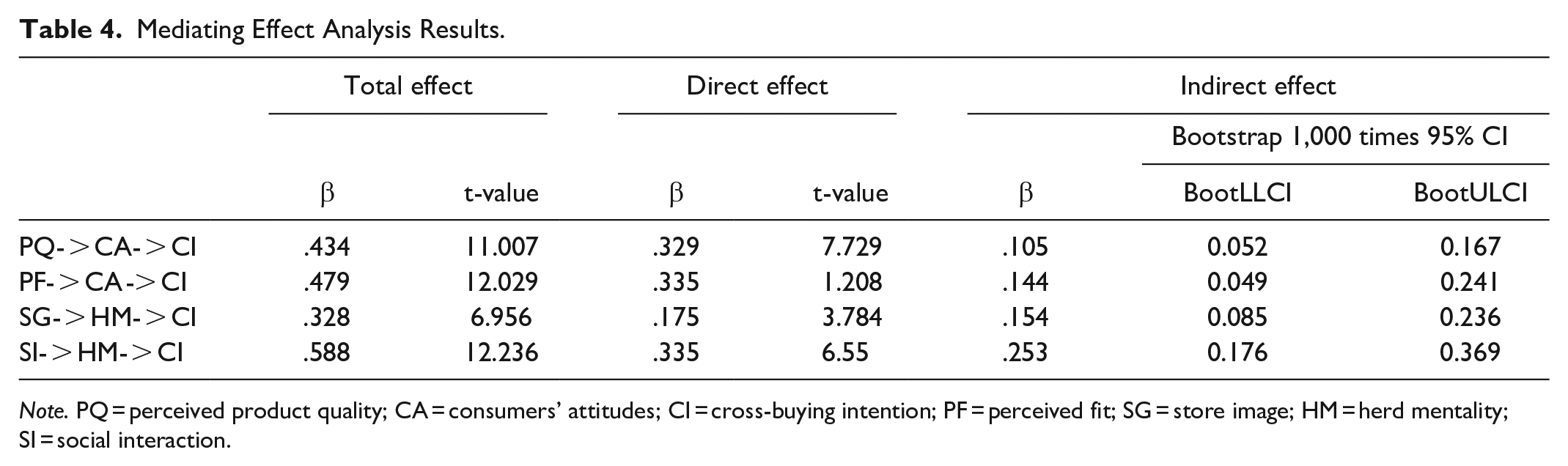
Note. PQ = perceived product quality; CA = consumers’ attitudes; CI = cross-buying intention; PF = perceived fit; SG = store image; HM = herd mentality; SI = social interaction.
Conclusion
Based on the ELM, this study examines the influencing factors of consumers’ instant cross-buying intentions against the background of supermarkets’ cross-border integration. The analysis results based on data from a sample of 527 consumers show that the six hypotheses proposed in this study are all supported. The present study has considerable theoretical and managerial significance for the development of supermarkets’ cross-border integration.
Discussion of the Findings
First, on the central path, consumers’ attitudes play a mediating role between central cues and consumers’ instant cross-buying intentions, while on the peripheral path, consumers’ herd mentality plays a mediating role between peripheral cues and their instant cross-buying intentions. This study demonstrates that differences in consumers’ motivation and ability to process information lead to different path choices affecting consumers’ intentions. Moreover, the variables that play a mediating role in this process differ, as also found by previous studies (e.g., Chen et al., 2022; Xu & Warkentin, 2020). In addition, the results show that consumers’ attitudes and herd mentality have different degrees of positive effects on consumers’ instant cross-buying intentions. For instance, consumers’ instant cross-buying intentions are more influenced by their herd mentality than their attitudes (0.41 < 0.60). However, this result is inconsistent with Petty and Cacioppo’s (1986) results, who showed that relevant cues via the central path have a greater influence on consumers’ intention formation than relevant cues via the peripheral path. There may be two reasons for this result. On the one hand, it may be because supermarkets’ cross-border integration is an emerging format and consumers may be less familiar with it at present. When consumers face the unfamiliar, the sense of uncertainty is strong and herd behavior is considered to be an important strategy for safe decision-making (Vedadi & Warkentin, 2020). On the other hand, the products of current cross-border integrated formats in the supermarket industry include catering, fresh food, and flowers, most of which are low-involvement products (Jian et al., 2021). For low-familiarity and low-involvement products, consumers rely on peripheral cues, follow the behavior of the majority, and generate instant cross-buying intentions. Therefore, firms should pay more attention to the influencing factors of the peripheral path and make strategic adjustments.
Second, both perceived product quality (β = .36; p = .001) (H1) and perceived fit (β = .63; p < .001) (H2) have significant effects on consumers’ attitudes. These results confirm the finding of Aaker and Keller (1990), who showed that consumers’ evaluations of extended brands are more likely to be influenced by perceived parent brand product quality and perceived fit than other factors. In this study, perceived fit has almost twice as much effect on consumers’ attitudes as perceived product quality (0.63 > 0.36). This result may be because supermarkets’ cross-border integration mainly has the advantage of one-stop convenient shopping by combining products in different formats and focuses on high-end supermarket brands (Jiang & Wang, 2020). In this context, consumers pay more attention to the fit between products in different formats, which also prompts consumers to ignore small differences in product quality (Valentin Ngobo, 2004). In view of this, we suggest that companies should focus not only on product quality, but also on improving consumers’ perceived fit of the product portfolios in different formats, increase related sales, and expand product synergies.
Third, store image and social interaction both have significant effects on consumers’ herd mentality, supporting H3 and H4. These results confirm the findings of Sun (2013) and Cheung et al. (2014). In this study, compared with store image, the impact of social interaction on the path coefficient of consumers’ herd mentality is greater (0.29 < 0.71), indicating that the influence of social interaction is larger. This may be because the cross-border integration of supermarkets attracts customers through advertising and marketing, especially online (e.g., creating an image of an “internet-famous shop”). Therefore, consumers feel that buying in supermarkets with cross-border integration is a rising trend, which then attracts more people to follow the herd. This means that consumers are recommended to buy in supermarkets with cross-border integration, particularly by online word-of-mouth (e.g., “internet-famous shop”), which arouses their herd mentality, thereby increasing their instant cross-buying intentions.
Theoretical Contribution
First, this study focuses on the emerging scenario of supermarkets’ cross-border integration. Previous studies have focused on analyzing the advantages and disadvantages of cross-border integration and have rarely explored the specific behavioral characteristics of consumers. Combined with the characteristics of supermarkets’ cross-border integration, this study focuses on the process through which consumers’ instant cross-buying intentions are formed. It proposes that for consumer groups that have different information-processing motives and capabilities, we should pay attention to the effectiveness of different dimensions of information (e.g., content marketing and informational promotion) on changes in consumers’ intention and decision-making and improve the management of these dimensions to raise supermarket performance. Therefore, this study should help supermarket marketers create a better version of the promotional message for cross-border integration and transformation.
Second, this study extends the previous research framework on cross-buying intentions. For example, Valentin Ngobo (2004) showed that consumers’ cross-buying intentions are mainly affected by psychological factors such as perceived convenience, perceived fit, perceived value, and satisfaction. However, in practice, retailers have also begun to pay attention to the economic benefits brought about by external situational factors such as store image and social interaction. Therefore, this study shows the importance of peripheral situational factors and proposes a comprehensive research model. Based on the ELM, it adds two mediating variables, consumers’ attitudes and herd mentality, from the central and peripheral paths, respectively. The results prove that against the background of supermarkets’ cross-border integration, the influencing factors of both paths can improve consumers’ instant cross-buying intentions. Further, the factors associated with herd mentality on the peripheral path carry more weight than consumers’ attitudes on the central path. This means that potential consumers are often more susceptible to herd mentality when deciding whether to instantly cross-buy products in different formats. These findings enrich our understanding of the formation process of consumers’ instant cross-buying intentions in supermarkets’ cross-border integration.
Managerial Implications
The global expansion strategies of foreign multinational retailers such as Wal-Mart (United States), Carrefour (France), Metro (Germany), and Tesco (United Kingdom) have further intensified competition in the supermarket format. Klein and Schmitz (2016) showed that small supermarkets in remote areas can use the aggregation of various retail formats to attract consumers in order to compete with large supermarkets. The marketing practice of domestic and foreign supermarkets’ cross-border integration also shows that an attractive option for combined shopping visits is crucial to improving performance. However, most companies are still blindly imitating the strategies of competitors and remain unclear about the internal mechanisms and influencing factors of consumers’ instant cross-buying intentions.
The conclusions of this study provide guidance for supermarkets to implement cross-border integration models in the following two aspects. First, this study shows that consumers’ herd mentality is the most important influencing factor of instant cross-buying intentions and that establishing a pleasant store environment and publicizing social interactions can stimulate consumers’ herd mentality to a certain extent. Therefore, we suggest that supermarkets should pay more attention to store image and social interaction in the early stage of their transformation. Supermarkets can transform the store image and integrate multi-format marketing scenarios across borders to deliver a new content experience to consumers. At the same time, supermarkets can advertise through social platforms such as Weibo and Xiaohongshu to establish social interactions between consumers and raise their curiosity.
Second, previous studies have also shown that the purchase intention generated via the external path often only shows a short-term effect and that the stimulating effect of this external environment weakens over time (Petty & Cacioppo, 1986). In addition, research shows that group buying information spread through the mass media and interpersonal communication have a positive effect on sales in the initial stage, but again weaken over time (Zhou et al., 2013). Therefore, as supermarkets’ cross-border integration relies on advertising to gain attention, it is necessary to consider the relevance of business integration and product quality to promote the formation of good consumers’ attitudes in the long term. On the one hand, many supermarkets currently favor adding catering categories directly to retail supermarkets, and the taste and environment of catering are worse than those in professional catering stores. Therefore, supermarkets must further improve the correlation between formats and arouse consumers’ perceived fit. On the other hand, since the impact of COVID-19, consumers’ demand for food consumption safety has risen sharply. Therefore, supermarkets must strictly regulate the safety of products and ingredients, becoming cross-border integrated supermarkets in which consumers can consume safely.
Limitations and Future Research
Despite its theoretical and practical significance, this research has limitations that need to be overcome in the future. First, the survey is affected by factors such as the epidemic situation and time and data are collected through online questionnaires. Longitudinal data and experimental methods can be used in future studies to validate the findings of this study.
Second, this study focuses on the cross-border integration of fast-moving consumer goods, catering, and fresh products, most of which are low-involvement products. However, supermarkets are also trying the cross-border integration of retail and IP culture, and most of these products are high-involvement products. Whether supermarkets’ cross-border integration based on high-involvement products can also arouse consumers’ instant cross-buying intentions can be tested in future research.
Third, supermarkets’ cross-border integration is essentially a strategic cooperation and there are certain risks. This innovative format will not only have positive effects, but may also have negative effects. Therefore, future research could study the two-way impact of supermarkets’ cross-border integration.
Footnotes
Declaration of Conflicting Interests
The author(s) declared no potential conflicts of interest with respect to the research, authorship, and/or publication of this article.
Funding
The author(s) disclosed receipt of the following financial support for the research, authorship, and/or publication of this article: This paper is supported by Fujian Province Innovation Strategy Research Project: “Research on the Performance Evaluation of Participants in the Rural-Business Interconnection Model of Fujian Province” (No.2020R0034), Special Fund for Education and Scientific Research of Fujian Provincial Department of Finance: “Research on the Integrated Development of Culture and Tourism in Fujian Province” (K8118J04A)
