




Abstract
Medical crowdfunding in social media is growing to be a convenient, accessible, and secure manner to cover medical expenses. It differs from traditional donation initiatives and medical crowdfunding on non-social media platforms in that projects are disseminated via social media network and among acquaintances. Through semi-structured in-depth interviews on donation behaviors of 52 respondents, this study uses grounded theory to extract seven main categories that affect medical crowdfunding donation behavior in social media, namely interpersonal relationship, reciprocity of helping, attitude toward donation, perceived behavior control, perceived trust, project information, and characteristics of patients. In the spirit of Elaboration Likelihood Model, we develop a theoretical framework that the seven factors influence donation behavior in medical crowdfunding in social media via a central and a peripheral route.
Keywords
Introduction
With the development of the internet infrastructure and great enthusiasm in product and service innovation, medical crowdfunding (MC) has become a popular manner to practice medical charity. MC allows patients to collect donations from the crowd via online platforms to cover expenses of medical treatments. Compared with traditional medical donation, MC moves the entire donation activities from offline to online, and has the advantage of low cost, low threshold, fast communication, and wide contact with the public. MC has been considered a substitute to the insufficient national health systems in many countries (Bassani et al., 2019). Data from China Charity Alliance show that in the first half of 2019, the online public fundraising platforms in China has released more than 17,000 pieces of fundraising projects, and it has received 5.26 billion clicks, followers, and participations in total. The total amount of donations raised exceeds 1.8 billion Chinese yuan (http://www.charityalliance.org.cn/gov/12667.jhtml)
Due to the popularity of social media such as Facebook, Twitter, and WeChat, the use of social media as a means for MC has become a norm, and leads to a tremendous amount of funding from online donations. MC in social media refers to the phenomenon that the campaign applicants or patients circulate the campaign to their social network via social media such as WeChat, Facebook, Twitter, and so on. Friends and acquaintances covered in their social media network will decide whether to donate. Compared with usual crowdfunding websites and platforms, MC in social media takes the advantages of social media in interconnections, and enables crowdfunding projects to spread across as wide a range of people as possible in a faster way. The most prominent feature is that the circulation of the crowdfunding campaign is among friends and acquaintances who are somehow related to the patient, rather than among strangers. The relationship between the potential donor in the social media community and the MC campaign applicant or patient is of particular importance compared with the situation in usual platforms.
There have been several studies on donation behavior and successful funding on donation-based crowdfunding (Gleasure & Feller, 2016; Meer, 2014; Mollick, 2014). Yet MC is distinct among all types of donation-based crowdfunding in that it raises funds to finance medical expenses to cure a disease or save lives. There is an old Chinese saying that helping the starving but not the poor. It means we should help in the urgent situations like paying medical expenses so to be cured rather than the normal situations where money is needed for reasons other than life-death situation. Among the few research on MC, Murdoch et al. (2019), Burtch and Chan (2019), and Bassani et al. (2019) show the benefits of MC to individual and society, while Dressler and Kelly (2018), Jin(2019), Kubheka (2020), and Snyder et al. (2017) raise the ethics concerns of this form of donation. Liu et al. (2018), Kim et al. (2016), and Snyder et al. (2017) study the credibility of MC campaigns. Van Duynhoven et al. (2019) study the influence of the socioeconomic status of fundraisers. Xu and Wang (2019) and Ba et al. (2021) extend the research to the context of China. Regarding the role of social media in MC, Beier and Wagner (2015), Lu et al. (2015), and Ren et al. (2020) show that social media helps to spread MC campaigns. Berliner and Kenworthy (2017) and Kubheka (2020) emphasize the requirement of digital skills in MC successful in social media. The extant study often relies on the hard information extracted from campaigns and initiators while ignoring the thoughts and the opinions of the donor. Especially, when MC is shared in social media, the community culture must play a significant role in the donation decision. Therefore, we want to fill this gap by making an exploratory analysis of the donation behavior in MC in social media. In this study, social media refers to online social network platforms such as WeChat, Facebook, and Twitter.
To explore the factors behind the donation behavior, we approach the social media user rather than the hard information published on MC platforms. By interviewing a sample of 52 MC donors in a social media, we document a variety of items that are mentioned by interviewees. Applying the methodology of grounded theory, we extract seven prime categories that explain the donation behavior. In the spirit of Elaboration Likelihood Model (ELM), we develop a theoretical framework, where interpersonal relationship, reciprocity of helping, attitude toward donation, perceived behavior control, and perceived trust influence donation behavior in MC in social media via a peripheral route, and project information and characteristics of patients influence donation behavior via a central route.
We contribute to the literature in three manners. First, we fill the gap in the research of MC which is disseminated via social media. In addition to the usual factors in medical donation, we also identify factors that are particularly relevant to the context of social media with the help of social media theories like social cognition theory and social capital theory. Second, we complement the literature by taking the perspective of donors and compose a list of factors from analyzing the firsthand data. Third, we try to propose a theoretical framework that can help promote the effective dissemination of crowdfunding information in social media.
The remaining of the article is organized as follows. Section “Literature Review” starts with a literature review of donation-based crowdfunding, then zooms into MC, and the role of social media in MC. The section ends with a review of ELM, which is often used in prior research on online behavior. Section “Methods and Data Collection” discusses the methodology and data collection. Section “Analysis and Results” presents the analysis. Section “Results and Discussions” concludes with a summary of results, and discusses a few directions for future research.
Literature Review
Donation-Based Crowdfunding
Crowdfunding is an open call on the internet for the provision of financial resources in the form of (a) donations, (b) a future product, service, or some other reward, or (c) exchange for shares or debt securities of a company (Fisk et al., 2011). There are, therefore, four types of crowdfunding: equity-based, lending-based, reward-based, and donations-based crowdfunding. It is a new financing model that emerged with the sharing economy and “Internet +.” Different from traditional fund-raising methods, crowdfunding is mainly based on small-amount funding, which achieves the effect of accumulating more by raising small amounts of funds from many individuals.
Donation-based crowdfunding or charitable crowdfunding can be framed as a type of philanthropy, namely giving monetary aid to the needy without any material reward (Behl et al., 2020). Donation-based crowdfunding is considered to be the smallest type compared with the other three types of crowdfunding in many regions (Zhao & Shneor, 2020). Thus, it is very necessary to study the donation-based crowdfunding to promote its success.
Extant literature has shown several aspects that influence whether a donation-based crowdfunding project gets sufficient donations. First, the project description must stand out to attract attention. Beier and Wagner (2015) study the most prominent crowdfunding platforms in Switzerland, and find that richness of project description and frequency of updates can stimulate more donations. Shneor and Vik (2020) review the literature and show that inclusion of a video leads to greater funding success. Second, the early donation is often the key to whether crowdfunding projects can be funded. Early donation is a signal to others that the project is worthwhile, thus stimulate others to donate as well (Solomon et al., 2015). Third, certain features of the campaign also matter. A higher funding target, a female fundraiser, and a larger social network size are associated with a higher success (Shneor & Vik, 2020). Forth, the perceived service quality of the platform and perceived risk of the crowdfunding project will affect the donor’s commitment and loyalty to the donation project, which in turn affects the decision of the donation (Shneor & Vik, 2020). Fifth, regarding the incentive of donation, intrinsic, and both individual and social dimensions of motivation are at work, and extrinsic rewards even demotivate donation (Zhao & Shneor, 2020). Gleasure and Feller (2016) distinguish the motivation behind the donations to individuals and motivation behind the donation to organization.
MC
MC is a particular type of donation-based crowdfunding. MC campaign applicants/patients raise a certain amount of medical expenses for patients who are seriously ill and not sufficiently covered by health insurance, and the campaign is initiated to the society through an online platform. Anyone can voluntarily give any amount of donation, which offers no tangible rewards. This form of crowdfunding has a certain time limit. If the specified amount of money is not raised within the time limit, the project fails and the money raised will also be refunded to donors (Belleflamme et al., 2014; Gerber et al., 2012; Shneor & Munim, 2019). The online platform has greatly simplified the process and makes it easy and convenient to use to both patients and donors. MC differs from other types of donation-based crowdfunding as the funds are raised to finance medical expenses to cure a disease or save lives. To put it in a broad perspective, MC success influences not only the individual but also the health system. Murdoch et al. (2019) make a content analysis of newspapers during 2015 to 2017 on MC in the United States and Canada, and find that MC campaigns are portrayed positively and neutrally much more often than negatively. Burtch and Chan (2019) show that successful MC campaigns can reduce personal bankruptcy filings in the United States. Bassani et al. (2019) analyze MC campaigns across 12 developed countries and find that MC can be a substitute when the public health coverage in that country is low. In contrast to the benefits brought by MC, ethics concerns have been raised on the issues of fraudulent campaigns, loss of privacy, fairness, and equity in distributing MC funds (Dressler & Kelly, 2018; Jin, 2019; Kubheka, 2020; Snyder et al., 2017).
Unlike traditional charities like Red Cross, the credibility of MC cannot be enhanced by the credibility of the charitable organization because it is for personal fundraising. In addition, MC has a low cost and low threshold to applicants, and this may lead to fraud project by ill-intentioned people. Thus, project credibility is a key determinant for donation decision. Liu et al. (2018) find that website quality, transaction convenience, project content quality, and reputation of applicants are positively related to perceived credibility. Moreover, Kim et al. (2016) study 11 factors that are associated with perceived credibility and emphasize that collective endorsements can improve the credibility of the campaign. Snyder et al. (2017) propose that project information should be detailed to ensure credibility. They find that the detailed description of the patients’ medical needs and experiences can stimulate the donation behavior. Besides credibility, Van Duynhoven et al. (2019) find that fundraisers with socioeconomic privilege like high income, home ownership, and high educational attainment are more likely to succeed in MC. In the context of China, Xu and Wang (2019) study the text in MC campaigns and find certain strategies in composing the text around the sympathy of potential donors, such as narration based on the traditional Chinese cultural values in family and “filial piety,” and text reflecting pathetic conditions of the patients. Ba et al. (2021) study the MC projects from the Tencent GongYi platform, and show that types of diseases, stage of treatment, and demographic and social factors of fundraisers influence the success of MC.
MC in China
Studies have found that about 13.5 people are diagnosed or die of cancer every minute in China (W. Chen et al., 2016). Another study showed that nearly 77% of people generally believe that the burden of serious illness on the family is beyond the scope of their ability (Huang et al., 2016). The two biggest MC platforms are Qingsongchou and Shuidichou, Chinese equivalent of GoFundMe. According to its website homepage, Qingsongchou has a pool of 550 million users and raised more than 25.5 billion Chinese Yuan (an equivalent of US$3.64 billion assuming 7 Yuan per U.S. dollar) to help more than 2.53 million families by September 2018 since its establishment in 2014. According to the 2019 Corporate Social Responsibility (CSR) report issued by Shuidichou, this MC platform has helped 630,000 patients to raise a funding amount of more than 7.2 billion Chinese Yuan (an equivalent of US$1.03 billion assuming 7 Yuan per U.S. dollar) by June 2018 since its establishment in April 2016. Due to its low cost, low threshold, and high efficiency, MC is well received by many patients in urgent need. To regulate this type of charity fundraising, the Ministry of Civil Affairs in China announced the rules and regulations to manage these internet-based public fundraising platforms in 2017, and designated 12 donation-based crowdfunding platforms (Zhao & Li, 2020). It is stated that applicants should take full responsibility for the authenticity of the information and potential donors should be informed properly by the platforms of potential risks. If false information for help is found, it will violate the criminal law and constitute legal liability.
MC in Social Media
Social media is a place where internet users interact with each other to establish a relationship through public discussion and emotion communication (Hamm et al., 2013), and it has become the primary means of information acquisition, communication, sharing, and socializing. Users in social media are different in personal traits, subjects of concerns, depth, and frequency of participation. Theories from social psychology and communication have been used to explore factors influencing users’ behaviors and their motives, such as social cognitive theory (Bandura, 1977), social capital theory (Nahapiet & Ghoshal, 1998), planned behavior theory (Ajzen, 1991), and so on. There has been research on interaction between different social media users (Gao et al., 2012), relationship between behavior and social interaction (Swain, 2010), behavior prediction (Ngonmang et al., 2012), and community design and behavior (Fiedler & Sarstedt, 2014).
Many MC platforms advice their applicants to share the campaign link in their social media account as it is the best way to reach those closest to you (Berliner & Kenworthy, 2017). The most popular social media in China, WeChat, has a monthly active users exceeded one billion in 2018. In addition to the usual three elements, namely, platforms, applicants/patients, and donors, successful funding MC in social media also depends on the social media users and the online community they are in.
MC in online communities raises funds across geographic restrictions and greatly reduces the transaction costs of financing-related operation in traditional offline fund-raising models through the application of advanced information and communication technology tools (Choy & Schlagwein, 2016). When MC is shared in social medial, not only a donation is convenient but also sharing the campaign to another online community is easy by usually just a click of a button (Brenda Zanele, 2020). This helps to spread the campaign information to more community users. MC in social media is also more proactive, and it pushes the campaign actively in front of the online community instead of letting the campaign passively waiting on the crowdfunding platform. Moreover, it allows social media users or potential donors to keep track of a crowdfunding campaign and obtain useful insights in real time, such as updating treatment status, comments, interaction with patients, project progress, and so on (Liang & Turban, 2011; Lu et al., 2015). Beier and Wagner (2015) show that adding social media channels to the project page on the crowdfunding platform increases the crowdfunding success. Ren et al. (2020) find that when MC campaign is shared in social media, the endorsement in social media by “hearts” and “likes” motivates more viewers to donate.
MC via social media requires the campaign initiators to be acquainted with this form and will use the network in social media. Kubheka (2020) finds the success of these campaigns is influenced by the digital skills, preexisting social networks, and the emotional potency. Berliner and Kenworthy (2017) study the MC campaigns in the United States, and also find media literacy is required to communicate deservingness to stimulate donation or spread the campaign to their personal networks.
More and more fundraisers are using social media to spread the campaigns and to collect donation. The extant research focuses on studying the information on the MC campaign, communication, and sharing behavior of the initiator or patients, whereas very little attention is paid to the behavior of donor. Thus, we want to explore this perspective and try to answer the following research question:
ELM
The ELM was proposed by Petty and Cacioppo in 1981 to explain how individuals process information via two routes and this will change attitudes and behavior. Its basic assumption is that attitudes guide decision-making and other behaviors. It proposes information is processed via two routes: central and peripheral routes. Central route refers to attitude change resulting from a personal careful and thoughtful consideration, and a more comprehensive analysis, reflection, evaluation, and induction of information. The peripheral routes refer to the individual’s assessment of information through peripheral clues, such as emotional, intuitive judgment or other unconsciously formed information to change attitudes which ultimately leads to attitude changes (Luo et al., 2014).
The ELM is widely used in the research of online behavior. In the study of consumer’s willingness to purchase products, the impact of factors related to the two routes on consumer attitudes and behavior is shown (Sher & Lee, 2009). S. H. Chen and Lee (2008) apply the ELM to study the role of personality traits and perceived values in persuasion of online shopping, and explain how personality traits influence the two routes to perceived value and consequently influence attitude and online shopping behavior. The ELM is also used in financial market research in advertising to test users’ behavior in the information systems discipline. Greiner and Wang (2010) show that the ELM can fully explain the trust between consumers in the electronic financial market. Through the application of the ELM in various subject areas, it can be found that the key to the application of the ELM is to study both the internal and external factors that affect individuals’ acceptance of information. Adjusting these influencing factors can achieve the purpose of persuasion, and then guide the behavior.
In addition to its wide application in e-commerce, ELM has also been applied in the crowdfunding research to explain how central and peripheral routes account for the changes in users’ attitudes and behavior. Bi et al. (2017) apply the ELM and consider the quality signals of crowdfunding projects as the central route factor, and internet word-of-mouth as the peripheral route factor to study the funding decision in reward-based crowdfunding. Allison et al. (2017) apply the ELM in studying persuasion in crowdfunding. They consider entrepreneur factors (like education and experience) and product factors (like product quality and usefulness) as central path factors, and consider portraying a dream, adopting group identity, and positive narrative tone as peripheral route factors. Our research context is donation behavior in MC in social media. This is an online behavior that will also be affected by various internal and external factors. Thus, we will apply the ELM to identify the central and peripheral factors of the donation behavior in MC in social media.
Methods and Data Collection
Grounded Theory and Method of Interview
There has been no theoretical framework for explaining donation behavior in crowdfunding in social media. To establish a framework, we resort to the grounded theory. The grounded theory is for the purpose to establish a theory based on empirical data when there is no mature theoretical foundation. The experience is summarized directly from the original data in an inductive way, and for a systematic theory (Fang, 2018). This method is widely used in sociology and study of behavior (Birks et al., 2013).
MC is a new concept developed in recent years, and MC via the channel of social media is even newer. In MC, the fundraiser displays the project on an internet platform for the purpose of financing from the crowd. Considering the risks of network security and information leakage, the information displayed by crowdfunding projects is limited to basic contents such as medical history and documents of medical diagnosis. Any organization or individual can publish help-seeking MC project on the internet platform, but its low threshold and low-cost characteristics make the project itself doubtful. Yet when these crowdfunding projects are posted on social media where users are connected somehow, the project information can be extensively disseminated among the online community. How users of social media decide to donate can be very different from the users of an internet platform where the crowdfunding project is posted because the project is coming from the user’s social network rather than from strangers. Therefore, it is necessary to conduct an in-depth study of the users’ donation behavior under a rich context provided by a qualitative research method.
Interview method is an important data collection method in grounded theory research. Compared with other survey methods, the interview method collects rich information, discovers the new or ignored aspects, and allows an in-depth exploration of the problem (Coleman & O’Connor, 2008). So, we use a semi-structured interview on users’ donations to obtain a rich data set. Then we will encode the interview by following three steps: open coding, axial coding, and selective coding. The coding results will be tested for theoretical saturation. Constant comparison will be made throughout the process of text analysis. After rounds of refining and modifying, theoretical saturation will be achieved, which means new resources gained no longer contribute to the theory construction.
Sample Selection and Data Collection
The grounded theory approach requires that interviewees must have rich and extensive experiences in the research subject so as to provide effective explanations of their experiences to researchers. Therefore, purposeful sampling method is adopted in this study. In this process, only the participants of MC in social media were selected, and they had some understanding and knowledge of MC, had an MC donation experience, and are willing to reflect on the subject. Based on the above criteria, we get our sample from two sources. The first group of respondents selected in this study are donors of the MC projects posted in the so-called “Friends’ circle” from the authors’ WeChat’s account. If a donation is made, the user’s name, avatar, and donation amount will be displayed below the crowdfunding project, and they are contacted for participation in the interview. The other group of respondents comes from social surveys, where the researchers look for potential respondents in the leisure places such as tea shops, cafeteria around a shopping mall, and a school. Before the conversation, the researchers first presented their ID cards (or student ID cards) to the respondents, and explain the purpose and content of this conversation to reduce the concerns of respondents. Then the respondents are asked whether they understand and have participated in the MC donation. If they do, then the semi-structured interview is conducted. Respondents get a reward in the form of a paper notebook or a bottle of drink.
The collection of data is mainly through one-on-one in-depth interviews. One-on-one in-depth interviews help respondents to think and express relatively fully, and at the same time, researchers carefully observe the external facial or body expression and emotions of the respondents, so as to understand the attitudes, emotions, and potential drivers of the respondents’ donation behavior as much as possible. The semi-structured interview revolves around following questions:
Have you ever taken part in MC projects? And via what platforms?
Under what conditions would you think of donating money? Why?
Under what conditions would you not think of donating money? Why not?
On this basis, respondents were asked to recall the latest experience and to give a detailed description. The interview was recorded after permission. Recordings were transcribed to interview logs and memos. In the period of July 1 to August 25, 2018, 52 interviews were conducted, and male interviewees accounted for 46% and females, 54%. The occupation of the respondents is very diverse and includes teachers, clerks, corporate employees, doctors, civil servants, workers, and students. Forty interviews were randomly picked for further coding analysis and model construction, while the remaining 12 were kept for the theoretical saturation test.
Analysis and Results
Open Coding
Open coding is a technique of qualitative data analysis by conceptualizing and categorizing the data (Fang, 2018). Open coding develops codes through description, naming, and classifying the phenomenon under consideration. In this study, open coding is to encode and label 40 interview logs word by word, to generate initial concepts and discover concept categories from the raw data. To diminish observer’s bias, this study labeled original words/texts of the respondents to explore the first level concepts. Since the first level concepts amount to a great quantity in vast diversities, categorization was done by eliminating concepts with low frequency, and keeping concepts with a frequency of at least 3 times. Categorization ended up in 21 core categories listed as the following:
Axial Coding
Axial coding is to look for latent logic among found categories and develop the prime category and the auxiliary category. The prime category focuses on abstract concepts at a higher level, relating to auxiliary categories in the coding paradigm. Category analysis is to dig out the main category from the existing categories, so that it can link other categories (Fang, 2018).
Interpersonal Relationship
Respondents will evaluate the relationship before deciding whether to donate. Almost all the respondents mentioned that whether the relationship is “near” or “far” is the primary reason for their donation, and it is found the closeness of relationship is put on top of the reason list. If their relationship is close, they are very likely to donate (relationship is mentioned such as “I’m related to the patient in some way,” “I know him,” “He is my acquaintance,” “Have daily communication”). Donation is thought to be an exchange of favor to maintain the interpersonal relationship. In social interaction, you keep a contact with acquaintances and greet each other; you are supposed to show sympathy and offer help when someone in your social network is in trouble. That is to say, interpersonal relationship is the primary factor for users to consider donation in the MC, which depends on the intimacy and closeness of the relationship. This view is consistent with the prediction of social capital theory. Moreover, it is consistent with the concept of solicitation in donation where donors are asked to donate (Bekkers & Wiepking, 2011).
Reciprocity of Helping
During the interview process, rewards to the respondents who donate are mainly manifested in psychological and spiritual happiness and satisfaction derived from image (respondents mentioned “It is not so appropriate to just stand by”), impression (respondents mentioned “To leave a good impression”), recognition (respondents mentioned “For the sake of face”), and so on. Respondents generally believe that helping others can make them feel happy and satisfied (respondents mentioned “Feel satisfied” and “Feel happy when helping others”). They regard donation as a meaningful deed such that their personal worth is improved and self-efficacy is achieved. Social exchange perspective holds that people exchange with each other with favorable treatment, which means one party is obliged to pay back when he has been offered help or resources. Studies have found that a norm of reciprocity is related to people’s helping behavior (Deckop et al., 2003).
Attitude Toward Donation
Attitude toward donation includes charity awareness and wealth view. Charity awareness is a comprehensive reaction to charity in social psychology. It is a kind of cognition, perception, and psychological reaction to charity, and is embedded in an individual’s self-consciousness and conception. It is expressed through kindness and compassion, and is used to guide actions, and transforms thoughts into actions. During the interview process, some of the respondents showed strong empathy, saying “try my effort,” “it’s so pathetic,” “show love,” and “seems he is in need of help.” At the same time, some respondents with less philanthropic awareness have regarded MC as negative information, showing behavioral orientation of “never read such news” or “just skip it.” This category coincides with the concept of awareness of need in the literature review of eight mechanisms behind charitable giving (Bekkers & Wiepking, 2011). Regarding wealth view, it is a powerful moral force, and dominates individual economic, political, and moral activities (Hwang et al., 2017). Some respondents indicated that their economic resources are limited (“economically incapable to lend a hand” or “short of money”), and the current economic situation is only enough to support themselves, or “help if I am capable of.”
Perceived Behavior Control
Individual willingness is also constrained by realistic conditions such as resources and risks before it is transformed to behavior. Perceived behavioral control refers to an individual’s perception of how easy it is to perform an action (Scalco et al., 2018). In the interview process, three main aspects were mentioned, namely, limited attention, network complexity, and perceived risk. Limited attention refers to the level of difficulty in obtaining information. Sixteen respondents said they seldom read donation-related news and they just run into such messages forwarded by friends or happened to read such messages accidentally (respondents mentioned “It was forwarded by others most of time” and “Happen to read”). When respondents were asked why they did not make a donation, network complexity and perceived risk are repeatedly mentioned (respondents mentioned “It might be fraudulent,” “too many internet fraud,” and “It’s hard to make a judgment if it’s true). Perceived risk is found to be one of the main reasons hindering users’ online transactions (Featherman & Pavlou, 2003). As a type of online financing method by nature, MC is also a form of online transaction, and thus contains fraudulent risks.
Perceived Trust
Perceived trust is one of the most considered factors for many respondents, and it depends on three aspects: relationship with the initiator, reporting by other news media, and credibility and transparency of the platform. The closer the relationship between the donator and the initiator, the higher the level of trust (respondents mentioned “It is authentic if it is initiated by acquaintances” and “Trust my friends”). The news media has an influence as well. News from internet often requires validation to be authentic. If a medial crowdfunding project is reported also by another known news media, this dissemination can improve the authenticity and attention of project information, and reduce the perception of uncertainty in the project (respondents mentioned “It’s been reported by . . .”). Frequent revealing of fraud in MC platforms consumes people’s trust and makes people doubt the authenticity of the project (respondents mentioned “It’s hard to tell whether platform information is true” and “Too much fraud occurred”). People wonder what happens after funds are collected (respondents mentioned “I don’t know how the money will be handed over to the patient” and “I feel money is not always used in the right place”). If the platform itself is credible in giving out true information and transparent in disclosing the whole process, this encourages people to donate. This is the same as in the traditional charity where revealing the trustworthy information and disclosing the already collected funds can enhance the public’s willingness to donate (Cordery, 2013).
Project Information
The project initiator needs to describe the crowdfunding project and provide a lot of information related to the project, such as pictures, videos, and the target funding amount (Croson & Shang, 2008). In the interview, these project details are all mentioned by respondents. The severity of disease influences donators’ perceived value of donation (respondents mentioned “Is it serious?” and “What kind of illness”). Pictures (picture of medical casebook and identity card photo) help donors to have a better understanding of the situation the patient is in. Funding amount conveys the financing target and the hardship where the patient is suffering. They all affect the willingness to donate.
Characteristics of Patients
In the interview, the identity of the patient is mentioned as a reason for donation. Respondents said that “especially children” and “students” are more likely to win their sympathy. Children are the object of social care, and they are more likely to evoke sympathy and compassion. Donors will think of their own children, thus narrowing the emotional distance from them, and desire to donate. The social status of the patient is mentioned by some respondents. The higher the social status the patients have, the easier they gain social attention and support. The feelings of “pity” and “regret” will arise if donators do not help, and thus promote the donation behavior. One respondent mentioned, “ According to the specific information of the donation project, some patients are indeed in a difficult situation, especially students or children, I will consider donating.”
In summary, we sum up the seven prime categories as listed in Table 2: interpersonal relationship, reciprocity of helping, attitude toward donation, perceived behavior control, perceived trust, project information, and characteristics of patients.
Coded Categories.
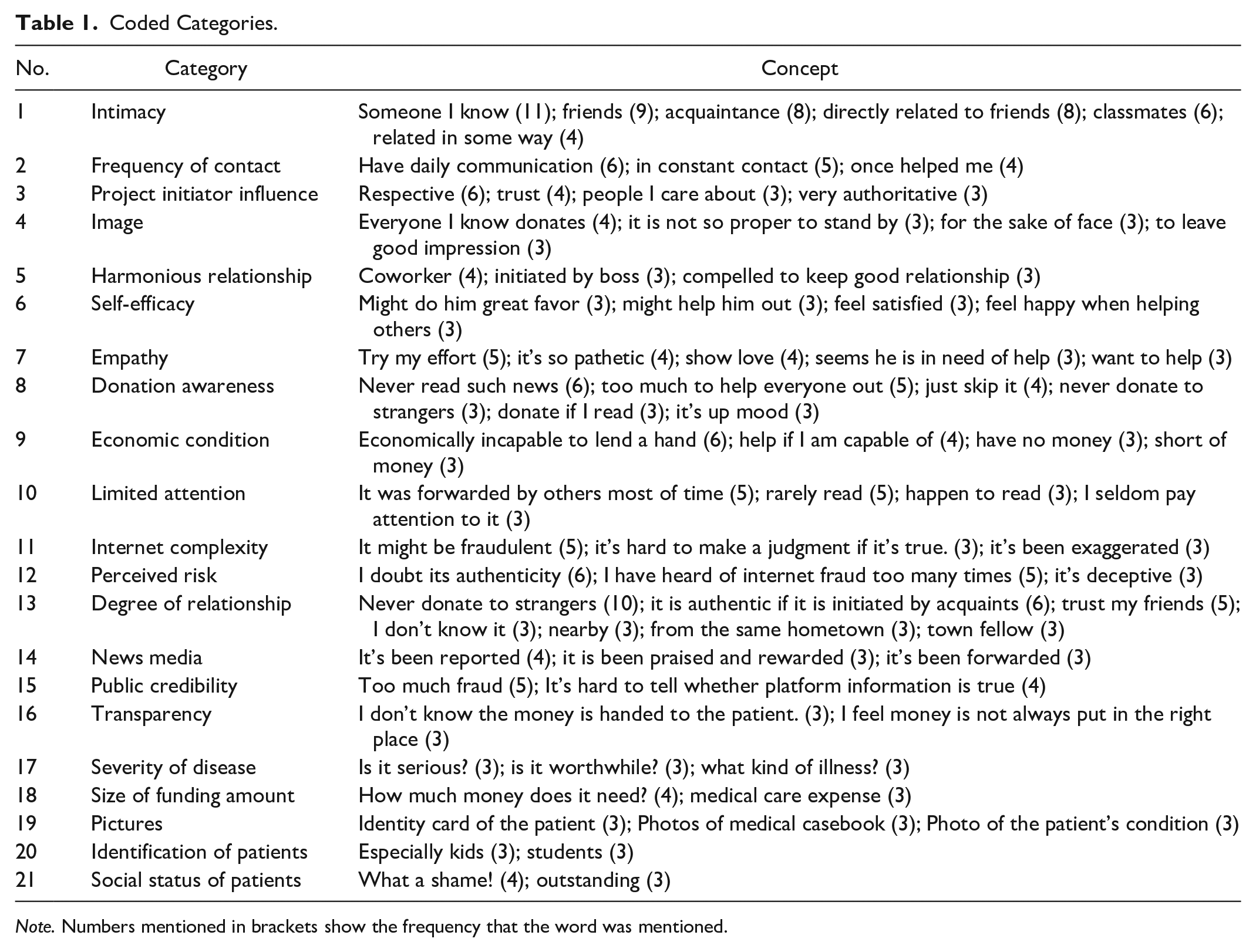
Note. Numbers mentioned in brackets show the frequency that the word was mentioned.
Categorization From Axial Coding.

Selective Coding
Selective coding enables observers to a storyline that relate prime categories to core categories to explain incidents. Based on comparisons of original interview textual materials and analysis of 21 core categories, this study summarizes these categories or concepts into seven prime categories as follows: interpersonal relationship, reciprocity of helping, attitude toward donation, perceived behavior control, perceived trust, project information, and characteristics of patients. These seven prime categories show a significant influence on users’ donation behavior in the MC in social media.
We apply the ELM to group the internal and external factors in driving users’ donation behavior. The ELM is often used to explain online behavior. This model suggests that individuals’ information processing or changes in attitude can be affected via a central route and a peripheral route. In studying the donation behavior in social media, we separate the identified prime categories into central route factors and peripheral route factors. According to ELM theory, the central route emphasizes the individual’s deliberation of information and leads to the change of attitude through a comprehensive analysis, thinking, evaluation, and induction of information. In MC, when users receive project information, they need to conduct a self-analysis and evaluation on the funding project and patient. The information related to the funding needs of the patient constitutes the central route factors that affect the donation behavior of the MC. The peripheral route refers to the individual’s judgment of information through peripheral clues. This information is not about the project itself, but related to the specific environment associated with the project. In the MC, the peripheral route factors include interpersonal relationship, reciprocity of helping, attitude toward donation, perceived behavior control, and perceived trust. The factors derived from grounded theory and applied to ELM are put together in the following theoretical framework that explains the users’ donation behavior in MC in social media. The framework is displayed in Illustration 1.
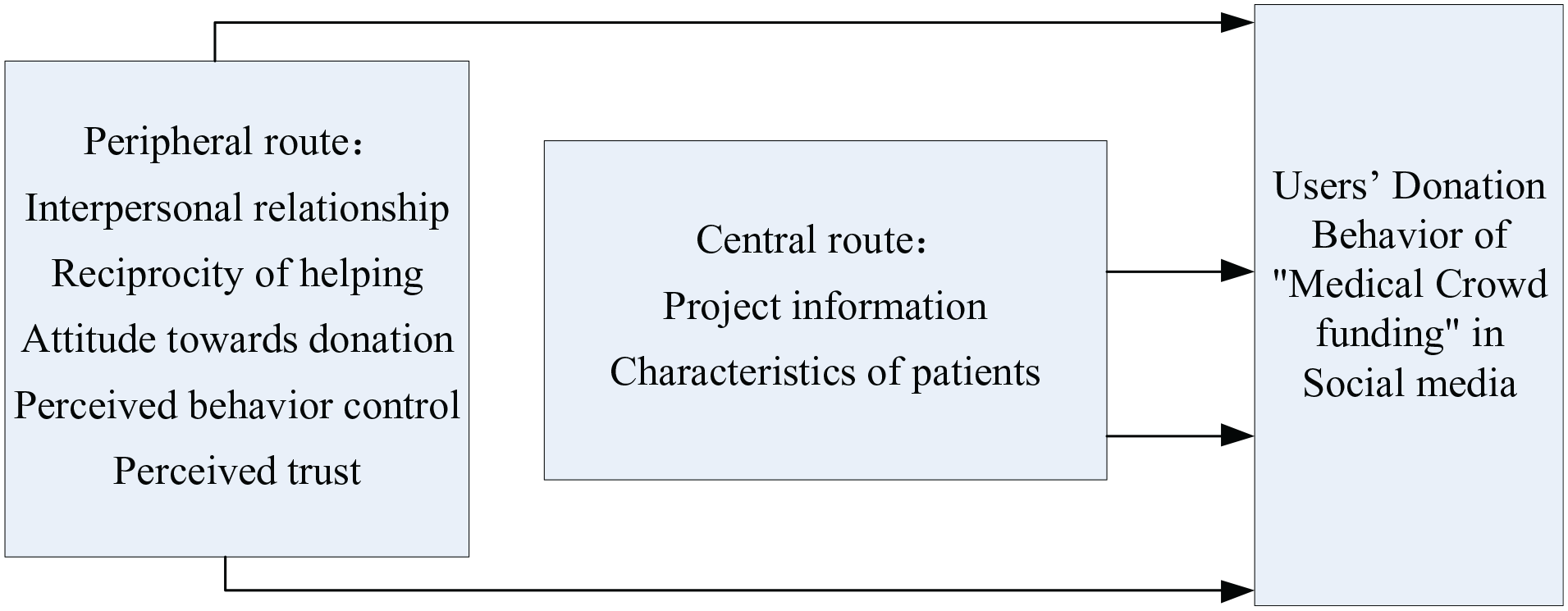
A model of the influencing factors of donation behavior in medical crowdfunding in social media.
Theory Saturation Test
We conduct the theory saturation test to show that no new factors can be found. We used the remaining 12 interview records to conduct a theoretical saturation test. The results show that the concepts from our earlier analysis are well developed. We also collect additional data at another time to make this test. In China, a major platform for the MC projects is WeChat. We randomly selected 10 persons from the authors’ WeChat friends circle from August 6, 2019, to August 10, 2019. They are interviewed in the same way as we did in the method section. Each interview lasted about 20 to 30 min. The participants ranged in age from 20 to 45 years, with four males and six females. After the interview, we transcribed the interview recordings and analyzed the content of the transcribed text in an iterative process. First, we identify the concepts closely related to the research question in the text. Second, we develop some categories from the identified concepts, which can be categories different from earlier categories in the main interview, as the concepts are independently encoded. Finally, we group the categories into different factors/prime categories. The results are shown in Table 3.
Concepts, Categories, and Factors From 10 New Participants.
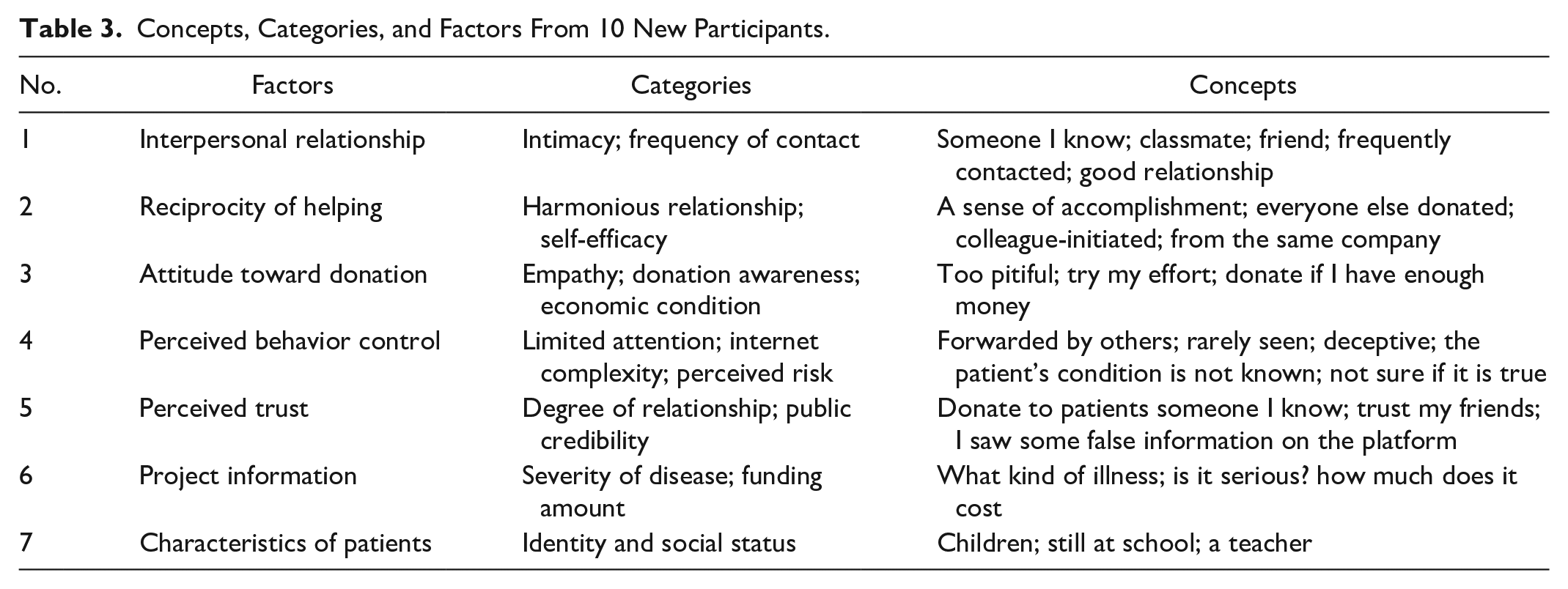
Both saturation tests show that the concepts from our earlier analysis are well developed. Beyond the seven prime categories that affect users’ donation behavior, no new important categories and relationships have been found. In conclusion, the proposed theoretical framework is theoretically saturated.
Results and Discussions
MC in social media has attracted many patients to finance their medical expenses and become an important complement to the traditional public donation model. This study conducts an exploratory analysis of users’ donation behavior and explores the reasons of their donation behavior. We follow grounded theory to collect data, code the data, and develop prime categories that explain the donation behavior. Applying the ELM, we develop a theoretical model of the influencing factors of users’ donation behavior in MC in social media. This study draws the following conclusions:
First, it is shown that interpersonal relationship, reciprocity of helping, attitude toward donation, perceived behavior control, perceived trust, project information, and characteristics of patients have a significant impact on the donation behavior in MC in social media. On one hand, the project information and characteristics of patients influence the donation decision through a central route. That is, the decision is made by the users through considering and judging the project information and the patient. On the other hand, interpersonal relationship, reciprocity of helping, attitude toward donation, perceived behavioral control, and perceived trust influence the donation decision through a peripheral route. That is, users will not only consider the content of the project and patient information itself but also be affected by other external factors.
Second, the peripheral route factors like interpersonal relationship, reciprocity of helping, and perceived trust influence donation decisions and also show an interrelation. This study finds that most users will selectively read messages based on the evaluation of the relationship with the source. A close relationship will lead to a consideration of donation, and a distant relationship will lead to becoming a bystander. This close interpersonal relationship is related to reciprocity of helping and perceived trust. Donation is considered as an act of reciprocity of helping. Donation can maintain a harmonious interpersonal relationship. A close relationship implies a trust in the project initiator. In addition, some users mentioned it is not the platform they trust, but the friends and acquaintances they believe in. Previous studies (Zhao & Shneor, 2020) have proved the Chinese-style crowdfunding credit system lacks a degree of credibility, and this view is confirmed in the research of this article. Of course, in addition to this, there are still many users who donate because they want to help others to gain satisfaction, which is the reciprocity of helping factor. Zhao and Li (2020) find that current research suggests that donation behavior is driven by impure altruism closely linked to intrinsic motivations such as satisfaction, joy, and a sense of belonging (Zhao & Shneor, 2020). In this article, we extend previous research.
Third, the peripheral route factors like attitude toward donation and perceived behavioral control influence donation decisions. Users with strong empathy and donor awareness are more willing to help, and this is consistent with the factors of philanthropy in Bekkers and Wiepking (2011). Perceived behavioral control includes complex online environment and perceived risk in donation to MC in social media. In today’s online environment, the complexity of the network makes many users unsure whether the crowdfunding information they see is true. The openness of social media stimulates the emergence of MC in large quantities. People feel tired of reading many MC projects with similar information. It also causes a concern whether the help information is true or not. With this overload of MC information, the project with the greatest need of help sinks in the sea of information.
Fourth, the central route factors like project information and characteristics of patients influence donation behavior. Our study finds that the help information of students and children is more likely to attract attention than other identity of patients, as these groups generate compassion among the users. Previous studies have found a positive relationship between age and donation behavior (Van Slyke & Brooks, 2005).
Fifth, the factors like interpersonal relationship, reciprocity of helping, and perceived trust are particularly relevant in MC in social media because the projects are disseminated among the friends’ circle in the social media. All these three factors are related to consideration of helping acquaintances.
Finally, we want to point out that although the MC disseminates the idea of benevolence, once a fraudulent project is detected, it will arouse people’s negativity and rejection of charitable activities, resulting in irreversible negative social effects. We argue that donation is not only a simple action but also represents a spiritual development. When donation behavior develops into a common social behavior, a shared value system will form, which will then internalize and constrain the misbehavior, so that the social value system will continue to develop in a benign and orderly manner.
Different from the prior research on public donation, we study the influencing factors of donation in MC in social media. But our research is not without limitations and provides avenues for future research.
First, our interview was conducted by approaching people at the leisure places randomly that limits the size of the respondents and also biases the sample toward the ones who are extrovert and willing to share their experiences. Second, this study is of an explorative nature to find out the factors influencing donation decision. We cannot say much about the relative magnitude of the effect, which needs a quantitative research in the future. In addition, there is interrelation among some factors. How they independently and jointly influence the donation decision is unknown. Finally, factors like age, gender, and occupation have been found influential in traditional donation research. Yet in our study, respondents do not mention them as reasons for their decision; thus, they are not included in our model. It is possible that these factors may interact with our factors in their impact on the donation decision. Thus, a quantitative research with more observations such as a survey or even big data is warranted.
Footnotes
Declaration of Conflicting Interests
The author(s) declared no potential conflicts of interest with respect to the research, authorship, and/or publication of this article.
Funding
The author(s) disclosed receipt of the following financial support for the research and/or authorship of this article: This article is under grant of The National Social Science Fund of China (No.18CTQ033).
