




Abstract
The present study aimed to assess differences in the expectation of positive and negative future events between nurses with and without burnout, as well as differences among nurses with different levels of burnout. A case-control study design were adopted for this research. Participants were recruited from a tertiary hospital in the eastern region of China. Data collection took place between November 2021 and March 2022. Based on the Chinese version of the Maslach Burnout Inventory, participants were categorized into four groups: mild burnout, moderate burnout, severe burnout, and no burnout. Between-group comparisons included nurses with and without burnout, while within-group comparisons included nurses with different levels of burnout. The Oral Word Association Test (OWAT) and Future Thinking Task (FTT) were used to obtain 40 items related to nurses’ future thinking. Participants used a computer to assess the likelihood, importance, and emotional responses to each scenario. Nurses’ perceptions of the likelihood of positive future events are negatively correlated with emotional exhaustion and depersonalization, and positively correlated with low personal accomplishment. Compared to nurses without burnout, those with burnout have more pessimistic expectations and believe that negative future events are more likely to occur. Nurses with burnout perceive positive future events as less important, and as the severity of burnout increases, they view negative future events as more significant. The present study demonstrated that nurses with burnout are more likely to have negative expectations of the future and to improperly highlight the importance of future negative events.
Plain Language Summary
This study aimed to understand how nurses’ expectations about positive and negative future events differ based on whether they experience burnout and the severity of that burnout. We conducted a case-control study in a Chinese hospital, categorizing nurses into four groups based on their burnout levels. We used two tests to explore their future thinking. Results showed that, overall, nurses were more optimistic about positive future events compared to negative ones, regardless of burnout. However, nurses experiencing burnout tended to undervalue the importance of positive future events. Conversely, they gave more importance to negative future events compared to their non-burnout counterparts. In conclusion, this study suggests that nurses with burnout may have a more negative outlook on the future and may not fully appreciate the significance of positive events. Understanding these differences could help in developing strategies to support nurses’ well-being and improve their outlook on the future.
Introduction
Nurses constitute the largest workforce within the healthcare system and play a crucial role in ensuring the continuity of global healthcare systems and enhancing healthcare practices (Muz & Erdoğan Yüce, 2021). This critical role often requires the development of close nurse-patient relationships, which demand substantial emotional engagement (Membrive-Jiménez et al., 2022). Therefore, nurses are susceptible to substantial work-related stress, making them one of the groups most affected by this issue (Jamieson & Graves, 1998). Previous research has revealed that burnout not only negatively affects nurses’ sleep quality, anxiety, and depression but is also closely related to organizational behavior factors such as job satisfaction and turnover intentions (Hu et al., 2020; B. Xue, Feng, et al., 2024). Therefore, as a significant occupational risk affecting nurses, burnout negatively impacts the operation and efficiency of global healthcare systems, necessitating further investigation into its related factors to provide a scientific basis for potential intervention strategies.
Burnout refers to a syndrome that develops in individuals who are under intense work pressure for a long time; the symptoms include emotional exhaustion, depersonalization, and reduced personal achievement (Maslach & Jackson, 1981). A meta-analysis has shown that the prevalence of burnout among nurses worldwide is 11.3%, highlighting both the widespread nature and the severity of this problem (Woo et al., 2020). Although addressing nurse burnout is currently challenging, researchers have continuously emphasized this issue and explored its high-risk factors. Numerous foundational and nursing management studies suggest that the risk factors for nurse burnout primarily include organizational and personal factors. Regarding personal factors, age, gender, marital status, parental status, and professional title all influence nurse burnout (Zeng et al., 2020). Additionally, individual traits like genetics, personality, and psychological capital are significant contributors to burnout (Shang et al., 2024; B. Xue, Wang et al., 2024). Organizational factors, such as decent work conditions, excessive workload, leadership style, lack of rewards or recognition, poor interpersonal relationships, lack of fairness, social support, and work-family conflict, contribute to nurse burnout (Dall’Ora et al., 2020; Niinihuhta & Häggman-Laitila, 2022). Therefore, nurse burnout is not merely an accumulation of fatigue but rather a complex issue involving the interplay of work stress, interpersonal relationships, and work environment factors. Moreover, the impact of burnout extends beyond current work performance and mental health, potentially affecting an individual’s thoughts and imaginations about the future.
In the last decade, there has been an explosion of interdisciplinary research interest in future thinking, defined as the ability to mentally project oneself into possible future events and thereby “preexperience” them (Schacter et al., 2017). Future thinking stands as a profoundly significant cognitive function in humans. Extensive prior research has underlined its array of adaptive advantages, including aiding individuals in planning adjustments (Szpunar et al., 2016), making effective decisions (Kaplan et al., 2016), and regulating emotions (Jing et al., 2016; Schacter et al., 2017). A consistent body of research has revealed that individuals with psychiatric disorders often experience impairments in their future thinking abilities (Moustafa et al., 2018). Notably, conditions like depression (Hallford et al., 2020), bipolar disorder (Boulanger et al., 2013), and schizophrenia (Barry et al., 2020) have been associated with abnormal future thinking patterns, reinforcing the strong link between psychiatric disorders and future thinking. Furthermore, evidence from multiple studies suggests a strong association between burnout and an individual’s future thinking. Research using the Sentence Completion for Events in the Future Test (SCEFT) found that nurses experiencing burnout showed impaired future imagination (Xue et al., 2023). On the other hand, a crucial characteristic of burnout is a sense of hopelessness about the future (Civilotti et al., 2022; Espeland, 2006), defined as the extent to which an individual is pessimistic about the future (Bauer et al., 2022). Additionally, neuroimaging evidence suggests that the brain’s medial prefrontal cortex shows increased activity when people imagine the future (Schacter et al., 2017). Meanwhile, studies on the neural mechanisms of burnout have found that local morphological changes in the brain are associated with burnout, and the medial prefrontal cortex in people with burnout also shows abnormal changes (Savic et al., 2018).
In 1991, Snyder and colleagues introduced the Hope Theory, defining hope as a positive motivational state (Snyder et al., 1991). Hope comprises two parallel systems: “pathway thinking,” which involves an individual’s ability to design and select strategies to achieve goals, and “agency thinking,” which refers to the sustained motivation to pursue goals despite obstacles. Nurses experiencing burnout often exhibit lower levels of hope, potentially perceiving a lack of pathways to achieve their goals (e.g., inability to effectively cope with work stress) or feeling demotivated (e.g., losing interest in career development). This diminished hope may negatively influence their future thinking. Thus, we hypothesize that nurses with burnout would exhibit a decrease in positive future expectations and an increase in negative expectations when thinking about future events. Meanwhile, a greater degree of burnout would correspond with nurses being less likely to imagine positive events happening to them in the future and a greater likelihood of imagining negative events happening to them in the future.
To date, future thinking among nurses with burnout has received scant attention in the research literature. Thus, by drawing upon existing research on future thinking on psychiatric disorders, our study attempts to assess future thinking for positive and negative events among nurses with and without burnout, with the goal of revealing how burnout influences nurses’ cognitive and emotional expectations of the future.
Methods
Design
This study employed a case-control design from March 2022 to July 2022.
Participants
Sample Size
The sample size was calculated using G*Power 3.1 (Franz, Universität Kiel, Germany), which indicated that to detect a small-to-moderate-sized interaction effect (f = 0.25) with an alpha level of 0.05 and statistical power of 0.80, a total sample size of 72 participants was needed.
Inclusion and Exclusion Criteria
Inclusion criteria included: (i) nurses with or without burnout, (ii) no history of neurological disorders, (iii) right-handedness and ability to complete the keystroke experiment, and (iv) provision of informed consent and cooperation in study completion.
The exclusion criteria were as follows: (i) nurses in advanced study, undergraduate or trainee nurses, and (ii) nurses who were not on duty during the survey period.
This study conducted a preliminary screening for occupational burnout among 500 female nurses at a tertiary hospital in Hangzhou, Zhejiang Province. After discarding 42 invalid questionnaires, 458 valid questionnaires were retained, yielding a response rate of 91.60%. We invited all nurses meeting the inclusion criteria, and 170 agreed to participate in the study. All participants were female, including 36 with mild burnout, 34 with moderate burnout, 38 with severe burnout, and 62 without burnout.
Measurements
The Chinese version of the Maslach Burnout Inventory (MBI) was originally developed by Maslach (Maslach et al., 1997), translated into Chinese by scholars (Feng Y, 2004), and subsequently subjected to a rigorous assessment of its reliability and validity to ensure its suitability for academic research. There are three dimensions in the Maslach Burnout Inventory: emotional exhaustion (9 items), depersonalization (5 items), and low personal accomplishment (8 items). Each item is rated on a 7-point Likert scale from “0” (never) to “6” (every day). According to the study criteria (Williams et al., 2020), inclusion of participants in the burnout group was based on results of the Maslach Burnout Inventory (MBI); those who scored high on burnout domains, including emotional exhaustion (score of 27 or higher), depersonalization (score of 10 or higher), or low accomplishment (score of 33 or lower), were judged to have at least one manifestation of job burnout. The Cronbach’s α coefficient of the MBI-HSS in this study was 0.827, and three subscales of Cronbach’s α coefficients for emotional exhaustion, depersonalization, and lack of personal accomplishment were .92, .82, and .73, respectively.
Materials
The material for this experiment consisted of 40 sentences describing different types of events. These materials were created after the researchers conducted individual interviews with some nurses who did not participate in the formal experiment. We used an adapted version of the oral word association test (OWAT) and a future thinking task (FTT) to collect materials related to nurses’ future thinking. First, the experimenter verbally explained what future thinking events were and provided specific examples, such as occupational exposure, to ensure that the nurses understood the meaning of future scenarios. Next, the nurses were asked to generate 20 possible events that may occur within the next 10 years within a five-minute time frame. They were then asked to create one or more positive and negative scenarios for each event, estimate the timing of each event, and imagine the environment, participants, and details of each scenario. One example of an important future event for nurses is “occupational exposure.” The corresponding positive events included responses such as “One afternoon four years later, when I was performing venipuncture for the patient, I completed the difficult venipuncture with the careful operation.” Meanwhile, the corresponding negative incidents included responses such as “One morning four years later, while performing a venipuncture on a patient, I accidentally pricked my finger with a needle, resulting in occupational exposure.” The order of the two scenarios was balanced. To avoid errors caused by experimenter omission or misjudgment, the interviews were recorded using a recording device (with prior consent from the participants, who were assured that the recording would be deleted after data entry). Finally, the events that met the requirements were balanced using a Latin square design and reviewed again with the interviewed nurses for confirmation. The researchers finally compiled a list of 20 positive and 20 negative events that were very significant to nurses. In general, the 40 events are very likely to happen to nurses within the next ten years. More examples are provided in the Supplementary materials.
Data Collection
The experiments were conducted in a comfortable, soundproof laboratory. After entering the room and signing the informed consent form, the nurses were guided to sit in front of a 14-inch laptop screen, positioned 27 cm away. We used E-Prime 1.0 software (E-Prime Psychology Software Tools Inc., Pittsburgh, USA) running on a laptop to present the prompts and stimuli and to record the responses. To obtain the future thinking score, we used the likelihood estimation measurement (LEM) paradigm as the research instrument. In line with previous studies (MacLeod et al., 1997), nurses were provided with imaginary content for which they must rate their degree of feeling; this measurement avoids any subjective influence of the researcher. After receiving instructions via the E-Prime program, they pressed the “Enter” key to begin the practice task. The program randomly presented four practice trials (two positive and two negative future events). If the participants had questions after completing the practice tasks or wished to repeat them, the researcher provided assistance. In the formal experiment, a “+” symbol appeared in the center of the screen for 3000 ms, followed by a prompt for the future event and its likelihood rating (displayed in two lines: the first line showed the imagined future event, and the second line prompted the likelihood assessment). The participants used the number keys (1–50) to rate the likelihood, and upon completing this rating, they pressed the “Space” key. The screen then displayed the future event and the emotional response rating prompt (again in two lines: the first showing the future event, and the second requesting the emotional evaluation). Participants rated their emotional response using the number keys (1–50). After rating the emotional response, participants pressed the “Space” key, which prompted them to rate the importance of the future event (displayed in two lines: the first showing the event, and the second requesting the importance rating). After completing the importance rating, they pressed “Space” again to proceed to the next future event (see Figure 1 for an example of the trials). Referring to a previous study design (MacLeod & Cropley, 1995), each sequence was presented with three different evaluations for a total of 40 sequences. Forty imagined future events were randomly shown to the participants.

Example of the trials used in the likelihood estimation measurement task.
Ethical Considerations
During the study, the researchers ensured that participants provided informed consent and took measures to protect their privacy and confidentiality. The researchers respected the rights and autonomy of participants and strictly adhered to professional ethical guidelines and institutional regulations. Informed consent was obtained from all participants. This study obtained approval from the Ethics Review Committee of the School of Nursing, Hangzhou Normal University (Approval No: 2022001).
Statistical Analyses
The statistical procedures were completed using IBM SPSS 26.0 (IBM Corp. Released, Armonk, NY, USA). For demographic variables, descriptive statistics such as frequencies and percentages were used to describe the data, and differences were compared using chi-square tests and Fisher’s exact tests. Descriptive statistics using the mean, standard deviation, and range were used to analyze the variables of future thinking regarding likelihood, importance, and emotional feelings. Furthermore, repeated measures analysis of variance (ANOVA) was used to evaluate the differences in variables between different groups of nurses regarding positive and negative events. When an interaction effect was present, t tests were used to assess the differences between groups. A significance level of p < .05 was considered statistically significant in this study.
Results
Demographic Analysis Results
The demographic data (e.g., education, years of working, working hours with patients) of the nurses with different levels of burnout are shown in Table S1. There were no differences in demographic characteristics between the different groups of nurses (p > .05). Additionally, the demographic data of nurses who declined to participate in the study showed no significant differences compared to those who participated, as presented in Table S2.
Correlation Analysis
The study results show that positive future likelihood events were negatively correlated with emotional exhaustion (r = –.198, p < .01) and depersonalization (r = –.168, p < .05). Additionally, low personal accomplishment demonstrated a significant positive correlation with positive future likelihood events (r = .229, p < .01). In a similar vein, positive future feelings (FP) events were significantly negatively correlated with emotional exhaustion (r = –.200, p < .01). See Table 1.
Correlations Between Burnout Dimensions and Future Events.
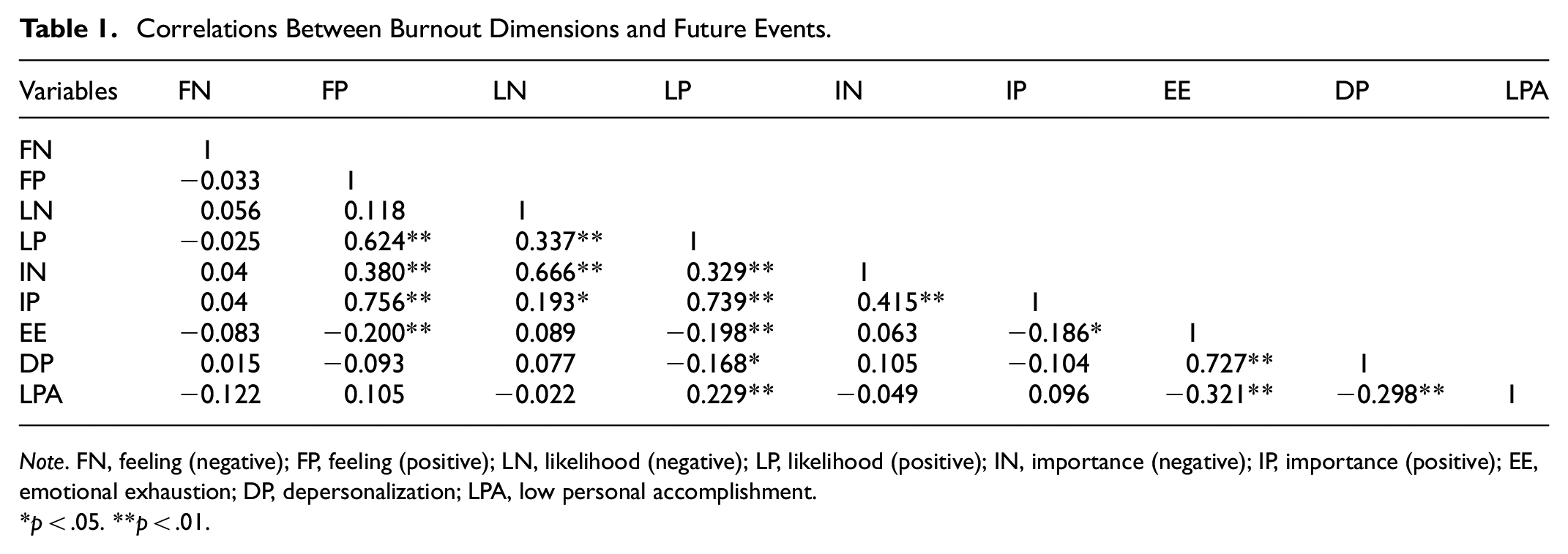
Note. FN, feeling (negative); FP, feeling (positive); LN, likelihood (negative); LP, likelihood (positive); IN, importance (negative); IP, importance (positive); EE, emotional exhaustion; DP, depersonalization; LPA, low personal accomplishment.
p < .05. **p < .01.
Differences in Expectation of Future Events Between Nurses with and without Burnout
The mean rating scores of nurses with and without burnout for different evaluations are shown in Table 2.
Mean Rating Scores of the Nurses with and without Burnout.

Note. M = Mean; SD = Standard deviation.
For each score (likelihood, importance, feeling), a 2 (group: burnout, no-burnout) × 2 (valence: positive, negative) ANOVA was conducted.
For likelihood scores, the main effects of valence [F (1,168) = 307.09, p < .001, ηp2 = 0.65] were significant. However, the main effect of group was not significant [F (1,168) = 0.56, p = .456, ηp2 = 0.00]. The interaction effect of group and valence was significant [F (1,168) = 17.44, p < .001, ηp2 = 0.09]. The means are shown in Figure 2A. Further analysis showed that nurses with burnout rated the likelihood of future negative events to be higher than did nurses without burnout (t = 3.478, p = .001) but they did not significantly differ in their ratings for the likelihood of future positive events (t = –1.531, p = .128).

Differences in rating of future events between nurses with and without burnout.
For importance scores, the results showed a significant main effect of valence [F (1,168) = 228.57, p < .001, ηp2 = .58]. However, the main effect of group was not significant [F (1,168) = .207, p = .650, ηp2 = 0.00]. The interaction between group and valence was significant [F (1,168) = 13.19, p < .001, ηp2 = 0.07]. The means are shown in Figure 2B. Further analysis showed that nurses with burnout rated the importance of future positive events lower than did nurses without burnout (t = 2.436, p = .016); furthermore, there was no significant difference in future negative events between the two groups (t = –1.454, p = .148).
For emotional feeling scores, the main effects of valence [F (1,168) = 610.71, p < .001, ηp2 = 0.78] were significant. However, the main effect of group [F (1,168) = 1.63, p = .204, ηp2 = 0.01] and the interaction of group and valence [F (1,168) = 3.19, p = .076, ηp2 = 0.02] were not significant. The emotional feeling scores did not differ between nurses with and without burnout (all p > .05).
Differences in Expectation of Future Events Among Nurses with Different Levels of Burnout
The mean rating scores of nurses with different levels of burnout for different evaluations are shown in Table 3.
Mean Rating Scores for Nurses with Different Levels of Burnout.

Note. M = Mean; SD = Standard deviation.
A 4 (level: no burnout, mild burnout, moderate burnout, severe burnout) ×2 (valence: positive, negative) ANOVA was conducted.
For likelihood scores, the main effects of valence [F (1,166) = 249.64, p < .001, ηp2 = 0.60] and the interaction effect [F (1,166) = 7.89, p < .001, ηp2 = 0.13] were significant. The main effect of level [F (1,166) = 2.51, p = .061, ηp2 = 0.04] was marginally significant. Further analysis revealed significant differences in the likelihood of future positive event scores between nurses without burnout and those with mild (t = 4.08, p < .001) and severe (t = 2.39, p = .020) burnout. Moreover, nurses without burnout also displayed a trend to differ from those with moderate burnout (t = 1.85, p = .067) in the likelihood of future positive event scores. For likelihood scores of the negative future events, there was a significant difference between nurses without burnout and those with severe burnout (t = –2.13, p = .036). Additionally, there was a marginally significant difference between nurses without burnout and those with moderate burnout (t = −1.91, p = .059), but the difference was not significant between nurses without burnout and those with mild burnout (t = 0.91, p = .366). At the same time, there was a significant difference between nurses with mild burnout and those with moderate (t = −2.97, p = .004) and severe (t = −2.99, p = .004) burnout. The means are shown in Figure 3.

Differences in future events among nurses with different levels of burnout.
For importance scores, the results showed a significant main effect of valence [F (1,166) = 182.05, p < .001, ηp2 = 0.52]. However, the main effect of level was not significant [F (1,166) = 1.57, p = .199, ηp2 = 0.03]. The level by valence interaction effect was significant [F (1,166) = 5.72, p < .001, ηp2 = 0.09]. Further analysis showed a significant difference in importance scores of future positive events between nurses without burnout and mild (t = 2.65, p = .009) burnout. Regarding the importance scores for negative events, there were significant differences in ratings between nurses without burnout and moderate (t = –2.26, p = .026) burnout, between nurses with mild burnout and moderate (t = –3.02, p < .001) burnout, and between nurses with mild burnout and severe (t = –2.08, p = .041) burnout. The means are shown in Figure 3.
For emotional feeling scores, the main effects of valence [F (1,166) = 576.13, p < .001, ηp2 = 0.78] were significant. However, the main effects of level [F (1,166) = 0.60, p = .616, ηp2 = 0.01] and the interaction effect [F (1,166) = 1.35, p = .259, ηp2 = 0.02] were not significant. Further analysis showed no difference in emotional feeling scores among all nurses (all p > .05).
Differences in Future Thinking Among Nurses with Different Dimensions of Burnout
To further investigate the differences in future thinking among nurses with different dimensions of burnout, we analyzed the positive and negative future events imagined by nurses who experienced burnout in only one of the three dimensions of emotional exhaustion, depersonalization, or personal accomplishment. There were no significant differences in the interaction effect and the ratings of positive and negative future events among nurses with different dimensions of burnout in terms of likelihood, importance, and emotional experiences (all p > .05).
Discussion
This study aimed to compare how nurses with and without burnout perceive positive and negative future events. To our knowledge, this is the first study to delve into future thinking concerning both positive and negative events among nurses experiencing burnout. The findings reveal that different dimensions of burnout significantly influence the perceived likelihood of positive future events occurring. Compared to nurses without burnout, those experiencing it had more pessimistic expectations, believing that negative future events are more likely to occur. Significant differences were noted in the assessment of the likelihood of negative future events between nurses with mild burnout and those with moderate to severe burnout. Nurses with burnout perceived positive future events as less important, and as the severity of burnout increased, they viewed negative future events as more significant.
This study’s findings suggest that varying burnout dimensions correlate with the perceived likelihood of positive future events, aligning with theories of self-positivity bias and temporal self-appraisal. The theory posit that individuals tend to view their future selves optimistically, believing they will improve over time (Watson et al., 2007, 2012). This optimism can mitigate work-related stress and fatigue, potentially preventing burnout among nurses. However, as burnout worsens, sustaining this optimistic self-view becomes more difficult. Emotional exhaustion diminishes the capacity to feel positive emotions, while depersonalization reduces interest in positive aspects of work and life, ultimately undermining confidence in a fulfilling future.
Our study also found that nurses with burnout had increased negative expectations about the future. In accordance with the present results, previous studies demonstrated that depressed patients had increased negative expectations about the future (MacLeod & Cropley, 1995). This finding suggests that hopelessness and a negative attitude toward the future among nurses may be important manifestations of burnout (Bauer et al., 2022). Excessive stress accumulated by nurses with burnout in their work and personal lives leads to an increase in negative emotions and a more negative self-image (Bush, 2009; Jeanneau & Armelius, 2000). Contrary to our expectations, the results did not indicate a significant difference in positive expectations between nurses with and without burnout. This finding is in contrast to those of previous studies on depression that showed decreases in the likelihood score of future positive events (MacLeod et al., 1997). Research findings suggest that the prevention and management of burnout among nurses should focus on addressing nurses’ negative expectations and attitudes about the future.
Additionally, we examined the perceived likelihood of future events among nurses with different levels of burnout. In our analyses, we discovered no differences in the ratings of nurses with different levels of burnout for positive future events. However, there were significant differences in the likelihood evaluation for future negative events between nurses with mild burnout and those with moderate and severe burnout. This is consistent with the mechanism by which burnout occurs. Holding negative expectations about the future may shape a person’s reaction to external events. Persistent negative outcomes may lead employees to experience symptoms of burnout (Koc & Bozkurt, 2017). Finally, we also found the same trend in ratings of future negative events between nurses with and without burnout as well as between nurses with different levels of burnout. This finding indicates that increased negativity when thinking about the future is the most dominant manifestation of burnout in nurses in the initial stages of burnout, and this may be consistent with the developmental process of burnout (Cordes & Dougherty, 1993). These results suggest that burnout may arouse nurses’ attention and concern about negative future events, which in turn may affect their emotional state and performance.
We also explored whether perceptions regarding the importance of future events differed among nurses experiencing burnout. Our findings indicated that nurses with burnout considered future positive events to be less important compared to nurses without burnout. Previous studies have found that individuals with burnout have negative attentional preferences (Bianchi & Laurent, 2015). Thus, they care more about negative future events and less about positive future events. This may be linked to worry among nurses with burnout in addition to low self-efficacy under chronic stress (Liu & Aungsuroch, 2019), feelings of losing control over their lives (Ekstedt & Fagerberg, 2005), and fear of future negative events (Fu et al., 2021). We further analyzed the differences in the ratings of the importance of future events among nurses with different levels of burnout. Consistent with the likelihood results, nurses with different levels of burnout showed no difference in importance in positive future events. However, there were differences in the importance ratings of future negative events between nurses with mild burnout and those with moderate and severe burnout. This result is consistent with the existence of cognitive distortions of burnout (Diefenbeck, 2005). These findings suggest that burnout may influence nurses to perceive negative events as having a greater impact on their lives. Consequently, it is recommended that managers provide adaptive coping strategies for nurses with burnout to enhance their ability to manage negative situations effectively.
Implications
This study is crucial for alleviating nurses’ professional burnout. Firstly, positive future expectations play a significant role in reducing burnout, highlighting the importance of interventions that promote self-esteem and optimism among nursing professionals, such as future-oriented solution focus therapies or workplace health promotion programs (Landkroon et al., 2022; Luo et al., 2019). Furthermore, nurse managers can develop the resilience of nurses experiencing burnout, who often assign greater importance to potential negative events. Enhancing their psychological resilience can improve their ability to manage future adversities effectively. For instance, mindfulness-based stress reduction programs and psychoeducational groups can significantly aid nurses in managing stress, thereby enhancing their ability to handle future challenges more effectively (Lin et al., 2019; Sawyer et al., 2023).
Limitations
As an exploratory study, the present study inevitably has some limitations that should be considered when interpreting the findings. First, the participants of this study were female clinical nurses from the same hospital in a developed area of China. This might affect the generalization of the findings from our study. Subsequent investigations should encompass a more diverse sample, incorporating both male and female nurses from various hospital types (such as general and specialized hospitals) and different geographic regions (encompassing both developing and developed areas) to enhance the validation of our study’s outcomes. Second, the sample size was relatively small, especially for nurses with mild, moderate and severe burnout. Future studies should adopt a larger number of participants to verify the findings. Third, we used the same set of 40 events as experimental materials for all the participants. Although the events were obtained from interviews with some nurses in the same hospital who had a similar background and experience as the nurses in the formal experiment and the events are generally likely to appear to the participating nurses in the future, it is possible that a few events might not fit with some nurses’ situations. Future studies could use specific events from individual interviews with each participant, which could guarantee the ecology of the experimental materials.
Conclusions
In conclusion, the current study investigated the characteristics of future thinking in nurses with burnout and found that they have more negative expectations about the future. Nurses with burnout also reported the importance of future negative events. Future research could further explore the coping strategies of nurses with occupational burnout when facing future challenges, specifically examining how they adjust their mindset to handle potential negative events.
Supplemental Material
sj-docx-1-sgo-10.1177_21582440251358068 – Supplemental material for The Difference in Future Thinking Between Nurses with and without Burnout: A Case-Control Study
Supplemental material, sj-docx-1-sgo-10.1177_21582440251358068 for The Difference in Future Thinking Between Nurses with and without Burnout: A Case-Control Study by Yaping Feng, Bowen Xue, Zhiguo Hu, Shengya Feng, Yihui Zhao, Xin Li, Xiaoshan Yang and Hong Luo in SAGE Open
Footnotes
Acknowledgements
We sincerely thank all the nurses who participated.

Ethical Considerations
This study obtained approval from the Ethics Committee of the School of Nursing Hangzhou Normal University (NO. 2022001).
Author Contributions
Study designed by YF, ZH and HL. Data collection supervised by YF, YZ, XY, and XL. Data analysis by SF and BX. Data interpretation and writing by YF, and revised by ZH and HL. All authors contributed to the final manuscript.
Funding
The authors disclosed receipt of the following financial support for the research, authorship, and/or publication of this article: This work was supported by the Hangzhou Biomedical and Health Industry Development Support Project (2022WJC035).
Declaration of Conflicting Interests
The authors declared no potential conflicts of interest with respect to the research, authorship, and/or publication of this article.
Data Availability Statement
The datasets generated during or analyzed during the current study are available from the corresponding author on reasonable request.
Supplemental Material
Supplemental material for this article is available online.
References
Supplementary Material
Please find the following supplemental material available below.
For Open Access articles published under a Creative Commons License, all supplemental material carries the same license as the article it is associated with.
For non-Open Access articles published, all supplemental material carries a non-exclusive license, and permission requests for re-use of supplemental material or any part of supplemental material shall be sent directly to the copyright owner as specified in the copyright notice associated with the article.
