




Abstract
The factors affecting nursing job satisfaction and burnout have been widely studied, but the research results vary in nations with different cultures and organization schemes. The healthcare system of Macao is unique, which tends to be a combination of that of Chinese and Portuguese. This study aimed to assess the factors influencing job satisfaction and burnout and to investigate their associations with demographic characteristics. This descriptive cross-sectional study was conducted among 345 randomly selected nurses registered with the Health Bureau of Macao Special Administrative Region who agreed to participate in this study voluntarily. This study employed two questionnaires using eight subscales (28 items) and five subscales (49 items) to describe job satisfaction and burnout, respectively. The demographic variables of age, highest education level, monthly income, type of working organization, and role were associated with job satisfaction. Whereas marital status was the only demographic variable associated with burnout. Professional development opportunities and childcare support were the main reasons for job dissatisfaction and coping strategies was the major issue for burnout. No significant correlation was found between job satisfaction and burnout. Health organizations may provide solutions focusing on these factors to enhance the job satisfaction of nurses and reduce burnout.
Introduction
Job satisfaction is generally considered as the positive feelings a worker has toward the corresponding working conditions. The job satisfaction of nurses affects work efficiency, nursing care quality, staff stability, and patient satisfaction (Dilig-Ruiz et al., 2018). Many factors may influence the job satisfaction of nurses, with the most common ones being salary, extrinsic benefits, recognition and promotion, patient-nurse relationship, peer relationships, work environment, supervision, and career development (Akuffo et al., 2021; Wang et al., 2017). In addition, the job satisfaction of nurses may also be influenced by personality traits, including self-esteem, optimism, self-efficacy, negative affectivity, and proactive personality (Chang et al., 2010). Prolonged low job satisfaction may increase work stress and cause burnout (J. Liu et al., 2019).
Nurse burnout is commonly referred to as the physiological and psychological changes that nurses face at work, such as pressure, helplessness, and disappointment. These may lead to negative work attitudes, personality changes, and emotional exhaustion (W. Liu et al., 2018). The main cause of burnout is prolonged work stress, which can be caused by excessive workload, high work responsibilities, job insecurity, poor work-life balance, and conflicts with co-workers or patients. This may cause nurses to want to leave their profession.
Another factor that has been associated with nurse burnout and job satisfaction is work engagement. Unlike burnout, work engagement is generally considered as the level of enthusiasm toward work and is a positive work-related state. Studies had employed the self-report questionnaire, Utrecht Work Engagement Scale (UWES-J) to measure work engagement that was characterised by three psychometric subscales: vigor, dedication, and absorption (Shimazu et al., 2008; Torabinia et al., 2017). Work engagement was found to be positively associated with job satisfaction and negatively related to burnout.
Jobs demands-resources (JDR) model is a tool to evaluate the predictors of employee well-being, engagement, and outcomes. Job demands are the stressors for the job, such as workload, work conflict, and stressful working environment. Whereas job resources are the factors that may help the employee to reduce stress and achieve goals, for examples collaboration, social support, and autonomy. A JDR model was developed in a previous study (Kaiser et al., 2020) to investigate how job demands and job resources correlate to the outcomes, such as job satisfaction, and service quality, mediated by burnout. The study involved different health care workers, including nurses and doctors. Their result showed that burnout was negatively related to job satisfaction. Studies related to nursing job satisfaction and burnout can be found for the cities and countries close or related to Macao, including Hong Kong, China, and Portugal (W. Liu et al., 2018; J. Liu et al., 2019; Queirós et al., 2019). However, until now, this type of study has not been carried out in Macao.
Macao is a former Portuguese colony (for more than 400 years) and it is now a special administrative region of China, meaning the governing systems in Macao are different from both Portugal and China. The healthcare system (and thus the organizational culture) of Macao may be considered a mixture of Portuguese and Chinese (Noesselt, 2021). Studies have shown that organizational culture is a factor affecting job satisfaction and burnout (Cronley & Kyoung Kim, 2017; Hwang, 2019). For instance, Hwang (2019) suggested that an organization with a high hierarchy-oriented culture may benefit nursing job satisfaction. Although our study is not investigating the organizational culture of Macao’s institute, we believe that Macao has a unique organizational culture that may indicate far different factors influencing nursing job satisfaction and burnout than in any other city.
Macao is relatively small compared with its near cities, such as Hong Kong and Guangzhou. The size and population of Macao are 32.9 km2 and 680,000 inhabitants, respectively, making it one of the most densely populated cities in the world (Demographic Statistics, 2021). The life expectancy of Macao citizens is 83.4 years, with about 10.5% of the population being over 65 years of age (S. Leong et al., 2019). This high life expectancy and high proportion of elderly has increased the demand for nursing care. A shortage of nurses is also a problem in Macao. The ratio of nurses per 1,000 citizens is 3.7 (Health Statistics, 2021), which is below the 8.8 per 1,000 standards set by the Organization for Economic Co-operation and Development (Health at a Glance, 2019). These are potential factors that may adversely affect the characteristics of the working environment, emotional exhaustion, and work-life balance of nurses, leading to the reduction of job satisfaction, and causing burnout. On the positive side, the Macao government has favorably updated the employment contract for nurses working in public sectors in the past decades. This caused a substantial increase in salary, employment benefits, on-shift allowances, and promotion opportunities (C. S. U. Leong, 2014). This study found that the average salary of a nurse is much higher than that of the general population in Macao.
This study investigated the overall level of Macao nursing job satisfaction and burnout and assessed their correlation. The factors influencing nursing job satisfaction and job burnout were also analyzed.
Materials and Methods
Design and Sample
This is a descriptive cross-sectional study using three different questionnaires to investigate the factors that may influence nursing job satisfaction and burnout. The research participants were selected from the Macao nursing register of the Health Bureau of Macao Special Administrative Region. There were 2,491 nurses registered in the database (Health Statistics, 2021). The participants were selected and recruited through convenient sampling. The participants were nurses registered with the Health Bureau of Macao Special Administrative Region who agreed to participate in this study voluntarily and were able to read and write in Chinese. This is because the questionnaires were written in Chinese. The minimum number of participants that could adequately represent the population of nurses in Macao was 333. This minimum sample size was calculated using the convenience interval, margin of error, sample proportion, and population size as 95%, 5%, 2,491, and 50%, respectively (Suresh & Chandrashekara, 2012). This study employed three questionnaires to collect data on demographic data, job satisfaction, and burnout.
Demographic Data
The characteristics of the participants were measured using the demographic questionnaire (Table 1). It used 11 questions to collect information on gender, age group, marital status, number of children in the family, years of nursing experience, education, monthly income, working organization, working department, role, and whether the participant would consider nursing as a lifetime career.
The Significant and Non-significant Associated Demographic Characteristic by Job Satisfaction and Burnout Scores.

Note. A p-value of <.05 indicates the association was statistical significant.
Job Satisfaction
The questionnaire used in this study to measure nurse job satisfaction was based on that of Mueller and McCloskey (1990). The modified questionnaire used in this study contained eight subscales with 28 items to represent job satisfaction (Figure 1; Supplemental Table 2). These subscales were extrinsic rewards, scheduling satisfaction, family and work-life balance, co-workers, interaction, professional development opportunities, praise/recognition, and control and responsibility. For each item, the 5-point Likert scale was used to measure the responses from the participants (1 = very dissatisfied, 2 = moderately dissatisfied, 3 = neither satisfied nor dissatisfied, 4 = moderately satisfied, and 5 = very satisfied). The points of the 28 items were added together and the participants who achieved a high overall score indicated the corresponding job satisfaction was high.

The average scores of the eight items of the job satisfaction questionnaire completed by the 345 participants.
Burnout
The questionnaire used in this study to measure nurse burnout was adopted from Tang et al. (2007). It was a modified Chinese version of that by Moreno-Jiménez et al. (2005), which was originally written in Spanish. The English version shown in Supplemental Table 3 is translated from the Chinese version by Tang et al. (2007) and it is for presenting to the readers of this article only. The questionnaire used in this study was in Chinese. It used five subscales with 49 items to study nurse burnout (Figure 2; Supplemental Table 3). The five subscales were: (1) characteristics of work, which explore the uncertainty of job roles, interpersonal tension and work burden; (2) emotional exhaustion, which investigates depersonalization; (3) positive personality characteristics, which consider a sense of accomplishment, challenge, and self-control; (4) coping strategies, which explore seeking support and avoiding problems; and (5) outcome of burnout, which considers physical and psychological conditions. Same as the job satisfaction questionnaire, the 5-point Likert scale was used to measure the response (1 = strongly disagree, 2 = disagree, 3 = neutral, 4 = agree, and 5 = strongly agree). The points of the 49 items were added together and a high score indicated substantial burnout.
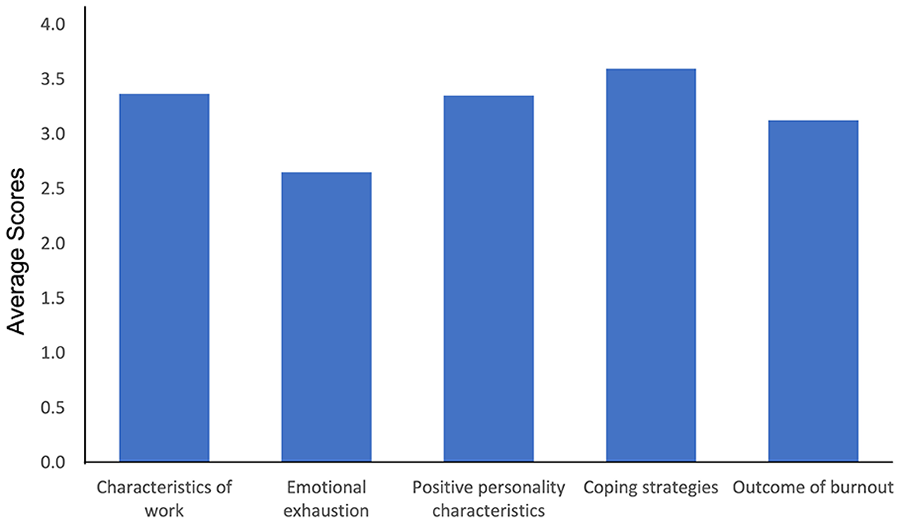
The average scores of the five items of the burnout questionnaire completed by the 345 participants.
Reliability and Validity
The three questionnaires were evaluated by three academic scholars using a four-level scoring scale for each question: 1 point indicated the question was inappropriate and should be deleted, 2 points indicated the question was inappropriate and deletion or major changes should be considered, 3 points indicated the question was appropriate but minor modification was required, and 4 points referred to a very appropriate question and no changes were required. The academic scholars were also welcomed to give suggestions for modifications. The reliability of the questionnaires was then tested by asking 30 nurses to complete the form and the Cronbach’s alpha reliability coefficient (Tavakol & Dennick, 2011) was calculated using SPSS software (version 26.0). Values of Cronbach’s alpha greater than .8 indicated the questionnaire had good reliability, between .7 and .8 indicated acceptable reliability, between .6 and .7 referred to questionable reliability and below .6 was unacceptable (Tavakol & Dennick, 2011). The Cronbach’s alpha of the satisfaction and burnout questionnaires were .88 and .85, respectively, indicating both questionnaires were reliable.
The validity of the questionnaires was evaluated by three academic scholars using content validity index (CVI) analysis (Polit & Beck, 2006). The three scholars assigned a score to each question using a 4-point Likert scale (1 = not relevant, 2 = somewhat relevant, 3 = quite relevant, and 4 = very relevant). Questions scored with 1 or 2 were either deleted or modified. The CVI of each question was calculated as the number of scholars who rated the question as 3 or 4 divided by the total number of scholars. In general, a questionnaire with an average CVI value of all the questions above .80 is considered as having acceptable validity (Polit & Beck, 2006). The CVI values of both the job satisfaction and burnout questionnaires of this study were 0.94, indicating the content of both questionnaires had acceptable validity.
Data Collection and Analysis
The consent form and the three questionnaires were distributed and collected as Google forms through the Macao Nursing Association contact list. The participants had 12 weeks to complete the form. All the questions had to be answered before submission to prevent missing data. SPSS software (version 26.0) was used to analyze the data. t-Test and one-way ANOVA were used to analyze the statistical significance of the mean differences, whereas the chi-square test was used to test the statistical association between two categorical variables. Post hoc analyses were performed to investigate the association between the subscales of job satisfaction and burnout. Pearson’s correlation was used to measure the strength and direction of the linear relationship between job satisfaction and burnout (Table 2).
Pearson’s Correlation Between the Subscales of Job Satisfaction and Burnout.
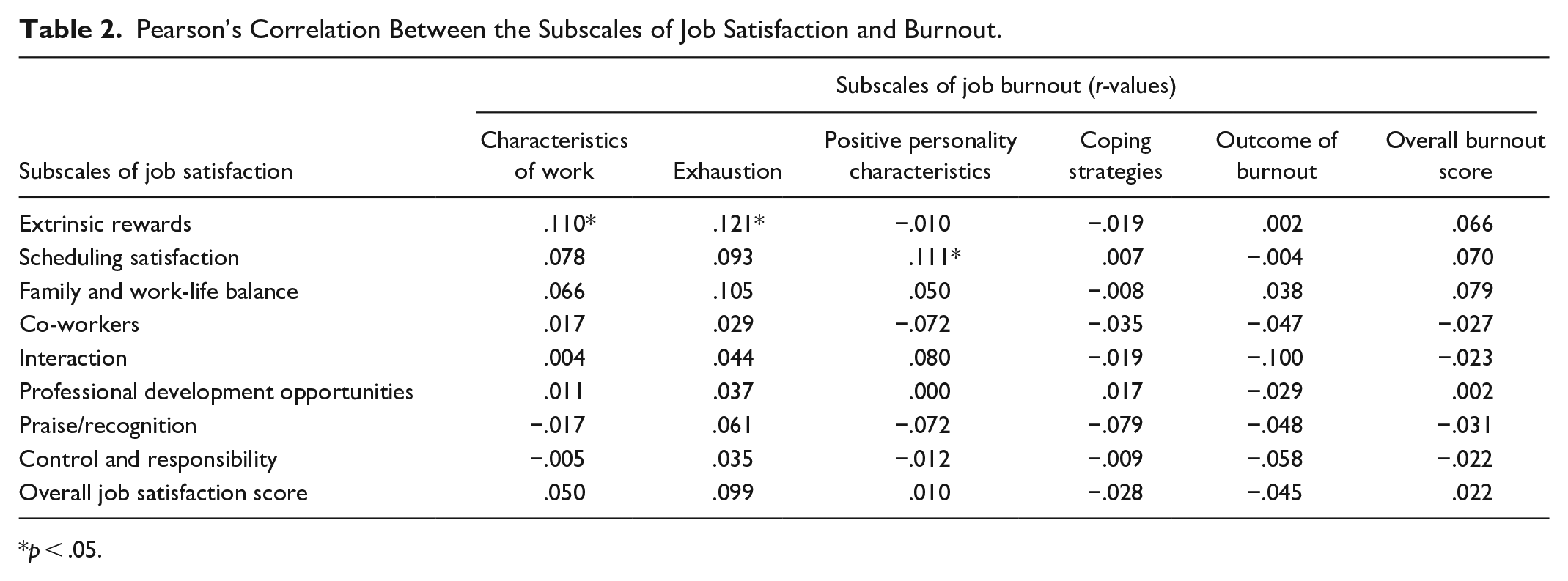
p < .05.
Results
The number of participants who completed the three questionnaires was 345, which is higher than the calculated minimum sample size (333) required to represent Macao nurses.
Demographic Data
The results obtained from the demographic data, job satisfaction, and burnout questionnaires are shown in Table 1 and Supplemental Table 1. The majority of the participants were female (84.9%), 21 to 30 years old (44.3%), had no children (59.7%), and reported the highest education level as an undergraduate (70.1%). The distribution between married (50%) and single (47%) participants was similar. Most participants had 3 to 5 years of nursing experience (25.8%), followed by 6 to 10 years (20.9%), and more than 20 years (18.6%). They were mainly practicing clinically (95.9%), working in public sectors (70.4%), had monthly income between USD 4,500 to 6,000 (52.5%), and considered nursing as their lifetime career (69%).
Job Satisfaction
The job satisfaction questionnaire used 28 items to represent eight subscales (Supplemental Table 2). Each item could be scored from 1 to 5 points, leading to a maximum score of 140 points. High scores indicated the participants were satisfied with the job. The average score of all the participants among all the subscales was 86/140 (i.e., 61.4%). Among all the subscales, the co-workers subscale achieved the highest score (65.1%), followed by extrinsic rewards (63.7%), job recognition (62.7%), social contact (62.3%), work schedule (62.1%), job control and responsibility (60.4%), family and work-life balance (55.8%), and professional development opportunities (56.0%). The top three items with the highest scores were working with nursing peers, recognition from colleagues, and number of workings hours per day (Supplemental Table 2). The three items with the lowest scores were career advancement opportunities, writing and publishing articles, and performing nursing research.
Table 1 and Supplemental Table 1 show the characteristics of the participants corresponding to their job satisfaction and burnout. Type of working organization, consider nursing as a lifetime career, age group, highest education level, monthly income, and role were the characteristics that were associated with job satisfaction. Nurses who worked in the non-clinical public sector with higher education and at an older age tended to have higher job satisfaction.
The differences in the job satisfaction scores obtained for the public and private sectors were statistically significant. Post hoc analyses were performed to study the association between the characteristics of participants and the items of the job satisfaction questionnaire (Supplemental Tables 4 and 5). The results indicated that the nurses working in the public sector had significantly higher scores in extrinsic rewards, family and work-life balance, and control and responsibility than those working in the private sector. The score differences between the nurses who did and did not consider nursing as a lifetime career were statistically significant. The nurses who considered nursing as a lifetime career obtained higher scores in extrinsic rewards, scheduling satisfaction, family and work-life balance, co-workers, interaction, professional development opportunities, praise/recognition, and control and responsibility (Supplemental Tables 4 and 5).
There were significant differences between the job satisfaction scores among the age groups (Table 1). The older age groups generally obtained higher scores in extrinsic rewards, family and work-life balance, control, and responsibility as compared with the younger age groups (Supplemental Tables 4 and 5). Regarding education, the more educated nurses obtained higher scores in job satisfaction (Table 1). The nurses with master’s or specialization degrees obtained significantly higher scores in extrinsic reward, family and work-life balance, interaction, and control and responsibility as compared with those of nurses with an undergraduate degree or diploma (Supplemental Tables 4 and 5).
With regards to the work department, nurses who worked in the outpatient department had the lowest job satisfaction, followed by A&E. Whereas, nurses who worked in obstetrics and gynecology (O&G) has the highest job satisfaction. Post hoc analysis indicated that the working department was associated with professional development opportunities, in which O&G, pediatrics, and surgery had the highest scores (Supplemental Tables 4 and 5).
Burnout
The burnout questionnaire in this study employed 49 items to characterise five subscales and each item could be scored from 1 to 5 points (Figure 2; Supplemental Table 3). The minimum and maximum scores for this questionnaire were 49 and 245, respectively. High scores indicated high burnout. The average score for this questionnaire was 156/245 (i.e., 63.7%). The percentage scores of the five subscales were 71.9% (coping strategies), 67.4% (characteristics of working environment), 67.0% (positive personality characteristics), 62.5% (outcome of burnout), and 53.0% (emotional exhaustion). The top three items with the highest scores were “when encountering difficulties, I will find someone to talk to and ask for help,” “I think my work is important to me and valuable to society and I will do my best,” and “when I am in trouble, I will accept the support of others” (Supplemental Table 3). The three items with the lowest scores were “I never care about the problems and I just treat them as if they don’t exist,” “I feel useless,” and “I’m always overexcited” (Supplemental Table 3).
The result indicated that marital status was the only characteristic of participants that affected burnout significantly (Table 1). The single participants had a lower burnout score than those who were married, widowed, divorced, or separated. The post hoc analysis indicated the significant association between the characteristics of work and marital status (Supplemental Tables 6 and 7). The outcome of burnout was associated with gender, with the female participants obtaining a higher score than the male participants. The highest level of education was associated with coping strategies and the participants with diplomas tended to have a higher score than those with more advanced education (Supplemental Tables 6 and 7).
Correlation Between Job Satisfaction and Burnout
Pearson’s correlation was used to analyze the correlation between job satisfaction and burnout. The results indicated that there is no significant correlation between them (r = .022, p < .690). The correlation between all the items of both burnout and job satisfaction were also analyzed (Figure 1; Supplemental Table 2). Most of them had no significant correlation. The extrinsic rewards of job satisfaction were weakly correlated with the characteristics of work and emotional exhaustion items (Figure 1; Supplemental Table 2). Scheduling satisfaction was also weakly correlated with positive personality characteristics.
Discussion
This cross-sectional survey study described job satisfaction and burnout among nurses in Macao using a representable sample size. As demonstrated in Tables 1, 2, and 3, most of the survey scores were around 3. These scores were measured using a 5-point Likert scale (1 = very dissatisfied/disagree and 5 = very satisfied/agree). This indicated that most nurses were neither satisfied/agree nor dissatisfied/disagree with most survey items. The nurses in Macao had average job satisfaction and moderate burnout.
For job satisfaction, a large number of nurses were more satisfied with their salary, number of working hours, and interaction with other nurses among all other factors, whereas professional development opportunities and childcare support were the main reasons for job dissatisfaction. Some of these results were different from that of a national Chinese study, which involved 11,337 nurses from 92 hospitals across mainland China (Wu et al., 2018). The study concluded that low income, night shift experiences, and opportunities for interaction were the key factors causing job dissatisfaction in mainland China. Our study revealed that most nurses in Macao earned a monthly salary of USD 4,500 to 6,000 (Table 1), which is much higher than most people earn in Macao. According to statistics from the Macao government (Employment Survey for January-March 2021), the median monthly salary between January 2021 and March 2021 was USD 1,875. This may be the reason that most nurses were satisfied with their salaries in Macao.
A Portuguese study found that social support from co-workers was a significant factor for enhancing nursing job satisfaction (Orgambídez-Ramos & de Almeida, 2017). The nurses involved in our study tended to be satisfied with their co-workers, especially nursing peers. A previous study also indicated that appropriate collaborative work between nurses, supervisors, and physicians could improve job satisfaction (Kalliath & Morris, 2002). Nevertheless, developing a collaborative model between co-workers may improve the efficacy of nursing jobs and eventually job satisfaction (Bridges, 2014).
This study revealed that most nurses in Macao were highly educated, with 93% reporting their highest education level as undergraduate or higher. A study showed that education level was a significant predictor of job satisfaction (Albashayreh et al., 2019). Depersonalization and emotional exhaustion were associated with education level and these two factors may lead to burnout (de Paiva et al., 2017). Thus, the high education level of Macao nurses may have helped to reduce burnout.
Professional development opportunities achieved the lowest scores among all the other subscales of the job satisfaction questionnaire. The nurses were not satisfied with the opportunities to perform research or write and publish papers. The participation in professional associations scored slightly higher than the others (Figure 1). Professional development is important for healthcare professionals, as it helps to maintain and improve the competence to practise. Nursing associations and organizations in Macao may promote and support nursing research to enhance job satisfaction.
Surprisingly, this study found that the nurses with non-clinical roles had higher job satisfaction. We believe this is due to a less stressful working environment for those in non-clinical roles. Studies have indicated that role stress can significantly affect job satisfaction (Chen et al., 2007). However, the reliability of the result in this study may have been biased by the large sample size difference between the two groups. The number of nurses with clinical and non-clinical roles was 331 and 14, respectively.
Unlike job satisfaction, which was found to be associated with many demographic characteristics, burnout was only associated with marital status (Table 1). Single nurses tend to have high burnout levels. This agrees with a meta-analytic study that included 32 studies that investigated the relationship between marital status and burnout (Ortega et al., 2018). The study concluded that single nurses were correlated with a high level of depersonalization, which is one of the reliable subscales of burnout. However, the study also concluded that males or those who had no children had higher burnout levels. This is different from the finding of this study.
Among the five subscales of burnout, emotional exhaustion achieved the lowest scores. This indicated that most nurses disagreed with being emotionally exhausted. Emotional exhaustion is one of the main causes of burnout in many countries (Yeh et al., 2021) and this study showed that nurse exhaustion was relatively uncommon in Macao. On the other hand, most nurses in Macao agreed on having difficulties in coping with problems. This may improve by providing lessons on coping strategies to nurses. Research has found that effective lessons on coping strategies and group cognitive-behavioral therapy can efficiently reduce burnout (Bagheri et al., 2019). Another subscale that contributes to nurse burnout in Macao was the characteristics of the working environment. The nurses agreed that they were often blamed by patients if mistakes occurred. This may indicate that the relationships between nurses and patients were suboptimal.
This study concluded that no significant correlation was found between job satisfaction and burnout. This agrees with the study of Saeidi et al. (2020) that was performed in Iran. However, this was contradicted by some other studies (Figueiredo-Ferraz et al., 2012; Habibi et al., 2014), which found that job satisfaction was a significant predictor of nurse burnout. In the study by Habibi et al. (2014) three subscales of burnout: emotional exhaustion, personal accomplishment and depersonalization were found to be significantly correlated with job satisfaction (Habibi et al., 2014). We believe it is difficult to find the reasons for causing such contradictions in different studies. One reason may be due to the variation of organizational culture, which has been shown to have significant effects on nursing job satisfaction (Chung & Ahn, 2019). The organizational culture of the Macao medical system is unique, as it is a combination of Chinese and Portuguese cultures.
Study Limitations
This study has several limitations. This is a cross-sectional study that did not include control variables and follow-up investigations over time. These may lead to bias, such as information bias, detection bias, and recall bias. This study was performed during the COVID-19 pandemic and studies have found that the nurse burnout rate was exacerbated and job satisfaction was also significantly lower during the pandemic, especially in countries with high infection rates (Ross, 2020). Another study revealed that nurses who took care of patients with COVID-19 had significantly lower occupational satisfaction (Savitsky et al., 2021). To minimise this potential factor, the nurses involved in this study were not taking care of patients with COVID-19 and more importantly, the COVID-19 infection rate was/is extremely low in Macao. The population of Macao is around 680,000 and the total cumulative COVID-19 cases were less than 63 during the data collection phase of this study and no death was found to be related to the infection (Health Statistics, 2021). Thus, we believe the effect of the pandemic on this study was minimal.
The time period for the data collection was relatively long (12 weeks) for a cross-sectional study. This may introduce bias, such as seasonal bias, environmental bias, and policy bias. Our data collection process began from April to June, this period was not holiday peak season, there were no major changes in governmental/hospital health policy, the weather was generally stable, and it was not within the flu season in Macao. We believe the effect of this long data collection period on this study was minimal.
Another limitation is that some other known factors that may affect burnout and job satisfaction were not included in this study. For example, workplace violence has been an issue in China for the past several years and it is found to be associated with a higher incidence of burnout and lower job satisfaction (J. Liu et al., 2019). A study performed in 2014 revealed that 4.7% of nurses in Macao had experienced workplace violence, such as physical or verbal assault and sexual harassment (Cheung et al., 2017). However, no recent studies can be found to assess the current situation in Macao. This can be a potential area for future studies.
Recommendations and Suggestions
The results of this study demonstrated that the most dissatisfying factor of job satisfaction was professional development opportunities, especially with regard to performing research and publishing academic articles. The general barriers to performing research for nurses are the limitation of time, research skills, physician cooperation, and support from the organization (Aljezawi et al., 2019). Thus, providing the necessary resources (e.g., time and materials) may encourage nurses to perform research. Mentorship is another area worth trying to support nurses who are willing to perform research but lack research experience or confidence (Johnston & Brassil, 2014).
Coping strategies was a major issue for burnout in nurses in Macao. This may improve by providing nurses with adequate organizational social support and appropriate training for personal coping strategies. These may include training on relaxation, self-care and self-control, identification of personal stressors, and communication to patients and peers (Akbar et al., 2016). Nurses and other healthcare professionals should be encouraged to support their peers to prevent or provide treatment for burnout (Ortega et al., 2018).
Conclusions
This study revealed that nurses who had a high level of education, high monthly income, and worked in the public sector had significantly high job satisfaction. However, none of these factors was associated with burnout. The only demographic characteristic that was statistically associated with burnout was marital status. Single nurses had a higher burnout tendency when compared with that of married or divorced nurses. The participants of this study were not satisfied with research support, which had limited their opportunities to publish research articles. Coping strategies was a major issue for burnout. Both the private and public sectors should be aware of these factors and provide appropriate solutions to enhance nursing job satisfaction and reduce burnout.
Supplemental Material
sj-docx-1-sgo-10.1177_21582440221104811 – Supplemental material for Cross-Sectional Association and Influencing Factors of Job Satisfaction and Burnout Among Nurses in Macao
Supplemental material, sj-docx-1-sgo-10.1177_21582440221104811 for Cross-Sectional Association and Influencing Factors of Job Satisfaction and Burnout Among Nurses in Macao by Kinfong Leong, Pedro Fong, Chiufai Kuok and Lirong Meng in SAGE Open
Footnotes
Acknowledgements
The authors thank all the study participants.
Consent to Participate
Written consent was obtained from all participant before taking part in this study. The collected data were kept confidential and used only for the purpose of this study.
Declaration of Conflicting Interests
The author(s) declared no potential conflicts of interest with respect to the research, authorship, and/or publication of this article.
Ethical Approval
This study was performed in accordance with the Declaration of Helsinki. The ethical approval was obtained from the research ethics committee of Macao Polytechnic University, Faculty of Health Sciences and Sports (9-2019).
Funding
The author(s) disclosed receipt of the following financial support for the research, authorship, and/or publication of this article: This work was funded by Macao Polytechnic University.

Supplemental Material
Supplemental material for this article is available online.
References
Supplementary Material
Please find the following supplemental material available below.
For Open Access articles published under a Creative Commons License, all supplemental material carries the same license as the article it is associated with.
For non-Open Access articles published, all supplemental material carries a non-exclusive license, and permission requests for re-use of supplemental material or any part of supplemental material shall be sent directly to the copyright owner as specified in the copyright notice associated with the article.
