




Abstract
The phenomenon of academic burnout among students is caused by a variety of diverse factors, while its consequences have very serious consequences, both for the health of those affected and their effectiveness in later professional life. The purpose of the research presented in this article was to assess academic burnout using the example of universities in Poland. Data for analysis were collected through a survey questionnaire created by the authors of the study. The tool contained 16 mixed questions, including six to collect anonymous sociodemographic information. Statistical calculations used included Kruskal-Walli’s test, Spearman rank-order correlation, multivariate cluster analysis and PROFIT analysis to develop the model. A novelty is the holistic approach to student academic burnout, identifying not only its causes and symptoms but also drawing attention to preventive measures on the part of the University or those potentially exposed to it. The majority of the respondents experienced the phenomenon of academic burnout, which was most often associated with a large number of responsibilities and stress, while it was mainly manifested by discouragement and lack of enjoyment of learning; slightly less by mental exhaustion, a feeling of helplessness and lack of motivation to take on any challenges both in the near and long term. Furthermore, first-degree full-time students are the group most resistant to academic burnout, and the factor most likely to cause them to develop this problem is a lack of regularity in their studies. Second-degree students, particularly full-time students, are the most vulnerable to academic burnout.
Plain Language Summary
The main objective of the research carried out in this article was to assess academic burnout by using the example of higher education institutions in Poland. The aim was to verify the answers to the following research questions: · What is the scale of academic burnout among students of higher education institutions in Poland? · What factors have the greatest impact on the development of academic burnout in the opinion of university students in Poland? · What factors contribute the most to academic burnout among university students in Poland? · What are the most common symptoms of academic burnout among university students in Poland? · Is there a link between university students in Poland who overcome academic burnout and their opinions on the measures that must be taken to prevent it? · What conditions are conducive to the emergence of academic burnout among students in different situations in terms of the form and level of their studies? The study was conducted using a questionnaire method, with a proprietary survey questionnaire developed for the purposes of this study. The tool consisted of 16 mixed questions. Most of the respondents had experienced academic burnout (64.10%). The factors that had the greatest impact on the emergence of academic burnout among the respondents were constant stress, too many responsibilities at the university and an imbalance between academic and private life. The students surveyed attributed slightly less importance to the feeling that the knowledge gained during their studies would not be used in their professional work. Furthermore, the most common symptom of academic burnout reported by students was discouragement and lack of enjoyment of learning. To a lesser extent, the respondents observed mental exhaustion, a feeling of helplessness, and a lack of motivation to take on any challenges in the short or long term.
Introduction
The term burnout can occur in a variety of contexts, including professional and educational contexts (El Mouedden et al., 2022). This syndrome (often equated with psychological syndrome [Platania et al., 2020]), is referred to in educational settings as academic burnout (Ramos-Vidal & Ruíz, 2024). Academic burnout for students can be equated to a state of overwhelm felt by students, occurring when they cannot cope with the demands placed on them by the university (Bali et al., 2024). This phenomenon is constantly increasing (Salmela-Aro et al., 2022) and is also directly related to the approach of students to the educational process (the quality of student learning (W. Yu et al., 2023) and the results they achieve (Gabola et al., 2021; Güngör & Sari, 2022) and (as shown by research on this phenomenon in Poland) with the level of satisfaction of the need for autonomy and competence (Strzelecki, 2023).
It is worth noting that academic burnout also has a negative impact on students’ health (de Souza et al., 2021; Madigan & Curran, 2021) and can significantly affect job performance after graduation (Pham Thi & Duong, 2024), which is why the topic addressed in this paper is so important not only from the point of view of universities (which can effectively, through differentiated action, counteract it), but also future employers.
Academic burnout is manifested by mental and physical exhaustion (Gómez et al., 2024), lack of motivation (Madigan & Kim, 2021; Prendergast et al., 2024) to face any challenge near and far, deterioration of academic performance (Ferriby & Schaefer, 2022; Park et al., 2021), low self-esteem (Fernández-Castillo & Fernández-Prados, 2022; Puah et al., 2024), discouragement and lack of enjoyment of learning (leading to a desire to drop out of studies [Reyes-de-Cózar et al., 2023]), lack of concentration, inability to focus attention, difficulty in remembering information (Gil-Calderón et al., 2021) (which can lead to feelings of helplessness), depression (Kaur et al., 2020; Mao et al., 2019), deterioration of personal circumstances (van Vendeloo et al., 2018) or relationships with the immediate environment (due to depersonalisation [Fuller et al., 2020] and feelings of hopelessness [Rehman et al., 2020]).
The main factors that trigger the described phenomenon can include: a continuous high level of stress that affects academic performance (Kuzior et al., 2024; Vansoeterstede et al., 2024; Wadi et al., 2024), (which in higher education is related, among other things, to time pressure and demanding, long tasks to be completed [Gusy et al., 2021]), an excess of academic responsibilities (Burgis-Kasthala et al., 2019; Rosales-Ricardo et al., 2021) related to writing term papers or taking multiple examinations (Miltojević et al., 2022) (which ultimately results in an imbalance between academic and private life), employment outside the university (Pate et al., 2023) (which often leads to an imbalance between academic and professional life due to the combination of responsibilities in both areas (Drăghici & Cazan, 2022) or a lack of support from lecturers (Guízar Sánchez et al., 2023). Further aspects influencing the appearance of academic burnout are related to not having a good relationship with the student group (as studies have shown, if students feel a sense of belonging to a group, their level of burnout is significantly lower (Hoferichter et al., 2023), lack of regularity in their studies (related to irregular attendance [Sugara et al., 2020]), social pressure (Felaza et al., 2020) (which may be related to critical evaluation of the course of study by the immediate environment) or personal problems.
The’ perception of the educational environment of students (Cano et al., 2024) is an important element that triggers the phenomenon in question. Its components may include the following factors: choosing the wrong field of study (the domain of which may be a competitive culture (Zeeman et al., 2024)), an unsatisfactory level of education (related, e.g., to an excess of project classes (Kok et al., 2024)), fear for the future after graduation, and the feeling that the knowledge gained during studies will not be used in one’s professional career (translating into a lack of involvement [Huyghebaert-Zouaghi et al., 2024]) or a lack of sense of purpose in undertaking any educational activity resulting from the current unstable global situation.
Furthermore, the COVID-19 pandemic (Uysal & Dönmez, 2024) which caused a complete lifestyle to change in all key areas (Huan et al., 2024) (also in the educational process [Jezzini-Martinez et al., 2023]), undoubtedly contributed to the increase in academic burnout of students. The shift to distance learning (Asikainen & Katajavuori, 2022; Bolatov et al., 2022; Rohmani & Andriani, 2021; Salmela-Aro et al., 2022) has provided students with a significant amount of theoretical knowledge, at the expense of meeting their needs both socially and emotionally (Malakcioglu, 2024).
The literature discusses the topic of burnout in the context of employees (e.g., lecturers), while not enough attention is paid to the occurrence of this phenomenon among the beneficiaries of the educational process, that is, students of various fields of study. In view of the above, the aim of the research undertaken was to assess academic burnout on the example of higher education institutions in Poland. We assume that the form and level of studies are related to academic burnout among students. The aim was to verify the answers to the following research questions:
What is the scale of academic burnout among university students in Poland?
What factors are the most influential in the development of academic burnout as perceived by university students in Poland?
What factors are most likely to cause academic burnout in Polish university students?
What is the most common manifestation of academic burnout among university students in Poland?
Is there a relationship between the overcoming of academic burnout by university students in Poland and their opinions on the measures needed to counteract this phenomenon?
What conditions are conducive to the emergence of academic burnout in students who are in different situations in terms of form and level of study?
Materials and Methods
Research Tool
The study was carried out using the questionnaire method, using a proprietary survey questionnaire developed for this study. The tool consisted of 16 mixed questions, six of which were designed to collect anonymous sociodemographic information. The remainder of the questionnaire included questions that addressed the issue of academic burnout, ranging from how the term is understood, opinions on factors that influence the occurrence of the phenomenon and personal experiences of the phenomenon. Some of the questions were of matrix nature, where respondents referred to individual items on a 5-point Likert scale. The survey research was conducted according to the ethical principles of conducting research with human participants according to the guidelines of the Declaration of Helsinki. Written informed consent was obtained to participate in the study. The reliability of the questionnaire was tested with the Cronbach alpha internal consistency coefficient, the results of which indicated a high level of reliability (alpha = .89).
The questionnaire was developed based on a review of the literature on the subject and the research team’s experience in academic teaching and education management. The tool’s design considered the issues related to student burnout, referring to risk factors, symptoms and potential countermeasures. The questionnaire included single-choice and multiple-choice questions, matrix questions based on a five-point Likert scale and a semi-open question with the option ‘Other, please specify’. Although no formal pilot study was conducted, the content of the tool was consulted with a group of students and teachers in terms of clarity, allowing the elimination of semantic ambiguities. The lack of complete psychometric validation is a limitation of the study, which is discussed in a separate section of the article.
The survey was conducted electronically through the Interankiety.pl on-line platform between 9.01.2023 and 10.03.2023. The inclusion criterion for the survey was the status of a student in a higher education institution in Poland. The respondents were informed about the scientific purpose of the survey and the anonymous and voluntary nature of participation in this study.
Object of the Analysis
Academic burnout in the example of higher education institutions in Poland was the focus of this statistical analysis. In doing so, both students’ opinions on the phenomenon; the scale of the occurrence of academic burnout among the students surveyed; the factors that led to the emergence of the problem; overcoming it; and the conclusions drawn on this basis for future action to avoid academic burnout were analysed.
The analysis consisted first of assessing the overall results of the survey, including the identification of groups of factors that cause academic burnout to a similar degree. This was followed by an examination of the relationship between the respondents’ overcoming of academic burnout and their opinions on the actions needed to be taken by students to counteract the phenomenon. Finally, a model of conditions conducive to academic burnout was developed in groups of students distinguished by form and level of study.
Statistical Analysis Methodology
The results of the survey were analysed quantitatively and descriptively. Qualitative variables and question responses were described using counts (n) and percentage distributions (%), while measurable variables were described using basic parameters of descriptive statistics. The distribution of quantitative variables was verified using the Shapiro-Wilk test for conformity to a normal distribution.
The selection of specific statistical analysis methods was dictated by the measurement scale of the variables and the purpose of the study. Kruskal-Walli’s test and the Mann-Whitney U test were used due to the lack of normality of the distributions and the need for intergroup comparisons for ordinal variables, which were previously rescaled to a scale of 1 to 5 points to allow quantitative analysis. Spearman’s rank correlation allowed us to estimate the strength of the relationship between nonparametric variables. Multivariate cluster analysis (using Ward’s method as the cluster linkage principle) enabled the identification of recurring patterns in the assessment of burnout factors, while PROFIT analysis was used to construct a model illustrating the relationships between the form and level of studies and risk factors. Each analysis indicated the level of statistical significance and, in the case of comparative tests, also measures of effect size.
Statistical analysis was performed using the Statistica v.13.3 PL statistical programme from StatSoft, Inc. The significance level was set at p < .05.
Characteristics of the Research Sample
A total of 1,000 students participated in the survey, including 622 males, 358 females and 20 of another gender. The respondents were overwhelmingly between 19 and 25 years old (89.40%); between 26 and 32 years were 7.20% of the respondents, and the smallest proportion was in the ‘33 and over’ age group (3.40%). Most of the students surveyed were studying full-time (72.70%); in a first-degree programme (83.30%), mainly in their first semester (57.20%).
To estimate the minimum sample size, the sample size formula for qualitative characteristics (with a finite sample) was used (Mynarski, 2000). When calculating the minimum sample size, data from the Central Statistical Office (CSO) on 1,218.2 thousand tertiary students in Poland were considered in the academic year 2021/2022 (GUS, 2023). Additionally, 95% probability was assumed that the result obtained in the study would not deviate from the actual population value by more than 5%. According to these estimates, the minimum sample size is 384 individuals. Thus, the sample size achieved (N = 1,000) exceeded its minimum level almost three times.
Results and Discussion
Overall Results
The general results of the survey were first assessed. This section presents the distribution of the responses of the students surveyed to the individual survey questions.
The concept of ‘academic burnout’ was generally understood by the students surveyed as fatigue and lack of enjoyment of learning (40.10%). Almost one in three respondents defined the concepts as a loss of sense of further learning (32.40%), and almost one in four, respectively, as a phenomenon inherent in their functioning in the academic community, consisting of a lack of motivation to take on new challenges in their chosen field of study (23.80%). The fewest respondents described ‘academic burnout’ as a sudden need to change educational path or understood the above concept in a different way (2.30% and 1.40%, respectively).
The students surveyed, when rating on a scale of 1 to 5 the influence of individual factors on the development of academic burnout, generally rated the importance of choosing the wrong course of study highest (5 – maximum) (45.60%). In addition, respondents generally attributed maximum (5) or significant (4) influence on factors such as the feeling that the knowledge gained at university will not be used in one’s career (30.20% and 35.70%, respectively); lack of balance between academic and private life (29.20% and 39.20%, respectively) and personal problems (28.00% and 39.20%, respectively). In general, the surveyed students attributed a significant influence on the appearance of academic burnout to factors such as too many responsibilities in the university (46.30%), an unsatisfactory level of education (38.40%), and a lack of balance between academic and professional life (41.10%). Respondents perceived a slightly lower impact, mainly significant (4) or moderate (3), in factors such as lack of good contact with the student group (34.80% and 32.90%, respectively); lack of good contact with lecturers (37.60% and 29.10%); lack of a sense of purpose in undertaking any educational activity due to the current unstable world situation (27.50% and 30.80%, respectively); criticism of the choice of major by the immediate environment (27.70% and 24.00%, respectively); constant stress (37.60% and 36.60%, respectively) and lack of regularity in studying (35.00% and 30.60%, respectively). Respondents were divided when it came to assessing the other two factors, with anxiety about the future after education generally having a significant (4) impact (35.00%) in the context of the emergence of academic burnout; less frequently moderate (3) or maximum (5) (23.50% and 21.40%, respectively). On the contrary, the respondents were more divided in their assessment of the importance of the Covid-19 pandemic and the resulting change in teaching form, most attributing scores ranging from no impact (1) to minimal (2) and moderate (3) to significant (4) impact to this factor (18.00%–26.60%).
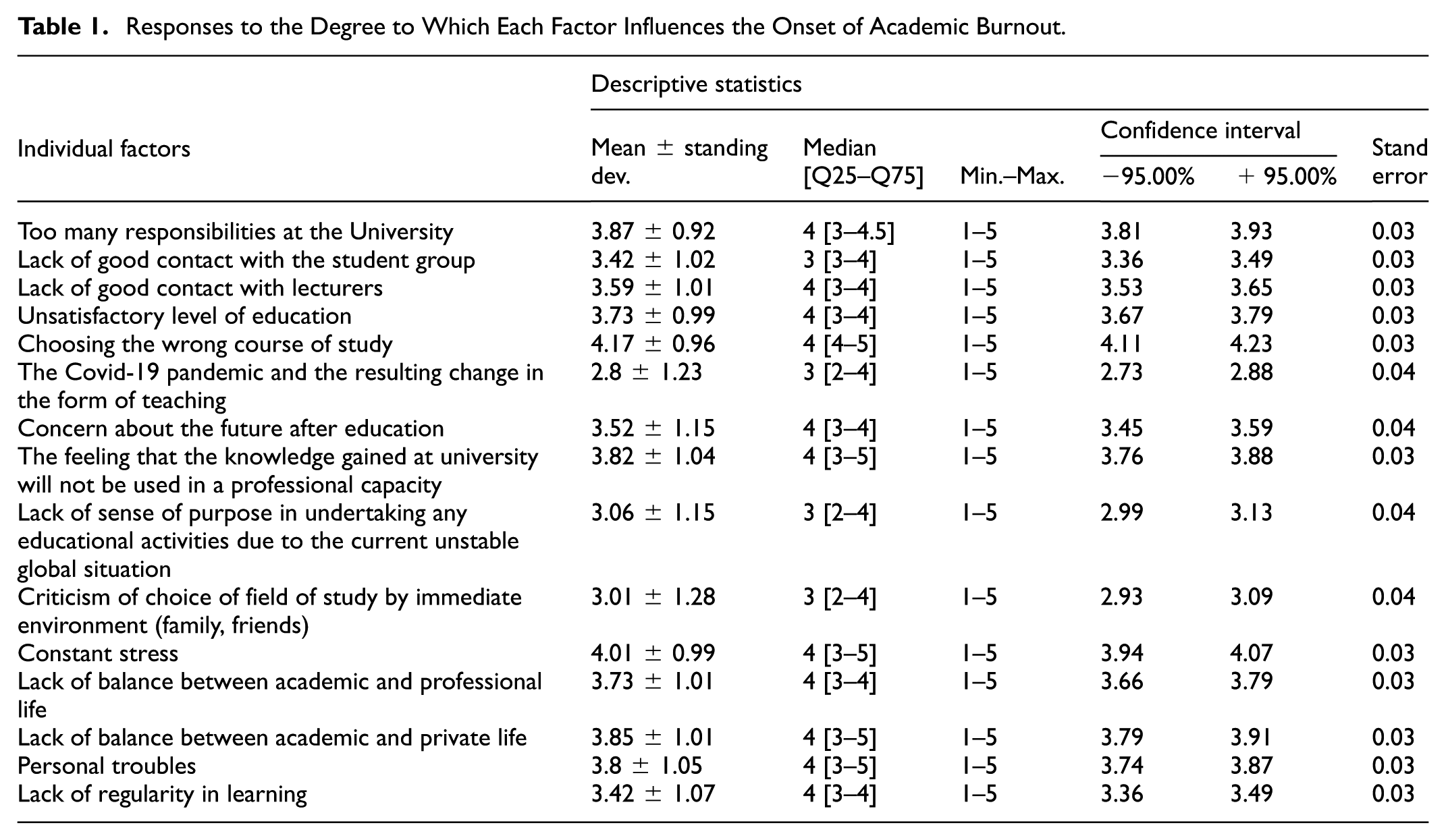
After recoding the responses on the degree of influence of individual factors on the emergence of academic burnout on a point scale, it turned out that the greatest influence was attributed by the students surveyed to the issue of choosing the wrong course of study (M = 4.17; SD = 0.96) and a slightly smaller influence to the factor of constant stress (M = 4.01; SD = 0.99). Next, in terms of importance, there were factors such as too many responsibilities at university (M = 3.87; SD = 0.92); lack of balance between academic and private life (M = 3.85; SD = 1.01); the feeling that the knowledge gained at university will not be used in one’s career (M = 3.82; SD = 1.04) and personal problems (M = 3.8; SD = 1.05).). Of less importance in terms of the appearance of academic burnout, the students surveyed perceived an unsatisfactory level of education (M = 3.73; SD = 0.99) and an imbalance between academic and professional life (M = 3.73; SD = 1.01). The next most significant factors were lack of good contact with lecturers (M = 3.59; SD = 1.01) and anxiety about the future after education (M = 3.52; SD = 1.15). The respondents attributed similar importance to the emergence of academic burnout to the problems of lack of regularity in the study (M = 3.42; SD = 1.07) and lack of good contact with the student group (M = 3.42; SD = 1.02). The factors with the least impact, according to the respondents, were the lack of sense of purpose in undertaking any educational activity due to the current unstable world situation (M = 3.06; SD = 1.15); criticism of the choice of study course by the immediate environment (family, friends) (M = 3.01; SD = 1.28) and, in particular, the Covid-19 pandemic and the resulting change in the form of teaching (M = 2.8; SD = 1.23). Detailed data are provided in Table 1.
Responses to the Degree to Which Each Factor Influences the Onset of Academic Burnout.
Most of the respondents had experienced academic burnout (64.10%). One in three respondents (35.90%) had not had this type of experience. Factors such as criticism of the students’ choice of field of study by their immediate environment (55.23%) and the Covid-19 pandemic and the resulting change in teaching format (43.68%) did not generally contribute to academic burnout in the students surveyed. In addition, respondents generally perceived no impact or reported a moderate impact on the onset of academic burnout from factors such as lack of good contact with the study group (31.05% and 23.71% respectively) and lack of sense of purpose to undertake any educational activity due to the current unstable global situation (29.17% and 24.34% respectively).
The main significant or moderate influence on the development of academic burnout in the respondents was the unsatisfactory level of education (24.80% and 24.49%, respectively); and significant or maximum influence was continuous stress (29.80% and 37.44%, respectively) and the imbalance of academic life (30.27% and 27.77%, respectively). Respondents were slightly more divided in their assessment of the impact of having too many responsibilities at the University, which was most often considered to be moderate, considerable and maximum (22.78%; 36.35% and 25.90% respectively). The same was true for the impact ratings of the feeling that the knowledge gained at university would not be used in a career (20.44%; 28.86% and 25.90% respectively). In the case of the other factors, the students surveyed were even more divided and a similar proportion of respondents rated the importance of each factor extremely differently.
The results of converting the ratings of the degree to which individual factors caused the respondents to develop academic burnout into a point scale indicate a relatively similar importance of each factor. Factors such as constant stress (M = 3.81; SD = 1.23), too many responsibilities at the University (M = 3.68; SD = 1.12) and lack of academic-life balance (M = 3.55; SD = 1.27) had the greatest impact on the development of academic burnout in the respondents. The students surveyed attributed slightly less importance to the feeling that the knowledge gained at university would not be used in their professional work (M = 3.45; SD = 1.31). The next most important factors in this respect were fear for the future after graduation (M = 3.1; SD = 1.44); lack of balance between academic and professional life (M = 3.09; SD = 1.42) and personal problems (M = 3.07; SD = 1.37). To a slightly lesser extent, factors such as unsatisfactory level of education (M = 2.96; SD = 1.32), lack of regularity in learning (M = 2.94; SD = 1.3) and lack of good contact with lecturers (M = 2.86; SD = 1.24) caused academic burnout in respondents. This was followed by factors such as a lack of sense of purpose in undertaking any educational activity due to the current unstable world situation (M = 2.63; SD = 1.35); choosing the wrong course of study (M = 2.59; SD = 1.39) and lack of good contact with the study group (M = 2.53; SD = 1.31). In contrast, the Covid-19 pandemic and the resulting change in teaching format (M = 2.3; SD = 1.38) and the criticism of the choice of major by the immediate environment (M = 2; SD = 1.33) had the least impact on the emergence of academic burnout in the students surveyed. Detailed data are provided in Table 2.
Degree in Which Individual Factors Cause Respondents to Develop Academic Burnout.

Then a multivariate cluster analysis was used to identify the groups of factors causing academic burnout in the respondents. The results of this analysis using an agglomerative method showed that, in assessing the extent to which individual factors caused academic burnout, students similarly referred to issues related to their choice of major and the situation in which they were in (choosing the wrong major; the Covid-19 pandemic and the resulting change in the form of teaching; not feeling a sense of purpose in undertaking any educational activity due to the current unstable world situation; criticism of their choice of major by their immediate environment). Another group of factors included issues of contact with others and the level of education (lack of good contact with the student group; lack of good contact with lecturers; unsatisfactory level of education). Another group of factors included issues related to concerns about the future (concern about the future after education; feeling that the knowledge gained at university will not be used in a career). A separate group of factors included those related to a lot of responsibilities and stress, and thus an imbalance in life (too many responsibilities at the University; constant stress; lack of balance between academic and professional life; lack of balance between academic and private life). The last and fifth group of factors were those related to personal learning opportunities (personal troubles; lack of regularity in studying).
The results of the cluster analysis using a non-hierarchical clustering of characteristics, so-called k-means clustering, fully matched the results of this analysis using the agglomeration method. The factors included in the individual groups showed that the issues related to the high number of responsibilities and stress, and consequently the lack of balance in life, were the most important for the emergence of academic burnout (MCluster4 = 3.53; SDCluster4 = 0.93); while the least important were the issues related to the chosen field of study and the situation the students faced in relation to the pandemic and instability in the world (MCluster1 = 2.38; SDCluster1 = 0.96). Detailed data are provided in Figure 1 and Table 3.

Dendrogram obtained for factors that lead to the emergence of academic burnout in subjects.
Clustering Elements for the Factors That Created Academic Burnout in the Respondents.

The identification of five clusters of factors that contribute to academic burnout allows the identification of areas for practical intervention. Factors related to responsibilities, stress and imbalance (cluster 4) indicate the need to support students in time management and to introduce solutions that promote academic-private life balance (e.g., flexible schedules, psychological support, mentoring). In turn, factors in the first group, concerning existential uncertainty and perceived relevance of studies, should prompt universities to take measures aimed at strengthening internal motivation and better aligning programmes with the needs of the labour market. The practical significance of the identified patterns can help in the implementation of targeted anti-burnout policies at the university level.
The symptoms of academic burnout present in the respondents to the greatest extent, that is, significant and maximum, were mental exhaustion (40.25% and 30.89%, respectively) and discouragement and lack of enjoyment in science (39.31% and 40.56%, respectively). Additionally, respondents generally felt, to a significant degree, a lack of motivation to take on any challenges both in the near and long term (36.97%) in relation to academic burnout. To a significant or moderate degree, respondents observed themselves experiencing symptoms of academic burnout in the form of physical exhaustion (30.89% and 28.39%, respectively) and deterioration in academic performance (24.18% and 31.20%, respectively). Feelings of helplessness as a symptom of academic burnout were mostly experienced by the surveyed students to a moderate, severe, and maximum degree (23.71%; 34.79% and 27.46% respectively). Long-term depression was generally not present in respondents (39.16%). On the contrary, in assessing the degree to which the other symptoms of academic burnout were present, study participants were more divided and similarly often indicated extremely different ratings.
Recoding the scores of the degree of occurrence of individual symptoms of academic burnout on a point scale showed that discouragement and lack of enjoyment of learning were the most perceived symptoms by the students surveyed (M = 4.15; SD = 0.88). To a lesser extent, the respondents observed mental exhaustion (M = 3.89; SD = 1.03), a sense of helplessness (M = 3.71; SD = 1.11) and a lack of motivation to take on any challenge both near and far (M = 3.7; SD = 1.07). Subsequent symptoms in this regard were a significant decrease in self-esteem (M = 3.29; SD = 1.35), physical exhaustion (M = 3.1; SD = 1.14) and deterioration in academic performance (M = 3.01; SD = 1.25) and personal situation (M = 2.92; SD = 1.3). In contrast, the symptoms perceived the least by the respondents of academic burnout included deterioration of relationships with the immediate environment (M = 2.74; SD = 1.3) and long-term depression (M = 2.54; SD = 1.48).
During the difficult period of academic burnout for the students surveyed, the greatest support was provided by friends (63.03%) and family (57.10%). Almost one in four respondents received such support from fellow students (23.71%); one in ten respondents received it from a psychologist or psychiatrist (10.14%); and the fewest received it from academic teachers and year supervisors, respectively (2.50% and 2.18%, respectively). Other sources of support during the difficult period of academic burnout were available to 7.64% of the respondents. On the contrary, almost one in five respondents (18.25%) did not receive relevant support.
When asked about overcoming academic burnout, the students surveyed were generally unable to make a clear assessment of this (44.46%). Almost one in five respondents did not rather overcome their academic burnout (19.97%) or managed to do so (19.03%). 12.32% of the respondents definitely did not overcome their academic burnout, while this was definitely the case for 4.21% of the respondents.
The vast majority of the students surveyed did not have the opportunity to express their opinion about academic burnout at their university (70.40%). This opportunity was provided to 29.60% of the respondents.
To counteract academic burnout, female and male students should – according to the respondents – first and foremost take care of the balance between academic and private life and between academic and professional life. Respondents most often considered both of these activities to be very important (44.20% and 30.10%, respectively) and important (33.80% and 37.60%, respectively). Additionally, respondents generally rated continually setting new goals to pursue in their current field of study (45.00%) and being precise about the benefits of studying in their current field of study (43.40%) as important activities. The respondents mostly considered it very important, important or moderately important (24.20%; 34.50% and 28.20%, respectively) to ensure regularity in studying to prevent academic burnout. In contrast, the change in study course when academic burnout occurs was generally moderately important by the respondents (39.80%).
As the most important, that is, rated as significant and very significant, actions necessary to be taken by the University in order to counteract the phenomenon of academic burnout among students, respondents considered demonstrating care for a good atmosphere during classes (36.00% and 43.40%, respectively) and during all activities related to studying and academic life (38.90% and 35.90%, respectively), as well as providing a place at the University for active rest (34.60% and 31.90%, respectively). The respondents rated the post-health activities of the HEIs as very important, important and moderately important, such as the continuous monitoring of the quality of the educational process, taking into account the opinions of students to a significant extent (27.90%; 36.00% and 24.20%, respectively) and the provision of comprehensive psychological support in the HEIs for students regarding academic burnout (28.00%; 32.80% and 25.90%, respectively). Encouraging students by the HEIs to actively participate in academic events (e.g., fairs, events, festivals) is mostly significantly or moderately important according to the respondents (33.10% and 26.30%, respectively). On the other hand, activities involving the organisation of regular information meetings on the phenomenon of academic burnout were generally rated by respondents as significant, moderately significant, and insignificant (20.10%; 26.40% and 33.20%, respectively).
The results of the opinions on the measures that the university should take to counteract the phenomenon of academic burnout among students, encoded on a point scale, indicate that, in the opinion of the respondents, the most necessary measures are ensuring a good atmosphere during classes (M = 4.17; SD = 0.9) and during all activities related to study and academic life (M = 4.03; SD = 0.94). The respondents placed slightly less importance on measures related to providing places for active rest in the University building (M = 3.85; SD = 1.05), continuous monitoring of the quality of the educational process, taking into account, to a significant extent, the opinions of the students (M = 3.77; SD = 1.04) and providing comprehensive psychological support for students in the field of academic burnout in the University building (M = 3.71; SD = 1.09). The final place in this regard was to encourage students to actively participate in academic events (e.g., fairs, parties, festivals) (M = 3.44; SD = 1.14). On the other hand, the respondents attributed the least importance in the context of counteracting academic burnout among students to the University’s activities related to the organisation of regular information meetings on this phenomenon (M = 2.73; SD = 1.1).
Relationship Between Overcoming Academic Burnout and Opinions on Actions Students Need to Take to Counteract the Phenomenon
The overcoming of academic burnout by the students surveyed had an impact on their opinions on some of the actions that students needed to take to counteract this phenomenon. As the analysis with the Kruskal-Wallis test showed, overcoming academic burnout statistically significantly differentiated the evaluation of the importance – in the context of counteracting this phenomenon – of activities such as continuously setting new goals to pursue in the current field of study. H(2, N = 641) = 25.03; p < .001; ε2 = 0.04; Identifying the benefits of studying in one’s current field of study: H(2, N = 641) = 13.28; p < .01; ε2 = 0.02; taking care to be systematic in your studies: H(2, N = 641) = 15.46; p < .001; ε2 = 0.02; Attention to balance between academic and professional life: H(2, N = 641) = 10.17; p < .01; ε2 = 0.02; and between academic and private life: H(2, N = 641) = 6.28; p < .05; ε2 = 0.01. A post hoc test showed that those who had not managed to overcome academic burnout attributed less importance to continually setting new goals for themselves to pursue in their current field of study (MNot = 3.12; SDNot = 1.07) than those who had overcome the aforementioned phenomenon or were not able to clearly assess it (MYes = 3.63; SDYes = 0.94 and MDifficult to say = 3.48; SDDifficult to say = 0.89); and also in the former group, less importance was attributed to precisely defining the benefits of studying in the current field of study (MNot = 3.35; SDNot = 1.03; other groups: MYes = 3.63; SDYes = 0.96 and MDifficult to say = 3.66; SDDifficult to say = 0.92). According to the results of the post hoc test, students who had not overcome academic burnout perceived the importance of activities related to making sure that they were systematic in their studies to a lesser extent than those who were unable to explicity assess this (MNot = 3.3; SDNot = 1.2 and MDifficult to say = 3.73; SDDifficult to say = 1.01) and about the balance between academic and professional life (MNot = 3.66; SDNot = 1.15 and MDifficult to say = 4; SDDifficult to say = 0.94). Although some of the results obtained showed statistical significance, their effect size was relatively small (ε2 = 0.01–0.04), suggesting a moderate strength of the relationship. An example is the assessment of the importance of activities such as regularity in studying or maintaining a balance between academic and professional life, which differentiated groups of students according to whether they had overcome academic burnout. Despite the low statistical effect, these differences may be of practical importance, as they signal that even small changes in the perception of one’s own strategies can influence the process of coping with burnout. These results indicate a need to support students not only through systemic measures but also in developing self-awareness and self-reflection on their daily academic habits. In contrast, when assessing the importance of maintaining academic-life balance, the post hoc test did not identify pairs of groups that differed.
However, the opinion of the students surveyed about a major change in a situation of academic burnout as an action necessary for the students to take to counteract this phenomenon was not dependent on the issue of overcoming academic burnout. The analysis the different groups distinguished in terms of overcoming the above-mentioned phenomenon, the importance of changing the field of study in a situation of feeling academically burnt out was rated very similarly, at levels ranging from MDifficult to say = 2.84; SDDifficult to say = 1 to MNot = 2.87; SDNot = 1.18. Analysis with the Kruskal-Walli’s test showed that there were no statistically significant differences in this respect between the aforementioned groups: H(2, N = 641) =0.09; p = .958; ε2 = 0.00.
Model of Conditions Conducive to Academic Burnout in Different Groups of Students
The final stage of the analysis carried out was the construction of a model of the conditions conducive to academic burnout in different groups of students using PROFIT (PROperty FITting) analysis. This research was aimed at finding out the conditions under which groups of students distinguished by the form and level of study are the most at risk of academic burnout, and thus the conditions they should avoid.
Within the framework of the present investigation, the objects analysed in the developed model were groups of students: Full-time first-degree students (S-1); Full-time second-degree students (S-2); Part-time first-degree students (N-1); Part-time second-degree students (N-2).
On the other hand, the variables (traits) were the individual factors of academic burnout in terms of the extent to which they contributed to the development of the phenomenon mentioned above in the students surveyed, such as the following. The variables (characteristics) were the individual factors of burnout in terms of the extent to which they contributed to the phenomenon in the students surveyed, such as: Too many responsibilities at the University (C1); Lack of good contact with the student group (C2); Lack of good contact with lecturers (C3); Unsatisfactory level of education (C4); Choosing the wrong course of study (C5); Covid-19 pandemic and the resulting change in teaching form (C6); Concern about the future after graduation (C7); Feeling that the knowledge gained at university will not be used in one’s career (C8); Lack of sense of purpose in undertaking any educational activity due to the current unstable situation in the world (C9); Criticism of the choice of field of study by the immediate environment (family, friends) (C10); Constant stress (C11); Lack of balance between academic and professional life (C12); Lack of balance between academic and private life (C13); Personal troubles (C14); Lack of regularity in studying (C15).
To develop the model, the average scores of the degree to which each factor causes academic burnout were used in the above groups, as shown in the Table 4.
Average Ratings of the Degree to Which Each Factor Causes Academic Burnout in Groups Distinguished by Form and Level of Study.
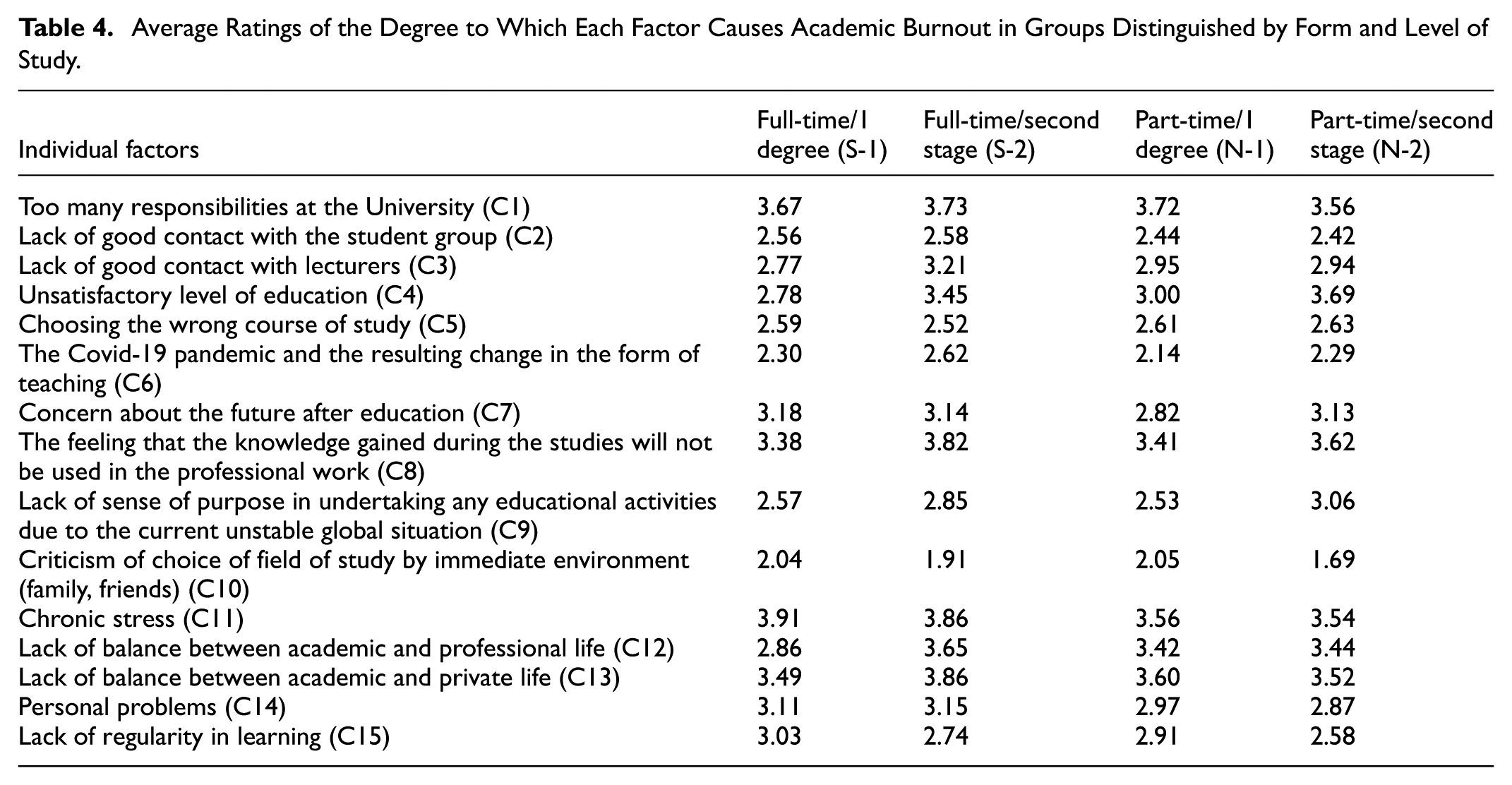
As part of the construction of a model of conditions conducive to the phenomenon of academic burnout among students in relation to the form and level of study, multidimensional scaling was first performed to develop a graphical presentation of the structure of similarity (or dissimilarity) between the analysed objects in relation to a selected set of variables (traits). Due to the identical nature of the analysed characteristics (5-point Likert scale) as variables, there was no need to standardise them. During multidimensional scaling, the classical Euclidean distance was used, and, consequently, the 15 characteristics describing the four studied objects were reduced to two dimensions. The STRESS coefficient for multidimensional scaling including all features was 0.00, indicating a high reliability of the results of the multidimensional scaling procedure. It turned out that each of the four groups of students studied differed from the others in terms of the degree to which individual factors caused them to suffer from academic burnout, with the groups of full-time and part-time first-degree students being the most similar in this respect. This was followed by verification of the fit of the individual items. As part of this research, a regression analysis was performed in which the explanatory variable was the subsequent factors that caused academic burnout and the explanatory variables were the values of the two dimensions for each individual, obtained by multidimensional scaling: Dim. 1 and Dim. 2. As a condition to consider a given organisational behaviour as key, it was assumed that it had a fit of R2 > .70. The results of this analysis are presented in the Table 5.
Results of Regression Analysis Between Individual Factors That Cause Academic Burnout and the Resulting Dimensions of the Units Studied.
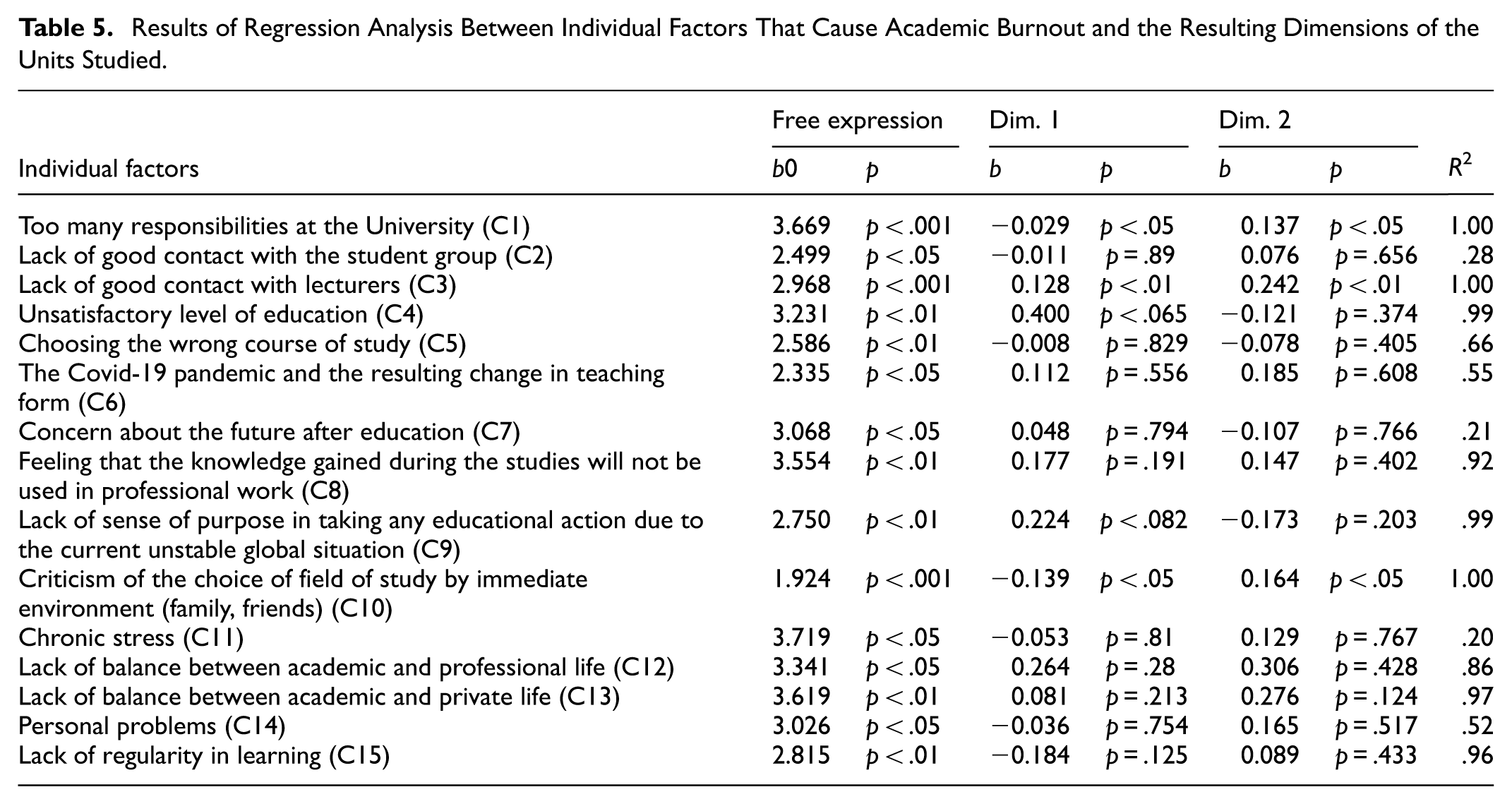
Based on the values obtained from the determination coefficients in the regression analyses, it was found that the factors influencing the differentiation of the studied individuals (in terms of the degree of causing academic burnout) were the following: Too many responsibilities at the University (C1); Lack of good contact with lecturers (C3); Unsatisfactory level of education (C4); Feeling that the knowledge gained at university will not be used in one’s professional work (C8); Lack of sense to undertake any educational activities resulting from the current unstable situation in the world (C9); Criticism of the choice of field of study by the immediate environment (family, friends) (C10); Lack of balance between academic and professional life (C12); Lack of balance between academic and private life (C13); Lack of regularity in studying (C15).
The final stage in the construction of the model on the conditions that foster academic burnout among students in relation to the form and level of study was the PROFIT analysis. The results of this analysis are presented in Figure 2. As can be read, first-degree full-time students were at the lowest risk of academic burnout; second-degree students, particularly full-time students, were the opposite in this respect. In the former group mentioned above, the factor most likely to cause academic burnout was the lack of regularity in the study (C15), with the importance of this factor being relatively low compared to first-degree part-time students. Those in the latter group felt academic burnout significantly due to the lack of regularity in study (C15) and criticism of their choice of major by their immediate environment (C10); slightly less so due to too many responsibilities at the university (C1). Second-degree full-time students experienced academic burnout significantly due to a lack of good contact with lecturers (C3); a lack of balance between academic and professional life (C12), and a feeling that the knowledge gained at university will not be used in their professional work (C8); slightly less so due to a lack of balance between academic and private life (C12). In contrast, part-time students of the second-degree were at risk of academic burnout, particularly due to the lack of sense of purpose in carrying out any educational activities resulting from the current unstable world situation (C9) and the unsatisfactory level of education (C4). It should be added here that all factors that exposed second-degree students to academic burnout, irrespective of their form of study, were particularly distant from first-degree full-time students in this respect.

Multidimensional scaling results for individual sites (groups distinguished by form and level of study) including all characteristics.
Research on Academic Burnout Considering the Literature
An analysis of the literature shows that studies conducted to measure academic burnout among students relatively often include medical students, as these studies are associated with enormous stress (Ilic & Ilic, 2024) and burnout syndrome among this group is becoming a common and serious problem (Kuehn et al., 2023). The most used tool for this purpose is the Maslach Burnout Inventory-Student Survey (Zupančič et al., 2024), which details three dimensions of academic burnout: cynicism, emotional exhaustion, and lack of efficacy (Schaufeli et al., 2002). The dimension of emotional exhaustion is associated with excessive educational demands, cynicism is based on an indifferent attitude towards academic activities and reduced academic effectiveness is related to an underestimation of personal competence (Kiss & Pikó, 2025). The original questionnaire presented in this manuscript addresses these three dimensions. The dimension of emotional exhaustion includes not only the factors that contribute to the emergence of this phenomenon, but also its symptoms. Cynicism and reduced academic effectiveness, on the other hand, are mainly based on its symptoms. Among other things, an interesting relationship can be pointed out here, demonstrated by a study conducted among 1977 Chinese medical students. Their main objective was to assess the impact of academic adaptation on academic performance. The results of the study showed that higher levels of academic adaptability are associated with lower levels of burnout and associated higher levels of academic performance of students (Xie et al., 2019). These results are consistent with those obtained in Poland, as research shows that choosing the wrong study field (according to 45.6% of the respondents) and the associated lower level of university adaptation contribute to the phenomenon of academic burnout. In turn, a study of 202 medical and dental students entering Portuguese universities found that behaviours such as perfectionism, repetitive negative thinking, and self-compassion correlate not only with each other but also with burnout (Cabaços et al., 2023). These data may be partially related to the results obtained in Poland, as the negative thinking of the respondents associated with the feeling that the knowledge gained during their studies will not be used in their work contributes to the development of academic burnout (the respondents mostly attributed a maximum (5) or significant (4) impact (30.20% and 35.70%, respectively).
An interesting approach to academic burnout is presented in a study conducted among 97 medical students who obtained their education at a Korean university. It found that the degree of academic burnout experienced by first- and second-year students was higher than that experienced by students studying in subsequent years (J. Yu & Chae, 2020). The situation in Poland is slightly different in this regard. Second-cycle students, especially full-time students, are most at risk of academic burnout due to lack of good contact with lecturers, an imbalance between academic, professional and private life, and the feeling that the knowledge acquired during their studies will not be used in their professional life.
It is worth noting at this point that a way to counteract academic burnout among students in this field of study may be their participation in arts programmes (Volpe et al., 2022).
The tool to measure academic burnout was also used in a study focused on identifying this phenomenon among 114 nursing students entering a Brazilian university. Their analysis showed that the syndrome in question was identified in 10.5% of respondents (Galdino et al., 2020).
In contrast, a survey of 22,983 students in Heilongjiang province, China, looked to assess the current level of academic burnout among them and the factors that influence this phenomenon. The results show that more than half of the students experienced academic burnout. This was related to, among other things, the pressure of studying and the current level of interest in the knowledge being acquired (Liu et al., 2023). These results are consistent with those obtained in Poland, as most respondents experienced academic burnout (64.10%).
Research related to academic burnout is of great importance, as it not only analyses the causes and symptoms of this phenomenon, but also indicates preventive measures that can be taken by both students and institutions. This will influence the’ motivation of students to pursue lifelong learning and improve their quality of life in all areas.
The limitation of this study is the use of only a questionnaire, which, despite the large sample size, limits the depth of understanding. Lack of a qualitative element (e.g., individual interviews) prevents a more complete understanding of the complexity of coping mechanisms for burnout. Additionally, the questionnaire was not subjected to a complete psychometric validation process (including factor analysis), which limits the possibility of unequivocally confirming the validity of the construct. The sample was also not regionally diverse, which may affect the generalisability of the results on a national scale.
Future research should not only use a mixed approach, supplemented by a qualitative component, but also fully validate the measurement tools, both through factor analysis and comparison with verified, standardised scales measuring academic burnout. Consideration should also be given to the possible adaptation of existing psychometric tools to the conditions of Polish higher education.
Conclusions
The scale of academic burnout among university students in Poland is high. According to students of higher education institutions in Poland, choosing the wrong course of study and constant stress have the greatest impact on the emergence of academic burnout; a large number of responsibilities in the university, an imbalance between academic and private life and a feeling of lack of prospects of using the knowledge gained at university in professional work are slightly less important in this respect.
Academic burnout in tertiary students in Poland manifests itself primarily as discouragement and lack of enjoyment of learning; somewhat less so as mental exhaustion, a sense of helplessness and a lack of motivation to take on any challenges in both the near- and long term.
Students’ underestimation of the importance of preventive measures towards academic burnout makes it more difficult for them to overcome this problem when it affects them. Students who have not managed to overcome academic burnout attribute less importance, in terms of counteracting the aforementioned phenomenon, to continuously setting new goals to pursue in their current field of study; to precisely identify the benefits of studying in their current field of study; to take care to be systematic in their studies, to balance their academic and professional lives and between their academic and private lives.
First-degree full-time students are the group most resistant to academic burnout, and the factor most likely to cause them to develop the problem is the lack of regularity in their studies. Second-degree students, particularly full-time students, are the most vulnerable to academic burnout. For first-degree part-time students, academic burnout occurs under conditions of lack of regularity in study, criticism of their choice of major by their immediate environment and too many responsibilities at the University. Second-degree full-time students are prone to academic burnout because of a lack of good contact with lecturers, a lack of balance between academic and professional and private life and a feeling that the knowledge gained at university will not be used in their professional work. In contrast, for part-time second-degree students, academic burnout occurs in the absence of a sense of purpose in undertaking any educational activity resulting from the current unstable world situation and unsatisfactory levels of education.
To counteract the phenomenon of academic burnout, students should, according to the respondents, first and foremost maintain a balance between their academic and private lives, as well as between their academic and professional lives. Furthermore, respondents generally considered it important to continually set new goals for themselves in their current field of study and to precisely define the benefits of studying in their current field. Maintaining regularity in study to counteract academic burnout is, in the opinion of the respondents, mostly very important, important or moderately important.
The respondents considered that the most important, that is, important and very important, measures to be taken by the University to counteract academic burnout among students are ensuring a good atmosphere during classes and during all activities related to studying and academic life, as well as providing a place for active rest on the University premises. Respondents rated as very important, important and moderately important measures such as continuous monitoring of the quality of the educational process, considering to a significant extent the opinions of students and providing comprehensive psychological support for students in the field of academic burnout on the University premises.
It should be noted that terms such as ‘most resilient’ or ‘most vulnerable’ to academic burnout refer only to the average trends resulting from the statistical analysis used. They are not evaluative labels for individuals or groups, but rather abbreviations that describe differences between respondents’ categories in light of quantitative analyses. The authors fully recognise that the level of susceptibility to academic burnout can be significantly modified by individual coping strategies, life circumstances and socioeconomic conditions, which were not the direct subject of this study. For this reason, the interpretation of the results should consider their average nature and the need for further and more in-depth qualitative research.
The manuscript has some limitations; first, the research was conducted in Poland and second, only in universities. Future research may include other countries as well as primary and secondary schools to compare the results obtained and build a common model of the relationship of academic burnout by grade level and different regions of the world.
The presented study used a proprietary questionnaire, whose reliability was confirmed by a high Cronbach’s alpha coefficient (.89). However, it should be emphasised that this tool has not undergone a full validation procedure. This means that its construct validity and the possibility of directly comparing the results with other studies using standardised questionnaires may be limited. Consequently, the results obtained should be interpreted primarily as a reflection of the subjective perceptions of the respondents in the context of the definition of academic burnout adopted in the study. In the future, it is advisable to carry out a full validation of the tool and/or use validated measures, which would allow for an in-depth analysis of the phenomenon and enable international comparisons. Furthermore, to enrich the knowledge on academic burnout, the authors plan to use existing tools in future research, such as the Maslach Burnout Inventory (MBI).
Footnotes
Ethical Considerations
According to our University Ethical Statement, the following shall be regarded as research requiring a favourable opinion from the Ethics Commission in the case of human research (based on a document in Polish:  [accessed on 10 October 2024]): Research in which persons with limited capacity to provide informed consent or research on persons whose capacity to provide informed or free consent to participate in research and who have a limited ability to refuse research before or during its implementation, in particular – children and adolescents under 12 years of age; persons with intellectual disabilities; persons whose consent to participate in the research may not be fully voluntary, including prisoners, soldiers, police officers and employees of companies (when the survey is conducted at their workplace); and persons who agree to participate in the research on the basis of false information about the purpose and course of the research (masking instruction, i.e., deception) or do not know at all that they are subjects (in so-called natural experiments). Research in which persons particularly susceptible to psychological trauma and mental health disorders are to participate, in particular – mentally ill persons; victims of disasters, war trauma, etc.; patients receiving treatment for psychotic disorders; and family members of terminally or chronically ill patients. Research involving active intervention in human behaviour aimed at changing that behaviour without direct intervention in the functioning of the brain, for example, cognitive training, psychotherapy and psychocorrection (this also applies if the intervention is intended to benefit the subject [e.g., to improve his/her memory]). Research concerning controversial issues (e.g., abortion, in vitro fertilisation, the death penalty) or requiring particular delicacy and caution (e.g., concerning religious beliefs or attitudes towards minority groups). Research that is prolonged, tiring, or physically or mentally exhausting. Our research was not conducted on humans meeting the abovementioned condition. None of the participants had a limited capacity to provide informed consent, were susceptible to psychological trauma or had mental health disorders, and the research did not concern any of the abovementioned controversial issues and was not prolonged, tiring, or physically or mentally exhausting. The survey research was conducted in accordance with the ethical principles of conducting research with human participants based on the guidelines of the Helsinki Declaration.
Consent to Participate
Written informed consent was obtained to participate in the study.
Funding
The authors disclosed receipt of the following financial support for the research, authorship, and/or publication of this article: The research received funding under the research subsidy of the Faculty of Organization and Management of the Silesian University of Technology in Poland for the year 2025 (BK- 258/ROZ2/2025).
Declaration of Conflicting Interests
The authors declared no potential conflicts of interest with respect to the research, authorship, and/or publication of this article.
Data Availability Statement
The data will be made available upon request sent to the corresponding author.