




Abstract
Copenhagen Burnout Inventory (CBI) is a tool assessing fatigue and exhaustion as the core features of burnout. Despite its wide use and evidence of good psychometric properties, little is known about its structural validity. Therefore, this study aimed to examine internal psychometric properties and the latent composition of the Serbian version of CBI. A sample of 382 child welfare workers engaged in the work with the domestic population and professionals working with refugees and migrants completed a 19-item version of CBIser. Results showed that full-scale CBI despite having good psychometric properties lacks structural validity. A short-form of the instrument was empirically derived and several concurrent confirmatory models found in previous studies were tested. A three-factor model of personal, work-, and client-related burnout showed to be the best fitting one, and the 13-item form of CBI proved to be a structurally valid and psychometrically sound measure of burnout.
World Health Organization included burnout in the 11th edition of the International Classification of Diseases (ICD-11) as an occupational phenomenon not classified as a medical condition (WHO, 2019). ICD-11 conceptualize burnout as a syndrome resulting from prolonged work-related stress that has not been successfully managed. According to ICD-11, it is characterized by three dimensions: (1) feelings of energy depletion or exhaustion; (2) increased mental distance from one’s job or feelings of negativism or cynicism related to one’s job; and (3) reduced professional efficacy (WHO, 2019).
This conceptualization of the syndrome is highly similar to the initial Maslach’s definition by which burnout is understood as a psychological syndrome that can be described along three separate dimensions—exhaustion which represents a core dimension of burnout (loss of energy, wearing out, depletion, debilitation, and fatigue), feelings of cynicism and detachment from the job (depersonalization, detached concern, loss of idealism, negative attitudes, withdrawal, irritability), a sense of professional inefficacy, and a lack of accomplishment (reduced efficiency or capability, inability to cope with stressors, low morale) (Leiter & Maslach, 2016; Maslach & Jackson, 1986).
Once the concept of burnout syndrome was initially established, The Maslach Burnout Inventory (MBI) (Maslach & Jackson, 1986) and its varieties became the most dominant instrument for the assessment of this construct. By some estimations, in the period from its introduction as a measure of burnout up to the late ‘90, this instrument has been used in more than 90% of all empirical studies on this topic (Schaufeli & Enzmann, 1998). A meta-analysis of the factor-analytic studies that used Maslach’s instruments conducted on 45 studies with diverse populations of professionals concluded that empirical results support the three-factor latent structure of the instrument (Worley et al., 2008). Although initially characterized as uncorrelated (Maslach & Jackson, 1981), empirical data showed that three factors of burnout stand in moderate intercorrelations (Worley et al., 2008).
However, numerous conceptual and practical issues raised regarding this measure (see e.g., Demerouti et al., 2003; Halbesleben & Demerouti, 2005; Kristensen et al., 2005) led to the development of new tools for the assessment of burnout construct. One of those widely used measures is the Copenhagen Burnout Inventory (CBI) (Kristensen et al., 2005).
In contrast to the MBI that includes three dimensions of burnout, the CBI focuses on the attribution of fatigue and exhaustion as a core feature of burnout (Borritz et al., 2006; Kristensen et al., 2005). The CBI does not measure reduced personal accomplishment and depersonalization/cynicism, although the authors of the instrument encourage studying these aspects as distinct phenomena that are related to, but not central to the burnout syndrome. The instrument assesses burnout in three domains: personal, work-related, and client-related burnout (Kristensen et al., 2005).
The personal burnout is a generic burnout scale that assesses “the degree of physical and psychological fatigue and exhaustion experienced by the person” (Kristensen et al., 2005, p. 197). The work-related burnout subscale measures “the degree of physical and psychological fatigue and exhaustion that is perceived by the person as related to his/her work” (Kristensen et al., 2005, p. 197). Finally, the client-related burnout subscale assesses “the degree of physical and psychological fatigue and exhaustion that is perceived by a person as related to his/her work with clients” (Kristensen et al., 2005, p. 197). Therefore, two latter subscales differ in terms of attribution of one’s exhaustion and fatigue to different factors—to work as a whole or work with people. In general, studies show that these three domains are moderately correlated.
This public domain instrument is widely used as a measure of burnout, translated into numerous languages, and used in a variety of populations (see Appendix A). Numerous studies reported CBI having excellent psychometric properties with internal consistencies for personal burnout ranging from 0.78 to 0.93 (mean α .89), work-related burnout ranging from 0.77 to 0.93 (mean α .87), and client-related burnout ranging from 0.78 to 0.93 (mean α .86) across studies (Appendix A). Full-scale internal consistency, whenever reported, exceeded 0.89, indicating a relatively focal and reliable assessment of the construct.
In the initial paper on the development of CBI, the authors expressed their skepticism regarding the factor structure of the instrument stating that “the rationale for having three distinct scales is not statistical but theoretical and methodological” (Kristensen et al., 2005), and that the domains of CBI can be used independently depending on the aim of the study, domain/s of interest, and population studied. However, we believe that every psychological assessment tool besides having acceptable reliability has to meet other essential psychometric criteria such as high homogeneity within its respective domains and a certain level of divergence from other postulated domains in order to be evaluated and characterized as measures of distinct yet related aspects of the construct.
Studies addressing the question of the latent structure of the CBI using either exploratory (EFA) or confirmatory factor analysis (CFA) resulted in inconclusive findings. Namely, some studies found the initial three-factor solution to fit the data well (Andrew Chin et al., 2018; Fong et al., 2014; Lapa et al., 2018; Milfont et al., 2008; Phuekphan et al., 2016), although few of them had to exclude some of the items to achieve an acceptable fit (Fiorilli et al., 2015; Javanshir et al., 2019). Furthermore, in some of the studies concluding that a three-factor solution has a good fit, authors introduced ad hoc modifications to the model to achieve a satisfactory fit by allowing for a number of error covariances both within as well as between domains, leading to inflation of relevant fit indices, thus arising the question of the factorial validity of the instrument (e.g., Andrew Chin et al., 2018; Fong et al., 2014; Lapa et al., 2018; Phuekphan et al., 2016; Walters et al., 2018).
Moreover, studies that used only two subscales (e.g., personal and work-related burnout Yeh et al., 2007) found evidence on their two-factor structure but at the same time provided insufficient evidence on their empirical differentiation as some of the items highly loaded on both factors while other did not load on their respective factor. Additionally, previous studies pointed to the empirical distinction between two aspects of work-related burnout, namely, work frustration and work exhaustion (Yeh et al., 2007). Also, some empirical data suggest that four instead of three latent factors underlie the CBI—personal, client-related, while work-related burnout exhibits insufficient homogeneity splitting into two work-related latent dimensions, namely work-characteristics-related and work-distaste-related burnout (Mahmoudi et al., 2017). Moreover, some data showed that the distinction between personal and work-related burnout is potentially insufficient, thus questioning the differentiation between these factors on the latent level (Lapa et al., 2018; Milfont et al., 2008). Finally, due to moderate to high correlations between three CBI factors a few studies examined a hierarchical latent structure of the CBI and demonstrated that the model with higher-order general factor of burnout model has a fair fit (Lapa et al., 2018; Milfont et al., 2008; Phuekphan et al., 2016).
Given the wide usage of the CBI as a measure of burnout and the utilization of its aspects in the assessment of relatively focal aspects of the construct which are predominantly based on their face validity and limited empirical evidence on their structural validity, it seems necessary to investigate the latent structure of this instrument in more detail. Therefore, this study aims to examine internal psychometric properties and the latent structure of the Serbian version of CBI (CBIser) in order to contribute to the existing empirical evidence on its psychometric quality as well as to provide evidence on the suitability of its subscales as measures of distinct burnout domains. Within the current study, the psychometrical evaluation of the newly adapted CBIser is presented by contrasting several conceptual and empirical models of the structural composition of CBI found in the literature. The structural validity of the CBIser is tested on a sample of participants involved in “people work” which represents a population at especially high risk of suffering from burnout-related difficulties (Maslach & Jackson, 1981).
Method
Participants
The information about the study was advertised through social welfare workers associations and centers, humanitarian organizations, and continuous educational programs between 2015 and 2019. A convenient sample of 382 participants (46.1% females), age ranging from 22 to 62 (M = 38.13, SD = 10.64) took part in the study. A sample consisted of two groups of participants—child welfare workers predominantly engaged in the work with the Serbian domestic population (35.3%) in the Belgrade area, and professionals predominantly engaged in the work with refugees and migrants passing through the Balkan route (64.7%) who were accommodated in transit or asylum centers across Serbia. The first group of participants consisted of individuals from helping professions employed in four child welfare services, working as care workers in residential homes for children and youth, caseworkers engaged in selection and training of prospective foster families, bringing together foster families and children and following and supporting children in foster families, and short term emergency residential care workers. The sample included: social workers, psychologists, special educators, pedagogues, speech therapists, and medical nurses. The latter group of participants consisted of people of various educational backgrounds involved in providing diverse types of assistance and services to refugees and migrants such as psychological support, legal assistance, cultural mediation, medical assistance, provision of food and non-food items, prevention and identification of human trafficking, etc. After obtaining informed consent, participants filled out a paper version of the instrument either at the workplace or at community centers.
Instrument
All items of the CBI (Kristensen et al., 2005) were backward translated by three researchers fluent in both English and Serbian. Due to the easily understandable and easy to answer nature of CBI items, after backward translation, there was no need for special language or cultural adaptations of individual items. Full 19-item CBI (Appendix B) measuring personal burnout (six items), work-related burnout (seven items), and client-related burnout (six items) were administered in the same order as originally intended alongside a 5-point scale (1—never/almost never/to a very low degree; 5—always/to a very high degree). For all items, higher ratings reflect the higher degree of given burnout-related difficulty, except for item 13 which is reverse scored. CBI score/s is calculated by averaging the items so the higher score indicates more severe levels of burnout.
Data Analysis
Data analysis was performed using IBM SPSS for Windows, Version 21. Descriptive statistics were used to examine distributions of scores of the initial CBI subscales and their total score. An average value of 3 was used as the cutoff score (corresponding to the cutoff of 50 used in previous studies) for elevated burnout levels (moderate and higher) (Borritz a Kristensen, 2004). Rtt10g macro for SPSS (Knežević & Momirović, 1996) was used to calculate internal psychometric characteristics of the instrument, for both scale- and item-level analyses. For the scale-level analyses item sampling adequacy (Kaiser-Meyer-Olkin, KMO), internal consistencies (Cronbach alphas, α), average inter-item correlations (H1), and the proportion of variance of reliable components (eigenvalues higher than 1) accounted for by the first principal component (H5) served as an indicator of homogeneity. On the item level, proportions of the variance of each item accounted for by the remaining items were used as indicators of item reliability, while principal component loadings (H) and item-total correlations (B) served as indices of internal validity.
Confirmatory factor analyses (CFA) were performed using IBM SPSS Amos for Windows, Version 21, and maximum-likelihood estimation. To evaluate the latent compositions of each domain separately, four partial CFAs were performed, namely, unidimensional models of personal, work-, and client-related burnout, as well as the two-factor model of work-related burnout distinguishing between work exhaustion and work frustration (Yeh et al., 2007). Modification indices (χ2 change) and correlations of error terms were inspected for any signs of poor local fit and items exhibiting substantial error covariances were eliminated. After eliminating items with substantial covariances of errors following five full models of burnout were tested: (1) a single-factor unidimensional model of burnout; (2) a two-factor model of burnout with personal and work-related burnout factors merged into a single dimension, and client-related factor as a separate dimension; (3) a three-factor model of personal, work-, and client-related burnout; (4) alternative three-factor model of personal, work-, and client-related burnout with item 13 loading on the personal instead of work-related factor (see Mahmoudi et al., 2017); and (5) a four-factor model of burnout including personal, work-characteristics-related, work-distaste-related, and client-related burnout (Mahmoudi et al., 2017). For the testing of all multi-factor models, inter-factor covariances were freely estimated. Following fit indices were consulted to assess the degree to which the data fit specified models, namely, χ2 statistic, Comparative Fit Index (CFI), Tucker-Lewis Fit Index (TLI), Root Mean Square Error of Approximation (RMSEA), and Standardized Root Mean Square Residual (SRMR). The following criteria for good fit were used—TLI and CFI ≥ 0.95, RMSEA < 0.06, and SRMR < 0.08 (Hu & Bentler, 1999).
Results
One-third of the sample (33.0%) demonstrated moderate to high levels of burnout. Descriptive statistics for individual items are presented in Appendix B, while Table 1 presents the descriptive statistics of the CBI total score and its domains. As can be seen, the theoretical range of scores on the individual subscales and the total score was mostly covered to the full extent. All the CBI subscales and the total score showed symmetrical distributions. However, client-related burnout and CBI total score showed slight deviations from the normal distribution as indicated by standardized kurtosis.
Descriptive Statistics for the Three Domains of CBI and Total Score.
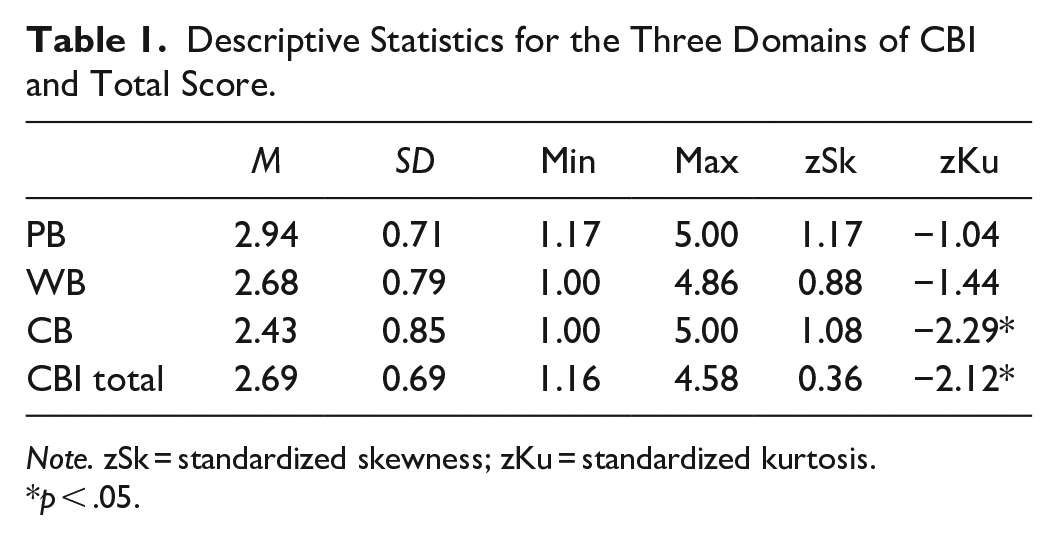
Note. zSk = standardized skewness; zKu = standardized kurtosis.
p < .05.
To examine the internal psychometric properties of the CBI, analyses were conducted on a full-scale, domain-, and item-level. CBI demonstrated high item sampling adequacy indices pointing to the high representativeness of all of its domains (Table 2). Similarly, reliability indicators (Cronbach’s alpha) for personal, work-related, client-related burnout, and CBI total score proved to be high. Finally, the proportion of the variance accounted for by the first principal component relative to all reliable components indicated maximal homogeneity for each of the CBI domains.
Psychometric Properties of the CBI.

Note. KMO = Kaiser-Meyer-Olkin sampling adequacy; α = Cronbach’s alpha; H1 = average inter-item correlation; H5 = homogeneity measure.
Item analysis (Table 3) showed that most of the items demonstrate excellent internal psychometric properties. Namely, item sampling adequacy for all items exceeded 0.95, while the proportions of the variance of individual items accounted for by the remaining CBI items (reliability indicators) have shown to be rather high, exceeding 60% for most of them. Finally, the values of principal component loadings and item-total correlations pointed to the high convergence of individual items toward the joint object of measurement.
Psychometric Characteristics of CBI Items.

Latent Structure of the CBIser
To examine the latent composition of the CBI, several item-level CFAs were performed, testing a priori defined structural models found in previous studies. Firstly, three partial models of individual domains were tested, namely unidimensional models of personal, work-, and client-related burnout, as well as the two-factor model of work-related burnout separating work exhaustion and work frustration (Yeh et al., 2007). Since all three within-domain unidimensional models of burnout demonstrated relatively poor fit indicated by both absolute and relative fit indices (personal burnout χ2(9) = 114.04, p < .001, CFI = 0.917, TLI = 0.861, RMSEA = 0.175, SRMR = 0.051; work-related burnout χ2(14) = 119.88, p < .001, CFI = 0.925, TLI = 0.887, RMSEA = 0.141, SRMR = 0.045; client-related burnout χ2(9) = 143.25, p < .001, CFI = 0.893, TLI = 0.822, RMSEA = 0.198, SRMR = 0.062) we made certain corrections in each subscale. More precisely, to achieve satisfactory fit within each domain, factor loadings and covariances of error terms were inspected in detail aiming to detect a minimal number of items sharing a substantial portion of residual variance and to exclude them from the instrument.
In the personal burnout item subset, similarly as in previous studies, the first two items demonstrated a marked correlation of error terms (r = .514, p < .001). Only after specifying covariation of error terms between these the model achieved acceptable fit (χ2(8) = 25.89, p = .001, CFI = 0.986, TLI = 0.973, RMSEA = 0.077, SRMR = 0.024). Thus items 1 and 2 shared a noticeable proportion of the unique variance which can be attributed to their similar wording and targeting of physical “symptoms” of burnout, which is not the case for other items of this domain. Due to the underrepresentation of these symptoms and prominent unique covariance, these two items were excluded from the personal burnout scale. Within the work-related set of items greater similarity between items referring to work exhaustion and frustration (items 7 and 8 r = .247, p < .001; items 8 and 9 r = .301, p < .001) on the one hand, and tiering effects of the job, on the other (items 11 and 12, r = .346, p < .001) was obtained after the extraction of the factor subsuming the common variance. Only after specifying residual covariations between these items acceptable fit was achieved (χ2(11) = 31.35, p = .001, CFI = 0.986, TLI = 0.972, RMSEA = 0.070, SRMR = 0.025). Minimal corrections needed to resolve the issue of correlated residuals, required the exclusion of two items from this subscale, specifically items 8 and 11. After their exclusion, the object of measurement of this subscale seemed to remain intact since both items to a large degree proved to be fairly content-represented by the remaining items in this subscale. In the client-related burnout subscale, items targeting finding hard and frustrating to work with clients (items 14 and 15, r = .456, p < .001) on one hand, and feeling of tiredness from working with clients and being able to continue working with clients (items 18 and 19, r = .447, p < .001) on the other, demonstrated content overlap after the extraction of a common factor. After freely estimating these covariations, all indices showed good model fit (χ2(7) = 13.42, p = .063, CFI = 0.995, TLI = 0.989, RMSEA = 0.049, SRMR = 0.018). To avoid narrowing down the object of measurement of this subscale only two items were excluded (items 15 and 18) while their counterparts were retained.
After the exclusion of the aforementioned items, acceptable fit indices were achieved within all three partial models (Table 4). A model with work-related burnout separated into correlated dimensions of work frustration and work exhaustion factors was abandoned since it didn’t demonstrate superior fit to the more parsimonious single-factor model of work-related burnout (Δχ2(1) = .46, p = .498) and extracted dimensions didn’t show the adequate level of differentiation (r = .976, p < .001).
Fit indices.
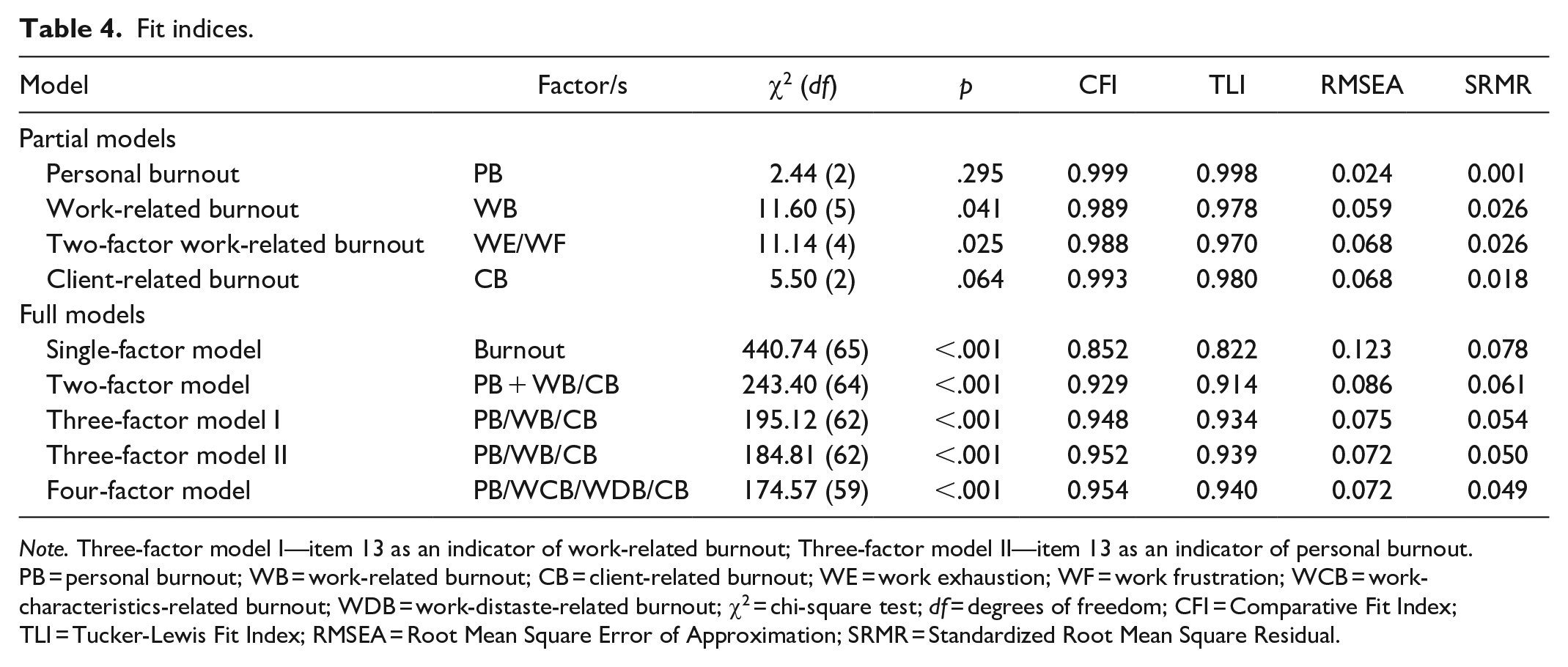
Note. Three-factor model I—item 13 as an indicator of work-related burnout; Three-factor model II—item 13 as an indicator of personal burnout. PB = personal burnout; WB = work-related burnout; CB = client-related burnout; WE = work exhaustion; WF = work frustration; WCB = work-characteristics-related burnout; WDB = work-distaste-related burnout; χ2 = chi-square test; df = degrees of freedom; CFI = Comparative Fit Index; TLI = Tucker-Lewis Fit Index; RMSEA = Root Mean Square Error of Approximation; SRMR = Standardized Root Mean Square Residual.
Using a 13-item set we have tested five models based on the previous findings. Table 4 presents fit indices for each of the five models tested, while inter-factor correlations are presented in Table 5. Factor loadings for tested models are given in Appendix C.
Latent Correlation Matrix.
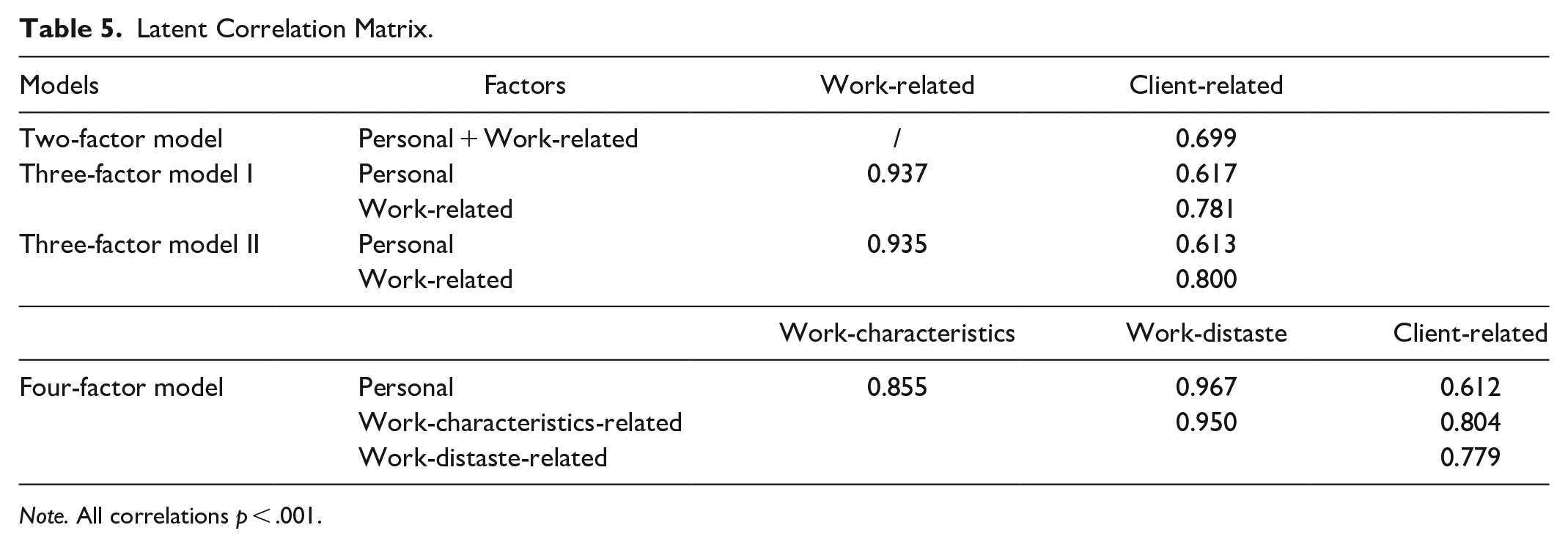
Note. All correlations p < .001.
Fit indices didn’t provide support to the hypothesis of the unidimensionality of the CBI (Table 4). Although a two-factor model of burnout achieved better fit than the single-factor model (Δχ2(1) = 197.34, p < .001], a three-factor model demonstrated a superior fit to both single-factor (Δχ2(3) = 245.62, p < .001) and two-factor model (Δχ2(2) = 48.28, p < .001]. By comparing fit indices of two concurrent three-factor models it can be seen that item 13 proved to be a somewhat better marker of personal than work-related burnout. Finally, a four-factor model achieved better fit than all other models (single-factor model Δχ2(6) = 266.17, p < .001; two-factor model Δχ2(5) = 68.83, p < .001; three-factor model I Δχ2(3) = 20.55, p < .001, Δχ2(3) = 10.24, p = .017). However, the magnitude of correlations between personal and work-distaste factors as well as between two work-related factors (Table 5) pointed to their substantial overlap with correlations exceeding .95.
Therefore, both three-factor models proved to be adequate models underlying the short version of the CBIser, and the final set of 13 items retained satisfactory item sampling adequacy for the full-scale (KMO = 0.983) and domains of personal (KMO = 0.953 for the first and 0.960 for the second three-factor model), work- (KMO = .932 for the first and 0.917 for the second three-factor model), and client-related burnout (KMO = 0.921). Internal consistencies of the final item set retained high alpha value for personal (α = .861 for the first and .848 for the second three-factor model), work-related (α = .812 for the first and .819 for the second three-factor model), client-related domain (α = .824), and a full-scale CBI (α = .912).
Discussion
The CBI represents one of the most utilized tools for measuring burnout syndrome. One of its major comparative advantages over other measures is most certainly the fact that it’s in the open domain and freely available. The instrument was adapted into numerous languages (Andrew Chin et al., 2018; Fong et al., 2014; Javanshir et al., 2019; Lapa et al., 2018; Phuekphan et al., 2016) and used in a variety of populations.
Numerous studies so far showed that CBI is a reliable tool, with internal consistency measures usually ranging between 0.75 and 0.95, while the full-scale reliability most often exceeds 0.90. Yet, despite its wide use and extensive evidence on good internal psychometric properties, little is known about its latent composition and structural validity since studies exploring the latent structure of CBI resulted in inconclusive findings. One of the potential reasons for the lack of examination of factor validity of the instrument could be that its authors clearly noted that CBI was not developed following rigorous psychometric criteria nor its subscales were empirically derived using statistical procedures (see Kristensen et al., 2005), but rather, its relatively distinct subscales are developed on a “theoretical and methodological” basis and recommended to be used independently depending on the aim of the study, domain/s of interest, and population studied (Kristensen et al., 2005). Although this may very be the case, we believe that empirical evidence on the factorial validity of the instrument is necessary for its reliable use which would provide a reasonable amount of confidence in its object of assessment and domains of interest. Therefore, this study aimed to examine the psychometric properties of the newly adapted CBIser and systematically examine its structural composition and factorial validity in the context of several concurrent models found in the literature.
The results of the present study add to the empirical evidence of the excellent internal psychometric properties of the instrument. Namely, obtained internal consistencies for personal, work-related, and client-related burnout subscales and CBIser total score well falls in the range of other adaptations, so the CBIser can be considered fairly reliable. Other indices of psychometric quality, proved that CBIser and each of its domains have an adequate level of representativeness of items sampled for covering the construct of interest as well as high convergence toward the joint object of measurement.
Examination of the latent composition of the CBI, however, demonstrated the lack of factorial validity of its domains. Namely, since individual domains are defined as relatively focal measures of different attributions of one’s burnout, initial models of structural validity were tested within each of the domains separately. The results have shown that some of the items developed for the measurement of a particular domain share a substantial proportion of unique item variance leading to poor model fit within each domain. Similar issues, although usually not recognized as such emerged in previous studies as well, and remained mostly unaddressed as potential indicators of insufficient structural validity of the CBI (Andrew Chin et al., 2018; Fong et al., 2014; Lapa et al., 2018; Phuekphan et al., 2016; Walters et al., 2018). Specifically, to attain adequate fit authors most often neglected this issue by adding additional specifications to the models and accounting for the item covariance not accounted for by the common factor, that is, consulting modification indices and specifying covariances of error terms post hoc, usually without any elaboration.
To address this issue, namely, to free the instrument from salient item unique sources of covariance, from the initial item pull within each of the domains we eliminated items demonstrating substantial covariations of error terms. At the same time, we made an effort not to alter and/or to greatly narrow down the focus of measurement within individual domains. For example, due to their generic nature and underrepresentation, items explicitly targeting physical symptoms within the personal burnout domain exhibited substantial covariance of uniqueness, so the two items were excluded from this domain. For the same reason, within work-related and client-related burnout domains unique item associations were broken down for item pairs exhibiting the largest number of those associations. Only after these modifications, independent within-domain models demonstrated acceptable fit and after showing that work-related burnout is a unitary domain pointing to the inadequacy of its differentiation into subdomains of work frustration and work exhaustion (Yeh et al., 2007), we were able to test the latent structure of the short 13-item form of the CBIser.
The question of the latent composition of CBI raised in previous studies was addressed by contrasting several conceptual and empirical models found in the literature. Firstly, we tested a single-factor model of burnout, that is the hypothesis of the unidimensionality of the burnout construct measured by CBI. Similarly, as in previous studies (e.g., Andrew Chin et al., 2018; Fiorilli et al., 2015; Fong et al., 2014), this model exhibited a poor fit. Two-factor model testing potential lack of divergence between personal and work-related burnout found in previous studies (e.g., Lapa et al., 2018; Milfont et al., 2008) by merging these dimensions into a single factor with a correlated but distinct domain of client-related burnout demonstrated somewhat better yet still insufficiently good fit proving that these dimensions do not represent indicators of the same construct.
The inconclusive status of item 13 has led us to test two concurrent three-factor models. Namely, item 13 referring to the lack of energy for family and friends during leisure time initially developed to measure work-related burnout, due to the fact that it is the only reverse coded item, in previous studies exhibited either poor internal validity (Andrew Chin et al., 2018; Fong et al., 2014; Javanshir et al., 2019; Yeh et al., 2007) or had inconclusive status as a marker of work-related or personal burnout (Mahmoudi et al., 2017). Therefore, in the first model item, 13 was defined as a marker of work-related burnout while in the second it was defined as a marker of personal burnout. Both three-factor models underlying correlated domains of burnout achieved acceptable fit. Yet, a comparison of two models showed that the latter had a superior fit demonstrating that the lack of energy for family and friends in leisure time represents a slightly better indicator of personal than work-related burnout. However, since this item was initially developed to capture work-related burnout and its relation to this factor may seem more straightforward from a conceptual point of view, further evidence is needed to support its definite repositioning to the personal burnout scale. Additionally, since item 13 is the only reverse keyed item of CBI and thus consistently demonstrates relatively poor psychometric characteristics, we suggest that future studies consider its rephrasing (e.g., Do you lack energy for family and friends during leisure time?). Lastly, a four-factor model of burnout including personal and client-related, while differentiating work-related burnout into dimensions work-distaste and work-characteristics (Mahmoudi et al., 2017) was tested. Despite showing fit superior to other models, a four-factor model was abandoned since two work-related-subdimensions exhibited latent correlation very close to the maximum value, offering empirical support for the model of three correlated factors as the most adequate model underlying the short version of CBIser.
Conclusion
Within the present study, psychometric properties and latent composition of the Serbian version of the CBI were examined and a short form of CBIser was proposed. Several empirical and conceptual models that were tested have shown that the short version of the CBIser can be described along three distinct yet highly correlated dimensions capturing different aspects of burnout—generic personal, and one’s attribution of burnout to work, and client. The short version of the CBIser proved to be a psychometrically sound measure of burnout free of measurement issues found in previous studies. However, the three-factor latent composition of the proposed brief version of the instrument needs to be validated on independent groups of participants of various occupations and educational backgrounds to eliminate the possibility that modifications suggested here are solely sample-dependent and thus may have led to a biased version of the instrument. In addition, future studies need to provide additional evidence on the construct and predictive validity of the brief version of the instrument.
Footnotes
Appendix A
Internal Consistencies of CBI and Its Domains Reported in Previous Studies.

| Country | Population | PB | WB | CB | CBI | |
|---|---|---|---|---|---|---|
| Winwood and Winefield (2004) | Australia | Dentists | 0.89 | 0.79 | 0.85 | |
| Kristensen et al. (2005) | Denmark | Medical staff, social workers | 0.87 | 0.87 | 0.85 | |
| Flinkman et al. (2008) | Finland | Nurses | 0.88 | |||
| Milfont et al. (2008) | New Zealand | Teachers | 0.87 | 0.87 | 0.79 | |
| Yeh et al. (2009) | Taiwan | Company employees | 0.93 | 0.89 | ||
| Bagaajav et al. (2011) | Mongolia | Medical staff | 0.78 | 0.82 | 0.87 | |
| Kozak et al. (2013) | German | Staff working with adults with intellectual disabilities | 0.91 | |||
| Fong et al. (2014) | China | Human service workers | 0.91 | 0.84 | 0.78 | |
| Hildingsson et al. (2013) | Sweden | Midwives | 0.87 | 0.93 | 0.81 | |
| Jordan et al. (2013) | Australia | Midwives | 0.90 | 0.77 | 0.93 | 0.92 |
| Molinero-Ruiz et al. (2013) | Spain | Educational centers, social workers, healthcare, industry employees | 0.90 | 0.83 | 0.82 | |
| Lee et al. (2014) | Taiwan | Teaching staff | 0.93 | 0.92 | 0.91 | 0.96 |
| Fiorilli et al. (2015) | Italy | Teachers | 0.89 | 0.78 | 0.79 | |
| Craiovan (2015) | Romania | Social services staff from the NGO sector | 0.87 | 0.86 | 0.85 | |
| Berat et al. (2016) | Serbia | Unspecified occupations, sales, healthcare | 0.88 | |||
| Phuekphan et al. (2016) | Thailand | Nurses | 0.91 | 0.93 | 0.88 | 0.96 |
| Andrew Chin et al. (2018) | Malesia | Medical students | 0.85 | 0.87 | 0.83 | |
| Mahmoudi et al. (2017) | Iran | Nurses | 0.89 | 0.84 | ||
| Ivanić et al. (2017) | Croatia | Emergency medical workers | 0.92 | 0.92 | 0.87 | 0.93 |
| Johnson and Naidoo (2017) | South Africa | Teachers | 0.88 | 0.89 | 0.86 | |
| Leake et al. (2017) | USA | Child welfare staff | 0.90 | 0.89 | ||
| Walters et al. (2018) | USA | Social workers | 0.90 | 0.91 | 0.90 | |
| Flinkman et al. (2008) | Finland | Nurses | 0.88 | |||
| Sestili et al. (2018) | Italy | University professors | 0.89 | 0.87 | 0.84 | 0.92 |
| Dev et al. (2018) | New Zealand | Nurses | 0.92 | |||
| Samaraweera et al. (2018) | Shri Lanka | Teachers | 0.83 | 0.82 | 0.85 | |
| Stoll and Gallagher (2019) | Canada | Midwives | 0.90 | 0.89 | 0.91 | |
| Huang et al. (2019) | Taiwan | Physicians | 0.90 | 0.86 | ||
| Lapa et al. (2018) | Portugal | Physicians | 0.88 | 0.86 | 0.85 | 0.91 |
| Avanzi et al. (2018) | Italy | Teachers | 0.87 | 0.84 | ||
| Javanshir et al. (2019) | Iran | Educational staff, healthcare, industrial setting, social services | 0.90 | 0.82 | 0.88 | |
| Messias et al. (2019) | USA | Clinical providers and biomedical scientists | 0.91 | 0.89 | 0.88 | |
| Ofei-Dodoo et al. (2019) | USA | Program managers of obstetrics and gynecology | 0.92 | 0.93 | ||
| Papaefstathiou et al. (2019) | Greece | Trainee doctors | 0.89 |
Note. PB = personal burnout; WB = work-related burnout; CB = client-related burnout; CBI = full CBI.
Appendix B
Descriptive Statistics for 19 CBI Items.
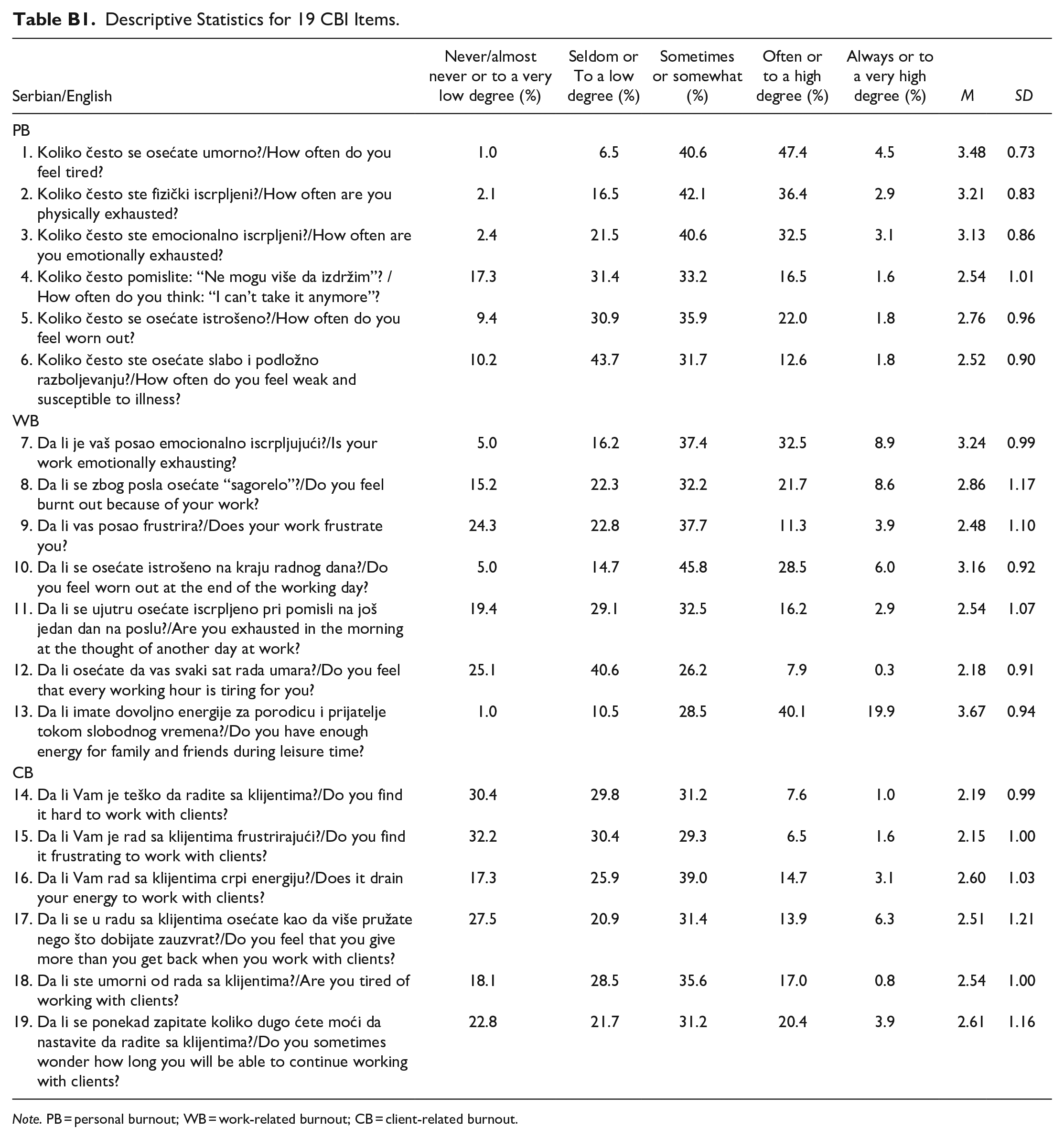
| Serbian/English | Never/almost never or to a very low degree (%) | Seldom or To a low degree (%) | Sometimes or somewhat (%) | Often or to a high degree (%) | Always or to a very high degree (%) | M | SD |
|---|---|---|---|---|---|---|---|
| PB | |||||||
| 1. Koliko često se osećate umorno?/How often do you feel tired? | 1.0 | 6.5 | 40.6 | 47.4 | 4.5 | 3.48 | 0.73 |
| 2. Koliko često ste fizički iscrpljeni?/How often are you physically exhausted? | 2.1 | 16.5 | 42.1 | 36.4 | 2.9 | 3.21 | 0.83 |
| 3. Koliko često ste emocionalno iscrpljeni?/How often are you emotionally exhausted? | 2.4 | 21.5 | 40.6 | 32.5 | 3.1 | 3.13 | 0.86 |
| 4. Koliko često pomislite: “Ne mogu više da izdržim”? /How often do you think: “I can’t take it anymore”? | 17.3 | 31.4 | 33.2 | 16.5 | 1.6 | 2.54 | 1.01 |
| 5. Koliko često se osećate istrošeno?/How often do you feel worn out? | 9.4 | 30.9 | 35.9 | 22.0 | 1.8 | 2.76 | 0.96 |
| 6. Koliko često ste osećate slabo i podložno razboljevanju?/How often do you feel weak and susceptible to illness? | 10.2 | 43.7 | 31.7 | 12.6 | 1.8 | 2.52 | 0.90 |
| WB | |||||||
| 7. Da li je vaš posao emocionalno iscrpljujući?/Is your work emotionally exhausting? | 5.0 | 16.2 | 37.4 | 32.5 | 8.9 | 3.24 | 0.99 |
| 8. Da li se zbog posla osećate “sagorelo”?/Do you feel burnt out because of your work? | 15.2 | 22.3 | 32.2 | 21.7 | 8.6 | 2.86 | 1.17 |
| 9. Da li vas posao frustrira?/Does your work frustrate you? | 24.3 | 22.8 | 37.7 | 11.3 | 3.9 | 2.48 | 1.10 |
| 10. Da li se osećate istrošeno na kraju radnog dana?/Do you feel worn out at the end of the working day? | 5.0 | 14.7 | 45.8 | 28.5 | 6.0 | 3.16 | 0.92 |
| 11. Da li se ujutru osećate iscrpljeno pri pomisli na još jedan dan na poslu?/Are you exhausted in the morning at the thought of another day at work? | 19.4 | 29.1 | 32.5 | 16.2 | 2.9 | 2.54 | 1.07 |
| 12. Da li osećate da vas svaki sat rada umara?/Do you feel that every working hour is tiring for you? | 25.1 | 40.6 | 26.2 | 7.9 | 0.3 | 2.18 | 0.91 |
| 13. Da li imate dovoljno energije za porodicu i prijatelje tokom slobodnog vremena?/Do you have enough energy for family and friends during leisure time? | 1.0 | 10.5 | 28.5 | 40.1 | 19.9 | 3.67 | 0.94 |
| CB | |||||||
| 14. Da li Vam je teško da radite sa klijentima?/Do you find it hard to work with clients? | 30.4 | 29.8 | 31.2 | 7.6 | 1.0 | 2.19 | 0.99 |
| 15. Da li Vam je rad sa klijentima frustrirajući?/Do you find it frustrating to work with clients? | 32.2 | 30.4 | 29.3 | 6.5 | 1.6 | 2.15 | 1.00 |
| 16. Da li Vam rad sa klijentima crpi energiju?/Does it drain your energy to work with clients? | 17.3 | 25.9 | 39.0 | 14.7 | 3.1 | 2.60 | 1.03 |
| 17. Da li se u radu sa klijentima osećate kao da više pružate nego što dobijate zauzvrat?/Do you feel that you give more than you get back when you work with clients? | 27.5 | 20.9 | 31.4 | 13.9 | 6.3 | 2.51 | 1.21 |
| 18. Da li ste umorni od rada sa klijentima?/Are you tired of working with clients? | 18.1 | 28.5 | 35.6 | 17.0 | 0.8 | 2.54 | 1.00 |
| 19. Da li se ponekad zapitate koliko dugo ćete moći da nastavite da radite sa klijentima?/Do you sometimes wonder how long you will be able to continue working with clients? | 22.8 | 21.7 | 31.2 | 20.4 | 3.9 | 2.61 | 1.16 |
Note. PB = personal burnout; WB = work-related burnout; CB = client-related burnout.
Appendix C
Factor Loadings for Tested Models: Short Forms of the CBI.
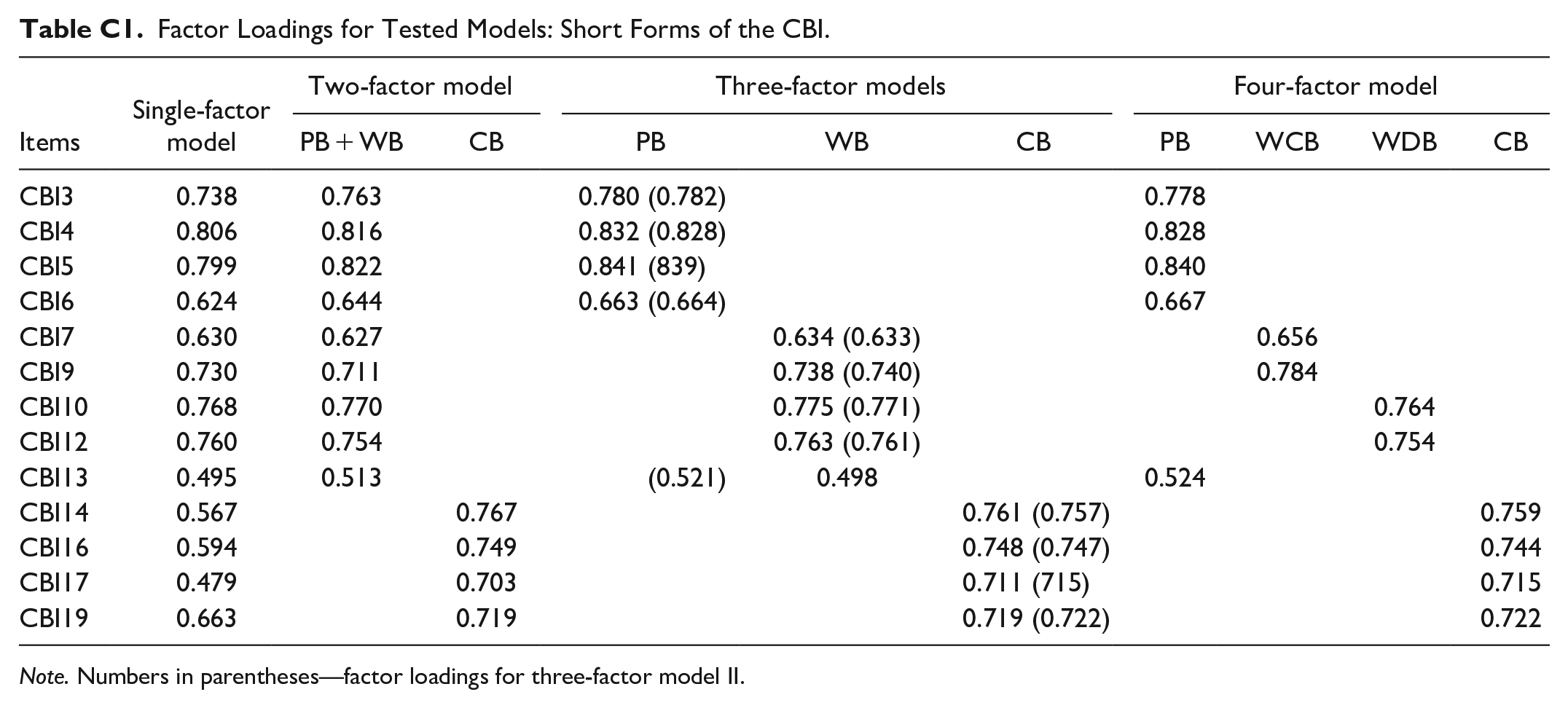
| Items | Single-factor model | Two-factor model | Three-factor models | Four-factor model | ||||||
|---|---|---|---|---|---|---|---|---|---|---|
| PB + WB | CB | PB | WB | CB | PB | WCB | WDB | CB | ||
| CBI3 | 0.738 | 0.763 | 0.780 (0.782) | 0.778 | ||||||
| CBI4 | 0.806 | 0.816 | 0.832 (0.828) | 0.828 | ||||||
| CBI5 | 0.799 | 0.822 | 0.841 (839) | 0.840 | ||||||
| CBI6 | 0.624 | 0.644 | 0.663 (0.664) | 0.667 | ||||||
| CBI7 | 0.630 | 0.627 | 0.634 (0.633) | 0.656 | ||||||
| CBI9 | 0.730 | 0.711 | 0.738 (0.740) | 0.784 | ||||||
| CBI10 | 0.768 | 0.770 | 0.775 (0.771) | 0.764 | ||||||
| CBI12 | 0.760 | 0.754 | 0.763 (0.761) | 0.754 | ||||||
| CBI13 | 0.495 | 0.513 | (0.521) | 0.498 | 0.524 | |||||
| CBI14 | 0.567 | 0.767 | 0.761 (0.757) | 0.759 | ||||||
| CBI16 | 0.594 | 0.749 | 0.748 (0.747) | 0.744 | ||||||
| CBI17 | 0.479 | 0.703 | 0.711 (715) | 0.715 | ||||||
| CBI19 | 0.663 | 0.719 | 0.719 (0.722) | 0.722 | ||||||
Note. Numbers in parentheses—factor loadings for three-factor model II.
Declaration of Conflicting Interests
The author(s) declared the following potential conflicts of interest with respect to the research, authorship, and/or publication of this article: All authors have reviewed and approved the final version of the manuscript and the manuscript is not currently being considered elsewhere. There is no conflict of interest involved in publishing this paper.
Funding
The author(s) disclosed receipt of the following financial support for the research, authorship, and/or publication of this article: Marko Živanović and Maša Vukčević Marković receive institutional support from the Ministry of Education, Science and Technological Development of the Republic of Serbia. Emina Borjanić Bolić receives support from the College of Social Work, Belgrade, Serbia. Psychosocial Innovation Network supported this work.
Ethics Statement
This study was ethically approved by the Institutional Review Board (IRB) of the Department of Psychology, Faculty of Philosophy, University of Belgrade, Serbia, protocol number #2019-024.
