




Abstract
As organisations increasingly focus on sustainability, green organisational culture has gained significant attention for its potential impact on various organisational outcomes. One such outcome, organisational commitment, plays a critical role in enhancing employee motivation, retention, and overall firm performance. Another important research variable that affects organisational commitment is perceived organisational support. This study examined the mediating role of perceived organisational support (POS) in the relationship between green organisational culture and organisational commitment in large and medium-sized manufacturing firms. Using a quantitative approach, the study used a non-experimental, cross-sectional design and employed partial least squares structural equation modelling (PLS-SEM) to analyse data from a random sample of 154 firms. Data were processed with SmartPLS 4 software. The results revealed that POS exerts a complementary mediation in the relationship between green organisational culture and organisational commitment. A positive association was found between green organisational culture and POS, which in turn positively influences organisational commitment. While the links between green organisational culture and organisational commitment have been explored, the role of POS as a mediator in that relationship has remained unexamined. This study addressed this gap by demonstrating how POS impacts the green organisational culture-organisational commitment relationship. These findings offer valuable insights for managers seeking to enhance organisational commitment. By promoting a green organisational culture and supporting POS, firms can improve employee commitment, contributing to organisational success. This study provides valuable empirical evidence within a new geographical and industrial context—namely, Peru’s manufacturing sector. Manufacturing firms play a crucial role in advancing global sustainability. The findings suggest that when companies integrate eco-friendly practices into their business models, they experience positive effects on organisational behaviour, which in turn enhances their competitiveness. Furthermore, in line with the organisational support theory, this is the first study that demonstrates the complementary mediating effect of POS on the green organisational culture-organisational commitment relationship.
Plain language summary
This study explores the impact of green organisational culture on organisational commitment, with a focus on the role of perceived organisational support (POS) as a mediator. As organisations increasingly prioritize sustainability, fostering a green culture has become essential for improving key outcomes like employee motivation, retention, and overall performance. The research examined how POS, or the extent to which employees feel supported by their organisation, influences the relationship between a green organisational culture and organisational commitment. Using a survey-based approach with data from 154 medium and large manufacturing firms, the study employed Partial Least Squares Structural Equation Modeling (PLS-SEM) to analyse the data. The results revealed that POS plays a significant role in enhancing the effects of a green culture on organisational commitment, with employees who perceive strong support from their organisation showing a higher commitment when working in a green culture. While previous studies have explored the direct links between green organisational culture and organizational commitment, the role of POS as a mediator had not been examined until now. Furthermore, this study contributes valuable empirical evidence in a new geographical and industrial context, such as Peru’s manufacturing sector, as manufacturing firms play an important role in the planet’s sustainability. Results of this research imply that when firms incorporate ecofriendly practices into their business model, there are positive repercussions on organisational behaviour and, thus, on their competitiveness. This research fills that gap by demonstrating how POS strengthens the positive effects of a green culture on organizational commitment. The findings offer practical insights for managers, highlighting the importance of both promoting a green culture and ensuring that employees feel supported. These strategies can lead to higher employee commitment and, in turn, greater organisational success.
Keywords
Introduction
The purpose of this study was to determine whether perceived organisational support has a mediating effect on the relationship between green organisational culture and organisational commitment in manufacturing firms. The research was performed in Lima, Peru. Regarding the variables involved, Schein (2004) defined organisational culture as “a pattern of shared basic assumptions that was learned by the members of the organisation, and that has worked well enough to be taught to new members” (p. 17). Organisational culture has been widely studied, particularly in terms of its influence on the behaviour of organisations’ employees (Hooi et al., 2022). All of these studies have concluded that there is a positive relationship between the two variables. Bektiarso (2022) and Hasan et al. (2020) concluded that a strong organisational culture fosters motivation and commitment among employees, which in turn act as a catalyst for achieving organisational objectives. Hasan et al. (2020) and C. H. Wang (2019) found that improvements to employee motivation have a positive effect on organisational performance.
The research on green organisational culture is still relatively new. As such, the definitions of this variable are constantly evolving. Norton et al. (2015) suggested that the definition should be an adaptation of Schein’s (1990) definition of organisational culture, which includes organisational assets (organisational structures and processes), institutional values (philosophies, strategies, goals, or objectives), and underlying assumptions (beliefs, thoughts and feelings, habits) as part of it. Accepted definitions of green organisational culture have several points in common: (a) environmental management patterns and assumptions; (b) symbols; (c) shared institutional values; (d) management-based environmental beliefs; and (d) the adoption of environmental management standards (Chang, 2015; Y. S. Chen, 2011; Marshall et al., 2015).
Organisational commitment, that is, a desire among individuals to adopt an organisation’s values and contribute to achieving its goals, is also decisive in allowing organisations to achieve their objectives (Gassas & Salem, 2023). People who develop organisational commitment will voluntarily make a greater effort to contribute to the organisation’s wellbeing (L. W. Porter & Lawler, 1968; Rodríguez & Sánchez del Río, 2023). To achieve organisational commitment, however, employees’ perceived organisational support must be taken into account. This concept refers to employees’ perceptions regarding the firm’s recognition of their contributions toward achieving organisational goals (Robaee et al., 2018). If workers feel they are receiving adequate organisational support, this will increase their organisational commitment (Sarfraz et al., 2019).
In response to pollution and environmental degradation, many organisations have introduced environmentally friendly initiatives into their operations, seeking employee involvement in and commitment to efforts of environmental conservation (Al-Hakimi et al., 2021; S. Wang et al., 2022). This corporate concern with caring for the environment has given rise to the concept of green organisational culture, which is still nascent and continues to evolve (Aggarwal & Agarwala, 2021; Al-Swidi et al., 2021). Green organisational culture can be defined as the values, beliefs, habits, and knowledge shared by the members of an organisation that highlight their preoccupation with caring for the environment (Imran & Jingzu, 2022; Siswanti & Muafi, 2022).
The literature review showed that there are no studies to date on the mediating effect of POS on the relationship between green organisational culture and organisational commitment. Shahriari et al. (2022) conducted a study analysing the mediating effect of job satisfaction on the relationship between green organisational culture and organisational commitment and suggested studying the possible mediating effect of perceived organisational support on the relationship between green organisational culture and organisational commitment. Li et al. (2023) analysed the mediating effect of perceived organisational support on the relationship between visionary leadership and employee creativity and suggested studying the effect of perceived organisational support on other relationships. Sarwar and Shahzad (2024) conducted a study in which they analysed perceived organisational support as a mediating variable in the relationship between green human resource management and healthcare organisational sustainability, and suggested studying the mediating effector of perceived organisational support in other relationships where include organisational culture. It is necessary to point out that the study presents important contributions, since it is the first to analyse the mediating effect of perceived organisational support in the relationship between green organisational culture and organisational commitment and contributes to a better understanding of organisational commitment and how it can be improved managing green organisational culture and perceived organisational support in organisations.
Theoretical Framework and Hypothetisation
Theorical Framework
The organisational support theory, developed by Eisenberger et al. (1986), specifically focuses on the importance of employees perceiving that their organisation values and supports them. This theory posits that to establish the organisation’s willingness to reward superlative work effort and satisfy social and emotional needs, employees create global beliefs about the extent to which the organisation cares about their well-being and appreciates their contributions (Rhoades & Eisenberger, 2002).
According to Eisenberger et al. (1986), the organisational support theory is based on: (a) social exchange, in which organisations and collaborators engage in mutual relationships; (b) valorisation and well-being, where employees interpret the intentions that the organisation has towards them; and (c) the principle of reciprocity, where employees tend to commit to the organisation when they perceive the organisation’s support.
Literature Review and Hypothetisation
Organisational Culture
Organisational culture plays an important role in improving organisational performance (Joseph & Kibera, 2019; Mengstie et al., 2023). The maintenance of their cultural identity is one of the main strategies used by firms to create value (Gagliardi, 1986). In his seminal study, Schein (1985) defined organisational culture as: a pattern of shared basic assumptions that was learned by a group as it solved its problems of external adaptation and internal integration, that has worked well enough to be considered valid and, therefore, to be taught to new members as the correct way to perceive, think, and feel in relation to those problems. (p. 17)
This definition refers to basic assumptions that are shared and accepted by all the organisation’s members. On the other hand, Lundberg (1990) defined organisational culture as “what is taught and reinforced to members as the proper way to perceive, think, feel, and act vis-à-vis crises and tasks” (p. 20). D. R. Denison and Mishra (1995) defined organisational culture as the set of values, knowledge, and habits shared by an organisation’s members that enables them to achieve organisational goals. Additionally, Robbins and Judge (2013) defined organisational culture as a “system of shared meaning held by members that distinguishes the organization from other organizations” (p. 513), highlighting organisational culture as an element that sets organisations apart. One recent study suggests that organisational culture is the set of well-rooted values, customs, and traditions shared by the members of an organisation (Bagga et al., 2023).
According to the literature, organisational culture can be strong or weak. A strong organisational culture is one in which a majority of the organisation’s members share a well-rooted sese of that culture’s values and other expressions; the stronger the culture, the greater the adhesion and commitment of the organisation’s members, which in turn improves the firm’s profitability (Chiavenato, 2009; Gordon & DiTomaso, 1992; Robbins & Judge, 2013; Sorensen, 2002). It is convenient to keep in mind that the study of organisational culture can become more complex, since organisations are immersed in a dynamic and changing environment (Copuš et al., 2023).
Green Organisational Culture
The concept of green organisational culture is relatively new (Aggarwal & Agarwala, 2021; Al-Swidi et al., 2021). Given the need for environmental conservation, business strategies seeking to help achieve this goal must be aligned with organisational culture (Fok et al., 2021; Hartman et al., 2009; Rouse & Daellenbach, 1999). Some studies conceptualise green organisational culture as the cultural change triggered in response to environmental challenges (Newton & Harten, 1997; T. H. Porter & Coleman, 2016). Siswanti and Muafi (2022) defined it as “a set of values, symbols, assumptions, and organisations. It can also be understood as artefacts that reflects [sic] an obligation or desire to be an environmentally friendly organization” (p. 1154). Vargas-Hernández et al. (2024) stated that green organisational culture is supported by shared values and eco-friendly practices that are developed within organisations. In their seminal study, Harris and Crane (2002) developed a model in which they established three dimensions of green organisational culture, as follows:
Depth: Pertains to how deeply managers perceive the environment to be important to the organisation’s members.
Degree: Refers to the extent to which managers feel that environmental values are manifested in the organisation.
Diffusion: Refers to the degree to which environmental values and behaviours are transmitted through the organisation.
Green organisational culture plays a fundamental role in organisations since it helps model the behaviour and way of thinking of the members of the organisation, promoting environmental awareness and promoting green behaviour within the organisation (Enbaia et al., 2024; Yu & Li, 2024).
Organisational Commitment
The concept of organisational commitment has been addressed by numerous authors, who have conceptualised it in various ways. Kanter (1968) defined it as a person’s affective and emotional attachment to the group. Buchanan (1974) conceptualised it as the affective attachment developed by individuals to the organisation’s values and objectives. Farrell and Rusbult (1981) defined it as the likelihood that an employee will develop feelings and a psychological attachment toward the organisation where they work. Wiener (1982) defined it as a sense of moral obligation among employees to meet organisational goals, while Mottaz (1988) argued that it is the “affective response (attitude) resulting from an evaluation of the work situation which links or attaches the individual to the organisation” (p. 469). Meyer and Allen (1991) analysed the prior work of various authors, conceptualising organisational commitment as “the psychological state that (a) characterises the employee’s relationship with the organisation, and (b) has implications for the decision to continue or discontinue membership in the organisation” (p. 67).
Organisational commitment is important in business. High levels of commitment among executives and employees signify that all of them identify with the organisational objectives and are willing to make additional efforts for the organisation’s wellbeing (L. W. Porter & Lawler, 1968; Rodríguez & Sánchez del Río, 2023). Organisational commitment fosters motivation in people, inside and outside the organisation, which in turn strengthens job performance and the achievement of the firm’s goals. Organisational commitment has three dimensions: (a) affective commitment; (b) continuance commitment; and (c) normative commitment (Allen & Meyer, 1990; Meyer & Allen, 1991), as described below.
Affective commitment: Refers to the employee’s emotional attachment to, identification with, and involvement in the organisation. Employees with a strong affective commitment feel the need to continue employment with the organisation.
Continuance commitment: Refers to the employee’s level of awareness of the advantages and/or convenience involved in continuing to work for the organisation.
Normative commitment: Refers to the degree and/or sense of obligation developed by employees to continue working at the organisation. People with a high level of normative commitment will feel a powerful urge to continue being part of the organisation.
Perceived Organisational Support
In their seminal study, Eisenberger et al. (1986) developed the perceived organisational support theory, according to which “employees in an organisation form global beliefs concerning the extent to which the organisation values their contributions and cares about their wellbeing” (p. 500). This lays the foundation for the definition of perceived organisational support. This study also provides evidence that employee commitment is influenced by perceived organisational support.
According to another formal definition of perceived organisational support, it “refers to employee perceptions regarding the extent to which the organisation values their contribution and cares about their wellbeing” (Eisenberger et al., 2020, p. 102). To foster perceived organisational support, the organisation must create the necessary working conditions and these conditions must be perceived by employees, a dynamic in which effective leadership is also advisable (Eisenberger et al., 1990, 1997, 2001, 2019, 2020). The development of perceived organisational support increases employee commitment to the organisation, reduces stress, builds trust, and entails a series of benefits for the organisation (Eisenberger et al., 1990, 1999, 2001, 2019).
Green Organisational Culture and Perceived Organisational Support
The literature review shows that there is a relationship between organisational culture and perceived organisational support. The evidence indicates that organisational culture exerts a significant effect on perceived organisational support (Ekmekcioglu & Öner, 2024; Kim et al., 2020; Salvador et al., 2022). Sumardjo and Supriadi (2023) analysed a sample of 195 employees at a security company in Indonesia and found that organisational culture partially exerts a positive and significant effect on perceived organisational support, which may be increased if organisations implement and promote a strong organisational culture. Vieira-dos Santos and Gonçalves (2018) analysed a sample of 635 employees of higher education institutions in Portugal and found that organisational culture helps explain and understand perceived organisational support, Additionally, the authors recommended continuing to study the relationship since it may vary in different contexts.
Other studies have found that inclusive leadership uses organisational culture as a tool for influencing perceived organisational support and achieving organisational goals (T. Wang et al., 2024). Doğan et al. (2024) stated that organisations that foster a strong organisational culture that leads to strong perceived organisational support make this into an effective tool for eliminating burnout.
Using Zhao et al. (2010) recommendation to study mediation, the following hypothesis is thus proposed:
Perceived Organisational Support and Organisational Commitment
Studies by Eisenberger et al. (1990) and Aselage and Eisenberger (2003) found that perceived organisational support helps improve employees’ commitment. Eisenberger et al. (1990) analysed a sample of 237 employees of companies from different sectors in the United States—(a) schools, (b) brokerage firms, (c) police officers, (d) manufacturing firms, and (e) insurance companies—finding that organisations are able to increase employee commitment by improving perceived organisational support. Aselage and Eisenberger (2003) analysed the perceived organisational support theory and integrated it theoretically with the psychological contract theory, allowing them to study the relationships that arise between employee and employer.
More recent studies show that perceived organisational support plays an important role in organisations thanks to its positive contribution to building organisational commitment (Eisenberger et al., 2020; Hoo et al., 2024; Mehrad et al., 2022; Sarfraz et al., 2019; C. Wang, 2022). Eisenberger et al. (2020) analysed the theoretical model proposed by Baran et al. (2012) and concluded that perceived organisational support contributes to the formation of organisational commitment. Hoo et al. (2024) conducted a systematic study in which they analysed 93 publications on the impact of perceived organisational support on organisational commitment, finding evidence demonstrating the influence of perceived organisational support on the formation of organisational commitment. Mehrad et al. (2022) analysed a sample of 93 nurses from the public and private healthcare system in Spain, demonstrating that perceived organisational support is positively correlated with organisational commitment, where nurses with a high perceived organisational support may develop a high organisational commitment. Sarfraz et al. (2019) analysed a sample of 241 nurses from the public and private healthcare system in Pakistan and found that perceived organisational support may reduce stress indices and thus improve organisational commitment. C. Wang (2022) analysed a sample of 362 employees from the hospitality sector in China and found that perceived organisational support helps enrich organisational commitment.
Additionally, the scientific evidence shows that there is a positive relationship between perceived organisational support and organisational commitment (Hngoi et al., 2024; Ilyas et al., 2023; Kumar & Bagga, 2024; Ni et al., 2023; Peña et al., 2024; Rubel et al., 2023; Sheikh, 2023). Hngoi et al. (2024) analysed a sample of 440 workers from the private business sector in Malaysia and found that perceived organisational support positively affects organisational commitment. Ilyas et al. (2023) analysed a sample of 361 professionals from the public and private healthcare sector in Pakistan and found that perceived organisational support has a positive effect on organisational commitment. Kumar and Bagga (2024) analysed a sample of 324 employees from five firms in the information technology sector in India and found that perceived organisational support is positively related to organisational commitment. Thus, by fostering perceived organisational support, it is possible to increase employee commitment. Ni et al. (2023) analysed a sample of 858 nurses from twelve Chinese hospitals and found that perceived organisational support is positively related to organisational commitment. Peña et al. (2024) analysed a sample of 137 companies that are part of the client portfolio of the Spanish company Andrade Fitness Limited Co., and found that perceived organisational support and organisational commitment are positively associated. Rubel et al. (2023) analysed a sample of 430 supervisors from the textile manufacturing sector in Bangladesh and found a positive relationship between perceived organisational support and organisational commitment, meaning that a high level of perceived organisational report may increase employee commitment. Sheikh (2023) analysed a sample of 617 employees from the banking sector in India and found that perceived organisational support positively influences employee commitment.
The literature reflects the need to validate the relationship between perceived organisational support and organisational commitment due to the multiple changes that the context undergoes (Kumar & Bagga, 2024; Saadeh & Suifan, 2020; Silva et al., 2022).
Accordingly, following Zhao et al. (2010) recommendation to study mediation, the following hypothesis is proposed:
Green Organisational Culture and Organisational Commitment
The literature shows evidence of the relationship between green organisational culture and organisational commitment. In his seminal study, D. Denison (1990) showed that employee commitment and motivation can be reinforced through organisational culture. Harris and Crane (2002) argued in their seminal study that green organisational culture can be used as a tool for getting an organisation’s members involved and committed. Subramanian and Suresh (2023) indicated that green organisational culture has the ability to influence commitment and model certain values of employees. In addition to this, Madan et al. (2025) stated that green organisational culture drives people’s commitment to ecologically responsible behaviour.
Various researchers have also concluded that a strong organisational culture reinforces employees’ organisational commitment (Bektiarso, 2022; Fulmore et al., 2024; Hasan et al., 2020; Hassanian et al., 2023; Meliala et al., 2023). Bektiarso (2022) analysed a sample of 150 high school teachers from Indonesia and found that organisational culture may act as a mechanism for bolstering teachers’ commitment. Fulmore et al. (2024) analysed a sample of 710 service sector employees in the United States and found that a strong organisational culture helps reinforce employee commitment. Hasan et al. (2020) analysed a sample of 217 employees of government banks in Indonesia and found that organisational culture is an important component in the creation of organisational commitment. Hassanian et al. (2023) analysed a sample of 257 nurses belonging to medical and education centres in Iran and found that organisational commitment is constructed through organisational culture. Meliala et al. (2023) analysed a sample of 270 employees from the Indonesian Ministry of Manpower and found that organisational culture directly affects employee commitment. Thus, a positive relationship can be observed between organisational culture and commitment (Amtu et al., 2021; Hamidi et al., 2024; Marcos et al., 2020; Thanh Nguyen et al., 2023).
Studies by Shahriari et al. (2022) and C. H. Wang (2019) showed that green organisational culture has a significant and positive effect on organisational commitment. Shahriari et al. (2022) analysed a sample of 201 employees from manufacturing firms in Iran and found that green organisational culture reinforces organisational commitment, demonstrating a positive relationship between green organisational culture and organisational commitment. C. H. Wang (2019) analysed a sample of 327 Chinese manufacturing firms and found that green organisational culture positively influences organisational commitment, as well as boosting firms’ competitiveness.
Accordingly, following Zhao et al. (2010) recommendation to study mediation, the following hypothesis is therefore proposed:
Green Organisational Culture, Perceived Organisational Support, and Organisational Commitment
The literature review showed that the mediating effect of perceived organisational support on the relationship between green organisational culture and organisational commitment has yet to be studied. L. Chen et al. (2024) analysed the mediating effector of perceived organisational support in the relationship between transformational leadership and knowledge sharing behaviour, and stated that perceived organisational support is an important motivation factor in organisational dynamics. Authors such as Lee and Jun (2024) analysed the mediating effect of perceived organisational support on the relationship between organisational commitment and turnover intention, finding that perceived organisational support exerts a mediating effect on the relationship between organisational commitment and turnover intention. The researchers recommended analysing this mediating effect on other relationships. Li et al. (2023) analysed the mediating effect of perceived organisational support on the relationship between visionary leadership and employee creativity and recommended studying the direct mediating effect of perceived organisational support on other relationships.
Shahriari et al. (2022) also conducted a study analysing the mediating effect of job satisfaction on the relationship between green organisational culture and organisational commitment, and suggested researching the mediating effect that perceived organisational support may have on the relationship between green organisational culture and organisational commitment. Additionally, Sarwar and Shahzad (2024) conducted a study in which they analysed perceived organisational support as a mediating variable in the relationship between green human resource management and healthcare organisational sustainability, and suggested studying the mediating effector of perceived organisational support in other relationships where include organisational culture.
Therefore, according Zhao et al. (2010) recommendation to study mediation, the following hypothesis is proposed:
Figure 1 shows the conceptual model proposed for this study.

Conceptual Model Used in the Study.
Methodology
Population and Sample
The study focused on large and medium-sized manufacturing firms headquartered in Lima, Peru. According to the Ministry of Production (2023), in 2022 there are 1,076 such firms in the city. In Peru, large firms are defined as those with annual sales revenue exceeding 2,300 UITs (Peruvian Tax Units), while medium-sized firms have annual sales revenue between 1,700 and 2,300 UITs. One UIT is valued at 5,150 Peruvian soles (approximately USD 1,390) as per the National Institute of Statistics and Computer Science (2023).
The manufacturing sector is an important source of job creation and generates considerable economic benefits, but it faces great environmental challenges, such as pollution and excessive consumption of non-renewable resources (Enbaia et al., 2024). The population was made up of 1,076 firms medium and large manufacturing firms from Lima, Peru. A random sample of 154 firms was used. According to Hair et al. (2017), the minimum sample size required when using partial least squares structural equation modelling (PLS-SEM) must be equivalent to the maximum number of items of a latent variable, multiplied by 10. Therefore, the sample size used in the research is convenient.
Research Instruments
The key variables in the study were measured using well-established, widely used scales. The green organisational culture was assessed using the six-item scale developed by C. H. Wang (2019), based on a five-point Likert scale. Organisational commitment was measured using the nine-item scale by Allen and Meyer (1990), employing a seven-point Likert scale. For perceived organisational support, the nine-item questionnaire developed by Eisenberger et al. (2020) was used, also based on a seven-point Likert scale. Since the original scales were in English, they were first translated into Spanish, then back-translated, and validated according to the process outlined by Sousa and Rojjanasrirat (2011) to ensure accuracy and cultural relevance. All research variables are reflective.
Data Collection
A database was created using information from the Peruvian Ministry of Production, which included firm size, firm names, business activities, contact details, and top executives' information. Initial contact was made through emails sent to top managers or HR heads, followed by follow-up telephone calls. The research instruments were applied using Google Forms, in situ or using phone calls to get assisted replies, leaving a lapse of at least 30 min between the replies, to eliminate the possibility of the common method bias. Completed forms were cleansed and analysed using Excel.
Data Analyses
Data were processed and analysed for normality, heteroscedasticity and collinearity. Then, the descriptive statistics were calculated using SPSS v29. The next step was to evaluate the measurement model and the structural model, and to test the hypotheses using PLS-SEM, with SmartPLS 4. PLS-SEM was chosen because it is recommended when testing associations between latent variables and when using small sample sizes (Hair et al., 2017, 2018; Lowry & Gaskin, 2014).
Results
Descriptive Statistics
Table 1 shows the descriptive statistics of the sample used in this study, showing the size of the firms included in the study, as well as the firm type according to the business activity in which they are engaged. The study also considered the length of time they have been doing business and whether they export the goods that they manufacture.
Descriptive Statistics of the Sample (Manufacturing Firms).
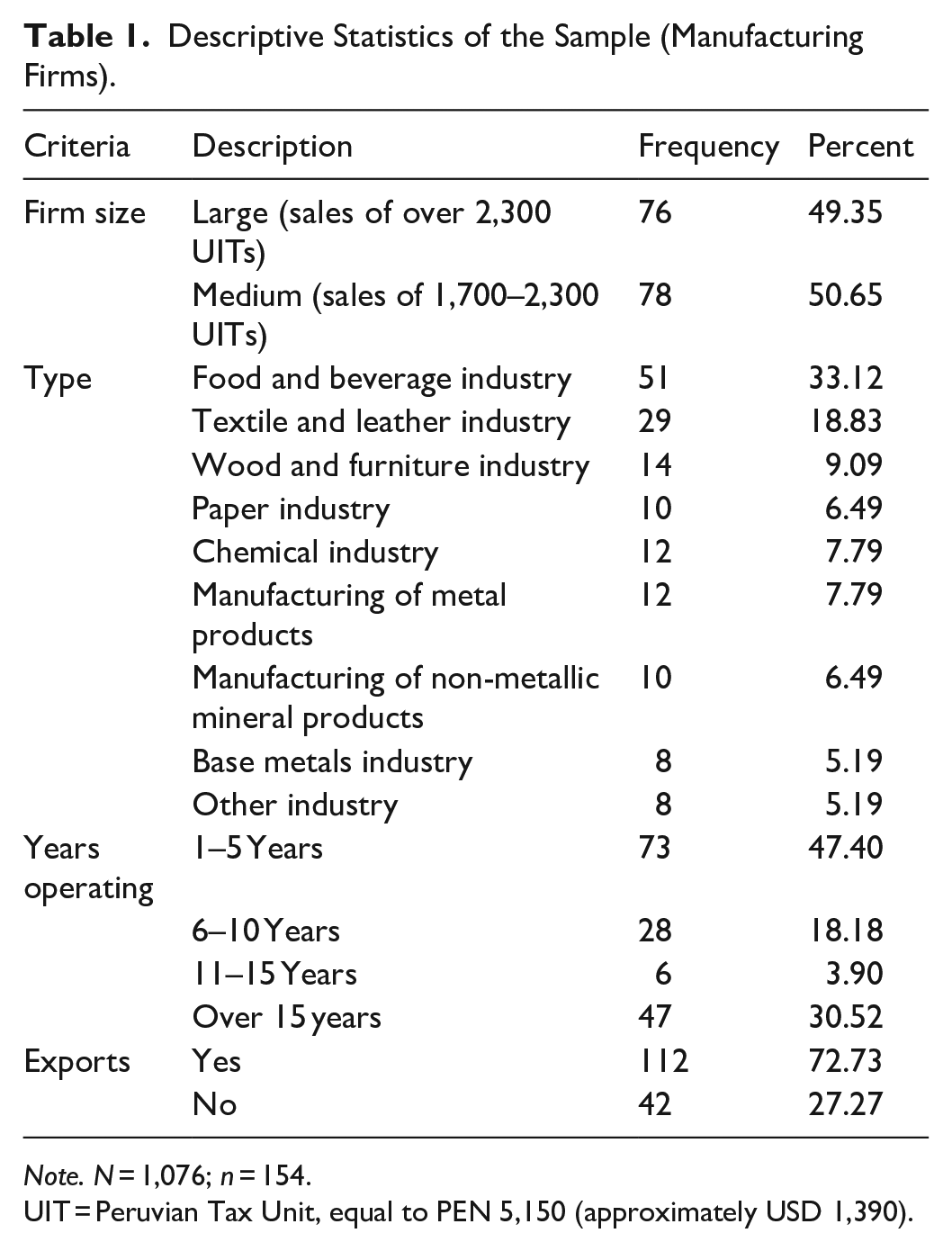
Note. N = 1,076; n = 154.
UIT = Peruvian Tax Unit, equal to PEN 5,150 (approximately USD 1,390).
Measurement Model Evaluation
Factor loadings were calculated for each research variable to confirm the validity and reliability of the conceptual model. In reflective models, loadings must be higher than 0.708 while guaranteeing that the average loading of each latent variable included in the model is higher than 0.70 (Hair et al., 2018; Mueller & Hancock, 2018). It was observed that the average loading for green organisational culture is 0.771, while the average loading for organisational commitment is 0.708, and for perceived organisational support is 0.781. The loadings thus meet this reliability criteria.
To test the model’s internal consistency and reliability, Cronbach’s alpha and the composite reliability (CR) indicator were calculated. To verify the internal consistency, the values obtained for Cronbach’s alpha must be higher than .70 (Dash & Paul, 2021; Hair et al., 2020) and for CR they must be higher than .708. It may be observed that Cronbach’s alpha and CR values of all three latent variables are higher than .70, and .708, respectively, thus confirming the model’s internal consistency and reliability.
Additionally, the average variance extracted (AVE) was calculated to verify the model’s convergent validity. According to Mueller and Hancock (2018), the AVE must be higher than 0.50 to ensure convergent validity. The AVE for green organisational culture is 0.602, for organisational commitment is 0.504, and for perceived organisational support is 0.612, thus confirming the model’s convergent validity. Table 2 shows the loading results, AVE, Cronbach’s alpha, and CR of each construct.
Results of the Evaluation of the Measurement Model.
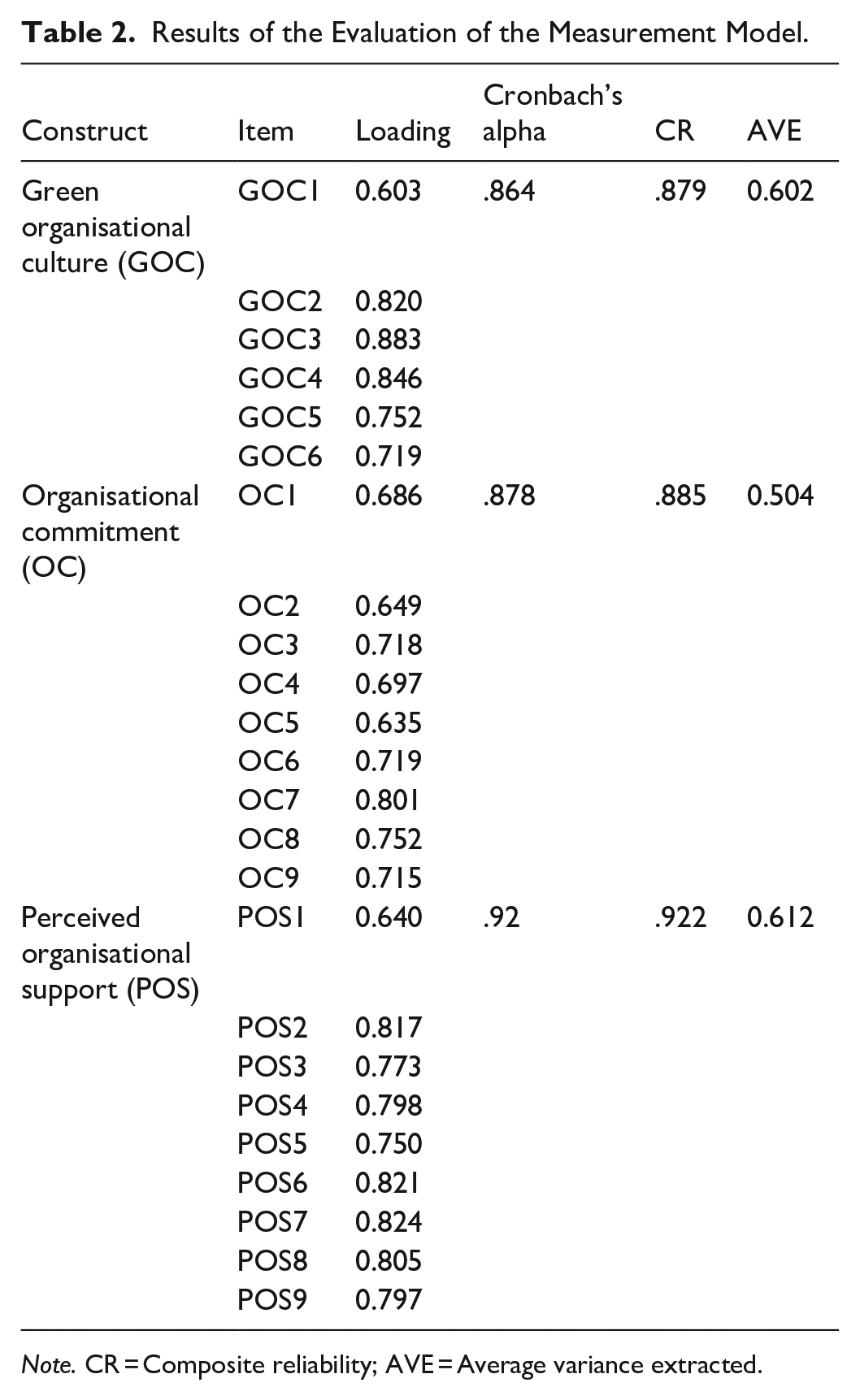
Note. CR = Composite reliability; AVE = Average variance extracted.
To verify the model’s discriminant validity, the heterotrait–monotrait (HTMT) ratio was calculated. If the values for HTMT are less than 0.90, the model’s discriminant validity is confirmed (Hair et al., 2022). The values for the HTMT ratio are less than 0.90, thus confirming that the measurement model meets this criterion for discriminant validity. Table 3 shows the results of the HTMT ratio.
Discriminant Validity Results Using the HTMT Ratio.
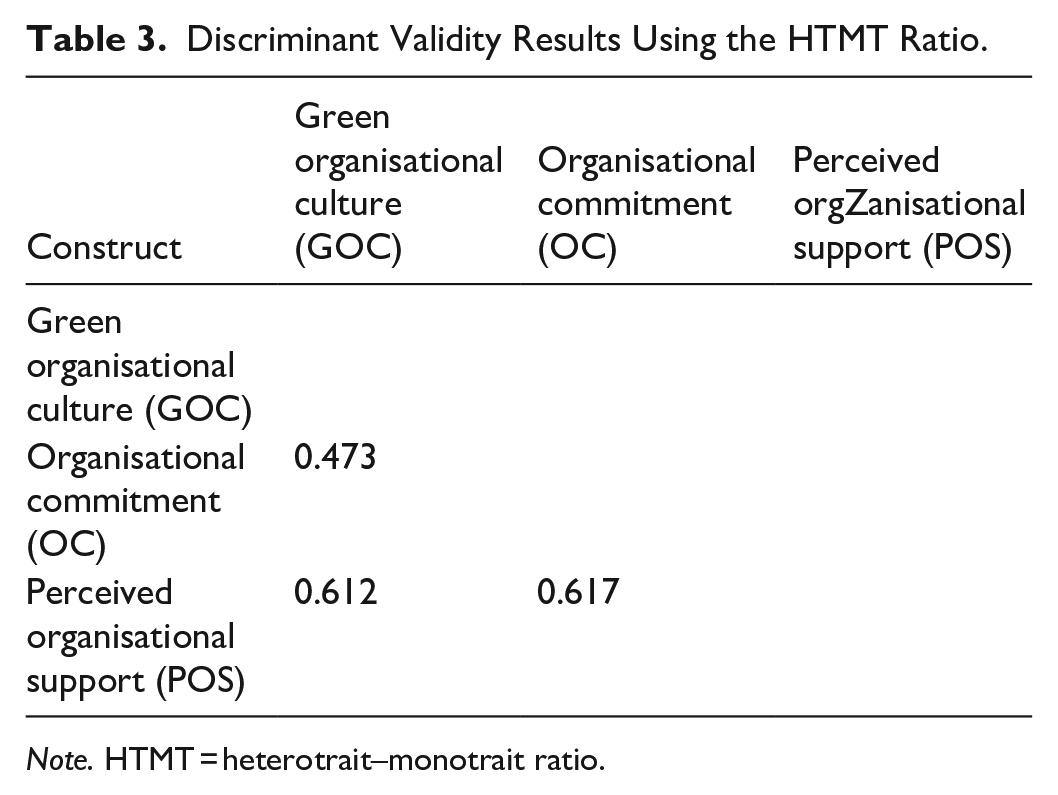
Note. HTMT = heterotrait–monotrait ratio.
Evaluation of the Structural Model
The structural model estimated the goodness-of-fit index at 0.672, which is acceptable (Vinzi et al., 2010). Figure 2 presents the structural model, showing the item loadings and proposed relationships among the three latent variables. The structural model was evaluated using the bootstrapping technique with 5,000 subsamples.

Results of the Factor Loadings, Path Coefficients and R2 of the Proposed Relationships.
The evaluation of the structural model was performed by determining the model’s explanatory and predictive power, using the process recommended by Hair et al. (2017). The model’s predictive power was measured using the coefficient of determination (R2). It indicates the proportion of variance in the endogenous variable explained by its predictors. According to Hair et al. (2011), R 2 of <0.25 is very weak, between 0.25 and 0.50 is weak, between 0.50 and 0.75 is moderate, and equal or over 0.75 is substantial. The results obtained in the analysis indicate that the R2 for the relationship between green organisational culture and perceived organisational support is 0.339, while that the R2 for the effect of the combination of the exogenous and mediating variables on the endogenous variable is 0.345, indicating a weak predictive power (Henseler et al., 2009). See Table 4.
Explanatory and Predictive Power of the Structural Model.

Note. R2 = coefficient of determination; f2 = effect size; Q2 = predictive relevance of the model.
In addition to the R2, the effect size (f2) was evaluated, where values of over 0.02, 0.15, and 0.35, indicate a small, medium, and large effect size, respectively (J. Cohen, 1988). For the relationship between green organisational culture and organisational commitment, the f 2 was 0.159, indicating a medium effect size. For the relationship between green organisational culture and perceived organisational support, the f2 was 0.446, indicating a large effect size. For the relationship between perceived organisational support and organisational commitment, the f2 was 0.244, indicating a medium effect size. In conclusion, the model’s explanatory power is moderate.
The model’s predictive power was further analysed using the indicator of predictive relevance as measured by the cross-validated redundancy measure (Q2), calculated using blindfolding. It assesses a model’s out-of-sample predictive accuracy for the endogenous variable. It indicates how well the model can predict the data points. A Q2 value of over 0.02 demonstrates the predictive capacity of the model variables (Hair et al., 2018). Values of more than 0.02, 0.15, and 0.35, respectively, indicate a low, moderate, and high predictive significance (L. Cohen et al., 2018; Hair et al., 2018; Henseler et al., 2009). The perceived organisational support variable presented a Q2 of 0.289, indicating a moderate predictive relevance. The green organisational commitment variable has a Q2 of 0.162, indicating a moderate predictive relevance. Thus, the model’s overall predictive power is moderate. Table 4 presents the results of the evaluation of the structural model’s explanatory and predictive power.
Hypothesis Testing
The relationships between the research variables were further analysed, including the path coefficients and the statistical significance of the relationships (see Table 5). The results (p-value ≤.000 and the lower limit of the confidence interval is greater than 0) confirmed that green organisational culture significantly and positively impacts perceived organisational support, which means that Hypothesis 1 was supported. Perceived organisational support was also found to significantly and positively impact organisational commitment (p-value ≤.000 and the lower limit of the confidence interval is greater than 0), which means that Hypothesis 2 was supported. Additionally, the results (p-value ≤.000 and the lower limit of the confidence interval is greater than 0) showed that green organisational culture significantly and positively impacts organisational commitment, which means that Hypothesis 3 was supported.
Path Coefficients and Analysis of Relationships Between Research Variables.

To determine whether perceived organisational support had a mediating effect on the relationship between green organisational culture and organisational commitment, the procedure established by Baron and Kenny (1986), improved by Zhao et al. (2010) was applied. Analysing the indirect effects (see Table 6), it was determined that all three relationships between variables are statistically significant, thus confirming that green organisational culture has an indirect impact on organisational commitment through perceived organisational support. In other words, perceived organisational support has a complementary mediating effect on the relationship between green organisational culture and organisational commitment (Zhao et al., 2010). Based on the foregoing, it can be concluded that Hypothesis 4 (H4) was supported.
Total Indirect Effects.

Discussion
The empirical evidence resulting from this research proved that perceived organisational support exerts a complementary mediating effect on the relationship between green organisational culture and organisational commitment, which is consistent with what was stated by L. Chen et al. (2024), who argued that perceived organisational support is an important motivation factor in organisational dynamics. The literature shows the existence of a direct relationship between green organisational culture and organisational commitment. A strong green organisational culture strengthens organisational commitment, revealing that green organisational culture is significantly and positively related to organisational commitment (Amtu et al., 2021; Bektiarso, 2022; Hasan et al., 2020; Marcos et al., 2020; Shahriari et al., 2022; Thanh Nguyen et al., 2023; C. H. Wang, 2019). In line with the above, the literature showed that green organisational culture is an important component in organisations as it helps shape people’s behaviour and drives people’s commitment to ecologically responsible behaviour (Enbaia et al., 2024; Madan et al., 2025; Yu & Li, 2024). The results obtained in this study show that green organisational culture is significantly and positively related to organisational commitment in large and medium-sized manufacturing firms.
Reviewing the relationship between green organisational culture and perceived organisational support, the literature shows that a strong green organisational culture strengthens perceived organisational support in firms (Ekmekcioglu & Öner, 2024; Kim et al., 2020; Salvador et al., 2022; Sumardjo & Supriadi, 2023; Vieira-dos Santos & Gonçalves, 2018). The literature also suggests that further studies are required to confirm this relationship, since it may vary depending on the context (Vieira-dos Santos & Gonçalves, 2018). The results obtained in this study confirmed the existence of a positive and significant relationship between green organisational culture and perceived organisational support in large and medium-sized manufacturing firms.
The literature also shows that perceived organisational support positively contributes to building organisational commitment (Eisenberger et al., 2020; Ilyas et al., 2023; Mehrad et al., 2022; Ni et al., 2023; Rubel et al., 2023; Sarfraz et al., 2019; Sheikh, 2023; C. Wang, 2022). Additionally, the literature suggests the need to validate the relationship between perceived organisational support and organisational commitment in light of the many changes suffered by the environment (Kumar & Bagga, 2024; Saadeh & Suifan, 2020; Silva et al., 2022). The findings obtained in this study confirmed the existence of a positive and significant relationship between perceived organisational support and organisational commitment in large and medium-sized manufacturing firms, which is consistent with the empirical evidence offered by the literature.
Conclusions
This study is the first to empirically verify the complementary mediating effect of perceived organisational support on the relationship between green organisational culture and organisational commitment, making this one of the study’s theoretical contributions to the academic and business worlds and thus confirming Hypothesis 4. It also introduces a structural equation model with moderate predictive and weak explanatory power, applicable across different sectors and contexts. In line with the organisational support theory, the three hypotheses regarding direct relationships between the research variables included in the conceptual model were supported: (a) the relationship between green organisational culture and perceived organisational support was positive and significant, with a p-value ≤.000, thus confirming Hypothesis 1; (b) the relationship between perceived organisational support and organisational commitment was positive and significant, with a p-value ≤.000, thus confirming Hypothesis 2; and (c) the relationship between green organisational culture and organisational commitment was positive and significant, with a p-value ≤.000, thus confirming Hypothesis 3.
It was also verified that the proposed structural equation model has a moderate predictive power and a moderate predictive relevance. The explanatory power of the model was determined using f2. The R2 for the relationship between the exogenous and mediating variables with organisational commitment is 0.345, while the R2 of the relationship between green organisational culture and perceived organisational support is 0.339. The f2 values for the relationship between green organisational culture and organisational commitment is 0.159, for the relationship between green organisational culture and perceived organisational support is 0.446, and for the relationship between perceived organisational support and organisational commitment is 0.244, thus indicating that the effect size of the relationships is medium. The model’s predictive relevance was determined using the Q2 value. For the predictive relevance of green organisational culture of organisational commitment, a Q2 value of 0.289 was obtained, while for the predictive relevance of green organisational culture and perceived organisational support on organisational commitment the Q2 value is 0.162, thus confirming that the predictive relevance of the model is moderate.
It is suggested that executives of manufacturing firms take decisive steps to foster a green organisational culture in their organisations and strengthen perceived organisational support, which will in turn increase organisational commitment to boost their employee’s productivity within the organisation, with the consequent positive repercussions on the firm’s competitive position. It is also recommended that manufacturing firms and firms from other sectors analyse the proposed conceptual model to incorporate green organisational culture into their business model. In line with what was stated by C. H. Wang (2019), firms must have the courage to implement a strong green organisational culture, since this will enable them to achieve multiple benefits such as achieving the commitment of their collaborators and positively differentiating themselves from their competitors.
Implications
Theorical Implications
The study findings make an important academic contribution by verifying that perceived organisational support mediates the relationship between green organisational culture and organisational commitment. In other words, this variable directly and significantly contributes to the modification of corporate behaviour. For example, if a firm seeks to improve organisational commitment, it can do so by finding ways to increase perceived organisational support among its employees. Simply put, measuring and improving perceived organisational support increases organisational commitment, which the literature shows is very important to a firm’s success (Eisenberger et al., 1986; Hngoi et al., 2024; Peña et al., 2024; Rhoades & Eisenberger, 2002).
The verification of a new SEM model involving these three variables also has implications for scholars. Since, the research results reconfirmed the existence of significant relationships between the variables included in the model, as well as the complementary mediation of perceived organisational support on the relationship between green organisational culture and organisational commitment, helping increase or support knowledge of these important relationships.
Practical Implications
Manufacturing firms also play an important role in the planet’s sustainability. This study confirmed that green organisational culture affects organisational behaviour. In other words, when firms incorporate ecofriendly practices into their business model, this has positive repercussions on organisational behaviour, and thus, their competitiveness. This study focused on manufacturing firms, in the context of an emerging economy, meaning that the results are most applicable to these firms in particular, contributing to their potential performance within a sustainable development framework, fostering a strong green organisational culture and boosting perceived organisational support among their employees (C. H. Wang, 2019). The verification of a new SEM model involving these three variables also has implications for firms. Since, this model may be used in other sectors, contexts, and countries, provided sufficient care is taken to verify it using the methodology employed in this study.
Limitations and Future Studies
The research focused on large and medium-sized manufacturing firms located in Lima, Peru. The study did have certain limitations, the most notable is the cross-sectional design used in this study. Regarding future research, it is recommended to replicate this study in other countries, contexts, and sectors to confirm or reject these results, thus improving the understanding of the relationships between the variables studied, and continuing to test the pertinence of the proposed structural model. Ideally, some of these studies should use a longitudinal research design. In keeping with the recommendation by Aggarwal and Agarwala (2021), additional studies are suggested including the green organisational culture variable, given that it is continuously evolving. In line with the above, future research should analyse the mediating effect of perceived organisational support in relationships that include green organisational culture, as recommended by Sarwar and Shahzad (2024). It is also suggested to incorporate the variable gratitude as a mediating or moderating variable on the relationship between perceived organisational support and organisational commitment, adapting the perceived organisational support model proposed by Eisenberger et al. (2020).
Footnotes

Ethical Considerations
The study involved human participants through questionnaires. The questionnaires were administered online, and responses were anonymous, ensuring the confidentiality and anonymity of the participants. Questions requiring sensitive information were avoided, and participants were given the option not to answer questions they felt uncomfortable with. The potential social and personal benefits of the study far outweigh any possible risks. The study’s findings offer valuable information for managers seeking to improve organisational commitment. By promoting a green organisational culture and supporting perceived organisational support, companies can improve employee engagement, thereby contributing to organisational success. Additionally, the study findings make an important academic contribution by verifying that perceived organisational support mediates the relationship between green organisational culture and organisational commitment.
Consent to Participate
Informed consent was obtained from all subjects involved in the study. Informed consent was obtained through an online form. All participants received clear and accurate information about the nature and purpose of the study, their rights, and the potential risks of the study.
Funding
The author(s) received no financial support for the research, authorship, and/or publication of this article.
Declaration of Conflicting Interests
The author(s) declared no potential conflicts of interest with respect to the research, authorship, and/or publication of this article.
Data Availability Statement
The data that support the findings of this study are available on request from the corresponding author.