




Abstract
Grounded in social information processing (SIP) theory, this study investigates how leader sensemaking competence (LSC) affects expatriate agility (EA) during economic downturns, considering the mediating roles of perceived organisational support (POS) and self-efficacy (SE). Survey data from 283 expatriates in Thailand reveal that LSC positively influences EA, with POS and SE mitigating the link. The study advances expatriate management literature by using the SIP theory and empirical evidence, emphasising the importance of leaders’ cognitive abilities and organisational support in promoting EA during global crises. The findings provide practical guidance for organisations aiming to develop a resilient expatriate workforce capable of navigating economic uncertainty in international business operations.
Plain language summary
This study examines how leaders’ ability to understand and explain complex situations (called ‘sensemaking’) helps expatriate employees adjust during challenging economic times. It was found that when leaders are good at sensemaking, expatriates feel more confident about their own abilities and are more supported by their organisation. This confidence and support helps expatriates to be more flexible and adaptable in their work. This study surveyed 283 expatriates from Thailand. The results show that leaders’ sense-making skills had a positive impact on expatriates’ adaptability. This relationship was partially explained by expatriates’ increased confidence in and feelings of organizational support. The findings highlight the importance of organisations in developing leaders who can navigate uncertainty and help expatriates feel capable and supported during economic challenges. This can lead to a more resilient expatriate workforce that can adapt and perform well, even in difficult global business environments.
Keywords
Introduction
Economic downturns intensify the various obstacles that multinational enterprises (MNEs) face in their global operations (Karavitis & Kazakis, 2022). Economic volatility disrupts supply chains, reduces market demand, and creates uncertain financial conditions, necessitating MNEs to adapt quickly. Those with substantial investments in emerging markets or those relying heavily on international trade are particularly vulnerable. In these circumstances, expatriates’ capacity to rapidly adapt and respond to fluctuating challenges during international assignments – referred to as expatriate agility (EA) – becomes crucial for MNEs aiming to navigate complex environments (P. Caligiuri et al., 2020; Faeth & Kittler, 2020; Zhong et al., 2015). For instance, Thailand, an export-driven economy, has faced significant disruptions from global economic crises, political instability, natural disasters, and structural issues. The COVID-19 pandemic further highlighted the country’s vulnerability to external shocks, underscoring the need for greater resilience (Prianto et al., 2023). Investigating expatriates’ experiences amid economic difficulties offers valuable guidance for MNEs operating in volatile environments.
Expatriates are employees dispatched by their organisations to work in foreign nations for long durations, typically to oversee business operations, provide specialised skills or manage local teams. Expatriates possess a unique ability to bridge the gap between headquarters and local operations, which ensures effective communication and decision-making, especially during economic downturns. Their adaptability directly impacts the capacity of MNEs to make swift and informed decisions and maintain business continuity amidst volatility (Ahrens et al., 2018; Zhong et al., 2021). Nonetheless, our comprehension of how to specifically foster this agility in expatriates during economic uncertainty remains limited.
A key factor in promoting this agility is leader sensemaking competence (LSC), which involves the ability to interpret and provide meaningful guidance in complex and ambiguous situations (Combe & Carrington, 2015) and emerges as a critical leadership attribute for navigating uncertainty (Tisch & Galbreath, 2018; Tripathi & Singh, 2022).
Existing research indicates that perceived organisational support (POS) often acts as mediator in the link between leadership styles and employee outcomes (I.-C. Huang et al., 2021; Lee et al., 2024). Similarly, it has been demonstrated that the link between transformational leadership and change behaviour is mediated by self-efficacy (SE; Bayraktar & Jiménez, 2020). Despite this growing recognition of LSC’s importance, its specific role in fostering expatriate agility during economic uncertainty – and the mediating roles of POS and SE in these connections – remain critically underexplored. This study aims to remedy this gap by proposing that expatriates rely heavily on cues from leaders and their broader support networks during economic downturns to enhance their agility.
Grounded in social information processing (SIP) theory (Salancik & Pfeffer, 1978), this study explores how LSC influences EA, particularly emphasising the mediating roles of POS and SE. It also explores the extent to which POS and SE individually influence EA, investigates the connection between POS and SE and assesses the combined mediating effect of both on the LSC-EA relationship.
Furthermore, the study investigates how these relationships unfold during periods of economic uncertainty, highlighting the mechanisms through which leader sensemaking competence fosters expatriates’ ability to adapt, innovate, and perform effectively in complex and challenging environments. To attain this purpose, the study aims to answer the following particular research questions:
How does LSC directly influence POS, SE and EA?
How do expatriates POS and SE, which directly influence EA in navigating complex environments, particularly during economic uncertainty?
What is the relationship between POS and SE, and how do they mediate the relationship between LSC and EA?
This study contributes significantly to the field of expatriate management literature by focusing on the critical function of LSC in promoting EA. By examining this concept, a domain that has yet to be extensively explored, this study deepens our comprehension of how effective leadership can foster the agility and responsiveness of expatriates in complex and challenging environments.
In addition, it elucidates POS and SE as intermediary mechanisms between LSC and EA. Ultimately, by providing actionable recommendations, this study assists MNEs in forming policies and practices that can fortify their expatriates during periods of global turmoil or instability, resulting in the cultivation of more resilient and adaptable international workforces.
The findings will provide valuable insights for MNEs in designing strategies to assist and increase the agility of their expatriate workforce, particularly in the face of economic challenges and uncertainties in the global business environment.
Theoretical Background and Literature Review
Social Information Processing Theory
SIP theory (Salancik & Pfeffer, 1978) presents a theoretical framework for comprehending how individuals form perceptions and behaviours in unfamiliar or complex organisational settings, such as expatriate assignments (Jabeen et al., 2022). According to the SIP theory, social signals are crucial in influencing how individuals perceive their work environment. These social signals are derived from information from leaders, peers and support networks (Ali et al., 2023; Pustovit, 2020). In this regard, leader sensemaking competence, which characterises a leader’s capability to interpret complex situations and provide guidance, serves as a critical social cue that influences how expatriates perceive challenges and develop adaptive strategies (Fey, 2020).
While this theory has been examined mostly in Western contexts, recent studies have investigated its application in various economic settings. For example, Kadam et al. (2021) discovered that the distinctive multicultural corporate environment moderated the influence of social signals on expatriate behaviour.
Leader Sensemaking Competence
LSC encompasses the ability to interpret intricate and ambiguous situations, especially in economic uncertainty and offer substantial guidance to others (Da’as et al., 2021; Jansson et al., 2021). This competence matters for fostering organisational adaptability and resilience, particularly when confronted with uncertainty and cultural complexity prevalent in expatriate assignments (Armon et al., 2023; Osland et al., 2023). Effective sensemaking enables expatriates to adjust swiftly, maintain clarity amid confusion, and efficiently navigate challenges.
During economic instability, LSC assumes heightened significance as expatriates confront altered market conditions, diminished financial resources, or job losses. Sensemaking leaders are crucial in helping expatriates maintain their perspective, formulate adaptive strategies and cultivate resilience in uncertainty. Research has demonstrated the favourable influence of LSC on expatriate adjustment, performance and well-being (Dirani et al., 2020; Osland et al., 2023). By delivering cognitive and emotional support, sensemaking leaders augment expatriates’ comprehension of their new cultural surroundings, enhancing their effectiveness and resilience.
However, the precise channels through which LSC moulds EA, particularly during economic insecurity, remain unclear. Comparative studies have shown that the manifestation of LSC varies across economic circumstances. For example, research in North Europe by Penttilä et al. (2020) found that LSC in highly competitive markets often focuses on swiftly adapting to technological changes. Meanwhile, a study in India by Gupta et al. (2023) highlighted the importance of LSC in navigating intricate bureaucratic procedures.
Perceived Organisational Support
POS constitutes a fundamental concept in human resource management; it refers to how an employee perceives how much an organisation recognised their contribution and demonstrates care for their well-being (Eisenberger et al., 1986). This principle is especially important for expatriates, who sometimes function in foreign environments with limited support networks. POS can help mitigate feelings of isolation and give expatriates the confidence to tackle the challenges inherent in their assignment (Kurtessis et al., 2017). Based on SIP theory principles, POS is a crucial social cue that shapes expatriates’ perceptions of their environment. When expatriates feel supported by their organisations, they tend to believe they have the resources and assistance they need to adapt to new circumstances and develop the agility required to succeed in international assignments.
Research has indicated that POS impacts expatriate adjustment, psychological well-being, task proficiency and organisational commitment (Bayraktar, 2019). Expatriates acquire POS from multiple sources, including direct supervisors, larger organisations and host-country colleagues’ commitment (Sokro & Pillay, 2020). This support is vital for addressing challenges such as role ambiguity, work/family conflict and feelings of isolation frequently experienced by expatriates (van der Laken et al., 2016).
The POS concept has been explored in various economic settings, revealing significant variations. For instance, H. Huang et al. (2020) found the quality of guanxi (personal ties) in Chinese organisations, emphasising the importance of cultural factors in shaping POS.
Self-Efficacy
SE refers to the belief in one’s own ability to attain goals, and it has been found to be a major component of personal success (Bandura, 1977b; Maddux & Kleiman, 2016; Schunk & DiBenedetto, 2021). Studies have indicated that expatriates exhibiting high SE tend to persevere in facing challenges, adapt to new cultural environments and maintain high performance levels (Agrawal, 2023; AlMazrouei & Zacca, 2021b; Chang et al., 2023; Dang & Chou, 2019).
According to SIP, leaders affect expatriates’ SE by providing direction, support, and recognition. SE is important during economic downturns because it helps people retain confidence and handle problems. However, SE development differs between individualistic and collectivistic cultures, necessitating culturally sensitive approach (Jin et al., 2023).
Expatriate Agility
EA pertains to the capacity of individuals working overseas to adjust promptly, navigate, and respond effectively to the fluid and volatile challenges inherent in global assignments (P. M. Caligiuri, 2023; Muduli & Pandya, 2018). The extant literature underscores the multifaceted nature of EA, encompassing traits such as proactivity, adaptability, resilience and the ability to seek fresh information, revise strategies swiftly, and implement changes effectively in cross-cultural contexts (Shet, 2024; Tarba et al., 2023). In today’s economic climate, characterised by volatility and recurrent crises, EA has emerged as a critical skill for overcoming challenges and maintaining effectiveness in international assignments.
The SIP theory posits that support structures and cues from leaders play a crucial role in expatriates’ capacity to develop the agility necessary to navigate unfamiliar and uncertain environments. Studies have shown that EA has a positive effect on job performance, cultural adjustment and job satisfaction (Nguyen & Lee, 2019; Petermann & Zacher, 2022). However, the factors contributing to the development of EA, particularly in global crises and uncertainty, have not been sufficiently explored (Christofi et al., 2021).
Studies show that the importance and nature of EA vary across economic contexts. For instance, Kular (2020) emphasised the role of EA in navigating complex regulatory environments in the European Union, while a study in Malaysia and Singapore by Cheong et al. (2019) highlighted how EA supports adaptation to rapidly changing market conditions in Southeast Asia.
In summary, the SIP theory provides insight into how leaders and organisational support impact expatriate success, particularly during economic instability. It suggests that expatriates can develop adaptability through interpreting signals, receiving backing and cultivating strong self-efficacy. This research aims to comprehend how LSC, POS and SE interact to promote EA during economic downturns, a crucial but underexplored research area.
Hypotheses Development
Leader Sensemaking Competence and Expatriate Agility
In times of economic hardship, the ability of leaders to make sense of their surroundings is especially crucial for expatriates. Amidst uncertainty, complexity and fluctuating organisational priorities, expatriates face formidable challenges. Based on the SIP theory, we propose that leaders with robust sensemaking skills deliver essential social cues that alleviate uncertainty for their expatriate teams. By deciphering intricate situations, providing explicit directions and proactively tackling potential obstacles, these leaders empower expatriates to concentrate on their tasks, adjust their tactics, and develop the flexibility required to react effectively to unforeseeable economic conditions (Jansson et al., 2021; Liu et al., 2021).
SIP theory states that individuals formulate attitudes and behaviours depending on information signals from their social context (Salancik & Pfeffer, 1978). In the context of international assignments, leaders with high sensemaking competence provide crucial social cues that help expatriates interpret and respond to complex situations. Through clear communication, guidance and problem-solving approaches, these cues serve as information inputs that shape expatriates’ understanding of their environment and influence their agile behaviours.
Economic downturns often present paradoxical demands for expatriates, necessitating them to balance cost reduction with growth targets or exhibit stability amid rapid change (D. Wang et al., 2022). Successful leaders in sensemaking are better equipped to manage these complexities and guide their teams through uncertain terrain.
Studies have shown how LSC improves a range of successes for expatriates, including performance, well-being and adjustment (Dirani et al., 2020; Fey, 2020; van der Merwe et al., 2020). LSC is significant for expatriates and has been observed across different economic environments. For example, Linder (2015) found LSC helps expatriates navigate complex regulatory frameworks in Germany, while Richardson and Amir (2024) highlighted its role in managing cultural diversity among Malaysian managers in Australia.
Leader Sensemaking Competence and Perceived Organisational Support
LSC plays a pivotal role in shaping expatriates’ POS. This is especially important during economic downturns when heightened uncertainty exacerbates expatriates’ anxieties about job security, resources and potential isolation.
SIP theory posits that employees’ perceptions of organisational support are formed based on cues from their work environment (Eisenberger et al., 1986). Effective communication of commitment, demonstration of empathy and proactive addressing of these concerns by leaders sends powerful social cues. This fosters a strong sense of security and belonging (Pinto & Caldas, 2015; Salancik & Pfeffer, 1978; van der Laken et al., 2016).
Leaders’ ability to interpret economic signals and providing tailored guidance and support signal the organisation's enduring commitment to expatriate well-being and success (Eisenberger et al., 1986; Kurtessis et al., 2017). POS serves as vital for expatriates’ adjustment and enhances the resilience and adaptability required to deal with uncertain economic conditions (Marques et al., 2023; Nardon & Hari, 2022; Qomariyah et al., 2022).
Leader Sensemaking Competence and Self-Efficacy
LSC plays a crucial role in shaping expatriates’ SE. This impact is amplified during economic downturns, where ambiguity and uncertainty can lead to heightened self-doubt among expatriates.
SIP theory states that information from the social environment shapes what individuals believe about their abilities (Bandura, 1977b). Leaders with high sensemaking competence provide social cues that enhance expatriates’ belief in their ability to navigate challenges. They provide clarity, demonstrate resourcefulness and frame challenges as opportunities, fostering a sense of SE in their expatriate teams (Bandura, 1977b). The social cues signal to expatriates that they possess the capabilities and support needed to succeed, even in uncertain environments. Recent studies have shown that LSC can enhance expatriates’ SE by promoting psychological empowerment and proactive behaviour (Jansson et al., 2021; Liu et al., 2021).
Leaders assume a vital function in nurturing expatriates’ SE by framing adversities as opportunities for advancement and progress, particularly during economic recessions. By underlining the potential for learning and innovation in trying times, leaders can impart a positive and proactive mindset within their teams (Bellis et al., 2023; Djourova et al., 2020; Miller & Maykut, 2021). This cognitive shift is paramount for preserving motivation and empowering expatriates to seek solutions amidst challenging situations.
Self-Efficacy and Expatriate Agility
Using SIP theory and prior research, we posit that SE is vital for EA. This is especially relevant during economic downturns, where ambiguity is heightened and expatriates require greater self-reliance to navigate unforeseen challenges. Individuals with high SE are more inclined to approach difficult situations confidently and believe in their ability to overcome obstacles and devise solutions (Bandura, 1977b; Cabrera-Aguilar et al., 2023; Usher and Morris, 2023). This self-belief serves as a social cue, signifying expatriates’ inherent ability to respond agilely. Expatriates with strong SE tend to adopt a proactive mindset, take calculated risks, experiment with innovative approaches and promptly modify their strategies in the face of challenges (Agrawal, 2023; H. Huang et al., 2020; Schueler et al., 2021).
Furthermore, SE fosters a proactive learning mindset for navigating economic uncertainty. Research has shown that expatriates who believe in their capacity to learn and adapt actively seek new skills and knowledge, enabling them to view challenges as opportunities and develop innovative solutions (Bellis et al., 2023). In addition, SE empower expatriates to utilise their skills and resources more effectively, enhancing their ability to navigate the intricate aspects of international assignments and maintain high levels of performance during uncertain economic times (Abdalla & Al-Zufairi, 2020; Chang et al., 2023).
Perceived Organisational Support and Expatriate Agility
During times of economic instability, Expatriates who experience an immense sense of organisational support are prone to feel secure, empowered, and psychologically safe when taking calculated risks necessary for adaptive responses (P. Caligiuri et al., 2020). Based on SIP theory, POS provides crucial social cues that reassure expatriates, clarify their roles and responsibilities, and offer backing for innovation and experimentation (Rhoades & Eisenberger, 2002). This support fosters increased confidence in embracing novel approaches, adapting to the iterative learning process inherent in agility and maintaining resilience in the face of setbacks.
The association between POS and EA has been investigated in various economic contexts. For instance, Ererdi et al. (2022) found that POS was essential for expatriate agility during economic recessions. Similarly, H. Huang et al. (2022) showed that in China, POS facilitated expatriates’ adaptation to rapidly changing market conditions in emerging economies.
According to recent research, Giauque et al. (2019) and Hack-Polay and Mahmoud (2021) highlight that expatriates who experience high levels of POS from their leaders, peers, and host country nationals (HCNs) are more prepared to deal with the challenges and uncertainties of their missions. This support bolsters their confidence in their ability to adapt to changing requirements. Ultimately, robust POS fosters resilience and empowers expatriate to bounce back after setbacks, which is an essential component of successful agile responses during times of crises (Kubovcikova & van Bakel, 2022; van Bakel & Vance, 2023; Van Gorp et al., 2017).
Perceived Organisational Support and Self-Efficacy
Referring to the SIP theory, POS plays a crucial role in shaping expatriates’ SE. This influence is particularly amplified during economic downturns when ambiguity and uncertainty can erode self-belief. When expatriates perceive strong support from their organisation, they receive social cues that indicate their value, the availability of resources and the leaders’ beliefs in their abilities (Eisenberger et al., 1986; Kurtessis et al., 2017). These social cues foster better SE, enabling expatriates to approach challenges with confidence and resilience, both crucial agility components.
Expatriates, who perceive high levels of POS from their leaders, peers and HCNs, are more likely to feel equipped to navigate the complexities of their assignments, even during challenging economic times (Akhimien & Adekunle, 2023; C.-H. Wang & Varma, 2018; Xu et al., 2023). This support fortifies their belief in their competence to learn, adapt, and devise innovative solutions. Furthermore, organisational support equips expatriates with precious instrumental resources like information, training, and mentorship. It bolsters self-efficacy by honing their skills and knowledge base and empowering them to confront challenges with a proactive problem-solving mindset. Additionally, a supportive network provides positive reinforcement and encouragement during self-doubt, which is invaluable during economic downturns (House et al., 2019).
Mediating Role of Self-Efficacy
Building on the SIP theory, we argue that SE serves a crucial mediating role through which LSC influences EA. This mediatory role is intensified during economic downturns when heightened uncertainty and rapidly shifting priorities can erode expatriates’ confidence in their ability to navigate challenges (AlMazrouei & Zacca, 2021a; Chang et al., 2023; Salancik & Pfeffer, 1978). Leaders with strong sensemaking skills can alleviate this uncertainty by providing social cues that reassure expatriates, clarify their expectations, and signal confidence in their capabilities (Agrawal, 2023; Bandura, 1977b; Djourova et al., 2020).
Elevated SE enables expatriates to tackle challenges with flexible problem-solving and decision-making, which are essential for a nimble response in an unpredictable environment. Moreover, expatriates with stronger self-belief are more likely to adopt a proactive mindset, take initiative, seek new approaches, and learn from setbacks – markers of agility. Empirical research demonstrates the mediatory function of SE in the connection between leadership behaviour and the employee performance (Bayraktar & Jiménez, 2020; Zeeshan et al., 2021). Under intricate expatriate assignments, SE is essential for translating leadership support into agile behaviours, allowing expatriates to fully leverage their skills and resources amid ever-changing challenges (Armon et al., 2023; Goiseau & Taksa, 2020; Wyant & Kramer, 2022).
Mediating Role of Perceived Organisational Support
Based on SIP theory, we posit that POS is a key mediating mechanism through which LSC competence influences EA. The amplified role of POS in this relationship is particularly evident during economic downturns when heightened ambiguity and concerns about an organisation’s stability can leave expatriates feeling isolated and uncertain about their future (Ersoy et al., 2023).
SIP theory explains this mediation process: Leaders with strong sense-making skills mitigate these concerns through proactive communication, empathy and fostering a supportive climate. These actions send powerful social cues that reassure expatriates, signal the organisation’s ongoing commitment and strengthen their sense of belonging and security (Kilskar et al., 2020). These cues shape expatriates’ perception of organisational support, influencing their agile behaviours.
POS serves as a crucial psychological resource, providing expatriates with the confidence and emotional support necessary to build and leverage networks with key stakeholders. This support is essential for navigating uncertainty and driving agile responses under rapidly changing circumstances (P. Caligiuri & Bonache, 2016; Everly et al., 2022).
Empirical studies consistently show that leadership behaviours affect employee outcomes, such as adjustment and effectiveness, through the intermediary function of POS (I.-C. Huang et al., 2021; Kim et al., 2018; Li et al., 2023). In the problematic setting of overseas postings, POS becomes even more influential. When expatriates feel strongly supported, they develop the psychological resilience needed to manage unforeseen circumstances, maintain their focus, and form vital networks during unpredictable times. The ability to form strong networks, which is a hallmark of EA, is driven by POS (Armon et al., 2023; van der Laken et al., 2016).
Serial Mediation: Perceived Organisational Support and Self-Efficacy
Integrating SIP theory, this study proposes a serial mediation model particularly relevant during economic downturns characterised by heightened ambiguity and uncertainty (Fey, 2020; Osland et al., 2023). This model suggests that LSC influences EA through sequential mediation of POS and self-efficacy.
Leaders with strong sensemaking competencies provide clarity, demonstrate empathy and proactively address potential problems, especially during challenging economic times (Maitlis & Christianson, 2014). These actions, consistent with SIP theory, send powerful social cues to foster a supportive organisational climate that enhances the sense of security and belonging among expatriates (Kurtessis et al., 2017; Mascarenhas et al., 2022; Salancik & Pfeffer, 1978). This increased POS bolsters expatriates’ SE, enhancing their belief in their ability to adapt, innovate and navigate complex challenges (Bandura, 1977b; Chang et al., 2023). Ultimately, this elevated SE translates into the agile behaviours necessary for optimal performance, even during economic instability (Stephens et al., 2020).
In situations of significant uncertainties caused by a global crisis or economic downturn, the LSC plays a crucial role. Instead of leaving the expatriate feeling lost, the leader clarifies the revised organisational goals and strategies in response to the downturn (Nardon & Hari, 2022). This act of sensemaking, consistent with the SIP theory, provides clarity, reduces ambiguity and offers direction (Salancik & Pfeffer, 1978). The leader’s proactive communication and responsiveness signal support expatriates’ success within the modified goals (Pinto & Caldas, 2015). This fosters a strong sense of POS, demonstrating the organisation’s continued commitment, which subsequently bolsters expatriates’ SE (Eisenberger et al., 1986; Kurtessis et al., 2017). Because of this enhanced self-belief, expatriates are more likely to approach a situation with confidence, proactively seek new opportunities and adapt their approach in response to evolving demands (Armon et al., 2023). This self-belief fuels agility, enabling them to maintain performance and contribute to the organisation’s success despite the downturn.
The proposed conceptual framework is illustrated in Figure 1.

Conceptual model.
Methodology
Research Context
This research provides a novel viewpoint by exploring the relationship between LSC, expatriates’ SE, POS and EA in the unique context of Thailand. Thailand is a rapidly developing upper-middle-income country with a diverse economy and is exposed to global opportunities and crises (Prianto et al., 2023). It is a strategic site for MNEs due to its advantageous position in Southeast Asia, pro-investment legislation and sophisticated infrastructure. This is a crucial context for understanding expatriate experiences. However, previous research has not thoroughly investigated how LSC interacts with EA, particularly in response to economic fluctuations. The aim of this study is to close this gap by providing valuable insights for MNEs and expatriates in Thailand.
Sample and Data Collection
This study examined the effects of LSC on EA through the mediating roles of SE and POS by using a quantitative approach. Data were gathered from a broad sample of expatriates employing several MNEs in Thailand. A purposive sampling technique ensured that participants represented different industries, nationalities, genders, age groups, education levels and work locations. To enhance sample representativeness, factors such as MNC size and nature of operations (e.g., regional headquarters or manufacturing base) were taken into account. See Table 1 for the breakdown of the sample characteristics.
Demographic information of the participants.

A cross-sectional study design was utilised, involving the distribution of 400 questionnaires. Each questionnaire contained a cover letter explaining the study’s purpose, ensuring the respondents’ confidentiality and requesting their voluntary participation. A total of 328 questionnaires were returned, representing an 82% response rate. After data screening and validation, 283 responses were deemed suitable for analysis. The a priori power analysis was conducted, using G*Power 3.1 (Faul et al., 2009), a minimal sample size of 77 was found with a medium effect size (f2 = 0.15), alpha level of 0.05, and power of 0.80 according to Cohen (2013)’s guidelines. The final sample size of 283 exceeded this threshold, resulting in appropriate statistical power.
Measures
The questionnaire was pilot tested with five expatriate managers from various industries to ensure its clarity and relevance to the research. Established rating scales from previous research were used to ensure construct validity and reliability. The scale for each statement was set from 1 (strongly disagree) to 5 (strongly agree). Cronbach’s alpha was used to assess the reliability of all scales, with values ranging from .846 to .939, exceeding the recommended threshold of .70 as shown in Table 3.
Leader sensemaking competence (LSC) was assessed using a six-item scale that was adapted from the work of Maitlis and Christianson (2014) and aligned with the conceptualisation of the sensemaking dimension put forward by Brownlee-Turgeon (2017). In order to make the scale relevant to expatriates, the items were tailored to their experience. Some examples of the items included in the scale are: ‘My leader can connect events in ways that may not be obvious to others’ and ‘My leader interprets unusual things rather than dismissing them’.
Self-efficacy (SE) was measured using the General Self-Efficacy Short Scale (GSE-3), originally developed in German as the Allgemeine Selbstwirksamkeit Kurzskala (ASKU; Beierlein et al., 2012; Nießen et al., n.d.). The scale comprises three items: ‘I can rely on my abilities in difficult situations’ and ‘I can usually solve challenging and complex tasks well’.
Perceived organisational support (POS) was measured using six items sourced from the short form of the POS survey (Eisenberger et al., 1986), as suggested by Rhoades and Eisenberger (2002). These items were chosen as they encompass the key components of the definition of POS: recognising and valuing employees’ contributions and concern for their well-being.
Expatriate agility was derived from Muduli (2017) concept of workforce agility, incorporating the item ‘I am comfortable working outside my home country’ to suit the study population. Representative items encompass ‘I am comfortable with change, new ideas and new technologies in my organisation’ and ‘I quickly develop skills, adjust to new environments, and collect information’.
Control Variables
This study incorporates control variables to account for their potential influence on core relationships, as suggested by prior expatriate management research (Alshahrani, 2022). Age, gender, marital status, position level, education level, cultural background and prior work-related foreign experience were controlled. For industry, it was acknowledged that variances across industries or work locations may influence how LSC, SE and POS impact EA (Chang et al., 2023). By controlling these factors, this study aimed to enhance internal validity by isolating the unique relationships between the key variables of interest and providing a more accurate comprehension of the hypothesised relationships.
Data Analysis
The Partial Least Squares Structural Equation Modelling (PLS-SEM) method was used to analyse the suggested model since it is reliable for tackling intricate models with multiple mediators and its robustness to non-normal data distributions (Hair et al., 2019). The analysis involves two stages: First, the outer model, including evaluating validity, construct reliability and factor loadings. Second, the proposed hypotheses were confirmed by path coefficient analysis (Hair et al., 2020).
Common Method Bias and Multicollinearity Analysis
Potential issues concerning common method bias (CMV) were taken into account. According to Harman’s single-factor test, CMV is not a significant concern because the initial factor accounted for only 41.05% of the variance, falling below the 50% threshold.
The study found that variance inflation factors (VIF) tests for multicollinearity were not significant, as all constructs and predictors had VIF values below 3.3 (Kock & Lynn, 2012). The highest VIF value was 1.726 for SE, confirming that multicollinearity is not a concern, ensuring the stability and reliability of the regression coefficients and supporting the credibility of the findings as shown in Table 2.
Variance Inflation Factors.

Finally, marker variable approach further confirmed these results, displaying no significant correlations between a theoretically unrelated variable and the study’s constructs. (Lindell & Whitney, 2001). The correlation matrix revealed all correlations were below both the .80 threshold (Hair et al., 2020), with the highest correlation being .58 between POS and SE as shown in Table 3.
Descriptive Statistics and Correlations.

Note. The diagonal elements are the square roots of AVE. A = not available; AVE = average variance extracted. The diagonal elements are the square roots of the AVE in bold. **Correlations are significant at p < 0.01. and *0.05.
Results
Measurement Model
The measurement model was evaluated with regard to validity, construct reliability and factor loading (Hair et al., 2020). All factor loadings were significant (p < .001) and exceeded the 0.70 threshold, as depicted in Table 4, indicating robust connections between the indicators and their relevant constructs (Hair et al., 2020). Construct reliability was established, with Cronbach’s alpha and composite reliability values for all constructs greater than the .70 threshold (Hair et al., 2020).
Results of CFA.

Note. CA = Cronbach’s alpha; CR = composite reliability; AVE = average variance extracted; CFA = confirmatory factor analysis.
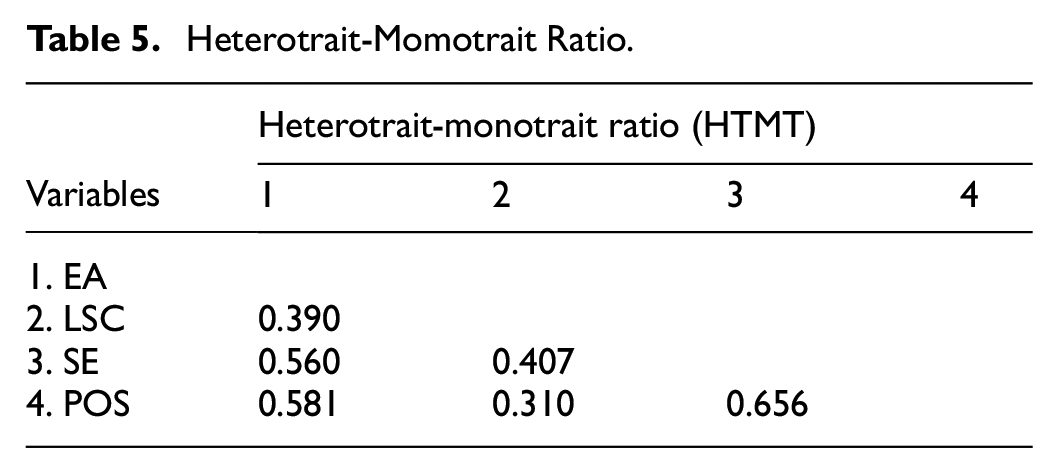
The average variance extracted (AVE) was used to evaluate convergent validity. All constructs exceeded the 0.50 threshold (Table 4), indicating adequate convergent validity (Fornell & Larcker, 1981). Discriminant validity, which proves that each construct is unique, was supported by both the Fornell-Larcker criterion and HTMT (Henseler et al., 2015). All HTMT values were below 0.90, indicating discriminant validity (Table 5) and the square root of each construct’s AVE was greater than its correlations with the other constructs (Table 3).
Heterotrait-Momotrait Ratio.
Additionally, the measurement model’s fit was assessed. The results (χ2/df = 2.639, df = 203) suggested a reasonable and fair fit between the hypothesised model and the observed data. The model demonstrated adequate fit with CFI = 0.933, TLI = 0.924, and RMSEA = 0.076 (90% CI [0.068, 0.084]). Additional fit indices further supported the model’s validity, including SRMR = 0.046, NFI = 0.897, GFI = 0.855 and AGFI = 0.819, all within acceptable ranges, indicating a good fit to the data.
Structural Model
The outcomes of the path analysis reveal the R-squared values for the endogenous variables:
Results of Path Analysis.

Note.
Although the R2 value for POS is lower, the link between SE and POS is statistically significant, with a substantial effect size
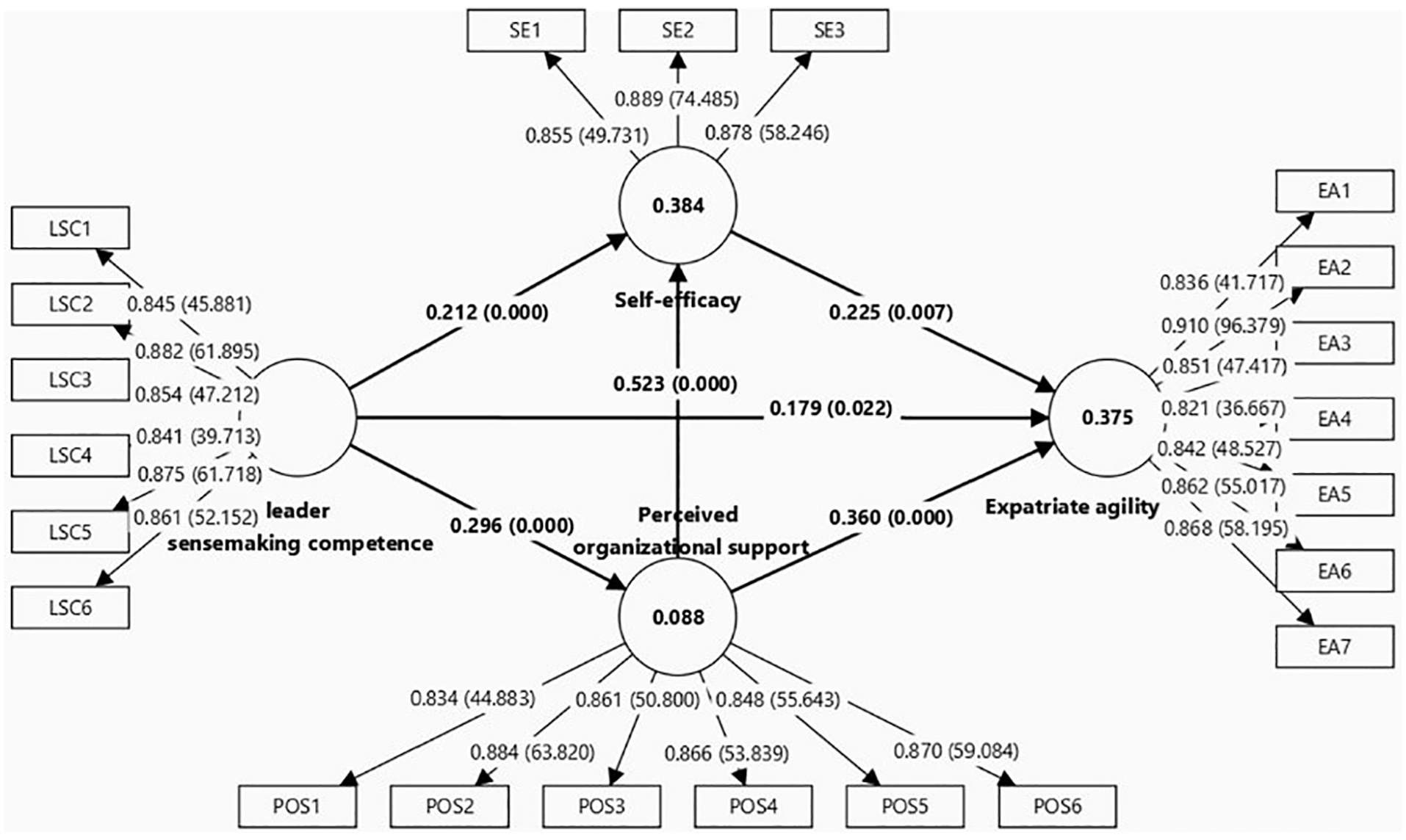
Structural model.
Hypotheses Testing
The significance test entailed assessing the significance of the path coefficients using the bootstrapping procedure with 10,000 bootstrap samples. The measure of significance is the p-value, which must be less than or equal to .05, indicating that the path from predictor to outcome is significant. Hypothesis H1 posited that LSC positively influences EA, and the results supported this hypothesis

Results of hypothesis testing.
Mediation Analysis
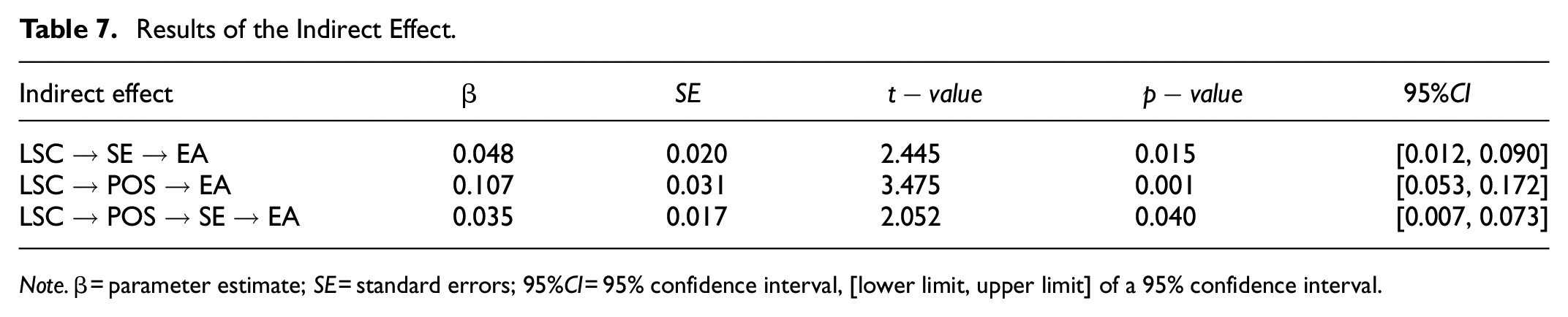
This study explored the mediating roles of SE (H7) and POS (H8) in the relationship between LSC and EA. The results (Table 7) support both mediating effects. H7 (SE Mediation): SE partially mediates the leader sensemaking-agility relationship
Results of the Indirect Effect.
Note.
H8 (POS Mediation): POS also partially mediates the leader sensemaking-agility relationship
H9 (Serial Mediation): The results further support a serial mediation model
Discussion
The results of this investigation significantly improve our comprehension of the connection between LSC and EA during economic uncertainty. The analyses supported all hypotheses, revealing a strong and positive connection between LSC and EA and the mediating factors of POS and SE.
First and foremost, the direct influence of LSC on EA (H1) underscores the importance of leaders’ ability to interpret complex and ambiguous situations. Leaders with solid sensemaking skills equip expatriates with the tools to navigate challenges effectively, fostering an environment where agility is paramount. This finding is consistent with prior literature that highlights how important leadership is in shaping employee behaviours and outcomes in uncertain contexts (Tisch & Galbreath, 2018).
Additionally, the positive relationship between LSC and POS (H2) suggests that leaders who demonstrate effective sensemaking capabilities create a supportive organisational climate. By providing clear guidance and resources, leaders help expatriates feel valued and supported, which is essential for promoting their agility. This finding emphasises the need for MNEs to invest in leadership development programmes that enhance sensemaking abilities, ultimately benefitting expatriates’ performance in unpredictable environments.
The results also revealed that LSC positively influences SE (H3), indicating that leaders’ interpretative skills enhance expatriates’ belief in their capabilities. This relationship is crucial, as strong SE has been linked to better performance and adaptability (Bandura, 1997b). As expatriates gain confidence in their abilities through effective leadership, they are more likely to respond dynamically to their challenges, improving overall organisational performance.
The support for H4 and H5 further reinforces the interconnectedness of these constructs, showing that both SE and POS directly influence EA. The findings imply that organisations must foster a culture of support and empower expatriates to develop their self-efficacy. By cultivating these elements, MNEs can enhance the agility of their expatriate workforce, especially during economic downturns when flexibility is critical.
Moreover, both SE and POS partially mediate the link between LSC and EA, according to the results of H7 and H8. This implies that while LSC directly influences EA, it also enhances POS and SE. Leaders who excel in sensemaking provide guidance and contribute to a work environment where expatriates feel upheld and confident in their skills. This result emphasises how intricately these factors interact, suggesting that interventions aimed at enhancing LSC could have cascading effects on expatriate outcomes.
Finally, the support for H9, indicating a serial mediation model, further enriches our understanding of these relationships. The results demonstrate that LSC influences POS, which subsequently fosters SE and ultimately enhances EA. This sequential pathway illustrates the nuanced mechanisms through which leadership shapes expatriate outcomes. By recognising the interconnectedness of LSC, POS and SE, organisations can develop comprehensive strategies that target multiple levels of influence to bolster expatriate agility.
Theoretical Implications
This study advances our understanding of expatriate management by emphasising the significance of LSC, especially in the context of economic instability. It expands existing leadership models by focusing on leaders’ capacities to navigate unpredictable environments (Marques et al., 2023). The study provides a more thorough comprehension of expatriate agility. Expatriate success in uncertain economic environments depends not only on individual adaptability or organisational support but also heavily on leaders’ abilities to interpret and communicate complex situations.
This study also enhances the applicability of SIP Theory (Salancik & Pfeffer, 1978) and offers novel insights into how leaders provided social cues are crucial in helping expatriates navigate complex, uncertain environments, demonstrating LSC influences EA through perceived organisational support (POS) and self-efficacy (SE) by illustrating how leaders, through sensemaking, shape expatriates’ confidence and their sense of organisational support. Unlike previous applications in stable contexts, our study shows SIP Theory’s relevance in dynamic, crisis-prone settings, offering a new perspective on how social information is processed and utilised in challenging international assignments. This study aligns with and builds upon previous research that demonstrates the interconnected nature of SE and POS, with POS augmenting SE (Caesens & Stinglhamber, 2014; Musenze et al., 2022; Na-Nan & Sanamthong, 2019).
This study also extends the Leader-Member Exchange (LMX) Theory (Erdogan & Bauer, 2015) in international contexts, indicating that the calibre of leader-member connections is heavily influenced by the leader’s ability to make sense of complex environments. The strong relationship between LSC and POS indicates that leaders’ sensemaking competence significantly shapes expatriates’ perception of organisational support.
Moreover, the study contributes to the Conservation of Resources (COR) Theory (Hobfoll et al., 2018) by demonstrating that LSC dynamically influences resources like POS and SE in expatriate contexts. LSC enhances these psychological resources, boosting expatriate agility. This dynamic perspective on resource building in international assignments offers new insights into how expatriates develop and sustain psychological resources in challenging environments.
The study suggests that cognitive interpretation of leader sensemaking in expatriate contexts is more critical than simple imitation, as mediated by SE. This suggests that leaders’ sensemaking enhances expatriates’ belief in their capabilities to navigate challenges rather than providing a model to follow, as per the findings. This offers nuanced extensions to Social Learning Theory (P. Caligiuri & Tarique, 2014)
In conclusion, this study significantly advances expatriate management theory by demonstrating the central role of leader sensemaking in fostering expatriate agility. Extending SIP Theory provides a nuanced and comprehensive model for understanding expatriate success in challenging global environments.
Practical Implications
The findings have significant ramifications for MNEs in terms of international human resource management. To ensure expatriate success during economic downturns, MNEs should go beyond general support measures and implement targeted programmes to enhance leader sensemaking in interpreting economic and market changes. Additionally, programmes to strengthen expatriates’ SE and POS within the organisation should be prioritised.
Firstly, organisations should prioritise developing LSC. Investing in targeted training programmes that improve leaders’ ability to interpret complex market conditions and economic and political indicators that signal emerging crises, as well as scenario-based simulations and analyses of past crises, can help develop leaders’ pattern recognition skills for uncertainty (Armon et al., 2023). Additionally, communication training is tailored to address diverse audiences, manage expectations during turbulent times, and provide clear directional guidance that will enhance EA.
Secondly, organisations should establish robust support systems, especially during periods of uncertainty. MNCs can achieve this through structured mentoring programmes pairing experienced expatriates with newcomers, regular virtual peer support networks and multi-channel communication platforms for real-time information sharing (van Bakel et al., 2022). Clearly defined roles and responsibilities can also reduce ambiguity for expatriates.
Thirdly, Leaders have an important role in actively instilling confidence towards their expatriate workforce. Support should be tailored to individual needs, taking into account expatriates’ existing skills and backgrounds. This can be done through pre-departure assessments, personalised development plans and ongoing feedback and recognition. These strategies will bolster expatriate resilience and adaptability by strengthening SE and POS (Setti et al., 2022).
Implementing strategies can boost expatriates’ resilience and adaptability, especially during economic uncertainties, by strengthening LSC, boosting POS and enhancing expatriate SE, all crucial factors in promoting EA.
Limitations and Future Research Directions
Even though this study has yielded insightful information, it is essential to recognise its limits. The cross-sectional design, for instance, restricts the capacity to make causal inferences, and the dependence on self-reported data increases the likelihood of common method bias, potentially inflating relationships between variables. Future studies must consider employing longitudinal research, which could provide stronger evidence for how LSC influences EA over time, clarifying causal relationships. Moreover, gathering information from various sources to address these issues. For instance, peers or superiors could assess LSC, while expatriate agility EA could be measured through objective performance metrics in addition to self-reports.
Furthermore, since the study was conducted within the Thai context, it is possible that the results cannot be applied to other cultural or economic settings. It is essential to acknowledge that Thailand’s unique cultural characteristics could have influenced the observed relationships between key variables, and these dynamics might differ in cultures with different values and norms. Therefore, future research should focus on understanding how LSC affects EA in diverse cultural and industrial contexts. This inclusivity will not only enhance the generalisability of the findings but also uncover culture-specific patterns, enriching our understanding of the subject. Future studies could also explore other individual factors, such as resilience and openness to experience or organisational structures, like flexible work arrangements, as potential mediators in the relationship between LSC and EA during economic downturns.
Conclusion
This research enhances understanding of expatriate management by studying the effect of LSC on EA via SE and POS. This underscores the significance of effective leadership during tough economic times and indicates that leaders with solid sensemaking abilities cultivate EA and the psychological factors that support it, which are crucial for coping with economic uncertainty. This study provides a more refined comprehension of EA by incorporating SIP theory. These findings offer valuable guidance for organisations operating in an era of increasing economic uncertainty. Investing in developing leader sensemaking, creating supportive work environments and providing tailored support to individual needs, as recommended by the study, will ultimately help organisations build a globally adaptable and resilient workforce.
Footnotes
Acknowledgements
We extend our heartfelt gratitude to all participants who graciously shared their valuable time and insights for this study. Your contributions have immensely enriched our knowledge of the adaptability of expatriates in Thailand during economic downturns, and we are deeply appreciative of your dedication to this research.

Ethical Considerations
The study adhered to ethical principles and was exempt from ethics committee approval as it fulfilled institutional guidelines and did not gather sensitive information. Participants were informed of their rights, including the right to withdraw from the study without consequences, and the confidentiality of the data collected was ensured for research purposes.
Funding
The author(s) received no financial support for the research, authorship, and/or publication of this article.
Declaration of Conflicting Interests
The author(s) declared no potential conflicts of interest with respect to the research, authorship, and/or publication of this article.
Data Availability Statement
The data that support the findings of this study are not publicly available to maintain participant confidentiality and protect their privacy. The anonymous voluntary survey did not collect sensitive information and met the criteria for exemption from ethics committee approval per institutional guidelines. However, the data may be made available by the corresponding author, upon reasonable request and subject to a data sharing agreement that ensures the confidentiality and privacy of the participants. Requests will be reviewed on a case-by-case basis, and any data sharing will be subject to necessary safeguards to protect participant privacy.