




Abstract
With the swift advancement of artificial intelligence technology, generative AI reviews, as a novel form of online evaluation, are increasingly capturing consumers’ attention, thereby infusing innovation into the traditional online review paradigm. This technology, grounded in big data and sophisticated machine learning algorithms, seamlessly integrates users’ historical behavior data with real-time demand information. By meticulously excavating both commonalities and discrepancies from a vast corpus of reviews, it presents consumers with a more holistic and objective product representation. Nevertheless, the utility, transparency, and the fostering of consumer trust in generative AI reviews have precipitated extensive discourse. Drawing upon the Elaboration Likelihood Model, this investigation delves into the multifaceted attributes of generative AI reviews. Employing a questionnaire survey methodology, it systematically explores their influence on consumer purchase decision-making behavior. The findings reveal that the quality, emotional resonance, length, and credibility of generative AI reviews exert a positive influence on consumer purchase decisions. This impact is ultimately mediated through the perceived usefulness of the reviews. Furthermore, the inclination to trust artificial intelligence serves as a moderator, altering the perceived usefulness of reviews of varying lengths. This research not only enriches the landscape of online review studies and expands the horizons of generative AI review research but also bears substantial practical implications. It offers valuable insights for the refinement of the information ecosystem on e-commerce platforms and for enhancing consumer purchase decision-making processes.
Plain Language Summary
With the rapid development of artificial intelligence technology, Generative AI review, as an emerging form of online review, is gradually entering the field of vision of consumers and bringing innovation to the traditional online review model. This technology, based on big data and machine learning algorithms, combines users’ historical behavior data and real-time demand information to mine commonalities and differences from massive reviews, presenting a more comprehensive and objective product image to consumers. However, issues such as the usefulness, transparency of Generative AI reviews, and trust-building among consumers have also sparked widespread discussion. This study combines the Elaboration Likelihood Model with the multidimensional attributes of Generative AI reviews to explore how they influence consumer purchase decision-making behavior. The research results indicate that these attributes have a positive impact on consumer purchase decisions, and this impact ultimately acts on purchase decisions through perceived usefulness. At the same time, propensity to trust in artificial intelligence moderates consumers’ perceived usefulness of reviews of different lengths. This research not only enriches the research scope in the field of online reviews and expands the research boundaries of Generative AI reviews, but also has important practical implications for improving the information ecosystem of e-commerce platforms and consumer purchase decisions.
Keywords
Introduction
In the realm of online shopping, a predominant tendency among consumers is to peruse fellow consumers’ online reviews as a means to form initial perceptions of products prior to making a purchase (Mudambi & Schuff, 2010). A consumer survey undertaken by the global market research firm Kantar in 2021 revealed that over 93% of consumers consult online product reviews before finalizing a purchase. Furthermore, the survey highlighted that more than 85% of consumers consider online reviews to be a pivotal factor influencing their shopping decisions, with over 80% expressing trust in the product reviews they encounter on websites. Online reviews have progressively evolved into a primary channel for consumers to acquire product information (K. L. Xie et al., 2014) and mitigate perceived uncertainty levels (Ye et al., 2011), thereby playing a crucial role in shaping consumers’ purchase decisions. However, as the influence of online reviews in consumer decision-making continues to escalate, a plethora of issues have come to the forefront. Taking the Amazon platform as a case in point, the quantity and quality of online product reviews are intrinsically linked to the product’s ranking in search results. This has led some merchants to engage in deceptive practices, such as posting fake reviews or spamming, to augment the number of positive reviews and thereby secure higher visibility. Although Amazon has been progressively stringent in its review moderation efforts, there remain merchants who, despite the risk of account suspension, opt to undertake such behaviors. In an effort to address this issue to the fullest extent, Amazon has taken a proactive approach by tackling the problem at its root. This has been achieved through the introduction of generative AI reviews, aimed at reducing sellers’ dependence on traditional reviews.
With the continuous advancements in artificial intelligence technology, a novel form of online evaluation—Generative AI reviews—is gradually gaining traction in consumers’ awareness and introducing innovation to traditional online review models. Taking Amazon as a case study, its introduced Generative AI review function performs a deep analysis and synthesis of existing product reviews, extracting critical information and viewpoints to offer consumers more concise and actionable evaluation content. Additionally, AI-summarized reviews highlight specific product attributes, such as performance, ease of use, and stability, and mark them with checkmarks to indicate the presence of these features in the product. For instance, if consumers wish to ascertain the ease of use of a particular product, they can simply click on the corresponding product attribute under the highlighted reviews to access reviews related explicitly to “ease of use.” By categorizing the various functions of the product, the AI summary brings previously obscured negative or mediocre reviews to the forefront among a multitude of reviews, thereby making the product’s strengths and weaknesses distinctly apparent.
Unlike traditional AI, which simulates human language style and thinking patterns, Generative AI reviews do not rely on the input of a single reviewer or limited subjective experience. Rather, they are grounded in big data and machine learning algorithms, integrating users’ historical behavioral data and real-time demand information to extract commonalities and differences from a vast corpus of reviews. This approach presents consumers with a more comprehensive and objective product image. Such an evaluation method not only enhances the relevance and usefulness of the information provided but also significantly improves consumers’ shopping experience and decision-making efficiency. Furthermore, AI-summarized reviews mitigate the disparity originally induced by the overwhelming volume of reviews, thereby leveling the competitive playing field and prompting sellers to concentrate on the intrinsic quality of their products, ultimately leading to an improvement in product quality.
However, the introduction of Generative AI review has also sparked discussions on a series of complex issues such as usefulness, transparency, and consumer trust building. The core question is what role does this AI-generated evaluation content play in the consumer purchase decision process? Does it really help consumers make more informed choices? On one hand, supporters believe that Generative AI review can effectively solve the information overload problem in traditional online reviews, quickly extracting key evaluation points for consumers, thereby simplifying the decision-making process. On the other hand, critics worry that this evaluation method may be too mechanistic, neglecting the complexity and diversity of human emotions. At the same time, due to the lack of trust between humans and machines and the existence of artificial intelligence hallucination(Christensen et al., 2024), many consumers may not believe in the authenticity and usefulness of Generative AI review, which could further affect their purchase decision behavior. Therefore, deeply analyzing the effectiveness of Generative AI review and exploring its impact mechanism on consumer purchase decisions not only has important practical implications for improving the information ecosystem of e-commerce platforms but is also an academic topic that urgently needs further research in the interdisciplinary field of information technology and social psychology.
Currently, although some scholars have integrated online reviews with consumer purchase decisions, research on Generative AI reviews—as a novel form of online evaluation—remains relatively scarce. The practicality and impact mechanism of Generative AI reviews on consumer purchase decisions necessitate further exploration. Accordingly, this study situates its research within the context of the application of generative AI reviews in online shopping. By leveraging the Elaboration Likelihood Model, it constructs a mechanism via empirical analysis to investigate the influence of generative AI reviews on consumer purchase decisions, thereby offering valuable insights and recommendations for e-commerce platforms and consumers.
Literature Review and Research Hypothesis
Online Review and Generative AI Review
Online reviews, a prevalent form of online word-of-mouth (Changchit & Klaus, 2020), encapsulate consumers’ experiences and perceptions regarding specific product attributes or service quality. These reviews not only facilitate first-time buyers in identifying suitable products but also significantly influence sales outcomes for businesses, either promoting or hindering them (Chen & Xie, 2008). Via online reviews, consumers can articulate their opinions through text, images, and videos, thereby engaging in communication and interaction with other users (Namvar & Chua, 2023). Such reviews serve to mitigate information asymmetry between consumers and online retailers and play a pivotal role in shaping consumers’ purchase decisions (Shen et al., 2016). A plethora of studies have demonstrated that online reviews equip consumers with adequate information to make informed, rational decisions (Ren & Nickerson, 2019; Sun, 2012). Moreover, prior research has highlighted that the impact of online reviews on consumers’ purchase decisions is both multi-dimensional and multi-stage. The multi-dimensional aspect refers to the influence of various facets of online reviews—such as quantity, valence, timeliness, and textual content—on consumers’ purchase decisions (Duan et al., 2008; X. Li et al., 2019). The multi-stage aspect pertains to the influence of online reviews across multiple stages of the consumer decision-making process, affecting perceptions, purchase intentions, and ultimately purchasing behavior (Jensen et al., 2013; Xiao et al., 2016).
With the rapid development of artificial intelligence technology, Generative Artificial Intelligence, as an important branch of AI, is gradually demonstrating its powerful creativity and application value in various fields. The deployment of generative AI is increasingly prevalent across consumer, business, and regulatory domains, with significant applications in various functional sectors, particularly within sales and marketing (Dwivedi et al., 2024). Tools such as Bard, ChatGPT, Synthesia, Claude, ERNIE Bot, Kimi, and their counterparts are adept at generating a diverse array of marketing materials, including advertising content in various formats (text, imagery, and video), digital marketing strategies, chatbot-based interactions, blog articles, and sales training programs (Ooi et al., 2023). In the realm of marketing, e-commerce platforms utilize generative AI to integrate potential customers’ browsing histories and purchasing patterns with additional digital traces, thereby enabling the hyper-personalization of content. The resultant dynamic and real-time offers have the potential to enhance the conversion rates of promotional activities while concurrently reducing the click-through rates. Generative AI significantly alleviates the effort consumers exert in searching by streamlining information access, providing customized suggestions, offering conversational search support, and enhancing the capabilities of visual search (Kshetri, 2024).
With the progression of technology, generative AI reviews, as an innovative form of evaluation, are increasingly being embraced by major e-commerce and review platforms such as Amazon, Dianping, and Taobao (Figure 1). Generative AI reviews involve the utilization of generative AI technology to conduct in-depth analysis and mining of a substantial volume of user reviews, automatically extracting key information and opinions, and presenting them to consumers in a refined and accurate manner. Compared to traditional user-generated reviews, generative AI reviews are distinguished by their efficiency and objectivity. By analyzing user reviews, they automatically generate concise evaluation summaries, thereby facilitating consumers’ quick understanding of product features. It is evident that generative AI reviews necessitate a certain volume of review data as a foundation; without a substantial number of reviews, the referential value of AI-generated reviews is significantly diminished. Given that this feature has only recently been introduced, there are discrepancies in the generative AI reviews across platforms. Based on a comparative observation and user interviews regarding generative AI reviews on four platforms (Amazon, Taobao, Dianping, and Agoda), we identified that users’ perceived differences primarily revolve around the quality of reviews (relevance, objectivity, etc.), the length of reviews (the detail of content), emotional content (whether the reviews contain emotional sentiment), and the varying credibility of reviews due to platform differences. Furthermore, since generative AI reviews represent a novel technological product, there is a paucity of related research, indicating a significant research gap.

The generative AI review function of the Amazon shopping website.
Elaboration Likelihood Model
The Elaboration Likelihood Model (ELM), proposed by social psychologists Petty and Cacioppo in 1984 (Cacioppo & Petty, 1984), provides a solid theoretical foundation for studying the factors influencing consumers’ perceived credibility of persuasive messages. This model suggests two paths that influence consumer behavior and attitude: the central route and the peripheral route. The central route refers to the process where users think, analyze, and summarize information, which ultimately leads to a change or formation of attitudes. The central route emphasizes the content of the information itself. The peripheral route refers to the process where users form judgments based on certain situational cues of the information, which in turn leads to a change or formation of attitudes. Although users can process information through either of the two routes, in practice, they often combine the use of both routes to process information (Sussman & Siegal, 2003).
A considerable amount of research has utilized the Elaboration Likelihood Model to analyze and understand the process and mechanisms by which users process online reviews in the internet environment. In the context of e-commerce, the virtual nature of the internet increases the risk and uncertainty of transactions, thereby complicating consumers’ purchase decision-making. For online reviews, the attributes of the reviews can directly influence users’ judgments of products or services, with researchers tending to believe that the quality of the review information impacts consumers through the central route; whereas factors such as the credibility of the reviews have an impact through the peripheral route. Therefore, this paper categorizes the review-related attribute variables into two types based on the ELM model: the central route and the peripheral route. The central route represents the characteristics of the review information, mainly reflecting the quality of the review information, while the peripheral route reflects the reliability of the review information, such as differences in the credibility of reviews due to platform differences or the number of reviews. Generally, consumers can make purchase decisions based on the characteristics of the review information alone; when consumers do not have sufficient trust in the review information, they need to rely on the related content of the information source to make a decision on whether to purchase. The Elaboration Likelihood Model aligns well with the research approach of this paper and is therefore used as a theoretical reference for constructing the research model.
Literature Review and Research Hypothesis
Related research indicates that when consumers are making purchase decisions, the information available about product quality and merchant credibility is often incomplete, necessitating information search to reduce consumption uncertainty (Sussman & Siegal, 2003). Positive reviews can increase the purchase intention of potential consumers (Changchit & Klaus, 2020; Iyer et al., 2020). Online reviews can influence consumers’ perceived usefulness. Due to the existence of merchant-controlled reviews and false review (Mewada & Dewang, 2022), consumers only sometimes consider online reviews to be useful. Mudambi and Schuff (2010) constructed a model of review perceived usefulness based on information economics and demonstrated the impact of factors such as the extremity of online reviews and product type on the perceived usefulness of online reviews. Additionally, the quality of online reviews, measured by dimensions such as perceived persuasiveness, has an important influence on consumers’ purchase intentions (K. Z. K. Zhang et al., 2014). Online reviews possess multidimensional characteristics. Based on the primary features of generative AI-generated reviews and the current main perceived differences by users, this study selects review quality, emotional content, review length, and review credibility as the main research objects.
The quality of online review information, as a central cue, can create expectations of trustworthiness regarding the source of the review information for consumers (Meservy et al., 2014). In fact, the quality of reviews reflects the professionalism and reliability of the review source. Information sources that provide accurate, factual, and detailed descriptions of the product’s relevant features are more trustworthy compared to those with simple content and subjective product descriptions (Song et al., 2017). Existing research typically defines and measures review quality based on the content of online reviews. D.-H. Park et al. (2007) proposed that review quality can be measured using four indicators: relevance, understandability, sufficiency, and objectivity, based on the characteristics of the information content itself. They believe that high-quality reviews contain rich information about product usage and experiences, have clear logic and strong persuasiveness, provide true and detailed descriptions of the product, and have sufficient and objective reasons. Conversely, low-quality reviews are often subjective, emotional, and do not provide objective and actual information related to the product, lacking convincing evidence and coherence. High-quality online reviews can help consumers clearly categorize the strengths and weaknesses of products, reduce the time and cost of information search, and improve the efficiency of purchase decisions. Sussman and Siegal’s (2003) research found that the quality of information has a significant positive impact on knowledge workers’ perceived information usefulness. In online shopping, high-quality user reviews are more likely to be trusted by recipients and have a greater influence on their purchase decisions because they provide sufficient evidence and better reflect the true attributes of the product. Research by scholars such as Godes and Mayzlin (2004) confirms that review quality has a significant impact on product sales. Park’s research found that online review quality influences consumers’ purchase intentions, and this influence is moderated by the number of reviews and consumer involvement (D.-H. Park et al., 2007). Burhanudin’s (2024) research discovered that customer review quality affects social commerce satisfaction and consumers’ trust in social media and social commerce.
McAllister (1995) points out that one important type of interpersonal trust is affect-based trust, which is a trust established on the emotional connections and interactions between individuals (Lewis & Weigert, 1985). On e-commerce platforms, many consumers will leave reviews after completing online shopping or booking activities to express their emotions and attitudes (Biswas et al., 2020). This emotionally biased online reviews then feedback on consumer behavior (Vermeulen & Seegers, 2009). Emotional content refers to the emotional cues contained in reviews (G. Huang & Liang, 2021), including positive, negative, and neutral cues. Reviews with rich emotional content are more likely to evoke resonance and interest from users (Cao et al., 2011). Ullah investigate the impact of emotional content within review texts on the number of helpfulness votes received (Ullah et al., 2015). The study’s findings indicate that reviews with positive emotional content are perceived as more helpful, whereas negative emotional content does not influence perceptions of helpfulness. Filiere and Mcleay studied the impact of online review sentiment on travelers’ willingness to stay, and the results showed that travelers are more inclined to choose hotels with positive review sentiment for their accommodation (Filieri & McLeay, 2014). Consumers tend to perceive online reviews with positive emotional content as being more useful. When reviews contain a significant amount of anger, it can reduce the perceived usefulness of online reviews and also have a negative impact on consumers’ purchase decisions (Yin et al., 2020). People often perceive AI as lacking in emotional warmth and empathy (M.-H. Huang & Rust, 2018), leading to resistance behavior. The emotional content in generative AI reviews may bridge the psychological gap between users and AI, causing users to view the AI tool as a friend rather than an assistant (A. Zhang & Rau, 2023). This could encourage a more positive mindset when browsing reviews, which might enhance users’ perception of the usefulness of the reviews to some extent, thereby facilitating purchase decisions.
Review credibility refers to online consumers’ perception of the reliability or authenticity of reviews and recommendations on online platforms. It is a subjective concept that depends on the information recipient themselves, and different information recipients may perceive different levels of online review credibility. When shopping on online platforms, one of the most important factors that consumers often consider when paying attention to online reviews is review credibility (Cheung et al., 2009). Trust plays a central role in helping consumers reduce inner insecurity and overcome the risks of online shopping (McKnight et al., 2002). Credible online reviews not only display product information but also have a recommendation function, thereby meeting the needs of different consumer groups and influencing their purchase decisions (D.-H. Park & Kim, 2008). Compared to low review credibility, consumers perceive high-credibility reviews as more useful, which can better promote their purchase decisions (M.-J. Kim et al., 2011). Previous studies found that the trustworthiness of a review encourages consumers to sort and filter information, receive recommendations, and make more well-informed decisions (Lim et al., 2006).
Review length refers to the level of detail in the AI-generated review summaries, usually quantified by the number of characters or sentences. In studies on the impact of review length on the usefulness of reviews, the vast majority of scholars support a significant positive correlation between review length and review usefulness. Based on the length of the review text, online reviews can be classified into long-text reviews and short-text reviews (Y. Wang et al., 2020). Longer reviews typically contain more useful information, which can better stimulate potential consumers to read the reviews and help users make decisions (Pan & Zhang, 2011). Brief reviews often lack a comprehensive assessment of product performance, while longer reviews contain relatively more information, more fully reflecting the details of the product and helping consumers gain indirect consumption experience (Racherla & Friske, 2012). However, when the number of words in a review exceeds a certain threshold, overly long reviews can increase the cognitive load on consumers (Pan & Zhang, 2011), and the usefulness of the review may actually decrease (Kuan et al., 2015). Based on this, the following hypotheses are proposed in this study:
The concept of perceived usefulness was first introduced by Fred D. Davis in the Technology Acceptance Model and has been widely applied in research across various fields such as information systems, e-commerce, and online learning. Review perceived usefulness refers to the perceived value that influences consumers’ purchase decisions after reading product reviews posted by others (Mudambi & Schuff, 2010), serving as a crucial factor in promoting the adoption of reviews by consumers. On online platforms, the characteristics of online word-of-mouth have a significant positive impact on users’ behavioral intentions, with perceived usefulness playing a mediating role (Saidani et al., 2023). Positive evaluations also increase consumers’ purchase intention, and this effect is enhanced when positive evaluations are perceived as useful (Jia & Liu, 2018; Yi et al., 2019). Based on this, the following hypotheses are proposed in this study:
Trust propensity refers to an individual’s general willingness to trust other things formed after long-term socialization (Ridings et al., 2002). Individuals from different cultural backgrounds possess distinct personality traits and developmental experiences, resulting in variations in trust propensity. Generally, users with stronger trust propensity have a higher willingness to believe in external things, and vice versa. Consumers’ willingness to believe and adopt review information posted by others in the online environment is influenced by their trust propensity. Existing research indicates that individuals with strong trust propensity are more likely to trust others, while those with weak trust propensity are the opposite (H. Xie et al., 2011). Trust propensity in artificial intelligence refers to the degree of acceptance and trust people have in AI technology. Due to the continuous learning and non-interpretable characteristics of generative AI systems, they adopt a black box mechanism in design and development. Additionally, the data used may contain biases as it is not filtered and tested (Bauer et al., 2023), leading to significant differences in people’s trust propensity towards such systems. Research has found that consumers’ trust propensity in generative AI significantly influences their travel behavioral intentions (T. Kim et al., 2024). As generative AI reviews are a new product of “Generative AI,” their perceived usefulness may be influenced by trust propensity in AI. This paper infers that individuals with different levels of trust propensity in AI have different judgments of review quality, emotional content, review length, and review credibility, leading to different levels of perceived usefulness for consumers. Based on this, the following hypotheses are proposed in this study:
Based on the Elaboration Likelihood Model (ELM) and research approach, this study explores the impact of generative AI reviews on consumers’ purchase decisions from both the central and peripheral routes, with perceived usefulness as the mediating variable and trust propensity in artificial intelligence as the moderating variable. The research framework is shown in Figure 2.
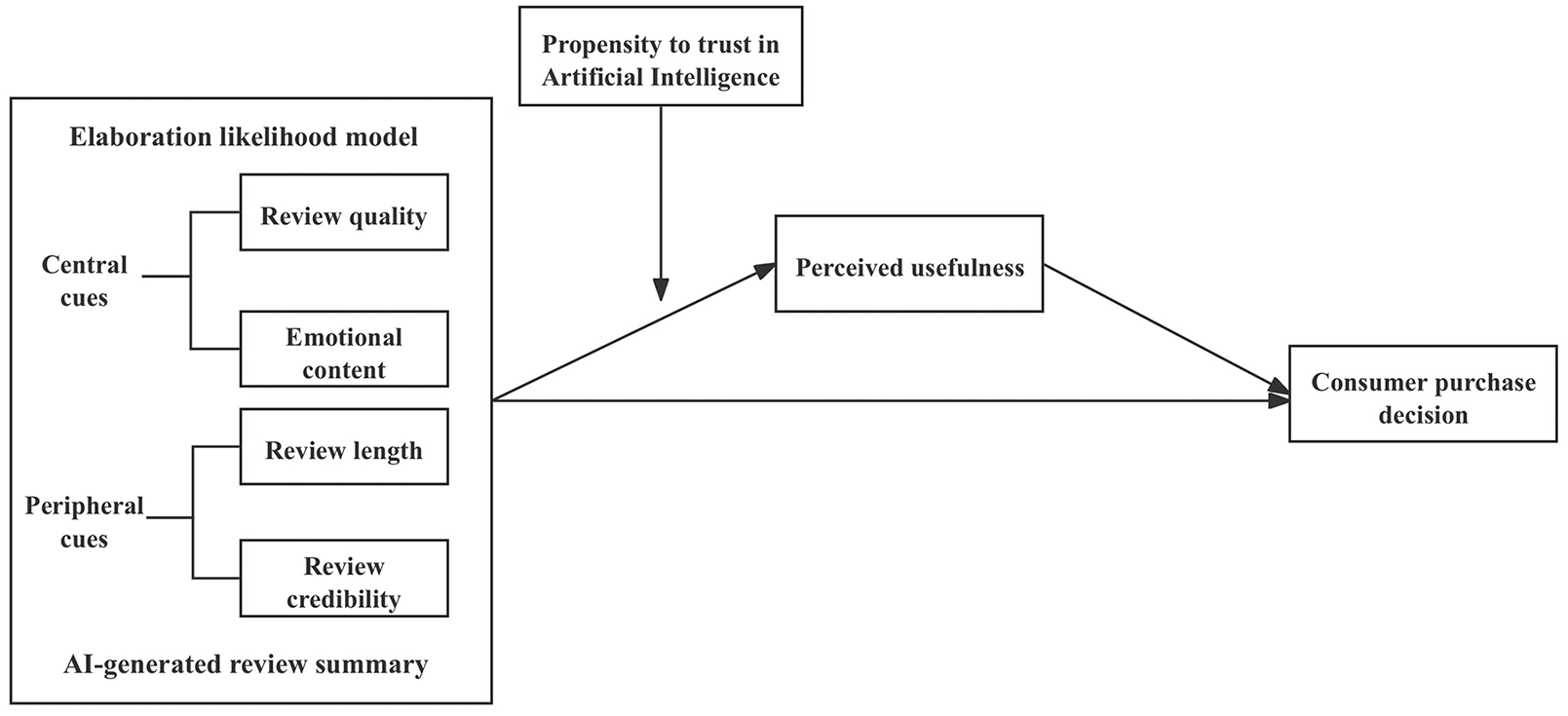
Research model diagram.
Research Design
Variable Measurement
To ensure the reliability and validity of the scales, the variables in this study’s questionnaire were all derived from established scales published in major international core journals. When adapting these scales, the study followed the bidirectional translation-back translation program (Brislin, 1970) and made appropriate adjustments in line with the research context. Specifically, the attributes of generative AI reviews encompass four dimensions: review quality, emotional content, review length, and review credibility. The scales for these dimensions are mainly drawn from relevant studies by scholars such as Park (D.-H. Park et al., 2007), Cheung (Cheung et al., 2009), Yin (Yin et al., 2014) and Yingying Gu (Gu & Zhu, 2023). The measurement of propensity to trust in artificial intelligence primarily relies on the research findings of Ridings (Ridings et al., 2002). The perceived usefulness is mainly referenced from the work of Moon and Kim (2001). The consumer purchase decision is primarily based on the research findings of C. Park & Lee (2009). This study uses a five-point Likert scale to measure all items, with scores from 1 to 5 representing “strongly disagree” to “strongly agree.”
Sample and Data Collection
This study primarily investigates the impact of generative AI reviews on consumer purchase decisions. Therefore, the survey targets individuals who have a habit of browsing online reviews when making purchase decisions on e-commerce platforms. Consequently, we included a true-or-false question at the beginning of the questionnaire: “Do you have the habit of browsing online reviews to obtain references when making purchase decisions on e-commerce platforms?” This question served to filter out consumers who do not have the habit of browsing online reviews, thereby ensuring the representativeness of the sample. Additionally, at the beginning of the questionnaire, we presented respondents with partial product pages from Amazon, Dianping, and Taobao (including product information, merchant information, generative AI reviews, and some original user reviews) to help them better understand the research subject. Subsequently, we invited the participants to fill out the relevant survey items. Finally, we collected and statistically analyzed the basic information of the respondents, including gender, age, occupation, and educational background.
To ensure the reliability and validity of the questionnaire items, a pre-survey was conducted with 20 participants before the formal investigation to verify their understanding of the questions. No issues related to wording or measurement were identified. Subsequently, an online pre-survey was conducted using the “Sojump” platform to assess the reliability of the measurement items. A total of 120 questionnaires were distributed in the pre-survey, with 120 valid responses collected. Exploratory factor analysis was employed to further refine the initial scale items, with the following criteria for item removal: (1) items with factor loadings less than 0.7; (2) items that would decrease the chi-square value of the latent variables; (3) items that did not contribute to the average variance extracted (AVE) and composite reliability (CR). The refined scale consisted of 27 items.
The formal survey commenced on July 1, 2024, and lasted for 2 weeks. It employed the snowball sampling method to distribute and disseminate the questionnaires on the “Sojump” online platform. A total of 412 questionnaires were collected. Invalid questionnaires, including those with blank items, filled with the same answer from beginning to end, and with obvious contradictions between answered items and reverse-coded items, were excluded. Ultimately, 401 valid questionnaires were obtained. Among them, the proportion of female samples was higher than that of male samples, with females accounting for 67%. The age samples were mostly distributed between 18 and 40 years old, with the highest proportion of 31% being 31 to 40 years old, followed by 24% of samples being 18 to 30 years old. In terms of education, the proportion of individuals with a bachelor’s degree was the highest, accounting for 44%. According to the consumer profile released by Amazon, the proportion of female users on Amazon is slightly higher than that of male users, and the majority of users are in the 18 to 40 years old youth and middle-aged group. The survey sample is in line with the user profile of generative AI reviews and has good representativeness.
Data Analysis Results
Reliability and Validity Analysis
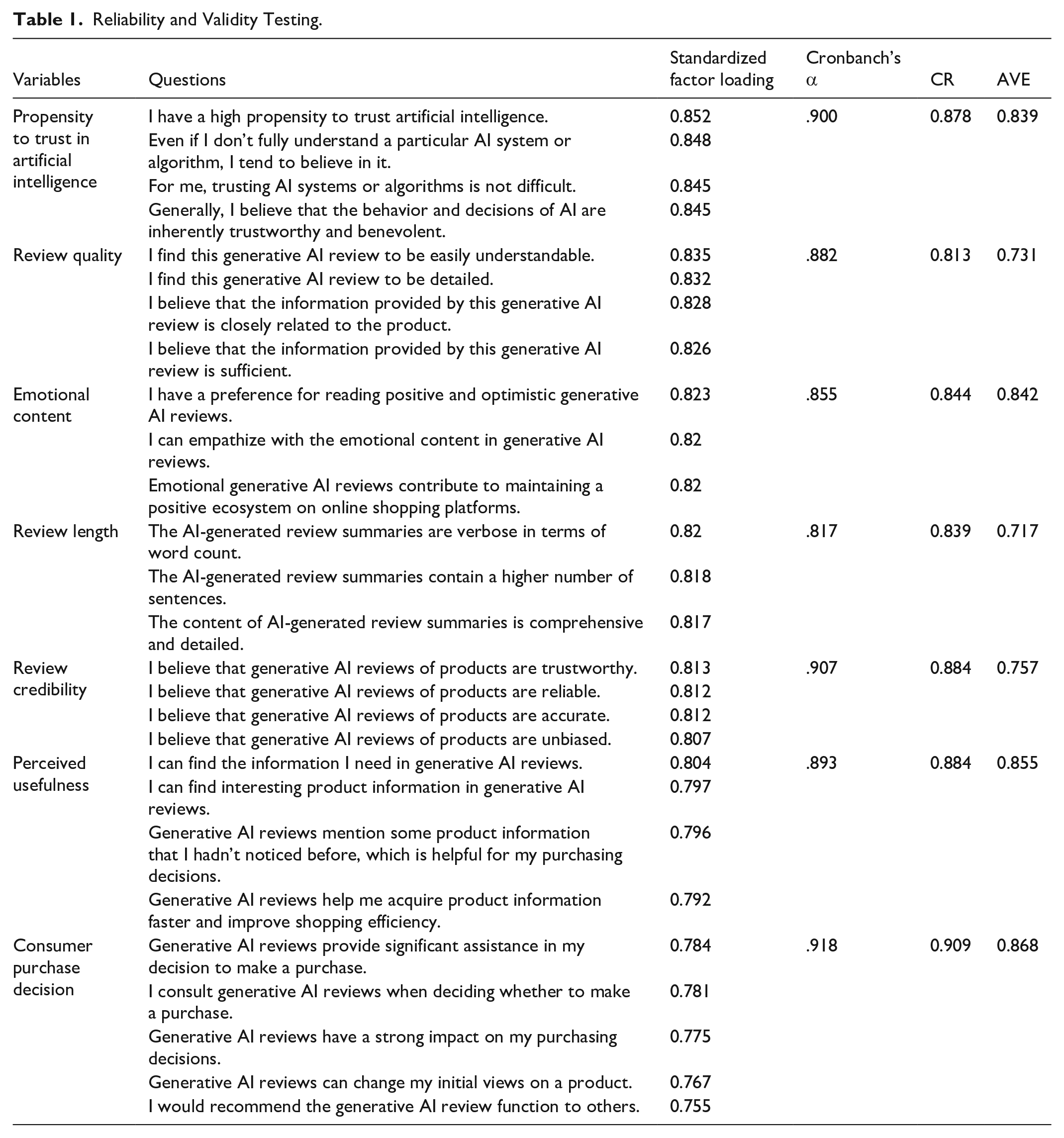
The results of the reliability and validity analysis are shown in Table 1. This paper uses Cronbach’s α coefficient to test the reliability of the variables. The results indicate that the Cronbach’s α coefficient of each variable is greater than .8, suggesting that the variables have good reliability. The factor loadings of all variables are greater than 0.7, the composite reliability values are all above .7, and the average variance extracted values are all greater than 0.5, indicating that the scale has good validity.
Reliability and Validity Testing.
Correlation Analysis
Pearson’s correlation coefficient method is used to analyze the correlations between variables, and the results are shown in Table 2. The correlation coefficients between review quality, emotional content, review length, review credibility, and perceived usefulness are .880, .851, .841, and .860, respectively, and they are significant at the .01 level. These data indicate that there is a significant positive correlation between the four attribute characteristics of generative AI reviews and perceived usefulness, supporting hypotheses H1a, H1b, H1c, and H1d. The correlation coefficients between review quality, emotional content, review length, review credibility, and consumer purchase decision are .854, .879, .815, and .899, respectively, and they are significant at the .01 level. These data indicate that there is a significant positive correlation between the four attribute characteristics of generative AI reviews and consumer purchase decision, supporting hypotheses H2a, H2b, H2c, and H2d. The correlation coefficient between propensity to trust in artificial intelligence and perceived usefulness is .830, and it is significant at the .01 level, indicating a significant positive correlation between them. The correlation coefficient between perceived usefulness and consumer purchase decision is .869, and it is significant at the .01 level, indicating a significant positive correlation between them, supporting hypothesis H3.
Mean, Standard Deviation, and Correlation Analysis.

Note. N = 401.
p < .01.
Mediation Analysis
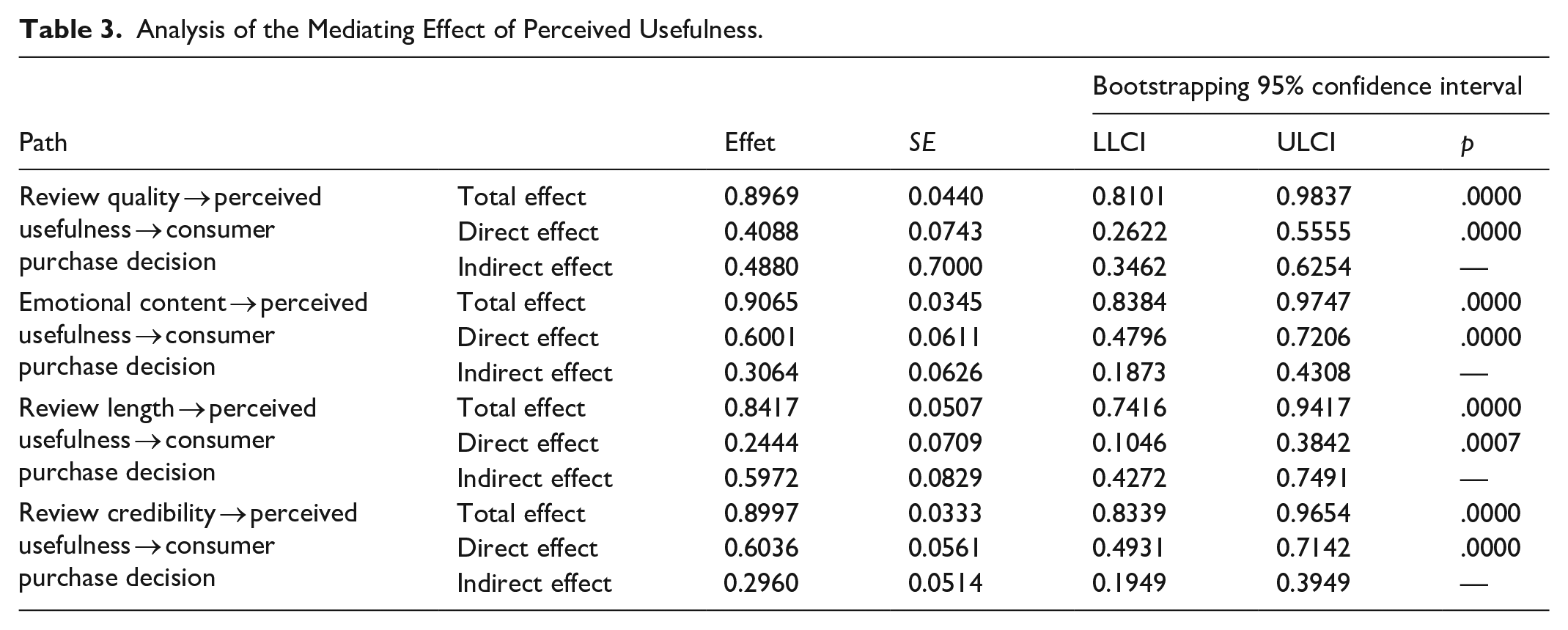
This paper uses the Bootstrap M method to test the significance of the mediation effect, with 5,000 bootstrap samples. As shown in Table 3, the direct effect of review quality → perceived usefulness → consumer purchase decision is 0.4088, and the indirect effect is 0.4880. The 95% confidence intervals for both effects do not include 0, indicating that perceived usefulness mediates the relationship between review quality and consumer purchase decision, supporting hypothesis H4a. The direct effect of emotional content → perceived usefulness → consumer purchase decision is 0.6001, and the indirect effect is 0.3064. The 95% confidence intervals for both effects do not include 0, indicating that perceived usefulness mediates the relationship between emotional content and consumer purchase decision, supporting hypothesis H4b. The direct effect of review length → perceived usefulness → consumer purchase decision is 0.2444, and the indirect effect is 0.5972. The 95% confidence intervals for both effects do not include 0, indicating that perceived usefulness mediates the relationship between review length and consumer purchase decision, supporting hypothesis H4c. The direct effect of review credibility → perceived usefulness → consumer purchase decision is 0.6036, and the indirect effect is 0.2960. The 95% confidence intervals for both effects do not include 0, indicating that perceived usefulness mediates the relationship between review credibility and consumer purchase decision, supporting hypothesis H4d.
Analysis of the Mediating Effect of Perceived Usefulness.
Moderation Analysis
This study employed SPSS to conduct a hierarchical regression analysis for testing the moderating effects. As shown in the following Table 4, after incorporating the moderating effects, the interaction terms of review quality × propensity to trust in artificial intelligence (β = −.026, p = .328 > .05), emotional content × propensity to trust in artificial intelligence (β = −.003, p = .911 > .05), and review length × propensity to trust in artificial intelligence (β = −.016, p = .570 > .05) did not have a significant impact on perceived usefulness, thereby refuting Hypotheses H5a, H5b, and H5d.
Moderating Effect Hypothesis Testing Results.

However, the interaction of Review Length × Propensity to Trust in Artificial Intelligence (β = .149, p = .026 < .05) has a significant impact on perceived usefulness. Based on the regression results, a moderation effect plot was drawn, and as shown in Figure 3, it is clearly observed that for individuals with a high propensity to trust in artificial intelligence, the length of the reviews has a greater impact on perceived usefulness, thereby validating the establishment of Hypothesis H5c.

Moderation effect diagram.
Conclusion and Discussion
Research Findings
In the context of the digital economy, online reviews have become a means for consumers to perceive products and services, while also assuming great importance in the consumer purchase decision process (Zhu & Zhang, 2010). With the advancement of “Artificial Intelligence + Marketing,” generative AI reviews are increasingly being used by consumers for online shopping decisions. However, as generative AI reviews are a novel concept for many users, and there are variations in the quality of generative AI reviews produced across different e-commerce platforms, the presence of AI hallucination raises doubts about the credibility of generative AI reviews. Consequently, assessing the usefulness of generative AI reviews is crucial for users’ subsequent adoption and decision-making. This study, through a questionnaire survey and based on the Elaboration Likelihood Model, explores users’ evaluation and adoption of generative AI review information in decision-making. The research findings are presented in Table 5.
Hypothesis Testing Results Table.

Research Contribution
Firstly, this study enriches the research scope in the field of online reviews, particularly expanding the boundaries of Generative AI review research. With the widespread application of Generative AI review functions on major shopping platforms, the usefulness of such reviews and consumer trust have become urgent academic issues demanding in-depth exploration. Previous studies have primarily focused on traditional user-generated online reviews, with insufficient discussion on the emerging phenomenon of Generative AI reviews. Based on the theoretical framework of the Elaboration Likelihood Model, this study delves into the impact mechanism of Generative AI reviews on consumer purchase decisions, aiming to address the core question of whether Generative AI reviews are effective in consumer purchase decisions. Through systematic empirical analysis and theoretical discussion, this study partially fills the research gap in Generative AI reviews and provides important theoretical support and empirical evidence for understanding the role of Generative AI reviews in consumer behavior.
Secondly, from the perspective of consumers processing review information and grounded in the theoretical logic of the Elaboration Likelihood Model, this study identifies that relevant variables within the central route play a pivotal role in the perceived usefulness of online reviews. Specifically, the quality and emotional content of Generative AI reviews exert a positive influence on perceived usefulness and purchase decisions. High-quality reviews are characterized by rich product information, clear logic, and strong persuasiveness, offering detailed and authentic descriptions of products, supported by sufficient and objective reasoning. Furthermore, the emotional content embedded in Generative AI reviews is instrumental in shaping consumer purchase decisions. Reviews laden with emotional content are more likely to resonate with users, thereby stimulating their interest and facilitating decision-making. In the peripheral route, the length and credibility of Generative AI reviews also positively affect perceived usefulness and purchase decisions. Longer reviews tend to contain more valuable information and better engage potential consumers, encouraging them to read the reviews. High credibility in Generative AI reviews substantially enhances users’ perception of review usefulness, alleviating the sense of insecurity associated with online shopping and prompting consumer purchase decisions. These research findings further validate the applicability of the ELM model in the domain of online reviews and deepen the understanding of the quality of review information.
Thirdly, leveraging the theoretical framework of the ELM model, this study comprehensively examines the mediating role of perceived usefulness in the relationship between the characteristics of Generative AI reviews and consumer purchase decisions. The research findings reveal that perceived usefulness significantly mediates the relationship between review quality, emotional content, review length, and review credibility with consumer purchase decisions. This elucidates the intrinsic mechanism by which the characteristics of Generative AI reviews influence consumer purchase decisions through their impact on perceived usefulness. Specifically, when assessing Generative AI reviews, consumers evaluate their usefulness based on the quality, richness of emotional content, appropriate length, and credibility, which in turn substantially influences their purchase decisions. This study not only enhances the understanding of the mechanism underlying Generative AI reviews but also provides a novel theoretical perspective and empirical evidence for online review research grounded in the ELM model.
Fourthly, this study introduces the moderating variable of propensity to trust in Artificial Intelligence and reveals that it significantly and positively moderates the relationship between review length and perceived usefulness. However, the moderating effect on the relationship between review quality, emotional content, and review credibility with perceived usefulness is not pronounced. This finding can be interpreted from multiple theoretical perspectives. From the standpoint of information processing theory, consumers with a high level of trust in AI are more inclined to perceive AI as an information source possessing considerable knowledge, skills, or professional expertise in generating review summaries, thereby reducing their risk perception. In such instances, consumers may regard longer reviews as being produced through sophisticated algorithms and big data analysis, encompassing more comprehensive and in-depth information, thereby enhancing perceived usefulness. This trust propensity encourages consumers to allocate more attention and cognitive resources to reading lengthy reviews, meticulously examining the product and service information contained, and consequently increasing the perceived usefulness of the reviews. The interaction between trust propensity and review length is further supported by cognitive load theory, which posits that users are more likely to rely on AI to alleviate cognitive burden when confronted with substantial information content (Y. Li et al., 2024). Conversely, if consumers lack trust in AI, they may perceive long reviews as redundant or fabricated, thereby diminishing perceived usefulness (J. Li et al., 2023).
However, the moderating effect of AI trust propensity on review quality, emotional content, and review credibility is not significant, which is closely related to the role of consumers’ information processing abilities and preferences as emphasized in social cognitive theory. Social cognitive theory underscores that individuals’ information processing abilities and preferences are pivotal in their cognitive processes. When evaluating review quality and emotional content, consumers rely more on their own information processing abilities and preferences, as well as their intuitive judgments of the review content itself. These core attributes directly influence consumers’ perception of review usefulness, with AI trust propensity having a relatively minor impact. Regarding review credibility, interviews revealed that many respondents indicated that their perception of the credibility of Generative AI reviews is primarily derived from their trust in the platform itself and data transparency. Specifically, consumers loyal to a particular platform often perceive the Generative AI reviews on that platform as credible (Verma et al., 2023), and the platform’s transparent display of original data sources further reinforces this perception. Additionally, platform-specific differences are significant factors influencing review credibility, as varying e-commerce platforms differ in their application of AI technology, user interface design, and information presentation, which may also contribute to differences in consumers’ perceived usefulness.
Nevertheless, Generative AI reviews are not entirely beneficial to users. With their widespread promotion, the limitations of Generative AI reviews have become increasingly apparent. Firstly, the potential bias in AI-generated content cannot be overlooked (Aquino, 2023). Such bias often originates from inherent biases in the training data, such as gender, racial, or cultural prejudices, which can be amplified during the review generation process, potentially leading consumers to receive distorted information and affecting the fairness and accuracy of their decision-making. Secondly, the potential risk of manipulating reviews has become increasingly prominent (Q. Wang et al., 2024). Illicit actors may exploit the technical characteristics of Generative AI to mass-produce fake reviews and integrate them into data sources, not only infringing on consumer rights but also undermining the trust foundation and authenticity of information in the online review system. Meanwhile, the presence of AI hallucinations can also affect consumers’ perception of the usefulness of Generative AI reviews, as Generative AI may produce false or unfounded ideas when generating reviews, further exacerbating the problem of information distortion and interfering with consumers’ judgment. Furthermore, from the perspective of social cognitive theory, consumers’ information processing abilities and preferences also play a role, with varying degrees of acceptance and trust in AI-generated content among different consumers, further complicating the issue.
Research Implication
This study offers insights for e-commerce practitioners and consumers. First, e-commerce platforms should focus on innovating and optimizing Generative AI review technology to ensure that it achieves the best possible quality, information richness, and readability, thereby maximizing consumers’ perceived usefulness. Additionally, platforms can establish interactive feedback mechanisms that allow consumers to evaluate AI-generated reviews, which can serve as a basis for algorithmic optimization and enhance review quality. Second, e-commerce platforms can develop tools for analyzing user interaction data, quantifying trust levels by monitoring user interactions with Generative AI software and providing personalized services accordingly. For consumers with a high propensity to trust, detailed and lengthy reviews can be provided to leverage the information richness and enhance perceived usefulness. For those with a low propensity to trust, reviews should be concise, highlighting key information to avoid the trust discount caused by information overload. Moreover, to effectively cultivate and enhance consumers’ trust in artificial intelligence, e-commerce platforms can launch more AI tools (such as AI shopping assistants). For instance, the Southeast Asian e-commerce company Lazada’s LazzieChat can answer shopping queries, search for product descriptions, and generate answers based on user needs, understanding customer preferences during chats to provide personalized recommendations, simplifying the shopping process and enhancing perceived usefulness, ultimately fostering positive changes in consumer behavior. Third, e-commerce platforms should implement transparency strategies by clearly labeling AI-generated reviews, showing data sources, and explaining the algorithmic mechanisms behind AI-generated summaries to enhance users’ perceived credibility of Generative AI reviews. Fourth, by integrating emotional intelligence technology, ensure that AI reviews accurately reflect product features and meet consumers’ emotional needs, which can be achieved by adding tone words or emojis to improve emotional perception. This fosters trust and promotes positive changes in consumer behavior.
For consumers, when utilizing Generative AI reviews, it is essential to cultivate critical thinking and gain a deep understanding of the logic behind AI-generated reviews to effectively use them in supporting purchase decisions. Additionally, maintain a continuous learning attitude and curiosity towards AI technology. By increasing the use of Generative AI software, gradually build trust in AI reviews. This not only helps us adapt to the evolving e-commerce environment but also promotes harmonious interaction between individuals and technology, enhancing digital literacy while enjoying the conveniences brought by AI.
Research Limitation and Future Direction
This study primarily focuses on the impact of attribute characteristics such as review quality, emotional content, review length, and review credibility of generative AI reviews on consumers’ perceived usefulness and purchase decisions, but it may have overlooked other potential influencing factors. For instance, factors such as the transparency of generative AI review algorithms, platform differences, and review consistency may also affect perceived usefulness and purchase decisions. Simultaneously, individual user characteristics and product attributes also influence the outcomes. Due to the high flexibility of the Elaboration Likelihood Model, in different studies, the same information characteristics may function through the central route or as peripheral route factors, and could even act as moderating variables, potentially leading to research findings that are only applicable in specific contexts. Additionally, the data collection for this study primarily relied on questionnaires distributed in China, thus the conclusions may be influenced by the specific regional and cultural contexts of China and may not be entirely applicable to other countries or regions. Lastly, this research primarily focuses on the positive effects of Generative AI reviews, yet there are certain drawbacks to consider. For instance, when the algorithm itself is not sufficiently precise, the reviews it generates may contain erroneous information, misleading consumer purchase decisions. Although AI can rapidly generate a large volume of reviews, they may lack personalization, failing to provide precise customization for specific situations or products. The study also lacks an exploration of the double-edged sword effect of Generative AI reviews.
Future research can be conducted in the following directions: First, consider conducting studies in real-world environments, such as randomly inviting consumers on the street to open a platform for information search, browse through Generative AI reviews, and then recommend restaurants or products to friends, along with filling out related questionnaires, to enhance the generalizability of the conclusions. Second, this study primarily focuses on the impact of the content attribute characteristics of Generative AI reviews on consumer purchase decisions, but review consistency (the consistency between Generative AI reviews and user reviews, business reputation, etc.), product type, platform type, and consumer characteristics may all influence the perceived usefulness of reviews. Future research can further consider the mechanisms and interrelationships of these information sources to more comprehensively understand the role of Generative AI reviews in the consumer purchase decision process. Meanwhile, since Generative AI reviews are inherently generated by machine algorithms, algorithmic transparency is also a significant factor affecting their perceived usefulness (Ning et al., 2024; Shin & Park, 2019). When users believe that AI-generated reviews have a high level of algorithmic transparency, will this enhance their perception of usefulness and lead to a purchase decision? Third, this study mentions several times that the presence of AI hallucination may reduce users’ perception of the usefulness of reviews. In future research, Perceived Hallucination can be introduced as a new moderating variable for investigation.
Footnotes

Ethical Considerations
The study was approved by the Academic Committee of Southwestern University of Finance and Economics and Chongqing Jiaotong University, and no ethical issues were involved in the study. All respondents of the research data were informed and consented.
Consent to Participate
All respondents of the research data were informed and consented.
Funding
The author(s) disclosed receipt of the following financial support for the research, authorship, and/or publication of this article: This study was supported by the 75th batch of general program of China Postdoctoral Science Foundation “Research on the Digital Spatial Construction and Impact Mechanism of Internet Celebrity Tourism Destinations from the Perspective of Media Geography” (2024M753861), and the Project of Language Committee of Chongqing Municipal Education Commission in 2025: “Research on Monitoring, Early Warning and Governance Strategies of Language Ecology in Cyberspace” (yyk25215).
Declaration of Conflicting Interests
The author(s) declared no potential conflicts of interest with respect to the research, authorship, and/or publication of this article.
Data Availability Statement
We are currently working on this project, and the data will be used for future research and analysis. However, any researcher who needs the data for further investigations can contact the corresponding author through email with reasonable reason.