




Abstract
Followed by the fast developments in Internet of Things (IoT), artificial intelligence (AI) technologies, utilizing cloud architecture and big data, have been integrated into various aspects of our daily lives. Such an integration results in high levels of convenience, comfort, and energy savings. Deploying such new technologies benefits the elevator industry as well. Intelligent elevator with energy control schemes can improve the energy efficiency of eco-friendly applications. The purpose of this study is to examine the factors that affect the intelligent elevator adoption of Taiwanese people using the extended unified theory of acceptance and use of technology (UTAUT 2) model, which considers factors such as environmental consciousness, artificial intelligence optimism, attitude, and perceived quality. A well-structured face-to-face survey is performed to obtain data from the consumers living in central Taiwan. The data acquired are analyzed via structural equation modeling using the partial least squares method. The analysis results indicate that attitude, habit, performance expectancy, effort expectancy, and perceived quality are important factors that affect the behavioral intentions of consumers when adopting new technologies, such as an intelligent elevator. However, facilitating conditions adversely affect the behavioral intentions. In addition, environmental consciousness and artificial intelligence optimism are crucial factors that affect performance and effort expectancies, whereas the latter two contribute positively to attitude. The findings of this study supplement existing literature regarding the behavioral intentions for adopting intelligent elevators. Finally, the theoretical and practical significances of this research study are discussed.
Keywords
Introduction
Such an integration results in high levels of convenience, comfort, and energy savings. Particularly, AI applications are growing rapidly and penetrating various fields, including our daily lives and professional environments (Gansser & Reich, 2021; Schepman & Rodway, 2020). Because elevators are the most common vertical transportation facilities in modern buildings, the associated control systems should be designed to maximize their transportation capacities while enhancing the passenger service quality (Wang et al., 2021). In modern residential and commercial buildings, and elevator control systems must efficiently execute various commands on elevator cars. Deploying such new technologies benefits the elevator industry as well. More specifically, AI and computational intelligence are the new technologies that have been continuously adopted in elevator control systems (Allied Market Research, 2014; Jamaludin et al., 2009; Wang et al., 2021).
According to the United Nations (2015), 70% of people will live in cities by 2050, and this exponential growth and high population density signifies an innovation potential for the elevator industry, especially in Asian countries, which contain more than 60% of the world’s 100 tallest buildings. According to the Global Market Insights (2022) market report, global elevator industry was valued at $ 82.29 billion in 2020 and will witness a CAGR of approximately 2.5% between 2021 and 2027. Given the potential elevator industry growth, the purpose of this study is to examine the effects of technology acceptance variables and intension on the utilization of next generation “intelligent elevators.” Intelligent elevators are advanced systems that have new-age digital security system controls with touch screens, biometrics, and destination dispatching that allow automated vertical transportation of passengers. As this system is automated, it reduces the waiting time and increases traffic management efficiency in residential, commercial, and other buildings. Owing to advancements in smart functions, intelligent elevators combined with energy control schemes that improve the energy efficiency can be utilized in eco-friendly applications (Allied Market Research, 2014).
Although intelligent products are ready in terms of technology and present potential advantages, their success greatly depends how easily the public on accepts these technologies. Therefore, considering the potential growth intelligent elevator market, understanding how certain factors may influence the adaptation of consumers to a new technology and the accessibility of this new technology (i.e., time saving) are crucial for the industry development and closing the research gap. The purpose of this study is to identify the possible factors that consumers consider when adopting new technologies, such as an intelligent elevator, by means of a comprehensive model. To the best of our, smart appliances have been widely studied but the intelligent elevator topic remains a niche. For example, Baudier et al. (2020) built a model to assess the smart home acceptance of people based on the UTAUT2 model. Canziani and MacSween (2021) used the extended technology acceptance model (TAM) to examine the consumer acceptance of voice-activated smart home devices. Kowalski et al. (2019) demonstrated that people with high technical skills are more willing to adopt smart appliances. Moreover, they observed that smart appliances can improve the energy efficiency of consumers who want to improve their energy control capabilities (Bradfield & Allen, 2019). Hence, understanding the factors affecting whether consumers will opt for intelligent elevators is vital for the large-scale application of intelligent elevators.
Recently, various models and methods have been adopted to analyze the factors influencing the acceptance and application of new information systems and information technologies. These different models and methods have garnered global attention from researchers and practitioners of industries, which include: the theory of planned behavior (TPB), theory of reasoned action (TRA), technology acceptance model (TAM), and unified theory of acceptance and use of technology (UTAUT). Nevertheless, these acceptance models are limited in understanding the acceptance mechanisms of intelligent products because they seldom emphasize the unique features of products (Andrews et al., 2021; Gursoy et al., 2019; Liu & Tao, 2022). Therefore, Ostrom et al. (2019) suggested that, under intelligence services and factors should be considered such that their correlations can be obtained. In the meantime, Venkatesh et al. (2003) proposed UTAUT, which has currently become one of the most popular theories in information systems and information technologies applications. Its prediction performance has been proven to be reasonably satisfactory (Andrews et al., 2021; Chao, 2019; Liu & Tao, 2022; Schmitz et al., 2022; Tan, 2013a, 2013b, 2019). UTAUT is a stable model, where the variance prediction of behavioral intention and use of technology reaches 56% and 40%, respectively. Furthermore, Venkatesh et al. (2012) proposed the extended UTAUT (namely, UTAUT 2), which outperforms UTAUT. The variance prediction of behavioral intention and use of technology now becomes 74% and 52%, respectively (Duarte & Pinho, 2019). In our study, the original assumptions presented in UTAUT 2 are adjusted such that the model works for intelligent elevators. The five structures described in UTAUT 2 are used to determine the behavioral intention of consumers in adopting intelligent elevators, which are: performance expectancy, effort expectancy, social influence, facilitating conditions, and habit.
Given the continuous advancements in intelligent technologies and increasing concerns of the public about the environment and product quality, this study not only focus on the variables in the UTAUT2 model but also involves three other variables: artificial intelligence optimism, environmental consciousness, and perceived quality. We consider the intelligent elevator as a new energy saving appliance with uncertainty. Hence, from an individual perspective, we adopt artificial intelligence optimism and environmental consciousness metrics to measure the technology uncertainty and energy savings. In addition, the perceived quality is a critical aspect of designing a successful product (Stylidis et al., 2020). Therefore, we utilize the perceived quality to measure whether the perceived quality impacts how consumers adopt the intelligent elevator. Technology readiness (TR) allows us to understand theoretically the attitude and adoption of consumers regarding a technology (Cruz-Cárdenas et al., 2021; Parasuraman, 2000; Schepman & Rodway, 2020; Sun et al., 2020). Meanwhile, technology optimism, which is an important dimension of technology readiness, enables us to comprehend the positive attitude of people toward a technology. As the AI technologies advance, the positive attitude of people toward the consequences and benefits owing to these technologies should be explored. Thus, our study investigates the effects of AI optimism. Moreover, environmental consciousness has become an essential component in consumers’ decision-making mechanisms (Kautish et al., 2019; Verplanken, 2018). Because intelligent elevators include energy control schemes, energy efficiency can be enhanced to fulfill environmental requirements. Subsequently, the present research discusses the role of consumers’ environmental consciousness on the use of intelligent elevators. Finally, perceived quality is an important predictive factor in purchase decision making (Konuk, 2021). However, previous studies suggested that perceived quality requires a more detailed analysis (Coelho et al., 2020; Konuk, 2021; Parker et al., 2021), and the research on perceived quality in the field of intelligent elevators is lacking. Thus, this study also investigates the effects of consumers’ perceived quality on behavioral intention in adopting intelligent elevators.
After its development, UTAUT 2 has been applied in various fields to explore the important factors affecting behavioral intention in information systems and information technologies applications. Unfortunately, it remains incapable of explaining how individuals accept new technologies. In previous studies, researchers recommended that several new variables should be added to extend the model. Hence, the present research includes three exogenous variables from an individual perspective, which are: artificial intelligence optimism, environmental consciousness, and perceived quality. In addition, an endogenous variable, namely, attitude, is added. Little is known regarding artificial intelligence optimism and environmental consciousness. In summary, the main objective of this study is to explain the determinants of behavioral intention of Taiwanese consumers toward the use of intelligent elevators based on the extended UTAUT 2 framework and environmental consciousness, perceived quality, attitude, and artificial intelligence optimism. The results of this study will contribute to its relevant field and close the gap between existing literature. This study has multi-faceted objectives, which include: (1) To review consumers’ behavioral intention when adopting intelligent elevators through UTAUT 2 model; (2) To understand the effects of consumers’ perceived quality on their behavioral intention regarding using intelligent elevators; (3) To determine the influences of consumers’ artificial intelligence optimism and environmental consciousness on performance expectancies and effort expectancies. The results of this study can be of referential value to elevator manufacturers for developing new models of intelligent elevators. This study has three important theoretical contributions. First, this study is a pioneer in the research of behavioral intention of consumers toward the use of intelligent elevators. These influencing factors are crucial in motivating consumers to use intelligent elevators. Second, this study is focused on the roles that artificial intelligence optimism, environmental consciousness (EC), and perceived quality (PQ) play on the intention to use intelligent elevators. Third, this study extends the existing knowledge in the UTAUT 2 theoretical framework validity to the research on usage intention. Furthermore, the results of this study provide important insights that are valuable to manufacturers and developers of intelligent elevators.
Literature Review and Hypothesis Development
Extended Unified Theory of Acceptance and Use of Technology
Unified theory of acceptance and use of technology is a commonly used model that exhibits good prediction performance and accurately explains the user behavior when a new technology launched. It was developed by Venkatesh et al. (2003). Previous studies utilized UTAUT to determine the factors affecting consumers’ behavioral intention regarding using new IT technologies (Chao, 2019; Hossain et al., 2019; Liu & Tao, 2022; Tan, 2013a, 2013b, 2019). For example, after investigating eight main theoretical models of technology adoption in the information technology field, Venkatesh et al. (2003) proposed their own model that characterizes the factors affecting the acceptance and use of technologies, which was called the unified theory of acceptance and use of technology (UTAUT). The eight main theories included in UTAUT are: the theory of reasoned action (TRA) (Fishbein & Ajzen, 1975), theory of planned behavior (TPB) (Ajzen, 1991), technology acceptance model (TAM) (Davis, 1989), motivational model (MM) (Davis et al., 1989), social cognitive theory (SCT) (Compeau & Higgins, 1995), model of personal-computer utilization (Thompson et al., 1991), combined TAM and TPB (C-TAM-TPB) (Taylor & Todd, 1995), innovation diffusion theory (IDT) (Moore & Benbasat, 1991). The unified theory of acceptance and use of technology (UTAUT) includes four exogenous constructs (performance expectancy, effort expectancy, social influence, and facilitating conditions), two endogenous constructs (behavioral intention and use behavior), and four moderators (age, gender, experience, and voluntariness of use) to attain a more accurate prediction.
Venkatesh et al. (2012) proposed to extend the original UTAUT model, which resulted in the development of UTAUT 2. The authors provided a more comprehensive synthesis models that explored the acceptance of consumers, which included seven independent factors that impact the dependent factor, namely, behavioral intention. The seven constructs include the four from the original UTAUT model (performance expectancy, effort expectancy, social influence, facilitating condition) and three new constructs (hedonic motivation, price value, and habit) (Venkatesh et al., 2012). The authors considered these seven constructs as exogenous constructs to predict behavioral intention and use (Duarte & Pinho, 2019; Schmitz et al., 2022). The new model architecture can predict 74% and 52% of the variance of consumers’ behavioral intention and use for a technology, respectively (Duarte & Pinho, 2019; Venkatesh et al., 2016).
Since its initial proposal, UTAUT 2 has been widely applied in various fields to understand the important factors affecting the consumers’ behavioral intention regarding using information systems and information technologies technologies. Examples of these factors are: mobile health, artificial intelligence, and mobile commerce. Notice that UTAUT 2 attains satisfactory results (Cabrera-Sánchez et al., 2021; Duarte & Pinho, 2019; Gansser & Reich, 2021; Shaw & Sergueeva, 2019). In this study, we exclude hedonic motivations because the intelligent elevator is not an entertainment appliance (Tamilmani et al., 2019). Moreover, we exclude the price-value describing the cognitive trade-off between perceived benefit of the applications and monetary cost from an individual perspective (Ramírez-Correa et al., 2019). Because the consumers usually don’t buy an intelligent elevator individually, they may not have an idea about the price value. We introduce the remaining variables and hypotheses in the following sub-sections.
Performance expectancy
Performance expectancy is defined as: consumer belief that using a technology or system can enhance their performance in a certain task (Schmitz et al., 2022; Venkatesh et al., 2012). Performance expectancy is an important factor that impacts the behavior intention (Baudier et al., 2020; Cabrera-Sánchez et al., 2021; Cimperman et al., 2016; Shaw & Sergueeva, 2019). The intelligent elevator can passively function as an elevator system that is proactive and intelligent in traffic control, which optimizes transport efficiency (Hangli et al., 2020). The above description indicates that intelligent elevators can save consumer time and increase their intention of using them. Thus, the following is hypothesized:
H1: Performance expectancy has a significant positive effect on behavioral intention.
Effort expectancy
Effort expectancy denotes the “perceived ease of use” (Venkatesh et al., 2003). Perceived ease of use is the degree to which a user believes that using an intelligent elevator would be free of physical and mental effort. Intelligent elevators are equipped with voice-activated functions through which the consumer can utilize the intelligent Elevator without any effort (namely, touching buttons). Therefore, the voice-activated functions that ease the process of using a product are more likely to induce behavioral intention. Subsequently, effort expectancy has a significant influence on behavioral intention (Casey & Wilson-Evered, 2012; Cimperman et al., 2016; Schmitz et al., 2022). Therefore, we hypothesize the following:
H2: Effort expectancy has a significant positive effect on behavioral intention.
Social influence
Social influence is described how much the acceptance of a technology by one individual is influenced by their social environment (Sun et al., 2013). When UTAUT was improved as UTAUT 2 to explain voluntary use, social influence was among preserved constructs (Venkatesh et al., 2012). Recent studies have described social influence as a strong antecedent of the behavioral intention to use a technology. (Baudier et al., 2020; Cabrera-Sánchez et al., 2021). Therefore, we hypothesize the following:
H3: Social influence has a significant positive effect on behavioral intention.
Facilitating conditions
Facilitating conditions are defined as the factors regarding which an individual believes the technology or organization can support them. The intelligent elevator solves the bottleneck problem in large-scale buildings (Hangli et al., 2020), using which consumers save time compared to a normal elevator. Prior research has examined the facilitating conditions in various contexts. For example, facilitating conditions can be leveraged to predict tablet use intentions (Magsamen-Conrad et al., 2015) and directly influence technology adoption (Oliveira et al., 2014). Therefore, we hypothesize the following:
H4: Facilitating conditions has a significant positive effect on behavioral intention.
Habit
Habit is another factor that should be considered impacting behavior intention (Cabrera-Sánchez et al., 2021; Limayem et al., 2007). The intelligent elevator comprises a combination of Internet of Things (IoT), artificial intelligence (AI) technologies, cloud architecture and big data, which have already integrated into various aspects of our daily lives. Prior research suggests that the habit is correlated with behavioral intention (Ramírez-Correa et al., 2019). Therefore, we hypothesize the following:
H5: Habit has a significant positive effect on behavioral intention.
Attitude
Attitude toward using a novel technology is defined as the degree of positive or negative user evaluation or feelings regarding the use of the technology (Shuhaiber & Mashal, 2019). The two key constructs of the UTAUT2 are performance expectancy and effort expectancy. Prior researchers considered performance expectancy and effort expectancy as a powerful driver of attitude (Alkhowaiter, 2020, 2022). Influenced by the technology acceptance model (TAM) that was introduced by Davis (1989), Venkatesh et al. (2003) included performance expectancy instead of perceived usefulness and effort expectancy instead of perceived ease of use in their model. In this study, we adhere to the TAM structure to explore how the attitude impacts the intention of using intelligent elevators. In addition, effort expectancy can positively predict performance expectancy (Cimperman et al., 2016). Therefore, we hypothesize the following:
H6: Attitude toward using an intelligent elevator is positively related to the intention of using it.
H7: Performance expectancy has a significant positive effect on attitude toward using an intelligent elevator.
H8: Effort expectancy has a significant positive effect on attitude toward using an intelligent elevator.
H9: Effort expectancy has a significant positive effect on performance expectancy.
Perceived Quality
Perceived quality is an important predictive factor in consumers’ decision-making processes (Konuk, 2021). It has a direct impact on consumers’ purchasing decisions and brand loyalty, especially when they have little or no information on the products they would like to purchase (Armstrong & Kotler, 2003; Coelho et al., 2020). It is defined as the “consumers’ judgment on the overall excellence or superiority of the product” (Zeithaml, 1988). Although perceived quality has been extensively applied and discussed, authors of previous studies believed that it should be researched in further detail (Konuk, 2021; Parker et al., 2021). In other words, so far, research on perceived quality has only examined and validated the significance of perceived quality among other factors considered, namely degree of satisfaction, perceived value, and brand trust (Coelho et al., 2020; Konuk, 2021; Parker et al., 2021). However, there is relatively little discussion regarding the relevance of perceived quality to intelligent elevator applications. To develop marketing strategies and forecast the sales of intelligent elevators, we are interested in assessing how the perception of quality could be derived from products for product-market analyses (Das, 2014). On the goods–services continuum, products could be classified as goods or services (Kotler et al., 2004). In this study, we define the perceived quality as the degree of positive evaluation regarding the intelligent elevators related to the quality of their offerings, operations, or achievements (Kotler, 2000; Parker et al., 2021; Zeithaml, 1988). Therefore, we hypothesize the following:
H10: Perceived quality of an intelligent elevator has a significant positive effect on behavioral intention.
Environmental Consciousness
Environmental consciousness is another important factor that affects individual behavior. Under green marketing, the relationship between environmental consciousness and behavioral intention should be explored (Kautish et al., 2019). Often, the ever-increasing public environmental consciousness causes stronger environmental attitude, which affects behavior (Verplanken, 2018). Some studies have revealed that environmental concerns have already become an important component of consumers’ decision-making processes (Kautish et al., 2019; Verplanken, 2018). Environmental consciousness has been conceptualized as the concerns and perceptions toward environmental issues and attitudes toward alleviating environmental problems (Chen & Hung, 2016; Kaffashi & Shamsudin, 2019). In addition to the complexities of the construction industry, individuals with high environmental consciousness demonstrate greater environmental commitment attitudes. The intelligent elevator is an effective energy-saving technology, which enables individuals with strong environmental consciousness to actively reduce their environmental impact. Moreover, individuals with stronger environmental consciousness would more eagerly engage with new technologies that protect the environment. Following the above discussion, our study infers that the energy saving aspect of an intelligent elevator can improve the performance expectancy of individuals with stronger environmental consciousness because they would more eagerly use an eco-friendly technology. Consequently, environmental consciousness may increase their confidence in the intelligent elevator technology and promote the idea that it is easy to use (Wang et al., 2020). Therefore, we hypothesize the following:
H11: Environmental consciousness has a significant positive effect on performance expectancy.
H12: Environmental consciousness has a significant positive effect on effort expectancy.
Artificial Intelligence Optimism
In history there are four technological revolutions due to groundbreaking technological advancements. The first industrial revolution was caused by steam-powered engines, while the second was due to the discovery of electricity. The third industrial revolution took place after the invention of computers, whereas information era technologies, such as, artificial intelligence (AI), machine learning, big data, Internet of Things (IoT), wireless sensors, and robots caused the fourth industrial revolution (Andrews et al., 2021; Kumar et al., 2020; Marr, 2020). AI has already been applied and become indispensable in many fields, including our daily lives and professional applications (Gansser & Reich, 2021; Schepman & Rodway, 2020). Such widespread application probably significantly affected the attitude of people when accepting new AI related products. Other specific aspects of people’s perceptions on AI have been discussed in detail in the literature, as well as many important positive (e.g., convenience of life and services and assistance in decision-making) and negative (e.g., future unemployment) effects of AI (Andrews et al., 2021; Schepman & Rodway, 2020).
Because AI applications become increasingly popular, we should discuss the evaluation process of the positive attitude toward AI applications and their consequences and benefits. In this regard, TR is the most widely applicable concept to exploring consumers’ attitude toward new technologies (Cruz-Cárdenas et al., 2021; Parasuraman, 2000; Schepman & Rodway, 2020; Sun et al., 2020). Parasuraman (2000) proposed the TR concept and defined it as: the tendency of people to embrace and use new technologies to achieve personal and professional goals (Parasuraman, 2000). According to the author, TR comprises four dimensions: optimism, innovativeness, discomfort, and insecurity. The first two dimensions are the drivers or motivators of TR, whereas the last two are considered as inhibitors. Among them, optimism reflects positive attitude toward a technology. An optimistic consumer believes that the newly proposed technology can provide humans with convenience, flexibility, and efficiency, all of which benefit their daily lives (Parasuraman, 2000; Sun et al., 2020). In the present study, the views of participants on a specific AI application, namely, intelligent elevators, are analyzed. Intelligent elevators are advanced systems with new-age digital security system controls that utilize touch screens, biometrics, and destination dispatching to achieve automated vertical transportation of passengers. Hence, in this study, it is hypothesized that AI has been widely adopted in various fields, including, intelligent elevators, and it can bring convenience, flexibility, efficiency, and desirable benefits to daily lives of humans. Thus, the artificial intelligence optimism is defined as the positive attitude of people toward AI. In other words, optimistic people believe that AI can enhance their loves in terms of increased flexibility and efficiency.
Because an effective understanding of users’ TR allows us to accurately predicts user behavior (Cruz-Cárdenas et al., 2021; Parasuraman, 2000; Sun et al., 2020), many researchers have leveraged TR when predicting consumer behavior (Sun et al., 2020). Cruz-Cárdenas et al. (2021) believed that, compared to the inhibitors, the drivers of TR are stronger psychometric properties (Cruz-Cárdenas et al., 2021). Sun et al. (2020), analyzed the effects of TR on technology acceptance, from the perspective of hotel employees. Their results revealed that optimism enhances perceived usefulness and perceived ease of use. Although there have been studies regarding the influence of optimism on perceived usefulness and perceived ease of use, the studies on AI technologies or associated products remain lacking. Besides, as far as we know, there are no previous studies on the relationships between artificial intelligence optimism, performance expectancy, and effort expectancy. To fill this research gap, here we hypothesized that consumers’ artificial intelligence optimism will increase their performance expectancy and effort expectancy on intelligent elevators.
H13: Artificial intelligence optimism has a significant positive effect on performance expectancy.
H14: Artificial intelligence optimism has a significant positive effect on effort expectancy.
The aim of this research is to explore the determining factors of consumers’ behavioral intention in adopting intelligent elevators based on the UTAUT 2 framework, which integrates environmental consciousness, artificial intelligence optimism, attitude, and perceived quality. Our model includes both (1) exogenous (environmental consciousness, artificial intelligence optimism, social influence, facilitating conditions, habit, and perceived quality) and (2) endogenous variables (attitude, performance expectancy, effort expectancy, and behavioral intention). Figure 1 illustrates the hypothetical relationships between the variables and path model.

Research framework.
Methods
Instrumentation and Data Collection Tools
We used questionnaires for data acquisition. For all constructs, equations were adopted from relevant studies published in well-known and reliable international journals on information technology, information systems, or business management. Back-translation was used to translate the questions from English to Chinese with the help of two researchers. Then, five experienced scholars in the fields of intelligent technology, elevator industry, and questionnaire design were invited to review and revise the translated questions. According to the feedback and comments from the respondents, the questions were slightly modified to attain a logical ordering. Finally, the Chinese questions were translated to English to make sure that the translation is correct.
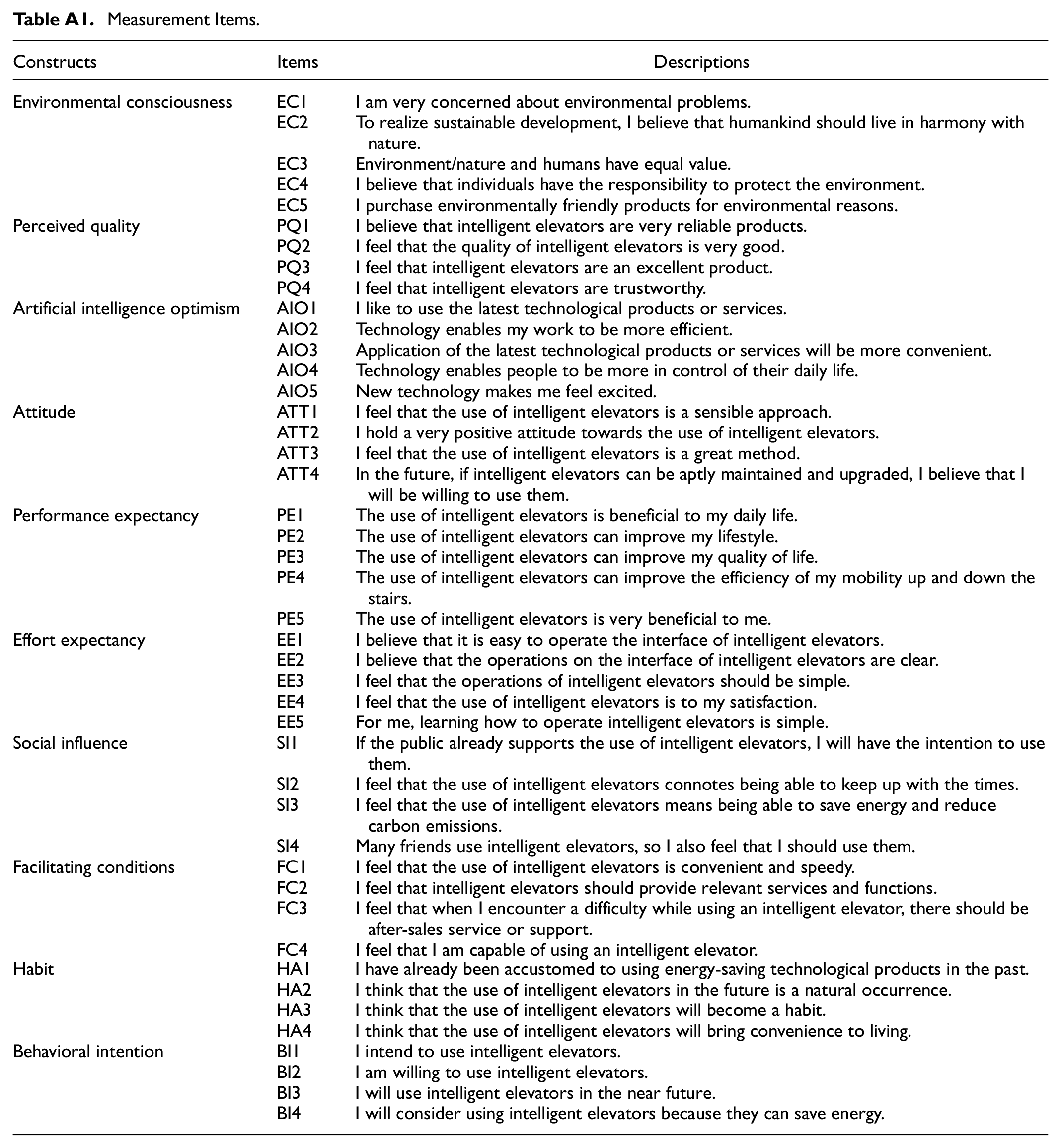
First, the main constructs of the UTAUT 2 framework are modified based on previous research (Andrews et al., 2021; Baudier et al., 2020; Cabrera-Sánchez et al., 2021; Duarte & Pinho, 2019; Liu & Tao, 2022; Venkatesh et al., 2003, 2012), which are: performance expectancy (five items), effort expectancy (five items), social influence (four items), facilitating conditions (four items), habit (four items), and behavioral intention (four items). The artificial intelligence optimism (five items) is modified according to relevant studies as well (Cruz-Cárdenas et al., 2021; Parasuraman, 2000; Schepman & Rodway, 2020; Sun et al., 2020). Furthermore, the five items in literature (Chen & Hung, 2016; Kautish et al., 2019; Verplanken, 2018) are adopted to evaluate consumers’ environmental consciousness. Similarly, the questions concerning attitude (four items) are adopted and revised based on previous studies (Canziani & MacSween, 2021; Davis, 1989; Shuhaiber & Mashal, 2019). Lastly, four items from literature (Coelho et al., 2020; Konuk, 2021; Parker et al., 2021; Zeithaml, 1988) are selected to assess consumers’ perceived quality. All question items are evaluated based on the Likert five-point scale. Score = 1 indicates that the respondent “strongly disagrees” with the statement, whereas score = 5 reflects that the respondent “strongly agrees” with the statement. In addition, the respondent demographics and participant characteristics are measured by using the nominal scale. The following information are collected: gender, age, monthly income, and formal education. All measurement items of the questionnaire used are shown in Appendix Table A1.
Pilot Study
The pilot study of this research analyzes data obtained from 126 consumers living in central Taiwan. It is discovered that, for all constructs, Cronbach’s α values exceed its standard value of .7 (Hair et al., 2010). This suggests that all measurement items in this study are reliable with high confidence levels. The obtained results can be used as important reference tools for formal questionnaires.
Sample and Descriptive Statistics
Through cross-sectional surveys, data were collected from 1,200 consumers living in the Taiwanese residential areas where intelligent elevators were installed. All respondents participated in the research voluntarily. They have been fully informed of the details of the project and signed written informed consent forms. In addition, they were allowed to answer the questionnaires anonymously, and their data were kept confidential and used only for research purposes. The questionnaires that were not completely answered, contained inconsistent responses or sustained data losses were discarded. 1,173 respondents took part in our research. More specifically, 54.2% of them were females and 36.9% of the respondents are younger than 39 years old. Furthermore, 56.4% of the respondents have attended colleges and universities, and 45.2% of the participants have monthly incomes between NT$20,001 and NT$40,000. The demographic details of the respondents are presented in Table 1.
Demographic Details of Respondents. (N = 1,173).

Results
To test the proposed research model and hypotheses, SmartPLS 3.0 is adopted for data analysis. According to the study conducted by Hair et al. (2014), when the sample size is small, PLS convergence outperforms the covariate-based structural equation models. Hair et al. (2010) further demonstrated that covariate-based structural equation models usually lead to identification problems. Hence, PLS has become the recommended method in formative index estimation models. Moreover, in this research, bootstrapping with 5,000 resamples is employed to analyze the structural models. In the meantime, t-tests are used to test and validate the hypotheses proposed (Hair et al., 2021).
Nonresponse and Common Method Bias
Multiple tests are conducted to verify the validity of the survey data. First, t-tests are performed to detect non-response bias. The non-response bias of responses sampled from questionnaires collected at different times are compared (Armstrong & Overton, 1977). The comparison results demonstrate that there are statistically no differences between questionnaires collected earlier and later. Second, the common method variance (CMV) issue is examined based on how Harman (1976) assessed CMV. We found that there are no single factors. In addition, the first factor cannot explain most of the variance (37.73%) and the variance is lower than 50%. Hence, the CMV issue is not significant in our research.
Measurement Model
The recommendations of Anderson and Gerbing (1988) and Hair et al. (2010) are adopted to use two-stage data to examine the model of interest. First, in the measurement model analysis, (1) the convergent validity (CV) and (2) discriminant validity (DV) of all measurement variables are estimated. The most commonly used evaluation indexes are adopted to verify the reliability and validity of all constructs. These include: factor loadings, Cronbach’s alpha, composite reliability (CR), and average variance extracted (AVE) (Bagozzi & Yi, 2012; Fornell & Larcker, 1981; Hair et al., 2010). The analysis results are summarized in Table 2. Most importantly, the standardized factor loadings of all constructs are higher than 0.6, which denote statistical significance (p < .05) (Hair et al., 2010). The Cronbach’s alpha and rho_A values of all constructs exceeds .7 (Hair et al., 2010), indicating very high internal consistency for all constructs. Furthermore, the composite reliability (CR) of all constructs and average variance extracted (AVE) are higher than their respective reference values of 0.7 and 0.5 (Fornell & Larcker, 1981; Hair et al., 2010). These reveal that all constructs are highly reliable and convergent valid.
Construct Reliability Results.

EC = environmental consciousness; PQ = perceived quality; AIO = artificial intelligence optimism; ATT = attitude; PE = performance expectancy; EE = effort expectancy; SI = social influence; FC = facilitating conditions; HA = habit; BI = behavioral intention; AVE = average variance extracted; CR = composite reliability.
The square root of AVE is larger than the corresponding correlation coefficient, confirming the DV of the data. Observe that in Table 3 all diagonal elements are higher than the off-diagonal elements in the corresponding rows and columns. The related estimated values of all constructs are lower than 0.85, reflecting a satisfactory data DV. About the results of the Heterotrait-Monotrait (HTMT) ratio (see Table 3), HTMT ratio for attitude compared to behavioral intention, and attitude compared to facilitating conditions above 0.9, other values were below 0.9 (Henseler et al., 2015). Therefore, all constructs in this research are discriminant valid.
Correlation Matrix and Square Root of the Average Variance Extracted (AVE).
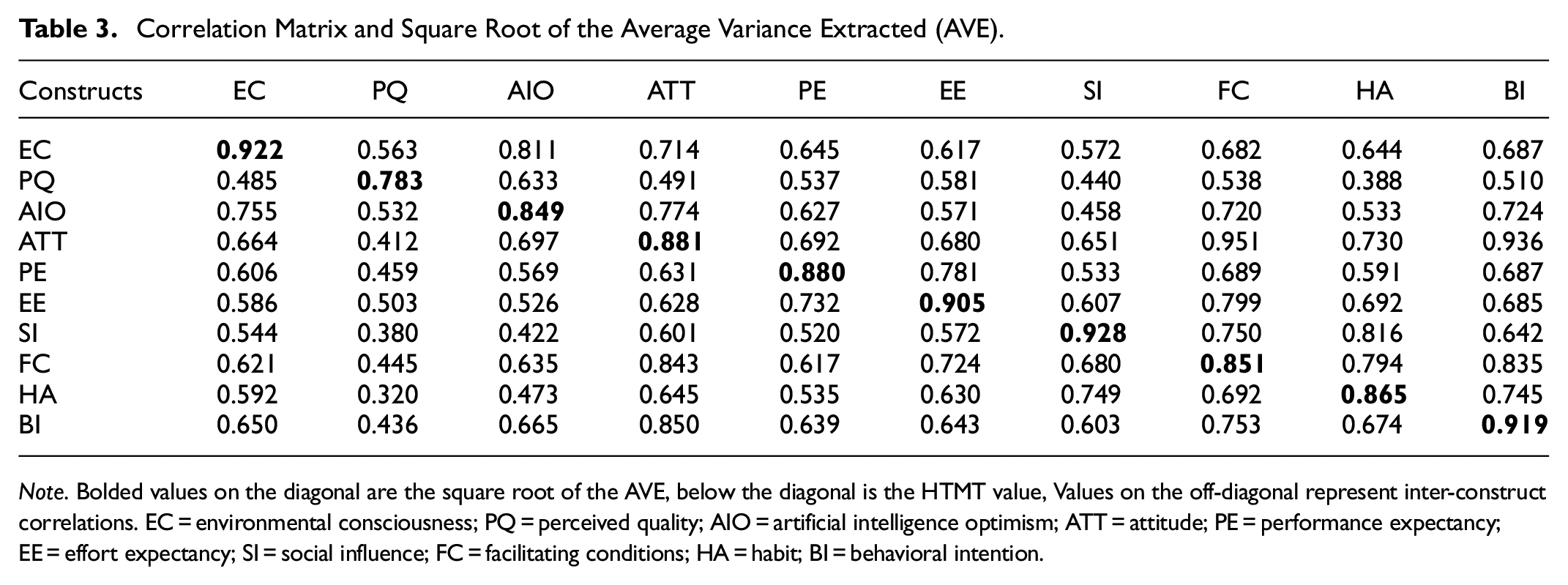
Note. Bolded values on the diagonal are the square root of the AVE, below the diagonal is the HTMT value, Values on the off-diagonal represent inter-construct correlations. EC = environmental consciousness; PQ = perceived quality; AIO = artificial intelligence optimism; ATT = attitude; PE = performance expectancy; EE = effort expectancy; SI = social influence; FC = facilitating conditions; HA = habit; BI = behavioral intention.
Structural Model
Three evaluation indexes, namely goodness-of-fit (GoF), standardized root mean square residual (SRMR), and predictive relevance (Q2) (Alolah et al., 2014; Hair et al., 2017, 2019; Tenenhaus et al., 2005), are chosen to assess the overall quality and fitting performance of the model of interest. The resulting GoF equals 0.667 and exceeds the critical value of 0.36 (Alolah et al., 2014; Tenenhaus et al., 2005), whereas the obtained SRMR value is 0.061, which is lower than the standard value of 0.08 suggested by Hair et al. (2017). The Q2 value exceeds the threshold of 0.000 (Hair et al., 2019). The evaluation indexes that measure the fitting performance of the proposed model all are within the ranges prescribed by their respective authors, demonstrating that our model exhibits a fitting performance overall and is applicable for further research.
Table 4 and Figure 2 present the analysis results of our model. The exogenous variables of the model can effectively predict the key endogenous variables. The explained variation (R2) values of the endogenous variables, namely, PE, EE, ATT, and BI, are 59.6%, 36.6%, 46.4%, and 78.6%, respectively. All endogenous variables possess strong explanatory power. Hence, in the proposed model, the relationships of all constructs are stable and sufficiently explanatory.
Structural Path Model’s Hypothesis Testing Outcomes.

p < .05.

The structural model with *p < .05.
The path analysis results reveal that PE (β = .073, p < .05), EE (β = .067, p < .05), HA (β = .168, p < .05), ATT (β = .706, p < .05), and PQ (β = .057, p < .05) have significant positive influence on BI. Particularly, the influence of ATT on BI is the strongest. Hence, the results support the hypotheses 1, 2, 5, 6, and 10. Yet, SI has no impact on BI (β = .023, p > .05), while FC (β = −.094, p < .05) have significant negative influence on BI. Therefore, hypotheses 3 and 4 are rejected. In the meantime, PE (β = .383, p < .05) and EE (β = .349, p < .05) demonstrate significant positive effects on ATT, hence, hypotheses 7 and 8 are accepted. Lastly, EE (β = .545, p < .05) exhibits significant positive influence on PE, supporting hypothesis 9. Furthermore, EC (β = .146, and .446, respectively, p < .05) and AIO (β = .187 and .193, respectively, p < .05) are important antecedent factors for PE and EE. Consequently, hypotheses 11, 12, 13, and 14 are proven true.
Discussion
The present study aims to discuss the important factors influencing consumers’ behavioral intention when adopting intelligent elevators. Therefore, we attempted to establish an UTAUT 2-based theoretical framework integrating different exogenous (i.e., environmental consciousness, artificial intelligence optimism, and perceived quality) and endogenous (i.e., attitude) variables to explain and predict consumers’ behavioral intention regarding using intelligent elevators. Fourteen were hypotheses proposed. With the help of PLS-SEM, UTAUT 2 is extended based on the research background regarding intelligent elevators that are adopted by consumers living in central Taiwan. Statistically significant data are obtained for 12 hypotheses. The results support the proposed theoretical framework and confirm the applicability of the extended UTAUT 2 model as the foundation of relevant theories. Our findings can effectively explain the applicability of theoretical bases to predict and explain consumers’ behavioral intention regarding using intelligent elevators. Undoubtedly, the conclusions of this study can be utilized as a reference by the intelligent elevator manufacturers.
An important result of this research is that the results of the original UTAUT 2 model can be remarkably improved by extending the model through including four new variables, namely attitude, artificial intelligence optimism, environmental consciousness, and perceived quality. The research results reveal that attitude is a component in technology acceptance models but it is not a component in the UTAUT 2 model. Although attitude is included in the UTAUT survey at the very beginning, it is neglected later, because it has no significant influence (Venkatesh et al., 2003). Nevertheless, the actual data demonstrate that attitude is the most essential factor affecting consumers’ behavioral intention when adopting intelligent elevators. This observation agrees with the ideas proposed in previous studies (Davis, 1989; Shuhaiber & Mashal, 2019). Positive attitude increases consumers’ behavioral intention regarding utilizing intelligent elevators, reflecting that, if there are no positive thoughts on the use of intelligent elevators and its potential consequences, consumers will hardly use intelligent elevators. Therefore, informing the consumers about the functions, properties, convenience, energy saving performance of intelligent elevators and the differences between intelligent and traditional systems can enhance the behavioral intention of consumers. Thus, it is recommended that intelligent elevator manufacturers should provide information on the functions, performance, convenience, and energy efficiency of intelligent elevators along with the differences between intelligent and traditional elevators. This will help boost the behavioral intention of consumers.
The data used in this research clearly demonstrates that, among all constructs of UTAUT 2, habit affects behavioral intention the most strongly, even though previous studies suggested that performance expectancy is the main factor in predicting consumers’ acceptance (Baudier et al., 2020; Cabrera-Sánchez et al., 2021; Shaw & Sergueeva, 2019). Furthermore, according to the obtained results, habit is vital in predicting behavioral intention (Gansser & Reich, 2021). When increasingly many people use AI technologies or products, habit increases. Meanwhile, performance expectancy and effort expectancy have positive impact on the use of intelligent elevators; these findings are similar with previous studies (Gansser & Reich, 2021). Thus, consumers believe that the intelligent elevator control systems can effectively and efficiently execute commands in elevator cars and, thereby, provide better service quality. In addition, the intelligent systems of intelligent elevators reduce the waiting time and increase traffic management efficiency in residential, commercial, and other buildings. Moreover, the interactive interfaces are user-friendly and easy to operate. As a result, consumers’ behavioral intention regarding using intelligent elevators increases. Moreover, we identified that performance expectancy and effort expectancy have positive influence on attitude. When consumers think that intelligent elevators can operate efficiently and provide high-quality services through user-friendly interfaces, their attitude toward intelligent elevators becomes more positive. Overall, it is recommended that the practitioners of intelligent elevators should provide a better user Interface (UI)/user experience (UX) design and improve the management efficiency of elevators to reduce the waiting time of users for elevators.
Interestingly, social influence has no significant effects on behavioral intention regarding using intelligent elevators. In multiple research, social influence greatly affects behavioral intention regarding adopting new information systems or information technologies technologies (Baudier et al., 2020; Cabrera-Sánchez et al., 2021). On the other hand, some studies defend the opposite argument (Cimperman et al., 2016; Shaw & Sergueeva, 2019). Cimperman et al. (2016) reported that social influence has no considerable effects on behavioral intention. The authors believed that this may be due to the background of use and issues related to privacy and information security. Here, another possibility is proposed. Currently, the ambiguity concerning the adoption of intelligent elevators and relevant technologies remains. Moreover, there are limited AI technologies introduced in elevator industry surveys; hence, consumers feel that technologies related to intelligent elevators are not mature and are not needed. Therefore, intelligent elevator practitioners should enable consumers to understand the relevant technology used in intelligent elevators in their product descriptions in order to motivate more consumers to use intelligent elevators.
As AI technologies are continuously developed and are applied in various fields, many intelligent products emerge. In the elevator industry, intelligent elevators utilize AI schemes, and energy control technologies to enhance energy efficiency and become further eco-friendly. However, there is still ambiguity concerning intelligent elevators and relevant technologies. Hence, in this study, we attempted to include artificial intelligence optimism and environmental consciousness as exogenous variables in UTAUT 2 framework (for performance expectancy and effort expectancy, respectively) and considered perceived quality as the antecedent factor of behavioral intention. First, the data support the key proposition, which states that artificial intelligence optimism and environmental consciousness impose positive influence on performance expectancy and effort expectancy, respectively. Particularly, environmental consciousness has the most prominent effects on effort expectancy. In this research, artificial intelligence optimism is defined as follows: the positive attitude of people toward AI. People believe that AI can enhance their lives through improving flexibility and efficiency. In the meantime, environmental consciousness is defined the attitude of individuals. It comprises concerns and views of people on the environment and reduction of environmental problems. Thus, consumers with high levels of environmental consciousness and artificial intelligence optimism have a stronger belief that intelligent elevators possess not only intelligent control but also the ability to enhance traffic management efficiency in residential and commercial facilities and buildings; in other words, they believe that these elevators, which operate through user-friendly and simple interfaces, can reduce the waiting time of users. Therefore, consumers’ performance expectancy and effort expectancy for intelligent elevators are increased. Furthermore, intelligent elevators are advanced systems with new-age digital security system controls with touch screens, biometrics, and destination dispatching. They can, through the on-board energy control schemes, improve the facility energy efficiency to achieve eco-friendliness. In short, the present study extends the application spectrum of artificial intelligence optimism and environmental consciousness to the field of intelligent elevators. Finally, the positive effects of perceived quality on behavioral intention are discovered. This confirms the suggestion stated in previous studies that perceived quality is an important factor in predicting the purchase decisions of consumers (Coelho et al., 2020; Konuk, 2021). Because intelligent elevators are still under development, certain relevant specifications and technologies employed are still unclear. This makes consumers highly concerned about the product quality of intelligent elevators. Consequently, when consumers feel that intelligent elevators are of high quality, their behavioral intention to use intelligent elevators will increase. Hence, it is suggested that intelligent elevator practitioners help consumers understand the features and quality of intelligent elevators. When consumers feel that the quality of intelligent elevators is high, their behavioral intention to use intelligent elevators will also increase.
Limitations and Future Research
Although the results of this study provided theoretical and practical contributions, many limitations remain that may limit their generality. First, in this study, consumers living in the central region of Taiwan were surveyed, and a non-random but convenient sampling process was adopted. This sampling method prevents the survey results from being extended to other regions. In further studies, adopting a systematic sampling method and expanding the investigation scope can enhance the applicability of the research results. Secondly, this study is a cross-sectional study, which will affect causal inference. Thus, it is suggested that future researchers should use other study designs (i.e., experimental study or longitudinal study) to explain behavioral intentions of consumers toward the use of intelligent elevators. Third, consumers’ perceptions change over time owing to the continuous innovation of technology and increasingly diversified intelligent systems. Consequently, the behavioral intentions of consumers regarding the adoption of intelligent elevators may be captured through a longitudinal study. However, the current study is a cross-sectional study, which prevents causal inferences. Hence, other study designs (namely, experimental or cross-sectional studies) should be adopted in future investigations to understand the factors that affect consumers’ behavioral intentions regarding the adoption of intelligent elevators. Finally, the extended UTAUT 2 model, which is widely used in information technology theory, was adopted in this study to examine the factors that affect the adoption of intelligent elevator by Taiwanese consumers. However, only a few theories can be used to understand the behavioral intentions of consumers’ using such new technologies. The information system success model and task-technology fit (TTF) can be adopted in follow-up studies.
Conclusions
IoT and AI technologies have been applied to various areas and have yielded high levels of convenience, comfort, and energy saving. Furthermore, the deployment of these new technologies enhances the service quality of the elevator industry. Although smart home appliances have been widely discussed in previous studies, intelligent elevators remain uninvestigated. Therefore, this study was conducted to examine the factors that affect intelligent elevator adoption by Taiwanese consumers using the UTAUT 2 model, which considers factors, such as environmental consciousness, artificial intelligence optimism, attitude, and perceived quality. The results of this study revealed important issues associated with the behavioral intentions of consumers regarding adopting an intelligent elevator, which have not been fully discussed in previous studies. First, based on the UTAUT model and other variables (namely, environmental consciousness, artificial intelligence optimism, perceived quality, and attitude), consumer’s behavioral intentions regarding adopting intelligent elevators were investigated and discussed. The results indicated that attitude was an important factor that affected consumer’s behavioral intentions in adopting intelligent elevators. Second, among the five main structures of the UTAUT 2 model, performance expectancy, effort expectancy, facilitating conditions, and habit were verified to be important factors for predicting consumers’ behavioral intentions regarding adopting intelligent elevators. Particularly, the facilitating conditions negatively affected the behavioral intentions. Whereas, social influence did not affect the behavioral intentions. Third, environmental consciousness and artificial intelligence optimism were important external variables that affected performance and effort expectancies. Finally, the results of this study supported the development of the intelligent elevators, extended UTAUT 2 model, and perceived quality. Furthermore, important practical suggestions for researchers, public, and the elevator industry that can facilitate the further development intelligent elevators in the future are made here.
Footnotes
Appendix
Measurement Items.
| Constructs | Items | Descriptions |
|---|---|---|
| Environmental consciousness | EC1 | I am very concerned about environmental problems. |
| EC2 | To realize sustainable development, I believe that humankind should live in harmony with nature. | |
| EC3 | Environment/nature and humans have equal value. | |
| EC4 | I believe that individuals have the responsibility to protect the environment. | |
| EC5 | I purchase environmentally friendly products for environmental reasons. | |
| Perceived quality | PQ1 | I believe that intelligent elevators are very reliable products. |
| PQ2 | I feel that the quality of intelligent elevators is very good. | |
| PQ3 | I feel that intelligent elevators are an excellent product. | |
| PQ4 | I feel that intelligent elevators are trustworthy. | |
| Artificial intelligence optimism | AIO1 | I like to use the latest technological products or services. |
| AIO2 | Technology enables my work to be more efficient. | |
| AIO3 | Application of the latest technological products or services will be more convenient. | |
| AIO4 | Technology enables people to be more in control of their daily life. | |
| AIO5 | New technology makes me feel excited. | |
| Attitude | ATT1 | I feel that the use of intelligent elevators is a sensible approach. |
| ATT2 | I hold a very positive attitude towards the use of intelligent elevators. | |
| ATT3 | I feel that the use of intelligent elevators is a great method. | |
| ATT4 | In the future, if intelligent elevators can be aptly maintained and upgraded, I believe that I will be willing to use them. | |
| Performance expectancy | PE1 | The use of intelligent elevators is beneficial to my daily life. |
| PE2 | The use of intelligent elevators can improve my lifestyle. | |
| PE3 | The use of intelligent elevators can improve my quality of life. | |
| PE4 | The use of intelligent elevators can improve the efficiency of my mobility up and down the stairs. | |
| PE5 | The use of intelligent elevators is very beneficial to me. | |
| Effort expectancy | EE1 | I believe that it is easy to operate the interface of intelligent elevators. |
| EE2 | I believe that the operations on the interface of intelligent elevators are clear. | |
| EE3 | I feel that the operations of intelligent elevators should be simple. | |
| EE4 | I feel that the use of intelligent elevators is to my satisfaction. | |
| EE5 | For me, learning how to operate intelligent elevators is simple. | |
| Social influence | SI1 | If the public already supports the use of intelligent elevators, I will have the intention to use them. |
| SI2 | I feel that the use of intelligent elevators connotes being able to keep up with the times. | |
| SI3 | I feel that the use of intelligent elevators means being able to save energy and reduce carbon emissions. | |
| SI4 | Many friends use intelligent elevators, so I also feel that I should use them. | |
| Facilitating conditions | FC1 | I feel that the use of intelligent elevators is convenient and speedy. |
| FC2 | I feel that intelligent elevators should provide relevant services and functions. | |
| FC3 | I feel that when I encounter a difficulty while using an intelligent elevator, there should be after-sales service or support. | |
| FC4 | I feel that I am capable of using an intelligent elevator. | |
| Habit | HA1 | I have already been accustomed to using energy-saving technological products in the past. |
| HA2 | I think that the use of intelligent elevators in the future is a natural occurrence. | |
| HA3 | I think that the use of intelligent elevators will become a habit. | |
| HA4 | I think that the use of intelligent elevators will bring convenience to living. | |
| Behavioral intention | BI1 | I intend to use intelligent elevators. |
| BI2 | I am willing to use intelligent elevators. | |
| BI3 | I will use intelligent elevators in the near future. | |
| BI4 | I will consider using intelligent elevators because they can save energy. |
Declaration of Conflicting Interests
The author(s) declared no potential conflicts of interest with respect to the research, authorship, and/or publication of this article.
Funding
The author(s) received no financial support for the research, authorship, and/or publication of this article.
