




Abstract
Most consumers read online reviews before making online purchase decisions. Online reviews of a product usually include positive and negative contradictory online reviews (CORs). Previous studies have confirmed the impact of CORs on consumers’ online purchase decisions. However, literature review showed that most of the conducted studies on the dimension of CORs are single dimension. Therefore, this study examined how CORs affected consumers’ online purchase decisions from two dimensions: proportion of positive and negative reviews and emotional arousal. The results of a two (proportion of positive and negative reviews: high vs. low) × 2 (emotional arousal: calm vs. arousing) inter group experiment from 306 Chinese consumers showed that CORs have a significant negative impact on consumers’ purchase online decision, and CORs affect consumers’ online purchase decision by affecting perceived risk. The results of this study enrich literature of online reviews. Findings of this study provide important information to e-retailers on how CORs affect consumers’ online purchase decisions. The theoretical and practical implications of the proposed study are also discussed.
Keywords
Introduction
Online reviews are an important source of information for consumers to buy products or services online (Lee & Shin, 2014). Reading online reviews published by consumers who have bought a product on an e-commerce platform can help consumers who want to buy this product not only understand the product information and characteristics, but also reduce uncertainty and shopping risks (Hong et al., 2017). According to the data of eMarketer in 2021, 73% of consumers will choose to buy products online because of reviews. If there is no review, 92% of consumers will hesitate to buy. Thus, online review is one of the most important factors influencing consumers’ online purchase decisions (Yang et al., 2022; Zemborain & Johar, 2007; K. Z. K. Zhang et al., 2014).
At present, the research on online reviews affecting consumers’ online purchase decisions mainly involves four important aspects: source of online reviews (Hsu et al., 2017; Zhou & Duan, 2016), the display mode of online reviews (Xu et al., 2015), time of online reviews (Y. Wang et al., 2021; Y. Zhao et al., 2020), and content characteristics of online reviews (Ren et al., 2018; Shoham et al., 2017). Among them, the content characteristics mainly refer to the number and content of online reviews. Some scholars have discussed the impact of online reviews on consumers’ online purchase decisions from the perspective of content characteristics, affirmed the importance of content characteristics, and concluded that content characteristics of online reviews significantly affect consumers’ online purchase intention (Cui et al., 2012; Stouthuysen et al., 2018).
The relevant research on the content characteristics of online reviews mainly simplifies them into positive reviews, neutral reviews, and negative reviews from the perspective of valence. Previous studies only considered the impact of online reviews with a certain characteristic on consumers’ online purchase decision. Many studies ignored the important fact that the online reviews of a product are the coexistence of positive reviews and negative reviews (Shoham et al., 2017). Lin et al. (2019) found that online reviews are rarely completely unilateral (all positive or all negative) reviews. At the same time, it is easy for consumers to choose whether to buy when facing all positive reviews or all negative reviews, but it is difficult to choose whether to buy when facing the coexistence of positive reviews and negative reviews. Therefore, the impact of CORs on consumers’ online purchase decisions has theoretical and practical research significance.
In recent years, scholars have paid attention to the impact of CORs on consumers’ online purchase decisions. For example, Shi et al. (2018) research showed that CORs reduce consumers’ positive attitudes and increase negative attitudes and contradictory emotions. According to the research of Shoham et al. (2017), consumers prefer products with both positive and negative CORs, because consumers believe that they have complete information about the product. However, the existing research on the level of CORs is mostly concentrated on valence (positive or negative), so the dimension of CORs is relatively single.
In order to fill this gap, we quote the views of the relevant research that online reviews are emotional. For example, Huang et al. (2013) believe that online reviews can be divided into positive and negative reviews, and online reviews are emotional, which is the key to the role of online reviews. Guo et al. (2020) hold the same view that online reviews are emotional, and they think happy online reviews increase consumers’ purchase intention. From the perspective of the emotional arousal of CORs, we put forward four different level of CORs from the two dimensions of the proportion of positive and negative reviews and the emotional arousal, and explore the impact and mechanism of CORs on consumers’ online purchase decisions. On the basis of Stimulus-Organism-Response (SOR) theory (Mehrabian & Russell, 1974), CORs can be regarded as an external stimulus, which can cause changes in consumers’ attitudes and then affect consumers’ online purchase decisions. Studies have found that when consumers face contradictory choices, the impact of perceived risk on consumers’ online shopping is particularly prominent (Mitchell, 1999).
Therefore, based on the theory of perceived risk, this paper constructs a theoretical analysis framework of the impact of CORs on consumer online purchase behavior, and obtains research data through a two-factor inter-group experimental design. The stepwise regression method is used to test the intermediary effect of perceived risk. The research results show that the degree of CORs has a significant negative impact on consumers’ online purchase behavior, and perceived risk plays an intermediary role. This study expands literature on CORs and consumer online purchase decisions. In addition, these findings provide practitioners of electronic retailers with practical insights on online reviews management and product sales.
Literature Review
CORs
CORs refer to the coexistence of positive and negative reviews, and the positive and negative reviews reach a certain proportion, which makes it difficult for consumers to determine the advantages and disadvantages of the reviewed goods and make decisions (Shihab & Putri, 2019; L. Zhang et al., 2018). There are two conditions for the formation of CORs. First, online reviews on a product have both positive and negative reviews. Second, according to the consumer contradictory attitude theory, when the positive and negative reviews do not reach the degree of contradiction among consumers, the consumer attitude is still unitary, which is also an important distinction between the unitary attitude theory and the dual attitude theory in the consumer attitude theory. Therefore, the contradiction can be formed only when the positive and negative reviews reach a certain proportion (Priester & Petty, 1996).
Previous studies on CORs focused on the existence of positive and negative reviews and the number of them. First, research on the proportion of positive and negative reviews. When online shopping, consumers obtain positive information through online reviews, so as to reduce uncertainty, perceive more usefulness, and they will make decisions (Lin et al., 2019; J. Zhao & Li, 2023). Therefore, positive and negative reviews coexist, and the number of negative reviews is no higher than the number of positive reviews. CORs will have an impact on consumers’ online purchase decisions. Second, research on the content of positive and negative reviews. Studies have shown that online reviews can express the emotional characteristics of reviewers, that is, emotions will affect consumers’ online purchase decisions, and emotions affect consumers’ decisions differently in positive and negative reviews (Bagozzi et al., 1999; Fisher et al., 2008; J. Liang et al., 2016). Specifically, in a benign environment (more positive reviews than negative reviews), positive emotions play a role, and in a non-benign environment (the number of positive reviews does not exceed the number of negative reviews), negative emotions play a role. Chung and Lee (2019) studied the calm and arousal dimensions of information emotion and found that the arousal emotion plays an important role in positive and negative information.
Therefore, the CORs in this paper include positive and negative reviews, considering the proportion of positive and negative reviews and the emotional arousal. Referring to the definition of emotional arousal in Chung and Lee (2019), emotional arousal refers to the review content that can trigger the body’s response. Emotional expression is not strong in calm emotional arousal (e.g., a cup of unclean water). Emotional expression is strong in arousing emotional arousal (e.g., a cup of dirty water).
When the proportion of positive and negative reviews is high (i.e., the number of positive reviews is relatively large), emotional arousal will make consumers perceive more positive information and play the “positive role” of emotional arousal. When the proportion of positive and negative reviews is low (i.e., the number of negative reviews is relatively large), emotional arousal will make consumers perceive more negative information and play the “negative role” of emotional arousal, that is, emotional arousal plays a “double-edged sword” role in situations with different proportions of positive and negative reviews.
Consumers’ Online Purchase Decisions
Consumer online purchase decision refers to the relevant behaviors of consumers’ search information and purchase decision about goods or services on the e-commerce platform (Zhao et al., 2020). Consumers’ online purchase decisions can be divided into many types, such as purchase, willingness to pay, repurchase, and recommendation (Bo & Yang, 2022). There are many factors that affect consumers’ online purchase decisions, such as price, online purchase environment, authentication, etc. Due to the particularity of online shopping, online review, as one of the most easily spread online word-of-mouth forms, is an important source of information for consumers to make decisions about online purchase of agricultural products (Lee & Shin, 2014; Shin et al., 2022).
Mehrabian and Russell (1974) first proposed the “Stimulus - Organism - Response” model in the field of environmental psychology, which shows that external environmental stimuli can affect the internal state of individuals and further affect individuals’ response. It was first studied and applied to the retail industry, that is, the traditional offline physical stores. However, with the rapid development of e-commerce, some scholars also began to explain the impact of the stimulating factors on consumers’ online purchase decisions through SOR theory (Guo et al., 2021; Kawaf & Tagg, 2012; Peng & Kim, 2014). Referring to SOR theory, online review is one of the key factors that the information presented to consumers in online shopping comes from external factors and can stimulate consumers’ internal state. Consumers read online reviews to search for information, understand information that is related to the product, and finally make a decision.
SOR theory studies the behavioral changes ultimately caused by an external stimulus. Therefore, the behavioral variables of this study examine consumers’ initial purchase decision (whether to buy or not) before reading CORs and final purchase decision (whether to buy or not) after reading CORs. The purpose is to ensure that changes in consumers’ purchase decision are caused by CORs.
Perceived Risk
The concept of perceived risk is derived from psychological research. Bauer (1960) first introduced perceived risk into the research field of consumer behavior. Bauer (1960) believes that consumers may have unpleasant situations when shopping, and the uncertainty of this situation is perceived risk. Cox (1967) pointed out that the premise of perceived risk theory research must be that consumers’ purchase behavior is goal oriented. This theory is applicable to the situation that consumers read online reviews because they have purchase goals. Previous scholars have conducted in-depth research on perceived risk models and dimensions. Perceived risk models are mainly divided into four types: the two-factor model proposed by Cunningham (1967), the multi-dimensional model proposed by Cox (1967), the “inherent risk operational risk” model proposed by Bettman (1973), and the comprehensive perceived risk model proposed by Dowling and Staelin (1994).
The research model of perceived risk plays a key role in the development of perceived risk theory. The perceived risk in this paper mainly refers to the uncertainty of losses and adverse consequences in the process of consumers’ online purchase of fresh agricultural products. Based on the comprehensive perceived risk model proposed by Dowling and Staelin (1994), combined with the reality of online shopping, this paper determines the dimension of perceived risk. After reading online reviews, consumers can first learn about the product itself, followed by other comprehensive information about the product. Therefore, the perceived risk of this paper includes two dimensions: perceived product risk and perceived other risks. Perceived product risk refers to consumers’ perception that the quality of fresh agricultural products is different from that described by merchants. Perceived other risks refer to consumers’ perceived concerns about the logistics, transportation, and after-sales service of fresh agricultural products.
Research Hypothesis
CORs and Consumer Online Purchase Decision
The impact of CORs on consumers’ purchase decisions has been studied, and the results are not uniform. On the one hand, CORs have a positive impact on consumers’ online purchase decisions. Under specific conditions, CORs make consumers have contradictory attitudes. It can stimulate potential consumers to produce impulsive purchase behavior due to curiosity (Steward et al., 2020). On the other hand, the impact of CORs on consumers’ purchase decision may also be negative. The higher the degree of CORs, the greater the consumers’ contradictory attitude, the higher the degree of consumers’ hesitation and the lower the possibility of purchase decision (Lim & Seo, 2019; Shi et al., 2018).
This paper argues that CORs will bring uncertainty to consumers. It has been found that uncertainty is the biggest obstacle to consumers’ purchase intention (Nguyen et al., 2011; J. Zhu et al., 2012). At the same time, CORs will bring negative emotions to consumers, and emotional information management believes that negative emotions will reduce consumers’ positive attitude (Savolainen, 2014; Taute et al., 2011). Therefore, the higher the degree of CORs, the less likely consumers are to buy.
The impact of CORs on consumers’ purchase decision is not a simple linear relationship. The proportion of positive and negative reviews will have an impact on consumers’ purchase decision, but the emotional arousal contained in online reviews should still be considered. The higher the emotional arousal is, to some extent, the embodiment of the authenticity of the reviews provided by reviewers, which can better affect consumers’ online purchase decisions (Chen et al., 2018). From the perspective of the proportion of positive and negative reviews, the higher the proportion of negative reviews, the lower the possibility of consumers making purchase decisions (Banerjee et al., 2017). From the perspective of emotional arousal, compared with calm, emotional arousal can cause empathy among consumers (Shin, 2018). When the proportion of positive reviews is high. It will enhance the possibility of consumers’ online purchase decisions. When the proportion of negative reviews is high. It will reduce the possibility of consumers’ online purchase decisions. Therefore, we propose the following:
The Role of Perceived Risk
CORs have a positive impact on consumers’ perceived risk. On the one hand, based on the Telepresence theory, consumers’ online purchase of fresh agricultural products is different from offline purchase. Online shopping lacks telepresence (Daassi & Debbabi, 2021), and consumers obtain more information through online reviews to improve their telepresence. The higher the degree of CORs, the less likely consumers are to obtain positive information, and the higher the perceived risk of consumers. On the other hand, based on Regret Theory, consumers have a psychological state of regret in online purchase decision because products or other factors do not meet expectations (X. Liang et al., 2018; Park & Hill, 2018). Consumers prefer to buy products with high proportion of positive reviews and emotional arousal in online reviews, because if most consumers buy goods and give positive feedback, consumers’ perceived risk level will be relatively low. Therefore, we propose the following:
Previous studies have found that consumers’ perceived risk will reduce consumers’ purchase decisions (Kim et al., 2008; Miao et al., 2017). Roselius (1971) pointed out that perceived risk has strong subjectivity. Perceived risk is an individual’s subjective cognition of objective risk and its consequences. The product and other risks perceived by consumers in the process of online shopping for fresh agricultural products are not objective risks, but the subjective judgment of the possible risks of purchase decision according to consumers’ personal experience or rationality. This judgment belongs to the organism variable in SOR theory, which will affect consumers’ final purchase decision. Therefore, we propose the following:
In Figure 1, the research model for the study is exhibited.

Theoretical analysis framework.
Methods and Materials
This section explains the experimental design, and introduces the experimental product, the contents of CORs, as well as survey procedure, and estimation procedure.
Experimental Design
The experimental manipulation variable of this research is the degree of CORs. The two-factor 2 × 2 inter group experimental design is carried out according to the proportion of positive and negative reviews (high 9:1 vs. low 5:5) and the interval of emotional arousal (calm vs. arousing).
The reason for choosing 9:1 and 5:5 as the high and low proportion of positive and negative reviews is based on previous research results. Online consumers read eight or more reviews before making a purchase decision and spend half to an hour reading them (Jiménez & Mendoza, 2013). Lee et al. (2008) research shows that negative reviews play a greater role than positive reviews. Based on the experimental design of Shihab and Putri (2019) on the number of positive and negative reviews in consumers’ online shopping of fresh agricultural products, eight online reviews are selected, and the proportion of positive and negative reviews is set to 2:6 and 4:4 respectively. Therefore, this experiment selects 10 online reviews. The high level of positive and negative reviews is set to only one negative review, and the low level of positive, and negative reviews is set to the same number. And the reality is the same. When online reviews are all positive or the number of negative reviews is more than positive reviews, consumers are easy to make purchase decisions. At the same time, it explores the relationship between CORs, consumer perceived risk and consumer purchase decision. See Table 1 for experimental grouping.
Experimental Grouping.

Materials
Experimental Product
Zigui navel orange produced in Hubei Province of China was selected as the fresh agricultural product for the experiment. There are three main reasons. First, China’s Internet e-commerce platform has developed rapidly, and it has become a very common phenomenon for consumers to buy fruits through e-commerce platform. Second, from the reality of online trading, because oranges are sweet and rich in vitamin C, and navel oranges are a representative kind of oranges and are common fruits in online shopping, they have always ranked among the top three in the sales of fruit categories on Taobao and other online fresh platforms in China. Third, oranges have the characteristics of both search and experience products. Consumers not only need to understand the inherent attributes of the product through the merchant’s relevant description, such as net content, size, color, etc., but also need to use the experience information of other consumers as a decision reference. At the same time, oranges need food experience to obtain quality products, such as taste, distribution speed, freshness, etc. Before buying, consumers usually read product related information and refer to other people’s online reviews as the basis for decision-making. After reading the merchant’s product information description and review information, they are easy to form their own views, which is in line with the research theme of this paper.
Contents of CORs
The online reviews materials used in the experiment were designed by using web crawler software Python 3.8, text analysis software ROST CM 6.0 (ROST Content Mining is a content mining software developed by the ROST team of Wuhan University, China. This paper uses version 6.0, which is abbreviated as ROST CM 6.0.) and information coding software MAXQDA (MAXQDA is a professional software for qualitative, quantitative, and mixed method data analysis).
First, use the web crawler software Python 3.8 to capture relevant reviews. Take Miaoxiansheng, a subsidiary of China Taobao e-commerce platform, as the review capture platform, use Python 3.8 software and taking “orange” as the keyword, select the top ten orange products in “sales volume,” capture the reviews with content in chronological order, and get15,986 reviews, including14,138 initial reviews and1,848 additional reviews.
Second, the text analysis software ROST CM 6.0 is used to extract high-frequency words. Enable the software’s own filtered word list, conduct Chinese word frequency analysis in the captured online review data, and get the top 50 high-frequency words, see Table 2.
Summary of High Frequency Feature Words.

Third, we use the text analysis software ROST CM 6.0 to determine the emotional arousal level of online reviews. Classify and import the captured online reviews data into ROST CM 6.0. we make statistics on the emotional distribution of online reviews through the emotional analysis tool. The common method of emotional analysis in ROST CM 6.0. Firstly, the software matches the high-frequency words with the emotional dictionary. Secondly, it gets the word score. Finally, it gets the emotional arousal level of the words. The segmented statistical results of online reviews are shown in Table 3.
Emotional Segmentation Statistical Results of Online Reviews.

Because the software automatically divides the emotional arousal level of online reviews into three categories according to the score range, this experiment selects two emotional arousal levels: calm and arousing of positive and negative reviews. The specific expression text of online reviews is shown in Table 4.
Examples of Emotional Expression Text.

Fourth, use the information coding software MAXQDA to encode the information points. This research summarizes five subject words “taste,”“freshness,”“fruit attribute,”“packaging logistics,” and “shopping perception.” According to the logical relationship between these subject words, the first three are classified as “product attribute” and the last two are classified as “non product attribute.” Specific categories include eight core contents: “sugar content”, “moisture content,”“freshness,”“fruit diameter,”“fruit weight,”“packaging,”“logistics,” and “shopping experience.” Mark different subject words corresponding to corresponding text data in MAXQDA software. After marking, export all marked records under the same subject word with different reviews, classify them, conduct qualitative analysis manually, divide all text data into segments according to semantic, sort out and code information points, see Table 5.
Information Point Code.
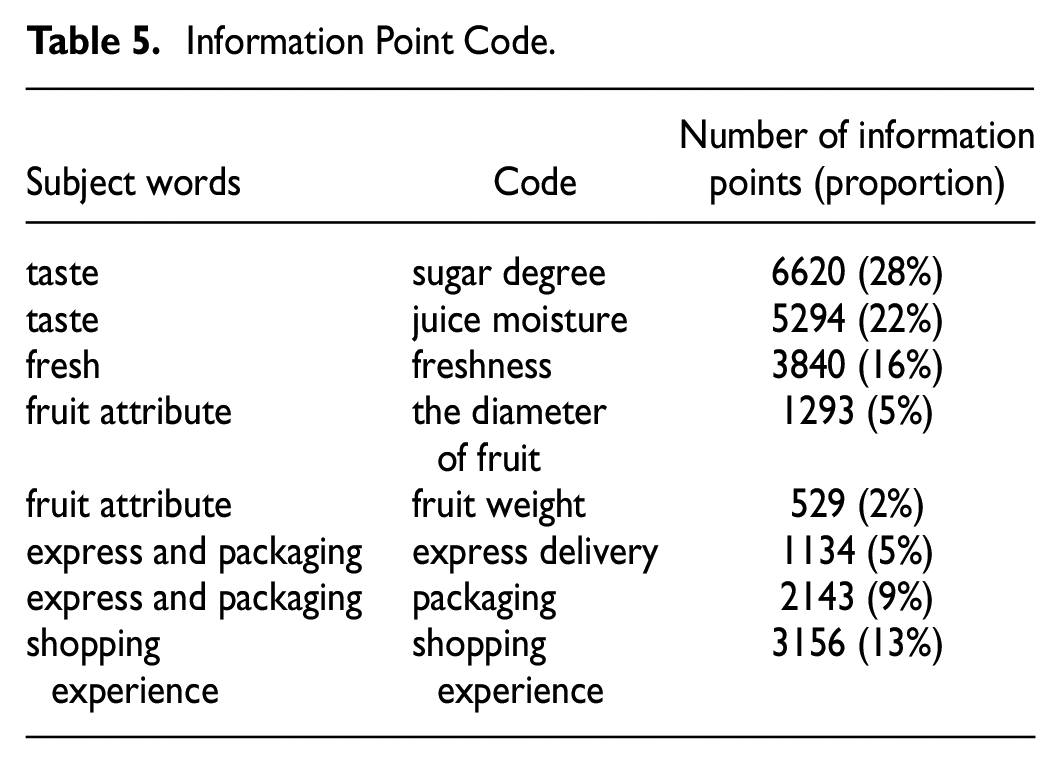
Fifth, determine the online reviews materials used in the experiment. Considering the number of positive and negative reviews and the range of emotional arousal, the online reviews materials used in the experiment should have four quality characteristics: (1) Viewpoint and logical discussion; (2) Attribute and performance description; (3) Event and scenario description; (4) Emotions and emotional expressions. The length of online reviews is controlled at 60 to 70 words, including key contents such as sugar content, moisture content, freshness, and shopping feeling. Secondary contents such as logistics, packaging, fruit diameter, and fruit weight attribute are selectively added. Finally, four online reviews with different degrees of contradiction are formed, namely “High (9:1) proportion of positive and negative reviews & Arousing (Emotional arousal),”“High (9:1) proportion of positive and negative reviews & Calm (Emotional arousal)”, “Low (5:5) proportion of positive and negative reviews & Calm (Emotional arousal),” and “Low (5:5) proportion of positive and negative reviews & Arousing (Emotional arousal).” See Appendix Tables A1 to A4 for CORs materials used in the experiment.
Survey Procedure
Data Collection
The experimental area was Shenyang, Liaoning Province, China. Fresh agricultural products have a certain transportation radius, which corresponds to that the communication effect of brand labels is the most effective within a certain radius, so the province where the experimental products are located is selected. As the provincial capital city, Shenyang has a large population and a high level of economic development, which can meet the requirements of scientific sample sampling and consumers’ online shopping experience.
The sampling method is quota sampling. Firstly, the house price income ratio is introduced to convert the house price into personal monthly income; Secondly, according to the monthly income distribution of Chinese fresh online shopping users, see formulas (1) and (2), residential areas are randomly selected from each income level; finally, consumers are selected according to the principle of convenience. The per capita housing area in Shenyang is 29.29 square meters, and the house price income ratio in Shenyang in 2017 was 6.3. The personal monthly income distribution data comes from the consumption insight report of China’s fresh e-commerce industry in 2018 (Bo & Yang, 2022).


The recruitment method is online and offline. Invite consumers over 18 years old with online shopping experience. Invite the third consumer in sight to participate in the experiment. If the consumer refuses to accept the interview, continue to invite the next consumer to improve the randomness of the respondents (Yanyan, 2018). In order to improve the participants’ enthusiasm, we promise to provide material rewards for the participants in the whole process. The participants are required to be at least 18 years old and have the experience of online shopping of fresh agricultural products. From June 15, 2020, over a period of 45 days, 14 residential districts were selected and 320 consumers were invited to participate in the auction experiment. Due to time changes or failure to pass the pre-experiment, the final effective sample was 306.
Experimental Procedure
The first step is preliminary measurement. We told the participants that the experimental scenario is to assume that they are purchasing oranges on Taobao fresh e-commerce platform. (Taobao is a large online retail and business district in the Asia Pacific region. It was founded by Alibaba Group in May 2003. Taobao is a popular online shopping and retail platform in China. It has nearly 500 million registered users and more than 60 million regular visitors every day. At the same time, the number of online goods per day has exceeded 800 million, with an average of48,000 goods sold per minute.) We showed the participants the detailed information about the experimental product oranges in the e-commerce platform (Zigui orange, ¥39.9/500 g, free delivery by express). Participants make a decision whether to buy or not.
The second step is the manipulation of CORs materials. Before reading the online reviews materials, the participants make a decision on whether to buy. Show the CORs materials to the participants, and the degree of CORs seen by different groups is different. Participants were required to read the experimental materials according to their usual shopping habits for no less than 3 min. It should be noted that one of us is responsible for randomly distributing CORS materials, and the others are responsible for operating the experiment. This can avoid the influence of the experimental operator’s knowledge on the experimental accuracy.
The third step is the final measurement. After reading the online reviews materials, the participants make a decision on whether to buy. At the same time, participants need to fill in questionnaires such as perceived risk and gender. During the experiment, it was emphasized to the participants that “There is no right or wrong in all the questions, and the participants can answer according to their true feelings.”
Estimation Procedure
Variable Measure
Purchase Decision (Y)
The dependent variable is the change of online purchase decision before and after respondents read CORs. Initial purchase decision before reading CORs materials (1 means to purchase and 0 means not to purchase) and final purchase decision after reading CORs materials (1 means to purchase and 0 means not to purchase). Purchase decisions are divided into “increased purchase decisions” (Y1) and “reduced purchase decisions” (Y2). Y1 = 0 is the control group for increased purchase decision, which means “There is no initial purchase decision and no final purchase decision.”Y1 = 1 is the treatment group for increased purchase decision, which means “There is no initial purchase decision, but there is a final purchase decision.”Y2 = 0 is the control group for reduced purchase decision, which means “There is an initial purchase decision and a final purchase decision.”Y2 = 1, is the treatment group for reduced purchase decision, which means “There is an initial purchase decision, but there is no final purchase decision.”
CORs
According to the experimental groups I–IV, the degree of CORs is taken as 1 to 4, indicating that the contradiction degree is from low to high. See Table 6.
Summary Statistics of Key Variables.

Perceived Risk (M)
Perceived risk variables include perceived product risk (M1) and perceived other risks (M2). The values of perceived risk variables are 0, 1, and 2 respectively, indicating the degree of perceived risk. M = 0 means “There is no perceived product risk or perceived other risks.”M = 1 means “There is a perceived risk, perceived product risk or perceived other risks.”M = 2 means “There is both perceived product risk and perceived other risks.”
Empirical Analysis Method
This paper uses the data analysis software STATA 16.0 to analyze the recovered effective data, including three parts: The first part uses descriptive statistical analysis to describe the demographic information; The second part is to test the design quality of the contradiction degree of online reviews, and complete the reliability and validity analysis of the questionnaire; The third part is to test the research hypothesis through analysis of variance and ordered logistic regression analysis. The reasons for choosing Logit regression model in this paper are as follows.
Because the online purchase decision in this paper is a binary variable, we choose the binary Logit model for analysis. Binary Logit model, also known as probability model, constructs the ith respondent online shopping behavior model. The dependent variable is the increased or reduced purchase decision, and the independent variable is CORs. And we select gender, age, education level, monthly disposable income and online shopping time as control variables. As shown in formula (3). Xi stands for CORs, β0 represents a constant item, ε i represents random error term.
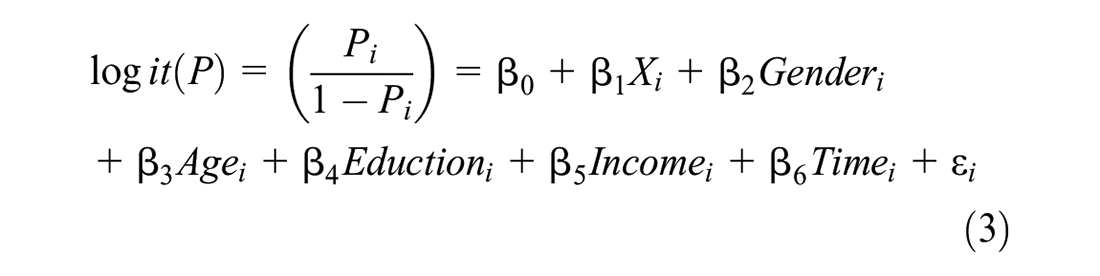
Because the value of perceived risk in this paper is 0, 1, and 2, which is an ordered variable, the ordered Logit model is selected for analysis (Williams, 2010). The impact model of perceived risk of the ith respondent is constructed. The dependent variable is perceived risk, and the independent variable is CORs. The control variables of this model are the same as those in publicity (1), as shown in formula (4). Yi represents the perceived risk of the ith respondent, Xi represents CORs, β 0 represents a constant item, ε i represents random error term.

Results
Characteristics of Sample
The sample demographic data is provided in Table 7. The majority of respondents were female (69.61%) and younger (68.62% under 45). The majority of respondents hold a University Degree or above (71.59%). Most people’s disposable income exceeds ¥3,000 per month (68.72%). The majority of respondents have been online shopping for more than 3 years (76.14%). The sample is in line with the description of “young, knowledgeable and middle-class family users are the main population for online shopping of fresh products” in the 2018 consumption insight report on China’s fresh e-commerce industry.
Description of Demographic Characteristics of Sample Participants.

Note. The number of samples is 306.
Hypothesis Test
The Direct Impact of CORs on Consumers’ Online Purchase Decisions
Manipulation inspection. In different degree grouping of CORs, the descriptive statistical analysis results of initial and final purchase decisions are shown in Table 8. After reading the two groups of CORs with high proportion of positive and negative reviews (I and II), the average value of the final purchase decision is higher than the average value of the initial purchase decision, and the CORs increase the possibility of respondents’ purchase. After reading two groups of CORs with high proportion of positive and negative reviews (III and IV), the average value of the final purchase decision is lower than the average value of the initial purchase decision. The CORs reduce the possibility of respondents’ purchase. Paired sample t-test was conducted for participants’ initial and final purchase decisions. The results showed that it was significant in the 95% confidence interval (Mean = 0.0654, t = 2.3100, p < .05, 95% CI [0.0097, 0.1210]).
Mean Statistics of the Possibility of Respondents’ Initial and Final Purchase Decision.

Note. The number of samples is 306.
When the emotional arousal remains unchanged (I and IIvs. III and IV), respondents in the high proportion of positive and negative reviews is more likely to make online purchase decisions than the low-level consumption. H1a is supported. When the proportion of positive and negative reviews remains unchanged (I and III vs. II and IV), the possibility of respondents’ online purchase decision in emotional arousal group is higher than that in emotional calm group. H1b is supported. From the difference of respondents’ purchase decision possibility (the possibility of final purchase decision minus the possibility of initial purchase decision in each group), it can be seen that the possibility of respondents’ purchase decision is decreasing with the improvement of the level of CORs. Taking the mean difference of purchase decision and the degree of CORs as grouping variables, the results of one-way ANOVA showed that there were differences between groups (mean MS (between Groups) = 2.4583, F = 11.0280, p < .001). H1 is supported.
Testing the influence mechanism of CORs on consumers’ online purchase decision
The variables and regression results in the model are shown in Table 9. The six models were processed by Logit regression with Stata 16 software.
Logit Model Regression Results of Perceived Risk and Purchase Decision.

Note. Logit model is adopted for model 1, model 3, model 4 and Model 6, and Ordered Logit model is adopted for model 2 and model 5; Robust z-statistics in parentheses; ***p < .01. **p < .05. *p < 0.1.
From the significance level of the model, the overall regression significance level p-value of model 1, model 2, model 5, and Model 6 is less than .01, and the overall regression significance level p-value of model 3 and model 4 is less than .05, indicating that the statistical results of the model are significant. Pseudor2 of models 1 to 6 is 0.1752, 0.1298, and 0.0768 respectively 0.0532, 0.6728, and 0.2637 are all between [0, 1], indicating that the explanatory variable has a good explanation for the explained variable.
For the participants in Group I (participants’ purchase decision from initial no purchase intention to final purchase intention), CORs significantly negatively affect the increase of participants’ purchase intention (regression result of model 1, β1 = −.9096, p < .01), the higher the degree of CORs, the lower respondents’ purchase intention; CORs significantly positively affect participants’ perceived risk (regression results of model 2, β2 = .6885, p < .01), the higher the degree of CORs, the greater the perceived risk of participants; Perceived risk has a significant negative impact on the increase of participants’ purchase intention (the regression result of model 3, β3 = −6.5128, p < .01), the higher the perceived risk of participants, the higher the purchase intention, and the less likely it is.
For the participants in Group II (participants’ purchase decision from initial purchase intention to final non purchase intention), CORs significantly positively affect the reduction of participants’ purchase intention (regression result of model 4, β4 = .7159, p < .01), the higher the degree of CORs, the lower respondents’ purchase intention; CORs significantly positively affect participants’ perceived risk (regression results of model 5, β5 = .4834, p < .01), the higher the degree of CORs, the greater the perceived risk of participants; Perceived risk has a significant positive impact on participants’ purchase intention (regression results of model 6, β6 = 1.7612, p < .01), the higher the perceived risk, the lower the purchase intention and the greater the possibility of reduction. Therefore, H2 and H3 are supported.
Discussion
Conclusion
This study investigated the effect of CORs on consumers’ online purchase decisions. Empirical work has already established some antecedents of online reviews (Banerjee et al., 2017; Chen et al., 2018; Lee & Shin, 2014). This study examined the role of CORs as an antecedent to perceived risk and consumers’ online purchase. Previous studies have mostly studied the nature of online reviews in a single dimension. Our research deeply studies the impact of online reviews on purchase decisions from the proportion of positive and negative reviews, as well as the emotional arousal of online reviews. The research results show that CORs have a significant negative impact on consumers’ online purchase intention. This study fills the gap in literature.
First, the emotional arousal of online reviews has a “non-linear” impact on the possibility of consumers’ online purchase decisions. Compared with emotional calm, emotional arousing can more affect consumers’ online purchase decisions. Studies have confirmed the importance of emotional arousal (Filieri et al., 2019; Malik & Hussain, 2017; Yin et al., 2017). Yin et al. (2017) studied how emotional arousal affects readers’ perception of the usefulness of online reviews. In the article, the authors proposed a diminishing return model, that is, under the low level of arousal, the marginal effect of arousal on perceived help is positive, but decreases at the high level. In our study, when the proportion of positive and negative reviews is high, emotional arousal plays a positive role. When the proportion of positive and negative reviews is low, emotional arousal plays a negative role, and it is more likely to affect consumers’ online purchase decision. The “non-linear” impact of emotional arousal is consistent with the research conclusion that consumers pay more attention to negative reviews, that is, negative reviews play a more important role than positive reviews in previous studies (Lee et al., 2008; Paltoglou et al., 2013; Shihab & Putri, 2019; Weisstein et al., 2017; Yin et al., 2016). Based on the qualitative classification of previous CORs composed of positive and negative reviews, our research conducted a quantitative and in-depth discussion.
Second, CORs play different roles in different stages of the change of consumers’ online purchase decisions. Before and after reading CORs, consumers’ purchase intention is from no to yes (Group I) and consumers’ online purchase intention is from yes to no (Group II). In the first case, CORs play a more important role. The findings show that when consumers have no purchase intention, CORs has an important impact on purchase decisions (Shan et al., 2021). This is consistent with the previous research results that online reviews are an important basis for consumers’ online purchase decisions, and the impact of CORs on consumers’ purchase decisions (Hu et al., 2012; K. Z. K. Zhang & Benyoucef, 2016).
Third, CORs have a significant positive impact on consumers’ perceived risk, and perceived risk has a significant negative impact on consumers’ online purchase decisions. The research results provide empirical evidence for the path study of the impact of perceived risk on purchase decisions in CORs (Suki & Suki, 2007).This is consistent with the existing research results that perceived risk plays an important role in consumers’ online purchase behavior (W. Zhang et al., 2022).
Theoretical Implications
Theoretically, the results of this study have promoted literature of consumers’ online purchase decision in many aspects. Firstly, this is a study on the impact of CORs on online purchase decision in multiple dimensions of valence level and emotional level. Consistent with previous research conclusions, we found that the level of CORs can predict consumers’ online purchase behavior (Bigne et al., 2020; Hwang et al., 2018; Ruiz-Mafe et al., 2018).
Secondly, although previous studies have emphasized the source of online reviews (Hsu et al., 2017; Zhou & Duan, 2016), presentation mode (Xu et al., 2015), time of online reviews (Y. Wang et al., 2021; Y. Zhao et al., 2020), and its impact on consumers’ online purchase decisions, this paper is helpful to the in-depth study of the content characteristics of online reviews.
Finally, the results of this paper extend the application of SOR theory in literature of consumers’ online purchase (Peng & Kim, 2014; B. Zhu et al., 2020). The empirical results show that CORs affect online purchase decisions through perceived risk. Previous studies have mostly examined the impact of positive incentives such as promotion on consumers’ online purchase decisions (Fu et al., 2018; Kawaf & Tagg, 2012; Peng & Kim, 2014), but there are few studies on the psychological changes caused by negative incentives. This study provides new evidence for related research.
Practical Implications
This study shows that online marketers must consider the impact of CORs on consumers’ online purchase decisions. We should correctly view the coexistence of positive and negative reviews on products (Shoham et al., 2017). Online marketers should not only pay attention to the proportion of positive and negative reviews, but also pay attention to online reviews with high emotional arousal level. The positive online reviews with high emotional arousal level should be highlighted, and online marketers should apologize for the negative online reviews with high emotional arousal level, and given positive feedback. Research shows that the impact of online reviews on consumers is also related to the attitude of businesses.
In this study, by classifying consumers’ online purchase intention before reading CORs, we can identify the target consumers. Consumers in group I have no purchase intention. They obtain useful information through positive online reviews to improve their purchase intention. Consumers in group II have purchase intention. They understand the uncertain information through negative online reviews, and then reduce the purchase intention. The results show that the perceived risk in this process plays an important role, and reducing consumers’ perceived risk can improve their online shopping possibility. This is also consistent with the Enlightenment of relevant research (Chang & Wu, 2012; Lăzăroiu et al., 2020).
The sales of agricultural products have an important impact on agricultural production and farmers’ income. Especially in the marketing environment of “Internet + Agriculture,” online store operators need to establish online sales platforms such as agricultural product feature museums, expand product marketing channels, and improve online sales capabilities. The research results show that CORs have a significant negative impact on consumers’ online purchase decisions. Therefore, the research results are helpful for online store operators to pay attention to the online comment information of agricultural products and do a good job in public opinion management when the proportion of negative comment information increases and the comment emotion is strong.
Limitations and Areas of Future Research
Despite these findings, the study still has some limitations. Firstly, the data of this study is limited to the consumer data obtained through virtual experiments in the past month, which may not represent the overall situation of Chinese consumers’ purchase of fresh agricultural products in e-commerce. Future research can conduct consumer experiments in more regions of China to obtain data and analyze heterogeneity. In addition, with regard to the selection of experimental products, a single fruit was selected as the representative of fresh agricultural products, without considering the information of agricultural product brands. Future research can be based on the fresh agricultural product brand perspective of CORs to study the difference of the impact of CORs with or without brand agricultural products on consumers’ online purchase decisions. Finally, this study only considers the role of perceived risk in the impact of CORs on consumers’ online purchase decisions. In the future, we will deeply study the role of important variables such as consumer trust in the impact of CORs on consumers’ online purchase decisions.
Footnotes
Appendix
CORs IV: Low (Proportion of Positive and Negative Reviews) and Arousing (Emotional Arousal).

| Review content | Positive/Negative |
|---|---|
| The oranges were received. They looked round and cute. The delivery speed was fast. The fruit price was Affordable and none of them were bad. They looked very fresh. The skin was thin and tastes very tender and juicy. | Positive |
| The mouthfeel is smooth, greasy and sweet. The fruit is full, tender and fresh. It is especially cost-effective. My family like it. The fruit is enough weight, thin skinned, sweet meat, rich juice, and vitamin C supplement. The orange skin is really thin and thin. It’s the first that I see such a thin-skinned orange. | Positive |
| Very good. It’s good to receive it in about a week during the epidemic. The fruit is big and delicious. I will continue to buy it back next time. It’s full of water and tastes like sweet. It’s a good choice. You can’t buy it online until you can’t buy it for the new year’s epidemic. GREAT! | Positive |
| The orange Q plays Q, and it’s sweet and delicious. It’s unexpected that there is express delivery in Northeast China. I’ve bought it here for the second time and I will recommend it to everyone. | Positive |
| It’s really good. It’s much better than before. I’ve never seen such a sincere seller. It’s really beautiful. They’re all fresh. The oranges look uniform in size and great in color. I wish the store a prosperous business and will bring friends to buy it next time. | Positive |
| You want me to tell the truth? I’ve bought jelly oranges many times. They are almost thin skin and enough water. That tastes very delicious, but this one it’s not the same variety at all. They have thick skin that even can not to chew. And they also have seeds. Is this also called jelly orange? I don’t want to evaluate them because I don’t want to give bad reviews. | Negative |
| The picture is inconsistent with the real object. Many oranges have shriveled and the package not only cracked, which reduced nearly 2 kg of 8 kg jelly orange, but also ignored the after-sales service. It’s really a black heart merchant. I advise everyone not to buy things from his house. It’s really disgusting. | Negative |
| I really don’t want to give a praise. It’s absolutely bad. This store clearly deceives customers. Selling fake and shoddy goods to customer. It is just a pile of soft and rotten oranges. None of them can be eaten. The taste is not good than others oranges. It’s not the taste like Hubei Zigui navel orange at all, and its appearance is completely different. | Negative |
| I don’t know how to get so many praises. Is it difficult that I am discriminated against? Why are my oranges in the box in disorder? It’s very simple, and the oranges are too expensive that terrible to eat. | Negative |
| I haven’t given a bad review for a long time, but I have to give a bad review on both products and services this time. The peel of oranges is so thick and it’s hard to eat. There’s almost no water in them. The merchant is so dishonest. I don’t know how long he can open the store. Close the store as soon as possible. | Negative |
Author Contributions
Conceptualization, Xiaoli Yang, Le Bo and Yimo Chen; formal analysis, Le Bo; funding acquisition, Xiaoli Yang; data curation, Yimo Chen; methodology, Le Bo; writing—review and editing, Le Bo, Xiaoli Yang and Yimo Chen.
Declaration of Conflicting Interests
The author(s) declared no potential conflicts of interest with respect to the research, authorship, and/or publication of this article.
Funding
The author(s) disclosed receipt of the following financial support for the research, authorship, and/or publication of this article: This research was funded by The National Social Science Fund of China (Grant No. 18BJY132).
