



Abstract
This research investigates the factors and configurations influencing the intention of primary and secondary school students to use online education. Employing the Technology Acceptance Model (TAM), the research framework incorporates considerations of external environmental factors, extending the model. Methodologically, Structural Equation Modeling (SEM) is utilized for path analysis, supplemented by fuzzy-set qualitative comparative analysis to comprehensively explore the influencing mechanism of primary and secondary school students' intentions to use online education. This study collected 423 valid questionnaires through stratified random sampling from urban and rural schools, with the sample comprising 250 secondary school students and 173 primary school students. Firstly, the SEM analysis reveals significant positive relationships between perceived usefulness, external support, information and communication technology atmosphere, satisfaction, and intention to use. Secondly, further configuration analysis explains the impact of different condition combinations on primary and secondary school students' intention to use online education, pinpointing perceived usefulness and satisfaction as core conditions influencing intention. The results indicate that enhancements in usefulness, satisfaction, and the external environment can stimulate students' active participation in and acceptance of online education.
Introduction
With the rapid development of technology, online education has become a significant trend in the field of education. Driven by the internet and influenced by the COVID-19 pandemic, learning is no longer confined to traditional classroom environments, and online education has emerged as an effective complement to traditional classroom learning. This transformation not only alters the traditional landscape of education but also provides learners with a more flexible and personalized learning experience (Ellis & Bliuc, 2019; Hong et al., 2021). Online education stands out due to the extensive availability of resources and the convenience it offers (Jiao et al., 2022; Mukhtar et al., 2020). Learners can access knowledge from top educational institutions worldwide without being constrained by geographical location. This not only enriches the choices of academic disciplines but also provides learners with more opportunities for in-depth study. Additionally, excellent educational resources can be shared among a larger user base, overcoming the issue of uneven distribution of educational resources (Ma & Yuen, 2011). As online education becomes more prevalent, the public has gradually accepted this new learning method, making it an indispensable part of society. Learners are increasingly seeking more flexible and convenient ways of learning in digital learning environments, and online education institutions continue to explore possibilities for providing high-quality teaching. However, the widespread adoption of online education may also lead to a digital divide, with inequalities arising from variations in learning devices, internet skills, and training (Tate & Warschauer, 2022). Therefore, online education has garnered widespread attention from scholars.
Existing research on online education has primarily focused on several key aspects. First, continuous intention in online education has garnered significant attention. Researchers have investigated learners' sustained engagement and usage patterns on online education platforms, aiming to understand their learning motivations, satisfaction levels, and the factors that contribute to their continued intention to use these platforms (Chen et al., 2022; Guo et al., 2016). Second, the impact of educational practices during the COVID-19 pandemic has been a critical area of exploration. Scholars have examined how online education effectively met the urgent educational needs during the pandemic, with lessons learned from this period being used to foster innovation and improvements within educational systems (Alismaiel et al., 2022; Maqableh & Alia, 2021). Third, learning outcomes in online education have been scrutinized to understand the effectiveness of online education compared to traditional teaching methods. Studies in this area evaluate academic achievements and knowledge retention, with the aim of assessing how online education influences student performance (Kang & Im, 2013; Lu et al., 2007). Fourth, participation and interaction in online education is a crucial element of research, where the focus is on the degree of cooperation, communication, and interaction among learners. Scholars investigate strategies to enhance these aspects and their subsequent effects on learning outcomes (Wang et al., 2022). Lastly, the relationship between online education and educational equity has emerged as a central theme. While online education provides students with increased access to learning opportunities and resources, overcoming geographical and temporal barriers, there are concerns about its potential to exacerbate the digital divide (Czerkawski, 2016; Yajie et al., 2023). This body of research seeks to balance the benefits of widespread online education adoption with the risks of inequality due to disparities in technology access and skills.
These studies provide a profound understanding of various aspects of online education and collectively reveal key factors influencing learners' intention to use online education, including learning experiences, levels of interaction, academic outcomes, and concerns about educational equity. Learners' acceptance and perspectives of online education directly impact their willingness to adopt this mode of learning (Bailey et al., 2021; Younas et al., 2021; Zobeidi et al., 2023). Therefore, in-depth research into learners' usage intentions can offer robust support for educational decision-makers, helping them formulate policies that better align with practical needs, and assisting online education providers in optimizing their services. Existing research is dedicated to examining various factors influencing learners' intention to use online education, conducting surveys on the actual usage patterns of online education, and revealing its advantages and challenges (Shanshan & Wenfei, 2022; Sidik & Syafar, 2020). Studies approach this investigation from aspects such as technological acceptance, personal traits, and course quality, exploring the influencing factors and mechanisms of learners' intention to use online education. Throughout this process, researchers have experimented with diverse models, such as TAM, UTAUT, ECM, TPB, etc. (Altalhi,2021; Balouchi & Samad, 2021; Pan et al., 2021; Soria-Barreto et al., 2021). Through in-depth exploration and study of these models, scholars have provided targeted recommendations for online education, aiding in the design and adjustment of online courses to enhance teaching effectiveness.
The previous scholars have provided comprehensive insights into learners' intention to use online education, laying the groundwork for this paper. Through a comprehensive review of existing literature, this study acknowledges the significant progress made in researching usage intentions in the field of online education. However, it also identifies some aspects that require further in-depth exploration. Presently, research in this area primarily focuses on adults and university students, with limited studies targeting primary and secondary school students. Given that primary and secondary school students constitute a crucial segment of learners, this study will specifically delve into the research on the intention to use online education among this demographic. This expansion aims to provide a fresh perspective for a comprehensive understanding of the influence of online education on the primary and secondary school age group. Additionally, this study argues that the consideration of environmental factors in existing research still has room for exploration, especially in elucidating the impact of technological environmental factors on usage intentions from the perspective of social interaction (Zhang et al., 2023).
In recent years, China has made significant achievements in network infrastructure development and the promotion of digital applications. 5G technology has rapidly expanded across major cities and remote areas, while the extensive construction of fiber-optic networks and data centers has further consolidated China's leading position in digital infrastructure. The government, through the implementation of the “Internet Plus” strategy, has continuously advanced the integration of education and information technology, making online learning a regular mode of education, particularly for primary and secondary school students. This robust infrastructure ensures that students nationwide have reliable access to high-speed networks, enabling them to connect to high-quality educational resources. Although a digital divide still exists between urban and rural areas (Wang, et al., 2021), the government has actively worked to bridge this gap through policies such as “network poverty alleviation.” Most schools, both urban and rural, now have internet connectivity, and the government has increased investment in online educational resources, especially in remote regions, striving to achieve educational equity. Consequently, the digital literacy of Chinese students has risen rapidly. From an early age, primary and secondary school students are exposed to and proficient in the use of various digital devices and platforms, gradually developing strong digital skills.
The rapid development of educational technology and the widespread use of online learning platforms present Chinese students with more choices. Changes in technological environments and the adoption of new perspectives may lead to different research outcomes. This study integrates aspects of family and school support from previous research into external support (ES) among the added environmental factors. This is to capture the impact of favorable external resources and conditions required for online education on students' usage intentions. Another selected environmental factor is the Information and Communication Technology Atmosphere (ICTA) to explain the role of technological socialization in students' usage intentions. Furthermore, most existing online education studies predominantly employ structural equation models, which have advantages in studying paths but also Come with limitations. These limitations may constrain a profound and comprehensive understanding of the complexities of online education intentions. Inspired by Chen, Chen et al. (2023), who combined the TOE model and fsQCA method to explore complex configurations and connections of online education platforms, this paper adopts the Technology Acceptance Model (TAM) as the primary model. The study integrates new environmental factors into the model and explores the influencing mechanisms using structural equation modeling. Subsequently, a combination of Fuzzy Set Qualitative Comparative Analysis (fsQCA) and the TAM model is employed for supplementary research (Manosuthi et al., 2022; Yang et al.,2022). This comprehensive approach aims to provide a more holistic consideration of students' intention to use online education. The paper employs two different methodological approaches—path analysis and configuration analysis—to contemplate online learning intentions.
Literature Review and Hypotheses Development
Technology Acceptance Model
Technical Acceptance Model (TAM) is a theoretical framework used to explain and predict individuals' willingness to adopt new technologies. This model primarily focuses on individuals' acceptance of specific technologies (Davis, 1989). Before adopting a new technology, individuals engage in cognitive processes to assess and perceive the technology. The decision-making process is influenced by perceived usefulness and perceived ease of use, which directly impact individuals' attitudes or satisfaction. Ultimately, individuals' attitudes or satisfaction determine their behavioral intentions (Afonso et al., 2018; Toft et al., 2014; Wallace & Sheetz, 2014).
Due to the model's maturity in understanding technology adoption, many scholars employ it to study online education (Chahal & Rani, 2022; Estriegana et al., 2019; Han & Sa, 2022). The core explanatory variables of this model are perceived usefulness (PU) and perceived ease of use (PEOU), both considered crucial factors determining individual adoption of new technologies. Perceived usefulness involves individuals' subjective perceptions of the technology's contribution to their job or task performance, while perceived ease of use relates to individuals' perception of the ease or difficulty in using the technology. By delving into individuals' cognitive processes regarding technology, TAM provides a theoretical foundation for designing and promoting new technologies, aiding in the formulation of more effective strategies to encourage widespread technological applications (Alasmari & Zhang, 2019; Songkram & Osuwan, 2022).
As research progresses, TAM has been criticized for oversimplifying the complex process of individual technology adoption (Bagozzi, 2007; Prasetyo et al., 2021; Venkatesh & Davis, 2000). Many scholars argue that it overlooks other important factors that may influence adoption behavior, prompting extensions and modifications to the original TAM model. This involves identifying new variables or integrating with other models to form novel models (Estriegana et al., 2019; Hsu & Lin, 2022; Jiang et al., 2021). This paper contends that when addressing issues related to students' online education using the TAM model, external environmental factors influencing students' behavioral intentions may not have been adequately considered. The choice of online education intentions may also be influenced by factors such as family and school environments, social atmosphere, etc.
Perceived Usefulness
Perceived usefulness (PU) refers to an individual's subjective perception of the benefits or practical usefulness of using a particular technology or system (Venkatesh et al., 2003). Specifically, in the context of students' online education research, perceived usefulness reflects students' cognitive evaluation of whether online education can provide effective learning assistance, address learning issues, improve learning efficiency, or achieve other learning objectives (Al-Rahmi, Shamsuddin et al., 2021; Esteban-Millat et al., 2018). Numerous empirical studies have validated this factor, with some research demonstrating a direct and significant impact of PU on behavioral intention (BI) (Al-Rahmi, Yahaya et al., 2021; Zardari et al., 2021), while others suggest that PU does not have a direct and significant impact on BI (Estriegana et al., 2023; Kumar et al., 2020; Li et al., 2021). This paper posits that if students believe that using online education can bring tangible benefits and assistance, they are more likely to express the intention to use it. Additionally, when students perceive online education as helpful to their learning, they are more likely to enhance satisfaction during usage. Therefore, this paper proposes the following hypotheses:
Perceived Ease of Use
Perceived ease of use (PEOU) refers to an individual's perception of the ease or difficulty of operating a particular technology or system. In the context of this study, perceived ease of use reflects students' perceptions of the simplicity, convenience, and ease of learning and operating an online education platform (Mustofa et al., 2022; Pal & Vanijja, 2020). Previous research indicates that an improvement in PEOU is often associated with enhanced efficiency and effectiveness when using technology. Users tend to be more satisfied with their experience when they can complete tasks quickly and accurately (Rosli & Saleh, 2023). Beyond efficiency considerations, this paper posits that PEOU can also reduce cognitive load for students, making it easier for them to grasp and utilize online learning technologies. Therefore, this paper proposes the following hypothesis:
External Support
Previous studies have extensively explored the support provided by families and schools for students' online education, primarily focusing on the provision of necessary learning devices, quiet study environments, and ample course resources (Khlaisang et al., 2021; Mo et al., 2021). In addition, the encouragement and involvement of parents and teachers in online learning have been identified as crucial actors, as they play a vital role in fostering positive learning attitudes and enhancing students' self-directed learning abilities (Woo et al., 2021; Zhu et al., 2024). This paper expands the concept of external support by emphasizing the importance of devices, internet connectivity, and the influence of interactions between teachers and peers. In online education, stable internet access and appropriate digital devices are fundamental prerequisites for students to successfully engage in learning. Without these technological supports, the learning experience may be significantly compromised, affecting both student performance and satisfaction (Asio, 2021). Furthermore, real-time interaction between teachers and students, as well as communication among peers, is also considered part of external support. These interactions not only provide students with timely feedback on course content but also offer emotional support, helping to mitigate feelings of isolation caused by the lack of face-to-face interaction (Wang et al.,2022). Research suggests that positive teacher-student and peer interactions can help maintain high levels of engagement, strengthen social skills, reduce psychological stress, and ultimately enhance learning satisfaction (Lin et al., 2023). Thus, the following hypothesis is proposed.
Information and Communication Technology Atmosphere
In exploring issues related to online education, some researchers have focused on the factor of social influence to capture the extent to which individuals perceive that others believe they should use a new system (Venkatesh et al., 2003; Zhang et al., 2018). Research on social influence contributes to understanding the influence of social networks, peers, and educational mentors on individual decision-making, providing deeper insights into the dynamics of technology acceptance in online learning environments. Drawing inspiration from this concept, this study addresses a more general phenomenon: the application of information and communication technology in individuals' living environments and social networks, denoted as Information and Communication Technology Atmosphere (ICTA). In past research, researchers have focused on the impact of Information and Communication Technology (ICT) in online education, with studies often centering on discussions of the digital divide or the influence of ICT skills on online learning (Adarkwah, 2021; Jiang, 2022; Nungu et al., 2023). Few studies have incorporated the use of ICT as a social external influence into their research. In sociology, the development of socialization theory aims to understand how individuals acquire knowledge, skills, and beliefs from socializing agents such as parents, peers, schools, and mass media, to develop their social behaviors and interactions (Frønes, 2016; Mortimer & Simmons, 1978). Building on this theory, Tang (Tang et al., 2023) introduced the concept of technological socialization to explore how individuals learn technology-based knowledge, skills, values, and attitudes from socializing agents, particularly in the process of using various ICT products/services. Online education clearly falls under ICT products/services, and as ICT becomes increasingly vital in daily life in the era of informatization, this paper considers the study of ICTA in online education to be worthy of discussion. Consequently, the following hypothesis is proposed:
Satisfaction
In the Technology Acceptance Model, satisfaction typically refers to users' overall perceptions and contentment with a specific technology or system. In the context of this study on students' online education issues, satisfaction can measure students' contentment with online education platforms, instructional tools, or other relevant technologies. The majority of research indicates a positive impact of satisfaction on behavioral intention (Rajeh et al., 2021; Zhou, 2017). In the traditional TAM model, usage attitude is often considered as a variable. Some researchers view them as two conceptually distinct variables, positing that satisfaction is an emotional response to the usage experience, while attitude is an emotional response to behavior. On the other hand, some scholars argue that satisfaction and attitude are synonymous in nature, with the only difference being the time of measurement. Attitude is considered a pre-existing construct, while satisfaction is a post-acceptance construct (LaTour & Peat, 1979). Considering that most students have already experienced online education during the pandemic, and recognizing that emotional responses to the usage experience are more pertinent in the context of students' online education issues, this paper chooses satisfaction as the variable and proposes the following hypothesis:
Behavioral Intention
In TAM research, behavioral intention refers to an individual's inclination to use a specific technology or system, indicating whether the individual intends to use, adopt, continue using, or promote a particular information technology (Hsia et al., 2014; Tawafak et al., 2023). Behavioral intention is considered a crucial factor capable of predicting whether a person will use a specific technology in the future. In the context of this paper exploring online education, behavioral intention refers to students' inclination to participate in and make use of online education platforms or courses, expressing whether they are willing to continue using this educational technology. This paper proposes an extended TAM model, incorporating external support (ES) and information technology atmosphere (ICTA) onto the base model. Satisfaction serves as the mediating variable to influence the intention to use online education. The specific model is presented in Figure 1.

Theoretical framework.
Research Design
The initial phase of the study involved constructing a conceptual model. Building upon the extended TAM (Technology Acceptance Model) framework, the study intends to develop a structural equation model (Figure 1) and a configuration model, focusing primarily on Perceived Usefulness (PU), Perceived Ease of Use (PEOU), External Support (ES), Information and Communication Technology Atmosphere (ICTA), Satisfaction (SAT), and Behavioral Intention (BI). The configuration model was constructed based on the structural equation model, incorporating synergistic linkages among factors beyond the foundation of the structural equation model.
The construction of both models was informed by extensive literature support and modifications to a classic TAM model. The authors engaged in discussions with other experts to refine the model structure. Both models emphasize the causal relationships of key factors (PU, PEOU, and SAT) from classical theory, as well as the newly introduced environmental factors (ES and ICTA) on BI.
The second phase of the research involved data collection. Surveys were conducted to identify the dominant factors influencing students' intention to use online education. The survey targeted primary and secondary school students, and a total of 423 valid responses were obtained. Participants were asked to assess the impact of causal factors (PU, PEOU, ES, ICTA, SAT) on their intention to use online learning. The survey employed Likert scales from psychometrics, and the results obtained will support the structural equation model and fsQCA. The questionnaire design was based on the conceptual model from the initial phase, and a pre-test was conducted before mass distribution to refine the questionnaire based on feedback from the pre-test results.
The third phase involves a paradigm analysis of the two models. Firstly, the Structural Equation Model (SEM) conducts a path analysis to examine the relationships among influencing factors, encompassing tests for both the measurement and structural models. Building upon the structural equation model analysis, the study constructed a configuration model and employed the fsQCA method to analyze the relational mechanisms between conditional variables and outcome variables from a configuration perspective, providing supplementary insights to the research. This includes data calibration, testing sufficiency condition analysis, robustness check and predictive validity.
In this study, the TAM model was extended, employing traditional structural equation research, while integrating TAM and fsQCA methods as complementary approaches, enriching the methodological tools for exploring causal relationships in educational research (Figure 2)

Research design.
Method
Fuzzy-Set Qualitative Comparative Analysis
Fuzzy Set Qualitative Comparative Analysis (fsQCA) is a qualitative research method employed to investigate how multiple conditions collectively lead to specific outcomes. Combining qualitative and quantitative characteristics, fsQCA is particularly suitable for addressing complex social science problems influenced by multiple factors (Fainshmidt et al., 2020; Misangyi et al., 2017). Researchers construct a “configuration table” enumerating different combinations of conditions, with each combination associated with a particular outcome. Ultimately, through fuzzy set operations and logical rules, researchers can identify key combinations of conditions that lead to specific outcomes. Compared to traditional structural equation models, fsQCA places greater emphasis on the concept of “configurations,” that is, combinations of multiple conditions. Therefore, fsQCA can simultaneously consider multiple conditions in one analysis, better reflecting the diversity and complexity of social phenomena. Additionally, fsQCA can handle unbalanced relationships, making it more suitable for revealing multifactorial influences in the real world (Mendel & Korjani, 2012; Vis, 2012). As an emerging research method and perspective, fsQCA has found widespread applications in the field of social sciences, including organizational studies, political science, educational research, and business studies (Beynon et al., 2019, 2020; Chen, Chen et al., 2023; Stroe et al., 2018). Fuzzy Set Qualitative Comparative Analysis (fsQCA) represents a methodological innovation that combines the strengths of both qualitative and quantitative analysis to explore how various conditions interact to influence specific outcomes. Unlike traditional statistical models, fsQCA allows researchers to address the complexity and interactions of conditions in their analysis. A key feature of fsQCA is its approach to fuzzifying the impact of conditions, meaning that each condition is not simply present or absent, but exists to varying degrees. This method captures more nuanced variations, particularly in cases where conditions are not fully defined or data is not completely quantifiable. FsQCA can handle more complex causal relationships and reveal nonlinear and interactive effects among conditions. This makes fsQCA particularly well-suited for studying intricate social phenomena.
Sampling and Data Collection
The target population of this study consists of primary and secondary school students, specifically categorized into primary school students (grades 1–6) and secondary school students (grades 7–9). To ensure a comprehensive representation of different educational environments, the study includes both urban and rural schools. The sampling frame was meticulously constructed by obtaining a directory of schools from local education authorities or school management departments, encompassing a mix of urban and rural institutions. Within each selected school, stratification was applied according to grade levels to guarantee that students from various grades were represented in the survey. The sampling procedure employed a stratified random sampling method. This process involved stratifying by geographical region (urban versus rural), school type (public vs. private), and grade level (primary vs. secondary). This approach ensured that each stratum was adequately represented in the sample. Schools were randomly selected within each stratum using a random number generator to maintain fairness in selection. Following school selection, several classes were randomly chosen from each selected school, ensuring that each grade level had an equal opportunity to be included. Subsequently, students from these classes were randomly selected, ensuring that every student had an equal chance of participation.
All participants (and their parents or guardians, especially for elementary school students) must voluntarily consent to participate after understanding the study's purpose, methods, potential risks, and benefits. The research team provided detailed informed consent forms and ensured that all participants signed the consent forms before the study began. The informed consent forms clearly informed participants and their parents that they have the right to withdraw from the study at any time. Measures were taken to protect participants' personal information and privacy during data collection, storage, and processing. Approval from the schools and education authorities was obtained before the research commenced.
During the survey process, provide specialized training for questionnaire administrators to teach them how to communicate in a way that is appropriate for children's age groups. Ensure they adopt a friendly and patient attitude to encourage students to express their genuine thoughts. Offer an option for anonymous questionnaire completion, especially for larger groups of students, allowing them to complete the questionnaire without direct interaction with an adult. This approach can reduce the psychological pressure students may feel when facing questionnaire administrators. To ensure younger participants understand the questions, use simple and clear language, and break down questions into easy-to-understand steps. For younger students, use visuals or examples to help them grasp the meaning of the questions. For elementary school students, design questionnaires with images and utilize visual aids that align with their cognitive levels to explain the questions. Create a supportive environment during the questionnaire process to help students feel safe and comfortable. Questionnaire administrators and teachers should exhibit a friendly and supportive attitude to encourage students to share their honest opinions. In some cases, organize group discussions where students can discuss the questions and complete the questionnaire together. This method can alleviate student stress and help them articulate their views more effectively.
The data collection period spanned from October to December 2023. Ultimately, the study obtained a total of 458 completed questionnaires. After data cleaning, removing cases with missing answers and questionnaires with more than 15 consecutive repetitions of the same response option, 423 valid questionnaires were retained, resulting in a response rate of 92.4%. The sample comprised 213 females and 210 males, accounting for 50.35% and 49.65% of the total sample, respectively. There were 250 middle school students and 173 primary school students, representing 59.1% and 40.9% of the total sample, respectively. Moreover, 326 respondents (77.1%) reported receiving online education in the past month. The gender distribution was approximately balanced, with a higher proportion of middle school students compared to primary school students, and the majority of students had experienced online education in the past 6 months. The sample information is illustrated in Table 1.
Study Sample.

Research Instruments
This paper developed a survey questionnaire as a research instrument, building upon previous studies. The questionnaire design integrated elements from studies by Prasetyo et al. (2021), and Gerlach et al. (2016). Four dimensions, namely Perceived Ease of Use (PEOU), Perceived Usefulness (PU), Satisfaction (SAT), and Behavioral Intention (BI), were examined with five, five, four, and five items, respectively. For External Support (ES), the conceptual framework of family support and school support was 51 referenced from Mo et al. (2021) and Zhu et al. (2024), resulting in the inclusion of four items under this dimension. Given the limited research on the Information and Communication Technology Atmosphere (ICTA), a self-designed section was incorporated into the questionnaire. In the design of this dimension, the focus was on the application of information and communication technology in students' social environments. The subjects of application included the students themselves, their elder family members, and peers. The items underwent exploratory factor analysis, ultimately encompassing inquiries about whether students' elder family members frequently use ICT for work and leisure, and whether they engage in ICT-based social interactions with peers. The entire questionnaire employed a five-point Likert scale, with 1 indicating strongly disagree and 5 indicating strongly agree, to measure responses to each item.
Data Analysis
This study employed IBM SPSS Statistics 17, IBM SPSS Amos 25, and fsQCA 2.5 for data analysis. IBM SPSS Statistics 17 was utilized for conducting reliability tests on the questionnaire, IBM SPSS Amos 25 for structural equation model (SEM) analysis, and fsQCA 2.5 for configuration analysis. The initial step involved conducting reliability and validity tests on the questionnaire data to ensure the reliability of the research. In the application of SEM, Confirmatory Factor Analysis (CFA) and path analysis were conducted. Factor loadings, Cronbach’s α, and Composite Reliability (CR) were used to assess the consistency of the scales and sub-scales containing individual factors. Following the construction of the measurement model and reliability checks, Construct Validity and Model Fit were examined through CFA. Once the fit of the structural model met the standard, path analysis or hypothesis testing was performed (Hsu et al., 2019; Huang et al., 2022). After completing the structural equation model (SEM) analysis, a configuration analysis was conducted to complement the results, employing the fsQCA method. The fsQCA method comprised three main steps: (1) selecting cases and transforming variables into fuzzy sets to construct a truth table, (2) testing the sufficiency of causal conditions based on the truth table, and (3) interpreting the obtained configurations or outcomes. Before conducting fsQCA analysis, an analysis of necessary conditions was performed to determine if crucial variables would be overlooked in subsequent configuration analysis (Ho et al., 2016; Kraus et al., 2018). Robustness check and predictive validity were conducted to ensure the robustness and effectiveness of the analysis. Only after undergoing all these steps can the fsQCA process be considered complete, comprehensive, and scientifically sound (Chaparro-Peláez et al., 2016; Eng & Woodside, 2012; Fiss, 2011; Park et al., 2017).
Result
Structural Equation Modeling
Measurement Model
Based on previous research, higher factor loadings, Cronbach’s α, and Composite Reliability (CR) for latent variable items indicate strong internal consistency in measuring the variable, suggesting a robust measurement of the latent variable. Generally, factor loading above .6, Cronbach’s α above .7, and CR above .7 are considered indicators of good internal consistency, rendering the measurement results acceptable. The Average Variance Extracted (AVE) is employed to assess convergent validity, with a value exceeding .5 indicating the usability of the variable (Hair et al., 2019). Items with standardized factor loading below .6 were eliminated, resulting in a total of 28 items for this study. The standardized factor loading ranged from .669 to .926, Cronbach’s α values ranged from .864 to .945, and CR values ranged from .861 to .951, all meeting the standards. This demonstrates good internal consistency for the latent variables in this study. AVE values ranged from .555 to .811, all exceeding .5, indicating good convergent validity for the latent variables used in this study. The summarized information is presented in Table 1.
When assessing discriminant validity of the measurement model, the focus is on whether there are significant differences in the concepts measured by items under different variables, and whether there are apparent distinctions in the connotations of latent variables. Discriminant validity ensures that the relationships between latent variables are relatively small, not exceeding the relationships within each corresponding latent variable. Specifically, discriminant validity can be assessed by calculating the Average Variance Extracted (AVE) for each latent variable. If the AVE value for a latent variable is greater than the sum of the squared correlations between that variable and other variables, discriminant validity is established (Hair et al., 2019). As indicated in Table 2, the model passes the discriminant validity test.
Reliability and Validity of Measurement Model.

Structural Model
In terms of the fit of the structural model, the indicators are as follows: the degree of freedom ratio is 2.916, which is less than 3; the Goodness-of-Fit Index (GIF) is 0.921, exceeding 0.9; the Root Mean Square Error of Approximation (RMSEA) is 0.067, less than 0.1; the Root Mean Square Residual (RMR) is 0.035, less than 0.05; the Comparative Fit Index (CFI) is 0.947, exceeding 0.9; the Normed Fit Index (NFI) is 0.921, exceeding 0.9. All indicators meet the requirements, indicating a good fit of the model (Kenny et al., 2015; Sanchez, 2013). According to the results in Table 3 and Figure 3, perceived usefulness (β = .215; p < .05), external support (β = .201; p < .01), and ICT atmosphere (β = .57; p < .01) significantly and positively influence satisfaction, confirming H2, H4, and H5. Perceived ease of use does not have a significant positive impact on satisfaction (β = −.019; p > .1), and H3 is not confirmed. Perceived usefulness (β = .154; p < .01) significantly and positively influences usage intention, validating H1. Satisfaction (β = .215; p < .05) has a significant positive impact on usage intention, confirming H6.
Discriminant Validity of the Measurement Model.

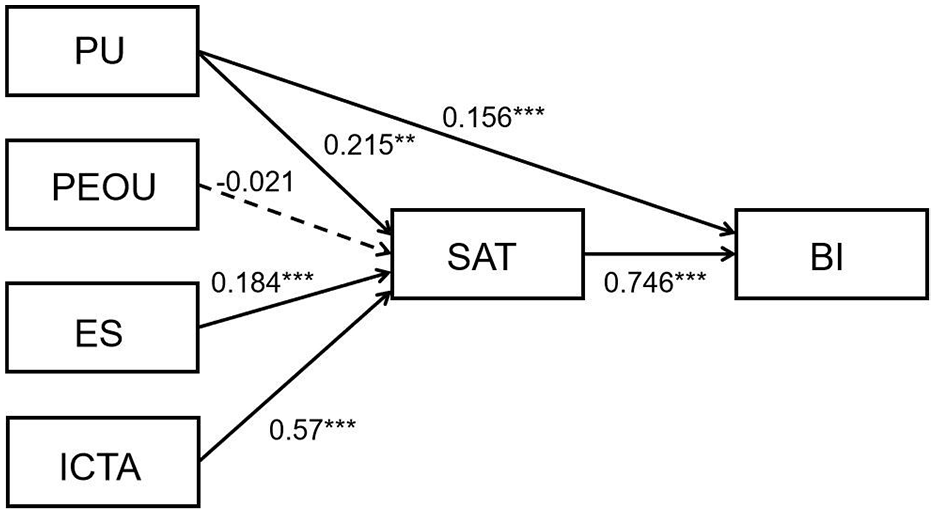
Hypotheses testing results.
FsQCA
In the results of the structural equation model, PU, ES, ICTA, and SAT all have direct or indirect positive effects on BI. Therefore, these variables are included as exogenous variables in the configuration model, with BI as the endogenous variable. Despite the non-significant impact of PEOU on BI, it is still included as a conditional variable to maintain the completeness of the study and the need for mutual validation between the two models. This paper attempts to integrate the TAM model and fsQCA, mutually corroborating each other. While providing a comprehensive analysis of student online education research, the paper innovatively elaborates on the TAM model using fsQCA. The model configuration is presented in Figure 4.

Configuration analysis model.
Calibration
The first step in FsQCA involves transforming the data into fuzzy set data, where data is converted into fuzzy memberships on a 0 to 1 scale, a process referred to as calibration. Calibration necessitates specifying three anchor points: full membership, full non-membership, and the crossover point. Given the dense nature of the survey sample data in this study, a direct calibration method was employed, as observed in previous research (Manosuthi et al., 2022; Pappas & Woodside, 2021; Ragin, 2009; Woodside, 2013). In our research, the upper quintile was calibrated as full membership, the median was transformed into the crossover point, and the lower quintile was calibrated as full non-membership (Pappas & Woodside, 2021).
Analysis of Necessary Conditions
After the completion of calibration, necessary condition analysis is conducted, wherein if the result conditions constitute a subset of antecedent conditions, the antecedent condition is considered necessary. While the analysis of sufficient conditions is central to fsQCA, it is crucial to first identify necessary conditions (Han & Hwang, 2016; Schneider et al., 2010; Veríssimo, 2016). Measurement is primarily based on consistency and coverage, with consistency gauging the extent to which the result conditions form a single subset of antecedent conditions, and coverage assessing the empirical importance or experiential relevance of a singular antecedent condition. When the corresponding consistency score surpasses the threshold of 0.9 and coverage exceeds the threshold of 0.5, the condition is deemed “necessary” (Ragin, 2000). As indicated in Table 4, none of the conditions exhibit consistency scores exceeding the 0.9 threshold; therefore, no necessary conditions for the intention to use are identified (Table 5).
Hypotheses Testing.
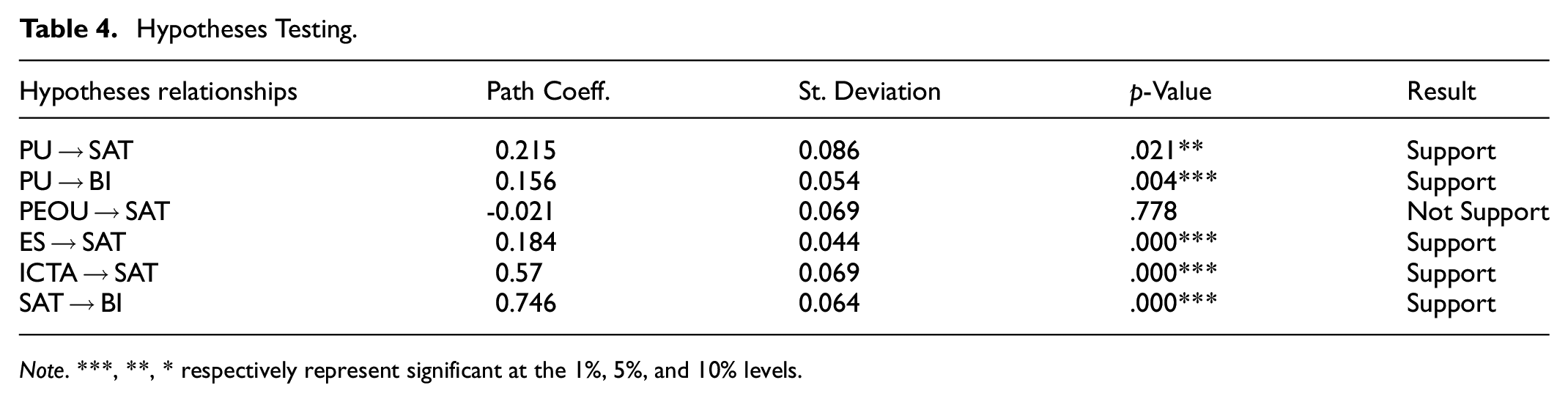
Note. ***, **, * respectively represent significant at the 1%, 5%, and 10% levels.
Analysis of Necessary Conditions.

Analysis of Sufficient Conditions
Configuration analysis tests causal relationships by examining the relationship between the outcome set and the antecedent set (Fiss, 2011). This analysis is conducted based on a truth table, initially constructed using set measures to form a truth table with 2k rows, where k represents the number of antecedent conditions used in the study. Subsequently, rows are reduced based on frequency thresholds and consistency thresholds. Finally, a Boolean algebra-based algorithm is applied to simplify the truth table. It is noteworthy that QCA literature suggests retaining at least 80% of cases in the sample after applying frequency restrictions (Ragin, 2009). To assess which configurations can determine outcomes, a consistency threshold equal to or greater than 0.80 is applied (Ragin, 2009). In this study, the frequency cutoff was set to 5, and a consistency threshold of 0.8 was chosen. The software ultimately provides complex solutions, intermediate solutions, and parsimonious solutions. Following the advice of Silva and Goncalves (2016), this study opted for intermediate and parsimonious solutions for analysis, with the latter primarily used to distinguish core conditions.
The analysis yielded five configurations influencing the intention to use, all composed of combinations of causal conditions. The solution coverage has reached 0.824, and the solution consistency has reached 0.876, indicating reliable and stable results.
Configuration 1 represents students who have a high level of satisfaction with online education, are situated in a conducive ICT atmosphere, and have sufficient external support. However, they exhibit low perceptions of the ease of use and usefulness of online education. These students are more inclined to external guidance and may still choose this mode of education despite their low perceptions of its ease of use and usefulness when faced with recommendations from family, school, or society. Additionally, they may not view online education as the most effective learning method, but due to its convenience and accessibility, they opt for it. For example, online education allows students to save commuting time and offers more flexibility in scheduling study time, factors that might influence their choice. This leads to high satisfaction among these students with online education, which becomes a core condition for their selection of online education.
Configuration 2 represents students who have high satisfaction with and perceive ease of use in online education, are situated in a favorable ICT environment, but lack sufficient external assistance and have low perceptions of the usefulness of online education. Satisfaction is a core condition for their choice of online education. In Chinese socio-cultural environment, traditional education is seen as a more orthodox and trustworthy educational method. Therefore, this social bias may influence students' perceptions of the usefulness of online education. Although these students are in a favorable ICT environment with good technical equipment and resources, their parents, schools, and teachers prefer traditional education, considering it more practical and valuable. This bias leads to distorted perceptions of the usefulness of online education among these students and less external support. The lack of sufficient support and resources may also lead students to perceive online education as less useful. However, since they are in a favorable ICT environment, these students may be more familiar with technology and have good technological adaptability. Therefore, they may be more likely to adapt to online education platforms and tools in the absence of external support, improve their perceived ease of use, experience technological efficacy, and increase satisfaction, thus choosing online education.
Configuration 3 demonstrates that high satisfaction alone, even with other aspects at low levels, can still enhance students' willingness for online learning. Some students may have special learning needs or interests that require access to specific learning resources provided by online education, which may be their only avenue to obtain them. They may need to acquire particular skills, specialized knowledge, or undergo training in specific fields, and these resources can only be obtained through online education. In this situation, despite their low perceptions of the usefulness, ease of use, external support, and ICT atmosphere of online education, it may still be their only means of accessing special learning resources. Therefore, they may still have some level of satisfaction with online education and be inclined to use it. They may overcome environmental challenges due to their specific learning goals and strive to utilize online education resources to meet their learning needs.
Configuration 4 represents students who perceive online education to be highly easy to use and highly useful, are situated in a favorable ICT atmosphere, and receive sufficient external assistance, but lack satisfaction with online education. These students may have high expectations for the application of technology due to ample external support and a favorable ICT environment. However, in practice, their dissatisfaction may stem from the failure of course content, teaching quality, personalization, etc., to fully meet their expectations. Perceived usefulness is the core condition for these students in choosing online education. They acknowledge the academic assistance that online education can provide. Additionally, with the widespread adoption of blended learning, online assignments have become a teaching trend, and the necessity to complete tasks online may be one of the reasons prompting these students to choose online learning.
Configuration 5 represents students who have high satisfaction, high perceived ease of use, and high perceived usefulness of online education, and have received sufficient external assistance, but are relatively isolated in terms of their information technology environment. For these students, the perceived usefulness of online education is the core condition driving their inclination towards online learning. They prioritize the practical application value of learning and believe that online learning can provide them with practical knowledge and skills to effectively meet their learning needs. Despite being in a relatively isolated information technology atmosphere, the active support from both family and school diminishes this negative influence. Although they lack a conducive information technology atmosphere, the external support complements their perceptions of the usefulness of online education.
Support from parents and schools provides them with confidence and motivation to explore online learning, while perceived usefulness assures them that online learning is an effective choice. These results are summarized in Table 6.
Analysis of Sufficient Conditions.

Note. ✷ represents the existence of core conditions, ⊙represents the absence of core conditions, ● represents the existence of auxiliary conditions, ◎represents the absence of auxiliary conditions, and “-” represents whether the condition can exist or not; Among them, the core condition is the condition that exists simultaneously in both the simplified solution and the intermediate solution; The auxiliary condition is a condition that exists only in the intermediate solution.
Robustness Check and Predictive Validity
In fsQCA studies, the selection of anchor points involves a certain degree of subjectivity, necessitating a stability test. Robustness check helps examine whether the model's results remain consistent under different parameter settings. Schneider and Wagemann (2012) proposed adjusting the consistency level and calibration thresholds as a robustness test for fsQCA configuration analysis. In this study, the consistency level was initially reduced from 0.87 to 0.83, and the calibration anchor points were adjusted by replacing the original full membership and full non-membership anchor points with the upper and lower quartiles, respectively. The frequency cutoff value was set at 4. The results of the reconfigured analysis were essentially consistent with the original, and the configurations forming the antecedent conditions were largely the same. To ensure the robustness of the results, the calibration anchor points were further adjusted to the 0.7 and 0.3 quantiles, with a frequency cutoff value of 5, and the resulting configurations remained similar.
The results of these robustness tests are summarized in Table 7. Overall, the configuration analysis in this study remains robust.
Robustness Check.

Predictive validity is essential to determine whether the model can effectively predict new data outside the subset of data used during model development. The examination of predictive validity involves three main steps.
Firstly, the original sample is randomly divided into two approximately equal subsamples, labeled as Subsample 1 and Subsample 2, both subjected to the same fsQCA analysis. Secondly, to assess whether the model for Subsample 1 exhibits high predictive ability for Subsample 2, the model is tested using the data from Subsample 2. Thirdly, using the same approach, the model for Subsample 2 is tested for its high Predictive ability for Subsample 1 (Afonso et al., 2018). Predictive validity is demonstrated by consistency and coverage. The test results are presented in Table 8, indicating high predictive ability between Subsample 1 and Subsample 2, validating the model's predictive validity.
Predictive Validity.

Discussion
Existing academic literature on the TAM model extensively explores various variables affecting technology decisions, with a particular emphasis on PU (Perceived Usefulness) and PEOU (Perceived Ease of Use). These two factors play crucial roles in the decision-making process, significantly impacting users' selection, acceptance, and adoption of specific technologies. However, in the results of this study concerning PEOU, there is a discrepancy with the findings of Mustofa et al. (2022) and Alfadda and Mahdi (2021). In previous research, PEOU was directly related to user satisfaction, as students prefer platforms with simple design and ease of operation, providing a better user experience, reducing operational difficulties in the learning process, and enhancing their satisfaction. However, in this study, the impact of PEOU on SAT is not significant. Mohammadi (2015) similarly suggested that PEOU does not have a significant role in the TAM model. The study offers two possible explanations for this.
First, over time, students may have become more accustomed to using online education platforms, adapting to the interfaces and features of online learning, and providers continuously optimizing their services, making online education more convenient. Second, with technological advancement, students' technological literacy may have increased, making it easier for them to adapt to various online education platforms, thus reducing the strong demand for ease of use. Therefore, the initial importance of PEOU may no longer be a significant influencing factor. In this study, PU has a significant positive impact on SAT and BI, consistent with most previous studies (Danesh Sedigh, 2013; Tao et al., 2022; Yu et al., 2022). PU may be related to enhancing students' learning experiences and academic achievements. When students perceive practical value in online education for their academic success, they are more likely to actively engage in learning activities, thereby increasing their satisfaction and willingness to learn online (Al-Rahmi, Shamsuddin et al., 2021). PU implies that students believe online education tools provide substantive assistance and support for their learning. If this academic approach effectively meets their academic needs, offers beneficial learning resources, and facilitates knowledge acquisition and understanding, students will feel satisfied, directly contributing to positive behavioral intention. For students with limited access to technology or less exposure to online education, PEOU may still be a critical factor influencing their satisfaction and willingness to use such platforms. Future research should take a more comprehensive approach in addressing the inequality of access to technology across different social groups and explore whether regional or cultural differences affect the impact of PEOU.
Environmental factors play a crucial role in students' online education in this study. Specifically, both ES and ICTA have positively influenced satisfaction, supporting the hypothesis of the significance of environmental factors in student online education research. The performance of ES aligns with studies by Lin et al. (2018) and Mo et al. (2021), where support from schools and families may provide students with quality learning resources and environments, including online materials, technological devices, and internet connectivity. Notably, ES encompasses the online learning participation of teachers and parents, identified as a form of social support in Ghai and Tandon’s study (2023), aiding students in building a positive learning community and thereby enhancing satisfaction (Maurer et al., 2003). Students' emotional and social needs are also crucial. Online education is not merely a technical process; it must also meet students' needs for social interaction, emotional support, and a sense of belonging in the virtual learning environment.
In contrast, ICTA has been seldom explored in previous research, with the focus mainly on the digital divide or the impact of ICT literacy on online education efficiency, manifesting as direct effects of ICT on online education (Hori & Fujii, 2021; Yajie et al., 2023). Limited research has delved into the influence of social networks and everyday ICT application on online education, treating ICT usage as an external social phenomenon. Based on the study results, it is suggested that if students grow up in a digital culture, their interactions with society may enhance their acceptance of ICT-related learning tools and platforms, making them more likely to have higher satisfaction with online education. Additionally, an essential condition influencing students' intention to use online education is SAT. The direct positive impact of SAT on BI is demonstrated in this study, akin to findings by Hsia et al. (2014), where individual attitudes or satisfaction ultimately determine behavioral intent. Based on the research findings, two core conditions affecting students' intention to use online education are identified as PU and SAT. While past studies have elucidated the roles of SAT and PU (Rajeh et al., 2021; Suliman et al., 2023), the results of this configuration study suggest their heightened importance, warranting greater attention in studies on students' intentions regarding online education. This may indicate that students prioritize their perception of the practical value and learning experience of online education. Students place greater value on factors that meet their learning goals and needs, providing substantive assistance, while satisfaction reflects their overall learning experience.
Based on previous research, these two crucial conditions may involve aspects such as the teaching quality, interactivity, and the ability to meet personalized needs of online education platforms (Mustafa et al., 2022; Soria-Barreto et al., 2021). PEOU, ES, and ICTA are proven to be peripheral conditions in configuration analysis, and these factors may lead to students having higher technological confidence, being more proficient with online learning tools, and more easily adapting to and enjoying this technology-based learning approach. This interpretation is similar to the impact of computer self-efficacy on online education in other studies (Chen, Chen et al., 2023; Shen et al., 2013). In another study utilizing fsQCA (Zheng et al., 2023), researchers combined the SOR model and TAM model to explore the impact of various online platform qualities, learning communities, personalization, perceived usefulness, and perceived ease of use on students' intention to use online education. In that study, PEOU and PU were identified as core conditions, influencing online education intention as internal perceptual factors. This contrasts with our study, possibly due to variations in students' perceptions of ease of use in different regions, cultures, and educational levels. Individual differences in technological proficiency, expectations for online learning tools, and attitudes toward technology may vary, impacting perceptions of ease of use. Simultaneously, PEOU serves as a peripheral condition in the configurational analysis, aligning with the non-significant impact of PEOU on BI in the structural equation model.
Conclusion
This research introduces environmental factors to construct an extended Technology Acceptance Model (TAM) and supplements the research with fsQCA. The research adopts two distinct methodologies in an attempt to comprehensively understand the online education intention of primary and secondary school students. TAM studies typically focus on the key variables of Perceived Usefulness (PU) and Perceived Ease of Use (PEOU). This study thoroughly discusses these two factors. Through path analysis, the research finds that the impact of PEOU on SAT is not significant. The paper suggests that students may have become accustomed to using similar online education tools or platforms, exhibiting a certain adaptability to online interfaces and functionalities. Coupled with students' familiarity with information technology in the digital age, PEOU may no longer be a significant influencing factor. In contrast, PU has a positive impact on SAT and BI, indicating that enhancing students' perception of the practicality of online education tools is a key factor driving their active engagement in learning and overall satisfaction. Therefore, educators and designers should strive to further optimize the functionality of online education tools to meet students' practical needs, enhance their perceived usefulness, and thereby stimulate more positive usage intentions and higher satisfaction levels.
This study underscores the importance of environmental factors in influencing students' willingness to engage in online learning and delves into potential environmental variable considerations. The results reveal that Environmental Support (ES) and Information and Communication Technology Acceptance (ICTA) have a positive impact on SAT, indicating that external resource support, social support, and a favorable information and communication technology environment positively influence students' willingness to engage in online learning. This emphasizes the crucial role of strengthening support systems from both home and school while also focusing on creating a positive information and communication technology atmosphere. Optimizing the technological environment can enhance students' satisfaction and willingness to engage in online learning. The research, employing configuration thinking, confirms the necessity of the collaborative interaction among Perceived Usefulness (PU), Perceived Ease of Use (PEOU), Environmental Support (ES), Information and Communication Technology Acceptance (ICTA), and Satisfaction (SAT) in shaping students' willingness to use online education.
The research identifies different combinations of elements forming conditions for usage intentions. In the configuration analysis, it is found that PU and SAT are the core conditions, while PEOU, ES, and ICTA serve as peripheral conditions in influencing students' online education intention. The direct impact of students' perception of whether online education actually enhances learning outcomes plays a fundamental and crucial role in forming usage intentions. However, in practical application, the significance of peripheral conditions such as perceived ease of use, external support, and the information and communication technology environment should not be overlooked. Improving these factors can help students integrate more easily into the learning process, providing necessary support and convenient conditions for online education. Although these peripheral conditions hold a secondary position, collectively they constitute a comprehensive framework that synergistically influences students' formation of usage intentions. Therefore, when designing and promoting online education platforms, it is essential to enhance usability, external support, and technical environment comprehensively, on the basis of ensuring usefulness and user satisfaction, to maximize students' active participation and endorsement of online education.
The contribution of this study lies in expanding existing models of online education research. From a methodological perspective, this study complements the results of SEM and fsQCA. SEM typically focuses only on the impact of a single path on the outcome variable, neglecting the theoretical explanation of interactions between predictor variables. In some respects, fsQCA enhances the findings of SEM, as this study identifies PEOU, ES, and ICTA as peripheral conditions, while PU and SAT are core conditions. Additionally, the fsQCA method used in this paper employs a sufficiently large sample, enriching research on large-sample fsQCA in the field of online education. From a theoretical perspective, this study suggests that the traditional TAM model requires reinterpretation within the context of specific digital environments. Besides the technological environment factors introduced in this study, the effectiveness of PEOU in new digital contexts also warrants further investigation.
Research Limitation
Despite using two methodologies to asses factors influencing students' willingness to use online education, the study still has some limitations. The research incorporated technological environmental factors into the TAM model, but future studies could explore additional factors that might influence willingness to use online education through alternative methods. Expanding the model of influencing factors would enhance the explanatory power of the model. The research background of the article focuses on China, where digital infrastructure is relatively well-developed.
However, online education is not equally accessible in all regions, and disparities in access to technology, reliable internet, and digital literacy can significantly affect the effectiveness of online teaching and learning. Future research will need to address these gaps and explore the heterogeneity within them.
Footnotes

Ethical Considerations
According to institutional guidelines and national laws and regulations, ethical approval is not required as there are no unethical practices involved in this study. We solely conducted a questionnaire survey, and since this research did not involve human clinical trials or animal experiments, further approval from the ethics committee was not sought. In accordance with the Helsinki Declaration, all participants provided written informed consent. Confidentiality and anonymity of the survey respondents were ensured. Participation was entirely voluntary.
Funding
The author(s) disclosed receipt of the following financial support for the research, authorship, and/or publication of this article: This study was supported by the National Social Science Fund of China, “Research on the Reaction and Impact Mechanism of Using Online Education by Urban Families in the Education Context of Double Reduction Policy” [grant number: 22XSH007].
Declaration of Conflicting Interests
The author(s) declared no potential conflicts of interest with respect to the research, authorship, and/or publication of this article.
Data Availability Statement
All data generated or analysed during this study are included in this published article.