



Abstract
The study investigates the mediating role of the technology acceptance model (TAM) in the relationship between technology readiness and English as a Foreign language (EFL) teachers’ intention to use online education. Based on the technology readiness index (TRI 2.0) and TAM, this study examines the mediating role of TAM in the relationship between EFL teachers’ technology readiness and their intention to integrate online education into their teaching practices. Data were collected from 333 in-service English teachers working in public schools across Turkiye via an online questionnaire. Structural equation modeling (SEM) was conducted to examine both direct and indirect relationships among the variables. The findings revealed that TAM significantly mediated the relationship between technology readiness and the intention to use online education. Optimism and innovativeness positively influenced TAM, while discomfort and insecurity had no significant effect. TAM was also identified as the most robust predictor of intention, highlighting the central role of technology acceptance in educational technology adoption. Additionally, optimism and innovativeness directly influenced intention, though their effects were more pronounced when mediated through TAM. The present research enhances the growing literature on teacher technology adoption by providing empirical evidence specific to EFL teachers, a group often underrepresented in the field. It also offers practical implications for the design of professional development initiatives, suggesting that fostering positive attitudes and enhancing perceptions of technological usefulness and ease of use have pivotal role in facilitating the effective incorporation of technological tools in instructional practices. Future research may consider incorporating contextual and institutional variables to further enrich the model.
Plain Language Summary
This study looks at how prepared English as a Foreign Language (EFL) teachers are to use technology and how that affects their willingness to use online education. It also explores the role of teachers’ beliefs about technology in this relationship. The research is based on two key models: the Technology Readiness Index (TRI 2.0), which measures how open and ready individuals are to adopt new technologies, and the Technology Acceptance Model (TAM), which focuses on whether people find technology useful and easy to use. Data were collected from 333 in-service English teachers working in public schools across Turkiye using an online questionnaire. The results were analyzed using Structural Equation Modeling (SEM), a method that helps explain complex relationships between different factors. The findings showed that teachers’ acceptance of technology, especially their beliefs about its usefulness and ease of use, plays an important role in whether they intend to use online education. Two traits from the TRI model, optimism and innovativeness, had a strong positive effect on technology acceptance and also directly influenced teachers’ intention to use online tools. On the other hand, feelings of discomfort and insecurity about technology did not have a significant impact. Overall, the study shows that positive attitudes and beliefs about technology are key to encouraging teachers to use online education. It suggests that teacher training and professional development programs should focus on improving teachers’ confidence in using technology and highlighting how it can support their teaching. Future studies may include school-related or institutional factors to better understand what helps or hinders teachers in adopting online teaching.
Keywords
Introduction
The adoption of digital technologies in education has experienced a substantial surge, especially following the global disruption caused by the COVID-19 pandemic (Trust & Whalen, 2020). This transformation has reshaped teaching practices globally, placing increasing emphasis on educators’ ability and willingness to adopt online teaching tools (Isaee & Barjesteh, 2023). In language education, where communication, interaction, and instructional design are intricately linked, the effective use of online platforms is particularly crucial. Therefore, understanding the determinants of teachers’ acceptance of technology has become a pressing concern in educational research.
Among the theoretical models employed to explain technology adoption, TAM has been extensively validated (Al-Emran & Granić, 2021; Koç et al., 2021; Ölmez & Ulutaş, 2023; Sukackė, 2019). It emphasizes the role of perceived usefulness (PU) and perceived ease of use (PEoU) in determining individuals’ intention to use technology (Davis, 1989; Teo et al., 2018). More recently, the TRI 2.0 has gained attention as a framework for assessing users’ predispositions toward technology, capturing both facilitators (optimism, innovativeness) and inhibitors (discomfort, insecurity) of technology use (Parasuraman & Colby, 2015). The integration of TAM and TRI has been shown to deliver a more in-depth explanation of adoption behaviors (Khong et al., 2023; Rahim et al., 2022).
In the context of educational technology research, it is essential to distinguish between pre-service and in-service teachers, as their experiences, needs, and attitudes toward technology integration can vary significantly (Scherer & Teo, 2019; Teo, 2011). Pre-service teachers, still undergoing pedagogical training, often engage with digital tools in a university setting and may exhibit higher perceived ease of use due to formal coursework. In contrast, in-service teachers operate within institutional constraints, balancing instructional responsibilities with ongoing professional demands, which may influence their technology readiness and acceptance differently (Hatlevik & Hatlevik, 2018; Hsu, 2016). However, despite the relevance of these differences, few studies have examined these frameworks jointly within the context of in-service EFL teachers, particularly those operating in public education systems. While existing literature has predominantly focused on pre-service teachers (e.g., Sun & Zou, 2022) or general educators (e.g., Eksail & Afari, 2020), limited attention has been paid to how experienced EFL teachers perceive and engage with online education platforms (Alharbi & Khalil, 2022; Isaee & Barjesteh, 2023; Ly et al., 2021). Furthermore, studies exploring whether TAM functions as a mediating mechanism between technology readiness and behavioral intention remain scarce (Al-Emran & Granić, 2021; Opoku & Enu-Kwesi, 2019).
Recent research suggests that technology acceptance may serve as a bridge between individual readiness and technology use. For example, Lee et al. (2022) found that foreign language teachers’ intention to engage in online teaching was significantly shaped by TAM constructs, while Khong et al. (2023) highlighted the role of technological pedagogical content knowledge (TPACK) and innovativeness as critical drivers of post-pandemic technology adoption. Nevertheless, empirical studies testing how personal traits such as optimism and innovativeness translate into behavioral intentions via TAM remain limited in the context of EFL instruction.
Given the limited empirical attention to this issue, the present study investigates the extent to which TAM functions as a mediator between technology readiness and EFL teachers’ intention to use online education. For a better grasp on the mediating role, two theoretically robust models are integrated without a focus on the external variables. Although both TAM and TRI 2.0 have been separately explored in educational technology research, their combined use remains relatively under-investigated in Turkish EFL contexts, particularly with a focus on the mediating role of TAM in predicting online education intentions. The study addresses an underrepresented population and offers further insights into the evolving scholarly discussion on teacher technology adoption and offers actionable insights for professional development, digital policy, and language teaching practices in increasingly technology-driven educational settings.
Theoretical Framework
TAM developed by Davis (1989) is grounded in the notion that attitudes toward using technology, behavioral intentions and actual use are predicted by PEoU and PU. PEoU refers to the user beliefs that no mental or physical strain is involved in using a specific system. PU, on the other hand, is related to user beliefs that utilizing a particular system would contribute to their overall job performance (Figure 1).

Original technology acceptance model by Davis (1989).
Previous research confirms the impact of PEoU and PU on the integration of the technology into educational settings (e.g., Dwianto et al., 2024; Hwa et al., 2015; Yadav & Shanmugam, 2024). Waheed and Jam (2010) carried out a study into teachers’ acceptance of online education with an attempt to extend the TAM model and suggested that PEoU and PU, among other variables in their study, significantly impacted teachers’ intention to accept online education. Han and Sa (2022), on the other hand, studied 313 university students’ acceptance of and satisfaction with online education during the COVID-19 pandemic and confirmed the positive impact of PU on the intention to accept online learning. Yan et al. (2024) studied the mediating role of PEoU and PU between flow and intention to use e-learning system among 662 undergraduates. The study revealed the significant impact of PEoU and PU between the relationship of flow and intention to use e-learning system. Another recent study with parallel results was conducted by Park and Kwak (2024). In their study, PEoU and PU enhanced the relationship between satisfaction and the intention to use non-face-to-face education service for the student participants. A recent study by Al-Adwan et al. (2024) also highlighted the influence of PU and PEoU on teachers’ intention to use educational technology at territory level. A study with similar results was carried out by Sharma and Saini (2022). The researchers confirmed the positive impact of PEoU as well as facilitating conditions on teachers’ technology use intentions. These findings consistently affirm that in the TAM framework, intention is positioned as the final outcome variable that is directly influenced by users’ PU and PEoU of a technology (Davis, 1989; Venkatesh & Davis, 2000). This positioning underscores the role of intention as the proximal determinant of actual technology adoption, making it a central construct in evaluating user behavior.
TAM’s simple structure makes it easy to use, hence the high number of studies using it to measure technology acceptance (King & He, 2006). A number of studies has tested and extended the original TAM (e.g., Al-Adwan, et al., 2023; Mailizar et al., 2021). Technology-readiness, an important component for the purpose of the study, was also attempted to be integrated into the TAM by Lin et al. (2007). Technology-readiness is defined as the tendency to employ newly emerging technologies both in social and work life and the dimensions in technology-readiness index (TRI) include optimism, innovativeness, discomfort, and insecurity (Parasuraman, 2000). Optimism is related to general good and positive feelings about technology while innovativeness indicates one’s likeliness to be a technology pioneer. Discomfort, on the other hand, includes feelings such as being overwhelmed by technology, and insecurity is mainly related to being skeptical about the outcomes of technology (Lin & Chang, 2011). One can have both positive and negative feelings about technology in varying degrees. In TRI, higher scores on the first two dimensions indicate a higher level of technology-readiness while higher scores on the last two lower the overall score of technology readiness (Lin, et al., 2007).
The findings gathered with this extentended model, technology-readiness and acceptance model (TRAM), reveal the significance of personal factors and experience in the intention to use the technology. PEoU and PU also have a significant effect on behavioral intention, and thus, the actual usage of the technology (Buyle et al., 2018).
The research by Gestiardi et al. (2021) concluded that higher technology-readiness abilities positively impacted PU of learning among students during COVID-19. Allam et al. (2021) reached similar results indicating technology readiness is a strong predictor of PU. Genoveva et al. (2023) investigated technology-readiness during COVID-19 with the participation of 327 participants who benefited from the technology for various reasons at the time. The structural equation model in the study revealed optimism dimension of technology-readiness has positive relationship with PEoU while PEoU, in turn, has positive relationship with behavioral intention and actual usage.
In line with the study’s objective, we adopted a deeper look into the potential role PEoU and PU (TAM) might have between technology-readiness and the intention to adopt online education. The previous literature revealed a number of studies pointing to the effect of both PEoU and PU on the intention to accept technology in education (Scherer & Teo, 2019). The research by Humida et al. (2022), for instance, shows that both PEoU and PU can successfully predict the intention to use e-learning. Mutambara and Bayaga (2021) examined the intention to use mobile learning among 417 high school students and confirmed the influence of both PEoU and PU on the acceptance of mobile learning. A recent study by Alshurideh et al. (2024) also discovered the effect of PEoU and PU on the intention to accept technology, ChatGPT in this case, in education.
The study by Damerji and Salimi (2021), on the other hand, suggests that there is an influence from both PEoU and PU on the relationship between technology-readiness and adoption of technology. Another study pointing out the role of PEoU and PU in the relationship between technology-readiness and intention to use technology was carried out by Cimbaljević et al. (2024). The study by Anh et al. (2024) also confirms the mediating role of PEoU and PU between technology-readiness and adopting technology. The results of the study carried out by Barua and Urme (2025) in an educational setting showed a positive relationship between the two dimensions of TRI, optimism and innovativeness, and PEoU and PU. While optimism was found out to be related to PU, innovativeness was positively related to both PEoU and PU.
The Proposed Model
The proposed model illustrated in Figure 2 identifies the hypothesized relationships among technology readiness, TAM, and the intention to use online education among EFL teachers. The outcome variable is defined as EFL teachers’ intentions to adopt online education in their instructional practice. This model proposes that technology readiness influences EFL teachers’ TAM, thereby shaping their intention to engage in online education. More specifically, it assumes that TAM mediates between technology readiness and behavioral intention. While institutional support, prior online teaching experience, and access to technological infrastructure are well-established contextual factors influencing technology adoption (e.g., Scherer et al., 2019; Teo, 2011), these external variables were intentionally excluded in this study. This decision was based on the need to isolate the individual-level cognitive and attitudinal mechanisms (i.e., technology-related beliefs and readiness traits) that directly influence acceptance decisions. Including external factors could have introduced multicollinearity and made it more difficult to determine the specific mediating effect of TAM constructs.
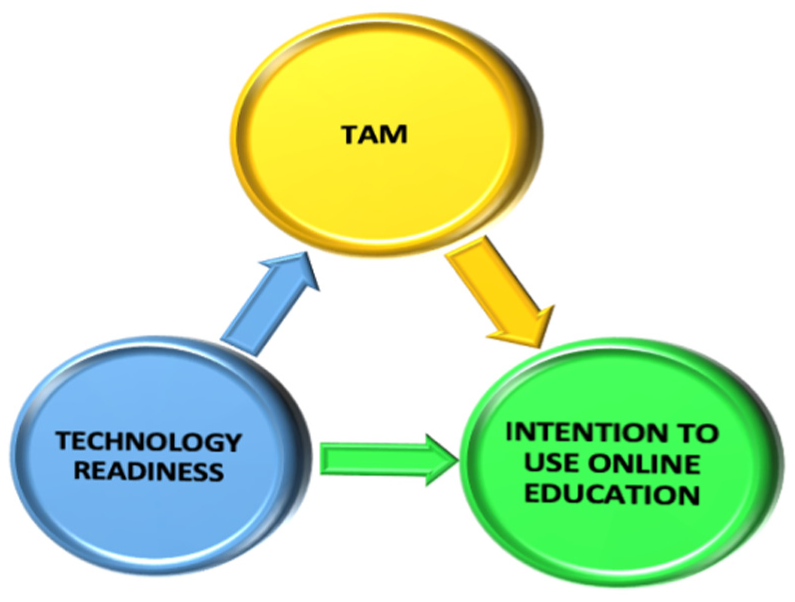
The proposed model.
Accordingly, grounded in this model, the current study tests the following hypothesis:
Method
In the study structural equation modeling (SEM) was conducted to examine the hypothesized relationships among technology readiness, TAM, and EFL teachers’ intention to use online education. SEM is defined as “a comprehensive statistical approach to testing hypotheses about relations among observed and latent variables” (Kline, 2016, p. 11). In line with the proposed model, the study sought to examine whether TAM mediates the relationship between technology readiness and intention to use online education. Ethical approval for the research was granted from the ethics committee of the university where the researchers are affiliated. Data were gathered using an online, participant driven, survey distributed through Google Forms. The survey link was shared with MoNE (the Ministry of National Education)-affiliated public schools, and responses were obtained from teachers volunteered to participate. These responses constituted the final dataset for the study.
Sample
The target population of this study comprises English teachers in the MoNE-affiliated public schools in Turkiye. To obtain a representative sample of this population, simple random sampling was conducted, providing each teacher with an equal probability of selection (Mertens, 2014). This approach enhances the sample’s representativeness and supports the generalizability of the results (Creswell, 2016). The final sample included 333 English teachers from various public schools around country. Given that SEM typically requires 250 to 500 participants for reliable analysis (Schumacker & Lomax, 2004), the sample size was deemed adequate for the study. Regarding participant characteristics, 70.3% of the respondents identified as male and 29.7% as female, indicating a male-dominant distribution. In terms of teaching experience, 42.0% of the teachers have between 11 and 15 years of teaching experience, followed by 31.8% with 6 to 10 years. Additionally, 20.7% of the participants have 16 or more years of teaching experience, while only 5.4% have been teaching for 1 to 5 years. This distribution suggests that most of the teachers participating in the study have moderate to extensive teaching experience, which may indicate that the findings are shaped predominantly by more experienced teachers. However, both gender information and teaching experience were collected only for descriptive purposes to profile the participants, as they were not treated as an analytical variable in the model.
Instruments
Three data collection tools were employed in this study: a demographic information form, the technology readiness index (TRI 2.0) developed by Parasuraman and Colby (2015), and the technology acceptance model (TAM) scale originally introduced by Davis (1989). The demographic form aimed to collect background details about the participants, such as their gender, years of teaching experience. This instrument provided essential contextual data to support the interpretation of the study findings and to profile the participant group more accurately. However, the original English versions of the TRI 2.0 and TAM scales were administered without translation, as all participants were qualified EFL teachers with a high level of English language proficiency. Therefore, no linguistic adaptation or forward-backward translation procedures were deemed necessary.
The TRI 2.0, constructed by Parasuraman and Colby (2015), was employed to measure participants’ readiness for technology adoption. TRI 2.0 is an updated 16-item scale that incorporates elements of new technologies while retaining the original four sub-scales construct of the model: optimism, innovativeness, discomfort, and insecurity. Each item on the instrument was rated using a 5-point Likert scale, ranging from (1) “Strongly Disagree” to (5) “Strongly Agree.” The use of TRI 2.0 enabled the study to capture an in-depth understanding of the participants’ psychological readiness for engaging with technology. To assess the validity and reliability of TRI 2.0, the Kaiser–Meyer–Olkin (KMO) coefficient indicated excellent sampling adequacy (0.891), and Bartlett’s test of sphericity was significant (χ2 = 3105.44, p < .001). EFA confirmed a four-factor structure, optimism, innovativeness, discomfort, and insecurity, explaining 68.55% of the total variance. Internal consistency coefficients demonstrated acceptable reliability for all subdimensions (optimism α = .726; innovativeness α = .784; discomfort α = .779; insecurity α = .758). CFA also supported the construct validity with strong model-fit indices (CFI = 0.941, RMSEA = 0.045).
TAM scale, introduced by Davis (1989), was also employed to examine participants’ technology acceptance behaviors. The scale comprises three sub-scales: (a) PU, (b) PEoU, and (c) IU, with a total of 12 items. Each item was rated on a 5-point Likert scale, ranging from (1) “Strongly Disagree” to (5) “Strongly Agree.” The TAM scale was considered suitable for this study due to its widespread recognition as a prominent framework for explaining technology acceptance behavior (Li, 2013; Lin et al., 2014). PU denotes individuals’ belief that using a particular technology positively impact their efficiency in performing tasks. On the other hand, PEoU reflects individuals’ perception that using a technology requires minimal effort. In this study, intention was treated as the dependent variable, independent of the TAM model. Intention directly measures individuals’ willingness and inclination to use online education and is considered the ultimate determinant of technology acceptance in the research. Within this framework, TAM was employed solely as a tool to examine how participants’ intentions toward online education are impacted by their perceptions of its usefulness and usability. TAM and Intention as a subscale showed robust psychometric properties. The KMO values were 0.875 for TAM and 0.742 for Intention, with significant Bartlett’s tests (χ2 = 1520.18 and χ2 = 223.40, p < .001). EFA confirmed the two-factor structure of PU and PEOU (71.20 % of explained variance) and a single-factor structure for Intention (81.40 %). Reliability analyses indicated high internal consistency (PU α = .845; PEOU α = .864; Intention α = .875). CFA results confirmed these structures, producing satisfactory model-fit indices for TAM (CFI = 0.960, RMSEA = 0.051) and an excellent saturated fit for intention (CFI = 1.000, RMSEA = 0.000). Consequently, these analyses confirmed that all instruments were valid and reliable for assessing EFL teachers’ technology readiness, acceptance, and intention to use online education.
Data Analysis
SPSS 27; IBM and AMOS 23; IBM software packages were employed to analyze the data. SPSS 27 was employed to generate descriptive statistics, evaluate the normality assumption, and conduct parametric analyses. The normality assumption was assessed by examining Skewness and Kurtosis coefficients, with values between −2 and +2 indicating a normal distribution. For datasets meeting this criterion, parametric tests were applied to ensure the reliability of the analysis in examining relationships between variables (George & Mallery, 2009). AMOS 23 was also utilized for SEM and mediating analyses. This approach enabled the investigation of both direct and indirect effects of the variables outlined in the TAM on the intention to adopt online education. Teachers’ perceptions of technology readiness, TAM, and their intention to use online education were evaluated using arithmetic means. The relationships between these perceptions were analyzed using Pearson correlation coefficients. Additionally, the mediating role of TAM in the relationship between EFL teachers’ technology readiness and their intention to use online education was examined through SEM, following the methodology proposed by Preacher and Hayes (2008).
Results
Descriptive Statistics and Correlations
Descriptive statistics and Pearson correlation coefficients were calculated to examine the preliminary relationships among the variables included in the analysis. The findings indicated in Table 1 provide valuable insights into the factors affecting EFL teachers’ intentions to use online education in their teaching practices. The strongest correlations were observed between the TAM and its constructs, PU and PEoU, with correlation coefficients of .989 (p < .001) for both. This indicates that EFL teachers’ acceptance of technology is strongly associated with their perceptions of its usefulness and ease of use. The strong correlation between TAM and its constructs highlights the necessity of ensuring that educational technologies are both user-friendly and perceived as beneficial by teachers.
Descriptive Statistics and Pearson Correlation Between Variables.
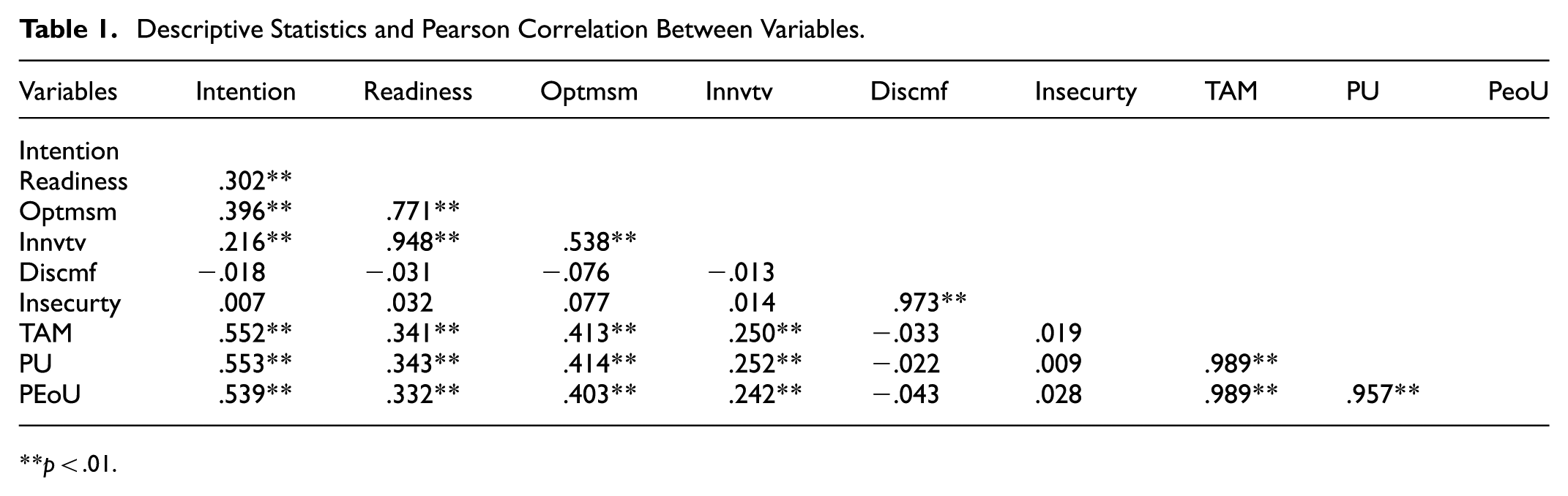
p < .01.
On the other hand, intention and insecurity demonstrated the weakest correlation (r = .007, p > .05), suggesting that feelings of insecurity regarding technology have little or no impact on teachers’ intentions to use it. This finding implies that while teachers may experience some level of insecurity or discomfort with technology, these feelings do not significantly hinder their willingness to adopt it.
The high correlation between readiness and innovativeness (r = .948, p < .001) highlights the strong relationship between teachers’ readiness to use technology and their propensity for innovation. Teachers who view themselves as innovative are more likely to be prepared to accept and embed technology into their instructional practices.
The positive and significant correlation between optimism and intention (r = .396, p < .001) indicates that teachers with positive expectations about technology are more likely to demonstrate an intention to use it in their classrooms. Optimism regarding the potential of technology to improve instructional processes emerges as a driving factor in teachers’ willingness to adopt it. Additionally, the strong negative correlation between discomfort and insecurity (r = .973, p < .001) suggests that feelings of discomfort with technology are closely associated with feelings of insecurity. Teachers who experience discomfort when using technology are more prone to having insecurity regarding their ability to use it effectively.
Findings of the Simple Linear Regression Analysis on the Direct Effects of TAM and TRI on the Intention to Use Online Education
Before conducting the mediation analysis, regression analyses were employed to explore the direct relationships between the independent variables and the dependent variable. Table 2 presents the results of multiple regression analyses examining the effect of TAM and TRI factors on teachers’ intention to use online education. Two separate regression models were tested.
Regression Analysis Results Regarding the Effect of TAM and TRI on the Intention to Use Online Education.

Firstly, the direct effect of the TAM on intention was examined. The findings indicate that TAM significantly and positively impact intention (B = 0.095, SE = 0.008, β = .552, t = 12.086, p < .001). This finding suggests that individuals’ level of technology acceptance strongly influences their intention to use online education. The explanatory power of the model was calculated as R2 = .305, and the overall model was found to be significant (F = 146.065, p < .001). Additionally, the Durbin-Watson (DW) statistic was determined to be 1.854, indicating no autocorrelation issues within the model. Second, the direct effects of TRI dimensions (optimism, innovativeness, discomfort, and insecurity) on intention were evaluated. The optimism variable was emerged as a significant positive impact on intention (B = 0.730, SE = 0.111, β = .396, t = 6.583, p < .001). This result suggests that individuals’ positive attitudes toward technology enhance their intention to use online education. However, the other variables-innovativeness (B = 0.006, SE = 0.100, β = .003, t = 0.056, p = .955), discomfort (B = −0.332, SE = 0.360, β = −.202, t = −0.922, p = .357), and insecurity (B = −0.371, SE = 0.370, β = −.220, t = −1.004, p = .316)-were not found to have significant effects.
Accordingly, the strong and significant effects observed for TAM and optimism indicate their potential as central mediating variables in the mediation analysis. On the other hand, the lack of significant direct effects for innovativeness, discomfort, and insecurity on intention implies that their potential mediating roles may be limited. Overall, these findings highlight TAM and optimism as key factors influencing individuals’ intention to use online education.
The Mediating Role of TAM in the Relationship Between EFL Teachers’ TR and Their Intention to Use Online Education
The study tested whether TAM mediates the association between EFL teachers’ technology readiness and their intention to engage in online education; the corresponding results are shown in Figure 3. The findings from the analysis of model fit indices indicate that the model demonstrates a highly satisfactory fit. First, the CMIN/DF value was calculated as 1.233, which indicates an excellent fit. This suggests that the model aligns well with the observed data. Similarly, the RMSEA value was found to be 0.026, which is below the 0.05 threshold, indicating a low level of error and confirming an excellent model fit. When examining other fit indices, values for NFI, CFI, IFI, and TLI all range between 0.95 and 1.00, satisfying the criteria for an excellent fit. These high indices indicate a strong combability between the proposed model and the actual data, further supporting the compatibility between the theoretical framework and empirical findings. Notably, the GFI and AGFI values were calculated as 0.984 and 0.965, respectively, further reinforcing the evidence of excellent fit. Additionally, the SRMR value was recorded at 0.027, which also falls within the threshold for excellent fit.

The measurement model.
Figure 3 illustrates the structural model illustrating the mediating role of TAM in the relationship between EFL teachers’ technology readiness and their intention to use online education. This model examines both the direct and indirect effects of the “Readiness” variable on “Intention” to utilize online education. Within the model, the readiness construct comprises four distinct dimensions: Insecurity, discomfort, innovativeness, and optimism. Among these, innovativeness and optimism exhibit strong positive effects on readiness, with standardized coefficients of β = .56 and β = .96, respectively. This indicates that EFL teachers who are innovative and optimistic toward technology are more prepared to integrate it into their practices. However, insecurity and discomfort have negligible and non-significant impacts on readiness (β = .08 and β = −.08, respectively).
The effect of readiness on TAM is both positive and significant (β = .43), suggesting that EFL teachers with higher levels of technology readiness are more inclined to accept technology. Furthermore, TAM significantly influences intention (β = .46), indicating that EFL teachers who embrace technology are more likely to intend to use it in their classrooms. In addition, while readiness exerts a significant direct effect on intention (β = .21), this effect is comparatively weaker than its indirect effect mediated through TAM. This implies that the influence of technology readiness on intention is strengthened when mediated by technology acceptance.
Accordingly, these findings suggest that TAM partially mediates the relationship between readiness and intention. Although readiness directly affects intention, TAM enhances this effect, further reinforcing EFL teachers’ intentions to use technology. These results align with the mediation analysis findings presented in Table 3, thereby supporting the model’s validity.
Results of Mediating Effect of TAM on the Relationship Between EFL Teachers’ TR and Their Intention to Use Online Education.

The mediation analysis results, as outlined in Table 3, comprehensively evaluate the direct and indirect effects of technology use levels (optimism, insecurity, discomfort, innovativeness) on TAM and the intention to use online education (intention). The findings reveal the strength and significance of the relationships between these variables, highlighting both direct and indirect effects. The optimism was identified as a significant effect on TAM (B = 0.917, SE = 0.138, CR = 6.634, p < .001, 95% CI [0.705, 1.144]). This result indicates that EFL teachers’ positive expectations toward technology significantly enhance their level of technology acceptance. Similarly, the direct effect of optimism on intention was also significant (B = 0.050, SE = 0.015, CR = 3.336, p < .001 [0.021, 0.079]). This finding demonstrates that optimism impacts on EFL teachers’ intention to use online education both directly and indirectly.
The innovativeness variable also showed positive and significant effects on both TAM and intention. The effect of innovativeness on TAM (B = 0.640, SE = 0.108, CR = 5.930, p < .001, 95% CI [0.428, 0.852]) and its direct effect on intention (B = 0.640, SE = 0.108, CR = 5.930, p < .001 [0.428, 0.852]) were both significant. These results suggest that EFL teachers’ levels of innovativeness increase both their technology acceptance and their intention to use online education. Additionally, the indirect effect of Innovativeness on intention through TAM was also significant (B = 0.406, SE = 0.122, CR = 3.336, p < .001 [0.163, 0.649]), indicating that the effect of innovativeness is further strengthened through TAM. These findings indicate that EFL teachers with higher levels of innovativeness are not only more inclined to accept technology but are also more likely to intend to use it for online instruction. This dual pathway reinforces the central role of innovativeness in predicting technology adoption among EFL teachers.
In contrast, the effect of the insecurity dimension on TAM was not significant (B = 0.095, SE = 0.066, CR = 1.448, p = .148, 95% CI [−0.004, 0.194]). Similarly, the direct effect of insecurity on intention was also not significant (B = 0.095, SE = 0.066, CR = 1.448, p = .148 [−0.004, 0.194]). These findings suggest that feelings of insecurity toward technology do not have a significant effect on either technology acceptance or the intention to use online education.
The discomfort dimension had a negative effect on both TAM and intention, but these effects were not statistically significant. The effect of discomfort on TAM (B = −0.096, SE = 0.067, CR = −1.430, p = .153, 95% CI [−0.194, 0.002]) and its direct effect on Intention (B = −0.096, SE = 0.067, CR = −1.430, p = .153 [−0.194, 0.002]) were not significant. These results indicate that while discomfort experienced during technology use may negatively influence technology acceptance and intention to use online education, this effect is not statistically significant.
Finally, the direct effect of TAM on intention was strong and significant (B = 0.080, SE = 0.009, CR = 8.854, p < .001, 95% CI [0.063, 0.097]). This finding underscores the critical role of technology acceptance in shaping individuals’ intention to use online education. The indirect effect of TAM was also highly significant, further confirming its strong mediating role.
Discussion
This study examined the mediating role of TAM in the relationship between technology readiness and intention to use online education among EFL teachers. The findings support and expand the earlier research on technology adoption in education by highlighting the importance of PEoU and PU in shaping teachers’ willingness to engage with online teaching platforms. These results are consistent with previous research, yet they also offer distinct insights into how different dimensions of technology readiness influence technology adoption in an educational setting.
The results show that TAM is the key predictor of teachers’ intention to use online education, confirming the significance of PU and PEoU in shaping adoption behaviors (β = .552, p < .001). This finding aligns with Chen and Tseng (2012), Han and Sa (2022), Hong et al. (2021), Khong et al. (2023), Lee et al. (2022), Scherer et al. (2019), Sun and Zou (2022), and Teo (2011), all of whom reported that teachers’ technology adoption is primarily influenced by their perceptions of how well a tool enhances their teaching effectiveness and how easily it can be implemented. Lee et al. (2022) investigated foreign language teachers’ intention to adopt online teaching and concluded that TAM, when combined with the task-technology fit (TTF) model, effectively explains teachers’ willingness to integrate online teaching tools. Similar to the present study, their results underscore the significance of PU and PEoU in predicting teachers’ adoption behaviors, reinforcing the notion that technology must not only be beneficial but also easy to use to gain widespread acceptance among educators. Lee et al. (2022) expanded the model by integrating TTF, which accounts for how well a given technology aligns with teachers’ instructional needs. This suggests that while TAM remains a fundamental predictor of online education adoption, the degree to which a specific technology fits teachers’ pedagogical requirements may further enhance their intention to use it.
Similarly, Khong et al. (2023) extended TAM by incorporating teachers’ TPACK and innovativeness to explain online teaching adoption. Their large-scale study (N = 1,740) confirmed that PU remained a key factor of teachers’ intention to use technology, particularly in the aftermath of the COVID-19 pandemic. The present study aligns with this finding, as the findings also demonstrate that PU is a key driver of technology acceptance. However, Khong et al. (2023) identified that training and institutional support have a significant impact on developing teachers’ perceptions of usefulness, whereas the present study did not examine external institutional factors. This distinction suggests that while teachers’ individual perceptions of usefulness and ease of use are critical for adoption, institutional-level support systems may further strengthen technology acceptance by providing necessary training and resources.
Furthermore, Sun and Zou (2022) explored pre-service EFL teachers’ acceptance of online teaching and found that PU, positive experiences with online learning, and social influences significantly impacted their acceptance levels. Consistent with the current study, their findings highlight the significant influence of PU on teachers’ intention to adopt online education. However, Sun and Zou (2022) emphasize that pre-service teachers’ prior experiences with online education shape their perceptions of usefulness, whereas the present study does not account for experience as a variable. This distinction highlights a potential area for further research investigating how prior exposure to online education affects teachers’ perceptions of usefulness and, consequently, their willingness to adopt digital teaching tools.
This study’s results also parallel those of Eksail and Afari (2020), who demonstrated that PU and PEoU had a critical role in forming trainee teachers’ intention to use educational technologies. However, while their study primarily focused on pre-service teachers as in the study by Sun and Zou (2022), the present study extends these findings to in-service EFL teachers, emphasizing the continued importance of technology acceptance throughout teachers’ professional careers.
Another key finding of this study is the strong correlation between TAM and its core constructs, PU and PEoU (r = .989, p < .001). This suggests that teachers’ perception of how easy a technology is to use is positively correlated with their perception of its usefulness, which in turn influences their intention to adopt online education. The interdependence of PU and PEoU within the TAM framework has been widely documented, with studies showing that higher levels of perceived ease of use often enhance perceived usefulness, reinforcing teachers’ technology adoption behaviors (Davis, 1989; Venkatesh & Bala, 2008). This finding reaffirms the theoretical claim that PEoU acts as an antecedent to PU, reinforcing the causal flow proposed by TAM. As Davis (1989) argued, systems that are easier to use require less cognitive effort, which enhances users’ overall perception of their utility. The high correlation found in this study provides empirical support for this proposition in the context of EFL teachers’ adoption of online education tools, suggesting that the perceived ease of a platform directly influences its perceived instructional value.
Another significant finding is that not all dimensions of technology readiness influence teachers’ intention to use online education. While optimism (B = 0.050, p < .001) and innovativeness (B = 0.640, p < .001) significantly predicted intention, discomfort and insecurity did not exhibit a direct impact. This suggests that teachers exhibiting a positive perception of technology are more likely to adopt online education, whereas concerns about discomfort or insecurity do not necessarily serve as barriers to adoption. These results align with Rahim et al. (2022), who found that optimism positively influenced academic staff’s intention to use open and distance learning. However, their study also identified a significant role for innovativeness, whereas the present study did not. The discrepancy may be due to contextual differences, as Rahim et al. (2022) focused on higher education faculty members, while the present study examined EFL teachers. This suggests that innovativeness might have a significant role in the contexts where educators have greater autonomy in selecting and integrating technological tools. The study by Yusuf et al. (2021) supports the significance of optimism in technology adoption. They found that students’ optimism positively influenced their intention to adopt e-learning. However, since their study was conducted with university students rather than teachers, it provides a learner-centered perspective that complements the teacher-focused insights of the present research.
The study also explored how technology readiness influences TAM constructs (PU and PEoU). The findings suggest that high-level of technology readiness contributes to greater acceptance of technology, which consecutively facilitates the adoption of online education. This supports previous research demonstrating a positive association between technology readiness and acceptance (Bağıran Özşeker et al., 2023; Kampa, 2023; Yusuf et al., 2021). Moreover, results from the present research emphasize that optimism and innovativeness have a greater impact on PU and PEoU than discomfort and insecurity.
A major contribution of this study lies in revealing the mediating function of TAM in the relationship between technology readiness and teachers’ intention to engage in online education. The findings indicate that while technology readiness directly influences intention, its impact is significantly stronger when mediated by PU and PEoU (β = .406, p < .001). This supports previous research indicating that TAM constructs play a significant mediating role in technology integration (Anh et al., 2024; Cimbaljević et al., 2024; Damerji & Salimi, 2021). Similarly, Eksail and Afari (2020) found that PU and PEoU mediated the impact of technology self-efficacy on intention to use technology among pre-service teachers. Although their study did not specifically examine technology readiness, their findings align with the current research in underlining the critical function of TAM in facilitating technology adoption in education.
Conclusion
This study explored the TAM’s mediating effect on the relationship between technology readiness and EFL teachers’ intention to use online education. The findings confirmed that TAM, particularly its core constructs-PU and PEoU- are critical determinant of teachers’ intentions to adopt online instructional methods. Technology readiness, especially optimism and innovativeness, positively influenced technology acceptance, thereby indirectly enhancing EFL teachers’ willingness to adopt online education. The high path coefficient from TAM to intention (β = .552, p < .001) highlights that EFL teachers are more inclined to integrate online instruction when they perceive the technology as both beneficial and user-friendly. However, discomfort and insecurity were not found to be significant predictors of either technology acceptance or intention, suggesting that negative predispositions toward technology may not substantially hinder adoption when positive perceptions are present. The findings of the model empirically demonstrate that English teachers’ personal dispositions toward technology, such as their optimism and innovativeness, significantly shape their perceptions of how useful and easy to use online education tools are. These perceptions, in turn, strongly influence their intention to adopt such tools in their teaching. This sequential relationship highlights a clear pathway through which individual readiness for technology contributes to technology acceptance and, ultimately, to behavioral intentions in EFL instructional settings.
The Practical Implications
Building on the findings of the current study, several practical implications emerge. At the curriculum level, teacher education programs should embed systematic instruction on technology integration that aligns with both theoretical models (e.g., TAM, TRI 2.0, TPACK) and practical pedagogical goals. Lee et al. (2022) suggest that digital teaching competencies must be cultivated through authentic, curriculum-embedded experiences that bridge content, pedagogy, and technological tools. Thus, rather than treating digital literacy as a standalone module, technology use should be integrated across teaching methods, classroom management, and assessment practices.
Given that PU and PeoU are critical to technology adoption, teacher training programs must prioritize strategies that enhance both dimensions. This includes offering hands-on workshops, simulations, and mentoring systems that allow pre-service teachers to explore how online teaching platforms support specific instructional outcomes. In-service training should also be tailored to address discomfort and insecurity, dimensions that, although they are statistically non-significant in this study, may still impact technology use in contexts with limited digital infrastructure or support.
Training should be contextually responsive. Scherer et al. (2019) and Teo (2011) argue that one-size-fits-all training is often ineffective; instead, localized and differentiated professional development is needed to address the varying needs of teachers based on their technology readiness profiles. Additionally, training programs should support reflective practice, enabling teachers to track their growth and self-efficacy in digital pedagogy over time, especially as technology evolves. On the other hand, improving technological infrastructure is crucial but it may merely not foster teachers’ positive attitudes and confidence toward using technology. Education authorities should consider establishing certification frameworks or micro-credentialing systems for digital pedagogy, which may serve as both incentives and benchmarks for ongoing professional development in technology-enhanced language education.
The findings of this study highlight the need for evidence-informed policies that systematically support teachers’ technology readiness and acceptance in EFL contexts. Therefore, educational policymakers should prioritize initiatives that foster a positive orientation toward technology use in schools. These may include access to reliable digital infrastructure, recognition and support of teacher-led innovations, and policies that encourage pedagogical autonomy in integrating digital tools. By addressing these dimensions simultaneously, educational decision-makers and practitioners can provide more effective support for teachers in successfully integrating technology into their teaching practices.
The Theoretical Implications
Along with its contributions, this study also highlights areas for further research. While the current model accounted for individual characteristics, it did not incorporate external contextual factors such as institutional support, access to resources, or prior online teaching experience. Additionally, gender and teaching experience were not examined as variables in this study. Future studies could extend the model by integrating these variables to provide a deeper insight into the dynamics impacting online education adoption.
The data were collected through online platforms constitutes another important consideration. This method may undermine the sample’s ability to fully represent the entire population (all EFL teachers in Türkiye). Teachers who are more tech-savvy, more enthusiastic about using digital tools, or have strong negative opinions about the topic were more likely to participate in the survey. It is recommended that future studies utilize qualitative data collection techniques (observation, interviews, etc.) to minimize this bias. Using different methodologies provides richer and more generalizable data on technology acceptance.
Furthermore, a longitudinal research design could offer valuable insights into how teachers’ technology readiness and acceptance evolve over time, particularly as digital platforms and instructional practices continue to develop (King & He, 2006; Teo, 2011). For example, repeated assessments at multiple time points could reveal how sustained professional development or changes in institutional infrastructure influence EFL teachers’ technology adoption trajectories. Likewise, cross-cultural comparative studies are warranted to examine the generalizability of the current model across different national education systems and sociotechnical environments. Prior research has shown that cultural dimensions, such as uncertainty avoidance and power distance, as well as systemic differences in teacher training, significantly shape the adoption and use of educational technologies (Lee et al., 2022; Scherer et al., 2019). For instance, cross-national comparative research could examine how differing ICT governance models, such as centralized systems (e.g., Türkiye, France, China, South Korea, and Egypt) versus decentralized ones (e.g., the United States, Germany, Canada, Australia, and Switzerland), influence the adoption of online education among EFL teachers. Such comparisons may reveal how variations in national educational structures, autonomy levels, and institutional support shape teachers’ technology readiness and acceptance across diverse sociocultural and policy contexts.
While TAM and TRI provide a robust framework for explaining individual-level determinants, other models such as the Unified Theory of Acceptance and Use of Technology (UTAUT; Venkatesh et al., 2003) or TPACK (Mishra & Koehler, 2006) emphasize social, institutional, and pedagogical factors that may also shape technology adoption in educational contexts. Future studies might incorporate or compare these models to enrich the theoretical understanding. Such comparative analyses would allow for a more nuanced understanding of the contextual and theoretical boundaries of the TAM–TRI integration, especially across different teaching environments.
Footnotes

Ethical Considerations
This study received approval from the Educational Sciences Ethics Committee at Ataturk University in Erzurum, Turkiye (Date: October 16, 2023/Approval number: 81). All participants provided informed consent, voluntary participation, and their confidentiality was ensured. This manuscript has not been published or presented elsewhere in part or in entirety and is not under consideration by another journal.
Author Contributions
Conceptualization: [Hatice Çeşme], [Birgül AkdağÇimen]; Methodology: [Hatice Çeşme]; Formal analysis and investigation: [Hatice Çeşme], [Birgül AkdağÇimen]; Writing – original draft preparation: [Hatice Çeşme], [Birgül AkdağÇimen]; Writing – review and editing: [Hatice Çeşme], [Birgül AkdağÇimen]; Resources: [Hatice Çeşme], [Birgül AkdağÇimen]; Supervision: [Hatice Çeşme], [Birgül AkdağÇimen].
Funding
The authors received no financial support for the research, authorship, and/or publication of this article.
Declaration of Conflicting Interests
The authors declared no potential conflicts of interest with respect to the research, authorship, and/or publication of this article.
Data Availability Statement
The datasets generated and/or analyzed during the current study are available from the corresponding author on reasonable request.