




Abstract
The COVID-19 pandemic has forced governments all around the world to impose lockdowns. As schools were closed and the students could attend schools physically, online education apps were used by the students to continue their education. The purpose of the study was to analyze the students’ intentions to use online education apps (OEAs) in the post-pandemic scenario. Purposive sampling was used to collect data from 327 first-time users of OEAs for their standard XII education. Various scales related to OEA’s aesthetics, students’ emotional response to OEAs, and the intentions to use OEAs in the post-pandemic scenario were used in the survey questionnaire. Correlations were analyzed to find answers to the research questions. The findings reflect that the aesthetics of OEA like the app design, graphics, structure, etc. significantly influence the emotional response and the intention of the students to use OEAs in the post-pandemic scenario. The emotional response of the students toward the OEAs, in itself, also influences the intention of the students to use OEAs in the post-pandemic scenario. When the students get pleasure, become excited, and feel in control of the app, their intention to use the OEAs in the post-pandemic scenario is positively influenced. The research adds to the literature related to OEAs, the aesthetics of OEAs, the emotional response to OEAs, and the intention to use OEAs. The OEA industry can use the finding to grow their consumer base in the post-pandemic scenario. The context of OEA and the results are original in nature.
Introduction
The COVID-19 pandemic has been the severest disruption in recent decades (WHO, 2020). After being reported in Wuhan (China) in December 2019, it had spread globally within the first 3 months of 2020 (Hui et al., 2020; Ilmiyah & Setiawan, 2020). Restrictions over physical movements, lockdowns, and social distancing were some of the measures taken by governments across the globe to curb the spread of the pandemic (Pan et al., 2020; D. Sharma, 2021; Venkatesh & Edirappuli, 2020;). Around the world, some 1.5 billion children could not go to school (Burges & Sievertsen, 2020; UNESCO, 2020a). Schools and parents adopted virtual, digital, and online education in order to ensure the continuity of education (Anderson et al., 2021; Burges & Sievertsen, 2020; UNESCO, 2020b). A World Economic Forum report predicts that online learning in the post-pandemic years will continue to grow as students, schools, and parents have experienced the benefits of online education (Li & Lalani, 2020). Even without the boost by the pandemic, online education applications (OEAs) market is expected to reach a valuation of around $400 billion (Costello, 2019). But for this pandemic, these millions of schools, students, and parents would have never used or experienced OEAs.
As online education industry is growing rapidly (Ashar, 2018; Christopher, 2017), and more and more players are entering the industry like Coursera, Udemy, EdX, Unacademy, Byzus, etc. (Supriya, 2018), it is going to become a very competitive industry. The OEAs are going to ensure that first-time users continue to use the app even when the schools are open in a post-pandemic scenario. Hence it becomes pertinent for various stakeholders that the motivating factors of using OEAs during the pandemic are investigated. Research studies have informed that the aesthetics and design of a technological interface (website or App) have a vital role in deciding the user’s intentions to continue to use a technological interface. The aesthetics and design play this vital role in creating a positive emotional response toward the website or app and motivate them to continue to use the website or app (Chang et al., 2014; Loureiro et al., 2020). Hence, OEAs aim to satisfy not only the academic needs and expectations (Ray et al., 2019, 2020) but also the aesthetic urge and emotional needs of the users in order to ensure continued usage of the apps by the users. Emotions and aesthetic attributes are key predictors of intention to use in several technological contexts like social media apps (Hall et al., 2017), retail apps (Hsieh et al., 2014), food delivery apps (Kumar & Shah, 2021). Hence it becomes crucial that the emotional and aesthetical appeals of the OEAs are studied in the context of first-time users. These appeals would be a strong indicator of the users’ intention to prolonged use of the OEAs in the post-pandemic scenario. The findings could help online education industry in understanding the customers’ emotional response and behavior toward OEAs. The research could also assist the industry in designing more emotionally and aesthetically appealing OEAs. In this context, the research is centered around the following research questions:
RQ1: How aesthetic appeal and design arouse emotions among first-time OEAs users in the emergency situation of the pandemic?
RQ2: How emotions like pleasure, arousal, and dominance are related to post-pandemic usage intentions of first-time OEA users?
Mehrabian and Russel’s (1974) PAD (pleasure, arousal, and dominance) theory is used as the theoretical framework to answer the research questions. PAD are independent dimensions that can explain the consumer’s feelings and perception toward a given entity (Loureiro et al., 2020; Yang et al., 2020). Changes in the consumer’s environment evoke PAD emotions (Shankar et al., 2020). As the schools were closed and the external environment of the students was changed, their feelings and perceptions get reflected in their emotions. First-time OEA users’ intention to use OEAs in the post-pandemic scenario is related to their emotional response to OEAs. A model based on PAD theory (Kumar & Shah, 2021) has been adopted to study the influence of OEA’s aesthetical and emotional appeal on the users’ intention to use OEAs in the post-pandemic scenario. Data from 327 first-time OEA users at the time of the COVID-19 pandemic was collected. The research can assist online education industry in improving its customer base by focusing on relevant aesthetics and emotions related to the OEAs.
The paper is divided into various sections. The next section focuses on the literature review, hypothesis development, and the conceptual model. Section 3 discusses the data collection, participants’ details, and analysis process along with the results and discussion. Section 4 presents the theoretical and practical implications. Limitations, future scope, and conclusion are presented in Section 5.
Literature Review
Online Education Apps (OEAs)
Online education has emerged as a strong contender of traditional face-to-face education (Ray et al., 2019). Even before the advent of the COVID-19 pandemic and the push it gave to online education, there were around 80 million enrollments on various online education platforms for different courses and programs (Shah, 2018). By 2026, online education market was expected to reach a valuation of around $400 billion (Costello, 2019). The growth of online education in India was also predicted to be very rapid. It was expected to reach a market valuation of $2 billion by 2021 (Christopher, 2017). Online education uses both available online platforms, website, and mobile applications. In the context of Indian school education, Byzus, Unacademy, Vedantu, and Toppr are some of the popular online education apps (Supriya, 2018; Tripathy & Devarapalli, 2020). The students are using the OEAs for the first time during the COVID-19 pandemic. But for the pandemic, the students would have continued their education in the traditional face-to-face mode across the globe (Chandra, 2021; Jain et al., 2021: India; Kuhfeld et al., 2020: USA;). However, in the post-pandemic scenario when the schools would be open, it would be a challenge for the OEAs to retain these consumers. Aesthetics and emotional response to online apps are important differentiators for consumer retention and intention to use in the context of online interfaces (websites or apps; Kumar & Shah, 2021; Loureiro et al., 2020). In the case of OEAs too, studying the relationship between the perception of the aesthetics of OEAs, the emotional response to the OEAs, and the students’ intention to use OEAs in the post-pandemic scenario can help the researchers and the OEA industry to understand the consumer behavior better. So far, researchers have not focused on understanding the impact of aesthetics and emotional response to OEAs on students’ intention to use OEAs in a non-emergency situation.
Pleasure, Arousal, Dominance (PAD) Theory
PAD theory is based on an environmental psychology point of view to comprehend the role of emotions on an individual’s assessment and responses (Mehrabian & Russel, 1974). When individuals encounter a stimulus, three basic emotions pleasure, arousal, and dominance are evoked in them (Huang et al., 2017). PAD theory asserts that all human emotions can be covered by these three basic human emotions where pleasure can mean feeling happy/sad, satisfied/annoying (Mehrabian, 1996; Yang et al., 2020), arousal can mean feeling excited/calm, stimulated/relaxed (Chang et al., 2014), and dominance can mean controllable/controlled, autonomy/bound (Hall et al., 2017).
Several research studies have used PAD theory to analyze the behavior and use of technology in diverse contexts. PAD and related emotions affect the behavior and intention to use technological interfaces (websites, apps, etc.) in various contexts like Facebook (Hall et al., 2017), online retail (Hsieh et al., 2014), luxury fashion related websites/apps (Jebarajakirthy et al., 2020), e-commerce apps/websites (Chang et al., 2014), online gaming websites/apps (Huang et al., 2017), and travel websites (Loureiro, 2015).
In the context of online education teachers’ emotions toward computers emerged as a strong predictor of their intention to use computers in the future (Kay, 2007). High school students’ emotions toward an online course were able to predict their intention to do another online course (Anderson et al., 2008). College students’ emotional response toward an online learning environment can predict the achievement of learning objectives (Sanchez-Franco, 2010). Above discussed researches assert that using PAD, emotions evoked for a technological interface (website/app) can be captured and studied (Kumar & Shah, 2021; Loureiro et al., 2020).
Based on the literature discussed above PAD is a suitable theoretical framework to study aesthetical and emotional responses of first-time users of OEAs in the pandemic.
Research Model and Hypotheses
The research model correlates aesthetic appeal and formality, and PAD emotions with post-pandemic use of OEAs. In the proposed study, aesthetic appeal and formality, and PAD emotions evoked by an OEA are termed as antecedent variables and post-pandemic use of OEAs as the outcome variable (Kumar & Shah, 2021; Figure 1). The research model asserts that at the time of the COVID-19 pandemic, students were impacted by the aesthetics of the OEAs as these aesthetic aspects generate PAD emotions in the students and encourage them to continue to use OEAs in the post-pandemic scenario.

Researxh model variables and their relationship paths.
Aesthetic Appeal, PAD, and OEAs
The aesthetics of an app or website are related to the emotions of pleasure consumers derive from the app or website (Chang et al., 2014). The aesthetic appeal of an app generates basic PAD emotions that lead to positive consumer behavior (Reppa et al., 2020). Aesthetics of an app or website exudes pleasing sensory emotions, builds a positive attitude, and leads to consumers’ intention to continue to use the app or website (Gatautis & Vaiciukynaite, 2013). The aesthetics of an app or website evoke positive emotions in e-commerce consumers and make them loyal to the app or website (Chang et al., 2014; Tsai, 2017). The use of visuals and graphics in the online interface leads to sensory pleasure in the consumers (Bufquin et al., 2020) and especially in hedonic consumers (Reppa et al., 2020). The rich aesthetics, visuals, and graphics in OEAs are distinct features of online education that cannot be matched by the traditional face-to-face education. These features of OEAs hook the students to the apps and create positive emotions like pleasure and enjoyment in the students when they are using OEAs. These positive emotions make students have a sense of control over OEAs. Thus it can be hypothesized that the aesthetical appeal of OEAs is positively related to pleasure (H1), arousal (H2), and dominance (H3).
Aesthetic Formality, PAD, and OEAs
The aesthetic formality of an app or website is related to the app or website’s simplicity, structure, navigational ease, and legible text (Chang et al., 2014). Aesthetic formality like the design and structure of an online interface means that the interface can be used without confusion, hassles, and with utmost ease. The readability of the text, the color scheme, and the use of simple language can lead to positive emotions and loyalty in the customers (Kumar et al., 2018). The design and structure of the online interface can generate negative (Shen et al., 2016) or positive emotions (Chang et al., 2014). OEAs are ensuring that the students can navigate the app with utmost ease, going back and forth in the course contents, video lectures, class notes, etc. The color scheme, font, and the use of simple language are also very important for the students as not taking care of these textual and design features can confuse the students. The design features can become irritating and distracting if proper attention so not paid to them. On the contrary, well-structured and practically designed apps can generate joy, pleasure, and a sense of control. It can be hypothesized that the aesthetic formality of OEAs is positively related to pleasure (H4), arousal (H5), and dominance (H6).
Dominance, Pleasure, and the Intention to Use OEA’s in the Post-Pandemic Scenario
Dominance is one of the three basic emotions that is related to the sense of control one individual has in a given task (Miniero et al., 2014). The sense of satisfaction and enjoyment one gets while conducting a given task is categorized under the emotion of pleasure (Hall et al., 2017). Several studies have reported a relationship between these two emotions dominance and pleasure. Miniero et al. (2014) reported a positive relationship between dominance and pleasure which creates consumer satisfaction. Dominance exerts pleasure and together these emotions lead to a positive attitude and continued usage in the case of social networking sites (Hall et al., 2017) and e-commerce websites (Hsieh et al., 2014). For OEAs, when students are able to control their experience and learning through the flexibility of time and space through OEAs in comparison to face-to-face classroom learning practices they engage more with OEAs. This sense of control gives students more pleasure and satisfaction as they use OEAs with more dominance and control for a longer period. It can be hypothesized that Dominance is positively related with pleasure while using OEAs (H7).
Dominance is ambivalently associated with consumers’ intention to use. Dominancy is positively associated with attitude but not significantly associated with intention to use for online travel businesses (Loureiro, 2015). The customers’ perception of dominance and their intent to buy were positively related in the case of e-commerce (Hsieh et al., 2014). Dominance is also positively related to costumer’s intention to share positive feedback with others for online games (Huang et al., 2017). As students use OEAs with control and dominance, they find the app convenient and easy to use. In comparison to a traditional face-to-face learning environment, the students can decide what to learn and when. This dominance over OEAs makes the students continue to use OEAs in the post-pandemic scenario too. It can be hypothesized that dominance is positively related to the intention to use OEAs in the post-pandemic scenario (H8).
Arousal, Pleasure, and the Intention to Use OEA’s in Post-Pandemic Scenario
Arousal can mean the feelings of excited/calm, stimulated/relaxed (Chang et al., 2014; Miniero et al., 2014). Several researchers have reported a positive relationship between arousal and pleasure like Hall et al. (2017) reported that arousal influences the pleasing emotions users experience that affect the user’s attitude and usage of social networking sites and apps. Arousal leads to pleasure in the context of websites related to travel (Loureiro, 2015), e-commerce (Chang et al., 2014), luxury fashion (Yang et al., 2020). In the case of OEAs, the aesthetics, visuals, and graphics made the students excited about the apps. As the pandemic has deprived the students of attending schools and continue their learning, through these OEAs when they were able to continue to their learning through a richer medium, they must have felt excited about the OEAs. This excitement is likely to lead to enjoyment and satisfaction as students navigate and learn through OEAs. Thus, it can be hypothesized that arousal is positively related to pleasure while using OEAs (H9).
Arousal and the intention to use have an ambivalent relationship. Arousal assists in cognitive processing and increases affection toward an entity (Loureiro et al., 2020), makes the users share more positive feedback with others (Kumar & Purbey, 2018). However, Loureiro (2015) found arousal insignificantly related to the continued usage intention in the context of travel-related websites. In the case of OEAs, students feel excited and aroused by various features of OEAs like the freedom to learn at any time and place, the rich graphics and smooth navigation, etc. The arousal is more so in comparison to a face-to-face classroom and in the time of the pandemic when other activities were not feasible. This excitement would surely encourage the students to continue to use OEAs in the post-pandemic scenario. It can be hypothesized that arousal is positively related to the intention to use OEAs in the post-pandemic scenario (H10).
Pleasure and the Intention to Use OEA’s in the Post-Pandemic Scenario
Several researchers have found that pleasure is positively related to consumers’ attitude, positive feedback, and intention to use (e.g., Yang et al., 2020). Pleasure is positively related to positive feedback (Huang et al., 2017), consumer satisfaction and recommendation (Miniero et al., 2014), continued usage intention in the case of social networking sites (Hall et al., 2017), and e-commerce websites (Loureiro, 2015). Pleasure is related to consumer’s intention to search for a product and intention to buy at e-commerce websites (Chang et al., 2014). For OEAs, when students get a sense of pleasure and enjoyment while using OEAs, this sense of pleasure leads to their satisfaction with OEAs. As students find OEAs pleasing and satisfying during the pandemic, they might intend to use OEAs in the post-pandemic scenario too. Hence, it can be hypothesized that pleasure is positively related to the intention to use OEA’s in the post-pandemic scenario (H11).
Research Methodology
Questionnaire Survey and Pilot
The study used a survey questionnaire tool to collect respondents’ data. The instruments were taken from previously conducted researches. Survey statements related to aesthetics were adapted from Chang et al. (2014), PAD from Huang et al. (2017), and intention to use in the post-pandemic scenario from Yang et al. (2020). The questions were adapted to the context of OEAs and a 5-point Likert scale was used where 1 = strongly disagree and 5 = strongly agree to the statement. A pilot study was conducted with 20 first-time OEA users during the pandemic. The validity and reliability of the constructs were tested and the Cronbach Alpha for the study’s constructs was greater than .7 the standard cut-off value.
Data Collection Process and Participants
In India, about 15 million students give Class XII board exams every year (K. Sharma, 2021). The average age of the students is 18 years with an equal gender ratio. However, only one in three students had access to online education in India as per a survey, thus roughly 5 million class XII students had an access to online education (Jain, 2021). The respondents were recruited through a multi-prong approach (Newman et al., 2020). As the lockdown and the pandemic did not allow data collection through offline mode, data was collected through an online medium. Indian school students of standard XII who were using OEAs for the first time in the pandemic were contacted through email, What’s App and social media. Purposive and snowballing sampling techniques were used to recruit participants for the study. In the messages sent to school students, it was requested that they forward the message to other school students. A total of 524 respondents filled the questionnaire, however, complete data were obtained from only 487 respondents. Further, only 327 respondents were first-time users of OEA and their data was considered for the analysis. Of the 327 respondents, 184 (56%) were male and 143 (44%) were female, 27 (8%) were 17 years old, 179 (55%) were 18 years old, 111 (34%) were 19 years old, and 10 (3%) were 20 years old. The questionnaire and the research project were approved by the research committee of the first author’s institute. A consent was also taken from 27 (8%) participants who were less than 18 years old.
Common Method Bias
Before hypothesis testing, normality and common method bias were checked. Following George and Mallery (2010) the skewness and kurtosis were within the recommended range. Further, common method bias was tested using Harman’s single factor test in which one factor explained 31.3% of variance which is below the recommended cut-off (50%, Podsakoff et al., 2012). Eichhorn’s (2014) common latent factor technique was also used to check the common method bias. These tests suggest that common method bias was absent from the data.
Results: Reliability, Validity, Measurement Model, and the Result of Hypothesis Testing
The model was checked for reliability and validity of constructs. Factor loading scores of all the items were well above the recommended value of 0.6 as given in Table 1 (Hair et al., 2010; Nunnally, 1994). Internal reliability and convergent validity criteria were also checked with composite reliability (CR) and average variance explained (AVE; Table 2). Both CR and AVE were more than the recommended limits (Hair et al., 2010). Following Fornell and Larcker (1981) discriminant validity was also checked by comparing the square roots of AVE and inter-construct correlational values. The correlations between pairs of the model’s measures were below the suggested limit of .80 and all value were positive (Kline, 2015). Hence, the model had reliability and validity. Model’s goodness of fit indices (i.e., χ2/df = 2.12, CFI = 0.91, GFI = 0.92, AGFI = 0.92, NFI = 0.93, TLI = 0.95, RMSEA = 0.05) were within the suggested limits (Hair et al., 2010).
Factor Loading of the Survey Questionnaire Items.

Analysis of the Validity and Reliability of the Measures of the Research.
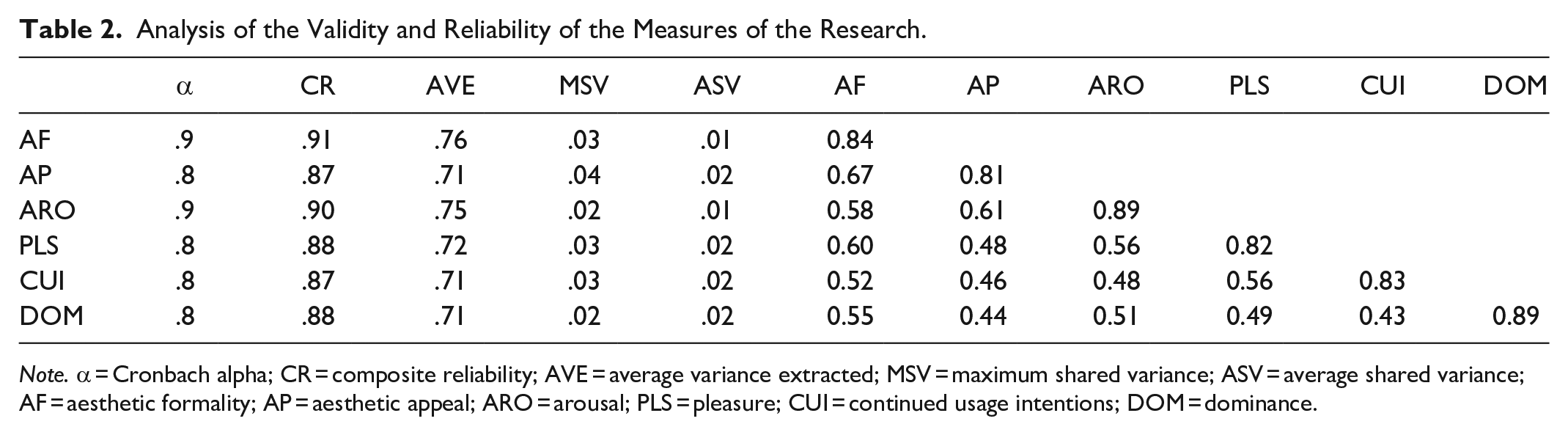
Note. α = Cronbach alpha; CR = composite reliability; AVE = average variance extracted; MSV = maximum shared variance; ASV = average shared variance; AF = aesthetic formality; AP = aesthetic appeal; ARO = arousal; PLS = pleasure; CUI = continued usage intentions; DOM = dominance.
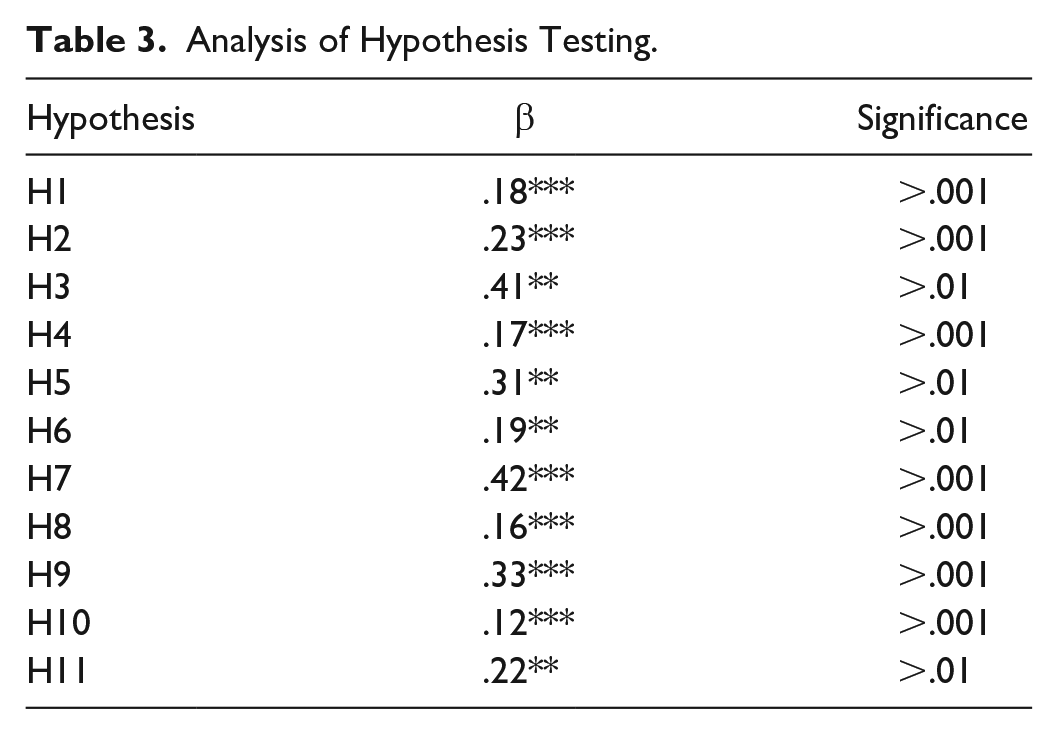
All hypotheses were accepted (Table 3) with H1, H2, H4, H7, H8, H9, and H10 at the significance level of .001 and H3, H5, H6, and H11 at the significance level of .01. The analysis indicates that aesthetics of an OEA like aesthetic appeal and aesthetic formality are positively related to the pleasure, arousal, and dominance the users experiences while using the OEAs. The more work on aesthetics of the OEAs will lead to more positive experience of the OEAs by the users. Further, the emotions of pleasure, arousal, and dominance also lead to users’ intention to use the OEAs in the post-pandemic scenario. The findings of the research like other researchers on the usage and intention to use an app stresses that OEA industry might focus on the aesthetics of the OEAs in order to create positive emotions (pleasure, arousal, and dominance) in the users as these positive emotions leads to more intention to use the OEAs in future. A detailed analysis of the results is presented in the discussion section below.
Analysis of Hypothesis Testing.
Discussion
Companies used emotional branding to influence consumer’s intention to use (Yang et al., 2020). Aesthetic appeal and aesthetic formality are positively associated with all three basic human emotions (PAD; H1–H6). These findings are supported by previous researches (Chang et al., 2014; Huang et al., 2017; Loureiro, 2015; Loureiro et al., 2020; Yang et al., 2020). During the pandemic, the students had only the OEAs to continue their education as the seamless interaction with teachers and peers in a traditional face-to-face learning environment was not available to them. In this context, aesthetical features like the rich graphics, visual appeal, readability of the text, smooth navigation, categorization of the content, etc. evoked PAD emotions. Further, the results show that dominance (H7) and arousal (H9) are significantly associated with pleasure. During the pandemic, when the students got in control of their learning through navigating the learning contents on the OEAs at relatively free will, and when the students got excited by the media-rich learning contents of OEAs, this sense of control and excitement led to a sense of enjoyment and pleasure. In the case of an online interface, previous researches like have found association between arousal and pleasure (Hall et al., 2017; Hsieh et al., 2014; Yang et al., 2020), and dominance and pleasure (Miniero et al., 2014; Yang et al., 2020). Dominance (H8) and arousal (H10) are also related to the intention to use OEAs in the post-pandemic scenario. Several studies support that in the context of online interfaces (apps or websites) dominance and arousal lead to positive consumer behavior like intention to use or purchase (Miniero et al., 2014; Yang et al., 2020). When students are in control of their learning through OEAs, and when they feel excited about the OEAs, they can certainly have intentions to continue to use OEAs in the post-pandemic scenario. Finally, pleasure (H11) has a significant relation with the intention to use OEAs in the post-pandemic scenario. Previous studies like Chang et al. (2014), Hall et al. (2017), and Loureiro (2015) have asserted the role of pleasure positively influencing consumer behavior like intentions to buy or use in the context of online platforms. The present research also adds to the literature by asserting the role of pleasure in consumers’ (students) intention to use an online interface after the special circumstances which forced them to use the online interface have ended. Even when the schools will be open, the students have reported to continue to use OEAs for the sense of enjoyment, control, and excitement they feel when they use OEAs. Previous studies have not researched the role of emotions and aesthetics in student’s intention to use OEAs in non-emergency situation.
Implications
Theoretically, the study adds to the research related to the use of technology in a crisis/emergency, PAD theory, and the intention to use. The present research studies the factors that determine the intention to use OEAs in the post-pandemic scenario by analyzing the intention to use OEAs during the COVID-19 pandemic. The use of online platforms (apps or websites) in crisis situations like a pandemic has become a rich research field (Kumar & Shah, 2021; Pan et al., 2020; Xie et al., 2020). Moreover, India is set to become a very large market of OEAs (Christopher, 2017). There are very few studies focusing on the use of OEAs in developing countries like India during a pandemic. Another theoretical implication of the research is in the field of PAD theory. The present research uses the PAD theory to study the impact of OEA’s aesthetics on the emotions (PAD) generated in the students. The present research asserts the applicability of PAD emotions in the context of OEAs. The results of the analysis show that aesthetical features of the OEAs externally stimulate and evoke PAD emotions. The research work extends the PAD theory by adopting it in OEAs’ context. Finally, the research studies consumer behavior, the intention to use, in the context of OEAs which has been not much explored before. By studying the intention to use the OEAs in the post-pandemic scenario, the study adds to the present body of consumer behavior research in the context of OEAs. The study visualizes the use of OEAs not only as an option during an emergency like the COVID-19 pandemic. The intentions of the consumers (students) to use OEAs in the post-pandemic scenario put validates the literature related to OEA usage in the new normal.
The COVID-19 pandemic has quickened the speed of digital adoption in all walks of life. Even the traditional school system and education industry have to shift to online platforms as the measures to curb the spread of the pandemic like lockdowns and curfews disrupted the traditional face-to-face schooling system. As schools and the education industry start to use OEAs to continue students’ education in the face of the pandemic, this research presents practical solutions to OEA industry to engage and retain their customers. Most importantly, the findings suggest that the aesthetics (formality as well as appeal) have an important role to play in generating PAD emotions in the students. The design, navigational features, text size, color scheme, graphics, the structure of the app and the contents, and the smooth interface lead to students getting pleasure, arousal, and dominance from the usage of the OEA. The lack of focus on aesthetics can make the use of the OEAs frustrating and can lead to the generation of negative emotions. The aesthetics lead to the generation of positive emotions and together the aesthetics and the emotional response of the students toward OEAs lead to students’ intention to use OEAs in the post-pandemic scenario. In this sense, OEA developers, designers, and managers must concentrate on the aesthetical appeal and aesthetical formality of the OEA so that students get a sense of control and get excited and enjoy while using the OEA and continue to use OEAs in the post-pandemic scenario.
Limitations and Future Research Scope
The research work is limited by the context of the pandemic. The perception of the students was captured at a time when they did not have any alternative but to use OEAs. In the future, the role of aesthetics and emotions in the intentions to use OEAs can be studied when the students are not forced to use OEAs due to an emergency like the pandemic. Further, since the data was collected through a self-reporting mechanism from a particular location (India), generalizing the finding can be a limiting factor. Researchers can take up the study at multiple locations.
Conclusion
The research paper studies the intention of the students to continue to use OEAs in the post-pandemic scenario using the PAD theoretical framework as a base. The intention to used is studied through two aspects of OEAs, first, the influence of the aesthetics and the role of PAD emotions. The results of the analysis show that aesthetics (appeal and formality) of OEAs are related to the PAD emotions generated while students use OEAs. And both aesthetics and the emotions generated are positively related to the students’ intention to use OEAs in the post-pandemic scenario. Hence, the research work offers several original additions to the research corpus of OEAs, aesthetics of online interfaces, PAD theory, and has insightful suggestions for researchers and OEA industry.
Footnotes
Declaration of Conflicting Interests
The author(s) declared no potential conflicts of interest with respect to the research, authorship, and/or publication of this article.
Funding
The author(s) received no financial support for the research, authorship, and/or publication of this article.
