



Abstract
This study conducts a bibliometric analysis to address the limitations of systematic literature reviews in handling large datasets, and provides a comprehensive knowledge map and future avenues of cognitive literary studies (CLS) that have yet to be systematically explored. Utilizing VOSviewer as a quantitative tool supplemented by qualitative interpretation, this study analyzes 1,283 journal articles extracted from Web of Science Core Collection database, aiming to offer a longitudinal view of CLS’s evolving landscape. This study identifies its inception, journal and national contributions, influential scholars, and articles using citation analysis. It examines dominant research themes and predicts developing trends using co-citation and co-word analysis. This study yields the following findings: (1) CLS research began in 1975, with a notable surge from 2000 onward; (2) Poetics Today is the most influential journal, with the United States leading in academic contributions. Scholars such as Zunshine, Palmer, Fauconnier & Turner and their works are most frequently co-cited; (3) The four dominant research topics are cognitive/theoretical/ontological foundations of narrative, intersection between cognitive poetics and cognitive linguistics, affective cognition in literary studies, and extended cognition and the environment; (4) The five developing trends are the neurocognitive poetics model of literary reading, expansion of scope in CLS, second-generation approaches to CLS, neuroesthetics and literary perception, and cognitive function of imagination. This study offers a foundational profile that contributes to the consolidation of CLS as a multidisciplinary and evolving field, facilitating a more systematic understanding of the theoretical engagement and methodological innovation within the field.
Plain Language Summary
Cognitive literary studies (CLS) is a field that examines how our minds and cognition interact with literature. Because CLS’s active intersection with various theories and methods in other disciplines, there are large amounts of literature included in this field. As a result, it’s hard to get a holistic view of this field. Therefore, this study uses data and statistics analysis to study the large body of published journals in CLS from 1975 to 2024. By analyzing 1,283 journal articles from the Web of Science database, the study traces the origin and development of CLS over time. It identifies key scholars, influential articles, and important journals. The study finds that CLS research began in 1975 but started to grow after 2000, with Poetics Today being the most important journal in the field. It also identifies key research topics in CLS, such as how cognition shapes narrative, the connection between cognitive poetics and linguistics, the role of emotions in reading, and how the environment influences our cognitive processes while reading. The study also points to several emerging trends in the contents, theories, and methods CLS. Overall, the study helps to clarify the current state of CLS and suggests directions for future research.
Introduction
Over the past four decades, one of the latest developments in literary studies is the “empirical-cognitive turn,” which integrates literary studies with insights from neurosciences, including the neurological study of cognitive processes, experimental psychology, and cognitive anthropology (Joseph & Das, 2023; Michelle, 2010). This cognitive approach has given rise to various subsets in literary studies including evolutionary literary criticism, cognitive literary history, Neuro Lit Crit, affective literary theory, and cognitively informed preexisting theories such as cognitive poetics, cognitive rhetoric, cognitive narratology, cognitive stylistics, cognitive ecocriticism, cognitive queer studies, and cognitive postcolonial studies, among others (Vernay, 2019). These fields explore how cognitive and neurological foundations influence literary creation and reception, representing a significant shift toward a more scientifically grounded understanding of literature.
This empirical-cognitive turn in literary studies signifies “the return of reading” because it is an “anti-theoretical move within literary theory” (Joseph & Das, 2023, pp. 132–133). While poststructuralist approaches rely too much on theories of philosophers such as Derrida, Foucault, Lacan, and Lyotard, and highlight the fluidity of meaning and the socially constructed nature of subjectivity, they simultaneously challenge the centrality and autonomy of the human subject in meaning-making and literary interpretation (Richardson, 1999). The relativistic and anti-humanist tendencies of poststructuralist approaches, along with its propensity for over-theorization, have rendered reading an intellectually exhausting endeavor (Joseph & Das, 2023). By prioritizing the nuanced, multiple-layered interpretation of texts, poststructuralist criticism has often shifted its focus away from the very act and mental process of reading itself. Stockwell (2019) critiques these tendencies by arguing that “understanding what we do when we engage in reading literature need not be an abstract or highly and purely theoretical exercise” (p. 2). Consequently, there have been increasing calls to move beyond poststructuralist paradigms and toward empirical and cognitive approaches to reading. This shift from discourse to cognition can be viewed as a rectification of “the poststructuralist focus on discourse and the dogged pursuit of ideology critique” (Bladow & Ladino, 2018, p. 4).
Mapping the cognitive approaches to literary studies has been notoriously challenging, largely due to the absence of a clear-cut definition. Given its inherently interdisciplinary nature, encompassing the diverse cognitive paradigms within a unified theoretical and methodological framework remains a complex endeavor. Scholars in this field come from diverse theoretical backgrounds, contributing to a spectrum of perspectives that are hard to reconcile. Zunshine (2015) contends that Richardson’s (2004) definition of CLS is the best one. Richardson defines CLS as “the work of literary critics and theorists vitally interested in cognitive science. . ., and therefore with a good deal to say to one another, whatever their differences” (p. 2). In Zunshine’s view, Richardson’s definition captures the “dynamic, relational nature” of CLS rather than imposing rigid boundaries, goals, or methods (p. 1). The multidisciplinary integration and ever-evolving methodologies further complicate efforts to construct a coherent map for CLS. Richardson’s definition thus aligns well with the dialogic, decentralized perspective that has guided the evolution of cognitive approaches to literature.
Vernay’s (2019) definition provides additional clarification by conceptualizing CLS as “a cluster of various literary criticism-related disciplines forming a broad-based trend which draws on the findings of cognitive science to sharpen their psychological understanding of literature by exploring the mental processes at work in the creative minds of writers and readers” (p. 113). While this definition is insightful, it is limited in scope as it exclusively emphasizes the mental processes of writers and readers, thereby overlooking the cognitive dimensions of literary characters (Feng, 2022). Given the centrality of characters’ cognitive processes in shaping narrative structure and reader engagement, their mental processes are equally critical in literary interpretation, as evidenced by Zunshine’s (2015) application of the theory of mind to analyze nested mental states of characters. Acknowledging these varying perspectives and conceptual limitations, this study seeks to propose a synthesized definition that captures its centrifugal tendencies in both theoretical and methodological approaches based on the reviewed literature.
Cognitive approaches to literature shift traditional focuses on identifying inherent meanings within literary texts from examining the cognitive processes underlying human engagement with literature (Vernay, 2019). By emphasizing the mental states attributed to oneself and others during the act of reading and interpretation, this cognitive turn moves beyond traditional exegesis of philosophical analyses (Joseph & Das, 2023). Caracciolo (2016) offers a comprehensive overview of CLS by delineating two principal approaches: the “processual approach” and “functional approach” (p. 194). The processual approach prioritizes the cognitive mechanisms involved in reading. It often employs empirical research methods to examine reader engagement. In contrast, the functional approach emphasizes the role of literary reading as a form of “cognitive workout” that functions as “scaffolds” for the development and enhancement of readers’ cognitive abilities (Caracciolo, 2016, pp. 194–195). Cognitive approaches contribute to the scientific rigor of literary studies, grounding literary analysis in cognitive science research (Gefen, 2018). More specifically, convergence of these approaches has crystallized into three major trends in CLS that are framed by the theoretical frameworks of cognitive linguistics, cognitive psychology, and cognitive neuroscience (Yu, 2024). Vernay (2019) further highlights the implications of these interdisciplinary approaches, arguing that they not only expand the analytical scope of literary studies but also “[renew] the paraphernalia of critical tools” that would revitalize the field (p. 116).
While cognitive approaches have revolutionized and revitalized various dimensions of literary studies, capturing the panorama of CLS remains challenging due to its interdisciplinary nature, methodological diversity, and rapidly evolving scope. Fludernik (2010) characterizes this complexity as the “centrifugal tendencies” inherent in CLS (p. 927). Traditional systematic literature reviews are typically conducted manually by scholars based on specific parameters such as research field, methodology, and theoretical framework (Donthu et al., 2021). Compared to bibliometric analyses that primarily employ quantitative methods, conventional systematic literature reviews rely more on qualitative techniques and are often limited in scope, as they tend to include a smaller selection of studies (Snyder, 2019). Such reviews may be subject to interpretive biases shaped by scholars’ preconceptions or heterogeneous academic backgrounds (MacCoun, 1998). Given the broad scope and extensive datasets required for the present study, bibliometric analysis emerges as a more suitable methodological approach. By integrating both quantitative and qualitative methods, bibliometric analysis allows for a more comprehensive examination of the field while mitigating potential biases and partiality associated with manual reviews.
Considering the inherent limitations of systematic literature reviews, this study employs bibliometric analysis to investigate how cognitive approaches to literary studies have been explored and evolved. By examining both retrospectively and prospectively through citation analysis, co-citation analysis, and co-word analysis, this study aims to map the intellectual landscape of CLS by identifying its publishing trend, leading journals, national contribution, influential works, key themes, and emerging trends. To be more specific, this study strives to answer the following questions:
(1) What are the research origins and historical trajectory of CLS based on the articles cited in WoS?
(2) What are the most influential articles, authors, journals, and countries that have contributed to CLS?
(3) What are the dominant research themes in CLS, and how have these themes evolved over time?
(4) What emerging research trends of CLS can be identified through bibliometric analysis?
Methodology
The Bibliometric Approach and Software Used
This study employs a bibliometric analysis to provide a more objective study of the intellectual structure of CLS. Bibliometric analysis is a quantitative approach to deciphering and organizing scientific knowledge and the evolution of established fields by analyzing large volumes of unstructured data (Donthu et al., 2021). It visualizes publishing patterns, author collaborations, and keyword relationship, helping to identify various aspects of the scientific landscape, such as influential works/authors, research topics, and future directions in a specific field. The bibliometric approach enhances qualitative structured literature reviews and quantitative meta-analyses by using network mapping to visualize scientific knowledge (Zakaria et al., 2023 ).
The software used for this bibliometric analysis is VOSviewer (version 1.6.20), the latest version released on October 31, 2023. Developed by Nees Jan van Eck and Ludo Waltman from Leiden University and launched in 2010, VOSviewer is a widely acknowledged professional scientometric software designed for literature management and scientific mapping analysis. It is particularly noted for its ability to display large bibliometric maps in a visually accessible manner (N. J. van Eck & Waltman, 2010). Additionally, VOSviewer is also frequently praised as a more user-friendly tool known for its simplicity, flexibility, and high graphic quality, making it a preferred choice for many scholars (Arruda et al., 2022).
In bibliometric research, citation analysis, co-citation analysis, and co-word analysis are commonly used to chart the past, present, and future trajectories of a research domain (N. Van Eck & Waltman, 2014). Citation analysis assesses the impact of documents based on citation counts, assuming that a higher citation frequency signifies greater academic influence. This method is particularly useful for identifying foundational works and understanding the initial stages of a field’s evolution. Co-citation analysis examines the frequency with which two documents are cited together in subsequent publications. It serves as a key tool for mapping the cumulative tradition and intellectual structure of a research (Bronk et al., 2023). Additionally, with its classified science base clusters, it enables a systematic exploration of the thematic development of a field (Dionisio, 2019). Co-word analysis, on the other hand, examines the co-occurrence of keywords in the same documents, assuming that these co-occurrence patterns indicate concept networks and predict research trends (Ding et al., 2001).
Considering the respective strengths of these three bibliometric analysis methods, a combination of these analyses offers complementary approaches that provide more comprehensive results while minimizing redundancy (Chang et al., 2015). By offering a science mapping tool to explore past and present studies as well as future trends, bibliometric methods can construct a comprehensive intellectual map that provides valuable insights into the interdisciplinary foundations and ongoing theoretical advancements in CLS.
Research Design and Data Collection
The bibliometric data were collected from Web of Science (WoS) core collection database on June 25, 2024. WoS was selected due to its reputation as one of the most authoritative bibliographic databases with strong coverage (Chadegani et al., 2013; Gaviria-Marin et al., 2019), which minimizes the risk of duplication of data retrieval. The search string used to retrieve and screen parameters is Topic = “cogniti*” OR “cognitive turn” OR “cognitive approach*” OR “cognitive paradigm*” OR “cognitive perspective*” OR “cognitive stud*” OR “cognitive criticism” AND Web of Science Categories = Literature OR Literary Theory Criticism OR Literary Reviews OR Literature Romance OR Literature German Dutch Scandinavian OR Literature British Isles OR Literature Slavic OR Literature African Australian Canadian OR Literature American. The asterisk was used to capture all variations and terms relevant to cognitive approaches. The Boolean Operators “AND” and “OR” were used to ensure the retrieved documents were inclusive enough, yet confined to the scope of literature or literary studies. The document type was limited to articles, as they are typically subject to rigorous peer-review to ensure originality, high quality and knowledge diversity (Kumar et al., 2021). Book reviews and other literature reviews were excluded as they do not necessarily constitute original researches (Savage & Olejniczak, 2022). Only English-language articles were included as English is the dominant language in academic publishing. No time limit is imposed on the research. The data was then exported as plain text file with “full record and cited references” as the record content. Following these criteria, the final dataset consisted of 1,283 articles.
This study is designed to offer both retrospective and prospective insights into the intellectual evolution of CLS. The retrospective approach examines the historical development of CLS through citation and co-citation analysis. Citation analysis identifies highly cited works to highlight foundational documents that shape the field. Co-citation analysis reveals relationships between frequently co-cited articles, which helps uncover how distinct research traditions and theoretical paradigms have developed over time. These two approaches facilitate the systematic reconstruction of a diachronic evolution of CLS. In contrast, co-word analysis offers prospective insights by predicting emerging trends. By tracking the evolution of keywords with high co-occurrence frequency, co-word analysis can identify dominant themes and suggest future research directions within CLS. In each category of analyses, the analysis unit such as sources, documents, cited references, and keywords is selected and screened based on appropriate thresholds to form clusters. The criteria of thresholds are chosen to ensure that they are neither too high to filter out pertinent clusters, nor too low to retain duplicated or insignificant themes.
While quantitative metrics provide objective data, this study also integrates qualitative analysis to ensure a more balanced interpretation. First, content analysis of highly cited works allows for a more nuanced interpretation of CLS’s foundational frameworks to counteract the limitations of pure bibliometric analysis. Second, co-citation and co-word clusters are categorized and summarized using thematic interpretation to enable a deeper understanding of divergent intellectual perspectives and provide insights into the evolving conceptual and methodological landscape of CLS. By reviewing both retrospectively and prospectively and integrating quantitative metrics with qualitative interpretation, this study aims to construct a rigorous and holistic mapping of CLS.
Results and Discussion
Origins and Historical Trajectory of CLS
Annual publications from WoS citation report (Figure 1) show that the earliest relevant papers date back to 1975. This can be attributed to the emergence of brain science and artificial intelligence in the 1960s, which contributed to the official establishment of cognitive science in the mid-1970s in America (Feng, 2022). By the late 1970s, cognitive science had become an interdisciplinary field, integrating insights from philosophy, psychology, computer science, linguistics and anthropology, among others (Miller, 2003). In the 1980s, Tsur (1983) first formulated the term “cognitive poetics,” together with other critics who proposed to incorporate paradigms of cognition and neuroscience into literary analysis. Robert de Beaugrande’s Text, Discourse, and Process: Toward a Multidisciplinary Science of Texts (1980), Norman Holland’s “The I” (1985), and Mark Turner’s “Death is the Mother of Beauty: Mind, Metaphor, Criticism (1987)” marked early intellectual efforts in this direction. However, these works “failed to provoke much of a response from the literary academy” (Richardson, 2004, p. 1). Richardson’s claim was substantiated by the citation chart, which reflects a low citation trend throughout the first two decades of the development of this interdisciplinary approach.

Number of annual publications and citations from WoS citation report.
There is a notable upward growth of publications from 1999 due to the establishment of “Cognitive Approaches to Literature” Discussion Group by the Modern Language Association in 1998. This institutional recognition promoted the integration of cognitive approaches into broader literary scholarship. The citation chart corroborates this shift, as the growth rate of citations remained modest before 1998 but began to accelerate thereafter. Starting from 2000, there has been a significant increase in both publications and citations. In 2002, Poetics Today published a special issue on cognitive approaches to literature together with Stockwell’s publication of Cognitive Poetics: An Introduction (2002), signifying a milestone in cognitive literary theory and criticism (Feng, 2022; Richardson & Steen, 2002). Correspondingly, Figure 1 visualizes the increasing recognition of the cognitive approaches with a clear upward trend in both publications and citations starting from 2002.
Distribution of Published Journals and Countries
On the VOSviewer interface, the parameters for identifying influential journals are set as “Type of analysis and counting method” = “Citation,” “Unit of analysis” = “Sources.” This process yields 253 sources, with 62 journals meeting the threshold of 5. Journals with the highest total link strength (TLS) are those most frequently cited alongside other journals, indicating that articles published in these journals are key literature widely referenced by other scholars. Of the 1,283 articles, 641 articles were published in the top 30 journals with the highest TLS, comprising nearly 50% of all the articles published globally. The top three journals with the highest TLS are Poetics Today, Style, and Journal of Literary Semantics, accounting for 19.3% of all published articles in this field. This analysis uncovers the influence of these journals and provides scholars with essential guidance in identifying pivotal sources in CLS. The top 10 journals with the highest link strength are listed in Table 1.
Top 10 Journals with the Highest Total Link Strength.

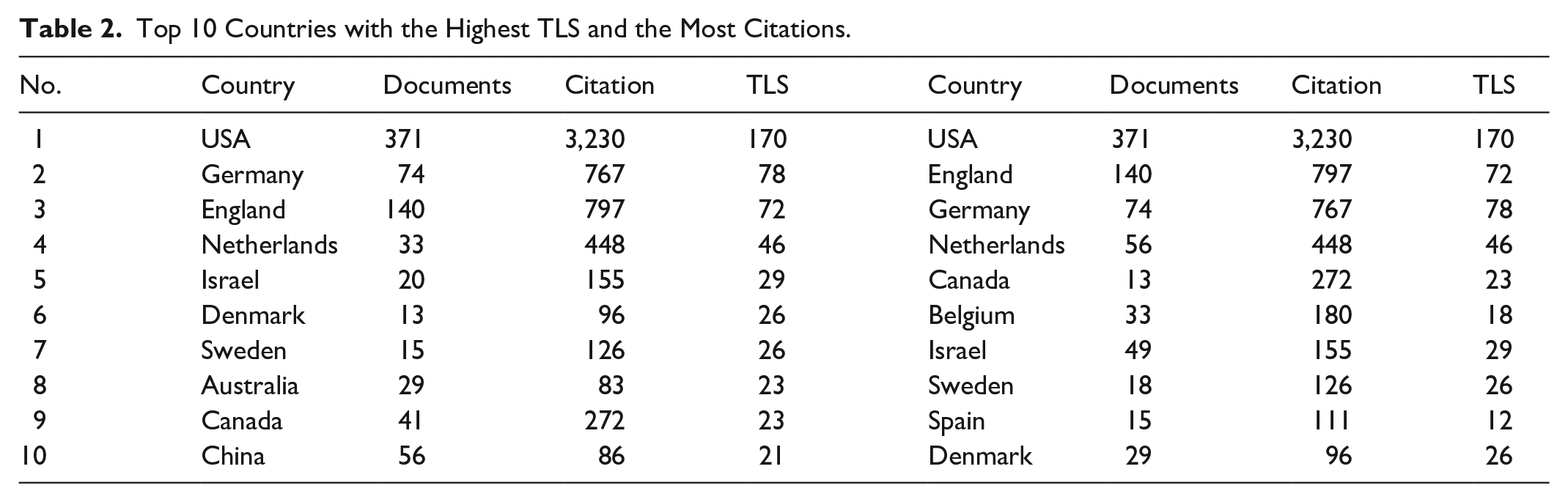
Regarding national contributions, the United States (371), England (140), and Germany (74) emerge as the top three countries, aligning with their position as the most cited and highest TLS nations. These countries take the lead in academic dissemination and intellectual exchange in CLS. Table 2 lists the 10 leading countries by TLS and citations. A combined analysis of TLS and total citation count provides a more comprehensive view of their academic influence and collaborative networks in international academia. The United States, with 3,230 citations, is the most influential country in CLS. The strongest citation link exists between the United States and Germany (38), followed by the United States and Israel (21). The citation link demonstrates a high level of relevance or collaboration in the research contents of these countries. Figure 2 illustrates the country citation network of publications.
Top 10 Countries with the Highest TLS and the Most Citations.

The country citation network of publications in cognitive literary studies.
Both journal and national distribution demonstrate the European-American preponderance in CLS publishing. It highlights the prominence of these journals and countries in academic collaboration and contribution within the field. However, this phenomenon also reflects deeper issues related to Western dominance and coloniality of knowledge in academic publishing. Language preference of English contributions may marginalize non-English scholarship of CLS. Citation bias toward more visible and frequently cited documents further entrenches the dominance of Western perspectives. Additionally, publication bias that favors research from established journals can distort the scientific literature by potentially hindering the development of the highly inclusive perspectives of CLS. Therefore, this analysis also highlights the necessity for a more nuanced approach to evaluating academic citations of CLS.
Highly Cited Articles
Highly cited articles are the foundational documents that have significantly advanced knowledge within a field. These articles are frequently referenced to validate studies, trace intellectual development, and identify active and influential topics in a field (Sahoo et al., 2020). The parameters for identifying highly cited articles are set as “Type of analysis and counting method” = “Citation,” “Unit of analysis” = “Documents,” the 10 most-cited papers are listed in Table 3. Notably, nine of these articles were published after 2000, which echoes the exponential growth in CLS in the 21st century—the era marked by the prominence of brain-centered inquiry (Boos, 2021). These papers offered significant theoretical, methodological, and practical insights into CLS.
Top 10 Documents with the Highest Citations.
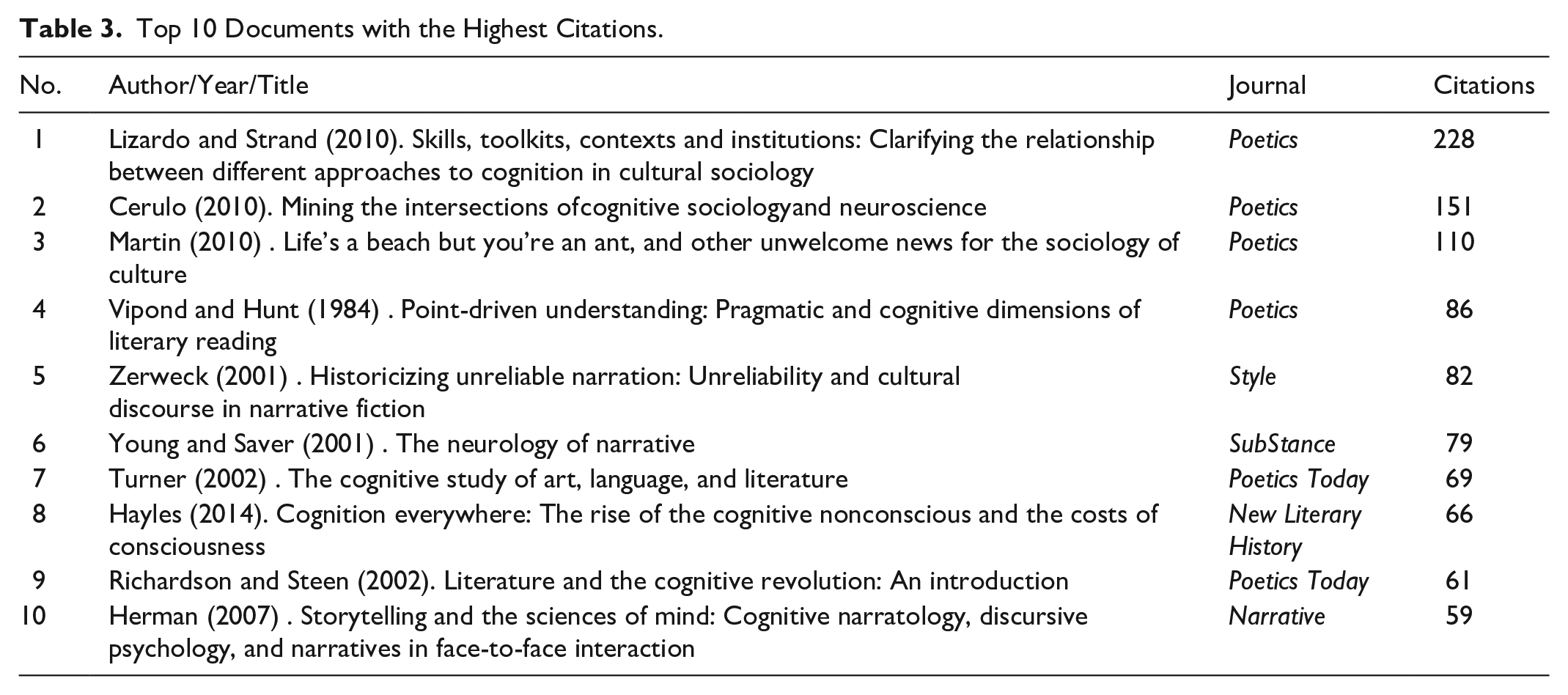
The results show that the article of Lizardo and Strand (2010) is the most cited. Their article delineates and differentiates two cognitive analytical approaches (the toolkit theory and strong practice theory) in the explanatory scope, empirical focus, and theoretical integration in cultural sociology. This study offers a fresh theoretical perspective on the intersection of sociocultural studies and cognition (Cerulo, 2010). By extending cognitive inquiry into cultural sociology, their work expands the boundaries of CLS. It underscores the role of cognitive process in shaping cultural phenomena, which is the core concern of CLS advocated by Zunshine (2010).
Considering the centrality of narrative in literature and cognition, Young and Saver (2001) integrate neuroscientific findings to identify the influence of human central nervous system on narrative comprehension, production, and recall. Their findings affirm narrative’s fundamental role in cognition and self-identity and provide empirical understandings of the neurobiological foundations of narrative. Hayles (2014) advances CLS by emphasizing the increasing role of cognitive nonconscious in shaping intellectual and cultural landscapes. By highlighting its function in problem-solving and interpretation, Hayles challenges traditional notions about meaning-making. This shift in understanding urges a reconsideration of the approaches to humanities, encouraging interdisciplinary insights from cognitive science to understand the interplay between conscious and nonconscious cognition in literature and beyond. These highly cited articles demonstrate the growing integration of cognitive science with cultural studies in current CLS.
Dominant Research Themes Based on Co-citation Analysis
Co-citation analysis of references helps identify research themes that are most frequently discussed and their correlations (Donthu et al., 2021). Documents with shared themes are often co-cited and encapsulated in the same cluster. The parameters are set as “Type of analysis and counting method” = “Co-citation,” “Unit of analysis” = “Cited references,” “Counting method” = “Full counting,” by which 43,366 cited references were obtained. The minimum number of citations of a cited reference was finalized at 16, which met the 55-citation threshold. Co-citation analysis visualizes how influential works are connected and conglomerated into distinct clusters in Figure 3, among which Zunshine (2006), Palmer (2004) and Fauconnier and Turner (2002) were the top three co-cited references. These documents represent the most influential works that provide foundational knowledge in shaping scholarly discourses. Table 4 lists the top 10 co-cited documents with the strongest TLS.

Co-citation analysis.
Top 10 Documents With the Highest Co-Citation and Total Link Strength (TLS).

Co-citation analysis identifies four distinct clusters (see Figure 3). The red cluster consists of 21 items that can be encompassed by the theme “Cognitive/theoretical/ontological foundations of narrative.” This cluster examines the origins and ontology of narrative by integrating philosophical inquiries into the nature of storytelling with cognitive sciences’ insights into mental processes. Cognition science offers an empirical framework to justify the evolutionary and cognitive significance of narrative as a cognitive tool that enhances social interaction and mental simulation (Boyd, 2009; Turner, 1996). Herman (2002) provides a cognitive-linguistic framework for understanding how stories are constructed and processed by human mind with insights from linguistic semantics and cognitive science. Readers predict and understand a story based on their prior cognitive schema to make inferences about characters’ motivations. Ryan (1991) and Doležel (1998) intersect narrative theory and possible worlds theory to explore how fiction creates alternative realities that enable readers to construct alternative realities through mental faculties such as cognitive simulation.
By grounding literary interpretation in cognitive mechanisms, this approach transforms the reading process from subjective speculation to an empirically supported understanding of how narratives engage the mind. This cluster provides foundational knowledge by providing essential contexts, and informing theoretical and empirical approaches to the interdisciplinary integration between narrative and cognition. It highlights the crucial prerequisite for studying cognitive approaches to literature by justifying the very origins and functions of narrative.
The second green cluster consists of 18 items. This cluster centers on the theme of “Intersection between cognitive poetics and cognitive linguistics.” This cluster highlights the theoretical and methodological implications of cognitive linguistics in understanding the language structure of literary texts. As the primary task of poetics is to “[deal] with problems of verbal structure,” poetics “is entitled to the leading place in literary studies” (Jakobson, 1960, p. 1). The study of literary poetics is inevitably intertwined with cognitive linguistics due to their shared focus on the underlying cognitive mechanisms involved in language processing and comprehension. Key frameworks from cognitive linguistics, including cognitive rhetoric and cognitive stylistics have been applied to explore the mental processes, emotional engagement, and role of readers in literary interpretation (Stockwell, 2002). Concepts such as conceptual metaphor (Lakoff & Johnson, 1980), conceptual blending (Fauconnier & Turner, 2002), and cognitive grammar (Langacker, 2008) are drawn to explore how literary texts are mentally processed and understood. While cognitive linguistics provides the theoretical foundation for understanding how languages engage the mind, cognitive poetics extends these principles by applying its theories of meaning construction and language processing to literature.
The blue cluster comprises 13 items centered on “Affective cognition in literary studies.” Over the past three decades, while CLS primarily draws on linguistic models to analyze language structure and semantics, it is also indebted to developments in affective science. The “affective turn” in literary studies highlights the significance of emotion systems in shaping—or even governing—narrative structures and interpretation. Gerrig (1993) emphasizes the importance of readers’ personal experiences, prior knowledge, and emotions in meaning construction. Readers’ cognitive abilities such as mental simulations enable their visualization and emotional engagement with narratives. Keen (2007) explores the psychological mechanisms behind empathy, maintaining that narrative techniques like focalization and characterization are designed to elicit empathetic responses and foster emotional identification with characters and situations. Hogan (2011) further examines the interrelation between emotion and narrative structures, arguing that stories are systematically shaped to evoke specific emotional responses that are crucial for readers’ interpretive process. This affective turn has significantly expanded CLS by integrating perspectives on affect, emotion, and reader response.
The yellow cluster consists of three items with its focus on “Extended cognition and the environment.” Traditional cognitive models often overlook the influence of sociocultural processes and the environment on cognition. The interplay between brain, environment, and cultural factors has important implications for cognitive cultural studies. DiMaggio (1997) explores the dynamic interaction between cultural contexts and cognitive processes. He emphasizes the role of cultural schemas in influencing individuals’ perceptions and cognitive styles. Clark and Chalmers (1998) propose the “extended mind” concept, arguing that cognitive processes are not confined to the brain but extend into body and environment. They underscore the role of objects in environment—such as tools, devices, and external media—as cognitive extensions. This cluster foregrounds the integration of sociocultural environments into cognitive processes, highlighting their critical role in shaping human cognition. Table 5 presents the key findings of the co-citation analysis.
Summary of Co-Citation Analysis.

In summary, co-citation analysis visualizes the thematic evolution of CLS over time. Driven by advancements in cognitive science, early research focused on the influence of narrative structures on cognitive processes and emotional responses. The field underwent a formative period dominated by cognitive poetics in the 1990s, with key contributions from scholars such as Reuven Tsur, Mark Turner, and Stockwell who integrated insights from psychology, linguistics and neuroscience. Since then, CLS has expanded to encompass diverse paradigms such as cognitive narratology, blending theory, embodied cognition, mental simulation, affective literary theory, and cognitive cultural studies. These paradigms provide frameworks for understanding how literature affects and is affected by human mind. This trajectory further reflects the ongoing cognitive turn that continues to evolve by integrating multidisciplinary methods and theories.
Research Trends of CLS Based on Co-Word Analysis
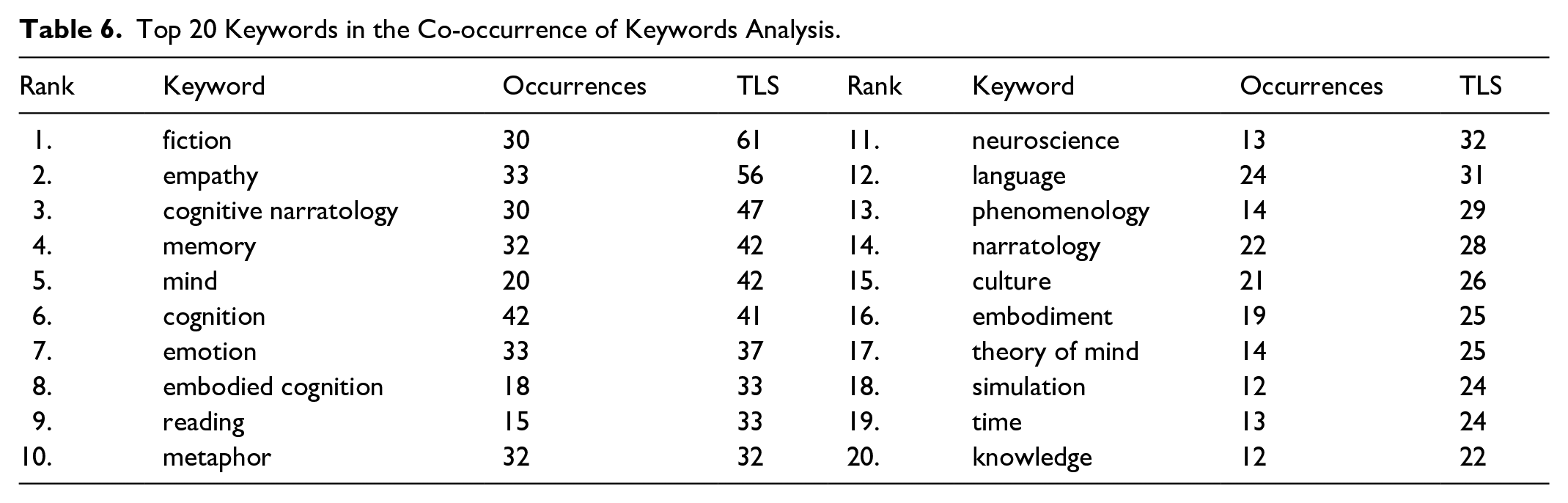
Co-word analysis identifies frequently co-occurring keywords to reveal research hotspots and emerging trends within a field. On VOSviewer interface, the parameters for co-word analysis are set as “Type of analysis” = “Co-occurrence,” “Unit of analysis” = “All keywords,” “Counting method” = “Full counting,” “Minimum number of occurrences of a keyword” = 9. Out of the 3,377 keywords, 50 met this threshold. The top 20 co-occurring keywords are listed in Table 6. These keywords form five distinct clusters (Figure 4), illustrating the interconnected network structure within the field.
Top 20 Keywords in the Co-occurrence of Keywords Analysis.

Co-word analysis of frequently co-occurring keywords.
The first red cluster comprises 14 keywords, indicating the developing trend of the “neurocognitive poetics model of literary reading.” This cluster shows that paradigms of cognitive linguistics and cognitive poetics remain and will continue to be highly relevant in the future. Neurocognitive poetics is such “an emerging highly disciplinary field” that draws concepts from cognitive poetics, computational linguistics, affective and cognitive neuroscience, and natural language processing (Jacobs, 2022, p. 177). It draws empirical and neurological evidence to provide a more realistic and natural approach to the reading of fiction and poetry (Jacobs, 2015b). It delves deeper into how cognitive processes such as emotion, attention, and perception are linked to readers’ reading experience (Brannon, 2022; Harbus, 2016; Stockwell, 2019). It signals that cultural literary studies are moving beyond the “‘cold’ information processing models” and toward “‘hot’ process models” that “integrate concepts from the humanities with current models from cognitive psychology and linguistics, affective neuroscience, and emotion theory” (Jacobs, 2015a, p. 17).
The second green cluster consists of 13 keywords with the focus on the expanded research scope in CLS. While most research in CLS has traditionally centered on adult literature, recent studies have begun to explore the mentality of children and adolescents in children’s literature (e.g., Kümmerling-Meibauer & Meibauer, 2013; Nikolajeva, 2016; Stephens, 2013; Trites, 2014). Given that children’s cognitive development is still in progress, how children’s literature relates to children’s cognitive development remains underexplored (Kümmerling-Meibauer & Meibauer, 2013). A notable contribution in this area is the special issue in International Research in Children’s Literature in 2013 and works of Trites (2014) and Nikolajeva (2014). A key challenge in this area is the “cognitive discrepancy” between the cognitively mature authors of children’s literature and their cognitively immature young readers (Nikolajeva, 2014, p. 13). This highlights the need for further integration of cognitive criticism with the cognitive and emotional development stages of children (Kokkola & Bossche, 2019). Additionally, while cognitive research has primarily focused on the neurotypicals, the cognitive capacities, and theory of mind of those neurodivergent, such as those with autism, dementia, ADHD (attention deficit hyperactivity disorder), and dyslexia, remain underexplored. The rise of cognitive disability studies thus represents another important expansion of the scope of CLS.
The third blue cluster consists of 12 keywords with a focus on “Second-generation approaches to CLS.” First-generation theories in cognitive science conceptualize the mind as abstract and independent from bodies and sensory modalities. In contrast, second-generation approaches emphasize simulation and the embodiment of mental processes that regard mind not merely as an information-processing tool but as “a continuum with bioevolutionary phenomena and cultural practice” (Kukkonen & Caracciolo, 2014, p. 261). This cluster emphasizes the embodied, emotional, experiential, embedded, enactive, and extended aspects of the mind, as reflected in frequently co-occurring keywords such as “embodied cognition,” “simulation,” “empathy,” “ethics,” and “cognitive narratology.”
The widely diverse set of paradigms and the thriving second-generation approaches are also evident in The Oxford Handbook of Cognitive Literary Studies, which lists cognitive narratology, emotion and empathy, moral emotions, cognitive theory, and literary experience as distinct subtopics under CLS. Moreover, latest developments in CLS have moved beyond traditional natural narratology to explore the intersection of cognition with unnatural narratology. Unnatural narratology provides a framework for examining textual phenomena and the interaction between contextual factors and readers’ emotional responses (Kang & Alber, 2023). The most recent issue of Style features an article on defamiliarization as an embodied phenomenon, which further advances the ongoing debates at the intersection of cognitive and unnatural narratology (Stopel, 2024). Despite the diversity in theoretical frameworks and methodologies, as well as the complexity of cognitive phenomena, these approaches share a focus on the emotional and experiential responses involved in the cognitive processing of literary texts.
The fourth yellow cluster consists of eight keywords with a focus on “Neuroesthetics and literary perception.” The emergence and development of neuroesthetics offer new paradigms in exploring esthetic perception in the creation and appreciation of literary works. Neuroesthetics, gaining prominence after 2010 (Skov, 2023), explores how the brain processes artistic and literary stimuli using theory of mind. It facilitates understanding of how narrative elements are encoded, retrieved from memory, and evoke emotional engagement such as pleasure and joy in process of reading. Recent studies emphasize the integration of esthetic experiences with spatial cognition (e.g., Knoop et al., 2016; Trentini, 2015), the neural bases of beauty perception in art (e.g., Derke et al., 2023), the cognitive value of esthetic emotions (e.g., Consoli, 2022), and the interrelationship between esthetic experience and cultural-historical memory (e.g., Jamalpour & Derabi, 2023). In terms of emerging research methods, functional neuroimaging techniques, including electroencephalography (EEG) and functional magnetic resonance imaging (fMRI), are increasingly applied (Derke et al., 2023) to measure esthetic perception in literature, which advances empirically informed literary studies.
The fifth purple cluster consists of three keywords with the theme of “Cognitive function of imagination in literary reading.” Imagination is understood as the mental faculties and neural activities crucial for artistic creativity, understanding, simulation, and hypothetical experience. More recent studies underscore the experiential and embodied aspects of imagination and its epistemological role in stimulating hypothetical emotional experiences (Cocquyt & Palombo, 2023), the significance of experiential imagination as the new foundation for the science of mind (Asma, 2022), evolutionary perspectives of imagination (Van Mulukom, 2020), decision making (Nanay, 2016), and perspective-taking and empathy (Gallagher & Gallagher, 2020). Table 7 summarizes the representative keywords, the number of keywords in each cluster, and the theme of each cluster.
Summary of Co-Word Analysis.

To conclude, based on keywords constituting these clusters, the research trends of CLS are mainly reflected in three aspects. First, CLS is embracing increasingly interdisciplinary and multidisciplinary theoretical frameworks that shift toward second-generation approaches. It moves toward a neurocognitive poetics model that draws from diverse theoretical paradigms such as cognitive linguistics, cognitive poetics, affective neuroscience, neuroesthetics, and natural language processing. Second, the scope of CLS research has extended beyond adult literature to include children’s literature and neurodiverse groups. Additionally, unconventional issues such as unnatural narratology and embodied literary experience have become emerging research focuses. Third, CLS is adopting more interdisciplinary and empirically-based research methodologies. Methods from fields such as computational linguistics and cognitive neuroscience are increasingly integrated, with functional neuroimaging techniques (EEG, fMRI) becoming widely applied to measure esthetic perception and cognitive processes during literary reading.
Limitations of the Study
Despite the merits of this bibliometric study, it acknowledges the following limitations. First, while bibliometrics is valuable instrument in conducting literature reviews, it is inherently constrained by the data sources used. It remains a quantitative approach that could benefit from the inclusion of a qualitative systematic literature review for a more nuanced understanding of CLS. Second, despite bibliometric analysis highlighting the objectivity in literature reviews, it still relies on certain subjective decisions made by researchers, such as the selection of search strings, threshold of the number of clusters, and the boundaries of research domain. Third, this study only draws data from WoS, relevant research published in other databases, non-indexed journals, or non-English publications may not have been captured in this study.
Besides, we acknowledge the existence of publication bias, citation bias, and index bias in bibliometric datasets, this may skew the findings toward overrepresentation of highly visible documents while overlooking less easily quantifiable data. Finally, given the expansive and complex nature of CLS, the broad scope of this study may inadvertently lead to overgeneralization that fails to account for specific subfields or contributions within the field. The diverse theoretical and methodological frameworks in CLS mean that certain nuances may be underrepresented. This points to an inherent challenge when attempting to cover such a multifaceted field within a single study, and further research focusing on a more balanced methodology and targeted areas of CLS is needed to address these gaps.
Conclusion and Implications
Findings of this study highlight the dynamic, diverse, and decentralized nature of CLS’s theoretical, methodological, and analytical approaches since its inception in 1975. Results show that Poetic Today, Style, and Journal of Literary Semantics are the top three journals with the strongest TLS. The United States, England, and Germany remain the leading countries in academic contribution and collaboration. Zunshine, Palmer, Fauconnier, and Turner and their works are most frequently co-cited in this field. Based on these findings, scholars may have an overall vision of the foundational publications that contribute to the field. Additionally, through co-citation of references, this study identifies four dominant research topics: cognitive/theoretical/ontological foundations of narrative, intersection between cognitive poetics and cognitive linguistics, affective cognition in literary studies, and extended cognition and the environment. Co-word analysis reveals three major developing trends in the theory, content, and methodology of CLS: the neurocognitive poetics model of literary reading, the expanded research scope to include narrative deviation and cognitively atypical groups, and the increasingly empirically and scientifically-based research methods.
These findings substantiate existing literature about CLS as a field characterized by theoretical pluralism and methodological diversity. This very dispersion confirms the centrifugal and interdisciplinary paradigm of CLS that denies rigid definition. Yet this absence of centrality is not a weakness but represents an unprecedented knowledge paradigm that is best understood as “an interdisciplinary field that explores how cognitive processes that are instantiated in minds, brains, bodies, and sociophysical environments matters shape and are shaped by literary writing, reading, experiencing, interpretation and literariness itself” (Richardson, 2018, p. 207). This definition situates CLS as both “an eye-opener” that bridges disciplines and “a boundary bender” that blurs the borderline between different research paradigms (Vernay, 2019, p. 121).
Rather than seeing the theoretical and methodological dispersion as limitations, CLS might reframe them as sites of generative tension and rigorous reflexivity. This very vitality suggests that the future lies not in consolidation, but in embracing productive fragmentation where the diversity remains a scaffold for innovation, not an obstacle to coherence. This bibliometric analysis, while representative rather than exhaustive, provides a more objective data-driven perspective that complements existing discursive discussions on CLS. By mapping the field’s intellectual landscape, it offers scholars both a diagnostic tool for assessing CLS’s development and a strategic compass for navigating its future, thereby advancing efforts to move CLS beyond its current research status “at the margin of literary scholarship” (Müller-Wood, 2017, p. 223). However, given the limitations inherent in the primarily quantitative bibliometric study and the vast, multifarious research body of CLS itself, future research may benefit from a more comprehensive methodology that incorporates both a qualitative systematic literature review and a more inclusive dataset to provide a more holistic picture of the field.
Footnotes

Ethical Considerations
This article does not contain any studies with human or animal participants.
Author Contributions
Zhou Qiaoqiao conducted the bibliometric analysis and wrote the initial draft. Noritah Omar contributed to the conceptualization and design of the study. Zainor Izat Zainal and Ida Baizura Bahar provided feedback while I was writing and revising the manuscript.
Funding
The author(s) disclosed receipt of the following financial support for the research, authorship, and/or publication of this article: This research was supported by Teaching Reform Research Project of Higher Education Institutions in Hunan Province (202502001601), Scientific Research Fund of Hunan Provincial Education Department (24C0549), and Hunan Provincial Social Science Fund (19WLH13).
Declaration of Conflicting Interests
The author(s) declared no potential conflicts of interest with respect to the research, authorship, and/or publication of this article.
Data Availability Statement
The dataset for VOSviewer analysis can be requested and forwarded as supplementary material upon request.