



Abstract
This study investigated the critical part that teachers’ strategies have in ensuring student safety during emergencies in public secondary schools. Understanding how teacher practices contribute to efficient emergency response and student safety is important. This is because educational institutions encounter a variety of possible hazards that include natural catastrophes and other emergencies caused by people or mere accidents. Through a combination of qualitative and quantitative research methods, it was determined that teacher practices, namely emergency planning, training and drills, resource allocation, and evaluation, have a moderate impact on student safety. The findings bear great significance in understanding the degree to which distinct facets of teacher practices contribute to their readiness in ensuring student safety during crisis situations in academic institutions. The findings provide valuable perspectives for policymakers in the field of education, as well as administrators and instructors, to refine current safety protocols, and enhance teachers’ capacity to protect students during emergency occurrences.
Introduction
Emergency readiness refers to the ability of individuals and organizations to respond effectively to unexpected events (National Center for Education Statistics, 2009). It is crucial to empower individuals through proper planning and by providing targeted support for vulnerable populations (Nova Scotia Education Department, 2008). Preparation and planning are the key components of dealing with unanticipated events (Najafi et al., 2015; Wheeler et al., 2013). There is a growing global concern about school emergency preparation, with recent events worldwide demonstrating that schools are not always secure places (National Center for Disaster Preparedness Columbia University, 2018). Increased natural disasters, school violence, terrorism, and pandemic flu make it necessary to prepare for all-hazard crises (Lenhardt et al., 2018). While crises and disasters are unavoidable, their effects can be mitigated by strategic planning, performing drills, and fostering a state of preparedness (Khorram-Manesh et al., 2017).
Emergencies are manifested in different ways globally. Educational institutions in Asia for instance, often face unforeseen circumstances due to natural disasters such as tsunamis, earthquakes, hurricanes, cyclones, heavy rains, floods, and disease outbreaks. These disasters have been reported in countries such as Myanmar, Pakistan, Haiti, Nepal, Japan, and China (Zhang et al., 2022). In sub-Saharan Africa, floods cause loss of life, property damage, and disruptions to teaching and learning programs. Kenya faces a 6.2% flood hazard risk, highlighting the importance of being well-prepared for emergencies (Ngoran et al., 2015). Disasters result in deaths, displacement, and property destruction, making emergency intervention necessary to minimize their impact on local communities and education (America Red cross, 2012). Schools that have a significant capacity to handle catastrophic situations can recover more quickly than those that lack readiness. Poor capacity to react leads to severe situations and damage, as evidenced by studies conducted by Kamunde (2010) and Okuom et al. (2012). Therefore, it is critical for instructors to be ready for quick and effective emergency response to save learners’ lives. Teachers who have the necessary competency and a positive mindset excel in emergency situations (Mubita, 2018). It is important to prioritize knowledge generation, mindset change, and safety protocols when dealing with emergencies. Countries should focus on training teachers and creating a curriculum that facilitates widespread risk mitigation measures (Gossip, 2017).
Emergency response preparedness requires the effective use and deployment of facilities and equipment (Morris et al., 2016). However, frontline responders face execution challenges, and resource and finance allocation barriers hinder the implementation of school safety programs, as evidenced by Mabasa (2014) and Maritim et al. (2015). While E. F. Brown (2020) provides insights into emergency procedures, and A. B. Smith and Johnson’s (2018) assessment of school safety measures offers valuable findings to administrators, these studies primarily address administrative issues, rather than the role of teachers as crisis leaders in emergency situations. The safety of students should be the primary concern for crisis leadership to protect them from potential harm and enable the effective handling of crisis situations, as highlighted by B. Brown et al. (2023). To accomplish this, measures such as evacuation, relocation, isolation, and expansion should be implemented, as suggested by Bilgin and Öznacar (2017). These measures aim to protect students and ensure their response during crises, such as evacuation, relocation, and isolation of affected areas to minimize the spread of the crisis. In this respect, leaders need to expand emergency response resources to manage crises effectively and prioritize student safety to build trust and reassure the school community. Teachers should also be prepared to respond to emergencies.
Fire disasters are the most common emergency situations in learning institutions in Kenya, particularly in highly disaster-prone counties like Kisumu. When students go on strike, they often set fire to their schools causing severe damage and loss of life. Therefore, it’s critical to have an emergency reaction plan in place. Kisumu schools also experience frequent flooding, which poses a significant risk to students and instructors. The Kenyan government established the School Safety and Standards Manual in 2008 to provide guidelines for ensuring student safety while in school. However, despite this initiative, there have been unfortunate incidents in Kenyan schools that have resulted in fatalities and property damage. Kisumu County is no exception to this, with several incidents of student endangerment taking place between 2013 and 2021. Flooding affected 34 schools in the county, leading to the closure of 38% of schools in the worst-affected sub-county, Nyando. Kisumu East sub-county had the most criminal activity cases, accounting for 20% of all the cases documented in the county. Nine incidents of student unrest were also reported during this period, leading to property damage, including burning of dorms, classrooms, and administrative structures. Research on school safety has primarily focused on the physical infrastructure, environment, and facilities rather than student safety and teacher readiness. This study seeks to address this gap by examining the unique attitudes and practices of teachers during emergency situations that affect student safety. Specifically, the study hypothesizes that there is no significant difference between the mean ratings of teachers and principals regarding emergency planning for student safety, teacher drills and training, resource allocation for emergencies, and evaluation of emergency practices.
Significance of Study
This study strives to focus and develop an understanding of day-to-day emergency response strategies employed by teachers in public secondary schools. While much of the available literature duels more on examination of policies, infrastructural standards, and administrative responsibilities, this investigation redirects attention toward the role of teachers who are the primary responders. It provides empirical evidence and analysis on the practices of teachers in handling emergency situations within the school environment. This therefore serves to bridge theoretical and empirical gaps in scholarly discourse on school safety.
The findings emanating from this study can be used to develop targeted scenario-based teacher training programs to improve their preparedness. They will also enhance safety policies and protocol by making them more practical oriented and teacher cantered. Findings also advocate for a better understanding of teachers’ needs and challenges in respect to efficient resource allocation and establishing a collaborative approach to safety. By recognizing the teachers’ role, the study can enhance collaborative overall school resilience and improve student safety outcomes.
Literature
Educational institutions just like any other organization are prone to risks. In the event of a dreadful and urgent situation, there are fundamental practices that demand comprehension and implementation. These practices encompass planning, training and drills, resource allocation, and evaluation (Li et al., 2013).
Emergency Safety Planning and Implementation
Planning for safety preparedness involves a number of facets, including the development of an evacuation strategy. This strategy involves an assessment of critical factors such as the time required for evacuation, the potential level of risk, and identification of safe locations within a premise (J. Smith, 2019). It also involves the identification of escape routes from the risk zone to the safe ones (Roud, 2021). To ensure adequate preparedness for emergencies, it is imperative that educational institutions develop emergency operations plans. They should also actively engage in the implementation of plans through regular exercises (Keyes, 2020). The procedures outlined in the plans should be subjected to periodic review and updates. This will effectively enable teachers to enhance their skills and confidence in responding to emergency situations (Kinsman, 2018). In addition, capacity building within the school community is very significant as it equips all stakeholders to tackle emergencies effectively (Poland, 2021). Therefore, implementing a comprehensive institution-wide emergency training program that involves all members of the school community becomes essential in ensuring preparation for emergency situations (McComb & Eather, 2017).
Training in emergency preparedness, response, and recovery has a positive impact on individuals’ knowledge, preparedness and ability to manage various situations (Kalanlar, 2017). The significance of drill programs, which incorporate evacuation routes, reporting, and training for school managers has been emphasized by Nthenya (2011). Training and drills are instrumental in improving disaster safety and effectiveness (Devnani, 2012). This can be accomplished by sharing information, increasing awareness, and cultivating a willingness to volunteer (Alim et al., 2015). Whereas this may be the case, impediments to response are predominant in education, training, and supervision of staff, thus hindering their preparedness for emergency situations (Bin Shalhoub et al., 2017). The inadequacy of information and skills pertaining to emergency preparedness, coupled with infrequent drills poses a threat to safety in educational institutions (Adenekan et al., 2016). This therefore means that teacher’s individual readiness is an indispensable component of planning in enhancing emergency preparedness (Sharifian et al., 2017).
Emergency Incident Safety Training and Drills
Emergency responses are characterized as critical actions that often require context-specific conduct. These actions are linked to training, knowledge, and risk perception (Ning et al., 2021). This in essence means that prioritization of the well-being of both students and staff during emergency situations is of utmost importance. Equally, the implementation of comprehensive training programs is imperative to ensure preparedness and effective response (Hošková-Mayerová et al., 2021). In most cases, the occurrence of emergencies often leads to disruption of regular academic schedule, resulting in a significant decrease in attendance and coverage of the curriculum. Consequently, this leads to a negative impact on academic achievement (Mudavanhu, 2014). To overcome these anomalies, regular training and drills to enhance the skills of both staff and students are fundamental in the promotion of safety and in the reduction of response time during emergencies (Cowan et al., 2013). In addition, the best enduring approach is to prepare the school personnel and students for a wide range of potential threats such as fires and extreme weather effects (Schildkraut & Nickerson, 2020).
During emergency incidents that occur in educational institutions, the implementation of a well-defined safety procedure is of great importance. This procedure ought to involve earmarked and designated first responders, communication protocol, and evacuation mechanisms (Y. Chen et al., 2022). Unfortunately, a considerable number of educational institutions lack an emergency management office (Izumi et al., 2020). This is coupled with a deficiency in knowledge and skills necessary for handling emergencies and rescue (Li et al., 2013). These inadequacies extend to teachers and other support staff who are often ill-equipped to handle emergencies that may affect students in school (Rao & Shenoy, 2014). The lack of crisis management skills among teachers further impedes their ability to provide adequate safety (L. L. Brown, 2008). Although simulation drills are a vital component of emergency preparedness, their effect on actual incidents remains unclear because of limited evidence (E. A. Skryabina et al., 2020). Nevertheless, these drills help to facilitate the identification of gaps in the plans and procedures (E. Skryabina et al., 2017). This in turn helps school management in taking appropriate actions and in sharing of lessons learned.
Allocating Resources for Student Safety
The occurrence of uncertainties intrinsic to emergencies poses challenges to many schools. In this respect, resource allocation assumes an important role in guaranteeing safety in emergency situations. The prompt and precise distribution of resources, consisting of workforce and equipments is fundamental in reducing the consequences of such an emergency. In essence, preparedness of an organization’s emergency response is heavily dependent on accessibility and efficacy of its facilities (Morris et al., 2016). Furthermore, provision of situational awareness to frontline responders is critical although often a challenging task (Xuan, 2019). In their scholarly investigation, J. Smith et al. (2018) place great emphasis on the critical role of a meticulously constructed resource allocation strategy. This strategy should effectively balance the allocation of resources while considering the dynamic nature of emergencies. In addition, collaborative decision-making amongst multiple response agencies in optimizing resource allocation and the overall management of emergency incidents is important (R. W. Johnson & Brown, 2020). Also, effective resource allocation, training, and drills can significantly enhance the level of preparedness (Sakurai et al., 2017). In such circumstances, efficient responses are dependent on the ability to detect potential threats and dispatch requisite actions (Xuan, 2019).
Otieno and Ofulla (2009) demonstrated that the insufficiency of resource allocation and under-financing are major challenges that most schools in Kenya face. These situations consequently limit their capacity to effectively manage emergencies such as fire incidents. Similarly, Maritim et al. (2015) concur by revealing that budgetary constraints have severe implications for safety preparedness. They observed in their study that none of the schools surveyed were able to afford fire extinguishers for all the necessary locations. In accordance with the National Research Council's report (2012), uncertainty calls for adaptive resource allocation models to adapt to real-time evolving incident conditions and ensuring safety response capabilities in emergency situations.
Despite the significance of emergency safety preparedness, the provision of financial support poses a notable challenge to educational institutions. Provision of such resources is crucial, particularly in cases of medical and fire emergencies that are common in boarding schools. If this is addressed, the effectiveness of emergency response will greatly improve. Whereas this may be true in ideal situations, the Ministry of Education’s safety guidelines in Kenya have yet to be fully implemented, largely due to insufficient funding and inadequate supervision (Nyakundi et al., 2014). To address this, establishing tailored organizational training programs for emergency responders is crucial for enhancing resource deployment, and overall response effort (Merchant et al., 2010).
Evaluation of Safety in Emergency Situations
There is no single country that is fully prepared for unforeseen emergencies. In such situations, evaluation is critical in improving safety measures. This includes enhancing response tactics and collaboration efforts (L. F. Smith et al., 2017). The evaluation could include safety protocols’ robustness, and fallibility that will enable enhancement and evidence-based modifications (Harper, 2020). Although teachers have been assigned the additional roles of safety/security officers, they still lack basic training, that sometimes they are deployed to handle emergency situations (Mersal & Aly, 2016). Evaluation during emergency incidents helps identify areas of improvement, assess safety guidelines and assist in decision-making (Helsloot & Ruitenberg, 2018). In turn transparency and accountability will be ensured (Bennett & Rajagopal, 2018). Accordingly, a comprehensive evaluation framework facilitates the evaluation of readiness of response teams, assessment of communication systems, and resource allocation (D. Johnson & Avery, 2019).
Moreover, the process of evaluation plays a crucial role in identification of gaps from previous incidents. The evaluation can be used by institutions to reflect on what worked and to identify ways to improve their response (Schildkraut & Nickerson, 2020). Knowledge acquired can substantially improve future response strategies and safety outcomes (Alexander, 2017). Therefore, a systematic analysis of emergency occurrences and reactions ensures continuous improvement of safety measures (Comfort et al., 2020). An examination of the sequence of steps executed during crises ultimately helps to improve educational organizations. By so doing prospective obstacles and communication failures that could have impeded the execution of precautionary measures are removed (Cimellaro et al., 2010). Dissemination of such experiences enriches the knowledge of a broad range of stakeholders (Boin et al., 2017). This approach guides procedures and promotes continuous improvement and adaptation of evidence-based safety provision (Young, 2020). These reports allow authorities to make necessary improvements thus enhancing public trust in emergency preparedness. Ultimately, evaluating safety provisions ensures that future emergency responses are better informed, better coordinated and capable of minimizing the safety of all involved (Harper, 2020).
Methodology
The purpose of the study was to understand the unique practices and attitudes of teachers regarding student safety during emergency occurrences. To achieve this, the researchers used a sequential explanatory framework, which involved collecting and analyzing both quantitative and qualitative data. The quantitative data was collected through questionnaires, while the qualitative data was collected through interviews. At the discussion stage, the researchers integrated the two sets of data to interpret the research findings and draw valid conclusions and recommendations. This approach was used to gain a more comprehensive understanding of the research issue. The study’s population included 42 principals, 324 teachers from schools that had experienced emergency incidents, and 5 quality management officers. The researchers used purposive sampling to select 37 principals out of the 42 because of their experience regarding the relevant information. The principals were crucial respondents in this study because they supervise teachers and provide final reports on incidents, thus allowing them to understand safety initiatives during emergencies. The researchers used saturated sampling to select 324 teachers, of which 299 participated in the study, with the remaining teachers being utilized in the piloting. Similarly, the researchers used the same sampling procedure to choose four quality management officers, with one having participated in the pilot.
Instruments
A five-point rating system questionnaire was administered to teachers and principals as a primary means of data collection. Five classifications were used to represent the data: very low, low, moderate, high, and very high. Data obtained from the questionnaires were interpreted in accordance with the Cheruiyot and Simatwa (2016) classification in which 1.00 to 1.44 is “Very Low,” 1.45 to 2.44 “Low,” 2.45 to 3.44 “Moderate,” 3.45 to 4.44 “High,” and 4.45 to 5.00 “Very High.” This was a self-constructed questionnaire by researchers and had five sections. The first section of the questionnaire focused on general information of the principals and the common characteristics of the school. The items in this section were both open and closed ended. It included items such as age, sex, and years of service, and school classification. The contents of the other four sections were derived from the literature factoring planning for safety (Keyes, 2020) including aspects of Review of emergency plans, Sharing information with stakeholders, and Collaboration with relevant service providers. Teachers’ engagement in drills and training (Kalanlar, 2017) included using experiences from emergency drills, preparing emergency personnel, and using lessons learnt. The section on allocating resources for student safety (Morris et al., 2016) included distributing resources, Backup personnel in times of need, identifying crisis-related tasks, and aligning tasks to resources. The last section focused on teacher evaluation practices on student safety (Harper, 2020) featuring aligning tasks to resources, evaluation of risk options, and evaluation of potential risk indicators. To collect qualitative data, an in-depth interview guide was modified from Gall et al. (2007) protocol. The purpose of this guide was to encourage candid conversation among participants so they could expound on their observations. By concentrating on the topics related to emergency preparation, drills and training, resource distribution, and the assessment of emergency procedures, this guide strategy also enabled the researchers to get further insights on various aspects of the quantitative data.
Reliability
This study assumed that school principals have knowledge about teachers’ readiness for emergency incident response. It is also assumed that teachers have had the opportunity to participate in responding to incidents in the school, and that all teachers react to ensure the safety of students during emergencies. Further, it assumed that schools have put in place procedures and resources for emergency response readiness. To ensure that these assumptions did not compromise the findings, the researchers used meticulous methods of gathering data, including questionnaires, and interviews. They verified information provided by quality management officers, teachers, and principals, and carefully analyzed the coherence and consistency of the facts that had been gathered with the assumptions. Additionally, the assumptions were lessened by using a combination of qualitative and quantitative methods, as well as triangulating data from several angles. To ensure the reliability of the instruments, a pilot study was conducted in a population similar to the study sample (Check & Schutt, 2012). The questionnaires were piloted in five schools (12%). The process was repeated on the same respondents after 2 weeks. From the data collected on the two occasions, Pearson’s product moment correlation coefficients of .86 for teachers and .81 for principals at the set p-value of .05 were obtained. These values were above the threshold of .7 and therefore credible to guarantee dependability of the findings (Bolarinwa, 2015).
Data Collection Protocol
Permission to carry out the research was obtained from relevant National, County, and Sub-County offices then used to facilitate data collection. Appointments were secured by telephone from the School Principals 2 weeks before the agreed dates of data collection. They in turn briefed the teachers to get ready for administration of questionnaires. The appointments were then confirmed by telephone a day prior to the actual day of data collection. The researchers visited the schools on the agreed days and distributed serialized self-administered questionnaires to the principals and teachers after obtaining their written consent by signing the Consent forms individually. After 1 week, the researchers visited the schools and collected the first set of completed questionnaires. One week later, the second set of completed questionnaires were picked. Subsequently, the researchers booked appointments with the quality management officers and conducted the interviews on the scheduled dates. The interview sessions were carried out in locations within their offices and lasted between 40 and 45 min. The interviews were taped, then transcribed, and organized thematically after coding, and also reported verbatim.
Findings
The findings on the subject matter are displayed in Tables 1 to 4, which outline the average ratings and T-test outcomes. The findings on practices of teachers during emergency incidents are categorized into four distinct domains: planning for safety, engagement in drills and training, resource allocation, and evaluation.
Planning for Safety.

Note. Teachers, n = 270 and principals, n = 32, 30.
Teachers’ Engagement in Drills and Training.

Note. Teachers, n = 270 and principals, n = 32, 30.
Allocating Resources for Student Safety.

Note. Teachers, n = 270 and principals, n = 32, 30.
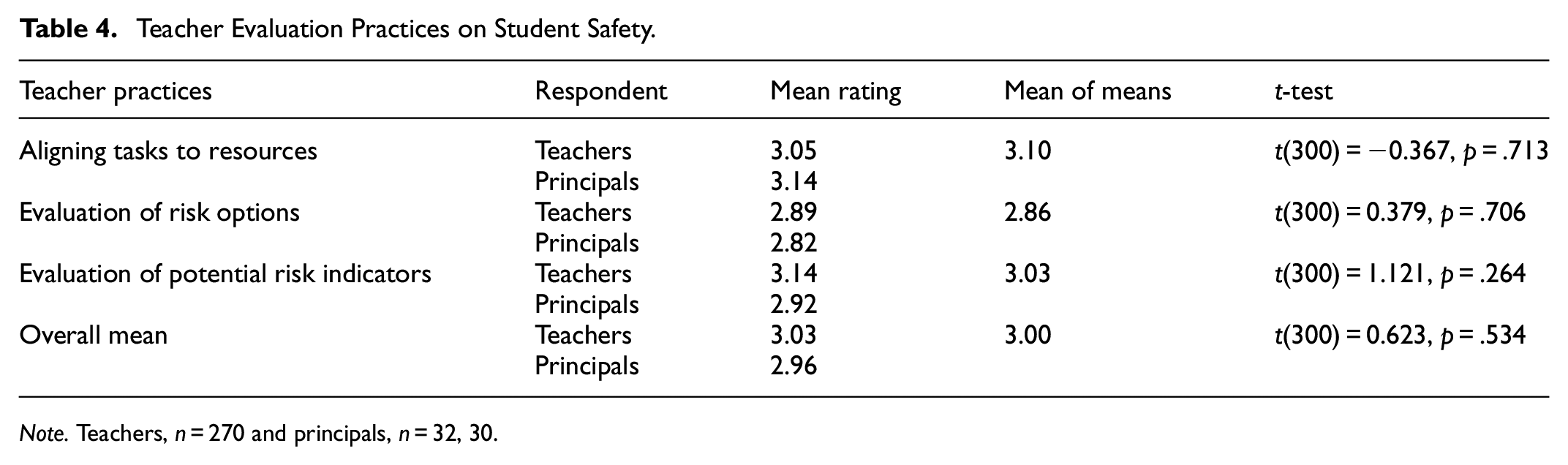
Teacher Evaluation Practices on Student Safety.
Note. Teachers, n = 270 and principals, n = 32, 30.
Based on Table 1, the mean rating for emergency plans review given by teachers was 2.86, while that given by principals was 2.83. These ratings were then averaged to give an overall mean rating of 2.85. This indicates that there was no significant difference between the two groups (t(300) = 0.156, p > .05). Therefore, it can be concluded that the practice of reviewing emergency plans by teachers moderately contributed to ensuring the safety of students during emergencies. Similarly, both teachers and principals had a mean rating of 3.06 and 3.08, respectively, for sharing information with stakeholders, resulting in an overall mean rating of 3.07. However, there was no significant difference between their responses t(300) = −0.141, p > .05, indicating that effective communication of response plans by teachers moderately contributed to student safety. Furthermore, the data shows that there was no significant difference (t(300) = 0.782, p > .05) between the mean ratings of 2.98 for teachers and 2.83 for principals in terms of their collaboration and consultation with external response teams. The overall mean rating of 2.91 supports this conclusion, indicating that this practice also moderately contributed to ensuring student safety during emergencies. Lastly, the overall mean rating for teacher practice in planning for safety is 2.94. The data shows that there is no significant difference between the mean ratings of teachers and principals (t(300) = 0.473, p > .05). This implies that teacher practice in planning for safety moderately contributes to ensuring safety during emergencies.
Referencing Table 2, the average rating for respondents, regarding the use of experiences from emergency drills are 3.05 and 2.76. Moreover, the overall average rating of 2.91 did not exhibit any significant statistical difference (t(300) = 1.417, p > .05). This variable therefore made a moderate contribution toward safety. The aspect of preparing emergency personnel was rated 2.83 and 2.87 for teachers and principals, respectively with an overall average of 2.85. There is no statistically significant difference between the respondents (t(300) = −0.148, p > .05). Results on using lessons learnt had a mean rating of teachers as 2.88, while that of principals was 3.07. Their overall rating of 2.98 indicates no significant difference (t(300) = −0.846, p > .05). The findings suggest that when teachers use lessons learnt from past experiences, it has a moderate impact on ensuring student safety during crises. The overall mean of 2.91 with no significant difference between teachers and principals (t(300) = 0.263, p > .05) on teacher engagement in drills and training, infers a moderate impact on student safety during an emergency.
Table 3 shows that the average rating by teachers for distributing resources was 3.07, while that of principals was 2.68. The overall average rating was 2.88. According to our analysis, there was no significant difference between the ratings given by teachers and principals, as indicated by t(300) = 1.842, p > .05. Similarly, the ratings given by teachers and principals for the availability of backup personnel during times of need were not significantly different, with t(300) = 0.649, p > .05. Having backup personnel to assist teachers in adhering to emergency procedures is moderately helpful in ensuring student safety. Moreover, teachers’ ability to identify crisis-related tasks during a crisis is somewhat beneficial in ensuring student safety. The mean rating for aligning tasks to resources among the respondents was 2.94, with teachers having a mean rating of 2.87 and principals 3.00. Our analysis found no significant difference between the mean ratings given to teachers and principals, with t(300) = −0.992, p > .05. The overall mean rating of emergency resource allocation was 2.90, and there was no significant difference between the mean ratings given to teachers and principals, as indicated by t(300) = 1.109, p > .05.
According to Table 4, both teachers and principals rated the alignment of tasks to resources with a mean score of 3.05 and 3.14 respectively, resulting in an overall average rating of 3.10. Consequently, there was no significant difference between the two groups, as confirmed by a t-value of 0.367 (300) and a p-value greater than .05. This suggests that the way resources are utilized has a moderate impact on ensuring student safety. Evaluation of risk options yielded an overall mean rating of 2.86, indicating no significant difference between the two groups, with a t-value of 0.379 (300) and a p-value greater than .05. This is also a moderate impact on student safety during emergency occurrences. Evaluation of potential risk indicators returned mean ratings of 3.14 and 2.92 for teachers and principals respectively. The overall mean rating of 3.03 with no significant difference (t(300) = 1.121, p > .05) suggests that evaluation of potential risk indicators moderately contributed to student safety. Analysis shows that there is no significant difference between the mean ratings of teachers and principals (t(300) = 0.623, p > .05).
Interpretation of Mean Rating
Table 5 presents the average scores for teachers and principals regarding their practices related to emergency preparedness. The scores were 2.97 and 2.90, respectively, with an overall average of 2.94. This demonstrates that there was no significant difference between the average scores of the respondents (t(300) = 1.340, p > .05). This is an indicator that both teachers and principals have similar views related to emergency response.
Summary of Emergency Response on Student Safety.

Note. Teachers, n = 270 and principals, n = 32, 30.
In processing qualitative data from the interviews, the four themes that emerged included planning for emergencies, drills and trainings, emergency resource allocation, and evaluation of emergency practices. These themes with corresponding codes are presented in Table 6
Qualitative Data.

On theme 1, results show that overcrowding in disaster scenarios can be reduced with the use of emergency planning, which is essential in guaranteeing a safe evacuation and emergency response. However, it is observed that in emergency situations, student safety was provided in part due to planning. Respondent 2 stated: from what I have seen in several school plans, and what we see on the ground, because we have the benefit of looking at the school budget in relation to emergency plans, the level of budget allocation is small, especially on fire hazards. Looking at our reports, we have constantly identified it as an area of gap for further improvement for most schools.
Efficient disaster preparedness endeavors to avert stampedes or mitigate their consequences by the arrangement of evacuation routes and protocols. On the other hand, obtaining the collaboration and support of pertinent stakeholders guarantees the effective execution of safety procedures. When planning, authorities can pinpoint areas in need of improvement and adjust safety practices by collecting and analyzing data.
On theme 2, training drills assist teachers in understanding their roles as rescuers as remarked by Respondent 1: Frequent and school-wide emergency response drills and exercises are very important but a challenge to schools because they must pay the service providers like St. John’s Ambulance for in-house training, but schools try to do whatever they can. What is encouraging is that schools that have had drills and exercises manage safety issues extremely well, not just to ensure safety of students but also to ensure safety of the whole school community. It is my hope that schools make effort to train and drill the school community for better preparedness gains as exemplified in the schools that have had the sessions.
Further, drills equip teachers with the skills to guide students to safe exits and evacuation points, reducing panic and ensuring a more orderly process. They develop competence in emergency procedures, gain confidence in handling crises, and rehearse protocols to ensure swift and effective evacuation.
On theme 3, strategic resource allocation and priority of rescue services are crucial for maximizing lifesaving chances and minimizing harm in emergencies. Respondent 4 said: I wish to categorically state that both human and financial resources allocated for provision of safety by some schools are quite dismal, sometimes even totally lacking in their financial allocation. On a scale of 1 to 10, I would rate it at 3. This implies that the process of developing a pool of teachers for emergency back-up is poor. Therefore, the contribution of teachers who are on standby for response cannot yield much in cases of an emergency.
Allocating resources effectively and promptly is crucial for emergency responses, as it influences people’s readiness and commitment to prioritize safety over personal interests.
Equally important in this study was the aspect of evaluation that is critical in emergency preparation. However, on theme 4, it was noted by respondent 3 as follows: post-event evaluations have been frequently done by the schools in the aftermath of emergency incidents. Stakeholders were keen to assess how their response worked and where it failed. However, implementation of the lessons learnt was still a challenge due to poor financial allocation to such activities. Therefore, the theoretical approach to evaluation without implementation does not yield much when it comes to response during emergency incidents.
Evaluation is critical in fostering a culture of awareness and readiness to support educational institutions during emergency response. This will inform active community participation, staff involvement, and targeted training programs to bridge identified gaps.
Discussion
The respondents have stressed the significance of having emergency plans in place for students. Most schools have teacher representatives in safety committees, which aligns with the findings of Sharifian et al. (2017). This highlights the importance of being prepared for emergencies by participating in emergency planning (Adenekan et al., 2016). Teacher training in emergency response has a moderate impact on student safety during emergencies. Drills help to simulate real-life situations, and practices help to improve the skills required for a response. However, the study’s findings suggest a potential gap between the drills and the necessary skills, indicating that teachers may be lacking in these essential areas.
The current analysis demonstrates that while teacher practices made a little contribution, they received the lowest mean ratings from both teachers and administrators which is in agreement with the findings of E. Skryabina et al. (2017). The majority of activities, including training, exercises, and resource allocation, all depend on the importance placed on safety-related activities during school budgeting, therefore this is probably the case. As stated by respondent 1; “teacher preparation programs alone will never be as effective in training teachers for emergency safety provision as they should be.” This implies that drills for emergency preparedness help participants better comprehend procedures, rules, and regulations while also enhancing their competence and self-assurance (E. Skryabina et al., 2017). In addition, effective emergency response depends on regular practice and implementation of these strategies inside educational institutions (Keyes, 2020).
Both human and financial resources are needed for school activities to improve safety readiness. A lack of funding might leave instructors ill-equipped. The small difference in ratings between principals and teachers may be due to teachers’ lack of exact budget details. However, their experience suggests that their allocation has served them dismally. This implies that poor decision-making and inadequate resource allocation can lead to failed emergency response efforts (Y. Chen et al., 2022). Furthermore, resources for emergency responders are crucial for better outcomes (Merchant et al., 2010). Although it has a lower overall score than other safety measures, teachers practice on backup personnel during emergencies slightly adds to student safety. Task identification is vital for targeted deployment and ensuring safety outcomes. It helps identify areas requiring attention, such as buildings, and teachers with relevant skills and competence to mitigate hazards. Ineffective task identification can lead to confused response actions and potential duplication of efforts.
Student safety in emergency situations was provided in part by teacher resource allocation practice. The notion put out by respondent 4 is in line with that of (Hošková-Mayerová et al., 2021) who asserts that bad leadership decisions frequently result in poor emergency management and inadequate emergency fund allocation. Due to insufficient allocation of resources, this might cause an emergency response attempt to fail. Similar results were noted by Mabasa (2014), who conducted an evaluation study to gage the Safe Schools Program’s implementation in the South African province of Limpopo. The findings showed that the implementation of the school safety programs in Limpopo was hampered by poor or insufficient resources and financial allocation. Similar findings to those of Mabasa (2014) were previously reported by Leandri (2011). According to the findings, the allocation of resources has a modest influence on learners’ safety in emergency situations. Variations in ratings are attributable to disparities in schools and community participation in safety initiatives. According to Ndetu and &Kaluyu (2016), resource distribution in Kenya’s elementary schools is fair, but policy execution is required to increase preparation. According to Onderi and Makori (2013), prioritizing competing activities in school budgets might impede activities linked to safety, resulting in poor teacher preparation and emergency response.
Equally important in this study was the aspect of evaluation that is critical in emergency preparation. Safety may be improved by means of evaluation if experiences are implemented. However, schools lack sufficient funds for First Aid equipment. In addition, school management allocates insufficient funds, resulting in a lower contribution to student safety provision. In line with this view, similar findings like that of Morris et al. (2016) found mismatches in resources and evaluation in emergency actions, compromising responder preparation.
The study findings have important theoretical and practical implications for crisis management in educational settings. They firmly support the combination of Social Cognitive Theory (SCT) and organizational safety culture as a powerful framework of understanding teacher preparedness. Findings suggest that teachers’ emergency responses are dynamically shaped by the interplay of their personal efficacy beliefs, what they observe and learn, past experiences, and the general safety rules. In addition, responses depend on the provision of resources and expectations with respective school’s cultures. Further, the findings reveal the significant potential of a decentralized decision-making system that will enable teachers to operate autonomously in actual crises. The results equally contribute to the current crisis leadership theory by implying that effective responses may not depend on traditional strict top-down directives. Instead, it calls for equipping and enabling teachers who are frontline personnel to act independently based on contextual assessments. In practice, findings advocate for proactive involvement of stakeholders, such as educators, policymakers, and school leaders.
Conclusion
The contribution of teacher safety practices including planning, training, exercises, resource allocation, and evaluation in enhancing student safety in emergency circumstances is moderate. Teacher safety practices such as training, drills, and resource allocation play a moderate role in student outcomes during emergencies because of their inadequacies followed by poor planning. This calls for more robust emergency-planning procedures to protect students. Although several limitations were identified, these results demonstrate the significance of teacher safety practices in ensuring safety in schools. Overall, the moderate contribution of teacher safety practices, together with the need for better planning and implementation indicates a shared perception regarding the necessity for improvements.
As part of policy implication, the study recommends that schools and the County Director of Education (Ministry of Education) conduct more frequent and comprehensive training and drills to enhance the competency of teachers in this area. In relation to the allocation of resources, the study proposes that Schools Board of Management engage in strategic planning and allocate additional resources toward enhancing teacher preparedness. Additionally, it is imperative for school principals and the Board of Management to cultivate positive and constructive relationships with relevant service providers, including St. John’s Ambulance and County fire Brigade. This practice will help to facilitate effective collaboration with teachers and enhance their preparedness. Lastly, it is critical to Promote open lines of communication so that teachers can voice concerns about safety, offer suggestions for safety measures, and take part in the decision-making process about the overall school safety.
Footnotes

Ethical Considerations
This study did not create distress or harm to the respondents and ethical approval was not relevant.
Funding
The author(s) received no financial support for the research, authorship, and/or publication of this article.
Declaration of Conflicting Interests
The author(s) declared no potential conflicts of interest with respect to the research, authorship, and/or publication of this article.
Data Availability Statement
Data sharing not applicable to this article as no datasets were generated or analyzed during the current study.