




Abstract
The present study is aimed to investigate in-service bilingual teachers’ perceptions of training needs in the competences and knowledge required to implement bilingual curricula in Taiwan. To this end, this study used mixed methods consisting of questionnaires and individual interviews to collect data from the intended cohort, that is, in-service teachers involved in bilingual curricula at elementary and junior high schools in Taiwan. In this study, data collection comprised questionnaire data from 76 respondents and transcripts of 15 interviews. Descriptive statistics and Grounded Theory method were employed to analyze the research data. The study revealed the differences in training needs of Taiwanese in-service bilingual teachers with regard to the school levels, teacher types, language proficiency levels, and bilingual teaching experiences. From the findings, several suggestions are made for professional development for in-service bilingual teachers in Taiwan. It is suggested that Taiwan’s Ministry of Education consider the factors of teacher types and school levels when developing in-service training courses. Additionally, training on the English language needs to be re-evaluated in the professional development courses for bilingual teachers in Taiwan, in particular for English language teachers. Through this study, the author wishes to shed light on training needs of bilingual teachers in Taiwan, and accordingly, to propose suggestions on bilingual teacher training.
Introduction
Since the Taiwanese National Development Council announced that the bilingual policy would be the prime national policy, approaches to promoting bilingual education have been widely discussed in Taiwan. One of the goals set for the bilingual policy is to cultivate bilingual talents to bring Taiwan to the world (National Development Council, 2018). Bilingual talents are mainly referred to as Taiwanese talents who are proficient in both Mandarin Chinese and English. Given the development of the Content and Language Integrated Learning (CLIL) approach in Europe, CLIL was considered to be a possible approach to bilingual education in Taiwan (Tsou & Huang, 2022; Tsou & Kao, 2018). CLIL is defined as “a dual-focused educational approach in which an additional language is used for the learning and teaching of both content and language” (Coyle et al., 2010, p. 1). In the case of Taiwan, the additional language used for the teaching and learning non-language subjects in bilingual classes following the CLIL approach is mostly the English language. As bilingual education is in its inception in Taiwan, teachers who are capable of teaching school subjects through English are in high demand. In 2020, Taiwan’s Ministry of Education (MOE) launched the first-ever bilingual teacher training program for in-service teachers at elementary and junior high schools. Under the MOE’s authorization, bilingual teacher training programs for in-service teachers have been provided at 16 universities in Taiwan (Ministry of Education, 2021).
Studies of CLIL teacher education in the European context have been published (e.g., Lasagabaster & Ruiz de Zarobe, 2010; Marsh et al., 2011; Martínez Serrano, 2017; Pérez Cañado, 2016a, 2016b, 2017, 2018; Pérez Murillo & Steele, 2017; Wolff, 2012), and CLIL research focusing on Latin America has also been seen (e.g., Banegas, 2012; Hillyard, 2011; McDougald, 2016). However, few studies addressed issues related to bilingual teacher development following the CLIL approach in an Asian context (Kewara & Prabjandee, 2018; Luo, 2021; Yamano, 2013). While the CLIL approach has been promoted in Asia (e.g., Lin, 2016; Lo, 2020; Tsou & Huang, 2022; Tsou & Kao, 2018; Yamano, 2013), data-based research on bilingual teacher development in relation to the CLIL approach is needed to examine the applicability and sustainability of the approach in the Asian context (e.g., Lo, 2020; Luo & Chen, 2022; Pineda et al., 2022). Furthermore, given the exponential growth of bilingual education in Taiwan, research on bilingual teacher development is called for.
In Taiwan, a curriculum that is implemented following a CLIL framework is commonly referred to as Shung Yu (two languages) Ke Cheng (curriculum), which literally means bilingual curriculum. Under the CLIL approach, the teachers involved in the implementation of bilingual classes in Taiwan are content teachers, who are non-language subject teachers, and English teachers. This study is aimed to explore the training needs of in-service bilingual teachers (including content teachers and English teachers) at elementary and junior high schools to identify the competences and knowledge required for bilingual teaching in Taiwan. Through mixed methods consisting of individual interviews and questionnaires, this study sought to answer the following questions (cf. Pérez Cañado, 2016a, 2016b, 2017):
What are the training needs of in-service bilingual teachers in Taiwan in terms of linguistic competence, intercultural competence, theoretical CLIL underpinnings, methodological CLIL aspects, materials and resources, and ongoing professional development?
How do the bilingual teachers’ training needs differ considering the school levels (i.e., the elementary schools and junior high schools), teacher types (i.e., language teachers and content teachers), bilingual teaching experience, and target language levels?
In view of the research findings, the author wishes to illuminate the implications for the professional development of bilingual teachers in Taiwan and to contribute to bilingual teacher development and bilingual education in Taiwan and other similar contexts.
Literature Review
CLIL Teaching Models
CLIL has been operating in Europe for almost 30 years, and CLIL teaching models were developed based on contextual variables, such as “context, content, language (communication), learning (cognition) and culture” (Coyle et al., 2010, p. 16). These models served an educational purpose and were characterized by the collaborative relationships developed between the content and the language teachers and the use of the students’ first language and the target language for instruction (Ball et al., 2015). In Taiwan, the bilingual teaching models that involve a content teacher and a language teacher (i.e., an English teacher) at elementary and junior high schools can be characterized as follows (Luo, 2021; Luo & Chen, 2022):
Model 1: An English teacher teaches alone and mainly in the target language but uses both Mandarin Chinese and English to facilitate student learning of the subject content.
Model 2: A content teacher teaches alone through both Mandarin Chinese and English.
Model 3: A content teacher and an English teacher teach the same lesson. The content teacher teaches in students’ first language, and the English teacher teaches the language components of the lesson (such as the subject-specific vocabulary) mainly in the target language.
These bilingual teaching models illustrate how content and language teachers give bilingual classes in Taiwan. As both content and language teachers are involved in bilingual teaching, it is argued that in planning an in-service training course for bilingual teachers, training needs of both content and language teachers need to be considered.
Professional Competences for CLIL Teachers
When implementing CLIL approaches, CLIL teachers in Europe encountered challenges such as increased workload, lack of CLIL materials, the complexity of CLIL instruction, and lack of linguistic and methodological competences by content teachers (Alonso et al., 2008; Cabezas Cabello, 2010; Infante et al., 2009). To deal with these challenges, CLIL teachers needed to acquire language skills, teaching competences in the target language (Fernández & Halbach, 2011), knowledge of bilingual pedagogy (Pena Díaz & Porto Requejo, 2008), and CLIL knowledge (Rubio Mostacero, 2009). To prepare qualified CLIL teachers in Europe, Marsh et al. (2011) proposed a European framework for CLIL teacher development that defined the professional competences required for a CLIL teacher. These competences include (a) teacher reflection, (b) CLIL underpinnings, (c) content and language awareness, (d) methodology and assessment, (e) research and evaluation, (f) learning resources, and (g) classroom management in CLIL (Marsh et al., 2011).
Initiatives for CLIL teacher development, such as in-service teacher training and initial teacher education, have been undertaken in European countries such as Spain (see Martínez Serrano, 2017; Pérez Murillo & Steele, 2017), Italy (see Cinganotto, 2016; Lopriore, 2020), and the United Kingdom (see Hillyard, 2011). In 2012, the Italian Ministry of Education launched CLIL teacher training courses which aimed to train content teachers with a B2 to C1 level of English on the Common European Framework of Reference for Languages (CEFR) to teach content through English (Lopriore, 2020). The main components of the CLIL teacher training in Italy included (a) language skills development, (b) introduction to second language acquisition, (c) lesson and syllabus planning, (d) cooperative approaches, (e) classroom observation and action research, (f) assessment and evaluation, (g) materials selection and use, (h) microteaching and practicum, and (i) a final project developed with multimodal and information communication technology (ICT) tools (Lopriore, 2020, p. 100).
In Spain, Pérez Cañado (2016a, 2016b, 2017) investigated CLIL teachers’ training needs and proposed CLIL teacher education which addressed CLIL teachers’ linguistic and methodological needs. The components of CLIL teachers’ training needs are listed as follows (Pérez Cañado, 2016a):
(1) Linguistic competence, which includes grammatical knowledge, accurate pronunciation, academic vocabulary knowledge, knowledge of formulaic language, oral communication skills, listening skills, and reading skills;
(2) Intercultural competence, which includes knowledge of the target cultures, capacity to reflect on intercultural experience and to develop critical intercultural awareness, and capacity to compare cultures from a multicultural perspective;
(3) CLIL theoretical underpinnings, which means understanding of CLIL framework and development, theories about language and learning underlying CLIL, and understanding of CLIL research;
(4) CLIL methodology, which means knowledge of teaching approaches and procedures employed in CLIL, and knowledge of principles and techniques of assessments;
(5) CLIL teaching material and resource development, which means ability of adapting and developing bilingual teaching materials and resources, ability of using multimedia software, ability of using online reference materials, social media and online apps, and ability of using computer-mediated communication; and
(6) Ongoing professional development, which means understanding of quantitative and qualitative research, ability of using action research methods, familiarity with journals and books on CLIL, and knowledge about organizations, networks and conferences on CLIL.
Along the same lines, Martínez Serrano (2017) proposed a competence-based training model for in-service CLIL teachers in Andalusia. This training model aimed to help both content and language teachers to develop linguistic competence, pedagogical competence, emotional competence, and social skills. She concluded that in-service CLIL teacher training should improve the teachers’ target language competence and provide them with the pedagogical updates to teach the subjects successfully through CLIL. Similarly, Pérez Cañado (2018) identified seven core competences of CLIL teachers: (a) linguistic competence, (b) pedagogical competence, (c) subject content knowledge, (d) organizational competence in grouping and CLIL learning modalities, (e) interpersonal competence, (f) collaborative competence, and (g) reflective and development competence. Within these seven core competences, teachers’ training needs would vary depending on CLIL teachers’ teaching experiences, knowledge bases (language teachers or content teachers), previous foreign experiences, and target language levels (Pérez Cañado, 2018). Following the line of research, Pavón et al. (2020) examined how variables such as teacher types and English levels would influence CLIL teachers’ perceptions of training and development needs. Their study found that content teachers needed more training, while teachers’ levels of English influenced their agreement on whether language teachers required more training.
As stated earlier, in 2020, Taiwan launched the first-ever in-service bilingual teacher program at the elementary and junior high school levels. This program aimed to equip content teachers and English teachers with the knowledge and competence to teach subject content through the English language. The program consisted of components such as (a) introduction to bilingual education, (b) underpinnings of CLIL, (c) translanguaging and scaffolding in CLIL, (d) use of multimodality in CLIL, (e) CLIL material development and task design, (f) assessment in CLIL, (g) observations and reflections, and (h) micro-teaching (Ministry of Education, 2021). To shed light on the capabilities required for bilingual teachers in Taiwan, Luo and Chen (2022) explored a teaching capability maturity model for bilingual teachers based on the level of maturity of teachers’ teaching capabilities. Their study found that the most needed capabilities for bilingual teachers in Taiwan were content knowledge followed by curriculum development capability, content pedagogical knowledge, and content teaching capabilities. Additionally, Taiwanese bilingual teachers needed to develop educational contextual knowledge, that is, knowledge of educational and multicultural issues concerning “curricula and teaching, school-based resources, and the influence of educational contexts on student learning” (Luo & Chen, 2022, p. 9). In the same line of research, a study by Pineda et al. (2022) analyzed the training needs of in-service CLIL teachers in Taiwan and Spain and found that Taiwanese bilingual teachers had methodological and linguistic needs and valued content training.
CLIL studies have indicated that as an innovative educational approach, CLIL has the potential to enhance content and foreign language learning (e.g., Lasagabaster & Lopez Beloqui, 2015; Yamano, 2013). However, there are significant challenges in the implementation of bilingual education following a CLIL approach in the Taiwanese context. A study by Luo (2021) revealed the challenges facing in-service bilingual teachers in elementary schools in Taiwan such as lack of knowledge about the non-language subjects by English teachers, lack of knowledge about CLIL approaches, lack of competence to teach through English by content teachers, and lack of bilingual teaching materials. While bilingual curriculum development in Taiwan is immature compared with regular school curricula, Taiwan’s bilingual policy will inevitably increase the demand for bilingual teachers. Consequently, preparing in-service language and content teachers for bilingual curriculum implementation is urgently needed. Data-based research into in-service teachers’ perceptions of the competences and knowledge required for bilingual instruction is necessary (cf. Martínez Serrano, 2017; Pérez Cañado, 2018). This study, therefore, sought to shed light on the in-service training needs of bilingual teachers in Taiwan and to provide suggestions for teacher professional development.
Research Methods
The present study investigated in-service teachers’ perceptions of training needs in the competences and knowledge required to implement bilingual curricula in Taiwan. To this end, this study used mixed methods consisting of a questionnaire and individual interviews to collect data from the intended cohort, that is, in-service teachers involved in bilingual curricula at elementary and junior high schools in Taiwan. Mixed methods research employs quantitative and qualitative approaches to collect, combine, and analyze both quantitative and qualitative data for a better understanding of the research questions than either research approach alone can provide (Creswell & Plano Clark, 2011). A mixed-methods approach can achieve a “breadth and depth of understanding and corroboration” of the training needs of in-service bilingual teachers in Taiwan (Johnson et al., 2007, p. 123). In this study, a questionnaire and individual interviews were employed, which allowed for data triangulation and the illumination of the training needs from an in-service teacher perspective (Johnson, 1992). The questionnaire was conducted to gain insights into the in-service teachers’ perceptions of their training needs. It also enabled the author to describe and document the teachers’ differing training needs in view of teacher types, school levels, bilingual teaching experiences, and target language levels. Individual interviews with the in-service teachers were employed to provide detailed descriptions of the training needs from the teachers’ points of view.
Questionnaire Survey
To investigate bilingual teachers’ training needs, a questionnaire survey was conducted by email with in-service bilingual teachers. The questionnaire was adapted from the study by Pérez Cañado (2016b). It focused on bilingual teachers’ training needs in the Taiwanese context from an in-service teacher perspective and was conducted in Mandarin Chinese. In addition to the demographic data, the questionnaire had 37 items, which were answered using a 4-point Likert scale to avoid any central tendency errors, and six open-ended questions to measure the in-service teachers’ perceptions of their current levels and training needs in the competence and knowledge for the delivery of bilingual curricula (cf. Pérez Cañado, 2016b) (see the questionnaire in Appendix A). The questionnaire items were divided into six competence and knowledge categories: linguistic competence, intercultural competence, theoretical underpinnings of CLIL, methodological aspects of CLIL, materials and resources, and ongoing professional development. The 4-point Likert scale indicates the teachers’ perceptions of their current levels of competence and knowledge (1 = none, 2 = insufficient, 3 = adequate, and 4 = excellent) and their training needs (1 = none, 2 = low, 3 = considerable, and 4 = high). To test the questionnaire’s validity and reliability, three English teaching professionals who were knowledgeable about CLIL and related studies were invited to review the questionnaire for the appropriateness, comprehensiveness, and clarity of the survey items. Their suggestions and comments were incorporated into the revised questionnaire. Additionally, Cronbach’s alpha was used to measure the reliability of the questionnaire. The Cronbach’s alpha reliability values are presented in Table 1. All values were at least above .75, which are satisfactory (Taber, 2018).
Cronbach’s Alpha Reliability Value.

Individual Interviews
To further explore the in-service bilingual teachers’ training needs, the author conducted interviews in addition to the questionnaire survey. The surveyed teachers were invited to give an individual interview on a voluntary basis (see interview protocol in Appendix B). The interviews were conducted in Mandarin Chinese to solicit in-depth information about the teachers’ perceptions of their training needs. There were 15 interviews, each of which lasted from 40 min to 1 hr. Due to the COVID pandemic, the interviews were conducted via distance mode. The interviews were tape-recorded, transcribed, and translated from Mandarin Chinese to English. The interview translations were checked for accuracy by a second person to ensure reliability and validity.
Research Participants
To invite in-service teachers to participate in the questionnaire survey, the author emailed the questionnaire to the in-service teachers who had attended the MOE bilingual teacher training program in 2020 and have been teaching bilingual classes. Due to the limited access to the in-service teachers’ email addresses, the author managed to email the questionnaire to 92 in-service teachers. Seventy-six in-service teachers consisting of 66 females (86.8%) and 10 males (13.2%) replied to the survey. The response rate is 82.6%. According to the demographic data, the cohort of the surveyed teachers comprised 44 English language teachers (57.9%) and 32 content teachers (42.1%), with 50 of these teachers being elementary school teachers (65.8%) and 26 being junior high school teachers (34.2%). Within the cohort, 44 teachers (57.9%) had bilingual teaching experience of less than 1 year, while 32 teachers (42.1%) had taught bilingual classes for more than 1 year. Regarding English language ability, 60 teachers (78.9%) replied that they had achieved a B2+ level on the Common European Framework of Reference for Languages (CEFR), and 16 teachers (21.1%) were at the B1 level or below. Among the surveyed teachers, 15 teachers accepted the interview invitation and agreed to participate in an individual interview on a voluntary basis. The interviewed teachers consisted of four junior high school content teachers, three elementary school content teachers, two junior high school English teachers, and six elementary school English teachers. Their bilingual teaching experiences ranged from less than 1 year to 4 years. The information of the interview participants is shown in Table 2.
Background of the Interview Participants.

Note. T = teacher.
Data Analysis
The quantitative data collected through the questionnaire survey were analyzed using SPSS Statistics 20. Descriptive statistics were employed to reveal the competences and knowledge that bilingual teachers needed in order to deliver a bilingual curriculum, for which means and standard deviations were calculated. Due to the small sample size, Wilcoxon signed-rank test analysis was employed to determine the statistically significant differences within the teacher types, school levels, bilingual teaching experiences, and target language levels. When there was no significant difference, a post hoc power analysis would be conducted (Lenth, 2007). Grounded Theory method was used to analyze the interview data. The author began the interview data analysis by iteratively scrutinizing and comparing the data to identify the themes. Next, the themes were compared to determine a set of focused codes, which were used to synthesize, integrate, organize, and conceptualize the large qualitative data segments (Charmaz, 2014). Finally, findings grounded in the data were developed.
The data analysis focused on both the qualitative information and the quantitative data to ensure a fair triangulation and to corroborate the research findings. The data collected from the questionnaires were analyzed in combination with the interview data to ensure a detailed, comprehensive account of the in-service teachers’ training needs for the teaching of bilingual curricula in Taiwan, such as linguistic and intercultural competences, the theoretical CLIL underpinnings, the methodological aspects of CLIL, materials and resources, and ongoing professional development. The qualitative and quantitative data were compared and the findings were synthesized to gain a holistic understanding of the issues being studied.
Statistical Results
A non-parametric Wilcoxon signed-rank test was used to evaluate the differences between the surveyed teachers’ current levels and their training needs, with a higher mean for training need indicating the need for greater competence and knowledge training. The statistical analysis of the overall sample data revealed that the means for the teacher training needs were higher than the means for the perceived current levels in all the competence and knowledge categories except for linguistic competence (current level M = 2.97; training needs M = 2.70), and significant differences were found for all the categories (see Table 3). Namely, all the surveyed teachers perceived that they had greater training needs for all the competences and knowledge except for linguistic competence. The Wilcoxon signed-rank test results revealed that the entire cohort of the surveyed teachers perceived the highest training needs for ongoing professional development (effect size = −0.32), followed by methodological aspects of CLIL (effect size = −0.30), and theoretical underpinnings of CLIL (effect size = −0.25).
Perceptions of Current Levels and Training Needs by All Teachers (N = 76).

p < .05. **p < .01. ***p < .001.
Similarly, the data analysis for the cohort of elementary school bilingual teachers found that the means of the teacher training needs were higher than the means of the perceived current levels in all the competences and knowledge except for linguistic competence (current level M = 2.95; training needs M = 2.64), and significant differences were found for all the categories (see Table 4). The elementary school bilingual teachers in this survey perceived greater training needs for all the competences and knowledge except for linguistic competence. The Wilcoxon signed-rank test results revealed that the elementary school bilingual teachers perceived the highest training needs for ongoing professional development (effect size = −0.35), followed by intercultural competence (effect size = −0.30), and methodological aspects of CLIL (effect size = −0.29).
Perceptions of Current Levels and Training Needs by Elementary School Teachers (n = 50).

p < .05. **p < .01. ***p < .001.
The statistical analysis indicated that in the cohort of junior high school bilingual teachers, the means for the teachers’ training needs were higher than the means for their current levels in all the competences and knowledge except for linguistic competence (current level M = 2.99; training needs M = 2.80) (see Table 5); however, the significant differences were found only for methodological aspects of CLIL (p = .03) (effect size = −0.30) and ongoing professional development (p = .04) (effect size = −0.28). The post hoc power values were 0.14, 0.10, 0.20, and 0.16 for the categories of linguistic competence, intercultural competence, theoretical underpinnings of CLIL, and materials and resources, respectively, in which there was no significant difference.
Perceptions of Current Levels and Training Needs by Junior High School Teachers (n = 26).

p < .05. **p < .01. ***p < .001.
In view of the teacher types, the means of the English teachers’ training needs were higher than the means of their current levels for all the competences and knowledge except for linguistic competence (current level M = 3.09; training needs M = 2.64) (as shown in Table 6). The Wilcoxon signed-rank test results revealed that the English teachers perceived greater training needs for ongoing professional development (effect size = −0.33) and intercultural competence (effect size = −0.27). The significant differences were found for linguistic competence (p = 0.00), intercultural competence (p = .01), and ongoing professional development (p = 0.00). The post hoc power values were 0.16, 0.10, and 0.13 for the categories of theoretical underpinnings of CLIL, methodological aspects of CLIL, and materials and resources, respectively, in which there was no significant difference.
Perceptions of Current Levels and Training Needs by English Teachers (n = 44).
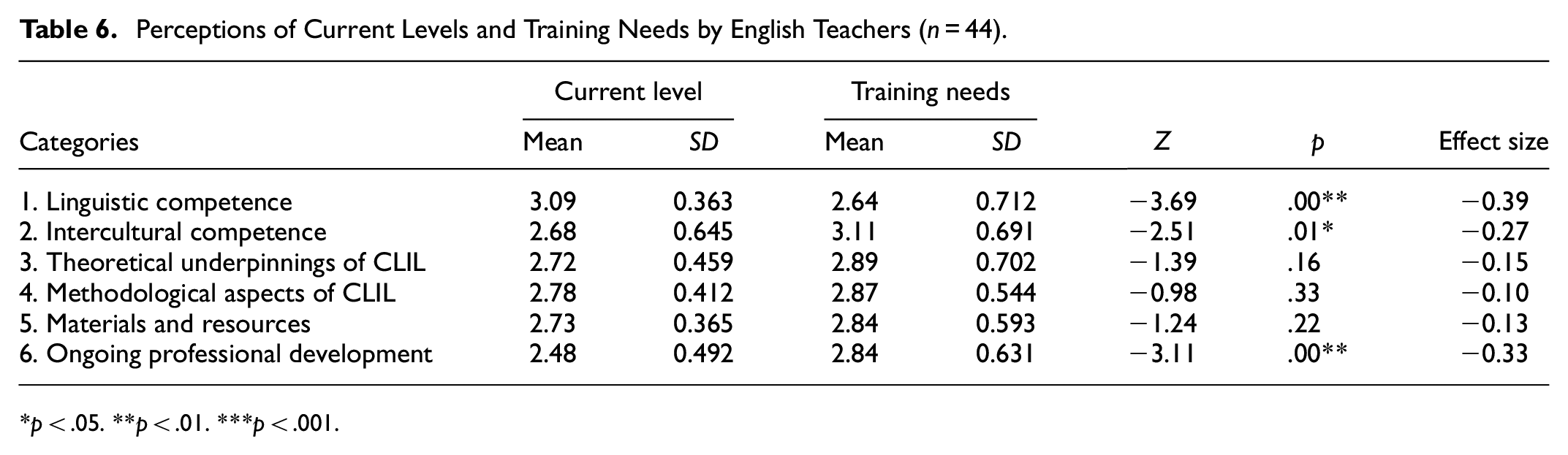
p < .05. **p < .01. ***p < .001.
The data analysis showed that the means of the content teachers’ training needs were higher than the means of their perceived levels for all the competence and knowledge categories except for linguistic competence (see Table 7). The significant differences were found for the categories of theoretical underpinnings of CLIL, methodological aspects of CLIL, materials and resources, and ongoing professional development. The post hoc power values were 0.05 and 0.16 for linguistic competence and intercultural competence, respectively, in which there was no significant difference. The Wilcoxon signed-rank test results indicated that the content teachers perceived greater training needs for methodological aspects of CLIL (effect size = −0.52), followed by theoretical underpinnings of CLIL (effect size = −0.40), and ongoing professional development (effect size = −0.31).
Perceptions of Current Levels and Training Needs by Content Teachers (n = 32).

p < .05. **p < .01. ***p < .001.
The statistical analysis revealed that the means of the training needs of the bilingual teachers with B1 level or below were higher than the means of the teachers’ perceived levels in all the competence and knowledge categories; however, the differences were not statistically significant. As for the bilingual teachers with B2 level or above, the means of their training needs were higher than the means of their perceived current levels for all competence and knowledge categories except for linguistic competence (see Table 8). The differences were found statistically significant in all of the categories. It appears that the bilingual teachers with B2 level or above perceived that they had greater training needs for all the competences and knowledge except for linguistic competence. The Wilcoxon signed-rank test results revealed that the cohort of the bilingual teachers with B2 level or above perceived greater training needs for ongoing professional development (effect size = −0.32), followed by methodological aspects of CLIL (effect size = −0.31), theoretical underpinnings of CLIL (effect size = −0.27), and materials and resources (effect size = −0.26).
Perceptions of Current Levels and Training Needs by Teachers With B2 Level or Above (n = 60).
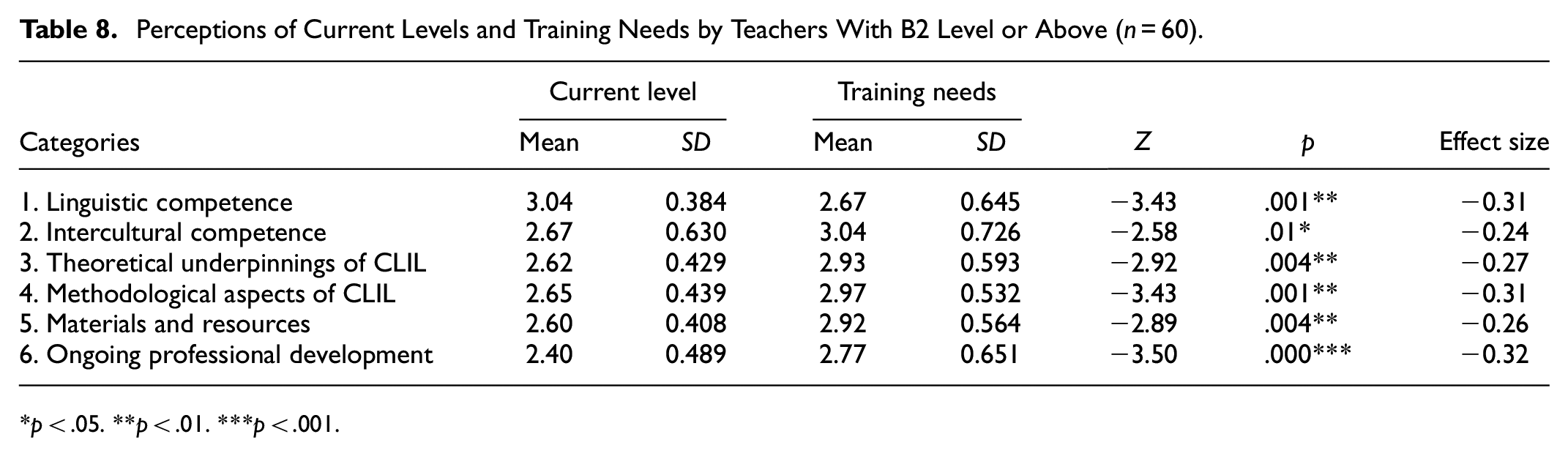
p < .05. **p < .01. ***p < .001.
The statistical analysis indicated that the teachers with bilingual teaching experience of less than 1 year had higher training needs than their perceived levels for all the competence and knowledge categories (see Table 9). The significant differences were found for the categories of theoretical underpinnings of CLIL, methodological aspects of CLIL, materials and resources, and ongoing professional development. The post hoc power values were 0.24 and 0.19 for linguistic competence and intercultural competence, respectively, in which there was no significant difference. The Wilcoxon signed-rank test results showed that this cohort of teachers perceived greater training needs for methodological aspects of CLIL (effect size = −0.36), followed by theoretical underpinnings of CLIL (effect size = −0.35), and ongoing professional development (effect size = −0.35).
Perceptions of Current Levels and Training Needs by Teachers With Bilingual Teaching Experience of Less Than 1 Year (n = 44).

p < .05. **p < .01. ***p < .001.
In the cohort of teachers with bilingual teaching experience of more than 1 year, the teachers’ training needs were higher than their current levels in all the competences and knowledge except for linguistic competence (see Table 10). Significant differences were found for linguistic competence (p = .04), intercultural competence (p = .01), and ongoing professional development (p = .02). In the categories of theoretical underpinnings of CLIL, methodological aspect of CLIL, and materials and resources where there was no significant difference, the post hoc power values were 0.09, 0.17, and 0.27, respectively. The Wilcoxon signed-rank test results indicated that this cohort of teachers perceived greater training needs for intercultural competence (effect size = −0.31) and ongoing professional development (effect size = −0.28).
Perceptions of Current Levels and Training Needs by Teachers With Bilingual Teaching Experience of More Than 1 Year (n = 32).

p < .05. **p < .01. ***p < .001.
An independent sample t-test was used to evaluate the training need differences between the teacher groups in view of the school levels (elementary vs. junior high schools), teacher types (English vs. content teachers), target language levels (B2 level or above vs. B1 level or below), and bilingual teaching experience (less than 1 year vs. more than 1 year). The data analyses indicated that the training need differences between the teacher groups were not statistically significant.
Interview data
In the interviews, the teacher participants were asked about their perceptions of in-service training for bilingual teachers. The interview data analysis was characterized into themes that emerged.
Training Needs Varied Depending on Teacher Types
The teacher participants (e.g., T1, T4, T6, T11, and T13) commented that bilingual teachers’ training needs would vary depending on the teacher types. Namely, English (language) teachers and non-English (content) teachers have different training needs. For instance, T1 remarked: I am an English teacher. I need training on the subject I teach. I need to gain knowledge of the subject content and learn how to teach it, that is, content teaching methodology. Training that enhances my competence in teaching the content will be the most helpful.
T1’s remarks were echoed by T6, who was an English teacher and thought that her content knowledge was not sufficient for conducting bilingual lessons on the subject content. In comparison, T4, who was an English teacher, commented that content teachers were knowledgeable about the subject content they taught, but they sometimes used incorrect English in teaching the content. She thought that content teachers needed to enhance their English language ability. Both T11 (an English teacher) and T13 (a content teacher) made similar remarks that bilingual English teachers needed to enhance their content knowledge, while bilingual content teachers needed training on the English language, especially specific to the content they taught.
Training on Material Development Was Needed
Most of the teacher participants (e.g., T3, T5, T7, T8, T9, T11, T12, T13, and T15) remarked that in-service training on material development was necessary for bilingual teachers. T5 commented: In addition to bilingual methodological competence, bilingual teachers’ ability in developing teaching materials and resources is essential in promoting bilingual education. Teaching material development is a challenge faced by bilingual teachers in Taiwan. If bilingual teachers can develop teaching materials and resources, they will find it less daunting to implement bilingual teaching.
Similarly, T12, who was a content teacher, said that bilingual teachers’ competences included language ability and the ability to adapt teaching materials. Bilingual teachers needed to know how to adapt and develop teaching materials, such as creating worksheets and PPT slides.
Training on Bilingual Teaching Methodology Was Needed
Additionally, the in-service training need for bilingual teaching methodology was mentioned by the teacher participants (e.g., T2, T3, T4, T5, T7, T9, T11, T12, and T15). For instance, T3 remarked that in addition to the target language ability, bilingual teachers needed to know how to guide students in bilingual classes and how to scaffold content learning. T9 also commented that she needed training on how to apply CLIL concepts to bilingual teaching in class. When commenting on the training needs for bilingual teaching methodology, the teacher participants (e.g., T6, T13, and T14) said that the ability to utilize ICT in bilingual teaching was a plus for bilingual teachers. Both T13 and T14 remarked that they would like to learn how to apply ICT to bilingual teaching and thought that the use of ICT would engage the students in learning and help them to comprehend the content being taught.
Training Needs Changed Over the Years of Bilingual Teaching Experience
While the interview data indicated that the training needs of the in-service bilingual teachers varied depending on the types of teachers, some of the teacher participants (e.g., T2, T4, T7, and T10) commented that teachers’ training needs would change over the years of bilingual teaching experience. T4, who was an English teacher with 4 years’ bilingual teaching experience, made the following remarks on training needs: The provision of in-service training should be arranged in progression. In the beginning, content teachers need to enhance their English ability, while English teachers need to increase their knowledge of the subject content they teach. Next, bilingual teachers need to enhance their knowledge of the theoretical underpinnings of bilingual teaching. They need to know the theoretical framework to develop a well-grounded bilingual curriculum. Finally, the teachers need to establish support groups to continue professional development. Ongoing professional development is needed for the teachers.
T2 and T10 also made similar comments that bilingual training should first focus on language training for the teachers to achieve the B2 level, followed by training on CLIL theories and then bilingual teaching methodology.
Discussion of Findings
Given the data analysis, the findings are discussed based on the research questions: (a) the training needs of in-service bilingual teachers in Taiwan; and (b) the differences in training needs in view of school levels, teacher types, bilingual teaching experiences, and English language levels.
Training Needs: Lower for Linguistic Competence and Higher for Ongoing Professional Development
Similar to the findings of Pérez Cañado (2016b), the training need analyses of this study revealed that the in-service bilingual teachers in Taiwan had a lower training need for linguistic competence, and higher training needs for ongoing professional development and methodological aspects of CLIL. The training needs for the entire cohort were significantly higher for ongoing professional development, methodological aspects of CLIL, theoretical underpinnings of CLIL, and intercultural competence, in that order (cf. Luo & Chen, 2022). Different from previous studies of bilingual teacher education (Luo, 2021; Martínez Serrano, 2017; Pérez Cañado, 2016b, 2017) that highlighted the importance of linguistic training, the present study found that, except for the teachers with B1 level or below, the other teachers’ needs for linguistic training were lower than their perceived current levels of linguistic competence. The perceived current level of linguistic competence was positive for the whole cohort, and was also higher for different teacher types, school levels, bilingual teaching experience, and target language proficiency. Namely, a statistically significant difference was found in the entire cohort of teachers and in the sub-cohorts of English teachers, elementary school teachers, teachers with B2 level or above, and teachers with bilingual teaching experience of more than 1 year. It appears that the in-service teachers in this study would benefit less from linguistic training.
Training Needs Varied Among Teacher Cohorts
This study revealed the differences in the teachers’ training needs considering the school levels, teacher types, language proficiency levels, and bilingual teaching experiences. Compared with previous studies (e.g., Pérez Cañado, 2016b), this study found that there were training need differences in both the school levels and teacher types. While the training needs of the elementary school bilingual teachers were significantly higher for ongoing professional development, intercultural competence, methodological aspects of CLIL, and theoretical underpinnings of CLIL, in that order, the training needs of the junior high school bilingual teachers were higher for methodological aspects of CLIL and ongoing professional development. Therefore, compared with the junior high school bilingual teachers, the elementary school bilingual teachers would benefit from in-service training on intercultural competence and theoretical underpinnings of CLIL. The statistical results showed that the elementary school bilingual teachers had significantly high training needs in the competence and knowledge categories similar to the entire bilingual teacher cohort with the only difference being in the degree of the training needed.
In view of the teacher types, this study found that the training needs of the English teachers were significantly higher for ongoing professional development and intercultural competence, while the content teachers’ training needs were significantly higher for methodological aspects of CLIL, theoretical underpinnings of CLIL, and ongoing professional development. Therefore, it is argued that the content teachers would benefit from CLIL methodological and theoretical foundation training, and the English teachers appeared to have the greatest gap between their training needs and perceived current level for ongoing professional development. Additionally, the study revealed that the training needs of the teachers with B2 level or above were significantly high for all the competence and knowledge categories except for linguistic competence. Differing from the findings of Pavón et al. (2020), this study found that the bilingual teachers with a higher level of the target language (English) ability wished to have more training. Furthermore, the statistical results indicated that, similar to the elementary school bilingual teachers, the bilingual teachers with B2 level or above had significantly high training needs in the competence and knowledge categories same as the entire teacher cohort; the only difference was in the degree of the training needed.
The interview data analysis revealed that the difference in training needs for bilingual teachers pertained to content knowledge and language competence. The teacher participants remarked that competent bilingual teachers should be able to teach subject content through English. Content teachers needed in-service training in enhancing their English language ability to sufficiently deliver lessons through English, while English teachers needed training in content knowledge to develop competence in teaching the subject content. In line with previous research (e.g., Pérez Agustin, 2019; Vilkancienė & Rozgienė, 2017), the interview data analysis of this study indicated the content teachers’ training needs to improve language proficiency.
Additionally, the interview data corroborated the statistical analysis of the bilingual teachers’ training needs for bilingual teaching methodology (cf. Luo & Chen, 2022). In agreement with the findings of Porcedda and González-Martínez (2020), the study found that fulfilling the bilingual teachers’ training needs in bilingual pedagogy, material development, and ICT was essential for proper bilingual curriculum implementation (as commented by T3, T9, T13, and T14). While the statistical analysis did not indicate significant differences in the training needs among the teachers considering their bilingual teaching experience, the interview data revealed that the teachers’ training needs would change over the years of bilingual teaching experience. Similar to the study by Vilkancienė and Rozgienė (2017), this study found that the training needs of Taiwanese novice bilingual teachers would be different from those of experienced and trained bilingual teachers (as remarked by T4 and as shown in Tables 9 and 10).
In this section, the author discussed the findings in view of the research questions. As bilingual education is relatively new in Taiwan, the scope of this study was limited by the sample size, which means that the statistical findings cannot be fairly generalized. When there was no significant difference, a post hoc power analysis was conducted. The post hoc power values were not high due to the small sample size. Nevertheless, the findings of this study shed light on Taiwanese in-service bilingual teachers’ training needs in competences and knowledge related to bilingual curriculum implementation in Taiwan.
Suggestions and Conclusion
Given the findings, suggestions are made on professional development for in-service bilingual teachers in Taiwan. First, it is suggested that the MOE consider the factors of teacher types and school levels when developing bilingual teacher training courses. Namely, the in-service training courses need to be tailored to the specific needs of the different cohorts of in-service bilingual teachers (cf. Lo, 2020). For instance, English language teachers would benefit from training on ongoing professional development and intercultural competence while content teachers would benefit from CLIL methodology and theoretical foundation courses (cf. Martínez Serrano, 2017). Similarly, the in-service training courses for elementary school bilingual teachers should be different from those for their counterparts at junior high schools, as indicated in the discussion of findings.
Second, the author suggests that the linguistic training component should be re-evaluated in the professional development course for in-service bilingual teachers in Taiwan. The statistical findings indicated that the in-service bilingual teachers perceived higher current levels than training needs for linguistic competence in the target language, whereas the interview data revealed the content teachers’ training needs for linguistic competence. It appears that the content teachers would benefit from linguistic training more than the English teachers would (cf. Martínez Serrano, 2017). To deliver professional development courses that better fulfill in-service bilingual teachers’ needs, it is suggested that the MOE evaluate the need for linguistic training to be part of the professional development programs for bilingual teachers, in particular for language teachers.
Third, the component of ongoing professional development should be integral to the in-service training and initial teacher programs for bilingual teachers in Taiwan. The statistical analyses showed that the teachers in this study had high training needs for ongoing professional development, which consists of knowledge about organizations, networks and conferences on CLIL, ability of using action research methods, familiarity with journals and books on CLIL, and understanding of quantitative and qualitative research. It is suggested that the knowledge and ability to sustain Taiwanese bilingual teachers’ ongoing professional development should be emphasized in bilingual teacher education in Taiwan.
Fourth, more data-based research on bilingual teacher training in Taiwan is needed to shed light on bilingual teacher development. Due to the scope of this study, it is not possible to generalize the statistical findings. Large-scale data-based research on bilingual teacher training in Taiwan that uses various research methods is needed to develop a comprehensive and focused professional development course for bilingual teachers.
In conclusion, this study explored the training needs for in-service bilingual teachers in Taiwan considering teacher types, school levels, target language levels, and bilingual teaching experience. The results of this study revealed the differences in training needs of Taiwanese in-service bilingual teachers with regard to the different school levels, teacher types, language proficiency levels, and bilingual teaching experiences. Given the study findings, several suggestions are made for in-service bilingual teacher training. Because of the bilingual education policy, there has been an exponential increase in bilingual curricula in Taiwan, which has consequently led to a significant rise in the demand for bilingual teachers. Research addressing issues related to bilingual teacher development has become important. It is hoped that this study has contributed to knowledge building in the field of bilingual education.
Footnotes
Appendix A. Questionnaire for In-Service Bilingual Teachers
(Adapted from Pérez Cañado, 2016b)
Please circle the number that most applies to you in the following statements and answer the questions provided.
Appendix B. Interview Protocol
Acknowledgements
The author was grateful to the teachers who participated in this study.
Declaration of Conflicting Interests
The author declared no potential conflicts of interest with respect to the research, authorship, and/or publication of this article.
Funding
The author disclosed receipt of the following financial support for the research, authorship, and/or publication of this article: This study was funded by the Ministry of Science and Technology, Taiwan. Grant number: MOST 109-2410-H-007-076.
Ethical Approval
Written consent was obtained from Research Ethics Review Committee, National Tsing Hua University. REC No. 10905HT054.

Data Availability Statement
The data generated during this study are not publicly available, but are available from the author on reasonable request.