




Abstract
The Cybergogy approach is a teaching and learning methodology that integrates technology and pedagogy to promote critical thinking skills and inventive problem-solving among Technical and Vocational Education and Training (TVET) learners. This approach leverages the affordances of digital technologies such as virtual reality, simulations, and gamification to create immersive learning experiences that engage learners and promote higher-order thinking skills. The purpose of this study is to determine the relationship between the use of the cybergogy approach and the development of thinking skills and inventive problem-solving skills among the TVET learners and analyze the correlational strength between Thinking skills and Inventive Problem-Solving skills. The study used a quantitative research design, with correlational study, with 164 sample size from TVET learners. The data collected from the study analyzed using descriptive statistics, non-parametric test. The analysis explored the differences in the development of thinking skills and inventive problem-solving skills. The analysis will also examine the learners' perceptions of the effectiveness of the cybergogy approach in promoting these skills. The study findings showed that the Cybergogy approach can be an effective way to promote thinking skills among TVET learners. However, cybergogy approach not effective way to improve problem solving skills. The findings of the study could inform the development of effective teaching strategies that incorporate cybergogy to enhance the learning experience and improve the skills of TVET learners. The study could also contribute to the growing body of knowledge on the use of cybergogy in education.
Introduction
The realm of education is constantly undergoing rejuvenation, encompassing changes in curriculum and learning methods. Among the proposed reforms, there is a growing emphasis on shifting from traditional learning materials to technology-driven media. By harnessing the power of information and communication technology, students can enjoy enhanced flexibility in communication and information retrieval. In language learning, the adoption of cybergogy as a teaching approach encourages students to recognize that learning can take place at anytime and anywhere, depending on their individual circumstances in accessing computers and the internet. The internet offers a vast array of comprehensive and diverse subject matter, readily accessible to students
Cybergogy focuses on creating a learning environment that is not limited by time or space. As a result, learners can access educational content and resources from anywhere and at any time, as long as they have an internet connection. The internet has opened up opportunities for individuals who may not have had access to education before, such as those living in remote areas or with physical disabilities. Multimedia resources are another important aspect of cybergogy to enhance the learning experience. Videos, animations, interactive simulations, and virtual reality all fall under this category (Geng et al., 2019). Using these resources can engage learners and make complex concepts more accessible and understandable. Besides multimedia resources, cybergogy also incorporates social learning and collaboration. Through social media, online forums, and collaborative projects, learners can communicate and share knowledge with each other. In addition, this may create a sense of community and support, which are crucial to motivation and learning success (Septianisha et al., 2021). Cybergogy facilitates personalized learning, which involves tailoring the learning experience to the preferences and needs of the individual learners. Based on a learner's performance and feedback, adaptive learning technologies can adjust the content’s pace and difficulty. As a result of cybergogy, teaching and learning can be flexible and adaptable, making use of the potential of technology to enhance the educational experience. A personalized learning experience provides a variety of benefits, including increased access to education, greater engagement and motivation (N. A. Ismail et al., 2019).
However, Cybergogy is a term used to describe the application of technology in the realm of education and learning. It involves the use of digital tools and platforms to create engaging and interactive learning experiences for students. To promote thinking skills, cybergogy can be used to create learning experiences that require students to engage in higher-order thinking.
Thinking skills and inventive problem-solving skills are essential competencies for success in technical and vocational education and training (TVET) fields. However, there is often a gap between the skills that are taught in TVET programs and the skills that are required in the workforce. TVET curricula may not be keeping pace with the rapidly changing demands of the workforce. This could result in the teaching of skills that are no longer relevant or the omission of skills that are now in high demand (Kagara et al., 2020). TVET programs may place too much emphasis on technical skills and not enough emphasis on soft skills such as critical thinking, creativity, and problem-solving. These skills are becoming increasingly important in the modern workforce, and TVET programs must adapt to meet these changing demands (Ayonimike, 2014). TVET programs may rely too heavily on traditional teaching methods, such as lectures and memorization, and not enough on active learning methods that promote problem-solving and critical thinking skills. This could result in students not developing the skills that are necessary for success in the workforce and TVET programs may not provide students with enough opportunities to work on real-world problems and projects that require inventive problem-solving skills. This could result in students not having the opportunity to develop their problem-solving skills in a practical setting.
In the 21st century, education has faced criticism from various sectors, necessitating the specification of modern needs (Foshay & Kirkley, 2003; Wenno et al., 2021). For instance, problem-solving skills are essential in industrial sectors, and employees require them (Wan Mohamed & Omar, 2010). In response to the importance of inventive problem-solving skills in today’s world, teachers have recognized the need for curriculum reform and innovative teaching methods. This skill is widely acknowledged as crucial (Abdul Latif, 2014; Omar, 2015), making it essential for teachers to become adept problem-solvers themselves. Additionally, inventive problem-solving is seen as a creative assessment method for fostering innovation (Buzuku & Shnai, 2018), particularly in design and technology (DT) subjects, where it enhances students’ creativity in designing innovative products (R. Wang & Zhang, 2017).
The Malaysia Education Blueprint 2013-2025 emphasizes the significance of teacher quality in determining student outcomes. Students perceive teachers with strong thinking styles as providers of high-quality learning experiences (Doménech-betoret & Gómez-artiga, 2014). Therefore, teachers must possess sufficient knowledge and skills in inventive problem-solving to deliver effective instruction. They play a crucial role in introducing problem-solving techniques, generating ideas, and developing practical solutions (Tee et al., 2017). A. Ismail and Abiddin (2014) have expressed concerns about whether teachers are adequately prepared to teach this skill, leading to an examination of teachers’ perception of their own abilities.
Recent studies emphasize the importance of digital pedagogy in fostering higher-order thinking skills (Kurniawan et al., 2024), yet the integration of cybergogy in TVET remains underexplored. While cybergogy offers an immersive and interactive learning environment (Asad & Malik, 2023), its effectiveness in enhancing problem-solving skills requires further empirical validation, particularly in skill-based education settings. Emerging research suggests that the effectiveness of cybergogy depends on the alignment of digital learning activities with cognitive skill development frameworks such as Bloom’s taxonomy and problem-based learning (Terzieva et al., 2021). However, existing studies have primarily focused on general education contexts, leaving a gap in understanding its impact on TVET learners, who require practical, hands-on problem-solving abilities (Rudinger, 2020).
A. Ismail and Abiddin (2014) explored teachers’ perception of their thinking style, inventive problem-solving skills, and problem identification, highlighting the importance of thinking style in inventive problem-solving and the factors contributing to the development of these skills. Ultimately, the paper emphasizes that teachers’ perception plays a crucial role in determining their students’ success in designing creative and innovative products that align with current technological needs.
Despite the increasing adoption of digital learning environments, there remains a lack of empirical research on the effectiveness of the cybergogy approach in fostering thinking skills and inventive problem-solving abilities among Technical and Vocational Education and Training (TVET) learners. Existing studies on cybergogy primarily focus on its role in facilitating engagement and digital literacy (Lee, 2021; Zawacki-Richter et al., 2020), yet its impact on higher-order cognitive skills, particularly in vocational and technical contexts, remains underexplored.
Furthermore, research on problem-solving skills in TVET settings has predominantly centered on traditional pedagogical methods (Chan et al., 2023; Mustapha et al., 2022), with limited attention given to how cybergogy can scaffold critical thinking and creative problem-solving processes. While studies in higher education have examined constructivist and experiential learning frameworks (Hernández-de-Menéndez et al., 2022), there is insufficient evidence on how these approaches align with cybergogy in TVET environments, where hands-on, skill-based learning is crucial.
Additionally, recent advancements in digital learning tools and AI-driven instructional strategies have transformed educational landscapes (Ng et al., 2023), yet their integration within cybergogical frameworks for enhancing problem-solving competencies remains under-researched. Given the increasing demand for 21st-century skills in vocational education (UNESCO, 2023), it is imperative to investigate whether cybergogy can effectively develop the cognitive and metacognitive skills necessary for TVET learners to solve complex, real-world problems.
To address the gap in thinking skills and inventive problem-solving skills in TVET fields, it is important to focus on updating the curriculum, placing greater emphasis on soft skills, using active learning methods, and providing students with opportunities to work on real-world problems. This could involve incorporating more project-based learning, internships, and on-the-job training into TVET programs, as well as leveraging technology to enhance the learning experience. By doing so, TVET programs can help bridge the gap between the skills that are taught and the skills that are required in the workforce. Cybergogy can be used to teach practical skills by providing learners with interactive and immersive learning experiences that simulate real-world environments and situations. Cybergogy can be an effective way to teach practical skills by providing interactive and immersive learning experiences that simulate real-world environments and situations, include video tutorials, personalized feedback, online communities, and real-world examples. Educators can design engaging and effective cybergogy-based learning experiences to help learners develop practical skills. To promote inventive problem-solving skills, cybergogy can be used to create immersive simulations or gamified learning experiences. Additionally, cybergogy can be used to promote self-directed learning. It is important to evaluate each tool and platform carefully to ensure it aligns with teaching objectives and student learning styles.
Determine the relationship between the use of the cybergogy approach and the development of thinking skills and inventive problem-solving skills among the TVET learners.
Analyze the correlational strength between Thinking skills and Inventive Problem-Solving skills
Literature Review
Cybergogy Approach
The term “cybergogy” has become popular for describing tactics that encourage participation in online education. According to M. Wang and Kang (2006), cybergogy makes use of internet technology to improve education by letting students take an active role in relevant learning activities. The method that cybergogy makes easier is demonstrated in the model below. The three interrelated components of cybergogy are social, dynamic, and cognitive. These elements are essential to take into account in the context of online learning. Using past knowledge, creating learning objectives, creating learning activities, and taking into account various learning styles are all examples of cognitive aspects. Students' perceptions of themselves, their attitudes toward the learning community, the learning environment, and the actual learning process are all considered emotional variables. Effective communication, community dynamics, contextual circumstances, and personal traits are all taken into account by social factors (Lustyantie & Arung, 2020). Cybergogy is essentially an educational strategy that uses virtual learning environments to support students' social, emotional, and cognitive learning. It promotes students to access information, modules, reports, and different kinds of references by using computers and the internet. Cybergogy leverages technology to improve learning outcomes by fusing the ideas of andragogy and pedagogy. Cybergogy is being adopted in a number of nations and is anticipated to spread throughout society in the next years. Cybergogy is in line with the goals of Education 4.0, which is to establish virtual learning environments that are collaborative, autonomous, and learner-centered. In response to the Fourth Industrial Revolution, where people and robots work together to solve issues and discover new opportunities, education 4.0 was developed (Wenno et al., 2021). Cybergogy responds to modern society’s demands in the “innovative era.” Cybergogy management of educational initiatives strives to give students the tools they need to use emerging technology to adapt to changing social norms. The ultimate objective is to empower students to flourish and make constructive contributions to their communities (Muresan, 2014).
Cybergogy exerts a significant impact on fostering independent learning through the utilization of internet and social media platforms. Moreover, contemporary students demonstrate a greater inclination and interest in engaging with learning methods that incorporate both paragogy and cybergogy approaches (N. A. Ismail et al., 2019). Furthermore, Septianisha et al. (2021) suggest that cybergogy can be effectively applied in the realm of Information and Communication Technology (ICT), facilitating innovative teaching and learning processes that align with educational pedagogical concepts.
According to the aforementioned assertion, cybergogy is a crucial idea for dealing with the difficulties of learning in the twenty-first century and for successfully adjusting to the current COVID-19 epidemic, guaranteeing the continuation of the educational process. Using the power of information and communication technology, cybergogy is an instructional strategy that is in line with the digitalization of education. This suggests that the use of learning technologies, with teachers and students actively interacting with technology that supports their cognitive, dynamic, and social components, is intimately tied to its implementation (Asad & Malik, 2023). The cybergogy model as shown in Figure 1.

Cybergogy model (M. Wang & Kang, 2006).
Muresan’s (2013) research yields insightful information about the use of cybergogy in education. The goal of the study “A Blended Learning System Within the Cybergogy Paradigm” was to help students enhance their transversal abilities, particularly their ability to communicate in foreign languages and engage in intercultural discourse. Drawing from Anderson and Krathwohl’s taxonomy, the study put forth a conceptual model that included several dimensions, such as communication, foreign language proficiency, international and cultural approaches, and organizational culture. Using an online platform, the conceptual framework was implemented in accordance with the andragogical and cybergogy paradigms. Muresan carried out additional research in 2014 under the title "Using Cybergogy and Andragogy Paradigms in Lifelong Learning. The principles of andragogy and cybergogy within the context of the self-assessment paradigm and their application in lifelong learning processes were the main focus of this study. The strategy entailed combining the ideas of formative self-assessment, cybergogy, and andragogy in order to help shift attitudes and circumstances surrounding lifelong learning. In order to supplement the conceptual and practical approach, the study focused on autonomous learning within the framework of using e-learning programs and included a case study that implemented an e-learning program. Overall, these studies highlight the practical application of cybergogy and its integration with other paradigms, such as andragogy and formative self-assessment, to enhance learning outcomes, particularly in the areas of transverse competencies and lifelong learning.
The study conducted by Suhaimi et al. (2020) titled “Promoting Transformative Mathematical Learning Through Heutagogy, Paragogy, and Cybergogy Approaches” focuses on educating mathematics educators about the application of heutagogy, paragogy, and cybergogy approaches in the classroom. The study aims to provide insights and guidance on how these pedagogical approaches can be utilized to enhance mathematical learning experiences. By incorporating principles from heutagogy, paragogy, and cybergogy, educators can create transformative learning environments that empower students to take ownership of their learning and engage in collaborative and technology-enhanced experiences. Sumarsono (2020) examines the heutagogy and cybergogy paradigms from a transdisciplinary standpoint in a related work. In order to obtain pertinent research data, the study uses a literature review approach, consulting credible national and international journals like Elsevier, Google Scholar, Scopus Journal, and IEEE Journal. Reviewing, analyzing, assessing structurally, classifying, and categorizing the available information are some of the steps in the review process that go into giving a thorough grasp of the heutagogy and cybergogy paradigms.
Thinking Skills
Cognitive talents known as thinking skills enable people to process and evaluate data in a methodical and logical way. Critical thinking, decision-making, and problem-solving all require these abilities. Several instances of cognitive abilities comprise: Analytical thinking: The capacity to divide complicated information into manageable chunks and assess each one impartially The capacity to come up with original concepts and solutions to issues (Birgili, 2015), logical thinking: the capacity to draw conclusions from reason and facts, Critical thinking is the capacity to assess claims and supporting data and reach decisions based on reasoned logic. The capacity to see issues, weigh potential solutions, and determine the best course of action Making decisions: The capacity to weigh options and select options in light of the facts at hand and the capacity to plan ahead and anticipate opportunities and potential roadblocks is known as strategic thinking. Strong cognitive abilities are beneficial for success in a variety of spheres of life, such as employment, education, and interpersonal interactions (Abosalem, 2016). By practicing and partaking in mentally demanding and stimulating activities, these abilities can be improved.
Thinking skills and cybergogy are two related concepts that are important in the field of education, particularly in the context of online or technology-mediated learning. Thinking skills refer to the cognitive processes that individuals use to analyze, evaluate, and synthesize information. These skills include critical thinking, problem-solving, creativity, and decision-making, among others (Alsaleh, 2020). They are essential for success in many areas of life, including education, work, and personal relationships. Cybergogy, on the other hand, refers to the application of educational principles and strategies in online or technology-mediated learning environments. Cybergogy involves the use of digital tools and platforms to facilitate learning and foster engagement among learners. Thinking skills are critical for success in cybergogy because they enable learners to navigate and make sense of the vast amounts of information available online and to engage critically with digital media. In cybergogy, educators must also be mindful of the unique challenges posed by online learning, such as distractions, information overload, and the need for self-directed learning. To promote thinking skills in cybergogy, educators can incorporate activities and assignments that require learners to engage in critical thinking, problem-solving, and decision-making. They can also provide opportunities for collaborative learning and feedback, which can enhance creativity and innovation. Additionally, educators can use digital tools such as simulations, games, and interactive multimedia to engage learners and promote deeper learning.
Inventive Problem-solving Skills
Inventive problem-solving skills refer to the ability to come up with creative and innovative solutions to complex problems. These skills involve thinking outside the box, generating new ideas, and finding novel approaches to challenges. Some examples of inventive problem-solving skills include: Brainstorming: Using a group or individual brainstorming technique to generate a large number of ideas in a short amount of time, Analogical thinking: Making connections between seemingly unrelated concepts or ideas in order to generate new insights and solutions, Lateral thinking: Approaching problems from different angles and perspectives in order to find unexpected solutions, Design thinking: Using a user-centered approach to problem-solving, emphasizing empathy, experimentation, and iteration to create innovative solutions, Prototyping: Creating a physical or digital model of a potential solution in order to test and refine ideas, Risk-taking: Being willing to take calculated risks in order to try new approaches and methods and Collaboration: Working with others to share ideas, perspectives, and expertise, and to develop more effective solutions. To improve your inventive problem-solving skills, you can practice techniques such as brainstorming, analogical thinking, and lateral thinking. You can also seek out opportunities to work on projects or tasks that challenge you to think creatively and innovatively. Additionally, you can cultivate a mindset of openness to new ideas and a willingness to take risks, while also being open to feedback and willing to iterate on your ideas (Snyder & Snyder, 2008).
Inventive problem-solving skills can be applied to various aspects of daily life, including work, school, personal relationships, and hobbies. To apply these skills in daily life, need to, identify problems, brainstorm solutions, evaluate them, test them, reflect on the process, seek feedback, apply creativity, and collaborate with others. By being patient, taking risks, and collaborating, individuals can become more effective problem-solvers and achieve greater success in their daily lives. By focusing on these skills, individuals can improve their problem-solving abilities and achieve greater success in their daily lives (Kiong et al., 2019).
Inventive problem-solving skills are crucial in addressing the challenges posed by cybergogy, the use of technology in education. As technology becomes increasingly important, educators and learners must think creatively and innovatively to find innovative ways to enhance learning. These skills can be applied in various ways, such as adapting to new technologies, addressing cybersecurity concerns, facilitating collaboration, and balancing screen time. Adaptive problem-solving skills help educators and learners identify new opportunities and find innovative ways to use technology to enhance learning.
According to a study by Kiong et al. (2022), project-based learning in the Design and Technology course presented difficulties for teachers. These issues included learning how to solve creative problems at different stages of the process, which made it difficult for the students to come up with original ideas and get good grades when completing projects. In order to help teachers guide students more successfully, the study suggests creating high-quality modules. Students can use concepts from imaginative problem-solving to produce high-quality, technologically advanced products at the classroom level by combining it with project-based learning. Additionally, this research has implications for higher education, as students exposed to project-based learning and problem-solving during their school years can utilize these skills to independently solve problems in integrated design subjects and final year projects at the university level. Ultimately, this approach will equip students with the necessary skills to make a significant impact in the industry upon graduation.
Kolb’s (1984) experiential learning cycle, which consists of concrete experience, reflective observation, abstract conceptualization, and active experimentation, provides a structured approach to problem-solving. However, cybergogy, which emphasizes self-directed, technology-enhanced learning in digital environments (Lee, 2011), may not fully facilitate the iterative reflection and active experimentation required for deeper cognitive engagement in problem-solving tasks. This misalignment could explain its limited effectiveness in fostering problem-solving skills, as students may struggle to bridge digital interactions with experiential learning cycles.
Similarly, Bloom’s taxonomy (1956), which categorizes cognitive skills from lower-order (e.g., remembering, understanding) to higher-order thinking (e.g., analyzing, evaluating, and creating), provides a useful lens for understanding cybergogy’s limitations. While cybergogy supports information acquisition and comprehension in digital learning environments, it may not sufficiently scaffold learners toward higher-order cognitive processes essential for problem-solving (Anderson & Krathwohl, 2001). The absence of structured guidance, instructor scaffolding, and collaborative problem-solving mechanisms could hinder students from effectively transitioning from knowledge acquisition to application and synthesis, thereby diminishing the impact of cybergogy on problem-solving skill development.
As technology becomes more prevalent in education, it is essential to be aware of potential cybersecurity risks and find innovative ways to mitigate them. Moreover, fostering collaboration and communication through technology can present unique challenges, and inventive problem-solving skills can help educators and learners find innovative ways to collaborate effectively. Balancing screen time with other activities is also essential, and inventive problem-solving skills can help educators and learners find creative solutions for incorporating technology into their daily routine while taking breaks and engaging in other activities. Overall, inventive problem-solving skills are a valuable asset in navigating the complex challenges and opportunities presented by the use of technology in education (Weber & Greiff, 2023).
Methodology
Research Design
This study employs a survey instrument in a correlational design. A correlational study gathers information on two or more variables, after which the correlation coefficient—a statistical indicator of the direction and degree of the relationship between the variables—is computed. A value of 0 indicates no correlation, a value of -1.0 indicates a perfect negative correlation, and a value of +1.0 indicates a perfect positive correlation. The correlation coefficient can vary from -1.0 to +1.0. The implementation of this study will take place in three stages, with the phases being separated based on the attainment of the research goals.
Concept Mapping
Based on the systematic approach of literature and focus groups, concept mapping that is the innovation of Thinking skills and Inventive Problem- Solving skills integration in the learning approach that is Cybergogy will be developed. The focus group consisted of seven industry experts representing each major field in the program followed by the study sample. The main and significant elements of Thinking skills and Inventive Problem- Solving skills will be identified first before being integrated in the main elements of the learning approach. This mapping will take into account the importance of the marketability of vocational College graduates in the industry.
Quantitative Data Collection and Framework Development
After concept mapping is obtained, an instrument in the form of a questionnaire will be developed. This questionnaire will be distributed to the research sample which is second year Malaysian Vocational Diploma students from the technology program namely Construction Technology, Automotive Technology, Electrical and Electronic Technology, Industrial Machinery Technology, Welding and Metal Fabrication Technology and Air Conditioning and Cooling Technology. Findings from the survey conducted on the sample will be based as the main input in the production of the innovation framework of Thinking skills and Inventive Problem- Solving skills integration with heutagogy, paragogy and cybergogy for the needs of an industry-based learning approach in Vocational Colleges that can be applied to all vocational College students.
Production of a Digital Constructive Alignment Model Template for Case-Based Workplace Learning Activities for Promoting Thinking Skills and Inventive Problem Solving
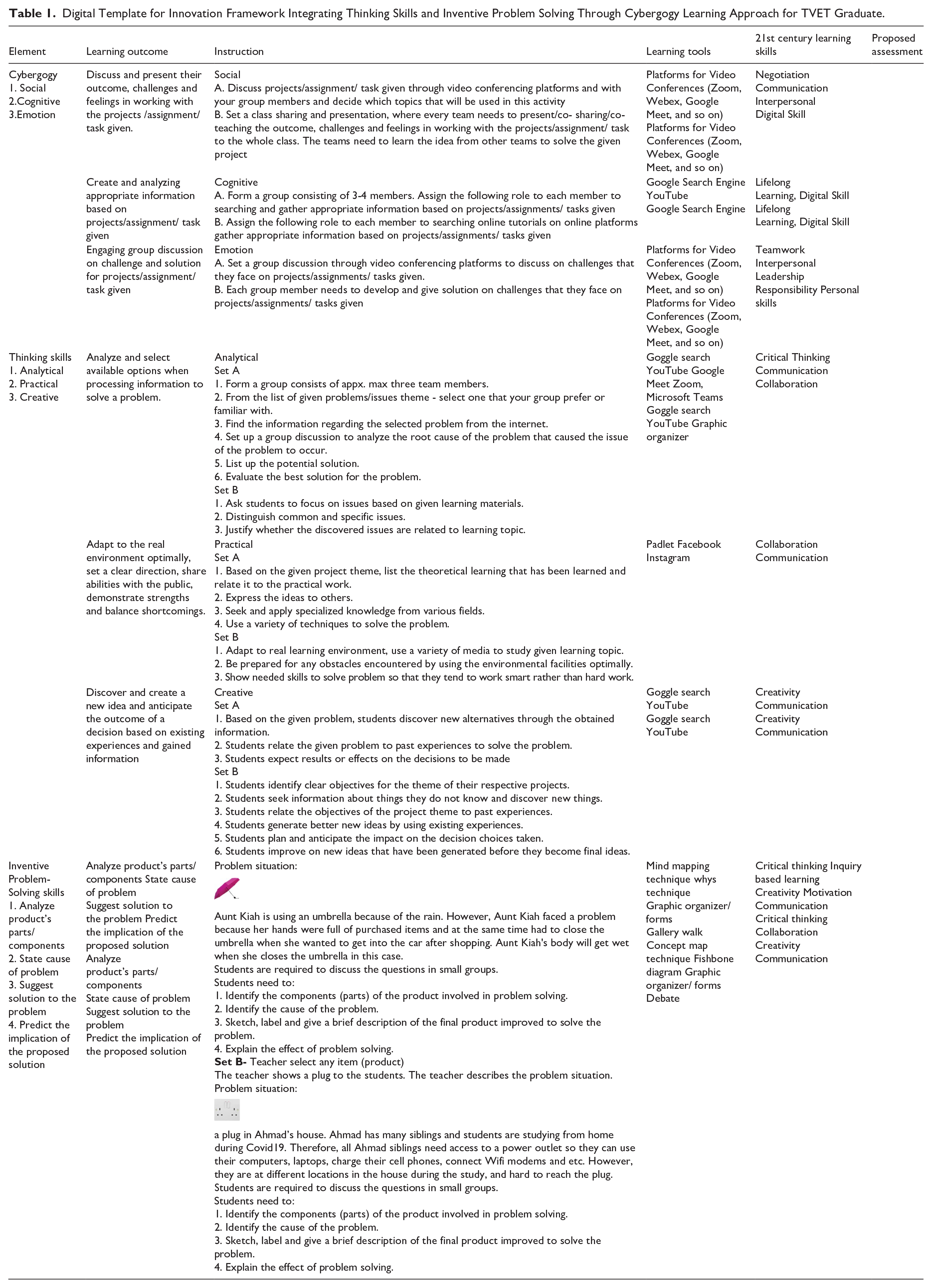
After the innovation framework of Thinking skills and Inventive Problem- Solving skills integration in cybergogy is obtained, the framework for the needs of the industry-based learning approach in this Vocational College will be used as the main reference in the development of the digital temple. The digital template will be used as a treatment for Thinking skills and Inventive Problem- Solving skills mastery through one type of learning approach namely Cybergogy. This template gives access to users, especially instructors, to be used in the learning and facilitation process. In addition to delivering the main teaching content to students, the authentic integration of Thinking skills and Inventive Problem- Solving skills can be done by the teacher at once. The development of this digital template is based on the Biggs Model, which is the design of the constructive alignment of the curriculum. However, the digital Template for Innovation framework Integrating Thinking Skills and Inventive Problem Solving Through Cybergogy Learning Approach for TVET Graduate Marketability in Industry showed in Table 1.
Digital Template for Innovation Framework Integrating Thinking Skills and Inventive Problem Solving Through Cybergogy Learning Approach for TVET Graduate.
Sample
The population for this study was 3,137 respondents. According to the table of Krejcie and Morgan (1970), the study sample was 346 respondents. After the study was conducted, the researcher received a total of 346 responses from respondents. Researchers have carried out data cleaning by identifying meaningless data that does not bring any meaning to the study. The participants were TVET learners who were enrolled in a technical vocational training program. The sample size was 164 TVET learners.
Instruments
This study used a questionnaire set method. A total of three sets of questionnaires have been developed representing the Thinking Skills questionnaire, the Inventive Problem-Solving questionnaire, and the Cybergogy questionnaire. The questionnaire was reviewed by five experts in the field from Universiti Teknologi Malaysia, Universiti Sains Islam Malaysia, Universiti Kebangsaan Malaysia and Universiti Teknikal Malaysia Melaka. As a result of the expert review, there are improvements in terms of sentence structure however no items from the questionnaire were discarded. Questionnaires were distributed to students through the Google Form method. The TVET learners can be exposed to the cybergogy approach, which includes online resources and activities that promote thinking skills and inventive problem-solving skills. For the cybergogy questionnaire divided to three factors (Cognitive, Emotion and Social) and it was conducted to 41 items after removed the unfit items, Thinking Skills questionnaire divided to three factors (Analytical, Creative and Practical) and it was conducted to 42 items after removed the unfit items. However, Inventive Problem-Solving questionnaire divided to four factors (Identifying the Cause Problem, Physical Conflicts, Selecting Problem Solving Tools and Inventive Principle) and it was conducted to 50 items after removed the unfit items.
Data Collection
Before the data collection of the actual study was carried out, all procedures were carried out, namely expert confirmation as well as a pilot study using the Rasch model to measure the type of item developed. After completing the procedure, study was carried out by distributing a set of questionnaires to nine Vocational Colleges divided by zone in Malaysia where each moderator was appointed by zone to facilitate the data collection process. The data collection period of the study was carried out simultaneously for all sets of instruments and completed within 3 months which is March 2022.
Validity and Reliability
In order to check the reliability of the item instrument, a pilot study was conducted. This pilot study also aims to detect any weaknesses such as the look and feel of the survey. The survey was sent to 100 respondents from the sample population. Results from pilot studies provide information for modifications survey sample. To validate the items, the reliability of the person (individual) and the item is used to the extent that the item is compatible (obeys the fit) with the Rasch Model and the item and person separation index. Reliability value more than 0.8 is an acceptable value, while a value between 0.6 and 0.8 is less acceptable and a value less than 0.6 is unacceptable (Bond & Fox, 2007).
Results of the Pilot Study
A pilot study was conducted at the South Zone Vocational College involving 100 students. The results of the pilot study on three instruments are shown in the Table 2.
Statistical Summary of the Reliability and Isolation Index of Instruments.

The results in Table 2 found that the value of person separation for Cybergogy is 5.08 which shows that there are five data groups that have the same perception of items (patterns). In addition, the separation item obtained a value of 1.74 which shows that there are two types of responses from the five scales provided (variety of responses), the value of person reliability and item reliability shows 0.96 and 0.75 where the findings are acceptable. However, thinking skills the value of person separation is 6.29 which shows that there are six groups of data that have the same perception of the item (pattern) and the item separation shows a value of 1.93 where it shows that there are two types of response from the five scales provided (variety of responses), the value of person reliability and item reliability shows 0.98 and 0.79 where the findings are acceptable. Based on the results of the pilot for problem solving skills, person separation with a value of 6.44 which shows that there are six data groups that have the same perception of the item (pattern) while for the separation item which obtained a value of 1.34 it shows that there is one type of response from the five scales provided (variety of responses), the value of person reliability and item reliability shows 0.98 and 0.64 where the findings are acceptable because a reliability value of more than 0.8 is an acceptable value, while a value between 0.6 and 0.8 is acceptable and a value less than 0.6 is unacceptable (Bond & Fox, 2007).
Item Fit
Next, in order to ensure the appropriateness of items or fit items that measure a construct or latent variable, the MNSQ outfit index value needs to be paid attention to first compared to the MNSQ infit where the infit and outfit values must be between 0.6 and 1.4. Based on the findings of the study, there are four items that are outside of the MNSQ outfit range that need to be removed from the cybergogy scale, there are three items that are outside of the MNSQ outfit range that need to be removed from the thinking skills scale, and there are five items that are outside of the MNSQ outfit range that need to be removed from the Inventive Problem-Solving Skills scale. The items are shown in the Table 3.
Items Eliminated According to Fit Item Values for Cybergogy, Thinking Skills and Inventive Problem-solving Skills Scales.

Data Analysis
The association between the TVET learners’ development of creative problem-solving and critical thinking abilities and their use of the Cybergogy approach can be ascertained by employing correlation analysis on the data. Non-parametric quantitative data analysis was utilized in this study since the data did not fit the assumptions of equal variances and normality. The data on the variables of interest, including means, standard deviations, and percentages, can be summarized using descriptive statistics. The association between the application of the Cybergogy approach and the development of critical thinking and creative problem-solving skills among TVET learners was investigated using correlation analysis and the Kruskal–Wallis H test. A Spearman’s rank correlation coefficient and Friedman test can be calculated to determine the strength and direction of the relationship.
Findings
First the researchers checked Descriptive statistics can be used to summarize the data on the variables of interest, including means, standard deviations, and normality test. The results showed in Table 4.
Kolmogorov-Smirnov and the Shapiro–Wilk test for Thinking skills and Problem-solving Skills.
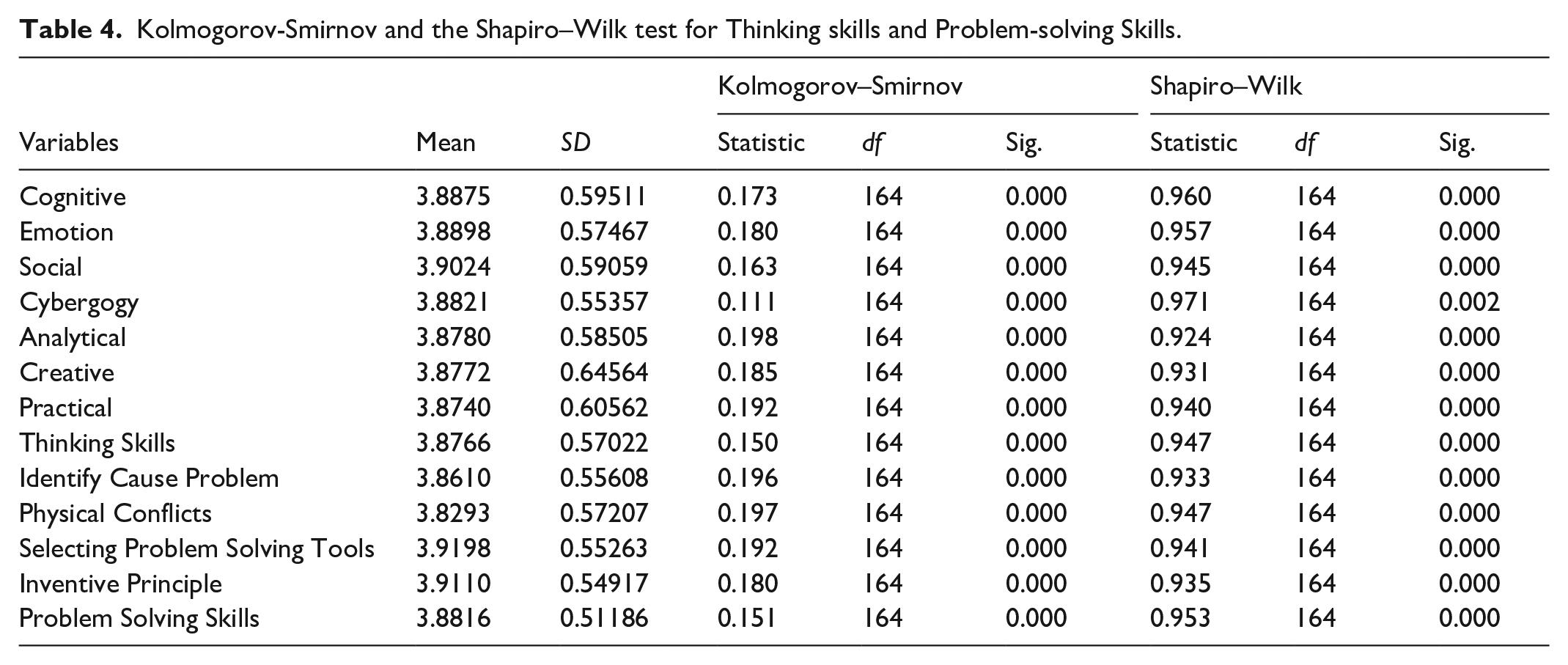
In Table 4 appears to show the results of normality tests performed on various measures. The measures include cognitive, emotion, social, cybergogy, analytical, creative, practical, thinking skills, identify cause problem, physical conflicts, selecting problem solving tools, inventive principle, and problem-solving skills. For each measure, the table lists the mean and standard deviation, as well as the results of two normality tests: the Kolmogorov-Smirnov test and the Shapiro–Wilk test.
It is usual practice to employ the Shapiro-Wilk test and the Kolmogorov-Smirnov test to ascertain if a particular sample of data is normally distributed. A p-value of less than .05 from either test indicates that the data may not be regularly distributed. All measurements in this study had both tests run, and the p-values that were produced were all less than .05. Consequently, it can be said that the data are not distributed regularly. Owing to this departure from normalcy, the researchers decided to evaluate the relationship between Cybergogy and critical thinking and problem-solving abilities using non-parametric tests like Spearman's rho correlation coefficient. Table 5 displays the particular outcomes of this analysis.
Spearman’s Rho Correlation Coefficient Between Cybergogy and Thinking Skills and Problem-solving Skills.
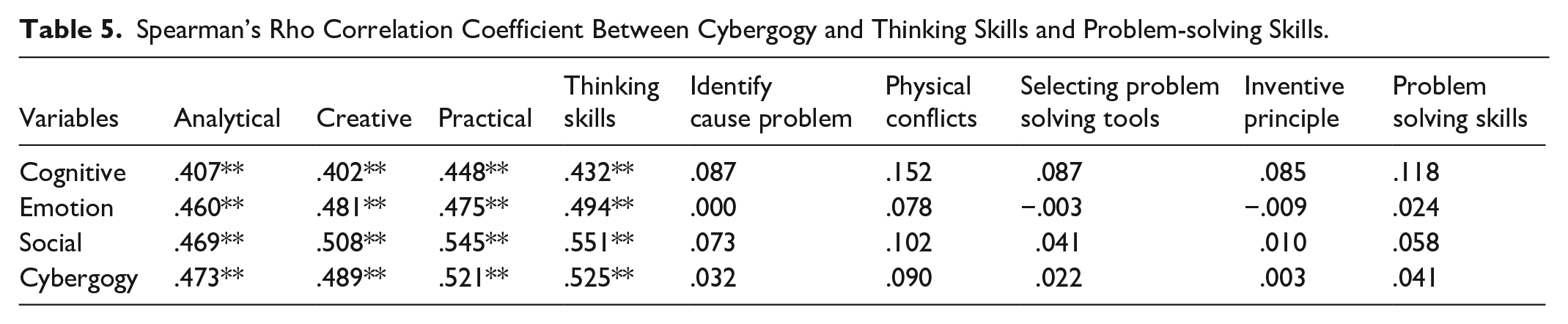
The Spearman’s rho correlation coefficients, together with their corresponding sub-components, were computed to ascertain the association between the utilization of Cybergogy and cognitive abilities such as thinking and problem-solving capabilities (Table 5). An indicator of the direction and intensity of a relationship between two variables is the Spearman's rho correlation coefficient. The table shows the computed Spearman’s rho correlation coefficient, which goes from −1 to 1, for each variable and sub-component. Strong positive correlations, where one variable tends to rise along with the other, are indicated by coefficient values closer to 1. On the other hand, a significant negative correlation is indicated by a coefficient value closer to −1, which means that as one variable rises, the other tends to fall. A coefficient value closer to 0 suggests no significant correlation between the two variables.
The results of the analysis show that there is a significant positive correlation between the use of cybergogy and thinking skills and problem-solving skills among TVET learners. For instance, the Spearman's rho correlation coefficient between cybergogy and practical thinking skills is 0.521, with a p-value of less than 0.05, indicating a statistically significant correlation. This suggests that the use of cybergogy is associated with the development of practical thinking skills among TVET learners. Similar patterns can be observed for the other variables and sub-components. Overall, the results suggest that the use of cybergogy is positively associated with the development of thinking skills and problem-solving skills among TVET learners. These findings could be useful for educators and policymakers in designing and implementing effective teaching strategies that incorporate cybergogy to enhance the learning experience and improve the skills of TVET learners. Additionally, these findings could inform future research on the development of skills in different domains and sub-components using innovative teaching approaches, such as cybergogy.
Relationship Between the Use of the Cybergogy Approach and the Development of Thinking Skills and Inventive Problem-solving Skills Among the TVET Learners
To measure the relationship between cybergogy and thinking skills and the relationship between cybergogy and problem-solving skills among TVET learners the researchers used Kruskal–Wallis H test as non-parametric test to found out the relationship between two variables or more wite more than group or levels. The results for Kruskal–Wallis H test showed in Table 6.
Test Statistics using Kruskal–Wallis H Test for the Relationship Between Cybergogy and Thinking Skills and Problem-solving Skills.

Table 6 reports the test statistics for various variables related to cognitive, emotional, social and cybergogy, and their sub-components of thinking skills (analytical, creative, practical) and identification of problem causes, physical conflicts, selection of problem-solving tools, inventive principle, and problem-solving skills as dependent variables. The test statistics are presented using Kruskal–Wallis H test, which is a non-parametric statistical test used to compare the medians of one group with more than one dependent variable.
For each variable and sub-component, the table reports the Kruskal–Wallis H statistic and its associated degrees of freedom (df), as well as the p-value, referred to as the asymptotic significance. The p-value indicates whether the differences observed between the groups are statistically significant or not. A p-value less than .05 means that the differences are statistically significant, while a p-value greater than 0.05 means that the differences are not statistically significant. Overall, the table showed that the Kruskal–Wallis H statistic for the cognitive variable ranges from 24.643 to 30.415 across the sub-components of Thinking skills, with p-values less than .05, indicating statistically significant difference using cybergogy to enhance thinking skills. Meanwhile, cognitive variable with problem solving skills range from 1.440 to 5.087 across the sub-components of problem-solving skills, with p-value greater than .05, indicating not statistically significant using cybergogy to enhance problem solving skills. For instance, the Kruskal–Wallis H statistic for the emotion variable ranges from 34.214 to 37.389 across the sub-components of Thinking skills, with p-values less than .05, indicating statistically significant difference using cybergogy to enhance thinking skills. Meanwhile, emotion variable with problem solving skills range from 1.026 to 1.428 across the sub-components of problem-solving skills, with p-value greater than .05, indicating not statistically significant using cybergogy to enhance problem solving skills. For instance, the Kruskal–Wallis H statistic for the social variable ranges from 34.316 to 41.371 across the sub-components of Thinking skills, with p-values less than .05, indicating statistically significant difference using cybergogy to enhance thinking skills. Meanwhile, social variable with problem solving skills range from 1.593 to 3.338 across the sub-components of problem-solving skills, with p-value greater than .05, indicating not statistically significant using cybergogy to enhance problem solving skills. For instance, the Kruskal–Wallis H statistic for the overall cybergogy ranges from 25.871 to 34.258 across the sub-components of Thinking skills, with p-values less than .05, indicating statistically significant difference using cybergogy to enhance thinking skills. Meanwhile, overall cybergogy with problem solving skills range from 3.455 to 5.131 across the sub-components of problem-solving skills, with p-value greater than 0.05, indicating not statistically significant using cybergogy to enhance problem solving skills.
Correlational Strength Between Thinking skills and Inventive Problem-Solving skills
To measure the Correlational strength between Thinking skills and Inventive Problem-Solving skills among TVET learners the researchers used Spearman’s rho correlation coefficient as non-parametric test to found out the relationship between two variables or more wite more than group or levels. The results for Spearman’s rho correlation coefficient showed in Table 7.
Spearman’s Rho Correlation Coefficient Between Thinking skills and Problem-solving Skills.

In Table 7, the results of the Spearman’s rho correlation analysis between thinking skills and inventive problem-solving skills, along with their sub-components, are presented. The Spearman’s rho correlation coefficient is a non-parametric statistical method that quantifies the strength and direction of the relationship between two variables. For each sub-component of thinking skills, the table displays the Spearman’s rho correlation coefficient with each sub-component of inventive problem-solving skills. The coefficient values range from −1 to 1. A coefficient value closer to 1 indicates a strong positive correlation, suggesting that as one sub-component of thinking skills increases, the corresponding sub-component of inventive problem-solving skills tends to increase as well. Conversely, a coefficient value closer to −1 indicates a strong negative correlation, implying that as one sub-component of thinking skills increases, the corresponding sub-component of inventive problem-solving skills tends to decrease. A coefficient value closer to 0 indicates no significant correlation between the two variables.
The analysis results indicate that there is no statistically significant correlation between thinking skills and inventive problem-solving skills, including their respective sub-components. This lack of correlation is evident in the specific example of the correlation coefficient between analytical thinking skills and selecting problem-solving tools, which is −0.028, with a p-value of .723. These values suggest that there is no meaningful relationship between these variables. Similar patterns of no significant correlation can be observed for the other sub-components as well. Overall, the findings suggest that the development of thinking skills does not necessarily correspond to the development of inventive problem-solving skills, and vice versa. These results have important implications for educators and policymakers. It highlights the need for tailored teaching strategies that address the specific needs and strengths of students in developing both thinking skills and inventive problem-solving skills. By recognizing the lack of correlation between these domains, educators can design targeted interventions and instructional approaches to foster these skills independently. Furthermore, these findings can guide future research in understanding the factors that influence the development of skills in different domains and sub-components. Exploring the potential factors that contribute to the development of thinking skills and inventive problem-solving skills separately may provide valuable insights for educational practices and curriculum design.
Discussion
The increasing integration of technology in education has paved the way for innovative pedagogical approaches, such as cybergogy, which is particularly relevant to Technical and Vocational Education and Training (TVET) learners. Cybergogy has the potential to enhance student engagement and motivation by creating an interactive, visually stimulating, and flexible learning environment. By leveraging digital tools, cybergogy provides learners with access to a vast repository of resources that facilitate learning and problem-solving. Moreover, its emphasis on thinking skills and inventive problem-solving aligns with the competencies required in technical and vocational fields, where learners must critically, creatively, and analytically address complex challenges.
Despite these advantages, the effectiveness of cybergogy in fostering problem-solving skills among TVET learners remains questionable when applied in isolation. Unlike conventional academic disciplines, TVET programs heavily rely on hands-on training, physical interaction with tools, and exposure to real-world problem-solving scenarios. The reliance on digital learning environments alone may not adequately support the development of practical skills that are essential for effective problem-solving in technical fields. This limitation is particularly evident when considering the need for direct engagement with equipment, tools, and materials, which cannot be entirely replicated in virtual learning spaces.
Another critical challenge of cybergogy in TVET contexts is the limited opportunities for industry engagement and mentorship. TVET learners benefit greatly from interactions with industry experts and professionals, who provide insights into real-world challenges and the problem-solving strategies employed in professional settings. Self-directed and digital learning models may not fully facilitate these essential exchanges, potentially leaving learners without the necessary contextual understanding to apply their skills in authentic workplace scenarios. Furthermore, problem-solving in technical fields often requires collaborative efforts, where individuals work together to devise innovative solutions. However, cybergogy-based methods may not always provide sufficient opportunities for learners to engage in meaningful collaboration, as virtual platforms may lack the depth of interaction found in face-to-face learning environments.
Feedback mechanisms also play a crucial role in skill development, particularly in practical applications. In traditional TVET settings, instructors provide immediate and hands-on feedback to students, allowing them to refine their techniques and approaches. Cybergogy methods, while capable of offering automated assessments and peer feedback, may not always capture the nuances of hands-on skill development. The absence of direct, instructor-led feedback in practical applications could hinder learners from recognizing errors, refining techniques, and achieving proficiency in real-world problem-solving. Additionally, exposure to real-world contexts is essential for developing effective problem-solving skills, as learners need to apply theoretical knowledge in diverse, unpredictable situations. Cybergogy-based learning environments, particularly those that do not incorporate simulations, case studies, or real-world applications, may fall short in bridging this gap.
When comparing this study to recent research, several key distinctions emerge. Previous studies, such as Al-Daraiseh and Al-Shboul (2017), have demonstrated that interactive multimedia, including videos and simulations, can enhance problem-solving skills among technical college students. Similarly, Alqurashi and Alshumaimeri (2020) found that blended learning—which integrates traditional instruction with online learning—can effectively promote critical thinking skills. Karim et al. (2019) further emphasized the role of educational games in fostering creative thinking among technical college students. These studies highlight that technology-enhanced learning can support cognitive skill development when strategically designed. However, they also suggest that hybrid models—rather than purely digital methods—are more effective for fostering higher-order thinking and problem-solving skills in TVET learners.
This study builds upon these findings by emphasizing the necessity of integrating cybergogy with more hands-on, experiential learning approaches. While cybergogy can provide an engaging and flexible learning experience, its impact on problem-solving skills is maximized when combined with other methodologies, such as blended learning, industry mentorship programs, and structured collaborative problem-solving tasks. Future research should explore hybrid instructional models that merge cybergogy with real-world case studies, scaffolded learning experiences, and hands-on skill development opportunities to create a more holistic and effective learning environment for TVET students.
Conclusion
The findings of this study highlight the potential of cybergogy in fostering thinking skills and inventive problem-solving abilities among TVET learners in today’s digital landscape. As industries demand adaptability to rapidly evolving technologies, learners must develop critical thinking, creativity, and decision-making skills. This study demonstrates that while cybergogy offers opportunities for self-directed and technology-mediated learning, its effectiveness depends on well-structured instructional strategies. To enhance thinking skills and problem-solving abilities, educators should design learning experiences that integrate digital tools such as simulations, gamified learning environments, and interactive multimedia. Assignments should require learners to critically analyze information, engage in decision-making, and solve real-world problems. Collaborative learning activities and structured feedback mechanisms can further enhance creativity and innovation. Additionally, scaffolded learning approaches can support students in navigating complex digital resources effectively. The study also provides valuable insights for TVET instructors by identifying effective teaching strategies that promote critical thinking and problem-solving. By leveraging digital tools appropriately, educators can create engaging and meaningful learning experiences that prepare students for the workforce. These findings contribute to the advancement of TVET education by informing the development of instructional practices that improve learner outcomes, enhance employability, and ultimately strengthen the quality of vocational education and training.
This study has several limitations that should be considered when interpreting the findings. First, while cybergogy has shown potential in fostering thinking and problem-solving skills among TVET learners, its effectiveness may vary across different TVET programs due to variations in curriculum structure, learner characteristics, and institutional support. Additionally, the study primarily focused on specific digital tools and pedagogical strategies, which may not comprehensively represent the full range of cybergogy applications in diverse educational settings. Another limitation is the potential influence of external factors such as students’ prior exposure to technology, learning styles, and instructor expertise, which may have affected the outcomes but were not extensively examined in this study.
Based on these limitations, several recommendations for future research and practice are proposed. Future studies could explore the integration of various educational technologies, such as artificial intelligence-driven learning platforms, virtual and augmented reality, or adaptive learning systems, to enhance the effectiveness of cybergogy in TVET settings. Additionally, investigating the impact of blended learning approaches that combine cybergogy with hands-on, experiential learning could provide deeper insights into optimizing teaching strategies for skill-based education. Longitudinal studies examining the long-term effects of cybergogy on learners’ critical thinking, problem-solving, and employability outcomes would also be beneficial. Lastly, future research could analyze the role of instructor training and support mechanisms in improving the implementation and effectiveness of cybergogy in TVET programs. By addressing these areas, future studies can contribute to a more comprehensive understanding of how cybergogy can be effectively tailored to different TVET programs, ensuring its broader applicability and impact on learner success.
Footnotes

Author Contributions
All authors listed have significantly contributed to the development and the writing of this article.
Funding
The author(s) disclosed receipt of the following financial support for the research, authorship, and/or publication of this article: The research was supported by Ministry of Higher Education (MOHE) through Research Excellence Consortium Grant Scheme (Vot K352).
Declaration of Conflicting Interests
The author(s) declared no potential conflicts of interest with respect to the research, authorship, and/or publication of this article.
Data Availability Statement
The datasets generated during and/or analyzed during the current study are available from the corresponding author on reasonable request.