




Abstract
This research examines primary school teachers’ perceptions of organizational justice, trust, and citizenship. The study was conducted with randomly selected 414 primary school teachers working in state schools in six districts.. “Personal Information Form,” “Organizational Justice Scale,” “Organizational Trust Scale,” and “Organizational Citizenship Scale” were used to collect the data. A correlational scanning model was used in the study. Participants scored highly on the Distributive Justice, Interactional Justice, and Procedural Justice dimensions of the Organizational Justice Scale and generally on the Organizational Justice Perception scale. Teachers scored high on the sub-dimensions of Organizational Commitment, Autonomy and Initiative, and Voluntary Participation sub-dimensions of the Organizational Citizenship Scale.Teachers have scored moderately on Respect and Cooperation, Harmony and Obedience, Selflessness, and Conscientiousness sub-dimensions, but have scored low on the overall Organizational Citizenship Perception scale. The strong correlation between teachers’ organizational citizenship behaviors and their perception of organizational trust highlights the potential for schools to build trust and foster active teachers’ participation in school processes. When schools have a strong grasp of justice and foster a culture of trust, it can positively impact school effectiveness and performance. This study offers valuable insights for developing effective strategies aimed at creating a healthier work environment and improving communication within educational institutions. As the first study of its kind conducted in North Cyprus, it serves as a crucial resource for future research in this area, enhancing its significance. In addition, these findings can be valuable for managers, leaders, and researchers seeking to improve the internal dynamics of schools.
Keywords
Introduction
The meaning of organizational justice is the employees’ fairness perception in an organization (Golverdi et.al, 2024) including the fair treatment of employees, and fairness of decisions and procedures within organizations (Wan, 2016). Interpersonal justice, procedural justice, informational justice, and distributive justice are its dimensions (Colquitt et al., 2001). Procedural justice suggests that people judge fairness on the outcomes, decision-making, and participation opportunities (Rastegar & Lisa Ruhanen, 2022). Distributive justice is the fair distribution of workplace resources and rewards to employees. Employees evaluate distributive justice based on their perception of whether resources such as promotions, salaries, rewards, and benefits are shared equally or fairly. Interpersonal justice brings upon perceptions of fair treatment in interpersonal interactions, while informational justice casts perceptions of adequate and truthful explanations (Colquitt et al., 2001).
Organizational justice refers to teachers' overall perception of fairness in how they are treated within a school environment (Burns & Dipaola, 2013) and relates to creating a fair environment among management, teachers, staff, students, and parents in educational institutions. Organizational justice for teachers involves fairly distributing workload, conducting performance evaluations, and providing equal promotion opportunities. This concept applies to various areas, including decision-making processes and resource allocation. It is important to create a working environment that supports teachers' professional development and allows them to utilize their talents effectively (Aydınlık, 2023). Past studies have indicated that organizational justice is positively related to organizational citizenship behavior (Cohen & Eyal, 2015), encouraging teachers to assist their colleagues in the workplace (Yuen Onn et al., 2018). When teachers feel they are treated fairly by their school principals, they experience greater satisfaction and positive emotions, which boosts their confidence in achieving the school’s common goals (Pérez-Rodríguez et al., 2024).
Ensuring organizational justice includes preserving the rights of the school community members and ensuring equal access to opportunities. In the case of students, organizational justice means fairly implementing educational and disciplinary policies. It’s important to use a fair approach when evaluating, rewarding, and disciplining students for their achievements. Every student should have equal opportunities in education (Polat & Celep, 2008). For staff, organizational justice means ensuring fair and safe working conditions, as well as transparent and objective recruitment and promotion processes. Protecting personnel rights and promoting justice in the workplace can lead to greater job satisfaction and increased productivity. For parents, organizational justice is characterized by ensuring equal access to opportunities to communicate and collaborate with school administration. Taking into account parents' concerns and suggestions can foster greater participation in decision-making processes and strengthen school-community relations (Aydınlık, 2023). To ensure organizational justice in schools, it is essential to focus on a few basic elements:
Transparency in Decision-Making Processes: Transparency in decision-making processes plays a critical role in the management of a school and community participation. The school administration should share with the community how the decision-making processes work, what factors are considered, and why a decision is made. Transparency allows community members to be informed about the school administration and helps build trust, encourages everyone to participate in decisions and makes school members feel more connected to the school administration, provides accountability, increases the effectiveness of the school administration, and encourages satisfaction and participation of school members (Kurtcu, 2021).
Equal Opportunities: Equal opportunities are one of the core values of a school and are necessary for each student to realize their potential. The school should provide equal education and opportunities to all students, regardless of differences such as gender, race, economic status, or learning level. Equal opportunities in education mean that students have equal access to the resources, support, and opportunities needed for their educational success. This allows students to develop their abilities and potential and increases the likelihood of each student achieving the highest level of success. The school should take various steps to provide equal opportunities in education. These steps include providing educational materials and resources according to the needs of each student, providing special education and guidance services to support students, and ensuring that teaching methods support different learning styles. School administration and teachers should not allow any discrimination or discriminatory practices among students and should protect the rights and dignity of each student. This ensures that the school community feels that it is in an environment based on equality and justice (Macit & Aydoğan, 2023).
Communication and Feedback: Communication and feedback are essential elements for a school community to function properly. Communication involves the exchange of information, emotional connection, and interaction between school administrators, teachers, students, parents, and other stakeholders. Clear and effective communication facilitates problem-solving, encourages collaboration, and helps build trust. School administration should use a variety of communication channels to ensure effective communication between teachers, students, and parents.Tools such as announcements, emails, websites, social media, and school meetings can help convey important information to community members. Interactive communication methods such as individual interviews and parent-teacher meetings strengthen personal connections and encourage collaboration (Demir, 2021). Feedback is an important tool for evaluating and improving the performance of students, teachers, and parents. Feedback to students improves the learning process and allows students to recognize and develop their strengths. Feedback to teachers and other staff members supports professional development, encourages collaboration, and strengthens teamwork. Feedback to parents helps them monitor the student's academic and social development and creates a supportive environment at home. Communication and feedback increase trust in the school community, encourage collaboration, and increase student achievement. Open and effective communication facilitates problem-solving and makes community members feel heard and supported. Feedback improves the performance of students, teachers, and parents and increases the quality of the school. Therefore, school administrators and staff should carefully manage communication and feedback processes and encourage the participation of community members (Uslu, 2023).
Commitment to the Principles of Justice and Transparency:** Justice means recognizing that all community members have equal rights and opportunities and acting according to that understanding. Transparency involves clearly and understandably communicating decision-making processes and practices while encouraging community members to engage in these processes. By upholding the principles of justice and transparency, school administration builds trust within the community and earns its respect. Justice ensures that discipline policies and rules are applied fairly, allowing every student to feel that their rights are protected and that everyone is held to the same standards. The equitable distribution of resources and opportunities reinforces the sense of equality and justice among community members (Toker & Doğan, 2023).
Professional Development Opportunities: Professional development opportunities are an important support provided to increase the skills of a school's staff, update their knowledge and skills, and adopt best practices. School administration should support and encourage the continuous professional development of teachers and other staff. Professional development opportunities can be provided in various ways to improve teachers’ pedagogical skills, learn new teaching methods and technologies, and provide better education to students. Seminars, workshops, conferences, and online training can provide teachers with new ideas and strategies. Teacher collaboration and mentoring programs also enable teachers to learn from each other and grow together (Ergin, 2022; Gençer Öztan, 2022).
Organizational citizenship behavior in schools encompasses student behaviors that extend beyond academic performance and contribute positively to the overall functioning and atmosphere of the school. These behaviors are intended to enhance the school's success, improve relationships between students and teachers, and promote solidarity and cooperation among students. According to Demir (2021), organizational citizenship behavior in schools typically manifests in the following ways
Volunteering: Activities, projects, or community service activities that students volunteer for at school constitute one aspect of organizational citizenship behavior, such as participating in school activities, cleaning the school grounds, or being active in student clubs within the school. Volunteering also contributes significantly to the personal development of individuals. Volunteering activities develop empathy, increase communication skills, and provide the opportunity to meet new people. In addition, thanks to volunteering, individuals discover and develop their talents and feel more valuable (Toker & Doğan, 2023).
Helpfulness and Solidarity: Helpfulness occurs when an individual extends support to others in need, whether through material assistance or emotional support. This kind of aid can significantly impact people's lives. In contrast, solidarity involves individuals uniting and acting together toward a common goal. By combining their strengths, they can take larger and more effective actions. Both helpfulness and solidarity enhance the social fabric of society and foster trust among individuals. They also cultivate empathy, contributing to the development of a more understanding community (Polat & Celep, 2008).
Compliance with School Rules: Compliance with school rules ensures that students contribute to the overall functioning of the school and that the school operates in an orderly and peaceful environment. Compliance with school rules is an important behavior that ensures that students behave in a disciplined and responsible manner in the school environment. These rules are determined to protect the safety of students, the quality of education, and general order. Compliance with school rules teaches students to respect the rules they live in society, to take responsibility, and to be mature individuals (Elagöz & Elagöz, 2023; Toker & Doğan, 2023).
Leadership and Assuming Responsibility: Leadership involves students having a vision, influencing others, and guiding them (Polat & Celep, 2008). When a student acts as a leader, he/she inspires others, encourages cooperation, and strives to achieve common goals. Taking responsibility refers to students developing a sense of responsibility towards themselves and their environment. When a student takes responsibility, he/she completes the assigned tasks on time and regularly, accepts his/her mistakes, and is open to development. Leadership and taking responsibility increase students' self-confidence, develop leadership skills, and strengthen teamwork abilities. It creates a positive impact on the school community, encourages solidarity and cooperation among students and positively affects the general atmosphere of the school (Yurdakul et al., 2023).
The current research suggests that the engagement of teachers in organizational citizenship behavior positively impacts overall school performance (Choong & Ng, 2023), improves the achievement of students (Choong et al., 2020), and enhances the reputation of the schools (Oplatka, 2009).
Organizational trust in schools encompasses the feelings of belief, respect, and trust among stakeholders, including teachers, students, parents, and school administration. Trust plays a crucial role in strengthening relationships and cooperation within the school, contributing significantly to its overall success and effectiveness. It is built upon open communication, cooperation, and mutual respect. When teachers and administrators demonstrate transparent and fair behavior, it enhances the trust of students and parents in the school. In addition, mutual respect and understanding in student-teacher relationships increase students’ confidence and commitment to school. Organizational trust within schools greatly influences the overall atmosphere. In a trust-based environment, employees and students are more motivated, collaborate better, and experience higher job satisfaction. This not only improves students’ learning outcomes but also allows teachers and administrators to perform their roles more effectively (Zengin, 2020). Organizational trust in schools also impacts relationships with parents. When parents trust the school, they become more actively involved in their children's education and provide greater support for school activities. This strengthens the connection between the school and the community, as well as enhancing the school's role within society. Organizational trust within schools is a crucial factor that determines the overall effectiveness and success of the school. In an environment of trust, teachers, students, and parents are more motivated, cooperate more effectively, and achieve a higher level of success. Therefore, schools need to prioritize the encouragement and support of organizational trust (Uyar Bulut, 2018). When teachers are treated fairly in schools, they trust their principals more. This trust can lead to teachers demonstrating positive citizenship behaviors that benefit students, colleagues, and the overall success of the school (Kasekende et al., 2016).
Importance of the Research
It is apparent that justice, citizenship, and trust in organizations have been extensively researched across various types of organizations, outside of the education sector. However, there are limited studies focusing on these aspects within educational organizations (Baş & Şentürk, 2011).
This study aims to provide valuable insights for developing effective strategies to create a healthier work environment and improve communication within educational institutions. In addition, no study incorporating these three concepts has been previously conducted in North Cyprus. Therefore, it is believed that this study will provide a valuable contribution to the existing literature and can serve as a resource for future studies.
Theoretical Background
Organizational Justice
Organizational justice is a concept that employees perceive as to whether the decisions taken, policies implemented, and behaviors performed for them in their organization are fair or not. This concept shapes employees' experiences at work and affects their commitment, trust, and motivation in the work environment. The three main dimensions of organizational justice are procedural justice, interactional justice, and distributive justice. While procedural justice involves perceptions of whether decision-making processes and implemented policies are fair, distributive justice indicates fair distribution of rewards and resources. Interactional justice focuses on whether people's interactions with others are fair.Organizational justice has a positive impact on job performance and employee satisfaction by enhancing their confidence in both their roles and the organization as a whole. Therefore, it is essential for businesses to actively promote organizational justice and strengthen employees’ perceptions of fairness (Yüksel, 2015). When employees perceive their workplace as fair, it builds trust and boosts their motivation and commitment. Conversely, a sense of injustice can diminish work motivation and increase the desire to leave a job. This is particularly significant in professions such as teaching, where interpersonal relationships are crucial. Teachers expect fairness in their interactions with students, in their relationships with administrators, and in the distribution of their workloads. Thus, ensuring organizational justice not only contributes to the personal well-being of individuals but also positively influences the overall performance of the organization.
In summary, organizational justice is an indispensable element for the sustainable success of businesses and increases the success of businesses by strengthening employees’ confidence in their jobs (Yılmaz & Bilir Güler, 2018).
Organizational Justice Dimensions
Organizational justice is examined in three basic dimensions, where employees in a business perceive whether the behaviors they experience, decision-making processes, and resources are fair. First, distributive justice focuses on whether employees' distribution of resources and rewards at work is fair. Employees evaluate distributive justice based on their perception of whether resources such as promotions, salaries, rewards, and benefits are shared equally or fairly. Second, procedural justice is the perception of whether workplace decision-making processes and implemented policies are fair. Employees evaluate procedural justice according to the presence of elements such as participation in decision-making processes, transparency, impartiality, and compliance with the rules. Finally, interactional justice focuses on whether employees’ interactions with others in the workplace are fair (Yoldaş, 2018).
Employees want to feel that relationships with their managers, colleagues, and other colleagues are fair, supportive, and respectful. When these three dimensions come together, employees feel a kind of balance and equality at work, which positively impacts job satisfaction, commitment, and performance. Organizational justice underpins businesses' efforts to manage social interactions and increase employee motivation. Therefore, businesses need to make efforts to ensure these three justice dimensions and strengthen employees' perceptions of justice. Organizational justice is the concept that employees in a business or organization perceive about whether the situations, policies, and decisions they encounter at work are fair or not. This perceived fairness involves employees’ evaluation of whether their treatment, rewards, and resources are fairly distributed (Çetin & Güney, 2019).
Factors Affecting Organizational Justice
When the factors affecting organizational justice are examined in the literature, we see that these factors are grouped under six main headings:
Leadership Style (Aslan, 2018; Çetin & Güney, 2019; Çoban & Deniz, 2021; Çolakoğlu et al, 2019)
Decision Making Processes (Demir, 2021; Yalçin, 2021)
Communication (Akpolat & Oğuz, 2022; Kurtcu, 2021)
Corporate Culture (Gültekin, 2021; Kaya, 2022)
Training and Development Opportunities (Akay, 2020; Çankaya, 2020)
Application of Rewards and Punishments (Demir, 2021; Kurtcu, 2021).
Consequences and Effects of Organizational Justice
Organizational justice provides a fair business environment that produces various positive results (Kurtcu, 2021). These results:
Employee Satisfaction and Loyalty (Eryiğit, 2021; Karakuzu, 2023).
Motivation and Performance (Bayrak, 2021).
Intra-Business Communication and Collaboration (Dumlu, 2021; İlğan, 2021).
Conflict and Stress Reduction (Demir, 2021).
Increase in Business Reputation and Creation of Employer Brand (Kurtcu, 2021).
Organizational Citizenship
Organizational citizenship is the tendency of individuals working within an organization to contribute to increasing the success of the workplace by voluntarily making extra efforts outside of their duties. This concept refers to employees working to make a positive contribution to the workplace and their colleagues, rather than thinking only about themselves and their work. Organizational citizenship behaviors encourage teamwork and collaboration by creating a positive environment in the workplace. For example, an employee can help colleagues, suggest new ideas, support the goals of his organization, and make suggestions for improvement.These behaviors improve the organizational atmosphere, increase employee motivation, and strengthen employees' commitment to the organization. Organizational citizenship affects not only individual performance but also the overall success of the workplace. Solidarity and support among employees reduce stress in the workplace and increase productivity. Positive behaviors enhance organizational success and improve public perception. Organizational citizenship behaviors become part of the organizational culture and can have a positive impact not only among employees but also on other stakeholders of the business. Therefore, organizations should develop appropriate reward and recognition systems and provide a supportive environment for their employees to encourage organizational citizenship behaviors (Polat & Celep, 2008).
Organizational Citizenship Behavior Dimensions
Organizational citizenship behavior (OCB) is a significant concept examined in the business literature and increases business success. OCB generally has five basic dimensions. These are used to measure employees’ behavior and contributions at work. The first dimension is called organizational cooperation. This dimension assesses employees’ tendency to help coworkers. For example, behaviors such as supporting colleagues, sharing knowledge and experience, solving problems together, or sharing the workload are evaluated under this dimension. The second dimension is called spontaneous initiative. This dimension measures employees’ voluntary initiative and extra effort. Behaviors such as proposing new ideas to achieve business goals, making extra efforts to improve business processes, or solving business-related problems are examples of this dimension. The third dimension is called sensitivity. This dimension assesses employees’ tendency to be sensitive to and provide support to the needs of the business and co-workers. Realizing that colleagues are going through a difficult time and volunteering to support them or meet the needs of the business are evaluated under this dimension. The fourth dimension is called organizational justice. This dimension evaluates employees’ tendency to comply with business policies, treat co-workers fairly, and create a fair environment that supports the company's goals. The fifth dimension is called responsibility. This dimension measures the tendency of employees to take personal responsibility for the success of the business and take an active role in business-related matters. Behaviors such as protecting the reputation of the business, ensuring customer satisfaction, and contributing to the general goals of the business are evaluated under this dimension (Demir, 2021).
Organizational Trust
Organizational trust is established through open communication, fair treatment, reliability, and mutual support, forming the foundation for effective organizational functioning. The importance of organizational trust emerges when employees trust each other and their organizations. Trust makes it easier for employees to cooperate, and share their knowledge and experiences, and strengthens teamwork. In an environment of trust, employees work with higher motivation, take initiative, and contribute more effectively to the goals of the organization. Organizational trust reduces workplace stress, prevents conflicts, and increases job satisfaction and commitment. When employees work in a reliable environment, they feel happier and more peaceful, and their work performance increases accordingly. Establishing and maintaining organizational trust is important for organizations. Leaders should reassure employees and foster an environment of trust through open communication and fair behavior. They should support activities and programs that will strengthen trust relationships between employees and make efforts to develop the trust culture of the organization. In this way, ensuring organizational trust becomes a critical factor for the sustainable success of the organization (Demir, 2021).
Organizational Trust Dimensions
This concept is generally examined in three basic dimensions: interpersonal trust, top-management trust, and organizational justice. Interpersonal trust refers to employees’ feelings of faith and trust in each other. This dimension underpins relationships between coworkers and influences work processes such as collaboration, sharing, and support. Open communication, consistency, and reliable behavior among employees contribute to the formation of trust between individuals. Top-management trust refers to employees’ belief and trust in the organization’s top managers. This dimension focuses on leaders’ transparency, fair behavior, and trustworthiness. When employees trust their senior management, they have more respect for their decisions and guidance and feel more committed to the overall goals of the organization (Özdoğru & Güçlü, 2021). If organizational justice is achieved, employees feel valued and are more committed to their organizations. These dimensions of organizational trust ensure that relationships and functioning within an organization are maintained in a healthy manner. Establishing and maintaining trust is a process that must be encouraged and supported by leadership. In this way, organizations enable employees to collaborate, increase their productivity and ensure their success in a sustainable way (Dodurga, 2020).
Related Research and Importance of Research
When the literature is examined, studies conducted on organizational citizenship in which teachers take part as participants are the researches of Basım et al. (2009); Farooqui (2012); Martinez (2012); Korkmaz and Arabacı (2013); Erbir (2023); Choong et al. (2024). Basım et al. (2009) revealed that there is a positive relationship between the learning organization levels of people working in an organization and their organizational citizenship behaviors. Farooqui (2012) suggested that all levels of organizational climate were positively linked to all levels of organizational citizenship behaviors. Martinez (2012) emphasized that organizational citizenship behavior plays an important role in the school environment and increases teachers’ motivation, job satisfaction, and performance. Korkmaz and Arabacı (2013) claimed that factors such as the type of school, their positions, and their fields of work can have an impact on their perception of organizational citizenship. Erbir (2023) found significant correlations between the level of organizational commitment and organizational citizenship behavior. Choong et al.(2024) indicated that distributive justice is the most significant dimension of organizational justice that influences organizational citizenship behavior and collective efficacy mediates the relationship between organizational citizenship behavior and organizational justice partially.
Studies examining teachers’ perceptions regarding organizational justice include Terzi et al. (2017); Çağlayan and Ari (2017); Yalçın and Özbaş (2021); Karagöz (2021), Demir (2021), Eyigün (2022); Saydam and Selvi (2023); Kılıç and Aydın (2024); Balcı (2024); Gülbahar et al.(2024); Kocabaş and Karabağ Köse (2024); Çavuşoğlu and Şeker (2024). Terzi et al. (2017) revealed that by promoting fairness in educational organizations, managers can increase employee commitment and participation in work. Çağlayan and Ari (2017) found a moderate to low level of positive relationship between dimensions of organizational justice and various aspects of organizational commitment among teachers.The study of Yalçın & Özbaş (2021) found that organizational justice and perceived organizational support are significant predictors of academics’ organizational cynicism. Eyigün (2022) revealed that there is a highly significant negative correlation between organizational justice and organizational cynicism. Karagöz (2021), Demir (2021) indicated a positive linear relationship between teachers’ perceptions of organizational justice and their levels of organizational commitment in their studies. Kılıç and Aydın (2024) determined that the distributive justice and interactional justice sub-dimensions of the organizational justice scale did not significantly predict the intention to leave the job. It was determined that the distributive justice and interactional justice sub-dimensions of the organizational justice scale significantly and positively predicted the school commitment sub-dimension of the subjective well-being scale. It was determined that the school commitment and teaching competence sub-dimensions of the subjective well-being scale did not significantly predict the intention to leave the job. It was determined that subjective well-being was a partial mediator variable in the relationship between organizational justice and intention to leave the job. Balcı (2024) indicated that there is a moderate positive relationship between the arithmetic means of organizational commitment and organizational justice scores of the teachers who participated in the research. Gülbahar et al.(2024) revealed a low-level negative linear relationship between organizational justice and interactional justice and the school environment dimension of organizational silence, a low-level negative linear relationship between all dimensions of organizational justice and the emotional dimension of organizational silence, and a low level negative linear relationship between organizational justice and procedural justice and the source dimension of organizational silence. The study of Kocabaş et al.(2024) determined that there is a significant, positive and moderate relationship between teachers' organizational justice perceptions, organizational commitment and job satisfaction. The research results showed that the indirect effect of organizational justice on job satisfaction through organizational commitment is stronger than its direct effect. Çavuşoğlu and Şeker (2024) revealed that teachers have a positive perception of organizational justice if they are treated fairly.
The number of studies on organizational trust in which teachers participate as participants is very few. These studies include Yücel et al. (2024) and Liu et al.(2024). Yücel et al. (2024)emphasized that factors such as age, education level, and length of service in the institution should be taken into consideration to increase the organizational trust levels of teachers. Liu et al. (2024) indicated that organizational trust has significant mediating effects on the relationship between teacher well-being and distributed leadership
Polat and Celep (2008) and Baş and Şentürk (2011) researched the perceptions of teachers about these three organizational topics in Turkey and found that primary school teachers had positive and high organizational justice, organizational citizenship, and organizational trust perceptions in their schools. In the study conducted by Polat and Celep in 2008, a positive moderate interaction was found between teachers’ perception of organizational justice and organizational citizenship behavior. Also, teachers’ perception of organizational justice has a positive effect on organizational citizenship behaviors.
Çetinkaya and Çimenci (2014) researched the effect of organizational justice on organizational citizenship behavior and the mediating role of organizational identification. This study analyzed the interaction between organizational justice perception and organizational citizenship behavior using structural equation modeling and determined whether organizational identification is a mediator in this interaction. Many studies are showing that there are positive interactions between organizational justice and organizational citizenship behaviors. Moorman et al. (1993) stated that there were positive and significant relationships between procedural justice and organizational citizenship behavior, and Tansky (1993) between the perception of organizational justice as a whole and the altruism and conscientiousness dimensions of organizational citizenship. Such studies reveal that the perception of justice within the organization positively affects the organizational citizenship behavior of employees. İşcan and Sayın (2010) aimed to examine the interaction between organizational trust and organizational justice. The findings showed that the rise or fall in perceptions of organizational justice had a similar effect on organizational trust. Thus, a strong relationship was determined between organizational trust and procedural justice, and a significant relationship was also found between distributive justice and organizational trust. The results of the study reveal that the trust that employees have in their managers and the organization, in general, is strongly associated with their belief that the decisions taken by managers in particular, and the organization in general are fair. This shows that perceptions of organizational justice play a critical role in employees' formation of trust in the organization. The study conducted by Baş and Şentürk (2011) showed that primary school teachers are generally positive about organizational justice and organizational trust. However, it was determined that teachers’ perception of justice in their relationships with administrators was lower and the trust in administrators was lower than in other relationships. Such studies are important for understanding and improving organizational dynamics in educational institutions.
Ersan (2018) found positive and significant interactions between dimensions of organizational trust and dimensions of organizational citizenship behavior and suggested that employees tend to exhibit organizational citizenship behaviors to the extent they trust the organization. That is, employees in a trusting environment tend to show more involvement, helpfulness, and responsibility for their organizations. Polat and Celep (2008) found that the participating teachers’ perceptions of organizational justice, organizational trust, and organizational citizenship behavior were at high levels; and they determined that these three important organizational concepts are interrelated. On the other hand, Yılmaz (2009) showed no significant interaction between teachers’ views on organizational trust, trust in people they work with, trust in stakeholders and trust in the principal, and their organizational citizenship behaviors.
Günaydın (2001) conducted a study in private enterprises and found that distributive justice did not predict trust in managers. However, he identified other dimensions of justice—specifically procedural justice and practical justice—as significant predictors of trust in management. Demircan (2003) also discovered that procedural justice is the most important factor influencing students’ trust in their principals. In other words, students’ perceptions of the fair execution of management processes and decisions play a crucial role in their trust in managers. Similarly, Menguc (2000) found that procedural justice strongly predicts trust in managers. Additionally, Polat and Celep (2008) reported that both organizational trust and organizational justice significantly impact teachers’ demonstrations of organizational citizenship behaviors.
Employees’ trust in their managers is closely linked to the presence of procedural justice. Research indicates that how employees perceive fairness within an organization significantly influences their trust in managers. In particular, procedural justice is a strong predictor of this trust relationship.
Purpose of the Research
This research aimed to find out the perceptions of primary school teachers about organizational justice, organizational trust, and organizational citizenship. In this context, answers to the following questions were sought:
- What are primary school teachers’ perceptions of organizational justice, trust, and citizenship?
- Is there any significant relation between teachers’ perceptions of organizational justice and citizenship?
- Is there any significant relation between teachers’ perceptions of organizational justice and trust?
- Is there any relation between teachers’ perceptions of organizational citizenship and trust?
- Do the teachers’ perceptions of organizational justice and organizational citizenship affect the perception of organizational trust?
Method
Research Model
The relational scanning model was used within the scope of the quantitative research method and general scanning model in this research. Quantitative research makes experienced situations objective, and observable and can measure, and reveal the results of the subject being researched statistically and numerically (Girgin, 2020). The relational screening model includes various statistical analysis methods to evaluate and understand the relationships between variables (Gürbüz & Şahin, 2014).
Population and Sample
The population of this research consists of 1701 primary school teachers working in state schools, in six districts of North Cyprus. Data were collected from 414 volunteer teachers through random sampling and on a voluntary basis. Random sampling is a sampling method based on randomly selected sample individuals from a certain population. In this method, the probability of each individual being selected for the study is determined equally and in a known way. Therefore, the sample obtained through random sampling can provide a more reliable representation of the population (Özen & Gül, 2007).
Data Collection Tools
The questionnaire administered to the participants includes four sections. The first section includes the Personal Information Form (gender, age, years of seniority, the district in which the school is located), and the second section includes items of the “Organizational Justice Scale” produced by Moorman et al. (1993) and translated into Turkish by Polat (2007), third section includes items of the “Organizational Trust Scale” developed by Çalışkan (2021). The last section includes the items of the “Organizational Citizenship Scale in Schools” developed by Memduhoğlu and Zengin (2019). The Organizational Justice Scale (ORS) includes three dimensions: distributive justice, procedural justice, and interactional justice. The scale, which consists of nineteen items in total, includes 6 items for distributive justice, 9 for procedural justice, and 4 for interactional justice. The Organizational Trust Scale consists of 17 statements and is rated on a 5-point Likert type. The scale consists of three sub-dimensions. The first 7 statements assess the “Trust in Colleagues” sub-dimension, the next 5 statements assess the “Trust in Manager” sub-dimension, and the last 5 statements assess the “Trust in the Organization” sub-dimension. The survey requires participants to express their opinions on a 5-point Likert scale: (1) Strongly Disagree, (2) Disagree, (3) Undecided, (4) Agree, and (5) Strongly Agree. The Organizational Citizenship Behavior Scale in Schools (OCBSS) is a 5-point Likert-type agreement scale used to assess participants' reactions to certain statements. This scale includes five options: (1) Strongly Disagree, (2) Disagree, (3) Undecided, (4) Agree, and (5) Strongly Agree. The Organizational Citizenship Behavior Scale in Schools is a measurement tool designed to determine the opinions of teachers and administrators working in schools regarding organizational citizenship behaviors. The scale, which consists of forty statements in total, includes seven different sub-dimensions: Organizational Commitment (4 items), Respect and Cooperation (6 items),Autonomy and Worthiness (8 items), Compliance and Obedience (4 items), Voluntariness in Participation (8 items), Altruism (5 items ), and Conscientiousness (5 items).
Data Collection
Before collecting data, ethical approval from university was obtained, along with permission from the Primary Education Department, to survey state primary school teachers. It was also agreed that the data could be shared with the Ministry of Education upon completion of the study. The researchers distributed questionnaires to all primary school teachers in six districts via Google Forms between November 2023 and April 2024. Teachers who read and signed the informed consent form participated in the study. No funding was received for this research. This study has several limitations. Firstly, it is quantitative and does not capture the deeper perceptions of teachers regarding organizational justice, organizational trust, and organizational citizenship behavior. Additionally, the research is constrained by the data collected from the scales and the statistical methods employed for data analysis. The findings are based on responses from 414 primary school teachers during the 2023 to 2024 academic year.
Analysis of Data
SPSS 28.00 tool was used to analyze the data. Cronbach alpha values of the three scales used in the survey were calculated and all three scales were found to be reliable in terms of internal consistency (Table 1).
Reliability Analysis.

Cronbach’s alpha value provides a measure of the internal consistency of a scale expressed between 0 and 1 and the acceptable values of Cronbach’s alpha range from .70 to .95 (Tavakol & Dennick, 2011).
Normality test results are shown below:
The data is considered to be normally distributed because Skewness values are between -2 and +2 and Kurtosis values are between −7 and +7 (Hair et al.,2010). In this research, parametric tests were used to ensure reliable statistical analysis, assuming that the data followed a normal distribution. Additionally, the relationship between variables was assessed using correlation analysis, and regression analysis was employed to determine how well one variable predicts the other (Table 2).
Normality Test.

Findings
Personal Information of the participants is given in Table 3.
Demographic Information About the Participants.
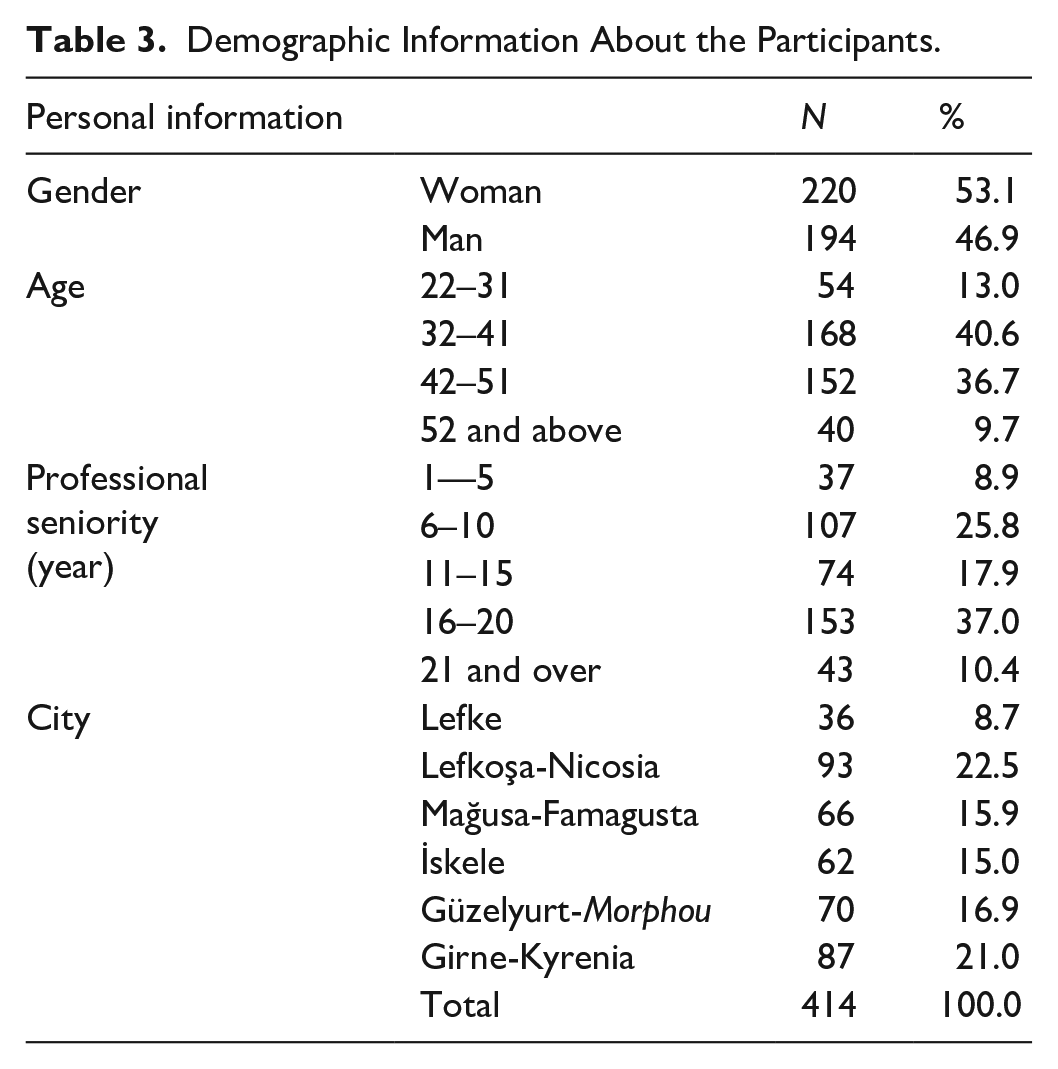
In total, 414 teachers participated in this research. 53.1% of the teachers are women, 40.6 are between the ages of 32 to 41, 37.0% have 16 to 20 years of professional seniority, and 22.5% work in schools in Nicosia district (Table 3).
Descriptive Analysis Results of Organizational justice scale are given below.
The average values of the analysis results in this study were normalized according to the 1 to 5 interval scale to comply with the evaluation range of Polat (2007). According to normalized values, the Distributive Justice dimension has “high” results with a value of 3.69, the Procedural Justice dimension has “high” results with a value of 3.78, and the Interactional Justice dimension has “high” results with a value of 3.80. Teachers’ overall Perception of Organizational Justice was “high” with a value of 3.77 (Table 4).
Teachers’ Organizational Justice Perception Level Scores.

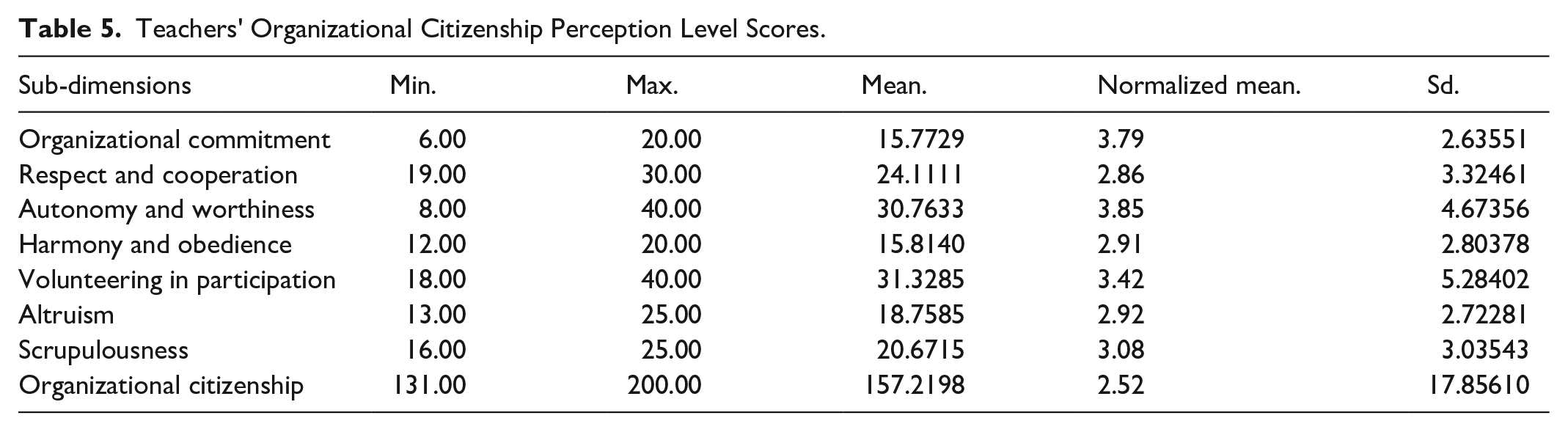
The average of the Organizational Commitment dimension is 15.7729. The “Respect and Cooperation” sub-dimension has an average value of 24.1111. The Autonomy and worthiness sub-dimension attracts attention with an average of 30.7633. The “Volunteering in Participation” sub-dimension stands out with an average of 31.3285. On the other hand, the “Harmony and Obedience” sub-dimension has a lower value with an average of 15.8140. The “Altruism” sub-dimension stands out with an average value of 18.7585 and the “Conscientiousness” sub-dimension stands out with an average value of 20.6715. Finally, the average value of “Organizational Citizenship” scale is 157.2198. The average values of the analysis results in this study were normalized according to the 1 to 5 interval scale in order to comply with the evaluation range of Polat (2007). According to normalized values, the sub-dimensions of Organizational Commitment (3.79), Autonomy and Valuation (3.85) and Volunteerism in Participation (3.42) are rated as “high,” Respect and Cooperation (2.86), Harmonyand Obedience (2.91), Altruism (2.92), Conscientiousness (3.08) sub-dimension levels were found to be “medium” and teachers' overall Organizational Citizenship Perception level was found to be “low” with a value of 2.52 (Table 5).
Teachers' Organizational Citizenship Perception Level Scores.
A wide range was observed in the dimension of trust in colleagues, ranging between a minimum of 9.00 and a maximum of 35.00, while the average value was calculated as 27.5459 and the standard deviation was 4.22624. The average score of the participants from the “trust in manager” sub-dimension is 18.8937 and the standard deviation is 3.13047. Similarly, a spread between minimum 5.00 and maximum 25.00 values was observed in the dimension of trust in the institution, while the average value was recorded as 19.9589 and the standard deviation was 2.55700.
The measurement with the widest range is the organizational trust dimension. In this dimension, which varies between a minimum of 19.00 and a maximum of 85.00, the average value was calculated as 66.3986 and the standard deviation was 7.69221. According to normalized values, the Trust in Colleagues sub-dimension was “high” with 3.85, the Trust in Manager sub-dimension was “high” with 3.78, and the Trust in the Institution sub-dimension was “high” with 3.99. Teachers' general perception of Organizational Trust was “high” with a value of 3.87 (Table 6).
Teachers’ Organizational Trust Perception Level Scores.

The results generally show that organizational justice levels have a positive moderate interaction (r = .539) with the perception of organizational citizenship. Distributive justice (r = .626, p < .001), procedural justice (r = 0.439, p < .001), and interactional justice (r = .700, p < .001) dimensions, organizational members' level of commitment, respect and cooperation, autonomy and worthiness. Also, there is a significant correlation between compliance and obedience, volunteering in participation, altruism, conscientiousness, and organizational citizenship.
In particular, the high positive correlation between the interactional justice dimension and organizational citizenship is striking (r = .807, p < .001), which shows that positive social interactions within the organization contribute positively to the citizenship behaviors of organizational members (Table 7).
The Relation Between Organizational Justice and Organizational Citizenship.
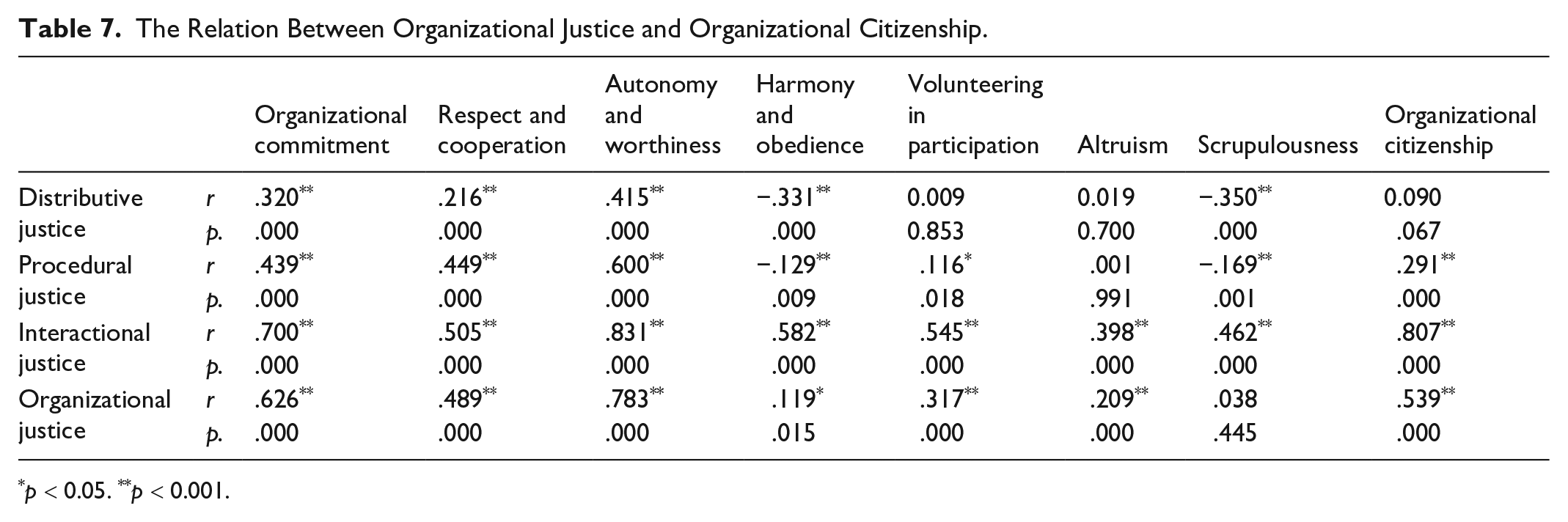
p < 0.05. **p < 0.001.
The results show that dimensions of justice positively interact with employees’ perceptions of trust. The distributive justice dimension includes trust in colleagues (r = .111, p = .024), trust in the manager (r = .529, p < .001), trust in the institution (r = .258, p < .001), and general organizational trust (r = .362, p < .001).
While the procedural justice dimension shows a strong positive relationship with trust in the manager (r = .697, p < .001), trust in the institution (r = .481, p < .001), and general organizational trust (r = .465, p < .001), no significant relationship was found with trust in colleagues (r = .040, p = .420). The interactional justice dimension is trust in colleagues (r = .245, p < .001), trust in the manager (r = .752, p < .001), trust in the institution (r = .708, p < .001), and general organizational trust (r) = .676, p < .001) is significantly associated with a high positive value.
The total organizational justice dimension exhibits a positive moderate relationship with employees’ perceptions of trust. Trust in colleagues (r = .181, p < .001), trust in the manager (r = .820, p < .001), trust in the institution (r = .618, p < .001), and general organizational trust (r = .639, p < .001) indicates a positive moderately significant association (Table 8).
The Relation Between Perceptions of Organizational Justice and Organizational Trust.

p < 0.05. **p < 0.001.
The obtained coefficients and p values show a moderate positive relationship (r = .690) between employees' organizational citizenship and their perception of trust. First of all, in the relationship between organizational commitment and trust, trust in colleagues (r = .094, p = .055) showed a weak positive correlation. In contrast, trust in the manager increased this relationship more clearly at a positive moderate level (r = .556, p < .001) ).
Correlations at various levels were observed between trust in colleagues in the respect and cooperation dimension and trust in the manager (r = .507, p < .001) and the institution.
These correlations became more evident in the autonomy and valence dimension. This analysis showed that a high level of trust increases employees’ ability to think freely, use initiative and commitment to their organizations (r = .780, p < .001). Strong correlations were found between organizational citizenship behaviors and perceptions of trust, compliance and obedience, voluntarism in participation, altruism, conscientiousness (Table 9).
The Relation Between Organizational Citizenship and Organizational Trust Perceptions.

p < 0.05. **p < 0.001.
Dependent Variable: Organizational Trust
Independent Variables: Organizational Justice, Organizational Citizenship
The variables of organizational justice and organizational citizenship perception have a significant value for the perception of organizational trust. The Beta value obtained for the organizational justice variable is .376 and .487 for the organizational citizenship perception variable.
Beta values of both variables are positive, which shows that when both variables increase, the perception of organizational trust increases. The standardized coefficients indicate the contribution of the effect of both independent variables on the perception of organizational trust.
Analysis statistics (F, p, R, r²) also show that the general model has significant explanatory power. The F value is quite high (F = 279.284) and the p-value is low (p = .000). The R value (.759) indicates that the model explains the dependent variable to a large extent (r² = .576) (Table 10).
The Association of Organizational Justice and Organizational Citizenship Perception on Organizational Trust Perception.

Discussion and Conclusion
This research aimed to contribute to the existing literature by investigating primary school teachers' perceptions of organizational justice, citizenship, and trust, and exploring the relationships between these organizational concepts.
Participant teachers received high scores from the dimensions and total of the Organizational Justice scale. This result is consistent with past studies of Polat and Celep (2008), Baş and Şentürk (2011), Terzi et al. (2017), Çavuşoğlu and Şeker (2024), indicating that teachers have a positive perception of organizational justice if they are treated fairly and school principals can increase teachers commitment and participation in work by promoting fairness in educational organizations.
Next, the findings of this research further indicate that the sub-dimensions of Organizational Commitment, Autonomy and Valuation, and Volunteerism in Participation are rated as “high,” Respect and Cooperation, Harmony and Obedience, Altruism, and Conscientiousness sub-dimension levels were found to be “medium” and teachers’ overall Organizational Citizenship Perception level was found to be “low.” In contrast to the results of this research, many researchers found positive and high perceptions of teachers about organizational citizenship such as Polat and Celep (2008) and Baş and Şentürk (2011). Organizational citizenship behavior of teachers promotes effective and cooperative work in schools (Uzun, 2018), enhances school performance (Makvandi et al., 2018), and helps quick recovery in crisis (Kong & Belkin, 2021); Martinez (2012) emphasized that organizational citizenship behavior plays an important role in the school environment and increases teachers’ motivation, job satisfaction, and performance. Korkmaz and Arabacı (2013) revealed that factors such as the type of school, their positions, and their fields of work can have an impact on their perception of organizational citizenship, hence investigating the main causes of low perceptions of teachers about organizational citizenship in state schools of North Cyprus is crucial.
Participating teachers received high scores in the sub-dimensions of the organizational trust scale, namely “Trust in Colleagues,” “Trust in the Manager,” and “Trust in the Institution” and in the Organizational Trust perception scale, in line with the findings of Polat and Celep (2008) and Baş and Şentürk (2011).
Significant positive correlation was found between teachers' perceptions of organizational justice and organizational citizenship. Additionally, it was observed that there was a significant positive moderate relationship between the participant teachers' perceptions of organizational justice and organizational trust. The results indicated a positive moderate relationship between organizational behaviors and organizational trust. Regression analysis revealed that the perception of organizational justice and organizational citizenship explains the perception of organizational trust in a significantly positive way and that these factors have important roles in organizational relations. These results are supported by the works of many studies as mentioned earlier. In the studies conducted by Tansky (1993), Moorman et al. (1993), Erturk (2007), Polat and Celep (2008), Al-Hyasat et al. (2013); Çetinkaya & Çimenci (2014), and Yuen Onn et al.(2018); Choong et al. (2024) positive interactions were found between teachers' perception of organizational justice and organizational citizenship behavior. İşcan and Sayın (2010) found a strong relationship between organizational trust and procedural justice and a significant relationship between distributive justice and organizational trust. Ersan (2018) indicated positive and significant interactions between dimensions of organizational trust and dimensions of organizational citizenship behavior. Polat and Celep (2008) determined that organizational justice, organizational trust, and organizational citizenship behavior are interrelated. They found that organizational trust and organizational justice have a significant impact on teachers’ display of organizational citizenship behaviors. On the other hand, Yılmaz (2009) showed no significant interaction between teachers’ views on organizational trust, trust in people they work with, trust in stakeholders and trust in the principal, and their organizational citizenship behaviors.
Suggestions and Practical Implications
This study offers valuable insights for developing effective strategies aimed at creating a healthier work environment and improving communication within educational institutions. As the first study of its kind conducted in North Cyprus, it serves as a crucial resource for future research in this area, enhancing its significance. Ultimately, this study aims to contribute meaningfully to the formulation and development of management policies in the field of education in North Cyprus.
It is recommended to provide in-depth informative seminars and workshops for teachers and school administrators to improve their understanding of organizational justice, organizational citizenship, and organizational trust, all of which impact the culture and success of educational institutions.
Footnotes
Acknowledgements
The researchers thank to all primary school teachers participated in this research.

Ethical Considerations
Cyprus Health and Social Sciences University, Study reference number: KSTU/2023/236
Consent to Participate
All participants read the consent form and the ones who approved the consent form participated in the study.
Author Contributions
S.S. collected the data, H.Ş and S.S. did the statistical analysis. H.Ş. wrote the research paper. H.Ş and S.I. contributed to the interpretation of the data.
Funding
The author(s) received no financial support for the research, authorship, and/or publication of this article.
Declaration of Conflicting Interests
The author(s) declared no potential conflicts of interest with respect to the research, authorship, and/or publication of this article.
Data Availability Statement
The data of the research will be available and can be shared.