




Abstract
Cognitive impairments are common in older adults, and social participation’s impact on their cognitive function needs further confirmation. Based on the panel data from the five waves of the Chinese Longitudinal Healthy Longevity Survey (CLHLS), this study uses a panel fixed effect model, propensity score matching, and mediation analysis to explore the relationship between social participation and cognitive function in older adults. In the CLHLS questionnaire, cognitive function consists of 24 questions, including general ability, response ability, attention and calculation ability, memory, and language comprehension and self-coordination. Social participation is divided into three types: group interaction-type, self-entertainment-type, and household labor-type, with a total of eight activities. After adjusting the confounders, social participation is positively associated with cognitive function (β = 1.65, p < .001). Specifically, self-entertainment-type social participation shows the strongest positive association (β = 1.09, p < .001), followed by household labor-type social participation (β = .58, p < .001), while the impact of group interaction-type social participation is the weakest (β = .47, p < .001). Activities of daily living (ADL) mediate the relationship between social participation and cognitive function, with the strongest mediating effect in the impact of household labor-type social participation. These findings emphasize the importance of promoting social participation for older adults’ cognitive health. Families can organize regular activities, communities create self-entertainment programs, and healthcare providers integrate social activities into geriatric care. Future studies should explore additional confounding factors and use more comprehensive measures of social participation to better capture its impact on cognitive function.
Keywords
Introduction
Maintaining the cognitive health of older adults is a focal point in alleviating the pressures of aging, achieving healthy aging, and enhancing the quality of life in later years. According to the data from the “World Population Prospects 2022” report, the proportion of the population aged 65 and above was 10% in 2022 and is projected to rise to 16% by 2050 (United Nations Department of Economic and Social Affairs Population Division, 2022), indicating a further deepening of global population aging. China is no exception to this trend. As of the end of 2022, the population aged 65 and above in China reached 209.78 million, accounting for 14.9% of the total population (National Bureau of Statistics of China, 2023), and it is projected to increase to 29% by 2050 (Du & Li, 2021), surpassing the global rate of population aging. Focusing on older adults and improving their well-being is key to achieving active aging. However, cognitive decline poses a potential threat to the quality of life in old age. From 2000 to 2020, the prevalence of cognitive impairment among older adults in China was 22.0% (Z. Wang et al., 2020). From 2018 to 2021, Subjective Cognitive Decline (SCD) affected 58.33% of older adults in China (Cheng et al., 2023). Cognitive function has a low reversibility, making treatment and rehabilitation difficult, and the cost of medical services and long-term care is high. This not only imposes a heavy burden on individuals, families, and society (Ritchie et al., 2016), but may also reduce the life expectancy and increase the risk of mortality for the older adults (Yaffe et al., 2016).
As early as 2002, the World Health Organization (WHO) proposed the concept of active aging and emphasized that the social participation of older people is a core element in promoting an actively aging society (Kalache & Gatti, 2003). In 2022, China also emphasized the importance of advancing the Healthy China initiative and implementing a proactive strategy to address population aging. Ensuring the social participation of older people is a key aspect in addressing the issue of population aging. Previous studies have found that social participation among older people contributes to their physical and mental health (Barbieri, 2021; Y. Zhang et al., 2022), but further verification is needed regarding its impact on cognitive function.
Literature Review
Many scholars define social participation as the process in which older adults actively engage in various activities, such as social, cultural, entertainment, and volunteer services, based on legal channels and their own needs, and establish connections and interactions with the community, family, friends, and others (Alma et al., 2012; Van Hees et al., 2020). Based on previous research, this study defines older adults’ social participation as their involvement in activities that are beneficial to themselves or social development. These activities span various aspects, including interpersonal communication, leisure and entertainment, and household labor (Goll et al., 2018).
The relationship between social participation and cognitive function needs to be clarified, and there are differences in opinions among different scholars. Some scholars have pointed out that social participation has a positive impact on the cognitive function of older adults (Park et al., 2022; J. Wang et al., 2022). Studies have found that older adults who participate in activities have better cognitive function compared to those who do not participate (Z. Zhou et al., 2020). In old age, engaging in active social activities can not only alleviate the decline in perceptual speed (Lövdén et al., 2005), but also mitigate cognitive aging (Nie et al., 2021). This is because, on the one hand, social participation increases interpersonal interaction in older adults, thereby stimulating the brain and hormone levels, and relieving cognitive problems (C. Shen et al., 2022). On the other hand, social participation enhances a sense of belonging and achievement in older adults, thereby preventing cognitive decline (Berkman, 2000). Some specific research has found that participating in social and leisure activities can alleviate the decline in cognitive abilities in older adults (Litwin & Stoeckel, 2016). Internet use has been shown to have beneficial effects on cognitive function in later life (Berner et al., 2019; Kamin & Lang, 2020), and social and intellectual activity participation are of relative importance to predict cognition in old age (Fernández et al., 2023). However, some scholars argue that there is a negative relationship between social participation and cognitive function in older adults. In terms of the types of participation, some scholars have pointed out that unhealthy behaviors such as smoking and drinking may impair the cognitive function of older adults (Mercken et al., 2010). In terms of the level of participation, high-frequency social participation may have a negative impact on the cognitive function of older adults. For example, frequent participation in high-stress activities may not be beneficial for maintaining the cognitive function of older adults (Kawachi & Berkman, 2001). In terms of the places of participation, participating in places such as bars and funerals may have adverse effects on the cognitive function of older adults (Watkins, 2004). From this, it can be seen that negative social interactions and negative social interaction patterns may be detrimental to maintaining the cognitive health of the elderly (Myroniuk & Anglewicz, 2015). In addition, some scholars believe that there is no significant relationship between social participation and cognitive function in older adults. A study conducted on older adults in Amsterdam, Netherlands found no significant association between social participation and cognitive function (Aartsen et al., 2002). McGue and Christensen (2007) also found that social participation had no significant effect on improving cognitive function in older adults. Research has also found that social activity participation does not have an impact on cognitive decline in older men (Hwang et al., 2018).
In summary, although there have been some achievements in the research on the relationship between social participation and cognitive function in older adults, there is still no consensus and further exploration is needed. Firstly, most studies have only assessed the association between social participation and cognitive function at a single time point or in the short term, with very few studies examining the long-term impact of social participation on cognitive function and tracking individuals over several years. Secondly, previous measures of social participation have primarily focused on the interaction with others, whereas this study comprehensively examines the impact of social participation by including not only group interaction-type social participation but also self-entertainment-type and household labor-type social participation. This not only reflects the diversity of daily activities among older adults but also profoundly illustrates the influence of traditional Chinese culture, family values, and social structures on their behavioral patterns. Group interaction-type social participation emphasizes collectivism and social responsibility, self-entertainment-type social participation reflects personal interests and self-fulfillment, while household labor-type social participation highlights family obligations and intergenerational support. Finally, in the research process, existing studies have focused more on the direct impact of social participation on cognitive function in older adults, with less exploration of the intermediate mechanisms through which social participation affects cognitive function. Therefore, this study will further analyze the impact of social participation on cognitive function in older adults, providing evidence from China for international research on aging.
Theoretical Explanation and Research Hypothesis
The activity theory of aging put forward by Cavan et al. (1949) in the 1940s to 1950s has been widely applied in the study of aging and older adults’ health. This theory holds that older adults should maintain their previous lifestyle and activity level to maintain their physical and mental health (Brooks et al., 2023; C. Zhang & Liang, 2023), emphasizing the importance of maintaining social participation and active activities. According to this theory, the social participation of older adults may have a positive impact on their cognitive function (Kim et al., 2023). Firstly, social participation can provide ongoing stimulation, activate the brain, and enhance cognitive abilities. Participating in social activities requires thinking, communication, and decision-making, all of which can exercise the brain and improve cognitive ability. Secondly, social participation can help older adults establish and maintain social connections, reduce feelings of loneliness, and increase life satisfaction (Liao et al., 2022). Social support and life satisfaction are considered to be important factors in protecting cognitive functions (Liu et al., 2023; Rutter et al., 2020). Research has found that socially active older adults experience slower rates of cognitive decline (Piolatto et al., 2022). Furthermore, social participation can provide meaningful roles and identities, enhancing older adults’ sense of self-worth and purpose in life, which also helps them to maintain a good cognitive state.
The social participation referred to by activity theory of aging is mostly social activities that interact with others, such as group interaction-type social participation. However, early research has shown that although the level of activity participation is related to social adaptation, some people still adapt well even if they are detached from social activities. For example, some older adults do not actively participate in social activities but find joy in gardening and bird-keeping at home, reading and writing to achieve inner peace, their lives are equally happy (Lentoor et al., 2023; Çetinkaya et al., 2022). This indicates that different forms of social participation may have the same effect on the cognitive function of older adults, such as engaging in sports, gardening, and other self-entertaining activities, which may also have positive effects on their cognitive function. In addition, household chores can also be seen as a form of physical activity, which is positively correlated with cognitive function among older adults (Lee et al., 2021). Based on theoretical support, the first set of hypotheses is proposed:
Furthermore, through social participation, older adults can reduce the stress brought about by the aging of physical functions, maintain physical vitality, and preserve or enhance their ability to perform activities of daily living (ADL). There is a close relationship between ADL and cognitive function, older adults with better daily activity capabilities tend to have better cognitive function (Christensen et al., 1994). Therefore, by engaging in social participation, older adults get more opportunities for exercise and labor, thereby improving their ADL, which has a positive impact on their cognitive function. Based on this, the second set of hypotheses is proposed (Figure 1):
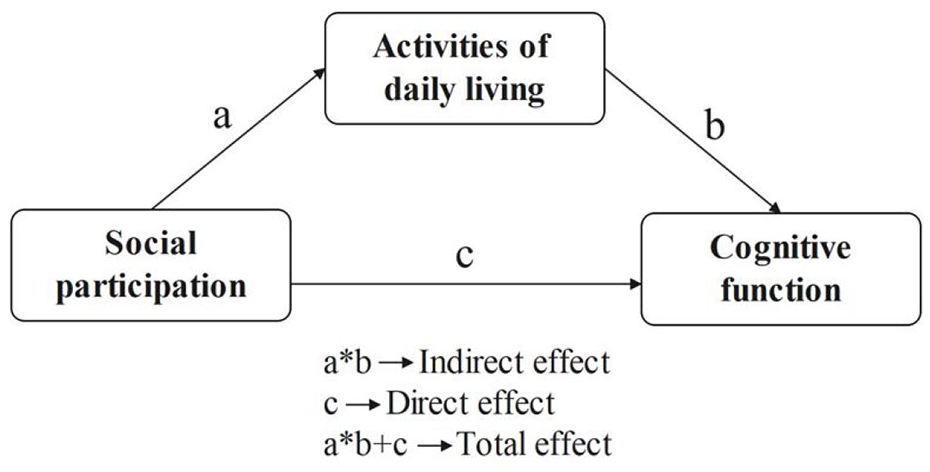
The impact pathways of social participation on cognitive function.
Methods
Data Source
The data used in this study are derived the five-panel data of the Chinese Longitudinal Healthy Longevity Survey (CLHLS), conducted in 2005, 2008, 2011, 2014, and 2018. The survey, administered by the Center for Healthy Aging and Development Studies at Peking University, is a representative and comprehensive social science survey on issues related to the older adults in China. The study focuses on individuals aged 65 and above, and after excluding variables with missing or incomplete observations, there are 35,818 individuals with 56,461 observations for longitudinal analysis.
Variable Setting
Dependent Variable
Cognitive function. The data for cognitive function is derived from the CLHLS questionnaire, which is based on the Modified Mini-Mental State Examination (MMSE) and modified to fit the Chinese context. The questionnaire measures five dimensions of cognitive function: general ability, response ability, attention and calculation ability, memory, and language comprehension and self-coordination. It consists of 24 questions, with each item scoring 1 point except for the “one-minute food naming” item, which is scored 7 points (1 point for each food named, with a maximum of 7 points). In this study, the Cronbach’s alpha coefficients of the MMSE range from .78 to .86 in five waves. The total score ranges from 0 to 30, with higher scores indicating better cognitive ability and lower scores indicating poorer cognitive function (Ma et al., 2022; K. Shen et al., 2019).
Independent Variable
Social participation. Broadly defined, social participation is not limited to activities in the public sphere or formal organizational contexts. It encompasses self-entertainment activities based on personal interests, such as outdoor activities, gardening, and pet care, which can influence society through interpersonal interactions and knowledge dissemination. It also includes household labor activities, which contribute to social stability, community economy, and culture by maintaining family relationships and facilitating neighborhood experience sharing. As long as these activities are connected to society and can generate impact, they fall within the scope of broadly defined social participation. In the CLHLS questionnaire, social participation refers to an individual’s involvement in social activities, including household chores, personal outdoor activities, gardening or pet-keeping, reading books or newspapers, raising poultry or livestock, playing cards or mahjong, watching TV or listening to the radio, participating in organized activities, covering a total of eight types of activities. The options for the above questions are “Almost every day,” “Not every day, but at least once a week,” “Not every week, but at least once a month,” “Not every month, but sometimes,” “Do not participate,” respectively assigned the values 5, 4, 3, 2, 1. The scores are summed and standardized, with the final score ranging from 1 to 5. The higher the score, the higher the frequency of social participation of older adults. Social participation is further divided into group interaction-type social participation (playing cards or mahjong, and organized activities), self-entertainment-type social participation (personal outdoor activities, gardening or pet-keeping, reading books or newspapers, watching TV or listening to the radio), and household labor-type social participation (household chores, raising poultry or livestock). The scores for each type of social participation are summed and standardized, with the final scores for group interaction, self-entertainment, and household labor all ranging from 1 to 5.
Mediating Variable
Activities of Daily Living (ADL). The CLHLS questionnaire investigates the ADL of older adults through six items: bathing, dressing, indoor activities, using the toilet, eating, and controlling bowel movements. Each project has three options: “completely self-care,” “partially self-care,” and “completely unable to self-care,” assigned values of 3, 2, and 1 respectively. The scores from the six items are added together to give a final score ranging from 6 to 18 points. The higher the ADL score, the stronger the older adults’ ability to take care of themselves in daily life.
Covariates
Based on the literature review, three categories of covariates are selected: personal characteristics, lifestyle, and economic status. Personal characteristics include five variables: gender (male = 1, female = 0), age (65–120), years of schooling (0–22), place of residence (city = 1, rural = 0), and marital status (with spouse = 1, without spouse = 0). Lifestyle includes four variables: smoking (yes = 1, no = 0), drinking (yes = 1, no = 0), regular exercise (yes = 1, no = 0), and sleep quality (very good = 5, good = 4, general = 3, bad = 2, and very bad = 1); The economic situation includes two variables: subjective economic level (very rich = 5, relatively rich = 4, general = 3, relatively poor = 2, and very poor = 1) and sufficient source of living (yes = 1, no = 0).
Statistical Analysis
The multicollinearity test results indicate that the variance inflation factor (VIF) for each variable ranges from 1.06 to 1.99, all of which are significantly less than 10. This suggests that there is no significant multicollinearity issue among the variables. Building on this foundation, this study examines the relationship between social participation and cognitive function in older adults using descriptive analysis, panel fixed effect model (FE), propensity score matching (PSM), and mediation analysis. It focuses on analyzing the relationship between different types of social participation and cognitive function in older adults, and further demonstrates the underlying mechanisms.
Results
Descriptive Statistics
Table 1 presents the descriptive statistical results of variables, with an average cognitive function score of 22.24 (SD = 8.77) for the older adults from 2005 to 2018, indicating a trend toward improvement. The average score for social participation is 2.12 (SD = 0.82), and the average score for ADL is 16.97 (SD = 2.42). The average age of the older adults is 86.03; females are more than males, accounting for 56.30%; the level of education is generally low, with an average of only 2.37 years of education; urban older adults are fewer than rural ones, accounting for 46.28%; the proportion of the older adults with spouses is low, only 36.08%. The proportion of smoking, drinking, and regular exercise is relatively low, at 17.48%, 17.26%, and 30.30% respectively. 61.41% of the older adults have good sleep quality. The proportion of the older adults with general or above subjective economic level is 84.55%, and the proportion with sufficient source of living is 79.83%.
Descriptive Statistical Results of Variables.

The Relationship Between Social Participation and Cognitive Function in Older Adults
FE Regression Results of Social Participation and Cognitive Function
To control for errors and endogeneity issues (L. Zhou et al., 2023), this study uses panel fixed effect model (FE) to examine the impact of social participation on cognitive function based on panel data. Table 2 shows the effects of social participation, group interaction-type social participation, self-entertainment-type social participation, household labor-type, and covariates on cognitive function in older adults.
The Relationship Between Social Participation and Cognitive Function in Older Adults (N = 56,461).

p < .05. ***p < .001.
Model 2 shows a significant positive relationship (p < .001) between social participation and cognitive function in older adults, with higher levels of social participation leading to higher levels of cognitive function. In addition, there are significant positive relationships between ADL, sleep quality, subjective economic level, sufficient source of living and cognitive function in older adults; there is a significant negative relationship between age and cognitive function in older adults. The three types of social participation also have significant positive impacts on cognitive function in older adults. From the perspective of the impact coefficient, self-entertainment-type social participation is the largest, followed by household labor-type social participation, and group interaction-type social participation is the smallest.
PSM Analysis of Social Participation and Cognitive Function
Table 3 shows the ATT of the impacts of social participation on cognitive function in older adults, which are significant at the 1‰ level. The ATT obtained through the three matching methodologies demonstrate consistency, indicating that the research results are robust. After controlling for selection bias, the net effects of social participation on cognitive function are 3.74 to 4.65, which proves that social participation can improve cognitive function in older adults. Similarly, PSM estimation also shows that group interaction-type, self-entertainment-type, and household labor-type all have a stable positive effect on the cognitive function of the older adults. It remains that self-entertainment-type has the strongest impact, followed by household labor-type, and group interaction-type is the weakest.
PSM Estimation for the Effect of Social Participation on Cognitive Function in Older Adults (N = 56,461).
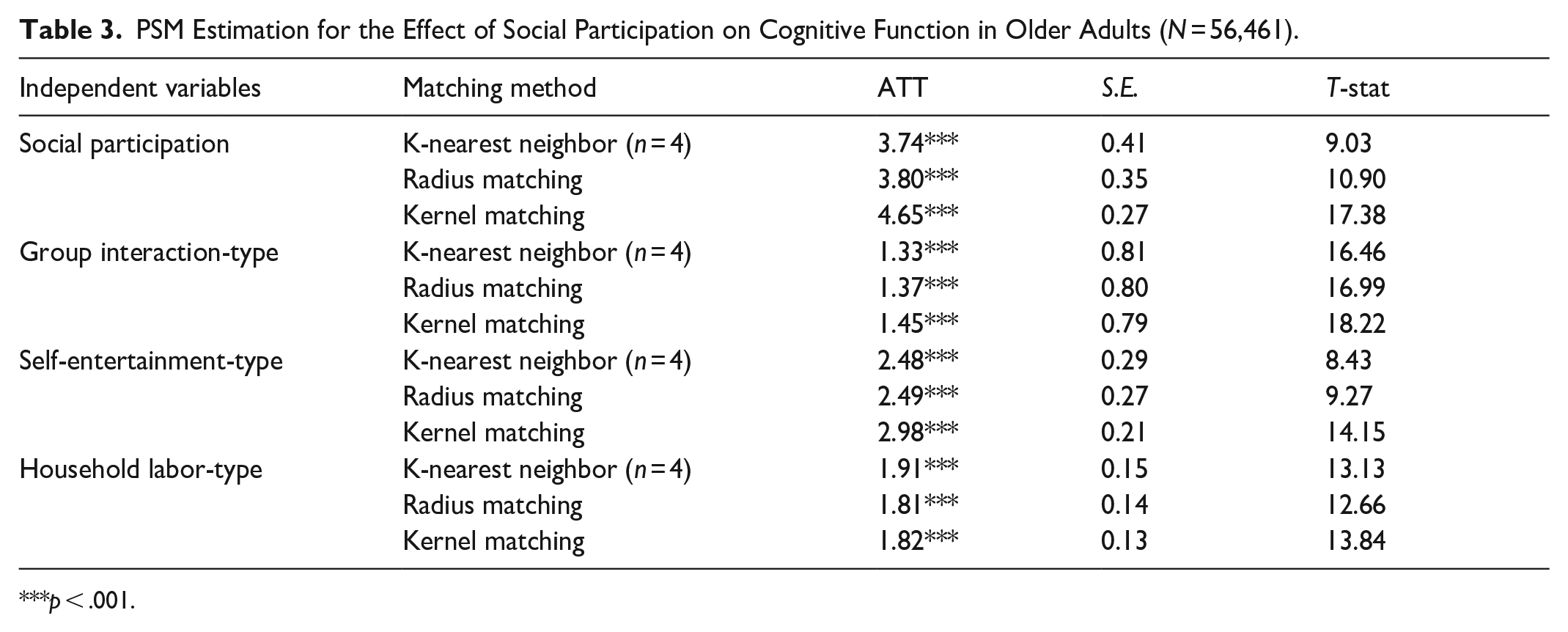
p < .001.
Mediating Effect Analysis of ADL
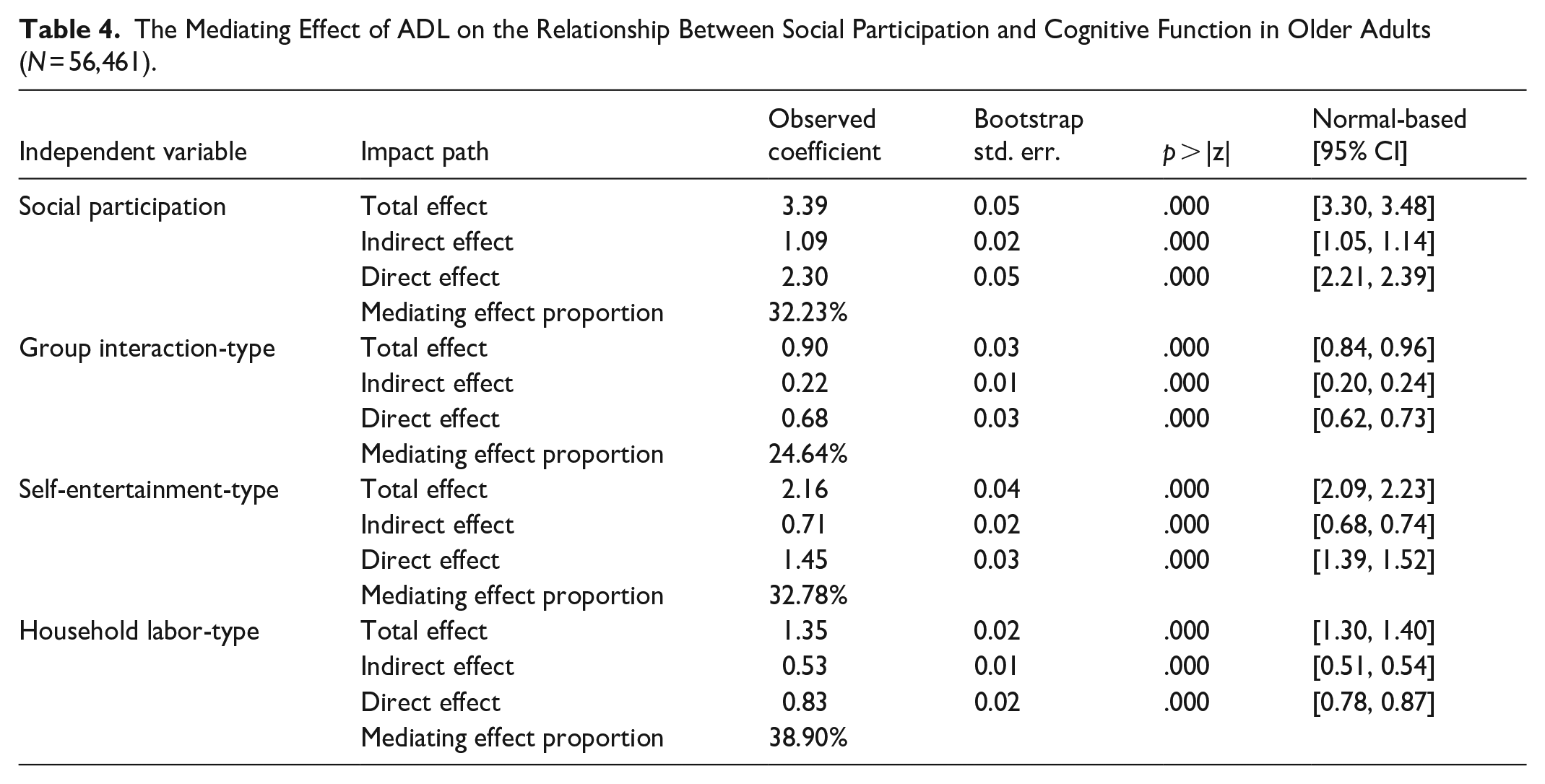
To explore the impact mechanism between social participation and cognitive function in older adults, the Bootstrap method was used to test the mediating variable of ADL, and the results are shown in Table 4. ADL partially mediates the relationship between social participation and cognitive function in older adults, accounting for 32.23%. It can be seen that social participation can not only directly affect the cognitive function of the older adults, but also indirectly affect cognitive function by improving ADL. From a specific type perspective, ADL also has partial mediating effects in the relationship between group interaction-type, self-entertainment-type, household labor-type, and cognitive function of the older adults, accounting for 24.64%, 32.78%, and 38.90%, respectively. ADL has the strongest mediating effect in the relationship between household labor-type social participation and the cognitive function of the older adults, and the weakest mediating effect in the relationship between group social participation and the cognitive function of the older adults.
The Mediating Effect of ADL on the Relationship Between Social Participation and Cognitive Function in Older Adults (N = 56,461).
Discussion
Firstly, this article uses a panel fixed effects model to examine the impact of social participation on cognitive function in older adults. To minimize the impact of data bias and confounding factors and ensure the validity of the conclusions, we additionally employed propensity score matching (PSM) for testing. The research results indicate that social participation can effectively reduce the risk of cognitive dysfunction in older adults and significantly improve their cognitive function level. The older adults with higher levels of social participation exhibit superior cognitive function. This can be attributed to the fact that social participation amplifies their opportunities to engage with the outside world, thus stimulating brain function and decreasing the likelihood of cognitive impairment. This finding aligns with some previous studies (Barnes et al., 2004; Bassuk et al., 1999). The results support Hypothesis 1 and confirm the guiding role of the activity theory of aging in the relationship between social participation and cognitive function. Unlike previous studies, we innovatively divide social participation into three types: group interaction-type, self-entertainment-type, and household labor-type, which provides a new perspective for understanding the social participation in older adults. It is important to not only focus on the social participation of older adults in interacting with others, but also to recognize their participation in self-entertainment-type and household labor-type. This viewpoint aligns with the core concept of active aging, which emphasizes that the older adults are the solvers of problems, rather than the creators of them (Peng & Fei, 2013). Because the cognitive function of older adults is not only influenced by the degree and quality of interpersonal communication, but also by their own feelings (Adams et al., 2011). From the effects of these three types of social participation, self-entertainment-type social participation contributes the most to the improvement of cognitive function in older adults. This may be because it can help older adults relax their body and mind, enhance their sense of control over life, and reduce the probability of cognitive impairment. For example, “watching TV or listening to radio” can serve as an important way for older adults to obtain various types of information, helping them improve their lifestyle, enhance their understanding and knowledge reserves, thereby promoting the development and maintenance of cognitive abilities (Lin et al., 2023). Household labor-type social participation also has been found to positively affect the cognitive function of the older adults. Through household labor, the older adults can strengthen their connection with their families, such as cooking and taking care of their grandchildren. This not only provides necessary physical activities, but also provides more emotional comfort to the older adults (Ku et al., 2013). Group interaction-type social participation also has a significant positive impact on the cognitive function of older adults, which may be because maintaining an open lifestyle can effectively strengthen their social networks and relationships, enabling them to receive positive feedback in interpersonal interactions, thereby preventing cognitive decline. These results support hypotheses 1.1, 1.2, and 1.3. Therefore, when considering the impact of social participation on cognitive function in older adults, it is crucial to categorize and analyze different types of participation. Previous studies have attempted to classify social participation, but there is a certain degree of overlap in these classifications. For instance, some researchers have defined social participation as encompassing three types: participation in organized social activities, collective leisure activities, and informal social activities (J. Wang et al., 2022). However, this classification scheme may require further refinement to fully capture the nuances of social participation in older adults.
Secondly, to explore the impact mechanism between social participation and cognitive function in older adults, we chose ADL as the mediating variable. Previous studies have confirmed that social participation can improve ADL levels in older adults (Holt-Lunstad & Steptoe, 2021). The results of the mediating effect indicate that ADL has a partial mediating effect, with the highest proportion of mediating effect in the impact of household labor-type social participation, reaching 38.89%. This may be because household labor requires older adults to engage in moderate physical activity in order to maintain physical function (Li et al., 2022). Moreover, household labor-type social participation involves the daily family life of the older adults and is closely related to their ADL. Previous studies have also shown that older adults participating in household labor can help improve their physical and mental health (Y. Wang et al., 2023). Therefore, household labor-type social participation can promote cognitive function by increasing the ADL level of the older adults. Furthermore, ADL also serves as a partial mediator in the relationship between self-entertainment social participation and cognitive function in older adults. Engaging in leisure activities such as gardening or pet-keeping may enhance physical health in older adults, thereby positively influencing their cognitive function (Xu et al., 2023). It is worth noting that ADL has the lowest mediating effect on the relationship between group interaction-type social participation and cognitive function of the older adults, possibly because it requires certain ADL ability support when engaging in group social activities. These results support the second set of research hypotheses.
Finally, there are some limitations to this study. (1) Some confounding factors that may affect cognitive function, such as drug intervention, have not been investigated in CLHLS and therefore cannot be included in the multivariate model. (2) The survey questions on social participation in CLHLS are limited and may not fully reflect the actual situation of social participation in daily life.
Conclusions
This study, based on the representative survey data from China, examines the relationship between social participation behavior and cognitive function among older adults, and further explores the mediating effect of ADL in this relationship. This study mainly found that: (1) higher frequency of social participation is usually associated with improved cognitive function, with the strongest impact of self-entertainment-type social participation, followed by household labor-type social participation, and the weakest impact of group interaction-type social participation; (2) ADL has a partial mediating effect in the relationship between social participation and cognitive function, with the strongest mediating effect in the impact of household labor-type social participation and the weakest in the impact of group interaction-type social participation. These findings spotlight the significance of promoting social participation for older adults to safeguard cognitive health. On the family front, family members should regularly organize activities like family movie nights or cooking together. This not only strengthens family ties but also engages the elderly in social interaction, stimulating their cognitive function. In the community, policymakers ought to create programs centered around self-entertainment. For example, set up community reading days and gardening workshops. These activities meet the elderly’s self-entertainment needs while encouraging socializing. Additionally, healthcare providers can integrate such social activities into geriatric care, tailoring suggestions according to each senior’s condition. Although there are still some limitations to this study, these findings still contribute to a deeper understanding of the impact and mechanisms of social participation on cognitive function in older adults. It provides new empirical evidence for research in this field and is of great significance in improving cognitive function in older adults. Future studies should explore additional confounding factors and use more comprehensive measures of social participation to better capture its impact on cognitive function. Longitudinal studies with diverse populations are needed to generalize these findings and investigate the long-term effects of social participation on cognitive health. Meanwhile, more research is encouraged to focus on the relationship between the social participation and cognitive function in different cultural contexts, so as to provide more comprehensive theoretical support and practical guidance for the health of older adults around the world.
Footnotes
Acknowledgements
The authors would like to acknowledge the Chinese Longitudinal Healthy Longevity Survey (CLHLS) team for providing data.

Ethical Considerations
The CLHLS study was approved by the Research Ethics Committee of Peking University (IRB00001052-13074). All methods and research processes for this study were performed in accordance with the Declaration of Helsinki guidelines and regulations.
Consent to Participate
All participants or their proxy respondents provided written informed consent.
Author Contributions
Chong Zhang: Conceptualization, Methodology, Software, Writing – original draft, Formal analysis, Supervision. Juan Xiong: Visualization Data curation, Software, Formal analysis. Wenqi Luo: Data curation, Writing – review & editing. Lin Sun: Writing – review & editing. All authors read and approved the final manuscript submitted.
Funding
The author(s) disclosed receipt of the following financial support for the research, authorship, and/or publication of this article: This work was supported by the University of Electronic Science and Technology of China Scientific Research Start-up Fund (Grant numbers Y030222059002015).
Declaration of Conflicting Interests
The author(s) declared no potential conflicts of interest with respect to the research, authorship, and/or publication of this article.