




Abstract
This study investigated the association between living arrangements and psychological well-being (PWB) among older adults in rural China and whether activities of daily living (ADL) disability moderate this association. The study data were drawn from the sixth to eighth waves of the Chinese Longitudinal Healthy Longevity Survey. The baseline sample included 4,042 individuals aged 65 years and above. PWB was measured using seven mood-related and personality-related questions. ADL disability was measured using Katz’s 6 items of ADL. Living arrangements were categorized into six categories. Linear mixed-effect models were used to examine the association between older adults’ living arrangements and PWB as well as the moderating effect of ADL disability on this relationship. The results showed that compared with living alone, living with spouse only, and living with spouse and children were positively associated with PWB (β = .621, p < .01; β = .527, p < .05), and living with children (no spouse) was negatively associated with PWB (β = −.564, p < .001). ADL disability was negatively associated with PWB (β = −.457, p < .01). Living with children (no spouse) × ADL disability had a positive interaction effect (β = .278, p < .05). These findings suggest that living alone and living with children (no spouse) are not conducive to PWB among older adults in rural China, and ADL disability reduces the negative effects of living with children (no spouse) on PWB. Our findings provide a crucial direction for PWB interventions aimed at older adults in rural China.
Plain Language Summary
We used the longitudinal data and the linear mixed-effect models to investigate the association between living arrangements and psychological well-being (PWB) among older adults in rural China and whether activities of daily living (ADL) disability moderate this association. We found that living alone and living with children (no spouse) are not conducive to PWB among older adults. ADL disability reduces the negative effects of living with children (no spouse) on PWB. Our findings provide a crucial direction for PWB interventions aimed at older adults. Specifically, interveners should not only focus on older adults living alone but must also consider those living with their children (no spouse) when making plans to enhance the PWB among older adults in rural China. Among the older adults living with children (no spouse), the PWB of those without ADL disability should be receive special attention. However, as with other studies, this study has some limitations. First, due to the lack of data, some factors that might influence the relationship between living arrangements and PWB among older adults could not be included in this study. Second, although longitudinal data was used in this study, the possibility of reverse causality could not be ignored. Third, although the non-independence of the observed data was corrected using random coefficients, the errors might still be correlated within individuals.
Introduction
Psychological well-being (PWB) is an individual’s subjective feeling of their quality of life, life satisfaction, self-satisfaction, and subjective as well as objective value creation, and it is one of the vital indicators of healthy aging (Zhou et al., 2019). Currently, China is experiencing a rapid increase in population of older adults, and nearly 60% of people aged 65 years and above live in rural areas (National Bureau of Statistics, 2021). A study based on the China’s Health-Related Quality of Life Survey for Older Adults 2018 showed that more than 27% of the population of older adults living in rural areas suffered from psychological health problems (Du et al., 2019). Therefore, to ensure successful aging in China, improving PWB among older adults living in rural areas is essential.
As a factor of social surroundings, living arrangements have important implications for PWB among older adults (Weissman & Russell, 2017). Numerous previous studies have explored the association between living arrangements and PWB among older adults (Cheung & Yeung, 2015; Gubhaju et al., 2018; Oh et al., 2015; Weissman & Russell, 2017; Zhou et al., 2019). In such studies, first, owing to the close differences in social development levels and cultural backgrounds, there have been many conflicting results. Second, most of these studies were cross-sectional, and thus, they could not show a correlation between the independent change processes of outcome variables and that of other variables (Ployhart & Vandenberg, 2010). Third, research on older adults living in rural areas is relatively underdeveloped, especially in China. In rural areas of throughout China, intergenerational coresidence, which is widely regarded as a linchpin of old-age support, is changing owing to socioeconomic development and the outmigration of large numbers of adult children. Specifically, among older adults aged 65 years and above, the proportion of those living with their spouse or alone continued to increase, while the proportion of those living with children continued to decrease (X. He et al., 2020). Therefore, it is necessary to use longitudinal data to explore the association between living arrangements and PWB among older adults in rural China.
The relationship between living arrangements and PWB among older adults is complex. Previous studies have found that the association between living arrangements and PWB among older adults can be moderated by other factors. For instance, a previous study suggested that obtaining financial support from the government enhanced PWB among older adults living with their families (Zhou et al., 2019). Another study indicated that downward social comparison reduced or even eliminated the loss of PWB associated with living alone among older adults (Cheng et al., 2008). Disability in activities of daily living (ADL) was considered a key risk factor for psychological health (M. He et al., 2019; B. Kim et al., 2020). Some studies indicated that the inability for older adults to independently perform basic ADL can result in a decline in their PWB (Du et al., 2019; J. Wang et al., 2014). However, few studies have explored the moderating effect of ADL disability on the association between living arrangements and PWB.
Therefore, using the longitudinal methods, this study aims to (1) investigate the association between living arrangements and PWB among older adults in rural China and (2) examine the moderating effect of ADL disability on this association.
Methods
Data Sources
Data obtained from the Chinese Longitudinal Healthy Longevity Survey (CLHLS) were used in this study. The CLHLS was conducted by the Center for Health Aging and Development Studies of the National School of Development at Peking University and the Chinese Center for Disease Control and Prevention. The survey focused on older adult populations randomly sampled from half of the counties and city districts in 23 Chinese provinces. Sample information such as demographic and socioeconomic characteristics, self-assessment of health and quality of life, and cognitive function was collected through face-to-face interviews. The CLHLS has been conducted for eight waves from 1998 to 2018. In each subsequent wave, all respondents previously interviewed were re-interviewed, and newly recruited samples were included. Details of the CLHLS sampling design and data quality have been described in previous studies (Zeng et al., 2009).
Owing to the unavailability of some key variables in waves 1 to 5, only data obtained from sixth to eighth waves were used in this study. Furthermore, to avoid selection bias, we restricted the sample used in this study to initial investigations (2011). A total of 9,765 respondents participated in the sixth wave (2011/2012). We sequentially excluded 4,579 respondents living in urban areas, 86 respondents under the age of 65 years, 653 respondents with missing information associated with the key variables, and 491 respondents who presented incorrect answers. Ultimately, 4,042 participants from the sixth wave were included in this study. Among them, 1,980 participants completed the survey in the seventh wave, and 995 participants completed the survey in the eighth wave. There were no missing data on the key variables associated with these participants. Excluding the interviewers that could not unavailable (too ill, deceased, or migrated), and the response rate for each wave was above 90% in this study. To accurately judge individual results, we used unbalanced panel data, and we did not fill in the small amount of missing data associated with control variables.
Variables
Dependent Variables
In the CLHLS, PWB among older adults was assessed based on the indicators of personality and emotional response. The PWB scale comprised 4 positive items and 3 negative items. The positive items comprised four questions, as follows: (1) Do you always look at the bright side of things? (2) Do you like to keep things clean and tidy? (3) Can you make decisions regarding your personal affairs independently? (4) Do you feel as happy as you were when you were young? The negative items comprised three questions, as follows: (1) Do you feel fearful or anxious? (2) Do you feel lonely and isolated? (3) Do you think you are less useful as you get older? The response range of all questions was 0 to 4 (0 = never, 4 = always). Responses to the negative questions were reversed to ensure the consistency of scoring. The final total score ranged from 0 to 28, with higher scores indicating enhanced PWB. This scale exhibited high reliability and validity, and thus, it is used by numerous scholars to measure PWB among older adults in China (Gu, 2008; Mao & Han, 2018). In this study, the Cronbach’s α values of the PWB scale in 2011/2012, 2014, and 2018 were .904, .899, and .898, respectively.
Independent Variables
The independent variables included living arrangements and ADL disability. Living arrangements were classified into six types, as follows: (1) living alone, (2) living with spouse only, (3) living with spouse and children, (4) living with children (no spouse), (5) living with others, including siblings, parents, other relatives, friends, or nannies, and (6) living in a nursing home. ADL disability was measured using Katz’s 6 items of ADL (bathing, dressing, toileting, indoor transferring, continence, and eating) (Brorsson & Asberg, 1984). This study adopted a two-level scoring method for this scale. If the respondents did not require any help, the score was 0. Otherwise, the score was 1. The total ADL disability score could range from 0 to 6. Zero points indicated that the respondents could take care of themselves, whereas 6 points indicated that they were entirely dependent on others. In this study, the Cronbach’s α values of the ADL disability scale in 2011/2012, 2014, and 2018 were 0.896, 0.915, and 0.915, respectively.
Control Variables
Building on previous studies, PWB may be associated with socio-demographic characteristics, health behaviors, and health status (Jia et al., 2021; Kovalenko & Spivak, 2018; Zhou et al., 2019). Considering the objectives of this study and the availability of data, we included the following control variables: (1) socio-demographic variables, including the respondents’ gender (1 = female, 0 = male), age, years of education, marital status (1 = married, 2 = divorced, 3 = widowed, 4 = unmarried), average annual household income, and the number of surviving children; (2) health behavior variables, including smoking, drinking, and exercise; these activities were descriptions of the current situation, and they were all indicated using “1 = yes” or “0 = no”; (3) health status variables, including self-rated health and the number of chronic diseases. Among the health status variables, self-rated health was assessed as follows “How is your health?,” and five options were provided (1 = extremely poor, 5 = extremely good). Among the respondents, the number of chronic diseases was assessed from reports noting diagnosed diseases obtained from a list of 24 common diseases affecting older adults. Because this variable did not conform to the normal distribution, in this study, the respondents were divided into three categories (0 = none, 1 = one, 2 = two, 3 = three or more).
Data Analyses
Descriptive statistics were used to describe the baseline characteristics of older adults by the six living arrangements. The differences in characteristic variables by the six living arrangements were tested. Specifically, the χ2 test was used for categorical variables (gender, marital status, smoking, drinking, exercise, and the number of chronic diseases), the variance test was used for continuous variables that conformed to the normal distribution (self-rated health), and the Kruskal-Wallis H test was used for continuous variables that did not conform to normal distribution (age, education, average annual household income, number of surviving children, ADL disability, and PWB).
Linear mixed-effect (LME) models were used to examine the association between living arrangements and PWB among older adults as well as the moderating effect of ADL disability on this relationship. LME models can handle missing values and unbalanced data, and it can be used to examine within- and between-person phenomena that contribute to change, simultaneously (Hoffman, 2015; Magezi, 2015). In general, using the LME models can enhance the accuracy and replicability of the study results.
The general form of LME model is:

Where y is an n × 1 vector of observed responses, X and D are known design matrices of dimensions n × k and n × m, β is a k × 1 vector of fixed effects, γ is a m × 1 vector of random effects, ɛ is an n × 1 vector of random errors (Laird, 1982).
The form of LME model in this study was as follows.
Level 1 equation:

Level 1 equation was intra-individual equation. Where yij were PWB value of the jth elderly in the ith wave, β0j were individual intercepts, β1j were individual’s specific slope of changing PWB values over time, tij were time variables, eij were residual error of PWB values observed by each individual j in each wave i.
Level 2 equations:


Level 2 equations were inter-individual equations. In β0j equation, β00 was the total intercept of all individuals, β01 was slop of regression equation predicting β0j from xj, μ0j was residual, namely, the unexplained deviation from β00 for individual j. In β1j equation, β10 was the overall change slope of all individuals, β11 was slop of regression equation predicting β1j from xj, μ1j was residual, namely, the unexplained deviation from β10 for individual j. The xj variables include living arrangements, socio-demographic characteristics, health behavior, health status, ADL disability and their interactions with living arrangements.
All statistical analyses were performed using STATA 15.0.
Results
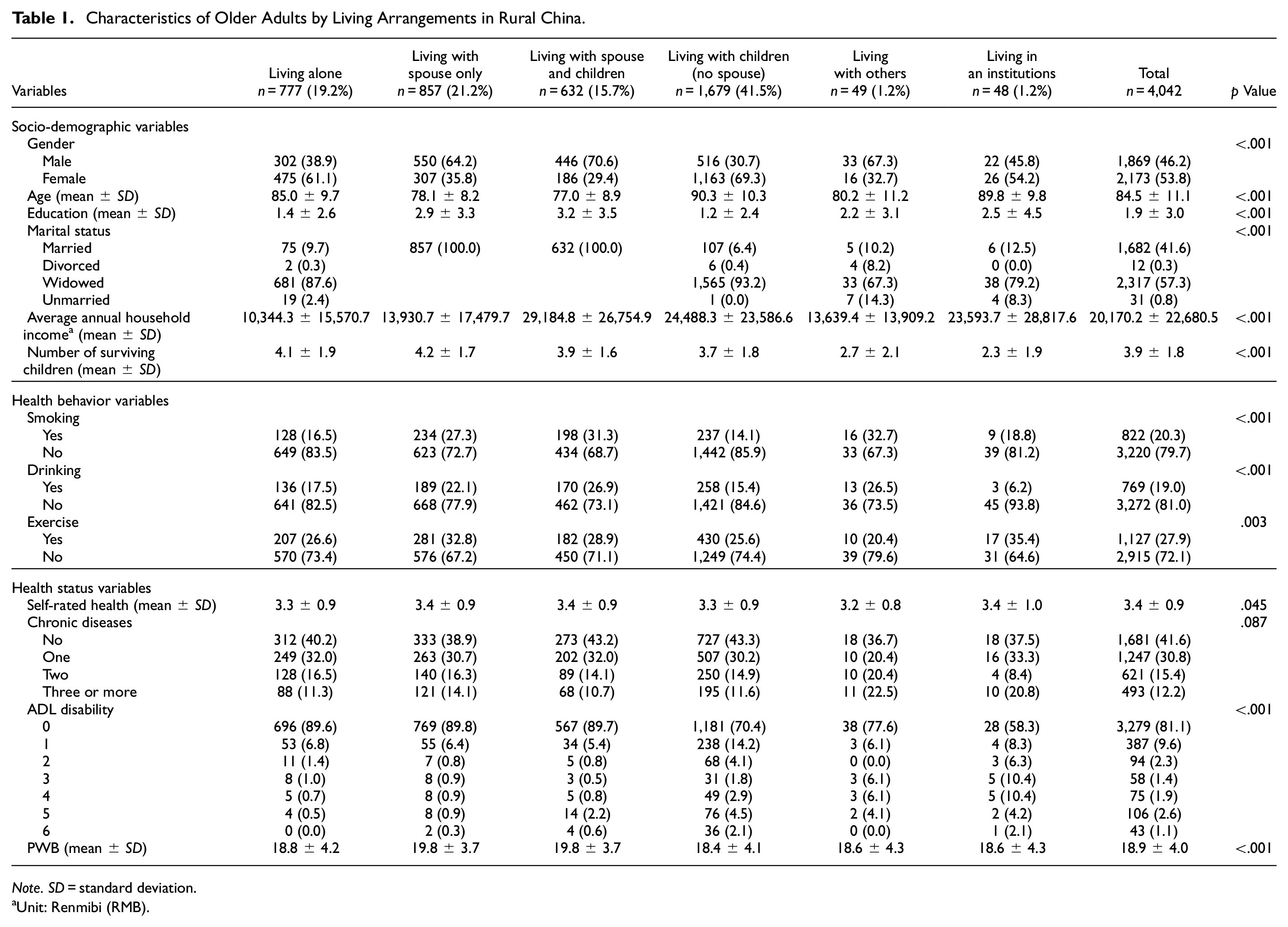
Table 1 shows the general characteristics of the baseline samples by living arrangements. 4,042 respondents were included at the baseline year (2011). Among them, 53.8% were females, 57.3% were widowed, the average age was 84.5 years, the average length of education was 1.9 years, and the average annual household income was RMB 20,170.2. Nearly 80% of the respondents did not smoke, 81% did not drink, and about 28% exercised daily. Approximately 60% of the respondents had at least one chronic disease, and 81% had no ADL disability. The average scores of self-rate health and PWB of the respondents were above the medium level. Overall, 41.5% of the respondents lived with their children (no spouse), 21.2% lived with their spouse only, 19.2% lived alone, 15.7% lived with their spouse and children, and less than 2.5% lived with others or in a nursing home. Except for chronic diseases, the differences in other characteristic variables by the six living arrangements were statistically significant (p < .001). Compared with other groups, the respondents living with their spouse and children were younger, had longer educational years, and had higher levels of family income. The respondents living with their spouse only or with their spouse and children had the best PWB. The respondents living with others were most likely to smoke and not exercise. They reported the worst levels of self-rate health. The respondents living in nursing homes were most likely to report having ADL disability.
Characteristics of Older Adults by Living Arrangements in Rural China.
Note. SD = standard deviation.
Unit: Renmibi (RMB).
Table 2 shows the regression results of the LME models. Model 1 was an unconditional Level 2 model with a random intercept. Model 2 was an unconditional Level 2 model with a random intercept and slope. We established that the Var (Residual) and Var (cons) values of Model 2 were the same as those of Model 1, and Var (time) value was 0. Therefore, Models 3 and 4, with the Level 2 variables added, allow only random intercept variation.
Regression Results of LME Models for PWB.

Note. β = coefficient; SE = standard error; LR = likelihood ratio. *p < .05; **p < .01; ***p < .001
In Model 3, the Level 2 variables, including living arrangements, socio-demographic characteristics, health behavior, and health status, were included. The results showed that compared to living alone, living with spouse only and living with spouse and children were positively and significantly associated with PWB among older adults (β = .624, p < .01; β = .497, p < .05); living with children (no spouse) was negatively and significantly associated with PWB among older adults (β = −.561, p < .001).
In Model 4, the Level 2 variables, including ADL disability and their interactions with living arrangements, were further introduced. The results showed that compared with living alone, living with spouse only, and living with spouse and children were still positively associated with PWB (β = .621, p < .01; β = .527, p < .05), and living with children (no spouse) was still negatively associated with PWB (β = −.564, p < .001). ADL disability was negatively associated with PWB (β = −.457, p < .01). Among the interaction items between living arrangements and ADL disability, only living with children (no spouse) × ADL disability had a significant interaction effect (β = .278, p < .05). This interaction effect was shown in Figure 1.
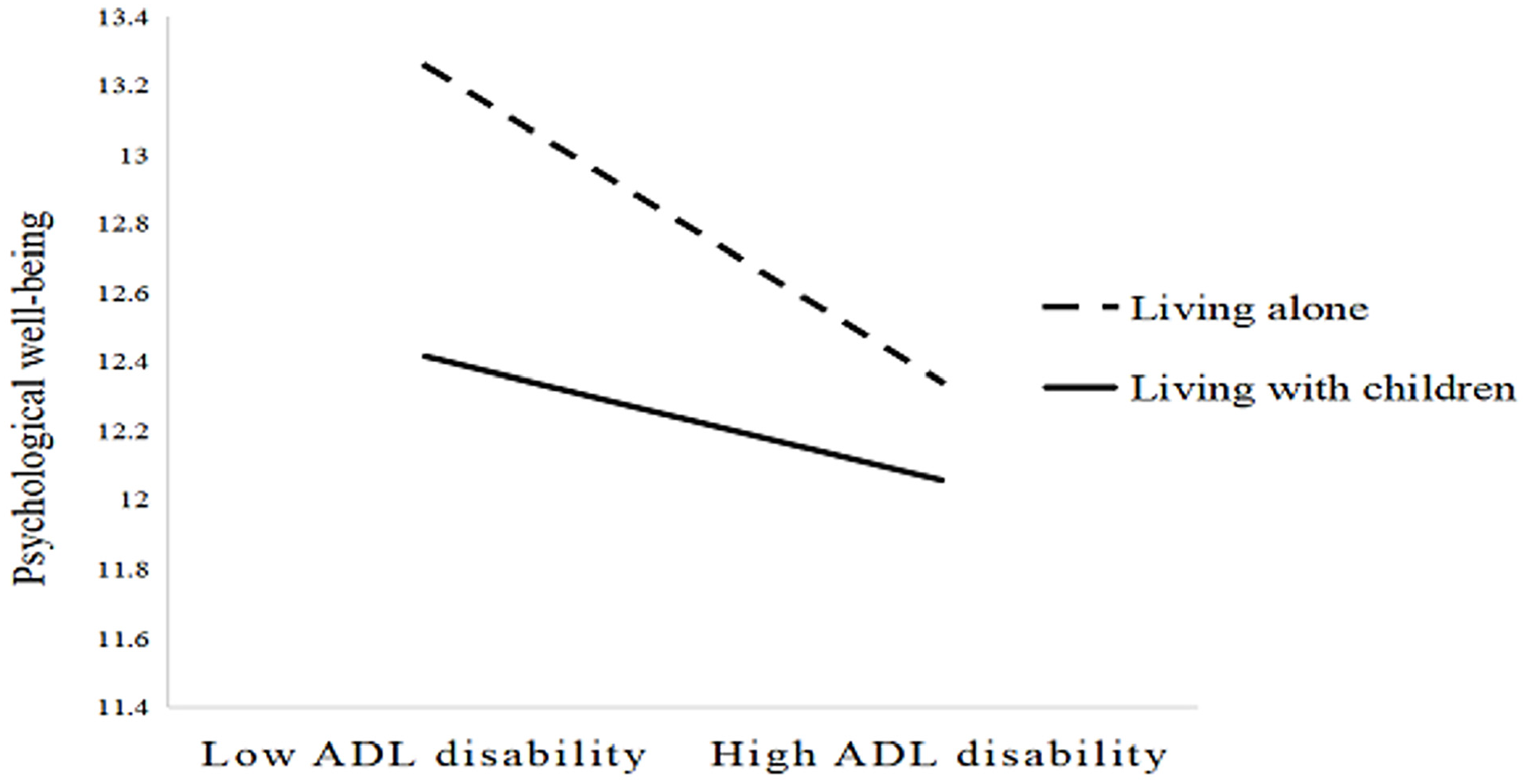
Relationship between ADL disability and PWB as a function of living arrangements.
In the control variables, age and unmarried marital status were negatively associated with PWB, respectively. Conversely, average annual household income, drinking, exercising, higher educational levels, and higher self-assessed health conditions were positively associated with PWB.
Discussion
Using unbalanced panel data obtained from the sixth to eighth waves of the CLHLS, this study examined the association between living arrangements and PWB among older adults living in rural China and the moderating effect of ADL disability on this association. We found that older adults living with their spouse only and those living with their spouse and children reported better PWB than those living alone. This finding is in line with previous studies (J. Kim et al., 2015; Weissman & Russell, 2017; Zhang et al., 2019). The results may be due to the protective effect of the spouse. Couples can encourage each other’s healthy lifestyle and provide direct and effective emotional support and financial support. As a result, spouses are considered as excellent stress relievers (Williams et al., 2017).
Interestingly, we found that among all living arrangements, living with children (no spouse) was the worst for PWB among older adults. This finding is inconsistent with previous studies (Cheng et al., 2008; Mao & Han, 2018). This inconsistency may be because, with economic development and social progress, older adults in rural areas attach significant importance to independence, freedom, equality, and self-esteem. Without a spouse, older people living with their children tend to be more dependent on their children, an aspect that may damage their self-esteem and independence (Kawachi & Berkman, 2001). Furthermore, when older adults live with their children, they inevitably have confrontations with their children. Confrontations are likely to bring further harm to PWB among older adults, especially when they receive no support from their spouses (Chappell, 1991; Zhang et al., 2019).
In line with previous studies, this study found that ADL disability had a significantly negative association with PWB among older adults (M. He et al., 2019; Jiang et al., 2002; Prince et al., 1998). This is because older adults cannot perform daily activities and take care of themselves owing to physical dysfunction, which results in increased dependence on others and psychological problems. Furthermore, we found that ADL disability weakened the negative association between living with children (no spouse) and PWB among older adults. This is because older adults require increased levels of care as their self-care abilities decline. However, formal long-term care insurance policies catering to older adults remain insufficient in China, and the income levels of such older adults were generally low in rural areas. Therefore, currently, informal care from family members is the most popular choice among such individuals (Chen et al., 2020; Liu & Sun, 2015). Additionally, children taking care of their parents with ADL disability are consistent with the Chinese tradition of filial piety, which is considered psychological comfort for the older adults.
Further, similar to previous studies, we confirmed that higher levels of socioeconomic status (years of education and average annual household income) and better self-rated health were associated with higher PWB (Boro et al., 2021; Du et al., 2019; Reyes et al., 2020). However, in this study, age was negatively associated with PWB, which seems to be inconsistent with other studies on PWB among older adults in China (Du et al., 2019; Zhou et al., 2019). This inconsistency may be caused by the differences in research objectives.
This study had several strengths. First, the study data were obtained from CLHLS. As a survey of the older adult population, it covered almost all provinces in China and ensured a sufficient representation of the oldest-old population. Therefore, compared to studies based on survey data in some areas, the results of this study were more universal (Li et al., 2020; P. Wang et al., 2017). Second, this study used longitudinal data. Compared to studies based on cross-sectional data, longitudinal research can provide additional insights into how variables change over time (Fang et al., 2019; Ployhart & Vandenberg, 2010). Third, LME models were used for longitudinal data analysis. Compared with the statistical analysis methods used in previous similar studies, such models can be used to examine both within- and between-sample differences, as well as process unbalanced datasets (Blackwell et al., 2006; Zhou et al., 2019). Therefore, the results of this study were highly accurate.
However, several limitations of this study should be recognized. First, the related factors, such as occupation and religion, were not considered owing to the lack of data. These factors might have influenced the relationship between living arrangements and PWB among older adults (Quashie & Pothisiri, 2018; Zhou et al., 2019). Second, although longitudinal data was used in this study, the possibility of reverse causality could not be ignored. In other words, PWB might influence the choice of living arrangements. Therefore, the results of this study should be interpreted as supporting the association rather than causing it. Third, although the non-independence of the observed data was corrected using random coefficients, the errors might still be correlated within individuals.
Conclusions
This study extended the research on the association between living arrangements and PWB among older adults in rural China. We recognize that living alone and living with children (no spouse) are not conducive to PWB among older adults. ADL disability reduces the negative effects of living with children (no spouse) on PWB. Our findings provide a crucial direction for PWB interventions aimed at older adults. Specifically, interveners should not only focus on older adults living alone but must also consider those living with their children (no spouse) when making plans to enhance the PWB among older adults in rural China. Among the older adults living with children (no spouse), the PWB of those without ADL disability should be receive special attention.
Footnotes
Acknowledgements
The authors thank the Center for Healthy Aging and Development Studies, Peking University, for providing data support; and the Soft Science Research Program of Henan Province for providing funding support.
Declaration of Conflicting Interests
The author(s) declared no potential conflicts of interest with respect to the research, authorship, and/or publication of this article.
Funding
The author(s) disclosed receipt of the following financial support for the research, authorship, and/or publication of this article: This study was funded by Humanities and Social Science Research Program of the Ministry of Education (grant number: 21YJA630062). The funding body did not participate in any research work.
Ethics Approval and Consent to Participate
The datasets used in this study is a publicly availability datasets. Not applicable.
