




Abstract
According to the principle of degressively proportional allocation, if agents are ordered so that the sequence of their entitlements is increasing, then the quotients of goods apportioned to agents and entitlements of agents generate a nonincreasing sequence. In addition, an agent with a smaller entitlement cannot receive more goods than an agent with a greater entitlement and therefore degressive proportionality can be considered as a compromise between equality and proportionality. This compromise should guarantee that the interests of both low-entitlements and high-entitlements agents are protected. This paper considers the problem of domination of one group of agents over another in a degressively proportional allocation of goods. As a result, we conclude that there is no degressively proportional allocation rule such that its domination is finite with respect to both equal and proportional sequences of weight. However, it is possible to control both types of domination described.
Keywords
Introduction
One of the most important elements in economics is the division of common resources (natural or produced) or distribution of imposed burdens. A condition of the well-balanced development of societies, which is also stable in the longer perspective, is control of domination by any division’s agents over other participants. The opportunity to gain an unbounded dominance may lead to marginalization of some groups and hence to a significant stratification of society. A precondition to sustainability is therefore the specification of transparent and acceptable principles of sustainable distribution which eliminate the chances of gaining too much domination. Thus a key element of a fair division problem is the determination of the amount of domination that is possible to be gained by some groups over others.
Based on egalitarian concepts, two fundamental rules of allocation have been developed. The first one is an absolute equality, when each agent, irrespective of its entitlements, is allocated the same amount of goods. The other one is the equality of representation (proportionality), where the share of a distributed good for each agent equals the share of its entitlements in the total entitlements of all agents. These principles are extreme cases of the concept of degressive proportionality. A well-known example of applying this concept is enacted in the Treaty of Lisbon as a legal basis of how seats in the European Parliament are distributed (Lamassoure & Severin, 2007). A degressively proportional allocation means that deputies from more populated countries represent more citizens than those from less populated ones. The intention of the authors of this concept was to provide a solution which could prevent the supremacy of the most populated or a group of the most populated countries in the European Parliament. Even if disproportions in population numbers would have increased, the rule was supposed to guarantee a proper, minimal representation to all members of the community, therefore preventing the most populated countries from an outright advantage in voting.
On the other hand, too much distance between proportionality and equality, favoring the latter, results in a significantly smaller number of citizens represented by a Member of European Parliament from a less populated country than by an MEP from a more populated country. As a result (see Theil, 1969; Theil & Schrage, 1977), the chance of hearing a case from the citizen of a smaller country is much greater than in the case of a citizen from a larger country. The limitation of greater distance from proportionality is justified by less privilege for the citizens of smaller states in regard to citizens of larger states. In this way, degressive proportionality as a principle of allocation should be seen as a means to not only prevent the domination of agents or groups of agents with significantly greater entitlements over the remaining participants of the division, but also to avoid excessive equalization of goods allocated to agents apart from the actual diversification of their entitlements.
Without additional assumptions, the principle of degressive proportionality also authorizes allocations that do not preserve monotonicity, that is, more populated countries can receive fewer mandates than less populated countries. This property is not desired and is rationally unacceptable. Therefore, in 2007, the European Parliament resolution on the composition of the European Parliament imposed an additional condition to disallow such situations. Consequently, the advantages granted to less populated countries cannot deprive any agent of the amount guaranteed by equal division when all agents are allocated the same amount of a good.
A principle formulated in such a general manner leads to many solutions, thus the main stream of research concerning degressive proportionality focused on the task of finding a rule allowing the indication of a unique solution for a given problem of allocation. The problem was originally formulated as a classical apportionment problem (an exhaustive description of the apportionment problem may be found, inter alia, in (Balinski & Young, 2001; Pukelsheim, 2017; Young, 1995), therefore, it is no wonder that most of the propositions which can be found in the literature basically modify the methods known in this area (see Cegiełka & Łyko, 2014; Charvát, 2019; Dniestrzański, 2014; Haman, 2017; Martínez-Aroza & Ramírez-González, 2008; Pukelsheim, 2010; Ramírez-González, 2012; Słomczyński & Życzkowski, 2012). These solutions generally indicate the degressively proportional sequences of real values and the methods of finding their complete representation. The main idea is how to select the real degressively proportional sequence that is unique and well defined in the case of applying the proportional rule (as in the so-called quotas). The selection rules for integer representation are typically obtained from a wide offer of propositions considered in a classical apportionment problem, such as the well-known Cambridge Compromise (Grimmett et al., 2011).
As is easily seen, the rounding itself, while determining integer representation, can result in a violation of the condition of degressive proportionality. This means that the principle is observed on the level of the sequence in real terms, but the allocation obtained from it does not necessarily satisfy the principle. This stream of research is referred to as unrounded degressive proportionality (see e.g., Cegiełka et al., 2018). Another group of research deals with finding the degressively proportional integer sequence directly. This stream of research is called rounded degressive proportionality (RDP). Findings from the classical apportionment problem are used here to a small degree, and other methods are also applied. The authors make use of the topological (Cegiełka et al., 2019; Łyko & Rudek, 2013, 2017) and ordering (Cegiełka et al., 2017, 2019; Dniestrzański & Łyko, 2014) properties of the set of all solutions. Their definite strength is that the obtained solutions satisfy the principle of regressive proportionality. Their weakness however, is in the insufficient transparency of algorithms in generating a final solution that is key with a view toward universal applications. Similarly important is a long-lasting approach based on well-known algorithms such as the methods of D’Hondt, Saint-Laguë, or Hare–Niemeyer.
Making use of the principle of degressive proportionality is also justified by its positive impact on utilitarian welfare maximization, (e.g., Koriyama et al., 2013). On the other hand, there are no papers dealing with degressive proportionality from the viewpoint of the degree of domination of one agent or a group of agents. Considering the motivation of having legal power granted to the principle presented above, one has to assert that such a viewpoint is well-founded. Degressive proportionality is an intermediate solution between equality and proportionality. Equality obviously prevents domination of an agent or a coalition of agents whereas proportionality may lead, depending on entitlements, to an arbitrarily high dominance of one agent or a group of agents. Proportionality in contrast prevents an excessive equalization of the amounts of goods allocated to agents without taking account differences between the entitlements of agents.
The problem discussed in the article consists of indicating the amount of such domination in selected rules of degressively proportional allocation. The domination is identified with the maximal weighted ratio of the amount of goods allocated to any two subsets of agents. Weights in this case represent the shares of agents which can be considered (arbitrarily or by a group of agents) the fairest ones. A sequence of these weights is called a pattern. Due to the fact that degressive proportionality is a compromise between equality and proportionality, it is reasonable to examine domination in regarding an equal pattern (the weights of individual agents are equal) and a proportional pattern (the weights are proportional to entitlements).
The problem of balance and domination in relation to degressive proportional allocations has not been analyzed in the literature so far. Although the main idea of using such allocations is to protect agents with smaller entitlements from domination of agents with greater ones and vice versa, the potential scale of such domination has not been explored so far. This research gap is filled in the presented work. The main novelty of this work is the quantitative analysis of domination. Thanks to the formal, mathematical definition of this concept, it has been possible to study degressively proportional allocation rules from the perspective of maintaining a balance of benefits and losses resulting from the allocation, both for groups of agents with small and large entitlements. Thanks to this new approach, conclusions have been obtained that show to what extent a given rule can reconcile the conflicting interests of both groups and to what extent it is possible to control domination of one of them over the other.
The main results prove that domination of weak degressive proportional rule depends only on amounts of goods given to smallest and largest agent. Hence, protection against domination regarding an equal pattern as well as a proportional one is not possible. Nevertheless, some control of the domination effect is possible in regard to both patterns. In addition, the methods of such control are discussed in this article, both in a general case as well as for some actual allocation examples.
Degressive proportionality has been the subject of scientific research for only a dozen years, and many questions remain open. To the best of the authors’ knowledge, no studies analyzing the domination of degressively proportional allocations have been published so far. Therefore, the approach proposed by the authors is original and has a chance to initiate a research stream that can contribute to a more complete understanding of concept of domination in allocation problems.
Methods
Basic Definitions and Notation
In the article, we use the usual notions (compare e.g., Young, 1995). An allocation problem is a pair
An allocation rule is a function
A rule of equal allocation and a proportional rule are the classical examples of allocation rules. In an equal allocation, which is a solution of a rule of equal allocation, every agent receives the same amount of goods. In a proportional allocation, which is a solution of a proportional rule, every agent receives the amount that is proportional to its entitlements. There is exactly one equal allocation and one proportional allocation for every allocation problem, that is, if
Problem Statement
Consider two disjoint non-empty subsets of

A domination of allocation

A domination of an allocation can be interpreted as a discrepancy of allocation
Example 1. (Determining
Determining Domination for Allocation

The calculations in Table 1 show that
Example 2. Another interesting example of the usage of domination is comparison of the dominance of each individual agent relative to the set of all other agents. Such domination may reflect the strength of a single agent compared to the others. An example of an allocation problem where such an approach may be applicable is the problem of allocation of slots in the FIFA World Cup tournament between the individual member confederations of FIFA resulting from the team classification method proposed by the Bureau of the FIFA Council (FIFA, 2017), which is to be in force from 2026. We have: FIFA={OFC, CONMEBOL, CONCACAF, AFC, CAF, UEFA} (where acronyms stand for confederations: OFC—Oceanian, CONMEBOL—South American, CONCACAF—North, Central American and Caribbean, AFC—Asian, CAF—African and UEFA—European),
Fact 1. For all positive real numbers
Proof. Condition
Proposition 1. For allocation
Proof. Every sequence of quotients
Proposition 2. For allocation
Proof. It follows from Fact 1 that condition
As regards any allocation, one can discuss domination and a sense of dual balance, with respect to normed pattern allocation. Balance can be considered as an opposite to domination. Therefore, one can define an allocation balance coefficient as
Determining the Domination of One Confederation Over All Other Confederations Associated With FIFA With Different Patterns of Distribution of Places for the FIFA World Cup From 2026.
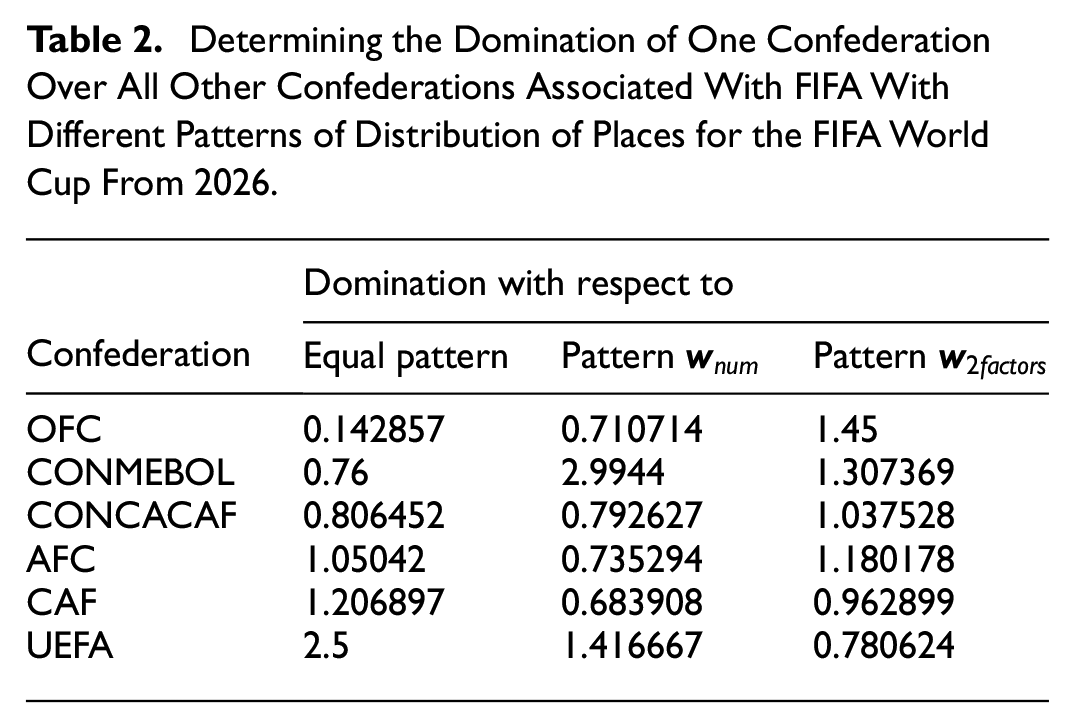
It follows from Proposition 2 that only an allocation proportional to normed pattern allocation has domination equal to 1. This situation can be interpreted as complete conformity to a pattern and balance of allocation and thus has no privileges for any group of agents with respect to another one. In any other case one can always indicate two subsets of agents, with one dominating over the other one.
A significant property of domination and balance coefficient follows from Propositions 1 and 2. Given an allocation that is considered by all parties as the fairest one, we can reduce the set of feasible allocations to those for which value
A normed pattern allocation can be defined for a given problem of allocation
Likewise, we can talk about the rule balance coefficient. It suffices to define
Since we are interested in the domination of degressively proportional allocation rules, let us define such. We say that
Notice that, in contrast to equal and proportional allocations, there may exist more than one degressively proportional allocation
It follows from Proposition 1 that if
Corollary 1. If allocation
Proof. The condition of degressive proportionality of
Let us note that merely assuming monotonicity of allocation
Corollary 2. If allocation (a) (b) (c)
Proof. Since allocation
It turns out that there is no degressively proportional allocation rule for which both domination with respect to equal allocation as well as to proportional allocation would be finite.
Proposition 3. For all degressively proportional allocation rules
Proof. By Corollary (2c), the properties of supremum and since
It follows from Proposition 3 that for rules satisfying the condition of DP it is not possible to restrict domination at the same time with respect to equal allocation and to proportional allocation. For example, in the case of seat allocation rules in the European Parliament, if a given rule ensures that the quotient of the number of seats allocated to the greatest and the smallest state does not exceed a certain positive number, then an infinite increase in the quotient of populations in the greatest and the smallest state should result in an infinite increase in the quotient of the number of citizens represented by one MEP from the smallest country and the greatest country, and vice versa.
In order to avoid the privileged treatment of any agent during the phase of selecting an allocation rule, one should only consider rules with both dominations comparable, that is, infinite. This is for example the property of allocation rules which apply power functions
Nevertheless, even with such restrictions, we still deal with some privilege. Taking the quotient of both dominations considered, we obtain
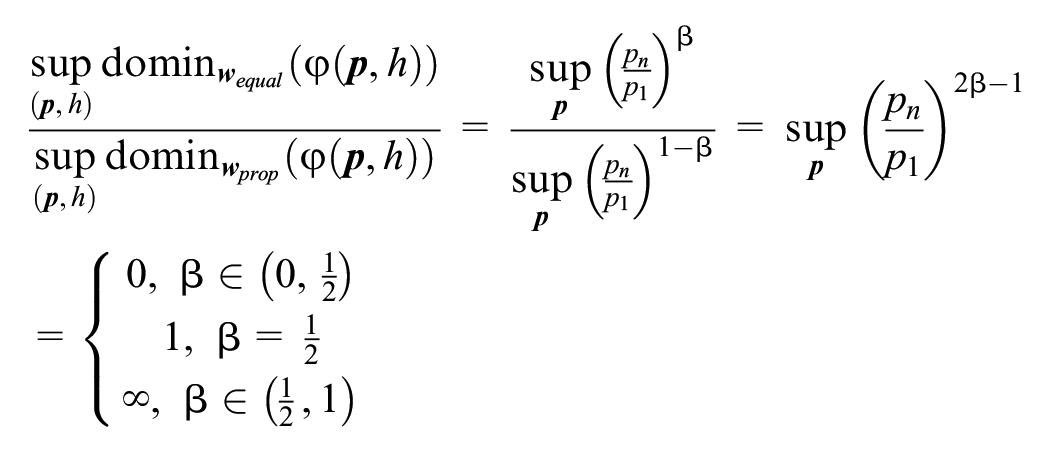
This means, however, that for a power rule allocation with an exponent unequal to 1/2, both dominations are infinite, but the greater the quotient of agents’ entitlements, the sooner some agents may gain over others following this solution. As a consequence, an unlimited and uneven increase of agents’ entitlements might influence all agents participating in the division to disapprove the rule with the properties described above. Free from such potential inconvenience is the rule which satisfies the following condition for any

where
Coefficient
Proposition 4. If degressively proportional allocation rule
Proof. By Corollary 2 (c) we have
From a practical viewpoint the most interesting rules are, of course, those which satisfy the condition of compensation with
The following section presents the examples of DP allocation rules for which one of the dominations with respect to
Empirical Verification
Let

Dominations of GWP rules with respect to
Considering only rules satisfying the GWP condition we can write the dominations of the rule with respect to equal allocation and proportional allocation as
Let us consider sequence

This relationship is shown in Figure 1. The line denoted by
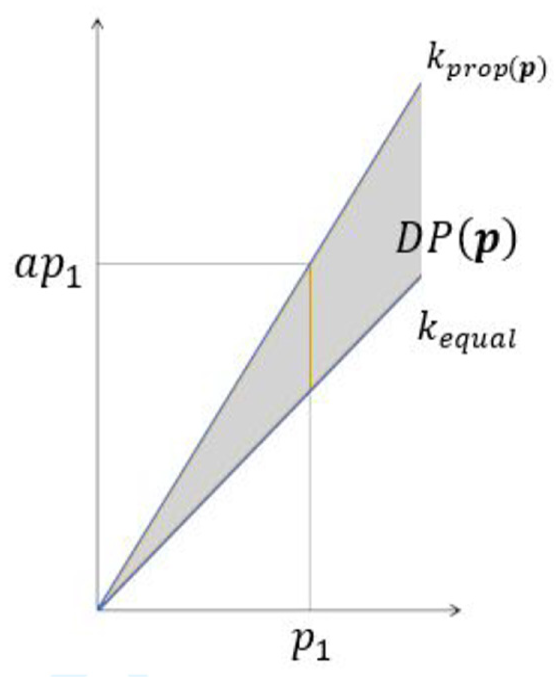
A projection of the set of degressively proportional allocations onto a plane
Notice that for a fixed sequence
In the following subsections we explain typical methods of goods allocation to the smallest and the greatest agent that can be regarded as methods determining boundary conditions of the allocation. Furthermore, we shall present approaches to control domination with respect to the equal pattern and proportional pattern in the context of each method.
Let
Geometric Interpretation of DP Allocation
In this section the two geometric interpretations of DP allocations of goods among agents with the smallest and the greatest entitlements will be presented. Both use the idea of balance or the equal distance from equal and proportional allocation. In the first case one considers the points lying on bisectors of line segments representing the
Convex Combination of Equality and Proportionality
Let a sequence of entitlements

thus,

Taking a particular value of the coefficient
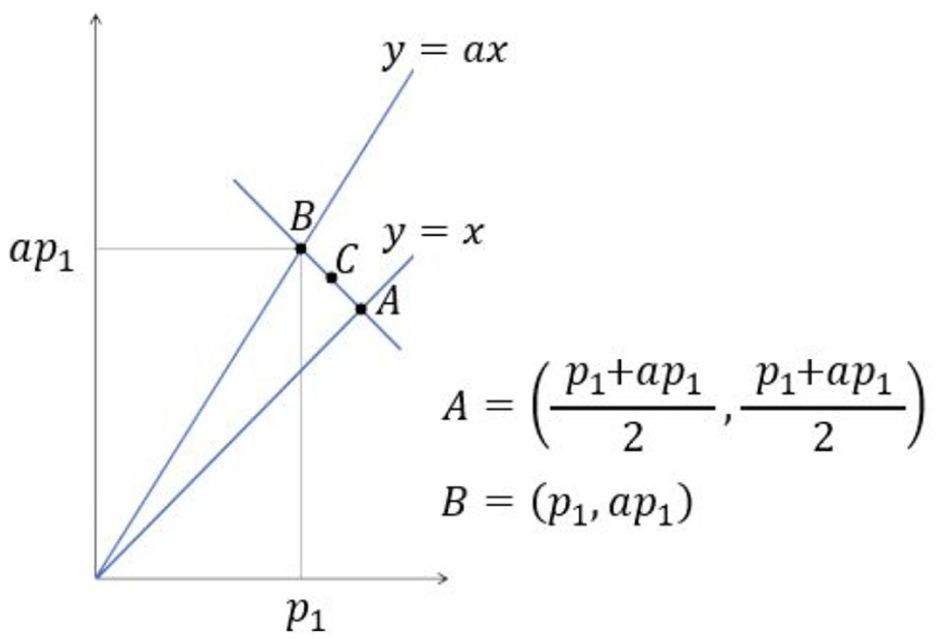
Convex combination of equal and proportional allocations among agents with the greatest and the smallest entitlements.
The value of quotient

For equal and proportional allocations we have:

This constraint does not depend on the disparity of entitlements and is finite for an arbitrary parameter
In the case of the rule presented in this section the solution of this equation is
Angle Bisection
Let a sequence of entitlements be given in the form

Division of angle between equal and proportional allocations among agents with the greatest and the smallest entitlements.
Quotient

It is easily seen that when
It is also worth noticing that
Index Approach to Balance of DP Allocation
Measures of inequality or disproportionality play a significant role in welfare economics (see e.g., Cowell, 2011). They help to measure income inequality and wealth inequality as well as inequality of goods distribution. In the latter case they indicate the deviation of a given allocation from equal or proportional allocation. These indexes have various forms and different properties. They can be normed or may take arbitrary values.
The so-called Pigou-Dalton transfer principle (Dalton, 1920; Pigou, 1912) is one of the frequently assumed properties of inequality measures. This inequality index is said to satisfy this condition if each transfer of a good from an agent with smaller entitlements to an agent with greater entitlements does not reduce the value of the index.
This property is significant in the analysis of DP allocations. In the case of two agents participating in a division, a measure satisfying the Pigou-Dalton transfer principle assumes the minimum value for equal allocation, because any other DP allocation appears from equal allocation by means of transferring a good to an agent with greater entitlements. Similarly, the maximum value is reached by proportional allocation, because any other DP allocation occurs from proportional allocation by transferring a good to an agent with smaller entitlements. As a result, one can easily regard symmetric allocation, in the sense of a given inequality measure, as a mean value, for instance the arithmetic mean of equal and proportional allocations. Many indexes are equal to zero for an equal allocation, therefore an allocation whose value of inequality index is equal to half its value computed for a proportional allocation can be regarded as a symmetric allocation.
Gini Index
The Gini index (Gini, 1921) is one of the best known inequality measures in the literature dealing with inequality measurement. For a two-element sequence

Therefore, the solution is the same as in the case of a convex combination of equality and proportionality. As a result, all properties, including limited ones, are identical to those obtained in section “Convex Combination of Equality and Proportionality.” In particular,
Atkinson Index
We will focus on one of the most important formula of the Atkinson index, that is, the complement to

In the case of equal allocation,

If
Finding coefficient
Under Proportionality
The above-presented rules have finite domination with respect to a proportional pattern. We shall now indicate a rule whose domination with respect to a proportional pattern is finite. Let a sequence of entitlements be given
Table 3 presents the summary of results obtained in section “Empirical Verification.”
Dominations With Respect to the Equal and Proportional Patterns and Coefficients

Conclusions
The principle of degressive proportionality in the context of apportionment problems emerged as an alternative to the principle of proportionality typically applied in such cases. Its introduction was primarily motivated by a desire to protect the interests of agents with small entitlements. In the case of European Parliament composition this principle was supposed to ensure an appropriate parliamentary representation of even the least populated member states in the European Union. Hence it was about excluding the excessive domination that is understood in this article to be the domination regarding an equal pattern allocation. This absence of domination was legally sanctioned in the Treaty of Lisbon by indicating the smallest and the greatest number of seats its member states are allowed, 6 and 96; in this particular case the domination was limited to 16.
If there are no boundary conditions one may consider the problem of domination in degressively proportional allocation, in the above-mentioned sense and more generally, with respect to any normed pattern allocation. In this context, there is also a proportional allocation in addition to an equal one among all normed pattern allocations. In particular, equal and proportional allocation represent two limits of degressively proportional allocation. Just like a small domination with respect to an equal pattern indicates the guaranteed protection of agents with small entitlements, a small domination with respect to a proportional pattern is supposed to guarantee the protection of interests of agents with greater entitlements against the excessive, absolute egalitarianism represented by an insufficiently diversified allocation.
The article basically concludes that no rule of degressively proportional allocation exists that would simultaneously protect against domination in both of the senses mentioned. This means that, by deciding to select the rule of finite domination with respect to a proportional pattern or finite domination with respect to an equal pattern, we undermine the protection of interests of agents with small entitlements or those with large entitlements. Consequently, fairer rules can be regarded as those whose domination is not finite with respect to both an equal as well to a proportional pattern, such as rules applying power functions which are often recommended as a convenient solution to an allocation problem in agreement with the principle of degressive proportionality (as in Dniestrzański, 2014; Martínez-Aroza & Ramírez-González, 2008; Słomczyński & Życzkowski, 2012). Among them, the fairest rules can be distinguished, that is, those whose ratio of these dominations is constant, for example rules based on a square root allocation function.
Also, the allocation rules of finite domination with respect to an equal pattern are important in practice (see Table 3). Such rules play a significant role in apportionment issues when analyzing the problem of a qualified majority, that is, in cases when decisions are not based on an ordinary or absolute majority of votes. In such cases the necessary majority is typically
Discussion
Domination and balance of an allocation rule depend only on minimal and maximal values of quotients
Using the
The results presented in this article could also be used in other areas of scientific research. The domination of individual agents or groups of agents over others can be interpreted in terms of a power index. This allows for a new look at the issue of voting power, for example, in the problems of stakeholders or political groups in collegial bodies. The importance of the domination goes beyond the domain of electoral problems. An example could be applications in economics. The problem of the division of goods and burdens is analyzed in the literature in different ways. One of the theories dedicated to it is game theory. Problems of cooperation and competition are considered in mathematical economics. Among such issues is oligopoly and monopoly. The tool proposed in this work allows to easily detect and analyze potential advantages of some economic entities over others in terms of the existence of a monopoly or oligopoly, both on a single market and on many different markets at the same time. By determining the appropriate pattern for allocation of market shares between individual entities, corresponding to the absence of monopoly or oligopoly, it is possible, using the domination, to analyze market dominance in terms of the existence of an oligopoly or monopoly. It is known that an oligopoly (monopoly) takes place when there are several (one) entities dominating the others. The criterion for the existence of an oligopoly (monopoly) may be the existence of a group of entities (one entity) for which the coefficient of dominance over the set of all other entities (calculated in a similar way as in Example 2) is greater than a certain previously determined value greater than 1 or, in case of oligopoly, the existence of a group of entities for which the coefficient of dominance over the group of other entities exceeds fixed value.
Footnotes

Ethical Considerations
Not applicable.
Funding
The author(s) disclosed receipt of the following financial support for the research, authorship, and/or publication of this article: This manuscript was funded by Wrocław University of Economics and Business.
Declaration of Conflicting Interests
The author(s) declared no potential conflicts of interest with respect to the research, authorship, and/or publication of this article.
Data Availability Statement
Data sharing not applicable to this article as no datasets were generated or analyzed during the current study.