




Abstract
Different from the existing literatures, this study innovatively explores the impact of China’s quasi market on pollution. This study examines the impact of local government interventions in the land market and structural distortions on industrial pollution in Chinese cities, using data from 287 prefecture-level cities between 2007 and 2017. Our findings reveal three key results: (1) The level of land marketization has a significant inverted-U relationship with industrial wastewater and sulfur dioxide emissions, indicating that land market liberalization initially exacerbates pollution but eventually leads to improvements. (2) Distortions in land supply exacerbate industrial pollution, with structural supply factors significantly contributing to water, air, and waste pollution. (3) Regional differences exist, with land marketization and supply distortions having varying effects across eastern, central, and western regions. These results suggest that local governments’ land policies play a crucial role in shaping environmental outcomes and provide insights into how land use regulations could be adjusted to balance industrial growth and environmental protection. Despite its contributions, the study has limitations, including the use of data from a specific time period, potential biases in the sampling method. Future research could address these limitations by exploring longer time frames, using more representative samples, and incorporating additional data sources to enhance the robustness of the findings.
Introduction
China’s economy has experienced rapid growth since the opening up of the country. Industrialization has driven economic growth, but it has also brought about environmental pollution (L. Guo & Liu, 2022; W. Sun et al., 2019). Industrial wastewater, industrial sulfur dioxide (SO2), and industrial fume (dust) are now the main sources of pollution in China. In 2019, China produced 1.069 million tons of industrial wastewater emissions, 263.1 tons of industrial SO2 emissions, and 345 tons of industrial fume emissions. Although the total amount of polluting emissions has decreased compared with 2007, environmental issues remain an important constraint to sustainable and healthy economic growth (Shao et al., 2019). Highly polluting industries are moving to countries with low environmental standards and vast land supply, such as India and the Philippines. The “pollution paradise” effect is the cause of increasing industrial pollution emissions and industrial land concessions (Ding et al., 2022; Seskin et al., 1983; Tian & Lin, 2017).
Land allocation impacts the industrial structure, technology level, and environmental pollution (Chen et al., 2018a,b; Yuting et al., 2019). In China, environmental pollution is closely related to the pattern of economic development driven by local governments, and land supply policies, in particular, have played a key role in this process. China’s land marketization reform has promoted the dominant role of market mechanisms in land resource allocation. However, the negative association between the economic development model and environmental pollution still exists due to government intervention and imbalances in the supply structure of the land market (Lin & Ho, 2005).
In 2002, China’s Ministry of Land and Resources promulgated the Regulations on Bidding, Auctioning, and Listing of State-owned Land Use Rights (LURs) for Transfer. Under these regulations, LURs must be transferred through bidding, auctioning, or listing, as well as reserving the allocation and agreement methods. However, these reforms concern the allocation of land for residential and commercial uses, whereas the allocation of industrial land remained heavily restricted. A major reform in land supply policy was implemented in 2003. Local governments adopted the land supply strategy of offering industrial land at low prices to attract industrial enterprises and offering a small area of land for commercial use at a high price. This approach can promote regional economic growth and increase land concession revenues, but it seriously interferes with the land market, distorts the land concession structure, and may come at the expense of the environment, which is profoundly affected by the high energy consumption and emissions of industrial enterprises (Cai et al., 2013; Chen et al., 2018; Q.Wang et al., 2020; Zheng & Shi, 2017).
Quasi-marketization is a unique and incomplete market type, wherein land supply is the result of the combined forces of local government intervention and market supply and demand. While local government-led land supply strategies have promoted short-term economic growth, they have also made environmental pollution and resource allocation imbalances persistent problems. In globalization, land marketization has accelerated, and the movement of capital and population has accelerated, promoting technological innovation, progress, and thus ecological sustainability (Ahmed et al., 2016; T. Liu et al., 2016). However, over-reliance on market-based mechanisms may worsen environmental pollution (T. Liu et al., 2016; Sapkota & Bastola, 2017).
Scholars have mainly studied the influencing factors of urban industrial pollution from the aspects of industrial structure and enterprise characteristics (He et al., 2018; Hettige et al., 1996). Regarding land allocation, existing literature mainly analyzes the issue from the perspective of resource protection and the institutional level, and rarely explores the relationship between land allocation and industrial pollution (Chen et al., 2018). However, industrial land allocation is closely related to industrial structure and enterprise characteristics, etc., and its impact on industrial pollution cannot be ignored (W. Du & Li, 2021).Therefore, this paper innovatively assesses the impact of urban industrial pollution from the perspectives of government intervention and the distorted supply structure in the land market. Establishing and exploring the link between the land market supply structure and industrial pollution has important implications for the use of land resources and the management of environmental pollution. The paper makes two chief contributions to the field. First, it explores the relationship between a highly quasi land market and industrial pollution, and second, it analyzes whether increased marketization would mitigate industrial pollution.
The rest of this paper is organized as follows. In section 2, we review the literature. Section 3 discusses the spatial and temporal distribution of industrial pollution emissions. In Section 4, the data, models, and methods. Next, we offer empirical results in Section 5 and conclude the study in Section 6.
Literature Review
Industrial Pollution and Its Influencing Factors
Rapid industrialization and urbanization have been central to sustained economic growth in many developing countries, including China (C. H. Yang et al., 2012). However, this economic growth has been accompanied by the emission of substantial amounts of industrial pollutants, creating significant environmental challenges (Feng et al., 2020). Multiple factors influence the complex mechanisms driving industrial pollution in urban areas. These factors intersect in ways that complicate the path toward sustainable development, where the need for economic growth often conflicts with environmental protection goals (M. Zhou et al., 2020).
One of the key drivers of industrial pollution is fiscal decentralization. In China, local governments have strong incentives to prioritize GDP growth, often at the expense of environmental regulations. This fiscal structure encourages local governments to relax environmental control measures, attract both domestic and foreign firms, and provide tax incentives in order to stimulate industrial investment (M. Zhou et al., 2020). This strategy of economic promotion, however, can exacerbate environmental degradation, as it leads to insufficient funds being allocated to environmental management during periods of rapid economic development (W. Fan et al., 2021; Okeke et al., 2020; M. Zhang et al., 2019). The discrepancy between the short-term economic goals of local governments and the long-term environmental sustainability goals of the central government often creates a misalignment in priorities, contributing to the growing environmental crisis in industrialized areas.
Numerous studies have identified key factors contributing to industrial pollution emissions, including the level of economic development, industrial structure, population growth, FDI, environmental regulations, and production technologies. Rapid economic development, particularly in emerging economies like China, is closely linked with rising pollution levels, a relationship supported by the “Environmental Kuznets Curve” (EKC) hypothesis. This hypothesis suggests an inverted U-shaped relationship between economic growth and environmental degradation, wherein pollution increases in the early stages of industrialization but begins to decline as income levels rise and cleaner technologies are adopted (Dong et al., 2018). However, this relationship is not straightforward, as pollution reduction is heavily dependent on changes in industrial structure. Studies by X. Zhou et al. (2013) and Cheng et al. (2018) emphasize that optimizing industrial structure—shifting away from polluting industries toward more sustainable sectors—can significantly reduce pollution emissions. This highlights the importance of structural change as a critical component in environmental management.
The role of foreign direct investment (FDI) in industrial pollution is another key area of debate. The “pollution haven” hypothesis, proposed by Copeland and Taylor (1994), suggests that stricter environmental regulations in developed countries drive polluting industries to relocate to less-regulated developing regions, exacerbating pollution in these areas. However, the “pollution paradise” hypothesis challenges this view, proposing that FDI can bring advanced technology, management practices, and cleaner production methods to developing regions, leading to environmental improvements. Studies by Ashraf et al. (2021) lend support to this perspective, showing that FDI flows to developing countries can positively influence environmental quality by improving resource efficiency and introducing environmentally friendly technologies.
In addition to industrial structure and FDI, technological innovation has also been identified as a key factor in reducing industrial pollution. Technological advancements can lead to more efficient resource use and lower emissions, yet some studies have pointed to the existence of a threshold effect. The benefits of technological innovation on environmental quality may vary depending on the level of development in a region and the capacity for adopting new technologies (He et al., 2012; Hatzipanayotou et al., 2014). In China, research on fiscal decentralization and promotion incentives has shown that local governments, under pressure to meet GDP targets, may lower environmental standards and offer tax incentives to attract polluting industries. This dynamic exacerbates industrial pollution, highlighting the negative side of economic incentives when they are not aligned with environmental goals (Y. Zhou et al., 2017).
The Quasi-Marketization and Urban Land Allocation
Existing research predominantly highlights the economic dynamics and strategies involved in land concessions, focusing on the trade-offs between land attraction and land finance hypotheses. Land markets play a crucial role in urban and industrial development, and institutions related to land use, such as governments, can greatly influence urban dynamics (J. Zhang et al., 2017). In China, the fiscal and administrative powers of local governments have been mismatched since the 1994 tax-sharing reforms. These reforms have led to the relative decline of local financial power and official promotions are now based on economic indicators, such as GDP. Local governments now actively seek off-budget fiscal revenue to promote regional economic development. These governments can guide regional economic development not only through capital and taxation but also through investment and land allocation, which is an important factor in production. As a result, land concessions and land taxes have become two major sources of fiscal revenue for local governments in China (Qun et al., 2015).
The literature reveals two main hypotheses on land concession strategies. One is the “land attraction” hypothesis, which is related to promotion incentives. Under this hypothesis, local governments can offer land at low prices to obtain investment. The other is the “land finance” hypothesis, which is related to fiscal decentralization. Under this hypothesis, local governments can obtain land finance by raising land prices. The propensity of local Chinese governments to favor land finance and the deviation of land concession prices is related to the public ownership of land in China and Chinese politics (C. Xu, 2011). Thus, in the Chinese context, the land attraction hypothesis suggests that the local government will lower the price of industrial land, or even offer it for free, to attract companies to the area and thus drive economic growth. In contrast, the land finance hypothesis suggests that the government is deeply concerned about maximizing short-term revenue from land with low-priced industrial land concessions redressed by revenues from commercial and residential land concessions. Thus, the government will reduce the area of commercial and residential land supply and raise the price of commercial and residential land concessions to obtain substantial land concessions. J. Zhang et al. (2017) found that total revenue from land sales in China grew steadily from 1999 to 2007, wherein industrial land sales accounted for 55% of total land sales, but only about 25% were attributed to commercial and residential land sales. This finding reflects the distorted land sale structure caused by local governments that sell large amounts of industrial land at low prices and small areas of commercial and residential land at high prices.
The marketization of land plays an important role in economic growth, and the level of marketization of land and land transaction prices can reflect the efficiency of land resource utilization and allocation. Unlike private land ownership in Western countries, China’s land system is public; the state owns land and has a monopoly on the primary land market, which hinders the optimal allocation of land resources by market mechanisms (J. Wang et al., 2018). State-owned construction land is the only legal means of acquiring land for urban development in China. The land market in China starts with the government converting agricultural collective land into state-owned land before the right to use the state-owned land is then transferred. The market for the transfer of LURs includes a primary market, where the state-owned land is leased, allocated, agreed, and “auctioned,” and a secondary market where LURs are leased and mortgaged. Before the introduction of the “auction and listing” policy, the government offered large areas of industrial land by agreement. Under China’s land market positioning model, local governments sell land through public bidding, auction, and listing, which is considered the market-based land allocation method.
The Relationship Between Land Supply and Industrial Pollution
China’s tax-sharing reforms involve restructuring the distribution of central and local revenues and, in this way, strengthening the central government’s power over local governments. In a sense, these reforms reinforce the tendency of local governments to obtain fiscal revenues through the allocation of land. Local governments relieve fiscal pressure through land market forces and government intervention (Y. Wang & Hui, 2017; Z. Yang et al., 2015). Market-based allocation refers to the allocation of land to individual operators through competition on the basis of price and supply and demand. The price of land transactions reflects the level of land marketization, and, currently, “auction and listing” is regarded as a market-based allocation method. The lag in the market mechanism and the existence of allocation and agreement result in an imperfect market and the inappropriate use of land. Administrative allocation mainly refers to the allocation of land among business entities through government policies. This type of allocation usually occurs under the pressure of financial assessment and promotion incentives.
The primary goal of local governments is economic growth. Thus, as discussed above, they intervene in the land market by offering industrial land at low prices to attract local investment and encourage enterprises to move and reduce the area of commercial and residential land to increase its price. This leads to the distorted allocation of industrial land and commercial and residential land (Y. Liu & Geng, 2019). However, another possible consequence is the presence of low-end enterprises pursuing low costs and high profits. Low-end enterprises generate more pollutants and are detrimental to the adjustment of industrial structure and technological upgrading. Existing studies have found that changes in land use can affect the environment and that irrational land allocation strategies may be a major source of local environmental pollution. Attracting corporate investment by offering land at low or even below-cost prices reduces the quality of urban development and exacerbates social segregation and environmental pollution (Yaping & Min, 2009).
The most commonly used methods for measuring the degree of land marketization are the direct calculation method (R. Wang & Tan, 2020; Yuan et al., 2019) and the weighted calculation method (T. Liu et al., 2016; Qun et al., 2015). The direct calculation method directly measures the level of land marketability using indicators such as price, area, and quantity of land transfers. The weighted calculation method assigns different weights to the transfer prices by agreement, bidding, auction, and listing on the basis of the direct calculation method (X. Fan et al., 2020). The methods used to measure the degree of land distortion are the area proportional method, price proportional method, and production function proportional method. These calculation methods mainly involve the proportion of the supply area of industrial, mining, and storage land to the total area of state-owned construction land supply, the proportion of the agreed concession area to the total area, the proportion of the average price of residential land to the average price of industrial land, and the C-D production function (Huang & Du, 2017; Y. Liu & Geng, 2019; Tao et al., 2010).
Literature Summary
In summary, industrial pollution is influenced by multiple factors such as fiscal decentralization, industrial structure, FDI, and technological innovation, with local governments’ economic incentives and land allocation strategies playing a critical role. The quasi-marketization of China’s land system has enabled “land for investment” and “land finance” strategies to drive economic growth, but it has also led to land misallocation and environmental degradation. Most existing research focuses either on the economic aspects of land marketization or on the measurement of land distortion, without fully addressing the long-term environmental consequences, particularly in the context of industrial pollution. The research in this paper will further analyze the long-term impacts of land marketization and land allocation strategies on industrial pollution and reveal through empirical analyses how local governments’ policy choices in land grants exacerbate or mitigate environmental problems.
The Spatial Distribution of Industrial Pollution and Land Marketization
Calculations show that industrial wastewater, industrial SO2, and industrial fume (dust) emissions decreased between 2007 and 2017, but overall emissions are still high. In 2017, 9 of the top 10 most polluting cities for industrial wastewater discharge were in the eastern region of China and 7 of the 10 least polluting cities were in the western region. The total amount of industrial wastewater discharged in the eastern region accounted for 59.4% of the total amount of industrial wastewater discharged in the country, discharge in the central region accounted for about 24%, and discharge in western China accounted for 16.3% of the national total. Half of the top 10 most polluting cities for industrial SO2 and industrial fume (dust) discharge were in the eastern region. In 2017, the eastern region discharged 39% of the national total of industrial SO2 discharges, the central region accounted for 24.9%, and the western region accounted for 35.7%. The proportion of industrial fume (dust) discharged in the whole country is similar to that of industrial SO2.
In this research, 287 cities in China and the three indicators of industrial wastewater, industrial SO2, and industrial fume (dust) emissions from 2007 to 2017 are selected for analysis. The entropy value method is used to construct the industrial pollution index given that industrial pollution mainly includes the three elements of wastewater pollution, exhaust gas pollution, and solid pollution (Liu et al., 2016). The calculations used are as follows.
The raw data are then normalized:

where
Next, the proportion is calculated:

where
Then, the entropy value, redundancy, and weights are calculated. Entropy value:

where
Information entropy redundancy:

where
Weight:

where
Finally, the industrial pollution index is calculated:

where
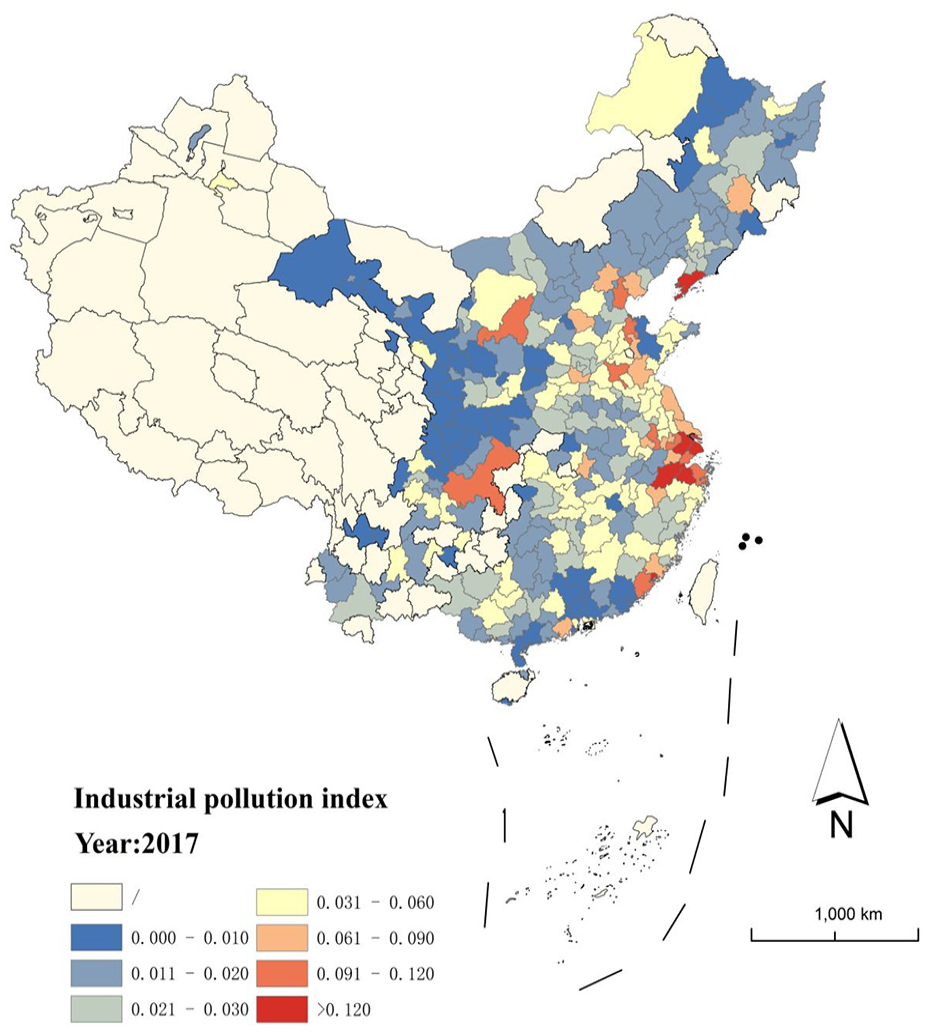
The industrial pollution index, land marketization level, and land supply distortion degree in 2017 were spatially visualized using ArcGIS 10.6. Figure 1 shows industrial pollution in Chinese cities in 2017. The industrial pollution index ranges from 0.0002 to 0.2278, with a higher pollution index in the eastern region compared with the central and western regions. Thirty cities in the eastern region have a pollution index of 0.1 or higher, and 11 of the 12 cities with a pollution index greater than 0.1 belong to the eastern region.

Industrial pollution index in China’s cities.
Figure 2 shows land supply distortion in Chinese cities in 2017. A total of 95% of the urban land supply distortion degree is less than 0.5, and most of the top 10 cities with a significant land supply distortion degree belong to the eastern region. It can be seen that there is spatial convergence between the degree of land supply distortion and industrial pollution.
Land supply distortion in China’s cities.
Data, Methods, Models
Study Area and Data Sources
The paper investigates the effects of land market levels and land supply distortions on industrial pollution. The sample includes 287 prefecture-level cities in China. Data on land marketization and land supply distortions are obtained from the China Land and Land Yearbook (2008–2018). Data on industrial pollution, GDP per capita, population density, industrial structure, FDI, technology level, and environmental regulation are obtained from the China Urban Statistical Yearbook (2008–2018). Data on road area per capita are obtained from the China Urban Construction Statistical Yearbook (2008–2018). FDI is converted into RMB at the exchange rate of the relevant year, and GDP per capita deflations are treated as constant prices in 2007.
Variable Definition and Descriptive Statistics
Based on the literature review, this paper tests the impact of land marketization level and structure distortion on industrial pollution selecting industrial wastewater discharge per unit of GDP, industrial SO2 emissions per unit of GDP, industrial fume (dust) emissions per unit of GDP, and the industrial pollution index as the explained variables. The explanatory variables are the proportion of the area of land sold by public bidding, auction, and listing to the total area of land sold, the proportion of the area of land sold by agreement to the total area of state-owned construction land from 2007 to 2008, and the proportion of the area of industrial and mining warehouses to the total area of state-owned construction land from 2009 to 2017 (most of the land sold by agreement is industrial land). GDP per capita, population density, industrial structure, FDI, technology level, environmental regulations, and road area are applied as the control variables. To eliminate the effect of inflation, the data on monetary value variables from 2007 to 2017 were treated as constant prices in 2007 according to the corresponding price indices. FDI was converted into RMB at the exchange rate of that year. The quantitative methods and descriptive statistics for each variable are given in Table 1. To mitigate the heteroskedasticity problem, industrial pollution, GDP per capita, population density, FDI, and road area are used in logarithmic form in the empirical evidence.
Variable Definitions and Descriptive Statistics.

Empirical Models and Estimation Methods
This paper adopts a comprehensive and comparative approach to systematize and summarize the existing literature. Through the analysis of the mechanism of land marketization and land structure distortion on industrial pollution, based on environmental economics and new economic institutionalism, the paper constructs a panel model of land marketization and land supply distortion on industrial pollution based on the analysis of the mechanism of the impact of land marketization and land supply distortion on industrial pollution.

where Y is the explanatory variable, which includes industrial wastewater emissions per unit of GDP (
The primary reason for choosing System GMM in our study is its ability to effectively address endogeneity issues in dynamic panel data models using lagged variables as instruments. This method is particularly suited for capturing the dynamic relationships between industrial pollution levels and economic activity while handling individual fixed effects to avoid bias in the estimates (Bond, 2002). Given this, the use of classical OLS methods may lead to biased estimation results; the generalized method of moment (GMM) can solve the endogeneity problem in the model and obtain consistent estimates (Hashmi & Alam, 2019). The advantages of GMM estimation are as follows: (1) the explanatory variables and core explanatory variables may be determined simultaneously, and dynamic panel GMM estimation where appropriate instrumental variables are chosen can effectively control the endogeneity problem of explanatory variables (Çoban & Topcu, 2013); (2) GMM that uses differentially transformed data can also overcome the omitted variable problem when unobservable variables are correlated with the explanatory variables or when certain individual influences are omitted. Systematic GMM (SYS-GMM) includes one-step and two-step GMM. The SYS-GMM proposed by Blundell and Bond (1998) is used because the weight matrix of the two-step estimation depends on estimated parameters and has a downward bias in the standard deviation, which does not significantly improve efficiency as the estimators are not reliable (Arellano & Bond, 1991; Arellano & Bover, 1995; Singhania & Saini, 2021).
Empirical Results
Full Sample Estimation Results
The GMM is established on the premise that autocorrelation does not exist in the disturbance terms. Thus, the optimal lag order for industrial wastewater, industrial SO2, and industrial fume (dust) was determined at lag order 1. The optimal lag order for the pollution index was placed at lag order 2 based on the results of the AR(1) and AR(2) tests. The results of the AR(1) and AR(2) tests (see Table 2) indicate that the second-order serial correlation problem does not exist in the model and the regression results of each equation are valid. The Hansen-J values indicate that the selected instrumental variables pass the over-identification test and satisfy the correlation and exogeneity requirements. While System GMM is not typically assessed by traditional fit indices (like R-squared), the robustness of the results can be evaluated using the aforementioned diagnostic tests. In our study, all tests confirmed that the model was properly specified, and the estimates obtained were consistent and unbiased.
Regression Results for the Impact of Land Marketization on Pollution.

Note. Robust standard errors of regression coefficients are shown in parentheses. The Hansen-J test refers to the over-identification test for restrictions in the GMM estimation. The original hypothesis suggests that there is no over-identification of the equation perturbation terms. AR(1) and AR(2) tests are Arellano-Bond tests for the existence of first- and second-order autocorrelation; *, **, and *** denote significant results at the 10%, 5%, and 1% levels of significance. The AR(1), AR(2), and Sargan statistics are p-values.
Models (1), (2), and (3) (see Table 2) show that the coefficient of land marketization is significantly positive and the coefficient of the quadratic term is significantly negative. The results show that the effect of land marketization on industrial wastewater, industrial SO2 emissions and the industrial pollution index follows an inverted U-shaped pattern of change (see Figure 3), which means that urban industrial wastewater and industrial SO2 emissions increase significantly as the level of land marketization increases. In contrast, the increase in the level of land marketization can significantly reduce urban industrial water and air pollution when the level of marketization reaches a certain level. This result is attributed to the fact that the overall level of land marketization is initially low, with price increases subsequently encouraging the government to expand the scale of land use, which does not influence the occupancy of industrial enterprises (L. Liu et al., 2015). Moreover, the demand for land is limited by the inverse price mechanism as the level of marketization increases further, which reduces the opportunities for industrial pollution. The coefficients of land supply distortion concerning industrial pollution are positive when the effects on industrial wastewater, industrial SO2, industrial fume (dust), and industrial pollution index are significant at the 1% level. This result indicates that the distortion of the land supply structure exacerbates industrial pollution, and the larger the proportion of industrial land, the more serious the effect on industrial pollution. This confirms that Chinese local governments’ tendency to allocate land to industry distorts the land resource structure, accelerates industrial development, and aggravates industrial pollution. Additionally, the following coefficients are positive and significant at the 1% level: industrial wastewater, industrial SO2, industrial fume (dust) in the lagged period on wastewater, SO2 and fume (dust) in the current period, and the industrial pollution index in the current period, the single lagged period, and in the two lagged periods. These results indicate that environmental pollution is a long-term dynamic process, that is, pollution in the previous period that is not treated in time will aggravate the pollution level in the current period.
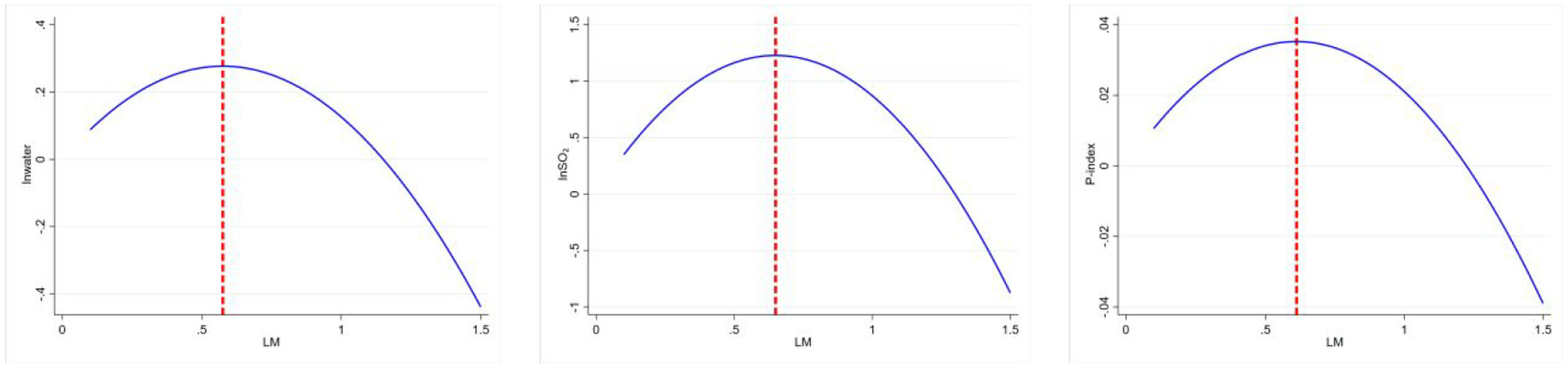
Relationship between the land marketization and the industrial pollution.
Sub-sample Estimation Results
The geographical expansiveness of a country as large as China must be considered as regional differences may have an impact on the estimation results. To investigate such differences, the overall sample was divided into two parts, namely, the eastern region and the central and western regions, which were further analyzed on the basis of sub-regions. The results of the sub-regional regressions of the impact of land marketization and structural distortion on industrial pollution are shown in Table 3.
The Sub-regional Regression Results for the Impact of Land Marketization on Pollution.

Note. Robust standard errors of regression coefficients are shown in parentheses. The Hansen-J test refers to the over-identification test for restrictions in the GMM estimation. The original hypothesis suggests that there is no over-identification of the equation perturbation terms. AR(1) and AR(2) tests are Arellano-Bond tests for the existence of first- and second-order autocorrelation; *, **, and *** denote significant results at the 10%, 5%, and 1% levels of significance. The AR(1), AR(2), and Sargan statistics are p-values.
As can be seen in Table 3, the results of the AR(1) and AR(2) tests indicate that there is no second-order serial correlation problem in the model and the regression results of each equation are valid. The Hansen-J values indicate that the selected instrumental variables pass the over-identification test and satisfy the correlation and exogeneity requirements. From Models (5) to (8), it can be seen that land supply distortion aggravates industrial wastewater and industrial fume (dust) emissions in China’s eastern region. From Models (9) and (12), it can be seen that in the central and western regions, land marketization has a significant inverted U-shaped effect on industrial wastewater and industrial SO2 emissions but not industrial fume (dust) emissions, and land supply distortion has a significant positive effect on all three industrial emission types.
This could be explained by the fact that more attention is paid to economic efficiency in an accelerated industrialization process with less control exercised over production quality and environmental protection, and local governments are also more inclined to allocate land to industry to attract foreign-funded enterprises, thus increasing industrial pollution. The economy of China’s eastern region is relatively advanced compared with the central and western regions, and the cost of construction land is also relatively high. In this context, it is not the land market price mechanism that attracts enterprises but geographical location. In the central and western regions, land supply is generally sufficient, which provides more opportunities for new industries, and the land market price mechanism has a more significant influence on enterprises. Additionally, it should be noted that the coefficients of industrial pollution in the lagging period for the eastern, central, and western cities are significantly positive for the current period, which is consistent with the results of the full sample analysis.
Conclusions and Policy Recommendations
Conclusions
As a critical production factor, land profoundly influences enterprise location decisions (Ruiz et al., 2020). In China, local governments leverage their dominant position in the land market to attract enterprise investment by lowering industrial land prices through fiscal subsidies and incentive measures (S. Guo et al., 2020). As a result, the actual price of industrial land is significantly lower than its market value, and the extensive expansion of industrial land leads to a distortion in the allocation of land resources (J. Du & Peiser, 2014). This paper constructs an analytical framework based on a theoretical analysis of the impact of the land market and its structural distortions on industrial pollution by analyzing the 2007 to 2017 data from 287 prefecture-level cities in China. The paper presents three main findings. Other developing or transitional economies may face similar challenges regarding the misallocation of land resources and its environmental consequences during rapid industrialization. The study’s findings provide evidence of the environmental effects of land resource allocation.
First, consistent with the findings of W. Sun et al. (2019), this study verifies the nonlinear effect of land marketization on the levels of industrial wastewater and industrial sulfur dioxide emissions. The results show that a low level of land marketization will exacerbate industrial pollution emissions, followed by an abatement effect, and there is an inverted “ U ” shaped relationship between the two. The low level of land may promote the development of high-consumption and high-emission enterprises, thus exacerbating pollution emissions. With the increasing level of land marketization, the screening effect on high-polluting enterprises gradually emerges, thus realizing the emission reduction effect (Jin & Jayne, 2013). Unlike the linear relationship in previous studies, we reveal a nonlinear relationship between the two, enriching our understanding of the environmental effects of land marketization.
Second, land supply distortion has positive effects on the industrial waste emissions surveyed and is statistically significant, which is consistent with the findings of Du and Li (2021). Industrial pollution worsens when the proportion of industrial land concessions increases. Additionally, industrial structure, GDP, population density, FDI, and other socio-economic development factors have a significant impact on industrial pollution.
Third, the regression results by region show that the effects of land marketization and structural distortion on industrial pollution differ across regions (Hu et al., 2022). Regarding land marketization, its nonlinear impact on industrial pollution varies across regions. In the central and western regions, industrial wastewater and SO2 emissions are significantly higher, suggesting that in these areas, the market price mechanism is weaker and low land prices may attract high-emission industries, thereby intensifying environmental pressures. As land marketization improves, its screening effect on polluting enterprises becomes more pronounced, especially in regions where the market mechanism is more mature. Regarding land supply distortion, the environmental impact is more prominent in the eastern region, where distorted land allocation has led to increased industrial wastewater and fume (dust) emissions. In contrast, all three major types of pollution (wastewater, SO2, and dust) show strong associations with land distortion in the central and western regions, indicating that land misallocation is a key driver of pollution across these areas. These findings emphasize the necessity of region-specific land governance strategies under the pressure of local governments to maintain economic growth through land finance.
Policy Recommendation
The above conclusions have important guiding significance for promoting land marketization, reducing distortions in land supply, and reducing urban industrial pollution. Therefore, we provide the following three policy recommendations.(1) Reduce government intervention and further promote the market-based allocation of industrial land. The government should improve the performance appraisal mechanism and alleviate the promotion and financial pressure on local governments aiming at economic appraisal. (2) In addition, by adjusting the land grant structure and then adjusting the industrial structure, it should reduce the occupation of high-pollution and high-emission enterprises and encourage and support the development of high-technology level and low-pollution enterprises so as to curb industrial pollution. (3) Clarify the differences in regional development levels and rationally formulate investment attraction strategies. According to the level of urban development, the land allocation strategy should be combined with the industrial structure of each region, reasonably allocate construction land resources, and improve the utilization efficiency of construction land.
Limitations and Future Directions
Although this study supplements the research on the relationship between Government-regulated market, land supply distortion, and industrial pollution, it still has shortcomings that need further improvement. Some limitations are acknowledged in this study: First, the sampling method used in this study may introduce potential biases. The sample may not fully represent the entire spectrum of industrial pollution across different regions.
(1) Second, our study relies on recent data regarding land and industrial pollution levels. However, the limited availability and timeliness of some data may affect the long-term validity of our findings. Future research directions include: (1) Using longer time spans for dynamic analysis. (2) Comparing countries to explore how land policies affect industrial pollution under varying institutional settings and policy environments. (3) Investigating the effects of specific policy interventions, such as environmental regulations or tax incentives, and how they interact with land policies to create compounded environmental impacts.
Footnotes
Acknowledgements
This work was supported by National Social Science Fund of China (23FJYB009), The Ministry of education of Humanities and Social Science project (23YJA630130, 23YJC630247).

Funding
The author(s) disclosed receipt of the following financial support for the research, authorship, and/or publication of this article: This work was supported by National Social Science Fund of China (23FJYB009), The Ministry of education of Humanities and Social Science Project (23YJA630130).
Declaration of Conflicting Interests
The author(s) declared no potential conflicts of interest with respect to the research, authorship, and/or publication of this article.
Data Availability Statement
If anyone makes a request, the authors will provide the data.