




Abstract
This study analyzes the relationship between haze pollution and industrial agglomeration using particulate matter (PM2.5) concentration data from 269 prefecture-level cities in China between 2007 and 2016. We calculate the industrial agglomeration level using the location entropy method with industrial output as the core variable. We find that the industrial agglomeration effect is adversely affected by increased haze pollution, proving a negative correlation between them. We also compare the effect of haze pollution on industrial agglomeration before and after the 18th National Congress. The comparison shows that the effect of haze pollution on industrial agglomeration during 2012 to 2016 was significantly less than that during 2007 to 2011. Therefore, the industrial agglomeration effect can be strengthened by reducing environmental pollution through vigorous environmental governance efforts. These findings provide empirical evidence for governments’ continued implementation of current environmental protection policies.
Introduction
Organic carbon and black carbon aerosols are formed after the volatilization of organic matter generated in human activities and daily life, which makes haze pollution intensified. The 2020 Global Environmental Performance Index report shows that more than 3.5 billion people worldwide (about 1/2 of the world’s total population) are exposed to unsafe air pollution, and poor air quality kills more people five times than unsafe drinking water each year (Wendling et al., 2020). Especially for densely populated developing countries such as India and Pakistan, the impact of haze pollution on health is even more serious. Rich countries such as Kuwait and Saudi Arabia have also caused serious haze pollution due to the processing of petroleum fuels. Developing countries have a strong desire to develop their economies, urbanization, and industrialization. Developed countries have also experienced the impact of haze pollution on health and economic development. Therefore, policy makers all over the world hope to benefit their own people and future generations by controlling haze pollution.
The Chinese government has implemented 43 years of reform and opening-up of the economic market, and these remarkable economic achievements have been acknowledged worldwide. However, the prioritization of economic development during the past few decades has led to the prominent issue of environmental pollution. In particular, haze pollution has deeply affected the everyday life of people in China. As China’s government states, special efforts are being made to resolve the pollution problem and to take continuous action on air pollution prevention and control (Xi, 2019).
In 2019, with the ultimate aim of promoting green development, the government implemented the strictest possible systems for protecting the environment (Xi, 2019).
While the government aims to promote economic development through industrial agglomeration, these efforts affect the local environment. Haze pollution is just one of the resulting environmental changes. An important question to be addressed is whether haze pollution affects the progress of industrial agglomeration (Ye et al., 2021). While many studies have discussed the relationship between haze pollution and industrial agglomeration (X. Li et al., 2021), most only focus on the one-way effect of industrial agglomeration on environmental pollution. Some researchers remain concerned about modern technologies implemented in agglomerations to reduce air pollution by improving energy efficiency (Skiba et al., 2021; Zimmermann et al., 2021). The inverse effect of environmental pollution and, in particular, haze pollution on industrial agglomeration remains largely unexplored.
This article focuses on analyzing how haze pollution affects industrial agglomeration. With this focus, we can provide suitable policy recommendations to the local government on environmental management and reducing pollution to ensure a healthier society.
Literature Review
The correlation between haze pollution and industrial agglomeration has always been an important topic for academic research. Early studies focused on the relationship between environmental quality and industrial agglomeration and have generated some preliminary findings that consider industrial agglomeration to be the major cause of air pollution (De Leeuw et al., 2001; Rupasingha et al., 2004). Some researchers believed that industrial agglomeration had deteriorated environmental quality. For example, Ottaviano et al. (2002) suggested that if we do not make breakthroughs in certain technological bottlenecks, excessive industrial agglomeration will worsen environmental quality. Using Shanghai as a case study, Ren et al. (2003) demonstrated that industrial agglomeration intensified the exploitation of land resources. Some other studies hold the opposite opinion that industrial agglomeration has an obvious positive effect on improving the environmental condition. These studies demonstrate that industrial agglomeration can achieve a win-win situation by promoting economic growth and simultaneously realizing pollution control from the following perspectives: the spillover of clean technology through collaborative innovation among different enterprises (Krugman, 1998) and the recycling effect of the cluster economy (Ehrenfeld, 2003).
In recent years, an increasing number of researchers have shifted their focus toward the relationship between haze pollution and industrial agglomeration (Ye et al., 2021). However, existing studies have failed to reach a consensus on the issue of industrial agglomeration and environmental pollution. These disagreements are reflected in the following two aspects.
First, whether industrial agglomeration has a positive or negative effect on environmental pollution remains controversial. Industrial agglomeration helps alleviate the “pollution paradise” effect (Zeng & Zhao, 2015). The price mechanism and competition mechanism of industrial agglomeration can provide enhanced resource allocation, improve innovation capabilities and technological content, promote resource sharing and knowledge spillover, and reduce the efficiency losses in energy utilization. These effects ultimately contribute to pollution reduction, energy saving, and emission cuts (Yuan & Xie, 2014). However, many researchers believe that industrial agglomeration intensifies environmental pollution through output scale, structure, and efficiency (Ye et al., 2021; Zhang & Dou, 2015).
Second, domestic researchers in China and foreign researchers hold different perspectives when analyzing the relationship between industrial agglomeration and environmental pollution (X. Li et al., 2021). Existing studies by foreign researchers have focused on analyzing the change of air quality in urban agglomerates. They believe that industrial agglomeration has a negative external effect on environmental quality, causing a deterioration of the ecological environment (Hosseini & Kaneko, 2013; Simonen et al., 2014). Studies by domestic researchers seek to analyze the economic causes and effects of haze as well as the economic measures necessary to reduce haze pollution. Some studies argue that industrial transfer is an important reason for the spatial dependence of haze pollution, and the level of haze pollution continues to rise with increasing GDP (Xiu et al., 2020). Therefore, while industrial agglomeration contributes to improved regional economic growth and development (Dai & Lin, 2021), it also leads to many environmental problems that require urgent attention (Ma & Zhang, 2014). At the same time, some studies hold the opposite view and argue that industrial agglomeration provides a positive effect in improving the environmental condition (Perkmann et al., 2011). Industrial collaborative agglomeration can reduce haze pollution by improving manufacturing efficiency (Cai et al., 2020).
Other researchers have measured the total factor of energy efficiency and the degree of industrial agglomeration. These empirical studies found that industrial agglomeration benefits environmental improvement, affects the prevention and control of air pollution positively (J. Li & Ye, 2020), and contributes to the improvement of air quality (Zhao et al., 2020). Other studies have demonstrated that the increasing level of industrial agglomeration during urban expansion can be affected by population size. Industrial agglomeration has a single threshold effect on haze pollution, while population, regional infrastructure, and economic development level can have a control effect on haze pollution (Luo & Li, 2018; Yang et al., 2021).
In summary, the problems of haze pollution and industrial agglomeration have been analyzed in detail by existing literature. However, most research has only focused on analyzing the effect of industrial agglomeration on haze pollution (Yang et al., 2021) and not the reverse. In particular, the endogenous issues of haze pollution and industrial agglomeration caused by reverse causality have not been studied extensively. Moreover, most studies have employed methods associated with haze pollution (Luo & Li, 2018). Therefore, the present study seeks to investigate the effect of haze pollution on industrial agglomeration with an emphasis on addressing the endogenous problem caused by reverse causality.
Collecting data associated with haze pollution as the research objective is a challenging task. Currently, economic research on haze pollution in China focuses mainly on conventional pollutants, such as industrial wastewater and industrial sulfur dioxide, and the air pollution index (API) (Grossman & Krueger, 1995). The cause of haze pollution, PM2.5, has become an important research topic in recent years. Simultaneously, economic research concepts based on the PM2.5 concentration have also generally been accepted by the academic community (Chen & Chen, 2018). However, most of the current research on the relationship between haze pollution and industrial agglomeration is based on haze pollution data at the provincial level, and there are very limited complete haze data for prefecture-level cities. This study analyzed the PM2.5 concentration data for prefecture-level cities from 2007 to 2016 based on the remote sensing data from NASA’s website (J. Li & Ye, 2020). Hence, a comprehensive analysis of the relationship between haze pollution and industrial agglomeration from the urban perspective became possible.
In addition to data availability, endogeneity poses another challenge in examining the effect of haze pollution on industrial agglomeration. Multiple measures have been taken to reduce the adverse effects of the endogenous issue on the research results. These include controlling a series of urban characteristic variables, fixed effects, and missing variables as much as possible. Moreover, in this study, instrumental variables are constructed based on inversion data to help alleviate the endogenous issue.
In summary, the three main innovations of the present research study are as follows. (1) Contrary to studies that have focused on the effect of local government behavior on haze pollution, this article provides a systematic analysis of the effect of haze pollution on industrial agglomeration. (2) In this study, we construct a haze panel data using the PM2.5 concentration data of 269 prefecture-level cities and conducted an economic analysis. Such a complete dataset has rarely been used in past studies. (3) Inversion data are constructed as an instrumental variable to address the endogenous issue. This approach effectively alleviates the endogenous problem in this study.
Research Design and Data Description
Baseline Model and Data Description
We examine the effect of haze pollution on agglomeration empirically using relevant data of 269 prefecture-level cities in China collected over 10 years from 2007 to 2016. Further analyses are performed to investigate the effect of the underlying transmission mechanism on agglomeration. To examine the effect of haze pollution on agglomeration, the following baseline regression analysis model is designed for this study:

where
The core explanatory variables and control variables are based on the existing and necessary data included in the “China City Statistical Yearbook” from 2007 to 2016. These data were cleaned before being used in this study. The data for certain cities (e.g., Shannan) are missing. For other cities that were affected by national urban area adjustment (e.g., Chaohu), the corresponding data could not be obtained continuously over the target years. Moreover, some newly established cities (e.g., Sansha) have a short history. Therefore, a complete dataset is only available for a few recent years. To ensure the availability and integrity of the research data, these cities are not included in the present study.
In most past studies, carbon dioxide, sulfur dioxide, and industrial waste data have been used to analyze environmental pollution. In this study, however, the PM2.5 data are used as the core explanatory variables. These data are collected from the satellite monitoring data and published by the Center for Social Economic Data and Application of Columbia University. The monitoring data of PM2.5 are internationally recognized authoritative data that can provide an objective and fair representation of an area’s environmental pollution condition. China has already established a PM2.5 monitoring system that covers all its cities. Therefore, the use of PM2.5 monitoring data to study the relationship between haze pollution and agglomeration not only provides an objective empirical analysis with a high level of authenticity but also holds practical significance for policymakers. The inversion data associated with the instrumental variables were extracted from NASA remote sensing data through analytical processing. Both these datasets are cleaned following the method required for obtaining the explained are. Finally, the panel data of 269 prefecture-level cities in China over 10 years were preserved through data matching.
Variables and Descriptive Statistics
The core explained variable—industrial agglomeration (Agg)—is calculated using the location entropy method. This method eliminates the difference in regional scale. To analyze the relationship between industrial agglomeration and haze pollution, the industrial output value is selected (Yang et al., 2021) as the core variable in the location entropy calculation in this study. The detailed calculation procedure is given by

where
A set of urban characteristic variables is also controlled in the baseline regression to minimize the error caused by the omission of certain variables. These variables include (1) fiscal decentralization (fdincome): the ratio of per capita local government income to per capita central government income; (2) per capita consumption level (consume); (3) per capita loans from financial institutions (lnloan): loans borrowed from financial institutions per unit of the population; (4) investment in real estate (estate): per capita investment in real estate development; (5) population density (density): permanent population per unit area; (6) percentage of fixed asset investment in GDP (asset); and (7) three industrial wastes (persanfei). In addition to these variables, urban industrialization (industry) that may affect environmental pollution and industrial agglomeration (Ye et al., 2021) is controlled. The data and statistical descriptions of the explained variables, core explanatory variables, and a series of control variables are illustrated in Table 1.
Data Description and Variable Statistics.

Source. China City Statistical Yearbook; Columbia University; NASA.
As each time series in the panel data used in this study is a unit root process, the panel cointegration test should be further conducted to investigate whether there is a long-term equilibrium cointegration relationship between variables. The Kao test requires that the cointegration vectors of all panels are equal. The original assumption is that there is no cointegration relationship between panel data. Table 2 reports the t-values of five statistics of the Kao test. The corresponding p-values are less than .01; therefore, the original hypothesis of “no cointegration relationship” can be strongly rejected at the 1% level, and it is considered that there is a cointegration relationship in the panel data used in this study.
Cointegration Test.

***p < .01.
A cointegration test can explain whether there is a long-term equilibrium relationship between haze pollution and industrial agglomeration, but it cannot reveal whether there is a causal relationship between them. A Granger causality test addresses the question of whether the independent variable causes the explained variable Table 3 reports the relevant test results. The original hypothesis is that the explanatory variable is not the Granger reason of the explanatory variable. The results show that the explanatory variables selected in this study are Granger reasons for the explanatory variables.
Granger Causality Test.

***p < .01.
The Effect of Haze Pollution on Industrial Agglomeration: The Baseline Regression Model
Table 4 illustrates the regression result of the baseline model (1). As illustrated by Model 1, haze pollution and industrial agglomeration are significantly negatively correlated after controlling a series of urban characteristic variables and fixed effects. Considering that industry affects industrial agglomeration and haze pollution, introducing industry power as a variable can minimize errors caused by the omission of other variables and therefore, provide more reliable results. As illustrated by Model 3, the negative effect of haze pollution on industrial agglomeration is significant even after considering the effect of industry.
Haze Pollution and Industrial Agglomeration: Baseline Regression Result.

Note. Y denotes control of the urban effect and time effect.
p < .05. ***p < .01.
Finally, considering that the current condition of haze pollution has a weak influence on the historical condition of local finance, the haze pollution variable is delayed by one period in Models 2 and 4 to mitigate the error in the reverse causality. This adjustment allows us to measure the explanatory power of haze pollution on industrial agglomeration during the delayed period. Nevertheless, the regression results demonstrate a significant negative correlation between haze pollution and industrial agglomeration. Furthermore, statistically, the negative correlation between haze pollution and industrial agglomeration was demonstrated in both the current and delayed periods at a significance level of 1%. In summary, these results empirically confirm the negative correlation between haze pollution and industrial agglomeration. These findings confirm the conclusions of most researchers; there is an obvious negative correlation between haze pollution and industrial agglomeration. However, the causal identification angle is different. Therefore, the conclusion of this study is that the increase of haze pollution is the reason for the decline of industrial agglomeration; that is, industrial agglomeration can be encouraged by reducing urban haze pollution. However, we remain attentive to the ways in which haze pollution affects industrial agglomeration. This study believes that the “human” factor is the most important reason. Subsequent chapters will focus on the mechanism analysis.
Further Analysis and Results
Endogeneity and instrumental variables
The baseline model provides a direct analysis of how haze pollution affects industrial agglomeration. However, the endogenous problem of haze pollution variables in the model setting is an inevitable issue. The effect of haze pollution on industrial agglomeration can be reflected through the industrial policies of local governments or the adjustment of location and differences in resource factor endowments. However, industrial agglomeration may also affect haze pollution due to financial constraints of local governments or insufficient construction of industrial parks. An effective approach to mitigate the endogenous problem is to find an appropriate instrumental variable for the core explanatory variable PM2.5.
According to the general rule, the target instrumental variable must not directly affect the explained variable (industrial agglomeration) and must be highly correlated with the endogenous variable (PM2.5 concentration). Following this criterion and considering that haze pollution is associated with atmospheric and meteorological changes, the temperature inversion data were selected as the instrumental variable. Under certain weather conditions, the atmospheric structure above the ground experiences an abnormal phenomenon in which the temperature increases with the increasing altitude. This phenomenon is known as “temperature inversion” in the field of meteorology. The atmosphere in which temperature inversion occurs is called the “inversion layer.” The instrumental variable—the temperature inversion data—was collected from NASA remote sensing data.
The detailed method for extracting the required data is as follows. First, the grid data of the air temperature from the first to the third layer (following the order of the closest distance to the ground) for each day from 2007 to 2016 are analyzed by selecting the coordinate points in the region of China with varying latitude and longitude (0.5, 0.625). Subsequently, the data represented by the point closest to the latitude and longitude of the prefecture-level city are matched to the corresponding district/county. Then, a dummy variable is established to reflect the daily change of the inversion temperature according to the air temperature data. This dummy variable is set as 1 if the air temperature in the second layer is higher than that in the first layer, or 0 otherwise.
Then, the dummy variables are summed up in 1 year to obtain the number of days of temperature inversion in a certain area in a year and to yield the continuous variable of temperature inversion at the district/county level. Finally, the continuous variable of inversion temperature at the district/county level is used to obtain the mean value of the temperature inversion variable of all districts and counties in the prefecture-level city and eventually the continuous variable of the inversion temperature of the prefecture-level city.
Temperature inversion can be used as an instrumental variable for haze pollution because temperature inversion is a natural phenomenon. However, temperature inversion in a certain place makes it very unfavorable for spreading haze (Weber et al., 2007). Figure 1 illustrates the scatter plot and regression line of temperature inversion data with the haze PM2.5 concentration. The figure demonstrates a significant positive correlation between temperature inversion weather and haze PM2.5 concentration. Moreover, as temperature inversion occurs more frequently and strongly, the local weather conditions change more frequently, which favors haze formation and an increasing PM2.5 concentration. Therefore, the temperature inversion variable is positively correlated to haze pollution.

Temperature inversion weather and haze PM2.5 concentration for prefecture-level cities over multiple years.
The meteorological factors in each region are determined by natural conditions such as the earth’s revolution or the local latitude. Therefore, the exogenous assumption for the effective instrumental variable is satisfied here. Furthermore, using temperature inversion as the instrumental variable offers an additional advantage: the change of temperature inversion can occur in both the cross-sectional and temporal dimensions. This characteristic helps identify the effect of temperature inversion on haze pollution at the city level. As temperature inversion is an exogenous natural climate phenomenon that is also directly related to haze, many economists have begun to use temperature inversion as an instrumental variable to study haze pollution (Arceo et al., 2016; Chen et al., 2017; Fu et al., 2018).
In summary, a two-stage least squares regression model (2SLS) is designed to analyze the mitigation of endogeneity through the introduction of the instrumental variable:


where
Regression result of instrumental variable
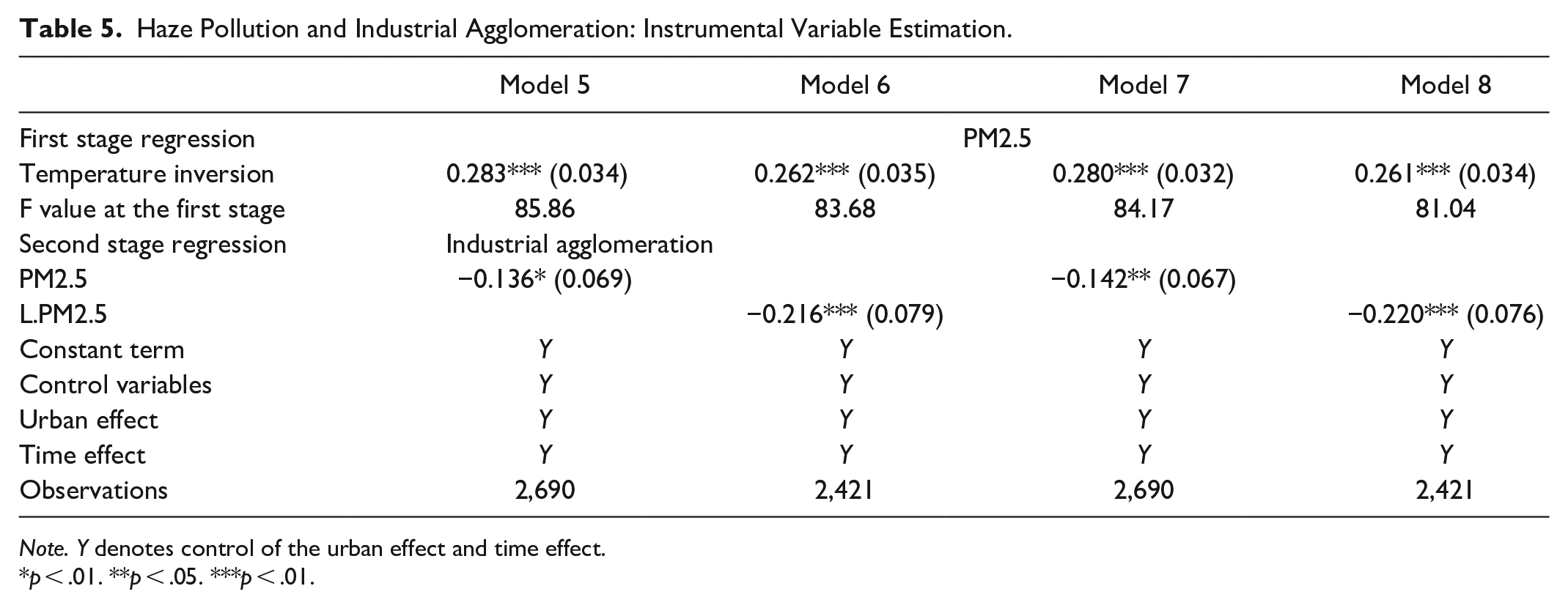
In this section, we use the temperature inversion data as the instrumental variable to estimate the effect of haze pollution on industrial agglomeration within the unified framework of the 2SLS model. Table 5 reports the results obtained using equations (2) and (3). Compared with Models 5 and 6, Models 7 and 8 incorporate the industrial production variable to account for the errors caused by the omission of other variables. Simultaneously, the core explanatory variables used in Models 6 and 8 are still delayed by one period to account for the reverse causality effect. While an instrumental variable regression can alleviate the potential endogeneity issue of baseline regression, this approach helps control for remaining endogeneity.
Haze Pollution and Industrial Agglomeration: Instrumental Variable Estimation.
Note. Y denotes control of the urban effect and time effect.
p < .01. **p < .05. ***p < .01.
The regression results of the first stage in Table 5 demonstrate that haze pollution intensified with instrumental variables below the 5% significance level regardless of whether the omitted variables or reverse causality effect are considered. This result confirms that the more frequently temperature inversion occurs, the greater the probability of haze formation. This trend is consistent with current basic meteorological behavior. All F test values in the first stage were greater than the empirical value of 10, which indicates that the problem of “weak instrumental variables” is eliminated significantly.
As illustrated by the regression results in the second stage, the effect of haze pollution on industrial agglomeration is consistent with the baseline results reported in Table 4 regarding both direction and significance. This finding further confirms the negative effect of haze pollution on industrial agglomeration. However, quantitatively, the estimated values of haze pollution in the second stage regression are smaller than those reported by the baseline regression Models 1 to 4. This behavior suggests that the negative effect of haze pollution on industrial agglomeration tends to be overestimated by the potential endogenous problem. In other words, the negative effect of haze pollution on industrial agglomeration can be reflected more objectively after eliminating the endogenous problem.
Specifically, the regression results of Model 7 in the third column of Table 5 illustrate that the PM2.5 concentration increases by 0.280% for each day of increase in temperature inversion. The regression results in the second stage demonstrate that the industrial agglomeration level decreases by 0.142% for every 1% increase in PM2.5 concentration. The delay of the core explanatory variable for one period in Model 8 indicates a weakened effect of haze pollution on industrial agglomeration. Models 5 and 6 indicate that the effect of instrumental variables on haze pollution and the level of haze pollution on industrial agglomeration are significantly reduced when neglecting the problem of missing variables.
Heterogeneity Analysis
China’s complex geographical environment comprises a wide range of land and vast bodies of water, creating high regional heterogeneity. Therefore, it is necessary to consider the effect of regional differences on haze pollution and industrial agglomeration. All the city samples explored in this study are classified into either inland or coastal. The coastal cities refer to the prefecture-level cities with coastline included in their regional boundaries. Based on the availability of the data, 60 coastal cities were identified (Figure 2).The corresponding regression results are illustrated in Models 9 and 10 in Table 6. As illustrated by the regression results, the effect of haze pollution on industrial agglomeration is more pronounced in inland cities than in coastal cities.

China’s coastal cities.
Haze Pollution and Industrial Agglomeration: Heterogeneity Analysis.

Note. Y denotes control of the urban effect and time effect.
p < .01.
Moreover, the effect of instrumental variables on haze pollution in inland cities is significantly higher than in coastal cities. This may be because coastal cities are significantly less affected by haze pollution than inland cities. Therefore, the pressure to control environmental pollution is less stringent in coastal cities because of their geographical locations and natural conditions. However, inland cities need to prevent and control haze pollution to secure a healthy environment.
To analyze the effect of haze pollution on industrial agglomeration under different time factors, the relationship between haze pollution and industrial agglomeration based on time heterogeneity is reported in Models 11 and 12 in Table 6. In these results, the entire sample is equally divided into two sub-samples, with each covering the earlier 5 years and the latter 5 years. The primary objective is to compare the effect of haze pollution on industrial agglomeration before and after the 18th National Congress. As illustrated by the comparison, the effect of haze pollution on industrial agglomeration during 2012 to 2016 was significantly less than that during 2007 to 2011.
Meanwhile, the effect of the instrumental variable on haze pollution becomes significantly greater than that during 2007 to 2011. It shows that the impact of haze pollution on industrial agglomeration is long-term, and with the passage of time, this impact is gradually increasing. This provides strong data-based support for our unremitting efforts to prevent and control haze pollution.
Transmission mechanism
Relevant research results show that haze pollution has a negative impact on industrial agglomeration. Nevertheless, what causes this phenomenon? In other words, what is the transmission mechanism through which haze pollution affects industrial agglomeration? This study explores the transmission mechanism of the impact of haze pollution on industrial agglomeration from the two channels of human capital and population density. Considering that China’s industrial agglomeration shows great differences in space and time, this study further analyzes the heterogeneity of the transmission mechanism in the form of subsample regression. Specifically, this study divides the samples from the two dimensions of city size classification and time, and discusses the human capital and population density mechanisms of haze pollution affecting industrial agglomeration.
First, haze pollution can affect the process of industrial agglomeration through human capital. On the one hand, human capital is one of the important factors in promoting industrial agglomeration, especially in the context of current trends in economic development and digital and knowledge economies—population scale promotes the development of local economy and the process of human capital. On the other hand, haze pollution significantly impairs the accumulation of human capital by affecting education levels and health. In order to verify this mechanism, this study selects the number of years of education per capita as a proxy variable of urban human capital. Table 7 reports the empirical regression results. The human capital transmission mechanism can be effectively verified; that is, human capital accumulation improves industrial agglomeration, while haze pollution significantly reduces human capital. Among them, the regression coefficients of human capital variables in Models 13 and 14 are significantly positive, indicating that the process of human capital progress is also the process of the continuous progress of industrial agglomeration. In addition, from the perspective of heterogeneity, compared with Model 15, under the full sample framework, the coefficient of human capital is significantly negative, indicating that haze pollution is not conducive to the progress of human capital in small cities. Of course, it should be noted that the progress of human capital is often accompanied by the agglomeration of population and enterprises, which may increase industrial agglomeration in specific regions. Model 16 shows that the negative impact of haze pollution in large cities on human capital is not significant, which may be related to the natural attractiveness of employment, medical care, and sanitation to the population in medium and large cities. Models 18 and 19 show that the negative impact of haze pollution on human capital gradually weakens over time, which is also in line with the fact that the introduction of talents between cities continues to increase, resulting in the dispersion of human capital.
Haze Pollution and Industrial Agglomeration: Human Capital Mechanism.

Note. Y denotes control of the urban effect and time effect.
p < .05. ***p < .01.
Second, another important mechanism by which haze pollution affects industrial agglomeration is permanent residents. On the one hand, permanent residents are an important driving force for industrial agglomeration, and industrial agglomeration is inseparable from a certain amount of labor. On the other hand, haze pollution damages the image of the city and slows down the pace of population migration. In order to verify this mechanism, this study selects the resident population per unit area as a proxy variable. Table 8 reports the empirical regression results, and the transmission mechanism of permanent residents can be effectively verified; that is, increasing the number of permanent residents increases industrial agglomeration, while haze pollution significantly reduces the number of permanent residents. Here, the regression coefficient of the permanent residents variable in Models 20 and 21 is significantly positive, indicating that the process of permanent resident development is also the process of the continuous advancement of industrial agglomeration. In addition, from the perspective of heterogeneity, compared with Model 22, under the full sample frame, the coefficient of permanent residents is significantly negative, indicating that haze pollution is not conducive to the process of permanent resident development in small cities. Of course, it should be noted that the process of permanent resident development is often accompanied by the agglomeration of population and enterprises, which may increase industrial agglomeration in a specific area. Model 15 shows that the negative impact of haze pollution in large cities on permanent residents is not significant, which may be related to the natural attractiveness of employment, medical care, and hygiene in large cities. Models 25 and 26 show that the negative impact of haze pollution on permanent residents gradually weakens over time.
Haze Pollution and Industrial Agglomeration: Permanent Residents’ Mechanism.

Note. Y denotes control of the urban effect and time effect.
p < .05. ***p < .01.
Robustness analysis
To further validate the study’s reliability, a series of robustness analyses are performed using Model 3 reported in Table 4 as the baseline model. The corresponding results are reported in Models 27 to 30 in Table 9.
Haze Pollution and Industrial Agglomeration: Robustness Analysis.

Note. Y denotes control of the urban effect and time effect.
p < 0.05. ***p < 0.01.
First, the core explanatory variable—PM2.5 concentration—is closely related to industrial wastewater, industrial dust emissions, and industrial sulfur dioxide. Moreover, these three industrial wastes are also related to the expansion of industrial production through the local governments’ borrowing behavior. This results in errors from missing variables, and the effects of the “three industrial wastes” per capita are further controlled in this study. Model 27 reports the corresponding regression results. Compared with Model 3, there is almost no change in the coefficient and significance in the results.
Second, the instrumental variable described earlier is only for the core explanatory variables. To eliminate this negative effect, the control variables are delayed by one period in Model 28 in Table 7. No further changes are found in the regression results. Third, to eliminate the influence of the abnormal value of haze pollution on the regression results, Model 29 excludes the 0.5% samples with the highest and lowest PM2.5 concentrations. The results of the study still do not change significantly. Fourth, to make the samples more comparable, the regression results are reported in Model 30 after excluding the samples from municipalities and sub-provincial cities and above. Compared with Model 3, the results remain unchanged. In summary, the effect of haze pollution on industrial agglomeration is robust and well documented.
Conclusions, Policy Recommendations, and Limitations
Environmental protection and local government behavior are important topics that require attention and investigation from researchers. Local governments in China have ignored the problem of haze pollution caused by the long-term pursuit of GDP growth. Such long-term accumulation of haze pollution cannot be solved by short-term local government control measures. This study explores the relationship between haze pollution and industrial agglomeration using the PM2.5 concentration data of 269 prefecture-level cities in China from 2007 to 2016. The industrial agglomeration level is calculated using the location entropy method, in which the industrial output value is selected as the core variable.
The primary conclusions from this study are as follows. (1) Haze pollution and industrial agglomeration are negatively correlated. The industrial agglomeration effect by local government is adversely affected by the expansion of haze pollution. Therefore, the industrial agglomeration effect can be enhanced by reducing haze pollution through vigorous efforts in environmental governance. (2) The effect of haze pollution on industrial agglomeration is more pronounced in inland cities than in coastal cities. (3) The effect of the instrumental variable on haze pollution is significantly higher in inland cities than in coastal cities. (4) This study focuses on examining the effect of haze pollution on industrial agglomeration after the 18th National Congress and comparing it with that before that Congress. The effect of haze pollution on industrial agglomeration during 2012 to 2016 was significantly less than that during 2007 to 2011.
Our research findings have important policy implications. First, haze control has an inevitable profound effect on the behavior of local governments. Control and prevention of haze pollution can enhance the effect of industrial agglomeration. Therefore, local governments should actively engage in haze pollution management to promote a virtuous circle of haze control and local economic growth. Second, remarkable progress has been made in environmental supervision and governance since the 18th National Congress in 2012. The government should continue to increase investment in environmental protection and maintain high-pressure environmental supervision. The control and prevention of haze pollution would provide new momentum to economic growth in the future.
Third, this study has put forward a direction for local governments to expand the effect of industrial agglomeration: to pursue industrial agglomeration based on environmental protection with a continuous effort in environmental protection governance and haze index reduction. Fourth, it is easier for inland cities to achieve a virtuous circle of economic development and environmental protection than coastal cities. Inland cities should hold a perspective with more foresight in urban development and avoid pursuing economic growth at the cost of haze pollution. Local finance should invest more in environmental protection to generate greater economic benefits through industrial agglomeration effects. Fifth, the analysis of the research mechanism suggests that haze pollution affects industrial agglomeration through the “human” factor. Therefore, urban development should strengthen efforts to attract and cultivate technical talents, and take measures to promote the flow of talents and urban population growth.
Although this study considers the impact of haze pollution on industrial agglomeration, it has three limitations. First, extending the period of the study—especially to supplement data after 2017—will improve the study and thus its applications for the Chinese government’s control of haze pollution. Second, when the instrumental variables were selected for temperature inversion, the study did not control for the topographical factor. Simultaneous control of mild terrain may lead to more scientific results. Third, China’s experience in controlling haze pollution may not be applicable to other countries. The above limitations are all directions worthy of further research in the future; for example, scholars may do well to study the relationship between haze pollution and industrial development in the context of globalization.
Footnotes

Declaration of Conflicting Interests
The author(s) declared no potential conflicts of interest with respect to the research, authorship, and/or publication of this article.
Funding
The author(s) received no financial support for the research, authorship, and/or publication of this article.