



Abstract
Artificial intelligence (AI) has become an important driving force for sustainable development. Based on panel data from China’s A-share listed companies from 2014 to 2023, this study empirically examines the impact and mechanisms of AI on corporate green competitiveness. The results indicate that AI significantly enhances firms’ green competitiveness and its three sub-dimensions—green strategy, green innovation, and green practices—and these conclusions remain robust after a series of robustness tests. Further analysis reveals that AI promotes green competitiveness by improving green total factor productivity and curbing corporate greenwashing. In addition, environmental regulation, public environmental concerns, peer effects, and supply chain finance play significant positive moderating roles. Moreover, the heterogeneity analysis indicates that while the positive effect of AI on green competitiveness shows no significant variation between the manufacturing and non-manufacturing sectors, it is more pronounced in heavily polluting industries, coastal regions, and large enterprises. These findings provide a new theoretical perspective on corporate green transformation in the intelligent era and offer a theoretical basis for policymakers to improve the synergistic development framework between AI and environmental governance.
Plain Language Summary
As the world faces growing pressure to reduce pollution and fight climate change, many companies are trying to become more environmentally friendly. This study looks at how artificial intelligence (AI) can support that effort. AI includes tools like smart algorithms, data analysis, and automation, which help businesses make better decisions and improve efficiency. We studied Chinese companies listed on the stock market from 2014 to 2023 to see if using AI helps them improve in three key areas: setting green goals (green strategy), developing eco-friendly products and technologies (green innovation), and changing how they operate to reduce harm to the environment (green practices). Our findings show that companies using AI perform better in all three areas. Moreover, the heterogeneity analysis indicates that while the positive effect of AI on green competitiveness shows no significant variation between the manufacturing and non-manufacturing sectors, it is more pronounced in heavily polluting industries, coastal regions, and large enterprises. AI helps companies plan better, use resources more wisely, and adopt greener ways of working. This research shows how digital technologies like AI can help businesses go green. It offers useful insights for company leaders, technology developers, and government policymakers. By using AI, companies not only improve their environmental performance but also become more competitive in a world that increasingly values sustainability.
Keywords
Introduction
With the intensification of global climate change, resource constraints, and ecological challenges, sustainable development has become an international consensus. The global community is actively seeking innovative solutions, and artificial intelligence (AI), as a transformative tool, has attracted increasing attention. Governments worldwide have emphasized both its potential and the importance of risk management (Mijit et al., 2025). The United Nations has launched a series of global initiatives and actions to explore the potential of AI in emission reduction, energy optimization, and climate adaptation. The European Union, centered on the Artificial Intelligence Act (Regulation (EU) 2024/1689), has established a risk-based AI governance framework and promoted the application of AI in sustainable development through energy efficiency requirements and environmental impact assessments. Meanwhile, the United States has accelerated AI infrastructure development while strengthening energy conservation and carbon reduction measures to achieve synergy between technological advancement and low-carbon development. Collectively, these international efforts are advancing the integration of AI into global sustainable development.
As a representative emerging economy, China is facing challenges arising from extensive economic growth, such as resource depletion, environmental pollution, and ecological degradation. To address these challenges, China has positioned green development as a core component of its national strategy. In the AI-driven green transition, China also demonstrates a distinctive policy-led model and strong scale effects, which generate spillover impacts on global supply chains and the achievement of sustainable development goals (H. J. Wang, Zheng, et al., 2024). However, in practice, many enterprises still suffer from insufficient green innovation capacity and a lack of motivation. Some adopt passive green strategies, maintain a wait-and-see attitude, or engage in symbolic actions merely to obtain government subsidies (Lian et al., 2022), leading to a disconnection between behavior and outcomes and weakening their green competitiveness. Therefore, empirical research focusing on the Chinese context can not only reveal how firms leverage technologies such as AI to build competitive advantages and reduce formalistic behaviors but also provide valuable insights for the transformation of other emerging economies and the global community.
Green competitiveness refers to the ability to integrate environmental, resource, and competitive advantages in an organic manner, achieving green and low-cost production, creating green differentiation, and improving efficiency while reducing pollution and conserving resources (Juniarti et al., 2024). The construction of corporate green competitiveness is a gradual and dynamic process that evolves from strategic intent to capability building and practical implementation (Y. S. Chen, 2008). As a top-level design, green strategy serves as the foundation and prerequisite for green innovation and green practices (Bataineh et al., 2024). Green innovation, through technological R&D and institutional optimization, provides critical support for strategy implementation and promotes corporate green transformation (Silvério et al., 2025). Green practices reflect the proactive implementation of green strategies and the fulfillment of environmental responsibilities in daily operations. These practices, manifested through employees’ and organizational daily actions, can further stimulate green innovation (Ahmed et al., 2024). They are mutually reinforcing and jointly construct a green and low-carbon production system, helping firms achieve dual improvements in economic and environmental performance, thereby forming a sustainable green competitive advantage (F. Wang, 2023).
Existing literature presents a dual perspective on the role of AI in enhancing corporate green competitiveness. While some studies confirm its positive effects, others reveal potential inhibitory impacts. On the one hand, AI demonstrates significant potential in empowering corporate sustainability. Through algorithmic optimization, AI can substantially improve green innovation outputs, optimize operational efficiency and resource allocation, and thereby strengthen internal governance effectiveness (Verma et al., 2023) and corporate environmental responsibility awareness (Baskaran et al., 2023). Moreover, as a key technological enabler, AI not only enhances firms’ overall Environmental, Social, and Governance (ESG) performance and facilitates low-carbon transformation—namely, the systemic shift from high-carbon to low- or zero-carbon energy systems (J. Yu, Xie, et al., 2025)—but also improves corporate green performance by embedding green principles into production and manufacturing processes, thereby achieving synergies among economic, social, and ecological benefits (Delanöe et al., 2023).
On the other hand, AI may weaken green competitiveness through environmental costs and social challenges. In terms of resource consumption, its heavy reliance on energy-intensive infrastructure and electricity usage can lead to a surge in pollution emissions (J. Hou, Kang, et al., 2024). From a social perspective, AI-induced job displacement, privacy violations, and algorithmic bias exacerbate the digital divide and hinder firms’ green transformation (Frank et al., 2025). In addition, at the corporate level, the financial pressure of AI-related R&D often drives managers to prioritize short-term cost savings over environmental investment, thereby reducing green innovation efficiency and distorting resource allocation paths (Besiroglu et al., 2024). Therefore, this study aims to systematically analyze the relationship and mechanisms between AI and green competitiveness, thereby advancing both theoretical understanding and practical application of AI in the context of sustainable development.
The potential contributions of this study lie in two main aspects. At the theoretical level, this paper expands the analytical framework of the influencing factors of green competitiveness from the perspective of AI. Existing studies have mainly focused on the impact of intelligent technologies on corporate green innovation and green transformation (X. X. Yu, Hu & Feng, 2025), whereas systematic exploration of how AI enhances green competitiveness through internal operational mechanisms remains limited. To address this gap, this study constructs an analytical framework encompassing three dimensions of green competitiveness—green strategy, green innovation, and green practices—and establishes two mechanism pathways, namely resource allocation efficiency and green governance effects, to systematically reveal the internal mechanisms through which AI enhances green competitiveness. At the practical level, this paper empirically evaluates the actual impact of AI on firms’ green competitiveness and further conducts heterogeneity analyses across four dimensions: industry characteristics, pollution intensity, regional distribution, and firm size. The findings provide managerial implications for enterprises to strategically deploy AI resources and enhance green development capabilities under the “dual carbon” goals. Moreover, they offer valuable insights for policymakers to design effective green transformation policies and technology guidance mechanisms.
The structure of this paper is arranged as follows. The Theoretical Analysis and Research Hypotheses provides a detailed analysis of the impact of AI on green competitiveness. This is followed by the Research Design which discusses the sample selection, data sources, variable measurement, and the research model. Subsequently, the data analysis including the descriptive statistics, regression analysis, and mechanism effect testing, as well as robustness tests and further heterogeneity analyses are presented in Empirical Analysis section. Finally, the research conclusions and recommendations are given in the Conclusion section.
Theoretical Analysis and Research Hypotheses
AI influences corporate green competitiveness through three dimensions: green strategy, green innovation, and green practices. From the perspective of green strategy, AI helps enterprises integrate green strategies into their overall development strategies, thereby enhancing strategic consistency and resource allocation efficiency, which in turn strengthens green competitiveness (H. Y. Li et al., 2025). In complex and competitive environments, traditional intuition-based decision-making models fail to provide firms with accurate and forward-looking information support. In contrast, AI can effectively alleviate information asymmetry among firms and improve interface management across departments, facilitating the precise matching and integration of green factors and resources under green strategic orientations (Benzidia et al., 2021). Moreover, AI technologies help narrow the “information gap” between governments and enterprises, enhance the quality of governmental information supervision, reduce corporate green opportunistic behaviors, and strengthen firms’ motivation for green transformation (Agrawal et al., 2024).
From the perspective of green innovation, AI promotes green innovation through multiple mechanisms, helping enterprises achieve sustainable competitive advantages. First, in the process of green development, firms often face numerous uncertainties and risks. AI can provide scientific risk assessment and management recommendations, assisting firms in developing effective risk prevention and control strategies, thereby reducing risks in green development and fostering green innovation (J. Li & Wang, 2025). Second, by leveraging precise big data analytics and efficient information processing capabilities, AI facilitates the aggregation and deep expansion of green knowledge, driving the transformation of green innovation decision-making from experience-based to data-driven, thus improving both efficiency and scientific rigor (Belhadi et al., 2020). Furthermore, AI enables efficient interconnection across different business processes, reduces operational costs, and releases additional resources for green innovation. This helps alleviate the strategic response delays caused by resource constraints and strengthens firms’ confidence in pursuing green innovation (Xiao et al., 2025).
From the perspective of green practices, AI promotes environmentally responsible behavior within firms through intelligent monitoring and behavioral incentive mechanisms, encouraging employees to adopt green practices in daily operations. This, in turn, strengthens corporate environmental responsibility and enhances green competitiveness. For instance, AI improves the transparency of environmental information, prompting top management to place greater emphasis on green development and to strengthen green management practices, thereby accelerating corporate green transformation (Pu, 2025). In addition, AI optimizes resource allocation, enhances information sharing, and increases managerial transparency, which together improve the efficiency and effectiveness of implementing green practices and help mitigate performance pressures often encountered during the early stages of green transformation (B. Y. Wang, Khan, et al., 2024; J. K. Wang, Wang, et al., 2024). Furthermore, AI technologies such as real-time monitoring and predictive algorithms enable firms to achieve precise pollution control, shifting them from compliance-oriented behavior toward proactive sustainable operations. This also facilitates green supply chain coordination and the internalization of low-carbon practices, thereby improving operational efficiency and environmental resilience (K. Y. Lin, 2025).
Overall, AI enhances the effectiveness of corporate green strategy implementation by improving the scientific rigor of strategic decision-making and the precision of resource allocation (C. H. Chen, 2024). By facilitating cross-domain knowledge integration and technological collaboration, AI strengthens the systemic nature of corporate green innovation (J. Liu & Liu, 2023). Moreover, through reinforcing behavioral practices among employees and management as well as optimizing operational mechanisms, AI significantly improves the proactivity and persistence of corporate green practices. Thus, leveraging its technological advantages, AI systematically deepens green strategy, accelerates green innovation, and standardizes green practices, thus serving as a core driving force for enterprises to build and sustain green competitiveness.
This study further constructs two theoretical frameworks—the factor coordination effect and the green governance effect—based on the mechanism through which AI empowers enterprises, to explore how AI influences corporate green competitiveness.
Drawing on resource allocation theory, this study analyzes the mechanism of AI’s impact on green transformation from both internal and external dimensions. At the internal level, core AI technologies—including process automation, data analytics, and intelligent modeling — alleviate resource misallocation caused by information asymmetry, improve information flow efficiency, and promote the formation of green management mechanisms, thereby enhancing resource utilization efficiency and ultimately increasing firms’ green total factor productivity (GTFP) (Avramov et al., 2022). Moreover, owing to AI’s data-sharing capabilities, information barriers between departments are eliminated, enabling the flexible cross-departmental flow of production factors. This facilitates precise cost control and directs more financial resources toward green innovation, thereby improving GTFP and advancing corporate green transformation (Benbya et al., 2021). At the external level, AI stimulates inter-firm linkage effects by integrating upstream and downstream supply chain resources, enhancing operational efficiency, and reducing uncertainty in the process of green transformation, which accelerates green upgrading (Mariani et al., 2023). Meanwhile, traditional industries leveraging AI for high-end and refined transformation not only promote industrial structure optimization and upgrading but also further enhance GTFP and drive industrial green development (J. L. Wang et al., 2023).
Based on impression management theory, AI can effectively curb greenwashing behavior. Under the institutional context of national advocacy for sustainable development, investors tend to favor firms engaged in green innovation and hold higher performance expectations for enterprises undergoing green transformation (Abdullah et al., 2024). Therefore, in the process of information disclosure, greenwashing may operate as a decoupling strategy through which managers convey positive signals to the market in order to align with regulatory expectations and public environmental pressures (Gatti et al., 2020). From an internal perspective, AI enhances the efficiency of information transmission and processing, improves transparency in business and financial management, strengthens the quality of internal control, and reinforces managerial supervision (Tan et al., 2025). At the same time, as an effective risk management tool, AI contributes to improving the efficiency and capability of green governance (Dohrmann et al., 2024). It has been widely applied in board performance evaluation, financial risk forecasting, and fraud detection, thereby promoting the intelligent transformation of green governance (Ahdadou et al., 2024).
From an external perspective, the extensive application of AI technologies across supply chains and regulatory networks enables cross-verification of information among stakeholders, reducing the possibility of information concealment (Jing & Fan, 2024) and suppressing corporate greenwashing. In addition, AI-driven transparency and diffusion of green information increase public and institutional attention to corporate environmental responsibility. These external pressures and expectations are rapidly transmitted to corporate management, leading firms—under the combined influence of environmental policies, social supervision, and market reputation—to reposition green development as a core strategy for long-term competitive advantage rather than passive compliance (Y. C. Zhang et al., 2025). Accordingly, this study proposes the following hypothesis:
However, AI may also hinder corporate green competitiveness through adverse effects such as resource consumption, ethical dilemmas, and technological lock-in. First, the long-term and uncertain nature of AI investment increases firms’ implicit costs, while the delayed recognition by capital markets further exacerbates the “IT paradox,” causing its potential benefits to be offset by additional managerial costs (Benedek et al., 2025). At the same time, the computationally intensive nature of complex AI models raises carbon footprints and electronic waste, thereby diminishing future environmental dividends (Hassan & Ibrahim, 2025). Moreover, AI deployment occupies substantial financial and computing resources, constraining the accumulation and application of green resources.
Second, the high degree of automation in AI weakens managerial autonomy and control. Algorithmic bias arising from historical data distortion or unfair design, together with privacy risks during data processing, may provoke stakeholder backlash and erode organizational trust. These issues undermine corporate social legitimacy and indirectly constrain green competitiveness (Raisch & Krakowski, 2021).
Finally, AI models that rely heavily on historical data tend to prioritize short-term efficiency optimization, leading to decision standardization and resource allocation homogeneity, which erodes firms’ resource heterogeneity and capacity for green capability development (Cellard et al., 2025). In the long run, such “algorithmic lock-in” effects reinforce path dependence and impede the sustained evolution of low-carbon innovation and green competitiveness.
Accordingly, this study proposes the following hypothesis:
The theoretical framework of this study is illustrated in Figure 1.

Theoretical framework.
Research Design
Sample Selection and Data Sources
Since 2014, with increasing national attention, AI in China has entered a stage of rapid development and has gradually become a key driver of high-quality economic growth. To minimize measurement bias caused by limited early-year data, this study selects Chinese A-share listed companies on the Shanghai and Shenzhen stock exchanges from 2014 to 2023 as the research sample. Part of the textual data, including the number of corporate news reports and information management network search indices, is obtained from the China Research Data Service Platform (CNRDS), while the remaining financial and operational data are sourced from the CSMAR database, a widely recognized and authoritative database for Chinese listed firms.
To enhance the reliability of the empirical results, this study applies the following data-cleaning procedures: (a) excluding samples with missing or abnormal data; (b) excluding firms marked as ST, *ST, or delisted during the sample period to remove financially distressed cases; and (c) excluding firms in the financial industry. After the above screening, a total of 25,810 firm-year observations were retained. To mitigate the influence of outliers, all continuous variables were winsorized at the 1% level.
Variable Measurement
Dependent Variable: Green Competitiveness (GC)
This study takes green competitiveness as the dependent variable, aiming to measure a firm’s overall capability to promote green transformation and achieve both economic and environmental sustainability. Following prior studies (Bourini et al., 2024; M. S. Wang et al., 2025), green competitiveness is examined from three dimensions: green strategic orientation, green innovation, and green practices. An integrated green competitiveness index is then constructed using the entropy weight method, which quantitatively captures a firm’s comprehensive capacity for green development.
Green Strategy (Gstr)
Referring to existing studies (W. J. Hou, Pan, et al., 2024), green strategic orientation reflects enterprises’ behavioral preferences and value orientations in the field of green development. It is not easy to quantify directly; however, the high frequency of specific categories of keywords appearing in annual reports can effectively demonstrate firms’ strategic orientation and serve as a reliable proxy indicator.
To avoid word frequency bias caused by differences in wording among different enterprises, this study measures green strategic orientation based on the sum of seven structured disclosure items reported in listed companies’ annual reports and social responsibility reports. These items include: whether the company explicitly discloses environmental or green development concepts; whether it discloses environmental goals; whether it establishes an environmental or green management system; whether it obtains third-party environmental management certification such as ISO 14001/14000; whether it conducts environmental education and training; whether it organizes environmental protection campaigns; and whether it implements the “Three Simultaneities” policy, meaning that environmental protection facilities are designed, constructed, and operated simultaneously with the main project.
Green Innovation (Ginn)
Referring to existing studies (Xiao et al., 2024), green innovation is commonly measured by the number of green patent applications, which represent the concrete manifestation of firms’ green innovation performance. Green patents mainly include invention patents and utility model patents, among which green invention patents can more intuitively and accurately reflect firms’ true innovation capability. To avoid attribution ambiguity and time-lag bias caused by factors such as patent application delays, renewal fee strategies, and joint patent applications, this study selects patents that were granted in the current year and independently obtained by the firm. In order to capture the firm’s green innovation orientation and intensity rather than merely its scale, this study uses the proportion of independently granted green invention patents in the total number of patents as the measurement indicator of green innovation. In addition, compared with logarithmic transformation, using the proportion better characterizes the weight of green innovation within the overall innovation structure, and is more suitable for horizontal comparison across industries and firms of different sizes.
Green Practices (Gpra)
Referring to existing studies (Baskaran et al., 2023), this study uses firms’ environmental protection expenditure as an indicator to measure their green practices. To eliminate the influence of firm size, the indicator is expressed as the ratio of environmental protection expenditure to total assets.
Environmental protection expenditure refers to the classification method adopted in previous studies (T. W. Wang & Chen, 2022), which is based on the notes to annual reports of listed companies under the details of construction in progress and administrative expenses. It includes capital expenditures on environmental protection projects—such as energy-saving, wastewater treatment, and desulfurization—recorded under “construction in progress,” together with pollution discharge fees and greening costs recorded under “administrative expenses.”
Independent Variable: Artificial Intelligence (AI)
Referring to existing studies (Yao et al., 2025), this study uses the level of intelligent investment as an indicator of the degree of AI application within a firm. AI-related data are manually extracted from firms’ financial statements, including intangible assets and fixed asset investments associated with AI, and the ratio of their total value to total annual assets is calculated. Specifically, AI-related intangible assets refer to accounting items whose names contain keywords such as “intelligent,”“software,”“system,”“information platform,” or “data,” while fixed assets refer to items containing keywords such as “electronic equipment,”“computer,” or “data equipment.”
Mechanism Variables: Green Total Factor Productivity, Greenwashing
Green Total Factor Productivity (GTFP)
Referring to existing studies (C. Y. Zhao, 2023), this study measures GTFP using a non-radial Slack-Based Measure–Malmquist–Luenberger (SBM-ML) model. The evaluation index system is constructed from three dimensions: input factors, desirable output, and undesirable output. A higher GTFP value indicates a stronger resource coordination effect of the firm.
Greenwashing
Following prior literature (Hu et al., 2023), this study measures greenwashing by quantifying the inconsistency between firms’ oral green publicity and their actual green performance.
Control Variables
Following existing research (X. X. Yu et al., 2024), this study incorporates ten control variables to account for firm-level characteristics that may influence green competitiveness. These variables cover basic firm attributes, financial indicators, and corporate governance factors including firm size, firm age, ownership type, fixed asset ratio, debt-to-asset ratio, return on assets ownership concentration, board size, CEO duality, and R&D intensity.
The definitions of all control variables are provided in Table 1.
Variable Definitions.

Model Specification
Based on the research hypotheses developed in the previous section, this study constructs a fixed effects model as the baseline regression framework. The main regression model is specified as follows:

In the model, GC represents a firm’s green competitiveness, which is analyzed from both the overall dimension and three sub-dimensions—green strategy (Gstr), green innovation (Ginn), and green practices (Gpra)—to comprehensively capture the core elements of corporate green development. AI denotes the level of artificial intelligence application. Control refers to a set of control variables. Year and Industry represent year-fixed effects and industry-fixed effects, respectively. The term
Empirical Analysis
Descriptive Statistics
Table 2 reports the descriptive statistics of the main variables. The mean, standard deviation, maximum, and minimum values of firms’ green competitiveness (GC) are 0.030, 0.040, 0.250, and 0.000, respectively, indicating that the overall level of green competitiveness is relatively low and still has considerable room for improvement. Among its three sub-dimensions, green strategic orientation performs relatively well, green practices are at a moderate level, while green innovation shows the lowest indicators. This suggests that sample firms have already established a basic foundation in green strategic planning, demonstrate moderate implementation of green practices with noticeable heterogeneity, but still need to strengthen their investment in green innovation.
Descriptive Statistics.

For AI, the mean, standard deviation, maximum, and minimum values are 0.010, 0.010, 0.060, and 0.000, respectively, indicating that the overall level of AI application among sample firms remains low, with insignificant inter-firm differences. Although a few leading enterprises exhibit higher AI adoption, the majority are still at the initial stage of development. The statistical characteristics of the remaining control variables are consistent with previous literature and are therefore not further discussed here (X. X. Yu, 2024).
Table 3 presents the correlation matrix results among the main variables. The results show that the correlation coefficients between AI and all control variables are relatively low. Among them, the highest correlation is between leverage (Lev) and firm size (Size), with a coefficient of 0.520. All correlation coefficients are below 0.6, indicating that the variables are relatively independent and that there is no serious multicollinearity problem. Furthermore, the results of the Variance Inflation Factor (VIF) test show that all variables have VIF values below 2, and the overall mean VIF is 1.27, which is well below the commonly accepted threshold of 10. These results indicate that multicollinearity is not a concern in this study, suggesting that the model specification is appropriate for subsequent regression analysis.
Correlation Matrix of Key Variables.
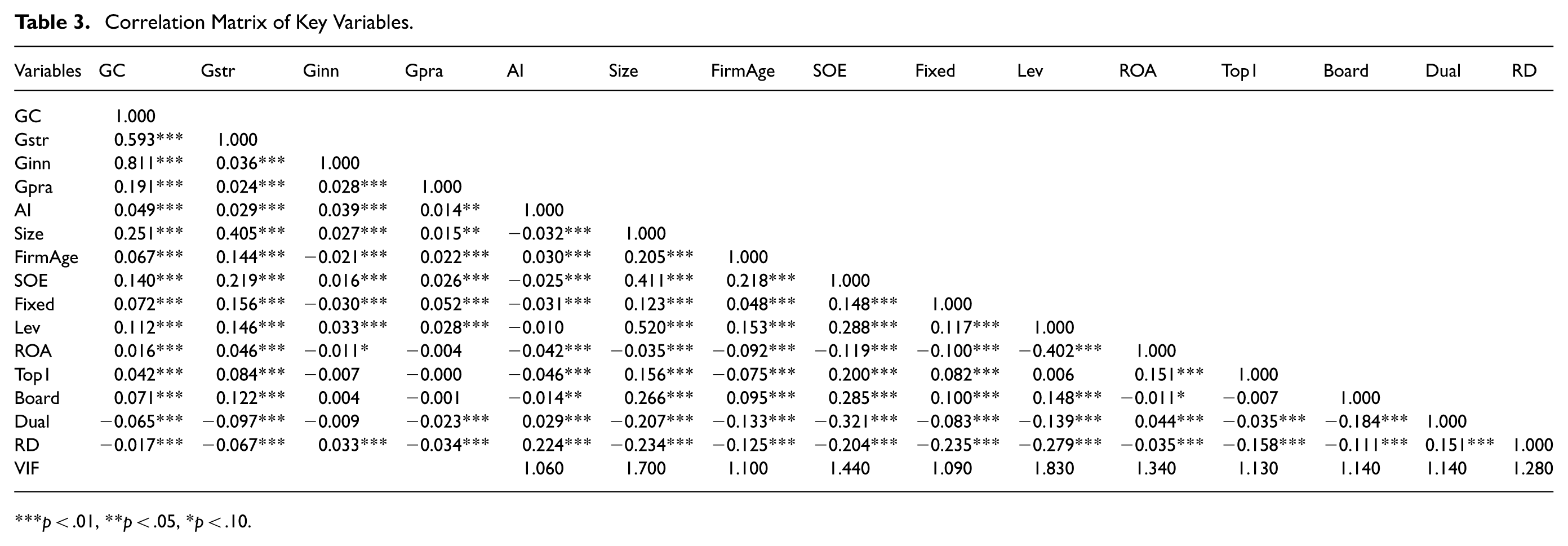
p < .01, **p < .05, *p < .10.
Baseline Regression Results
Table 4 presents the baseline regression results of AI on green competitiveness and its three sub-dimensions. Column (1) shows that the coefficient of AI on green competitiveness is 0.041, which is positively significant at the 1% level, indicating that AI enhances firms’ green competitiveness. The adoption of intelligent technologies improves energy efficiency, facilitates the coordination between economic and environmental performance, and helps firms overcome path dependence on existing technologies. By fostering an innovation-friendly ecosystem, AI effectively mitigates the uncertainty risks associated with green technology R&D, thereby enabling firms to achieve green transformation (Talebzadehhosseini & Garibay, 2022).
Baseline Regression Results.
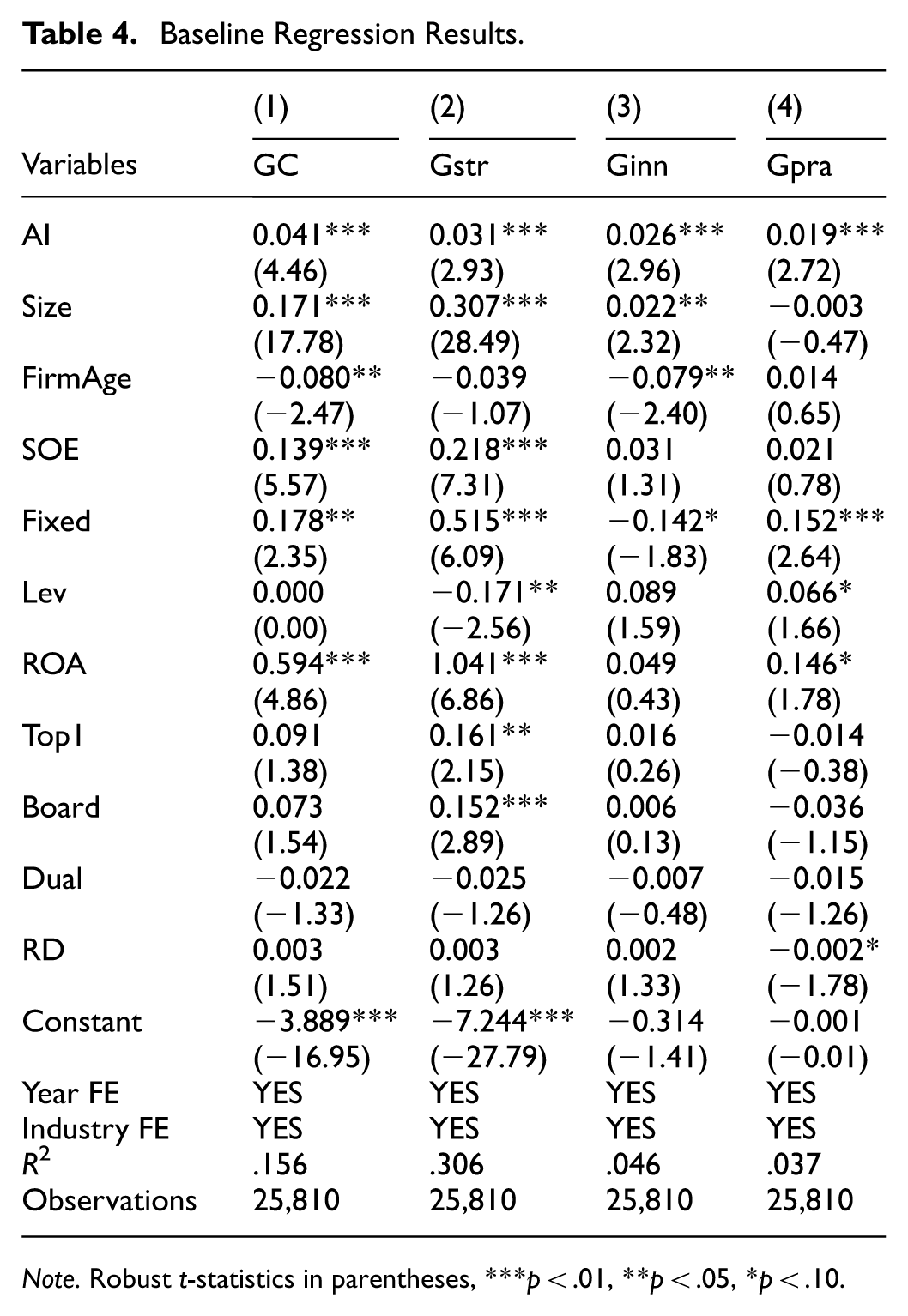
Note. Robust t-statistics in parentheses, ***p < .01, **p < .05, *p < .10.
Specifically, the coefficient of AI on green strategic orientation is 0.031 and is positively significant at the 1% level, suggesting that AI contributes to the advancement of firms’ green strategies. The application of AI not only alleviates resource misallocation but also enhances firms’ ability to cope with environmental uncertainty. In addition, it reduces management and production costs across the value chain, facilitating strategic transformation toward green development (Kesidou & Wu, 2020).
The coefficient of AI on green innovation is 0.026, also positively significant at the 1% level, indicating that AI strengthens firms’ green innovation capability. AI technologies effectively lower the costs and trial-and-error risks associated with green technological innovation, while improving collaborative efficiency and the commercialization of green R&D outcomes (K.-H. Wang, Wen, et al., 2024).
The coefficient of AI on green practices is 0.019, which is positively significant at the 1% level, suggesting that AI promotes firms’ implementation of green practices. The deep integration of AI into operational processes enables real-time monitoring and dynamic adjustment of energy consumption, pollution emissions, and green process optimization. This strengthens corporate environmental responsibility and ensures the effective implementation of green management systems (Cao & Peng, 2023).
Overall, AI demonstrates a significant positive impact on green competitiveness and its three dimensions—green strategic orientation, green innovation, and green practices—supporting H1.
Robustness Checks
Excluding Abnormal Years and City Samples
Considering the potential impact of major global public health and safety events during 2021 to 2022 on the empirical results, this study re-estimates the model after excluding the data for these two years. As shown in Columns (1)–(4) of Table 5, the effect of AI on green competitiveness and its three sub-dimensions remains positively significant at least at the 5% level.
Robustness Tests by Excluding Special Samples.
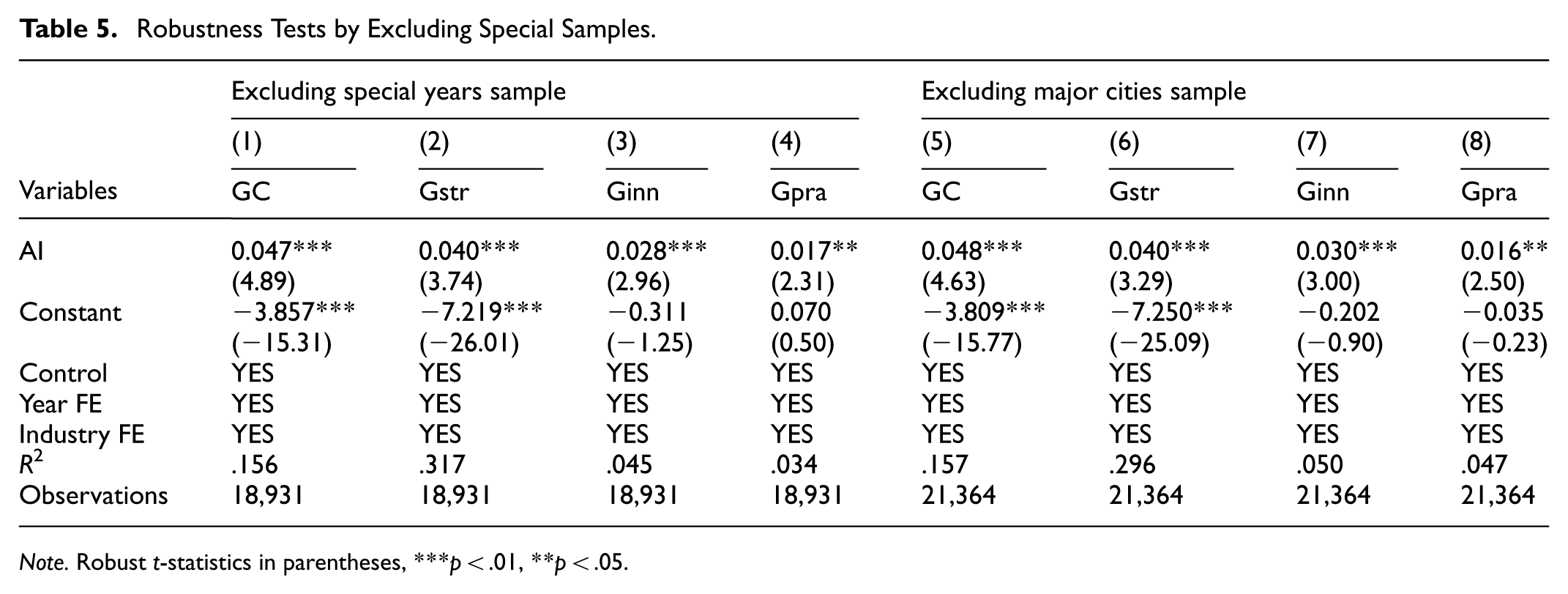
Note. Robust t-statistics in parentheses, ***p < .01, **p < .05.
In addition, recognizing that the four municipalities—Beijing, Tianjin, Shanghai, and Chengdu—may exert a significant siphon effect in terms of economic influence and information technology talent concentration compared with other cities, these samples are also excluded for further regression testing. The corresponding results, reported in Columns (5) to (8) of Table 5, remain significant at the 5% level, confirming that the main regression findings are robust and consistent.
Lagged Effect Test
Given the possibility that the impact of AI on corporate green competitiveness may exhibit time lag effects, this study addresses potential endogeneity concerns by re-estimating the regression using the one-period lag of both the core explanatory variable (AI) and control variables. The results are presented in Columns (1) to (4) of Table 6. The coefficient of AI lagged by one period is positively significant at least at the 5% level, indicating that the positive correlation between AI and green competitiveness remains valid and the effect is robust.
Robustness Tests: Lagged Variables and Alternative AI Measure.

Note. Robust t-statistics in parentheses, ***p < .01, **p < .05, *p < .10.
Robustness Check Using an Alternative Core Independent Variable
Referring to existing studies (J. Chen et al., 2024), this study measures the level of AI development using the frequency of AI-related keywords (AI_words) appearing in the annual reports of listed companies and conducts regression analysis accordingly. As shown in Columns (5) to (8) of Table 6, the results indicate that the replaced core variable remains positively significant at the 1% level, while its three sub-dimensions are significant at least at the 10% level. Moreover, the direction of the regression coefficients is consistent with that of the baseline results, confirming the robustness and reliability of the study’s findings.
Instrumental Variable (IV) Approach
Given the potential endogeneity issues in the empirical model—such as omitted variables and reverse causality—this study follows existing research (Yu et al., 2024) and employs the average level of AI development within the same year, industry, and city as an instrumental variable (IV) for robustness testing. The regression results are presented in Columns (1) to (4) of Table 7. The results show that the instrumental variable is positively significant at the 1% level, and the F-statistic is substantially higher than the critical value of the Stock–Yogo weak instrument test, indicating that the model does not suffer from weak instrument problems. Moreover, the K–P rk LM test significantly rejects the null hypothesis of under-identification, confirming that the selected instrumental variable is correlated with the endogenous variable and that the model is properly identified. These findings once again verify the robustness of the conclusions drawn in this study.
Robustness Tests Using IV and PSM Methods.

Note. Robust t-statistics in parentheses, ***p < .01, **p < .05, *p < .10.
Propensity Score Matching (PSM) Method
To further mitigate potential sample selection bias, this study conducts a robustness test using the propensity score matching (PSM) approach. First, the sample is divided into a treatment group and a control group based on the median value of AI application. Second, a 1:1 nearest-neighbor matching without replacement is performed using the control variables as covariates. The matching quality is verified and found to be satisfactory. Finally, the regression analysis is re-estimated using the matched sample. As shown in Columns (5) to (8) of Table 7, the effect of AI on green strategy, green innovation, and green practices stays clearly positive at the 5% level or better. This means the results still hold even after considering possible self-selection problems.
Mechanism Test
To further explore how AI affects green competitiveness, this study conducts a mechanism test using green total factor productivity (GTFP) and greenwashing as mediating variables. The regression results are reported in Table 8.
Regression Results for Mechanism Testing.
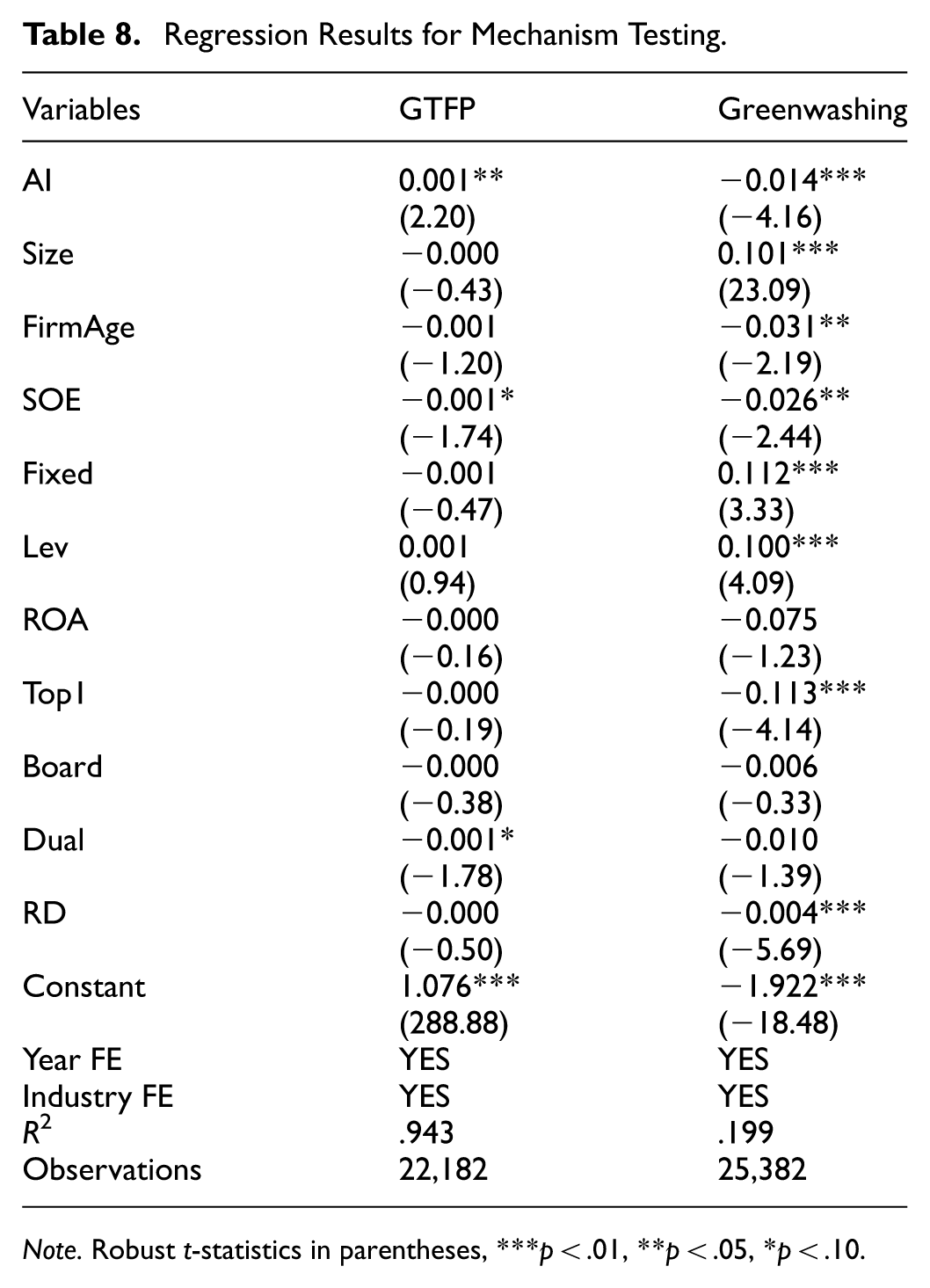
Note. Robust t-statistics in parentheses, ***p < .01, **p < .05, *p < .10.
The impact of AI on GTFP is positively significant at the 5% level, indicating that AI enhances firms’ green total factor productivity. The high level of coordination among internal and external production factors enables firms to increase their R&D investment in green technological innovation and sustainable development. It also facilitates resource conservation and recycling, reduces waste, and improves resource utilization efficiency, thereby lowering production costs and enhancing environmental performance. Collectively, these improvements contribute to strengthening firms’ green competitiveness (Y. K. Lin & Zhong, 2024).
Meanwhile, the effect of AI on greenwashing is negatively significant at the 1% level, suggesting that AI helps to curb firms’ greenwashing behavior and improves corporate green governance efficiency. The application of AI significantly enhances the efficiency of information acquisition and analysis, reduces the supervision and evaluation costs of external stakeholders, and strengthens the ability to detect and expose greenwashing behavior. Furthermore, AI’s advanced analytical and semantic capabilities weaken the concealment of such behavior, amplify firms’ exposure to reputational and market risks, and thus effectively deter these practices, ultimately enhancing firms’ green competitiveness (Sari et al., 2025).
Therefore, AI promotes green competitiveness by operating through two key mechanisms: the factor coordination effect and the green governance effect.
Moderating Effect Test
Table 9 reports the regression results of the moderating effects of environmental regulation, public environmental concern, peer effects, and supply chain finance on the relationship between AI and green competitiveness.
Regression Results of Moderating Effects.

Note. Robust t-statistics in parentheses, ***p < .01, **p < .05, *p < .10.
Environmental Regulation
Following existing studies (Dai et al., 2023), this study measures the intensity of environmental regulation using the ratio of enterprises’ completed industrial pollution control investment to industrial value added. As shown in Column (1), the interaction term between AI and environmental regulation (AI*ERS) is positively significant at the 1% level, indicating that environmental regulation significantly strengthens the positive impact of AI on firms’ green competitiveness. Specifically, under stricter environmental regulation, the promoting effect of AI investment on green competitiveness becomes more pronounced.
Environmental regulation, through substantial investments in pollution control, releases strong governance signals that encourage firms to increase their AI investment and fully leverage its potential in green information disclosure and supervisory management, thereby reinforcing the positive effect of AI on green competitiveness (X. Y. Zhang et al., 2024). Meanwhile, stronger regulatory oversight raises firms’ environmental compliance costs, motivating them to adopt AI technologies to reduce costs and improve efficiency. AI thus plays an increasingly important role in green risk prevention, decision-making, and process upgrading, further amplifying its positive contribution to firms’ green competitiveness (Zhai & An, 2020).
Public Environmental Concern
Following existing studies (Dabbous et al., 2023), this study uses the Baidu Search Index to represent public environmental concern. Specifically, the keywords “smog” and “environmental pollution” are selected, and the annual average Baidu Index is adopted to construct the public environmental concern indicator. As shown in Column (2), the interaction term between AI and public environmental concern (AI*Pub) is positively significant at the 10% level, indicating that public environmental concern enhances, to some extent, the positive impact of AI on green competitiveness. In other words, the higher the level of public environmental concern, the more effectively firms can leverage AI applications to strengthen their green competitive advantage.
As an external social pressure mechanism, public environmental concern amplifies market demand for green products through negative public opinion risks and consumer preferences, thereby encouraging firms to increase their AI investment in areas such as low-carbon and sustainable development (X. F. Zhao & Li, 2025). Furthermore, its decentralized and widespread nature compensates for the limitations of governmental supervision, promoting public participation, information transparency, and law enforcement mechanisms, all of which reinforce AI’s positive role in facilitating green transformation. In addition, heightened public concern intensifies investor preferences and capital market trust constraints, motivating firms to establish long-term incentive mechanisms that strengthen AI’s endogenous role in risk prevention and green transformation (N. Liu et al., 2023).
Peer Effects
Referring to prior research (Zaighum et al., 2024), this study adopts the secondary industry classification codes issued by the China Securities Regulatory Commission (CSRC) to categorize industries, defining firms in the same sub-industry as the target firm as peer firms. The AI peer effect is measured by calculating the annual average AI level of other firms within the same industry as the target firm. As shown in Column (3), the interaction term between AI and peer effects (AI*Peer) is positively significant at the 5% level, suggesting that a higher AI peer effect amplifies the positive influence of AI on green competitiveness.
Since peer firms often share similar AI application scenarios, firms tend to refer to peers’ AI investment behavior to reduce operational risk when making AI-related decisions (Luo et al., 2025). Moreover, AI-related knowledge, technologies, and human capital diffuse within peer networks through spillover effects, enhancing the ability of lagging firms to absorb AI-driven green innovation technologies and resources, motivating them to engage in green practices, and ultimately strengthening their green competitiveness (X. X. Yu, Hu and Feng, 2025). In addition, AI’s capabilities in prediction, simulation, and optimization, demonstrated through peer learning and diffusion, enable firms to identify frontier technologies and optimize R&D pathways, thereby improving their green competitiveness (J. Wang et al., 2022).
Supply Chain Finance
Following prior studies (Lu et al., 2023), this study measures the level of supply chain finance (SCF) by counting the frequency of SCF-related keywords in corporate disclosures and applying a logarithmic transformation to the results. As shown in Column (4), although supply chain finance itself does not have a significant direct effect on green competitiveness, the interaction term between AI and supply chain finance (AI*SCF) is positively significant at the 1% level, indicating that SCF significantly strengthens the positive impact of AI on green competitiveness. This finding suggests that under the support of supply chain finance, firms can better leverage AI to enhance their green competitive advantage.
Supply chain finance facilitates firms’ access to lower-cost external funding, encouraging them to allocate more resources to green technology R&D and environmental equipment upgrades, thereby amplifying AI’s efficiency effect in resource allocation (Tu et al., 2025). Moreover, by establishing an institutional arrangement centered on financial platforms, SCF improves contract enforcement and coordination between firms and their supply chain partners. This reduces information asymmetry and inefficient investments caused by resource misallocation, further enhancing AI-driven knowledge sharing and technology diffusion, and ultimately strengthening firms’ overall green competitiveness (Ma et al., 2024).
Heterogeneity Analysis
This study further conducts group regressions based on four dimensions—industry attributes, pollution intensity, regional distribution, and firm size. The detailed results are presented in Table 10.
Regression Results of Heterogeneity Analysis.

Note. Robust t-statistics in parentheses, ***p < .01, **p < .05.
Industry Attributes
The sample is divided into two groups: manufacturing and non-manufacturing firms. As shown in Columns (1) to (2) of Table 10, the impact of AI on green competitiveness is significantly positive at the 1% level in both manufacturing and non-manufacturing samples. By comparing the coefficient values, the effect of AI on green competitiveness is obviously stronger in non-manufacturing firms. The knowledge integration effect of AI in manufacturing firms is easily diluted by the complexity of the supply chain, and its equipment dependence further limits the marginal utility of AI in optimizing energy consumption and emission control, resulting in contributions to green competitiveness mainly in incremental optimization (Zhou et al., 2025). In contrast, non-manufacturing firms focus more on AI application orientation and cross-domain integration, which makes it easier to achieve exponential improvement through dynamic capability reconfiguration.
Pollution Intensity
The sample is divided into two groups: heavily polluting firms and non-heavily polluting firms. As shown in Columns (3) to (4) of Table 10, the regression coefficient of AI is significantly positive at the 5% level in the heavily polluting firms, but not significant in the non-heavily polluting firms. Heavily polluting firms face greater pressure of green transformation and regulation, and their improvement in green competitiveness comes from substantive motivations, such as improving green technological efficiency of production processes, increasing resource utilization, and reducing pollution emissions (Y. L. Zhao et al., 2025). In contrast, the green practices of non-heavily polluting firms are mostly driven by strategic motivations, such as obtaining short-term profits or shaping a green image, but these actions are mostly superficial and lack true green value. Therefore, the role of AI in enhancing green competitiveness is relatively limited (Shi & Yang, 2024).
Regional Distribution
The sample is divided into two groups: coastal firms and inland firms. As shown in Columns (5) to (6) of Table 10, the impact of AI on green competitiveness is significantly positive at the 1% level for firms in coastal regions, while it is not significant for firms in inland regions. This difference shows that due to the well-developed digital economic infrastructure and favorable policy environment, firms in coastal regions can better exert the positive effect of AI in green transformation. Firms in coastal areas are located in high-risk environments, where AI promotes the spillover of GTFP through “intelligent resilience networks,” enabling a shift from passive response to active prevention. Meanwhile, through the platform effect, AI helps break barriers, promote knowledge integration and low-carbon innovation, and strengthen green competitiveness. In contrast, inland firms are affected by spatial isolation and institutional closure, and the sunk costs of early low-end AI investment and skill mismatch have inhibited the improvement of green competitiveness (Shen & Zhang, 2023).
Firm Size
This study uses the median of total assets in the sample as the threshold, classifying firms with total assets above the median as large firms and those below the median as small and medium-sized firms (SMEs) (P. Yu & Zeng, 2024). As shown in Columns (7) to (8) of Table 10, AI significantly promotes green competitiveness at the 1% level in large firms, while the result is not significant in SMEs. This indicates that large firms are more capable of achieving green competitive advantages through AI technology. Large firms, with sufficient capital and data reserves, can be deeply embedded in AI infrastructure to systematically optimize GTFP and promote a paradigm shift from partial emission reduction to sustainable ecological transformation (H. Li, 2025). In contrast, SMEs’ resource constraints lead to incomplete AI deployment and insufficient algorithm training data, causing biased outputs and path lock-in, amplifying the risk of “black-box” decision-making, and delaying the dynamic evolution from incremental automation to paradigm green innovation (Yang et al., 2024).
Conclusion
Research Conclusions
Under the “dual-carbon” goals, how enterprises can leverage AI and other advanced technologies to achieve green transformation has become a key issue for promoting sustainable development. Based on panel data of China’s A-share listed firms from 2014 to 2023, this study systematically investigates the mechanism through which AI influences corporate green competitiveness.
The findings reveal that, first, AI significantly enhances firms’ green competitiveness. Second, AI exerts both factor coordination effects and green governance effects—it improves green total factor productivity (GTFP) and suppresses greenwashing behaviors, thereby further strengthening green competitiveness. Third, environmental regulation, public environmental concern, peer effects, and supply chain finance all play positive moderating roles in reinforcing the impact of AI on green competitiveness. Fourth, heterogeneity analysis shows no significant difference between manufacturing and non-manufacturing firms; however, the positive effect of AI is more pronounced among heavily polluting industries, coastal regions, and large enterprises.
Overall, these findings provide valuable insights into the role of AI in enhancing corporate green competitiveness and offer practical implications for accelerating green transformation and achieving sustainable development goals.
Policy Recommendations
Based on the above findings, this study proposes the following policy recommendations to provide theoretical guidance and practical implications for policymakers and corporate managers:
First, promote the deep integration of intelligence and greenness. The government should introduce targeted incentive policies to encourage enterprises to embed AI and other advanced technologies into their green transformation processes. Priority resources should be directed toward heavily polluting industries, coastal firms, and large enterprises to facilitate the deep integration of AI into production processes and green innovation practices, thereby driving a technology-led low-carbon transition. At the same time, external factors such as government regulation, public environmental concern, and financial institutions should be leveraged to strengthen the moderating role of AI in improving green competitiveness, ensuring that the green dividends of AI benefit enterprises and regions of all types and promote balanced national development.
Second, strengthen regulatory and governance mechanisms to curb greenwashing and stimulate genuine transformation. The government can build a monitoring system centered on data transparency and environmental information disclosure to strictly regulate corporate greenwashing behaviors. In addition, by developing environmental standards and regulatory instruments, it can discourage false promotion and encourage substantive green practices. Public environmental concern should also be leveraged as a guiding mechanism—through media campaigns and educational programs—to raise consumer awareness and accelerate corporate green transformation. Furthermore, the establishment of a green supply chain finance system can integrate AI-based green performance indicators into financing criteria, forming a market-oriented positive feedback loop.
Third, implement differentiated guidance to promote balanced transformation. Given that the effect of AI on green competitiveness varies by industry, region, and firm size, the government should incorporate these heterogeneities into its technological promotion and environmental policy frameworks. For inland regions and small and medium-sized enterprises, more support should be provided for technology adoption, application training, and digital infrastructure to narrow the transformation gap. For non-heavily polluting industries, emphasis should be placed on preventive AI deployment to facilitate early-stage green innovation planning. Meanwhile, coastal and large enterprises should be encouraged to play a demonstrative role in driving AI adoption along their supply chains, fostering factor coordination and governance amplification effects, thereby generating peer spillovers and promoting overall green upgrading across industries.
Research Limitations and Future Directions
Although this study constructs a relatively comprehensive research framework and empirically verifies the core mechanisms, several limitations remain. First, the research sample is drawn from Chinese listed companies, and the conclusions may not be fully generalizable to non-listed or SMEs. Future studies could incorporate micro-level data through firm interviews and questionnaire surveys to further validate and expand the findings, thereby enhancing their generalizability. Second, as the data are primarily based on the Chinese context, future research could adopt an institutional theory perspective to explore the boundary conditions of AI’s impact on green competitiveness in multi-institutional and cross-country settings, thus improving external applicability. Finally, this study mainly relies on macro-level quantitative data, leaving the role of micro-level factors—such as managerial cognition, employees’ digital skills, and green culture—insufficiently explored. Future research could further investigate the behavioral mechanisms and pathways through which AI promotes green competitiveness at the micro level.
Footnotes
Acknowledgements
The authors would like to thank the editorial team and reviewers for their valuable comments and suggestions.

Ethical Considerations
This study does not involve any human participants or animal subjects; therefore, ethical approval is not applicable.
Funding
The authors received no financial support for the research, authorship, and/or publication of this article.
Declaration of Conflicting Interests
The authors declared no potential conflicts of interest with respect to the research, authorship, and/or publication of this article.
Data Availability Statement
Data sharing not applicable to this article as no datasets were generated or analyzed during the current study.