




Abstract
Following with the social-economy development and the increase of the incidence of various respiratory diseases, countries all over the world are increasingly paying attention to the issue of air pollution. This study uses the tracking data of 31 provincial capitals in China from 2013 to 2020, empirically tests the impact of air pollution on public health based on the ordinary least squares regression, and investigates the reliability of research conclusions with single instrumental variables and double instrumental variables based on the 2-Stage Least Squares and 3-stage Least Squares method. The results showed that air pollution significantly increased the “the number of respiratory diseases deaths per 10,000 people,” the effect reached 24.97%; and there were significant differences in the effects due to different pollution levels, along with the cumulation of the number of days with the air pollution index exceeds 300, the deterioration effects of air pollution on public health will reach the highest value as 0.42%. After replacing the indicators of public health and the treating of endogeneity, the above results are still robust. The impact coefficients significantly increased compare to benchmark model, which has increased to 89.66%. The variable coefficients of days with air pollution index exceeding 300 has increased to 6.66%. In the formation mechanism of air pollution, both industrial pollution and domestic pollution play significant roles, their effects reached 14.79% and 39.61%, respectively; they jointly increase the deterioration degree of air pollution and transmit to the impact of air pollution on public health, the interaction effect reached 5.86%. The air pollution has considerable impact on public health, and when the degree of air pollution increases, its impact is enhanced. The main impact mechanism of air pollution is presented as the joint influences of industrial pollution and domestic pollution that transmitting to the public health.
Keywords
Background
Along with the economic development and the increasing changes of natural environment across the world, the consensus of environmental protection are reached globally. Air pollution is most closely related to human production and life. Due to the strong mobility of air, its impact on different groups is usually homogeneous or lack of discrimination. Compared with other environmental pollution factors, residents are more likely to be exposed to air pollution. Serious air pollution even increases the prevalence of lung cancer or respiratory diseases, and thus reduces expectancy per capita life. Since the 21st century, with the rapid development of economy in China, China’s per capita GDP (Gross Domestic Product) has reached 80,976 yuan by 2021 (National Bureau of Statistics, 2022), and residents’ living standards has been tremendously improved. At the same time, air pollution that caused by rapid economic development in all parts of China has increasingly affected residents’ lives and had imposed remarkable impact on their health. For example, according to the list of carcinogens published by the international agency for research on cancer (IARC) of the World Health Organization in 2020, outdoor air pollution belongs to class I carcinogens because it is high-dense in particulate matters. This indicates that the impact of changes of air pollution on human health is becoming more and more serious (Alex et al., 2019; Hyuna et al., 2021; Soto-Coloballes, 2020). Theoretically, ecological destruction and environmental pollution will reduce the comfort of human life, and result in decline of production efficiency, as well as will affect individual health and facilitate the prevalence of related diseases (Chen et al., 2020). Consequently, medical consumption will be increased (J. Liu et al., 2020; Shahriyari et al., 2022).
In recent years, air pollution in northern China has become increasingly serious. Among them, haze is the primary manifestation of air pollution, and the components of haze are more complex. For example, it contains inhalable particles (PM10), sulfur dioxide (SO2) and other substances harmful to human body, which will not only affect the health of residents, but also cause an increase of hospitalization rate and a significant increase of medical consumption (Li & Zhang, 2014; Dong, 2018; Effatpanah et al., 2020; Yu et al., 2019). Therefore, from the current situation of air pollution, it is of great practical and policy significance to explore the issues of public health. This study takes the evolution trend of air pollution in 31 provincial capitals of China as the main objectives, and attempts to explore its impact mechanism and transmission mechanism on public health. Therefore, this study is able to provide important empirical support for more effective air control schemes.
Literature Review
The current research perspective of air pollution and public health mainly includes residents’ well-being, environmental migration (Lin et al., 2020; Liu, 2021a; Olstrup et al., 2019; X. Liu et al., 2021b), several other studies have examined the impact of air pollution on residents’ health from the perspective of population flow and its measurement accuracy (Song et al., 2019; Liu, 2021b). However, there are relatively few studies investigate the effect of air pollution from the perspective of medical consumption.
Theoretically, air pollution has a strong health depreciation effect, which is indirectly transmitted to the promotion effect of medical consumption, and resulting in large amount of social costs (H. Liu & Wang, 2022; Obiyan & Kumar, 2015). Therefore, we reviewed the existing literature according to this basic theory. Research of Qin et al. (2020) shows that air pollutants, is one of the risk factors that seriously threaten human health. If humans are exposed to air pollutants for a long time, it will lead to many diseases, such as cardiovascular and cerebrovascular diseases, diabetes, nervous system damage and cancer. From the perspective of medicine, inhalable particles mainly affect individual health through two ways: one is to act on the respiratory tract of human body, that is, causing individual respiratory tract infections, chronic obstructive pulmonary diseases, lung cancer and other respiratory diseases through initial target organs (Berend, 2016; Bowatte et al., 2017; Camarinho et al., 2013; Schultz et al., 2017; Shahriyari et al., 2022); The second is to start the continuous effect with the respiratory tract as the target, that is, triggering the inflammatory cascade through local inflammatory factors, and resulting in a significant increase in the incidence of individual cardiovascular and nervous system diseases (Alderete et al., 2017; Bourdrel et al., 2017; Cacciottolo et al., 2017; Münzel et al., 2018; Toledo-Corral et al., 2018). The conclusions of existing studies that the significant and negative impact of air pollution on residents’ physiological health are consistent. For example, the research shows that when the concentration of PM10 in air pollutants increases by 10 μg/m1, the daily mortality of cardiovascular disease and respiratory system are increased by 0.36% and 0.47% respectively; When the concentration of fine particulate matter (PM2.5) increases by 10 μg/m1, daily cardiovascular mortality and respiratory mortality are increased by 0.55% and 0.74%, respectively (C. Liu et al., 2019). With the significant increase of the concentrations of Carbon Monoxide (CO), ozone (O3), PM2.5 and PM10 in air pollutants, the individual’s probability of suffering from respiratory disease, heart disease, or lung cancer is significantly increased (Duflo et al., 2008; Momtazan et al., 2019; C. Pope & Dockery, 2006; Schlenker & Walker, 2011; J. J. Zhang et al., 2020). Also, cardiovascular disease is also significantly increased, and the risk of death is significantly increased (Vlachokostas et al., 2012; Huang et al., 2012; Cao et al., 2021).
Meanwhile, based on the analysis of concentration of air pollutants, studies also show that air pollution significantly improves infant mortality, adult mortality and elderly mortality, and thus reduces life expectancy (Arceo et al., 2016; Chay & Greenstone, 2003; Y. Chen et al., 2013; Ebenstein et al., 2017; H. Liu & Hu, 2022). The research of Cesur et al. (2018) shows that air pollution has a negative effect on the average life expectancy of the population, and mainly reduces the average life expectancy through the path of increasing the lung cancer rate. Deryugina et al. (2019) investigated the impact of air pollution from the perspective of health behavior and summarized the impacts into two parts: direct behavior related to environmental health and social behavior (spillover behavior). In addition, air pollution could have a significant impact on residents’ mental health. The study found that air pollution significantly increases the possibility of residents that suffering from depression, anxiety or cognitive diseases, and thus results in more serious psychological problems (S. Chen et al., 2018; H. Liu et al., 2021a; Liu, 2022; Mason et al., 2019; X. Zhang et al., 2018). For example, based on China Family Panel Studies (CFPS) data, X. Zhang et al. (2018) and Xue et al. (2019) found that air pollution reduced residents’ cognitive ability and mental health status.
Besides, several studies have focused on the impact of BTEX (Benzene, Toluene, Ethylbenzene, Xylene) and other pollutants on the health. Many research conclude that the exposure to more BTEX pollutants will increase the lifetime probability of cancer and health risk (Goudarzi, Alavi, et al., 2017, 2018). Parts of studies also discusses the correlation between air pollutant standards and air quality (Morovati et al., 2018; Naghizadeh et al., 2019), such as the relation between the status of air particles and meteorological conditions (Biglari et al., 2017), and the relationship of air particles and seasonal changes of cold and warm (Goudarzi, Idani, et al., 2017). Others investigate the health risks of dust storms (Goudarzi, Daryanoosh, et al., 2017), ozone and human health (Javanmardi et al., 2018), Thus, a comprehensive research framework is formed.
Overall, the existing studies have discussed the health effects of air pollution in general, there are also many studies focusing on the impact of traffic related air pollution on public health (Kunzli et al., 2000; Loh et al., 2009; Vlachokostas et al., 2011). But the analysis of the effects of air pollution on public health from a macro perspective is relatively insufficient, especially the analysis based on multi-year panel data of typical cities is rare. In addition, most of the existing studies have evaluated the health impact of average level of air pollution, while the impact of different degrees of air pollution is ignored. Therefore, based on the existing research, we uses the tracking survey data of 31 provincial capital cities in China from 2013 to 2020 as to investigate the impact of air pollution on public health. Compared to the existing studies, the main contributions and innovations of this study focus on: First, the research content is supported by the dynamic detection data of air pollution from the Ministry of Ecology and Environment of China. We select the deaths of respiratory diseases and lung cancer as the main proxy indicators of public health, and adopt the ordinary least square (OLS) method for benchmark estimation. Furthermore, considering the endogeneity of air pollution, we employ the two-stage instrumental variable method (2-Stage Least Squares, 2SLS) to deal with the endogeneity. Based on this, the regional employment structure is found as endogenous, thus we confirm the robustness of the estimation results by usuing the 3-Stage Least Squares (3SLS) method, and analyze the formation mechanism of air pollution impacts from the dual perspectives of industrial pollution and domestic pollution. Second, from the perspective of improving the regional public health, we focus on the impact of regional annual average level of air pollution on public health, and investigate the public health impact of the air pollution under different pollution levels. Third, in terms of research methods, taking the ordinary least square estimation as the benchmark model and the instrumental variable method as the main body, the 2SLS method is selected for endogenous test and processing; meanwhile, the robustness of the estimation results of three-stage 3SLS method under the condition that both of air pollution and regional employment structure are endogenous, is checked.
Methods and Data
Methods
Benchmark Model: OLS Estimation
Considering the linear association between air pollution and public health, we first establish the benchmark model based on the ordinary least square estimation (OLS), as follows:

In model (1),
Instrumental Variable Method:2SLS and 3SLS Estimation
In the benchmark model, the impact effect of air pollution on public health is endogenous. For example, the public health level in areas of severe air pollution will be low, while the public health level areas of slight air pollution areas will be higher. Thus, significant impact of air pollution on public health could be found. Public health also has an impact effect on regional air pollution. For example, if local governments pay more attention to environmental protection, there may be existing causal relationship between the two variables. In addition, there might be biases in the estimation results caused by missing variables such as unobservable variables. Therefore, we further select the two-stage instrumental variable method for endogenous treatment. The specific model is set as follows:


Model (2) is basically consistent with model (1), but it assumes that air pollution is endogenous. Hence, 2-Stage Least Squares (2SLS) is used for estimation, with the first stage is to estimate the cause factors of air pollution. Here, we select the regional mineral resource endowment as the instrumental variable, which is
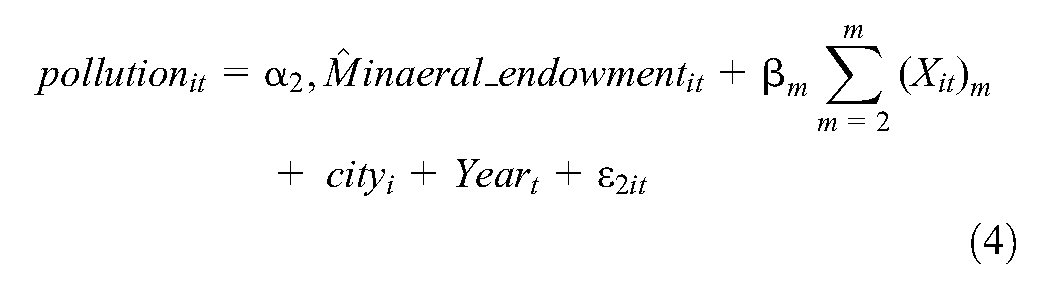

Model (4) and model (5) are using 3-Stage Least Squares (3SLS) method for endogenous treatment based on model (3). The first stage uses the regional economic development level as the instrumental variable for the number of mining employees. Theoretically, in the short term, the level of economic development does not critically have a impact on the regional employment structure, that is, economic growth is exogenous to the employment structure; while short-term economic growth will affect individual employment choices, especially the adjustment of policy of employment structure has a direct impact on the number of people engaged in mining production in the region. Therefore, economic growth meets the requirements of instrumental variable for the number of short-term mining employees (Dubravskaya, 2020; Traoré & Ouedraogo, 2021). The estimation of the number of regional mining employees obtained from model (5) is subsequently brought into model (4). In this second stage, the number of mining employees is used to estimate regional air pollution. The third stage is to bring the estimated air pollution obtained in model (4) into model (2) to estimate the impact of air pollution on public health, which is the consistent estimate in the three-stage model. The main research framework and method design are shown in Figure 1.

The basic framework of this study (method part).
Data
Referring to the current situation of China’s socio-economic development and improvement of environmental quality, we focus on the data of air pollution and public health after 2013. It is because monitoring data of air quality across the country was mostly missing in 2013, and the data sources become stable after 2013. During the period from 2013 to 2020, China’s social and economic environment and natural environment management policies have been largely changed, such as the idea of “two mountains” proposed by Xi Jinping in 2016. Therefore, the dataset mainly includes air pollution and public health data of 31 mainland provincial capitals from 2013 to 2020, which are obtained from China Statistical Yearbook and annual statistical report of urban air quality. Among them, macroeconomic variable are based on the statistical values of each provincial capital and region from 2013 to 2020. Environment variables are calculated as weighted average of daily updated statistics, and summarized to monthly scores in each counted year. Thus, the environmental data includes monthly data of each provincial capital city from January 2013 to December 2020. Finally, a total of 248 statistical samples are collected via data matching, and the balanced panel data could be constructed.
Variable Description Statistics
The core explanatory variables of the article are AQI and annual days of extreme pollution-AQI100, AQI150, AQI200, and AQI300 that reflect the degree of regional pollution. The core explained variable is regional public health. We take the annual number of respiratory diseases deaths per 10,000 people in the region as the main variable, and use the annual number of lung cancer deaths per 10,000 people in the region, the annual times of outpatient per capita and the annual inpatient rate per capita as alternative variables for robustness test. The specific variable definitions and descriptive statistics are shown in Table 1.
Descriptive Statistics of Variables.

In parallel, we sorted out the changing trend of air pollution and regional mining employees in major cities from 2013 to 2020, as presented in Figure 2. It can be clearly seen that the AQI and mining employees in major cities have a downward trend during this period. In details, the downward trend of regional mining employees is more significant. While the regional AQI shows a tendency of fluctuating decline, with a significant downward in 2017 and a slight increase after 2018. The overall level of AQI is declining, however, the degree of decline is relatively gentle.

Number of mining employees and air pollution (AQI).
Results
Benchmark Estimation
At first, we use OLS to test the impact of air quality on public health, and the test results are recorded in Table 2. After controlling the investment on natural environment, annual sunshine, the number of health technicians and other public health factors, the results of model (1) show that air pollution has a significant and positive effect on the “number of respiratory diseases deaths per 10,000 people,” and its effect is 0.2497. That means with the 1% increase of AQI, the “number of respiratory diseases deaths per 10,000 people” will increase by 0.2497. In Table 2, model (2)–model (5) are the test with extreme pollution days as the explanatory variables. Their results indicate that number of days with different pollution degrees have a significant and positive impact on the “number of respiratory diseases deaths per 10,000 people.” Their influence coefficients are quite different. The influence coefficients of AQI100, AQI150, AQI200, and AQI300 are 0.0016, 0.0021, 0.0026, and 0.0042, respectively. It demonstrates that along with the strengthening of pollution degree, the effects of extreme pollution days on “the number of respiratory diseases deaths per 10,000 people” significantly increase. Compared with Frank and Julia’s (2015) and Yin et al.’s (2019) analysis of air pollution, existing studies have paid more attention to the analysis of public health indicators that caused by air pollution, such as the spatial distribution of public health or disease burden rate, and also global disease burden etc. (Chan et al., 2021). In this study, AQI is selected for testing the effect of air pollution. The indicator has advantages, but it also has certain deficiencies, for instance, it could not clarify what factors in the air quality cause the decrease of public health, and how to improve relevant social policies from the analysis result. Therefore, we attempt to solve the problem through in-depth analysis of the internal mechanism of air pollution change later.
Air Pollution and Public Health (OLS).

Note. Standard errors in parentheses.
p < .01. **p < .05. *p < .1.
Air Pollution and Annual Average Inpatient Rate
Based on the benchmark test, we investigated the impact of air pollution on the resident’s annual average inpatient rate. The solid line in Figure 3 represents the influence coefficient of air pollution on the annual average inpatient rate, the dotted line represents the confidence interval at the level of ±95%, respectively, and the horizontal axis represents the year. In the model, we controlled the indicators of natural environment and public health related factors, and also fix the regional effect. From the results shown in Figure 3, the impact coefficient of air pollution on residents’ inpatient rate is trending downward slightly. However, from the whole, its coefficient values are relatively consistent, which means that the impact of air pollution on annual inpatient rate has not largely changed during this period. The purpose of the above analysis is to show that recent improvement of air quality has not reached the degree which can reduce the impact of air pollution on society. Thus, air pollution is still severe. In order to explore the internal causes of this problem, we will conduct endogenous test and expansionary test later.

Air pollution and annual average resident inpatient rate.
Endogenous Test
Due to the previous theoretical deduction of the endogenous impact of air pollution, we select instrumental variables for endogenous treatment. The approach is to use 2SLS and select the number of employees in regional mining industry as instrumental variable. The number of employees in the regional mining industry can truly reflect the scale of the regional mining industry. Moreover, this study employs the method of regional fixed effect by matching the data of total number of employees in the regional mining industry in the survey year. Hence, cases of local registered permanent residence that engaged in mining production in other places are excluded. By this way, the data can truly reflect the regional industrial structure. In addition, the number of employees in the regional mining industry is also one of the important indicators of the regional economic development. When the regional economic development is weaker, the proportion of the secondary industry in the economic structure will be higher. However, the number of employees in the regional mining industry is not a necessary factor for the level of regional economic development. For example, some regions are rich in mineral resources, which drives the growth of regional GDP, but the social costs in these regions are also high, due to such as mineral accidents, environmental governance and so forth. According to this, we first conduct endogenous test based on the benchmark model, and the results are shown in Table 3. In the two-stage model test, the results of first stage show that the number of employees in the regional mining industry has a significant and positive impact on regional air quality as well as extreme pollution days. The F value test of stage 1 is greater than the standard value of 10, which means the selected instrumental variables is effective.
Air Pollution and Public Health (2SLS Treatment).

Note. Standard errors in parentheses.
p < .01. **p < .05. *p < .1.
The results of second stage of test show that after endogeneity treatment, air pollution still has a significant impact on the public health. However, compare to the benchmark model, we found that in the two-stage model, the corresponding impact coefficient of air pollution has greatly increased. For example, the impact coefficient of AQI has increased from 0.2497 to 0.4837; The influence coefficients of AQI100, AQI150, AQI200, and AQI300 increased to 0.0018, 0.0038, 0.0076, and 0.0322, respectively. The above results indicate that under the condition of excluding the effects of regional mining production, the impact of air pollution on the public health, such as the “number of respiratory diseases deaths per 10,000 people” in the region, is largely underestimated. This is also one of the essential contents of this study. We should not only explore the impact of air pollution on the public health, but also try to reveal its internal transmission mechanism and possible social costs. The endogenous test here confirms the impact of the number of mining employees in the region, or reflects the public health cost of industrial pollution in a region, like mining. At the same time, along with the social and economic development especially in developing countries, domestic pollution is also increasing, such as the pollution caused by the excessive increase of private cars. Therefore, we will take industrial pollution as the main objective to further explore the health effects of air pollution that caused by industrial pollution in a three-stage 3SLS model, we will also investigate the relationship between industrial pollution and domestic pollution in the effects on public health.
Processing of Dual Instrumental Variables
Considering industrial pollution as the main component in air pollution, the number of employees in regional mining industry not only affects regional air pollution, but also itself might be endogenous. For example, low level of regional economic development may lead to the weak development of other industries in the region, resulting in a single employment structure. Therefore, from this practical problem, we try to conduct double endogeneity test. In details, it includes the endogeneity of regional employment structure on air pollution and the endogeneity of the impact of air pollution on regional public health. Different with the 2SLS model test, the 3SLS model can be used for three-stage endogenous test and treatment (Bakhsh et al., 2017; Dhrymes, 1969). The results of 3SLS estimation are presented in Table 4. In the first stage, we choose the regional economic development level, here the regional per capita GDP, as the instrumental variable of the number of regional mining employees. The reason is that the regional per capita GDP level affects the regional population employment structure and also the regional residents’ demands for the quality of life, but its impact on regional air pollution is not direct. As mentioned above, it is possible that economic growth level may be high in some areas with serious air pollution, and the level of economic development would also be high in some areas where air pollution is relatively slight.
Air Pollution and Public Health (3SLS Treatment).

Note. Standard errors in parentheses.
p < .01.
From Table 4, in the first stage test, the regional economic development level has a significant and negative effect on the number of employees in the regional mining industry, which indicates that higher economic development level brings about fewer workers that engaged in mining production. The results of the second stage test show that the number of regional mining employees still has a significant impact on regional air pollution, which demonstrates the reliability of the results from endogenous treatment. The results of the third stage test are: after controlling the endogenous impact of regional employment structure and air pollution, air pollution still has a significant impact on the “number of respiratory diseases deaths per 10,000 people.” Compare to the results of the benchmark model and the two-stage model, the impact coefficient of air pollution and extreme pollution days in the three-stage model further increased, also, the increasing trend of the influence coefficients of air pollution along with the increase of extreme pollution days was found.
Robustness Test
In the further test, we conducted robustness treatment by using different public health indicators as alternative variables, and the results are presented in Table 5. In column (1), the “number of lung cancer deaths per 10,000 people” is used as explained variable. The results reveal that air pollution has a significant and positive effect on the “number of lung cancer deaths per 10,000 people,” with an influence coefficient of 0.5430. In terms of the effects of number of days of extreme pollution, still the cumulative number of days with different degree of extreme pollution has a significant and positive impact on the “number of lung cancer deaths per 10,000 people.” Also, the impact of air pollution on the “number of lung cancer deaths per 10,000 people” is significantly increased following the increase of the degree of extreme pollution. The test using the annual average inpatient rate of residents and the annual average times of outpatient as explained variables are marked as (2) and (3), respectively. The results shows that air pollution has a significant and positive effect on the annual average inpatient rate and the annual average times of outpatient. Meanwhile, influence coefficients of the number of days of extreme pollution are increasing along with the increase of pollution degree. These tests demonstrate that the previous results about the air pollution effects on public health are robust.
Robustness Test Results.

Note. Standard errors in parentheses. The coefficient values corresponding to AQI variables under model (1)–model (3) are different model test results, and the results of model control variables are not listed.
p < .01. **p < .05.
Formation Mechanism of Air Pollution
In terms of influencing factors of air pollution and its direct forming element, after excluding the influence of natural factors, such as wind force or wind direction, the main cause of air pollution in a country or region is industrial pollution and domestic pollution. Therefore, in the discussing of effects of air pollution, the two elements are direct influencing factors both in theory and practice. However, deviated from this common sense, existing theoretical and empirical studies rarely investigate the joint impacts of the two elements. Thus, this section focuses on the outcome of air pollution under synergy effects of industrial pollution and domestic pollution, based on the investigation of one-way effect of the two elements. The test results are shown in Table 6. We select the annual number of mining employees in the region as the proxy variable of industrial pollution, and the annual number of private cars per capita in the region as the proxy variable of domestic pollution. Models (1)–(4) are estimations control the factors of regional natural environment, time effect and regional effect as well. The results of model (1) and model (2) show that both regional industrial pollution and domestic pollution have significant and positive effects on regional air pollution, and their effects are close to each other. When include both of the two elements into the model (3), we find that the effect of industrial pollution is smaller than that of domestic pollution, their effect coefficients are 0.1479 and 0.3961 respectively. Thus, domestic pollution plays a more important role among the influencing factors of current air pollution. Model (4) is a test by adding the interaction term of industrial pollution and domestic pollution. The results suggest that the interaction term has a positive effect. This means if the industrial pollution is fixed, domestic pollution can significantly and positively enhance the effect of industrial pollution. This promotion effect is 5.86%; or if the domestic pollution is kept stable, industrial pollution will also strengthen the impact of domestic pollution. The above results clarify that industrial pollution and domestic pollution are the leading factors in the formation of air pollution, and the combination of the two has a more serious consequence in increasing the pollution effect. This result also illustrates that the revision of air pollution control policies should not only pay attention to the impact of industrial pollution, but also pay attention to the formulation of measurements dealing with domestic pollution. Thereby, the effectiveness of implementing comprehensive environmental management measures could be improved.
Main Influencing Factors of Air Pollution.

Note. Standard errors in parentheses.
p < .01. **p < .05. *p < .1.
Discussions
Firstly, air pollution has a significant effect on the health risks of residents like respiratory diseases. Thus, air pollution has considerable impact on public health, and this effect varies under different levels of pollution intensity. For example, the impact of cumulative number of days with air pollution intensity index greater than 300 is higher than that of other levels of pollution intensity. From the existing research, scholars mostly explore the impact of annual average air pollution value on public health, while there are few investigations concerning the intensity of air pollution and its cumulative effect. Thus, these research often focus on the changing trend of micro individual health status due the exposure to polluted environment. For example, Frank and Julia (2015) focused on PM and found that air pollution has led to serious health outcomes in the past 10 years and the pollution is associated with many diseases; Yin et al.’s (2019) analysis was from the perspective of spatial aggregation effect of public health. They found that due to the convergence effect of regional public health, the negative external effect of air pollution is significant. Chan et al. (2021) investigated the social cost of industrial pollution and household pollution, and also estimated the empirical impact of different pollutants on health from the perspective of global burden of disease study (GBD). This study focuses on the formation mechanism of existing air pollution and the impact of air pollution intensity on public health. It is revealed that air pollution not only has an short-term impact on the health of residents, but also has significant impacts on the public health level if the residents exposed to air pollution for a long time. Especially for those exposed to high concentration of air pollution for a long time, their health level will be significantly lower.
Secondly, the transmission mechanism of air pollution affecting public health is another focus of this study. Based on the existing research, we not only investigated the impact of traditional industrial pollution on public health, but also investigated the health impact of private car ownership (domestic pollution) and its interaction with industrial pollution. This is different with the current studies, in which single industrial pollution or domestic pollution are mostly used as the main proxy variable of air pollution (Chakraborty & Green, 2014; Hasunuma et al., 2014; Jerrett et al., 2005; Mestl et al., 2007; Swami & Chauhan, 2015; Xu et al., 2019). We further clarify the formation mechanism of air pollution, making the conclusion of air pollution’s public health effects revealed in this study more reliable. From the analysis results, industrial pollution and domestic pollution both impose effects on regional public health. Moreover, if set under the same level of social and economic development, the impact of domestic pollution plays a leading role while its impact coefficient is higher than industrial pollution. Early research show that industrial pollution has an essential impact on public health (Paolocci et al., 2020; Rahman et al., 2021). However, the research conclusions vary due to different study period and different level of national economic development. For a large developing country like China, industrial pollution has increased rapidly since the founding of the people’s Republic of China in 1949. Until to the 21st century, the peak of air pollution intensity is reached. Industrial pollution has always been dominant, for instance, the phenomenon of “haze” is increasing (Shi et al., 2020; Zhao et al., 2020). However, following the social and economic development, the number of private cars owned by Chinese residents has increased significantly since the beginning of the 21st century, and the air pollution effect brought by this domestic pollution is also increasing. At the same time, governments began to deal with environmental problems like air pollution, which directly led to the gradual transformation or move of traditional polluting enterprises and the gradual reduction of industrial pollution. Especially in recent years, after the concept of “carbon peaking and carbon neutralization” was put forward, the changing trend of industrial pollution is more remarkable (Sun et al., 2020; Yang et al., 2021). Therefore, in the investigating of the impact mechanism of different pollution sources on public health, we should not only consider the impact of air pollution and its intensity, but also pay attention to the socio-economic characteristics of a country or region at different stages of development. This study has investigated the current changes in urban air pollution during 2013 to 2020, which could reflect the real situation of urban air pollution in China.
Based on the findings of this paper, we can discuss the policy measures for air pollution control from the following aspects: (1) From the perspective of layout of industry in a country or region, policymakers should not only consider the economic benefits brought by industrial production, but also pay attention to the distribution of industrial sites, for avoiding the aggravation of air pollution caused by the agglomerating of polluting industries and bringing higher cost on public health management. (2) At the same time, policy makers can conduct empirical investigation on the relationship between industrial policy and public health, and estimate the environmental and health cost under the impact of specific policies. Also, these parameters need to be taken into measurements to improve the quality and efficiency of public policies. Thus, unstable factors are reduced and social harmony is improved. (3) Decision makers should focus on control of traditional industrial pollution, but also focus the health hazards brought by the increasing numbers of. On the one hand, the improvement of the quantity and quality of public transport need to be considered. On the other hand, new energy or low-pollution vehicles need to be developed, and strengthening of the traffic restriction rules as well as controlling of social costs from traditional fuel consuming vehicles need to be taken account in.
The main highlights of this study are: Firstly, from the research perspective, this study examines the public health effects of air pollution from a macro perspective. Also, this study examines the internal mechanism of the air pollution impacting on public health from two facades of industrial pollution and domestic pollution. Secondly, in terms of research methods, based on the comparison of instrumental variables of air pollution such as wind force, air variation coefficient (VC) and inversion weather phenomena (Arceo et al., 2016; S. Chen et al., 2018; Fu et al., 2017; Muhanji et al., 2019; Qiang & Jian, 2020), this study uses the number of mining employees in the region as an endogenous variable. The variable can truly reflect the annual air pollution in the region. Thus, the reliability of the research conclusion is improved. Moreover, compared to the most studies that only adopt 2SLS method (Liu et al., 2021; Lyu et al., 2020; Ou et al., 2022) and ignore the impact of two-way endogenous effect, we use the 3SLS method to investigate the impact of air pollution under the endogeneity of both regional employment structure and air pollution. The results demonstrate that regional economic development affects air pollution through the affecting on economic structure and employment structure.
In addition, there are deficiencies of this study. First, due to the limitation of data sources, the main data of this study is from the statistic of 30 provincial capital cities in China from 2013 to 2020, but the data of earlier years are not obtained. Second, this study is not accurate to reflect the variation of air pollution impacts due to different time with environmental policy changes, or due to geographical differences. Also, although we have investigated the impact of industrial pollution and domestic pollution on air pollution, due to the limitations of proxy variables, we can not accurately estimate the impact of specific pollution subjects.
Therefore, from on the advantages and limitations of this study, we can further expand the sample size and investigate the effect of policy changes for future research. For example, we can increase samples of countries or regions with diverse social economic development conditions, and focus on the impact of the implementation of different environmental policies via horizontal comparison of different countries or regions in the same period, or vertical comparison of different development periods of the same country or region. Therefore, we can provide important empirical support for the formulation or adjustment of more effective policies for air pollution control.
Conclusions
The main conclusion of this study is that air pollution has a significant reduction effect on the public health. If the air pollution in a country or region is serious, the “number of respiratory diseases deaths per 10,000 people,” the “number of lung cancer deaths per 10,000 people, ” the annual average inpatient rate and the times of outpatient will be significantly increased. Furthermore, number of regional mining employees and economic development level have critical impact on regional air pollution, which indirectly affects regional public health. In addition, with the increase of pollution intensity, the impact of extreme pollution days on public health will also increase. Among the abundant causes of air pollution, industrial pollution and domestic pollution play a leading role. When the two elements co-exist, the impact of domestic pollution will be significantly higher. Also, industrial pollution and domestic pollution interact with each other, resulting in the increasing degree of air pollution. Therefore, focusing on the contemporary social cost of air pollution, we should not only investigate the causes of air pollution, but also analyze the internal formation mechanism and leading force of air pollution. Based on this, most effective intervention for environmental management could be achieved, in order to impede the impact path of air pollution onto public health. For example, it is possible to gradually strengthen the treatment of causes of domestic pollution and reduce the utilization rate of private cars, on the basis of policies for industrial environmental governance. Generally, the causes of air pollution are mixed, and public health is complex. To deal with the relationship between the air pollution and public health, we need to comprehensively estimate their inner constraint factors, and thus to improve the effectiveness of governance policies.
Footnotes
Acknowledgements
The authors are very grateful for the financial support of THE MOE (Ministry of Education in China) Project of Humanities and Social Sciences, Major Project of Philosophy and Social Sciences by the Ministry of Education and National Natural Science Foundation of China.
Abbreviation
OLS=Ordinary Least Squares; 2SLS=Two-Stage Least Squares ; 3SLS=Three-Stage Least Squares; AQI=Air Quality Index; PM=Particulate Matter; GDP=Gross Domestic Product; SO2=sulfur dioxide; CO=Carbon Monoxide; O3=ozone; PM2.5=fine particulate matter; PM10=inhalable particulate matter; CFPS=China Family Panel Studies; BTEX=Benzene, Toluene, Ethylbenzene, Xylene; CI=Confidence Interval.
Authors’ Contributions
Liu drafted and revised it critically for important intellectual content and approved the version to be published, and carry out language retouching, modification. Wang and Hu made a substantial contribution to the concept and design of the work, interpretation of data, and drafted the article.
Declaration of Conflicting Interests
The author(s) declared no potential conflicts of interest with respect to the research, authorship, and/or publication of this article.
Funding
The author(s) disclosed receipt of the following financial support for the research, authorship, and/or publication of this article: This work was supported by THE MOE (Ministry of Education in China) Project of Humanities and Social Sciences [23YJC630052], Major Project of Philosophy and Social Sciences by the Ministry of Education [23JZD031], and National Natural Science Foundation of China [2023hx125; 42001179; 71904167; 42376223].
Ethics Approval and Consent to Participate
Not applicable.
Consent for Publication
Not applicable.
