



Abstract
Building on emotions as social information theory, this study examines the mechanism underlying the impact of cognitive job crafting on the relationship between customer gratitude expression and frontline employees’ career growth. Career centrality is tested as a boundary condition. To deepen the understanding of the gratitude effect in this context, this research employs both a scenario-based experiment and a three-wave field survey. The findings reveal that customer gratitude expression positively affects frontline employees’ career growth through cognitive job crafting. This effect is amplified among employees with high career centrality. As an initial attempt to investigate the gratitude effect on the relationship between customers and frontline service employees, this paper contributes to the literature on customer gratitude by highlighting its influence on frontline employees’ career growth from the perspective of cognitive job crafting.
Keywords
Introduction
Gratitude is a pleasant emotion experienced by individuals in response to receiving help. (Locklear et al., 2023). Haidilao, a leading Chinese restaurant chain, attracts millions through quality food, exceptional service, and strong brand positioning, serving over 500 million customers and ranking 14th in the 2024 Restaurant Brand 25 (Brand Finance, 2023). While Haidilao’s success is well-documented, the impact of customer gratitude on employees has been overlooked. By encouraging customers to write appreciation notes, Haidilao boosts frontline employees’ motivation and strengthens their connection to the brand, enhancing service quality. This is referred to as customer “gratitude expression” (Algoe et al., 2013; Grant & Gino, 2010; Park et al., 2019).
Gratitude expression refers to the explicit display of gratitude, either verbally or non-verbally, to acknowledge the help or contributions of others (H. Chen et al., 2024). In service contexts, customers feel thankful and are more likely to express appreciation toward frontline employees directly, due to the satisficed experience and benefit from the provided services (Zhu et al., 2022). Consequently, customers are a distinctive source of gratitude expression (Cao et al., 2023; Tang et al., 2022; Zhu et al., 2022). Given that customers have powerful influence in service (Dong et al., 2015), their gratitude expressions should have a considerable influence on employees. However, prior studies have only identified leaders and coworkers as sources of gratitude expression (H. Chen et al., 2024; Lee et al., 2019; Ritzenhöfer et al., 2019). How customer-expressed gratitude may affect employees’ behaviors, especially career development, has been overlooked (Tang et al., 2022).
Career growth refers to employees’ recognition of their career development speed within an organization, and reflects their expectations for career prospects (Weng & McElroy, 2012). Customer gratitude expression conveys an optimistic signal to employees by highlighting the respect and trust exhibited by customers toward employees’ current jobs, thus encouraging employees to craft optimistic cognitions regarding and establish a positive relationship with their current job. In the cognitive job crafting process (Wrzesniewski & Dutton, 2001), employees review the job’s meaningfulness and values, acquire job skills, and seek promotions and career developments. Therefore, cognitive job crafting can help reveal the mechanism underlying the relationship between customer gratitude expression and career growth.
Furthermore, career centrality shapes employees’ motivation in the customer gratitude expression process (Deci & Ryan, 1991), reflecting their self-positioning at work (Erdogan et al., 2018). Employees with high career centrality perceive customer gratitude as reinforcing job cognition and job crafting, viewing it as a career growth opportunity. In contrast, those with low career centrality are less responsive to customer gratitude, weakening the impact of cognitive job crafting on career growth.
The current research attempts to address these gaps in knowledge by investigating employee career growth in the context of customer gratitude expression. According to the emotions as social information (EASI) model, the research objectives are as follows. Initially, this research investigates the effect of customer gratitude expression on employee career growth, thus improving our understanding of the long-term influence of customer gratitude. Subsequently, this research examines whether cognitive job crafting mediates the customer gratitude effect. Job crafting is conceptualized as a bottom-up process of adjustment and reshaping rooted in employees’ role-based activities (Wrzesniewski & Dutton, 2001). Thus, focusing on cognitive job crafting helps to deepen the investigation of the underlying mechanism in this context. Ultimately, this research explores career centrality as a moderator, in which context a strengthening effect can be observed. By introducing career centrality, this study explores how employees’ characteristics influence their views on customer gratitude. This paper makes two primary contributions to this stream of literature. Theoretically, this paper explores the relationship between customer behaviors and employee careers through an in-depth discussion of customer gratitude in the service context. Practically, this paper provides beneficial suggestions regarding how to take advantage of customer gratitude to promote the employees’ long-term career performance.
Hypotheses Development
The Emotions as Social Information (EASI) Model
The EASI model posits that emotional expression can convey information in relevant situations. When individuals observe emotional expression on the part of others, they typically infer relational orientations and generate behavioral intentions that are in line with the observed individual’s emotions (van Kleef et al., 2010). The meaning of an emotional expression can vary with the situation, such as when an individual reacts to the observer’s behavior (Van Kleef et al., 2015). For example, if an employee is late and misses an important meeting, the manager may express anger. Such an emotional expression from the manager may lead the employee to apologize and promise to be punctual next time. Thus, when an observer receives the emotional expression, he or she draws inferences regarding others’ attitudes, feelings, and social intentions, which influence individual’s subsequent attitudes and behaviors (Van Kleef, 2009).
The EASI model defines this situation as an “emotional reaction,” where emotions influence observers by triggering responses. Positive emotional feedback shapes psychological states, fostering favorable perceptions, higher expectations, and motivation for positive actions (H. Chen et al., 2024). Emotional expressions affect both psychological states and subsequent behaviors (van Kleef, 2014).
Customer Gratitude Expression and Employee Career Growth
Customer gratitude expression fosters positive relationship perceptions, motivating employees to maintain connections. Zhu et al. (2022) found that it boosts job satisfaction and increases job involvement among employees. Everyone desires appreciation (Algoe et al., 2013), including frontline employees. According to EASI theory, emotional expression influences attitudes and behaviors through inferential and affective pathways (Van Kleef, 2009). Customer gratitude serves as both a cognitive and emotional signal, fostering optimistic job perceptions. It enhances employees’ self-awareness, self-affirmation (Judge et al., 1998), and workplace happiness (E. Kim & Yoon, 2012). Additionally, gratitude helps employees infer job effectiveness (Van Kleef et al., 2015), reinforcing their belief in their service approach and motivating sustained positive behaviors.
As a result, the positive cognitions and attitudes resulting from customer gratitude encourage employees to provide services by working correctly and exhibiting appropriate attitudes in the future, thereby leading enhancing their long-term professional skills and promoting high performance. Third, effective working methods, optimistic working attitudes, and high performance at work can help employees be appreciated by leaders and promote career growth (Zhang et al., 2023).
H1: Customer gratitude expression positively affects employee career growth.
The Mediating Role of Employee Cognitive Job Crafting
Job crafting involves cognitive or actual changes in tasks or relationships (Berg et al., 2010) and reshapes work through task, relationship, and cognitive dimensions (Wrzesniewski & Dutton, 2001). It enhances work involvement (Rudolph et al., 2017), job satisfaction (Cheng et al., 2016), and well-being (Slemp & Vella-Brodrick, 2014), while reducing burnout (Tims et al., 2013), job constraints (M. Kim & Beehr, 2018), and job boredom (Harju et al., 2016, 2018). However, job crafting requires driving factors (Petrou et al., 2015). From a cognitive perspective, we argue that customer gratitude expression could promote frontline employees’ cognitive job crafting.
First, based on the inferential processing path of the EASI theory, emotions can serve as a form of social information influencing recipients’ cognitive inference(Van Kleef, 2009). When customers express gratitude to employees, employees receive information indicating that their work and efforts are affirmed and approved (Lambert et al., 2010). Employees process the information cognitively, and interpret that their work behaviors are valuable to customers and meets their needs and values, thereby realizing the meaning and value of themselves and their work (Grant & Gino, 2010). Additionally, to some extent, the message conveyed by customer gratitude can meet employees’ intrinsic needs: affirmation from customers makes employees realize that their work is meaningful (the need to obtain job meaning) and that they are affirmed and recognized (the need for a positive self-image; Judge et al., 1998). To maintain these positive self-perceptions and self-feelings, employees focus and magnify these valuable parts proactively at the cognitive level, and reconstruct them into the purpose and meaning of their own job (Wrzesniewski & Dutton, 2001). They transform “a group of discrete tasks” into “a meaningful whole work” and consider their service work to constitute a valuable job, which is based on providing convenience to and creating value for customers (Buonocore et al., 2020).
Second, based on the affective reacting path of the EASI theory, customer gratitude expression infects employees through emotional contagion mechanism, making employees have a positive emotional state (Van Kleef, 2009). Gratitude is an emotion characterized by love, warmth, and joy, that conveys the good faith of the sender toward the receipt (Emmons & Shelton, 2001). When employees are appreciated by customers, they also experience this positive emotion. This positive state also enables employees to broaden their cognitive processing range, have more flexible cognitive styles, build individual resources, and enhance individual effectiveness (Fredrickson, 2001). The expanded cognitive scope makes employees more likely to view works in a more holistic way. Flexible cognitive styles, positive psychological states, and high individual efficacy meet the spiritual effort and psychological resources, that employees required to identify valuable and meaningful parts of their work as reshaping directions and achieve reshaping (H. Kim et al., 2018). Employees are more inclined to regard this process as a pleasant two-way work experience with customers rather than a boring single-service job (Nasr et al., 2014). This positive feeling encourages employees to focus on the positive aspects of their work and to interpret the job meaning in an optimistic way (Buonocore et al., 2020). Additionally, it fosters essential psychological resources, enabling employees to break habitual cognitive patterns and embrace a more adaptive mindset.
In summary, customer gratitude expression encourages employees to focus on positive job aspects, fostering an optimistic mindset and expanding job-related skills. This process enhances their understanding of the work’s significance, promoting growth and improving customer satisfaction through the development of new resources and efficient work methods.
H2: Customer gratitude expression positively affects employees’ cognitive job crafting.
As discussed, perceiving work meaning fosters positive career expectations (Strauss et al., 2012). Job crafting enhances employability (Brenninkmeijer & Hekkert-Koning, 2015), career competency (Akkermans & Tims, 2017), and commitment (M. Kim & Beehr, 2018), making cognitive job crafting a key mechanism linking customer gratitude to career growth.
Customer gratitude expression helps employees develop a positive understanding of their job’s value, motivating them to engage in cognitive job crafting. They recognize the job’s role in meeting self-development needs, enhancing their skills and performance. This process boosts career abilities and encourages employees to take on challenging tasks, fostering growth and expanding career opportunities. Ultimately, cognitive job crafting driven by customer gratitude enhances work enthusiasm and supports successful career development.
In summary, customer gratitude reflects respect for employees’ efforts, helping them reinterpret job meaning, boost enthusiasm, enhance engagement, and promote career growth. This expression encourages employees to reshape their work perspective, positively impacting their career development.
H3: Cognitive job crafting mediates the relationship between customer gratitude expression and employee career growth.
The Moderating Role of Career Centrality
Career centrality refers to how individuals define themselves in a career context, thereby reflecting the issue of individuals’ self-positions with regard to their careers (Fugate et al., 2004). Individuals with high career centrality define themselves by their careers, viewing career events as crucial to their self-concept and self-esteem, providing purpose and meaning (Hirschfeld & Feild, 2000). They prioritize career advancement, often sacrificing social life for growth (Noe et al., 1990), and seek jobs that align with their values and preferences, exerting greater effort toward career success (Erdogan et al., 2018).
Given the importance they place on their careers, we predict that employees with high career centrality would promote more job crafting in their cognitions, when they receive the gratitude from customers. On one hand, employees’ job motivation determines their working methods, including in terms of intensity and duration (Guo & Cheng, 2021). Employees with high career centrality, who prioritize their careers above other aspects of life, are more likely to find goals and meaning in works and devote greater energy and effort to career development (Noe et al., 1990). For them, the sense of “wanting” a job where one has opportunities to use and develop one’s skills, and purchases one’s career success will be stronger (Erdogan et al., 2018). As a result, they are more likely to interpret customer gratitude expressions as affirmations of their work methods and recognition of the value they create. This positive reinforcement strengthens their sense of work value and encourage them to engage in cognitive job crafting (Deci & Ryan, 1991), resulting in a stronger relationship between customer gratitude expression and cognitive job crafting.
On the other hand, employees with low career centrality prioritize other aspects of life over career development and are less willing to make sacrifices for career success (Erdogan et al., 2018). Their low motivation leads them to perceive customer gratitude passively (Wang et al., 2014), showing less drive for self-realization at work (Noe et al., 1990). Consequently, they are less responsive to customer gratitude and less likely to experience job meaning, weakening the impact of gratitude on their job crafting.
Based on the mentions above, career centrality is expected to moderate the relationship between customer gratitude expression and employees’ cognitive job crafting.
H4: Career centrality moderates the relationship between customer gratitude expression and cognitive job crafting. Customer gratitude expression has a stronger positive impact on employees’ cognitive job crafting when employee career centrality is high than when it is low.
According to the preceding discussion, career centrality moderates the mediating effect of job crafting on the relationship between customer gratitude expression and career growth. Employees with high career centrality are more likely to appreciate customer gratitude, viewing their work as meaningful and valuable. This enhances cognitive job crafting, motivating them to invest effort in improving job skills and performance, ultimately accelerating their career growth.
H5: Career centrality moderates the mediating effect of cognitive job crafting on the relationship between customer gratitude expression and career growth. For employees with high career centrality, the positive effect of customer gratitude expression on employee career growth via cognitive job crafting is enhanced.
The research framwork of the current study is shown in Figure 1.

Research Framework.
Overview of Research Studies
We tested these predictions in two complementary studies by applying a scenario-based experiment and a three-wave field survey. The experimental methodology could better reveal the causal mechanism between variables, which also overcomes the shortcomings of questionnaire surveys that can only reveal the correlation. In contract, the survey methodology shows a higher external validity, that benefits to generalize the findings from experiments with higher internal validity in a more reality scope. In Study 1, we utilized the scenario-based experiment to examine Hypotheses 1 to 5. Study 2 examined the overall model in a field context through an interval survey to check the robustness and enhance the external validity of findings in the experiment.
Study 1 was conducted in August, 2022 and Study 2 was conducted from March to May in 2023. Informed consent has been obtained from all participants involved in two studies. In the research process, all participants were informed that participation was voluntary and assured that their responses would be used only for academic research and kept strictly confidential. Participants could withdraw from the studies at any time without penalization. All the responses were anonymous, which helped to protect the privacy of participants.
Study 1: A Scenario-Based Experiment Conducted in a Restaurant Context
Research Design
Study 1 employed a 2 (customer gratitude expression: yes vs. no) × 2 (career centrality: high vs. low) two-factor subjects-between design. Following the previous research and focusing on real-life situations, this study designed a restaurant service situation to investigate the customer gratitude effect (Balliet & Ferris, 2013; Ferris et al., 2019).
The scenario featured a restaurant server named Fan Wang, who assisted a family celebrating a birthday and included a picture of a restaurant without customers. In the customer gratitude expression group, the customers thanked Fan Wang for the service; in contrast, in the control group, the customers remained silent. A pretest was conducted to test the effectiveness of the material. A total of 100 participants were recruited from the same subject pool. The results showed that customers in the customer gratitude expression group were significantly more thankful than were customers in the control group (MGratitude = 4.55, SD = 0.05; MControl = 1.97, SD = 0.18; t(98) = −14.64, p < .001). Thus, this experimental material could be used to support the formal experiment.
Participants and Procedures
This study recruited 380 frontline employees in China. Twenty to two participants who failed to complete questions were excluded, leading to a final sample of 357 (63.9% female; Mage = 31.08, SD = 6.91; a total of 85.20% of these participants had undergraduate or high college degrees). The procedure used for this study was as follows (Figure 2):

The procedure of Study 1.
First, the participants read the instructions, following which they were randomly assigned to one of two experimental groups, that is, either the customer gratitude expression group (N = 175) or the control group (N = 182). Subsequently, the participants were given at least 60 s to read the scenario. The designs used for these two groups were identical in terms of background and character set: Your name is Fan Wang, and you have been working in a restaurant for two years. As a restaurant server, your job is to introduce dishes to customers and meet their reasonable needs. After reading the material (see the Appendix), the participants answered questions for measurement items. Finally, they provided demographic information and got 10 RMB for their participations as compensations.
Measurements
Survey items were back-translated following procedures from Brislin (1970). Each participant was asked to assess whether they agreed or disagreed with the description of each survey item using a five-point Likert scale (from “1” = “strongly disagree” to “5” = “strongly agree”). The details of the items were summarized in Table 1. For control variables, employee gender, age, education, tenure, and job rotation were controlled because theses demographic characteristic may influence an individual’s attitude toward the work and the job.
Measures and Items Used in the Current Reserach.

Note. The items were all measured using 5-point Likert scale; “cognitive job crafting” requires participants to indicate the extent to which they engage in the described behaviors by indicating a 1 (hardly often) to 5 (very often); other variables require participants to indicate the extent of their agreements by indicating a 1 (strongly disagree) to 5 (strongly agree). “Work engagement” was only used in Study 1.
There is a potential alternative explanation for why employee received customer’s gratitude may obtain the feeling of career growth. As indicated by Zhu et al. (2022), receipt of customer could boost employee more efforts in works. The work effort may influence employee engage in their job more deeply, which would benefit to their career development. To address this alternative explanation, we adopted the nine-item scale developed by Schaufeli et al. (2006) to measure work engagement (Table 1).
Results
Manipulation Check
The results of a two-factor analysis of variance (ANOVA) including customer gratitude expression as the dependent variable indicated a significant main effect only with regard to the customer gratitude expression group (F(1,337) = 227.08, p < .001, η2 = 0.405). Neither career centrality nor the interaction term significantly affected the manipulation items pertaining to customer gratitude expression (Fs < 1.6, ps > 0.1). Customers in the customer gratitude expression group felt that the customers expressed gratitude more strongly than did customers in the control group (MGratitude = 4.57, SD = 0.33; MControl = 1.89, SD = 1.07). This finding indicates that the manipulation was successful.
The Main Effect
The results of a two-factor ANOVA featuring career growth as the dependent variable indicated a significant main effect of customer gratitude expression (F(1,337) = 30.37, p < .001, η2 = 0.083). Participants in the customer gratitude expression group exhibited significantly stronger career growth perceptions than did participants in the control group (MGratitude = 4.13, SD = 0.71; MControl = 2.99, SD = 1.19), thus supporting H1 (Figure 3). Furthermore, we also found a significant interaction between customer gratitude expression and career centrality (F(7,337) = 2.57, p < .05, η2 = 0.051).

The main effect in Study 1.
The Mediating Role of Cognitive Job Crafting
First, the results of a two-factor ANOVA featuring cognitive job crafting as the dependent variable indicated that the main effect of customer gratitude expression was significant (F(1,337) = 4.03, p < .05, η2 = 0.012). Participants in the customer gratitude expression group exhibited stronger perceptions of cognitive job crafting than did participants in the control group (MGratitude = 4.27, SD = 0.48; MControl = 3.48, SD = 1.00), thus supporting H2.
Second, the PROCESS results revealed a significant mediating effect of cognitive job crafting (using Model 4 based on 5,000 bootstrap samples, indirect effect = 0.705, CI = [0.5581, 0.8535]), thus supporting H3. Additionally, work engagement was included as a mediator, and the PROCESS results did not indicate a significant mediating effect (using Model 4 based on 5,000 bootstrap samples, indirect effect = 0.004, CI = [−0.0173, 0.0164], including 0; Table 2).
Bootstrapping Results of Indirect Effects in Study 1.

Third, a significant interaction was observed between customer gratitude expression and career centrality in the context of cognitive job crafting (F(7,337) = 4.54, p < .001, η2 = 0.087), thus indicating that career centrality moderated the relationship between customer gratitude expression and cognitive job crafting and thereby supporting H4. Furthermore, according to the Johnson–Neyman analysis, the moderating effect of career centrality becomes significant only when it is higher than 3.33 (β = .93, t = 7.85, p < .001; Figure 4).
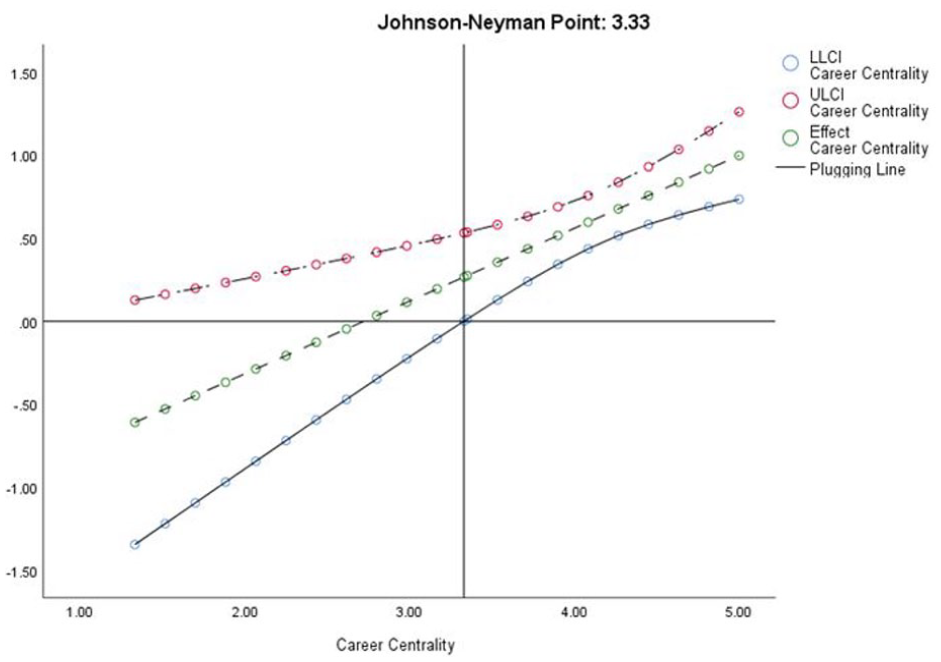
The results of Johnson-Neyman in Study 1.
Moderating Mediation
The PROCESS application was unitized to examine the moderating role of career centrality (Hayes & Preacher, 2014; using Model 7 based on 5,000 bootstrap samples).The mediation analysis yielded a 95% confidence interval (CI) for the interaction’s indirect effect that excluded 0 (indirect effect = 0.4011, CI [0.1973, 0.6109]), indicating a significant moderated mediating effect (Figure 5) and supporting H5. Specifically, customer gratitude expression increased cognitive job crafting among employees with high career centrality, thus boosting their career growth (indirect effect = 0.8266, 95% CI [0.6242, 1.0529]). However, this relationship was not observed among employees with low career centrality (indirect effect = 0.1579, 95% CI [-0.0765, 0.4150]).

Direct and indirect effects of the moderating role of career centrality in Study 1.
Summary
According to a scenario-based experiment design, the results demonstrated that participants who experienced customer gratitude felt a stronger sense of career growth than did those in the control group. Participants who received customer gratitude expression promoted high cognitive job crafting, thus enhancing their career growth perceptions. This customer gratitude effect was stronger for participants who viewed their careers as more central to their lives. The findings not only provide support for the underly mechanism of cognitive job crafting but also highlight the moderating role of career centrality in the customer gratitude effect. Thus, the five hypotheses were supported (Table 3).
The Key Results Summarization of Study 1.

The experimental design helped to demonstrate causal inferences, enhance the internal validity, and rule out the alternative explanation pertaining to work engagement. However, the findings from the experiment locks of the external validity, nor confirmed by the employees’ perception in real life. Thus, Study 2 applied a three-interval field survey to investigate the whole model in service employees’ responses to solve the problem above.
Study 2: A Field Survey of Hotel Frontline Employees
Participants and Procedures
This field survey focused on employees of full-service upscale hotels in China. The target sample for this study included full-time customer-facing frontline employees recruited from the front office, food and beverage, housekeeping, and marketing departments of four- or five-star hotels. Via the research team’s professional network, paper-based questionnaires were distributed to employees working in 16 hotels in four provinces, including 10 four-star hotels and six five-star hotels. With the assistance of the human resources managers of these hotels, the researchers distributed the survey questionnaires to each frontline employee. Each questionnaire was put in an envelope with the employee’s work ID and then distributed to the targeted employees. After filling out the questionnaire, employees returned it directly to researchers. The researchers paid each participant 30 RMB as compensation for the time and effort they invested in this research.
Data were collected at three time points with a 1-month interval (Figure 6). At Time 1, 906 participants evaluated customer gratitude expression and career centrality. At Time 2 (1 month after Time 1), 837 participants filled in a follow-up questionnaire rating their cognitive job crafting. At Time 3 (1 month after Time 2), 784 participants reported their career growth. Participants’ demographic characteristics were filled at every stage. The final sample included 711 effective questionaries, resulting in a response rate of 78.47%.

The time flow of the three-interval survey in Study 2.
Table 4 showed the demographic information. Among the 711 employees, 442 were female (62.17%). The average age was 31.24 years old (SD = 8.28). Tenure was reported as followed: less than 1 year (8.02%), 1 to 3 years (22.64%), 3 to 5 years (25.04%), 5 to 10 years (31.78%), more than 10 years (12.52%). In terms of education, 7.45% had a high school diploma or lower, 23.49% had completed a college degree, 63.72% held a bachelor degree, and 5.34% had postgraduate qualifications or higher. For job rotation, 57.25% never changed their jobs, 35.72% changed one to two times, 0.633% changed three to four times, and 0.7% changed five times or above.
Demographic Information in Study 2.

Note. N = 711. Age and tenure were collected by specific numbers. These two variables were presented by frequency and percentage in the table.
Measures
The measures used in Study 2 were identical to those in Study 1 (Table 1). Because the alternative explanation of work engagement was ruled out in Study 1, this variable was not included in this study.
Results
Confirmatory Factor Analysis
The discriminant validity of all variables was assessed by conducting confirmatory factor analyses (CFAs). Following the CFA procedure, we tested four CFA models: a single-factor model, a six-factor model, and a seven-factor model (in which the four dimensions of appraisal were included as separate factors). The results, which are shown in Table 2, indicate that the four-factor model exhibited a significantly better fit (χ2/df = 2.74, p < .001; IFI = 9.97, TLI = 0.96, CFI = 0.97, RMSEA = 0.04) than the other models, thus confirming that the four-factor model exhibited sufficient discriminant validity. Accordingly, the convergent validity of the measures was acceptable.
Common Method Variance
We applied three ways to address potential common method bias in research model (Podsakoff et al., 2003). First, through the design of study’s procedures, we created a temporal separation by introducing 1 month between the measurements of the predictor and criterion variables. Second, we took the method of Harman’s single-factor technique (Harman, 1976). We loaded all the items of four variables on a single variable and restricted them onto one factor with the method of principal-axis and constrained the analysis with on rotation. The result shows the variance of the first principal component was 38.05%, less than 40%. Therefore, we can know that CMV was not a serious problem in this survey. Third, we conducted a confirmatory factor analysis while controlling for unmeasured latent method factors to examine the influence of CMV. In particular, we incorporated the CMV factor as a latent variable into the four-factor model and allowed all the measurement items to load onto it (Podsakoff et al., 2003). As compared with the fit indices of the baseline four-factor model, the RMSEA of the four-factor + CMV model (χ2/df = 2.75, p < .001; IFI = 9.97, TLI = 0.96, CFI = 0.97, RMSEA = 0.05) varied by less than 0.02 (Table 5), thus indicating that common method variance was not a major issue in our study (Dulac et al., 2008).
Confirmatory Factory Analysis Results in Study 2.

Note. CGE = customer gratitude expression; CJC = cognitive job crafting; JCE = job centrality; JGR = job growth; CMV = common method variance; “+” = factor merging; IFI = incremental fit index; TLI = Tucker-Lewis index; CFI = comparative fit index; RMSEA = root-mean-square error of approximation.
Descriptive Statistical Analysis and Correlation Analysis
The means, standard deviations (SD), and correlation matrix of the control variables and the main variables are shown in Table 6. The results suggest positive relationships between customer gratitude expression and cognitive job crafting (r = .34, p < .01), career growth (r = .28, p < .01), and career centrality (r = .25, p < .01). Cognitive job crafting is positively correlated with career growth (r = .37, p < .01). In addition, positive relationships are observed between career centrality and both cognitive job crafting (r = .30, p < .01) and career growth (r = .37, p < .01). The results of the correlation analysis largely support our hypotheses.
Means, Standard Deviations, and Correlations of All Variables in Study 2.

Note. Gender: “1” = male; “2” = female; Education: “1” = a high school diploma or lower; “2” = a high college degree; “3” = a bachelor degree; “4” = postgraduate qualifications or higher; Job rotation, “1” = never, “2” = one to two times, “3” = three to four times, “4” = five times or above. N = 711. The square roots of AVE appear in parentheses along the diagonal.
p < .05. **p < .01.
Hypothesis Testing
We tested our theoretical model by conducting hierarchical multiple regression analyses, as shown in Table 4. The results indicated that customer gratitude expression had positive effects on career growth (β = .48, p < .01, Model 6); therefore, H1 was supported. In addition, customer gratitude expression was positively associated with cognitive job crafting (β = .49, p < .01, Model 2); therefore, H2 was supported.
H3 suggested that cognitive job crafting would mediate the relationship between customer gratitude expression and career growth. The results suggested that after adding cognitive job crafting to the model, the effect of customer gratitude expression on career growth was still significant (β = .18, p < .01, Model 8). Therefore, the relationship between customer gratitude expression and career growth is partially mediated by cognitive job crafting. Furthermore, we utilized the Hayes’ PROCESS model (Hayes & Preacher, 2014) to test the indirect effect of job crafting. The results showed that the indirect effect of customer gratitude expression on career growth via cognitive job crafting was significant (B = 0.333, CI = [0.289, 0.382]). Thus, H3 was further supported.
H4 stated that career centrality would moderate the positive relationship between customer gratitude expression and cognitive job crafting. To examine H4, we used the mean-centered scores of customer gratitude expression and career centrality to eliminate multicollinearity when creating the interaction (Aiken & West, 1991). Table 7 shows that the interaction between customer gratitude expression and career centrality has a positive effect on cognitive job crafting (β = .07, p < .01, Model 4). Following the suggestion of Aiken and West (1991), we described the effect of interaction by taking one standard deviation above and below the mean of career centrality. Figure 7 shows the interaction pattern, which is consistent with H4. Namely, customer gratitude expression was more positively related to cognitive job crafting when career centrality was high (β = .17, p < .01) than when it was low (β = .14, p < .01); thus, H4 was supported.
Hypothesis Testing Results in Study 2.

Notes. N = 711;
p < .05; ** p < 0.01.
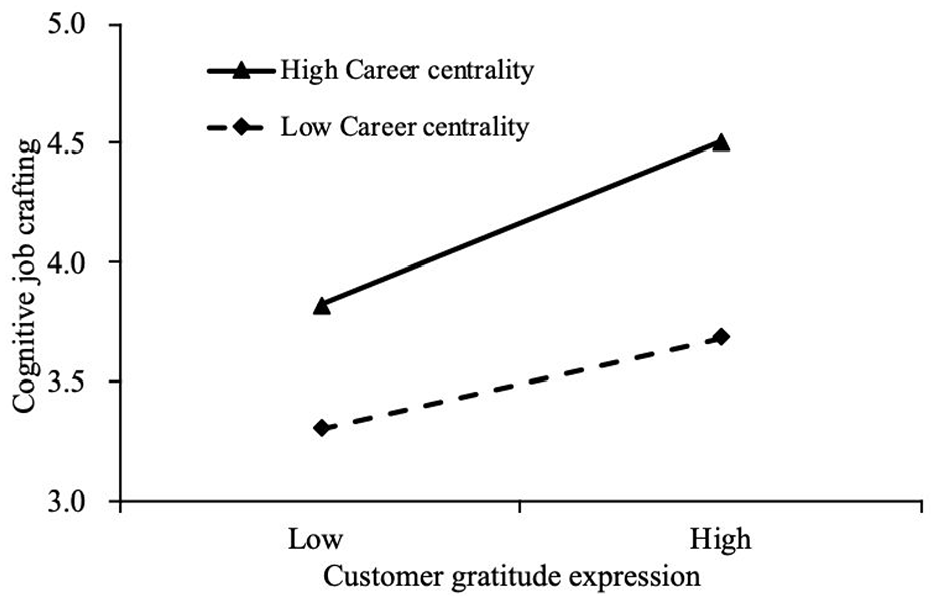
The interactive effects of customer gratitude expression and career centrality on cognitive job crafting in Study 2.
H5 proposed that career centrality moderates the indirect effect of customer gratitude expression on career growth via cognitive job crafting. The results in Table 8 showed that the condition indirect effect of customer gratitude expression on career growth through cognitive job crafting was stronger and significant when career centrality was high (Effect size = 0.31, SE = 0.04, 95% CI [0.235,0.383]) but was weaker and significant when career centrality was low (Effect size = 0.17, SE = 0.03, 95% CI [0.111, 0.231]). The significant difference between the above two conditional indirect effects (Effect size = 0.14, SE = 0.04, 95% CI [0.631, 0.220]) indicated that career centrality serves a critical role in conditioning the indirect effect of customer gratitude expression on career growth via cognitive job crafting. Thus, H5 received support.
Conditional Indirect Effect of Customer Gratitude Expression on Career Growth.

Summary
According to a three-wave survey design with 711 employees, Study 2 revealed that customer gratitude expression positively influenced frontline employees’ cognitive job crafting, providing support for H2. Furthermore, cognitive job crafting explained the impact of customer gratitude expression on career growth, confirming H1 & H3. For employees with high career centrality, the effect of customer gratitude expression on cognitive job crafting was stronger, supporting H4, along with a stronger mediating effect, validating H5.
In summary, Study 2 tested the hypotheses by reference to a larger sample to ensure the external validity of the research and replicated the results from Study 1, revealing robust findings. Combining Study 1 and Study 2, the current research enhance our understanding of the causal relations between customer gratitude expression and employees’ career growth and tested the moderating role of career centrality with regard to the underlying mechanism of cognitive job crafting.
General Discussion
Conclusion
This research applied the EASI model to examine why and when customer gratitude expression affects employee career growth. It confirmed that cognitive job crafting mediates this effect, and career centrality moderates it. Our hypotheses were supported by data collected from 1,068 employees, based on a scenario-based experiment and a field survey method. The findings demonstrate that customer gratitude expression positively influences frontline employees’ career growth and that cognitive job crafting can explain this effect. Additionally, we found that frontline employees’ career centrality serves as a moderator in this context and strengthens the customer gratitude effect through job crafting. These findings have important implications with regard to both theory and practice.
Theoretical Contributions
This paper extends the extant research on customer gratitude and links this factor to employees’ behaviors from a long-term perspective. Previous studies have predominantly focused on leaders and coworkers as sources of gratitude expression (H. Chen et al., 2024; Lee et al., 2019; Ritzenhöfer et al., 2019). However, frontline service employees play a pivotal role in maintaining relationships between customers and enterprises. Few studies have explored the relationship between customers and employees, especially frontline employees, who help shape customers’ initial images of restaurants or hotels. Only limited research has discussed the work outcomes of employees who are targeted by customer gratitude (Zhu et al., 2022), there has been a notable absence of research examining the corresponding career outcomes. To obtain sustained competitive advantages in the workplace, employees focus not only on current job performance but also on career development (Wang et al., 2014). Thus, this study contributes by offering a comprehensive understanding of the influence of customer behavior on employee career growth.
Second, this study adopted a novel emotional perspective to explain the impact of customer behaviors on employees’ career success. Previous scholars have focused on the antecedents of employees’ career development in terms of internal leadership factors, such as manager assessments (Weer & Greenhaus, 2020) and leader career calling (Ni et al., 2024), as well as organizational factors, such as organizational investment (Weng & Zhu, 2020) and working systems (Miao et al., 2023), while ignoring external customer-related factors. By introducing the cognitive job crafting mechanism, this study explains that external positive customer factors, as emotional signals, can encourage employees to discover the job meaning by changing their understanding of and views toward work in a manner that differs from the cognitive influence of other internal factors. Furthermore, the current study interacts and supports C. P. Chen’s (2003) integrating perspectives in Career Development Theory. C. P. Chen (2003) pointed out that context variables, such as interpersonal relationship, could affect an individual’s decision to think and feel his/her career. The present study verifies Chen’s points by introducing the positive interaction with customers as a contextual factor that prompt employees’ career development. Thus, this study highlights possible directions for future studies on the interpersonal relationship between customers and employees and the external environment that benefits to employees’ career growth and development.
Finally, we proposed career centrality as a moderator. As expected, we found that career centrality is a significant moderator of the relationship between customer gratitude expression and career growth. The positive effects of customer gratitude expression on career growth were more pronounced when career centrality was high. In other words, career growth was more problematic for employees with high career centrality. This specific finding is important and suggests that perceived gratitude from customers is a more constructive condition for employees who place great value on their careers (Erdogan et al., 2018). At the same time, even employees who reported low career centrality (values 1 SD below the sample mean) were affected by customer gratitude expression even though it was to a lesser degree. The identification of career centrality as a moderator of customer gratitude adds value to the literature by showing that not everyone is equally affected by customer gratitude expression. To date, Zhu et al. (2022) showed that perceived customer expression effects on occupational identification were stronger for employees who had high levels of concerning other parties. Our study extends this prior work to demonstrate that individuals who place greater importance over their careers, when they experience customer gratitude, experience higher career growth. Despite process in the study of receiving gratitude (e.g., Algoe et al., 2013; Bock et al., 2016; Grant & Gino, 2010), few studies have investigated the boundary conditions under which receipt of gratitude functions. In theorizing the moderating effects of career centrality, we fill this gap and respond to the call to consider the boundary conditions when investigating the interpersonal impacts of receiving gratitude (Ritzenhöfer et al., 2019).
Practice Implications
This research has several managerial implications for organizations. First, the most important implication for organizations is the importance of customers’ display of gratitude. Intangible and material rewards can be provided to motivate customers to voice, write, or engage in positive social interactions, behave in friendly ways, and express gratitude when they receive employees’ service and help (Zhu et al., 2022). Also, organizations can launch beneficiary contact programs so that employees have opportunities to contact and receive gratitude from customers (Grant & Gino, 2010), especially for service work, where beneficiaries are major part of the work itself. Therefore, organizations can promote and establish such a kind atmosphere to enable employees to feel recognized and valued, thereby promoting their career development. Additionally, organizations could mitigate negative emotions from customers, thus highlighting a certain degree of guiding significance with regard to their attempts to improve employees’ service performance and enhance customer loyalty.
Second, there are also implications for employers, recruiters and/or organizational decision makers. The findings indicated that the customer gratitude effect is influenced by employee career centrality, highlighting the importance for managers to focus on. Specifically, in addition to examining employees’ working skill and status, employers should determine whether employees have established a clear career development plan and possess the ability to manage work–life conflicts. Moreover, recruiters can employ appropriate recruitment methods (such as by asking questions about career centrality and administering psychological tests) to evaluate job candidates’ career centrality. Furthermore, organizational decision makers can cultivate employees’ career centrality by providing them with technical training, promoting career planning, and encouraging corporate culture communication to take full advantage of employees with high career centrality and maintain the organizational competitive advantages.
Finally, this study can help employees understand themselves and deeply enhance their career stability. Employees have increasingly focused on career growth in an increasingly unstable economic environment. Therefore, this study introduces career centrality to facilitate employees’ comprehensive self-understanding. For example, employees with high career centrality should seek out enterprises that feature a seamless training system and a relaxed cultural atmosphere, which can emphasize employee development instead of blindly insisting on a “customer first” approach. Employees should cultivate a positive attitude in the workplace, focus on fostering meaningful interactions with customers, and actively derive satisfaction from customer gratitude, thereby enhancing their career stability. For these employees with high career centrality, organizations could give them promotion opportunities working as head waiters, that helps them consider more values on jobs and create high service performance. This practise also benefits organizations to set up a positive career model for other employees to follow, which may be useful to shape an aggressive organization environment.
Potential Limitations and Future Research Directions
This study also has limitations that require further discussion. First, this study discussed the moderating role of career centrality only at the personal level and did not consider other moderating factors. Future research could discuss other relevant factors, such as corporate culture, organizations’ levels of value orientation, and dynamic personality characteristics (Zhang et al., 2023). For example, culture is the rich complex of beliefs, practices, norms, and values prevalent in a society (Schwartz, 2006). Individualism-collectivism is a typical cultural construct that affects individuals’ attitudes and behaviors. According to Triandis (2001), people in individualistic culture are independent from their social group. Their behaviors are usually based on their own attitudes. Thus, employees from individualistic cultures may be less influenced by customer gratitude expression. In contrast, people in collectivistic cultures are interdependent with their social groups. They generally behave according to the norms of their groups because their priority is placed on the goals of social groups (Kitirattarkarn et al., 2019). Thus, employees in collectivistic cultures may show higher service performance due to the customer gratitude expression. Future research could explore the roles of other cultural factors in the current customer gratitude effect.
Second, this study revealed that job crafting has a partial mediating effect in this context, and future research could explore other possible mechanisms. For job crafting in the current research, the cognitive dimension was focused and tested. According to Berg et al. (2010), there are still two other dimensions in job crafting—relation and task. Future research could explore the impact of customer gratitude from relational and task-based perspectives to identify differences from this study. Additionally, alternative mechanisms such as organizational support, career commitment, and emotion regulation may offer further insights into the underlying processes. At the organizational level, support can stem from various sources within the company (K. Y. Kim et al., 2022). Customer gratitude serves as a form of support, shaping employees’ perception of organizational support. In return, employees respond with greater performance efforts, contributing to both organizational success and their own career growth. At the job level, customer gratitude reinforces employees’ work value, enhancing their enjoyment of service provision and strengthening career commitment to their organization (Weng et al., 2010). This, in turn, helps employees refine their skills and pursue sustainable career development. At the individual level, effective emotion regulation fosters positive emotions and well-being (Côté et al., 2008). Customer gratitude generates intrinsic positive feelings in employees, which enhance work performance and career growth. Future research could further explore these alternative mechanisms.
Third, although this study employed multiple methods, such as by combining scenario-based experiments with a survey to test the hypotheses and check the robustness of the results, some aspects of this methodology could be improved. Future researchers could perform a field experiment to investigate employees’ actual behaviors in a real-world workplace. In addition, the causal relationship between customer gratitude expression and career growth was shown in Study 1 by using experimental methodology. Although the statistic results from the longitudinal survey in Study 2 also confirmed, other longitudinal studies, such as diary method, could be applied to clarify the causal relationship again. Furthermore, the three time points in Study 2 were separated by 1 month, that may not be sufficient to show the long-term effects from customer gratitude. Future research could conduct a longer time interval each, such as a half year, to confirm the customer gratitude effect found in this study. At last, the current study was conducted in the hotels and restaurants industries, that may limit the generalizability of the results. Future research could expend the research to other service industries, such as hospitals, banks, and aviation services.
Footnotes
Appendix
Acknowledgements
The authors are grateful to the editors and the reviewers for their helpful comments.

Ethics Considerations
Ethical approval is not required for this study because our study is non-interventional (the survey) and involves only anonymous questionnaire surveys without human experimentation or clinical trials, in accordance with institutional policies and national regulations. It falls under the category of low-risk investigations and does not require formal ethical approval. Informed consent has been obtained from all participants involved in this study. In the research process, all participants were informed that participation was voluntary and assured that their responses would be used only for academic research and kept strictly confidential. Participants could withdraw from the study at any time without penalization. All the responses were anonymous, which helped to protect the privacy of participants. The research reported in the manuscript respects strictly the Declaration of Helsinki Ethical Principles.
Funding
The author(s) disclosed receipt of the following financial support for the research, authorship, and/or publication of this article: This work was funded by the Fujian Province Social Science Foundation (Nos. FJ2025B154 and FJ2023BF025), National Natural Science Foundation (Nos. 72272057 and 72372047) and Huaqiao University’s Academic Foundation for Higher-level Talents (20SKBS202).
Declaration of Conflicting Interests
The author(s) declared no potential conflicts of interest with respect to the research, authorship, and/or publication of this article.
Data Available Statement
The datasets generated during and/or analyzed during the current study are available from the corresponding author on reasonable request.