



Abstract
Nostalgic memory often involves one’s close relationships and fosters a sense of closeness to the target person in the memory. The motivation for social connections is a critical factor behind anthropomorphism (humanizing non-human targets). When people feel lonely, they anthropomorphize non-human targets to fulfill their need for social connection. In contrast, people reverse-anthropomorphize (dehumanize) targets when their sociality motivation is fulfilled. This study clarifies the relationship between nostalgia and anthropomorphism and tests two hypotheses. First, nostalgic memory causes a reverse-anthropomorphism of the target that is unrelated to nostalgic memory because nostalgia fulfills the sociality motivation. Second, a nostalgic memory about a target fosters its humanization because people feel close to the target in their nostalgic memory. We conducted two online experiments and analyzed data from 252 participants. They were assigned several tasks, including memory retrieval, loneliness checks, assessing nostalgia proneness, and ascertaining their closeness to the target. The results indicated that nostalgic memories reverse-anthropomorphized unfamiliar targets, while nostalgic memories about a target fostered targeted anthropomorphism.
Plain Language Summary
This study examines whether nostalgic memories foster or suppress attributing humanlike mental capacities to non-human targets (anthropomorphism). Nostalgic memories often involve close relationships, which make us feel socially connected. Moreover, nostalgic memory about a specific person makes us feel that the person is close to us. The motivation for being socially connected is a crucial factor that causes anthropomorphism. When people feel lonely, they anthropomorphize non-human targets to fulfill their need for social connection; in addition, people attribute humanlike traits to their close ones, such as in-group members or companion animals. In contrast, people reverse-anthropomorphize (dehumanize) targets when their sociality motivation is fulfilled. In Experiment 1, we examined that nostalgia satisfies sociality motivation, and thus, reduces anthropomorphism of the unfamiliar target that is unrelated to a nostalgic memory. In Experiment 2, we examined whether nostalgic memories of a specific target promote anthropomorphism by making the target feel closer.
In Experiment 1, the participants remembered either their most nostalgic memory or ordinary memory and then rated the unfamiliar technological gadgets based on five parameters related to the anthropomorphic state and rated a three-item loneliness scale. In Experiment 2, they recollected either the nostalgic or an ordinary memory with a tree or personal computers (PCs) and then rated them based on five parameters related to the anthropomorphic state and rated psychological closeness to the tree or PC.
The results of Experiment 1 demonstrated that recalling a nostalgic memory attenuated anthropomorphism of the unfamiliar target that was unrelated to the nostalgic memory, but the mediation effect of loneliness was not significant. The results of Experiment 2 showed that remembering the nostalgic memory of a specific target fostered anthropomorphism of the target, but the mediation effect of psychological closeness was not significant.
This study established that whether nostalgia causes anthropomorphism or reverse-anthropomorphism depends on whether the target is related or unrelated to the nostalgic memories. Whether these effects of nostalgia are mediated by sociality motivation or apply to human targets needs to be examined in the future.
Nostalgia, which is often described as a bittersweet emotion, is commonly experienced when people encounter a relic from the past, such as an old picture of their home or the strains of an old song. Though the objects that trigger nostalgia are sometimes non-human, people tend to recall nostalgic events with such objects as if they were alive through statements such as “I used to talk to a teddy bear when I was a child.” The object of their nostalgic memory feels familiar, alive, and warm, like a person close to them. Studies have demonstrated that nostalgic memory fulfills one’s motivation for social connectedness and reduces loneliness (Zhou et al., 2008). People have fundamental motivation to connect with others, and this sociality motivation is an essential trigger of anthropomorphism (Epley et al., 2007). Individuals tend to attribute uniquely human traits to non-humans (anthropomorphism) to satisfy their sociality motivation; for example, lonely or socially disconnected people are more likely to anthropomorphize non-human agents (Epley et al., 2008). Although nostalgia and anthropomorphism are related to social connectedness, the association of nostalgia and anthropomorphism has not been clarified in studies so far.
Nostalgia, commonly defined as “a sentimental longing or wistful affection for the past” (Pearsall, 1998), is often accompanied by autobiographical memory retrieval. Nostalgic memories typically involve momentous life events and close relationships, such as those with family members and friends (Wildschut et al., 2006). As nostalgia often entails memories of close relationships, it enhances the sense of social connectedness and reduces loneliness. In a study, the participants, who were instructed to “remember a nostalgic event” felt more socially connected and supported than those who were instructed to “remember an ordinary event” (Zhou et al., 2008). They also revealed that dispositionally lonely participants perceived little social support, but they were prone to nostalgia, which prompted their perceived social support. Abakoumkin et al. (2017) demonstrated that group-based exclusion increased nostalgia and fortified in-group identification for proximity-seeking participants. Nostalgia about societies and nations promoted feelings of belonging to an in-group and anger or prejudice toward an out-group (Cheung et al., 2017; Smeekes, 2015).
Nostalgic memories of a particular target also increase people’s sense of social connectedness to the target. In some studies, remembering nostalgic memories with a target person (e.g., an overweight person or an older person) helped participants feel socially closer to that person, and this sense of social closeness augmented positive attitudes toward the target person and reduced the incidence of negative stereotyping (Turner et al., 2012, 2018).
Nostalgia has also been shown to affect people’s attitudes toward non-human targets. Studies on consumer behavior have demonstrated that people prefer products and brands that evoke nostalgia. Such brands are more strongly associated with people’s memories, and thus, the connection between the self and the brand is perceived as stronger (Kessous et al., 2015). Loveland et al. (2010) investigated the conditions under which consumers prefer nostalgic products and found that people whose need for belonging is an active goal prefer such products more than their counterparts. They argued that consuming nostalgic products might help people reconnect with past experiences (e.g., time spent with friends) related to the products, thereby satisfying their need for belonging. These studies have implied that people may feel social connectedness with nostalgic objects.
Social connectedness has been known to be one of the crucial psychological factors behind anthropomorphism, which refers to attributing humanlike mental capacities (e.g., intentionality, emotion, and cognition) to non-human agents (Waytz et al., 2010). Mental capacities are thought to reflect human uniqueness (e.g., self-control and rationality) or human nature (e.g., warmth and emotion), and the attribution of mental capacity is related to the humanization and dehumanization of other people (Haslam & Loughnan, 2014). The three-factor theory of anthropomorphism propounds that three primary factors act as prerequisites for anthropomorphism (Epley et al., 2007): elicited agent knowledge, sociality motivation, and effectance motivation. Sociality motivation refers to the desire to be socially connected; people have a fundamental need to belong. When individuals feel lonely and socially disconnected, they try to fulfill their social connection needs by anthropomorphizing non-human targets. Subsequently, those who are dispositional or induced to feel lonely are more likely to anthropomorphize non-human agents (Epley et al., 2008).
Conversely, the fulfillment of sociality motivation causes reverse-anthropomorphism. Waytz and Epley (2012) demonstrated that when people feel connected with close others, it fulfills their need for belonging, which disconnects and dehumanizes distant out-group people. Bartz et al. (2016) extended this finding to non-human targets and demonstrated that recalling social connections (e.g., remembering important and meaningful relationships) attenuates the anthropomorphization of non-human gadgets. Furthermore, people tend to dehumanize out-group members when they fulfill their sociality motivation even through non-human objects (Shin & Kim, 2020). These studies demonstrate that lack of social connectedness promotes anthropomorphism, while reverse-anthropomorphism occurs when social connectedness is satisfied.
Regarding social connectedness and humanization, we tend to perceive more humanlike mental capacities in people and agents that are socially close to us. Socially close in-group members are perceived as fully human, while out-group members are envisaged as less human (Leyens et al., 2007). The same can be said for the humanization of non-humans. Sevillano and Fiske (2016) revealed that people perceive that animals have warmth (e.g., a good intention toward others) and competence (e.g., an ability to achieve their intention), and these perceptions differ depending on the type of animal. For example, animals that enter the companion cluster are more likely to be attributed with humanlike traits. They further contended that pet owners anthropomorphize their pets through sociability motivation and tend to feel high warmth and companionship toward their pets. In other words, people are more likely to attribute humanlike mental capacities to close non-human agents such as pets.
Studies have demonstrated that nostalgia is related to social connectedness and that people often feel nostalgia for non-human objects (Loveland et al., 2010; Zhou et al., 2008). Sociality motivation is a critical factor that causes anthropomorphism and reverse-anthropomorphism (Epley et al., 2008). However, it is not clear how nostalgic memories, which affect social connectedness, impact attributing humanlike mental capacities to targets that are either unrelated or related to the memory. This study examines the effect of nostalgia on anthropomorphism and clarifies whether nostalgia affects anthropomorphism via a sense of being socially connected. We also reveal whether people are more likely to anthropomorphize targets with which they feel social connections. Nostalgia has various social functions (e.g., facilitating helping behavior: Zhou et al., 2012), and this study will ascertain whether one of them is “humanization,” which is important for a prosocial attitude toward other people and non-humans, such as empathic concern and nature conservation (Haslam & Loughnan, 2014, Waytz et al., 2010).
We proposed two hypotheses on the relationship between nostalgia and anthropomorphism. First, recalling nostalgic memory reduces loneliness and causes reverse-anthropomorphism toward the target unrelated to the nostalgic memory. Anthropomorphism arises from a need for social connection, and when people fulfilled this requirement, the phenomenon can be reduced. For example, remaining socially connected fosters the dehumanization of out-groups (Epley et al., 2008) or reverse-anthropomorphism (Bartz et al., 2016). When asked to “remember a nostalgic memory” the participants often recalled relationships with people close to them, thus increasing their sense of social connectedness (Zhou et al., 2008). Moreover, collective nostalgia fostered closeness toward in-group members but not out-group members (Cheung et al., 2017; Smeekes, 2015). Thus, we hypothesized that recalling nostalgic memories reminds people of their close relationships and fulfills sociality motivation, and may cause reverse-anthropomorphism (dehumanization) of targets unrelated to ones’ nostalgic memory.
Second, nostalgic memories of a specific non-human target make people feel socially close to the target and promote anthropomorphism. Remembering nostalgic memories of a specific human target fosters a sense of psychological closeness between the self and the target person (Turner et al., 2012, 2018). In addition, people feel a greater connection with nostalgic brands (Kessous et al., 2015). Thus, it is possible that nostalgic memories of a specific target, even a non-human target, can strengthen a sense of closeness to it. As people attribute more humanlike mental capacities, such as warmth and competence, to their close in-group members or animal companions (Sevillano & Fiske, 2016), psychologically close targets may be more likely to be anthropomorphized.
Experiment 1
Experiment 1 examined our first hypothesis that retrieving nostalgic memory fulfills sociality motivation and attenuates anthropomorphization of a target that unrelated to the nostalgic memory. For this purpose, we used the Event Reflection Task (Sedikides et al., 2015)—which asks participants to remember a nostalgic or ordinary experience and describe it—and then requested them to rate four unfamiliar technological gadgets using an anthropomorphic mental-state rating scale (Bartz et al., 2016; Epley et al., 2008). We tested whether remembering nostalgic memory attenuates the anthropomorphism of gadgets compared to ordinary memory and whether nostalgia reduces loneliness as in the previous study. We also analyzed whether nostalgia attenuates anthropomorphism via decreasing loneliness.
Participants
This study was approved by the Ethics Committee of Faculty of Human Informatic, Aichi Shukutoku University. The sample size was determined by an a priori power analysis using G*Power 3 (Faul et al., 2007) to detect the expected differences in anthropomorphism rating between nostalgia and ordinary memory recollection groups. When we supposed a medium effect size d = 0.50, power of .80, and an alpha of .05 in the independent-samples t-test, N = 64 in each of the two groups, and a total sample size of N = 128 was required. To exceed the required sample size, we recruited 200 participants in the US via the Crowd Flower crowdsourcing platform (https://www.crowdflower.com). They received $1 for participation. All the participants provided written informed consent. They were presented with general informed consent, and were asked to give their consent to participate by clicking either an “Agree” or “Disagree” button. We discarded data from 52 participants because they were non-native speakers of English, had participated in similar experiments earlier, or did not complete the questionnaire. Therefore, the data of the remaining 148 participants were analyzed (Mage = 34.1; SDage = 12.0; 84 females and 64 males). The analysis results, in which we did not discard participants, are uploaded as part of the supplementary materials, and the resulting pattern is the same as if deleted.
Materials
Event Reflection Task
We asked the participants to think of “a past event that makes you most nostalgic” or “an ordinary past event.” Subsequently, they noted down four keywords about the nostalgic or ordinary event and then wrote a detailed essay about it (Sedikides et al., 2015).
Nostalgia Manipulation Check
The participants were asked to respond to three questions about the extent to which they felt nostalgic (e.g., “Right now, I am feeling quite nostalgic”) using a seven-point scale (1 = strongly disagree to 7 = strongly agree). The responses to the 3 items were averaged to create their nostalgia score (Sedikides et al., 2015).
Gadget Task
This task measured participants’ tendency to anthropomorphize a non-human object (Bartz et al., 2016; Epley et al., 2008). They were presented with four technological gadgets—Clocky, Clever Charger, Pure Air, and Pillow Mate—along with their respective descriptions (e.g., Clocky is a wheeled alarm clock that “runs away” so users need to get up to turn it off). The participants were asked to rate each of the gadgets on a 7-point scale (−3 = strongly disagree to 3 = strongly agree) based on five parameters related to the anthropomorphic state describing uniquely human traits; that is, whether they have “a mind of their own,”“intentions,”“free will,”“consciousness,” and “experience emotions.” They were also rated on three questions on the non-uniquely human traits of the gadgets (“attractive,”“efficient,” and “strong”), and these items served as fillers. The participants’ responses to the five uniquely human traits were averaged to form their anthropomorphism scores, with higher scores indicating a tendency to anthropomorphize non-human objects. The responses to the three non-uniquely human traits were averaged to form a non-uniquely human trait score.
Loneliness Check
We created a 3-item Loneliness Scale (e.g., “How often do you feel isolated from others?”) adapted from a previous study (Hughes et al., 2004). The items were rated on a 5-point scale (1 = hardly ever to 5 = often). The item responses were averaged, with higher scores indicating stronger feelings of loneliness.
Southampton Nostalgia Scale (SNS)
We used the 7-item SNS (Sedikides et al., 2015), which measures individual differences in nostalgia proneness and the frequency of feelings, and the personal relevance of nostalgic engagement. This questionnaire was used to test whether nostalgia arousal and loneliness may differ depending on nostalgia proneness.
Procedures
We used the Qualtrics platform (https://www.qualtrics.com) for stimulus presentation and data collection via the Internet. The participants were first presented with an informed consent page and then randomly assigned to either the nostalgia or ordinary condition of the event reflection task. They answered the nostalgia manipulation check, gadget task, loneliness rating, and SNS. Finally, they responded to questions about their demographic status, whether they had any trouble answering the questions, and whether they had concentrated on answering them.
Results
A statistical analysis was conducted using R version 4.1.0 software (R Core Team, 2021). The numeric data file and the R script file of the analysis of this study have been uploaded as part of the supplementary materials. Table 1 illustrates the reliability indexes (Cronbach’s α), mean scores, and standard deviations of the measures used in Experiment 1. All scales had Cronbach’s α reliability coefficients greater than .80, thus indicating that these measures were reliable.
Reliability Indexes (Cronbach’s α), Means, and Standard Deviations of the Measures in Experiment 1.
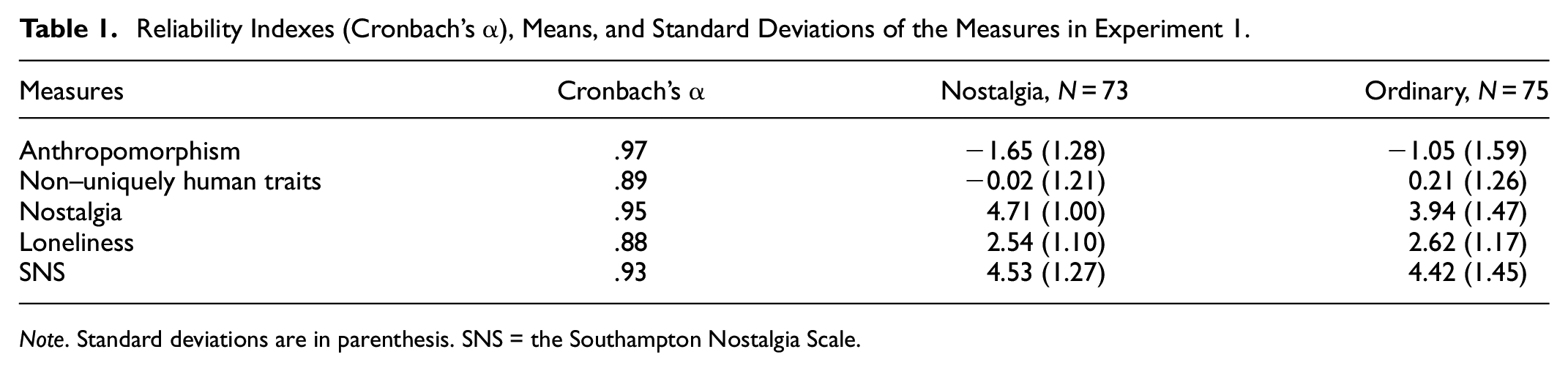
Note. Standard deviations are in parenthesis. SNS = the Southampton Nostalgia Scale.
Nostalgia Manipulation Check
To examine whether remembering nostalgic events evoked more nostalgia than remembering ordinary events and whether nostalgia proneness made a difference in evoking nostalgia, we conducted an analysis of covariance (ANCOVA) with nostalgia rating as the dependent variable, memory as the independent variable, and SNS score as a covariate. The assumption check indicated homogeneity of the regression slopes as the interaction term was not statistically significant, F(1,144) = 0.0001, p = 0.99. The participants who remembered the nostalgic event felt more nostalgic than those who recollected the ordinary event; F(1,145) = 14.2, p
To examine the content of the memories recalled by the participants, we extracted the most frequently used words by text mining the contents of their free descriptions. The top five most frequently used words in the nostalgia condition were “time,”“feel,”“happy,”“family,” and “back,” and in the ordinary condition were “none,”“day,”“feel,”“time,” and “just.” The text mining result file is uploaded as part of the supplementary materials.
Loneliness Rating
To examine whether remembering nostalgic events reduced loneliness more than remembering ordinary events and whether nostalgia proneness made a difference in loneliness, we conducted an ANCOVA with loneliness rating as the dependent variable, memory as the independent variable, and the SNS score as a covariate. The assumption check indicated homogeneity of the regression slopes as the interaction term was not statistically significant, F(1,144) = 0.0004, p = .98. The effect of memory retrieval on loneliness rating was not statistically significant, F(1,145) = 0.26, p = .61, η G 2 = .002 after adjustment for SNS score. The effect of the SNS score was significant, F(1,145) = 7.10, p = .009, η G 2 = .05, and this reveals that the higher the nostalgia proneness, the lower the loneliness, as in Zhou et al. (2008).
Nostalgic Memory and Anthropomorphism
The mean anthropomorphism score for the gadget task was lower for participants in the nostalgia condition than for those in the ordinary condition, t(146) = 2.52, p = .01, d = .42. There was no statistically significant differences in the scores between the nostalgia condition and the ordinary condition for non-uniquely human traits (filler item), t(146) = 1.13, p = .26, d = .19.
Research has demonstrated that nostalgia reduces loneliness (Zhou et al., 2008), and loneliness fosters anthropomorphism (Bartz et al., 2016; Epley et al., 2008). Therefore, we conducted a mediation analysis with memory retrieval (dummy coded: nostalgia = 1; ordinary = 0) and loneliness as predictors of anthropomorphism. The results demonstrated that the standardized regression coefficient between memory retrieval and anthropomorphism was statistically significant (β = −.59, p = .01). However, the standardized regression coefficient between memory retrieval and loneliness (β = −.07, p = .68) and loneliness and anthropomorphism (β = .12, p = .26) was not statistically significant. The standardized indirect effect was −.07 × .12 = −.009. We tested the significance of this indirect effect using bootstrapping procedures. The indirect effect was computed for 5,000 bootstrapped samples, and the 95% confidence interval was computed by determining the indirect effect at the 2.5th and 97.5th percentile, respectively. The bootstrapped standardized indirect effect was −.009, and the 95% confidence interval ranged from −.08 to .04. Thus, the indirect effect was not statistically significant.
Discussion
Results of Experiment 1 were partially consistent with the first hypothesis: Nostalgic memory attenuated the anthropomorphization of the unfamiliar target. We predicted that nostalgic memory might reduce loneliness, and that it could mediate the effect of nostalgia on anthropomorphism. However, we did not observe statistically significant effects of nostalgia on loneliness and a significant mediation effect. Furthermore, unlike the findings of previous studies (Bartz et al., 2016; Epley et al., 2008), loneliness did not increase anthropomorphism. A possible reason is that this study assessed the participants’ loneliness trait by asking how often they felt isolated from others, rather than evaluating their loneliness state. Furthermore, previous research induced a loneliness state and then tested the relationship between loneliness and anthropomorphism (Bartz et al., 2016).
The results of text mining indicated that participants in the nostalgia condition remembered close relationships such as family. These results are compatible with previous studies that demonstrated that nostalgic memory often involves close relationships and increases the sense of social connectedness (Wildschut et al., 2006; Zhou et al., 2008). Although it could not be measured with the loneliness scale used in this experiment, nostalgic memory might fulfill sociality motivation and attenuate anthropomorphism of unfamiliar gadgets.
Experiment 2
Experiment 2 was designed to test the second hypothesis. Studies established that when people remember nostalgic memory associated with a specific person, they feel that the person is socially close to them (Turner et al., 2012, 2018). Individuals also attribute more humanlike mental capacities to their close companion animals (Sevillano & Fiske, 2016). Experiment 2 examined whether retrieving a nostalgic memory with a specific target fostered the anthropomorphization of the target by increasing closeness to it.
We conducted a modified version of the Event Reflection Task (Turner et al., 2012, 2018), which asked participants to remember a nostalgic or ordinary memory with a target (trees or PCs). We also measured their closeness to the target using a modified version of the Inclusion of Other in the Self (IOS) Scale (Aron et al., 1992). Natural objects, technological objects, and animals are the most common anthropomorphism targets (Waytz et al., 2010). As people tend to attribute more humanlike traits to companion animals (Sevillano & Fiske, 2016), and the experience of having a pet is thought to influence strongly on animal anthropomorphism, we excluded animal targets and selected trees and PCs as everyday natural and technological target objects. Trees and PCs may differ in anthropomorphism scores, but there may be no variation in the effect of nostalgia on anthropomorphism in both targets. We tested whether remembering nostalgic memory of a specific target fosters anthropomorphism and psychological closeness of the target compared to ordinary memory, and whether nostalgia fosters anthropomorphism via increasing the closeness of the target.
Participants
This study was approved by the Ethics Committee of Faculty of Human Informatic, Aichi Shukutoku University. The sample size was determined by an a priori power analysis using G*Power 3 (Faul et al., 2007) to detect the expected differences in anthropomorphism rating among nostalgia-tree, nostalgia-PC, ordinary-tree, and ordinary-PC groups. When we supposed a medium effect size, f = 0.30, power of .80, and an alpha of .05 in a two-way factorial analysis of variance, N = 23 in each of the four groups, and a total sample size of N = 92 was required. We conducted an online experiment and recruited 116 English-speaking participants via the Crowd Flower crowdsourcing platform (https://www.crowdflower.com). Each participant received $1 and provided written informed consent. They were presented with the general informed consent and were asked to give their consent to participate by clicking either an “Agree” or “Disagree” button. We discarded data from 12 participants because they were non-native speakers of English, had participated in a similar experiment before, or did not complete the questionnaire. Data collected from the remaining 104 participants were analyzed (Mage = 37.7; SDage = 13.2; 57 females and 47 males).
Materials
Event Reflection Task
We used a modified version of the Event Reflection Task (Turner et al., 2012) and asked the participants to think of a nostalgic or ordinary event connected to their interaction with a tree or a PC. They noted down four keywords and then wrote an essay about the event.
Anthropomorphic Task
We modified the gadget task (Bartz et al., 2016; Epley et al., 2008) and asked the participants five questions (related to the anthropomorphic state) on the extent to which they felt the tree or the PC had “a mind of its own,”“intentions,”“free will,”“consciousness,” and “experienced emotions.” We also asked them questions related to three non-uniquely human traits, on the extent to which they found the tree or the PC “attractive,”“efficient,” and “strong.” The participants rated their responses on a seven-point scale (−3 = strongly disagree to 3 = strongly agree). The responses to the five questions related to the anthropomorphic state were averaged to form an anthropomorphism score. The questions on the three non-uniquely human traits were averaged to form a non-uniquely human trait score.
Closeness
We modified the IOS Scale (Aron et al., 1992) to measure the closeness between the participants and the targets. The participants indicated their relationship with the tree or the PC by selecting one of seven pairs of overlapping circles: the greater the overlap between the circles, the greater the closeness.
The measures for the nostalgia manipulation check, loneliness check, and nostalgia proneness (SNS) were the same as those used in Experiment 1.
Procedures
We used the Qualtrics platform (https://www.qualtrics.com) for stimulus presentation and data collection via the Internet. The participants were first presented with an informed consent page and then randomly assigned to the nostalgia-tree, nostalgia-PC, ordinary-tree, or ordinary-PC condition of the event reflection task; they answered the nostalgia manipulation check. Subsequently, they answered the anthropomorphism task, followed by the IOS task about the target that appeared in the event-reflection task. Then the participants answered questions on their loneliness rating, SNS, demographic status, whether they had any trouble while answering the questions, and whether they had concentrated on answering the questions.
Results
Table 2 illustrates the reliability indexes (Cronbach’s α), mean scores, and standard deviations of the measures used in experiment 2. Scales other than non-uniquely human traits (filler item) had Cronbach’s α reliability coefficients greater than .80, thus indicating that these measures were reliable.
Reliability Indexes (Cronbach’s α), Means, and Standard Deviations of the Measures in Experiment 2.

Note. Standard deviations are in parenthesis. IOS = the Inclusion of Other in the Self scale; SNS = the Southampton Nostalgia Scale.
Nostalgia Manipulation Check
We tested whether remembering nostalgic events evoked more nostalgia than recollecting ordinary events, and whether differences in target affect nostalgia. Nostalgia proneness might be a covariate with nostalgia. We conducted an ANCOVA with nostalgia rating as the dependent variable, memory and target as the independent variables, and the SNS score as a covariate. The assumption check indicated that there was homogeneity of the regression slopes as the interaction term was not statistically significant for memory × SNS, F(196) = 1.32, p = .25, target × SNS, F(1, 96) = 3.74, p = .06, and memory × target × SNS, F(1,96) = 0.04, p = .83. The results of the ANCOVA demonstrated that after adjusting the SNS score, the interaction between memory and target was not significant, F(1,99) = 1.14, p = .289, η
G
2 = .01, participants who remembered the nostalgic event felt more nostalgic than those who recollected the ordinary event F(1,99) = 14.1, p
To examine the content of the memories recalled by the participants, we extracted the most frequently used words by text mining the contents of their free descriptions. The top five most frequently used words extracted in the nostalgia-tree condition were “tree,”“house,”“time,”“remember,” and “see.” In the nostalgia-PC condition they were “one,”“computer,”“time,”“years,” and “first”; in the ordinary-tree condition they were “tree,”“trees,”“feel,”“yard,” and “good”; and in the ordinary-PC condition they were “computer,”“time,”“get,”“like,” and “and.” The text mining result file is uploaded as part of the supplementary materials.
Loneliness Rating
We tested whether remembering nostalgic events reduced loneliness more than remembering ordinary events and whether differences in the target affect loneliness. As in Experiment 1, nostalgia proneness might covariate with loneliness. We conducted an ANCOVA with loneliness rating as the dependent variable, memory and target as the independent variable, and the SNS score as a covariate. The assumption check indicated that there was homogeneity of the regression slopes as the interaction term was not statistically significant in memory × SNS, F(1, 96) = 3.46, p = .07, target × SNS, F(1, 96) = 1.07 p = .30, and memory × target × SNS, F(1, 96) = 0.03, p = .87. The results of the ANCOVA demonstrated that after adjustment for the SNS score there were no significant interaction, F(1, 99) = 1.66, p = .20, η
G
2 = .02; no effect of memory F(1, 99) = 0.01, p = .93, η
G
2
IOS Rating
A two-way analysis of variance (ANOVA) was conducted with the IOS rating as the dependent variable and memory and target as the independent variables to test the effect of nostalgic memory and the possible effect of targets on psychological closeness. The participants rated higher scores in the nostalgia condition than the ordinary condition, F(1, 100) = 9.06, p = .003, η
G
2 = .08, and in the condition pertaining to the tree than the PC, F(1, 100) = 5.24, p = .02, η
G
2 = .05, while the interaction between memory and the target was not significant, F(1, 100) = 0.27, p = .61, η
G
2
Nostalgic Memory and Anthropomorphism
A two-way ANOVA was conducted with anthropomorphism rating as the dependent variable and memory and target as the independent variables to test the effect of nostalgic memory and the possible effect of targets on anthropomorphism. In the anthropomorphism ratings, the participants rated higher scores in the nostalgia condition than the ordinary condition, F(1, 100) = 8.00, p = .006, η
G
2 = .07, and in the condition pertaining to the tree than the PC, F(1, 100) = 8.19, p = .005, η
G
2 = .08, while the interaction between memory and the target was not significant, F(1, 100) = 0.25, p = .27, η
G
2 = .01. In the ratings pertaining to the non-uniquely-human traits (filler item), the participants gave higher scores to the condition pertaining to the tree than the PC, F(1, 100) = 10.89, p = .001, η
G
2 = .10, while there was no significant effect of memory, F(1, 100) = 1.49, p = .22, η
G
2 = .01, and the interaction between memory and the target, F(1, 100) = 0.38, p = .54, η
G
2
To test whether the effect of nostalgic memory on anthropomorphism was mediated by psychological closeness, we conducted a mediation analysis with memory retrieval (dummy coded: nostalgia = 1; ordinary = 0) and closeness (IOS scores) as predictors of anthropomorphism. The results demonstrated that the standardized regression coefficient between memory retrieval and anthropomorphism was statistically significant, β = .62, p = .04. The standardized regression coefficient between memory retrieval and IOS, β = 90, p = .002, as well as IOS and anthropomorphism, β = .19, p = .05, was also statistically significant. The standardized indirect effect was .90 × .19 = .17. We tested the significance of this indirect effect using bootstrapping procedures. The indirect effect was computed for 5,000 bootstrapped samples, and the 95% confidence interval was computed by determining the indirect effect at the 2.5th and 97.5th percentiles. The bootstrapped unstandardized indirect effect was .17, and the 95% confidence interval ranged from −.03 to .42. Thus, the indirect effect was not statistically significant.
To examine an alternative mediation model, we conducted a mediation analysis of a model in which nostalgia promotes psychological closeness through the facilitation of anthropomorphism. The results demonstrated that the standardized regression coefficient between memory retrieval and anthropomorphism was statistically significant, β = .79, p = .008. The standardized regression coefficients between memory retrieval and IOS, β = .76, p = .012, as well as anthropomorphism and IOS, β = .19, p = .05, were also statistically significant. The standardized indirect effect was .79 × .19 = .15, and we tested the significance of this indirect effect using bootstrapping procedures. The indirect effect was computed for 5,000 bootstrapped samples, and the 95% confidence interval was computed by determining the indirect effect at the 2.5th and 97.5th percentiles. The bootstrapped unstandardized indirect effect was .15, and the 95% confidence interval ranged from −.02 to .40. Thus, the indirect effect was not statistically significant. As our mediation models were saturated, we did not compare model fit indexes.
Discussion
Our findings were partially consistent with the second hypothesis: Nostalgic memory about a target fosters the anthropomorphization of the target and increases psychological closeness to the target. Meanwhile, the mediated effect of nostalgia on anthropomorphism via closeness was not statistically significant. A possible explanation for the direct effect of nostalgia on anthropomorphism is that nostalgia is a complex secondary emotion, and secondary emotions are perceived as a uniquely human trait (Demoulin et al., 2004). People might attribute their nostalgic feelings to non-human targets and perceive the target as having secondary emotions as in the case of humans.
We found that nostalgic memory with the specific target prompted psychological closeness to the target. Turner et al. (2012) indicated that nostalgic memories with other people increase the self’s closeness with those people. In addition, research has demonstrated that people feel more connected to nostalgic brands (Kessous et al., 2015). The results from Experiment 2 support these studies by confirming that nostalgic memory with the target prompted psychological closeness with it, even though it was a non-human object. A central feature of nostalgia is social relationships (Hepper et al., 2012; Leyens et al., 2007); thus, people might feel a psychological closeness to a non-human target and other people.
Experiment 2 also demonstrated that psychological closeness to a target positively related to the target’s anthropomorphism. Because both mediation models in this experiment were saturated models, it was unclear whether psychological closeness promotes anthropomorphism or whether anthropomorphism enhances psychological closeness. However, studies have affirmed that people attribute unique human traits, such as feeling secondary emotions, to close in-group members (e.g., Leyens et al., 2007). There is the possibility that a psychologically close target is perceived as having more humanlike mental capacities, even if it is non-human.
Experiment 2 generated several unpredicted results. First, we found that participants felt more nostalgia, psychological closeness, and anthropomorphism with trees than PCs. Trees might be connected to childhood memories to a larger degree than PCs, thus making it easier to recall nostalgic memories related to them. It is also possible that trees are more easily anthropomorphized because they are natural and alive, unlike PCs. As in Experiment 1, nostalgia did not affect loneliness. This result might be because the questions were not about the loneliness state but on loneliness traits.
General Discussion
This study examined the effect of nostalgia on anthropomorphism and clarified whether nostalgia affects anthropomorphism via a sense of being socially connected. The results revealed two new findings on the relationship between nostalgia and anthropomorphism. First, the recollection of a nostalgic memory attenuated the anthropomorphization of the unfamiliar gadget unrelated to the nostalgic memory. Second, remembering a nostalgic memory about a target fostered the anthropomorphization of the target and enhanced psychological closeness to the target. These results indicate that the effect of nostalgic memory retrieval on anthropomorphism depends on whether the nostalgic memory involves the target. Therefore, it is not the nostalgic memory per se but the nostalgic memory of the target that is essential for perceiving humanlike traits in it.
Experiment 1 affirmed that nostalgia caused reverse-anthropomorphism of the target that was unrelated to the nostalgic memory. Nostalgic memory prompts feeling socially connected (Zhou et al., 2008), and when sociality motivation is satisfied, dehumanization and reverse-anthropomorphism are manifested (Bartz et al., 2016; Waytz & Epley, 2012). Although we did not obtain direct evidence that nostalgia satisfies social connectedness, several participants in Experiment 1 described close relationships such as family in their nostalgic memories. Such memories may have satisfied the sociality motivation and reduced the need for humanization. Research established that collective nostalgia for old societies and nations related to feelings of belonging to an in-group and negative attitude toward an out-group (Cheung et al., 2017; Smeekes, 2015). The results of our study suggest that nostalgia’s function of making us feel socially connected may, in turn, give rise to dehumanization or reverse-anthropomorphism of targets that do not relate to nostalgic memory. This situation may, in some cases, lead to a negative attitude.
Experiment 2 demonstrated that nostalgic memory of a specific target promotes anthropomorphism of the target and enhances psychological closeness to the target. However, it was not clear whether nostalgia fosters anthropomorphism through psychological closeness. A possible reason for nostalgia promoting anthropomorphism is that it may attribute a complex, human-specific secondary emotion, nostalgia, to the target. The effect of nostalgia on psychological closeness has been demonstrated regarding nostalgic memories of human targets (Turner et al., 2012, 2018), and our study demonstrated that this effect could be extended to non-human targets. Experiment 2 also revealed the positive relationship between psychological closeness and anthropomorphism.
This study had three limitations. The first limitation is regarding the cultural differences. Most studies on nostalgia or anthropomorphism have been conducted with Western participants. In this study, we referred to the findings of previous studies based on such Western participants; therefore, we recruited participants from the US. However, there were cultural differences in cognition and social judgments (Henrich et al., 2010), and the possibility of cultural differences in anthropomorphism has been pointed out (Epley et al., 2007). For example, because the boundary between humans and machines/nature is more ambiguous among Japanese people (Jensen & Blok, 2013), we can infer that Japanese people may feel that non-human targets are more closely related to them, and nostalgia may cause stronger anthropomorphization. Whether the findings of this study apply to participants from non-Western countries is a subject for future research.
The second limitation is that this study deals with the humanization of non-human targets, and it is unclear whether the findings also apply to the humanization of human targets. Social connectedness affects dehumanization toward out-group persons and reverse-anthropomorphism toward unfamiliar gadgets (Bartz et al., 2016; Waytz & Epley, 2012); subsequently, there may be common processes in attributing humanlike mental capacities to both humans and non-humans. Further research is needed to examine the influence of nostalgia on humanization/dehumanization from the perspective of both human and non-human targets.
The third limitation is that this study failed to clarify what mediates the influence of nostalgia on anthropomorphism. To verify whether nostalgia affects anthropomorphism via sociality motivation, it was necessary to use different measures of social connectedness, such as measuring loneliness status. In addition, although psychological closeness and anthropomorphism were found to have a positive relationship, it is also necessary to determine whether closeness is the cause of anthropomorphism or vice versa.
A possible implication of this study is that nostalgia may be a facilitator or inhibitor of prosocial behaviors toward non-human targets via a humanization. Both nostalgia and anthropomorphism have been shown to lead to prosocial behaviors. In a study where the targets were human beings, remembering the most nostalgic event in one’s life enhanced prosocial behaviors via increased empathy toward those in need (Zhou et al., 2012). Anthropomorphizing nature has increased social connectedness to nature and fostered conservation behaviors (Tam et al., 2013). Conversely, dehumanization and reverse-anthropomorphism decreased prosocial behaviors toward the target. Our results implied that nostalgic memory might increase the sense of social closeness, and the relation between an episode of nostalgic memory and a target may affect how people perceive the target’s humanness, which may affect prosocial attitudes toward the target.
This study reveals a new social function of nostalgia: its influence on humanization. The findings demonstrate that whether nostalgia causes anthropomorphism or reverse-anthropomorphism varies by including non-human targets in the nostalgic memory. However, whether these effects of nostalgia are mediated by sociality motivation, whether they apply to humans, or whether they lead to prosociality needs to be examined in the future. Nostalgia is a complex, secondary, and unique human emotion. Therefore, it is important to consider both the positive and negative effects of nostalgia on the act of perceiving others and people’s attitudes toward non-human targets.
Supplemental Material
sj-docx-1-sgo-10.1177_21582440231220492 – Supplemental material for Effect of Nostalgic Memory Retrieval on Anthropomorphism
Supplemental material, sj-docx-1-sgo-10.1177_21582440231220492 for Effect of Nostalgic Memory Retrieval on Anthropomorphism by Hiroko Nakamura and Jun Kawaguchi in SAGE Open
Supplemental Material
sj-docx-2-sgo-10.1177_21582440231220492 – Supplemental material for Effect of Nostalgic Memory Retrieval on Anthropomorphism
Supplemental material, sj-docx-2-sgo-10.1177_21582440231220492 for Effect of Nostalgic Memory Retrieval on Anthropomorphism by Hiroko Nakamura and Jun Kawaguchi in SAGE Open
Supplemental Material
sj-docx-3-sgo-10.1177_21582440231220492 – Supplemental material for Effect of Nostalgic Memory Retrieval on Anthropomorphism
Supplemental material, sj-docx-3-sgo-10.1177_21582440231220492 for Effect of Nostalgic Memory Retrieval on Anthropomorphism by Hiroko Nakamura and Jun Kawaguchi in SAGE Open
Supplemental Material
sj-docx-4-sgo-10.1177_21582440231220492 – Supplemental material for Effect of Nostalgic Memory Retrieval on Anthropomorphism
Supplemental material, sj-docx-4-sgo-10.1177_21582440231220492 for Effect of Nostalgic Memory Retrieval on Anthropomorphism by Hiroko Nakamura and Jun Kawaguchi in SAGE Open
Supplemental Material
sj-R-6-sgo-10.1177_21582440231220492 – Supplemental material for Effect of Nostalgic Memory Retrieval on Anthropomorphism
Supplemental material, sj-R-6-sgo-10.1177_21582440231220492 for Effect of Nostalgic Memory Retrieval on Anthropomorphism by Hiroko Nakamura and Jun Kawaguchi in SAGE Open
Supplemental Material
sj-xlsx-5-sgo-10.1177_21582440231220492 – Supplemental material for Effect of Nostalgic Memory Retrieval on Anthropomorphism
Supplemental material, sj-xlsx-5-sgo-10.1177_21582440231220492 for Effect of Nostalgic Memory Retrieval on Anthropomorphism by Hiroko Nakamura and Jun Kawaguchi in SAGE Open
Footnotes
Declaration of Conflicting Interests
The author(s) declared no potential conflicts of interest with respect to the research, authorship, and/or publication of this article.
Funding
The author(s) disclosed receipt of the following financial support for the research, authorship, and/or publication of this article: This work was funded by JSPS KAKENHI [Grant Numbers 18K18692, 19K03271 and 21KK0042] and Aichi Shukutoku University Research Grant 19TT03.

Supplemental Material
Supplemental material for this article is available online.
References
Supplementary Material
Please find the following supplemental material available below.
For Open Access articles published under a Creative Commons License, all supplemental material carries the same license as the article it is associated with.
For non-Open Access articles published, all supplemental material carries a non-exclusive license, and permission requests for re-use of supplemental material or any part of supplemental material shall be sent directly to the copyright owner as specified in the copyright notice associated with the article.
