




Abstract
The sustainable development of scenic spots have attracted much attention in academic circles, and the influence mechanism of anthropomorphic information framework to guide tourists to enhance environmental responsibility behavior is not clear. Based on the framework theory and prospect theory, the study constructed a theoretical model of anthropomorphic information framework acting on environmental responsibility behavior. The results of three experimental studies showed that: (1) The anthropomorphic information framework could significantly improve tourists’ environmental responsibility behavior, and compared with the positive anthropomorphic information framework, the negative anthropomorphic information framework can significantly improve tourists’ environmental responsibility behavior. (2) Natural empathy played an intermediary role between anthropomorphic information framework and tourists’ environmental responsibility behavior. (3) Self-construal moderated the relationship between anthropomorphic information framework and tourists’ environmental responsibility behavior. Among the interdependent tourists, compared with the positive anthropomorphic information framework, the negative anthropomorphic information framework was more likely to produce stronger environmental responsibility behavior and natural empathy. Among independent tourists, tourists’ environmental responsibility behavior and natural empathy generated by negative anthropomorphic information and positive anthropomorphic information were not significant. Through the above findings, we hope to improve the management level of tourist attractions.
Keywords
Introduction
“For Life on Earth - Save Our Seas” was the theme for World Environment Day 1998; In 2009, the United Nations General Assembly declared that 22 April is International Mother Earth Day; “As a result, the earth has a fever.” Al Gore in his Nobel Lecture thus likened the current condition of nature to a human ailment; Similarly, slogans such as “protecting mother river” that China has been crying for all along. The above-mentioned slogans, without exception, employ the anthropomorphic strategy—anthropomorphization refers to giving human characteristics, motivation, intention, or psychological state to non-human objects (Epley et al., 2007). This strategy has been very popular in the field of environmental protection, but can it really affect individual environmental responsibility behavior (abbreviated as ERB)? Few scholars explore the effect of anthropomorphic slogans on ERB from a theoretical perspective. Only Tam et al. (2013) have done sporadic studies showing that anthropomorphization may promote individual protective behavior. However, there is no literature discussing the relationship between anthropomorphic slogans and tourists’ ERB. With the rapid development of tourism based on scenic spots, the uncivilized behavior of tourists has increased explosively. Spitting, trampling lawn and littering have appeared in scenic spots (Li & Chen, 2021). A few scenic spots began to try anthropomorphic slogans to remind tourists to practice civilized behavior, such as the lawn slogan: “I am very shy, please don’t touch me!.” It is particularly important to explore the effect of anthropomorphic slogans on tourists’ ERB and its mechanism.
Throughout the studies of ERB, most scholars explored the factors affecting ERB from different perspectives, it can be generalized as social basic factors, such as gender (Wu et al., 2013), External situational factors, such as law (Iskra et al., 2004), and internal factors, such as environmental knowledge (Suet al., 2020). Schultz et al. (2005) pointed out that values was an important factor in environmental responsibility behavior; Onwezen et al. (2013) used normative activation theory to explore the role of expected pride and guilt in pro-environmental behavior; Ajzen (2002) successively proposed the theory of rational behavior and the theory of planned behavior. Under the assumption that tourists are rational people, attitudes, supervisor norms and perceived behavioral control are the most important factors affecting behavioral intentions (Ajzen, 2002). These scholars constitute a model based on rational choice that dominates the interpretation of behavior. As Richard H. Thaler, the father of behavioral economics, said: “individuals often rely on intuition to solve problems.” With the deepening of research, scholars realized that irrational factors were factors that cannot be ignored in explaining individual behavior, and anthropomorph is one of them. anthropomorphization persuading individual behavior is widely used in the field of consumer behavior research, few scholars discuss the effect of anthropomorphization on tourists’ ERB. Framework effect originally appeared in interpersonal communication, mapping bounded rationality (Kahneman, 2003), pointing out the influence of preference on individual risk decision behavior (Tversky & Kahneman, 1981), And as SEEK theory, the motivation to induce anthropomorphization may be social communication (Epley et al., 2007), So does it exist framework effect in anthropomorphization? The study is discussed from this perspective.
To sum up, the study explores the relationship between anthropomorphism and tourists’ ERB through scenario experiments, and tries to answer:
(1) Can anthropomorphic slogan really awaken tourists’ ERB?
(2) Is there an information framework effect in the process of anthropomorphization?
The above two issues are discussed to promote the improvement of environmental responsibility behavior theory and the sustainable development of tourist attractions.
Literature Overview
Information Framework Effect
The information framework effect was first proposed by Kahneman and Tversky, who believed that the same information can be conveyed to the audience in different information frameworks, and different information frameworks have different effects on the audience (Tversky & Kahneman, 1981). Usually, information framework can be divided into profit information (positive information) and loss information (negative information) according to the interest orientation of information description. Positive information framework refers to the positive role, attribute and return of a thing or behavior, while negative information framework emphasizes the negative role and potential risk of a thing or behavior (Chong & Druckman, 2007). Information framework refers to the means or methods of information presentation, which is also considered to be one of the strategies that affect the audience’s perception of information. Information framework effect has been widely used in marketing (Zhou et al., 2021), sociology (Chang & Lee, 2009) and other fields. However, scholars’ conclusions on persuasive behavior of profit information frame and loss information frame in different scenarios are inconsistent. In summary, the information framework effect is situational, and it is necessary to discuss the anthropomorphic slogans in scenic spots to improve tourists’ ERB.
Anthropomorphic Slogans and ERB
The term “anthropomorphization,” derived from the combination of “Anthropos” (human) and “morphe” (shape or form) in Greek, refers to the assignment of human identity, motivation, intention or mental state to non-human objects (Epley et al., 2007), In terms of content, scholars began to discuss the anthropomorphization of animals (Franklin et al., 2013), the anthropomorphization of machines (Waytz et al., 2010) and the anthropomorphization of brands and products (Puzakova et al., 2013). Although the content is not the same, but its core mostly discusses the persuasiveness of anthropomorphic information on individual behavior, including consumer purchase behavior (Tong et al., 2020), social donation behavior (Miyazaki, 2017), and environmental protection behavior of tourists (Tam, 2013). Aggarwal & McGill (2007) studies suggest that anthropomorphic products, such as facial expressions in cars, can inspire positive reviews; Hee found that Anthropomorphization used in social welfare causes individuals to become more guilty and to comply with social norms (Ahn et al., 2014).
When individuals anthropomorphize non-human objects, it establishes an emotional connection, thereby enhancing information persuasion and facilitating perceptual communication (Tam, 2019). According to the social cognitive chain of being, the status of everything in the world determines how to be treated by others (Brandt & Reyna, 2011), Eplay et al. (2007) pointed out that when human beings regard non-human individuals as moral subjects worthy of care and respect, they further believe that human beings have the same identity with these non-human objects, and recognize their rights, thereby triggering pro-environmental behaviors and enhancing their environmental responsibility behaviors. According to the extended conclusion of the prospect theory, most people are more sensitive to loss than to income, resulting in different behaviors and attitudes. Accordingly, individuals are more sensitive to negative anthropomorphic information than to positive anthropomorphic information. The negative anthropomorphic information will make individuals more likely to feel the similarity between people and the environment, and further pull into the social distance between human subjects and the environment, that is, the individual’s perceived psychological distance. According to the level of interpretation theory, the closer the psychological distance is, the more deeply people will feel the specific situation of environmental infringement, and then the more easily they will implement ERB. Therefore, we speculate that the ability of negative anthropomorphic information framework to persuade tourists to implement ERB is stronger than that of positive anthropomorphic information framework. Therefore, this study puts forward the hypothesis:
H1: The anthropomorphic information framework can enhance tourists’ ERB. Compared with the positive anthropomorphic information framework, tourists stimulated by the negative anthropomorphic information framework have stronger ERB.
Anthropomorphic Slogans and Natural Empathy
The earliest author of empathy, Rogers, the founder of humanism, is considered the innate nature of animals. Empathy with nature is Tam’s (2019) extension to the relationship between man and nature on the basis of empathy, which specifically refers to people’s emotional experience of feeling and sharing the natural world, especially the experience in emotions include positive and negative aspects. In Berenguer’s (1969) study, he found that individuals had a high degree of empathy with nature, and their environmental attitudes were more active. They are more willing to take pro-environmental behavior and engage in substantive environmental activities. Royzman & Kumar (2001) confirmed that humans tended to have natural empathy for negative emotions. Batson et al. (1991) proposed the “empathy-altruism hypothesis,” refers to individuals will have altruistic behavior motivation due to the role of empathy when others encounter misfortune. Batson et al. (1991) proved that negative emotions tend to stimulate empathy more, resulting in a series of altruistic behaviors. Therefore, we speculate that anthropomorphic slogans enhance tourists’ natural empathy, and natural empathy further promotes tourists to wake up ERB. In this process, negative anthropomorphic slogans may make tourists have stronger natural empathy and thus stronger ERB.
Therefore, the study puts forward the hypothesis:
H2a: anthropomorphic information framework can positively affect tourists’ natural empathy. Compared with the positive anthropomorphic information framework, tourists stimulated by the negative anthropomorphic information framework have stronger natural empathy.
H2b: Tourists’ natural empathy can positively affect ERB.
H2c: In H1’s influence path, natural empathy plays a mediating role, that is, the negative anthropomorphic information framework can stimulate stronger ERB from its ability to generate stronger natural empathy for the audience.
Self-construal
Self-construal constructs two different types. According to the degree of independence or connection between self and others: independent self-construal type and interdependent self-construal type (Markus & Kitayama, 1991). Markus pointed out that the former focuses on their own uniqueness and pursues individual independence, and the self-representation associated with it involves personal traits, abilities, and preferences. The latter pays attention to the connection between themselves and others, and desires to obtain good interpersonal relationships. Their self-representation is mostly based on interpersonal communication. The independent self-construal type is more self-centered in decision-making, which is a self-interest oriented decision-making tendency. The type of interdependent self-construal considers the relationship between society and individuals (Markus & Kitayama, 1991). It not only focuses on “individuals,” but also pays more attention to “society,” which is altruistic decision-making tendency (Cross & Madson, 1997). Research showed that all individuals have two self-construal elements that can be temporarily activated (Gardner et al., 1999). Scholars have pointed out that altruism values predict environmental behavior more significantly than egoism values. Self-dependence shows strong natural connection (Zhang, Zhang et al., 2014). From altruistic perspective, environmental behavior can be made by restraining self-interest when dealing with conflict between self-interest and environmental behavior choice (Zhang, Wang et al., 2014). Compared with interdependent self-construal, independent self-construal is dominated by self-interest, which is related to their own feelings. When dealing with conflicts between their own interests and environmental behavior choices, they often give priority to their own interests.
Therefore, this study assumes that:
H3a: Among interdependent self-construal tourists, negative anthropomorphic information framing produce more natural empathy than positive anthropomorphic information framing.
H3b: In independent self-construal tourists, the natural empathy generated by the negative anthropomorphic information framework and the positive anthropomorphic information framework is not significant.
H3c: In interdependent self-construal tourists, compared with positive anthropomorphic information, negative anthropomorphic information can produce stronger ERB.
H3d: In the independent self-construal tourists, the environmental responsibility generated by negative anthropomorphic information and positive anthropomorphic information are not significant.
Materials and Methods
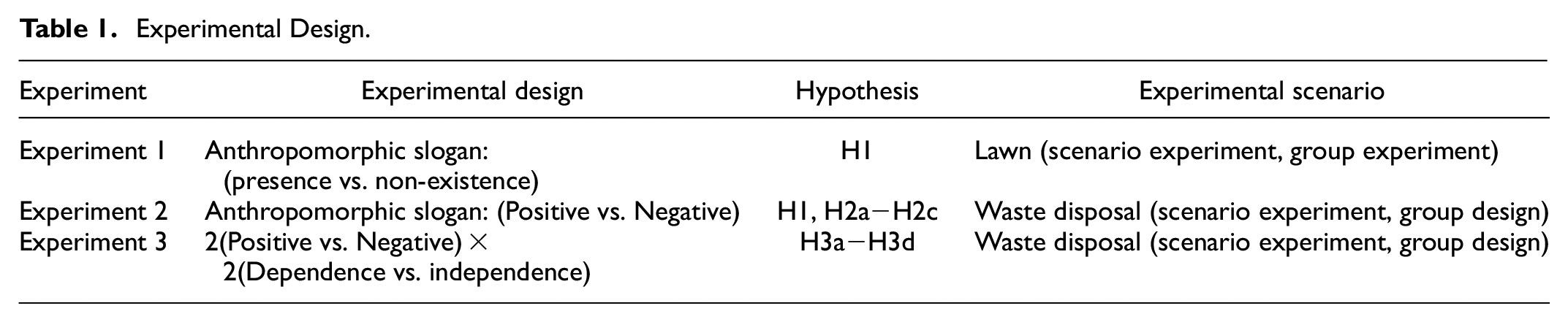
To better explore the information framework effect of anthropomorphic slogans on ERB, three situational experiments were designed. Figure 1 illustrates the hypotheses of this study. According to the prior research, there are subdivision behaviors of environmental responsibility behaviors, such as recycling behavior and energy saving behavior (Osbaldiston & Schott, 2012). To increase the external validity of the scenario experiment and improve the accuracy of the experiment, in the three sub-experiments, Experiment 1 set the scenario as “lawn,” and Experiment 2 and Experiment 3 set the scenario as “garbage disposal.” Please see Table 1 for details.

Theoretical framework.
Experimental Design.
Experiment 1: Effects of Anthropomorphic Information Framework on Tourists’ Trampling on Lawn
Experiment 1 adopted a single factor (anthropomorphization vs. non-anthropomorphization) between-group design. The purpose of the experiment was to test the influence of anthropomorphic information framework on tourists’ ERB. To test the effectiveness of experimental material manipulation, a pre-experiment was conducted before the formal experiment.
Pre-experiment
In the process of pre-experiment, the study used the “picture + text” combination to manipulate the subjects. By requiring the subjects to watch the pictures and read the corresponding text information, the subjects were brought into the experimental situation to complete the test. First, this study screened one anthropomorphic photo and one non-anthropomorphic photo. On the manipulation of anthropomorphic language, using the methods of Aggarwal & McGill (2007), the first person and informal language are used to manipulate anthropomorphic language. In terms of non-anthropomorphic language manipulation, the third person and formal language are used to manipulate non-anthropomorphic language. The above pictures were combined with language to form the independent variable manipulation materials of the experimental group and the control group. The subjects will be introduced into the scene, the introduction is: “On holiday, I came to Fuzhou M scenic area to play, scenic beauty. Currently, I need to go to the sales department to buy a bottle of water, and there are the following two paths to the sales department. Line 1 is the walkway of the scenic area (expected to take 8 minutes), and Line 2 is through the lawn, reaching directly (expected to take 4 minutes). When I was about to choose, I met an image tag.” The anthropomorphic group: “A cartoon lawn picture with big eyes, and equipped with text: Hi, I am Xiaomei. Please my friends do not step on me, I will also hurt.” Non-anthropomorphic group: “A warning sign picture with words: it has lush green grass, beautifying the environment, and clearing the air. Please do not trample the lawn.” Subsequently, 30 college students from a university in Fuzhou were recruited and randomly divided into the experimental group (14) and the control group (16), and then the materials were scored. The anthropomorphic scale draws on the items of Kim and McGill (2011), which are: I feel the image is similar to people, I feel the image has its own will and so on (α = .834). After independent sample t test, there are significant differences in the scores of anthropomorphic items between anthropomorphic group (A.G.) and non-anthropomorphic group (N.A.G.) (MA.G. = 5.837, MN.A.G. = 2.127, t = 11.375, p < .05). The above items were measured by Likert 7-point measurement method (1 very disagree, 7 very agree). The manipulation of experimental materials on independent variables is successful, and formal experimental studies can be carried out on this basis.
Formal experiment
The formal experimental procedure of Experiment 1 is consistent with the pre-experiment. One hundred forty full-time college students from a university in Fuzhou were invited to participate in the experiment (male = 47%,and female = 53%). The subjects were randomly divided into two groups. A A.G. and BN.A.G., each group to watch the corresponding stimulus materials. After watching and reading, two groups of subjects were asked to answer the following questionnaire based on the feelings after watching and reading. (1) The anthropomorphic information frame measurement item was consistent with the pre-experimental test process (α = .801). (2) ERB items, such as “ I will not make trampling the lawn of tourist attractions,” “I will stop others trampling the lawn” and other four items (α = .835). (3) Demographic characteristics, such as gender, age, education, and other data. Through data screening, 16 invalid questionnaires were excluded, and 124 valid questionnaires were left. The effective rate was 88.5%. There were 60 males and 64 females, with an average age of 23.15 years old. The educational background was mainly distributed in undergraduate (70%) and postgraduate (30%). AA.G. and BN.A.G. item scores were significantly different (MA.G. = 6.437, MN.A.G. = 2.302, t = 13.15 p < .05), the manipulation was successful and effective.
Experiment 2: Effects of Different Types of Anthropomorphic Information Frameworks on Tourists “Garbage Classification Behavior”
Experiment 2 used a single factor (positive anthropomorphization vs. negative anthropomorphization vs. non-anthropomorphism) between-group design, the purpose of the experiment was to test the impact of different types of anthropomorphic information framework on tourists’ ERB (test H1) and the mediating effect of natural empathy (test H2a, H2b, H2c). In order to test the effectiveness of experimental material manipulation, pre-experiment was conducted before the formal experiment.
Pre-experiment
Like the stimulus material in Experiment 1, the study used the “picture + text” combination to personify the subjects. By requiring the subjects to watch the picture and read the corresponding text information, the subjects were brought into the experimental situation to complete the test. First, this study screened one photo reflecting “positive anthropomorphization,” “negative anthropomorphization” and “non-anthropomorphization,” and the anthropomorphic language manipulation was consistent with Experiment 1. In order to highlight the information frame effect in the field of environmental protection, the language prompt of Schneider’s et al. (2001) “information frame effect in the field of smoking” is used for reference, and health is taken as a reference point. The above pictures were combined with language to form the independent variable manipulation materials of the experimental group and the control group. The subjects will be introduced into the scene, the introduction is: “On holiday, I came to Fuzhou M scenic area to play, scenic beauty. At this time, I need to throw the finished plastic bottle into the garbage, there are the following two kinds of garbage can throw garbage, garbage bin 1 is attached to the recyclable garbage bin, garbage bin 2 is attached to the irrecoverable garbage bin. When I was about to choose, I met an image tag.” Among them, positive anthropomorphic group: “Paste with a large mouth cartoon version of happy trash picture, and with text: Hi, I am Xiaomei. Ask my friend to deliver the correct food to me! So, I will become healthy.” Negative anthropomorphic group: “Sad garbage can picture with mouthless cartoon version, and with text: Hi, I am Xiaomei. Please don’t send the wrong food to my mouth! Otherwise, I will become unhealthy.” Non-anthropomorphic group: “paste a warning sign picture, and with text: To make garbage into treasure, classification and recycling cannot be less, please correctly classify garbage discarded.” Subsequently, 45 college students in a university in Fuzhou were recruited and divided into three groups, with 15 students in the positive anthropomorphic group (P.A.G.), 15 students in the negative anthropomorphic group (N.E.A.G.) and 15 students in the non-anthropomorphic group (N.A.G.). The scoring of materials required participants to score the above anthropomorphic information framework combination. First, the manipulation of information framework was tested: the measurement items were divided into positive and negative dimensions: “I felt (not) the implementation of garbage classification action would have a sense of gain (loss),” “I felt that the garbage classification publicity contained positive (negative) significance.” Through independent sample t test, in the positive anthropomorphic group, the positive dimension score was significantly higher than the negative dimension score (MP.A.G. = 6.335, MN.E.A.G. = 3.103, t = 4.503, p < .05). In the negative anthropomorphic group, the negative dimension score was significantly higher than the positive dimension score (MN.E.A.G. = 5.436, MP.A.G. = 3.557, t = 5.835, p < .05). The information framework was successfully manipulated in the above experiments. Secondly, the anthropomorphic manipulation was tested. This step was consistent with the above experiment 1. The samples of the positive anthropomorphic group and the negative anthropomorphic group were integrated, and the independent sample t test showed that the anthropomorphic measurement item score of the anthropomorphic group was significantly higher than that of the non-anthropomorphic group (MA.G. = 5.487, MN.A.G. = 3.668, t = 8. 05, p < .01). The anthropomorphic manipulation was successful in the experiment. The above items were measured by Likert 7-point measurement method (1 very disagree, 7 very agree). The successful manipulation of experimental materials on independent variables can be carried out on this basis.
Formal experiment
The formal experimental procedure of experiment 2 is consistent with the pre-experiment. One hundred fifty full-time college students from a university in Fuzhou were invited to participate in the experiment (male = 49.31%,and female = 50.69%). The subjects were randomly divided into three groups. Among them, 50 were negative anthropomorphic group (N.E.A.G.), 50 were positive anthropomorphic group (P.A.G.) and 50 were non-anthropomorphic group (N.A.G). Each group watched the corresponding stimulus materials. After watching and reading, both groups asked to answer the following questionnaire based on the feelings after watching and reading. (1) The anthropomorphic information framework measurement item, which is consistent with the pre-experimental verification process (α = .801), (2) Natural empathy measurement items, referring to Berengurer’s (1969) research results, including “after browsing the above information, I can feel the feeling of the trash in the information” and other four items (α = .894). (3) Garbage classification behavior measurement items, reference to research results such as Ning (Hui & Chung, 2015), Including “I tend to accept garbage classification propaganda content,” “I am willing to garbage classification” and other four items (α = .901). (4) demographic characteristics, such as gender, age, education, and other data. In this experiment, through data screening, 23 invalid questionnaires were excluded, and 127 valid questionnaires were left, with an effective rate of 84.6%. There were 61 males and 66 females, with an average age of 22.56 years old. The educational background was mainly distributed in undergraduate education (63%) and above (37%). Using independent sample t test, the scores of anthropomorphic items in the first anthropomorphic group (negative anthropomorphic group and positive anthropomorphic group) were significantly higher than those in the non-anthropomorphic group (MA.G. = 5.493, MN.A.G. = 3.071, t = 5.383, p < .01). Secondly, in the positive anthropomorphic group, the positive dimension score was significantly higher than the negative dimension score (MP.A.G. = 5.834, MN.E.A.G. = 3.596, t = 5.338, p < .05). In the negative anthropomorphic group, the negative dimension score was significantly higher than the positive dimension score (MN.E.A.G. = 5.883, MP.A.G. = 3.563, t = 4.457, p < .05). The manipulation is effective.
Experiment 3: The Moderating Effect of Self-Construal
Experiment 3 adopted a 2 (positive anthropomorphization vs. negative anthropomorphization) × 2 (interdependent self-construal vs. independent self-construal) within-group mixed design. All subjects were randomly assigned to four groups (positive anthropomorphization × interdependent self-construal, positive anthropomorphization × independent self-construal, negative anthropomorphization × interdependent self-construal, negative anthropomorphism × independent self -construction). The purpose of the experiment was to test the moderating effect of self-construal on tourists’ ERB (i.e., test H3a, H3b, H3c, H3d). To test the effectiveness of experimental material manipulation, pre-experiment was conducted before the formal experiment.
Pre-experiment
In order to ensure the effective manipulation of self-construal, pre-experiment was conducted before the formal experiment. The scene of the experiment was consistent with experiment 2, and then 33 college students (42.4% male) were recruited from a university in Fuzhou. They were randomly divided into interdependent self-construal type group (16 people) and independent self-construal type group (17 people). Subjects were asked to read self-construal stimulus materials and refer to Trainfimow’s practice. The independent self-construal type (interdependent self-construal type) instruction was “think about your expectations for yourself”(think about your family and friends’ expectations for yourself). Subjects were given 2 minutes to start the independent self-construal type (interdependent self-construal type). Then the subjects were asked to answer two questions: “I thought about myself” and “I thought about my friends (family).” Accordingly, the manipulation of the anthropomorphic information framework is consistent with experiment 2. The above items were measured by Likert 7-point measurement method (1 very disagree, 7 very agree). Participants were then asked to complete the anthropomorphic information framework scale (α = .852). At the same time, subjects were asked to fill in the self-construal scale, using the Singelis scale (Kitayama, 2010). A total of 24 items (α = .801), including 12 items of independent self-dimension and 12 items of interdependent self-dimension, referring to the method of Nakashima et al. (2008), the difference between the scores of the dependent dimension and the scores of the independent dimension in the scale is regarded as the dividing standard. The difference is regular as the dependent group, and vice versa as the independent group. The difference of 0 is not included in any group. When the subjects completed the experimental task, they also need to report demographic information, including age, education, and gender. After independent sample t test, the independent self-construal group was significantly higher than that of interdependent self-construal group (M independent = 5.431, M interdependent = 3.575, t = 13.850, p < .01). The tendency of interdependent self in interdependent self-construal group was significantly higher than that in independent self-construal group (M interdependent = 4.873, M independent = 5.432, t = 23.855, p < .01). It shows that the manipulation success of self-construal. Using the same method to test the success of anthropomorphic information framework manipulation. The data shows that in the positive anthropomorphic group, the score of positive anthropomorphic dimension is significantly higher than that of negative anthropomorphic dimension (MP.A.G. = 5.351, MN.E.A.G. = 2.335, t = 5.343, p < .001). In the negative anthropomorphic group, the scores of the negative anthropomorphic dimension were significantly higher than those of the positive anthropomorphic dimension (MN.E.A.G. = 5.568, MP.A.G. = 3.433, t = 6.856, p < .01), indicating that the experimental materials can effectively activate the participants’ anthropomorphic information frame tendency, and the manipulation was successful and effective.
Formal experiment
A total of 160 subjects participated in the formal experiment. After data screening, invalid questionnaires such as contradiction questionnaire were deleted. Finally, 143 valid questionnaires were retained, and the effective questionnaire rate was 86.1%. Participants asked to fill out (1) anthropomorphic information framework measurement items (α = .833). (2) Natural empathy measurement item (α = .862). (3) The measurement item of garbage classification behavior (α = .856). (4) Self-construal scale (α = .788). (5) Demographic characteristic. such as gender, age, education and other data. Among them, 68 were male and 75 were female, with an average age of 22.195 years, 88 (61.5%) had bachelor’s degree, 42 (29.3%) had master’s degree and 13 (9.2%) had doctoral degree. To test the effectiveness of experimental manipulation, it is consistent with the pre-experiment. After independent sample t test, in the positive anthropomorphic group, the score of positive anthropomorphic dimension was significantly higher than that of negative anthropomorphic dimension (MP.A.G. = 5.532, MN.E.A.G. = 3.159, t = 11.353, p < .001). In the negative anthropomorphic group, the scores of the negative anthropomorphic dimension were significantly higher than those of the positive anthropomorphic group (MN.E.A.G. = 5.583, MP.A.G. = 3.051, t = 10.73, p < .01), indicating that the experimental materials could effectively activate participants’ anthropomorphic information frame tendency, and the manipulation was successful and effective.
By independent sample t test, the independent self-construal of independent self-construal group was significantly higher than that of interdependent self-construal group (Mindependent = 5.587, Minterdependent = 3.384, t = 13.573, p < .01). The tendency of interdependent self-construal in interdependent self-construal group was significantly higher than that in independent self-construal group (Minterdependent = 4.833, Mindependent = 5.431, t = 19.784, p < .01), which indicated that the manipulation of self-construal was successful.
Results
Experiment 1: Firstly, single factor analysis of variance (ANOVA) was used to test the difference of ERB between A anthropomorphic group and B non-anthropomorphic group. The data showed that compared with B non-anthropomorphic group, A anthropomorphic group scored higher in ERB (MA.G. = 5.783, MN.A.G. = 4.225, F = 15.475, p < .05), indicating that under the guidance of anthropomorphic slogans, tourists are less likely to trample on the lawn. Covariance analysis was used to test the effect of anthropomorphic slogans on tourists’ ERB when the subjects’ age and gender were controlled. The results were consistent with one-way ANOVA. Age had no significant effect on tourists’ ERB (F = 10.83, p = .205). Gender had no significant effect on tourists’ ERB (F = 0.094, p = .760). In the subsequent two sub-experiments, the results of the analysis control the gender and age of the samples, and the results are not significant.
Experiment 2: Firstly, through one-way analysis of variance (ANOVA), the difference of garbage classification behavior between the anthropomorphic group and the non-anthropomorphic group was tested. The data showed that: compared with the non-anthropomorphic group, the anthropomorphic group had stronger garbage classification behavior(MA.G. = 5.632, SD = 0.893, MN.A.G. = 4.159, SD = 1.036, F = 15.475, p < .05), and it adopted the anthropomorphic information framework and the main effect test of garbage classification behavior. The conclusion in Experiment 1 was proved again. Then, one-way analysis of variance (ANOVA) was used to test the difference in garbage classification behavior between the positive anthropomorphic group and the negative anthropomorphic group. The data showed that compared with the positive anthropomorphic group, the negative anthropomorphic group had stronger garbage classification behavior (MN.E.A.G. = 5.864, SD = 0.773, MP.A.G. = 5.012, SD = 1.483, F = 10.356, p < .05), and passed the anthropomorphic information framework and the main effect test of garbage classification behavior. The same method was used again to test the differences in natural empathy among different groups. The data showed that the natural empathy scores of A negative anthropomorphic group and B positive anthropomorphic group were different (MN.E.A.G. = 5.673, MP.A.G. = 4.754, F = 4.21, p < .05). The H2a hypothesis is supported.
To further verify the relationship between variables, this study regards natural empathy as independent variable and garbage classification behavior as dependent variable and establishes a general linear regression analysis. After controlling demographic variables (gender, education, age), it was found that natural empathy had a significant impact on garbage classification behavior (β = .434, p < .01), and the H2b hypothesis was supported.
Next, we further examine the mediating effect of natural empathy. Referring to the test steps of Hayes & Rockwood (2020) on the mediating effect, the negative anthropomorphic group is coded as 1, and the positive anthropomorphic group is coded as 0. The PROCESS program of SPSS22.0 is to select Model 4. (Mediation model test), set the Bootstrapping number to 5000. The results showed that the mediating effect of tourists’ natural empathy between anthropomorphic information framework and garbage classification willingness is significant (β = .443, LLCI = 0.144, ULCI = 0.459, interval does not contain 0), so the H2c hypothesis is supported (Tables 2 and 3).
Analysis of the Mediating Effect of Tourists’ Natural Empathy.

on behalf of p < .05. ***on behalf of p < .001, both bilateral.
Results of Bootstrap Mediation Effect Test.

Experiment 3: One-way analysis of variance (ANOVA) results showed that anthropomorphization will make the participants in the garbage classification behavior differences (MN.E.A.G. = 5.834, MP.A.G. = 5.212, F = 6.227, p < .05), this result verified the H1 hypothesis again. To further test the moderating effect of self-construal on tourists’ natural empathy and garbage classification behavior. Verify assumptions H3a, H3b, H3c, H3d. In this study, 2 × 2 variance analysis and independent sample t test were used to verify the four hypotheses of H3a, H3b, H3c, and H3d. Firstly, H3a and H3b are tested with anthropomorphic information framework and self-construal as independent variables and tourists’ natural empathy as dependent variables. As shown in Figure 2a, the results of variance analysis showed that the interaction between anthropomorphic information framework and self-construal had a significant impact on tourists’ natural empathy (F = 7.885, p < .01), indicating that self-construal had a moderating effect on anthropomorphic information framework and tourists’ natural empathy. Further independent sample t-test showed that when tourists were interdependent self-construal type, the impact of negative anthropomorphic information framework on tourists’ natural empathy was significantly higher than that of positive anthropomorphic information framework on natural empathy (MN.E.A.G. = 5.69, SD = 1.05, MP.A.G. = 4.73, SD = 1.13, t = 7.885, p < .01). When tourists are independent self-construal type, there is no significant difference between negative anthropomorphic information frame and positive anthropomorphic information frame on tourists’ natural empathy (MN.E.A.G. = 4.23, SD = 0.78, MP.A.G. = 4.01, SD = 0.94, t = 0.781, p > .05). Proof of assumptions H3a, H3b

(a) Influence of anthropomorphic information on tourists’ natural empathy under different self-construal types and (b) Effects of anthropomorphic information on tourists garbage classification behavior under different types of self-construal.
In addition, this study used the same procedures and methods to test H3c and H3d. As shown in Figure 2b, the results show that the interaction between anthropomorphic information framework and self-construal had a significant impact on tourists’ garbage classification behavior (F = 4.651, p < .05), indicating that self-construal had a moderating effect on anthropomorphic information framework and tourists’ garbage classification behavior. Further independent sample t test, The results showed that when tourists are interdependent self-construal types, the impact of negative anthropomorphic information framework on tourists’ garbage classification behavior is significantly higher than that of positive anthropomorphic information framework on tourists’ willingness to garbage classification (MN.E.A.G. = 5.83, SD = 0.89, MP.A.G = 5.01, SD = 0.94, t = 11.353, p > .05 ), which proves the hypothesis H3c and H3d.
Discussion
This study focuses on: whether anthropomorphic can promote tourists’ ERB? Does the anthropomorphic slogans have information frame effect? Does there exist boundary conditions for and anthropomorphic information frames? These three questions designed three experiments and examined the mediating effect of natural empathy and the moderating effect of self-construal. Experimental results show that:
First, compared with non- anthropomorphic slogans, anthropomorphic slogans can better awaken tourists’ ERB. It is well known that anthropomorphization is widely used in real life and production, but the discussion of whether anthropomorphic is effective in protecting behavior has never stopped. However, the conclusion of this study is consistent with the existing scholars: Tam (2013) believed that natural anthropomorphization can positively promote individual protection behavior. Correspondingly, this is similar to some scholars’ opinions: Batson (2011) believed that it was difficult for individuals to sympathize with the environment, and the anthropomorphic of natural entities was possible to achieve its purpose. Clayton et al. (2011) believed that in order to make human beings sympathize with nature, human emotions or cognition must be parallel to natural emotions or cognition. On the other hand, anthropomorphization has something in common with the protection of non-human objects. Gray et al. (2007) found that the more participants thought a nonhuman role (such as a fetus, a robot) could perceive and feel, the less they would like to hurt it. This also provides a reference for future scholars to study the protective behavior of anthropomorphism on non-human objects.
Second, tourists also have frame effect on anthropomorphic slogans. Specifically, negative anthropomorphic information framework can promote tourists’ ERB better than positive anthropomorphic information framework. Frame effect is widely used in the field of consumer behavior. Most scholars believe that the profitable information framework can better affect their customer purchase behavior, while few scholars discuss whether there is information frame effect in environmental responsibility behavior in the public domain. This study also makes up for the blank to some extent. The conclusion of this study appeals to prior scholars’ conclusions: Tversky & Kahneman (1981) put forward the extended conclusion of prospect theory, that is, most people are more sensitive to loss than to income. This study also points out that natural empathy is an intermediary variable between anthropomorphic information framework and ERB. As Royzman & Kumar (2001) pointed out, the experience of empathy pleasure is relatively uncommon. People’s empathy is more likely to be caused by perceived negative emotions, rather than positive emotions. On the study of the relationship between empathy and altruistic behavior, Carrera et al. (2013) also pointed out that empathy often affects individual helping behavior. Accordingly Brown et al. (2019) proposed that lack of natural empathy limits environmental sustainability, This is consistent with the conclusion that natural empathy positively affects tourists’ ERB.
Third, there are differences in the relationship between anthropomorphic slogans and tourists’ ERB with different types of self-construal. Specifically, compared with positive anthropomorphic slogans, negative anthropomorphic slogans can make tourists have stronger natural empathy and environmental responsibility behavior in interdependent self-construal tourists, while there is no significant difference in independent self-construal tourists. Luo et al. (2020) has already argued that self-construal has an extremely important impact on consumers’ pro-environmental behavior. Individuals from western culture generally have independent self-construal, pursuing uniqueness and differentiation. Individuals from eastern culture have more typical independent self-construal and attach importance to the relationship between people. This study is based on the Chinese context, so the conclusions have some implications for China’s environmental protection behavior. But it should be noted that independent self-construal tourists under the influence of western culture may also be characterized by dependent self-construal personality (Guimond et al., 2006). It may expand the research conclusion applicable object.
Implications for Theory
Based on the above discussion, the possible theoretical contributions of this study include three aspects: (1) anthropomorphization has become an important perspective to study tourists’ environmental responsibility behavior. Exploring the impact of anthropomorphization on tourists’ environmental responsibility behavior has important theoretical value for improving the theoretical system of anthropomorphization. This study to some extent makes up for the blank of the two research fields, and expands its scope of application. This provides an important research perspective for subsequent scholars to study tourists “environmental responsibility behavior. (2) The frame effect is introduced into the theoretical framework of anthropomorphization-tourist environmental responsibility behavior, which broadens the scope of application of information frame effect theory to a certain extent. At the same time, most existing studies are based on the theory of planned behavior or normative activation (Cowan & Kinley, 2014; O’Connor & Assaker, 2022), and this study illustrates the bounded rationality of tourists” environmental responsibility behavior from the side (Kahneman, 2003), which provides evidence for scholars to carry out irrational phenomena affecting tourists’ environmental responsibility behavior. (3) Confirming that self-construal type is the boundary condition for anthropomorphic slogans to persuade tourists to conduct environmental responsibility. Through empirical test, this study confirms that there are differences between negative anthropomorphization and positive anthropomorphization in persuading tourists’ environmental responsibility behavior in different personality traits, which provides ideas for exploring the boundary conditions of anthropomorphization.
Implications for Tourist Scenic Areas’ Managers
From the perspective of framing effect, this study explores the driving mechanism of anthropomorphic slogans on tourists’ environmental responsibility behavior, and the conclusions have certain guiding significance for destinations to regulate tourists’ environmental behavior.
(1) From the overall level of scenic spots, as mentioned above, compared with non- anthropomorphic slogans, anthropomorphic slogans have a stronger effect on guiding tourists to produce natural empathy and then implement environmental responsibility behavior. Therefore, when planning and designing slogans, destination managers should consider the empathy ability of tourists for non-human objects and the anthropomorphic demand for new things. It can appropriately increase the frequency of anthropomorphic slogans, improve the proportion of anthropomorphic slogans in the scenic area slogan system, and then enhance tourists’ emotion and identity for the landscape.
(2) From the local level of tourist attractions, destination managers need to flexibly change presentation forms according to different scenarios such as attractions, walkways, lawns, and infrastructure. For example, in the new sculpture scene in the scenic area, tourists have anthropomorphic motivation and demand in the face of new things. With the rapid development of virtual reality, augmented reality, artificial intelligence and other emerging technologies, scenic spots can consider introducing these technologies to present anthropomorphic slogans and increase tourists’ natural empathy ability. For example, the eco-tourism scenic area has not yet opened up, scenic managers can use emerging technologies to show the panorama of tourists, on the other hand, to further present anthropomorphic slogans; for another example, in the two-box trash can scenario equipped in tourist attractions, scenic managers can flexibly use traditional ways such as posting anthropomorphic markers to guide tourists to implement environmental responsibility behaviors.
(3) From the content level of tourism slogans, destination managers can formulate slogans from two angles: positive anthropomorphic slogans and negative anthropomorphic slogans. Destination managers can flexibly use the positive anthropomorphic information framework and the negative anthropomorphic information framework according to the actual situation. The positive anthropomorphic information framework can describe the benefits and positive attributes of a thing or action. The negative anthropomorphic information framework can be described around the risks and negative attributes of a certain thing or action. Moreover, destination managers can properly consider the interactive influence of tourists’ personality traits on personified slogans. Studies have shown that self-construction can be temporarily awakened by personal pronouns (Hu & Ning, 2021; Kitayama, 2010), thus appropriately increasing the use of personal pronouns such as “we” and “our” in scenic signs and appropriately reducing the use of personal pronouns such as “I” and “my.”
Limitations and Future Research
Through the construction of theoretical models and empirical analysis, this study has obtained corresponding conclusions, but there are still the following limitations that constitute the future research direction. First of all, although anthropomorphism is widely used in management, marketing and other disciplines to explain the important antecedents of people’s behavior, and fruitful research results have been achieved, there are still few studies in tourism literature that combine anthropomorphism and framing effect to construct the formation mechanism framework of tourist responsibility behavior. Therefore, the universality of the integrated model constructed in this study needs to be further tested. Second, the study set self-construction as a moderator variable, whether there are tourism scenarios and other factors as moderator variables affect the accuracy of its conclusions. In order to further strengthen and accurately use the research conclusions to serve the practice, the anthropomorphic information framework should further accurately depict the tourism scene, such as the type of scenic spots; third, the research scenario only considers the impact of single information framework (positive information framework or negative information framework) on tourists’ environmental responsibility behavior. The managers of scenic spots also face how to arrange the positive anthropomorphization information framework and the negative anthropomorphization information framework in a reasonable order. In order to better guide tourists’ environmental responsibility behavior, it is necessary for future scholars to explore the stereotype effect in the effect of anthropomorphic framework in order to improve the research results in this field.
Footnotes
Acknowledgements
We are very grateful to the volunteers who conducted the behavioral experiments. We are also very grateful to Associate Professor Xia Yu for her guidance on the preliminary work for the article. Finally, we appreciate Yizhen Wu and Lele Xu for collecting some of the data.
Declaration of Conflicting Interests
The author(s) declared no potential conflicts of interest with respect to the research, authorship, and/or publication of this article.
Funding
The author(s) disclosed receipt of the following financial support for the research, authorship, and/or publication of this article: This research was supported by Fujian Association of Science and Technology think tank project: the influencing mechanism and realization path of environmental responsibility behavior of ecological tourists in Fujian Province (FJKX-A2011), Provincial Natural Science Foundation “The Evolution of Tourism Eco-efficiency and High Quality Development Path in Fujian Province under the “Dual Carbon” Goals” (2022J01150) and the National Social Science Foundation of China: “Spatial-Temporal Differentiation and Management Response of China’s Tourism Industrial Ecologization” (21BGL148).
Ethics Statement
In this study, the scenes were set as daily scenes, and the research variables were anthropomorphic. The related stimulus materials were all ordinary stimulus materials, which did not involve any research related to morality or the behavior of trampling morality. And when recruiting participants, the prerequisite was informed consent. Without disclosing the details of the situational experiment in advance, participants were informed of relevant information and promised to keep personal information confidential. Subjects can participate in the experiment when the preconditions are satisfied.
