



Abstract
Physical inactivity among university students is a growing concern, significantly impacting their overall health and well-being. Understanding the factors that influence physical activity is essential for promoting healthier lifestyles in this demographic. Grounded in Self-Determination Theory and the Health Belief Model, this study investigates how psychological capital affects college students’ physical activity, focusing on the chain mediating roles of health consciousness and health motivation. Data were collected from a questionnaire survey of 1,103 college students across seven universities in the Chang-Zhu-Tan metropolitan area and analyzed using structural equation modeling with Smart-PLS. The results indicate that psychological capital significantly predicts health consciousness, health motivation, and physical activity, with both mediators forming a significant chain mediation pathway. These findings suggest that psychological capital can promote physical activity by enhancing students’ awareness of health risks and benefits (as conceptualized in the Health Belief Model) and fostering internalized motivation (as proposed by Self-Determination Theory). Based on this, universities should develop strategies to enhance students’ psychological resources, raise their health awareness, and cultivate intrinsic motivation for physical activity, thereby promoting healthier and more active lifestyles.
Keywords
Introduction
Globally, the phenomenon of insufficient physical activity among college students is becoming increasingly severe, raising significant concerns in the field of public health (Memon et al., 2021). College students, typically aged between 18 and 24, are in a critical transitional phase from adolescence to adulthood (Haase et al., 2004). During this period, the establishment of healthy lifestyles is crucial for preventing and reducing the incidence of chronic non-communicable diseases in adulthood, such as cardiovascular diseases, diabetes, and obesity (Carballo-Fazanes et al., 2020). However, research indicates that many college students lack adequate physical activity due to factors such as academic pressure, lifestyle changes, and increasing reliance on modern technology, leading to significantly increased sedentary behavior (Ferreira Silva et al., 2022). For instance, a study in California found that 84.8% of college students’ daily activity time was spent in sedentary behavior (Miller & Street, 2019). Similarly, global surveys show that 41.4% of students across 23 countries do not meet recommended physical activity levels (Pengpid et al., 2015), with the highest inactivity rate in Pakistan reaching 80.6% (López-Valenciano et al., 2021). In China, the trend is equally concerning: 82.5% of 18-year-old boys and 89.8% of 21-year-old girls engage in less than 1 hr of daily physical activity (J. Wang, 2019).
In response, many universities have implemented measures such as sports courses, fitness facilities, and health seminars to encourage student participation in physical activity (Beaudoin et al., 2018; Guo et al., 2022). However, the effectiveness of these interventions is often limited, as they largely rely on external incentives without fostering students’ long-term intrinsic motivation. Although such initiatives may temporarily increase physical activity levels, students often revert to sedentary behavior once the external stimuli—such as course requirements or teacher encouragement—are removed. This suggests that interventions focusing solely on the external environment may fail to address the deeper, internal psychological factors that sustain behavioral change. Academic stress, lack of autonomy, and poor time management continue to drive sedentary behavior despite short-term gains from external support such as teacher encouragement or group activities (Leyton-Román et al., 2020; Renninger et al., 2021). Consequently, recent research has increasingly shifted toward examining the role of internal psychological drivers. Notably, concepts from health psychology and positive psychology—such as intrinsic motivation—have gained attention as more sustainable mechanisms for promoting personal behaviors (Cachón-Zagalaz et al., 2023; de Bruijn et al., 2023; Moreno-Murcia et al., 2021). Nevertheless, the current literature still exhibits several limitations. While motivational constructs such as intrinsic and extrinsic motivation have been extensively studied, most existing research tends to adopt a narrow, behavior-specific approach, overlooking broader psychological capacities that may underpin motivation across diverse health contexts (Figueroa et al., 2022). Although classical health behavior theories, such as the Health Belief Model have made valuable contributions to understanding health-related decision-making, they often conceptualize motivation as a context-dependent or situational response, rather than as a stable and enduring psychological resource. Consequently, such models may have limited capacity to fully explain long-term engagement in physical activity, particularly among young adults navigating complex academic and psychosocial challenges. Notably, few studies have incorporated broader constructs from positive psychology—such as Psychological Capital—into the domain of physical activity. While Psychological Capital has been widely applied in organizational and mental health research, its relevance and explanatory power in health behavior contexts remain underexplored. This reveals an important research gap: the need to examine how enduring psychological resources such as Psychological Capital interact with cognitive health beliefs and motivational factors to sustain physical activity. Addressing this gap can enhance current theoretical frameworks and inform the development of more psychologically grounded health promotion interventions.
In light of these gaps, the present study seeks to investigate the direct and indirect relationships between Psychological Capital and physical activity among college students, with a particular focus on the mediating roles of health consciousness and health motivation. Grounded in Self-Determination Theory (SDT) and the Health Belief Model (HBM), this research integrates motivational and cognitive-behavioral perspectives to explore how internal psychological resources influence health behavior. SDT highlights the significance of fulfilling basic psychological needs—autonomy, competence, and relatedness—in fostering intrinsic motivation, while HBM emphasizes individuals’ perceptions of susceptibility, severity, benefits, and barriers as critical determinants of health-related actions. By incorporating both frameworks, this study proposes a structural equation model to examine how Psychological Capital—comprising hope, self-efficacy, resilience, and optimism—shapes students’ health beliefs and motivational orientations (Dhir & Sharma, 2020), thereby influencing their engagement in physical activity. Academically, the study extends the application of Psychological Capital theory into the domain of health behavior in higher education and enriches the understanding of how internal psychological processes affect lifestyle choices. Practically, it offers evidence-based insights for designing more effective health promotion strategies that move beyond short-term, extrinsically driven interventions, emphasizing instead the cultivation of students’ intrinsic motivation and health awareness to support long-term behavioral change.
Literature Review and Hypothesis Development
Self-Determination Theory
Self-determination theory (SDT) is a renowned motivational theory in social psychology concerning human behavior (Deci et al., 2017). SDT posits that in life and learning, one’s basic psychological needs are met within the social environment, integrating natural behaviors with the activities that regulate them (Ryan & Deci, 2000). This process helps maintain a healthy and positive state in our learning, stimulating personal interests and autonomous motivation (Kusurkar et al., 2011). According to SDT, physical activity results from individual choice and is influenced by various factors. In this process, the intrinsic motivation to engage in physical activity is crucial (Teixeira et al., 2012). Therefore, analyzing the prerequisite variables affecting college students’ physical activity and the factors influencing the transformation of their behavioral intentions into actions is particularly important for understanding the process of physical activity.
Although existing research is gradually focusing on the connection between psychological willingness and physical activity, there is still a lack of in-depth discussions on the motivations, prerequisites, and key factors in the transformation of behavior for college students’ participation in physical activity. The sense of educational attainment is a psychological cognition and experience; when students perceive educational resources in school that align with their values, it enhances their sense of value attainment, generating stronger behavioral motivation and creating a positive campus exercise atmosphere. With the increasing academic and employment pressures on college students, their need for a healthy physique also grows stronger (Deliens et al., 2014).
Therefore, this study constructs an integrated model from the sense of educational attainment, health belief, and exercise atmosphere to physical activity, systematically revealing the theoretical framework of how the sense of educational attainment affects college students’ physical activity and exploring the relationship between the sense of educational attainment and physical activity, as well as the role of the exercise atmosphere, providing a reference for effectively improving the physical health status of college students. This model helps understand the motivation transformation mechanism in college students’ participation in physical activity and provides theoretical support for schools to develop policies and measures to promote physical activities among college students.
Health Belief Model
The Health Belief Model (HBM), originally proposed by Rosenstock (1974) and later refined by Anuar et al. (2020), is a well-established model that explains and predicts health-related behaviors by focusing on individuals’ cognitive evaluations of health risks and behavioral consequences.
The core components of the HBM include perceived susceptibility, perceived severity, perceived benefits, perceived barriers, cues to action, and self-efficacy (Champion & Skinner, 2008). These components together influence the likelihood that an individual will engage in health-promoting behaviors. Within this framework, health consciousness can be conceptualized as an individual’s awareness of and concern about potential health threats. It is closely related to the constructs of perceived susceptibility and perceived severity. Individuals with higher levels of health consciousness are more attentive to health information and are more likely to monitor their own physical status and behaviors (Hong & Chung, 2022).
In addition, health motivation is theoretically linked to the HBM components of perceived benefits and cues to action. It reflects the internal value and personal relevance that individuals assign to maintaining or improving their health. Previous research has shown that motivation to engage in health behaviors tends to arise when individuals believe their actions will lead to meaningful benefits (such as improved well-being or reduced disease risk) and when they are stimulated by internal or external cues (Natour et al., 2023).
Psychological capital, which consists of hope, efficacy, resilience, and optimism (Luthans et al., 2007), may play a facilitating role in activating various components of the HBM. For example, individuals with high levels of self-efficacy and resilience may perceive fewer barriers to engaging in physical activity and feel more capable of overcoming those barriers. Similarly, hopeful and optimistic individuals are more likely to believe in the benefits of physical activity and expect positive health outcomes. These cognitive and emotional resources increase their overall readiness to take health-related actions.
Therefore, this study integrates the HBM into its theoretical foundation to help explain how psychological capital influences physical activity through health consciousness and health motivation. By emphasizing health-related cognitive evaluations, the HBM complements the motivation-focused perspective of SDT, thus enriching the overall conceptual model.
Hypothesis Development
Effect of Psychological Capital
Psychological capital refers to an individual’s positive psychological state, encompassing self-efficacy, hope, optimism, and resilience (Luthans & Youssef-Morgan, 2017). These components serve as internal psychological resources that enable individuals to adapt positively to challenges, maintain motivation, and pursue goal-directed behaviors. In the context of college students, who often experience academic stress, social pressure, and transitional life stages, psychological capital may play a crucial role in shaping their health-related behaviors and attitudes.
Physical activity is a key component of a healthy lifestyle, especially during the college years when sedentary behavior is prevalent. Students with high psychological capital are more likely to initiate and maintain regular physical activity due to several underlying mechanisms. Self-efficacy enhances students’ belief in their ability to successfully engage in and persist with physical exercise routines, even when facing time constraints or physical fatigue (Sun et al., 2021). Hope encourages them to set clear exercise goals and identify pathways to achieve these goals, while remaining motivated despite obstacles. Optimism promotes a positive attitude toward the outcomes of physical activity, such as improved health, physical appearance, and mental well-being. Resilience helps students recover from setbacks, such as temporary injuries or academic overload, and resume their physical activity habits.
Empirical studies have found a positive association between psychological capital and physical activity. For instance, Palumbo et al. (2018) noted that individuals with higher psychological resources are more likely to prioritize exercise as a strategy to enhance well-being. Moreover, Öjefors Stark and Olofsson (2021) emphasized that optimistic individuals are more likely to view physical activity as a rewarding investment. Therefore, it is reasonable to expect that psychological capital encourages students to engage in physical activity as part of their routine. Based on this, the following hypothesis is proposed:
Health consciousness refers to the extent to which individuals are aware of and concerned about their health, and their willingness to take responsibility for maintaining it. Psychological capital plays a significant role in fostering such awareness. Self-efficacy allows individuals to believe that their health-related decisions, such as diet, exercise, and sleep, which can lead to meaningful outcomes. Optimism leads students to adopt a forward-looking mindset, believing that healthy behaviors will contribute to better futures. Hope drives them to set health-related goals and commit to small but meaningful changes, while resilience helps them stay committed even when faced with competing academic or social demands. Muthuswamy and Akilandeswari (2023) found that individuals with stronger psychological capital tend to be more proactive and self-aware in managing their health. Chang (2020) further emphasized that such individuals are more capable of interpreting health information and making informed decisions. In a university setting, this may translate into more informed decisions about physical activity, diet, and substance use. Therefore, the following hypothesis 2 is proposed:
In addition to health consciousness, psychological capital also significantly influences an individual’s health motivation. Health motivation refers to the internal drive that compels individuals to take action to improve or maintain their health (Carter & Kulbok, 2002; Seifert et al., 2012). Individuals with high self-efficacy are often more motivated to engage in health-related activities, as they believe their efforts will lead to positive outcomes (Haegele & Zhu, 2021). For instance, when college students experience small successes, such as completing a workout session, their sense of self-efficacy increases, further motivating them to continue participating in similar activities in the future (F. Wang et al., 2022). Moreover, optimism and hope enable students to maintain a positive attitude when facing challenges, enhancing their willingness to engage in physical activities (Malinowska-Cieślik et al., 2019). At the same time, resilience helps students recover from failures or setbacks and continue pursuing their health goals (Etherton et al., 2022). In the daily lives of college students, academic pressures and social expectations often lead to a lack of health motivation, but the enhancement of psychological capital can help them overcome these barriers. Based on the above, hypothesis 3 is proposed:
The Effect of Health Consciousness
Health consciousness refers to an individual’s cognitive awareness and evaluative concern regarding their current and future health status (Chen, 2011). It reflects a person’s perceived importance of health and their readiness to process and act upon health-related information. Studies have shown that individuals with higher health consciousness are more likely to exhibit strong health motivation (Espinosa & Kadić-Maglajlić, 2018). Research indicates that health consciousness not only influences their understanding of health information but also encourages them to actively seek opportunities to engage in health-promoting activities (Cha, 2020). When individuals recognize the importance of health, they tend to focus more on behaviors that support well-being, such as proper diet, regular exercise, and other health-enhancing practices (Rahamat et al., 2022). For example, a study found a significant relationship between increased health consciousness and health motivation, with more health-conscious students being more likely to participate in exercise and other health-related activities (Pu et al., 2020). Based on this, this study proposes Hypothesis 4:
Distinct from motivational processes, health consciousness serves as an antecedent that triggers individuals’ evaluation and prioritization of health needs. It not only influences health motivation but also has a direct positive impact on their level of physical activity (Hong & Chung, 2022). Research shows that people with strong health consciousness are typically better able to understand the relationship between physical activity and overall health, which encourages them to actively participate in various forms of exercise (Ishibashi & Taniguchi, 2022). For instance, studies have shown that 5803 Chinese urban residents aged 18 years and over with higher levels of health consciousness are more likely to adopt proactive lifestyle choices, such as engaging in regular exercise, participating in sports activities, and following a healthy diet (Xue et al., 2020). Furthermore, health consciousness enables students to better resist temptations, such as reducing sedentary behavior and actively seeking opportunities to engage in physical activity (Compernolle et al., 2019). When people are aware of the risks associated with unhealthy lifestyle habits, they are more likely to take action to improve their physical well-being. Based on this, this study proposes hypothesis 5:
Health Motivation and Physical activity
Health motivation is conceptually distinct from health consciousness; it refers to the internalized psychological drive that propels individuals to pursue health-related goals and engage in specific health behaviors. It encompasses expectations of health outcomes, attention to health information, and the improvement of self-management abilities (Chrysochou & Grunert, 2014). In motivation theory research, motivation is considered one of the key factors influencing individuals’ engagement in specific behaviors (Ntoumanis et al., 2021). Studies have demonstrated a significant positive correlation between motivation and physical activity (Sevil-Serrano et al., 2022). In other words, individuals with higher health motivation are more likely to participate in physical exercise and other health-related activities (Giakoni-Ramírez et al., 2022).
Specifically, when individuals feel a strong sense of health motivation, they tend to create detailed exercise plans, set health goals, and actively seek opportunities to enhance their physical activity (Ferreira Silva et al., 2022; Goodyear et al., 2023). For example, research has shown that those with higher health motivation are more likely to engage in group sports, fitness classes, and other health-related activities (Figueroa et al., 2022). Moreover, health motivation also helps individuals overcome sedentary lifestyles by promoting active health behaviors such as walking, running, or participating in outdoor activities (Pedersen et al., 2021). Based on this, the following hypothesis 6 is proposed:
Mediating Effect
Although previous studies have demonstrated a positive relationship between psychological capital and health behaviors, the specific psychological mechanisms underlying this relationship remain insufficiently explained, particularly among university students. This study introduces health consciousness and health motivation as two sequential mediators to explore how psychological capital influences physical activity behavior. The theoretical foundation for the mediating effects integrates HBM and SDT.
Firstly, HBM posits that individuals’ engagement in health behaviors largely depends on their perceived health risks and the anticipated benefits of preventive actions. Psychological capital—which comprises self-efficacy, optimism, resilience, and hope—enhances individuals’ ability to accurately assess health threats and promotes greater concern for their own health. For instance, individuals with high self-efficacy are more confident in managing their lives (Berens et al., 2022), while optimistic individuals are more likely to view physical activity as a beneficial preventive measure (van Tonder et al., 2024). These cognitive processes are reflected in heightened health consciousness, representing ongoing awareness and concern for personal health status. Furthermore, studies by Peers et al. (2020) also found that elevated health consciousness enables individuals to better understand the benefits of physical activity, thereby motivating them to participate in health-promoting activities. Thus, psychological capital, as a cognitive resource, reinforces individuals’ health beliefs and facilitates their involvement in physical activity. Based on this theoretical link, we propose the following hypothesis:
Secondly, SDT emphasizes that behaviors are more sustainable when they align with personal values and are intrinsically motivated. Psychological capital fosters the development of intrinsic motivation by enhancing a sense of competence (self-efficacy), goal orientation (hope), persistence (resilience), and a positive outlook (optimism). These traits contribute to internally driven efforts to maintain health and to pursue health-related behaviors such as physical activity through self-determined actions. Empirical evidence supports the notion that psychological capital significantly enhances individuals’ health motivation. For example, Fleary et al. (2018) demonstrated that health motivation is closely associated with individuals’ attitudes, intentions, and engagement in health behaviors. Individuals with high psychological capital generally exhibit stronger health motivation, which propels them to engage in physical activity. Additionally, Haegele and Zhu (2021) indicated that increased health motivation is closely linked to self-efficacy and optimism, further fueling individuals’ drive to participate in physical activities. Therefore, psychological capital not only helps individuals recognize the importance of health but also inspires them to act through motivation-driven, goal-oriented behaviors. Accordingly, we propose the following hypothesis:
Finally, this study innovatively proposes a chain mediating model, whereby psychological capital influences physical activity behavior through the sequential effects of health consciousness and health motivation. Specifically, HBM emphasizes the role of perceived health threats and the evaluation of preventive behaviors in predicting health-related actions. Psychological capital, as a positive psychological resource, enhances individuals’ sensitivity to health issues and their ability to perceive health risks, thereby increasing their health consciousness (Berens et al., 2022). For instance, individuals with high self-efficacy are more confident in their ability to take effective preventive measures (Allen et al., 2022), while optimistic individuals are more inclined to believe in the positive outcomes of engaging in health behaviors (van Tonder et al., 2024). This process demonstrates how psychological capital fosters heightened attention and awareness of health conditions at the cognitive level, thereby promoting health consciousness.
Next, SDT complements this by explaining the motivational mechanism through which health consciousness translates into health behavior. SDT posits that after individuals recognize the importance of a behavior, they are more likely to persist in that behavior when intrinsic motivation is present. Psychological capital, through its components such as hope, optimism, and resilience, empowers individuals with a sense of self-realization and control over their health, thereby stimulating their internal health motivation. Particularly when health consciousness is already present, this internal motivation is more readily activated, leading to sustained physical activity engagement (Fleary et al., 2018; Haegele & Zhu, 2021).
Therefore, the proposed chain mediating pathway—“psychological capital → health consciousness → health motivation → physical activity behavior”—illustrates a complete cognitive-motivational-behavioral transformation process. This study is the first to systematically integrate HBM and SDT into a unified framework, uncovering the deeper mechanisms through which psychological capital affects university students’ health behaviors. This not only enriches the theoretical understanding of psychological capital in the field of health behavior but also provides a solid theoretical basis for intervention design. Based on this, we propose the following hypothesis:
Therefore, the hypothetical model is shown in Figure 1.

Hypothesized model diagram.
Methods
Participants
A total cluster sampling survey method was employed, selecting students from various academic disciplines and grade levels within seven universities in the Chang-Zhu-Tan metropolitan area as the research subjects. The questionnaire was administered from April to May 2024, with classes chosen based on a combination of convenience and representativeness, ensuring a diverse sample in terms of academic background and year of study. After communicating with class teachers and obtaining personal consent from the participants, the survey was conducted at the class level. A total of 1,200 questionnaires were distributed, with 1,103 valid questionnaires returned, resulting in a valid response rate of 91.92%. The high response rate was achieved through close coordination with instructors, in-class distribution of paper-based questionnaires, and gentle reminders, which encouraged timely completion and collection. Student demographics, including age and gender, were considered to enhance the representativeness of the sample.
Table 1 presents the demographic information and basic physical activity profiles of the participants. The average age was 19.21 years (SD = 1.36). There were 384 male students (34.8%) and 719 female students (65.2%). This gender distribution reflects the actual demographic structure of the student population in the sampled universities, where female students are the majority in most majors. To account for potential gender-related variance, gender was included as a control variable in the subsequent data analysis.
Demographic Information.
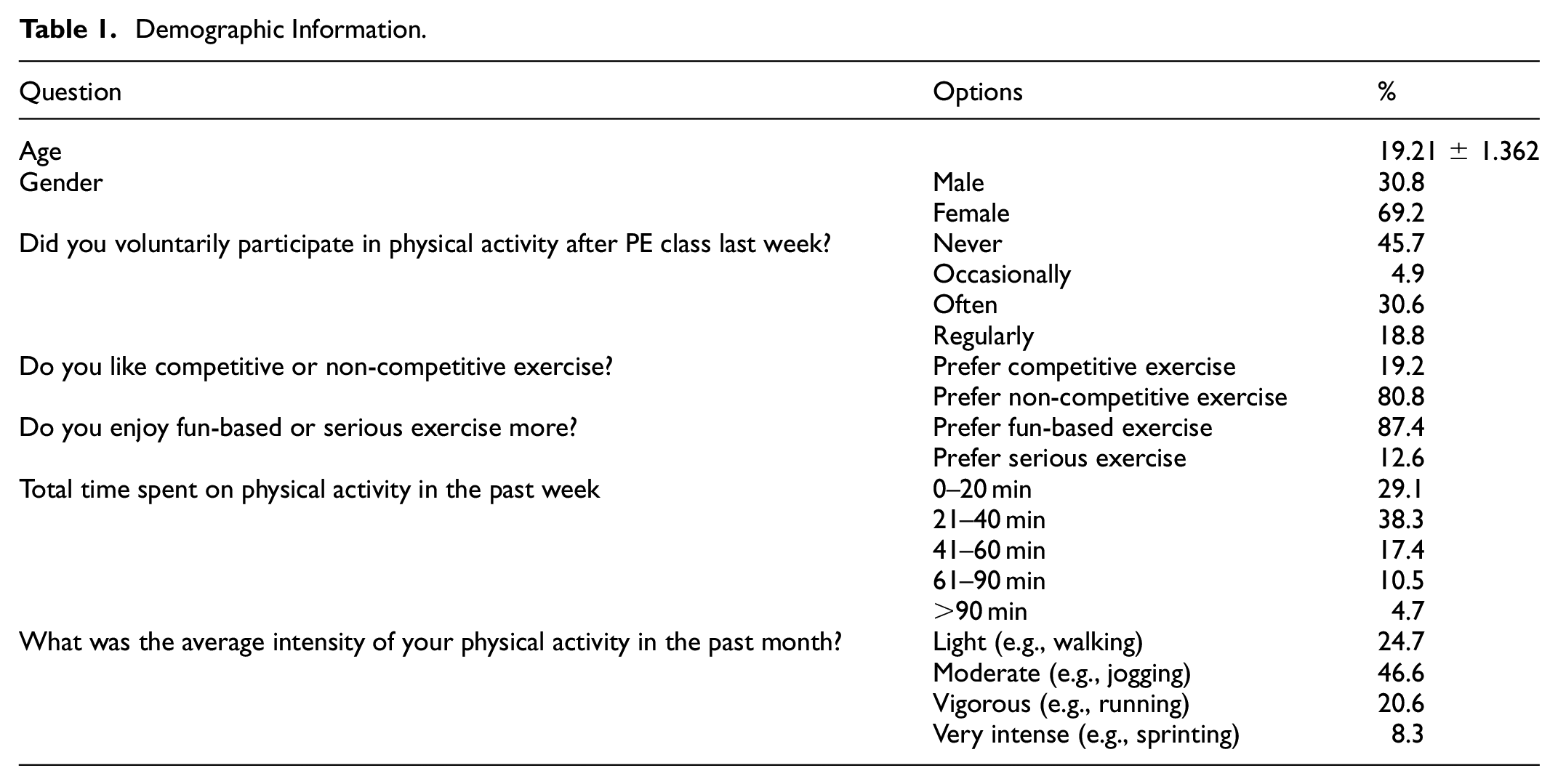
In terms of participation in physical activity after PE class, 45.7% of students reported never participating voluntarily, while 30.6% reported often participating. The majority of students preferred non-competitive (80.8%) and fun-based (87.4%) exercise. Most students engaged in physical activity for 21 to 40 min per week (38.3%), and the most commonly reported intensity level was moderate (e.g., jogging), accounting for 46.6% of the sample.
Research Instruments
The Psychological Capital Scale, developed by Luthans et al. (2007), covers four core dimensions: hope, optimism, resilience, and self-efficacy. This scale consists of 12 items, such as “If I should find myself in a jam, I could think of many ways to get out of it.” Each item is rated on a five-point Likert scale, with scores ranging from “1” (indicating not at all applicable) to “5” (indicating completely applicable).
The Health Consciousness Scale, developed by Gould (1990), includes five items, such as “I reflect about my health a lot.” Each item is measured using a five-point Likert scale, with scores ranging from “1” (indicating not at all applicable) to “5” (indicating completely applicable).
The measurement of health motivation utilized the scale developed by Moorman (1990), which includes five items, such as “I try to prevent health problems before I feel any symptoms.” Each item was rated on a five-point Likert scale, with scores ranging from “1” (indicating not at all applicable) to “5” (indicating completely applicable).
The Physical Activity Scale, based on the research findings of Liang (1994), comprehensively assesses an individual’s physical activity situation through three items: exercise intensity, weekly exercise frequency, and duration of each exercise session. A five-point rating system was used for the assessment of each indicator, scored from “1” to “5”. The higher the score, the higher the level of physical activity of the individual.
Common Method Bias Test
A Harman single-factor test was conducted to examine potential common method biases (H. Wang et al., 2023). All items of the research variables, including psychological capital, health consciousness, health motivation, and physical activity, were included in an exploratory factor analysis without rotation. The result showed a maximum eigenvalue variance of 27.492%, which is less than the critical value of 40%. Therefore, it is concluded that there is no severe common method bias in this study.
Data Analysis
Reliability and validity analyses, as well as correlation and regression analyses, were conducted using SPSS 26.0 on the research variables. Smart-PLS was employed to examine the relationships among college students’ psychological capital, health consciousness, health motivation, and physical activity. This approach facilitated the verification of mediating effects of psychological capital on physical activity.
Results
Validity and Reliability
Before proceeding with model estimation using PLS-SEM, this study thoroughly evaluated the psychometric properties of all constructs to ensure their appropriateness. Firstly, convergent validity was examined by looking at the factor loadings of the items, which should exceed the threshold of 0.5 (Hair, 2006). In this case, all factor loadings surpassed the required threshold, confirming satisfactory convergent validity. Next, discriminant validity was assessed by comparing the square root of the average variance extracted (AVE) for each construct with the correlations it has with other constructs. According to (Fornell & Larcker, 1981), for discriminant validity to be established, the square root of the AVE for a given construct should be greater than any of its correlations with other constructs. The results, as shown in Table 2, demonstrate that this condition was met, confirming that discriminant validity is well-supported. Lastly, the reliability of the constructs was evaluated using Cronbach’s alpha and composite reliability scores. All constructs had reliability coefficients of .70 or higher, demonstrating that the reliability of the constructs was satisfactory.
Validity and Reliability.

Note. *p-value < .001. Square root of AVE is presented in parentheses and bold. PC = Psychological Capital, HC = Health Consciousness, HM = Health Motivation, PA = Physical Activity.
In addition to the initial analysis, this paper also reports model fit indices to provide a more comprehensive assessment of common method bias (CMB), thereby reducing the reliance on Harman’s single-factor test (Table 3).
Model Fit.

Multicollinearity
Multicollinearity was evaluated by calculating the full variance inflation factor (VIF) for each latent variable. According to Kock and Lynn (2012), VIF values below 3.3 suggest that multicollinearity is not a significant issue. In this study, the VIF values for the latent variables ranged between 1.299 and 3.297, indicating that multicollinearity does not pose a significant problem for the analysis.
Hypotheses Testing
Figure 2 reports the results of the PLS-SEM estimation. The factor scores of the latent variables were calculated using the PLS algorithm, and they are an exact linear combination of the indicator scores. The analysis found that psychological capital is positively correlated with health consciousness (β = .224; p < .001; effect size = 0.053) and health motivation (β = .212; p < .001; effect size = 0.047), supporting Hypotheses 1 and 2. Health consciousness is positively correlated with health motivation (β = .197; p < .001; effect size = 0.041) and physical activity (β = .200; p < .001; effect size = 0.048), supporting Hypotheses 3 and 4. Health motivation is positively correlated with physical activity (β = .290; p < .001; effect size = 0.100), supporting Hypothesis 5.

Results from hypotheses testing.
Additionally, the mediation effects were further tested using the PROCESS macro (version 4.1) developed by Hayes, with 5,000 bootstrap resamples (Baron & Kenny, 1986). The results indicated that the confidence intervals for each pathway did not include zero, confirming the significance of the chain mediation effects, supporting Hypotheses 6, 7, 8, and 9. The detailed breakdown of effect sizes is presented in Table 4.
Mediation Effect Test.

Note. PC = Psychological Capital, HC = Health Consciousness, HM = Health Motivation, PA = Physical Activity.
Discussion
Theoretical Contributions
This study makes several meaningful contributions to the theoretical understanding of college students’ physical activity behaviors by integrating both motivational and cognitive perspectives into the analysis.
First, the study extends the application of psychological capital theory into the domain of health behavior. While psychological capital, comprising hope, efficacy, resilience, and optimism—has been extensively studied in organizational behavior and employee well-being (Luthans & Youssef-Morgan, 2017), its potential influence on personal health management remains underexplored. By conceptualizing psychological capital as a foundational internal resource that shapes how individuals perceive and engage in physical activity, this study demonstrates that psychological capital is not only crucial for workplace outcomes but also for fostering self-regulated health behaviors. This expands the theoretical reach of psychological capital beyond organizational contexts to include individual-level health outcomes.
Second, this study addresses a critical gap in the literature by introducing health consciousness and health motivation as mediating mechanisms linking psychological capital to physical activity. Whereas previous research has primarily emphasized external or environmental factors (e.g., institutional fitness programs or peer influence), this study shifts the focus to internal psychological pathways that enable individuals to transform positive psychological resources into sustained health behaviors. The mediating role of health consciousness is particularly informed by HBM, which provides a cognitive framework for understanding why individuals engage in health-related behaviors. Health consciousness, in this context, reflects individuals’ awareness of and concern about potential health risks, closely aligned with HBM constructs such as perceived susceptibility and perceived severity. To further strengthen the theoretical foundation, this study integrates HBM with SDT to propose a hybrid framework. In this model, cognitive evaluations (represented by health consciousness) and motivational processes (represented by health motivation) jointly explain how psychological capital influences physical activity. This integration is theoretically valuable, as it not only addresses why individuals are inclined to exercise (as emphasized by SDT), but also how their awareness and interpretation of health risks and benefits (as framed by HBM) shape this inclination. By bridging cognitive and motivational theories, the study provides a more comprehensive and nuanced understanding of the psychological mechanisms that drive health-promoting behaviors among college students.
Finally, by focusing on college students, a population often underrepresented in psychological capital and health behavior studies, this research provides theoretical insights with both developmental and policy relevance. College students face unique psychosocial challenges—including academic stress and screen overexposure—which influence both their mental and physical health. This study identifies psychological capital as a proactive resource that enables students to manage these challenges, form positive health beliefs, and maintain active lifestyles. These findings offer a theoretical foundation for health promotion and educational interventions aimed at young adults.
In sum, this study enriches existing literature by positioning psychological capital as a key antecedent to health behavior, explaining its effects through both cognitive (health consciousness) and motivational (health motivation) mediators. This dual-theoretical approach advances our understanding of the psychological foundations of health behavior and offers a comprehensive model for future empirical research.
Practical Implications
The findings of this study highlight the importance of enhancing physical activity among university students through targeted interventions that effectively utilize psychological capital, health consciousness, and health motivation. First, universities should develop comprehensive workshops aimed at strengthening students’ psychological capital. These workshops should focus on cultivating key traits such as resilience, optimism, hope, and self-efficacy, empowering students to tackle challenges related to physical activity and encouraging greater engagement in exercise. Additionally, it is crucial for universities to ensure that counseling services are readily accessible, as these services can help students establish positive health and fitness goals, thereby reinforcing their psychological capital and fostering a culture of well-being on campus.
To promote health consciousness, institutions should organize health education activities that raise consciousness of the significance of physical activity. These activities can include interactive seminars featuring health experts, informative posters displayed throughout the campus, and engaging social media content that emphasizes the benefits of a healthy lifestyle. Moreover, establishing peer education programs can create a supportive community where students share health knowledge and experiences. This peer interaction not only enhances the sense of belonging but also motivates students to participate in fitness initiatives endorsed by their peers.
To effectively foster health motivation, universities should implement reward systems that recognize and incentivize consistent participation in physical activities. Such incentives could include fitness challenges, discounts on gym memberships, and public recognition during campus events. These measures can significantly boost motivation levels and create a supportive competitive atmosphere. Furthermore, offering personalized fitness consultations can help students set realistic health goals tailored to their individual needs, thereby enhancing their motivation to remain physically active.
Ensuring that sports and recreational facilities are easily accessible to all students is vital for promoting an active lifestyle. Universities should regularly assess the availability and condition of these facilities and make necessary improvements to meet the diverse needs of the student population. Conducting regular sports events, fitness classes, and group activities can create an inclusive and engaging environment, encouraging students to incorporate physical activity into their campus life.
Finally, establishing partnerships with local health professionals can provide students with expert advice and resources related to physical activity and overall wellness. Collaborations can facilitate health screenings, workshops, and informational sessions that further support students’ health journeys. Additionally, creating comprehensive wellness programs that integrate physical activity as a core component can effectively embed healthy practices into students’ daily routines. By implementing these multifaceted strategies, stakeholders can significantly enhance physical activity levels among university students, contributing to their overall health and well-being while fostering a vibrant campus culture.
Limitations
This study has several limitations that should be acknowledged. Firstly, the data were collected through a cross-sectional design, which restricts the ability to infer causal relationships among psychological capital, health consciousness, health motivation, and physical activity. While the observed associations provide valuable insights, longitudinal or experimental studies are needed to clarify the directionality and underlying mechanisms of these relationships.
Secondly, the study relied entirely on self-reported measures, which are susceptible to common method bias, including social desirability and recall inaccuracies. Future research could incorporate objective tools—such as accelerometers or fitness trackers—to complement self-report data and enhance measurement validity.
Thirdly, the sample was drawn from a limited number of universities within the Chang-Zhu-Tan metropolitan area, which may restrict the generalizability of the findings. The relationship between psychological capital and physical activity may vary across different cultural, institutional, or regional contexts. Broader sampling across diverse settings is recommended for future studies.
Lastly, the study did not account for external or environmental factors that could influence students’ physical activity, such as access to sports facilities, peer support, or academic workload. These contextual variables may interact with psychological traits and should be considered in future models to offer a more comprehensive understanding of health behaviors.
Conclusion
In conclusion, this study highlights the significant role of psychological capital in influencing college students’ health behaviors, specifically through its effects on health consciousness and health motivation. By establishing these psychological factors as mediators, the research provides a deeper understanding of how psychological capital promotes physical activity, offering both theoretical and practical insights. The findings underscore the importance of developing psychological capital as a means to enhance students’ engagement in health-promoting behaviors, which is critical for their overall well-being and future success. These results provide a foundation for future interventions aimed at fostering healthier lifestyles in academic settings.
Footnotes
Acknowledgements
The authors gratefully acknowledge the reviewers.

Ethical Considerations
The study was approved by the Academic Committee of the School of Physical Education of Hunan University of Science and Technology. Informed consent was obtained from all participants prior to their involvement in the research. Participants were provided with detailed information about the study’s objectives, procedures, potential risks, and benefits, and their participation was entirely voluntary.
Author Contributions
Conceptualization: D.H. and D.K.; Methodology: D.H., D.K., and H.T.; Investigation: D.H., H.T., L.J., H.L. and X.L.; Original draft preparation: D.H. and H.L. Writing—review and editing: H.T., L.J., X.L. and D.K. All authors participated in the revision of the manuscript, read and approved the submitted version.
Funding
The author(s) disclosed receipt of the following financial support for the research, authorship, and/or publication of this article: This research was funded by the Hunan Provincial Social Science Committee (Grant No. XSP24YBZ065) and the Scientific Research Fund of the Hunan Provincial Department of Education (Grant No. 21C0323).
Declaration of Conflicting Interests
The author(s) declared no potential conflicts of interest with respect to the research, authorship, and/or publication of this article.
Data Availability Statement
The data that support findings and conclusions of this study will be available from the corresponding author upon a reasonable request.