




Abstract
This study explores the relationship between physical activity and career adaptability among Chinese university students and investigates the underlying mechanisms involved. A survey was conducted with 420 university students using various scales to measure physical activity, motives for physical activity, psychological capital, and career adaptability. The results of the study showed that: (1) physical activity has a positive predictive effect on university students’ career adaptability (β = .0005, 95% CI [0.0002, 0.0008]); (2) physical activity effectiveness and psychological capital play a mediating role in physical activity and university students’ career adaptability, and at the same time, this mediating role contains three paths: the separate mediating role of physical activity effectiveness (β = .0255, 95% CI [0.0046, 0.0509]), the separate mediating role of psychological capital (β = .0804, 95% CI [0.0375, 0.1282]), and the chain mediating role of physical activity effectiveness–psychological capital (β = .0437, 95% CI [0.0224, 0.0675]). Increased physical activity leads to increased physical activity effectiveness, which leads to increased levels of psychological capital, and ultimately to increased levels of career adaptability in university students. This study provides new insights into the career adaptability of university students and provides a reference for their career development.
Keywords
Introduction
In the context of globalization and a rapidly changing economic environment, university students’ career development faces increasingly complex challenges. The rapid economic growth in China, accompanied by social structural changes and educational system reforms, has intensified competition in the job market. To succeed in this highly competitive environment, university students need to possess a high level of career adaptability, enabling them to better cope with fluctuations and challenges in their career paths. Based on statistics from the Ministry of Education of the People’s Republic of China, from 2019 to 2023, the employment situation for Chinese university graduates has been increasingly severe, with the number of graduates continuously rising, reaching a record high of 10.76 million in 2022. This has significantly intensified the employment pressure faced by Chinese university students (Ministry of Education of the People’s Republic of China, 2022). Additionally, relevant literature indicates that the pressure from the job market has adversely affected the career adaptability of many university students (C. Dong et al., 2023; Pang et al., 2021). Career adaptability is defined as a psychological resource that individuals use when confronting challenges and transitions in their career development. It helps them adapt to changes in the career environment, solve problems related to career decision-making, and achieve success in their work (Porfeli & Savickas, 2012). As an essential ability to cope with career transitions and development challenges, career adaptability has garnered widespread attention from the academic community (Porfeli & Savickas, 2012). Career adaptability not only aids individuals in adjusting to changes in the workplace but also enhances their decision-making, exploration, and planning abilities during career transitions (Germeijs & Verschueren, 2007; Savickas, 2005).
Research has shown that career adaptability not only helps individuals better adjust to changes in their career paths, but is also closely related to various work and life outcomes, such as increased job satisfaction, enhanced work engagement, reduced turnover intentions, and improved self-esteem and well-being (Chan & Mai, 2015; Vianen et al., 2012). For university students in the early stages of their career development, career adaptability is not only a crucial ability for navigating the transition from academic to professional life but also serves as a foundation for future career success. Therefore, cultivating students’ career adaptability during their university years is of paramount importance, and assisting students in enhancing their career adaptability has become a key concern for educators and researchers alike.
There are numerous factors influencing career adaptability. This study focuses on physical activity, physical activity effectiveness, and psychological capital, based on their potential mechanisms in shaping career adaptability. First, physical activity not only significantly promotes physical health but also has positive effects on psychological and social functioning. Research has shown that physical activity can help individuals cope with stress and improve emotional regulation, which may, in turn, positively affect career adaptability (Bell et al., 2019; Schrempft et al., 2019). Second, physical activity effectiveness, as the direct physiological and psychological feedback resulting from physical activity, can enhance individuals’ self-confidence, sense of control, and ability to face challenges (Marconcin et al., 2022). These physical activity effectiveness can be translated into greater career adaptability in professional settings.
To more accurately measure physical activity effectiveness, this study also considers physical activity motivation. Physical activity motivation refers to the intrinsic drive that compels individuals to engage in physical activities, including the fitness, appearance, competence/challenge, social and enjoyment. Motivation plays a key role in realizing the benefits of physical activity, as higher levels of motivation are typically associated with sustained participation in physical activity which leads to more significant physical and psychological benefits (Ryan & Deci, 2000). Physical activity motivation is not only the driving force behind participation but also promotes career adaptability by enhancing individuals’ sense of internal control and self-efficacy (Ingledew & Markland, 2008). Therefore, motivation, as the core driving factor of physical activity effectiveness, is measured and analyzed in this study.
Finally, positive psychological factors within psychological capital—hope, optimism, resilience, and self-confidence—are considered crucial resources for individuals to manage uncertainty and stress during career development (Luthans et al., 2006). Hope and optimism within psychological capital are significantly positively correlated with career adaptability, as they help individuals maintain a positive attitude and enhance their ability to navigate complex career environments and make effective career decisions (Wilkins et al., 2014).
Therefore, this study aims to investigate the effects of physical activity, physical activity effectiveness under motivation, and psychological capital on career adaptability among university students, as well as their interactions. By analyzing the relationships between these variables and career adaptability, the study seeks to reveal how physical activity and physical effectiveness, through enhancing psychological capital, contribute to improving career adaptability. This research aims to provide a theoretical basis for enhancing career adaptability among university students and offer practical guidance for their career planning and development. The findings are significant not only for the career preparation of university students but also for providing potential pathways for educators and policymakers to enhance students’ employability.
Theoretical Background and Research Hypotheses
The Relationship Between Physical Activity and Career Adaptability
Career adaptability refers to an individual’s ability to cope with various challenges and transitions in their career development, encompassing qualities such as self-regulation, goal setting, and stress management (Johnston, 2018; Lofquist & Dawis, 1984). This capability is crucial for effectively managing uncertainty and changes throughout one’s career. Recently, with the increasing focus on the broader impacts of physical activity on personal development, researchers have begun to investigate whether physical activity can enhance an individual’s career adaptability. Physical activity not only has significant effects on physical health but also demonstrates positive impacts on psychological functioning (Faulkner et al., 2021; Marconcin et al., 2022). Existing studies indicate that physical activity can effectively alleviate anxiety and depression (Singh et al., 2023), enhance self-esteem and self-efficacy (G. Zhang et al., 2024), and improve psychological resilience and stress coping abilities (González-Valero et al., 2023). These mental health factors are of significant importance for individuals’ ability to cope with challenges and stress in their professional careers, which may impact the development and performance of their career adaptability.
Furthermore, physical activity can promote individuals’ physical health and fitness (Blair, 1993, 1996; X. Dong et al., 2021; Kaur et al., 2020; Proper et al., 2003). Research has shown a close relationship between physical health and mental health (Jacob et al., 2020; Knight et al., 2003; Ohrnberger et al., 2017; C. Wang et al., 2020). Therefore, good physical fitness may contribute to enhancing individuals’ work efficiency and quality of life (Fang et al., 2019; McAuley et al., 2012; Qi et al., 2020; Sławińska et al., 2013), thereby strengthening their performance and adaptability in their professional careers. Moreover, physical activity fosters numerous skills and qualities closely related to career adaptability, such as self-management skills (Dishman et al., 2005; Robinson et al., 2021; Saelens et al., 2000; Trost et al., 2015), teamwork skills (de Prada Creo et al., 2021; Pop, 2013), goal-setting abilities (Kotarska et al., 2022; McEwan et al., 2016; Shilts et al., 2004), and perseverance (Daniels et al., 2023; Normand, 2008; Rutberg et al., 2020; Yin et al., 2023). These attributes are particularly important for individuals facing long-term challenges in their careers. Although some studies have explored the relationship between physical activity and career adaptability (Celen-Demirtas et al., 2015; Till et al., 2011), gaps and limitations persist in theoretical frameworks and empirical research methods. Therefore, further investigation into the role of physical activity in enhancing career adaptability is crucial for providing new theoretical support and practical guidance for individual career development and health education.
Based on this, the following research hypothesis is proposed: Hypothesis 1: Physical activity positively predicts career adaptability among university students.
The Mediating Role of Physical Activity Effectiveness
Physical activity effectiveness refers to the positive impacts of physical activity on individuals’ physical, psychological, and social well-being, including improvements in physical health, mental health, and social skills (Eime, Young, Harvey, & Charity, et al., 2013). These effects are facilitated by providing opportunities for exercise and social interaction, which contribute to the overall health of university students. For instance, regular physical activity can enhance cardiovascular health, muscle strength, and flexibility (Eime, Young, Harvey, & Payne, 2013; Warburton et al., 2006). Additionally, exercise has been shown to reduce stress (To et al., 2022; Yuede et al., 2018), improve sleep quality (Banno et al., 2018; F. Wang & Boros, 2021), and boost physical health (Filgueira et al., 2021; Reigal et al., 2019) and cardiovascular function (Kao et al., 2020; Myers et al., 2019). Motivation is a crucial factor influencing participation in physical activity and the achievement of physical activity effectiveness. An individual’s motivation determines the frequency and intensity of their exercise, which in turn affects the significance and sustainability of the physical activity effectiveness. Research indicates a positive correlation between motivation for physical activity and its effectiveness (Dishman et al., 2005; Saelens et al., 2000). Motivation drives individuals to overcome obstacles and persist in their exercise routines, thereby enhancing their health and psychological well-being.
Furthermore, numerous studies have found a close relationship between participation in physical activities and career adaptability among university students. For example, research by Jekauc et al. (2015) indicates that participants in physical activities are more likely to exhibit better psychological health and adaptability. The study by Celen-Demirtas et al. (2015) suggests that recreational physical activities can enhance adult career adaptability. Additionally, research has shown that engaging in physical activities can improve university students’ psychological health, social skills, and self-awareness, aiding them in better adapting to university life (Eime, Young, Harvey, & Payne, 2013; Lerner et al., 2015; Nalbant, 2018). Moreover, physical activities can enhance physical fitness, self-esteem, and emotional regulation, factors that play an important role in university students’ career adaptability (McMahon et al., 2017). Moreover, participation in physical activities can cultivate university students’ confidence and self-efficacy (Bessa et al., 2021; Han et al., 2022; Kang et al., 2020; Te Velde et al., 2018). Through continuous exercise and challenges, individuals can gain a sense of achievement, learn to set goals, and strive to accomplish them, thereby enhancing their confidence and abilities to cope with various life difficulties and challenges. Furthermore, physical activities foster a positive mindset and optimistic attitude among university students (Remskar et al., 2022; Tavakoly Sany et al., 2023).
While the mediating role of career adaptability has been extensively studied (Al-Ghazali, 2020; Ocampo et al., 2020; Rasheed et al., 2020; Romano et al., 2021; R. Wang et al., 2022), relatively fewer studies have explored the impact of physical activity effectiveness as a mediating variable on career adaptability among university students. Therefore, this study aims to address this research gap by thoroughly investigating the mediating role of physical activity effectiveness in the relationship between physical activities and career adaptability among university students, offering theoretical and practical guidance to promote university students’ physical and mental well-being and career development. Building upon this, Hypothesis 2 is proposed: physical activity effectiveness mediate the relationship between physical activity and university students’ career adaptability.
The Mediating Role of Psychological Capital
Psychological capital is a positive psychological resource comprising hope, resilience, optimism, and self-efficacy (Luthans & Avolio, 2014; Luthans & Youssef-Morgan, 2017; Luthans et al., 2010). These psychological resources can have a positive impact on an individual’s adaptation, performance, and development (Carter & Cook, 1995; Naveed & Qamar Zia, 2024; van den Heuvel et al., 2014). Psychological capital significantly influences individuals’ job performance, career development, and life satisfaction (Madrid et al., 2018; Nguyen & Ngo, 2020). A growing body of research suggests that that physical activity has a positive impact on the cultivation and enhancement of psychological capital (Adel et al., 2020; Chen et al., 2022; Lowery & Cassidy, 2022; Lu et al., 2022; Y. Sun, 2023). Engaging in physical activities can promote individuals’ positive emotional experiences (J. Li et al., 2022; Maher et al., 2021; Newall et al., 2013; R. Wu et al., 2022), provide opportunities for success and challenge assisting individuals in overcoming difficulties and building self-confidence (Mendoza-Vasconez et al., 2022; Rauff & Kumazawa, 2022). Consequently, university students who regularly participate in physical activities often possess higher psychological capital, contributing to enhancing their career adaptability. Therefore, applying the concept of psychological capital to the relationship between physical activity and university students’ career adaptability helps to reveal its important role in these areas.
There is also related research indicating a close relationship between psychological capital and university students’ career adaptability (Baluku et al., 2021; De Andrade et al., 2023; Margaça et al., 2021; Safavi & Bouzari, 2019; C. Sun et al., 2023; Q. Xu et al., 2024; Zyberaj et al., 2022;). Individuals with higher levels of psychological capital typically exhibit stronger career adaptability. University students face various challenges in their academic, interpersonal, and career development, and possessing the ability to overcome difficulties and cope with setbacks (Avey et al., 2008; Cenciotti et al., 2017). Therefore, individuals with higher levels of psychological capital are more likely to possess good career adaptability. Currently, university students face various challenges and pressures in academic performance, interpersonal relationships, and career development, and having strong psychological capital can help them better cope with these challenges. Positive emotions and hope can enhance university students’ motivation for learning (Løvoll et al., 2017; Low et al., 2016; Mega et al., 2014; Morina, 2019; Oriol et al., 2016) and goal orientation (Lüftenegger et al., 2016; Pekrun et al., 2009), making them more confident in overcoming difficulties. Meanwhile, high self-efficacy enables university students to face future career development with confidence, fostering better career adaptability and competitiveness (Atitsogbe et al., 2019; Hamzah et al., 2021; Hou et al., 2019; Xiaoping et al., 2019). Resilience allows university students to quickly adjust their mindset when facing setbacks and failures, seeking new pathways and solutions (Akeman et al., 2020; J. J. Chang et al., 2021; Y. Wu et al., 2020; Yıldırım & Tanrıverdi, 2021).
Physical activities can indirectly influence individuals’ career adaptability by enhancing their psychological capital. Participation in sports cultivates optimism, self-confidence, and resilience in individuals, and the enhancement of these psychological resources helps individuals better adapt to the professional environment and cope with challenges and pressures at work (Avey et al., 2008; Cenciotti et al., 2017). Therefore, psychological capital plays a crucial mediating role between physical activity and career adaptability in university students. By fostering and enhancing psychological capital through physical activity, students’ career adaptability can be significantly improved, enabling them to better navigate the various challenges encountered during their academic phase and thereby facilitating their personal development and growth.
Based on this, Hypothesis 3 is proposed: Psychological capital mediates the relationship between physical activities and university students’ career adaptability.
The Role of Chain Mediation
Relevant studies have shown that physical activity significantly influences the development of psychological capital, thereby indirectly enhancing individuals’ career adaptability (Chen et al., 2022; M. Liu et al., 2022; Lu et al., 2022; C. Sun et al., 2023). Psychological capital, as an important psychological resource, comprises elements such as optimism, self-efficacy, resilience, and confidence, which play a crucial role in individuals’ performance in their careers (Ahmed et al., 2022; Firosyana & Kurniawati, 2019; Marcionetti & Rossier, 2021; Salim et al., 2023). Physical activity, particularly engaging in sports, has been shown to facilitate the development of these elements of psychological capital. For instance, aerobic exercise increases blood flow to the brain, promotes neuronal growth and connections, thereby improving individuals’ psychological state and emotional stability (Bernstein & McNally, 2018; Bernstein et al., 2019; Giles et al., 2018; Yao et al., 2021; Y. Zhang et al., 2019). This improvement in psychological state contributes to enhancing individuals’ optimism and self-efficacy, enabling them to face challenges in their career with greater confidence (Lu et al., 2022). Furthermore, participation in physical activity can enhance individuals’ self-discipline and endurance, thus strengthening their resilience (Adel et al., 2020). These abilities are crucial in a work environment as they aid individuals in coping with work pressures, challenges, and changes, thereby improving career adaptability.
Previous research has further demonstrated that psychological capital plays a significant mediating role between physical activity and career adaptability. For example, Y. Li and Wang (2017) found that a correlation between physical activity effectiveness and psychological capital among university students. This research also found a positive relationship between physical activity effectiveness and individual levels of psychological capital among university students, with differences observed when measuring psychological capital in terms of confidence, hope, resilience, and optimism across four dimensions.
Individuals with higher levels of psychological capital tend to maintain an optimistic outlook towards changes in the work environment and are more likely to confront difficulties and challenges with positive attitudes and behaviors (Avey et al., 2008). Furthermore, psychological capital contributes to individuals maintaining goal orientation and persistence in their careers, as well as enabling them to maintain a positive mindset when facing setbacks (Bocciardi et al., 2017; Gheyassi & Alambeigi, 2024; Santilli et al., 2017). By cultivating individuals’ psychological capital through physical activity, individuals are more likely to demonstrate higher adaptability and resilience in the work environment (Baluku et al., 2021; Chamani-Ghalandari et al., 2023; Selma, 2022). For instance, participating in team sports can enhance individuals’ collaboration skills and team spirit while also boosting levels of psychological capital, which are valuable qualities in the workplace (Cenciotti et al., 2017; Miraglia et al., 2017).
Based on this, research hypothesis 4 is proposed: there exists a chain mediation path “physical activity → physical activity effectiveness → psychological capital → career adaptability of university students” (Figure 1).

Hypothetical model of physical activity, physical activity effectiveness, psychological capital, and career adaptability.
Methodology
Participant Procedures
The participants of this study are undergraduate students currently enrolled in selected universities in Jiangxi Province, China. To ensure participant privacy and confidentiality, we formally contacted the relevant universities to seek permission for their students to participate in this research. This study adopts a non-experimental quantitative research method, utilizing a questionnaire survey to investigate the enrolled university students. During the survey process, participants were explicitly informed that the survey would be conducted anonymously, and that the collected data would be used solely for research purposes without any other implications. Furthermore, a commitment was made to strictly maintain the confidentiality of participants’ personal information.
Research Sample
The sample for this study was drawn from selected universities in Jiangxi Province, China. Jiangxi Province comprises 11 regions, from which we identified 11 universities as the population for this study. Initially, a simple random sampling method (Bowley, 1906) was employed to randomly select four universities out of the 11 as our study sample. Based on the Morgan sampling table (Krejcie & Morgan, 1970), a final sample size of 420 individuals was determined.
In the sampling process, we utilized a stratified random sampling method (Alexander Alexandrovic Chuprov: L. I., 1926) within each university. Specifically, 105 students were sampled from each university, comprising 32 first-year students, 32 second-year students, 21 third-year students, and 20 fourth-year students. Finally, a systematic random sampling approach (William Gemmell Mado: Madow & Madow, 1944) was employed to select participants from the designated samples within each university. The sample consisted of 173 males (41.2% of the total sample) and 247 females (58.8% of the total sample).
Measurement Tools
Physical Activity
The International Physical Activity Questionnaire (IPAQ) was used in this study to measure the daily physical activity of university students participating in sports. The IPAQ consists of seven questions, six of which ask about an individual’s physical activity. The structure of the questions was the same as that of the long questionnaire, except for the section on activity intensity. The short questionnaire was simply divided into walking, moderate-intensity, and vigorous-intensity activities and asked about the frequency of walking in a week and the cumulative time per day for different-intensity activities. The MET of walking in the short questionnaire was assigned a value of 3.3, moderate-intensity activity was assigned a value of 4.0, and vigorous-intensity activity was assigned a value of 8.0. The re-test reliability of this scale was 0.95 in this study.
Physical Activity Effectiveness
To understand the motivation for physical activity, Ryan et al. (1997) developed a scale called Motives for Physical Activity Measure-Revised (MPAM-R) to be used as a theoretical background for SDT. The Motives for Physical Activity Measure-Revised (MPAM-R) was designed to assess the intensity of five types of motivation to engage in physical activity, such as weight lifting, aerobic exercise, or various team sports. The scale consists of 30 items divided into five latitudes. In conclusion, the original scale showed acceptable psychometric properties through exploratory factor analysis and Cronbach’s alpha ranging from .78 to .92. The reliability of the scale in this study was .90.
Psychological Capital
From the perspective of psychological capital as defined by Luthans et al. (2007), self-efficacy, resilience, hope, and optimism are the four dimensions that can be measured. The instrument used in this study is a revised measure of psychological capital suitable for university students based on lanthanide PCQ-24. The questionnaire contains a total of 20 items, four items per latitude. A 5-point Likert scale was used (1 = not at all, 5 = fully) The reliability of the scale in this study was .935.
Career Adaptability
The Career Adaptability Scale developed by Porfeli and Savickas (2012) was used in this study. The Career Adaptability Scale (CAAS) consists of four scales, Career Concern, Career Confidence, Career Curiosity, and Career Control. Each scale has six items, and the scale has a total of 24 measurement items. The scale is based on a 5-point scale, with the “Fully Compliant” option worth 5 points, the “Mostly Compliant” option worth 4 points, the “Unsure” option worth 3 points, and the “Mostly Unsure” option worth 3 points. The option “not at all consistent” is worth 2 points, and the option “not at all consistent” is worth 1 point. The reliability of the scale in this study was .892.
Statistical Methods
This study employed SPSS 26.0 and the SPSS macro PROCESS, developed by Hayes, to conduct data analysis, with a particular focus on testing the chain mediation effects. First, based on Model 6 proposed by Hayes and Scharkow (2013), we analyzed the serial mediation effects among multiple mediating variables. The model strictly controlled for potential confounding factors, including gender, grade level, and student background, to minimize the influence of external variables. To test the significance of the mediation effects, we used a bias-corrected percentile Bootstrap sampling method, extracting 5,000 Bootstrap samples to estimate model parameters and generate corresponding standard errors and 95% confidence intervals. If the confidence interval does not include zero, the mediation effect is considered significant. Additionally, the mediation effect testing procedure follows the framework proposed by Wen et al. (2014) and Taylor et al. (2008). This includes: first calculating the direct effect of the independent variable on the mediating variable, then calculating the direct effect of the mediating variable on the dependent variable, and finally calculating the total effect of the independent variable on the dependent variable via the indirect effect path. At the same time, the serial mediation model was examined to identify the presence of multiple mediation paths, and the relative contribution of each path was analyzed to explain the complex relationships among the variables.
Data Analysis
After collecting the data, initial cleaning and analysis were conducted using SPSS 26.0, which included descriptive statistics, reliability analysis, and correlation analysis. Descriptive statistics were used to analyze the mean, standard deviation, skewness, and kurtosis of the study variables (independent variables, mediators, and dependent variables) to understand the data distribution. Reliability analysis was conducted using Cronbach’s α coefficient to assess the internal consistency of the scales, with α values above .70 indicating acceptable reliability. Correlation analysis was performed by calculating Pearson correlation coefficients to identify the relationships between variables, laying the foundation for subsequent mediation analysis. Following this, further mediation model analysis was carried out using the SPSS PROCESS macro. Based on Model 6, standardized path coefficients and effect sizes for each path were computed, focusing on testing the significance of the serial mediation effects. The direct, indirect, and total effects were reported in the analysis. To estimate the mediation effects and their confidence intervals, 5,000 Bootstrap samples were drawn. If the confidence intervals did not include zero, the mediation effects were considered statistically significant. To enhance the explanatory power of the model, AMOS software was used to further verify the fit of the proposed model. Structural Equation Modeling (SEM) analysis in AMOS was assessed through various fit indices (e.g., CFI, TLI, RMSEA) to evaluate the overall model fit.
Results
Common Method Bias
This study used a questionnaire to collect data, which may have the problem of common method bias. Harman’s one-way validated factor analysis and Zhou and Long’s (2004) statistical test of common method bias were used to test the common method bias of all hypothesis testing items, and the results showed that the exploratory factor analysis extracted three factors with eigenvalues greater than 1, and the variance explained by the first factor was 36.369, which was lower than the critical value of 40%, indicating that there is no common method bias Problems. The results showed that the exploratory factor analysis extracted three factors with eigenvalues greater than one.
Descriptive Statistics
The researcher used independent samples t-test for gender and student origin of the participants to compare the differences in physical activity, physical activity effectiveness, psychological capital, and career adaptability among university students, and the results are shown in Tables 1 and 2, and one-way ANOVA test for the grade level of the participants to compare the differences in physical activity, physical activity effectiveness, psychological capital, and career adaptability among university students, and the results are shown in Table 3.
Comparison of Differences in Gender.

p < .5. ***p < .001.
Comparison of Differences in Student Origin.
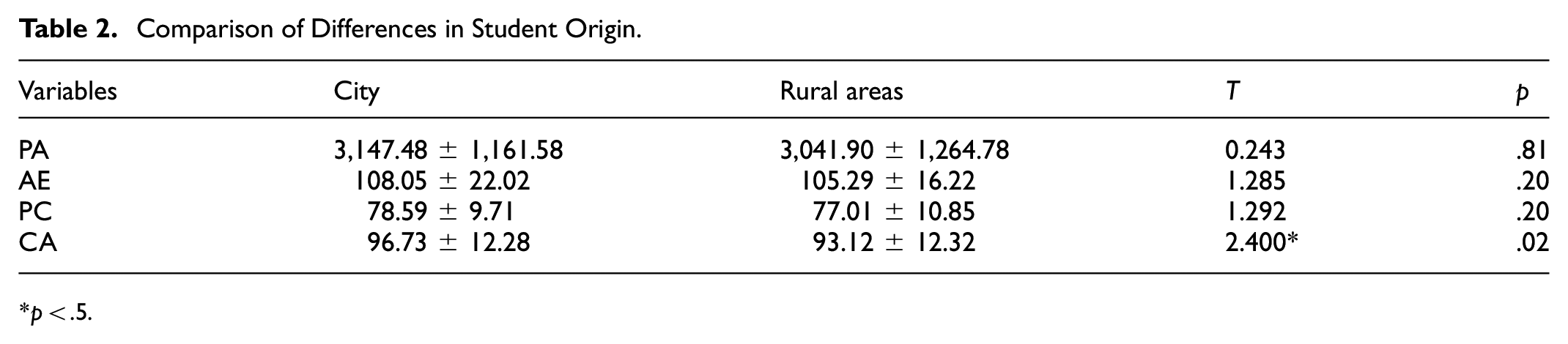
p < .5.
Comparison of Differences by Grade Level.

p < .5. ***p < .001.
The results of the independent sample t-test indicate that gender has a significant effect on university students’ physical activity, physical activity effectiveness, and psychological capital (p < .05), but no significant difference was found in career adaptability. Regarding the factor of student origin, no significant differences were observed in physical activity, physical activity effectiveness, and psychological capital, whereas significant differences were found in career adaptability. The results of the one-way ANOVA reveal that grade level has a significant effect on physical activity effectiveness and career adaptability, but no significant difference was found in psychological capital. Since freshmen and sophomores have two mandatory physical education classes per week as part of their curriculum, while juniors and seniors primarily engage in physical activity outside of class, with no standardized physical education courses, this study did not analyze the differences in physical activity participation across different grade levels.
Correlation Matrix of Variables
To examine the direct effects of physical activity, physical activity effectiveness, psychological capital, and career adaptability, bivariate Pearson correlation analyses were conducted on the dimensions of these four variables. The correlation coefficients are presented in Table 4.
Means, Standard Deviations, and Correlations for Each Variable Latitude.

Correlation is significant at the *.05 and **.01 levels (2-tailed), respectively.
The results of the Pearson correlation analysis revealed significant positive correlations between physical activity and the five dimensions of physical activity effectiveness, the four dimensions of psychological capital, as well as the four dimensions of career adaptability (r = .10 to .32, p < .01). Additionally, significant positive correlations were observed between the five dimensions of physical activity effectiveness and the four dimensions of career adaptability (r = .17 to .42, p < .01). Furthermore, significant positive correlations were found between the four dimensions of psychological capital and the four dimensions of career adaptability (r = .29 to .49, p < .01). To further explore the effects of physical activity intensity on university students’ career adaptability, the means of the four sub-dimensions of career adaptability—career concern, career control, career curiosity, and career confidence—were compared. The findings indicate that career adaptability levels increased significantly with higher physical activity intensity (Table 5). Specifically, the high-intensity physical activity group scored significantly higher on career concern, career control, career curiosity, and career confidence compared to the medium-intensity group (p < .01). Likewise, the medium-intensity group showed significantly higher scores than the low-intensity group (p < .01). These results demonstrate that physical activity intensity has a significant positive impact on university students’ career adaptability.
ANOVA Results of the Influence of Physical Activity Level on Career Adaptability.
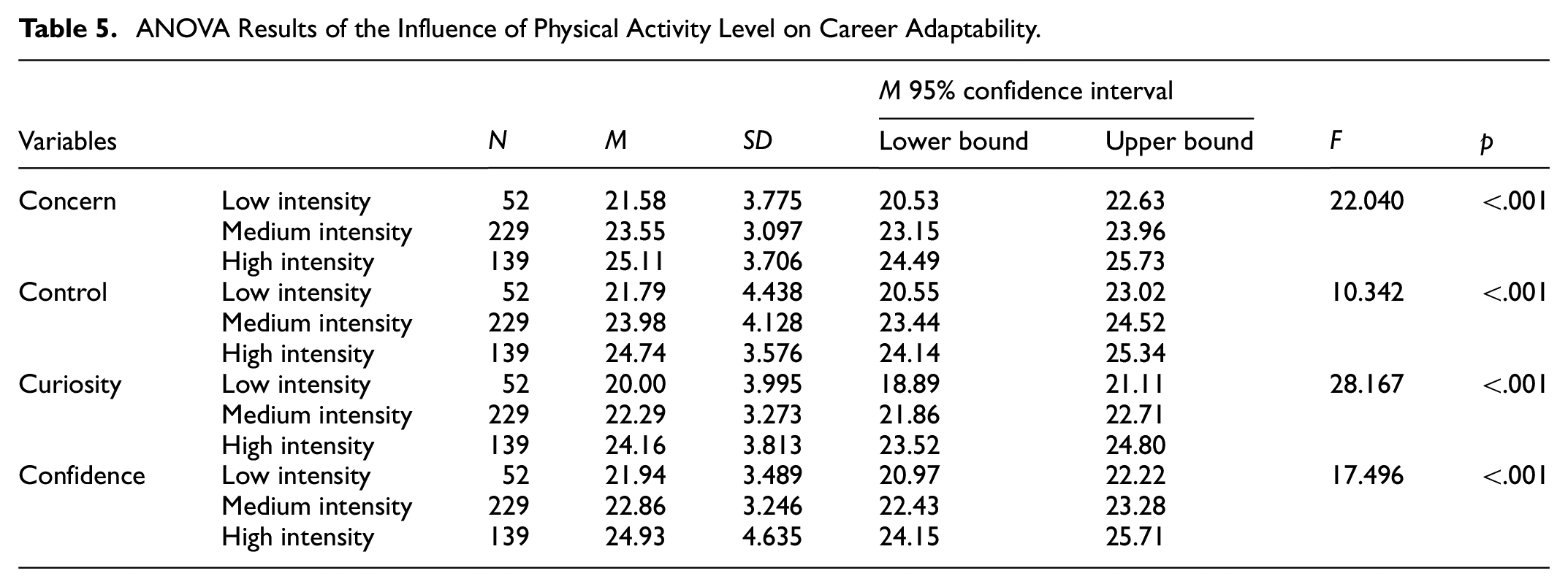
The one-way ANOVA results indicate that all four sub-dimensions of career adaptability exhibited significant differences across varying levels of physical activity intensity (p < .01). Specifically, regarding the career concern dimension, university students who engaged in low-intensity physical activity had a mean score of 21.58, those who participated in moderate-intensity physical activity scored 23.55, and those involved in high-intensity physical activity scored 25.11. For the career control dimension, the mean scores were 21.79 for the low-intensity group, 23.98 for the moderate-intensity group, and 24.74 for the high-intensity group. In the career curiosity dimension, low-intensity participants scored 20.00, moderate-intensity participants scored 22.29, and high-intensity participants scored 24.16. Lastly, for the career confidence dimension, the mean scores were 21.94 for the low-intensity group, 22.86 for the moderate-intensity group, and 24.93 for the high-intensity group. Thus, there was a significant positive correlation between physical activity intensity and career adaptability, with higher physical activity intensity being associated with higher scores on the dimensions of career adaptability.
Intermediary Model Testing
In this study, after controlling for the three demographic variables of gender, grade level, and student origin, the chain mediation of physical activity effectiveness and psychological capital was tested using the Model 6 mediation model through the Process 3.3 program in SPSS. The regression equation was constructed based on the relationship of the variables and the results obtained are shown in Table 6.
Regression Analysis of the Chained Mediation Model of Physical Activity Effectiveness and Psychological Capital.

Note. β are standardized coefficients.
p < .01. ***p < .001.
The regression analysis revealed that physical activity significantly positively predicts career adaptability (β = .1440, p < .01). Furthermore, when both physical activity effectiveness and psychological capital are included in the regression model, physical activity continues to exhibit a significant positive effect on physical activity effectiveness (β = .2116, p < .001) and psychological capital (β = .1585, p < .01). Physical activity effectiveness also significantly positively predicts psychological capital (β = .4072, p < .001) and career adaptability (β = .1206, p < .01). Additionally, psychological capital is a significant positive predictor of career adaptability (β = .5072, p < .001).
To assess the mediating effects between physical activity and career adaptability, a Bootstrap sampling method was employed with 5,000 bootstrap samples to calculate both the total and indirect effects. The detailed results of these analyses are presented in Table 7. This rigorous approach provides a comprehensive understanding of the relationships among physical activity, physical activity effectiveness, psychological capital, and career adaptability, and highlights the mediating roles of physical activity effectiveness and psychological capital in this context.
Model Effects and Bias Correction Bootstrap 95% Confidence Intervals.
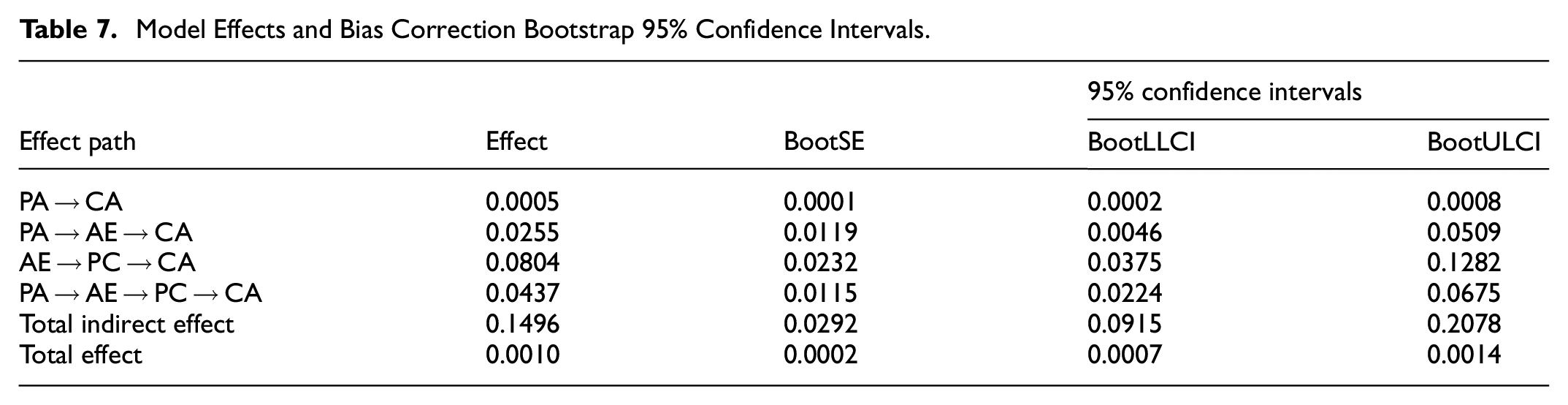
The results of the Bootstrap analysis indicate the following: The direct effect of physical activity on career adaptability was estimated at 0.0005 (95% CI = [0.0002, 0.0008]). The indirect effect through physical activity effectiveness as a mediating variable was 0.0255 (95% CI = [0.0046, 0.0509]), while the indirect effect through psychological capital as a mediating variable was 0.0804 (95% CI = [0.0375, 0.1282]). Additionally, the chain indirect effect involving both physical activity effectiveness and psychological capital as mediators was 0.0437 (95% CI = [0.0224, 0.0675]). The total of all indirect effects was 0.1496 (95% CI = [0.0915, 0.2078]), demonstrating a significant chain mediation effect in the relationship between physical activity and career adaptability through physical activity effectiveness and psychological capital. Specifically, the mediating effect of physical activity effectiveness accounts for 17.1% of the total effect, the mediating effect of psychological capital accounts for 53.7%, and the chain mediating effect accounts for 29.2%. The 95% confidence intervals for all three mediating pathways do not include zero, confirming the statistical significance of these mediating effects.
Further validation of the hypothesized model’s fit was conducted using AMOS 24.0, as illustrated in Figure 2. The model fit indices are as follows: χ2/df = 4.2225, RMSEA = 0.078, GFI = 0.903, CFI = 0.908, IFI = 0.909. According to W. Wu et al. (2009), these indices suggest that the model demonstrates an acceptable fit to the data, with all indices meeting or exceeding the recommended thresholds (χ2/df ≤ 5.00, RMSEA ≤ 0.08, GFI ≥ 0.90, CFI ≥ 0.90, IFI ≥ 0.90). Thus, the model is deemed to fit the data well, supporting the robustness of the observed mediation effects.
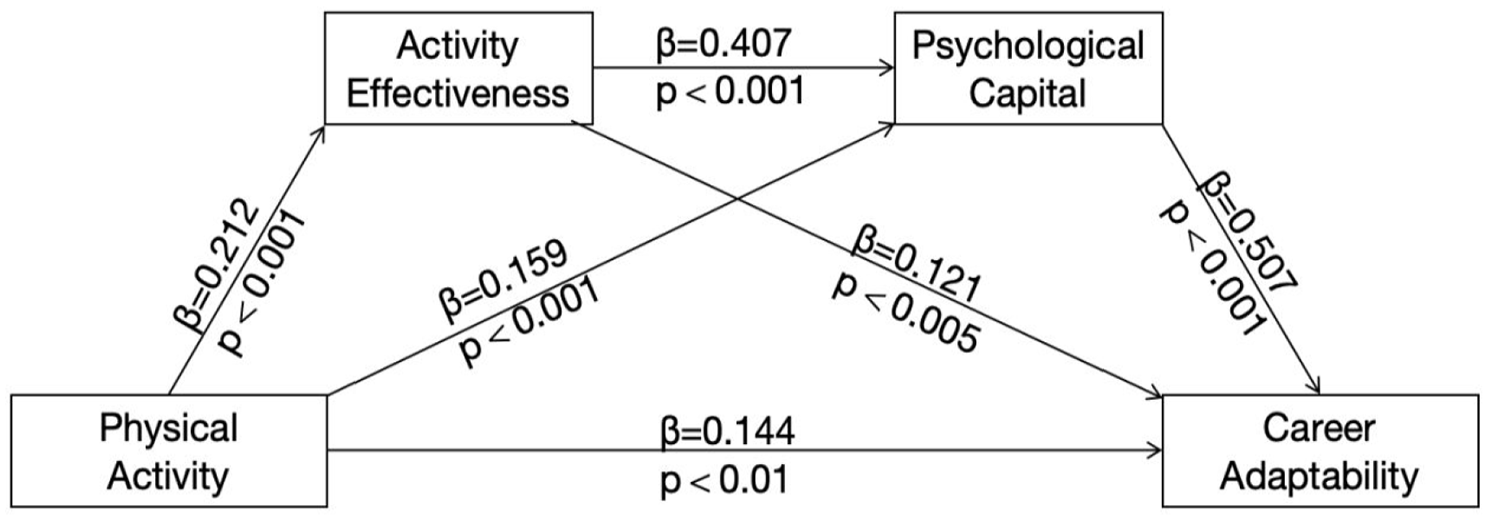
The chain mediating model of sports activities affecting university students’ career adaptability.
Discussion
Analysis of the Direct Effect of Physical Activity on Career Adaptability
Upon verification, research has found a positive correlation between university students’ participation in physical activities and their career adaptability, indicating that physical activities can positively predict the level of career adaptability among university students. This result confirms our first research hypothesis. Previous studies have also yielded similar conclusions. Although physical activities show significant positive associations with career concern, career control, career curiosity, and career confidence, the relationship between physical activities and career concern, as well as career control, is relatively weak yet still significant. Specifically, greater intensity of physical activities is associated with higher levels of individual career concern and career control. In career adaptability theory, career concern is considered the most crucial dimension, referring to the degree of individuals’ concern about their future careers. Therefore, a positive career attitude is paramount. From the perspective of physical activities, actively engaging in different types of exercise and exploring various intensities of physical activities contribute to cultivating this positive career attitude.
Additionally, individuals’ concern and attitude towards their careers directly impact their career development. For instance, research by S. F. Chang (2019) and D’zurilla et al. (2003) indicates that adolescents who hold positive attitudes towards the future are more likely to succeed academically and in their careers by effectively problem-solving. Therefore, maintaining a positive attitude towards physical activities is also crucial. If university students have a negative attitude towards participating in physical activities, they are less likely to engage in them proactively.
Therefore, active participation in physical activities by university students has a positive impact on their career adaptability. Encouraging university students to intensify their engagement in physical activities can promote their scores in career concern, career control, career curiosity, and career confidence, thus enhancing their level of career adaptability. Brown et al. (2021) explored how the choice of physical activities can assist in enhancing the employability of university students. They employed qualitative content analysis of focus group discussion records, focusing on students’ descriptions of career adaptability behaviors and dimensions (concern, control, curiosity, and confidence). The study also found that applying career construction theory can explain the motivation and interest of university students in engaging in activities that support the transition from university to work. Thus, Hypothesis 1 is supported, indicating that physical activity positively predicts career adaptability among university students.
Analysis of the Mediating Role of Physical Activity Effectiveness
According to the findings of this study, university students actively engage in physical activities with the specific aim of achieving certain physical activity effectiveness. The research results demonstrate that these physical activity effectiveness mediate the impact of physical activities on university students’ career adaptability. Therefore, the second research hypothesis proposed earlier is confirmed here. This strongly suggests that increasing both the quantity and intensity of physical activities can enhance physical activity effectiveness, thus improving university students’ level of career adaptability. Furthermore, there are significant positive correlations between different intensity levels of physical activities and various aspects of career adaptability. As physical activities and their outcomes strengthen, university students’ confidence in their future prospects also gradually increases.
A study by S. Y. Lee and Shim (2016) explored the relationship between extracurricular physical activity, self-competence, and career adaptability. The study found that extracurricular physical activity experiences were significantly related to students’ curiosity about career fitness, and that extracurricular physical activity also had a significant impact on students’ self-competence in career adaptability. Participation in physical activity is an ongoing process, and university students first need to be confident in themselves that they will be able to achieve the desired results of their activities. Through long-term self-affirmation, they build up sufficient self-confidence within themselves. As a result, when university students face unknown career tasks or make career decisions, they show positive and confident attitudes. Monteiro and Almeida (2015) analyzed the relationship between extracurricular physical activities and career adaptability among 406 graduate students. The research findings indicated that active participation in sports activities during higher education, which allows for experience accumulation and the development of career adaptability, is crucial in helping graduates successfully transition into professional environments.
Career Construction Theory (CCT) posits that an individual’s career development depends on their readiness for, resources within, and responses to their environment. Therefore, the ability to adapt to environmental demands is influenced by both interpersonal and intrapersonal factors. Compared to traditional 4-year university students, these individuals face varying degrees of educational obstacles. Therefore, Gregor et al. (2021) conducted research within the framework of CCT to investigate the relationship between motivational characteristics and career adaptability among different university student samples. The study found that individuals’ growth initiative and motivational characteristics impact university students’ career adaptability. Thus, initiative is crucial for university students’ career adaptability. By cultivating university students’ active participation in physical activities, they can autonomously attain the outcomes of these activities, thereby enhancing their career adaptability. Career adaptability refers to individuals’ readiness and ability to handle unknown career tasks, roles assumed, and respond to career changes or challenges. This capability results from interactions between individuals and their environment and is instrumental in advancing individuals’ abilities, which can be nurtured and facilitated. Physical activities, by enhancing physical activity effectiveness, contribute to improving university students’ levels of career adaptability. Thus, Hypothesis 2 is validated, demonstrating that the physical activity effectiveness has a partial mediating role between physical activity and career adaptability among university students.
Analysis of the Mediating Role of Psychological Capital
Based on previous research findings, physical activity has a positive predictive effect on the formation of psychological capital, which in turn has been demonstrated to positively influence career adaptability. Additionally, this study found that psychological capital partially mediates the relationship between physical activity and career adaptability. Therefore, these research results support the previously proposed hypothesis 3. Furthermore, there are significant positive correlations between physical activity and the dimensions of career adaptability. University students’ engagement in physical activities is associated with increased levels of psychological capital and decreased levels of negative emotions. This suggests that participation in physical activities helps cultivate individuals’ levels of self-efficacy, resilience, hope, and optimism in psychological capital. The enhancement of psychological capital levels contributes to improving individuals’ positive emotions and career adaptability levels. Therefore, through effective psychological health education for university students to enhance psychological capital levels, it is possible to effectively promote the cultivation of career adaptability through physical activities. These research findings provide valuable theoretical support for exploring the impact of physical activities on career development and offer important guidance for developing relevant psychological health education measures.
According to Y.-C. Wang et al. (2023), the mediating role of psychological capital in the relationship between physical exercise and university students’ sense of life meaning has garnered significant attention. The research indicates that physical activities has a significant predictive effect on university students’ sense of life meaning. Specifically, physical activities does not independently influence university students’ sense of life meaning through hope alone but can indirectly impact it through psychological capital alone. Furthermore, physical activities can indirectly influence university students’ sense of life meaning through a chain mediation effect of hope and psychological capital, emphasizing the critical mediating role of psychological capital in this process. Additionally, studies have shown that the mechanisms by which physical activities enhances psychological capital can be explained in two ways: Firstly, most physical activities involve collective participation, allowing individuals to interact with peers, receive social support, and thereby enhance positive psychological capital levels (Chen et al., 2022; Iso-Ahola & Park, 1996; Y. Sun, 2023). Secondly, even when individuals engage in physical activities alone, improvements in flexibility, strength, and endurance contribute to enhancing psychological capital abilities such as optimism and self-efficacy (Jayakody et al., 2014). Furthermore, research has explored the mediating role of psychological capital in the relationship between career adaptability and occupational success. The research results demonstrate a direct positive correlation between psychological capital and occupational success, while also showing an indirect influence on occupational success through career adaptability. Additionally, enhancing career adaptability, such as concern, sense of control, curiosity, and confidence, helps fully utilize psychological capital resources and promotes success in one’s career (C. Sun et al., 2023; Zyberaj et al., 2022).
Through the positive influence of psychological capital, university students consciously persist in participating in physical activities and gain mental toughness and optimism from them. This sense of achievement and positive psychological capital subconsciously influence the physical and mental health of university students, and significantly enhance their level of career adaptability. The enhancement of career adaptability by physical activities is a complex process, which is influenced by many factors, among which psychological capital is one of the important influencing factors. Therefore, universities should pay more attention to physical activities, encourage students to actively participate, create positive emotions, and cultivate a high level of psychological capital in order to enhance the career adaptability of university students.
Thus, the chain-mediated effect between physical activity, physical activity effectiveness, psychological capital, and career adaptability emphasizes the importance of how participation in physical activity affects career adaptability. This chain-mediated effect highlights the importance of promoting physical activity in fostering positive physical activity effectiveness and psychological capital, which ultimately contributes to university students’ career adaptability. Thus, Hypothesis 3 is validated, indicating that psychological capital has a partial mediating effect between physical activity and career adaptability among university students.
Analysis of the Role of Chain Mediation
This study proves that there is a significant positive correlation between physical activity and psychological capital, and the two can play a chain mediating role in the influence of physical activity on university students’ career adaptability, which verifies the previous research hypothesis 4. The physical activity effectiveness plays a good role in promoting the psychological capital, and provides a theoretical basis for the later enhancement of the psychological capital of university students reference. The findings of Y. Li and (2017) are consistent with the present study, pointing out that the physical activity effectiveness of university students is positively correlated with psychological capital and has an impact on psychological capital in terms of self-efficacy, hope, resilience, optimism and so on. Therefore, in order to promote the healthy development of university students’ psychological health and cultivate comprehensive talents, positive ways should be taken to guide the differences in university students’ psychological capital, further promote its benign development, and choose the appropriate educational methods according to individual differences in order to achieve good results in physical activity.
Although university students have different expectations of the physical activity effective, it positively affects psychological capital and promotes its enhancement regardless of the aspect of the effect. Studies have shown that developing career adaptability from freshman year helps to improve self-efficacy, which in turn enhances well-being (Atitsogbe et al., 2019; Lodi et al., 2020). It has also been shown that physical activity have a positive effect on the dimensions of individual psychological quality, and the enhancement of positive psychological capital is important for students’ personal and school competitiveness, as well as for the development of society. At the same time, the effect of physical activity can also affect the level of students’ psychological capital (Belcher et al., 2021; Folkins & Sime, 1981). In addition, Yu and Wang’s (2023) study found that self-identity had a significant contributing effect on high school students’ sense of meaning in life and could be enhanced by improving positive psychological capital and career adaptability. These findings inspire effective ways to enhance students’ sense of meaning in life.
Thus, the chain-mediated effect between physical activity, physical activity effectiveness, psychological capital, and career adaptability emphasizes the importance of how participation in physical activity affects career adaptability. This chain-mediated effect highlights the importance of promoting physical activity in fostering positive activity effectiveness and psychological capital, which ultimately contributes to university students’ career adaptability. Therefore, the research hypothesis 4: there exists a chain mediation path of “physical activity → physical activity effectiveness → psychological capital → career adaptability of university students” is verified.
Limitations and Suggestions for Future Research
The study used a questionnaire to measure the level of physical activity, physical activity effectiveness, psychological capital, and career adaptability, in which the physical activity effectiveness questionnaire is a subjective evaluation, and the student’s attitude in filling out the questionnaire determines the accuracy of the survey results. Moreover, the survey data in the study came from Jiangxi Province, China, and there was no data from other provinces, so the scope of this study was not comprehensive enough, and lastly, this study was a cross-sectional study, which only discussed and analyzed the relationship between the variables, and did not explore in depth the causality between the variables, and therefore could not provide support for determining the resultant relationship.
Based on the limitations of the study, the scope of the study should be enlarged in future research, and questionnaire surveys should be conducted in universities in other provinces of China. And in the process of filling out the questionnaire, students are urged to fill out the questionnaire carefully, so that the data collected will be more scientific and reasonable. Finally, the results of this study can be applied to practical research in future studies to investigate the intervention program of the effect of university students’ physical activity on career adaptability. Future research may use longitudinal design and multi-source data to discover the causal relationships between the variables presented in the model and determine their effects on university students’ career adaptability.
Implications
Based on the findings of this study, there are three effective ways to enhance university students’ career adaptability: increasing participation in physical activity, improving the effectiveness of physical activity, and boosting psychological capital. These factors not only have a direct positive impact on career adaptability but also promote students’ overall development in multiple ways. First, increasing participation in physical activities and improving the outcomes of these activities can help students better cope with physical and psychological pressures, thereby indirectly enhancing their career adaptability. Engaging in physical activity not only contributes to better physical health but also strengthens psychological capital (such as self-confidence and stress management abilities), which in turn enhances students’ capacity to adapt to career development. This allows students to develop more self-regulation skills in the face of a complex job market, enabling them to plan their career paths more effectively. Second, the enhancement of psychological capital plays a crucial role in improving career adaptability. Psychological capital comprises key elements such as self-efficacy, hope, optimism, and resilience. These factors enable students to better understand themselves and more effectively interpret external environments, thus strengthening their ability to face challenges in the job market. In particular, given the increasingly competitive employment landscape, the psychological pressure faced by university students is mounting. Enhancing psychological capital can effectively alleviate this pressure, helping students to build a more positive and stable mindset, which allows them to make more mature and flexible decisions in their career choices and development. Finally, improving career adaptability not only helps students gain a clearer understanding of their personal career goals but also sharpens their insights into the career environment. In this process, students can more clearly identify their strengths and weaknesses, while also gaining a better understanding of the requirements the external environment imposes on their future career development. This enhanced awareness is crucial for better integrating into society and adapting to future career changes. For higher education institutions, promoting the career adaptability of students is not only beneficial in improving their employment quality but also expands their career development pathways, thereby equipping them with a competitive advantage in an increasingly challenging job market.
Conclusion
In terms of improving the level of university students’ career adaptability, this study specifies three effective paths: (1) physical activity → physical activity effectiveness → career adaptability; (2) physical activity → psychological capital → career adaptability; (3) physical activity → physical activity effectiveness → psychological capital → career adaptability. The improvement of university students’ career adaptability comes from the improvement of physical activity effectiveness and psychological capital level. And when the amount of physical activity is larger and the intensity level is higher, the physical activity effectiveness and the level of psychological capital also increase. Physical activity has an important role in promoting the process of career adaptability in university students. Therefore, when choosing the form of physical activity to enhance career adaptability, universities can choose physical activities with high activity volume and high-intensity levels. In the whole process of participating in physical activities, the efficient activity effect is acquired, and the positive psychological state of the individual is also enhanced, that is, the sound will complete frontal personality, harmonious interpersonal relationship, correct self-assessment, rapid adaptability, and other such good social qualities, which will lead to the enhancement of university students’ career adaptability, and therefore, they will be able to more efficiently adapt to and cope with the unknown career tasks, and to promote their career development.
Footnotes
Acknowledgements
The author(s) gratefully acknowledge the university students who participated in this study. Their cooperation and valuable contributions were essential to the success of this study.

Ethical Considerations
This study was approved by the Ethics Committee of the University of Malaya (UM.TNC2/UMREC_2731).
Funding
The author(s) received no financial support for the research, authorship, and/or publication of this article.
Declaration of Conflicting Interests
The author(s) declared no potential conflicts of interest with respect to the research, authorship, and/or publication of this article.
Data Availability Statement
The data used in this study will be made available to other researchers upon publication of this article, to facilitate further research and validation. For inquiries regarding data access and retrieval, please contact the authors for detailed information.