




Abstract
The main aim of this study is to examine the mediating effect of psychological capital (PsyCap) on the relationship between proactive personality and academic performance among undergraduates. A quantitative approach with a cross-sectional study was employed. The sample consisted of 390 undergraduate students from Malaysian private universities. Partial Least Square-Structural Equation Modeling was used to confirm the proposed research model and test the hypotheses. Results revealed that proactive personality explained a significant proportion of the variance in PsyCap. Further, PsyCap partially mediated the relationship between proactive personality and academic performance. This study concluded that PsyCap could serve as personal resource to improve students’ academic performance. The findings of this study offer valuable theoretical and practical implications. The university’s management and academic staff need to work together to design effective training interventions and activities that can promote undergraduates’ proactive personality and PsyCap.
Plain language summary
This study aims to examine and understand how proactive personality and psychological capital of undergraduate students influence its academic performance. A total of 390 students participated in the survey. The data was analyzed using Smart PLS software version 3. The proposed model and hypotheses were confirmed using Partial Least Square structural equation modeling. Results indicate that psychological capital partially mediates the relationship between proactive personality and academic performance among undergraduate students. Thus, this study provides several insights to various stakeholders such as lecturers/instructors, students and university’s management on how to improve student performance.
Keywords
Introduction
Academic performance is considered as one of the most important outcomes in the context of higher education (Nambudiri et al., 2019). Previous studies have shown that academic performance is a crucial predictor of a student’s future educational attainment, employment, and earning potential (J. Liu et al., 2020; Ruiz et al., 2018; Sánchez-Cardona et al., 2021). As students are the primary stakeholder in education, continuous efforts are required to enhance their scholastic achievement. Furthermore, these efforts may help to reduce the attrition rate among university students caused by poor academic performance (Sánchez-Cardona et al., 2021). Additionally, academic performance is an essential indicator for comparing education quality across countries (J. Liu et al., 2020). Therefore, predicting academic performance has become a priority and a central objective for various stakeholders including students, parents, lecturers, university administrators, researchers, and policymakers (Martínez et al., 2019; Nambudiri et al., 2019).
Over the years, a wide range of predictors of academic performance has been documented in the literature, including intellectual ability and non-intellective factors (Richardson et al., 2012). Individual differences, such as dispositional personality traits and motivational factors, are among the important antecedents of one’s academic performance (Richardson et al., 2012). The recent emerging concept of psychological capital (PsyCap) provides additional insight into the determinants of one’s performance (F. Luthans, 2002). PsyCap is a higher-order construct, consisting of four major psychological resources, namely hope, self-efficacy, resilience, and optimism (acronym “HERO”; F. Luthans et al., 2007; F. Luthans & Youssef, 2004).
Avey (2014) explained that PsyCap is domain-specific. The analysis of PsyCap core construct and its consequences in the work domain are more commonly found in the literature as compared to non-work domains (Avey, 2014). PsyCap has been widely studied in work settings across sectors (Carmona-Halty et al., 2021; X. Liu et al., 2021). Generally, PsyCap is well recognized for its contributions toward favorable employees’ behavior, attitudes, well-being and performance (Avey et al., 2011; Youssef-Morgan & Luthans, 2015), career success (Turban et al., 2017; Yang & Chau, 2016), and work engagement (Chong et al., 2021; Lv et al., 2018). The growing interests in studies related to PsyCap is in line with the development of positive psychology, which focuses on the development of human strengths that can generate positive outcomes (Seligman & Csikszentmihalyi, 2000). Meanwhile, some researchers (e.g., B. C. Luthans et al., 2012, 2014) have addressed the important role of PsyCap in explaining students’ academic performance. Aside from being a valuable personal resource in promoting positive academic outcomes (K. W. Luthans et al., 2019), PsyCap plays a role in ameliorating problems of academic burnout (Wang et al., 2021).
Developing PsyCap among undergraduate students is essential, not only for their academic performance but also for strengthening their abilities to face challenges in the workplace. As such, more empirical studies on the link between PsyCap and academic performance among university students are necessary to design appropriate interventions to foster their internal capabilities. Thus far, the evaluation of PsyCap among students is still limited compared to employees’ PsyCap (B. C. Luthans et al., 2012, 2014). Furthermore, F. Luthans et al. (2015) urged for more studies on PsyCap in different cultural contexts. Additionally, this study also enables the examination on the validity of higher-order PsyCap construct among Malaysian students.
Next, it is interesting to note that previous studies have paid little attention to analyzing the factors that lead to the formation of PsyCap (Avey, 2014; Avey et al., 2011). Recently, F. Luthans and Youssef-Morgan (2017) pointed out that trait-like individual differences (e.g., personality traits) can serve as the precursors of PsyCap. In this regard, proactive personality has been highlighted as one of the key drivers in shaping an individual’s PsyCap (Avey, 2014; F. Luthans et al., 2015).
In tertiary education, students are expected to demonstrate initiative and proactivity in their approach to studying (Geertshuis et al., 2014). This is particularly important as students with a proactive personality are more likely to engage actively in autonomous learning, which can deepen their knowledge and equip them with the ability to independently solve problems. Such personal characteristic is highly valued in the job market. On the other hand, students who are passive or less proactive tend to rely solely on instructions, wait for answers, and only take action when problems arise. Consequently, they may experience low levels of motivational that can affect their performance (Parker et al., 2010). It is therefore not surprising that many educators express their concern about the level of proactivity among university students.
Generally, the influence of personality traits on academic performance is widely recognized (Richardson et al., 2012). For instance, a substantial body of research can be found between Big Five Personality traits and students’ academic performance (McCredie & Kurtz, 2020; Stajkovic et al., 2018; Zhou, 2015). In comparison, there is only a handful studies that focuses on the implications of proactive personality on academic outcomes (Geertshuis et al., 2014; Ng et al., 2019; Zhu et al., 2017). Meanwhile, others acknowledged the salient contribution of proactive personality on job and innovative performance at work (Bakker et al., 2012; Fuller & Marler, 2009; Ullah et al., 2024).
Although the previous studies have found a positive direct effect of PsyCap and proactive personality on students’ academic achievement, there is a research gap that needs to be addressed. Existing studies have not provided a comprehensive understanding of the interplay between PsyCap, proactive personality, and academic achievement. We argued that the state-like psychological resource (PsyCap) can serve as underlying mechanism linking personality trait and academic achievement. This research aligns with the call by Luthans and Youssef-Morgan (2017) for more scientific investigations on the mediating role of PsyCap. Empirically, several studies have shown that emotion, grit, and components of the Big Five personality traits explain academic performance indirectly through PsyCap (Carmona-Halty et al., 2021; K. W. Luthans et al., 2019; Nambudiri et al., 2019).
Despite these studies, the extent to which proactive personality would explain academic performance via PsyCap has not received adequate attention in the past. Hence, this study intends to fill the gap by examining the mediating effect of PsyCap between proactive personality and academic performance among undergraduate students. This study is significant in contributing to the emerging body of positive psychology literature by integrating PsyCap as a mediator of the relationship between proactive personality and academic performance. Additionally, this study is pivotal in providing empirical evidence about the antecedent and mediator of academic performance and its applicability in a university setting, Furthermore, this study is also making it possible to develop evidence-based future interventions designed to improve students’ academic performance through proactive personality and PsyCap.
Literature Review
Psychological Capital
PsyCap is a multidimensional construct described as a person’s positive psychological state of development, which can be depicted through four key characteristics: self-efficacy, optimism, hope, and resilience (F. Luthans & Youssef, 2007). Self-efficacy encompasses an individual’s belief or confidence in their ability to complete a particular task. Self-efficacious individuals are willing to make necessary efforts and determine the best course of action to facilitate successful goal attainment (F. Luthans, 2002). Next, optimism refers to one’s inclination to believe in positive outcomes for now and in the future (F. Luthans & Youssef-Morgan, 2017). Thirdly, hope is a person’s perseverance in pursuing specific goals and, when necessary, redirecting their paths to accomplish the goals and head toward success (F. Luthans, 2002). Lastly, resilience refers to the ability of an individual to bounce back quickly and effectively from adversities, uncertainties, challenging circumstances, or failures (F. Luthans & Youssef-Morgan, 2017). All these four components can be treated as personal resources that are important predictors of students’ academic performance and success (Martínez et al., 2019).
F. Luthans and Youssef (2007) further clarified the concept of PsyCap by introducing a state-trait continuum to explain different psychological characteristics and resources based on their malleability or flexibility toward change and development. PsyCap is regarded as a state-like resource that can be changed through short-term training interventions. In contrast, trait-like characteristics cover the personality factors that are relatively stable and not easy to change, especially among adults. On the other hand, pure traits are inherited or genetically based (e.g., physical characteristics and intelligence) which are unlikely to be changed, as opposed to positive states that are susceptible to change (e.g., happiness and positive moods; F. Luthans & Youssef, 2007; F. Luthans & Youssef-Morgan, 2017).
Despite being a relatively novel concept, PsyCap was found to be beneficial to the education sector, specifically to students at various levels of education. Past empirical studies demonstrate that PsyCap is effective in improving students’ academic adjustment (Liran & Miller, 2019), academic achievement (Carmona-Halty et al., 2021), and wellbeing (Poots & Cassidy, 2020). Additionally, PsyCap could serve as a form of motivation that enhances students’ learning capabilities, resulting in them achieving better academic performance in school (Da Costa et al., 2021). Datu et al. (2018) argued that students who experience positive PsyCap tend to engage with their study cognitively and affectively. For instance, students who cognitively appraise their situation and probability of success more positively are more likely to be motivated to put more effort and to have greater determination to succeed in their studies.
Psychological Capital and Academic Performance
Prior studies have demonstrated that PsyCap can positively influence behavior and performance at both the individual and organizational levels (F. Luthans et al., 2010; F. Luthans & Youssef-Morgan, 2017). However, there is a scarcity of research exploring the relationship between PsyCap and academic achievement in non-Western countries (Datu et al., 2018; Nambudiri et al., 2019). Datu and Valdez (2016) indicated that students with positive PsyCap are motivated and dedicated to their studies, leading to better academic outcomes. Students with positive PsyCap also portray greater confidence in attaining their academic goals. Martínez et al. (2019) further provided evidence that PsyCap would provide students with a sense of belief in their capabilities to overcome obstacles, learn from their mistakes and be able to bounce back by using different techniques and strategies to achieve their academic goals. As indicated by Ortega-Maldonado and Salanova (2018), PsyCap is a state-like positive psychological construct that motivates students to be highly involved in their study activities such as completing an assignment, preparing for the examination, and attending classes.
PsyCap was found to be a more powerful predictor of performance outcomes than its four constituent dimensions individually (F. Luthans et al., 2007), as it appears to have synergistic effects that enable the generation of broader and stronger cognitive and motivational processes. These effects can enhance one’s performance in both workplace and academic settings. Poots and Cassidy (2020) further indicated that someone who is hopeful, optimistic, resilient, and efficacious would believe that they have sufficient resources to cope with academic stress and achieve a better academic outcome. For instance, students who possess a greater sense of PsyCap are more motivated and better equipped to cope with academic challenges and perform better in the long run (Ayyash-Abdo et al., 2016; Day et al., 2010; Honicke & Broadbent, 2016; Richardson et al., 2012). Conversely, students with low confidence are less likely to persist in the face of obstacles and perform better academically. Therefore, we argue that students with high levels of PsyCap can positively influence academic performance by enhancing motivation, engagement, coping strategies, and attitude toward learning. Henceforth, the following hypothesis is proposed:
H1: Students’ psychological capital is positively related to academic performance.
Proactive Personality and Psychology Capital
Bateman and Crant (1993) were the first to offer a definition of proactive personality. Proactive personality is a relatively stable personality trait that describes “one who is relatively unconstrained by situational forces and one who effects environmental change” (Bateman & Crant, 1993, p. 105). In contrast to passive individuals, proactive individuals are self-directed and future-oriented, taking personal initiative and demonstrating proactive behavior. They actively seek potential opportunities and take the initiative to make changes to improve existing situations or themselves (Bateman & Crant, 1993).
Cai et al. (2015) contend that individuals with a positive proactive personality are more likely to have stronger self-esteem and put more effort into pursuing personal goals. Additionally, students with high proactive personality tend to seek or seize opportunities once they perceive them (Mustafa et al., 2016). They are more energetic in their learning, able to cope with stress, and solve complex problems (Kong et al., 2021).
Previous studies have found that students with a proactive personality are not only motivated to learn, but also tend to perceive a sense of self-efficacy in their learning (S. Liu et al., 2019; Zheng et al., 2020). Proactive personality is a stable trait that promotes confidence and frequency of proactive behavior over time (Geertshuis et al., 2014). This trait has also been found to play a role in mitigating the impacts of stress on academic performance (Zhu et al., 2017). Additionally, students with proactive personality are more likely to interact with others, including instructors, which can enhance their academic experiences and outcomes (Zheng et al., 2020).
Personality traits, such as proactive personality, have a paramount function in explaining state-like resources like psychological capital (PsyCap; Avey, 2014). This is parallel with the notion of the Conservation of Resources Theory (COR) of “resource caravans,” which explain that resources will build upon each other (Hobfoll, 2002). Students with proactive personality traits are capable of building and accumulating more resources (e.g., time and knowledge), leading to greater PsyCap (DuBrin, 2013). Proactive students tend to foster hopeful thinking, seek additional sources of information, and actively look for feedback to enhance their understanding and prepare themselves better to face academic challenges. Moreover, their proactive thinking and behavior enable them to be more optimistic and resilient in the face of obstacles, setbacks, and stress in their academic lives. Based on the above reasoning, the following hypothesis is proposed:
H2: Proactive personality is positively related to students’ psychological capital.
The Mediating Effect of Psychological Capital
Martínez et al. (2019) indicated that PsyCap is a personal resource that enhances students’ capability and confidence in achieving academic performance. It could be served as an important mediator in the context of education (Bak et al., 2022; Clarence et al., 2021; Paul & Jena, 2022). Carmona-Halty et al. (2019) proposed that a student who accumulates personal resources, such as hope, efficacy, resilience, and optimism, is more likely to possess the specific skills and attitudes necessary to meet academic requirements and achieve academic success. Consistent with the COR theory, PsyCap may serve as a mediating mechanism between personality and academic achievement among students (Carmona-Halty et al., 2019; Nambudiri et al., 2019). Positive proactive personality can motivate students to learn effectively and provide greater personal resources to perform academic activities, resulting in better academic achievement (Chai et al., 2023; Lin et al., 2014; S. Liu et al., 2019; Zheng et al., 2020). When students are equipped with composite coping resources or positive PsyCap, they become more open-minded and eager to envision challenges and academic goals.
Previous research has shown that personality traits can affect an individual’s performance by influencing their motivation, such as self-efficacy and optimism (Frese & Fay, 2001; Richardson et al., 2012). A recent study by Da Costa et al. (2021) found that having a positive PsyCap can improve students’ learning abilities and academic performance. Specifically, students with a proactive personality are more likely to take initiative and achieve their academic goals, leading to better academic performance. These proactive individuals also tend to be emotionally stable and better equipped to handle stress, which further enhances their performance (Adil et al., 2020; Bateman & Crant, 1993; Carmona-Halty et al., 2021; Kong et al., 2021). Emotionally stable people tend to have greater resources, such as perseverance in achieving their personal goals (hope), reliance on their abilities (efficacy), overcoming challenges (resilience), and optimism about their future (optimism; Carmona-Halty et al., 2019), thereby further fostering their performance. Therefore, this study suggests that proactive personality indirectly predicts academic performance through academic PsyCap in students. In response to the main research objective, the following hypothesis is proposed:
H3: Psychological capital mediates the relationship between proactive personality and academic performance among the students.
Proposed Research Model
Based on the above literature argument and discussion, a research model is proposed, as presented in Figure 1.

Proposed research model.
Method
Research Procedure
A quantitative study was employed for this research, where a self-administered questionnaire was used to collect responses from the targeted participants. The target population consisted of undergraduate students pursuing their studies in private universities in Malaysia. The sample was selected based on three criteria: (1) the students must be full-time undergraduate students in the selected university; (2) they must not be exchange students, and (3) they must have studied for at least one trimester in the university. Prior to the fieldwork, the researchers obtained permission from the deans of different faculties to conduct the survey.
Sampling Technique and Estimation Technique
The quota sampling technique was used in this study, taking into account the proportion of the student population in each faculty of the university. Slater (1995) posited that collecting data based on a single university is sufficient to provide an accurate picture of a specific context. The recommended minimum sample size of 110 was calculated based on the guidelines set forth by J. F. Hair et al. (2017), which consider a statistical power of 80% and significance levels of 5%. To test the proposed research model, structural equation modeling was utilized. This approach is well-suited for estimating complex causal relationships between variables and can generate a high degree of statistical power (J. F. Hair et al., 2019).
Sample
The self-administered questionnaires were distributed to the students of selected lecture classes at the beginning of the class, and the participants were informed that the survey was voluntary. The questionnaires were collected at the end of the class. Unfortunately, quite a number of students did not return the questionnaires. As a result, only 408 out of 1,000 questionnaires were returned, and 8 were excluded due to incomplete information. As 10 cases of multivariate outliers were discovered during the data screening process, the final sample for analysis consisted of 390 cases. This study’s sample size (n = 390) surpasses the minimum sample size requirement, ensuring adequate power to detect the effect size of 0.15 and achieve statistical significance at 0.05.
The sample consisted of 146 (37.4%) male and 244 (62.6%) female students. The average age of the respondents was 21 years old. A total of 29.2% were first-year students, 31.8% were second-year students, 34.4% were third-year students, and 4.6% were fourth-year students. The majority of the students were from business faculties, with 177 students contributing 45.4% of the total samples. This was followed by science and engineering students with 124 students (31.8%), social science students (n = 58, 14.9%), and students from other fields of study (n = 31, 7.9%). In terms of entry qualifications, more than half of the sample were from foundation programs (n = 229, 58.7%), followed by Unified Examination Certificate (UEC; n = 27, 6.9%), diploma qualifications (n = 20, 5.1%), A-levels (n = 15, 3.8%), and other qualifications or transfers from other institutions (n = 99, 25.4%).
Measures
The measures for the key constructs in this study were based on scales established in existing literature. Pre-tests and pilot tests were conducted before the actual study to ensure the content validity and reliability of the measures used. The questionnaire was designed in English language. In Malaysian private universities, English is the primary medium of instruction and communication, and students are required to meet a certain level of English proficiency to enroll. Therefore, it was not a concern for students to answer the questionnaire, which was designed in English.
The academic performance of undergraduates was measured using cumulative grade point average (CGPA). According to Richardson et al. (2012), CGPA provides the most reliable proxy of undergraduate students’ academic performance as compared to grade point average (GPA). Students were required to indicate their CGPA in the questionnaire.
Proactive personality was measured by referring to a shortened version of Bateman and Crant’s (1993) scale (Seibert et al., 1999). Based on feedback obtained from experts during the pre-test, several items were slightly modified so that the description better reflects full-time undergraduate students’ personal initiatives in their studies. Consequently, the modified proactive personality scale was tested in a pilot test with a group of 60 undergraduate students. The results showed that the 6-item measure of students’ proactive personality demonstrated greater internal consistency (Cronbach’s alpha = .827) than the 10-item scale (Cronbach’s alpha = .618). Thus, the 6-item proactive personality scale by Parker (1998) was adopted. This 6-item scale was originally derived from the 17-item scale constructed by Bateman and Crant (1993).
Claes et al. (2005) and Teye-Kwadjo and de Bruin (2022) further added that the 6-item scale is able to demonstrate the most optimal factor solution. The examples of the revised items were “If I see something I don’t like, I fix it.”“No matter what the odds, if I believe in something I will make it happen.”“ I love being a champion for my ideas, even against others’ opposition.”, I am always looking for better ways to improve my studies”, “If I believe in achieving good results, no obstacle will prevent me from making it happen.,” and “I excel at identifying opportunities.” Each item in this measure is rated on a seven-point Likert scale anchored at strongly disagree (1) and strongly agree (7). Considering the modifications made on proactive personality items, principal component factor analysis with varimax rotation was performed via SPSS software prior to the assessment of the measurement model. The results show that all the six items were loaded in a single factor (item loadings between 0.660 and 0.831). The single factor explained 54.136% of the total variance with eigenvalue of 3.248, well above the 1.0 criterion.
PsyCap in the academic setting was adapted from B. C. Luthans et al. (2012). PsyCap is a multidimensional construct that consists of four dimensions: hope, optimism, resilience, and self-efficacy. The measure comprises 24 items, with six items for each dimension. Sample items include “I feel confident analyzing a long-term problem to find a solution concerning my studies” (self-efficacy), “I can think of many ways to reach my current goals regarding my studies” (hope), “When I have a setback with my studies, I will recover from it and move on” (resilience), and “I’m optimistic about what will happen to me in the future as it pertains to my study” (optimism). All items were measured using a seven-point Likert scale ranging from strongly disagree (1) to strongly agree (7).
As the data were collected through self-reporting questionnaires, it is important to examine common method bias to ensure that no single construct accounts for more than 50% of the covariance among the measures (Podsakoff et al., 2003). The results of an unrotated factor analysis indicate that the first factor accounted for 35.50% of the total variance explained, which is less than the threshold level of 50% recommended by Harman’s Single Test guideline (Podsakoff et al., 2003). Therefore, common method bias is not a concern, and the data can be used for further analysis.
Data Analysis
To analyze the proposed research model, we employed SmartPLS 3.0 software to perform Partial Least Squares-Structural Equation Modeling (PLS-SEM) analysis. We used a two-stage analytical approach (Anderson & Gerbing, 1988; Choong et al., 2020), in which the first step involved evaluating the measurement model, followed by examining the structural model. We used the PLS algorithm to determine the reliability and validity of the measurement model. To assess the structural model, we used the bootstrapping procedure with 5,000 re-samples, allowing us to determine several critical assessment criteria of the model, such as predictive power (R2), effect size (f2), and the significance of the path coefficients (J. F. J. Hair et al., 2014). The predictive relevance (Q2) of the research model can be obtained by conducting the blindfolding technique (Chin, 1998).
Measurement Model
The major validity tests of the measurement model are convergent validity and discriminant validity. Convergent validity is assessed based on item loadings, composite reliability, and average variance extracted (AVE). The factor loadings for the six-item scale exceeded the threshold value recommended by J. F. Hair et al. (2017). The AVE score for proactive personality (0.540) was greater than the minimum cutoff value of 0.500 recommended by J. F. Hair et al. (2017), while the composite reliability (0.874) and Cronbach’s alpha values (.827) surpassed the recommended minimum value of .708 (J. F. Hair et al., 2017).
PsyCap is a reflective-reflective higher-order model composed of four first-order constructs: hope, self-efficacy, resilience, and optimism. As shown in Table 1, we removed two items from the resilience construct (R4 and R6) and one item from the optimism (O2) construct from the measurement model. Although the composite reliability and Cronbach’s alpha values of the two constructs (resilience and optimism) initially surpassed .700 when we ran the PLS algorithm, we needed to remove items to meet the convergent validity requirement, as the initial AVE values of the two constructs were below .500. The item loading for R4 (“I usually take stressful things at a calm pace with regard to my studies”) was 0.558, and the item loading for R6 (“I feel I can handle many things at a time with my coursework”) was 0.539. We removed R6 first, followed by R4. This improved the AVE value from the initial 0.468 to 0.578. The factor loading of O2 (“If everything goes right for me with my coursework, positive impacts will be created”) was 0.629. By discarding O2, the AVE value for the construct improved from 0.483 to 0.543.
Convergent Validity and Reliability Results.
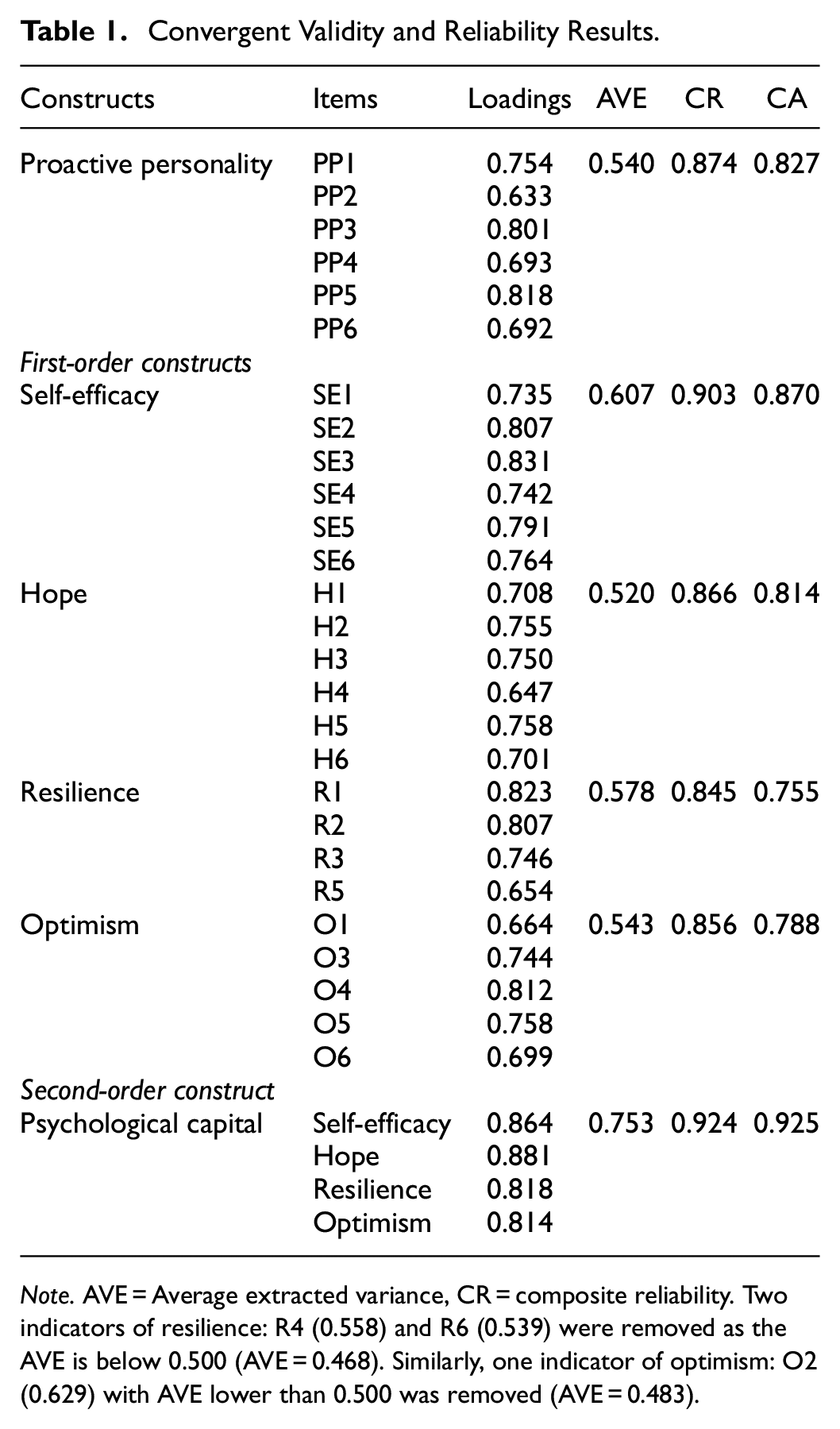
Note. AVE = Average extracted variance, CR = composite reliability. Two indicators of resilience: R4 (0.558) and R6 (0.539) were removed as the AVE is below 0.500 (AVE = 0.468). Similarly, one indicator of optimism: O2 (0.629) with AVE lower than 0.500 was removed (AVE = 0.483).
As a repeated indicator approach was used in the reflective PsyCap higher-order construct, we needed to calculate the AVE value of PsyCap by obtaining the average value of the total square root of each path coefficient (standard loading) toward PsyCap. The AVE of PsyCap is 0.753, which is acceptable. The composite reliability and Cronbach’s alpha values for each construct are well above the minimum threshold value of .700, as specified by Chin (2010). Based on these results, we can conclude that the measurement model possesses adequate convergent validity and reliability.
Discriminant validity was assessed using the Fornell and Larcker criteria (Fornell & Larcker, 1981) and the Heterotrait-Monotrait (HTMT) Ratio (Choong et al., 2024; Choong & Ng, 2023; Henseler et al., 2015). As depicted in Table 2, the square root of the AVE for each construct on the diagonal is at least 0.100 larger than the correlations between the key variables in this study. Table 3 shows that the HTMT values among the constructs range from 0.202 to 0.700, which is less than the conservative value of 0.850 (R. B. Kline, 2011) and the threshold value of 0.900 (HTMT.90; Gold et al., 2001). Additionally, Table 3 indicates that all the HTMT confidence interval upper limit values were less than 1.000 (J. F. Hair et al., 2017). Based on these results, we can conclude that each construct in this study was empirically distinct from the others, indicating that the measurement model has adequate discriminant validity.
Correlations and Discriminant Validity (Fornell-Larker Criterion).

Note. The diagonal represent the square root of AVE (bold), others are the correlations among the variables.
Discriminant validity-The Heterotrait-Monotrait Ratio (HTMT).
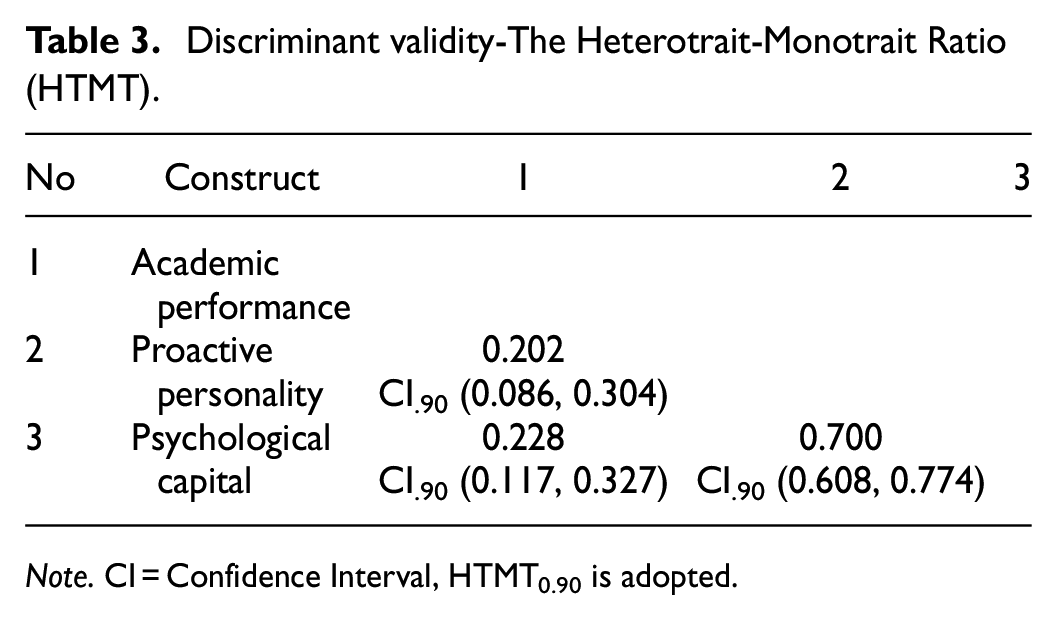
Note. CI = Confidence Interval, HTMT0.90 is adopted.
Structural Model
Table 4 and Figure 2 present the results of the structural model after performing a bootstrapping procedure with 5,000 resamples. The results show that PsyCap is positively related to academic performance (β = .177, t = 2.633, p < .01). Similarly, proactive personality is positively related to PsyCap (β = .621, t = 15.486, p < .001). Hence, Hypotheses 1 and 2 are supported. The results in Table 4 reveal that the R2 for PsyCap and academic performance are .386 and .051, respectively. This suggests that 38.6% of the variance in PsyCap can be explained by proactive personality, whereas 5.1% of the variance in academic performance can be explained by proactive personality and PsyCap. The predictive power on PsyCap is considered substantial, whereas for academic performance, it is regarded as small (Cohen, 1988). According to Cohen’s (1988) guidelines, the f2 value of 0.02, 0.15, and 0.35, respectively, represent small, medium, and large effect sizes. The results, as shown in Table 4, indicate that proactive personality has a substantial effect in producing the R2 of PsyCap (f2 = .020). On the other hand, PsyCap has a small effect in generating the R2 of academic performance (f2 = .628).
Path Coefficient, Effect Size and Predictive Relevance.

Note. PP = proactive personality; PsyCap = psychological capital; AP = academic performance; S.E. = standard error
p < .01. ***p < .001.
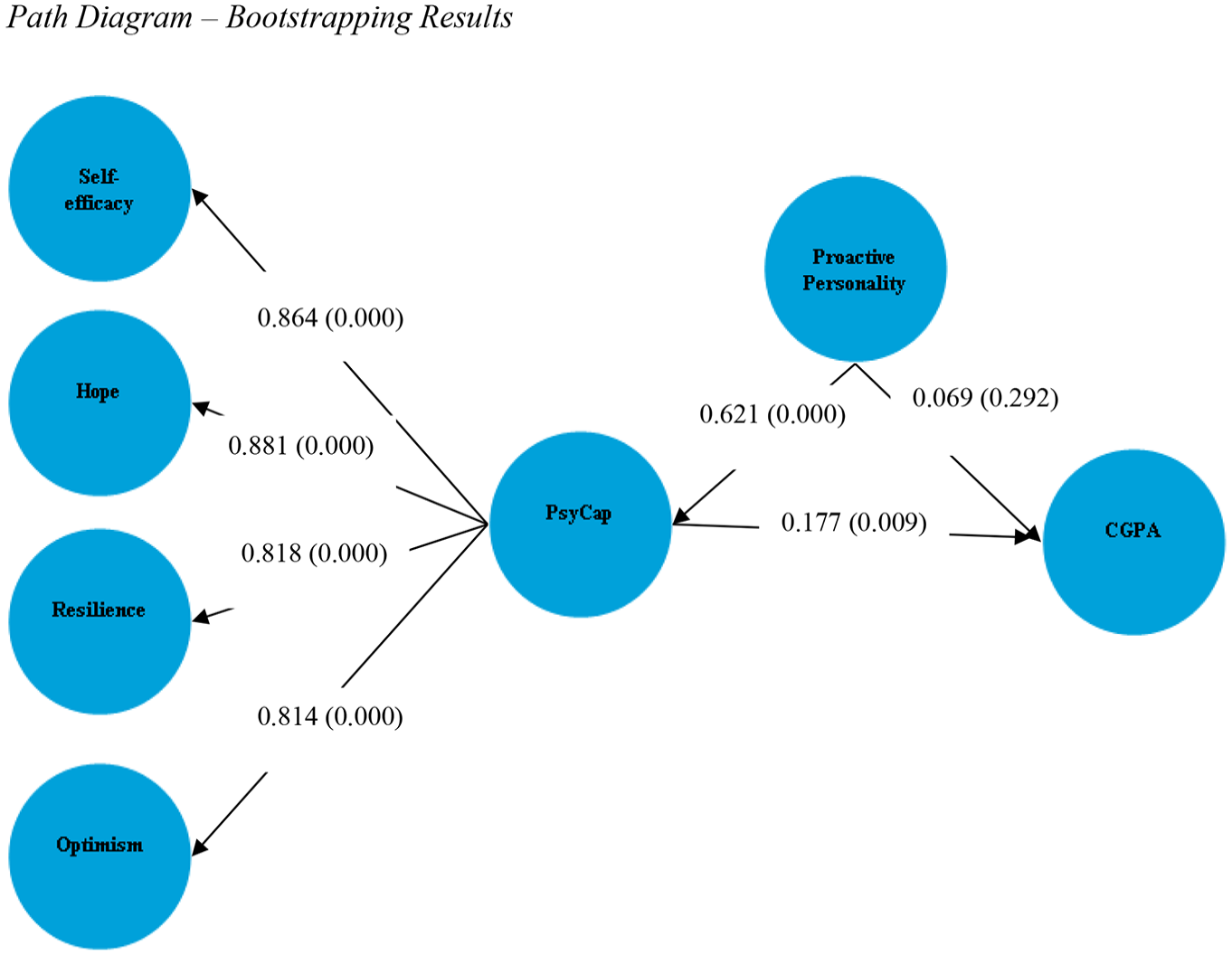
Path diagram—bootstrapping results.
The blindfolding technique was adopted to test the predictive relevance of PsyCap and academic performance (Geisser, 1974; Stone, 1974). Table 4 indicates that the Stone-Geisser’s (Q2) values for academic performance and PsyCap were 0.038 and 0.153, respectively, which were above the threshold of zero as suggested by J. F. Hair et al. (2011). Thus, it can be said that the model has adequate predictive relevance.
The results of the mediation analysis shown in Table 5 reveal that students’ PsyCap significantly mediates the relationship between proactive personality and academic performance (β = .110, t = 2.543, p < .001). Next, the variance accounted for (VAF) was calculated to determine the type of mediation in the model. The VAF value can be calculated by dividing the indirect effect with the total effect. Based on the rule of thumb, the VAF value of 80% and above indicates a full mediation. On the other hand, the VAF between 20% and 80% is regarded as partial mediation, and the VAF below 20% indicates no mediation exists (Choong & Ng, 2023; J. F. Hair et al., 2017). The determinant of the type or strength of the mediation effect based on the VAF value is appropriate since the model demonstrates a consistent mediating effect, whereby both the direct and indirect paths were positive (Nitzl et al., 2016). The VAF value of the present study is 61.45% indicated that the relationship between proactive personality and academic performance was partially mediated by PsyCap, thereby supporting H3.
Mediation Analysis.

Note. PsyCap = psychological capital; PP = proactive personality; AP = academic performance.
p < .05. **p < .01. ***p < .001.
Discussions
This study aimed to determine the direct effects of proactive personality on PsyCap and the influence of PsyCap on academic performance among undergraduate students. Additionally, this study considered the mediating effect of PsyCap between proactive personality and academic performance. As predicted, proactive personality was found to have a substantial influence on the development of PsyCap among undergraduate students. Thus, this study confirms that the positive relationship between proactive personality and PsyCap is not only applicable to professionals (Avey, 2014) but also to students in higher education institutions. The current findings support F. Luthans et al.’s (2015) argument that dispositional traits, such as proactive personality, are among the major contributors to the development of state-like psychological resources, such as PsyCap. Typically, students with a high level of proactive personality have a propensity for active involvement in negotiation, networking, information seeking, and feedback seeking (Ashford & Black, 1996; Geertshuis et al., 2014). They are problem solvers who find alternative ways to overcome difficulties and make decisions regarding their educational path. These characteristics reflect the importance of proactive personality in developing students’ PsyCap, which includes an optimistic outlook, confidence, hope, and the ability to recover well from adversity.
Additionally, it was found that students’ PsyCap and academic performance are positively related. Therefore, the results of this study are consistent with the findings of B. C. Luthans et al. (2012) and Jafri (2013). As contended by F. Luthans et al. (2010), PsyCap can serve as a fundamental source of motivation for individuals, enabling them to achieve their goals successfully. In light of the results of this study, it can be concluded that the motivational effect of PsyCap on students’ academic performance is applicable across different cultural contexts.
The mediation analysis results have revealed that PsyCap partially mediates the relationship between proactive personality and academic performance. Proactive personality significantly explains the variance in students’ academic performance in the absence of a mediator, that is, PsyCap. However, the direct effect between these two variables no longer exists once the mediator is included in the research model. These results are in line with the notion that personality traits can indirectly predict one’s performance via psychological resources or motivational constructs (F. Luthans et al., 2015; Richardson et al., 2012). Proactive individuals are future-oriented and take initiatives to make changes, challenging the status quo and persisting until changes occur (Crant, 1995; Parker et al., 2010). Therefore, proactive students can initiate a proactive motivational process (Parker et al., 2010), leading to higher academic PsyCap. Moreover, different resource theories, such as Hobfoll (2002) and Thoits (1994), recognize that personal resources or psychological resources, such as PsyCap, are crucial for individuals to mobilize their resources and achieve better outcomes.
In summary, proactive personality is key to developing high PsyCap among students, which in turn boosts their academic performance through conative, affective, cognitive, and social mechanisms (F. Luthans et al., 2015; F. Luthans & Youssef-Morgan, 2017). Undergraduates who demonstrate positive cognitive appraisals toward their academic-related matters have confidence in themselves, devote greater effort to their studies, and are more capable of handling multifarious academic demands. Apart from that, PsyCap induces positive emotions or positive affective states and promotes agentive conation, whereby students are goal-oriented. Furthermore, they are well-versed in planning and thinking of better ways to achieve better academic results. Additionally, proactive personality can strengthen individuals’ PsyCap social mechanism, as previous studies have shown that they are more actively engaged in the networking and socialization process (Ashford & Black, 1996; Geertshuis et al., 2014). This process can further shape different psychological capacities within themselves, which play a central role in augmenting students’ academic performance.
Implications
Theoretical Implications
The current study makes several noteworthy contributions to the existing literature. Firstly, the results from this study have confirmed previous findings and contributed additional evidence that the positive linkage between proactive personality and PsyCap is not only applicable to the work setting (Avey, 2014), but also applicable among full-time undergraduate students. Secondly, the present study reaffirms that the academic PsyCap higher-order construct is a valid measure that can predict academic performance in a non-Western cultural context. Finally, this study has not only responded to the call to investigate the predictors of PsyCap, which captured marginal attention from researchers (Avey, 2014), but the findings of this research have also provided additional insights that the relationship between proactive personality and academic performance was partially mediated by PsyCap.
Practical Implications
The findings of this study offer several practical implications to various stakeholders such as undergraduates, university management, and the Ministry of Higher Education. Specifically, the results show that PsyCap partially mediates the relationship between proactive personality and academic performance among undergraduates, revealing the mediating role of PsyCap in this relationship. Along with the results of the present study, proactive personality and PsyCap are two complementary psychological resources that can improve students’ academic performance. This indicates that measures need to be taken to foster proactive personality and PsyCap among undergraduates. These two personal qualities can be enhanced by offering training interventions and positive boosting strategies (Carmona-Halty et al., 2021; K. W. Luthans et al., 2019; Ortega-Maldonado & Salanova, 2018).
National Level
Given the importance of PsyCap in improving students’ academic performance, faculties should find ways to nurture students with an adequate level of PsyCap. Firstly, it is suggested that national higher education policies should emphasize the development of positive PsyCap, in addition to imparting knowledge and skills to students. Further, the Ministry could encourage universities to provide courses on proactive personality and psychological capital that equip students with the necessary knowledge and skills to foster these traits.
University Level
The university management can offer a series of tailored academic PsyCap development activities that have been practically proven to be effective in boosting students’ internal resources (F. Luthans et al., 2008; B. C. Luthans et al., 2014; K. W. Luthans et al., 2019). The experiment performed by B. C. Luthans et al. (2014) showed that a short PsyCap intervention (PCI) was effective in improving the business students’ PsyCap. In addition to classroom-based short PCI, such intervention can also be conducted online (F. Luthans et al., 2008).
Secondly, university management and individual academic staff are encouraged to adopt positive boosting strategies that can benefit students by intensifying their psychological resources (K. W. Luthans et al., 2019). Vicarious learning, interval coaching, and gamification techniques are among the positive boosting strategies that can be used in teaching and learning activities (K. W. Luthans et al., 2019). Sin and Lyubomirsky (2009) further indicate that the utilization of multiple positive boosting strategies can elicit more effective learning than a single positive boosting strategy. These positive boosting strategies could promote positive emotions that further improve psychological resources, which might help students achieve their academic outcomes (Carmona-Halty et al., 2021).
Building proactive personality can be a great challenge for academic staff, especially when dealing with students who are passive and spoon-fed. As such, universities and academic staff need to make efforts to create awareness among undergraduates that being proactive is important for their academic success in tertiary education, which emphasizes self-directed or autonomous learning. The self-directed learning approach requires students to take initiative compared to the more structured and dependent teaching and learning methods found in schools (Tan et al., 2013). Gao et al. (2020) further contend that the adoption of a student-centered culture could provide opportunities for students to think independently and train them to “think outside the box.” Lastly, universities and academic staff should provide opportunities for experiential learning. This can be done by giving students opportunities to apply their classroom learning to real-world scenarios, thereby aiding the development of a sense of agency and self-efficacy, crucial components of a proactive personality.
Individual Level-Students
Students’ proactive personality can be enhanced through soft-skill training interventions. Although the nature of a dispositional trait is relatively stable over time, it is still possible to alter students’ proactivity through well-designed training intervention programs such as proactive thinking training programs (Kirby et al., 2002). Academic staff who act as mentors/academic advisors or university counselors can identify the level of proactive personality among the students through a personality test, so that they can be advised to participate in training or activities that can enhance proactive thinking. Students with a proactive personality tend to have a positive attitude toward their lives with higher adaptability (Hu et al., 2021). Ultimately, they are more capable of coping with academic stress and challenges to attain better academic achievement and goals.
Limitations and Future Research
There are several limitations or shortcomings that need to be addressed in this study. Firstly, the cross-sectional nature of the present research precludes one from confidently drawing conclusions on the causality between the key variables. Future studies should adopt a longitudinal research design to infer the causal relationships among the variables in this study. Further, proactive personality and PsyCap training programs should be introduced, and studies can be conducted on the effectiveness of these interventions in improving students’ academic performance in the future. Next, the sample of this study consists only of undergraduate students from a single university, which may potentially limit the generalizability of the results. Future investigators can broaden the scope of the study by incorporating students from different private and public higher education institutions. Although self-report questionnaires are the most straightforward method of obtaining respondents’ personality information, as the respondents should know themselves best (P. Kline, 1993), such a method tends to be subject to social desirability bias. Therefore, future studies may need to adopt multi-source data collection (e.g., peers). Apart from proactive personality, other potential variables may be linked with academic performance indirectly through PsyCap; therefore, future investigators may extend the existing mediation model by incorporating other potential antecedents of students’ PsyCap, such as self-esteem and the leadership style of educators in the classroom.
Next, the pilot test reliability score for the 10-item scale was unfavorable, which led to the adoption of a 6-item version of the proactive personality measurement scale by Seibert et al. (1999). However, this could be due to the fact that the 10-item scale was tested with a small sample size (n = 60) or a different context, namely the higher education context. Although several past studies have tested and confirmed that the 6-item scale is the most efficient assessment instrument, these examinations were based on the employee context instead of the student context (Claes et al., 2005; Teye-Kwadjo & de Bruin, 2022). It is suggested that a 10-item or 17-item scale could be adopted for future studies, which may produce different results. Lastly, only 39% of the respondents responded to the survey, indicating a potential problem of non-response bias in this study. Providing incentives to respondents who are willing to participate in the survey could be considered as a measure to increase the response rate of future studies.
Conclusion
The main aim of this study is to examine the mediating mechanism on the relationship between proactive personality and academic performance among undergraduate students in Malaysia. We managed to collect 390 samples via self-administered questionnaire method. This data was processed and tested using the Smart PLS software. The PLS SEM technique was pursued to examine the proposed research model and hypotheses. Based on the findings, it reveals that undergraduate students with a high level of proactive personality exhibit greater PsyCap, which, in turn, promotes their academic performance. Continuous efforts are required to enhance both trait-like proactive personality and state-like PsyCap among undergraduate students. The results obtained in this study confirm that these two valuable personal resources are closely related to each other and serve as important contributing factors for students to excel academically. Graduates with such individual qualities are highly sought after by organizations as they will gradually serve as key performers of the organization.
In conclusion, this study suggests that psychological capital can act as a complementary variable, although its direct effect is considerably stronger than its indirect effect. Students’ academic performance can be improved through a positive, proactive personality and the development of psychological capital. These factors can enhance students’ motivation, resilience, and ability to cope with academic challenges. This study’s findings offer valuable insights to different stakeholders, including undergraduates, university management, and the Ministry of Higher Education. By working together, the university or academic staff and the students themselves can effectively foster the development of proactive personality and psychological capital among students, ultimately enhancing their academic performance.
Footnotes
Declaration of Conflicting Interests
The author(s) declared no potential conflicts of interest with respect to the research, authorship, and/or publication of this article.
Funding
The author(s) disclosed receipt of the following financial support for the research, authorship, and/or publication of this article: The work is supported by research grant of Universiti Tunku Abdul Rahman (Project No: IPSR/RMC/UTARRF/2016/C1/N1).
Ethics Approval
The questionnaire and methodology for this study were approved by the Human Research Ethics committee.

Data Availability
The datasets generated during and/or analyzed during the current study are not publicly available due the data is required to be kept confidentially which requested by third party but are available from the corresponding author on reasonable request.