




Abstract
In response to the need for further research on factors influencing university students’ well-being during challenging circumstances, this study tests a potential mechanism to unravel the complex relationships between perceived impacts of COVID-19 on psychological health, academic performance, and financial status, subjective well-being, and physical activity. The main objective was to investigate these intricate associations among university students. A nationwide online survey involving 848 Greek-speaking university students (70.8% females, average age = 27.65) was conducted. The results revealed both direct effects of subjective well-being on participants’ perceptions of COVID-19 impact on their financial status and psychological health, as well as indirect effects mediated by physical activity. The study also examined gender and age effects. These findings emphasize the importance of empirically examining the outcomes linked to subjective well-being and provide supporting evidence that higher levels of subjective well-being can lead to positive consequences. By shedding light on the interplay between subjective well-being, perceived pandemic impact, and physical activity, this study enriches our understanding of how university students cope with adverse circumstances like the COVID-19 pandemic.
Keywords
Introduction
The discovery of a novel infectious coronavirus disease (COVID-19) and its declaration as a pandemic prompted various mandatory stern actions by government bodies worldwide to prevent the infectious disease from spreading (i.e., self-isolation, quarantines, curfews, lockdowns). These austere actions have had a significant impact on various domains of people’s life (i.e., psychological, financial and academic performance), resulting in a substantial decrease in subjective well-being (SWB) markers (e.g., morale, hope) (Kimhi et al., 2020).
Subjective well-being refers to how people perceive and evaluate their lives, as well as specific areas and activities within them, and is a critical component of an individual’s psychological health (McKee-Ryan et al., 2005). It is viewed as an indicator of happiness and good mental health (Diener, 2008), making its investigation critical in understanding the impact of health crises on various domains of people’s lives. Reduced SWB has been associated with various adverse outcomes such as the intensification of emotional distress (Ornell et al., 2020) and the expression of feelings of anger and confusion during the COVID pandemic (Brooks et al., 2020). On the other hand, increased levels of perceived SWB have been related to better coping ability (Lyubomirsky et al., 2005). Given that higher SWB has been associated to a more favorable perception of prospective life demands (such as psychological, financial, and academic challenges) as a result of health crises, it is worthwhile to investigate potential factors that could help explain this association. Physical activity (PA) is one of the key factors worth considering when seeking to elucidate the association between SWB and perceptions of the impact of the COVID-19 pandemic. Following the World Health Organization’s (WHO, 2020) recommended guidelines, regular PA has been found to have a positive effect on physical and psychological health by protecting against mental disorders such as depression (Choi et al., 2019) and reducing the risk of various acute and chronic illnesses, as well as mortality (Huber et al., 2020). PA is thought to play a significant role in happiness, overall well-being, and life quality (Groessl et al., 2019), and it is one aspect of a person’s daily life that has been shown to be significantly impacted by unforeseen events and natural disasters (Okazaki et al., 2015). Until recently, the significance of PA during the pandemic, especially in periods of lockdown, has received limited attention. Recent findings have highlighted the critical role of PA in maintaining overall well-being and mental health (Matias et al., 2020). However, despite its importance, the association between subjective well-being and PA, specifically within the context of the COVID-19 outbreak, remains relatively unexplored (Villafaina et al., 2021). Amid the pandemic outbreak, young adults in higher education warrant special attention due to their heightened vulnerability to mental health issues and decreased well-being (Bruffaerts et al., 2018; Solomou & Constantinidou, 2020; Wang et al., 2020). However, there is a scarcity of reports on age and gender differences within this specific social group (Zhang et al., 2021). In a study involving Chinese college students during the COVID-19 pandemic, no age and gender differences were observed in the relationship between PA and perceived health, as well as between SWB and PA (Zhang et al., 2021). However, when the researchers controlled for perceived health, physically active female students reported higher SWB levels compared to males. Rogowska et al. (2020), on the other hand, found that female university students were significantly less physically active during the pandemic. Additionally, Wang et al.’s (2020) study found that females were more sensitive to mental health issues, decreased mental well-being, and anxiety due to the COVID-19 pandemic. Interestingly, in a systematic review of 23 studies examining the relationship between PA and happiness (i.e., SWB), Zhang and Chen (2019) identified gender differences in only two studies, with a positive association between PA and happiness emerging for males but not for females.
The aforementioned research evidence highlights the paucity of available information and the inconclusive nature of findings pertaining to the role of age and gender in SWB and the other variables under investigation. Furthermore, there is a notable dearth of research examining the influence of age and gender among university students on the relationship between SWB and perceived impact of the Covid-19 pandemic through PA during the pandemic. Consequently, no previous inferences have been drawn regarding whether age and gender could potentially contribute additional insights to elucidate the indirect effects of SWB on perceived pandemic impact through PA. Therefore, incorporating age and gender in the present study holds promise for enhancing our understanding of the topic under investigation.
University Students’ Perceptions on the Pandemic’s Impact: Psychological Health, Academic Performance, and Financial Status
Amid the repercussions of the pandemic on individuals, scholarly investigations propose that its effects on university students’ mental health may surpass those experienced by other age and social groups, such as fully employed or retired individuals (Lei et al., 2020). This observation is particularly salient for emerging adults who are prone to developing mental health issues, including anxiety, tension, and unhappiness (Lei et al., 2020), likely due to their proclivity for heightened activity levels and preference for social interaction and socialization (Cao et al., 2020). Monitoring this particular social group becomes crucial, not only due to the potential impact of the COVID-19 pandemic on their psychological well-being but also its potential consequences on their academic performance. Noteworthy studies have shed light on the adverse influence of the pandemic on students’ academic achievements. Frazier et al. (2019) documented diminished academic performance resulting from psychological discomfort, while Rogowska et al. (2020) established a correlation between students’ decline in academic performance and their overall subjective well-being (SWB) during the pandemic. The pursuit of happiness remains a potent ideal, yet the inability to experience genuine happiness owing to numerous constraints has likely prompted shifts in individuals’ perceptions of happiness.
In addition to the psychological and academic repercussions of the pandemic, financial concerns, such as financial insecurity, constitute another facet of students’ lives that has been profoundly affected by the pandemic (Rogowska et al., 2020). Notably, a study identified this factor as the second most crucial determinant of university students’ happiness and overall well-being (Bakhtiari et al., 2018). This observation can be elucidated by the notion that students experiencing low subjective well-being (SWB) and a sense of unhappiness or dissatisfaction during the pandemic may be more susceptible to heightened negative emotions due to factors like loss of wages, reduced income, or limited financial resources. Consequently, depending on their perceived level of happiness and the substantial changes in their daily routines, certain students may find themselves more vulnerable to the psychological, academic, and financial challenges posed during exigent times such as the pandemic.
Understanding the Link Between Subjective Well-Being and Perceptions of the COVID-19 Pandemic Impact
Ed Diener coined the term SWB in an effort to conceptualize and assess the empirical aspects of pursuing happiness. Diener (2008) theorized that SWB is composed of two affective elements (positive/negative) and a cognitive one (Satisfaction with Life; SWL) which are often distinguished (Diener et al., 1999) and studied independently (e.g., Tan et al., 2020). Diener (2008) and Veenhoven (2008), prominent figures in the field of SWB research, have asserted that the majority of past studies have primarily focused on identifying variables that predict SWB. However, these researchers have contended that many of these predictors, such as personality, sociability, work, activity, physical health, immune function, longevity, and culture, have been reported merely as correlates of SWB. This suggests that they could also serve as outcomes, or potentially act as both predictors and outcomes, and may even be influenced by a third variable (see also Lyubomirsky et al., 2005).
A seminal meta-analysis conducted by Lyubomirsky et al. (2005) provided empirical support for the notion that SWB can serve not only as an outcome but also as a predictor or even a causal factor influencing various life outcomes. The study indicated that individuals with high SWB, commonly known as happy people, tend to achieve success across multiple domains, display enhanced conflict resolution skills, and that their achievements are, in part, influenced by their levels of happiness (for a comprehensive overview, see Lyubomirsky et al., 2005). As a result, individuals with elevated SWB may demonstrate greater adaptability in social behaviors and skills, enabling them to effectively seek support from others (Agbaria & Ronen, 2010) or respond more adeptly to negative events compared to those with lower SWB levels (Imaginário et al., 2013). Additionally, van Woudenberg et al. (2020) argued that various theoretical frameworks, such as self-determination theory, behavioral change models, planned behavior theory, and control theory, can elucidate the cognitive and affective processes underlying SWB and its influence on desired outcomes. They further suggested the existence of a “vicious cycle” to explain their research findings regarding the reciprocal relationship between happiness and physical activity. In the context of the present study, the focus is on investigating the link between students’ self-reported satisfaction with life, representing the cognitive component of SWB, and their perceptions of how the pandemic has impacted different aspects of their lives.
The Mediating Role of Physical Activity in the Association Between SWB and Perceived Covid-19 Impact During the Pandemic
Numerous studies have been undertaken to determine the effects of various restriction measures on people’s overall health along with their way of living during the COVID-19 pandemic, as well as the causes of these adverse outcomes (Holmes et al., 2020). SWB has been argued to relate to better coping with regards to the psychological impact of potential life adversities (i.e., psychological, financial, academic) due to health crises, suggesting the need to explore variables that could help elucidate this relationship. Although the association between SWB and adverse life experiences has been extensively explored (Luhmann et al., 2012), the coping processes employed to adapt to these experiences, as well as the crucial factors that mediate this association, remain to be clearly understood (Wicker & Orlowski, 2021). In this regard, PA emerges as a promising variable that could contribute significantly to the exploration of this association.
Physical activity is considered an inexpensive and secure passage to healthier living (physical, psychological) and has been described to play a protective role mitigating the effect of adverse life events and the relationship between well-being and adverse experiences (Boisgontier et al., 2020; Easterlin et al., 2019). That is, regular PA is considered to play a critical role in happiness, overall well-being, and quality of life (Groessl et al., 2019), and it is one aspect in a person’s daily life shown to be substantially affected by unforeseen events and life adversities (Okazaki et al., 2015). Regular PA has been found to have a beneficial effect on both physical and psychological health (Choi et al., 2019) when individuals accrue a minimum of 150 min of moderate-intensity PA (10-min bouts) 5 to 7 days a week, in addition to participating in flexibility and muscle strengthening activities two to three times a week (WHO, 2020).
A study by Chmelík et al. (2021) found that teenagers with greater perceptions of satisfaction with life had higher levels of PA, whereas Villafaina et al. (2021) demonstrated the mediating role of PA level in the association between SWL and health-related quality of life. It is also argued that PA relates to better coping with life adversities. Increasingly, research studies indicate that throughout life, PA enhances brain health performance (i.e., cognitive and psychological performance) (Erickson et al., 2019) and correspondingly, it is suggested that PA may improve brain health during adversities or even temper or reverse the negative impact of life adversities (Donofry et al., 2021). The process of coping with adversity often involves employing mechanisms similar to those utilized to enhance SWB. These mechanisms encompass cognitive adjustments, such as understanding the situation and shifting attention, as well as engaging in social interaction and self-regulation to foster a satisfying experience, a sense of control and achievement, freedom, and independence, all of which contribute to an improved coping process (Downward & Dawson, 2016; Lera-López et al., 2017).
Previous research has highlighted physical activity as a means to accelerate the adaptation process during challenging events and as a significant protective factor against reduced SWB and the impact of life adversities (Wicker & Orlowski, 2021). This finding offers theoretical support for the idea that PA can mitigate the relationship between SWB and adverse events. Moreover, physically active individuals have been characterized as possessing higher and more enduring levels of resilience, enabling them to maintain positive well-being and cope more effectively with the adverse effects of the initial wave of the COVID-19 outbreak (Antonini Philippe et al., 2021).
Empirical investigations concerning the association between SWB, the impact of COVID-19 on various aspects of human life, and PA are notably scarce (Zhang et al., 2021). Only a limited number of studies have utilized PA levels to determine subjective well-being (e.g., Rogowska et al., 2021). Despite this, van Woudenberg et al. (2020) argued that the cross-sectional nature of most existing studies exploring the link between SWB and PA hinders the establishment of directionality in this relationship, necessitating further research for a comprehensive understanding. The same authors illustrated the potential for a short-term reciprocal relationship between SWB and PA and explored the plausibility of a feedback loop as a mechanism governing the interaction between these two variables.
The Present Study
University students are a distinct social group often linking their overall well-being with a more active lifestyle typically driven by interconnecting and congregating with others and physically engaging in various activities and groups. Universities similar to the ones included in the present study offer on their premises an abundance of options and opportunities for students to socialize and at the same time be physically active. Besides the path walks and bike lanes, with a small health and recreation fee included in the university fees, students have unlimited access to indoor and outdoor sports and recreation facilities. Furthermore, universities offer organized intramural sport programs that bring students together to engage in PA while having fun. Hence, it can be contended that the COVID-19 pandemic had a considerable impact on students’ lives and overall well-being, primarily due to the implementation of restrictive measures to control the outbreak. These measures, in turn, affected students’ access to convenient and affordable means of maintaining academic motivation, as well as psychological and physical health.
The significance of PA during the COVID-19 pandemic has only recently been recognized, as evidenced by studies indicating its crucial role in bridging the gap between overall well-being and mental health (Matias et al., 2020). Based on research findings regarding the impact of the COVID-19 pandemic on university students, it is reasonable to regard them as a particularly vulnerable social group (Bakhtiari et al., 2018). Long-term psychological research supports the positive association between PA and an individual’s SWB (e.g., Wicker & Frick, 2017). However, concerning reports published during the pandemic indicate a significant decline in PA (Rhodes et al., 2020), raising concerns about its implications. Given the available evidence and recognizing the unique needs of university students as a distinct social group, this study aims to elucidate the role of PA in explaining the relationship between university students’ SWB and their perceived psychological, educational, and financial impacts of the COVID-19 pandemic (Figure 1). Additionally, the study investigates gender and age differences concerning the aforementioned variables.

Proposed model of the direct/indirect effects of students’ SWB on the impact of COVID-19 during the pandemic (i.e., psychological, academic, and financial), subject to students’ levels of PA.
Method
Participants
Participants were 848 students enrolled in private Universities from the Greek-speaking area in Cyprus. The sample included 600 females (70.8%) and 248 males (29.2%). Three hundred ninety (n = 388) were undergraduates (45.8%) and 460 were graduate students (54.2%). The respondents’ age ranged from 17 to 60 (M = 27.66, SD = 7.84). Of them, 52% (n = 441) were aged 17 to 25, 27.8% (n = 236) were aged 26 to 33, 12.9% (n = 109) were aged 34 to 41, and 7.3% (n = 62) were aged 42+. The majority of respondents were studying Education Sciences (n = 361, 42%), Humanities and Social Sciences (n = 339, 39.6%), Law and Political Sciences (n = 62, 7.3%), and Business Administration and Economics (n = 45, 5.2%). A post hoc power analysis was performed utilizing G * Power (Faul et al., 2009). With an alpha level of .05, a sample size of 856, and a medium effect size of .50 (Cohen, 1992), achieved power for the study was .97.
Procedure
The current study, an exclusively anonymous nationwide survey on university students’ well-being during the COVID-19 pandemic, was administered (March 4th to April 3rd, 2021), through Limesurvey, an online survey platform. The study’s design falls within the survey methodology. Specifically, it is descriptive research, which is organized and structured in order for the information gathered to be statistically inferred on a population. The online survey met the required safety conditions and total anonymity of the participants. The study was approved by the Institutional Ethics Committee of the first author. Permission to distribute the online survey was also granted by each of the participating academic institutions. Gathering the data electronically was the only way because of the restrictive measures due to the pandemic. Participants were advised of the study’s purpose, their right to quit the survey at any time without ramifications, and how their responses would be handled with confidentiality and anonymity. At the start of the survey, students consented to participate by giving their consent electronically. They were recruited using mass emails delivered directly to their email addresses by university student advisors. Two weeks later, advisors notified students via email of the ongoing study. Moreover, students were informed that they could participate in the survey only once in an effort to avoid duplicate entries. The data for this study were generated from four parts of a multi-item survey questionnaire.
Measures
Demographics
The demographics section consisted of questions about participants’ age, gender, level of university education (i.e., undergraduate or graduate), and program of study.
Measures
Physical Activity Levels
PA level was measured using The Godin Leisure-Time Exercise Questionnaire (Godin & Shephard, 1985). The GLTEQ is easy to deliver and comprehend, sensitive to PA behavior changes, and demonstrates good validity and reliability (Godin & Shephard, 1985). The GLTEQ is a three-item self-report measure assessing the number of times (i.e., frequency) during a typical 7-day period, the participant engages for more than 15 min in various intensity levels (i.e., strenuous, moderate, and mild exercise) respectively. The weekly frequencies were multiplied by their respective metabolic equivalent of 9 (for strenuous), 5 (for moderate), and 3 (for mild) to obtain a composite score (total PA score ranging from 0 to 119) using the following formula: [Vigorous × 9] + [Moderate × 5] + [Mild × 3]. The GLTEQ consists of an additional question asking how often (often, sometimes, never/rarely), during a typical 7-day period, the participant is involved consistently in any activity “long enough to work up a sweat.”
Impact of COVID-19
The study assessed the effects of the COVID-19 pandemic on participants’ psychological health, academic performance, and financial status using a 7-point Likert scale ranging from 1 (totally disagree) to 7 (totally agree). A three-item summary measure derived from the Coronavirus Impacts Questionnaire (CIQ; Conway et al., 2020; Kokkinos et al., 2022) was employed to gauge the extent of negative impacts experienced in each domain: Psychological health (e.g., The Coronavirus has impacted my psychological health negatively), academic performance (e.g., The Coronavirus has negatively affected my academic performance), and financial status impacts of the COVID-19 pandemic (e.g., The Coronavirus has impacted me negatively from a financial point of view).
Subjective Well-Being
Students’ cognitive appraisal regarding their current life conditions was examined using the 5-item Satisfaction with Life Scale (SWLS; Diener et al., 1985; Kokkinos et al., 2021) adapted in Greek (e.g., The conditions of my life are excellent). The scale was evaluated on a 7-point Likert scale, ranging from 1 (Strongly disagree) to 7 (Strongly agree) was used. CFA suggested that the unidimensional model for this scale fits the data well, χ2/df = 31.829/13, CFI = 0.99, TLI = 0.97, SRMR = 0.026, RMSEA = 0.078 (0.055–0.107).
Data Analysis
First, descriptive analyses (means, standard deviations), bivariate correlations (Pearson’s r coefficient), and reliability analyses (Cronbach’s alphas) were calculated. Independent samples t-tests and one-way Anovas (and their non parametric equivalents in case of violation of the assumption of homogeneity of variance, i.e., Mann–Whitney U test and Kruskal-Wallis test, followed up by Bonferroni-corrected Mann–Whitney U tests—p-value < .005 was required for significance), were performed to examine gender and age differences in PA, SWB, and perceived COVID-19 pandemic impacts. All data analyses were performed using SPSS 27.0 (IBM). The effects of SWB on COVID-19 impacts through PA were tested using PROCESS (model 4; Hayes, 2013). In each model, gender and age were simultaneously controlled (i.e., they were entered as covariates). The significance of the direct and indirect effects is determined by computing bias-corrected 95% bootstrap confidence intervals (CI), and significance is inferred if the resulting interval does not contain zero (Hayes, 2013). Ninety-five per cent CI were based on5,000 bootstrap samples.
Results
Descriptive Statistics
Table 1 shows the descriptive statistics, the Cronbach’s alphas coefficients, and the correlations between the variables. As illustrated in Table 1, PA was positively correlated with SWB and with perceived COVID-19 financial status impact and negatively with perceived psychological health COVID-19 impact. Further, SWB showed negative associations with all perceptions of COVID-19 pandemic impact.
Descriptive Statistics, Cronbach’s Alphas (in Parentheses) and Bivariate Correlations Between Perceived COVID-19 Impact, SWB, PA.
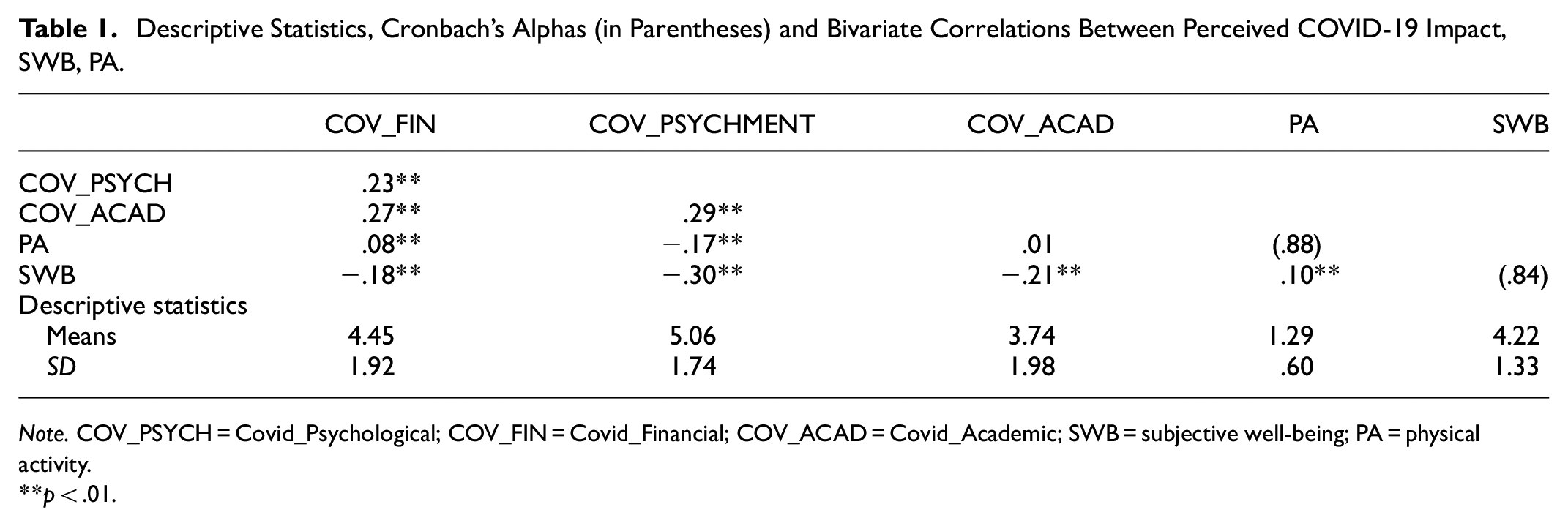
Note. COV_PSYCH = Covid_Psychological; COV_FIN = Covid_Financial; COV_ACAD = Covid_Academic; SWB = subjective well-being; PA = physical activity.
p < .01.
T-tests results showed statistically significant differences in terms of perceived COVID-19 impact on participants’ financial status, t(846) = −2.42, p < .05, and academic performance, t(846) = −4.55, p < .01, with males scoring higher (MM = 4.76, MM = 3.90, respectively) compared to females (MF = 4.42, MF = 3.25, respectively). Females, on the other hand, scored higher than males on perceived COVID-19 impact on psychological health, t(846) = 2.69, p < .05, (MF = 5.06, MM = 4.70). Males also scored higher on PA during COVID-19 than females, t(846) = −4.53, p < .01, (MM = 39.34, MF = 31.29). No gender differences were found for SWB.
One-way ANOVAs evaluated possible significant effects of participants’ age on their perceptions, SWB and PA. Results indicated that participants differed significantly in perceived COVID-19 impact on their financial status, F(3,847) = 6.86, p < .01, and SWB, F(3,847) = 5.44, p < .01. Post hoc multiple comparison tests, using the Bonferroni criterion showed that younger participants aged between 17 and 25 years had significantly higher mean from the rest of the age groups (M17–25 = 4.78 > M26–33 = 4.56 > M42+ = 4.08 > M34–41 = 4.06). In terms of SWB, older participants (aged 42+ years) reported significantly greater SWB compared to younger ones (aged 17–25) (M42+ = 4.75 > M17–25 = 4.28) who scored statistically significantly lower than those aged 26 to 33 years (M17–25 = 4.28 < M26–33 = 4.56).
Kruskal-Wallis tests were used to examine perceived COVID-19 impact on psychological health, academic performance and PA. The results of Kruskal-Wallis tests showed significant median differences among participants in perceived COVID-19 impact on psychological health H(3) = 18.10, p < .001, perceived COVID-19 impact on academic performance H(3) = 37.96, p < .001, and PA, H(3) = 20.97, p < .001. Post hoc pairwise comparisons using the Mann-Whitney test (Bonferroni correction for multiple tests) showed that students aged 42+ had significant higher scores in perceived COVID-19 impact on psychological health than those aged 17 to 25 years. In terms of perceived COVID-19 impact on academic performance, students aged between 17 and 25 years had significantly higher scores compared to three other age groups (i.e., those aged 26–33 years, those aged 34–41 years and those aged 42+). Finally, in terms of PA during the COVID-19 pandemic, those aged 17 to 25 years reported to exercise more than those aged 34 to 41 years.
Physical Activity as a Mediator Between SWB and Perceived Covid-19 Impact
The analysis of the indirect effects of SWB on participants’ perceptions of COVID-19 impact through PA, revealed direct effects of SWB on their financial status and psychological health (i.e., the higher the SWB the less the perceived COVID-19 impact on participants’ financial status and psychological health) (b = −0.25, SE = 0.052, 95% CI [−0.356, −0.151]), (b = −0.38, SE = 0.046, 95% CI [−0.475, −0.294]), and indirect effects of SWB on perceived COVID-19 impact on participants’ financial status and psychological health through PA (b = 0.0134, SE = 0.008, 95% CI [0.002, 0.034]), and (b = −0.026, SE = 0.009, 95% CI [−0.050, −0.011]).
Discussion
The purpose of the present study was to understand the role of PA during the COVID-19 pandemic in explaining the relationship between university students’ SWB and their perceptions of the psychological health, educational performance, and financial status impact of the COVID-19 pandemic. According to the findings, the pandemic seems to have a greater impact on psychological health on females than males, whereas males are more impacted academically and financially. Our finding regarding the greater perceived pandemic impact on psychological health on female students is consistent with a study carried out in China by Wang et al. (2020) while the Covid-19 outbreak was in its early stages. The study showed females being more sensitive to psychological health issues, decreased psychological well-being, and anxiety due to the COVID-19 pandemic. Possibly, the loss of social relationships and support owing to pandemic control efforts contributes to women’s psychological well-being and happiness. The observed higher physical activity scores among male students align with the findings of Rogowska et al. (2021), who similarly reported greater physical activity levels among males during the pandemic. This contrasts with the results of Zhang et al. (2021), who found that women exhibited higher levels of physical activity during the same period.
Significant bivariate correlations emerged between subjective well-being (SWB), physical activity (PA), and perceived COVID-19 impact across the three domains. Notably, higher SWB was associated with less negative perceptions of the pandemic’s impact on psychological health, academic performance, and financial status, aligning with previous literature suggesting that increased SWB fosters better coping skills during adversity (Lyubomirsky et al., 2005). Likewise, a positive relationship was found between SWB and PA, consistent with a prior study by Chmelík et al. (2021) involving 18 schools, which indicated that Czech and Polish students content with their lives were more physically active. Furthermore, PA demonstrated a significantly negative association with reported impact on psychological health but a positive association with perceived impact on financial status during COVID-19. Physically active individuals reported better psychological health, in line with corroborating research evidence (Matias et al., 2020). It is worth noting that physically active students also reported experiencing financial impacts due to the pandemic. Notably, to the authors’ knowledge, no prior study has investigated the relationship between PA and perceived financial status impact during the pandemic. However, it is important to acknowledge that the magnitude of this correlation is negligible. One plausible interpretation for this outcome is that students who engaged in physical activity during the lockdowns may have incurred supplementary financial expenses to sustain their active lifestyles (e.g., acquiring exercise equipment, enrolling in online PA classes), which could have contributed to a heightened sense of the pandemic’s impact on their financial stability.
This study also examined the potential effects of age on participants’ perceptions of the impact of the COVID-19 pandemic, SWB, and PA. Younger participants (aged between 17 and 25) significantly differed from other age groups in their perceived COVID-19 impact on financial status. This finding is consistent with previous research in multiple countries, where younger adults (ages 18–25) reported more negative impacts, particularly in terms of financial well-being (Belot et al., 2021). The same age group also experienced significant negative impacts on their psychological health and well-being due to the pandemic, aligning with our findings showing that students aged 42 and above had higher scores in perceived COVID-19 impact on psychological health and greater SWB compared to those aged 17 to 25 years. Research suggests that there exists a “U-shaped” paradox in SWB, where younger adults (ages 17+) experience a decline that reaches a minimum level in the early forties before gradually rising again (Blanchflower, 2021). Older individuals reporting better psychological health and SWB may be attributed to their greater emotional control and regulation of feelings compared to younger individuals. Studies have shown that older adults are more adept at utilizing behavior modification and emotion regulation strategies to cope with stressful situations and prevent negative emotions (Livingstone & Isaacowitz, 2015). This suggests that older individuals may develop life skills and coping strategies over time, enabling them to respond more effectively to stressors, leading to greater life satisfaction and improved psychological health compared to their younger counterparts.
Regarding students’ perceived impact of COVID-19 on academic performance, age played a significant role. Younger students (17–25 years old) reported notably higher scores in perceiving negative effects on their academic performance compared to other age groups. Research by Frazier et al. (2019) demonstrated that reduced academic performance in U.S. students was associated with higher levels of distress, inefficient coping skills, and lower resilience and overall psychological health. In the current study, younger students (17–25 years old) exhibited lower scores in psychological health compared to other age groups, suggesting that their lower academic performance might be linked to psychological distress, inadequate coping skills, and reduced resilience amid the negative psychological impact of the COVID-19 pandemic. In addition, the same age group engaged in more exercise compared to those aged 34 to 41 years old. This finding aligns with existing literature, which consistently depicts younger adults (18–25) as more likely to participate in leisure activities (Belot et al., 2021), while PA tends to decline with age, ranging from 40% to 80% as individuals grow older (Gopinath et al., 2018). Several reasons may account for this age-related decline in PA. Firstly, older individuals often face increased time constraints due to growing life responsibilities, particularly amid the challenging circumstances posed by the pandemic. Secondly, as people age, they may adopt more sedentary behaviors in their free time, at work, and at home. Additionally, the aging process entails a gradual decline in exercise tolerance, physical capacities, and functional abilities, making it more difficult to maintain a physically active lifestyle. Furthermore, older individuals might lack awareness, resources, or skills to adapt to unconventional or innovative means (e.g., online applications/classes, live streaming) to remain physically active during pandemic-related restrictions. Moreover, older age groups may exercise caution and be more hesitant to engage in outdoor activities to minimize the risk of infection.
Further, this study sought to identify the association between university students’ SWB and perceived psychological, educational, and financial impact of the COVID-19 pandemic through PA. Significant direct effects of students’ SWB on their perceptions of the impact of COVID-19 on psychological health and financial status were observed, indicating that the higher the student SWB, the less they perceived the pandemic’s impact on these two domains. These direct effects corroborate prior research indicating that SWB is a key factor in people’s lives, affecting their psychological health (Cao et al., 2020) and perceptions of financial security (Rogowska et al., 2020). Findings also demonstrated indirect effects of SWB on perceived pandemic impact on students’ psychological health and financial status through PA. Explicitly, PA mediated the negative association between SWB and students’ perceptions of the impact of COVID-19 on their psychological health, demonstrating how students with a higher SWB are likely to get involved in PA during the COVID-19 pandemic, which is associated with less perceived psychological health issues. Surprisingly, a marginal positive indirect effect of SWB on the perceived impact of COVID-19 in terms of financial status through high PA was found. A possible explanation for this finding is that students satisfied with their lives tend to maintain a positive outlook (e.g., remain hopeful and happy even when having less; taking healthier decisions), which has a higher impact on their views of their financial status.
Implications
This study holds both practical and theoretical implications as it expands the existing literature on the association between university students’ subjective well-being, perceived COVID-19 impact, and physical activity. It highlights the significant role of indirect effects of SWB through PA, lending support to claims that PA positively influences psychological health (Choi et al., 2019). Engaging in regular physical activity may act as a psychological buffer during distressing events like the COVID-19 pandemic, signaling a person’s life satisfaction.
The findings suggest that considering students’ PA levels, the degree of SWB (e.g., low or high) becomes crucial in evaluating the extent of perceived COVID-19 effects on psychological and financial aspects. High SWB individuals may experience better cognitive health, influencing their perception of current events. Therefore, universities could establish online student gyms, PA programs, and health safety protocols to support students’ physical activity and maintain their spirits and well-being.
The study’s identification of females being more psychologically affected and scoring lower on PA during COVID-19 indicates the need for university-based PA intervention programs tailored to the female population’s preferences and emotional needs. Similarly, younger adults (ages 18–25) were more significantly impacted by the pandemic in various aspects, calling for targeted intervention programs addressing their unique characteristics and offering support for financial issues, psychological health, and academic performance.
Understanding students’ perceptions of SWB can provide insights into how they cope with pandemic-induced changes in their lives. Students’ perceived psychological health and financial status appear to be linked to their level of happiness, adjustment, and participation in activities they enjoy, such as PA. Academic institutions should consider implementing relief mechanisms to support students during crises, offering free services, support groups, tutoring, and financial aid.
The study advocates for enhancing educational institutions’ and governmental organizations’ capacity to evaluate and address the consequences of lower SWB among the entire university student population. Collaboration among various professionals, including health care practitioners, counselors, and academic professionals, can lead to research-based intervention programs promoting students’ well-being and resilience. It is recommended that university institutions, including those involved in this study, leverage research insights to enhance their student service centers (e.g., Student Resource, Campus Healthcare, and Counselling Centers) by devising action plans and intervention programs that can be activated as needed. These programs may focus on socioemotional aspects, providing strategies and resources to maintain a positive outlook on life, academic performance, and financial stability. Utilizing online platforms, workshops, and consultations can empower students to face life challenges with resilience and positivity, even during unprecedented times like the COVID-19 pandemic.
Limitations
Notwithstanding the suggested benefits and implications of our study findings, certain limitations warrant consideration in their interpretation. Firstly, the study’s cross-sectional and descriptive nature restricts our ability to establish causal relationships between subjective well-being (SWB), physical activity (PA), and perceived COVID-19 impact. To address this limitation, future research should adopt longitudinal designs and advanced statistical analyses to more accurately discern the causal associations among these variables. Furthermore, it is important to acknowledge the disadvantages of online surveys, such as low response rates and potential non-representativeness of samples in relation to the broader population. However, online surveys have proven to be indispensable during the COVID-19 pandemic, facilitating the collection of real-time data despite geographical constraints. Their advantages include ease of use for respondents, convenient data analysis for surveyors, cost-effectiveness, diverse dissemination possibilities, and flexibility in question design. Additionally, while meticulous efforts and procedures were employed to collect data, the utilization of snowball sampling may have introduced bias, rendering the sample less representative of the overall population. To enhance the generalizability of findings across various social or cultural contexts, future research is encouraged to employ probability sampling methods.
The study’s notable contribution to existing research lies in its inclusion of a relatively large number of university student participants, enhancing the robustness of its findings. Furthermore, the study makes a significant addition to the literature by presenting a comprehensive operational mechanism to identify the factors influencing the psychological health, academic performance, and financial impact of COVID-19 during the pandemic. Notably, the study accounts for the indirect effects of subjective well-being, which are mediated through physical activity. Moreover, the findings provide empirical support for the significance of investigating the consequences of subjective well-being, as advocated by Veenhoven (2008) and Diener (2008). The alignment of the study’s results with the evidence presented by Lyubomirsky et al. (2005) further underscores the potential positive outcomes associated with higher levels of subjective well-being. Overall, this research advances our understanding of the complex interplay between subjective well-being, physical activity, and the diverse impacts of the COVID-19 pandemic, making it a valuable addition to the literature in this field. A promising avenue for future research lies in investigating plausible factors that may lead to adverse life consequences while also exploring measures to preserve subjective well-being (SWB) and effectively manage the impact of the pandemic (Liu et al., 2020).
Conclusions
The study explored the relationship between physical activity, subjective well-being, and perceived impact of the COVID-19 pandemic among university students. Higher SWB was associated with less negative perceptions of the pandemic’s impact on psychological health, academic performance, and financial status. Younger students (17–25 years old) reported higher negative impact on academic performance and psychological health. Male students scored higher in PA than females. The study also identified direct effects of SWB on perceived pandemic impact on psychological health and financial status, with PA mediating the negative association between SWB and perceived impact on psychological health. Surprisingly, a marginal positive indirect effect of SWB on perceived financial status impact through high PA was found, possibly due to satisfied students maintaining a positive outlook despite financial constraints. Overall, the study contributes to understanding how SWB and PA relate to students’ perceptions of the pandemic’s impact on their lives.
Footnotes
Declaration of Conflicting Interests
The author(s) declared no potential conflicts of interest with respect to the research, authorship, and/or publication of this article.
Funding
The author(s) received no financial support for the research, authorship, and/or publication of this article.
