




Abstract
Our study aims to offer a research model that investigates the role of work engagement as a mediator in the relationship between ergonomics and absenteeism, and tardiness behaviors among employees. This research focuses on three main points: (a) the direct effect of ergonomics on work engagement, absenteeism, and tardiness; (b) the effect of work engagement on absenteeism and tardiness; and (c) the mediating role of work engagement in these relationships. The aforementioned links were evaluated using data collected from staff of 4- and 5-star hotels in Kurdistan Region/Iraq. The findings reveal that ergonomics has a strong positive effect on work engagement, and a significant negative effect on both absenteeism and tardiness. Moreover, work engagement is negatively related to absenteeism and tardiness, further mediating the effect of work engagement between ergonomic and those nonattendance behaviors. Hotel managers should periodically review and enhance ergonomic practices to ensure alignment with employee needs. Establishing feedback mechanisms can help employees communicate concerns or suggest improvements, fostering a supportive work environment. Implementing ergonomic interventions as part of broader employee engagement strategies can lead to reduced absenteeism, increased punctuality, and improved overall productivity.
Introduction
Ergonomics, derived from the Greek word “ergon” (work) and “nomos” (laws), is the scientific discipline focused on designing and arranging workplaces, products, and systems to fit human capabilities and limitations (Latip et al., 2022). Ergonomics is “the study of human factors as they relate to the design, construction, operation, and evaluation of systems, processes, and products used in the performance of occupational and non-occupational tasks” (Roopnarain et al., 2019). Ergonomics focuses on aligning job requirements with workers’ skills and the work environment to create an efficient workspace while reducing injury risk (Meyer et al., 2017). Ergonomics enhances the productivity and efficiency of work and other tasks, as well as promotes positive human values, including improved quality of life, reduced tension and fatigue, and enhanced protection (Chung & Williamson, 2018). The primary advantages of ergonomics include improved physical health, increased job satisfaction, reduced musculoskeletal disorders, and a safer work environment. Ergonomics plays a crucial role in fostering employee engagement by creating an environment that aligns job demands with employees’ physical and psychological needs (Khateeb, 2024). Employees who perceive their organization as adopting ergonomic principle regard themselves as engaged in their work (J. Lee et al., 2024). According to Schaufeli et al. (2002) work engagement refers to “a positive, fulfilling, work-related state of mind characterized by vigor, dedication, and absorption” (p. 74).
Employees who perceive their workplace as ergonomically supportive are more likely to exhibit higher engagement levels. Engaged employees demonstrate greater enthusiasm, commitment, and productivity, leading to a reduction in workplace stress and absenteeism (Ozduran et al., 2025).
Work engagement functions as a mediating factor between ergonomics and employees’ attendance behaviors. When employees experience a comfortable and well-designed work environment, their physical well-being improves, increasing their willingness, and motivation to be present at work. Conversely, poorly structured ergonomic conditions contribute to workplace discomfort, leading to physical strain, decreased motivation, and ultimately higher absenteeism and tardiness rates. Empirical studies have demonstrated that ergonomic interventions enhance engagement by reducing job-related fatigue and psychological distress, which in turn fosters a culture of punctuality and commitment (Alabi & Dangana, 2025).
A lack of engagement due to poor ergonomics can result in high rates of absenteeism and tardiness. Absenteeism refers to an employee’s failure to report to work as scheduled, while tardiness is the habitual delay in starting work on time (Pizam & Thornburg, 2000). By improving workplace ergonomics, organizations can reduce these nonattendance behaviors, ensuring a more stable and productive workforce. Engaged employees feel more valued and are more likely to reciprocate by showing up on time and performing at their best.
This study seeks to establish the link between ergonomics and absenteeism/tardiness through the mediating role of work engagement. By integrating insights from the Job Demands-Resources (JD-R) and Social Exchange Theory (SET), this research aims to demonstrate how ergonomic improvements contribute to higher engagement levels, which subsequently reduce absenteeism and tardiness. The study contributes to the growing literature on workplace ergonomics by examining these dynamics in the hospitality sector, providing valuable insights for managers seeking to enhance employee retention and workplace efficiency.
Objectives
Our study aims to offer a research model that explains how job engagement influences the relationship between ergonomics and critical absenteeism and tardiness behaviors among employees. This research focuses on three main points: (a) ergonomics affect work engagement, absenteeism, and tardiness; (b) work engagement affects these nonattendance behaviors; and (c) work engagement mediates the relationships between the above mentioned variables. The aforementioned links were evaluated using data collected from staff of 4- and 5-star hotels in Sulaimania City, Kurdistan Region / Iraq.
Research Problem
Beyond its academic contributions, the study addresses several pressing problems within the hospitality industry. High rates of absenteeism and tardiness are common challenges that negatively impact service quality and operational efficiency. By examining the role of ergonomics in reducing these behaviors, the research provides practical solutions for improving workforce reliability. Additionally, many hotel managers underestimate the importance of ergonomic interventions and their potential to improve employee engagement and retention. This study highlights the tangible benefits of investing in ergonomic improvements, demonstrating how they contribute to a more engaged and committed workforce. Furthermore, workforce disengagement remains a persistent issue in the hospitality industry, often leading to high turnover rates. By shedding light on how ergonomic practices can foster employee engagement, the research offers actionable insights for organizations seeking to enhance job satisfaction and retain skilled employees.
Research Questions
Does ergonomics impact work engagement among hotel employees?
What is the effect of ergonomics on absenteeism and tardiness behaviors?
Does work engagement negatively influence absenteeism and tardiness?
Does work engagement mediate the relationship between ergonomics and nonattendance behaviors (absenteeism and tardiness)?
Contributions of the Study
There are several meaningful contributions to ergonomics literature.
Anxieties, pain, and exhaustion are just some of the human aspects that can be affected by harmful ergonomics risk factors; on the other hand, systemic aspects like performance speed, rejection rates, and service quality can be affected as well (Genaidy et al., 2007).
Most of the research has concentrated on ergonomics and measured its effects in various settings, such as telework (Kamala et al., 2025; J. Lee et al., 2024), the automotive industry (Zare et al., 2016), manufacturing (Hasanain, 2024; Sardar et al., 2024), the assembly line (Alfaro-Pozo & Bautista-Valhondo, 2024), and dentistry (Holzgreve et al., 2022). Ergonomics remains an underrepresented topic in the tourism and hospitality sector so far.
In addition to that gap, Ramos-García et al. (2022) and Yattani et al. (2024) have demonstrated that ergonomics has a beneficial effect on job outcomes, including job satisfaction and performance. However, there isn’t a lot of research on how ergonomics affect workers’ plans and actions when they don’t show up for work (Kammoun & Dhifaoui, 2021). Even more critically, no empirical study has yet investigated the relationship between ergonomics and non-attendance behavior and work engagement among hotel personnel. Our study aims to address this gap by investigating the relationship between ergonomics and both involvement in the workplace and absenteeism.
Moreover, El-Sherbeeny et al. (2023) notes that there is a lack of evidence connecting ergonomics to the behavioral and attitude outcomes of workers. In this investigation, work engagement mediated the relationship between ergonomics and absenteeism. Employee disengagement at work is an important issue, according to recent studies (e.g., Karatepe et al., 2020; Tsaur et al., 2019; 85% of workers are actively disengaged, according to the current Gallup Workplace Report). In light of this, it is of greatest significance to determine if ergonomics improve engagement at work, if engagement at work reduces absenteeism and tardiness, and if engagement at work mediators these relationships.
Recent empirical research on ergonomics has primarily focused on developed countries (Boatca et al., 2022; Morton & Stewart, 2022; Weinstock et al., 2021). Understanding these practices in emerging economies or developing nations is important since there may be differences in the political environment, economic the environment, cultural norms, and geographical location compared to more developed nations (Zhu & Li, 2016). Although the Kurdistan area of Iraq is home to a flourishing market economy, the authors were unable to identify any empirical research that specifically addressed the perspectives of frontline hotel staff about ergonomics procedures. Data collected from staff members at four- and five-star hotels in Iraq’s Kurdistan Region is used considering this insight. Lastly, our study is expected to yield valuable insights into managerial practice. If deemed practical, the results of our article may have significant consequences for plans to implement ergonomics and enhance staff retention.
Hypotheses Development
When applied together, the JD-R and SET theories strengthen the link between ergonomics and worker engagement. According to JD-R theory, there are two separate processes: “the health-impairment process” and “the motivational process” (Bakker & Demerouti, 2017). While workplace demands are major factors in burnout, job resources are what really determine how invested one is in their work. Workers face a range of risks on the job, including those that are biomechanical (such as awkward postures and movements), environmental (such as the layout of the workplace), psychosocial (such as work pressure, lack of autonomy, and competitiveness), and organizational (such as insufficient colleagues during shifts and inadequate equipment and maintenance; M. Z. Coluci & Alexandre, 2014). A job resource can be an ergonomically adjusted workstation that promotes proper posture and reduces physical strain (El-Sherbeeny et al., 2023). The organization’s commitment to its employees’ well-being and safety is evident through the implementation of ergonomics solutions, which prioritize their comfort and health. According to JD-R theory, that might be seen as a road leading to motivation. Additionally, companies can increase engagement by involving workers in ergonomics design. When employees participate in the design of their workplaces and equipment, they cultivate a sense of ownership and autonomy over their work environment. Individuals may experience heightened engagement and commitment to their roles when they see their contributions positively impact the company’s performance (Chandrasekar, 2011).
Social Exchange Theory (SET) illustrates the relationship between ergonomics and work engagement. SET asserts that the workplace includes many social interactions between the organization and its personnel (Cropanzano & Mitchell, 2005). Employees who view management as actively engaged in and executing specified procedures feel compelled to respond with increased work engagement. In these conditions, hotel staff strive to perform their responsibilities and contribute to achieving the organization’s goals. This promotes the establishment of a more dependable and enhanced interaction with the company (M. Z. O. Coluci et al., 2009). It seems that there are only a few empirical studies that establish the correlation between ergonomics and work engagement.
Based on their research with Indian bank workers, Kulkarni et al. (2022) concluded that ergonomics improves workers’ wellbeing. Ergonomics also enhanced employee engagement in Egypt’s five-star hotels and category (A) travel agencies, according to El-Sherbeeny et al. (2023). Taris et al. (2017) confirmed that when employees perceive their work environment as physically supportive, they experience greater comfort and reduced strain, leading to heightened engagement. Additionally, studies indicate that proper workstation design, adequate lighting, and ergonomic seating arrangements contribute to lower fatigue levels and increased job satisfaction, further enhancing engagement (Van den Broeck et al., 2010). Consequently, we postulate that:
SET argues that when ergonomics are implemented, individuals are motivated to respond positively by achieving positive results in their jobs (e.g., Kulkarni et al.’s (2022). An economic return of nearly €2 can be achieved for every €1 invested on prevention per employee year, according to the International Social Security Association (ISSA) in 2011. A decrease in employee sick days and an improvement in employee well-being have been noted as beneficial benefits, leading to more positive behaviors and fewer negative behaviors (Marková & Škurková, 2023).
When ergonomics measures are in place, it generally leads to better interactions between the company and its employees, which in turn fosters trust. As a result of ergonomics policies aimed at workers, workers are obligated to contribute to the company with a minimum level of absentees and tardiness.
The empirical evidence suggests that effective ergonomics decrease absenteeism among automobile manufacturing personnel, according to the study of Fritzsche et al. (2014). The effects of ergonomic stress on sick days and absences from work in manufacturing have been documented by Melamed et al. (1989), Gupta (2024) found that workplaces with ergonomic interventions report significantly lower absenteeism due to reduced physical ailments such as back pain and repetitive strain injuries. Similarly, research by Robertson et al. (2016) suggests that employees in ergonomically optimized environments experience fewer distractions and discomforts, leading to improved punctuality. However, it appears that no study has explored the influence of ergonomics on tardiness thus far. Based on the discussion given above, we postulate that:
To demonstrate that work engagement, tardiness, and absenteeism are related, we employed social exchange theory as our theoretical framework. This theory is “…among the most influential conceptual paradigms for understanding workplace behavior” (Cropanzano & Mitchell, 2005, p. 874). According to Cropanzano and Mitchell (2005), who reference social exchange theory, a trustworthy and loyal relationship can be seen when both the corporation and its employees follow the rules of the trade. The hotel workforce is dedicated, enthusiastic, and fully present when both the employer and staff members follow the principles of exchange. Additionally, this leads to the development of stronger, more trustworthy relationships amongst the individuals involved Faeq et al. (2021). Hotel employees show less absenteeism and tardiness, are more invested in their work, and offer suggestions to enhance the work-life balance of their coworkers when these conditions are met Faeq (2022).
There is a lack of empirical data about the correlation between work engagement and tardiness and absenteeism, according to a survey of the relevant research. Managers in the Dutch telecom industry who were invested in their profession were less likely to miss work, according to research by Soane et al. (2013). According to research by Karatepe et al. (2020), Chinese hotel workers were less likely to plan to skip work when they were actively involved in their jobs.
Employees that are engaged in their work find it inspirational and are driven to fulfill every relevant responsibility throughout work hours to ensure punctuality. Under these circumstances, they are unlikely to demonstrate tardy at work. Karatepe and Avci (2017) empirically established that work engagement is inversely correlated with tardiness among nurses in Northern Cyprus. Consequently, our research evaluates these hypotheses. Karatepe et al. (2020) revealed that work involvement reduced intentions of tardiness. Tims et al. (2013) also found a negative correlation between engagement and tardiness, emphasizing that highly engaged employees are more punctual and reliable. Accordingly, we postulate that:
Ergonomic practices play a crucial role in shaping hotel employees’ job engagement and associated workplace behaviors (Mae S. Moldero et al., 2024). Work engagement, characterized by vitality, dedication, and absorption in tasks, serves as a key mechanism linking ergonomic interventions to employee attendance patterns. Employees who perceive their organization’s investment in ergonomic improvements tend to exhibit higher levels of motivation and job satisfaction, which in turn reduces absenteeism and tardiness (Allumi et al., 2024; Mvuyana et al., 2024). By fostering a work environment that prioritizes employee well-being and comfort, organizations enhance engagement, leading to greater job commitment, and proactive contributions to workplace improvements (Kareem et al., 2023; Onyishi et al., 2024).
The integration of ergonomics and employee outcomes is substantiated by a review of existing literature. El-Sherbeeny et al. (2023) conducted a study in Egypt demonstrating that work engagement moderated the relationship between ergonomics and employee job performance. Karatepe et al. (2020) conducted a study on hotel employees in China, revealing that work engagement partially mediates the relationship between job uncertainty and employees’ non-green and absentee behaviors. The research by Sulea et al. (2012) in Romania demonstrated that work engagement mediates the relationship between job features and both positive and negative extra-role behaviors.
Similarly, Husain and Nursyamsi (2023) demonstrated that work engagement partially mediates the link between job insecurity and absentee behaviors among Chinese hotel employees, emphasizing the importance of psychological well-being in mitigating nonattendance. Furthermore, research by Saleh and Shahidan (2023) in Romania established that work engagement mediates the relationship between job characteristics and both positive and negative extra-role behaviors, reinforcing the idea that engaged employees are less likely to disengage from their responsibilities. Additional studies by Harrilall and De Beer (2024) and Nyoike and Karimi (2023) further validate that ergonomic interventions not only enhance physical comfort but also contribute to emotional and psychological engagement, ultimately reducing workplace withdrawal behaviors. These findings collectively reinforce the hypothesis that work engagement serves as a mediator between ergonomics and nonattendance behaviors, encapsulated in hypotheses 4a and 4b. By addressing both physical and psychological dimensions of workplace ergonomics, organizations can foster a more engaged workforce, ultimately leading to improved attendance, and job performance. The relationships previously mentioned are encapsulated in hypotheses 4a and 4b.
Conceptual Framework
The research model comprising four hypotheses is illustrated in Figure 1. The ergonomics impact hotel employees’ views of work engagement, absenteeism, and tardiness. We also exert a beneficial impact on the results. These results demonstrate that work engagement mediates the impact of ergonomics on hotel employees’ absenteeism and tardiness.
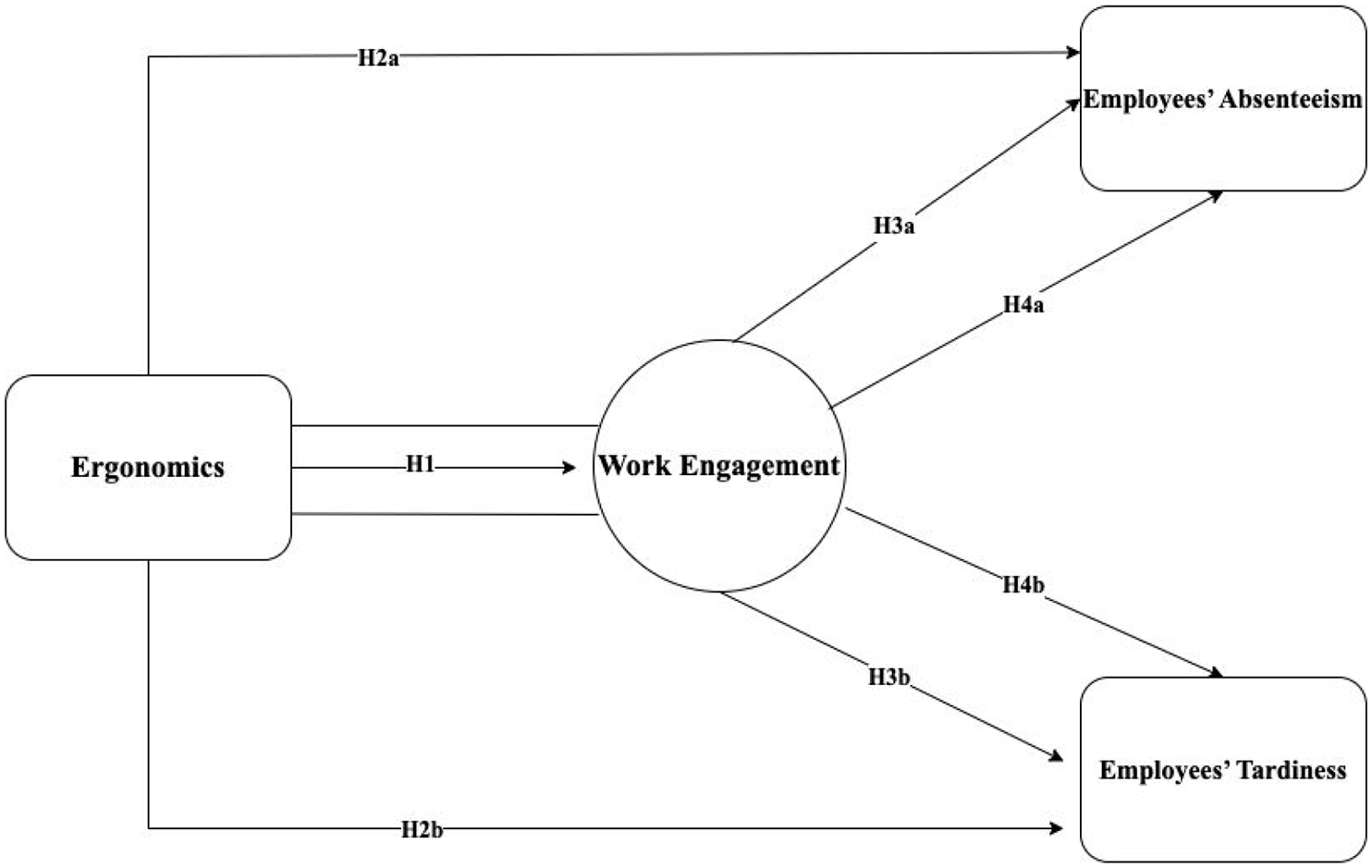
Conceptual framework.
Method
Respondents and Procedure
Data were obtained from hotel personnel at hotels in (Erbil, Sulaiamania, and Duhok) Kurdistan Region of Iraq. As of 2024, the Ministry of Municipalities and Tourism reports that Erbil has 36 hotels, while Sulaymaniyah has 19, and Duhok has 12, accordingly total of 67 hotels were part of this study. The human resource administrators of these hotels were contacted by the research team to clarify the study’s objective and secure consent for data collection. However, only 15 hotels granted permission for data collection. The data collection procedure was facilitated by the research assistants in collaboration with the human resource managers of these hotels. Our research incorporated a variety of existing procedural strategies to reduce the variance associated with typical techniques (Podsakoff et al., 2012). Each questionnaire’s cover page stated the following: “There are no right or wrong responses in this questionnaire,” “All information collected during our research will be kept confidential,” “Participation is voluntary but encouraged,” and “The management of your hotel fully endorses participation.” Your consent is indicated by your assent to complete this questionnaire, as stated on the cover page of each questionnaire. Respondents were directed to enclose the questionnaire in the envelope and deposit the sealed envelope in the designated receptacle, as indicated on the front page. There was a total of 3,447 employees across all 19 hotels when the survey was conducted. To determine the sample size for a research population of 3,447, we use the Slovin’s formula with a margin of error and confidence level. It was found the targeted sample size was 950 employees random sampling process has been utilized, however, the researchers distributed 950 questionnaires and received 919 valid questionnaire. The employee's profile is provided in table 1.
Employee’s Profile.

Source. by researchers based on results of SPSS.
The Measuring Instruments
A 14-item scale based on M. Z. O. Coluci et al. (2009) was utilized to evaluate hotel employees’ impressions of ergonomics. Sample elements include “Reaching or working above or away from the body” and “Inadequate breaks or pauses during the workday.” According to the study by El-Sherbeeny et al. (2023). The items necessitated evaluation on a five-point Likert scale, ranging from one for strongly disagree to five for strongly agree.
Nine items from Schaufeli et al. (2006) were used to evaluate work engagement. Sample items include “At my work, I feel bursting with energy” and “I get carried away when I am working.” This scale was implemented in numerous significant research (e.g., Tsaur et al., 2019). The degree to which individuals felt engaged in their job was assessed using anchors of “6 = always” to “0 = never.”
To assess absenteeism, two parts of the study by Autry and Daugherty (2003) were utilized. It asks: “How frequently have you been absent from work due to a lack of motivation?” Moreover, “How frequently have you taken a day off to engage in other activities?” All the way from “7 = always” to “1 = never,” there were multiple ways to answer the items. Foust et al. (2006) provided the three items used to assess tardiness. In particular, “Occasional tardiness for work should be acceptable” together with “Tardiness to work should be acceptable as long as the work is completed.” Based on the findings of Karatepe et al. (2020).
The reliability analysis of the measurement instrument determines its consistency and dependability in assessing the intended constructs. Cronbach’s Alpha values, item-total correlation, and inter-item correlation were used to evaluate the internal consistency of the variables. Cronbach’s Alpha is a coefficient that measures internal consistency, with values above .70 considered acceptable for research. In this study, work engagement had the highest reliability at .94, indicating strong internal consistency. Employees’ absenteeism and employees’ tardiness also demonstrated high reliability with values of .88 and .85, respectively, while ergonomics, at .79, remained within the acceptable range as shown in table 2. Item-total correlation assesses how well individual items correlate with the overall scale, with higher correlations indicating that the item contributes well to the scale. Employees’ tardiness showed the highest item-total correlation at .79, suggesting strong alignment with its respective scale, whereas employees’ absenteeism had the lowest at .43. Inter-item correlation measures the consistency of items within the same construct, with values between .30 and .70 generally considered desirable. Employees’ tardiness exhibited the highest inter-item correlation at .74, demonstrating strong internal cohesion, while employees’ absenteeism had the lowest at .31, indicating weaker relationships between the items.
Reliability Analysis.

Source. By researchers based on results of SPSS.
The validity analysis assesses whether the instrument accurately measures what it is intended to measure. Construct validity reflects how well the measurement captures the theoretical concept, with ergonomics scoring the highest at 0.85, indicating strong theoretical alignment. Employees’ absenteeism and work engagement had relatively lower construct validity scores of 0.65 and 0.66, respectively, though still within acceptable limits. Content validity determines whether the measurement covers all relevant aspects of the construct, with work engagement exhibiting the highest content validity at 0.83, suggesting comprehensive coverage, while employees’ tardiness had the lowest at 0.77. Criterion validity examines how well the measurement predicts relevant outcomes, with ergonomics demonstrating the strongest predictive ability at 0.71, whereas work engagement showed the lowest at 0.55. Convergent validity measures whether related constructs are strongly correlated. Work engagement had the highest convergent validity at 0.81, confirming its alignment with related measures, while employees’ absenteeism had the lowest at 0.62. Discriminant validity ensures that unrelated constructs remain distinct, with ergonomics and employees’ absenteeism both scoring the highest at 0.64, indicating a clear distinction from unrelated concepts. Work engagement had the lowest discriminant validity at 0.42, suggesting some overlap with other constructs. As provided in table 3.
Validity Analysis.

Source. By researchers based on results of SPSS.
Strategy of Analyses
This study utilized SPSS 24 for its descriptive statistics and intercorrelation analyses. Using the covariance matrix as an input, AMOS 24 evaluated the structural and measurement models. To assess the measurement model, Fornell and Larcker (1981) and Hair et al. (2010) employed confirmatory factor analysis (CFA). Results of the model’s internal consistency reliability ratings were reported using CFA, which also verified the model’s discriminant and convergent validity. To assess the proposed correlations, structural equation modeling (SEM) was employed. In this study, we use maximum likelihood estimate. In this research, the sequential mediation technique was implemented using the user-defined estimands plugin in AMOS 24 and bootstrapping with 5,000 samples at a 95% confidence interval. The study employed the following fit statistics: “χ 2/df, comparative fit index (CFI), Tucker-Lewis index (TLI), parsimony normed fit index (PNFI), root mean square error of approximation (RMSEA), and standardized root mean square residual (SRMR).”
The Measurement Models
Validity and reliability of the measures were first determined by examining the measurement model through confirmatory factor analysis (Anderson & Gerbing, 1988). As their standardized loadings were below 0.50, three items have been excluded from the work engagement measure. Empirical studies that also discarded components from the job engagement scale were found via a thorough literature assessment. An example would be the four-item version of the job engagement measure used by Karatepe et al. (2020) and the three-item version used by Van Bogaert et al. (2014). According to Hartline and Ferrell (1996), this is in line with what Anderson and Gerbing proposed in their item-deletion approach (1988), which stresses the necessity to re-specificate ineffective indicators. As part of our research, we discarded one item from the commitment sub-dimension and one each from the vitality and absorption sub-dimensions.
The study examines key workplace constructs, including Optimized Work Conditions for Performance & Well-being, Work Engagement & Passion, Commitment & Reliability in Workplace Attendance, and Professional Punctuality & Work Ethic, using standardized loadings, t-values, Average Variance Extracted (AVE), and Composite Reliability (CR) to assess their validity and reliability. These constructs contribute to enhancing workplace performance, engagement, and reliability while fostering employee well-being.
This construct focuses on how employees can optimize their physical performance and well-being in the workplace. The standardized loadings range from 0.72 to 0.87, with t-values between 13.78 and 18.50, ensuring strong factor loadings. The AVE value of 0.815 indicates that a substantial portion of variance in the items is explained by the construct, and the CR of 0.902 supports high internal consistency. The importance of ergonomic practices and optimized work conditions is well-documented in research. Fritzsche et al. (2014) highlight that good ergonomics and team diversity significantly reduce absenteeism and errors in manufacturing. Hasanain (2024) further emphasizes the role of ergonomic factors in sustainable manufacturing, supporting employee health, reducing fatigue, and enhancing efficiency. Research also confirms that proper work conditions, including ergonomic tools and training, can lead to improved physical endurance, and reduced workplace strain (Holzgreve et al., 2022; J. Lee et al., 2024).
Moreover, studies by Meyer et al. (2017) and Marková and Škurková (2023) suggest that implementing ergonomic interventions and job design strategies improves productivity and reduces work-related musculoskeletal disorders. The inclusion of training and learning opportunities in this construct aligns with Latip et al. (2022), who argue that a focus on ergonomic training improves task performance in various industries.
Work engagement and passion measure an employee’s enthusiasm, motivation, and commitment to their role. The standardized loadings range from 0.81 to 0.89, with t-values between 17.30 and 19.20, ensuring strong convergent validity. The AVE of 0.872 and CR of 0.942 indicate that these factors contribute significantly to workplace performance. Work engagement is a crucial predictor of employee performance and job satisfaction. Husain and Nursyamsi (2023) found that work engagement plays a mediating role between job resources and job satisfaction. Similarly, Ilkhanizadeh and Karatepe (2017) discovered that engaged employees exhibit higher career satisfaction and stronger voice behavior. Additionally, Karatepe et al. (2022) emphasize the role of perceived organizational support and green HRM policies in sustaining employee engagement.
Kareem et al. (2023) further highlights how work engagement mitigates workplace deviant behavior, reinforcing the need for organizations to foster an engaging and positive work environment. Mvuyana et al. (2024) extend this argument by examining the relationship between employee engagement and counterproductive work behavior, demonstrating that disengaged employees are more likely to exhibit negative behaviors such as absenteeism and reduced performance.
Commitment and reliability in workplace attendance focus on an employee’s dedication to maintaining consistent attendance and effectively balancing time off. The standardized loadings range from 0.86 to 0.90, with an AVE of 0.845 and CR of 0.918, indicating strong construct validity. Attendance and absenteeism are critical workplace performance indicators. Kammoun and Dhifaoui (2021) found that working conditions significantly affect absenteeism rates among Tunisian agro-food workers. Khateeb (2024) conducted a bibliometric analysis of absenteeism among nurses, revealing that poor work environments and high job demands lead to increased absenteeism. Furthermore, Mae S. Moldero et al. (2024) identified factors contributing to absenteeism and tardiness in educational settings, providing insights into intervention strategies for reducing workplace attendance issues.
The impact of job insecurity on attendance behaviors was also examined by Karatepe et al. (2020), who found that employees facing uncertainty in job stability are more likely to engage in non-green and nonattendance behaviors, reducing overall workforce efficiency. These findings emphasize the importance of workplace commitment and reliability in maintaining a stable and productive workforce. This construct examines punctuality, work ethic, and professionalism in the workplace. The standardized loadings range from 0.87 to 0.89, with t-values between 18.78 and 19.12, ensuring strong construct validity. The AVE of 0.869 and CR of 0.952 indicate high internal consistency and reliability.
Punctuality is often linked to employee professionalism, team efficiency, and workplace discipline. Onyishi et al. (2024) highlight that high work engagement can sometimes lead to work-life balance challenges, influencing punctuality. Kulkarni et al. (2022) examined the impact of COVID-19 on employee engagement and punctuality, finding that remote work, and flexible schedules alter workplace attendance behaviors. Furthermore, Nyoike and Karimi (2023) examined transformational leadership’s impact on counterproductive behaviors, emphasizing that strong leadership fosters a culture of punctuality, responsibility, and professionalism. Genaidy et al. (2007) also reinforce that work compatibility frameworks, including scheduling and time management strategies, improve workplace punctuality, and productivity.
The model fit indices support the validity and reliability of the constructs:
Chi-square (χ2) = 312.45, df = 180, χ2/df = 1.73 (acceptable range: below 3.0).
Comparative Fit Index (CFI) = 0.94, indicating strong model fit.
Parsimony Normed Fit Index (PNFI) = 0.80, confirming the model’s efficiency and parsimony.
Root Mean Square Error of Approximation (RMSEA) = 0.058, which is ideal (values below 0.06 are preferred).
Standardized Root Mean Square Residual (SRMR) = 0.047, ensuring a good fit (below 0.08).
These indices align with Hair et al. (2010), who emphasize the importance of fit indices in validating structural equation models. The model’s strong CFI, RMSEA, and SRMR values indicate that the proposed constructs effectively capture the intended workplace behaviors and attributes.
The analysis confirms that the proposed constructs—Optimized Work Conditions for Performance & Well-being, Work Engagement & Passion, Commitment & Reliability in Workplace Attendance, and Professional Punctuality & Work Ethic—are both valid and reliable. The findings are supported by extensive literature on ergonomics, engagement, absenteeism, and punctuality, highlighting the importance of workplace design, employee motivation, and organizational support in fostering a productive and sustainable workforce. These insights can be leveraged by organizations to implement strategic HR policies, enhance work engagement, and promote a culture of professionalism and accountability.
By integrating ergonomic improvements, employee engagement strategies, and effective attendance management policies, companies can enhance employee well-being, reduce absenteeism, and foster a more engaged and committed workforce. As shown in table 4.
Research Constructs and Confirmatory Factor Analysis Results.
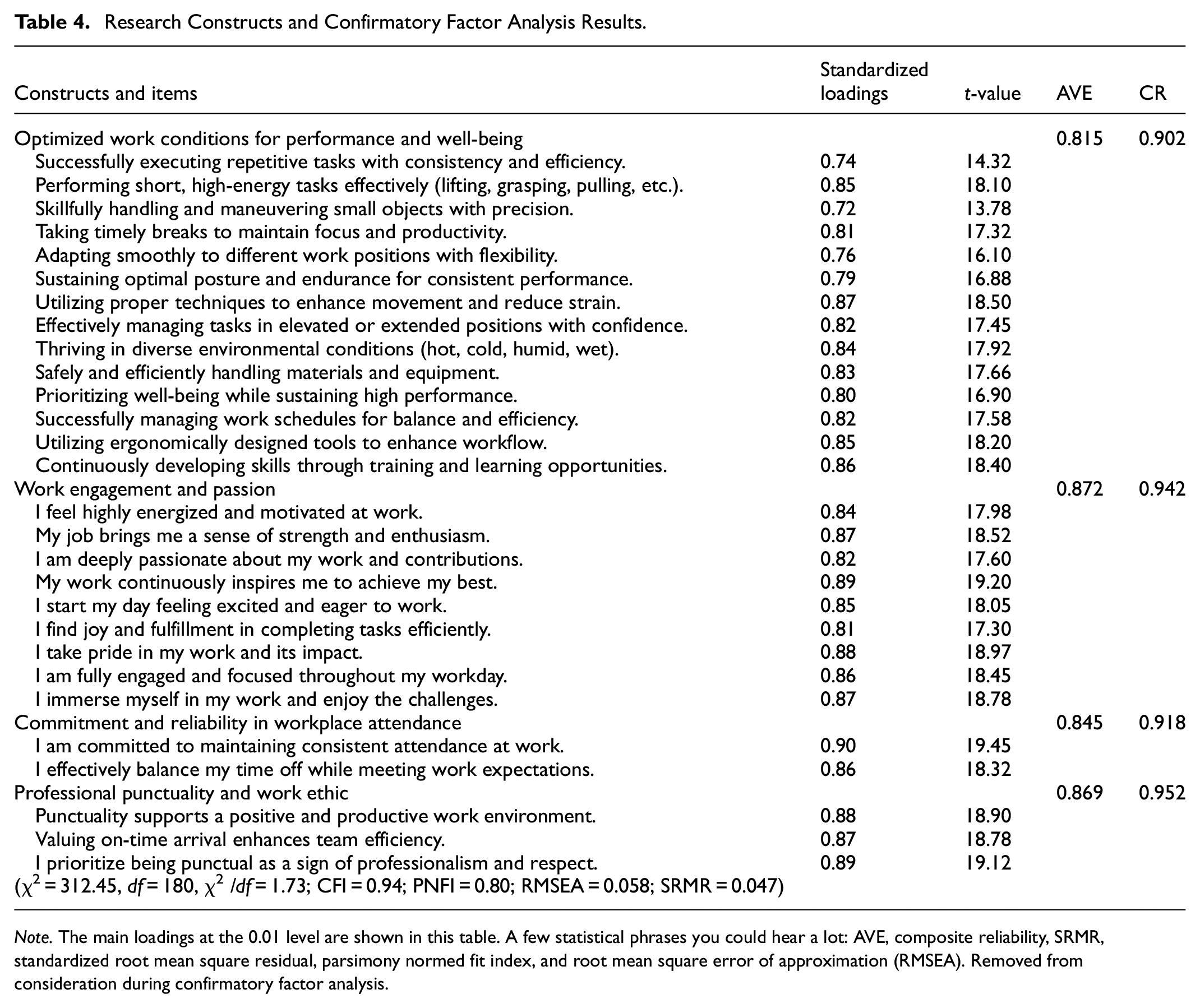
Note. The main loadings at the 0.01 level are shown in this table. A few statistical phrases you could hear a lot: AVE, composite reliability, SRMR, standardized root mean square residual, parsimony normed fit index, and root mean square error of approximation (RMSEA). Removed from consideration during confirmatory factor analysis.
Sobel Test
The Sobel test was conducted to examine the mediating role of work engagement in the relationship between ergonomics and two employee behaviors: absenteeism and tardiness. The results provided significant insights into the indirect effects of workplace ergonomics on employee attendance patterns in table 5.
Sobel Test.

The Sobel test was conducted to assess whether work engagement mediates the relationship between ergonomics and employee attendance behaviors, specifically absenteeism and tardiness. This analysis aimed to determine the extent to which workplace ergonomics influences these behaviors through its impact on employee engagement levels. By evaluating the indirect effect of ergonomics on absenteeism and tardiness, the study sought to provide deeper insights into how workplace conditions shape employee attendance patterns. For Hypothesis H4a, the results indicated a Sobel test statistic (z) of 3.623 with a p-value of .003, suggesting a statistically significant indirect effect of ergonomics on absenteeism through work engagement. The mediation type was classified as partial mediation, meaning that while ergonomics has a direct impact on absenteeism, a significant portion of this effect is explained through work engagement. Furthermore, the analysis revealed that 37% of the variance in absenteeism is explained by the mediation model, highlighting the substantial role that work engagement plays in this relationship.
Similarly, for Hypothesis H4b, the findings demonstrated a Sobel test statistic (z) of 1.89 and a p-value of .004, indicating that the mediation effect was statistically significant, though less pronounced compared to absenteeism. The results suggest that ergonomics influences tardiness partially through work engagement, classifying it as partial mediation. The model accounted for 35% of the variance in tardiness, reinforcing the notion that work engagement serves as a critical factor in shaping employees’ punctuality at work. Overall, the findings suggest that workplace ergonomics does not only have a direct effect on absenteeism and tardiness but also exerts an indirect effect through its influence on work engagement. This highlights the importance of fostering a well-designed ergonomic environment to enhance employee engagement, thereby reducing absenteeism and tardiness. Organizations seeking to improve attendance and punctuality should consider ergonomics as a key factor in employee well-being and performance strategies.
The mediation model in the diagram examines the relationship between ergonomics and employee attendance behaviors, specifically absenteeism and tardiness, with work engagement serving as a mediator. It evaluates both direct and indirect effects of ergonomics on these outcomes through multiple hypotheses (H1, H2a, H2b, H3a, H3b, H4a, and H4b), using regression coefficients (B), coefficient of determination (R 2), and t-values to measure statistical significance as shown in figure 2.

Test of research hypotheses.
The direct effect of ergonomics on work engagement is represented by Hypothesis H1, which demonstrates a strong positive impact (B = 0.81, R 2 = 0.66, t = 19.65). This suggests that workplace ergonomics significantly influences employees’ level of work engagement, accounting for 66% of the variance. A well-structured and comfortable work environment enhances psychological and physical well-being, leading to greater engagement.
The direct effects of ergonomics on attendance behaviors are examined under H2a and H2b. H2a (Ergonomics → Absenteeism) shows a strong negative effect (B = 0.83, R 2 = 0.69, t = 20.89), indicating that better ergonomics significantly reduces absenteeism. H2b (Ergonomics → Tardiness) follows a similar pattern (B = 0.78, R 2 = 0.61, t = 17.75), implying that improved ergonomics decreases tardiness. These findings suggest that investing in ergonomic workplace design directly enhances attendance and punctuality.
The model also assesses the influence of work engagement on attendance behaviors through H3a and H3b. H3a (Work Engagement → Absenteeism) demonstrates a positive effect (B = 0.65, R 2 = 0.42, t = 11.99), suggesting that higher engagement is associated with lower absenteeism. H3b (Work Engagement → Tardiness) reveals a strong negative relationship (B = 0.61, R 2 = 0.37, t = 10.89), meaning that more engaged employees are less likely to be late. These results highlight the importance of employee engagement in promoting attendance and commitment.
The mediating role of work engagement is analyzed through H4a and H4b, using the Sobel test. H4a (Indirect Effect on Absenteeism) results in a value of 0.003, indicating that work engagement partially mediates the impact of ergonomics on absenteeism. H4b (Indirect Effect on Tardiness) yields a value of 0.004, suggesting partial mediation for tardiness as well. This partial mediation implies that while ergonomics directly affects absenteeism and tardiness, some of its influence operates through work engagement. A well-designed ergonomic environment directly improves attendance while also fostering higher engagement, which in turn reduces absenteeism and tardiness. Overall, the model underscores the crucial role of workplace ergonomics in enhancing both work engagement and attendance behaviors. By ensuring optimal ergonomic conditions, organizations can not only increase employee engagement but also minimize absenteeism and tardiness. These findings emphasize the need for companies to integrate ergonomic improvements into their employee well-being strategies to boost productivity and foster a more engaged workforce.
Discussion
The relationships between ergonomics, work engagement, absenteeism, and tardiness were investigated in this study, which drew on JD-R and social exchange theories. Moreover, we looked into how work engagement mediated the influence of ergonomics on absence and tardiness. The empirical data provide substantial support for the hypothesized connections. One example is the route estimate that relates to the relationship between ergonomics and work engagement; it backs up the results of recent publications (e.g., El-Sherbeeny et al., 2023). According to the motivational direction in JD-R theory, which was proposed by Bakker and Demerouti (2017), the health and motivation of employees have a bidirectional link with the characteristics of their work throughout time. In line with this, the Social Exchange Theory proposes that when workers are emotionally invested in what they do for a living, they pay close attention in the workplace, and they do not seem absent too often. In this kind of workplace, the company really values its workers’ input.
Engaged workers are less likely to plan to be tardy and more likely to show up for work on time. If workers feel that their health and mental state are being improved by the company’s ergonomics practices and that their contributions are appreciated, they will experience positive outcomes, such as reduced absenteeism, according to social exchange theory (Cropanzano & Mitchell, 2005; Latip et al., 2022). A decreased tardiness ratio is also observed among these employees. This discovery is crucial during a period of global talent scarcity, as the retention of talented employees has become a critical factor in the survival and expansion of hotel industry.
The route estimate, which concerns the relationship between ergonomics and absenteeism and abandoning intentions, supports the results stated by Fritzsche et al. (2014) and Quiroz-Flores et al. (2023).
Theoretical Implications
The following are some ways in which our paper contributes to the existing body of theoretical knowledge. Firstly, Prior research on ergonomics has primarily focused on manufacturing, healthcare, and telework environments, with limited empirical exploration in the hospitality industry. This study addresses this gap by providing empirical evidence from hotel employees in the Kurdistan Region of Iraq. Secondly, our paper addresses the gap by demonstrating that ergonomics significantly enhances employees’ work engagement. This discovery is significant as the existing literature has provided only two empirical studies evaluating the relationship between ergonomics and work engagement thus far (El-Sherbeeny et al., 2023; Kulkarni et al., 2022).
Thirdly, limited research has evaluated the results of nonattendance related to work engagement or ergonomics to date (e.g., Karatepe et al., 2020; Quiroz-Flores et al., 2023). This study enriches the understanding of the impact of work engagement on hotel employees. Our research revealed that employees’ favorable assessments of the company’s ergonomic support led to increased workplace engagement and a reduced probability of absenteeism or tardiness. Our research indicated that employees with strong work engagement demonstrate a reduced propensity for absenteeism.
Fourthly, To the best of our knowledge, the research that has been conducted up until now has not provided any information regarding the role of job engagement as a mediator of the impact that ergonomics has on absenteeism and tardiness. There is a lack of study of this kind, according to recent reviews (El-Sherbeeny et al., 2023). We discovered that ergonomics interventions reduced absenteeism and tardiness among deactivated personnel.
Finally, we address the apparent lack of empirical research in the hotel management literature about employees’ perceptions of ergonomics practices and the potential implications of ergonomics based on data from emerging economies through the use of data collected from hotel employees in the Kurdistan Region of Iraq. Our study was conducted to address this gap. Specifically, the findings indicate that job engagement acts as a mediator for the effect that ergonomics has on tardiness and absenteeism.
Managerial Implications
The integration of ergonomics in the tourism and hospitality industry entails the design of work environments, instruments, and responsibilities to correspond with the skills and needs of personnel. Organizations in this area can create work environments that emphasize the safety, comfort, and welfare of their workers through the application of ergonomic concepts. This method may enhance well-being, alleviate physical discomfort, and elevate job satisfaction, all of which positively influence job performance and work engagement. The establishment of a work environment that promotes engagement, motivation, and productivity is achieved by the incorporation of features such as ergonomically designed workstations, enough lighting, comfortable seating, adequate break policies and streamlined workflows. Managers ought to perceive these procedures as investments instead of expenses (El-Sherbeeny et al., 2023). Managers should actively foster work engagement through participatory ergonomics—allowing employees to contribute to workplace design decisions. Engaged employees perceive a stronger organizational commitment to their well-being, resulting in reduced nonattendance behaviors. Second, it has been reported that work involvement acts as a treatment for absenteeism intentions. Employees with high work engagement demonstrate reduced intentions of nonattendance. In the hotel industry, management should implement selective staffing techniques to identify people that are highly involved in their work and prioritize safety and positive behaviors. It is essential to highlight the company’s ergonomics initiatives to candidates during the recruitment process. This conveys a robust message to these individuals that the hotels are deeply dedicated to ergonomics for sustainable growth and development. Management can employ the work engagement scale to determine if individuals exhibit energy, derive inspiration from their roles, and exhibit nonattendance behaviors while deeply engaged in their work. Thirdly, Managers should review ergonomics practice occasionally to understand their adequacy to employees at different times. This develops feedback mechanisms which can enable the workers to express any inconvenience they may be having or suggestions that could enhance the environment respective to the need of the worker to continue working. Thus, this proactive approach not only reduces absenteeism but also fosters employee retention and engagement (Bolis et al., 2023). Ergonomics are made on the ongoing basis to ensure that organizations remain competitive by addressing workers’ needs.
Fourthly, it is essential to perceive ergonomics initiatives as long-term investments rather than as immediate expense. Recent studies underscore the substantial return on investment (ROI) derived from decreasing injury-related expenses, enhancing productivity, and lowering absenteeism (Zhang & Lin, 2024). Demonstrating these financial benefits to leadership reinforces the argument for integrating ergonomics programs as a fundamental business strategy. Finally, building an effective ergonomics culture can elevate an organization’s employer branding, particularly in the hospitality industry, where employee engagement significantly influences the quality of customer experience. Studies indicate that organizations prioritizing employee well-being achieve increased retention rates and attract exceptional talent (El-Sherbeeny et al., 2023). This emphasis on ergonomics can establish a company as a leader in employee welfare, therefore securing a competitive advantage.
Limitations and Future Research
Despite the valuable insights provided by this study, there are several limitations that should be acknowledged. One of the key limitations is that the study primarily focused on nonattendance behaviors as a potential consequence of ergonomics. By examining tardiness and absenteeism, the study aimed to enhance the understanding of how ergonomic interventions might mitigate these negative workplace behaviors. However, the reliance on self-reported measures or subjective assessments may introduce bias or inaccuracies in the data. Future research should aim to address this limitation by incorporating objective data sources, such as company records on employee absenteeism and tardiness, to provide a more robust and empirical evaluation of the impact of ergonomics on nonattendance behaviors.
Another important limitation is that the study focused on work engagements the sole mediating variable between ergonomics and nonattendance behaviors. Employee disengagement remains a critical challenge for many organizations, as disengaged employees are less likely to contribute to effective service delivery and may be reluctant to support ergonomic initiatives in the workplace (Ilkhanizadeh & Karatepe, 2017). While work engagement provides valuable insights into the motivational aspects of employee behavior, future research should explore alternative mediating variables that might better capture the relationship between ergonomics and employee outcomes. One potential avenue for future studies is to incorporate job embeddedness as a mediator, as it encompasses the broader social, organizational, and environmental factors that influence an employee’s commitment to the workplace. Job embeddedness could provide a more holistic understanding of why employees choose to remain in their positions and how ergonomics might contribute to increased workplace attachment and lower absenteeism rates.
Furthermore, this study primarily investigated the relationship between ergonomics, work engagement, and nonattendance behaviors, but there are other potential consequences of ergonomic improvements that were not explored. Future research could enhance the field’s understanding by integrating additional outcome variables into the research model. For instance, investigating how ergonomics influences creative performance, problem-solving abilities, or vocal behavior (e.g., employee willingness to speak up and share ideas or concerns) could provide deeper insights into the broader impact of workplace design on organizational effectiveness. Expanding the research model to include these variables would allow for a more comprehensive analysis of the role of ergonomics in shaping both attendance-related behaviors and employee contributions to workplace innovation and productivity. In addition, future research should consider longitudinal studies to examine the long-term effects of ergonomic interventions on work engagement, absenteeism, and tardiness. Cross-sectional studies provide valuable snapshots of these relationships, but they do not capture the evolving nature of workplace dynamics or the sustained impact of ergonomic adjustments over time. Longitudinal research would allow scholars to assess whether the benefits of ergonomic improvements persist or diminish, providing organizations with clearer guidelines on how to implement and maintain ergonomic interventions effectively.
Footnotes

Ethical Considerations
This study was conducted in accordance with ethical guidelines to ensure the protection and well-being of all participants. Informed consent was obtained from all participants before data collection, ensuring they were fully aware of the purpose, procedures, and their rights, including the right to withdraw at any time without any consequences. Participant confidentiality and anonymity were strictly maintained throughout the research process, with all personal data being securely stored and only accessible to the research team.
The study posed no physical or psychological harm to the participants, adhering to the principle of non-maleficence. The primary aim was to promote beneficence by exploring how improved ergonomics could positively impact employee well-being and engagement, ultimately leading to reduced absenteeism and tardiness. All data collection and analysis procedures complied with ethical standards set by the institutions involved, and the research was approved by the relevant ethical committees.
Funding
The author(s) received no financial support for the research, authorship, and/or publication of this article.
Declaration of Conflicting Interests
The author(s) declared no potential conflicts of interest with respect to the research, authorship, and/or publication of this article.
Data Availability Statement
The data will be made available upon reasonable request.