




Abstract
The rebound of the global tourism industry highlights the importance of hotel employees’ work engagement, given their pivotal roles in service performance. While previous research has demonstrated the positive impact of health-oriented leadership (HOL) on employee engagement, few studies have examined the underlying mechanism and boundary conditions. An empirical analysis was conducted on four- and five star hotels in China, and 520 frontline employees were randomly selected from different hotels. Data were collected via online questionnaire, and the proposed model was tested using partial least squares structural equation modeling (PLS-SEM) with SmartPLS 4. The findings underscore that HOL has a positive impact on work engagement. Recovery experiences emerges as a pivotal mechanism mediating the relationship between HOL and work engagement. Furthermore, trust moderates the relationship between HOL and recovery experiences. High trust strengthens the relationship, while HOL and recovery experiences even have slightly negative relationship when the level of trust is low. This study contributes to the underlying and boundary mechanisms of the relationship from a recovery perspective.
Introduction
The decline of the COVID-19 pandemic and the relaxation of travel restrictions have resulted in a substantial recovery in the global hospitality and tourism sector. The inaugural World Tourism Barometer for 2024 indicates that global tourism has recovered to 88% of its pre-pandemic level by the end of 2023 (World Tourism Organization, 2024). The accumulation of pent-up demand for travel and enhanced air transport connectivity will facilitate a comprehensive tourism recovery by the end of 2024. According to data released by the National Bureau of Statistics, China’s hospitality and tourism industry increased its GDP by 14.5% year-on-year in 2023, ranking first among all industries. The hotel industry’s recovery has improved hotel performance, but frequent interactions in the industry have also signaled rapid engagement of frontline employees in service delivery and performance (Al Halbusi et al., 2023; Ampofo & Karatepe, 2022).
Hotel employees often face high job demands due to the characteristics of the hotel industry, including long working hours, shift work, heavy physical demands, and complex customer needs (Brien et al., 2017; Guan, Yeh, et al., 2020; S. Park et al., 2019). As a result, they are more likely to feel the rapid loss of resources and severe physical and mental health distress, which may lead to a decline in work engagement (Cheng & Cho, 2021; Hobfoll et al., 2018). Work engagement is defined as “a positive, fulfilling, work-related state of mind that is characterized by vigor, dedication, and absorption” (Schaufeli et al., 2002, p. 74). Engaged frontline employees can give their work their entire attention, exhibit greater energy and excitement when serving customers (Du et al., 2022; Zhang et al., 2022). They are the fundamental pillars of sustainable success and superior guest experience in a dynamic and fast-paced hotel environment (Meng et al., 2024; Rabiul et al., 2023).
Effective leadership styles are underlying factors to foster work engagement in the workplace (Decuypere & Schaufeli, 2021; Rahmadani et al., 2020). In the hotel context, it is of paramount importance for leaders to demonstrate concern for the physical and psychological health of their employees. Health-oriented leadership (HOL) was proposed as a coherent framework for leader’s awareness, value and behaviors about health of their followers and themselves which blends Staff Care and Self Care by Franke et al. (2014). HOL can be viewed as an external resource that offers employees a supportive environment to protect their health and well-being (Franke et al., 2014). Although previous research has examined the effect of HOL on work engagement (Grimm et al., 2021; Kaluza et al., 2021; Klebe et al., 2024), but most of the studies were conducted in Germany. However, Chinese workplaces prioritize authority and obedience, encourage employee dedication, and often require longer work hours, blurring the line between work and personal life influenced by traditional Confucian culture (Guan, Deng, et al., 2020; Le et al., 2020). Leaders prioritize performance over employees’ health and well-being (Yao et al., 2021). According to the 2023 State of the Global Workplace Report, East Asian employees experience the highest daily stress levels among global regions, with 52% reporting feeling stressed at work every day (Gallup, 2023). Consequently, there is a necessity to further substantiate the correlation between HOL and work engagement in China, given that it represents a distinct cultural context.
Furthermore, a critical question worth exploring in depth for scholars is when and why HOL more likely to increase work engagement of frontline hotel employees. The nature of work in the hospitality industry entails a high demand for employees during the workday (Singal, 2015). In this context, it is crucial that front-line workers recover from demanding work schedules. Recovery is a crucial process for replenishing resources so that people have the energy to deal with challenges at work and keep themselves in excellent physical and mental health (Demerouti et al., 2012). Recovery experiences are psychological processes in which individuals achieve recovery effects through various recovery behaviors, including psychological detachment, relaxation, mastery, and control (Sonnentag et al., 2017). The conservation of resources (COR) theory suggests that recovery is particularly important to resource gain when work is stressful (Bosch et al., 2018; Steed et al., 2021). HOL can be described as a valuable resource that provides followers with favorable working conditions and supportive services, thereby preventing them from experiencing high levels of job stress (Franke et al., 2014; Klebe, Felfe, Klug, 2021). Furthermore, employees’ recovery experiences can be conceptualized as internal resources that enable individuals to feel energized (Binnewies et al., 2010; Steed et al., 2021). Consequently, we posit that the recovery experiences can be regarded as a mediating mechanism between HOL and work engagement based on the COR theory and the job demands-resources (JD-R) model.
Moreover, there is little knowledge about the marginal conditions that strengthen or weaken the relationship between HOL and outcomes (Klebe, Klug, Felfe, 2021). We argue that the effectiveness of HOL may depend on whether the employee trusts the supervisor to be genuine or disingenuous. According to the social exchange theory (SET), trust is a key factor for leadership efficacy (Dirks & de Jong, 2022; Wang et al., 2016). Employees’ lack of trust in leadership is the reason why job resources have a negative impact on their job outcomes (Zak, 2017). Therefore, this study focuses on trust as a contextual factor between HOL and recovery experiences to establish a moderated-mediation model.
The study benefits the body of literature in a number of ways. First, previous studies on HOL have been conducted in Western cultural contexts. This study empirically examined whether HOL can effectively enhance employees’ recovery experiences and work engagement in a broader cultural context. Second, it offers new evidence on the process of recovery as proposed by the COR theory and the JD-R model by assessing the potential mediating effect that recovery experiences may have between HOL and work engagement. Third, based on the SET, we find that trust is an important boundary condition for HOL to influence employee recovery experiences. From the managerial perspective, our study can help hotel managers to understand HOL better and adopt approaches and strategies to improve employees’ work engagement. Our research can also help promote the sustainable development of China’s hotel industry and the realization of a healthy China strategy.
Theoretical Background
Theoretical Underpinnings
The fundamental premise of the COR theory is that people work hard to acquire, hold onto, nurture, and safeguard the things that are most important to them (Hobfoll, 1989). Resources are essential for sustaining energy and motivation at work including: (1) material resources, such as cars, houses, food, money, etc.; (2) conditional resources, such as social status, power, marriage, friends, colleagues, etc.; (3) personal characteristics, such as sense of humor, self-efficacy, optimism, and self-esteem, etc.; and (4) energetic resources, such as health and knowledge (Hobfoll, 1989). Stress happens when individual’s precious resources are threatened (Hobfoll et al., 2018). Those with greater resources are better able to cope with the demands of the job, while those who lack resources will act negatively in order to protect further loss of resources (Hobfoll et al., 2018). The importance of resources lies not only in the resources themselves, but also in the input of resources that can lead to new resources (Bakker & Demerouti, 2007). Thus, people are able to supplement their internal resources by accessing external resources and recovering from stress.
Besides, we also draw on the JD-R model’s dual processes to understand of how HOL functions within the dynamics (Demerouti et al., 2001). The elements of work can be broken down into three categories: job demands, job resources, and personal resources. According to the JD-R model, there are two processes of job effects on employees: the processes of motivation and health impairment (Demerouti et al., 2001). The presence of job resources is conducive to work engagement, which engenders favorable outcomes such as robust organizational commitment, elevated willingness to remain in the role, and superior job performance. Conversely, the presence of unreasonably high demands and a lack of job resources can lead to burnout, which can result in increased absenteeism, low performance and disengagement (Radic et al., 2020). Furthermore, job resources can buffer the impact of job demands on stress (Bakker et al., 2005). High job resources were found to have a favorable impact on employee outcomes when employees were in a high job demanding environment (Bakker et al., 2010).
Additionally, in order to understand the interaction between employees and their supervisors, academics have devoted a great deal of attention to the SET (Huang et al., 2021). The theory holds that social exchange is “an exchange of tangible or intangible activities that is more or less rewarding or costly” (Homans, 1961. p. 13). The theory assumes that the self-interested parties trade or exchange with another party to achieve outcomes that they cannot achieve themselves (Lawler & Thye, 1999), and that as soon as it is determined that these transactions are not mutual, they will end. Trust is the core principle of the SET between the parties. Usually, lower value exchanges occur initially, and larger value exchanges occur when the party establishes a higher level of mutual trust (Naim & Ozyilmaz, 2023). The SET provides a more robust framework for examining the dynamics of the relationships explored in the study.
Health-Oriented Leadership
The concept of HOL was proposed as a thorough framework for attitudes and behaviors of leaders that promotes health (Franke et al., 2014). It combines self care (how leaders and employees care for their health) and staff care (how leaders care for employees’ health). Staff care is an external resource that leaders provides their followers with supportive environments that promote their health and well-being in the workplace (Franke et al., 2014). Self care and staff care both are multidimensional concepts that contains affective, cognitive, and behavioral aspects: awareness, value, and behavior (Franke et al., 2014). Health awareness captures the consciousness and sensibility for signs of stress and workload and the resulting consequences (Franke et al., 2014). Value of health describes how important and relevant individuals perceive it to take care of health and health-promoting working conditions (Franke et al., 2014). Health behavior consists of health-promoting actions distinguished as follows: personal lifestyle (e.g., caring for a healthy lifestyle), positive or promoting health behaviors (e.g., fostering resources, reducing stressors), and negative or endangering health behaviors (e.g., work overload; Franke et al., 2014).
Previous research has demonstrated that HOL, as a novel form of leadership, has a greater impact on follower health than other positive leadership behaviors, such as transformational leadership (Franke et al., 2014; Kaluza et al., 2021; Pischel & Felfe, 2023). HOL holds that leaders can directly influence the health of their employees through their behaviors and indirectly through the work design and their role modeling (Franke et al., 2014; Rudolph et al., 2020). Previous research has highlighted the positive impact of staff care on follower health and other work-related outcomes (Arnold & Rigotti, 2021; Franke et al., 2014; Kaluza et al., 2021; Klebe, Felfe, Klug, 2021; Klug et al., 2019). Employee care can lead to higher job satisfaction, emotional organizational commitment (Krick et al., 2022), well-being (Santa Maria et al., 2019), job performance (Klebe, Felfe, Klug, 2021), and health-related disclosure intentions to leaders (Pischel & Felfe, 2023). It has been also found that it was associated with less exhaustion and burnout (Horstmann, 2018; Santa Maria et al., 2019) and work-family conflict (Franke et al., 2014).
The existing literature on the boundary condition between HOL and outcomes is limited. For instance, Klebe et al. (2024) found that ICT hassles diminish the positive impact of HOL on employees in a remote work environment. During a crisis, the positive effects of HOL on employees would be enhanced (Klebe, Klug, Felfe, 2021). Kaluza et al. (2021) found that higher ideal HOL expectations are associated employees’ well-being. Therefore, there is a need for further validation of the effectiveness of HOL.
Health-Oriented Leadership and Work Engagement
Work engagement is a concept used to describe “a positive, fulfilling, work-related state of mind that is characterized by vigor, dedication, and absorption” (Schaufeli et al., 2002, p. 74). According to Schaufeli et al. (2006), Vigor is defined as a state of being characterized by a high level of energy when working, a willingness to exert effort, and the capacity to persevere in the face of adversity. Dedication is characterized by a strong sense of purpose, resilience in the face of challenges, assurance, and enthusiasm in one’s work. Absorption is characterized by complete concentration on the task at hand and a rapid perception of the passage of time. The concept of work engagement has been extensively studied and has been found to be one of the most important predictors of job performance (Çankır & Arıkan, 2019; Chen & Peng, 2021; Karataş & Çankır, 2023).
Referring to the COR theory, resources are objects, circumstances, or energies that give people the ability to advance or safeguard their health (Hobfoll, 1989). In line with the COR theory, leader’s staff care can be viewed as an external resource that tasks can be prioritized in this manner, and employees will be encouraged to adopt health promotion actions and lead a healthy lifestyle (Franke et al., 2014). When employees suffer from job demands, supervisors’ staff care as a type of positive resource, can help them protect and increase their personal resources, consequently improving work engagement. According to the JD-R model, HOL as a positive job resource can prompt employees’ work engagement directly, and also can buffer the impact of job demands on hotel employees’ stress (Krick et al., 2022). The absence of HOL equates to a shortage of job resources, which makes it challenging for staff to fulfill the demands of their roles (Kaluza & Junker, 2022). This can cause additional resource loss and ultimately lower employee engagement.
By providing health-related resources and support, such as flexible work schedules, health-promoting activities, and a favorable work environment, HOL can help employees increase their resource pool and reduce the threat of resource loss. By reducing work stress and improving working conditions, HOL can reduce the amount of resource loss experienced by employees, resulting in lower stress reactions and increased work engagement (Dellve & Eriksson, 2017). HOL also encourages employees to invest in their health and well-being (Cho & Han, 2018), and this investment translates into higher work engagement and better job performance. Moreover, the COR theory emphasizes the role of environmental factors in resource conservation. By creating a supportive and caring work environment, HOL can act as an environmental factor that promotes positive changes in employee resources (Klug et al., 2019).
Some scholars have verified the impact of HOL on employee engagement in a Western cultural context. For example, Kaluza et al. (2018) found that healthy leadership practices were inversely correlated with emotional tiredness and positively correlated with work engagement. Grimm et al. (2021) stated that leader health awareness was positively associated with work engagement. Kaluza et al. (2021) argued actual health-oriented leader behaviors were positively associated with work engagement. Consequently, we believe that HOL, as a positive and scarce resource in the Chinese cultural context, can help employees to master positive physical and psychological resources, thus improving their work engagement. Therefore, the following hypothesis is proposed:
Health-Oriented Leadership and Recovery Experiences
Recovery is defined as “the process through which employees alleviate the detrimental effects of work stressors through recovery experiences” (Chawla et al., 2020, p. 19). Recovery experience is defined as potential psychological experience that manifest themselves as positive, referring to a process in which individuals achieve recovery effects through various behaviors including psychological detachment, relaxation, mastery, and control (Sonnentag & Fritz, 2007). Detachment is a complete mental disregard for work-related matters; Relaxation refers to unwinding activities of the body and mind; Mastery involves learning new things and seeking out new challenges; Finally, control refers to the freedom of scheduling one’s off-work time (Sonnentag et al., 2017). In this study, we view different types of recovery experiences by integrating them into a higher-order construct and define it as a process that employees experience at work or after work that can help them recover their physical and mental energy.
The COR theory states that resources move in caravans (Hobfoll et al., 2018). People are better able to acquire new resources when they have access to a lot of resources. HOL can be characterized as a resource that offers followers healthy working circumstances and supportive services and prevents them from experiencing intense job stress (Franke et al., 2014; Klebe, Felfe, Klug, 2021), while employees’ recovery experiences can be seen as internal resources that enable individuals to feel energized (Binnewies et al., 2010; Steed et al., 2021). HOL is a priceless tool that can expedite the recovery process by encouraging employees to avoid resource losses and assisting them in acquiring new resources. While Chinese hotel employees are faced with high levels of job demands, HOL can help them recovery from the stress and retain individual resources, thus providing sustainable energy for positive work state (Headrick et al., 2023; Kinnunen et al., 2011).
According to the COR theory, employees can maintain their energy levels and stay motivated by enhancing their job and personal resources (Bakker et al., 2007). HOL is a key role in promoting employee health by effectively alleviating burnout and perceived stress and allowing individuals to efficiently recover from demanding labor (Adler et al., 2017; Jiménez et al., 2017). HOL enables employees to reduce their workload and focus more on a healthy lifestyle. It only alters employees’ job resources, but also encourages subordinates to be more motivated and proactive in adopting healthy work practices. These include working fewer hours, detachment from work after hours, engagement in relaxation activities, and the ability to master and control one’s own life (Y. Park & Fritz, 2015). Prior studies proved that the quality of sleep and physical exercise could help people recovery from stressful situations and improve the mental health (H. I. Park et al., 2021; Schleupner & Kühnel, 2021). Thus, the hypothesis is formulated as:
Recovery Experiences and Work Engagement
According to the COR theory and the JD-R model, employees who experience high levels of resource recovery are more likely to dedicate more personal resources, such as emotional, cognitive, and physical ones which can increase work engagement (Kahn, 1990; Rich et al., 2010). Recovery experiences can increase individuals’ self-efficacy, generate positive emotions and enhance their personal resources; on the other hand, it can prevent further depletion of individuals’ energy under the job demands and help preserve psychological resources (Bennett et al., 2018; Headrick et al., 2023; Majcen et al., 2023). A high degree of recovery means that the person feels physically energized and mentally refreshed while working (Fritz et al., 2010; Steed et al., 2021). Previous literature has confirmed the positive effects of leave and weekend recovery activities on employee well-being (Dettmers et al., 2016; Hao et al., 2022; Y. Park & Haun, 2017).
Building on this framework, research on recovery has suggested that certain recovery activities can both prevent resource loss brought on by work stressors and create new resources (such as energy and a positive outlook), aiding in the replenishment of depleted reserves (Sonnentag & Fritz, 2007). Given that recovery from work help decrease job stress and helps build new resources (Sonnentag et al., 2017), it can be presumed that recovery experiences can enhance positive work states. Taken together, recovery experiences can help hotel employees compensate for the loss of mental and physical resources due to long-term work demands, which in turn reduce emotional exhaustion and low achievement at work, enhance work dynamics and focus, generate positive emotions and increase their work engagement. Prior research has also indicated that recovery experiences have a positive impact on employee engagement (Binnewies et al., 2010; Bosch et al., 2018; Steed et al., 2021). Therefore, the following hypothesis is proposed:
Mediating Role of Recovery Experiences
Job resources can either directly enhance employee work engagement or indirectly increase work engagement by influencing personal resources (Hobfoll et al., 2018; Xanthopoulou et al., 2007). When in a high-demand situation, if employees are able to recover and replenish their resources, then they are better able to invest those resources in accomplishing their job demands. Through the recovery process, employees are willing to utilize the resources to achieve their goals (Halbesleben et al., 2014). In this study, HOL serves as an external resource and enhances employees’ internal resources (recovery experiences). HOL can be effective in reducing burnout and improving employees’ work engagement by experiencing recovery process after demanding tasks (Jiménez et al., 2017).
Furthermore, HOL also contributes to resilience of employees in facing work stressors, which can foster an employee’s capacity to thrive amid challenges. Resilience is defined as the psychological ability to recover from major disruptive times in continuity and the ability to utilize resources to continually adapt and prosper at work in the face of challenges (Plimmer et al., 2022). Resilient employees can develop the ability to recover from stressful events, better manage network utilization, environmental adaptation and learn new organizational goals and interaction skills (Tonkin et al., 2018). Resilience-enhancing HRM practices can provide organizations with a competitive advantage in rapidly changing and dynamic situations (Bardoel et al., 2014; Kim et al., 2024). This is consistent with the mechanism in this study, and HOL acts as a job resource that not only mitigates job demands but also promotes personal resilience and recovery, which are central to sustained employee engagement and performance.
Previous research also has identified the mediating role of the recovery experiences between resources and work engagement. Kinnunen et al. (2011) proposed the job demands-resources model in the context of recovery and tested recovery experiences as mediators. A lot of research also found that recovery experiences act as a linking mechanism between workplace telepressure, relaxation exercises, park visits, physical activities, and individual outcomes (Barber et al., 2019; H. I. Park et al., 2021; Sianoja et al., 2018). Therefore, we suggest that recovery experiences mediate the effect of HOL on work engagement. The hypothesis is as follows:
Moderating Role of Trust
It’s critical to comprehend when HOL is most likely to lead to employee engagement. According to the relationship-based view, the high quality of the relationship between leaders and subordinates depends on the level of trust between them based on the SET (Nyhan, 1999). Trust is the foundation of a reliable long-term relationship between supervisors and employees, which is described as a psychological state that involves a person’s vulnerability and is founded on a good judgment of another person’s intentions (Dirks & Ferrin, 2002; Kramer & Tyler, 1996). The establishment and upkeep of social exchange relationships depend heavily on trust since it fosters a sense of accountability and lessens mistrust of rewards (Enwereuzor et al., 2020). In previous research, trust has been extensively examined as a moderator between leadership and employee outcomes (Chang & Wong, 2010; Palácios et al., 2021; Zhou et al., 2022).
In this study, we hypothesize that employee trust moderates the relationship between HOL and recovery experiences and indirectly affects work engagement. When employees have high level trust in the supervisors and believe that they are committed to improving their health and well-being by providing staff care, trust represents their endorsement to their supervisors. The level of trust in supervisors is a significant factor in determining whether they are perceived as genuine or not. The higher the level of trust, the more willing employees are to believe that supervisors are sincere in their health concerns and actively apply them, resulting in recovery and relaxation. Conversely, when trust is low, employees experience uncertainty about the future and perceive a risk of being manipulated. Low levels of trust in the leader can easily lead to undesirable behaviors by employees for the purpose of self-interest. If hotel employees do not trust their supervisors, they may perceive the staff care as not genuine, but merely an attempt to build an image or for other purposes. Consequently, employees may be reluctant to accept concern from their supervisors, which could weaken the impact of HOL on employee recovery experiences. Therefore, the following hypothesis is proposed:
Thus, the conceptual model of this study is presented in Figure 1.
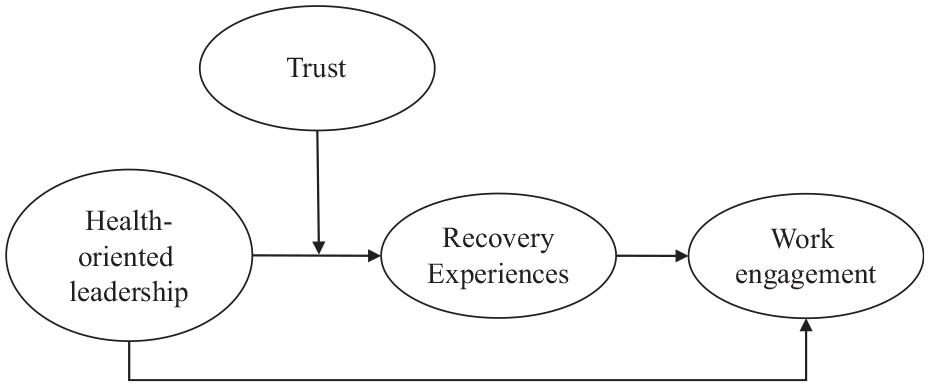
Research model.
Methodology
Sample and Data Collection
The sample data for this study comes from twelve four- and five-star hotels in Chengdu City of China, using a convenience sampling method (Saunders et al., 2023). One of the authors maintains a long-term collaborative relationship with these hotels. Chengdu is the capital city of Sichuan province and the economic center of southwest China. It is ranked by Trip Advisor as China’s premier travel destination and is the only Chinese city to be included in CNN’s “50 Places to Visit in a Lifetime,” attracting more than 200 million travelers by 2022 alone (Lv et al., 2024). Therefore, Chengdu’s well-developed hotel industry can serve as a representative of China’s hotel industry and provide an adequate sample for this study.
The questionnaire was prepared in Chinese as the target respondents were all Chinese. The translation-back translation procedure (Klotz et al., 2023) was carried out with the help of two experts in the field of organizational behavior. They were asked to review relevant concepts, the structure of the questionnaire, the clarity and appropriateness of each question and wording, and to discuss any difficulties they encountered in understanding and selecting an option. In general, they were able to understand the questionnaires, with the exception of some words of the scales which needed to be slightly modified to match the Chinese language For instance, the terms “milestones,”“demands,” and “carry away” could not directly translatable into Chinese due to the divergence in their meanings. These words were improved according to their suggestions to make them conform to Chinese language conventions.
Prior to the formal data collection, 87 questionnaires were collected for pilot test showing that the Cronbach’s alpha of all the scales meet the guideline that it should be greater than 0.7, which shows that all of the constructs’ internal consistency reliability complies with the study’s criteria (J. J. F. Hair et al., 2022). During July to August 2023, questionnaire was distributed to 600 frontline employees with the permission and assistance of the human resource managers of each hotel. The employees were invited to scan the QR code to complete the questionnaire, and informed of the purpose of the study. In the end, 565 questionnaires were returned, of which 45 were deleted due to response times of less than 100 s and straight-line responses. With a validity rating of 92.04%, 520 valid questionnaires were ultimately kept.
The demographic profile of the questionnaire respondents is displayed in Table 1. Female respondents (n = 334) constituted 64.2% of all respondents. 68.8% of the respondents (n = 358) were below 33 years old and they were born after 1990. Meanwhile, at the same time, 53.1% of the respondents (n = 276) were married and also 44.4% were single. 284 of the respondents had no children, accounting for 54.6%. In terms of educational level, 60.0% of the respondents (n = 312) had received an undergraduate education. Finally, 66% of the participants (n = 343) reported having worked at the hotel for less than 3 years.
Demographic Profile of Respondents (n = 520).

Measures
Each variable in this study was measured using a well-developed scale in previous research. Seven points of the Likert scale (strongly disagree = 1, strongly agree = 7) were used to measure work engagement, and five points of the Likert scale (strongly disagree = 1, strongly agree = 5) were used to measure the remaining constructs.
HOL
We measured HOL using a total of 15 items of the HOL Staff Care scale from Franke et al. (2014). Some sample items are “My supervisor invites me to inform him/her about health risks at my workplace” and “My supervisor immediately notices when something is wrong with my health.”
Recovery Experiences
We used the Recovery Experiences Questionnaire from Sonnentag and Fritz (2007), which consisted of four core dimensions of 16 items covering detachment (four items, e.g., “After work, I forgot about work.”), relaxation (four items, e.g., “After work, I kick back and relax.”), mastery (four items, e.g., “After work, I learn new things.”) and control (four items, e.g., “After work, I feel like I can decide for myself what to do.”). In this study, the recovery experiences was viewed as a higher-order measure model (for a similar method, see Cheng & Cho, 2021).
Work Engagement
We adopted Schaufeli et al. (2006)’s widely used nine-item uni-dimensional scale (UWES-9) to measure work engagement. Sample items are “The employee felt strong and vigorous while working” and “The employee was completely immersed in my work.”
Trust
We used a four-item scale established by Nyhan and Marlowe (1997). Sample items are “The level of trust between supervisors and workers in this organization is” and “My level of confidence that my supervisor will treat me fairly is.”
Control Variables
In earlier studies, gender and age were controlled to avoid their potential effects as they likely influence work engagement (Banihani et al., 2013; Chaudhary & Rangnekar, 2017; Rigg et al., 2014).
Common Method Bias
To control the potential for Common Method Variance (CMV) in our cross-sectional data, we took both procedural and statistical approaches according to the recommendations of Podsakoff et al. (2003). Firstly, all respondents participated in the survey were informed of the voluntary nature of participating and assurances of anonymity and confidentiality, to allay any concerns. Secondly, different scale ratings in the questionnaire were employed to minimize social desirability bias (Podsakoff et al., 2003). Statistically, we followed the Harman’s single-factor test and the common latent factor method (Podsakoff et al., 2003). Exploratory factor analysis was conducted on all items loading to a potential single factor using SPSS 26.0. The likelihood that a single factor could account for the maximum variance was 41.147%, demonstrating that no single factor accounted for the majority of the variance.
Furthermore, we conducted a confirmatory factor analysis utilizing the Mplus software. The Table 2 presents the model fit indices for seven different factor models, ranging from a seven-factor model to a one-factor model, as well as a CMV model. The models are compared based on their chi-square values (χ2), degrees of freedom (df), Comparative Fit Index (CFI), Tucker-Lewis Index (TLI), and Root Mean Square Error of Approximation (RMSEA). The results show that the seven-factor model has the best fit, with a χ2 value of 2665.205, df = 881, CFI = 0.91, TLI = 0.904, and RMSEA = 0.062. This is because the recovery experiences in our model is a higher-order construct that contains four second-order factors. The fit indices decrease as the number of factors decreases, with the one-factor model having the poorest fit (χ2 = 9768.582, df = 902, CFI = 0.554, TLI = 0.532, and RMSEA = 0.13). The CMV model, which accounts for common method variance, has a χ2 value of 2651.466, df = 845, CFI = 0.909, TLI = 0.898, and RMSEA = 0.064, indicating a good fit. Adding a common method variance (CMV) component to the model does not significantly improve the model fit, it suggests that CMV is not a major issue in the data.
Confirmatory Factor Analysis.

Note. HOL = health-oriented leadership; WE = work engagement; TR = trust; PSD = psychological detachment; REX = relaxation; CON = control; MAT = mastery.
Data Analysis and Results
Firstly, data were cleaned and descriptive analyses were performed on the respondents using SPSS 26.0. Next, the models were examined in two stages using partial least squares structural equation modeling (PLS-SEM) in SmartPLS 4.0, with the measuring model being the main focus of the first stage and the structural model being the main focus of the second (J. J. F. Hair et al., 2022).
Measurement Model
In this study, recovery experiences was estimated as a reflective-reflective high-order model according to the two-stage approach (Sarstedt et al., 2019). The results of the reliability and validity of all the constructs are shown in Tables 3 and 4. All the scales indicated satisfactory reliability as all the Cronbach’s α and CR values were above 0.7.
Validity and Reliability of Constructs.
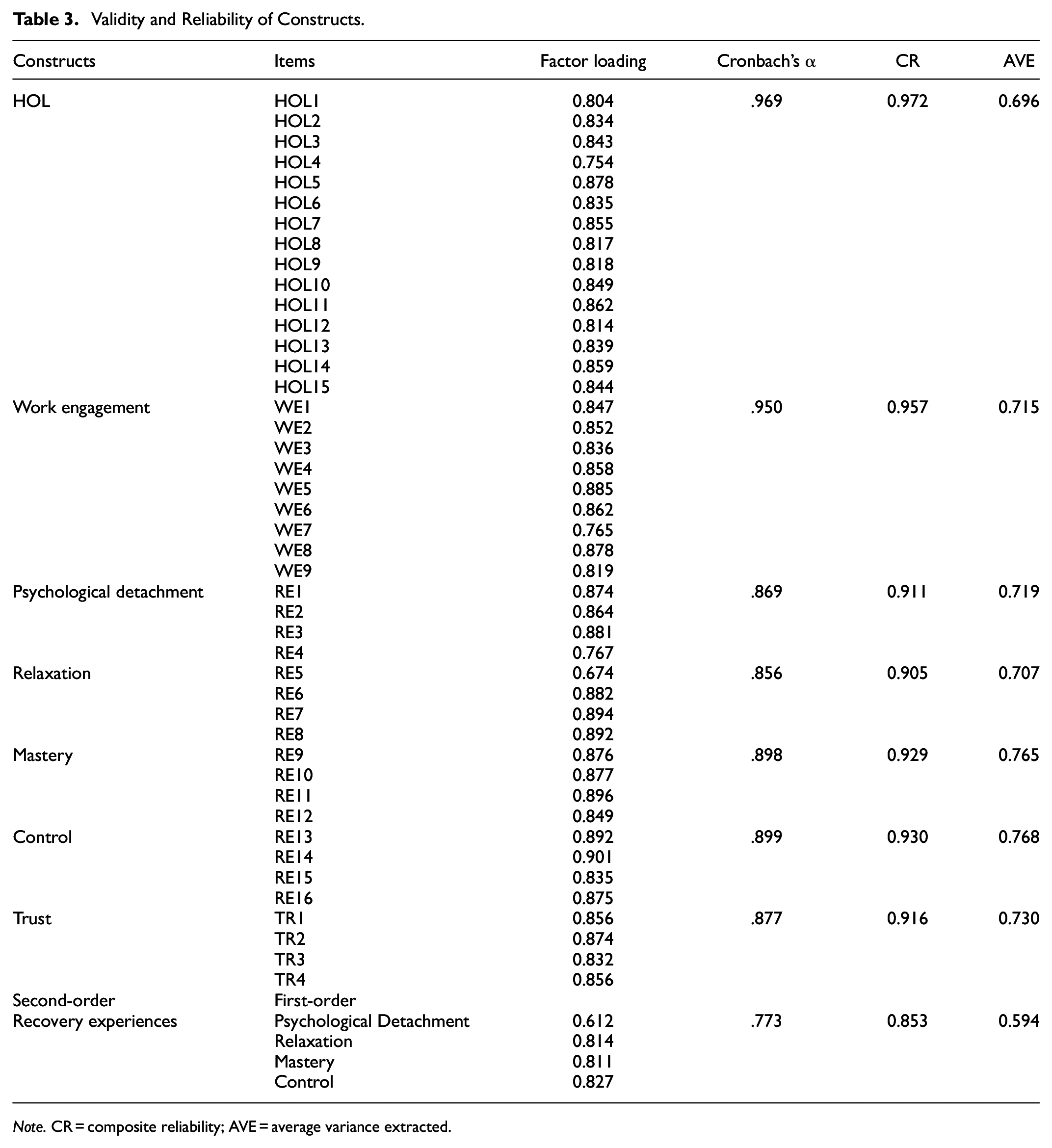
Note. CR = composite reliability; AVE = average variance extracted.
Assessment of Discriminant Validity Using HTMT.

Note. HOL = health-oriented leadership; WE = work engagement; TR = Trust; PSD = psychological detachment; REX = relaxation; CON = Control; MAT = mastery.
Second, to evaluate the convergent validity, factor loading and average variance extracted (AVE) were computed (Schlittgen et al., 2016). Generally speaking, an indicator’s factor loading should be greater than 0.708 because its square represents 50% of the AVE (J. J. F. Hair et al., 2022). Indicators with factor loading between 0.4 and 0.7 could be kept in this analysis unless AVE is less than 0.5 (J. F. Hair et al., 2019). Additionally, Table 3 indicates that the factor loading for each first order construct of recovery experiences meet the convergence validity requirement.
Third, discriminant validity refers to “the extent to which a structure is truly different from other structures” (Hair et al., 2014, p. 104). To evaluate discriminant validity, the Heterotrait-Monotrait Ratio (HTMT) criterion was applied, which is often considered the most commonly used method (Henseler et al., 2015). As can be seen in Table 4, all of the constructs fell below 0.85, which is consistent with the 0.85 (Kline, 2011) or 0.90 (Gold et al., 2001) thresholds.
Structural Model
First, the values of the variance inflation factor (VIF) for the multicollinearity problem were analyzed (Kock & Lynn, 2012). The results showed that all latent variables had VIF values between 1.202 and 2.105 below the value of 3.3 with no collinearity problem (Diamantopoulos & Siguaw, 2006; J. J. F. Hair et al., 2022).
Second, Table 5 presents the results of the statistical significance of parameters through the bootstrapping technique. Among the control variables, age (β = .193, p < .01) was found to significantly relate to work engagement, whereas gender (β = .079, p > .05) was not a significant predictor of work engagement. HOL (β = .498, p < .01) and recovery experiences (β = .256, p < .01) were positively related to work engagement. Also, the relationship between HOL and recovery experiences was supported (β = .412, p < .01). A mediation analysis was conducted on H4 to investigate the mediating effect of recovery experiences between HOL and work engagement. The results of the indirect effects (β = .105, p < .01) indicated that the mediating effect was significant. Therefore, H1 to H4 were all supported.
Results of Hypotheses Testing.

Note. LL = lower level; UL = upper level; STDEV = standard deviation; HOL = health-oriented leadership; WE = work engagement; RE = recovery experiences; TR = Trust.
p < .01.
Third, we used the two-stage approach to examine the moderating role of trust (Chin et al., 2003). The results of moderation analyses showed a significant interaction effect of HOL × TR (β = .194, p < .01) on recovery experiences (see Table 5). Figure 2 presented the relationship graphically. Increased recovery experiences is a result of highly HOL, particularly when trust is strong. However, when there is a low level of trust, HOL and recovery experiences even have slightly negative relationship. As such, H5 was partially supported.

Moderation slope analysis.
Fourth, as shown is Table 6, R2 is the percentage of the endogenous structure’s variance that can be accounted for by all exogenous constructs (Sarstedt et al., 2014). With the R2 value of .477, all exogenous variables are responsible for 47.7% of the variance in work engagement. Based on the common criterion (J. J. F. Hair et al., 2022), the effect of HOL (ƒ2 = 0.389) on work engagement is large, while the effect of recovery experiences (ƒ2 = 0.104) is small. In addition, the effect of HOL (ƒ2 = 0.204) on recovery experiences is medium.
Quality of the Model and Fit Indices.

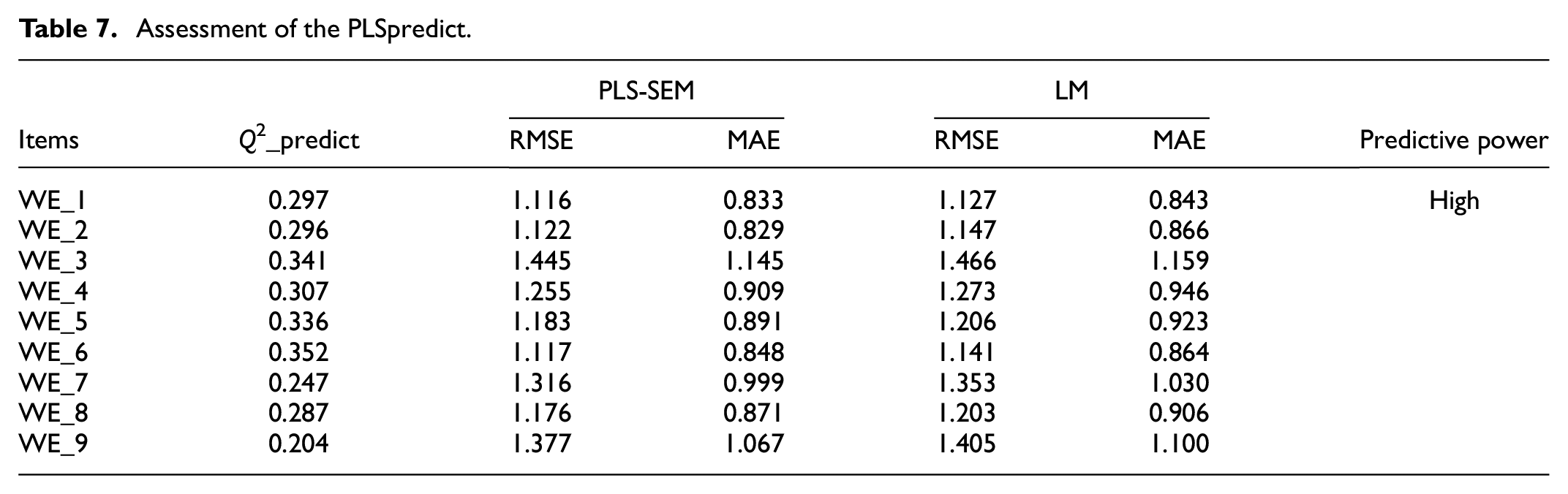
Finally, Q2 values were generated by running blind folding procedure which helps to assess whether exogenous constructs are predictive (J. J. F. Hair et al., 2022). The values of Q2 for work engagement (0.417) and recovery experiences (0.162) were greater than zero signifying acceptable predictive relevance as shown in Table 6. Moreover, we employed the PLSpredict model (Shmueli et al., 2019), which produces out-of-sample prediction at the endogenous item level. The results suggested that our model had high predictive power as show in Table 7.
Assessment of the PLSpredict.
Discussion and Conclusion
Discussion
The analysis of the data led to the following three key findings: (1) HOL promotes the work engagement of frontline employees in the Chinese hotel industry; (2) Recovery experiences mediates the above relationship; (3) High trust effectively strengthens the positive correlation between HOL and recovery experiences, while low trust even leads to a negative relationship between HOL and recovery experiences; (4) As a control variable, age has a significant effect on work engagement, while gender does not. The results will be discussed in detail in the subsequent section.
First, this study validates the value of HOL as an important job resource to improve the work engagement of hotel employees in China (H1). The work engagement of frontline employees depends on the motivation, resources and support they receive from the workplace (Sahi et al., 2022). When hotel employees perceive higher levels of HOL, they are more engaged in their work. The result is consistent with the prior studies (Grimm et al., 2021; Kaluza et al., 2021; Klebe et al., 2024) and the COR theory and the JD-R model provide a plausible explanation for the relationship. If the supervisor promotes HOL practices, employees will benefit from sustainable energy and motivation for work engagement. HOL not only helps hotel employees release stress, but also helps them replenish their resources to meet future challenges (Hobfoll et al., 2018). Our study validates the positive effect of HOL on employee work engagement in the Chinese cultural context which is particularly important for the hotel industry in China, where the increasing phenomenon of workplace involution has led to a high level of stressful work conditions for employees (Yin et al., 2023).
Second, HOL improves employee recovery experiences (H2), which in turn positively correlates with work engagement (H3). As predicted, recovery experiences mediates the relationship between HOL and work engagement (H4). The mediating mechanism of recovery experiences is also consistent with the assumptions of the COR model and the JD-R model. In other words, HOL, as an external resource, can significantly enhance the personal resources of hotel employees and increase their work engagement. When hotel employees are under great stressful circumstances, supervisors’ staff care is important for them to achieve recovery experiences. The greater the degree of recovery of an employee, the more energy and resources they are able to dedicate to their work. The findings are also consistent with a lot of occupational health psychology literature (Fan et al., 2021; Y. Park & Haun, 2017; Sonnentag et al., 2012) and offer empirical backing for the JD-R model in the context of recovery (Kinnunen et al., 2011). In conclusion, our study provides novel insights into the underlying mechanisms between HOL and work engagement.
Third, the findings indicate that the positive effects of HOL on employees’ recovery experiences are contingent upon the establishment of trust (H5). Trust can influence the indirect effects of HOL on work engagement through the recovery experiences. It is found that hotel employees who perceive a high degree of HOL are more likely to experience a higher level of recovery experiences when they have a higher level of trust in their supervisors. In addition, it is interesting to note that when employees’ trust is low, hotel employees who perceive a high degree of HOL instead perceive a lower recovery experiences. It can be reasonably assumed when employees lack trust in their supervisors, they tend to perceive their concern as false. Hotel employees are less likely to believe that their supervisors genuinely care about them. As a result, supervisors’ staff care may make them feel uneasy and burdened, and even lead to them being perceived as a target for future layoffs. Consequently, they are unable to fully disengage from their work and experience diminished levels of recovery. This study builds upon the existing body of literature on the boundary mechanism of HOL effectiveness, drawing upon the social exchange theory.
Finally, our study also finds that age as a control variable significantly affects work engagement, while gender is not significant. In accordance with previous studies (Chaudhary & Rangnekar, 2017; Rigg et al., 2014), a significant difference in work engagement was observed across age groups, with older employees exhibiting higher levels of work engagement. This may be attributed to the fact that older employees possess a greater array of job resources, which can assist them in navigating the job demands (Virtanen et al., 2020), thereby enhancing their work engagement. Additionally, no significant correlation was observed between gender and work engagement, which is at odds with previous studies (Banihani et al., 2013). This discrepancy may be attributed to the fact that gender is no longer a pivotal factor, given that women have become increasingly prevalent in the workplace in recent years. In particular, women may have an advantage over men in the service industry, particularly as hotel frontline roles. Our study also adds new findings to the work engagement literature from a demographic perspective.
Theoretical Implications
Firstly, this study empirically examines the impact of HOL on work engagement of employees in the Chinese hotel industry, thereby extending the existing knowledge of HOL literature. While existing research has increasingly focused on the impact of HOL on employee health and well-being, the impact of HOL on work engagement has not been explored in depth. In particular, given the cultural context of workplace involution in China, it is of relevance to study the impact of HOL on work engagement. Our study demonstrates that HOL can be considered a positive leadership that helps employees mitigate the decline in work engagement due to work overload.
Secondly, we propose a novel perspective to investigate how HOL affects work engagement drawing upon COR theory and the JD-R model. Prior research has emphasize the importance of HOL in promoting health and well-being primarily through employee self care, neglecting the psychological experience of employees during the recovery process and its positive impact on work outcomes. This study demonstrates that HOL as a job resource can buffer the impact of job demands on stress and promote work engagement, which enriches the understanding of how HOL functions within these dynamics and offers a nuanced view of the interplay between leadership, employee recovery, and work engagement from the recovery perspective.
Finally, our study found that trust played a significant moderating role between HOL and recovery experiences, echoing existing literature calling for HOL boundary conditions (Klebe, Felfe, Klug, et al., 2021). This study highlights the importance of trust in leader-employee interactions (Decuypere & Schaufeli, 2021), which contributes to more comprehensive understanding of HOL boundary in the hotel industry. HOL is frequently regarded as a resource for employees, yet when there is a lack of trust in their leaders, it can become a source of stress and pressure. Therefore, trust can be viewed as a vital factor that facilitates employees’ access to resources. Overall, this research offers a more nuanced explanation, suggesting that the degree of employee trust in a given leadership style may influence how effective it is.
Managerial Implications
Firstly, the study found that HOL in the hotel industry had a positive impact on the recovery experience and work engagement of frontline employees. This finding indicates that HOL is not only a leadership approach to enhancing employee health and well-being, but can also be regarded as a strategic human resource management practice (Gordon et al., 2019). It facilitates the development of a workforce capable of thriving in demanding environments and enhances the organizational performance of hotels in the face of challenges. Hotel managers can implementation of the HOL training program to remind them to take responsibility for their own health and employees (Nielsen et al., 2017; Stuber et al., 2021). Hotel supervisors should optimize work design to reduce repetitive tasks and enhance autonomy and flexibility. They also should ensure adequate opportunities for employees to recover, pay attention to their health warning signals and promote workplace wellness program. This is particularly important for current hotel employees, most of whom are of the younger generation, who prefer to maintain a work-life balance (Kaya & Karatepe, 2020; Yin et al., 2023).
Secondly, it can be posited that recovery experiences plays a significant mediating role between HOL and work engagement. Hotel managers can control workloads more effectively or establish healthy work environments where employees have more flexibility over their free time and can engage in recovery activities like meditation or physical activity during break or after work. When employees feel overwhelmed by service complaints from customers, employers in the hotel industry should provide employees more days off so they can enjoy leisure activities and temporarily disconnect from work. Hotels can also support positive recovery experiences by providing training programs to guide them to keep a healthy lifestyle, for example, psychological counseling and assistance services. The provision of information to employees regarding the benefits of HOL for themselves encourages a positive response and an increase in work engagement.
Thirdly, the finding suggests that trust is a key factor influencing the effectiveness of HOL in hotels. Hotel managers should pay close attention to the climate of trust in the workplace as a bridge between the organization and employees. By implementing people-centered and sustainable human resource management practices and communicating sincerely with their employees, supervisors can help them reduce their doubts and make them aware of the true intention of HOL. This can lead to the development of highly trusting interactions between supervisors and employees and to avoid defensive silence (Şahin et al., 2021), which in turn can increase employee engagement.
Limitation and Future Research
There are some limitations that provide opportunities for future research. Firstly, this study relied on data reported by a single source which may lead to common method bias (Podsakoff et al., 2003). While self-report has inherent limitations, it remains an invaluable tool when we focus on psychological experiences (Spector, 2019). Although we conducted statistical tests on the data and were unable to demonstrate any issues with CMV, multiple sources may provide different results. Future research can collect data from different sources and match employee and supervisor assessments to further mitigate the potential for CMV.
Second, the cross-sectional data and non-probability sampling may have hindered the possibility of establishing causal inferences. Although non-probability sampling can give accurate statistical inferences at relatively low cost, it may raise concerns about selection bias and validity issues regarding the intervention and its impact on specific estimates. Future studies may use probability sampling to better generalize findings. Longitudinal research methods or experience sampling method (Gabriel et al., 2019) could be utilized to collect data at different points in time to test for mediating effects (Naseer & Raja, 2021).
Third, the generalizability of this study is limited because the hypotheses were tested in the hotel context in Chengdu, China. This study only investigated frontline employees in hotels in China, which limited the applicability of its results to other regions and industries. In future studies, the scope of sample collection could be expanded to more regions and other industries (i.e., IT, health care, education, and tourism) to test the generalizability of the findings.
Fourth, we constructed a more concise model by examining recovery experiences as a higher-order construct, which was not possible to know which experience exerted a greater effect. Future research could further examine the multiple mediating roles of the four dimensions of recovery experiences between HOL and work engagement.
Finally, other factors such as organizational climate, job characteristics, and personal traits also have the potential to produce boundary effects between workplace behavior and role performance. Therefore, future research could also look at organizational climate (e.g., competitive climate, and organizational culture), job characteristics (e.g., workload, work-family conflict, and work autonomy), and personal traits (e.g., age, workaholism, agency, and communality) to further explore the functional boundaries between HOL, recovery experiences, and work engagement.
Footnotes
Acknowledgements
We are grateful to the anonymous reviewers for their insightful suggestions and constructive comments. We deeply thank the editors for their patient work on our manuscript.
Declaration of Conflicting Interests
The author(s) declared no potential conflicts of interest with respect to the research, authorship, and/or publication of this article.
Funding
The author(s) disclosed receipt of the following financial support for the research, authorship, and/or publication of this article: The project is sponsored by: (1) the Research Centre for EU-America Food Culture (2024OMYB08); (2) Sichuan Cuisine Development and Research Center (Grant #: CC24G16); (3) Sichuan Key Laboratory of Philosophy and Social Sciences for Artificial Intelligence in Sichuan Cuisine (Grant #: CR24Y19).
Ethics Statement
The study was approved by the Ethics Committee (full name: Ethics Committee for Research involving Human Subjects, Universiti Putra Malaysia, Malaysia; reference number JKEUPM-2023-627).
Informed Consent
All included respondents gave their written informed consent.

Data Availability Statement
The datasets generated during the current study are available from the corresponding author on reasonable request.