




Abstract
The study explained a model of employee social responsibility (ESR) as an antecedent to corporate competitiveness. It hypothesizes that ESR has significant effect on employee competitiveness (EC). Questionnaires were administered to a sample of 700 employees selected from a population of 5,595 from 20 classified hotels in the coastal region of Kenya using proportionate and systematic random sampling methods. Structural equation model was used for model specification and hypotheses testing. Confirmatory factor analysis was performed on six and four constructs representing ESR and EC, respectively. Overall, a negative effect of ESR on EC was found with un-standardized β estimates = −.516; SE = .071, p = .000. Accordingly, increase in employee corporate social responsibility (CSR) is associated with decline in EC. This was potentially paradoxical because employees demonstrated job and organization commitment and retention intention despite poor ESR practices.
Keywords
Introduction
Extensive organizational research thus far has focused on external corporate social responsibility (CSR) of various forms (Carroll, 1991; Garriga & Mele, 2004; Lantos, 2001; Orlitzky, Schmidt, & Rynes, 2003). Others have focused on external CSR and relationship with organizational outcomes (Preston & O’Bannon, 1997; Waddock & Graves, 1997; Wood, 1991). Few researchers have underscored the link between internal CSR and organizational outcomes. Others have tended to link fairness perceptions at work- and job-related outcomes (Adams, 1965; Mowday & Lyman, 1979), customer contact employees and provision of good service quality (Tsaur & Lin, 2004). Furthermore, theory on CSR has attempted to explore instrumental stakeholder theory (Mitchell, Agle, & Wood, 1997; Preston & Sapienza, 1990) and Rawls’s (1999) procedural and distributive justice dimensions. More literature focused on why employees perform well and are satisfied with their jobs (Janssen & Van Yperen, 2004). However, although literature on employee CSR continues to grow, employees as a unit of analysis in CSR organizational studies have received scant attention in the academic literature (Aguilera, Rupp, Williams, & Ganapathi, 2007). This is particularly critical in an African context where appropriate regulatory framework is weak or non-existent.
Although few studies have explored employee CSR-related practices in organization context, empirical results have been equivocal on the outcomes of employee social responsibility (ESR) in organizations. For instance, Sharpley and Forster (2003) found that hotel employees were satisfied with the wages they earned and would not work harder if they were paid more.
Similar studies like Tsaur and Lin (2004) considered and found a positive relationship between human resource practices and service quality of tourist hotels in Taiwan. For instance, a positive relationship was found in Taiwan between training and higher levels of employee behavior in tourist hotel (Tsaur & Lin, 2004). This differed with findings by Sharpley and Forster (2003) who found that in Cyprus, majority of hotel employees surveyed did not want to look for another job. According to Sharpley and Forster (2003) communication, information sharing and empowerment are all forms of employee involvement, a key dimension within successful service organization. According to Tsaur and Lin (2004), in developing countries, and particularly in the island settings, it seems paradoxical that employees hold key to competitive success in an industry that has traditionally viewed labor as a cost of production, a replaceable item, an item to dispose of in the low season and an item that can be hired and fired at will. A firm’s human resource management practices can create a work environment that motivates a client-oriented behavior from employees. Accordingly, organization settings and context have a significant influence on the results of such relationships.
This study develops and evaluates a model of ESR perceptions as antecedents of employee competitiveness (EC) outcomes. This focused particularly in service organization setting in an African context. Correspondingly, four hypotheses were tested as follows: First, an increase in ESR is significantly attributable to increase in employer CSR orientation, perceived fair wage, perceived level of discrimination, work benefits and facilities, work environment, remuneration and information. Second, an increase in EC latent construct is significantly attributable to increase in job satisfaction, organization commitment, job commitment, and organization attachment and employee retention measured variables. Third, ESR associates substantially with EC. Finally, ESR positively affects EC.
The organization of the article is as follows: Subsequent sections cover overview of theoretical constructs of the study, methodology, model specification, results, implications, and finally conclusions.
Theoretical Overview of Constructs
Reciprocal stakeholder responsibilities in organizations (Lantos, 2001), instrumental Stakeholder theory (Mitchell et al., 1997; Preston & Sapienza, 1990), and competitiveness models formed the basis for constructs conceptualization in the study. Specifically, reciprocity and justice in organization is posited as a kind of generalized obligation, which compels one person to make a return for the benefit received from others. Theory of distributive justice (Rawls, 1999) also seeks to explain the process of allocation of rewards among actors in a social system. Actors in a social exchange context have what they regard as legitimate expectations about how rewards should be allocated. Employees in an organization contingent upon their employer’s social responsibility will accordingly reciprocate.
ESR was conceptually defined by six dimensions: employer’s CSR orientation, perceived fair wage, perceived level of fairness or discrimination, work benefits, work environment, and remuneration and availability of information. Similarly, EC was conceptually defined by four dimensions: job satisfaction, organization commitment, job commitment, and organizational attachment/employee retention.
The study derived constructs of EC from job diagnostic survey (Hackman & Oldham, 1975) and modified these constructs in light of Spector (1997). These include level of job security; amount of pay; personal growth and development opportunities; degree of respect from supervisor, current duties, and organizational pride. In addition, employee retention indicators were developed from Cammann, Fichman, Jenkins, and Klesh (1979) and Hom and Griffieth (1991). This includes intention to quit the organization, intention to actively search job, conditional intention to quit, and retrenchment policy. Job satisfaction comprises satisfaction with job-related features, whereas organization commitment relates to attachment to the organization and willingness to work beyond expectations. Job commitment also deals with personal attention and focus on the job, whereas organization attachment and employee retention focus on lack of quit intentions.
Finally, organization commitment includes working hard beyond normal expectations, positive advocacy, caring about the fate of organization, organization pride, and inspiration and congruency of values (Mowday & Lyman, 1979).
Study Method
An explanatory survey was utilized to verify the relationship between ESR and EC. A survey of hotel employees in the coastal region of Kenya was carried out. Initially, 27 (30%) classified hotels were selected using simple random sampling from a total of 87 classified hotels found in the study area during the period and based on Kenya Gazette supplement (Government of Kenya [GOK], 2003). Preliminary survey showed that 20 of the selected hotels were accessible, whereas 7 were not due to temporary closure. A sample of 700 employee respondents was accessed by use of structural questionnaire. To verify the factor structure in the proposed scale as well as to explore whether significant modifications were necessary, confirmatory factor analysis (CFA) was performed on the variables. The data set contained responses from 700 employee respondents selected using systematic random sampling method from a population of 5,595 employees. AMOS (Arbuckle, 2003) was utilized as the statistical software on the 10 constructs representing both ESR and EC. The structural equation model (SEPATH) was specified using AMOS 5.0 (Arbuckle, 2003) and tested for model fit with maximum likelihood estimation technique.
Measures of ESR and EC
Six measured variables representing ESR and four measured variables representing EC were subjected to CFA. The measured variables for ESR were employer CSR orientation, perceived fair wage, perceived level of discrimination, work environment, work benefits and facilities, and finally, remuneration and information. The measured variables for EC were designated as organizational attachment/employee retention, job satisfaction, organizational commitment, and job commitment.
Model Specification
A model was proposed on the relationship between ESR and EC. In the model, the variables were assumed to be independent of each other. The measured indicators and the corresponding dimensions are presented in Table 1. Six dimensions in the proposed model were hypothesized to measure ESR and four measured variables were considered to measures EC. These dimensions were assumed to be uni-dimensional and non-correlating.
Dimensions of Employee CSR and Employee Competitiveness.

Note. CSR = corporate social responsibility.
Results of the Study
Profile of Respondents
A structured questionnaire was used to elicit background information on the employee respondents. Majority of the respondents were male, accounting for 65.4% of the sample, whereas the female respondents accounted for 34.3% of the sample. The work tenure was found to average 7 years. Majority of the employees were moderately educated with majority (33%) having diploma education, followed by certificate holders, 27.4%. Mean age for employees were 31.35 (SD = 6.38), while mean monthly wage was just slightly above Kenyan shilling (Ksh) 10,300 (103 Euros). On social responsibility priority for the employer, employees ranked their preference for the employer, thus the employer should be socially responsible to employees (rank 1) and then to customers (rank 2), followed by community (rank 3), and last the natural environment (rank 4). This finding showed that the environmental concern was not a top priority to the employee respondents.
Descriptive Statistics
Means for various items were aggregated to form composite means representing various constructs. Computing the means and SDs of the constructs anchored on a 5-point Likert-type scales, such that 1 = strongly disagree and 5 = strongly agree. Higher values indicated higher acceptance of the construct. The outcome yielded the following results: employer CSR orientation (M = 2.77; SD = 0.88), perceived fair wage (M= 1.81; SD = 0.68), perceived level of discrimination (M= 2.70; SD = 0.55), work benefits (M = 2.55; SD = 0.93), work environment (M = 2.71; SD = 0.88), remuneration and information (M = 4.21; SD = 0.63). On the other hand, other descriptive outcomes were as follows: job satisfaction (M = 2.37; SD = 0.76), organization commitment (M = 3.81; SD = 0.87), job commitment (M = 4.33; SD = 0.72), and organizational attachment and employee retention (M = 2.95; SD = 0.40).
From the foregoing descriptive analysis, wages were reportedly not perceived as fair and, second, employees exhibited high job and organization commitment, thereby exposing a gap between fairness of wage, job, and organization commitment. This implies that perceived fair wage may not be a key factor associated with job and organization commitment.
Third, employees indicated that they were willing to leave the organization but conditionally. They reported high job and organization commitment despite poor employer CSR. They also indicated that their organizations and personal values were not similar. Furthermore, employees indicated poor CSR record in the establishment including lack of evaluation of CSR actions, rewards, training for unemployed, among others. However, employees felt that they were being encouraged to be good citizens.
On effective communication strategy, there was poor perceived communication between the management of enterprise and the employees on key employment matters, except on salary, allowances, and deductions. As for ESR, evidence of some discrimination of employees in hiring and firing, poor CSR indicated by lack of union membership, poor health and safety conditions, and provision of facilities. Perceived discrimination in job training and promotion was reported. On fair wage, there was evidence of lack of fairness. Overall, employees felt that their wages needed to be increased.
On job satisfaction, employees showed high level of dissatisfaction on all job dimensions notably; job security, growth and development, respect from supervisor, and current duties. However, they indicated that they were proud to belong to the organizations team. On the matter of retention, employees indicated that they were not planning to leave the organization, unless given an opportunity in another organization. This showed high perceived employee retention. The dissonance between job satisfaction on one hand and organization commitment/job commitment on the other is somewhat of a paradox. Whereas high job commitment is reported, the employees were utterly dissatisfied. This is nevertheless unsurprising.
Model Evaluation
The proposed model was evaluated for fit. On evaluation, the initial results showed a poor fitting model. This suggested the data were not fitting the proposed model. Accordingly, the proposed model showed that χ2/df = 5.3, relative fit index (RFI) = .651, normed fit index (NFI) = .736, root mean square error of approximation (RMSEA) = .078, and comparative fit index (CFI) = .771. Conventionally, such poor fitting model required that either, the model is re-specified or modified with the support of theory. With the aid of modification indices and theory, systematic modification was performed. A revised CFA model was established after series of minor modifications. The model was again evaluated for model fit. The results were as follows: χ2/df = 4.3, NFI = .915, RMSEA = .070, and CFI = .932. These results showed a satisfactory model fit because the indices were within the recommended threshold as suggested by Hair, Black, Babin, Anderson, and Tatham (2006). Table 2 indicates the fit indices, proposed and revised model values, and indices threshold level for acceptance.
Comparative Model Fit Summary for Employee CFA Model.

Note. CFA = confirmatory factor analysis; CMIN = minimum discrepancy; RFI = relative fit index; NFI = normed fit index; RMSEA = root mean square error of approximation; CFI = comparative fit index.
From the above procedure, key statistical indicators were estimated to test plausibility of hypotheses on the relationship between ESR and EC. These were sample covariance, correlation coefficient, factor weights, and regression coefficients. The respective hypotheses and outcome of the analysis are reported in the sections, “Measures of Employee Social Responsibility,” “Measures of Employee Competitiveness,” “Relationship Between Employee Social Responsibility and Employee Competitiveness,” and “Employee Social Responsibility as a Determinant of Employee Competitiveness.”
Measures of ESR
Six measured variables were posited to positively estimate ESR. The measured variables were employer CSR orientation, perceived fair wage, perceived level of discrimination, work benefits and facilities, work environment, remuneration and information. Employee socially responsible practices by firms include among others: work benefits, excellent facilities, fair wage, favorable work environment, effective communication and no discrimination in hiring, promotion, training, and placement. This conceptualization has led to the following proposition:
Prior to testing the above hypothesis, the constructs for ESR were measured. One critical assumption was that employer CSR orientation was directly linked to ESR. Accordingly, the model of ESR had the regression weight for employer CSR orientation fixed at 1.00. This suggested that when ESR rose by 1%, employer CSR orientation also rose by an equal or proportionate amount (1%). This implied that an increase in ESR was attributed to increase in employer CSR orientation. This was a fixed indicator of employee CSR based on theoretical propositions. Organizational justice theory suggests that employer CSR orientation characterized by fairness and justice should in effect predict EC.
While ESR increased by 1 unit, work environment, correspondingly, went up by .532 units. This suggests that an increase in ESR is attributed to less than proportional increase in perceived work benefits by employees. Similarly, remuneration and information was found to contribute to an increase in ESR but not significantly. The highest increase in ESR was attributed to employer CSR orientation, suggesting that it went up by .875 SDs for every 1 SD in ESR. Similarly, while ESR went up by 1 SD, perceived level of discrimination increased by .176. Logically, an increase in existing socially responsible corporate behavior could lead to increased level of job discrimination. This is shown in Table 3.
CFA Parameter Estimates for ESR and Employee Competitiveness.

Note. Maximum likelihood estimates are used. CFA = confirmatory factor analysis; ESR = employee social responsibility; CR = critical ratio.
P = .000.
Factor score weights similarly showed consistent results to both regression and covariance results. For instance, when work environment went up by 100%, ESR rose by 5.3%. The degree of discrimination increase of 100% yielded a rise of ESR by 2.6%. Similarly, 100% increase in perceived fair wage yielded an increase of ESR by 1.3%. Work environment had the highest significant indicator of ESR of the hotel enterprise.
Measures of EC
Similar to measure of ESR, simultaneously, constructs for EC were measured. The argument therefore posited the following:
Considering path coefficients between measured variables and factors in the CFA model, all but one variable were significant at p < .05. The insignificant factor was job commitment, which was hypothesized to measure EC. The measured variable could not significantly predict the dependent variable. Of the four measured variables for the EC, three negatively estimated EC. Thus, three measured variables notably job satisfaction, organization, and job commitment had negative direct effect on EC. Findings indicated that only organizational attachment and employee retention positively estimated EC.
Relationship Between ESR and EC
Results on regression weights for ESR and EC were used to test the following hypothesis:
Considering the path coefficients between measured variables and factors in the CFA model, all but remuneration and information were significant at p < -.05. Remuneration and information was hypothesized to measure ESR. Thus, remuneration and information could not significantly predict ESR at 5% level of significance.
Furthermore, when EC goes up by 1%, level of job satisfaction goes down by 1.822. The organization commitment goes down by .830 for every unit increase in EC. Job commitment went down by .3%, corresponding with % increase in EC but this relationship was not significant at 5% level. The summary of the regression results between ESR and EC are provided in Table 3.
The sample mean for EC was below 3.0, which indicated competitive CSR attitudes. Results suggested a negative covariance between EC and ESR. This confirms that the sample enterprises have poor competitiveness. This indicates that the relationship is inverse and paradoxical, which means that while ESR is poor, the performance outcomes have been positive.
Factor score weights shows consistent results to both regression and covariance results. For instance, the predicted value of EC corresponded to the measured variables notably; job satisfaction (decline by 22%), organizational attachment and retention rose by 5.7% and 3.6%, respectively. The largest magnitude in absolute terms of a measured variable on any latent construct was employer social responsibility. For this variable, an increase of a 100% in measured variables led to a rise in ESR by 52.7%. When work benefits and facilities are considered, its rise by 100% led to a rise in predicted value of ESR by 40.9%. Two critical predictions of ESR were employee CSR orientation and work benefits and facilities.
For measured variable organizational attachment and retention, a rise by 100% led the predicted value for ESR to go up by 2.4%. Similarly, when job satisfaction rose by 100%, ESR also went up by 8.0%. Increase by 100% in both work environment, degree of discrimination, and work benefits and facilities led to a decline in the predicted value of EC by 2.4%, 0.8%, and 8.6%, respectively.
Increase in perceived fair wage, remuneration, and information by 100% led to a rise in EC by 7.8% and 1.2%, respectively. Perceived fair wage had more predictive power on EC in comparison with remuneration and information. Similarly, work benefits and facilities predict EC more than any other indicator in the model. The degree of discrimination showed a low predictive ability on EC.
For the factor score weights, as job commitment went up by 100%, the predicted value for ESR also rose by 1%. In addition, if organization commitment went up by 100%, ESR declined by 3.8%. This implies that job commitment positively predicts ESR, whereas organization commitment negatively predicts ESR.
ESR as a Determinant of EC
Ultimately, the hypothesis that was tested posited the following:
The results of the initial estimation of the model fit were measured using five fit indices: chi-square fit index, RMSEA, non-normed fit index (NNFI), CFI, and RFI. Minimum was achieved such as χ2 = 53.439; df = 26, and p = .001. Table 4 shows the fit index, revised model values, values threshold, and implication for model fit.
Model Fit Summary (Number of Parameters, n = 36).

Note. CMIN = minimum discrepancy; IFI = incremental fit index; NFI = normed fit index; RMSEA = root mean square error of approximation; CFI = comparative fit index; TLI = Tucker–Lewis index.
On performing CFA, six and four exogenous latent constructs were confirmed to measure ESR and perceived EC, respectively. Details of the results are shown in Table 5. Two path coefficients were not significant at 5% significance level. These were remuneration/information and job commitment. This implies that despite positive coefficient of remuneration/information, its relationship with ESR was found not to be significant. Similarly, the negative coefficient of job commitment on EC was also insignificant at 5% level. Thus, remuneration/information and job commitment were dropped as a measure of ESR and EC, respectively.
Structural Model Coefficients for ESR and EC.
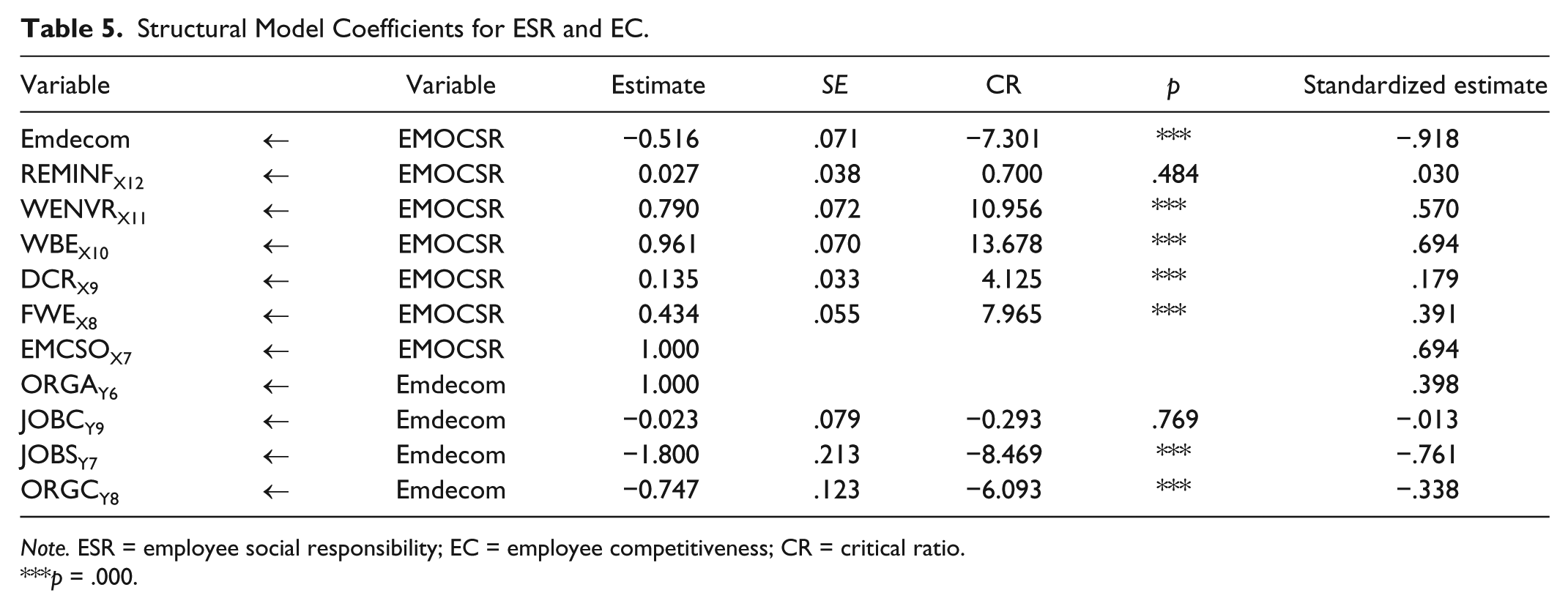
Note. ESR = employee social responsibility; EC = employee competitiveness; CR = critical ratio.
p = .000.
Overall, the total effect of ESR on EC was found to be significantly negative. The results showed un-standardized β estimates = −.516; SE = .071, p = .000. When the ESR increased by 1 SD, EC declined by .92 SDs. The general implication was that increased ESR was predicted by 1% lower perceived EC by .92%. There is a net decrease in competitiveness attributable to increase in existing employee-oriented CSR. The existing social responsibility practices could be hurting the competitiveness of the hotel firms.
This implies that an increase in the existing overall employee-oriented CSR has a significant downward effect on EC. The current employee social responsibility practices, programs, and strategies have an overall negative effect on EC. This has an important implication for competitiveness for service quality and customer satisfaction.
Conclusions of the Study
Several conclusions were derived from the study. Generally, moderate education level characterizes employees in the sample enterprises. Employees are poorly paid; employees considered social responsibility to the environment as lowest in their priorities.
It was evident that an increase in ESR latent construct significantly led to increase in employer CSR orientation, perceived fair wage, perceived level of discrimination, work benefits and facilities, work environment, remuneration, and information.
An assertion that an increase in EC is significantly attributable to increase in measured variables such as job satisfaction, organization commitment, job commitment, and employee retention.
The hypothesis that a significant positive relationship exists between ESR and EC latent constructs was partially accepted and mixed results.
The proposition that there was a significant positive effect of ESR on EC was rejected. There was evidence of a negative effect of ESR on EC.
Implications for Theory, Managerial Practice, and Policy
Organization studies have significantly focused on salient stakeholder’s need to be involved in key issues affecting them. An inclusive, effective, and satisfactory organization’s processes are crucial for committed employees. This implies that to be successful in a competitive market, it is important that hotel managers understand how employees feel at work and what they want (Lam, Zhang, & Baum, 2001).
Implications for Further Research
The moderating effect of employee profile on social responsibility and competitiveness dimensions need to be considered. Furthermore, there is need to control for enterprise size, industry, and sector in future studies.
Footnotes
Declaration of Conflicting Interests
The author(s) declared no potential conflicts of interest with respect to the research, authorship, and/or publication of this article.
Funding
The author(s) received no financial support for the research and/or authorship of this article.