



Abstract
Researchers studying achievement goal orientations theory generally approached it with a domain-generic perspective. Learners’ goals and motivation to learn, however, can vary by subject. This study examined the relationships among perceived parental goals, students’ personal goals, and engagement in a subject-specific domain (mathematics lessons), a novel context (Türkiye) and era (post COVID-19). The study explored how goals are adopted and how they affect engagement taking learners’ age into account. The participants comprised of 875 adolescents enrolled in high schools in Türkiye. For comparison purposes, they were grouped as underclassmen (9th and 10th graders) and upperclassmen (11th and12th graders). SEM analyses revealed that parental goals had a strong influence on adolescents’ adoption of personal goals. Parental mastery-approach goals had significant medium effects on students’ mastery-approach goals (underclassmen: β = .454, f2 = 0.21; upperclassmen: β = .478, f2 = 0.27, p < .001) and parental performance-approach goals had medium to large positive effects on students’ performance-approach (underclassmen: β = .516, f2 = 0.26; upperclassmen: β = .605, f2 = 0.42, p < .001) and performance-avoidance goals (underclassmen: β = .423, f2 = 0.15; upperclassmen: β = .494, f2 = 0.24, p < .001). In addition, student mastery-approach goals predicted classroom engagement more consistently than performance-related goals. Substantial group differences were observed between underclassmen and upperclassmen regarding the effects of goal orientations on affective engagement (z = 2.922, p < .01 for the difference between the effects of student mastery-approach goals and z = 2.062, p < .05 for the difference between the effects of student performance-avoidance goals). Findings underscore the necessity of raising parental awareness about how their achievement-related messages are perceived by their children, and increased opportunities should be provided to learners to help them better regulate their emotions.
Plain language summary
This study enriches our understanding of how adolescents’ perceptions of their parents influence their personal goal orientations and engagement in the classroom. The results suggest that adolescents’ perceptions of their parents play a key role in shaping their personal goals. We, thus, argue that parents should be better informed about how their interactions affect their children’s motivation to learn. We also found that mastery-approach oriented students were better than performance-approach and performance-avoidance oriented students in tolerating external messages that can negatively impact on their engagement. This highlights the importance of and the need for providing students with opportunities that can help them self-describe themselves and their goals, and regulate their emotions.
Keywords
Introduction
In recent years, achievement goal orientations theory has become one of the most frequently utilized frameworks to study motivation in academic contexts (Elliot & Hulleman, 2017; T. Urdan & Kaplan, 2020; Zhao & Redifer, 2016). The theory focuses on the importance of perceptions and posits that individual and environmental factors play a reciprocal role in endorsing and/or approving goals related to learning (Dweck & Leggett, 1988).
Research studies have consistently presented evidence on how environmental factors influence the adoption of goal orientations. Learning and success-related messages that students receive in school (i.e., through peers and/or teachers) or at home (i.e., from parents) were found to have a strong impact on students’ adoption of personal goals (e.g., Yıldızlı, 2020; Ames, 1992; Bae & DeBusk-Lane, 2018; Daniels et al., 2018; J.-I. Kim et al., 2010; T. Urdan & Midgley, 2003). Among these influences, parental goals play a crucial role in shaping students’ motivation. Nevertheless, variations in research findings with regards to the influence of parental goal orientations on students’ personal goal orientations (see e.g., the case of Greece in Gonida et al., 2014 and the case of Hong Kong in Wang et al., 2019) indicate that other factors (i.e., age and developmental stage) may also influence this relationship (T. Urdan & Kaplan, 2020).
Student engagement is another topic that is closely related to student motivation in general and goal orientations theory in particular. Researchers noted that engagement is an important factor influencing academic success (Fredricks et al., 2004). While research has established that engagement has a positive effect on student learning (e.g., Kuh, 2003; Tytler et al., 2008), fewer studies examined how goal orientations (both students’ and parents’) contribute to student engagement in subject-specific contexts, which is one of the research gaps that the present research aims to address.
Another gap in the existing research literature is the underrepresentation of adolescents in studies focusing on the achievement goal orientations theory. While researchers extensively studied the influences of parental goals on students’ adoption of personal goals with young learners as their participants (e.g., Madjar et al., 2016: Wang & Bai, 2023), fewer have examined this relationship with adolescent participants. Given that adolescence is a developmental stage characterized by shifts in self-regulation, autonomy, and sensitivity to social influences (e.g., Gonida et al., 2007; Zheng et al., 2019), it becomes crucial to explore how parental goals influence student motivation across different stages of adolescence. Moreover, prior studies have generally treated goal orientations in a generic manner, often overlooking subject-specific variations. Since students’ motivation and goals can differ across subject areas (Seegers et al., 2002), adopting a subject-specific perspective is necessary to gain a deeper understanding of these relationships.
One last gap identified in the literature concerns the long-term impact of the global COVID-19 pandemic on parent-student relationships (Knopik et al., 2021). During lockdowns, parents became more involved in their children’s education (Demir & Yıldızlı 2022; Garbe et al., 2020), which has potentially changed the way parental goals influence students’ personal goals. Therefore, investigating these effects in the post-pandemic era has become a valuable research niche. To address the above mentioned gaps in the literature, the present study examines the effects of perceived parental goals on adolescents’ (high school 9–12 graders) adoption of personal goals and engagement in mathematics lessons in the post-COVID-19 era. In particular, the study aims to investigate:
the influence of perceived parental goals on students’ personal goals and engagement,
the influence of students’ personal goals on engagement, and
whether there are differences between underclassmen (9th and 10th grade students) and upperclassmen (11th and 12th grade students) in terms of the effects of perceived parental and personal goals on engagement.
By focusing on a specific subject area (in this case mathematics) and considering developmental differences between different levels of high school, this study contributes to building a more complete picture of how parental goals influence student motivation and engagement throughout middle adolescence (Salmela-Aro, 2011). Furthermore, by situating the study in the post-pandemic era, the study provides insights into how parents’ increased involvement in their children’s education during the pandemic may have affected students’ goal orientations and engagement.
The Turkish education context and mathematics classes
High school tuition in Türkiye is the last step of the compulsory K-12 system which is administered as K + 4 + 4 + 4 (kindergarten, primary, secondary, and high school). The most common types of high schools are the Anatolian high schools which constitute around 87% (2,868/3,282) of all high schools in the country (Ministry of National Education, 2022). The end of high school tuition can be a very stressful period for adolescents due to university entrance exams conducted nationwide to select and place students into higher education programs (Yildirim et al., 2007). In addition, mathematics is a subject in which achievement is deemed essential to a nation’s economy (Reyna & Brainerd, 2007) and there is a consensus in Türkiye that mathematics is a vital subject that needs to be mastered in order to have a good career (Çiftci & Tatar, 2015). In parallel, mathematics questions have the highest impact on participant scores in university entrance exams which are conducted annually (Council of Higher Education, 2018). Thus, not only the students but also the parents put a lot of emphasis on the university entrance exams in general and mathematics in particular.
Students’ Personal Goals and Perceived Parental Goals
According to Ames (1992), goal orientations theory represents a holistic belief system centered on the way individuals approach achievement and strive for competence. Instead of focusing on what individuals want to achieve, it concentrates on why and how individuals want to achieve something (Anderman & Maehr, 1994). Although various categorizations have been proposed to organize the elements of the theory, the present study adopts the widely accepted trichotomous framework consisting of; (a) mastery-approach, (b) performance-approach, and (c) performance-avoidance goals (Linnenbrink-Garcia et al., 2008). While learners with mastery-approach goals focus on understanding, increasing skill levels and/or developing new ones, students with performance-approach goals strive to show their efforts to others or receive positive feedback from others, and students with performance-avoidance goals try to avoid actions that would make them look worse than others (Pintrich, 2000).
A considerable number of studies have been conducted on the effects of parental goal orientations on student goal orientations across the world. Initial studies were conducted in the USA with the participation of 6th and/or 7th grade students (e.g., Ablard & Parker, 1997; Friedel et al., 2007, 2010; Lindt & Yu, 2014). Those studies generally reported that parental mastery-approach goals were significant predictors of student mastery-approach goals, and parental performance goals were predictors of student performance-approach/avoidance goals. Ablard and Parker (1997) noted that parents are likely to exert their own goal orientations on their children. Studies in the European context were conducted in Croatia (Roncevic-Zubković & Kolić-Vehovec, 2014), Greece (Gonida et al., 2007, 2009, 2014), and Romania (Curelaru et al., 2020). The results in Europe were similar to those found in the USA outlining moderate effects of parental goals on student goals. There were, nevertheless, few variations (i.e., perceived parental goal orientations, in a number of cases, did not significantly predict the related student goal orientations at different age/grade levels; see e.g., Gonida et al., 2014).
Studies within the Middle East and North Africa region were conducted in Israel, and the findings outlined the continuation of the same trend (Madjar et al., 2016: Vedder-Weiss & Fortus, 2013). In East Asia, studies were conducted in Hong Kong (Wang et al., 2019), Taiwan (He et al., 2015), and South Korea (Jiang et al., 2014). Wang et al. (2019) was only able to confirm the direct effect of parent-oriented goals on students’ performance-approach and avoidance goals. Jiang et al. (2014), on the other hand, confirmed the significant direct effects of both parent mastery-approach (on student mastery-approach goals) and performance-approach goals (on student performance-approach/avoidance goals). Although numerous studies have been conducted on this topic around the world, further studies are necessary for a number of reasons. To begin with, most of those studies have been conducted prior to the global COVID-19 pandemic, which initiated a new era in the education system. During lockdowns, teaching/learning activities had to be moved online and the increased time both students and parents spent at home resulted in greater parental involvement in students’ lives (Knopik et al., 2021), potentially increasing the influence of goal orientations on student motivation. It is, therefore, important to explore and understand how the dynamics of goal orientations have been affected in this new educational landscape, which is one of the research niches identified in the present study.
Another limitation of previous research that is worth noting concerns the age of participants. Participants in previous research on the effects of parental goals on students’ personal goals were young learners, particularly in primary/secondary schools (e.g., Ablard & Parker, 1997; He et al., 2015; Madjar et al., 2016) and only few studies investigated these relationships with adolescent participants (e.g., Roncevic-Zubković & Kolić-Vehovec, 2014; Wang et al., 2019). In fact, adolescence is a crucial developmental stage in which individuals go through cognitive, emotional, and social changes (i.e., adolescents’ communication with their parents become less supportive and more conflicted, Furman & Buhrmester, 1992; adolescents become more sensitive to social comparisons and overly concerned about their social profiles, Gonida et al., 2007). Understanding how the relationship between parental goals and students’ personal goals changes throughout adolescence, therefore, becomes crucial for planning educational interventions that aim to increase student outcomes at different levels of education. In spite of this, nevertheless, research often neglected observing changes between different age groups during adolescence. The present research aims to address the above identified gaps by investigating the relationship between perceived parental goals and student goals in the context of mathematics teaching in Türkiye. By doing so, the study provides insights into how parental influences shape student motivation in a subject-specific manner during high school in the post-pandemic epoch.
Students’ Personal Goals and Engagement in Mathematics Lessons
Goals are cognitive representations of student aims which direct their academic and social behaviors towards the desired objectives (T. C. Urdan & Maehr, 1995). Achievement and engagement are among such desired objectives. Researchers have used the goal orientations theory to study the connection between student motivation and achievement (e.g., Alasqah, 2022). However, studying the influence of goal orientations on achievement, which is an end product, can be problematic (Huang, 2012). Researchers, instead, encourage conducting studies that focus on the influence of goal orientations on engagement (e.g., Miller et al., 2021) which is a process related to not only achievement (Marks, 2000) but also other life-long learning skills such as critical thinking, diligence, resilience, and collaboration (Tytler et al., 2008).
Shernoff (2013) defines student engagement as “the heightened simultaneous experience of concentration, interest, and enjoyment in the task at hand” (p. 12). This definition underlines the multidimensional nature of engagement which often is categorized as; affective, behavioral, and cognitive engagement (Fredricks et al., 2004). Affective engagement represents feelings and thoughts in schools/classrooms such as attention, interest, boredom, anxiety, or fear (Shernoff et al., 2016). Behavioral engagement, on the other hand, reflects the consistency of students’ academic actions such as exerting effort, participation in classroom activities, or doing homework. Finally, cognitive engagement represents action patterns regarding the depth of information processing and/or patterns related to the use of self-regulated metacognitive strategies.
Most studies investigating the relationship between students’ personal goals and engagement have been conducted in North America (e.g., Duchense et al., 2019; Greene & Miller, 1996; Miller et al., 2021; Patrick et al., 2007; Wolters, 2004) and Europe (e.g., Diseth & Samdal, 2015; Gonida et al., 2007, 2009; Putwain et al., 2018) and few studies have been conducted outside that area (i.e., China see Yi et al., 2020; Philippines see King et al., 2012). The results of the studies conducted with young learners indicated that student mastery-approach goals significantly and positively predicted various types of engagement; behavioral (King et al., 2012; Patrick et al., 2007; Putwain et al., 2018), cognitive (King et al., 2012; Patrick et al., 2007; Yi et al., 2020), and affective engagement (King et al., 2012). Studies conducted with the participation of older learners reported similar effects of mastery-approach goals on affective (Diseth & Samdal, 2015; Gonida et al., 2007, 2009), behavioral (Gonida et al., 2007, 2009), and cognitive engagement (Duchense et al., 2019; Greene & Miller, 1996; Miller et al., 2021; Wolters, 2004). The effects of performance-related goals, on the other hand, were not salient. Most studies either did not find significant effects (Gonida et al., 2009; King et al., 2012; Putwain et al., 2018) or reported weak effects of performance-approach goals on cognitive engagement (Greene & Miller, 1996), or the negative effects of performance-avoidance goals on affective, behavioral (Gonida et al., 2007), and cognitive engagement (Miller et al., 2021).
One of the key limitations of research in this area is that studies generally treated goal orientations theory as a general academic construct, without considering subject-specific variations. Those studies investigated goal orientations broadly and assumed that learners sustain the same motivational goals across different subject areas. Research, on the other hand, indicate that students’ goal orientations can change from one subject to another based on factors such as the perceived difficulty of the subject or learners’ personal interests towards specific subject areas (Seegers et al., 2002). Mathematics, in particular, presents unique motivational challenges since it is often regarded as a high-stake subject that requires continuous effort and persistence (DiNapoli, 2023; Reyna & Brainerd, 2007). While researchers studied goal orientations and engagement in specific subject areas such as science (e.g., Vedder-Weiss & Fortus, 2013) and language teaching (e.g., Wang et al., 2023), very few investigated the topic in the context of mathematics teaching. Considering that mathematics engagement is influenced by students’ self-efficacy, perceived competence, and anxiety (Cai & Liem, 2017; Skaalvik, 2018), it is important to investigate whether the relationship between students’ personal goals and engagement unfolds differently in mathematics compared to other subject areas. To address this limitation, the present research examines how students’ personal goals impact on engagement within the context of high school mathematics teaching. By focusing on a subject-specific context rather than treating goal orientations as a general construct, the study aims to present a more nuanced understanding of the relationship between motivation and engagement.
Parental Goals and Engagement in Mathematics Lessons
Research to understand parental influences on student engagement has gained momentum in recent years and researchers studied the effects of parental involvement (e.g., Mata et al., 2018) and parent-child-relationship (e.g., Mo & Singh, 2008) on student engagement. Research on the effects (direct/indirect) of parental goals on student engagement, however, is scant and under-researched.
The limited number of studies on this topic documented both direct and indirect effects. In the context of Greece and at high school level, Gonida et al. (2007, 2009) reported the positive direct effects of perceived parental mastery-approach goals on students’ behavioral engagement as well as indirect effects on both behavioral and affective engagement. Moreover, Gonida (2007) found that the direct effects of parental goals diminished in their model for older learners. In the context of Israel and secondary school level, Vedder-Weiss and Fortus (2013) identified only indirect effects of parental mastery-approach goals via student mastery-approach goals on classroom engagement. Finally, in the context of Hong Kong and at primary school level, Wang et al. (2023) found positive indirect effects of parental mastery-approach goals via student mastery-approach goals on cognitive and behavioral engagement whereas parental performance-approach goals negatively predicted engagement via student performance-avoidance goals.
Exploring and understanding how different parental goals affect student engagement is necessary especially considering that parental mastery-approach goals have the potential to encourage students’ curiosity and motivation to learn, whereas parental performance-approach goals may result in increases in learners’ levels of stress and/or fear of failure, or parental-avoidance goals may decrease students’ willingness to take risks during classroom tuition (Bempechat & Shernoff, 2012; Kamins & Dweck, 1999). Nevertheless, the findings of the limited number of studies on the mechanisms through which parental goal orientations influence engagement remain unclear, which indicates that further investigation on this topic is essential. Another gap in the related literature is the limited focus on whether the effects of parental goals vary across different age groups. With age, students develop greater autonomy and the effects of environmental influences decrease. This suggests a potential change in the extent to which parental goals impact on students’ engagement at different levels of high school (Eisenberg et al., 2006; Zheng et al., 2019). Exploring such developmental differences could, therefore, provide valuable information on how parental influences evolve over time. To fill these research gaps, the present study investigates both direct and indirect (via students’ personal goal orientations) effects of parental goal orientations on engagement. Investigating a largely unexplored aspect of parental influences will contribute to the development of a more comprehensive understanding of how parental goals shape student engagement at different levels in high school in a subject-specific manner.
Method
The present study followed a quantitative approach and a cross-sectional design in order to test the developed hypotheses (see the Results Section). The data were collected via survey questionnaires that were filled in by students.
Participants and Procedures
The participants in this study were high school students studying at different grades (9th to 12th) in three different cities (one big and two medium-size cities) located in Türkiye. In order to ensure that an ethical approach to data collection was followed, ethical approval was received from both the university where the second author worked and the provincial directorate for national education. Afterwards, the authors visited various schools in three different cities to collect data (during Fall Semester in 2022). Students and their parents were informed about the study prior to data collection and parental opt-out forms were provided in case parents did not want their children to participate in the study. Following checks, we decided to remove responses that were either mechanically filled or had missing data in five or more items, which left us with 875 responses. Demographic information about the participants is presented in Table 1.
Demographic Information About the Participants.

The participants in this study were “middle adolescents” (approximately 14–17 years; Salmela-Aro, 2011). During the analysis stage, however, they were grouped into two sub-groups as underclassmen (representing 9th and 10th grade students) and upperclassmen (representing 11th and 12th grade students) for the following reason; to explore whether there are differences between individuals who are going through the same developmental stage of adolescence (i.e., to compare students at the start of middle adolescence with students at the end of middle adolescence).
Measures
Three data collection tools were utilized to collect data; (a) Perceived Parent Goal Orientations Scale, (b) Student Achievement Goal Orientations Scale, and (c) the Classroom Engagement Inventory. Students were asked to answer the questionnaire items considering a specific subject area, in this case mathematics. For each item, students were presented with five options to choose from on a Likert scale (“1” represented “strongly disagree”/“never” and “5” represented “strongly agree”/“always” in the goal orientations scales and classroom engagement inventory respectively). In order to test the suitability of the data collection tools, a small scale pilot study (with 10 students at each grade level) was conducted prior to data collection for the main study. Two items were re-worded based on student feedback. In addition, Confirmatory Factor Analyses (CFA) were rerun for validity and reliability purposes.
Perceived Parent Goal Orientations Scales
Two scales (Perceived Parent Mastery Goals [PMGO] and Perceived Parent Performance Goals [PPGO]) from the Patterns of Adaptive Learning Scales (PALS; Midgley et al., 2000) were used to measure students’ perceptions of their parents’ goals. Six items measured PMGO (e.g., PMGO6—My parents want me to understand mathematical concepts, not just do the work) and five items measured PPGO (e.g., PPGO3—My parents would like me to show others that I am good at class work in mathematics). Fit indices provided support for the two-factor solution with minor modifications (PMGO3 and PPGO1 were deleted due to low factor loadings, and PMGO2 and PMGO5 were correlated). These yielded the following indices: χ2(24) = 78.993, p < .001, χ2/df = 3.291, CFI = 0.977, GFI = 0.981, AGFI = 0.964, RMSEA = 0.051, SRMR = 0.037, PCLOSE = 0.415. Item factor loadings within PMGO and PPGO ranged between 0.53 and 0.86, and 0.64 and 0.75 respectively.
Student Personal Goal Orientations Scales
Three scales (namely Student Performance-Approach (SPGO), Student Performance-Avoidance [SPAGO], and Student Mastery-Approach Goal Orientations [SMGO]) from PALS (Midgley et al., 2000) were used to measure students’ goal orientations. Five items measured SPGO (e.g., SPGO1—It is important to me that other students in my class think I am good at mathematics), four items measured SPAGO (e.g., SPAGO2—One of my goals is to keep others from thinking that I am not smart in mathematics lessons), and five items measured SMGO (e.g., SMGO4—It is important to me that I thoroughly understand class work in mathematics lessons). The Turkish equivalent of the original items in the perceived parent and student goal orientations scales were taken from Bostancioglu & Yıldızlı (2021) study where PALS items were translated and adapted to Turkish. CFA results indicated an acceptable model fit following minor modifications (three pairs of items—each pair under the same factor—were correlated). No items were deleted in this scale and the model fit indices were as following: χ2(58) = 291.538, p < .001, χ2/df = 5.027, CFI = 0.953, GFI = 0.959, AGFI = 0.920, RMSEA = 0.068, SRMR = 0.063, PCLOSE = 0.000. Item factor loadings within the SPGO, SPAGO, and SMGO ranged between 0.62 and 0.78, 0.57 and 0.62, and 0.60 and 0.83 respectively.
The Classroom Engagement Inventory
Three scales from the Classroom Engagement Inventory (which was adapted to the Turkish context by Sever, 2014) were used in the present study; affective engagement, cognitive engagement, and disengagement. There were six items aiming to measure students’ perceived affective engagement (e.g., AffEng1—I feel interested in mathematics lessons). Seven items aimed at measuring students’ cognitive engagement (e.g., CogEng1—If I make a mistake in mathematics lessons, I try to figure out where I went wrong) and three items aimed at measuring students’ disengagement (e.g., Diseng3—In mathematics lessons, I just pretend like I am working). CFA results suggested an acceptable model fit after minor alterations (two items—namely AffEng2 and CogEng6—were deleted and two pairs of items within the same factor were correlated): χ2(72) = 262.474, p < .001, χ2/df = 3.645, CFI = 0.800, GFI = 0.957, AGFI = 0.937, RMSEA = 0.055, SRMR = 0.056, PCLOSE = 0.119. Sever’s (2014) scale also included behavioral engagement (with two sub-dimensions; obedience, and classroom participation). However, the items that remained within behavioral engagement category after conducting CFA were not considered to fit the criteria of a factor (Stevens, 2009).
Data Analysis, Reliability, and Validity
Various quantitative tests were employed during the data analysis stage. Descriptive statistics were used to provide general information about the data set. Bivariate correlations were calculated to examine the relationships among variables. Confirmatory factor analysis (CFA) was utilized to ensure the validity and reliability of the measurement tools. Structural Equation Modeling (SEM; using Maximum Likelihood analyses properties in SPSS AMOS) was utilized to develop hypothesized models and various analyses were run (i.e., direct/indirect effects, multigroup analysis) to test the hypotheses. Direct effect sizes were determined as “small, medium, and large” (Aiken & West, 1991) by calculating f-squared values (f-squared = “R-squared with endogenous variable included” − “R-squared with the excluded endogenous variable”). Similarly, indirect effect sizes were determined as “small, medium, and large” by calculating v-squared values (v-squared = square of the sample mean; Gaskin et al., 2023). Bootstrapping (with 2,000 samples at 95% bias-corrected confidence intervals) was utilized when calculating indirect effects, and both lower and upper bonds as well as bootstrap standard error values are presented in the results section (Hayes, 2009). Finally, significance of path differences between models (underclassmen and upperclassmen) were examined by comparing critical ratios and regression weights for various variable effects to calculate z-scores (Byrne, 2016).
It is worth noting that while utilizing self-report measures (in this case a questionnaire) is valuable for capturing students’ perceptions of their parents’ and their personal goal orientations, such approaches also present potential biases such as social desirability (Grimm, 2010) and response bias (McGrath et al., 2010). Social desirability bias may lead students to over-report their engagement in mathematics lessons or their mastery-approach goal orientations due to perceived academic expectations while response bias (i.e., acquiescence bias) may cause students to agree with all items in the questionnaire regardless of their actual answer. We have taken a number of measures to mitigate such biases; (a) to decrease the effects of social desirability, we have ensured students that their responses will be anonymized and (b) to identify acquiescence bias, we have added three reversed items in various sections and we screened the data to remove responses with acquiescence bias from the dataset. Furthermore, to test for the presence of common method bias (CMB), we utilized various strategies such as employing Harman’s single factor test (Podsakoff et al., 2003), estimating the variance inflation factors (VIF, Kock, 2015), and examining correlations between factors (Gaskin, 2018). Despite these measures, nevertheless, we acknowledge that self-reported data may inherently reflect subjective perceptions. Therefore, we encourage readers to consider those potential biases when interpreting findings of the present research (see also Section 9).
Results
We have developed a number of hypotheses in line with the related literature and tested them utilizing various SEM analyses. To start with, due to the increased parental influences in the post-pandemic era (Knopik et al., 2021), we hypothesize that perceived parental goal orientations will be strong predictors of students’ personal goals (H1). In addition, the effects of genetic influences on personal goals increase and the effects of environmental factors decrease as learners progress through adolescence (Zheng et al., 2019). Underclassmen (9th to 10th grade students) are, thus, more likely to be influenced by external factors (i.e., parental expectations), whereas upperclassmen (11th to 12th grade students) develop greater autonomy and self-regulation. The transition during adolescence may result in observing different effects of perceived parental goals on students’ personal goals. Therefore, we hypothesize that there will be differences between underclassmen and upperclassmen in terms of the relationship between perceived parental goals and students’ personal goals (H2).
In addition, studies have consistently shown that students with mastery-approach goals demonstrate higher levels of engagement. The effects of personal performance-related (approach/avoidance) goals on engagement, on the other hand, are less salient (see “Students' personal goals and engagement in mathematics” Section). In line with this, we hypothesize that the scores of mastery-approach goal oriented students will predict their engagement in mathematics (H3) and the scores of performance-oriented (approach/avoidance) students will have a limited effect (if any) on engagement (H4). We do not expect to find any significant differences between underclassmen and upperclassmen regarding the effects of personal mastery-approach goals on engagement. This is because such learners are focused on themselves which potentially decreases the effects of the changes that occur during adolescence (i.e., social comparisons) or the increased pressure that university entrance exams might cause (H5). In contrast, we expect to observe group differences between the limited effects (if any) of performance-related personal goals on classroom engagement for underclassmen and upperclassmen (H6).
Students’ perceptions of their parents’ involvement are positively associated with their personal mastery-approach goals, which can positively affect student engagement, whereas the effects of parental involvement on students’ personal performance-goals does not necessarily translate to increased student engagement. In line with this, we hypothesize that students’ perceptions of parental mastery-approach goals will directly and/or indirectly (via student mastery-approach goals) predict their engagement (H7), but students’ perceptions of parental performance-approach goals will have (if any) a limited effect on their engagement in mathematics (H8). In addition, parallel to the arguments presented for H5 and H6, we do not expect to observe any significant differences between underclassmen and upperclassmen regarding the effects of perceived parent mastery-approach goals on student engagement (H9). On the other hand, since the influence of parental goals may intensify as students approach critical assessment periods (i.e., Friedel et al., 2007), we expect to observe significant differences between underclassmen (who have just started their high school journey) and upperclassmen (who are closer to complete high school tuition and enter university entrance exam) regarding the effects of perceived parent performance-approach goals on student engagement (H10).
Before testing our hypotheses, we utilized a number of strategies to test for the presence of common method bias (CMB). Firstly, we ran Harman’s single factor analysis to calculate the amount of variance a single factor explained. We forced SPSS to calculate the amount of variance explained by a single factor using Exploratory Factor Analysis (EFA) without rotation. The single factor solution (KMO = 0.90; χ2(528) = 11,418.71, p < .001) accounted for 23.45% of the variance, which is significantly below the 50% threshold (Podsakoff et al., 2003). Next, we estimated the variance inflation factors (VIF) by running a linear regression in which cognitive engagement was included as the dependent variable, and perceived parental mastery-approach goals, perceived parental performance-approach goals, students’ personal mastery-approach goals, students’ personal performance-approach goals, and personal performance-avoidance goals as independent variables. VIF results ranged between 1.283 and 1.547, which is below the threshold limit of 3.3 (Kock, 2015). Finally, we examined the correlations among variables and identified no significant correlations above the suggested .90 threshold level (see Table 3;Gaskin, 2018). These results indicate that CMB was mitigated in the present study. In spite of those measures, nevertheless, we acknowledge that self-reported data may inherently reflect subjective responses and may still include bias (see also the Conclusion Section).
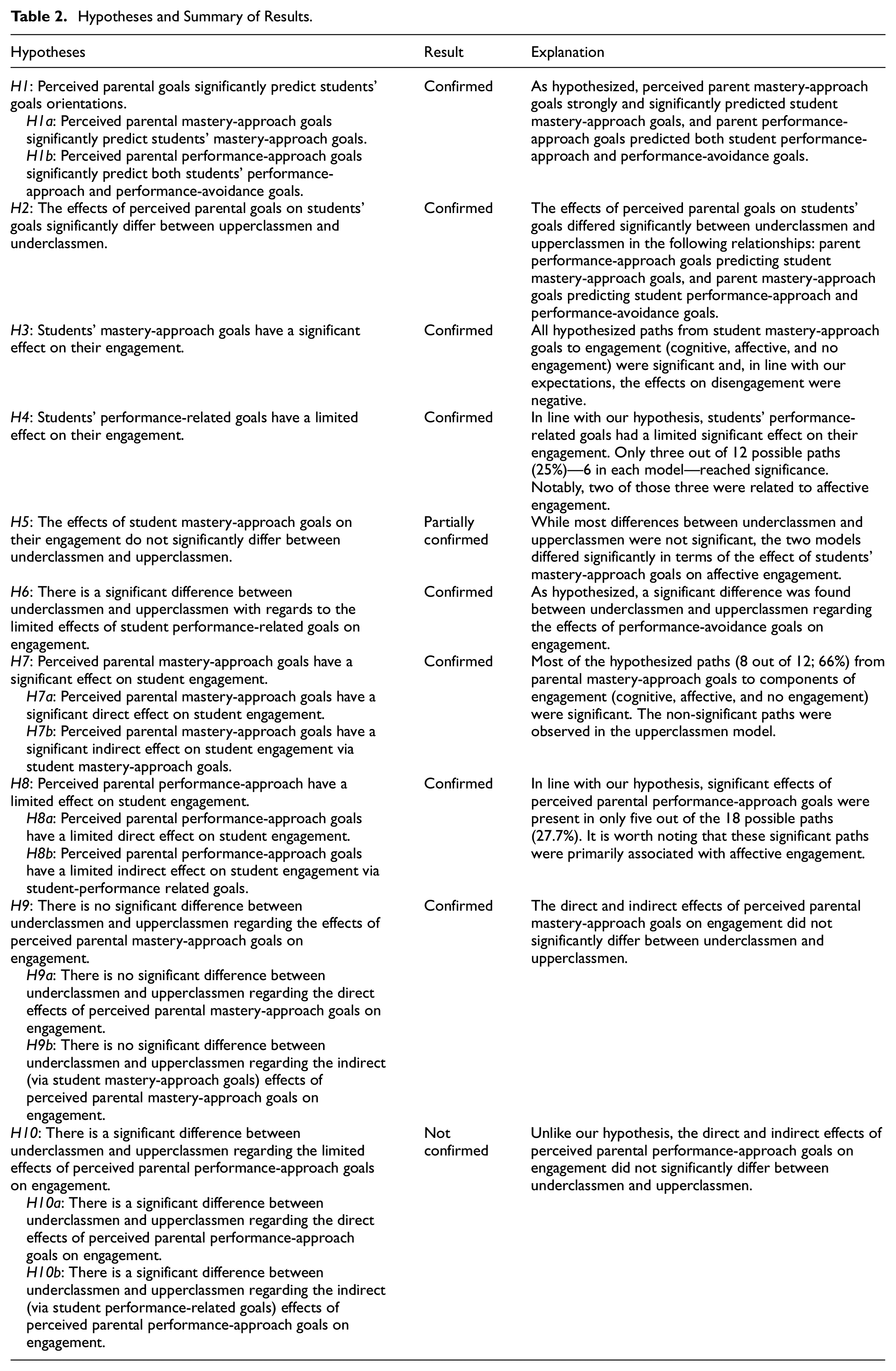
We, then, conducted a number of analyses to ensure measurement adequacy of the data. We examined configural invariance across groups (the underclassmen representing 9th and 10th grade, and upperclassmen representing 11th and 12th grade students) to find out whether the factors are sufficiently associated with identical item sets across groups. Fairly normal distributions were observed for all variables in terms of skewness (values ranging between −1.832 and +1.150) and kurtosis (values ranging between −1.322 and 2.936; Hair et al., 2010). In line with hypotheses, data from the two models were estimated freely to examine configural invariance. The results substantially confirmed configural validity of all scales as evidenced by a good model fit (Hair et al., 2010; χ2(1,128) = 2,111.541, p < .001, χ2/df = 0.872, CFI = 0.917, GFI = 0.906, AGFI = 0.860, RMSEA = 0.032, SRMR = 0.052, PCLOSE = 1.000). The hypotheses and results are summarized in Table 2.
Hypotheses and Summary of Results.
Relations Among Variables
Descriptive statistics and Pearson correlations among the variables in the two groups are presented in Table 3. The table shows that correlations for perceived parental goals and classroom engagement variables were generally consistent across underclassmen and upperclassmen models. In both groups, perceived parent performance-approach goals did not have any correlations with either affective engagement or disengagement. A notable difference between the groups was observed in terms of student goals; student performance-approach and student performance-avoidance goals’ correlations with other variables diminished in the upperclassmen group. The highest levels of correlations were observed between student mastery-approach goal orientation and cognitive engagement (r = .586 and .578 for underclassmen and upperclassmen respectively, p < .01), and cognitive engagement and affective engagement (r = .505 and .574 for underclassmen and upperclassmen respectively, p < .01). Negative correlations were only observed between disengagement and other variables.
Zero Order Correlations Between Variables for Underclassmen (9th and 10th Grade) Versus Upperclassmen (11th and 12th Grade).

Note. Aff Eng = Affective Engagement; Cog Eng = Cognitive Engagement; Diseng = Disengagement; PMGO = Perceived Parental Mastery-Approach Goal Orientation; PPGO = Perceived Parental Performance-Approach Goal Orientation; SMGO = Student Mastery-Approach Goal Orientation; SPAGO = Student Performance-Avoidance Goal Orientation; SPGO = Student Performance-Approach Goal Orientation.
p < .01.
Structural Equation Modeling: Parent Variables
Perceived parental mastery-approach goals (PMGO) were hypothesized to predict student mastery-approach goals (SMGO; H1) and engagement (H7) while perceived parental performance-approach goals (PPGO) were expected to predict student performance goals—both approach (SPGO) and avoidance (SPAGO; H1)—but have a limited effect on engagement (H8). As hypothesized, PMGO significantly predicted SMGO in both groups, showing medium effects (underclassmen: β = .454, f2 = 0.21; upperclassmenβ = .478, f2 = 0.27, p < .001; see Figure 1). Likewise, PPGO predicted SPGO with medium (β = .516, f2 = 0.26) to large effects (β = .605, f2 = 0.42) for underclassmen and upperclassmen, respectively (p < .001). PPGO also predicted SPAGO in both groups with medium effect sizes (underclassmen: β = .423, f2 = 0.15; upperclassmen: β = .494, f2 = 0.24, p < .001). These results confirmed H1.

Associations among perceived parental goals, students’ personal goals, and engagement.
In terms of the effects of perceived parental goals on engagement, the results confirmed H7, which proposed that PMGO would have a direct or indirect effect (via SMGO) on engagement. Of the 12 hypothesized paths, 66% (8/12) were significant. PMGO influenced engagement both directly and indirectly; however, direct effects were observed only in the underclassmen model, with small effects on Cognitive Engagement (β = .125, f2 = 0.03, p < .05) and Affective Engagement (β = .212, f2 = 0.04, p < .01). As for the indirect effects, the results suggested that PMGO had significant indirect effects via SMGO across all engagement variables in both models. Large positive effects were observed on Cognitive Engagement (underclassmen: β = .318, v2 = 0.14; upperclassmen: β = .380, v2 = 0.15, p < .001), with small to medium positive effects on Affective Engagement (β = .096, v2 = 0.01 and β = .284, v2 = 0.06, p < .001, respectively). Additionally, PMGO indirectly predicted medium negative effects on Disengagement (underclassmen: β = −.247, v2 = 0.07; upperclassmen: β = −.276, v2 = 0.06, p < .01, see Table 4). Notably, none of the bootstrapped confidence intervals included zero, further supporting the statistical significance of these findings.
Indirect Effects of Perceived Parental Goals on Engagement for Underclassmen and Upperclassmen.
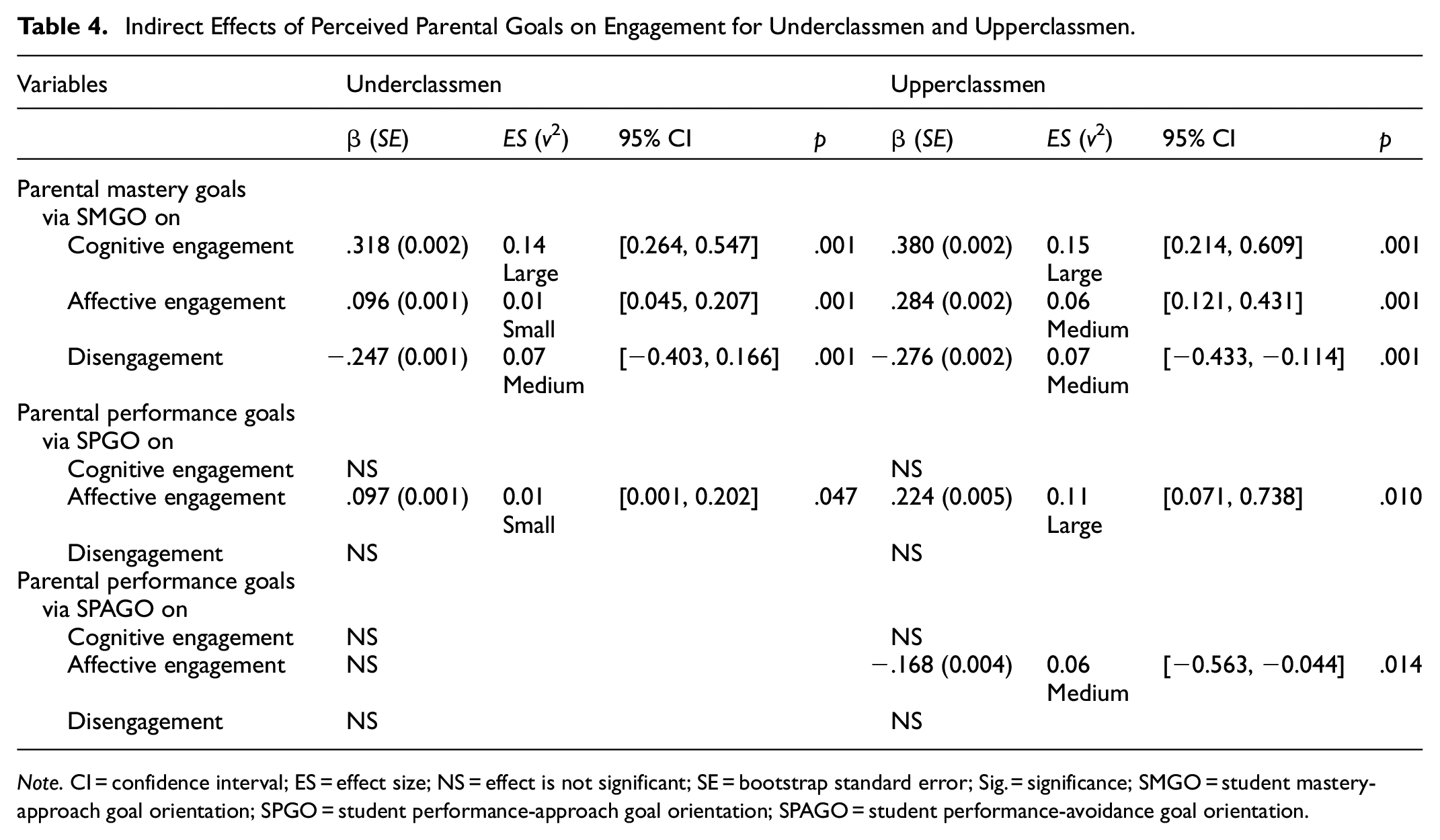
Note. CI = confidence interval; ES = effect size; NS = effect is not significant; SE = bootstrap standard error; Sig. = significance; SMGO = student mastery-approach goal orientation; SPGO = student performance-approach goal orientation; SPAGO = student performance-avoidance goal orientation.
The results also supported H8, which proposed that PPGO will have a limited effect (if any) on engagement. Of the 18 hypothesized paths, only 27.7% (5/18) were significant. Similar to H7, the direct effects were observed only in the underclassmen model, where PPGO had a small negative effect on Affective Engagement (β = −.206, f2 = 0.05, p < .01), and a small positive effect on Disengagement (β = .216, f2 = 0.03, p < .05). As for indirect effects, PPGO’s indirect effects (via SPGO and SPAGO) were limited to Affective Engagement. Indirect effects via SPGO were found in both models, with a small effect for underclassmen (β = .097, v2 = 0.01, p < .05) but a large effect for upperclassmen (β = .224, v2 = 0.11, p < .05). In addition, an indirect effect via SPAGO was only observed in the upperclassmen model, where it had a negative medium effect (β = −.168, v2 = 0.06, p < .05). These results indicate PPGO’s indirect effects on engagement was stronger for upperclassmen. Notably, none of the bootstrapped confidence intervals (see Table 4) included zero, further supporting the statistical significance of these findings.
Structural Equation Modeling: Student Variables
Student mastery-approach goals (SMGO) were hypothesized to predict engagement (H3) while student performance goals (SPGO/SPAGO) were hypothesized to have a limited effect on engagement (H4). The results supported H3; SMGO predicted all engagement variables included in the analyses in both models. SMGO had medium to large positive effects on Cognitive Engagement (underclassmen: β = .625, f2 = 0.29; upperclassmen: β = .622, f2 = 0.43, p < .001) and medium effects on Affective Engagement (underclassmen: β = .238, f2 = 0.27; upperclassmen: β = .451, f2 = 0.21, p < .001). While being medium in size, its effects on Disengagement were negative (underclassmen: β = −.483, f2 = 0.15; upperclassmen: β = −.432, f2 = 0.16, p < .001). Furthermore, in line with H4, student performance related goals had a limited effect on engagement in both models, with only 25% (3/12) of hypothesized possible paths reaching significance. In the underclassmen model, only SPGO had a significant small effect on engagement and that effect was only observed on Affective Engagement (β = .228, f2 = 0.03, p < .05). Significant effects in the upperclassmen model were also small and limited, only two paths were significant; SPGO (positively) and SPAGO (negatively) influenced Affective Engagement (β = .426, f2 = 0.08, β = −.393, f2 = 0.07, respectively, p < .05).
Structural Equation Modeling: Group Differences
The statistical difference between the constrained and free model was calculated to test whether the model differed between underclassmen and upperclassmen. The results implied that the hypothesized model varied between groups (χ2(49) = 82.483, p < .01). Regression weights and critical ratios for various variable effects were compared between groups in order to find the sources of the differences between the models (see Table 5).
Significance of Path Differences in the Hypothesized Model
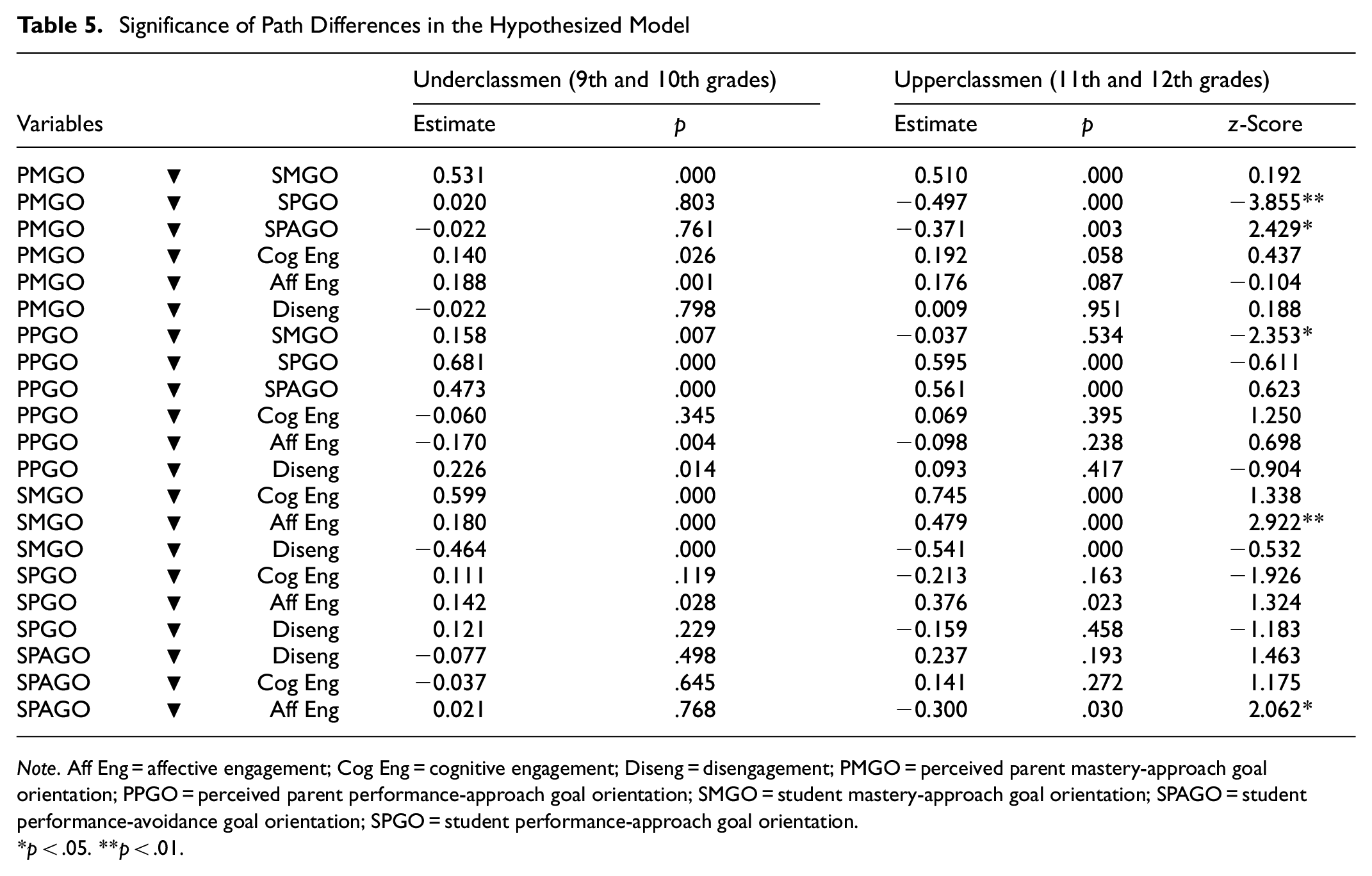
Note. Aff Eng = affective engagement; Cog Eng = cognitive engagement; Diseng = disengagement; PMGO = perceived parent mastery-approach goal orientation; PPGO = perceived parent performance-approach goal orientation; SMGO = student mastery-approach goal orientation; SPAGO = student performance-avoidance goal orientation; SPGO = student performance-approach goal orientation.
p < .05. **p < .01.
The results supported H2, which proposed that the effects of perceived parental goals would differ between underclassmen and upperclassmen. Significant group differences were found, with the largest differences being observed in the effects of perceived parental mastery-approach goals (PMGO) on student performance-related goals. PMGO had no significant effect on student performance-approach goals (SPGO) in the underclassmen model, but the same effect was significant and medium in the upperclassmen model (β = −.388, f2 = 0.23, p < .001; z = −3.855, p < .01). Similarly, PMGO did not significantly predict student performance-avoidance goals (SPAGO) in the underclassmen model, but its significant negative effect was observed in the upperclassmen model (β = −.250, f2 = 0.09, small effect, p < .001; z = −2.429, p < .05). In addition, the effects of perceived parental performance-approach goals (PPGO) on student mastery-approach goals (SMGO) were significantly different between groups (z = −2,353, p < .05). PPGO had a small positive effect on SMGO in the underclassmen model (β = .145, f2 = 0.03, p < .01), but this effect was not significant in the upperclassmen model.
The results partially confirmed H5 which proposed that there would be no difference between underclassmen and upperclassmen in terms of SMGO effects on engagement. While no significant group differences were observed for SMGO’s effects on Cognitive Engagement or Disengagement, the effects on Affective Engagement differed significantly (z = −2.922, p < .01) between underclassmen (β = .238, f2 = 0.27, p < .001) and upperclassmen (β = .451, f2 = 0.21, p < .001). In addition, the results supported H6 in which we expected to find a significant difference between groups in terms of the limited effects of SPGO and SPAGO on engagement. A significant group difference (z = −2.062, p < .05) was observed in SPAGO’s effect on Affective Engagement, which was not significant for underclassmen, but was significant for upperclassmen (β = −.393, f2 = 0.07).
In H9, we hypothesized that the effects of PMGO on engagement would not significantly differ between underclassmen and upperclassmen. The results supported H9 since we did not observe any significant differences between the two models in terms of the direct effects of PMGO on any engagement variable. Similarly, a comparison of estimates and effect sizes (see Table 4) indicated that PMGO’s indirect effects on engagement (via SMGO) were consistent across both groups, with identical effect sizes. In contrast, in H10, we expected that the limited effects of PPGO on engagement would significantly differ between groups. While groups did not significantly differ in terms of the direct effects of PPGO on engagement, differences emerged in the indirect effects. The indirect effect of PPGO on Affective Engagement (via SPAGO) was present only in the upperclassmen model (β = −.168, v2 = 0.06, small effect). In addition, the indirect effect of PPGO on Affective Engagement (via SPGO) was notably stronger for upperclassmen (β = .224, v2 = 0.11, large effect, p < .05) compared to underclassmen (β = .097, v2 = 0.01, small effect, p < .05).
Discussion
The present research contributes to the expanding knowledgebase on goal orientations by examining the interplay among perceived parental goal orientations, student goal orientations, and classroom engagement in a subject-specific (mathematics) and novel cultural context (Türkiye) in the post-COVID-19 era. The present study’s significance lies in the fact that it focuses on understanding the differences between the adoption of goal orientations and their effects by considering the intricate and situated meaning making by students (T. Urdan & Kaplan, 2020). Whilst acknowledging the role the wider cultural context can play (i.e., participants’ membership to a collectivist or individualistic culture), we argue that the sources of the differences in how goal orientations are adopted or how they affect outcomes (i.e., engagement or academic success) lie in more specific factors such as the developmental stage individuals go through, the educational context (i.e., a higher education system dependent on national exams administered once a year), the perceived ease/difficulty of the subject matter, or its perceived importance.
Influence of Parental Goals on Student Goals
The results showed that perceived parental goal orientations are strong predictors of student achievement goals. The estimates and effect sizes of parental goals on student goal orientations in the present study was higher than the effects reported in previous research (i.e., prior to the emergence of COVID-19 see e.g., Curelaru et al., 2020; Gonida et al., 2007; Jiang et al., 2014; Roncevic-Zubković & Kolić-Vehovec, 2014). Researchers reported that as students started to receive tuition via online platforms during the COVID-19 pandemic, their parents became more involved in their learning (e.g., Garbe et al., 2020). Aiming to compensate for the learning time their children lost, some parents began to place greater importance on their children’s academic success, which resulted in increased parental expectations (Grewenig et al., 2021). Parallel to the increases in parental observation and guidance, parents may have—unintentionally—limited their children’s independent study skills, making them more susceptible to parental influence (L. E. Kim & Asbury, 2020). Brought together, these arguments and the findings of the present study support the hypothesis that parents’ increased involvement in their children’s education during the COVID-19 pandemic resulted in increased effects of parental goals on student goals (see also, e.g., Wang et al., 2023).
The influence of parental goals on student goals were also found to be significantly different for underclassmen (9th and 10th grade students) and upperclassmen (11th and 12th grade students). For instance, while perceived parental mastery-approach goals did not significantly affect student performance-approach goals in the underclassmen model, this effect was significant, negative, and medium in size for upperclassmen. Considering the increased number of significant effects that perceived parental goals had on students’ personal goals in the upperclassmen model, we argue that—as they got older—the students started to better interpret the messages they received from their parents. Findings of related research also support this interpretation (e.g., Gonida et al., 2007, 2014, He et al., 2015).
In their meta-analysis, Bardach et al. (2020) underlined that young learners experience problems in differentiating between the goal-oriented messages in their environment which can direct them to actively pursue a combination of both mastery and performance goals. This is not surprising considering that students are conflicted during early adolescence and start of middle adolescence (a time period in which adolescents go through a lot of physical and mental changes), and they may positively transform the mastery-oriented messages they receive from their parents into both mastery and performance goals indicating a potential positive effect of parental mastery- approach goals on students’ performance-approach goals. It should also be noted that during this time, adolescents perceive that their need to be accepted in their environment can be facilitated by exertion of a high performance in school (Gonida et al., 2007), which can result in observing positive effects of perceived parental performance-approach goals on students’ mastery-approach goals. As they progress towards adulthood, however, students start to better identify and differentiate between the goal-oriented messages they receive from their parents. This understanding is further supported by the results obtained in the present research. In addition, when they notice their parents emphasize mastery goals, students are likely to adopt mastery-approach goals and less likely to adopt performance-related goals (J.-I. Kim et al., 2010) which helps explain the observed increases in the negative effects of parental mastery-approach goals over time on students’ performance-related goals.
A more context- and subject-specific interpretation of the results is as following; mathematics is one of the most important subjects in the Turkish education system and national university entrance exams which are conducted annually and in which students’ entry to a higher education program depends on their exam performance. In such an education system, one can argue that the effects of perceived parental performance goals on adolescents’ performance goals do not decrease in time, on the contrary, such effects may even increase as students approach critical periods such as the university entrance exam. Similarly, Friedel et al. (2007) noted that the emphasis parents place on mastery or performance goals can change during students’ transition to a next level of education or prior to high-stakes tests. Increased pressure that students are exposed to in such situations, in return, can change the effects parental goals have on student goals, which, in the present study, justifies the increased effects of perceived parental performance-related goals for upperclassmen who are closer to participating the national university entrance exams. An alternative explanation can be based on the cultural context this study was conducted in. Türkiye, unlike its Western counterparts, has a collectivist culture rather than an individualistic one. Parental and environmental expectations in such environments have a substantial impact on students’ goals. This indicates that parental performance-approach goals are more likely to influence students’ performance-related goals. Such effects become particularly significant in collectivist cultures with exam-oriented education systems since parental expectations increase (Li, 2005).
Influence of Student Goals on Engagement
The study also investigated how students’ personal goals influenced their engagement in mathematics lessons. Student mastery-approach goals consistently and positively predicted affective and cognitive engagement and negatively predicted disengagement (which functioned as the reverse of cognitive engagement) in both underclassmen and upperclassmen models. Similar effects of student mastery-approach goals on cognitive (e.g., Duchense et al., 2019; Greene & Miller, 1996; Linnenbrink, 2005; Miller et al., 2021; Patrick et al., 2007; Wolters, 2004; Yi et al., 2020) and affective engagement have been reported in previous studies (Diseth & Samdal, 2015; Gonida et al., 2007, 2009; King et al., 2012).
It was hypothesized that there would be no significant differences between underclassmen and classmen groups in terms of the effects of student mastery-approach goals on cognitive engagement or disengagement. This is because mastery-oriented students plan their learning in line with the dynamics of that particular goal orientation, which suggests that the changes that come along with adolescence will (if any) have limited effects. Unlike our hypotheses, however, it was surprising to observe a significant change between groups regarding the effects of student mastery goals on affective engagement. In this study, affective engagement represented students’ perceived value of and feelings (i.e., interest, anxiety, fear) towards mathematics and it is generally associated with students’ affective reactions in the classroom (i.e., having fun or getting bored; Lazarides & Rubach, 2017). It is possible that mastery-oriented students experience higher levels of fun and curiousness and/or lower levels of boredom and anxiety in later years (Gonida et al., 2009). To clarify, the more mastery-oriented the students are the more engaged they become in mathematics lessons, which increases the chances that they become successful. The success they achieve, in return, increases students’ level of enjoyment and interest and decreases the level of boredom and anxiety in mathematics, thereby, cumulatively increasing the positive effects of student mastery-approach goals on affective engagement in later years.
As for student performance-related goals (approach/avoidance), their effects on engagement were limited to affective engagement only. Neither cognitive engagement nor disengagement were predicted by students’ performance goals. These results echo previous research where the effects of student performance-related goals on engagement were not salient (e.g., Gonida et al., 2009; Putwain et al., 2018). This is not surprising because performance-oriented students focus on avoiding/ hiding their failures, not looking inefficient, or demonstrating that they are better than others, and those attributes do not reflect the essence of cognitive engagement. Researchers also identified that performance goals were not significantly related to indicators of cognitive engagement such as deep processing (Elliot et al., 1999), feedback seeking (Tuckey et al., 2002), or self-regulated learning (Pajares et al., 2000). In addition, while mastery-oriented students perceive exerting effort as a means for successful completion of a task, performance-oriented students do not think that they need to exert much effort since they believe they readily possess the capacity needed to complete a given task easily (Bell & Kozlowski, 2002). This helps explain why performance goals do not predict cognitive engagement that is heavily focused on effort exertion. Students who have performance-avoidance goals, on the other hand, are likely to abstain from actively participating in lessons to prevent looking unwise, stating something “wrong,” or revealing their lack of knowledge. Participation of such students become particularly difficult in courses such as mathematics (Miller et al., 2021). In short, the present research exemplifies the limited effects of personal performance goals on cognitive engagement in mathematics lessons.
One of the important findings in the present study was the influence of student performance goals on affective engagement. The difference between the estimates and effect sizes of student performance-approach goals on affective engagement in underclassmen and upperclassmen groups was noticeable (a higher estimate and effect size were observed for upperclassmen) and the difference between performance-avoidance goals’ influence on affective engagement in underclassmen and upperclassmen models was statistically significant. Student performance-avoidance goals did not predict affective engagement in the underclassmen model whereas it predicted affective engagement in the upperclassmen model. Research findings in this area are not uniform (see e.g., Datu & Park, 2019; Gonida et al., 2007, 2009; Lazarides & Rubach, 2017; Shih, 2021; Wang et al., 2023). Utilizing other theories in this case may be useful to interpret these findings. The expectancy-value theory suggests that motivation is enhanced by the combination of students’ high expectations of successfully completing a given task and the perceived value of the task (Eccles & Wigfield, 2002). In line with this, performance-approach goals indicate that students would exert effort not for the sake of learning but for the sake of completing the task so that they could show people in their surroundings that they are successful. Students with such goals may display higher levels of affective engagement by focusing on their expectations of success and the value of the task. The fact that performance-approach goals had a stronger impact on affective engagement for upperclassmen indicates that this group holds high expectations of success and recognizes the academic value of subjects such as mathematics. This interpretation is further supported considering that mathematics is a key subject for success in the high-stakes university entrance exam in Türkiye. Consequently, the emphasis on mathematics may have increased students’ affective engagement with the course. Likewise, the negative effects of performance-avoidance goals on affective engagement may have been caused by the increased exam pressure and increased parental expectations for achievement. Studies reported that students who felt pressured in mathematical tasks experienced high levels of anxiety (e.g., Cai & Liem, 2017) and performance-avoidance oriented students experienced higher levels of mathematical anxiety (Skaalvik, 2018). Researchers also found that as their year of study increases, students’ fear of mathematics rises (e.g., Başar & Doğan, 2020). Therefore, it is possible that the negative effects of performance-avoidance goals on affective engagement in mathematics lessons increase along with the year of study due to external factors such as the increased difficulty of lesson content or high-stake tests.
Influence of Parental Goals on Engagement
The results showed that the direct effects of perceived parent mastery-approach goals on cognitive and affective engagement were present for underclassmen, but not upperclassmen. The indirect effects (via student mastery-approach goals), however, were present for both groups. This finding indicates that as they get older, mastery-oriented students’ engagement is affected more by their personal goals and less by perceived environmental factors (in this case their perceptions of their parents). In other words, even though perceived parental goals impact on student goals, engagement is better predicted by personal goals in later years of high school. This supports the idea that socio-cognitive developments during adolescence promote individual awareness, affective perception, and development of theory of mind (Eisenberg et al., 2006). These findings can also be interpreted in relation to self-determination theory. As their need for autonomy increases, middle- and late-adolescents (in this case students in the upperclassmen group) develop a tendency to act in accordance with their own goals (Ryan & Deci, 2020).
Self-determination theory notes that individuals’ sources of motivation exist on a continuum with extrinsic motivation on one end and intrinsic motivation on the other. As previously explained, during high-pressure periods such as preparation for national exams, extrinsic motivation is expected to have a strong influence on students’ emotional engagement. During preparation for such exams, students may start to associate their academic success more closely with parental expectations and, thus, become more emotionally sensitive (Ryan & Deci, 2020). In addition, both students and their parents start to prioritize career expectations during this period. In collectivist cultures such as Türkiye, parental influences are stronger and this, in return, can influence students’ performance-approach goals and emotional engagement (Sawitri & Creed, 2015). This interpretation can be further supported with Pekrun’s (2006) control-value theory of achievement. According to this theory, academic emotions are associated with individuals’ perceptions of control and the value they attribute to task achievement. In high school years, in particular the final years of high school when academic competition intensifies, students’ perceived control may weaken while the significance of academic success increases. Therefore, during this time, students’ emotional responses and their academic commitment may—as observed in the present study—increase.
Conclusion
Whilst acknowledging the role the wider cultural context can play, the present study presented that studying goal orientations taking more specific factors into account (i.e., learners’ age and/or the course content) can help researchers better understand how goal orientations are adopted and how they affect outcomes (i.e., classroom engagement). Thus, we argue that there is a need to study goal orientations under more specific circumstances (i.e., in different subjects, with different student populations, taking learner characteristics into account).
In this study, we found that adolescents’ personal goal orientations in mathematics are strongly affected by their perceptions of their parents’ goal orientations, which reiterates the fact that parents play a significant role in education. These findings suggest that there is a need for training programs that aim to increase parents’ awareness of how their communication with their children can affect their children’s motivation. Such training programs can guide parents towards a better understanding of how they could support their children’s academic and psychological well-being. In addition, various programs (i.e., face-to-face and/or online) can be organized to teach parents about stress management strategies, self-regulation skills, and strategies to increase their children’s intrinsic motivation (Tang et al., 2021). The ultimate objective of such sessions should be the establishment of a healthy academic and social relationship between parents and children (Aucejo et al., 2020; Bansak & Starr, 2021). A particularly important point that needs to be emphasized is that high school students are at a crucial stage of career planning. It is worth remembering that economic uncertainties experienced during COVID-19 have led parents to encourage their children to pursue safer career paths (Bansak & Starr, 2021). This parental influence can negatively impact on students’ goal orientations which are crucial for career planning. Therefore, it is essential to educate parents on how they can direct children’s career choices based on the children’s characteristics and skills rather than imposing career choices on them (Loades et al., 2020).
While mastery-oriented students seemed to be better in tolerating negative external messages, performance-oriented underclassmen seemed to be more affected by their parents’ goals. Thus, performance-oriented students’ participation in classroom activities was more negatively influenced. This highlights the importance of and the need for providing students (especially performance-oriented ones) with opportunities that can help them better describe themselves and their goals. Teachers play a key role in this matter. The learning environment teachers create in the classroom can significantly influence students’ intrinsic motivation and shape their perceptions of whether learning is valuable. Considering that classroom activities can have a direct effect on students’ goal orientations (Ames, 1992; Ames & Archer, 1988), it is important that teachers recognize students’ efforts and progress, and prioritize processes that promote personal and meaningful learning opportunities (Anderman et al., 2001).
In addition, affective engagement, which is more affected by external factors, is considered to be an important variable for participation in mathematics lessons. Not only parents but also students’ awareness of this aspect should be increased to help them better regulate their affective engagement. Finally, the results in the present study advances our understanding that affective engagement (compared to cognitive engagement) is more likely to be affected by environmental factors. The dynamics of the educational system can have stronger effects on students’ affective engagement in mathematics lessons than the effects their personal goals have.
Like most studies in social sciences, the present one also has a number of limitations. First, the results were based on self-reported data collected from students. Whilst answering questionnaires, participants may have a tendency to provide socially acceptable responses, especially regarding topics such as engagement or parental expectations. To overcome such limitations, future research, alongside self-report measures, could incorporate multiple data collection methods (i.e., classroom observations, teacher evaluations, or parental feedback). Utilizing multiple sources of data would allow for a more comprehensive depiction of the issue. In addition, this study employed a cross-sectional design. Given the dynamic nature of academic pressure and parental influence during high school years, momentary self-reports may not be enough to fully capture these evolving processes. Therefore, researchers could design longitudinal studies to better showcase the changes in adolescents’ goals. In fact, one of the goals of the authors in this study was to re-collect data with the same population at the start of every semester for 2 consecutive years. However, unforeseen circumstances prevented us from accomplishing this goal. In spite of those limitations, nevertheless, the present study—conducted with high school adolescents in the post-COVID-19 landscape and a novel cultural context—provides new insights on the goal orientations theory and engagement (i.e., the increased effects of student goals on affective engagement in later years of high school), thereby, contributing to building a more complete picture of the achievement goal orientations theory and its effects on engagement.
Footnotes
Acknowledgements
This study is dedicated to the victims of the devastating earthquakes that took place in Türkiye on February 6, 2023 (shortly after the end of the data collection period). Unfortunately, a number of students participating in the study were among those victims. Some lost their lives, some were injured, and others lost their homes.

Ethical Considerations
The current study received ethical clearance from the Scientific Research and Publication Ethics Committee at Iskenderun Technical University (08-02-2022, No. 46202).
Consent to Participate
Students and their parents were informed about the study prior to data collection and parental opt-out forms were provided in case parents did not want their children to participate in the study.
Author Contributions
Hülya Yıldızlı: Conceptualization, Project administration, Funding acquisition, Investigation, Review of literature, Data collection & curation, Writing—original draft. Ali Bostancioglu: Review of Literature, Investigation, Project administration, Methodology, Data collection & curation, Statistical Analyses (Software), Writing—original draft, Validation, Visualization.
Funding
The author(s) disclosed receipt of the following financial support for the research, authorship, and/or publication of this article: This work was supported by Istanbul University-Cerrahpaşa (Grant number: SBA-2022-36538).
Declaration of Conflicting Interests
The author(s) declared no potential conflicts of interest with respect to the research, authorship, and/or publication of this article.
Data Availability Statement
The data that support the findings of this study are available from the corresponding author, Assoc. Professor Hülya Yıldızlı, upon reasonable request.